Here is an interview Butler did with Owen Jones, who amusingly takes her back to Gender Trouble and not a lot of attention paid to her most recent work. But this interview does allow her to update us on how she has moved from 1989, specifically the inclusion of trans. Here it is.
Category: resignify
Tracy McNulty
Demanding the Impossible: Desire and Social Change
Volume 20, Number 1 2009
doi 10.1215/10407391-2008-015
d i f f e r e n c e s : A Journal of Feminist Cultural Studies
What is the relationship between desire and social change?
the ethical stance or subjective position of an individual might incite a change of position in other people
The larger question these examples raise is whether the subjective stance of one person can initiate broad change or inspire collective action by means other than the group psychology: in other words, not by appealing to a particular set of values or ideals, or by cementing the group through identification or libidinal cathexes, or by offering some kind of external or even transcendental foundation for the ego, but by foregrounding the experience of the willing subject.
One can be determined to live a good or a moral or a selfless life, and yet this determination often fails inasmuch as it is fundamentally in conflict with an unconscious position, which it attempts to repress or control.
Desire, on the other hand, supposes the subject of the unconscious: it is not sustained by identification with something “outside” the subject that would allow it to repress the drives or facilitate its refusal to know anything about the unconscious. When Lacan offers as a formulation of the ethics of psychoanalysis the imperative not to give up on one’s desire—ne pas céder sur son désir—he suggests that desire is what admits of no compromise or concession, and that it therefore always bears some relation to death (Ethics 319).
Hallward is interested not in the role of the ideal in soliciting identification, but in the force of will and the voluntarist dimension of change. His examples are all the more provocative in that they include not only the great leaders who have given their names to religious and political movements but individuals working in relative obscurity whose apparently very modest acts have unexpectedly brought about important social transformations
I propose to take a more psychoanalytic approach to the problem by considering the individual act not principally as an instance of will or determination, but for the way it lays bare the stakes of desire. What distinguishes desire from determination or will?
What distinguishes desire from determination or will?
The interest of the question “What would Jesus do?” for example, is that it makes an implicit distinction between Jesus as a support for identification and Jesus as a subject of desire. The question supposes a kind of immovability in the desire of Jesus, something nonnegotiable: it implies that Jesus would not make concessions, that he would not waver.
If the answer to the question is somehow obvious, it is not because it concerns some specific content or principle, but because desire is an orientation or a stance with respect to the impossible object that causes it, and not a response to a particular case or circumstance.
The question is of a very different order than “What would Jesus say?” or “What would Jesus teach?” because it isn’t a matter of ideals, agendas, or programs.
It is also different from “What would Jesus want?” or “What would Jesus tell you to do?” because it is not a matter of demands or of satisfying a leader or an idealized role model by doing what we think he wants.
Desire gives rise to a new object, an object that did not exist before, that intervenes in the world so as to transform it
it is fidelity to an impossible cause of desire, not fidelity to a constituency
Desire is an orientation or a stance with respect to the impossible object that causes it, and not a response to a particular case or circumstance
Desire presents a challenge because it concerns the status of the act and not the affirmation of ideals or beliefs. It makes us aware of how the ideals we espouse make it possible not to act.
how desire differs from the idealizing love at stake in identification and therefore about its transformative potential.
Anxiety is the affect of psychoanalysis, because it responds to the analyst’s desire to know by overcoming the censorship applied to unconscious thoughts. Only by traversing this anxiety can the subject come to have another knowledge about what is happening to him or her, and thus find liberation from the repetition-compulsion of the fantasy.
Desire must find expression in an act or in the production of a new object that intervenes in the world so as to transform it.
This is the essence of sublimation, in which the absolutely singular and subjective nature of desire manages to find expression in the production of an object that is collectively valorized.
The “great man” is someone whose object constitutes a sublimation not only for himself but for his age.
Each of the examples I have discussed bears witness to the tension between the anxiety induced by desire and the effects it produces, and the restorative tendency to silence or efface that desire and to shore up the ego. They also qualify the possible optimism about social change by reinforcing the extent to which this change occurs at an individual level, through a painstaking process of self-overcoming that is by no means certain and that only occurs in a minority of cases.
Religious history in particular suggests that it is much easier to hide behind the ideal ego or to take comfort in the illusion of the all-powerful father than to confront the Other’s desire or absence. This is why psychoanalysis is ultimately pessimistic about the possibility of social change and hesitates to affirm the social beyond the “minimal social link” inaugurated by the transference. If the members of the group do not also traverse castration, the anxiety that results from the confrontation with the Other’s desire will simply provoke repression and violence, and not a change of position.
anxiety is the affect of freedom
But while the desire of the founder may not be sufficient in and of itself to incite change, these examples also make clear that the anxiety it induces can have a transformative effect.
This is because it exposes the profound freedom of an act founded on desire, in and beyond the castration or lack it implies. Translated into a more existential idiom, my argument is really that anxiety is the affect of freedom.
Freud sees in Moses a free man, one who threw off the shackles of superstition and nature worship to create a space for the subject as something other than a product of nature or the object of a capricious deity.
Desire is what is most free in the subject, because it involves a liberation from the fantasy of seduction and its particular colonization of the psychic object. Freud sees in Moses a free man, one who threw off the shackles of superstition and nature worship to create a space for the subject as something other than a product of nature or the object of a capricious deity.
While Jewish legend promotes the idea that Moses is the chosen instrument of God, the much more interesting truth is that the man Moses invents something new for civilization: something we can all draw upon and that no God can take away. The difference between ideals and desire is the difference between ascribing their freedom to an omnipotent God and assuming responsibility for that freedom themselves.
In the same way, Freud himself will attempt to free the subject of the unconscious from the shackles of morality and to prevent its reduction to an object of scientific observation.
But he makes clear that this freedom can come only through traversing anxiety and not avoiding it. It is a difficult freedom, whose stakes are nowhere better expressed than in the words imputed to Jesus: “I lay down my life in order to take it up again.”
While these words have been interpreted by many as a promise of eternal life, I believe that the anxiety and solitude with which Jesus approaches his own death points to a more difficult interpretation. His act emphasizes that there is something more than “mere life” and that desire opens onto a life that can be accessed only by traversing death. In a similar vein, the practice of psychoanalysis is founded on the supposition that true freedom comes only from traversing the death drive and not repressing or avoiding it.
desire finds expression in an act or in the production of a new object that intervenes in the world so as to transform it
Freud invents a mechanism that allows the analysand to free himself by confronting castration. But the end of analysis could be construed not merely as a liberation but as a call to change the world by demanding that it make place for a new object.
It involves the assumption of the truth that there is no object for desire, but more importantly, the necessity of constructing a new object: if there is no object or aim that would satisfy desire, this also means that desire is not bound by any existing object and is therefore innately transcendent. The logical conclusion of an analysis supposes that desire finds expression in an act or in the production of a new object that intervenes in the world so as to transform it.
But as Hallward reveals through the simple example of a man who clears space for a new soccer field, this new object need not be something so lofty. What is important is that it create a space for the subject, a space that was not there before. The creation of this new object gives rise to social change without even aspiring to do so, because it is not guided by ideals or goals, but by the desire of a subject.
The creation of this new object gives rise to social change without even aspiring to do so, because it is not guided by ideals or goals, but by the desire of a subject.
Tracy McNulty 2013
The New man’s Fetish The Southern Journal of Philosophy Volume 51, Spindel Supplement 2013
Byung-Chul Han
Psychopolitics: Neoliberalism and New Technologies of Power. 2017 Verso
True happiness comes from what runs riot, lets go, is exuberant and loses meaning — the excessive and superfluous. That is, it comes from what luxuriates, what has taken leave of all necessity, work, performance and purpose.
page 52
The art of living is the art of killing psychology, of creating with oneself and with others unnamed individualities, being, relations, qualities. If one can’t manage to do that in one’s life, that life is not worth living
Michel Foucault cited in Byung-Chul Han
The art of living stands opposed to the ‘psychological terror’ through which subjugating subjectivation occurs.
Neoliberal psychopolitics is a technology of domination that stabilizes and perpetuates the prevailing system by means of psychological programming and steering. Accordingly, the art of living, as the praxis of freedom, must proceed by way of de-psychologization. This serves to disarm psychopolitics, which is a means of effecting submission. When the subject is de-psychologized — indeed, de-voided — it opens onto a mode of existence that still has no names: an unwritten future. 79
McNay on Butler pt 1
McNay, Lois “Subject, Psyche and Agency : The Work of Judith Butler” Theory, Culture & Society 16.2 (1999) : 175-93. McNay document download here
McNay’s article is a thorough examination of Butler’s conception of performativity and agency. McNay then proceeds to compliment Butler with the work of Bordieu and Castoriadis. I should really follow up with notes but I don’t have the time right now.
anna o
Belsey, Catherine. Culture and the Real : Theorizing Cultural Criticism.
The worst of her symptoms, he discovered, could be traced to a night in July. The father she loved was seriously ill, and while her mother was away, Anna was left alone to nurse him. Sitting by his bedside, she fell into a ‘waking dream’, and seemed to see a snake coming from the wall to bite her father. Apparently, there may have been snakes in the field behind the house in the country, where the family was staying, and this might have motivated the image. She tried to keep off the hallucinatory snake, but ‘it was as though she was paralysed’. At the same time, ‘language failed her: she could find no tongue in which to speak’, until eventually she remembered some nursery rhymes in English, and then she found herself able to communicate – and pray – in that language (92– 3). What was the meaning of Anna O.’s encounter with the uncanny snake, and the severe disorder, at once physiological and psychological, it brought about? Breuer does not say, though he insists (optimistically, as subsequent investigations have revealed (BorchJacobsen 1999)), that as soon as she had reproduced her waking dream for him under hypnosis, her condition improved dramatically. With hindsight, however, and in the light of more than a century of subsequent psychoanalytic theory, it is not hard to develop on the basis of Breuer’s text a (possible, partial) reading of Anna O.’s waking dream. 34.
Anna ‘was markedly intelligent’, Breuer tells us, ‘with an astonishingly quick grasp of things and penetrating intuition. She possessed a powerful intellect which would have been capable of digesting solid mental pabulum and which stood in need of it – though without receiving it after she had left school’ (Freud and Breuer 1974: 73). It was Anna O. who invented the phrase, the ‘talking cure’, to describe Breuer’s treatment of her symptoms (83). She was fluent in several European languages. However, according to the case history, ‘This girl, who was bubbling over with intellectual vitality, led an extremely monotonous existence in her puritanically-minded family’ (74). In July the father she adored fell ill, and for the first few months Anna devoted all her energy to nursing him, until in December her own health broke down, and she was no longer able to care for him. She developed a cough, which began at her father’s bedside when she heard dance music next door, felt a sudden longing to be there, and then was overcome with self-reproach. After the waking dream of the snake, the cough was compounded by the more severe symptoms. And she could no longer speak her own language. When she is well, we might construe, Anna reproduces the cultural script, and duly performs the proper meaning of the word ‘woman’ in Vienna in 1880.
She stays at home, where her intelligence has no outlet; but she puts others first and nurses her sick father, when she would rather go dancing. In her illness she rejects this meaning in its entirety, and the language in which it takes its place, refusing the obligations of ‘womanhood’. All she can remember are nursery rhymes in a foreign language, the culturally transmitted but alien inscription of childhood and its irresponsibility. The hallucination surely fulfils a desire that cannot be consciously acknowledged, in which she neglects her responsibilities as a nurse by day-dreaming. And in this state, she makes no effort to save her father’s endangered life. 35
Where does her resistance come from? Not from consciousness, evidently: Anna loves her father and doesn’t consciously want to be rid of him. But not from ‘nature’, either. And still less from the body. The unconscious represents the residue of the obliteration performed by language of the instinctual, organic self. In Lacan’s terms, Anna’s forbidden impulse to go dancing, and her even more inadmissible wish not to have to nurse her father day and night, demonstrate the reappearance beyond the symbolic order, beyond anything she can recognize or control, of a desire that stems from pure loss. Dancing and day-dreaming are not an end in themselves, not the final object of unconscious desire, but stand-ins for something that would take the place of the missing real. Unconscious desire marks its loss to the speaking subject. 35-36
When smokers contracted lung cancer without knowing what caused it, they encountered the real. If medieval sailors nudged at the edge of the world, but failed to fall off, they encountered the resistance of the real. This is the real that exists outside us as a limitation on our power to make the world in our own image of it. In the psychic life of speaking beings, meanwhile, the real of the organisms they also are is lost to consciousness. This particularity is cancelled by the Other of language.
But what is lost reappears as a residue, unconscious desire for something else, which may, as in this case, be deadly in its aim. Anna’s forgotten, repressed, waking dream is subsequently ‘written’ on her body as a symptom, in the form of the paralysis which follows. Release from her illness is possible only when she remembers the event under hypnosis and narrates it in words to Breuer, ‘rewrites’ it at the level of the signifier. Inscribed on Anna’s body, presented, however inadequately, in the talking cure, and re-presented, however partially, in Breuer’s case history,
the hallucination of the snake reveals another identity for Anna O., another subject position, or perhaps more than one, in excess of the identification her culture offers as the proper, self-sacrificing meaning of what it is to be a woman. What she resists is the specific cultural script available to respectable young women, especially in Orthodox Jewish families, in late nineteenth-century Vienna.
But the possibility of resistance is structural, a dissatisfaction characteristic of the uneasy conjunction between a human organism and the Otherness of language which erases the particularity of real needs. Anna went on resisting the destiny her culture prescribed for her, but in due course she found a culturally permissible outlet for it in feminism. The non-fictional Anna O., Bertha Pappenheim, went on to give much of her subsequent energy to the emerging cause of women’s emancipation ( Jones 1953: 248). She translated Mary Wollstonecraft’s A Vindication of the Rights of Women into the German she had now recovered, and wrote a play about sexual exploitation called A Woman’s Right (Appignanesi and Forrester 1992: 78). She never married. 36.
Antigone
Butler, Judith. Antigone’s Claim
real of woman
Campbell, Kirsten. Jacques Lacan and Feminist Epistemology. Florence, KY, USA: Routledge, 2004. p 127-131
The production of the excluded ‘reality’ of women is evident in, for example, the case of sexual harassment.
Before feminist activism in this area, social discourses did not represent the ‘experience’ of sexual harassment. Sexual harassment existed as a social practice, but it was not possible to articulate that experience as such within the symbolic economy of existing social discourses. These experiences were literally ‘not spoken of’.
Yet at the same time, the sexual harassment of women is a social practice that is produced by gendered social relations. The social discourse produces both the practice and its disavowal. The exclusions of social fictions can be traced to the operation of a phallic Symbolic order that produces discourse as discourse and subject as subject.
In Lacanian terms, the production of the real of women as an excluded term of discourse is linked to the impossibility of symbolically rendering women in a phallocentric Symbolic order. The Lacanian position links the excluded real of women to the symbolically repudiated female body of the Mother in a phallic Symbolic order. In feminist terms, this symbolic economy renders ‘women’ as either the phantasy of The Woman or as an excluded term. In this formulation, feminist discourses articulate the founding symbolic repudiation of the excluded real of women.
Unlike social fictions, feminist discourses render the real of women not as lack but symbolize and reinscribe it into the signifying chain. This reinscription shifts the relation of symbolic elements within the chain, producing a new chain of signifiers. This reinscription produces a new discourse and thus a different representation of women.
Instead, the a should be understood as analogous to the Lacanian concept of the Real. This concept is one of Lacan’s most difficult and complex, as he uses it in many linked senses and its meaning changes over the course of his work. … Lacan posits the Real as excess, impossibility and lack. In Lacan’s earlier work, it is a material plenitude which exceeds the Symbolic order, and in which nothing is lacking … In Lacan’s later work, the real is impossible (‘le réel, c’est impossible’) (S17: 143). It is a logical obstacle that cannot be represented within the symbolic (S17: 143). For this reason, the Real is also lack in language, because it marks that which the Symbolic cannot symbolize. No signifying chain can represent it in its totality – hence its impossibility. Something must always fall out of discourse, which is its excluded a. 131
In this way, the Real can also be understood as the hole in the Symbolic order, the impossibility on which that order is predicated and the absence that it encircles. 131
It is not the matching of a signifier to its correlative signified, because there is no metalanguage able to tell the truth about truth and no transcendental signifier that can fix meaning as a correlate of reality (Lacan 1965: 16, Éc: 867– 868). Knowledge is a discourse of the Real, diffracting it through the prism of discursive structures. The production of a new signifying chain represents a different relation to the Real, and with it a new ‘real’.
My account of feminist knowledge does not understand the Real as a fixed entity that the act of knowing passively uncovers. Rather, it is the constitutive ‘outside’ of the existing limits of discourse. An effect of the excess plenitude of the Real is theoretical and political possibility.
If the Symbolic order does not represent the totality of being, then language can take a different form, can represent a different relationship to the Real, and can represent a different Real. It becomes possible to signify the Real differently. Such a conception grants a utopian dimension to knowledge, for if it is not immutable, then the world that it represents is not given, and it can describe a different Real.
Accordingly, knowledge exists in both a present and a future signifying relation to the Real. If the Real is an impossible plenitude, it becomes possible to accept that we can never fully know or represent it, while also accepting that it offers a multiplicity of possibilities.
There can be other symbolic exclusions from discourse, such that the operations of discourse are less costly to those excluded others of the Symbolic order.
We need not conflate the lack in the symbolic with a Symbolic that represents femininity as lack. To claim that it is possible to change a signifying relation to the Real (and with it the signifying relation to object, self and others) is not to claim that it is possible to obtain a mystical fusion with the plenitude of the Real, in which language is adequate to its all and the speaking being suffers no loss. My conception of feminist discourse assumes that there is no knowledge that can ever provide a full and adequate representation of the world. Rather, knowledge is necessarily incomplete, situated and partial, such that it cannot ever represent all, or be a transcendental Truth.
Campbell, Kirsten. Jacques Lacan and Feminist Epistemology.
Florence, KY, USA: Routledge, 2004. p 132.
http://site.ebrary.com/lib/oculryerson/Doc?id=10098962&ppg=145
Copyright ? 2004. Routledge. All rights reserved.
symbolic cuts the real
Campbell, Kirsten. Jacques Lacan and Feminist Epistemology. Florence, KY, USA: Routledge, 2004. page 108
Feminist discourse
In the Lacanian account of language, the Symbolic order is that which literally orders an undifferentiated Real (É: 71– 72). 2 An effect of that arrangement of signifiers is to ‘cut’ the Real, such that the Symbolic order structures signification of the Real in one way rather than another.
In Lacan’s later reformulation of the discursive operation of the Symbolic order, signification is structured so that it privileges certain discursive operations while excluding others. The Symbolic order delimits discursive operation because it inscribes certain subjects but not others, and certain social relations but not others. 107
However, it is that which the socio-symbolic order does not represent that puts feminism to work.
In many different practices, feminist knowledges attempt to reinscribe the object as subject through the tropes of the ‘impossible’ feminine, the repressed maternal, the refused body, the banished other, a misrecognized difference, an ‘unimaginable’ utopia. As the third-waver Barbara Findlen describes it, feminism has named ‘the problem that had no name’: by the time that I was discovering feminism, naming had become a principle occupation of feminists.
Everywhere you looked feminists were naming things – things like sexual harassment, date rape, displaced homemakers and domestic violence – that used to be called, as Gloria Steinem pointed out, just life. (1995a: xi)
In Lacanian terms, feminist knowledges represent that which the Symbolic order does not represent, and bring into the signifying order that which it previously refused. Applying the Lacanian model, how then might we understand the structure of this discourse? In its most structural and minimal terms, we might say that feminist discourse represents the a, the excluded of discourse. We can represent existing discourse and its relationship to its excluded term like this:
Existing discourse: s-s-s-s-s-s|a
Feminism recognizes that the Other is lacking; that it excludes from its symbolic economy the a. Feminism sets the knower to work, and the product of that work is a new signifier. Feminist knowledges articulate the a and produce a new signifier. 3 This new symbolic element represents that which the signifying chain did not previously articulate, the a:
Feminist discourse:  Feminist knowledge affirms the existence of this excluded term, in an act that Freud (1925a: 438– 439), and Lacan (S1: 57– 58) following him, describe as a judgment of existence. By such a judgment ‘we symbolically affirm the existence of an entity: existence is here synonymous with symbolization, integration into the symbolic order – only what is symbolized fully “exists” ’ (Zizek 1992: 136). It is possible, then, to describe a feminist act of knowing as an act of symbolization, which articulates the a of discourse in a judgment of existence. This symbolic affirmation gives the a existence, producing a new signifier. 108
In the Lacanian model, the inscription of a new signifier into the signifying chain produces new discourses. Because the differential relation of symbolic elements in the signifying chain produces meaning, its production is contingent upon a particular relationship of signifiers. However, the inscription of the excluded term reorders the relation of those symbolic elements. The insertion of the otherwise excluded term changes the previously closed order of these elements, creating a new discursive structure and so a new signifying chain. In this way, the analysand produces a new discourse and hence new meaning. From this model, it is possible to understand how the feminist articulation of the a can produce a new discourse. In the operation of feminist discourse, the act of knowing inserts a new signifier into the existing structure of symbolic elements, and thus forms a new signifying chain:
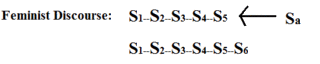 taken from page 109
The disruption and rearrangement of the prior signifying order produces a new relation of symbolic elements, and hence a new discourse. This new discourse produces new meaning, and hence a different representation of the world. This new representation of the world provides a new way to understand it. If knowing is a discursive practice, then the production of new discourses permits the creation of new knowledges by which to know the world.
In the 1970s, the feminist movement began to name the sexual violence many women experienced, but which was perceived neither as a political issue nor as being related to gender politics. This naming is the signification of the a of discourse, because it represents a violence against women which had previously not been articulated. The naming of gendered harms produces a signifier of an otherwise unsignified a of social discourses. …, Deirdre Davis argues that ‘[i]n order to address, deconstruct, and eradicate a harm, we must give the harm a name’ (1997: 200). This naming of the a is then inscribed into the signifying chains of social discourses, which produces a new signifying chain, or knowledge, around the issue of gendered harms. In this way, feminism produces new discourses of gendered harms that fundamentally shift the social meaning of sexual violence.
pluth on butler her lack of act
Pluth, Ed. Signifers and Acts: Freedom in Lacan’s Theory of the Subject. Albany: State University of New York Press, 2007.
Blog post originally published on May 14, 2009 at 15:16
Even attempts to avoid alienation by coming up with our own identities (say, in a project of aesthetic self-creation, or … in a Butlerian politics that affirms the openness of identity) are still always going to be geared toward getting recognition from the Other.
If we are interested in identity, in determining or asserting what we are (or even what we want to be), then we are interested in being objects of the Other’s desire. This interest relies upon an Other construed as a subject-supposed-to-know. No pursuit of the self, no matter how apparently subversive it may be, can avoid making an implicit appeal to this kind of Other. Both Butler and Lacan pursue the implications of this impasse, yet despite these similarities, there is an important difference in their results. (140)
Žižek points out (CHU: 124), that the dimension of the act is missing from Butler’s work … and that this is the real flaw … While Butler argues that the subject has no core, unchangeable identity, she does argue that the subject has an unchangeable fixation to identity as such. Her characterization of this fixation leads me to claim that despite her attempts to include a notion of agency in her work, her theory possesses a deterministic streak. The inclusion of a consideration of how acts use signifiers in a way THAT IS NOT BOUND UP WITH IDENTIFICATION AND RECOGNITION would remedy this. (141)
Butler’s accounts of agency and the subject do not require any notion of something external to or other than discourse. She can account for subjects and agents as well as transformations within the “matrix of intelligibility” from a perspective that only considers the discursively constructed nature of identity. Nevertheless Butler wants to avoid giving the impression that she adheres to an extreme “linguisticism.” … Butler wants to include some notion of the body in her account of identification while avoiding two things:
– On the one hand, she wants avoid making the body into a purely linguistic construct
– she also wants to avoid making the body into something simply outside of discourse. 144
In the Psychic Life of Power, the paradox of having to be subjected to power in order to be a subject comes under further scrutiny: “If the terms by which we gain social recognition for ourselves are those by which we are regulated and gain social existence then to affirm one’s existence is to capitulate to one’s subordination a sorry bind” (Butler Psychic 79, quoted in Pluth 147).
Butler reiterates here that it is only by being subjected to a signifier that identifies us that we can be subjects capable of resisting that identification, resisting a reduction to that signifier, and acting as agents. Once again, the preservation of some kind of relation to identity is absolutely crucial for Butler. Without a relation to an alienating identification, the kind of subversive activity she wants to affirm would not be possible. In fact, there would be no “subject” at all, and thus no chance for agency, without both an identity and the preservation of a frustrated relationship to this identity. 147
Because of being wed to the real in a different fashion, an act involves the realization that there is no Other of the Other, nothing behind the Other, as it were, acting as a ground.
Consequently an act transforms the subject (of fantasy) and consists of a signifying practice that does not rely on the Other as a guarantee of meaning and recognition. As … the Fort-Da game .. showed, an act is not for the Other.
Is Lacan’s idea of a desiring Other just like Butler’s idea of identity as a conflicted cultural field? They sound alike insofar as both involve a rejection of the fiction of an Other who is a subject-supposed-to-know. But the resemblance does not go much father. Butler’s “matrix of intelligibility,” out of which identity is forged, contains a multiplicity of signifiers whose interrelations can lead to unpredictable possibilities for identity.
But in Lacan’s work, an encounter with the Other’s desire is not an encounter with a multiplicity of signifiers offering various possibilities for identity. Rather, an encounter with the Other’s desire is an encounter with the absence of any signifier offering a support, guarantee, and recognition point for identity. It is such an absence that makes an encounter with the Other’s desire into an encounter with an impasse in symbolization, which is the mode in which the real appears in an act. Thus the encounter with the Other’s desire can be thought of as an encounter with the real. (148)
The difference between Lacan’s notion of a split, desiring Other and Butler’s notion of a multiple, conflicted social order is the difference between not having a signifier and having a cornucopia of signifiers, which is one way to figure the difference between a theory that includes the real in the symbolic, and a theory that overemphasizes the symbolic (although Butler would not use this term to describe her theory). While her discussion of the body as an impasse is an attempt to resolve this issue, it does not lead Butler to focus on how the subject may have a relation to something other than identity, and how the subject may be doing something other than performing identity —at least sometimes (148).
pluth on the act
Pluth, Ed. Signifers and Acts: Freedom in Lacan’s Theory of the Subject. Albany: State University of New York Press, 2007.
Originally published on: May 12, 2009 @ 13:53
the act does not depend on gaining recognition from the Other
involves doing something with signifiers
not far from Austin’s performative speech act but Lacan is not interested on acts that change the situation of the world or the set of facts within it . Lacan focuses on acts that change the structure of the subject If Austinian speech acts change the state of affairs in the world —making meetings closed, bachelors married, and so on— then Lacanian speech acts change the subject (101).
The act means crossing a certain threshold
Pluth goes on, “Notice that Austinian speech acts, in contrast, are not at all transgressive but are in fact highly ritualized and codified. The conditions for the success of an Austinian speech act largely depend upon the existence of social guarantees and rituals. Marriages, for example, are only successfully accomplished when performed under very specfic circumstances, and by the proper authorities. According to Lacan’s conception, however, an act transforms a subject, and even though it occurs with signifiers, it does not happen by following a preestablished ritual or code. Also, of course, there is no authority that can ensure the legitimacy of such an act. 101
It is not the case that someone is simply changed by an act: he or she is reinaugurated as a subject. Where there was a certain structure or law operative for a subject prior to an act —imagine this to be an unconscious law, the kind of meaning and determination constructed by the fantasy— an act brings about a transformation in this structure and thereby inaugurates a new subject. In this way, an act situates one outside such a law, and for this reason it is appropriate to consider acts to be transgressive. 102
pluth fort-da
Pluth, Ed. Signifers and Acts: Freedom in Lacan’s Theory of the Subject. Albany: State University of New York Press, 2007.
This blog entry was originally published on May 10, 2009 14:17
Fort-Da game is a repeated, attempt to exorcise a traumatic event. Yet instead of leading to a simple release of libidinal tension, and perhaps a dissolution of the traumatic event, the Fort-Da game sublates that tension into a signifying activity —canceling the event out as an affective tension, yet preserving it as a signifying tension in the form of a compulsive linguistic repetition.
… in the Fort-Da game, where the traumatic event is also simply being said, or named, by being taken up into signifiers. Yet there is no production of meaning by these signifiers, and the game does not use signifiers as part of an attempt to obtain a recognition of the trauma from the Other.
In other words, the game is not making a demand on the mother to satisfy the child’s needs. It merely repeats a trauma or signifying impasse that causes the subject and is an act in which the subject is disjoined from an Other who can bestow and guarantee recognition. 104
The signifying activity involved in the act achieves something fundamentally different from what fantasy achieves.
In an act, a subject does not constitute itself as a satisfying object of the Other’s desire, and in it a subject is not demanding recognition of its own desire by the Other either. Rather, a subject is simply using signifiers autonomously, as it were, in a signifying repetition of a libidinal event. Perhaps this gives us a further hint as to why Lacan calls an act transgressive: an act uses the Other’s language against, despite, and without, the Other, in what could be called a profound indifference to the Other (104).
butler 2008 italy
Excerpt from “Antigone’s Claim: A Conversation With Judith Butler”
Theory & Event Volume 12, Issue 1, 2009
This conversation was held in Pordenone, Italy, in September 2008, during a major cultural event that takes place every year. What follows is an expanded version of our conversation, including a few questions she received from the public and a few more questions that Judith Butler kindly took from us after the event.
Your work has attracted much attention both in America and outside of America, and your books are translated in many languages. What kind of audience do you have in mind when you write philosophy (We are still thinking of Giving an Account of Oneself)? Who is your implied reader?
Judy Butler: Let me say two things in response. I’m not sure I set out to write philosophy. I think sometimes I write philosophically. But those might be different things, to write philosophically and to write philosophy. When one writes philosophy one usually tries to stay within a genre that will be regarded as philosophical, or in accord with a protocol that has been accepted as part of philosophy. In either case, one writes in relation to the norm that governs philosophical thought at a given time. I consider philosophy as a resource, and it remains true that some of the questions I pose are derived from philosophical traditions. But it is very rarely the case that I actually write for a philosophy audience. Who, then, is my reader? When I write, I’m asking that question. Are you there? Who are you? I don’t have an image of the reader in mind; writing is more like an open petition, trying to find out whether there is someone there, opening up the place of the other within one’s own writing.
Maybe it would be worthwhile for me to go back for a moment to talk about what the questions are, because sometimes when I write I’m posing a set of questions to a reader, but that presupposes that the reader and I share some set of cultural predicaments. For instance, consider Simon De Beauvoir’s The Second Sex: do we call that philosophy or not? Is it a philosophical work? I would say yes. Does it stay within the boundaries of philosophy? No. She is asking relevant questions: what is a woman? Is a woman a person? Can she become a person? What does it mean to become a woman? In her work I saw that someone could take a philosophical question and bring it to bear on a concrete cultural and political problem. Consider Antigone. As we know, she buried her brother in spite of Creon’s order, and then, when she is asked to deny that she has done this, she enters a very interesting and particular position. Because she is not a citizen, she is not allowed to speak; she is prohibited from speaking, and yet she is compelled by the sovereign law to speak. So, when she does speak, she defies that law, and her speech exceeds the law that governs acceptable speech. To what extent, then, can Antigone figure for us in the position of the speaker who is outside of the accepted discourse, who nevertheless speaks, sometimes intelligently, sometimes critically, within and against that discourse? Perhaps the norms that govern philosophy work that way, producing a mimetic excess that questions the legitimacy of those norms. More broadly, these questions may have larger appeal and prove relevant to any number of people who are in minority positions or understand themselves as excluded from official public discourse – but somehow are still talking.
We read with great interest an unpublished paper in which you address a point that keeps coming up in your work, at least since the early 1990s. It is the question “who is the subject of responsibility?” In our post-Kantian world, the individual, by definition is subject of responsibility, while it seems that you question this standard assumption, criticizing its premises.
Judy Butler: Perhaps we might rephrase the question by asking, who qualifies as the subject of responsibility today? I know that under the Bush regime, the government promoted a very strong discourse about responsibility: the moral rationale for the devastation of the social welfare state was that individuals should take responsibility for themselves; the moral rationale for unilateral military incursions into sovereign nations has been that the US is understood to be responsible for the free world (I’m not sure, though, that the US will take its fair share of responsibility for the current economic crisis as a result of the deregulation of the stock market). The word is used in political ways that are quite interesting. In France and in Italy there is the term called ‘responsabilization’, which is the process of making citizens responsible for themselves – a process which would seem to contradict the very idea of selflegislation and self-formation that follows from Kantian notions of moral autonomy. “Responsibilization” is a way of describing a government procedure for the making of moral subjects. Not only is the government’s agency occluded by this term, but moralization in general seeks to ground behaviour and action in individual agents and so to deflect from the power of government in the regulated making of such subjects. It deflects as well from nongovernmental powers, including NGOs, that regulate who may become a subject of responsibility and who may not. In the US, we assume responsibility for the lives of those who are like us (and here “responsibility” means “compelled to make an intervention on behalf of”); we assume responsibility for the lives of Americans, but we don’t always recognize as a life those whose cultural backgrounds do not transparently conform to prevalent images of “our own,” especially when it is a question of racial difference and religious alterity.
The questions,’to whom am I responsible?’, ‘for whom am I responsible?’, seem, in these cases, to be limited in advance by the question, ‘with whom can I identify?’. And implicitly, if not forcibly, identification within the national frame assumes the kind of subject already recognizable to me, a subject, in other words, who poses no challenge to the norms of recognizability with which I operate. I confess that when I first started to think about responsibility I was worried primarily about forms of moralism, especially on the Left, where individuals with certain “subject positions” were held responsible for the entire history of social domination. I wanted then to think about a different idea of responsibility, one surely influenced by Levinas, but perhaps also by Arendt, that would not make responsibility into a purely individual matter. What interested me most was the idea that when I’m asked to take responsibility for my actions, I’m asked by someone, and this is also true when I pose such a question to myself. Derrida surely makes this clear in bringing out the sense of “response” in “responsibility”: I’m asked to respond to another human being, so I am already in a social situation. And if I am the one who asks myself to assume responsibility, I have become, through my own doubling, a social creature at the moment in which I pose the question. It is not just the fact of alterity, however, that makes the exchange a social one, but the fact that I am asked in a specific language or through a specific medium, and so am compelled to take responsibility in a language or medium that is understandable to the person who asks this of me; in that sense my efforts to take responsibility for myself are socially prompted and mediated, if not socially constructed, in a specific sense. Within such frameworks, we can situate moral theory within social theory essentially – and not contingently. I would suggest that the same holds for politics and political theory as well, since we have to ask about the political context in which the notion of responsibility emerges – and be able to parse the various meanings of “responsibility”. This is not, however, in my view, an effort to relativize and vanquish the use of the term, but to understand the concrete changes in political conditions that are necessary to establish responsibility on non-cynical grounds. The changing of those conditions is itself a responsibility, but it also leads to a realization of responsibility as part of the very process of instituting a more egalitarian and just organization of social life. This allows us to distinguish between spurious and non-spurious uses, even though the “spurious” is a risk to which any operative notion of responsibility is subject.
We see this most starkly when “responsibility” becomes one of the instruments for sustaining the condition of global irresponsibility, i.e., when under the Bush regime the US actively distinguishes between those populations worthy of protection and grief and those who are not. Let us hope that this modality changes substantially under the Obama administration.
We understand that the notion of “precarious life” is critical to your attempt at identifying the subject of responsibility. In fact, my life is precarious so long as I, as a subject, “am already in the hands of the other.” Could you elaborate on this point? If I, as a subject, am already in the hands of others, it means that I’ve lost a fundamental normative prerogative, meaning to consider my actions as consititutionally mine.
Judy Butler: (yay go judy!)
In the last two wars that the US has been fighting in Iraq and in Afghanistan, it has become very clear that the lives of US citizens, who were killed in 9/11, or the lives of US soldiers, are considered to be precious, are considered invaluable, grievable, openly grievable in public, and therefore made into heroic lives. But the lives that were taken in Iraq — and right now we can see it very clearly, when US army bombed a village in Pakistan, our ally, and it continues to disavow responsibility for this — are not considered lives at all, they are already dead before we killed them, they are already non-living before we deprive them of life. This is kind of schism that characterizes US foreign policy, but also public discourse in a number of venues, including the popular media. If we offer an alternative to this schism between lives that are grievable and lives that are ungrievable, it seems to me that we start with the presumption that human life is precarious life — I could also say that non-human life is also precarious life and that maybe precariousness links human and non-human life in ethically significant ways. When we start understanding our lives as precarious, we understand that we are linked to one another, but how can I take responsibility, how can I assume responsibility if I do not recognize that link?
When I say that we are already in the hands of others, or others are already in our hands, I’m saying that there is a link and that link is precariousness and it is by virtue of that link that we must assume responsibility for shared life.
You ask about what is properly “my own” – I think we can only lay claim to what is “my own” if there is someone before whom the claim is made and/or a language through which the claim is made legible. In this sense, “mineness” is made possible by sociality, and it is only secured through social and political arrangements; otherwise, it becomes a kind of madness.
Question:
You are wary of invocations of “global responsibility” since it is on the basis of such invocations that some countries seek to bring or install democracy in other countries. Carl Schmitt famously argued that “whoever invokes humanity is trying to cheat”… You see a moral puzzle in the ways people invoke global responsibility, and you point to a difficulty in determining whether such invocations are “responsible.” Is this talk of precarious life a way to go about the notion of “human rights” by possibly avoiding some of the difficulties (moral and theoretical) that such a notion (inevitably) involves?
Since I am, in general, less sure than Schmitt about who is cheating or how the cheat takes place, I would suggest that invoking humanity is ambivalent. For instance, when we (any of us) respond with horror when we witness the destruction of human life, is it because we recognize our common or shared “humanity” with those destroyed? Or is it that we become “humane” (and so give evidence to our own humanity) in reacting with a moral sentiment such as horror? What is less evident, but everywhere pressing, is the tacit framework presupposed by this burst of fierce and sudden sentiment. To the degree that certain scenes of destruction compel our horror more than others (equally destructive), it makes sense to ask, who is, without question, included and who is excluded from that humanity? In other words, which lives emblematize humanity, and which ones cannot so easily wield that signifying power?
So, one has to be critical about how and when the notion of humanity is invoked, but I am not convinced that it is always a lie or, indeed, a way of cheating. It is important to ask what it occludes, and how whatever it illuminates presupposes a consequential occlusion – one that turns the idea of “humanity” against the universality by which it is supported and seems, invariably, to reinstitute a certain anthropocentrism. As a result, I think it might be more helpful to consider instead a term such as ‘precarious life’ which, though it has strong resonances with the idea of humanity, functions very differently. There are at least two differences: the first is that
precarious life is a life that is shared in a specific sense: “shared life” is not simply a “life” that functions as a common element in which individuals participate on the order of a mathesis. Rather, it is common in the sense that we are reciprocally exposed and invariably dependent, not only on others, but on a sustained and sustainable environment.
Humanity seems to be a kind of defining ontological attribute, who I am, or who we are, that properly belongs to us as persons, and in that sense, it keeps the human within the humanistic frame. But what if our ontology has to be thought otherwise? If humans actually share a condition of precariousness, not only just with one another, but also with animals, and with the environment, then this constitutive feature of who we “are” undoes the very conceit of anthropocentrism. In this sense, I want to propose ‘precarious life’ as a non-anthropocentric framework for considering what makes life valuable.
Even when we ask the question, who is the human in human rights? In an effort to ground human rights in the conception of the human, we fail to ask what the human “is” such that it requires certain kinds of protections and entitlements. The “human” is not so much the presupposition of such a discourse, but a continually contested and rearticulated term. As a result, you find political organizations that at once expose the limits of the concept of the human and call for its reformulation: women’s human rights, the human rights of gays and lesbians, or the human rights of the physically challenged or the sans-papiers. Such populations are not only outside some conception of the “human” and requesting inclusions, but they are also establishing that precarious “outside” as the site from which certain kinds of claims can and should be made. If there is a language in which the claim is made, and if it is made before someone, then it establishes a social domain that exceeds the idea of the social presupposed by an historically contingent notion of human rights. Antigone, again, to be sure.
Question:
In your recent work, the focus on the “national subject” or the subject of violence or, for that matter, the subject of responsibility, has eclipsed the notion of a gendered subject, that had been a quite dominant issue in your work for almost twenty years. Here in Italy many people still think of Judith Butler as a feminist philosopher. Do you think this definition is still a valid one?
I am quite sure that I am a feminist thinker of some kind. Sometimes I am a feminist philosopher. I continue to work in feminism, and I will always work in feminism, there is no question about that. And maybe I am not always thinking in feminist terms, but if I am thinking that is probably a feminist achievement (laughs). I continue to work on transgender issues, on questions of violence on women, on sexual minorities; I work with clinical psychoanalysts to rethink the explanatory frameworks and categories that tend to pathologize sexual and gender minorities. That’s surely part of my ongoing work, and it will always be.
I would add that the idea of precarious life also emerges from a certain kind of feminist perspective, a critique of a certain presumptively masculine idea, embedded in classical liberal political forms, of the subject who is selfsufficient and a-social. Surely the critique of the idea that any of us can exist outside a condition of dependency is an important, enduring contribution of feminist theory and politics.
Perhaps what links my work on gender and my more recent work on war has to do with how social ontologies are regulated. I have been interested in how certain kinds of heterosexual frames and normative gender schemes make certain kinds of lives unliveable and ungrievable. That was an important dimension of AIDS activism, and remains one now, especially in light of the sufferings and losses on the African continent: it is very often a struggle to make certain kinds of lost life publicly grievable. The deaths by AIDS were not shameful deaths, but horrible deaths that deserved and deserve a public mourning. In a way, that point brought me to consider Antigone, her insistence on burying her brother even when the open public burial and grieving was against the law. The politics of mourning within war is clearly linked to that question of the distribution and regulation of grievable lives. How do we think about who is grievable and who is not, who is allowed to grieve openly and who is not? And what kind of public speech, parrhesia, is needed to call attention to the horrifying way that our capacity to feel horror is differentially distributed and naturalized?
As we titled this conversation “Antigone’s Claim”, so we may ask what would Antigone’s claim be for the present and how we understand her claim in the present. It seems to me that in insisting on the public grievability of lives, Antigone becomes for us a war critic who opposes the arbitrary and violent force of sovereignty. In a way, she stands in advance for precarious lives, including new immigrants, the sans-papiers, those who are without health insurance, those who are differentially affected by the global economy, questions of poverty, of illiteracy, religious minorities, and the physically challenged. That she, in some sense, becomes a figure through whom we can think what it means to understand certain lives as more precarious than others, who live out a precariousness so that others can engage in the fantasy of their impermeability and omnipotence.
Question:
Would it be possible to define your concept of “precarious life” as a new form of “humanism”?
Currently, I do not want a new humanism. If we ask what the human could be beyond humanism, then it seems we resituate the human within the non-human, not as a contingent fact of existence, but as a necessary ontology, an ontology that articulates certain constitutive bonds and binds. So I am struggling toward a non-anthropocentric conception of the human, if that is possible – even a non-anthropocentric philosophical anthropology. The other way of saying this is that wherever the human is, it is always outside of itself in the non-human, or it is always distributed among beings, among human and non-human beings, chiasmically related through the idea of precarious life. So we can neither lodge the human in the self, nor ground the self in the human, but find instead the relations of exposure and responsibility that constitute the “being” of the human in a sociality outside itself, even outside its human-ness.
Question:
You are defining the human in its frailty and at the limits of its capacity to make sense of the world. It’s a weak subject (although not in the sense of Vattimo’s). Do you see a form of universalism (perhaps the only one) in this idea? The universality of frailty, of mourning and loss? Are we relapsing though in a form of essentialism? Moreover, does this frailty entail a negative counterpart: the universality of violence, oppression, subjugation?
I am amused by this idea of a “relapse”! What is at stake is a way of thinking about what is ‘essential’ that implies a dispossession of the self. What strikes me as much more problematic is the idea of a self-aggrandizing subject, the kind that gets nationally instituted at times of war. But I am not just working with grief and frailty, but also with aggression and the various forms it takes. The point is to think about the frailty, the necessity, and the demands of the ties by which we are bound
In your book, you comment on Adriana Cavarero’s work, as much as she borrows from you in her Orrorismo, for instance regarding the vulnerability of the subject or the ethics of self-narrative. In spite of the transatlantic divide between European essentialism and Anglo-American postmodernism (or non-foundational post-structuralism), there are several points of convergence for the definition of an ethical and political (feminist) agenda. Which one do you think is the more prominent and relevant, but also do you see any major point of disagreement between you and Cavarero?
Cavarero is the one who has read Arendt and Levinas quite effectively to show that the singularity of the “you” requires a certain story. I am most interested in this move, and I have been led to rethink my own relation to these figures by virtue of her compelling analyses. Perhaps my own work tried to think more about the social and political conditions under which horror and grief are regulated, and this might be a bit different from hers, which tries to establish an ethical framework for moral sentiments. But yes, as you can imagine, the link between our work is an important one.
When you talk about war and conflict, you seem to adopt a language that has religious rather than simple ethical undertones. When you talk about non-violence, to break the cycle of revenge, for instance in the Israeli-Palestinian conflict, which implies forgiveness, you seem to open up your discourse to an ethical ground that resonates with a broad Judeo-Christian frame of reference. How do you stand in relation to religion and the new centrality of religious in contemporary thought, considering that it has become a central issue and concern for many intellectuals like Habermas, Zizek, Vattimo and others?
I don’t see a term like “forgiveness” as necessarily implicated in a religious framework. Maybe that seems odd, but it seems to me that the term, whatever its religious background, has and does travel outside of explicitly religious circles and can operate within ostensibly secular contexts. There will be those for whom the resonance exists, but I think we have to consider more closely, for instance, how reparation works in the theory of Melanie Klein, or how “forgiveness” operates in various international human rights commissions. What interests me most are modes of operating within conflict that find ways of expressing rage without retribution. This problematic is articulated in the Oresteia and, if I am right, marks a certain distinction between matters of justice and ideas of religious authority.
That said, I think it is important that we take note of the ways in which religious discourse informs many of our secular understandings of politics, and to see how such terms become resignified over time and through the shifting of contextual frames. I have been interested in Walter Benjamin’s appropriation of ‘forgiveness’ in some of his early writings on aesthetics. There, it is actually linked with the eradication of traces of guilt and the inauguration of a new temporal modality. Perhaps there continues to be ways of thinking revolution in such terms.
In recent years you have been writing and speaking about Israeli politics, and the problem of the ‘anti-Semitic’ charge to quell public criticism of Israel that it is almost inevitably advocated in many quarters. Anti-Semitism is indeed an oversensitive issue in the collective Western consciousness. How do you place yourself, being Jewish but anti-Zionist, in reference to this? And do you see the danger of a ‘culture of victimhood’ in the critical political discourse?
I want to suggest that public criticisms against gratuitous state violence form an important, if underappreciated, dimension of Jewish values, and that ideals of co-habitation with the non-Jew are also central to early strains of Zionist thought and to contemporary dissenting positions within Jewish intellectual life. I understand that my position is difficult to defend, since it would be important to know what is meant by “Jewish” here. But I want to suggest that the term refers to both secular and religious positions, but also to historical situations that are agnostic both in relation to secularism and religious belief. Within this broad domain, public criticism of gratuitous state violence has been crucial to a number of Jewish intellectual positions. I wish to underscore both the risks and obligations of public criticism, since whatever the motivations are for levelling criticisms against certain forms of state violence, it remains true that the criticism of Israeli state violence, for instance, can be construed in any number of anti-Semitic ways. This situation became acute, for instance, for Primo Levi, whose criticisms of Israel were exploited by those who covered the walls of Turin, his home town, with anti-Semitic slogans. How, then, does one unequivocally oppose anti-Semitism at the same time that one revives and furthers that Jewish tradition of public criticism that is formulated as a critique of state violence, an opposition to the forcible dispossession of minority populations? It is clearly impossible to accept anti-Semitism, just as it is to jettison key values furnished by this internally complicated Jewish tradition of public criticism. Much depends on our ability to distinguish between forms of public criticism that are part of democratic deliberation and those that propose violent and non-democratic means to achieve political ends. So perhaps my hope is that active and internal dissension among Jews on the topic of Israel can work in tandem with other political efforts to oppose the occupation and the radical disenfranchisements of 1948. In a way, this is to shift the “moral” discourse from persecution\victimization to an affirmative responsibility for cohabitation that links not only with precarious life as a social ontology, but also with a new fathoming of global responsibility for this time.