campbell sexuation

Campbell, Kirsten. Jacques Lacan and Feminist Epistemology. Florence, KY, USA: Routledge, 2004. p 86.

Similarly to the earlier accounts of the sexed subject, the phallus remains the pivot of the later Lacanian account of sexual difference. Lacan’s ‘Graph of Sexuation’ represents sexed identity in relation to the phallic function (S20: 79).

The phallic function is ‘the function that institutes lack, that is, the alienating function of language’ (Fink 1995: 103).

A relation to the phallus structures the masculine and feminine positions, which the formulae of sexuation represent (S20: 79– 80). Because it turns on the phallic function (S20: 59), ‘there is no such thing as a sexual relationship’ (S20: 12).For this reason, a relation between the sexes is an impossibility.

Lacan claims that the ‘male way’ of jouissance produces the non-relation between the sexes (S20: 56– 57). The phallic function produces the jouissance of the masculine subject, the enjoyment of the (phallic) organ on which ‘all’ turns.

Lacan argues that the phallic function inscribes the male subject ‘man as whole’ or ‘as all’ (l’homme comme tout) (S20: 79).

Joan Copjec describes that inscription as producing ‘a universe of men’, a masculine universal (1994: 235).

The masculine subject claims to be a man who is whole and all, a master of himself who ‘[b]y denying the trauma of primary Castration . . . unconsciously perpetuates the suppression of the person’s own division and the belief in her or his autonomy’ (Ragland-Sullivan 1987: 305).

The masculine claim rests on the exception of castration – such that he defines his universality in relation to an other without the phallus. The masculine subject represents his ontological lack as the castration of the feminine other.

That other position of the subject is that of  — a fantasy that affirms that the masculine subject has the phallus.
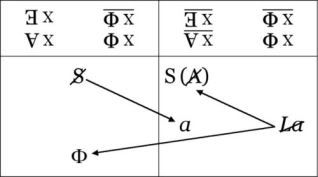
In this fantasy, desires the phallus, confirming that he has it. If the whole of the sexual relation is a fantasy, it is a masculine fantasy of as the cause of his desire (S20: 131). The cause of his desire is the objet a – the originary missing object that can never be found (S20: 86).

Zizek identifies that missing object as the Mother-Thing on which masculine fantasy turns (1989: 119). For the masculine subject, the feminine represents a fantasy object that can answer his desire for universality and completeness: she confirms that he does not suffer castration.

In its relation to the masculine subject, the feminine is a fantasy of a castrated other that confirms that she is castrated and he is not. The operation of the phallic function produces this fantasy.

For this reason, Lacan argues that does not exist. She exists only as a fantasy of the masculine subject, formed in his phallic jouissance and in his desire (86).

No woman can fulfil that fantasy. In this way, The fantasy Woman does not exist in the real, because no woman could enact the fantasy that he substitutes for her. Lacan points out in his earlier work on feminine masquerade that women may attempt to fulfil that fantasy (É: 321). However, while a woman may attempt to play out the masculine fantasy, in doing so she does not exist as other than in and through fantasy.

Lacan indicates the impossibility of by his bar through the definite article ‘The’. When interviewed in 1973, Lacan formulates the impossibility of ‘Woman’ as ‘The Woman does not exist’ (1974: 38). In Encore, Lacan makes it clear that, by that formulation, he does not mean that women do not exist but that the masculine fantasy of is an impossibility (S20: 72– 73).

If Lacan’s later account of the sexuated subject went no further than this description of masculine and feminine subjects, then it would only be a more elaborated version of the classical Lacanian theory of sexuation. As such, the phallus would still function as a transcendental guarantee of subjectivity and the Symbolic order. Such an account would therefore remain vulnerable not only to the feminist objection of androcentrism, but also to the compelling deconstructionist critique of ‘phallogocentrism’ (Derrida 1980).

However, in Encore, Lacan confronts the question of ‘What does woman want?’, which leads to a reworking of his theory of the female subject. In Encore, Lacan describes how ‘what I am working on this year is what Freud expressly left aside: Was will das Weib? “What does woman want?”’ (S20: 80). Lacan responds to that question with some of his most misogynist statements. He suggests that women tell nothing of their body or their pleasure, and that in fact they know nothing of their bodies or their pleasures (S20: 74– 75). Ultimately, Lacan reduces this mystical unknown Other to the unknowable maternal Thing (S20: 99). The question of what do women want implies a desire to know women, insofar as Lacan wants to know what women want. What is in question is Lacan’s knowledge of women. However, what Lacan puts into question is what women themselves know. His answer? Nothing. What emerges in Lacan’s discussion of what women want is a succession of gestures of rhetorical mastery, which understand this unknown object as ignorant of itself, and finally as unknowable. The drive to master that object is evident in Lacan’s claimed status of Knowing Master: ‘[i]t’s just that they don’t know what they’re saying – that’s the whole difference between them and me’ (S20: 73). However, these gestures of mastery are at play within the same text in which the ‘truth’ of women is in excess of a phallic regime, and constantly threatens to breach its symbolic logic.

The question of what women want opens the way for Lacan’s conception of the female subject as ‘not all’ (pas toute). In Encore, the position of the female subject is not rendered as nothing, but as not all of the phallus: ‘I said “of woman”, whereas in fact woman does not exist, woman is not whole (pas toute)’ (S20: 7).  (87)

In this formulation, the not all of the female subject is a not all of the phallic function. Lacan argues that ‘when any speaking being whatsoever situates itself under the banner “women”, it is on the basis of the following – that it grounds itself as being not-whole in situating itself in the phallic function’ (S20: 72). If the exception of castration defines ‘all’ of the masculine position (S20: 79), then the position of the female subject is that of an exception.

The masculine rests on the exception of feminine (castration). It rests on her being other than the phallic all. With this exception, the phallus cannot be posited as a universal and so cannot define all, because it has the status of a universal that rests on a non-universal.

Reading the Graph of Sexuation in Encore from the side of the masculine subject positions the female subject as an exception to the phallic signifier and hence as a signification of its limit. The phallus does not define her sexed subjectivity, because she comes to be a sexed subject through normative identifications with a member of the opposite sex.

It does not define her body, for the phallus does not symbolize her body (S3: 176). It does not represent her sexuality, since her jouissance is not a phallic jouissance (S20: 74). Lacan argues that ‘[a] woman can but be excluded by the nature of things, which is the nature of words and it must be said that if there is something that women complain about enough for the time being, that’s it’ (S20: 73).

To be a woman is not to be excluded from language. For Lacan, ‘[i]t’s not because she is not wholly in the phallic function that she is not there at all. She is there in full (à plein). But there is something more (en plus)’ (S20: 74). The paradox of the female subject is that she is within the phallic law of the signifier and yet ‘there is something more’.

The not all of the female subject should therefore be understood as the failure of the law of the signifier to represent her sexed subjectivity. The not all of the female subject is constituted in its failure to represent her subjectivity as other than phallic.

Her position of ‘Other’ is then a position of being other than the phallic subject. Therefore, the phallic signifier does not define the female subject. The not all is not that which is Other to the phallus, but that which it does not define. The Lacanian account of the position of the female subject is the failure of the symbolic to represent that subjectivity.

The Graph of Sexuation should therefore be read as a Graph of Male Sexuation and of the operation of masculine subjectivity. It does not describe the female subject other than in terms of the phallic function. For this reason, Lacan’s Graph can only represent the female subject as not defined by the law of the signifier.

In this later model of sexuation, the phallus only guarantees a masculine subject and symbolic order. The subjective and symbolic structures that it supports are therefore incomplete – there is always ‘something more’, such that the phallic order always produces an excess to itself. The phallus fails to effect closure of what otherwise appears to be a transcendental Symbolic order. For this reason, the not all provides a means to reconceive the female subject. (88)

campbell discourse of the master

Campbell, Kirsten. Jacques Lacan and Feminist Epistemology. Florence, KY, USA: Routledge, 2004.


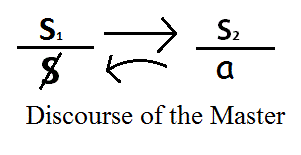
For Lacan, the Discourse of the Master describes the production of the speaking subject in the symbolic field. The subject comes into being when it enters the signifying chain through identification with a signifier, S1. The S1 is a fundamental symbolic element which ‘knots’ signifier and signifed and thereby arrests their constant sliding.  It represents the signifier that gives the subject its symbolic coherence and situates it within language.  For this reason, the marks the point of the ‘origin’ of the subject’s speech, because the identification with the I of speech, the S1 that symbolizes the I of the master, constitutes the subject (Seminar 17: 70).  In this way, identification with the I of the Master forms the subject in the symbolic field.  The Discourse of the Master thereby inaugurates a speaking subject which is identical to its proper signifer and which ‘names’ it.  For Lacan, this discourse binds the subject to the master signifier and all its illusions. 65

In the Discourse of the Master, the subject refuses knowledge of its formation in signifying networks. In his schema, Lacan represents this refusal to know by an arrow S1—>S2 labelled impossibility. Given this structure, it is impossible for the subject to know its relation to the signifier. For this reason, Lacan represents that impossibility by his figure of the barred subject, $He represents the subject as barred because it refuses to acknowledge the truth of its unconscious division. That lack is a consequence of its constitution as a speaking being, because castration is the price of entering the Symbolic order. The discourse of the Master hides the truth of the lack-in-being of the subject (S17 90). The Master does not want to know, and cannot know, the truth of its unconscious.  The subject perceives itself as an I, that is, as a unified subject, and hence refuses to acknowledge that it is in fact a Master that suffers castration.

The Discourse produces a subject who wishes to master its self, its others, its desire, and its unconscious. For Lacan, the Master wishes to dominate that which it excludes form its discourse (S17 110).

Fink describes how this subject must show no weakness, in this sense carefully hides the fact that he or she, like everyone else, is a being of language and has succumbed to symbolic castration’ (Fink in Nobus Key Concepts 1998). The castrated Master refuses to believe that it is castrated. 66

It veils over its lack with the illusion that it is whole and complete; the méconnaissance of a self that imagines that it is identical to itself and to its master signifier (S17 70). It imagines that it has mastery of a ‘univocal’ discourse that masks its unconscious division. 66

The Knowing Master is a position in which the imaginary order captures the knower such that it perceives its self and its objects in the mirror of the ego. The Master subject claims to be a unified subject which creates itself in an act of mastery. It imagines itself to be whole and identical to itself, and perceives its self and its others as identical to its egoistic projections. The knower constructs its relationship to its others as an objectifying identification in which the other is an object that it seeks to master. Its knowledge is an aggressive, objectifying and distorting domination of its known object. The knowing subject attempts to gain omnipotent control of itself and its world, so as to imagine itself as the ‘Absolute Master’ (Lacan 1955: 47, Éc: 33). It posits itself as omniscient, the possessor of absolute knowledge. 66

Lacan’s description of the knowing subject of the Discourse of the Master presents it as the universal, disembodied knower. However, given that the Lacanian account of subjectivity posits sexuation as its condition, then the knower is necessarily sexed.

Following a feminist deconstructive strategy leads us to ask, how is sexuation inscribed into the Lacanian theory of the knowing subject? (66)

To answer that question requires the reinscription of sexual difference into Lacan’s account of the production of the Master subject. 67

🙂 Here we go

For Lacan, the Master subject is produced through identification with a symbolic term, the trait unaire, translated as the unitary, unary or ‘single-stroke’ trait. Lacan’s theory draws on Freud’s account in Group Psychology (1921) of the process of the assimilation of an aspect or characteristic of another, in which the subject identifies with a trait of another subject. Lacan argues that an identification with the unitary trait ‘marks’ each one of us as a singular and unified identity. (S17 180)

He links this concept of the unifying mark to the signfier of ‘L’Un’ (The One).  ‘The One’ is the signifier that institutes the symbolic structure of the subject (S17 12, S20 143-144).

In the Discourse of the Master the unitary trait appears as S1, the master signifier.  The master signifier functions as the signifier that represents the subject as subject.67

However Lacan also links S1 to the phallic signifier. In his discussion of sexuation, Lacan describes the phallus as ‘that which is also incarnated in S1, which, of all the signifiers, is the signfier for which there is no signified (S20 80). The phallus incarnates or ‘makes flesh’ the S1 of the master signifier.

For this reason, identification with the phallic signifier operates as identification with the master signifier. What links these terms is the process of symbolic identification in which the phallic signifier is a master signifier that produces the subject.

Lacan argues that in the formation of the subject, the signification of the phallus [is evoked by the paternal metaphor]. The paternal metaphor is the attribution of procreation to the Name-of-the-Father and the signification of the paternal relation.

A moment of the Oedipus complex, the paternal metaphor represents the intervention of the Symbolic order (signified by The-Name-of-the-Father) in the subject’s imaginary relation to the mother (and her desire).

In the operation of the paternal metaphor, the desire for the mother is repressed and the phallic signifier stands in for that desire in the subject’s unconscious (Muller and Richardson 1994 213). This process forms the subject in a relation to the phallic signifier and hence as a sexed identity which has or does not have the phallus (S5 186). In this account, the masculine subject has the phallus, a position of possessing the signifier of the phallic object, while the feminine subject does not have the phallus, a position of lack and hence castration. 67

Lacan argues that the dissolution of the Oedipus complex involves symbolic interjection, in which ‘what was outside becomes the inside, what was the father becomes the super-ego’ (S1 169).  In symbolic identification the subject introjects the signifier of the father, forming the super-ego.  The subject assimilates the phallic signifier as the mark of the Father, and thereby incorporates the Symbolic father as an I. (S11 256-257)

Presenting the reformulation of the paternal metaphor (and of the Oedipus complex) in the theory of the Discourse of the Master.

In the Discourse of the Master, identification with the phallic signifier — S1 — of the Father produces a ‘unified’ subject. It is an identification with the paternal signifier because the phallic signifier is the mark of the Father, and hence of his Law. This symbolic identification ‘marks’ and names the subject with and by the Name-of-the-Father. Identification with S1 involves an assimilation of the Symbolic father. For this reason, Lacan describes ‘the law’, that is, the Law of the Father, as dominating the Discourse of the Master (S17 48). 68

The process of symbolic identification with the Father produces the illusion of a conscious self. It establishes a subjective relation of I and ego in which the I of the speaking subject appears to be co-extensive with the ego because of the operation of repression. For the Master subject, consciousness founds illusion of the transcendental I (S17 70). Identification with the Symbolic Father who has the phallus and is not castrated structures this position of mastery, forming the master subject in terms of a psychic structure of defence against the unconscious. The identification with the Symbolic father produces a subject structured by a méconnaissance of its origniary and ontological lack.

However, in the Lacanian account identification with the Symbolic father operates differently in formation of masculine and feminine subjects. In the logic of castration, the model of a typical ‘successful’ resolution fo the Oedipus complex is that of the paternal identification of the little boy because of the tie of the symbolic phallus and the real penis. (S4 209). In the third stage of the Oedipus complex, the little boy identifies with the father who possesses the penis while the little girl recognizes that he has it (S5 196) For Lacan, if masculinity and femininity both ‘fail’, they fail differently. The difference concerns the more or less ‘problematic’ assumption of Oedipal subjectivity, because the master signifier that represents the subject is masculine (S17 107).

In Lacan’s account, the masculine subject has the phallus (S20 80). That is, the masculine subject possesses the phallus and, in this sense, is not castrated.  The male subject defines its masculine position through the exception of castration such that his ‘all’ is defined through an other position of ‘not-being-all’.  This other position is that of castration, which is the feminine position of a being that does not have the phallus.  The phallus is the master signifier by which the masculine subject refuses the (lacking) body.  …The phallus ‘that props him up as signifier and is also incarnated in S1 which of all the signifier, is the signifier for which there is no signified (S20 80).  His ontological loss cannot be acknowledged without being symbolized as castration, for otherwise hts fantasy of omnipotence, unity and universality would unravel.

The displacement of ontological loss through the representation of castration in a symbolic function allows the masculine subject the illusion of mastery (S17 144).

In that illusion of mastery, the masculine subject misrecognizes itself as a being whole and complete of itself. It is a position of (masculine) mastery. 69

It is a position of presence, of the universal masculine subject which is ‘whole’ and which does not suffer loss or lack. The Discourse of the Master describes the production of the knowing master, a masculiine subject that secures its identity through identification with the Symbolic father in a repudiation of castration. 69

Reconceiving the knowing master as a masculine subject explains the formation of the masculine knower and its imaginary méconnaissance.  It explains the relation between the knowing subject of consciousness and the masculine knower … showing the link between the formation of masculine subjects and knowers.  In this way, it provides an account of the constitution of the knower as a masculine subject by providing the feminist deconstructive project with a means of understanding the formation fo the subject of ‘masculine’ knowledges.

Campbell, Kirsten. Jacques Lacan and Feminist Epistemology. Florence, KY, USA: Routledge, 2004. p 75.

My account of the discourses of mastery provides a means of retaining these insights of deconstructive theories, while also not reducing masculine knowledge to an effect of individual experience or familial objects. In the later Lacanian epistemology, different discursive social links produce particular forms of knowledges and knowing subjects. Those symbolic relations between subjects represent different forms of the social bond. In a Western culture, a phallocentric Symbolic order structures those social relations between subjects. In particular, it founds the Discourse of the Master as a dominant discourse of Western culture. The Discourse of the Master produces dominant forms of knowledge and the masculine knowing subject.

These masculine subjects need not be men. Both men and women can, and do, become knowing Masters. However, men are more likely to assume this position than women for two reasons.

First, the Master is a paradigmatic knower because of the material and cultural privileging of particular forms of masculine identity.
Second, the normative production of identity attaches masculinity to biologically male subjects.

My account of the discourses of mastery provides an explanation for this ‘demonstrable alignment’ between masculine knowers and knowledges. For example, following Scheman’s description of the Cartesian knower, it explains how identification with the Symbolic father forms this egoistic, defensive Knowing Master. Similarly, following Bordo’s description of the masculine Cartesian subject, it explains why the knowledges of the masculine knower repudiate its feminine others (indeed, all others), the better to control their difference (1986: 452).

Rather than seeing masculine knowledges as a reflection of the privilege of men in social relations (as in standpoint theory), my account explains how those social relations produce masculine discourses of mastery. Those social relations produce discourses of knowledge that form the knower and its objects. These forms of knowing are discursive practices that do not describe the nature of ‘knowledge’, but rather the production of particular knowers and forms of knowing. (76)

campbell sexuation

Campbell, Kirsten. Jacques Lacan and Feminist Epistemology. Florence, KY, USA: Routledge, 2004. p 64.

The power and difficulty of Lacan’s concept of sexed subjectivity for feminism lie in its linking of social, psychic and corporeal sexual difference. The very ground of feminist critiques of Lacan’s account is also that which makes it a powerful account of the formation of masculinity and femininity. This theory offers us, first, an explanation of the formation of sexed subjectivity, and second, an understanding of sexed subjectivity in which:

  1. To become a subject is to become sexed.
  2. To be sexed is to be caught within representations of sexual difference.
  3. That signification is contingent and not fixed by the body.

In this account, sexual difference is both necessary and necessarily contingent. While Lacanian epistemology presents the knower as if it were outside the field of sexual difference, the Lacanian theory of sexuation situates all subjects within that field. Zizek points out that ‘[o]ne of the crucial differences between psychoanalysis and philosophy concerns the status of sexual difference: for philosophy, the subject is not inherently sexualised . . . whereas psychoanalysis promulgates sexualisation into a kind of formal, a priori, condition of the very emergence of the subject’ (1998a: 81). As a speaking subject, the knowing subject of Lacanian epistemology is therefore also sexed. While Lacan does not develop his work in this way, in the next section of the chapter I read Lacan’s accounts of knowledge and sexuation together to develop a theory of the formation of the sexed knower and its knowledges. I interweave Lacanian epistemology and the Lacanian account of sexuation to offer a possible answer to the question: ‘How, then, is sexual difference, this fundamental Real of human existence, inscribed into the matrix of the four discourses? How, if at all, are the four discourses sexualised?’ (Zizek 1998a: 82).  (64)

campbell sexuation phallus

Campbell, Kirsten. Jacques Lacan and Feminist Epistemology. Florence, KY, USA: Routledge, 2004. p 60.

The later Lacanian epistemology also presents a subject that is sexually neutral, because  the master, academic, hysteric and analyst are positions without gender. Since both men and women have to enter the intersubjective relations of discourse in order to become subjects, the subject as such does not have a sex. … The Master is sexless because all must enter the Discourse of the Master in order to become subjects. That discourse produces all speaking subjects, such that ‘[i]n the final analysis, the “person” always has to do with the master’s discourse’ (S20: 69). Lacan makes his claim that the Discourse of the Master forms all subjects in Encore, (S20) the same seminar in which he also proposes that feminine sexuality and subjectivity are in excess of, rather than determined by, the phallic function. In his later work, Lacan repeatedly returns to the question of women’s knowledge (60).

The figure of the knowing woman is both difficult and fascinating for the later Lacan. This difficulty reflects the paradox of the classical account of sexuation: the phallus is a sexually neutral signifier which produces all subjects, but men and women become sexed subjects because of their different relation to the phallus.

In Lacan’s work, a different relationship to the phallic signifier defines the sexual difference of masculinity and femininity. In the description of the formation of the subject presented in Écrits, the child becomes an I and takes up a subject position in language after the intervention of the Law of the Father in the Oedipus complex. After the resolution of the Oedipus complex, subjectivity is assumed in the Symbolic order and the subject sexually differentiated by its relation to the phallus (É: 320– 321).

Similarly, Lacan’s later account argues that the subject’s relation to the phallic signifier produces it as sexed. As Lacan describes it in Encore, each speaking being must line up on one side or the other of the Graph of Sexuation (S20: 79).

In this way, Lacan’s account of the production of the subject turns on his concept of the phallus. This pivotal role of the phallus in the formation of sexed subjectivity gives rise to the most strenuous feminist critiques of Lacan’s work. Generally, the accusation of phallocentrism contains two objections:

– first, that Lacan ties his concept of the phallus to the biological organ of the penis,

– second, by doing so Lacan privileges masculinity and the male body as his model of sexual difference and its formation. For example, Elizabeth Grosz contends that in the phallocentric model, ‘[s]exual difference becomes codified into the presence or absence of a single feature – the male sexual organ’ (1990: 188).

In reply, Lacanians commonly accuse feminists of misreading this concept of the phallus. Typically, Bruce Fink argues that feminist authors such as Jane Gallop ‘have thus provided the reading public with patently or partially false interpretations’ (1995: 98). …

Following the ‘Function and Field of Speech’ (1953), Lacan’s concept of the phallus becomes increasingly complex and central to his theory of sexed subjectivity. For Lacan, the phallus operates in the three registers of the imaginary, the symbolic and the real. In the Symbolic order, the phallus ‘is the signifier for which there is no signified’ (S20: 80); in the imaginary order it operates as a narcissistic object of the phallic image which fulfils that lack (É: 354); and in the real as the real phallus, the organ of the penis (É: 320). …

By implication, the ‘lack’ to which Lacan refers is the anatomical difference of woman, which he renders as the absence of a penis. Kaja Silverman argues that we should expect this confusion of phallus and penis because:

in any [theoretical] passage centrally concerned with elaborating a lack specific to woman…that lack can only be elaborated through reference to the penis. The Lacanian phallus depends for its libidinal centrality upon the anatomical distinction between the sexes, and it cannot, consequently, be rigorously distinguished from the penis. (1992a: 96)

In this way, Lacan’s account of ontological loss is predicated on the assumption of a body that suffers anatomical ‘loss’. For this reason, reference to a social signification of the body secures the Lacanian account of sexed subjectivity.

Lacan emphasizes the contingency of the relation between biological and psychic sexual difference in his argument that the subject can have either masculine or feminine structures, regardless of biological sex (S20: 71). However, while sexuation may be contingent, the socio-symbolic field which assigns masculinity and femininity to male and female bodies also produces them as sexually different.

Sexual subjectivity is not so contingent that it becomes possible to sever its production from the signification of the biological body. A concept of biological sexual difference thus secures which bodies come to be ‘masculine’ and ‘feminine’ (63).

While biological sex does not determine sexed subjectivity, sexuation signifies what it is to have a ‘male’ or ‘female’ body. Because ‘masculine’ and ‘feminine’ refer to a relation of the subject to the phallus, sexuation operates as the signification of biological sex in relation to the phallic signifier. For example, Lacan understands the Hysteric as a position of both men and women. Both sexes can be hysterics and, as analysands, become hysterical subjects. However, he repeatedly identifies this position of the subject with the feminine. The Hysteric has a ‘feminine’ structure because it symbolizes the primary dissatisfaction of castration (S17: 84). Lacan acknowledges that ‘there are many more women hysterics than men – this is a fact of clinical experience – because the woman’s path to symbolic realization is more complicated’ (S3: 178). Conversely, the male hysteric has access to ‘both phallic and the Other jouissance’ (Fink 1995: 108). He is therefore still structured by reference to a masculine structure, that is a masculine relation to the phallic signifier, because otherwise he would not have access to the phallic jouissance which is linked to the male organ (S20: 7). The terms ‘masculinity’ or ‘femininity’ do not have content without reference to the description of bodily sexual difference.

In Lacan’s account, subjects have a masculine or feminine structure, which provides a signification of anatomical sexual difference. The relation to the phallic signifier that produces the subject also gives meaning to biological body. In this theory, the socio-symbolic order assigns masculinity and femininity to particular bodies and in particular ways. That assignation may be contingent; such that pace Fink men can have feminine psychic structures and women can have a masculine relation the phallus. Nevertheless, Lacan does not describe those women as men, but as phallic women. Lacan’s theory assumes that ‘order and norms must be instituted which tell the subject what a man or woman must do’ (1964b: 276), and that most commonly the normative position for men is masculinity and for women is femininity (64).

campbell 4 discourses pt 3.

Campbell, Kirsten. Jacques Lacan and Feminist Epistemology. Florence, KY, USA: Routledge, 2004. p 53.

I read the formulae of the four discourses as a dynamic representation of the discursive social link; as devices that formalize and elucidate fundamental forms of intersubjectivity. These models of the four discourses are a conceptual apparatus that can be used as skeleton keys to open the complexities of discourse.

In the theory of the four discourses, Lacan describes the different relations of the knower to other subjects and to its objects, and the different forms of those epistemological relations. Each discourse formalizes a position of a knowing subject, its relation to that which its discourse excludes, to its master signifier, and to its knowledge. The formulae represent the structural relation of these key elements, so that each represents a stable structure of discourse. Each schema describes a particular and specific form of knowledge. For example, the Discourse of the University attempts to know all, including that which it excludes. A desire for mastery and control of its objects dominates this discourse, which at the same time operates to reproduce the exclusions of its knowledge (S17: 70– 71). The foundational discourses thus articulate possible combinations of discursive elements, representing four possible positions of the knowing subject and four possible epistemological relations (53-54).

However, the position of the knower and the form of its knowledge cannot be understood by simply examining the place of the barred subject ($) or of knowledge (S2) in the formulae of the discourses. The knower does not take up the position of the $, just as S2 does not represent its knowledge (54).

Rather, Lacan suggests that a knowing subject takes up a particular speaking position (for example, that of the master, the hysteric or the analyst) and so produces a particular type of knowledge (mastering, hysterical, analytic). The discourses describe four possible forms of knowledge. (54)

The four discourses present a theory of specific forms of knowledge. However, they also constitute an epistemological metatheory. Underlying these four models is a radical imbrication of knowledge and discourse because ‘[d]iscourse is a fundamental apparatus which is prior to and which determines the whole relation of subjects to subjects and subjects to objects’ (Adams 1996: 72). For Lacan, discourse produces knowledge. It gives meaning to the world, and so how that world is known is contingent upon its symbolic network. Lacan’s formulae do not represent a formal description of the conditions of true belief abstracted from reality. Rather, as speaking beings we are always already within the world of discourse. Reality is a function of discourse, for discourse produces both the world that is known, and the only world that can be known (S17: 13). In this model, discourse has a necessary and stable structure which shapes the interplay of its elements and which produces signification. Lacan analyses discourses in terms of their constitutive elements, and the operation of those elements. The different combinations of a knowing subject, the barred subject, the signifying chain, the excluded from discourse (the a), and the master signifier, produce different forms of knowledge. Lacan reduces each discourse to its constituent components. In this way, Lacanian epistemology describes the structural logic or symbolic economy of knowledge. In this model, knowledge is contingent upon the discursive position of the knower. However, that subjective structure is necessarily an effect of discursive structure. By taking up a speaking position, the knower thereby is enmeshed in the fundamental relations of discourse. In the Lacanian account, it is inscribed in every act of enunciation of a subject (S17: 11).

In each of Lacan’s schemas, the knower exists in a particular relation to S2 – knowledge or le savoir (S20: 16). The knowledge of the Master differs from that of the Hysteric, and these subject positions articulate a different relation to that knowing. For example, Lacan contrasts the ignorance of the Master who does not want to know with the desire of the Hysteric to know. The discourse of the knowing subject produces its relation to the known object. This relation is inscribed in an order of signifiers such that ‘knowledge’ is a representation or signification of what is known. Accordingly, the different operations of discourse produce different forms of knowledge. Lacanian epistemology therefore posits knowledge as a signification of a known object. The object is signified, rather than known in and of itself. Discourse produces the known object, since the object can only be represented through signifying structures. This model of knowledge conceives it as a signifying act. The act of knowing is an act of representation that the stable structures of signifying chains produce. Therefore, knowledge itself has a discursive structure and thereby is rethought as the product of signification.

The later Lacanian epistemology does not describe the propositional content of knowledge, but instead describes how discursive networks produce a known object, and the relation between the knowing subject and its known object. In the later Lacanian epistemology, what is known is inseparable from how it is known. Knowledge describes a relation to the real, and the structuring of that relation in discourse. Lacan argues that the world is known through the meaning given to it, and that meaning is always bound up in discourse (S17: 13), because every ‘reality’ is presented in discursive networks (S20: 32). Discourse describes the symbolic structure through which the knowing subject represents the world to itself and to other subjects.

Knowledge is therefore a symbolic practice because it is an act of meaning of the knowing subject. This act of signification is the insertion of the known object into the signifying chain, placing it within a symbolic field that enwraps the object and gives it meaning. Lacanian epistemology posits knowledge as a signification given to the object.

What is known is therefore radically contingent upon the discourse of the knowing subject, and accordingly radically limited by it. If discourse produces knowledge, then discourse is a necessary condition of knowing. Forms of knowledge are therefore contingent upon discursive forms. In this way, Lacan’s theory suggests that there exists a causal, if not determinative, relation between knowledge and discourse (S17: 13). Lacan does not argue that these concepts are identical or reducible to each other. However, his account does suggest that what can be known is conditional upon discursive networks.

In this sense, discursive structures delimit what is thinkable and signifiable as knowledge, such that to change those structures is to change how we know the world (S20: 16). (55)

In Lacan’s theory, discourse produces signification. It structures signifiers by ordering their relation and so producing meaning. Discourse enables the otherwise arbitrary signifier to mean something not only to the knowing subject but also to other subjects. Discourse knots the signifier and signified together by functioning as the link that enables the circulation of the signifier between those who speak (S20: 30). The signifier is an arbitrary symbolic element that does not produce meaning until it is brought into relation with other signifiers.

Because subjects exist in a symbolic relation to one another, they are able to exchange meaning. In this model, different knowing subjects may use the same symbolic element to name a known object but each may attribute it with a different signified. For Lacan, what enables other knowing subjects to ‘read’ the signifier is the social link between knowing subjects.

The social tie is language because its discursive chains form the link and the relationship between speaking subjects. For Lacan, discourse is not a transparent relation between subjects. It does not imply that its addressee receives the message sent by the sender, as Lacan starts out from the position that communication is necessarily a failure (Verhaeghe 1997: 100). Rather, discourse is a particular arrangement of signifiers that enables symbolic exchange between subjects (56).

For Lacan, the practice of language ‘dominates’ the social because the social order is founded in the structures of language, the Symbolic order. The Symbolic order produces a number of stable discourses, which represent fundamental intersubjective relations. The four discourses therefore articulate four different and foundational social bonds (which in turn raises the possibility of the existence of other discourses) (56).

pluth on sexuality sexual difference

Pluth, Ed. “On Sexual Difference and Sexuality “As Such”: Lacan the and the case of lilttle hans.” Angelaki 12:2 (2007): 69-79.

Sexual difference is traumatic. No doubt, but what is so traumatic about it? Lacanians have had to dance around this forever because of a strong feminist current of critique whose vigilance with regards to spotting forms of essentialism and male bias in Lacanian theory, particularly any time a Lacanian talks about ‘sexual difference.’

Ed Pluth, a Lacanian, is doing more to shed some sort of repectable coherence and understanding to this freakin can of worms:

… what makes sexual difference “real” is the function it plays in the symbolic as a place-holder for something else. … The impasse or “trauma” that sexual difference marks in Lacanian theory is not really a trauma about sexual difference at all. … It is a trauma that, more originally, is about sexuality as such … In other words, if sexual difference is a symbolic impasse, and thus real, it is because it is the repetition of another impasse, one that Lacan describes as sexuality “as such.” 70

Here Pluth is saying that before sexual difference, there is the trauma of sexuality. Sexual difference is a way of taming sexuality as such

It [sexual difference] is less a way of making sense of sexuality than a way of doing something with sexuality, just by putting the enigma of sexual difference in the place of the enigma of sexuality itself (72).

Sexual difference is not a way of representing sexuality as such. A better way to put it is to say that the impossibility introduced by sexuality as such — an impossibility in the sense that its emergence defies symbolization — is replaced by another impossibility in signifiers: what Lacan ends up calling the impossibility of the sexual relationship. (76)

Sexual difference … is a translation or repetition of the impasse of sexuality as such in the symbolic. … a displacing or transferring of an impasse between the real as such and the symbolic as such into purely symbolic terms. (77)

pluth sinthome

Pluth, Ed. Signifiers and Acts: Freedom in Lacan’s Theory of the Subject. Albany: SUNY Press, 2007.

… Miller’s contention is that the analytic act in Lacanian theory was thought primarily as traversal, and thus as negation, as disinvestment. As we have seen, this is also how Žižek describes the act. If the fantasy is something in which one makes oneself subject, in which there is some procurement of enjoyment that comes along with a position recognized by the Other, then the disinvestment in question in an act is a separation from this position. Thus an act would entail a dissolution of the subject of fantasy and its replacement by a new subject. But what, if anything, does an act do to something like a sinthome? 160-161

Nothing at all, according to Miller. The sinthome does not budge after the libidinal disinvestment in fantasy that characterizes an act.

On of the problems explored in my closing chapters was the question of what remains of the Other after the act and what can be done with what could be considered a de-Othered symoblic.

Miller claims that in the sinthome one forms a partnership with something of the Other at the level of enjoyment — one enjoys the Other through one’s sinthome, and this enjoyed Other, which seems to occur in the form of an “enjoyed meaning” or sens-jouis, is contrasted to the Other as a site that guarantees meaning and confers recognition. What happens after the voiding of the Other is that rather than an investment in fantasy, which is mediated by the Other, there is a direct investment in signifiers as such; and it is on this basis that a partnership with the Other, on the level of enjoyment is forged (163).

copjec butler sexuation

Dyess, Cynthia and Tim Dean, “Gender: The Impossibility of Meaning.” Psychoanalytic Dialogues, 10:5 (2000): 735 – 56.  Web. Oct 5, 2009.

For Lacan, as for Freud, the unconscious has no understanding of sexual difference. This is still a radical notion; it must count among the central insights of psychoanalysis most frequently in danger of disappearing when psychoanalytic theory discards Freud’s earliest discoveries. It is also a tremendously difficult idea, and there are different ways of grasping it. One way would be to hypothesize that the first sight of anatomical, genital difference is traumatic for a child in that this difference cannot be fully assimilated by the ego — assimilated, that is, to one’s sense of his or her own bodily self. Although we would not want to suggest that this moment is an empirically verifiable event in every subject’s history, nevertheless each person’s first encounter with the morphological difference of the other sex presents him or her with a failure of recognition. It is this inaugural collapse of sense with respect to sexual difference that makes gender traumatic and justifies aligning it with the Lacanian real (752).

This point raises an issue on which we part company with Copjec’s account. Attempting to specify the distinctness of sexual difference vis-à-vis other categories of difference, Copjec (1994) argued that “sexual difference is unlike racial, class, or ethnic differences. Whereas these differences are inscribed in the symbolic, sexual difference is not: only the failure of its inscription is marked in the symbolic. Sexual difference, in other words, is a real and not a symbolic difference” (p. 207). Yet once sexual difference is understood as real in the sense that it is experienced originally as traumatic, then we can start to appreciate how racial difference also operates as a real, not merely a symbolic, difference. One’s first encounter with another human whose skin is colored very differently than his or her own also prompts a failure of recognition; to the extent that one cannot make sense of this difference, racial difference too remains in the real. The distinction between sexual difference and racial difference lies in the fact that every human encounters the trauma of sexual difference very early in life, whereas an encounter with racial difference may be deferred far longer, especially in racially homogeneous cultures. (note 4: 752)

There is a certain driven quality to these projects—to Freud’s essentialist stories as well as to the current dogma of gender’s plasticity. This may reflect the inevitable downfall of narrative, its failure to let itself fail in making sense. Perhaps the most obvious way in which Butler’s theory of gender attempts to make too much sense is in its concept of gender identification as loss resolved by melancholic identification (Butler, 1995a). Butler and Copjec agree that the symbolic order is founded on what exceeds its grasp. But Butler takes the additional step of theorizing this absence of meaning as a set of culturally foreclosed identifications. By presuming she knows what is already missing, Butler follows in Freud’s footsteps when he set about providing us with his infamous developmental narratives of gender. In this respect, the resolutely abstract quality of Copjec’s argument is particularly refreshing. She offers no account of why sexual difference should be traumatic for the individual, but only attempts to show us in logical terms how this is necessarily so. Culturally contingent explanations of gender will inevitably vary, but, as she puts it, “sex does not budge” (Copjec, 1994, p. 211) (753).

Gender is the prime example not only of the impossibility of meaning, but also of the structural impossibility of full relationality. This implies that our theory of gender must describe not only the limit conditions of signification, but also those of relationality. The essentialist, heterosexist alternative refuses to admit any such limitations. In this view, gender is something substantial that one acquires and that lends meaning to one’s relations. Men and women find their counterpart in each other. The social constructivist alternative also eschews limits; as discourse determines subjectivity, subjectivity can be manipulated via the rhetorical device of deconstruction. In other words, it’s all in our hands, and a potentially endless number of possibilities for full relationship may prevail. Yet no analysis of external limits, be they biological or social, ultimately accounts for the impossibility of completely knowing ourselves or one another. Psychoanalysis, when it attempts to theorize this internally imposed impossibility, positions itself to address how the connection between the individual subject and the social is continually mediated by factors outside our awareness. In so doing, it can help us fail better.

critique of butler from copjec perspective using real

Dyess, Cynthia and Tim Dean, “Gender: The Impossibility of Meaning.” Psychoanalytic Dialogues, 10:5 (2000): 735 – 56.  Web. Oct 5, 2009.

So when Lacan points out that “the signifier can’t signify itself,” he is drawing our attention not only to what has yet to be signified, but more fundamentally to the negative effects of the real, to what is outside the symbolic. Furthermore, once we agree with Lacan that the formal properties of discourse are determined by factors outside our grasp, we can consider a dimension of subjectivity that cannot be placed in the harness of language, that is not manipulable in rhetorical terms.  … Lacan’s concept of the real is intended to designate just this impossibility, the internal fissure or constraint that we are constitutively unable to grasp. (743).

Like Butler, Copjec is also aware of gender’s radical contingency, but whereas for Butler this is an effect of its social construction, for Copjec it is an effect of its location in the real. Although Butler leaves herself open to the charge of voluntarism, the idea that gender can be performed at will, Copjec emphasizes that, by virtue of its position in the Lacanian real, gender is no more subject to our manipulation than is the unconscious itself.

Another way of putting this is to say that, at the most basic level, Butler’s account of gender doesn’t leave room for the unconscious. Butler’s theory encourages us to rethink gender in terms of its possibilities; Copjec responds by pointing to a fundamental impossibility that inheres to gender. This doesn’t mean that Copjec is defeatist, but rather that she is familiar with the limit conditions imposed upon us by the unconscious and believes that a psychoanalytic theory of gender should account for these (745-6).

However, by locating gender in the real, Copjec is insisting that sexual difference resists meaning, rather than gives rise to competing meanings. …

For Butler … there is no viable distinction between the concept or discourse of gender and gender itself. On this point, Copjec lays bare the core difficulty in Butler’s argument. Referring to Butler’s conflation of concept and thing, Copjec (1994) wrote, “To speak of the deconstruction of sex makes about as much sense as speaking about foreclosing a door; action and object do not belong to the same discursive space”(p. 210). And this is precisely the position Butler occupies when, after noting that signification is always in process, she assumes that there is no stability of gender.

Deconstruction applies only to discourse, or in this case to the concept of gender. Although agreeing with Butler that the conceptual dimension of gender (i.e., its meaning) is always unstable, Copjec aims to argue further. Indeed, Copjec allows us to take the desubstantialization of gender one radical step further by describing how gender’s meaning is necessarily incomplete, not because of its unstable linguistic properties, but rather because it involves an inherent impossibility that arises as a consequence of its nonlinguistic dimension (746).

Copjec’s interpretation of the impossibility that Lacan presents us with nonetheless encourages us to think about the nonsymbolic, nonimaginary aspect of gender—in other words, she helps us to think gender in the real. Copjec’s use of Lacan’s sexuation graphs has some intuitive appeal. In talking about the limits of reason and about the real as a limit internal to language, Copjec shifts our attention away from what is imposed from the outside, whether it be the effects of an oppressive social regime, on one hand, or of brute materiality, on the other. Copjec is interested less in the external limits proffered by social constructivism or biological determinism than in a limit internal to language itself — the Lacanian real and the impasse in meaning that it creates. Being situated in the real, which is itself a negative instance, gender has no positive content. In this schema, gender is not an incomplete entity, but a totally empty one. Facing off with Butler, who by joining gender and signification makes gender something which communicates itself to others, Copjec (1994) argued:

When, on the contrary, sex is disjoined from the signifier, it becomes that which does not communicate itself, that which marks the subject as unknowable. To say that the subject is sexed is to say that it is no longer possible to have any knowledge of him or her. Sex serves no other function than to limit reason, to remove the subject from the realm of possible experience or pure understanding. This is the meaning, when all is said and done, of Lacan’s notorious assertion that “there is no sexual relation”: sex, in opposing itself to sense, is also, by definition, opposed to relation, to communication [p. 207].

Copjec is taking us much further than perhaps Lacan himself intended. It’s not merely that “there is no relation” (i.e., no symmetrical or complementary relation between men and women), but that sexual difference itself has no signifier, that it is not fully representable. Imaginary constructions of the difference between the sexes are fantasies—ways in which we provide ourselves with answers to impossible questions. In aligning sexual difference with the structural incompleteness of language—the impossibility of articulating this difference — Copjec puts her finger on its traumatic dimension, and this component of experience is something for which deconstruction has no vocabulary. According to Copjec, this is fundamentally what sexual difference is—a difference that cannot be determined. From this perspective, essentialism and social constructivism are efforts to negate this impossibility, this impasse of reason.

copjec antinomies of reason

Copjec, Joan., ed. Supposing the Subject. 1994. New York: Verso, 1996.  Print.

… sexual difference is unlike racial, class or ethnic differences. While these differences are inscribed in the symbolic, sexual difference is not: only the failure of its inscription is marked in the symbolic. Sexual difference, in other words is a real, not a symbolic difference.  This distinction does not disparage the importance of race, class or ethnicity; it simply contests the current doxa that sexual difference offers the same kind of description of the subject as these others do. Nor should this distinction be used to isolate considerations of sex from considerations of other differences. It is always a sexed subject who assumes each racial, class or ethnic identity (emphasis original 21).

Why insist, then, on the distinction. The answer is that the very sovereignty of the subject depends on it, and it is only the conception of the subject’s sovereignty that stands any chance of protecting difference in general. It is only when we begin to define the subject as self-governing, as subject to its own laws, that we cease to consider her as calculable, as subject to laws already known, and thus manipulable. It is only when the sovereign incalculability of the subject is acknowledged that perceptions of difference will no longer nourish demands for the surrender of difference to processes of ‘homogenization’, ‘purification’ or any of the other crimes against otherness with which the rise of racism has begun to acquaint us (emphasis original 21).

butler 2008 italy

Excerpt from “Antigone’s Claim: A Conversation With Judith Butler”
Theory & Event Volume 12, Issue 1, 2009

This conversation was held in Pordenone, Italy, in September 2008, during a major cultural event that takes place every year. What follows is an expanded version of our conversation, including a few questions she received from the public and a few more questions that Judith Butler kindly took from us after the event.

Your work has attracted much attention both in America and outside of America, and your books are translated in many languages. What kind of audience do you have in mind when you write philosophy (We are still thinking of Giving an Account of Oneself)? Who is your implied reader?

Judy Butler: Let me say two things in response. I’m not sure I set out to write philosophy. I think sometimes I write philosophically. But those might be different things, to write philosophically and to write philosophy. When one writes philosophy one usually tries to stay within a genre that will be regarded as philosophical, or in accord with a protocol that has been accepted as part of philosophy. In either case, one writes in relation to the norm that governs philosophical thought at a given time. I consider philosophy as a resource, and it remains true that some of the questions I pose are derived from philosophical traditions. But it is very rarely the case that I actually write for a philosophy audience. Who, then, is my reader? When I write, I’m asking that question. Are you there? Who are you? I don’t have an image of the reader in mind; writing is more like an open petition, trying to find out whether there is someone there, opening up the place of the other within one’s own writing.

Maybe it would be worthwhile for me to go back for a moment to talk about what the questions are, because sometimes when I write I’m posing a set of questions to a reader, but that presupposes that the reader and I share some set of cultural predicaments. For instance, consider Simon De Beauvoir’s The Second Sex: do we call that philosophy or not? Is it a philosophical work? I would say yes. Does it stay within the boundaries of philosophy? No. She is asking relevant questions: what is a woman? Is a woman a person? Can she become a person? What does it mean to become a woman? In her work I saw that someone could take a philosophical question and bring it to bear on a concrete cultural and political problem. Consider Antigone. As we know, she buried her brother in spite of Creon’s order, and then, when she is asked to deny that she has done this, she enters a very interesting and particular position. Because she is not a citizen, she is not allowed to speak; she is prohibited from speaking, and yet she is compelled by the sovereign law to speak. So, when she does speak, she defies that law, and her speech exceeds the law that governs acceptable speech. To what extent, then, can Antigone figure for us in the position of the speaker who is outside of the accepted discourse, who nevertheless speaks, sometimes intelligently, sometimes critically, within and against that discourse? Perhaps the norms that govern philosophy work that way, producing a mimetic excess that questions the legitimacy of those norms. More broadly, these questions may have larger appeal and prove relevant to any number of people who are in minority positions or understand themselves as excluded from official public discourse – but somehow are still talking.

We read with great interest an unpublished paper in which you address a point that keeps coming up in your work, at least since the early 1990s. It is the question “who is the subject of responsibility?” In our post-Kantian world, the individual, by definition is subject of responsibility, while it seems that you question this standard assumption, criticizing its premises.

Judy Butler: Perhaps we might rephrase the question by asking, who qualifies as the subject of responsibility today? I know that under the Bush regime, the government promoted a very strong discourse about responsibility: the moral rationale for the devastation of the social welfare state was that individuals should take responsibility for themselves; the moral rationale for unilateral military incursions into sovereign nations has been that the US is understood to be responsible for the free world (I’m not sure, though, that the US will take its fair share of responsibility for the current economic crisis as a result of the deregulation of the stock market). The word is used in political ways that are quite interesting. In France and in Italy there is the term called ‘responsabilization’, which is the process of making citizens responsible for themselves – a process which would seem to contradict the very idea of selflegislation and self-formation that follows from Kantian notions of moral autonomy. “Responsibilization” is a way of describing a government procedure for the making of moral subjects. Not only is the government’s agency occluded by this term, but moralization in general seeks to ground behaviour and action in individual agents and so to deflect from the power of government in the regulated making of such subjects. It deflects as well from nongovernmental powers, including NGOs, that regulate who may become a subject of responsibility and who may not. In the US, we assume responsibility for the lives of those who are like us (and here “responsibility” means “compelled to make an intervention on behalf of”); we assume responsibility for the lives of Americans, but we don’t always recognize as a life those whose cultural backgrounds do not transparently conform to prevalent images of “our own,” especially when it is a question of racial difference and religious alterity.

The questions,’to whom am I responsible?’, ‘for whom am I responsible?’, seem, in these cases, to be limited in advance by the question, ‘with whom can I identify?’. And implicitly, if not forcibly, identification within the national frame assumes the kind of subject already recognizable to me, a subject, in other words, who poses no challenge to the norms of recognizability with which I operate. I confess that when I first started to think about responsibility I was worried primarily about forms of moralism, especially on the Left, where individuals with certain “subject positions” were held responsible for the entire history of social domination. I wanted then to think about a different idea of responsibility, one surely influenced by Levinas, but perhaps also by Arendt, that would not make responsibility into a purely individual matter. What interested me most was the idea that when I’m asked to take responsibility for my actions, I’m asked by someone, and this is also true when I pose such a question to myself. Derrida surely makes this clear in bringing out the sense of “response” in “responsibility”: I’m asked to respond to another human being, so I am already in a social situation. And if I am the one who asks myself to assume responsibility, I have become, through my own doubling, a social creature at the moment in which I pose the question. It is not just the fact of alterity, however, that makes the exchange a social one, but the fact that I am asked in a specific language or through a specific medium, and so am compelled to take responsibility in a language or medium that is understandable to the person who asks this of me; in that sense my efforts to take responsibility for myself are socially prompted and mediated, if not socially constructed, in a specific sense. Within such frameworks, we can situate moral theory within social theory essentially – and not contingently. I would suggest that the same holds for politics and political theory as well, since we have to ask about the political context in which the notion of responsibility emerges – and be able to parse the various meanings of “responsibility”. This is not, however, in my view, an effort to relativize and vanquish the use of the term, but to understand the concrete changes in political conditions that are necessary to establish responsibility on non-cynical grounds. The changing of those conditions is itself a responsibility, but it also leads to a realization of responsibility as part of the very process of instituting a more egalitarian and just organization of social life. This allows us to distinguish between spurious and non-spurious uses, even though the “spurious” is a risk to which any operative notion of responsibility is subject.

We see this most starkly when “responsibility” becomes one of the instruments for sustaining the condition of global irresponsibility, i.e., when under the Bush regime the US actively distinguishes between those populations worthy of protection and grief and those who are not. Let us hope that this modality changes substantially under the Obama administration.

We understand that the notion of “precarious life” is critical to your attempt at identifying the subject of responsibility. In fact, my life is precarious so long as I, as a subject, “am already in the hands of the other.” Could you elaborate on this point? If I, as a subject, am already in the hands of others, it means that I’ve lost a fundamental normative prerogative, meaning to consider my actions as consititutionally mine.

Judy Butler: (yay go judy!)

In the last two wars that the US has been fighting in Iraq and in Afghanistan, it has become very clear that the lives of US citizens, who were killed in 9/11, or the lives of US soldiers, are considered to be precious, are considered invaluable, grievable, openly grievable in public, and therefore made into heroic lives. But the lives that were taken in Iraq — and right now we can see it very clearly, when US army bombed a village in Pakistan, our ally, and it continues to disavow responsibility for this — are not considered lives at all, they are already dead before we killed them, they are already non-living before we deprive them of life. This is kind of schism that characterizes US foreign policy, but also public discourse in a number of venues, including the popular media. If we offer an alternative to this schism between lives that are grievable and lives that are ungrievable, it seems to me that we start with the presumption that human life is precarious life — I could also say that non-human life is also precarious life and that maybe precariousness links human and non-human life in ethically significant ways. When we start understanding our lives as precarious, we understand that we are linked to one another, but how can I take responsibility, how can I assume responsibility if I do not recognize that link?

When I say that we are already in the hands of others, or others are already in our hands, I’m saying that there is a link and that link is precariousness and it is by virtue of that link that we must assume responsibility for shared life.

You ask about what is properly “my own” – I think we can only lay claim to what is “my own” if there is someone before whom the claim is made and/or a language through which the claim is made legible. In this sense, “mineness” is made possible by sociality, and it is only secured through social and political arrangements; otherwise, it becomes a kind of madness.

Question:

You are wary of invocations of “global responsibility” since it is on the basis of such invocations that some countries seek to bring or install democracy in other countries. Carl Schmitt famously argued that “whoever invokes humanity is trying to cheat”… You see a moral puzzle in the ways people invoke global responsibility, and you point to a difficulty in determining whether such invocations are “responsible.” Is this talk of precarious life a way to go about the notion of “human rights” by possibly avoiding some of the difficulties (moral and theoretical) that such a notion (inevitably) involves?

Since I am, in general, less sure than Schmitt about who is cheating or how the cheat takes place, I would suggest that invoking humanity is ambivalent. For instance, when we (any of us) respond with horror when we witness the destruction of human life, is it because we recognize our common or shared “humanity” with those destroyed? Or is it that we become “humane” (and so give evidence to our own humanity) in reacting with a moral sentiment such as horror? What is less evident, but everywhere pressing, is the tacit framework presupposed by this burst of fierce and sudden sentiment. To the degree that certain scenes of destruction compel our horror more than others (equally destructive), it makes sense to ask, who is, without question, included and who is excluded from that humanity? In other words, which lives emblematize humanity, and which ones cannot so easily wield that signifying power?

So, one has to be critical about how and when the notion of humanity is invoked, but I am not convinced that it is always a lie or, indeed, a way of cheating. It is important to ask what it occludes, and how whatever it illuminates presupposes a consequential occlusion – one that turns the idea of “humanity” against the universality by which it is supported and seems, invariably, to reinstitute a certain anthropocentrism. As a result, I think it might be more helpful to consider instead a term such as ‘precarious life’ which, though it has strong resonances with the idea of humanity, functions very differently. There are at least two differences: the first is that

precarious life is a life that is shared in a specific sense: “shared life” is not simply a “life” that functions as a common element in which individuals participate on the order of a mathesis. Rather, it is common in the sense that we are reciprocally exposed and invariably dependent, not only on others, but on a sustained and sustainable environment.

Humanity seems to be a kind of defining ontological attribute, who I am, or who we are, that properly belongs to us as persons, and in that sense, it keeps the human within the humanistic frame. But what if our ontology has to be thought otherwise? If humans actually share a condition of precariousness, not only just with one another, but also with animals, and with the environment, then this constitutive feature of who we “are” undoes the very conceit of anthropocentrism. In this sense, I want to propose ‘precarious life’ as a non-anthropocentric framework for considering what makes life valuable.

Even when we ask the question, who is the human in human rights? In an effort to ground human rights in the conception of the human, we fail to ask what the human “is” such that it requires certain kinds of protections and entitlements. The “human” is not so much the presupposition of such a discourse, but a continually contested and rearticulated term. As a result, you find political organizations that at once expose the limits of the concept of the human and call for its reformulation: women’s human rights, the human rights of gays and lesbians, or the human rights of the physically challenged or the sans-papiers. Such populations are not only outside some conception of the “human” and requesting inclusions, but they are also establishing that precarious “outside” as the site from which certain kinds of claims can and should be made. If there is a language in which the claim is made, and if it is made before someone, then it establishes a social domain that exceeds the idea of the social presupposed by an historically contingent notion of human rights. Antigone, again, to be sure.

Question:
In your recent work, the focus on the “national subject” or the subject of violence or, for that matter, the subject of responsibility, has eclipsed the notion of a gendered subject, that had been a quite dominant issue in your work for almost twenty years. Here in Italy many people still think of Judith Butler as a feminist philosopher. Do you think this definition is still a valid one?

I am quite sure that I am a feminist thinker of some kind. Sometimes I am a feminist philosopher. I continue to work in feminism, and I will always work in feminism, there is no question about that. And maybe I am not always thinking in feminist terms, but if I am thinking that is probably a feminist achievement (laughs). I continue to work on transgender issues, on questions of violence on women, on sexual minorities; I work with clinical psychoanalysts to rethink the explanatory frameworks and categories that tend to pathologize sexual and gender minorities. That’s surely part of my ongoing work, and it will always be.

I would add that the idea of precarious life also emerges from a certain kind of feminist perspective, a critique of a certain presumptively masculine idea, embedded in classical liberal political forms, of the subject who is selfsufficient and a-social. Surely the critique of the idea that any of us can exist outside a condition of dependency is an important, enduring contribution of feminist theory and politics.

Perhaps what links my work on gender and my more recent work on war has to do with how social ontologies are regulated. I have been interested in how certain kinds of heterosexual frames and normative gender schemes make certain kinds of lives unliveable and ungrievable. That was an important dimension of AIDS activism, and remains one now, especially in light of the sufferings and losses on the African continent: it is very often a struggle to make certain kinds of lost life publicly grievable. The deaths by AIDS were not shameful deaths, but horrible deaths that deserved and deserve a public mourning. In a way, that point brought me to consider Antigone, her insistence on burying her brother even when the open public burial and grieving was against the law. The politics of mourning within war is clearly linked to that question of the distribution and regulation of grievable lives. How do we think about who is grievable and who is not, who is allowed to grieve openly and who is not? And what kind of public speech, parrhesia, is needed to call attention to the horrifying way that our capacity to feel horror is differentially distributed and naturalized?

As we titled this conversation “Antigone’s Claim”, so we may ask what would Antigone’s claim be for the present and how we understand her claim in the present. It seems to me that in insisting on the public grievability of lives, Antigone becomes for us a war critic who opposes the arbitrary and violent force of sovereignty. In a way, she stands in advance for precarious lives, including new immigrants, the sans-papiers, those who are without health insurance, those who are differentially affected by the global economy, questions of poverty, of illiteracy, religious minorities, and the physically challenged. That she, in some sense, becomes a figure through whom we can think what it means to understand certain lives as more precarious than others, who live out a precariousness so that others can engage in the fantasy of their impermeability and omnipotence.

Question:

Would it be possible to define your concept of “precarious life” as a new form of “humanism”?

Currently, I do not want a new humanism. If we ask what the human could be beyond humanism, then it seems we resituate the human within the non-human, not as a contingent fact of existence, but as a necessary ontology, an ontology that articulates certain constitutive bonds and binds. So I am struggling toward a non-anthropocentric conception of the human, if that is possible – even a non-anthropocentric philosophical anthropology. The other way of saying this is that wherever the human is, it is always outside of itself in the non-human, or it is always distributed among beings, among human and non-human beings, chiasmically related through the idea of precarious life. So we can neither lodge the human in the self, nor ground the self in the human, but find instead the relations of exposure and responsibility that constitute the “being” of the human in a sociality outside itself, even outside its human-ness.

Question:

You are defining the human in its frailty and at the limits of its capacity to make sense of the world. It’s a weak subject (although not in the sense of Vattimo’s). Do you see a form of universalism (perhaps the only one) in this idea? The universality of frailty, of mourning and loss? Are we relapsing though in a form of essentialism? Moreover, does this frailty entail a negative counterpart: the universality of violence, oppression, subjugation?

I am amused by this idea of a “relapse”! What is at stake is a way of thinking about what is ‘essential’ that implies a dispossession of the self. What strikes me as much more problematic is the idea of a self-aggrandizing subject, the kind that gets nationally instituted at times of war. But I am not just working with grief and frailty, but also with aggression and the various forms it takes. The point is to think about the frailty, the necessity, and the demands of the ties by which we are bound

In your book, you comment on Adriana Cavarero’s work, as much as she borrows from you in her Orrorismo, for instance regarding the vulnerability of the subject or the ethics of self-narrative. In spite of the transatlantic divide between European essentialism and Anglo-American postmodernism (or non-foundational post-structuralism), there are several points of convergence for the definition of an ethical and political (feminist) agenda. Which one do you think is the more prominent and relevant, but also do you see any major point of disagreement between you and Cavarero?

Cavarero is the one who has read Arendt and Levinas quite effectively to show that the singularity of the “you” requires a certain story. I am most interested in this move, and I have been led to rethink my own relation to these figures by virtue of her compelling analyses. Perhaps my own work tried to think more about the social and political conditions under which horror and grief are regulated, and this might be a bit different from hers, which tries to establish an ethical framework for moral sentiments. But yes, as you can imagine, the link between our work is an important one.

When you talk about war and conflict, you seem to adopt a language that has religious rather than simple ethical undertones. When you talk about non-violence, to break the cycle of revenge, for instance in the Israeli-Palestinian conflict, which implies forgiveness, you seem to open up your discourse to an ethical ground that resonates with a broad Judeo-Christian frame of reference. How do you stand in relation to religion and the new centrality of religious in contemporary thought, considering that it has become a central issue and concern for many intellectuals like Habermas, Zizek, Vattimo and others?

I don’t see a term like “forgiveness” as necessarily implicated in a religious framework. Maybe that seems odd, but it seems to me that the term, whatever its religious background, has and does travel outside of explicitly religious circles and can operate within ostensibly secular contexts. There will be those for whom the resonance exists, but I think we have to consider more closely, for instance, how reparation works in the theory of Melanie Klein, or how “forgiveness” operates in various international human rights commissions. What interests me most are modes of operating within conflict that find ways of expressing rage without retribution. This problematic is articulated in the Oresteia and, if I am right, marks a certain distinction between matters of justice and ideas of religious authority.

That said, I think it is important that we take note of the ways in which religious discourse informs many of our secular understandings of politics, and to see how such terms become resignified over time and through the shifting of contextual frames. I have been interested in Walter Benjamin’s appropriation of ‘forgiveness’ in some of his early writings on aesthetics. There, it is actually linked with the eradication of traces of guilt and the inauguration of a new temporal modality. Perhaps there continues to be ways of thinking revolution in such terms.

In recent years you have been writing and speaking about Israeli politics, and the problem of the ‘anti-Semitic’ charge to quell public criticism of Israel that it is almost inevitably advocated in many quarters. Anti-Semitism is indeed an oversensitive issue in the collective Western consciousness. How do you place yourself, being Jewish but anti-Zionist, in reference to this? And do you see the danger of a ‘culture of victimhood’ in the critical political discourse?

I want to suggest that public criticisms against gratuitous state violence form an important, if underappreciated, dimension of Jewish values, and that ideals of co-habitation with the non-Jew are also central to early strains of Zionist thought and to contemporary dissenting positions within Jewish intellectual life. I understand that my position is difficult to defend, since it would be important to know what is meant by “Jewish” here. But I want to suggest that the term refers to both secular and religious positions, but also to historical situations that are agnostic both in relation to secularism and religious belief. Within this broad domain, public criticism of gratuitous state violence has been crucial to a number of Jewish intellectual positions. I wish to underscore both the risks and obligations of public criticism, since whatever the motivations are for levelling criticisms against certain forms of state violence, it remains true that the criticism of Israeli state violence, for instance, can be construed in any number of anti-Semitic ways. This situation became acute, for instance, for Primo Levi, whose criticisms of Israel were exploited by those who covered the walls of Turin, his home town, with anti-Semitic slogans. How, then, does one unequivocally oppose anti-Semitism at the same time that one revives and furthers that Jewish tradition of public criticism that is formulated as a critique of state violence, an opposition to the forcible dispossession of minority populations? It is clearly impossible to accept anti-Semitism, just as it is to jettison key values furnished by this internally complicated Jewish tradition of public criticism. Much depends on our ability to distinguish between forms of public criticism that are part of democratic deliberation and those that propose violent and non-democratic means to achieve political ends. So perhaps my hope is that active and internal dissension among Jews on the topic of Israel can work in tandem with other political efforts to oppose the occupation and the radical disenfranchisements of 1948.  In a way, this is to shift the “moral” discourse from persecution\victimization to an affirmative responsibility for cohabitation that links not only with precarious life as a social ontology, but also with a new fathoming of global responsibility for this time.

Pierpaolo Antonello is Senior Lecturer in Italian at the University of Cambridge, England, and Fellow of St John’s College.

Roberto Farneti is an Assistant Professor of Politics at the Free University of Bozen/Bolzano, in northern Ital