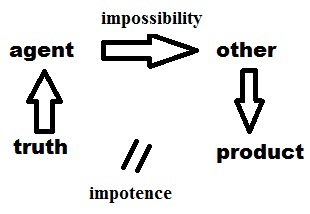
Ž the abyss of the Other desire 4

Žižek, S. The Plague of Fantasies. New York: Verso, 1997.
Fiat iustitia, pereat mundus is a Latin phrase. It means: “Let there be justice, though the world perish.”

Hegel’s (and Lacan’s, incidentally) point is that it is possible to move ‘beyond Good and Evil’, beyond the horizon of the Law and constitutive guilt, into drive

Hegel’s implicit thesis is that

diabolical Evil is another name for the Good itself; for the concept ‘in itself’, the two are indistinguishable, the difference is purely formal, and concerns only the point of view of the perceiving subject.

In short ‘diabolical evil’ is simply Kant’s name for what Freud [calls] the death drive.

I become aware of my freedom only through the experience of how, on behalf of the moral law, I am able to withstand the pressure of the pathological motivations which tie me to innerworldly phenomenal causality.

the pure moral act is impossible, of how one can never be sure that one is acting solely out of consideration for duty, is the far more uncanny fact that the moral act, precisely as impossible, is simultaneously unavoidable, that which is in a way impossible to transgress.

it is only my failure to act ethically which guarantees that I remain an ethical subject, since were I to accomplish a pure ethical act, I would change into a being of diabolical Evil (in a Sadeian Supreme-Being-of-Evilness). 230

true evil involves precisely the blurring of distinctions between Good and Evil — that is, the elevation of Evil into a consistent ethical Principle. A revolutionary terrorist, for example, is of aesthetic interest if he is not merely a bloodthirsty executioner killing and torturing out of pure egotistical baseness, but a sincere idealist ready to sacrifice everything for his Cause, convinced that he is doing a service to humanity, and thus caught in the tragic deadlock of his predicament. … … such an ‘ethical evil’ is the true diabolical Evil, much worse than the evil of simple egotistical baseness: the cleaner you are (the more your motives are selfless-humanitarian), the greater your evil. 234-235

abyss of the Other’s desire 3

Žižek, S. The Plague of Fantasies. New York: Verso, 1997.

The standard subject’s reaction to the act is that of aphanasis, of his/her self-obliteration, not of heroically assuming it: when the awareness of the full consequences of ‘what I have just done’ hits me, I want to disappear.  At this precise point Lacan (and already Freud’s notion fo the death drive) parts with the Romantic ideology of a ‘demonic’ self-destructive Will: the death drive is not a ‘will to die’, radical Evil is not a ‘diabolical’ intention that seeks pleasure in inflicting pain on one’s neighbour

abyss of the Other’s desire 2

Žižek, S. The Plague of Fantasies. New York: Verso, 1997.

.. the unique strength of Kant’s ethics lies in this very formal indeterminacy: moral Law does not tell me what my duty is, it merely tells me that I should accomplish my duty. That is to say, it is not possilbe to derive the concrete norms I have to follow in my specific siutation from the moral Law itself —

which means that the subject himself has to assume the responsibility of ‘translating’ the abstract injunction of the moral Law into a series of concrete obligations. 221

The fact that the Subject is a Universal Being means that, precisely, he cannot simply rely on some determinate substantial content (‘universal’ as it may be) which would fix the co-ordinates of his ethical activity in advance, but that the only way for him to arrive at Universality is to accept the objective indeterminacy of his situation — I become ‘universal’ only through the violent effort of disengaging myself from the particularity of my situation: through conceiving this situation as contingent and limiting, through opening up in it the gap of indeterminacy filled in by my act. 222

Subjectivity and universality are thus strictly correlative: the dimension of universality becomes ‘for itself’ only through the ‘individualist’ negation of the particular context which forms the subject’s specific background.

… compels us to reject any reference to ‘duty’ as an excuse: “I know this is difficult, and might be painful, but what can I do? It’s my duty…” … The reference to duty as the excuse for doing our duty should be rejected a hypocritical … The obscene jouissance of this situation is generated by the fact that I conceive of myself as exculpated from what I am doing: isn’t it nice to be able to inflict pain on others in the full awareness that I’m not responsible for it, that I am merely fulfilling the Other’s Will … this is what Kantian ethics prohibits. 221-222

The Kantian law is thus not merely an empty form applied to a random empirical content in order to ascertain if this content meets the critieria of ethical adequacy— rather, the empty form of the Law functions as the promise of an absent content (never) to come. … the form is not only a kind of neutral universal mould of the pluality of different empirical contents; the autonomy of the Form, rather, bears witness to the uncertainty which persists with regard to the content of our acts — we never know if the determinate content which accounts for the specificity of our acts is the right one: that is, if we have really acted in accordance with the Law and have not been guided by some hidden pathological motive. … the subject finds himself in a situation in which, although he knows there is a Law, he never knows (and a priori cannot know) what this Law is — a gap forever separates the Law from its positive incarnations. The subject is thus a priori, by virtue of his very existence, guilty: guilty without knowing what he is guilty of (and for that very reason guilty), infringing the law without knowing its exact regulations.

What we have here is, for the first time in the history of philosophy, the assertion of the Law as unconscious: the experience of Form without content is always the index of a repressed content — the more intensely the subject sticks to the empty form, the more traumatic the repressed content becomes. 226

abyss of the Other’s desire 1

Žižek, S. The Plague of Fantasies. New York: Verso, 1997.

An ethics grounded in reference to the traumatic Real which resists symbolization, the Real which is experienced in the encounter with the abyss of the Other’s desire

Che Vuoi? What do you want [from me]?

… the trauma qua real is not the ultimate external referent of the symbolic process, but precisely that X which forever hinders any neutral representation of external referential reality. … the Real qua traumatic antagonism is, as it were, the objective factor of subjectivization itself; it is the object which accounts for the failure of every neutral-objective representation, the object which ‘pathologizes’ the subject’s gaze or approach, makes it biased, pulls it askew. … the very stain or spot which disturbs and blurs our ‘direct’ perception of reality — which ‘bends’ the direct straight line from our eyes to the perceived object. (Plague of Fantasies 214)

sexual difference is not some mysterious inaccessible X which can never by symbolized but, rather, the very obstacle to this symbolization, the stain which forever keeps the Real apart from the modes of its symbolization. Crucial to the notion fo the Real is this coincidence of the inaccessible X with the obstacle which makes it inaccessible — as in Heidegger, who emphasizes again and again how Being is not simply ‘withdrawn’: Being ‘is ‘nothing but its own withdrawal…’ 216-217

… the unique strength of Kant’s ethics lies in this very formal indeterminacy: moral Law does not tell me what my duty is, it merely tells me that I should accomplish my duty. that is to say, it is not possible to derive the concrete norms I have to follow in my specific situation from the moral Law itself — which means that the subject himself has to assume the responsibility of ‘translating’ the abstract injunction of the moral Law into a series of concrete obligations. In this precise sense, the point of Kant’s ethics is (to paraphrase Hegel) ‘to conceive the moral Absolute not only as Substance, but also as Subject’: the ethical subject bears full responsibility for the concrete universal norms he follows — that is to say, the only guarantor of the universality of positive moral norms is the subject’s own contingent act of performatively assuming these norms. (221)

It is therefore Kant’s very ‘formalism’ which opens up the decisive gap in the self-enclosed ethic and/or religious Substance of a particular life-world: I can no longer simply rely on the determinate content provided by the ethical tradition in which I am embeded; this tradition is always already ‘mediated’ by the subject; it ‘remains alive’ only in so far as I effectively assume it. The way to undermine ethical particularism (the notion that a subject can find his or her ethical Substance only in the particular tradition outof which he grew) is thus not via reference to some more universal positive content (like the unfortunate ‘universal values shared by all humanity’), but only by accepting that the ethical Universal is in itself indeterminate, empty, and that it can be translated into a set of positive explicit norms only by means of my active engagement, for which I take full responsibility … thus there is no determinate ethical universality without the contingency of the subject’s act of positing it as such.    221

lack in the other

Tutt, Daniel. The Object of Proximity: The Ethics of Psychoanalysis in Žižek and Santner via Lacan. American University Also available here danielp.tutt(at)gmail.com

For Lacan, symbolic identity inhabits an empty place, or the “point de capiton,” which occurs when the subject functions as a signifier embodying a function beyond its own concreteness. The subject is emptied of its particular signification in point de capiton, in order to represent fullness in general. Point de capiton operates in national, religious, political, or ethnic signifiers such as “the nation” or “communism” or even religious identity groupings such as “Christian” or “Muslim,” yet they function as pure negativity, and represent what has to be excluded or negated.

As Yannis Stavrakakis points out in the Lacanian Left, the Name of the Father functions as an insertion into point de capiton, as an operation tied to power relations in late capitalism. Lacan’s Seminar on the Four Discourses introduces the “university discourse” as arising in the wake of the chaotic revolutionary protests of May 1968 in France, and across Europe. The university discourse is a mode of discourse that incorporates scientific discourse to legitimize relations of power. The subject in university discourse becomes equivalent with the social totality, and is situated in the particular historical and late capitalist symbolic space, where the movement occurs, mainly apart from the Master’s discourse, and into university discourse.

An excellent example that reveals the procedure of Name of the Father filing in the point de capiton into empty symbolic identity are the popular “culture jamming” Yes Men. The Yes Men are a group of activists who inhabit false symbolic authority by assuming the identity of powerful businessmen, activists, and politicians. They deliver totally ludicrous presentations that are in actuality totally empty of legitimate content. What they have discovered through these presentations to power holders is that their audiences end up listening attentively to their presentations, and more importantly, they end up taking their statements for total fact without question and most often end up agreeing with their absurd findings.

What this indicates more than anything is that symbolic identity construction functions as an empty gesture of symbolic power supported by a fantasmatic supplement, and both unite to form reality. What the Yes Men and the case of Schreber both indicate is that the commands of identity, deployed from the level of fantasy will always be filled up as an empty vessel. The “crisis of investiture” for both Schreber and the Yes Men occur when “the kernel of invasiveness of too much reality” functions on the side of symbolic identity as an empty space that can be filled in with an inherent negativity. This crisis of identity problematizes attempts to adequately symbolize oneself in everyday reality. 🙂 His use of Yes Men here is confusing.

Lack and Desire in the real

In the Ethics of Psychoanalysis, the mediating force of the Other is desire. Desire is posited as universal,  “all desire is desire of the Other,” since all desire is structured around a missing jouissance, around a lack; it is important to understand the way that lack of the Other structures symbolic identities.

Lack is always introduced through an act of exclusion, an exclusion in part responsible for the fundamental disequilibrium between integrating the Other into the symbolic realm, yet we find that there is something that does fill in the symbolic: fantasy

The imposition of fantasy arises precisely when the desire for filling in, or covering over lack arises. On a structural level, fantasy stimulates and promises to cover over the lack in the Other created by the loss of jouissance.

Since fantasy is also an effect of symbolic castration, it is also a defense mechanism against the fear of symbolic castration. Symbolic castration is defined by Lacan as, “a symbolic lack of an imaginary object,” and symbolic castration is the subject’s first perception of the Other, as not complete, but lacking.

Lacan argues that the subject can only maintain psychic normality by accepting this inherent lack of the other; hence symbolic castration plays a normalizing effect on the subject.

Fantasy then becomes crucial to understanding the role of the “I-Other” relationship and to determining how the Other serves as a support that fills in the void for the lack in the Other, in the realm of the symbolic. The illusory nature of fantasyserves as the central support for the desire to identify, which is inherently impossible in the real, as discussed above.

The Other of fantasy takes on the role of an object, or das Ding to sustains desire itself, and since the Other appears as a remainder, the Other is in an almost mythological status to the subject. The Other promises to provide what the subject lacks and thus unify both as subjects.

The other takes on the role of the object that can potentially unify both the split psyche (of the subject) and of unifying the split social field itself.

over-proximity

Tutt, Daniel. The Object of Proximity: The Ethics of Psychoanalysis in Žižek and Santner via Lacan. American University Also available here danielp.tutt(at)gmail.com

The Psychotheology of Over-Proximity

The ethical problem of proximity to the neighbor introduces a number of ethical implications for ethics, and the ethical relation to the Other in Eric Santner’s work, The Psychotheology of Everyday Life. For Santner, the ultimate problem of the neighbor is based on the whether the subject accepts the Other (or neighbor) in their jouissance, or REAL excess, and in so doing, how they come to handle this over-proximity. Santner characterizes the Freudian “mental excess” (what Lacan would later deem jouissance) as an “excess of validity over meaning,” as the “undeadness of biopolitical life,” and his primary ethical concern is in how to convert the excess into a “blessings of more life.”[25] This mental excess that the subject inhabits, or what Santner refers to as “undeadness” colors everyday life as “a paradoxical kind of mental excess that constrains by means of excess.”[26] Santner develops a slightly different type of Otherness than that of Lacan, based on Jean Laplanche’s psychoanalytic theory of “seduction. ” Laplanche was an intimate student and colleague of Lacan, and in his conception of the Other, or the “enigmatic signifier” the traumatic encounter with the Other’s desire becomes constitutive of the inner strangeness we call the unconscious itself. Therefore, unlike the Lacanian Other, Santner’s Other is stripped of its material properties, a position that evokes Derrida’s notion of the spectral aura of the Other:

“the other is not reducible to its actual predicates, to what one might define or thematize about it, anymore than the I is. It is naked. Bared of every property, and this nudity is also its infinitely exposed vulnerability: its skin. This absence of determinable properties, of concrete predicates, of empirical visibility, is not doubt what gives to the face of the other a spectral aura.” [Derrida, Adieu. To Emmanuel Levinas, pg. 111]

The subject is placed in a relationship with the enigma of the Other’s desire not through language (as in Lacan) but through an unconscious transmission that is neither simply enlivening nor simply deadening but rather “undeadening” – the encounter with the Other produces an internal alienness that has a sort of vitality, and yet belongs to no life at all. This “undeadness” creates an encounter with legitimation, or what Freud referred to as the death drive, a “too much-ness” of pressure and the build of an urge to put an end to it.

Santner’s ethics at this point, in light of the crisis of symbolic identity is concerned with whether we ought to assume our identity in the social body based on the symbolic mandates that determine our identity, or whether the subject ought to break with this system. The two poles of ethical action he develops are the “sciences of symbolic identity,” and the “ethics of singularity.” The strength of Santner’s ethical position is that only when we “truly inhabit the midst of life” are we able to “loosen the fantasy” that structures everyday life.

Thus, similar to what we see in Lacan, to own one’s fantasy is to really live as a free subject, aiming at the truly ethical question that Lacan poses: “have you acted in conformity with the desire which inhabits you?” for it is desire that aims at the real.

The Crisis of Symbolic Investiture

How the subject in Santner’s the Psychotheology, as well as Lacan’s ethical subject deals with “the crisis of symbolic investiture” are a matter of ethics, which we will explore below.

For both Lacan and Santner, ethics requires a confrontation with the Other to free oneself of the Other and then surrender to the real, or everyday life. The confrontation with everyday life, or the Lacanian real is a collapse of the subject’s symbolic constructed identity.

The symbolic identity crisis that Lacan and Santner refer to can be more clearly understood through Santner’s reading of the book Soul Murder, and Lacan’s theory of the Name of the Father. Soul Murder and Name of the Father are instructive to understanding how “the crisis of symbolic investiture” operates through psychoanalytic theory.   Both Lacan and Santner refer to the crisis of symbolic identity when discussing the infamous case of the Judge Daniel Schreber, who upon receiving the symbolic authority in society as a Judge experienced a total psychotic breakdown where his very ability to assume a symbolic identity rooted in authority became penetrated with “a kernel of invasiveness, which introduced the subject into too much reality.” What is it about this “too much reality” that created the conditions for the “the crisis of symbolic investiture?” To fully understand this crisis, a reading of Lacan’s late capitalist “university discourse” and the complex insertion of the Name of the Father bring the crisis into more clarity.

ethics pluth

Tutt, Daniel. The Object of Proximity: The Ethics of Psychoanalysis in Žižek and Santner via Lacan. American University Also available here danielp.tutt(at)gmail.com

In the Ethics of Psychoanalysis, Lacan develops the neighbor as “das Ding”, (the Thing) a pre-symbolic object characterized primarily by affect and appearing in the symbolic realm prior to any and all representation.[5]

Das Ding is a substanceless void, and in structure it is equivalent to the neighbor, or the Other.

The Other[6] takes on a “thing-like” character based on an excess materiality that always resists symbolization in the register of the real. This Other as object is filled in by a certain distance, what Lacan refers to as proximity, a proximity that is identical to the neighbor. As Lacan comments, “the neighbor is identical to the subject, in the same way that one can say the Nebenmensch that Freud speaks of as the foundation of das Ding as his neighbor.”[8] Lacan’s theory of the neighbor-as-das-Ding is rooted in Freud’s conception of das Ding: “and so the complex of the neighbor divides into two constituent parts the first of which impresses through the constancy of its compos[i]tion, its persistence as a Thing, while the other is understood by means of memory-work…”[9]

Lacan characterizes das Ding as “a primordial function located at the level of the unconscious Vorstellungen.”[10] Das Ding ultimately indicates that there is no sovereign good; and thus no possibility to constitute the good in the realm of the subject. “There is good and bad and then there is das Ding” – the Thing remains unfathomable, an excess, outside of the moral relationship.

Lacan’s Ethics: A Matter of Form and Freedom

… Lacanian ethics, as Zupancic correctly points out,… it is something that happens to us, it throws us out of joint, because it always inscribes itself in a given continuity as a rupture, a break or interruption. This is when ethics comes into play; i.e. will I act in conformity to what threw me out of joint? For Lacan, emphasis is placed on desire, “have you acted in conformity with the desire which inhabits you?” for after all, it is desire that aims at the real.[17]

Das Ding, in The Ethics of Psychoanalysis … [is] that which manifests desire for the real. Thus, the real, in ethical terms is an extra moral matter, similar to what we find in Kant’s moral system.

“If a man is to become not merely legally, but morally, a good man… this cannot be brought about by gradual reformation so long as the basis of the maxims remain impure, but must be affected through a revolution in the man’s disposition… He can become a new man only by a kind of rebirth, as it were through a new creation.”[Kant, Immanuel Religion Within the Limits of Reason Alone, Pg. 42 – 43]

Kant and Lacan are both placing ethics, and ethical change ex nihilo, and both develop their ethical systems out of a material excess, for Kant the excess is pathology, and for Lacan it is objet petite a. [21] Both systems are seeking to manage the “excess of the real,” and Zupancic argues, Lacan’s passage a la act is identical to Kant’s allegiance on form in his development of the Groundwork. For Lacan, the faculty of desire does not point to any particular act of desiring but to the frame of desiring as such, similar to how Kantian form points to duty.

The surplus in relation to legality and to the ethical is what is dealt with by form – the main point being that for Kant it is incumbent to follow the form of duty. Kantian ethics demands that an action not only conform to duty, but it mandates this conformity be the only content or motive of that action. Form itself must be appropriated as a material surplus, in order for it to determine the will, and Kantian form is the same as Lacan’s conception of objet petite a, the thing that persists beyond surplus enjoyment. The metaphysical question to both systems of ethics is virtually the same, how can form become matter?

Yet, both Lacanian and Kantian ethics seek to solve the problem of form, or how if Kantian form and Lacanian objet petite a force the subject to follow a sort of second nature, then ethics functions as a drive and isn’t ethics at all. As Zupancic argues, how Lacan dealt with objet petite a, or the surplus enjoyment left over in the domain of the real that persists for the sake of enjoyment is similar to how Kant dealt with the excess of pathology. Since the Kantian object drive is nothing but the drive of the will, and the Lacanain subject’s separation from the pathological objet petite a produces a certain remainder, a remainder that constitutes the drive of the ethical subject, both systems of thought construct ethics from very similar conceptual problems.

We are beginning to see the contours of a Lacanian subject forming that is not rooted in a nightmarish ontological rut as many have criticized Lacan, particularly those that argue his subjectivity is purely a subject constructed from language.

To the contrary, as Ed Pluth has noted in Signifiers and Acts: Freedom in Lacan’s Theory of the Subject, Lacan’s ethics are rooted in a view of freedom of the subject. Importantly, the Lacanian subject can change the destiny of an unconscious desire to the point of “being verbal to the second power” – since “every act of speaking involves an act of addressing an other – always implying a search for recognition from a third party other,” a true ethical act is one that does not address the big Other.

As Pluth observes, “an act does not receive recognition for its identity from an other… it is thus not the subject that acts, an ‘act subjects.’” Thus, the Lacanain subject can never locate the good in the subject, but the subject is able to overturn their lack of capacity to assume their own symbolic identity. The capacity of the subject to overturn their symbolic situation will be examined via Slavoj Žižek and Eric Santner’s reading of the ethics of psychoanalysis.

ethics Ž

Tutt, Daniel. The Object of Proximity: The Ethics of Psychoanalysis in Žižek and Santner via Lacan. American University Also available here danielp.tutt(at)gmail.com

Proximity towards the jouissance of the Other, or the neighbor, in Lacan’s seminar The Ethics of Psychoanalysis becomes a matter of ethical concern because the Other as das Ding (the thing) poses problems outside of the moral relationship. In this paper I will examine the ethical positions of two psychoanalytic theorists, Eric Santner and Slavoj Žižek. The proximity towards the excessive jouissance of the neighbor as das Ding presents a number of interesting ethical problems. Žižek’s confrontation with das Ding is a complex procedure that remains ambiguous, particularly in light of his sympathies towards the Christian Pauline agape version of radical love. Žižek’s treatment of proximity towards the Other seeks a total escape from the fantasmatic symbolic coordinates of the oppressive symbolic order, whereas with Santner, in his text The Psychotheology of Everyday Life, the “mental excess” of jouissance caused by confrontation with the Other as das Ding is sought to be converted into an owning of the excessive proximity into a “blessings of more life.”

This paper first identifies and describes the Lacanian subject – a subject rooted in lack and the crisis of symbolic investiture and argues that Lacanian subjectivity is capable of radical freedom from the fantasmatic symbolic coordinates that sustain its relationship to its own freedom. There are several meta-ethical questions that arise in light of Lacan’s notion of ethics for subjectivity inhabited by fantasmatic symptoms and a symbolic order structured by oppressive fantasy relations. These problems will be explored in this paper as they guide both Žižek’s and Santner’s work, particularly the superego demand to “love thy neighbor as thyself.” The question of politics in relation to the Other for Santner is centered on how to convert the “superego ban” into a blessings of more life.

Whereas with Žižek, the meta-ethical subject ought to be positioned in relation to the Other to enable a radical break from the fantasmatic symbolic coordinates into a new symbolic relationship to the Other, a position highly reminiscent of Antigone’s.

To what extent does Žižek’s ethics reflect Lacan’s sympathies towards Antigone’s reluctance to renounce her fundamental desire? Furthermore, how does Santner in the Psychotheology of Everyday Life position his meta-ethical subject in allegiance to the desire of the Other, and what are the political implications for both of these positions? Admittedly, this is an especially speculative question considering Santner does not deal directly with Lacan’s ethics seminar.

With the rise of the Lacanian left, and a number of texts beginning to identify the relationship between psychoanalysis and politics, we are presented with a powerful critique of the undergirding assumptions behind liberal theory. Perhaps most importantly is the notion that transitive recognition from the Other as the constituting ground of intersubjectivity is inherently blocked by the functioning of desire.

Das Ding and the Impossible Good of the Lacanian Subject

The ethical injunction to “love thy neighbor as thyself” is problematized in Lacan’s seminar The Ethics of Psychoanalysis, as the very core of the intersubjective relation is rooted in an unconscious structural relation to the realm that Lacan refers to as the symbolic. The Lacanian register of the symbolic is an often-difficult concept to unpack. One of the more cogent descriptions of the symbolic is found in popular culture through the example of Woody Allen’s public divorce with Mia Farrow. Allen is said to have dealt with the media in the same hyperactive, idiosyncratic ways as the characters in his films. A traditional psychoanalytic reading of this occurrence would argue that Woody Allen’s actions are merely repressed character traits of his own self put down onto the big screen and then reappearing as a result of a psychical and emotional breakdown. The Lacanian reading would argue something different; that Allen’s incorporation of his symbolic behavior patterns from symbolic art is real life as such. The Lacanian subject is deprived of that which it believes to be the most intimate part of himself, and this happens in the realm of the symbolic.  [ 🙂 Ž makes this point in CHU pg. 250 ]

When faced with the ethical injunction “to love thy neighbor as thyself,” the primary procedure for the multicultural and Judeo-Christian models are to keep at bay the proximity of the neighbor, as the neighbor is inhabited with an uncanny jouissance. To Lacan, one truly encounters the Other not when one discover her values, dreams, and wishes, but when the subject encounters the neighbor as jouissance. As Žižek has suggested, what the predominant liberal multiculturalist model has neglected is this very direct encounter with the “traumatic kernel” of the Other in favor of PC engagement with the “decaffeinated Other.”

“I encounter the other in her moment of jouissance. When I discern in her a tiny detail – a compulsive gesture, an excessive facial gesture – that signals the intensity of the real of jouissance. This encounter is always traumatic, there is something at least minimally obscene about it, I cannot simply integrate it into my universe, there is always a gap separating me from it.”[1]

The postmodern multiculturalist mode of engaging the other, as Zizek has noted, runs along two primary modes, that of the New Age, and the Judeo-Christian, both of which are merely displacing a form of pathos onto an Other that is more authentic, and this ends up causing a sort of inverted racism.

Encountering the Other at the level of das Ding, without depriving that Other of its symbolic jouissance, which the liberal multiculturalist requires, is by definition an exclusivist act by the distance it maintains towards the Other. This distance towards the other is the basis of the ethics of Eric Santner and Slavoj Žižek, but before examining them, we turn to Lacan’s ethical system.

Fink Stavrakakis Van Haute

Fink, Bruce. The Lacanian Subject. New Jersey: Princeton UP, 1995. [LS]
Stavrakakis, Yannis. Lacan and the Political. New York: Routledge, 1999. [LP]
Van Haute , Phillipe. Against Adaptation. New York: Other Press, 2002. [AA]

Alienation [LS 48]
By submitting to the Other, the child nevertheless gains something: he or she becomes, in a sense, one of tf language’s subjects, a subject “of language” or “in language.” Schematically represented, the child, submitting tothe Other, allows the signifier to standin for him or her.
Other/child
The child, coming to be as a divided subject, disappears beneath or behind the signifier, S.
S/$
“Your money or your life!”
… it is clear that your money is as good as gone. … You will thus, no doubt, be more prudent and hand over your wallet or purse; but you will nonetheless suffer a restriction of your enjoyment, insofar as money buys enjoyment. … in his or her confrontation with the Other, the subject immediately drops out of the picture. While alienation is the necessary “first step” in acceding to subjectivity, this step involves choosing “one’s own” disappearance.

Lacan’s concept of the subject as manqué-à-être is useful here: the subject fails to come forth as someone, as a particular being; in the most radical sense, he or she is not, he or she has no being. The subject exists — insofar as the word has wrought him from nothingness, and he or she can be spoken of, talked about, and discoursed upon — yet remains beingless.

Prior to the onset of alienation there was not the slightest question of being … Alienation gives rise to a pure possibility of being, a place where one might expect to find a subject but which nevertheless remains empty. Alienation engenders, in a sense, a place in which it is clear that there is, as of yet, no subject: a place where something is conspicuously lacking. The subject’s first guise is this very lack. [LS52]

Lack in Lacan’s work has, to a certain extent, an ontological status, it is the first step beyond nothingness.
… the subject is completely submerged by language, his or her only trace being a place-marker or place-holder in the symbolic order.

The process of alenation may, as J.A. Miller suggests, be viewed as yielding the subject as empty set, {0}, in other words, a set which has no elements, a symbol which transforms nothingness into something by marking or representing it. [LS52]

The empty set as the subject’s place-holder within the symbolic order is not unrelated to the subject’s proper name. That name is often selected long before the child’s birth, and it inscribes the child in the symbolic. A priori, this name has absolutely nothing to do with the subject; it is as foreign to him or her as any other signifier. But in time this signifier – more, perhaps, than any other—will go to the root of his or her being and become inextricably tied to his or her subjectivity. It will become the signifier of his or her very absence as subject, standing in for him or her.


“Imaginary relations” are not illusory relationships – relationships that don’t really exist – but rather relations between egos, wherein everything is played out in terms of but one opposition: same or different. They involve other porple who you consider to be like yourself for a variety of reasons. It could be because the two of you look very much alike, are similar in size or age, and so on.

Imaginary relationships are characterized by two salient features: love (identification) and hate (rivalry). Insofar as the other is like me, I love and identify with him or her, feeling his or her joy and pain as my own. In the case of identical twins, one often finds that one twin cathects the other twin’s ego almost as much as his or her own.

Difference inevitably creeps between even the most identical of twins, whether due to differential treatment by parents or changes in appearance over time, and the closer the relationship at the outset, the greater the rage over minute differences is likely to be.

Sibling rivalry is the best-known example of imaginary relations involving hatred. Whereas very young children usually do not call into question their subordination to their parents — perceiving a clear difference between their parents and themselves — they do regularly contest, right from a very tender age, their rank and status among their siblings.  Children generally consider their siblings as in the same category as themselves, and cannot abide overly preferential treatment by the parents of anyone other than themselves, double standards, and so on. They come to hate their siblings for taking away their special place in the family, stealing the limelight, and perfomring better than they do in activities valued by the parents. That same kind of rivalry generally esxtends in time to classmates, cousings, neighborhood friends, and so on. The rivalry in such relationships very often revolves around status symbols and implies all kinds of other symbolic and linguistic elements as well.  LS 84-85

calum Antigone the act part 7

It is as an example of the beautiful that Lacan reads Antigone and, particularly, within the play, Antigone. It is as such that, with Lacan, we find something in the text ‘other than a lesson on morality’.

This is not to claim that Antigone has, for Lacan, no ethical import. It is, after all, in the context of his seminar on the ethics of psychoanalysis that he spends considerable time discussing the play.

It is rather to stress that the ethical import of the play lies not in the moralising arguments it might be understood to put forward, whether these be in the sense of a discourse between competing conceptions of the just or (moral) good or in the sense of an advocation of a position of transgression.

While both these positions are, of course, possible, neither addresses the question of ethics. They remain, rather, on the side of (questions of) the law.

The ethical is by definition a subjective moment, the moment of subjective assumption in response to the lack encountered in the Other and the other.

The ethical, that is, is the moment of assumption of that point which refuses recuperation to an image or to a rule, that point where the Symbolic and the Imaginary break down or break open upon the Real.

In terms of the moral law, the ethical is the point at which the subject assumes upon itself the impossible place of that which would guarantee the law. In terms of the Imaginary, ethics is the response to that in the other which refuses recuperation to a coherent image of identification. To render Antigone or Antigone as an ethical example, or as the ethical example par excellence, is to assume to generalise that which is by definition beyond generalisation.

That is to say, to confer upon Antigone the status of example would be to make of Antigone and her act a rule which might be followed; thou shalt transgress the symbolic. But such an example is clearly not an ethical example at all. The ethical moment would necessarily resist any such generalisation and return in the form of the necessity of the subject assuming upon itself the impetus to follow (or reject) the example.

It is not especially that Antigone or Antigone’s act cannot function as an ethical example. It is rather that the ethical cannot be exemplified without recuperating it to a law. Which is to say, precisely, without rendering it other than ethical.

As beautiful, as that which would simultaneously reflect and lure our desire, Antigone would demand a response. This demand would be the subject’s confrontation with the desire that is in it. That is to say, in its location at and as the limit point of the Real, that at which desire would impossibly aim, the beautiful can be understood to be that which would ask of the subject, ‘Have you acted in conformity with the desire that is in you?’ (Lacan Seminar VII p. 314)

As, that is, that which can simultaneously support and lure desire, that which allows the subject to confront das Ding without it destroying the subject, the beautiful would be that which would allow the subject to confront the desire that is in it and thus begin to name this desire, to bring it into the world.

That is to say, it is precisely insofar as the beautiful allows the possibility of encountering the limit of the Real without subsuming the subject in the Real and thus rendering the subject impossible, that it allows the subject the possibility of both confronting its desire and inscribing its desire in the Symbolic.

It is in this sense that the beautiful would entail a cathartic function. The beautiful would allow the possibility of the purification of desire, not in the sense of allowing the subject to attain and occupy pure desire but in the sense of allowing the subject to experience its desire stripped of the trappings of the Symbolic and Imaginary orders and, significantly, to return to the Symbolic and Imaginary orders, bringing with it ‘a new presence’, something which cannot simply be accommodated as though it had always already been there.

The ethical significance of Antigone lies, therefore, not in Antigone’s act in the sense that her act would function as the quintessential ethical example but, rather,

the ethical significance of the play lies in the manner in which it would relate to the desire of the spectator.

The extent to which we can discuss Antigone’s act at all is the extent to which it has been or is being (re)inscribed in the Symbolic. This should alert us to the ambiguity of the act insofar as it can become a topic for discussion.

Antigone’s act, in the proper Lacanian sense, is her act. It is only available for her. What impacts of Antigone’s act on others is either/both a moment of emergence of the Real and/or a Symbolic recuperation depending on the moment of logical time from which it is perceived.

That is to say, we might discern separate moments in Antigone’s so called act.

  • There would be the moment of incomprehension wherein the act disrupts and cannot be explained.
  • There would also be the moment of comprehension wherein the act is slotted into a framework of explanation – e.g. Antigone promotes an alternative discourse on what is just, Antigone constitutes the revolutionary stance par excellence precisely because she promotes no discourse on justice at all but is understood to have introduced a moment of radical disruption for the social weave of Thebes.

Neither of these perspectives, however, can be adequate to the act as it is assumed by Antigone, if it is in fact an act at all.

Given that she is never more than a fictional character, one might be justified in pointing out that ‘she’ cannot assume anything. The pertinent ethical question in Antigone is how we, the audience, the spectator, the reader, respond to the play and respond beyond the play.

The only true act in Antigone is precisely not in Antigone, it is in response to Antigone.

calum on Ž the Other part 5

Neill, Calum. “An Idiotic Act: On the Non-Example of Antigone.” The Letter , 34, 2005, 1-28.

The Symbolic order is necessarily experienced by the subject as Other, as an Other of which there is available no objective and totalising conception. That is to say, the Symbolic as Other figures only insofar as it figures in relation to the subject who would encounter it. The Symbolic order is a structural condition which, as it manifests for and in relation to the subject, can only be seen to exist insofar as it exists for that subject.

Conjoined with this, the Symbolic would be the field in which the subject would assume its constitution and, thus, from which it would retroactively posit its emergence. While, then, the Symbolic and the subject obviously cannot be reduced to (aspects of) one another, neither can they, in this context, be separated from one another.

The conception of the act as a reconfiguration of the Symbolic would then have to figure as a subjective undertaking. In terms of Antigone’s act, the act would not only be Antigone’s in the sense that she performs it but it would be hers in the sense that it is performed in relation to the Symbolic order as it manifests for her. This would be to acknowledge that the act can only be experienced by the subject. But even in order for the subject to be understood to have experienced the act or to have experienced itself as acting this would necessitate the act’s (re)inscription in the Symbolic.

The act, as coterminous with the assumption of subjectivity, is necessarily pulsational. One cannot (permanently) occupy the act.

We should perhaps remember here Lacan’s claim from Television that ‘Suicide is the only act which can succeed without misfiring’. Suicide would be such an act precisely because it is not, from the subjective perspective, reinscribed in the Symbolic.

There is in suicide no continuation, no possibility of recuperation by or to the Symbolic but also, quite clearly, no possibility of subjectivity either. That suicide is the only act which can succeed without misfiring is not to advocate suicide, it is, rather, to recognise the impossibility of other acts not misfiring. Suicide is the only act which would not entail a recuperation to the Symbolic by the subject who would have committed it.

The point remains here, however, even acknowledging this subjective relation to the Other , that any act at all, in Žižek’s understanding of it, might figure as ethical even if this means that it only figures as ethical for the particular subject who has acted. Which is precisely to say that there is available no means to differentiate the ethical from the unethical. To paraphrase Simon Critchley’s question concerning Badiou’s notion of the event, and there does appear to be some theoretical resemblance between Žižek’s ‘act’ and Badiou’s ‘event’, how and in virtue of what is one to distinguish an ethical act from a non-ethical act?

Invoking Kant, Žižek represents the ‘proper ethical act’ as ‘doubly
formal: not only does it obey the universal form of law, but this universal form is also its sole motive’. 45

Moreover, the proper ethical act is inherently transgressive. It is not merely a matter of allegiance to a universal duty without pathological motives but it is an allegiance to a form of action which will redefine the very form of the prior conception of what would constitute the good, the norm, the Symbolic order. Žižek’s ‘moral law does not follow the Good – it generates a new shape of what counts as ‘Good’’. The proper ethical act is then, for Žižek, not so much defined by its irrational nature but is that which would institute a new conception or criteria for what counts as rational at all. Nothing which precedes an act is adequate to the task of judging the act.

As Žižek himself makes clear, the act is radically distinguished from ‘a simple criminal violation’. This, not because the act is necessarily a violation without pathological intent or because the act is a violation in the name of a competing conception of right or justice but precisely because the act entails the assumption of cause by the subject without illusory appeal to some other (or Other) foundation for action. It is in this sense that the act would be properly described as a suspension of the Other.

The act is located at the limits of the authority of the Other, the act is the point of subjective intervention without appeal to an Other authority.

The Other, as we have seen, can be understood as coterminous with the Symbolic order insofar as it manifests as a subjective experience. The Other, that is, is the Symbolic order as it is, and with the specificity with which it is, encountered by the subject.

Das Ding is that which cannot be recuperated to either the Symbolic order or to the Imaginary order. It is that of the Real which would insist at the limits of subjective experience. It is, in the context of ‘intersubjectivity’, that of the other which cannot be accommodated to a point of recognition, that in the other which can neither form an aspect of identity nor be reduced to a point of signification. It is also, then, that in and of the subject which can neither be reduced to imaginary identification nor recuperated to a system of signification.

What Žižek characterises as the insistence of ‘the Other-Thing’ would be more accurately described as that in any encounter which cannot be recuperated to a totalising comprehension. It is the insistence of this Thing which cannot adequately be accommodated which would be indicative of the lack in both the other and the Other.

In the encounter with the Other, the Other is experienced as demanding of the subject. It is such a demand which would be indicative of das Ding, insofar as das Ding might be that which would satisfy this demand. In this sense, das Ding can be understood to be a name for that which the Other is experienced as lacking.

It is clear then that, as Žižek appears to acknowledge, there is no possible correlation between the (particular) insistence of the subject and das Ding. If there were, then this would be to simultaneously ‘solve’ the lack in the Other and the lack in the subject.

Which would be to say that there is no subject and no Other for the subject. There would be, that is, no Symbolic order in which the act could be (re)inscribed.

The act should rather be understood as the subject’s always inadequate response to the Other (and the other).

The act is the moment of production of something in response to the other and the Other, precisely in the sense that that something is not the Thing, is not adequate to das Ding. The act would be the moment of subjective assumption, the moment of the subject’s causing its desire to come forth.

But such desire is never something which would be ‘entirely given’,  it is something which must be brought into the world anew. Insofar as the subject’s act is to be understood, it must be reinscribed in the Symbolic and, in being so inscribed, it does necessarily alter the Symbolic. It is in this sense that, as Žižek correctly notes, the act is a creatio ex nihilo.

It is in the act that ‘the subject creates, brings forth, a new presence in the world’.

It must however by emphasised that it, the act, is commensurate with the moment of subjective assumption.

That is, that the act is the act for the subject who would have constituted itself in the act.

Or, phrased otherwise, the act is the subjective moment of assumption and is thus only experienced as such by the subject.

This is not to argue that Antigone is a non-ethical example.

It is rather to emphasise that the very concept of an ethical example is nonsensical.

The ethical consists in the moment of assumption of and as the cause of one’s existence as subject. It is availed of no exterior support or justification.
calum on Ž part 4

Neill, Calum. “An Idiotic Act: On the Non-Example of Antigone.” The Letter , 34, 2005, 1-28.

A ‘truth’ which is clearly, then, not ‘true’ in the Platonic sense of corresponding to some perpetual higher order but is rather ‘true’ in the sense of the moment of a pure creation which would ‘expose’ the conventions of knowledge to be inadequate and force their reconfiguration. For Žižek, the act would be such a truth insofar as the act
would be that which would resist and refuse recuperation to the preexistent symbolic matrix.

Where something like a speech act would, by definition, rely ‘for its performative power on the pre-established set of symbolic rules and/or norms’, the Žižekian act would signal a break with any preestablished or given order.

(quoting from The Ticklish Subject)…  Žižek emphasises Antigone’s willingness to risk her ‘entire social existence’, her defiance of the ‘social-symbolic power of the City embodied in the ruler (Creon)’. Through so doing, Antigone could be understood to have entered the realm of ‘symbolic death’, that is to say, she can be understood to have situated herself outside the symbolic space of what was, previously, her society. For Žižek, such a moment of self-expulsion is tantamount to a ‘suspension of the big Other’, a radical break with and from the Symbolic order.

Žižek and Butler

In order to emphasise and clarify this radical character of the act, the fact that the act should be radically divorced from the Symbolic, that it should be envisaged as irrecuperable to the Symbolic, Žižek contrasts it with what he terms the performative ‘staging’ of revolt, or ‘performative reconfiguration’ 39 of the Symbolic order. Such performative reconfiguration would be exemplified in the position taken by Judith Butler in The Psychic Life of Power where she discusses the possibilities of subjective ‘resistance to given forms of social reality’.  In The Ticklish Subject Žižek responds to Butler’s advocation of forms of resistance which would successfully reconfigure and thus, contingently at least, offer the potential of ameliorating one’s social condition(s), warning against the illusion of assuming to have successfully challenged from within that which is always already in a position to recuperate any such challenge. The distinction here, for Žižek, is that between a reconfiguration which would maintain the terms of the Symbolic and a reconfiguration which would transform the very contours of the Symbolic and thus the terms in which the reconfiguration might be understood.41

Žižek’s point can perhaps be illustrated in the common-place notion of reverse discrimination where the very points of discrimination are precisely upheld in the process of their supposedly politically correct reversal. Some negative aspects of discrimination against ‘the disabled’, for example, may be addressed through the implementation of quotas for the employment of a certain percentage of ‘disabled’ workers but such regulation cannot but uphold the demarcation of certain people as ‘disabled’ and potentially stigmatised and maintain the significance of factors otherwise deemed ‘irrelevant’ to the criteria of employment or ability to ‘do the job’.

A position like Butler’s entails, for Žižek, both an overestimation of the effectivity of ‘performative reconfiguration’ and an underestimation of the potential for the more thoroughgoing revolt which would be exemplified in the character and act of Antigone.

For Žižek, it seems, it is this thoroughgoing rupturing status of the act with regard to the Symbolic, the impossibility of situating the act in or recuperating the act to the Symbolic which renders it ethical.

What, however, are we to make of Žižek’s insistence on the act as irrecuperable to the Symbolic? In the distinction that he puts forward between performative reconfiguration and absolute reconfiguration, one might be justified in asking how the latter might be possible. Clearly here Žižek is not suggesting that everything of the Symbolic is razed. He is not suggesting, for example, that the Greek spoken in Thebes would cease to be spoken after Antigone’s act. He appears, rather, to be suggesting that the meaning of the symbolic or social edifice is unavoidably altered.