ethics Ž

Tutt, Daniel. The Object of Proximity: The Ethics of Psychoanalysis in Žižek and Santner via Lacan. American University Also available here danielp.tutt(at)gmail.com

Proximity towards the jouissance of the Other, or the neighbor, in Lacan’s seminar The Ethics of Psychoanalysis becomes a matter of ethical concern because the Other as das Ding (the thing) poses problems outside of the moral relationship. In this paper I will examine the ethical positions of two psychoanalytic theorists, Eric Santner and Slavoj Žižek. The proximity towards the excessive jouissance of the neighbor as das Ding presents a number of interesting ethical problems. Žižek’s confrontation with das Ding is a complex procedure that remains ambiguous, particularly in light of his sympathies towards the Christian Pauline agape version of radical love. Žižek’s treatment of proximity towards the Other seeks a total escape from the fantasmatic symbolic coordinates of the oppressive symbolic order, whereas with Santner, in his text The Psychotheology of Everyday Life, the “mental excess” of jouissance caused by confrontation with the Other as das Ding is sought to be converted into an owning of the excessive proximity into a “blessings of more life.”

This paper first identifies and describes the Lacanian subject – a subject rooted in lack and the crisis of symbolic investiture and argues that Lacanian subjectivity is capable of radical freedom from the fantasmatic symbolic coordinates that sustain its relationship to its own freedom. There are several meta-ethical questions that arise in light of Lacan’s notion of ethics for subjectivity inhabited by fantasmatic symptoms and a symbolic order structured by oppressive fantasy relations. These problems will be explored in this paper as they guide both Žižek’s and Santner’s work, particularly the superego demand to “love thy neighbor as thyself.” The question of politics in relation to the Other for Santner is centered on how to convert the “superego ban” into a blessings of more life.

Whereas with Žižek, the meta-ethical subject ought to be positioned in relation to the Other to enable a radical break from the fantasmatic symbolic coordinates into a new symbolic relationship to the Other, a position highly reminiscent of Antigone’s.

To what extent does Žižek’s ethics reflect Lacan’s sympathies towards Antigone’s reluctance to renounce her fundamental desire? Furthermore, how does Santner in the Psychotheology of Everyday Life position his meta-ethical subject in allegiance to the desire of the Other, and what are the political implications for both of these positions? Admittedly, this is an especially speculative question considering Santner does not deal directly with Lacan’s ethics seminar.

With the rise of the Lacanian left, and a number of texts beginning to identify the relationship between psychoanalysis and politics, we are presented with a powerful critique of the undergirding assumptions behind liberal theory. Perhaps most importantly is the notion that transitive recognition from the Other as the constituting ground of intersubjectivity is inherently blocked by the functioning of desire.

Das Ding and the Impossible Good of the Lacanian Subject

The ethical injunction to “love thy neighbor as thyself” is problematized in Lacan’s seminar The Ethics of Psychoanalysis, as the very core of the intersubjective relation is rooted in an unconscious structural relation to the realm that Lacan refers to as the symbolic. The Lacanian register of the symbolic is an often-difficult concept to unpack. One of the more cogent descriptions of the symbolic is found in popular culture through the example of Woody Allen’s public divorce with Mia Farrow. Allen is said to have dealt with the media in the same hyperactive, idiosyncratic ways as the characters in his films. A traditional psychoanalytic reading of this occurrence would argue that Woody Allen’s actions are merely repressed character traits of his own self put down onto the big screen and then reappearing as a result of a psychical and emotional breakdown. The Lacanian reading would argue something different; that Allen’s incorporation of his symbolic behavior patterns from symbolic art is real life as such. The Lacanian subject is deprived of that which it believes to be the most intimate part of himself, and this happens in the realm of the symbolic.  [ 🙂 Ž makes this point in CHU pg. 250 ]

When faced with the ethical injunction “to love thy neighbor as thyself,” the primary procedure for the multicultural and Judeo-Christian models are to keep at bay the proximity of the neighbor, as the neighbor is inhabited with an uncanny jouissance. To Lacan, one truly encounters the Other not when one discover her values, dreams, and wishes, but when the subject encounters the neighbor as jouissance. As Žižek has suggested, what the predominant liberal multiculturalist model has neglected is this very direct encounter with the “traumatic kernel” of the Other in favor of PC engagement with the “decaffeinated Other.”

“I encounter the other in her moment of jouissance. When I discern in her a tiny detail – a compulsive gesture, an excessive facial gesture – that signals the intensity of the real of jouissance. This encounter is always traumatic, there is something at least minimally obscene about it, I cannot simply integrate it into my universe, there is always a gap separating me from it.”[1]

The postmodern multiculturalist mode of engaging the other, as Zizek has noted, runs along two primary modes, that of the New Age, and the Judeo-Christian, both of which are merely displacing a form of pathos onto an Other that is more authentic, and this ends up causing a sort of inverted racism.

Encountering the Other at the level of das Ding, without depriving that Other of its symbolic jouissance, which the liberal multiculturalist requires, is by definition an exclusivist act by the distance it maintains towards the Other. This distance towards the other is the basis of the ethics of Eric Santner and Slavoj Žižek, but before examining them, we turn to Lacan’s ethical system.

Fink Stavrakakis Van Haute

Fink, Bruce. The Lacanian Subject. New Jersey: Princeton UP, 1995. [LS]
Stavrakakis, Yannis. Lacan and the Political. New York: Routledge, 1999. [LP]
Van Haute , Phillipe. Against Adaptation. New York: Other Press, 2002. [AA]

Alienation [LS 48]
By submitting to the Other, the child nevertheless gains something: he or she becomes, in a sense, one of tf language’s subjects, a subject “of language” or “in language.” Schematically represented, the child, submitting tothe Other, allows the signifier to standin for him or her.
Other/child
The child, coming to be as a divided subject, disappears beneath or behind the signifier, S.
S/$
“Your money or your life!”
… it is clear that your money is as good as gone. … You will thus, no doubt, be more prudent and hand over your wallet or purse; but you will nonetheless suffer a restriction of your enjoyment, insofar as money buys enjoyment. … in his or her confrontation with the Other, the subject immediately drops out of the picture. While alienation is the necessary “first step” in acceding to subjectivity, this step involves choosing “one’s own” disappearance.

Lacan’s concept of the subject as manqué-à-être is useful here: the subject fails to come forth as someone, as a particular being; in the most radical sense, he or she is not, he or she has no being. The subject exists — insofar as the word has wrought him from nothingness, and he or she can be spoken of, talked about, and discoursed upon — yet remains beingless.

Prior to the onset of alienation there was not the slightest question of being … Alienation gives rise to a pure possibility of being, a place where one might expect to find a subject but which nevertheless remains empty. Alienation engenders, in a sense, a place in which it is clear that there is, as of yet, no subject: a place where something is conspicuously lacking. The subject’s first guise is this very lack. [LS52]

Lack in Lacan’s work has, to a certain extent, an ontological status, it is the first step beyond nothingness.
… the subject is completely submerged by language, his or her only trace being a place-marker or place-holder in the symbolic order.

The process of alenation may, as J.A. Miller suggests, be viewed as yielding the subject as empty set, {0}, in other words, a set which has no elements, a symbol which transforms nothingness into something by marking or representing it. [LS52]

The empty set as the subject’s place-holder within the symbolic order is not unrelated to the subject’s proper name. That name is often selected long before the child’s birth, and it inscribes the child in the symbolic. A priori, this name has absolutely nothing to do with the subject; it is as foreign to him or her as any other signifier. But in time this signifier – more, perhaps, than any other—will go to the root of his or her being and become inextricably tied to his or her subjectivity. It will become the signifier of his or her very absence as subject, standing in for him or her.


“Imaginary relations” are not illusory relationships – relationships that don’t really exist – but rather relations between egos, wherein everything is played out in terms of but one opposition: same or different. They involve other porple who you consider to be like yourself for a variety of reasons. It could be because the two of you look very much alike, are similar in size or age, and so on.

Imaginary relationships are characterized by two salient features: love (identification) and hate (rivalry). Insofar as the other is like me, I love and identify with him or her, feeling his or her joy and pain as my own. In the case of identical twins, one often finds that one twin cathects the other twin’s ego almost as much as his or her own.

Difference inevitably creeps between even the most identical of twins, whether due to differential treatment by parents or changes in appearance over time, and the closer the relationship at the outset, the greater the rage over minute differences is likely to be.

Sibling rivalry is the best-known example of imaginary relations involving hatred. Whereas very young children usually do not call into question their subordination to their parents — perceiving a clear difference between their parents and themselves — they do regularly contest, right from a very tender age, their rank and status among their siblings.  Children generally consider their siblings as in the same category as themselves, and cannot abide overly preferential treatment by the parents of anyone other than themselves, double standards, and so on. They come to hate their siblings for taking away their special place in the family, stealing the limelight, and perfomring better than they do in activities valued by the parents. That same kind of rivalry generally esxtends in time to classmates, cousings, neighborhood friends, and so on. The rivalry in such relationships very often revolves around status symbols and implies all kinds of other symbolic and linguistic elements as well.  LS 84-85

phallic identification

Bailly, Lionel. Lacan: A Beginner’s Guide. Oxford: One World, 2009.

Phallic Jouissance

Before the infant accesses the paternal metaphor, it supposes that the mother is there entirely for its satisfaction, and it en joys this mother-object, who is the whole and highly satisfactory world to it; at the same time, it has identified the mother as the representative of Other – the Omnipotent and Omniscient – and itself with her. Its identification with her at this stage is so intense that it experiences her as the powerful part of itself. Lacan described the infant’s psychological position at this point as being in ‘la jouissance de l’Autre’ (the enjoyment of the Other, Otherly enjoyment) … the Other referred to is a proto-Symbolic Other, as the child has not clearly situated it outside its dyadic relationship. Furthermore, the child’s enjoyment of this other is based upon its fantasy of omnipotence as conferred by its identification with the mother – an untenable albeit attractive state. 121

L’Autre jouissance is what can be observed in babies and small children; echoes of it remain in all of us. The infant is entirely sensualist and self-centred in its ‘Otherly’ enjoyment, it believes the objective world to be designed for its satisfaction, and that its will reigns supreme. However, at some point, this fantasy will be severely curtailed by the submission to the paternal metaphor and the infant’s entry into the Symbolic realm, in which it learns to take a different form of enjoyment – la jouissance phallique.

When a child begins to function well in the Symbolic realm – the realm of language, laws and all the social constructs that arise from these – it is the access to Phallic enjoyment that allows it to learn to read; to take pleasure in structured games in which there are rules (as opposed to purely physical play); to be able to include more and more elements of the real world in its imaginary games; to appreciate humour in which the joke consists in overturning rules of language or society; and to understand puns and clever rhymes where an appreciation of the underlying rule is necessary for the thing to work. The child as this stage will become interested in learning, and will start to develop its grown-up theories of the universe. All these things are manifestation of its Phallic enjoyment. But what is the impetus for the child to enter into Phallic enjoyment? Why should its symbolic castration make it go down this route? The answers to these questions are at the heart of the building of the Subject and its ego, and in them one may find the status of desire in the formation of the Subject. 122

The absences or ‘disobedience’ to the child of the mother (who is busy pursuing her own desire) are the cause of great anxiety and rage in the child: still relatively helpless, its fantasies of omnipotence (when mother is there and attentive) are damaged by the reality of its impotence (when she is not, or refuses it what it wants). The supposition that the mother is seeking the Phallus in her absence, or obeying its dictates when she goes against the will of the child, makes it the ultimate object of desire for the child, by this sequence of unarticulated thoughts:

It must be a wonderful thing if she spends so much time on it – it must be desirable in itself; also, it must be a powerful thing if she must obey it, even more powerful than she is – the child’s desire forms around the Phallus

Maybe if I can get it, then she will want to be with me and I will not have to face her absences and I will get whatever I want – the Phallus as an attainable object and a defence against anxiety.

After it has formulated in the imaginary the hypothesis of the Phallus, the child may, for a period, cling to the hope that it has the Phallus (which is proven by the mother’s presence), but if castration is successful and complete, then it relocates the Phallus in association with (hidden beneath) the Name-of-the-Father, in an act of symbolisation. Then, in accepting its barred (castrated) state ($), the child begins to seek the lost Phallus, which is now attachable to all manner of signifiers, in the exterior world (in its object relations, in the jargon of psychoanalysis). 123

As we have seen, the acceptance of the paternal metaphor is a way out of the impasse of its real impotence in the face of Mother’s absence or disobedience, and for two additional reasons: because the Phallus is relocated ‘elsewhere’ as a lost object, it or something of it is retrievable again; and because one may aspire, in identifying with the Name-of-the-Father, to gaining it. Because the Name-of-the-Father is a signifier, it is infinitely replaceable with others; the Phallus is an idea of the ultimate object of desire, attached to a representation that is in the unconscious but is also replaceable.

What the child supposes the Phallus to be for its mother will depend upon her real desires: a mother who is highly sociable and constantly in company may have a child who thinks that the object of her desire is contained in the concept of ‘sociability’ or ‘popularity’; a mother who is a piano teacher and whose object of desire seems to be enshrined in the ability to play the piano may have a child who, in his quest for the Phallus, becomes a concert pianist.

The desire to possess the Phallus is the motor behind much of human activity, which keeps at bay the anxiety that arises out of the acceptance of one’s lack of it. 124

Castration brings with it a new psychological need – that of possessing the Phallus, the metaphorical object of desire which will ensure the Subject’s own desirability; the Phallus now serves as the new object of the libidinal drive, whose organs of expression are not only the genitalia but also the intellect. There is just as much, if not greater jouissance in the functioning of the mind than in the functioning of any other bodily part. The ability to cross the bar of metaphor, to operate in the symbolic realm – to conceptualise, to analyse, and to rationalise – are all libidinal functions, which entail enjoyment of the mere functioning of the intellect. 124 … Phallic enjoyment is every bit as powerful component of desire as that related to a bodily function; as Lacan rather pithily said: “I am not fucking, I am talking to you. Well! I can have exactly the same satisfaction as if I were fucking. That’s all it means.”

The mother is not the only embodiment of the Other for the child (indeed, if she remains this way, the result is psychosis, as we have already seen).

The Other – the symbolised mental universe – is different for everyone: every small other has an Other. The child soon comes into contact with other Others – that of its father and a little later, those of its peers. With each new Other that is encountered, the desire of this Other is transmitted in language; thus, as she/he grows up, the individual’s desire becomes moulded by the desire of the many Others the Subject has identified with.

Lacan suggests that in these secondary identification, the ‘influence’ exerted by the others upon the Subject is that of a structuring (or restructuring) of desire, which passes through the medium of signifiers: ‘It does not involve the assumption by the subject of the other’s insignia, but rather the condition that the subject find the constitutive structure of his desire in the same gap opened up by the effect of signifiers in those who come to represent the Other for him, insofar as his demand is subjected to them.’ The individual Subject is thus formed by the complex interplay of many different identifications, as well as other environmental factors; so too is its desire. 127

Ž four discourses four subjects

Žižek, Slavoj. “Four Discourses, Four Subjects” in Cogito and the Unconscious. ed. Slavoj Žižek, Duke UP, 1998. 75-113.

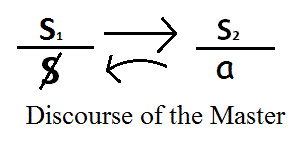
The illusion of the gesture of the Master is the complete coincidence between the level of enunciation (the subjective position from which I am speaking) and the level of the enunciated content, that is, what characterizes the Master is a speech-act that wholly absorbs me, in which “I am what I say,” in short, a fully realized, self-contained performative.

Such an ideal coincidence, of course, precludes the dimension of fantasy, since fantasy emerges precisely  in order to fill in the gap between the enunciated content and its underlying position of enunciation.

Fantasy is an answer to the question, “You are telling me this, but why? What do you really want by telling me this?”

The fact that the dimension of fantasy nonetheless persists thus simply signals the ultimate unavoidable failure of the Master’s discourse.

There is thus no reason to be dismissive of the discourse of the Master, to identify it too hastily with “authoritarian repression”: the Master’s gesture is the founding gesture of every social link.  Let us imagine a confused situation of social disintegration, in which the cohesive power of ideology loses its efficiency: in such a situation, the Master is the  one who invents a new signifier, the famous “quilting point,” which again stabilizes the situation and makes it readable; the university discourse that then elaborates the network of Knowledge that sustains this readability by definition presupposes and relies on the initial gesture of the Master.  The Master adds no new positive content — he merely adds a signifier, which all of a sudden turns disorder into order, into “new harmony,” … Therein resides the magic of a Master: although there is nothing new at the level of positive content, “nothing is quite the same” after he pronounces his Word. …

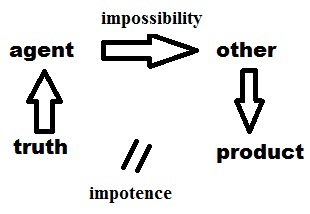
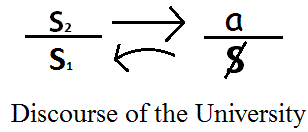
The University discourse is enunciated from the position of “neutral” Knowledge; it addresses the remainder of the real  (say, in the case of pedagogical knowledge, the “raw, uncultivated child”), turning it into the subject .   .  The “truth” of the university discourse, hidden beneath the bar, of course, is power (i.e., the Master-Signifier):

the constitutive lie of the university discourse is that it disavows its performative dimension, presenting what effectively amounts to a political decision based on power as a simple insight into the factual state of things.

What one should avoid here is the Foucaultian misreading: the produced subject is not simply the subjectivity that arises as the result of the disciplinary application of knowledge-power, but its remainder, that which eludes the grasp of knowledge-power. “Production” (the fourth term in the matrix of discourses) does not stand simply for the result of the discursive operation, but rather for its “indivisible remainder,” for the excess that resists being included in the discursive network (i.e., for what the discourses itself produces as the foreign body in its very heart). 78

Suffice it to recall the market expert who advocates strong budgetary measures (cutting welfare expenses, etc.) as a necessity imposed by his neutral expertise devoid of any ideological biases: what he conceals is the series of power-relations (from the active role of state apparatuses to ideological beliefs) that sustain the “neutral” functioning of the market mechanism. 79

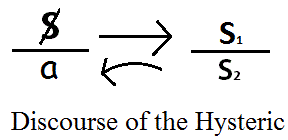
In the hysterical link, the . . over a stands for the subject who is divided, traumatized, by what an object she is for the Other, what role she plays in Other’s desire: “Why am I what you’re saying that I am?” … What she expects from the Other-Master is knowledge about what she is as object (the lower level of the formula).

In contrast to hysteria, the pervert knows perfectly what he is for the Other: a knowledge supports his position as the object of Other’s (divided subject’s) jouissance. For that reason, the matheme of the discourse of perversion is the same as that of the analyst’s discourse.

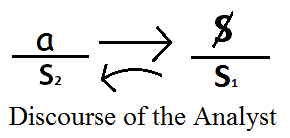
Lacan defines perversion as the inverted fantasy (i.e., his matheme of perversion is a-$), which is precisely the upper level of the analyst’s discourse. The difference between the social link of perversion and that of analysis is grounded in the radical ambiguity of objet petit a in Lacan, which stands simultaneously for the imaginary fantasmatic lure/screen AND for that which this lure is obfuscating, for the void behind the lure.

*So when we pass from perversion to the analytic social link, the agent (analyst) reduces himself to the void, which provokes the subject into confronting the truth of his desire. Knowledge in the position of “truth” below the bar under the “agent,” of course, refers to the supposed knowledge of the analyst, and, simultaneously, signals that the knowledge gained here will not be the neutral objective knowledge of scientific adequacy, but the knowledge that concerns the subject (analysand) in the truth of his subjective position.

In this precise sense, the analyst’s discourse produces the master signifier, the swerve of the patient’s knowledge, the surplus element that situates the patient’s knowledge at the level of truth: after the master signifier is produced, even if nothing changes at the level of knowledge, the same knowledge as before starts to function in a different mode. The master signifier is the unconscious sinthome, the cipher of enjoyment, to which the subject was unknowingly subjected.

*Text here is modified according to https://www.terada.ca/discourse/?p=7106

So, if a political Leader says “I am your Master, let my will be done!” this direct assertion of authority is hystericized when the subject starts to doubt his qualification to act as a Leader (“Am I really their Master?” What is in me that legitimizes me to act like that?”); it can be masked in the guise of the university discourse (“In asking you to do this, I merely follow the insight into objective historical necessity, so I am not your Leader, but merely your servant who enables you to act for your own good. …”); or, the subject can act as a blank, suspending his symbolic efficiency and thus compelling his Other to become aware of how he was experiencing another subject as a Leader only because he was treating him as one.

It should be clear, from this brief description, how the position of the “agent” in each of the four discourses involves a specific mode of subjectivity:

– the Master is the subject who is fuly engaged in his (speech) act, who, in a way, “is his word,” whose word displays an immediate performative efficiency;

– the agent of the university discourse is, on the contrary, fundamentally disengaged: he posits himself as the self-erasing observer (and executor) of “objective laws” accessible to neutral knowledge (in clinical terms, his position is closest to that of the pervert).

– the hysterical subject is the subject whose very existence involves radical doubt and questioning, his entire being is sustained by the uncertainty as to what he is for the Other; insofar as the subject exists only as an answer to the enigma of the Other’s desire, the hysterical subject is the subject par excellence.

Again, in clear contrast to it, the analyst stands for the paradox of the desubjectivized subject, of the subject who fully assumed what Lacan calls “subjective destitution” that is, who breaks out of the vicious cycle of intersubjective dialectics of desire and turns into an acephalous being of pure drive.

post oedipal traverse the fantasy

Žižek, Slavoj. “Cyberspace, or, How to Traverse the Fantasy in the Age of the Retreat of the Big OtherPublic Culture 10:3. (1998) 483-513.

This constellation also provides the key for the problem of the historicity of psychoanalysis. From the early days of his Complexes familiaux ([1938] 1984), Lacan was fully aware of the historicity of the Oedipal complex itself, as well as of its discovery by Freud.

In the modern bourgeois nuclear family, the two functions of the father that were previously separated, or embodied in different persons

(the pacifying Ego-Ideal, the point of ideal identification, and

the ferocious superego, the agent of cruel prohibition; the symbolic function of totem and the horror of taboo), are united in one and the same person.

The previous separate personification of the two functions accounts for the apparent “stupidity” of some aborigines, who thought that the true father of a child was a stone or an animal or a spirit. The aborigines were well aware that the mother was inseminated by the “real” father; they merely separated the real father from its symbolic function.

The unification of the two functions in the bourgeois nuclear family, by giving birth to the ambiguous rivalry with the father figure, created the psychic conditions for the modern, Western, dynamic, creative individualism and, at the same time, sowed the seeds of the forthcoming “crisis of Oedipus” (or, more generally, with regard to figures of authority as such, of the “crisis of investiture” that erupted in the late nineteenth century [Santner 1996). Symbolic authority was more and more smeared over by the mark of obscenity and thus, as it were, undermined from within.

In his early theory of the historicity of the Oedipus complex, Lacan thus already establishes the connection between the psychoanalytic problematic of the Oedipus as the elementary form of “socialization,” of the subject’s integration into the symbolic order, and the standard sociopsychological topoi on how modernity is characterized by individualist competitivity -on how, in modern societies, subjects are no longer fully immersed into and identified with the particular social place into which they were born, but can, in principle at least, freely move between different “roles.” The emergence of the modern “abstract” individual who relates to his or her particular “way of life” as to something with which he or she is not directly identified, but rather which depends on a set of contingent circumstances (the feeling that the particularities of one’s birth, social status, sex, and religion do not determine one fully, do not concern one’s innermost identity) relies on the mutation in the functioning of the Oedipus complex, on the above-described unification of the two aspects of symbolic authority (Ego Ideal and the prohibitive superego) in one and the same person of the “real father.”490

The key question here is: What is going on today when this very modern form of Oedipus is disintegrating– when so-called pathological Narcissism is asserting itself more and more as the predominant form of subjectivity? On the one hand, symbolic prohibitive norms are increasingly replaced with imaginary ideals (of social success, of bodily fitness); on the other hand, this lack of symbolic prohibition is supplemented with the reemergence of the ferocious superego figures. So we have a subject who is extremely narcissistic, who perceives everything as a potential threat to his or her precarious imaginary balance. (See the universalization of the logic of victim: Every contact with another human being is experienced as a potential threat. If the other smokes, if he or she casts a covetous glance at me, he or she already hurts me.) However, far from allowing the subject to float freely in undisturbed balance, this narcissistic self-enclosure leaves him or her to the (not so) tender mercies of the superego injunction to enjoy. One is thus tempted to propose a hypothesis according to which “postmodern” subjectivity involves a kind of direct “superegoization ” of the imaginary Ideal, caused by the lack of the proper symbolic Prohibition: It is the Ideal itself that gives rise to guilty feelings when we fail to reach it, since the (imaginary) Ego-Ideal is no longer supported by the symbolic Ideal-Ego, but directly by the superego.

So, to recapitulate. There is only one consistent answer to the question “Why does the superfluous prohibition emerge, which merely prohibits the impossible?” That is: It obfuscates this inherent impossibility in order to sustain the illusion that, were it not for the externally imposed prohibition, the full (“incestuous”) gratification would be possible. Far from acting as a “repressive” agency that prevents us access to the ultimate object of desire, the paternal figure functions instead to relieve us from the debilitating deadlock of desire, to “maintain hope.” What is missing in “Oedipus on-line” is precisely this “pacifying” function of the paternal figure that enables us to obfuscate the debilitating deadlock of desire. Hence, the strange mixture of “everything is possible” (since there is no positive prohibiting figure) and an all-pervasive frustration and deadlock that characterizes the subject’s experience of cyberspace.

The ontological paradox, scandal even, of fantasy resides in the fact that it subverts the standard opposition of “subjective” and “objective.” Of course, fantasy is by definition not “objective” (in the naive sense of existing independently of the subject’s perceptions); however, it is also not “subjective” (in the sense of being reducible to the subject’s consciously experienced intuitions). Rather, fantasy belongs to the “bizarre category of the objectively subjective-the way things actually, objectively, seem to you even if they don’t seem that way to you” (Dennett 1991, 132).8 When, for example, the subject actually experiences a series of fantasmatic formations which interrelate as so many permutations of each other, this series is never complete-it is always as if the actually experienced series presents so many variations of some underlying “fundamental” fantasy that is never actually experienced by the subject. 507

This brings us back to the mystery of “commodity fetishism.” When a critical Marxist encounters a bourgeois subject immersed in commodity fetishism, the Marxist’s reproach to him or her is not, “Commodity may seem to you a magical object endowed with special powers, but it really is just a reified expression of relations between people”; rather, the actual Marxist’s reproach is, “You may think that the commodity appears to you as a simple embodiment of social relations (that, for example, money is just a kind of voucher entitling you to a part of the social product), but this is not how things really seem to you. In your social reality, by means of your participation in social exchange, you bear witness to the uncanny fact that a commodity really appears to you as a magical object endowed with special powers.”

This is also one of the ways in which to specify the meaning of Lacan’s assertion of the subject’s constitutive “decenterment.” Its point is not that my subjective experience is regulated by objective, unconscious, mechanisms that are “decentered” with regard to my self-experience and, as such, beyond my control (a point asserted by every materialist), but rather something much more unsettling — I am deprived of even my most intimate “subjective” experience, the way things “really seem to me,” the fundamental fantasy that constitutes and guarantees the kernel of my being, since I can never consciously experience it and assume it.

According to the standard view, the dimension that is constitutive of subjectivity is that of the phenomenal (self-)experience. I am a subject the moment I can say to myself “No matter what unknown mechanism governs my acts, perceptions, and thoughts, nobody can take from me what I see and feel now.”

Lacan turns this standard view around: The “subject of the signifier” emerges only when a key aspect of the subject’s phenomenal (self-)experience (the “fundamental fantasy”) becomes inaccessible to him or her, is “primordially repressed.” At its most radical, the Unconscious is the inaccessible phenomenon, not the objective mechanism that regulates my phenomenal experience. So, in contrast to the commonplace according to which we are dealing with a subject the moment an entity displays signs of “inner life”— of a fantasmatic self-experience which cannot be reduced to external behavior — one should claim that what characterizes human subjectivity proper is rather the gap that separates the two — the fact that fantasy, at its most elementary, becomes inaccessible to the subject. This inaccessibility makes the subject “empty.” We thus obtain a relationship that totally subverts the standard notion of the subject who directly experiences herself, her “inner states”— an “impossible” relationship between the empty, nonphenomenal subject and the phenomena that remain inaccessible to the subject. 509

Geneticists predict that in about ten to fifteen years they will be able to identify and manipulate each individual’s exact genome (approximately six billion genetic markers comprising the complete inherited “knowledge”). Potentially, at least, individuals will thus have at their disposal the complete formula of what they “objectively” are. How will this “knowledge in the real,” the fact that I will be able to locate and identify myself completely as an object in reality, affect the status of subjectivity? Will it lead to the end of human subjectivity? Lacan’s answer is negative:

What will continue to elude the geneticist is not my phenomenal self-experience (say, the experience of a love passion that no knowledge of the genetic and other material mechanisms which determine it can take from me), but the “objectively subjective” fundamental fantasy, the fantasmatic kernel inaccessible to my conscious experience.

Even if science formulates the genetic formula of what I objectively am, it will still be unable to formulate my “objectively subjective’’ fantasmatic identity, this objectal counterpoint to my subjectivity, which is neither subjective (experienced) nor objective.

Traversing the Fantasy

A recent English publicity spot for a brand of beer enables us to further clarify this crucial point. Its first part stages a well-known fairytale anecdote: A girl walks along a stream, sees a frog, takes it gently onto her lap, and kisses it; of course, the ugly frog miraculously turns into a beautiful young man. However, the story isn’t over yet: The young man casts a covetous glance at the girl, draws her toward him, kisses her-and she turns into a bottle of beer, which the man holds triumphantly in his hand. For the woman, the point is that her love and affection (signaled by the kiss) turn a frog into a beautiful man, a full phallic presence (in Lacan’s mathems, the big Phi); for the man, the point is to reduce the woman to a partial object, the cause of his desire (in Lacan’s mathems, the object small a). On account of this asymmetry, there is no sexual relationship.

We have either a woman with a frog or a man with a bottle of beer. What we can never obtain is the “natural” couple of the beautiful woman and man. Why not? Because fantasmatic support of this “ideal couple” would have been the inconsistent figure of a frog embracing a bottle of beer. …

This, then, opens up the possibility of undermining the hold a fantasy exerts over us through our very over-identification with it-that is, by way of embracing simultaneously, within the same space, the multitude of inconsistent fantasmatic elements. Each of the two subjects is involved in his or her own subjective fantasizing: The girl fantasizes about the frog who is really a young man, the man about the girl who is really a bottle of beer. What modern art and writing oppose to this is not objective reality but the “objectively subjective” underlying fantasy that the two subjects are never able to assume, something similar to a Magrittesque painting of a frog embracing a bottle of beer, with the title “A man and a woman” or “The ideal couple.” … And is this not the ethical duty of today’s artist-to confront us with the frog embracing the bottle of beer when we are daydreaming of embracing our beloved? Does the artist need to stage fantasies that are radically desubjectivized and which can never be assumed by the subject?

This, then, is the point we were aiming at all along. Perhaps cyberspace, with its capacity to externalize our innermost fantasies in all their inconsistency, opens up to the artistic practice a unique possibility to stage, to “act out,” the fantasmatic support of our existence, up to the fundamental “sadomasochistic” fantasy that cannot ever be subjectivized. We are thus invited to risk the most radical experience imaginable: the encounter with our “noumenal Self,” with the Other Scene which stages the foreclosed hard core of the subject’s Being. Far from enslaving us to these fantasies and thus turning us into desubjectivized, blind puppets, it enables us to treat them in a playful way and thus to adopt toward them a minimum of distance-in short, to achieve what Lacan calls la traversee du fantasme, “going-through, traversing the fantasy.”

So let us conclude with a reference to the (in)famous last proposition of Wittgenstein’s Tractatus: “Wovon man nicht sprechen kann, davon muss man schweigen” [Whereof one cannot speak, thereof must one be silent] (87). This proposition renders in the most succinct way possible the paradox of the Oedipal law that prohibits something (incestuous fusion) which is already in itself impossible (and thereby gives rise to the hope that, if we remove or overcome the prohibition, the “impossible” incest will become possible). If we are effectively to move to a region “beyond Oedipus,” Wittgenstein’s proposition is to be rephrased into: “Wovon man nicht sprechen kann, davon muss man schreiben” [Whereof one cannot speak, thereof must one write].

There is, of course, a long tradition of conceiving art as a mode or practice of writing which augurs that which “one cannot speak about”- the utopian potential “repressed” by the exis ting sociosymbolic network of prohibitions. There is also a long tradition of using writing as a means to communicate a declaration of love too intimate and/or too painful to be directly asserted in a face-to-face speech act.

The Internet is widely used as a space for the amorous encounters of shy people, and, significantly, one of the anecdotes about Edison, the inventor of the telegraph, is that he himself used it to declare love and ask the hand of his secretary (being too shy to do it directly, by the spoken word). However, what we are aiming at is not this standard economy of using cyberspace as a place in which, since we are not directly engaged in it (since we maintain a distance toward it), we feel free to externalize and stage our innermost private fantasies. What we have in mind is a more radical level, the level that concerns our very fundamental fantasy as that “wovon man nicht sprechen kann.”

The subject is never able to assume his or her fundamental fantasy, to recognize him- or herself in it, in a performance of a speech act.

Perhaps cyberspace opens up a domain in which the subject can nonetheless externalize or stage his or her fundamental fantasy and thus gain a minimum of distance toward it.

This, however, in no way suggests that inducing us to “traverse the fantasy” is an automatic effect of our immersion into cyberspace. What one should do here is, rather, accomplish a Hegelian reversal of epistemological obstacle into ontological deadlock.

What if it is wrong and misleading to ask which of the four versions of the libidinal or symbolic economy of cyberspace that we outlined (the psychotic suspension of Oedipus, the continuation of Oedipus with other means, the perverse staging of the law, and traversing the fantasy) is the “correct” one? What if these four versions are the four possibilities opened up by the cyberspace technology, so that, ultimately, the choice is ours? How will cyberspace affect us is not directly inscribed into its technological properties; it rather hinges on the network of sociosymbolic relations (e.g., of power and domination) which always and already overdetermine the way cyberspace affects us.

Belsey, Catherine. Culture and the Real : Theorizing Cultural Criticism.

That idealist complacency, the certainty that we not only make ourselves, but also make the world in our own minds, confining what exists to consciousness and erasing the real in the process, may be one of the most dangerous features of Western culture in the twenty-first century.

While idealism does not overtly ally itself with the West’s depredation of the planet or its militaristic foreign policy, a theory that materiality is no more than the effect of culture offers no grounds for repudiating either of these practices. On the contrary, the conviction that what exists depends on our idea of it helps to disconnect our lifestyle from the damage it causes.  58

THE INCURSION OF THE REAL

There is some evidence, however, that the irreducible real is beginning to put up a resistance to our wasteful, culturally scripted habits, and to make itself knowable in the form of melting icecaps, floods, forest fires and high levels of skin cancer. Sadly, the West, which has done most to bring this about, only grudgingly acknowledges the situation, at least explicitly, while at the same time scrambling for control of the planet’s remaining natural resources. 60

Why was 9/11 so shocking? Perhaps because it represented the momentary incursion of the unknowable real into an increasingly idealist culture. The destruction of the twin towers seemed unheralded, inexplicable, unaccountable, out of our control. In the immediate aftermath of the event, sophisticated commentators, including Žižek, delighted in maintaining that 9/11 was first and foremost a media spectacle, reproducing in actuality an already-familiar Hollywood fantasy.  … These planes were not a repressed fragment of our own psyche but, on the contrary, a violent material intrusion from outside. Idealism could not accommodate them.

Paradoxically, to deny the real is also to claim to know for sure. The subject can never achieve such surety, the correspondence between world and consciousness that was Hegel’s goal. Nor can it confidently assert even the more modest conviction that what we don’t know doesn’t matter. How can we be sure even of that, when we can be certain of nothing? 61

What idealism misses, he maintains, is the crucial contribution of psychoanalysis, its understanding of the continuity between the subject and the world, interrupted but not finally erased by the advent of the symbolic order. We remain marked by the lost but inextricable real. The subject is alienated by the Otherness of the signifier and the consequent lack in being, with its propensity at any moment to subtract something from coherent thought or speech. We are subject to temporary disappearances from the signifying chain, liable at any moment to fade. Indeed,

[Lacan quote] “this is the essential flaw in philosophical idealism which, in any case, cannot be sustained and has never been radically sustained. There is no subject without, somewhere, aphanisis [fading] of the subject, and it is in this alienation, in this fundamental division, that the dialectic of the subject is established.” (1979, 221) 62

Stavrakakis Lacan and the Political pt 4

Sinthome

an identification with the symptom, a recognition in the real of our symptom of the only support of our being (Stav citing Žižek 1989) 133

Wo es war soll Ich werden: the subject must identify with the place where the syumptom already was: ‘In its pathological particularity [it] … must recognise the element which gives consistency to [its] being’ (Žižek 1989) 133

By saying ‘We are all Jews’, ‘We all live in Chernobyl!’ or ‘We are all boat people!’ — … we elevate the symptom, the excluded truth of the social field (which has been stigmatised as an alien particularity) to the place of the universal — to the point of our common identification which was up to now, sustained by its exclusion or elimination. The same happens when we say ‘We are all gypsies!’ — … What is promoted here is an attitude consistent with identifying with the symptom of the social and traversing social fantasy.

It is only by accepting such an impossible representation, by  making this declaration of impossibility, that it is possible to ‘represent’ the impossible or rather to identify with the impossibility of its representation. Identification with the symptom is thus related to the traversing of the fantasy. Going through fantasy entails the realisation of the lack or inconsistency in the Other which is masked by fantasy, the separation between objet petit a and the Other, a separation which is not only ethically sound but also ‘liberating’ for our political imagination.  134

What is clearly at stake here is the possibility of enacting symbolic gestures that institutionalise social lack, that is to say incorporate the ethical recognition of the impossibility of social closure.

Critique of Judith Butler, Will Connolly, Simon Critchley

Critchley’s Levinaisan ethics of the Other [and probably Butler’ s too]. ‘The community remains an open community in so far as it is based on the recognition of difference, of the difference of the Other’ (citing Critchley 1992).

The problem with such an analysis is that it presupposes the Other as a unifed totality or, even if this is not always the case, it seems to be offering a positive point of identification remaining thus within the limits of traditional ethical strategies or, in any case, not undermining them in a radical way.  What has to be highlighted is that it is precisely this relation — the identification with the Other — that attempts to bring closure to the social.

In order to have a non-totalisable relation to the Other we must relate — identify — with the lack in the Other and not with the Other per se. This is the radical innovation of Lacanian ethics.  And this is what democracy needs today. 139

Stavrakakis Lacan and the Political pt 1

(1-12)  How can we talk about Lacan and not fall prey to psychologistic analyses that reduce social to individual?  Freud wrote a good deal using that combined a psychoanalytic framework with a social analysis Civilization and Its Discontents, Jokes etc. and Lacan even more so, develops a socio-political conception of subjectivity that is “not reduced to individuality, a subjectivity opening a new road to understanding of the ‘objective’. 4

The million dollar question is what the hell does Stavrakakis mean here?  He quotes Laclau here to buttress the point about the impossibility of the construction of any identity.

Mirror Stage

Captivated by its image in the mirror. “But this captivation, the anticipation of synthesis, can never eliminate the real uncoordination of the body of the infant, it can never erase the external and alienating character of its own foundation. This ambiguity is never resolved” (18).

🙂 Stavrakakis here argues that the mirror image of the child is alienating, even though it is this image the infant recognizes, reaches out to as a basis of her identity, but it nevertheless remains fundamentally alienating, meaning, that there exists a gap, the infant is still uncoordinated yet his image gives him the appearance of a totality, of a wholeness that is complete and unified. Remember the imaginary is already caught up within the symbolic.  “If the ego emerges in the imaginary the subject emerges in the symbolic (19).

If the imaginary, the field of specular images, of spatial unities and totalised representations, is always built on an illusion which is ultimately alienating for the child, his or her only recourse is to turn to the symbolic level, seeking in language a means to acquire a stable identity.  By submitting to the laws of language, the child becomes a subject in language, it inhabits language, and hopes to gain an adequate representation through the world of words … ‘the subject is the subject of the signifier — determined by it” (Citing Lacan) (20).

Lack

But instead of transgressing alienation in the direction of acquiring a solid identity, the subject of the signifier, the subject constituted on the basis of the acceptance of the laws of language, is uncovered as the subject of lack par excellence. (20)

This lack can only be thought as a trace of the ineliminable ACT OF POWER at the root of the formation of subjectivity, as the trace of an ex nihilo decision entailing the loss of certain possibilities or psychic states (the imaginary relation with the mother, for example) and the formation of new ones (20). …

Already this is indicative of the political relevance of the Lacanian category of the lacking subject. This lack can only be thought as a trace of the ineliminable act of power at the root of the formation of subjectivity, as the trace of an ex nihilo decision entailing the loss of certain possibilities or psychic states (the imaginary relation with the mother, for example) and the formation of new ones.

The subject can only exist on the condition that it accepts the laws of the symbolic.

It becomes an effect of the signifier. In that sense it is a certain subordination, an exercise of POWER, that constitutes the condition of possibility for the constitution of subjectivity.

Judith Butler is right when, in her recent book The Psychic Life of Power, she argues that there is no formation of subjectivity without subordination, the passionate attachment to those by whom she or he (the subject in question) is subordinated (Butler, 1997:7).

[However Butler] remains within the limits of a somewhat traditional conceptualisation of power when she is personalising her account (those to whom we are subordinated are presumably our parents, especially during our early formative years).

In Lacan, it is the signifier that is revealed as the locus of this power forming the subject: ‘‘power is coterminous with the logic of the signifier’’ (Dyrberg, 1997:130).

This POWER of the signifier cannot be reduced to the physical presence or the behaviour of the biological parents.  It is the NAME-OF-THE-FATHER, the symbolic and not the real father, who is the agent of this POWER, the agent of symbolic Law (20).

Signifier and Signified

Meaning is produced by signifiers; it springs from the signifier to the signified and not vice versa … 25

What happens then to the signified in the Lacanian schema? Lacan understands the signified as an effect of transference. If we speak about the signified it is only because we like to believe in its existence.

[T]he signified disappears because it is no longer associated with the concept, as in Saussure, but is conceived as belonging to the order of the real; that’s why the bar dividing signifier and signified, … is understood as a barrier resisting signification, as a limit marking the intersection of the symbolic with the real (citing Boothby 1991). 26

Loss of the Signified

In Lacan, … the signified disappears as such, that is to say as the epicentre of signification, exactly because in its real dimension it is situated beyond the level of the symbolic.

What is retained is the locus of the signified which is now designated by a constitutive lack. What is also retained is the promise or the aspiration of attaining the lost/impossible signified, to fill in the vacuum in the locus of the absent signified.

Signification is articulated around the illusion of attaining the signified; but this illusion itself is a result of the signifying play. The signified, as we have pointed out, is an effect created by the signifier in the process of signification. 26-27

… if there is a signified it can only be a signifier to which we attribute a transferential signified function.

The signified, what is supposed to be, through its links to external reality, the source of signification, indeed belongs to the real. But this is a real that resists symbolisation — this is the definition of the real in Lacan; the real is what cannot be symbolised, the impossible.  Surely, if this real is always absent from the level of signification it cannot be in itself and by itself the source of this same signification. Its absence however, the constitutive lack of the signified as real can. This lack constitutes something absolutely crucial for signification.

This absence has to be compensated if signification is to acquire any coherence. It is the absence of the signified in its real dimension which causes the emergence of the transference of the signified. What emerges is the signified in its imaginary dimension.

There is, however, one more dimension to this signifying play.  This transference of the signfiied, the emergence of the imaginary signified can only be the result of the play between signifiers. This is how the third dimension, the dimension of the symbolic, determines signification. It is the predominance of the signifier that produces the imaginary signified in order to cover over the absence of the real signified or rather of the signified as real. 27

Here we need to introduce lack.

[I]rreducible lack is inscribed within the symbolic structure, a lack due to the priority of the signifier and the nature of the symbolic order; the subject becomes identical to this lack … by being born with the signifier, the subject is born divided. 28

The fact that we speak itself divides the subject: the gap between the subject of the enunciation and the subject of the statement can never be bridged.

From Identity to Identification

The fullness of identity that the subject is seeking is impossible both in the imaginary and in the symbolic level.  The subject is doomed to symbolise in order to constitute her- or himself as such, but this symbolisation cannot capture the totality and singularity of the real body, the close-circuit of the drives.

Symbolisation, that is to say the pursuit of identity itself, introduces lack and makes identity ultimately impossible. For even the idea of identity to become possible its ultimate impossibility has to be instituted. Identity is possible only as a failed identity; it remains desireable exactly because it is essentially impossible. It is this constitutive impossibility that, by making full identity impossible, makes identification possible, if not necessary. Thus, it is rather misleading to speak of identities within a Lacanian framework. 29

What we have is only attempts to construct a stable identity, either on the imaginary or the symbolic level, through the image or the signifier. The subject of lack emerges due to the failure of all these attempts. What we have then, if we want to be precise and accurate, is not identities but identifications, a series of failed identifications or rather a play between identification and its failure, a deeply political play. 29

The concept of identification becomes crucial then for any understanding of the Lacanian conception of subjectivity, … The ontic horizon of identification is that of ultimate failure; its ontological horizon that of impossibility.  Yet this is not, strictly speaking, a failure of identification, but a failure of identity, that is to say a failure to achieve identity through identification.

It is, however, this same impossibility to achieve identity (substance) that that makes identification (process) constitutive. This is not only true for the life of the child but for the life of the adult as well, something which reveals the relevance of the concept of identification for social and political analysis.

Since the objects of identification in adult life include political ideologies and other socially constructed objects, the process of identification is revealed as constitutive of socio-political life. It is not identity which is constitutive but identification as such; instead of identity politics we should speak of identification politics.

Name-of-the-Father introduces a certain lack, the Name-of-the-Father is a signifier that disrupts the imaginary relation between mother and child by erecting the prohibition of incest, the Paternal Function isntitutes a new order, an order structurally different from the natural order, an order instituting human society, a certain community of meaning (32).

… in order to gain the signifer we have to sacrifice the signified

Symbolic identification is an identification structured around the acceptance of this constitutive lack.

But the objective sphere is also lacking, how?

40 In a section entitled The objective is also lacking. Stav insists that even though Lacan made innovative theoretical strides on subjective side, the importance of Lacan for political theory comes through with his work on the ‘objective’ side.  Roughly the social.

These two levels are not, of course identical but in any case they are not antithetical; there is something linking the individual to the collective, … it is the subject, symbolic lack itself, which splits the essentialist conceptions of individuality; it is the same subject as lack that introduces division into human collectivity. 40
How does the subject ‘introduce division into human collectivity”?

Laclau is quoted by Stav, “‘Objectivism’ and ‘subjectivism’ are symmetrical expressions of the desire for a fullness that is ultimately impossible.” HSS 13

Lack in the Other

It is the Lacanian subject of the signifier, the lacking subject, that provides the first link between psychoanalysis, society and politics, and this precisely because it highlights its dependence on the socio-symbolic order: …

By locating, at the place previously assigned to an essence of the individual psyche, a constitutive lack, Lacanian theory avoids the essentialist reductionism of the social to the individual level and opens the way to the confluence of psychoanalysis and socio-political analysis, since this lack can only be filled by socio-political objects of identification. 37

If I need to identify with something it is not only because I don’t have a full identity in the first place, but also because all my attempts to acquire it by identifying with a supposedly full Other are failing.

Identification only becomes thinkable as a result of the lack within the structure, the structure of the social Other.  The objective as a closed totality is a semblance; the objective Other is lacking. 41

This then takes Stav into a discussion of the nature of this lack, and hence the introduction of jouissance and desire. Lack is a lack of jouissance, “lack of a pre-symbolic real enjoyment which is always posited as something lost, as a lost fullness, the part of ourselves that is sacrificed/castrated when we enter the symbolic system of language and social relations” 42

As soon as we enter the symbolic, the pre-symbolic – that which is impossible to integrate in the symbolic – is posited as an external prohibited object. “The universality of language cannot capture the singular real of the pre-symbolic mythical subject. The most intimate part of our being is experienced as something lost.” 42

The emergence of desire cannot be conceived independently of the family drama of the subject. The Name-of-the-Father demands the sacrifice of jouissance. … This loss … the prohibition of jouissance, is exactly what permits the emergence of desire, a desire that is structured around the unending quest for the lost/impossible jouissance. The paradox here is that what is prohibited is by definition impossible. 42

The trick of the Law is that it creates desire as a result of the lack imposed by the prohibition of incest. … it is the prohibition itself, the performative institution of symbolic Law, that makes possible the desire to ‘recapture’ this impossible jouissance. 43

This is the nodal point of the Oedipus complex … The Law makes us believe that what is impossible really exists and it is possible for us to encounter it again …  What is revealed here is a dialectic between desire and the Law.  The prohibition of an impossible jouissance creates the desire for its attainment …

It means that it is lack that introduces the idea of fullness and not vice-versa. It means that it is an act of power, an act of exclusion, that retroactively produces the fullness we attribute to what was excluded, to that unknown impossibility. 43

“It is … lack that introduces the idea of fullness and not vice-versa” 43

The individual’s entry into symbolic means a loss of jouissance (pre-symbolic real).  Is thus always seeking identification, and thus this is what is behind the emergence of the subject and yet “if full identity is proven ultimately impossible, what makes us identify again and again? … What stimulates our desire for new identification acts? ” 45

It is this repetition of failure that sustains desire as a promise to attain the mythical jouissance; if the realisation, the full satisfaction of desire is impossible, then the promise of this realisation becomes necessary; without it no desire can be sustained.  But what is the exact nature of this promise? … the name for this promise is fantasy. 45

Fantasy veils the lack in the Other

Fantasy is a scenario that veils the lack in the Other effected by castration. If the human condition is marked by a quest for a lost/impossible enjoyment, fantasy offers the promise of an encounter with this precious jouissance, an encounter that is fantasised as covering over the lack in the Other and, consequently, as filling the lack in the subject. 46

fantasy emerges as a support exactly in the place where the lack in the Other becomes evident; it functions as a support for the lacking Other of the symbolic.  … In short, it attempts to take the place of the lacking Other of the Other, of the missing signification that would, this is our mythology, represent our sacrificed enjoyment.  It is because reality is articulated at the symbolic level and the symbolic is lacking, that reality can only acquire a certain coherence and become desirable as an object of identification, by resorting to fantasy; the illusory nature of fantasy functions as a support for the desire to identify. 46

What has to be stressed … is that the domain of fantasy does not belong to the individual level; fantasy is a construction that attempts, first of all, to cover over the lack in the Other. As such it belongs initially to the social world; it is located on the objective side, the side of the Other, the lacking Other. 51

Fantasy sustains our sense of reality.  Our social construction of reality acquires its ontological consistency due to its dependence on a certain fantasy frame. When this frame disintegrates, the illusion – the promise – of capturing the real that sustains reality, the illusion that closes the gap between the real and our symbolisations of it, between signifier and signified, is dislocated 51-52

How can we preserve within our symbolisations a space for the recognition of the impossibility of their closure? 93

The Lacanian system is perhaps the closest we can get to a discourse opening itself up to what exceeds its limits. 93

The elimination of lack through a definite symbolisation of the real is impossible. Yet this is the condition of possibility of our freedom because it means that no order, no matter how repressive it might be, can acquire a stable character … 95
carlson pt 4

Carlson, Shanna T. “Transgender Subjectivity and the Logic of Sexual Difference” Volume 21, Number 2, 2010 d i f f e r e n c e s: A Journal of Feminist Cultural Studies

What would it look like to consider transgender identity as an expression of the logic of sexual difference?

I would like to define the transsexual subject as a person who identifies with a gender that is not consonant with the gender assigned at birth. In some cases, but certainly not all, the transsexual subject will go to whatever efforts possible (hormone therapy, sex or genital reassignment surgery, etc.) to “pass” as that gender. Inasmuch as the transsexual subject strives to pass and/or (for not all transsexuals strive to pass) identifies with one gender or another with an apparent degree of certainty, he or she is psychically no different than any other subject who lines up under one banner or the other.

Ostensibly “nontranssexual” subjects also strive to pass; they also identify with an apparent degree of certainty with one gender or another. In other words, “transsexuality” is not in and of itself any more extreme a type of symptom than is “man” or “woman.” Where transsexual subjects’ experiences may be different from those of ostensibly nontranssexual subjects, of course, arises in part from the fact that the latter have not, so far, proven particularly welcoming: from under the meager protection of their banners, they have not yet realized that they have no monopoly on the psychic experience of the semblance of “gender certainty.” Oftentimes, the upshot of this false monopoly on a piecemeal “certainty” is that transsexual subjects—particularly those who do not rigorously fit the demands of the public’s “incessant need to gender every person they see as female or male” (Serano 117)—are excluded, objectified, exploited, scapegoated, and silenced. 65

Transgenderism presents a slightly different situation, and this is the one with which this article has been occupied. For it could be argued that the
transgender subject—as someone who is not necessarily or only very strategically invested in “passing” as one gender or another (e.g., someone who could be described as “bigendered” or “gender-fluid” [Serano 27]), as someone who may be invested in embodying a gender that would attest to what he or she may define as the constructedness of gender (e.g., “genderqueer” [Serano 27])—would be the human subject as such, the unconsciously bisexual subject for whom sexual difference is only ever an incomplete, unsatisfactory solution to the failure of the sexual relation. In this way, transgenderism would figure as a solutionless solution to the impasses of sexual difference, a sort of unconscious scene of undecideability, but an undecideability fundamentally shared by all human subjects, no matter their seeming “gender.” 65

But there is another way of reading transgenderism, or another transgenderism available to subjects, wherein transgenderism figures not as a solutionless solution to the impasses of sexual difference, but rather as an expression of the logic of sexual difference: a feminine solution. Hysteria as it is defined by Lacan is a profoundly feminine phenomenon and is characterized by the question, “Am I a man, or am I woman, and what does that mean?” The hysteric tends to interrogate societal norms at large, oftentimes embodying a subversive attitude that arises in part from a profound suspicion that her own sexed and sexual body is incommensurate to cultural injunctions regarding gender identities.

As Ellie Ragland- Sullivan writes, “Lacan saw the hysteric as embodying the quintessence of the human subject because she speaks, as agent, from the lack and gaps in knowledge, language and being” (164).

The hysteric is, in some senses, interested in nothing but the lack that, for example, Dean may be read to circumvent by focusing on the apparent multiplicity of object a.

The failure, deadlock, and trauma of sexual difference returns for the hysterical/feminine transgender subject, irreducibly, in her insistent interrogation of the phallic function and in her very queer relation to the lacking Other. 66

Our question, then, might read as follows: what will the feminine/transgender subject do confronting a symbolic that she is “totally, that is, limitlessly inscribed within” (Copjec 227)?

For this, we do not have to look far—we might consider Antigone, or, if we wish to be more timely, we might pay attention to art, writings, memoirs, and scholarship by various present-day transgender or, sometimes, transsexual-identified subjects.

If part of the point this essay is trying to make, though, is that there is something transgendered about the human subject, and that this transgenderism transcends notions of gender, it follows that we need not be restricted by rigid definitions of gender identities to encounter the question, “Am I a man, or am I woman, and what does that mean?” Feminine subjects identify in multiple directions. More importantly, they demonstrate another sort of agility as well: “[Lacan] implied that for all the difficulties woman had with speech and the signifier, mistrusting its promises because they de facto fail her, a certain freedom to play was available to woman [. . .]

[A]ccording to Lacan, ‘Women are less enclosed by discourse than their partners in the cycle of discourse’” (MacCannell 198–99). When we recall that discourses are “forms of the social tie” (Lacan qtd. in MacCannell
235) and that discourses as social ties move to cover over the lack of the sexual relation, we could argue by extension that

the hysteric feminine subject in particular is structurally well situated to cycle through and fall between the cracks of discourses. Preoccupied as the hysteric is with the very question that discourse wishes to mask, she may be particularly well situated to “do something” to the social tie itself.

And yet, despite (but also because of) her “freedom to play,” the feminine/transgender subject’s speech does not stop insisting that discursive flexibility, lest it be mistaken for a merry-go-round of liberating multiplicity, is a flexibility borne of and about at least two overlapping lacks: castration and a certain exclusion.

Feminine/transgender speech materializes (sometimes, painfully silently) hollowed out by the deafening significance of what it “is” to “be” a (divided) (feminine) subject, a truth that echoes across gender divides and blurs.

Ragland cautions as well: “Given that the hysteric’s fundamental question in the signifier is ‘Am I a woman or a man?’ she is at risk of being overtaken by the real in both the symbolic and the imaginary” (69). She later adds more pointedly:

How, then, does the hysteric reveal a truth worth noting? Subversion for its own sake or acting out is not admirable […]. It is rather, this, that the subject, any subject except a psychotic, is divided. In varying ways, all individuals who are divided suffer from this. The master represses it in the place of truth. The academic puts it inthe place of repressed knowledge. The analyst interrogates it. Bu tthe hysteric lives it; it is her bade of honor that she lives castration at the surface of her life and discourse […]. The hysteric does not say, as poststructuralists would claim, I am man and woman, the difference makes no difference [. . .]. For her it is an either/or question. This is the heart of Lacanianism: either/or. Either one is masculine or one is feminine. One is not both, except in the suffering of hysteria. Both is the position of suffering, not liberation. It is this truth of the hysteric to which Lacan pays heed. (85)

If we are to dream of some liberatory remainder to this suffering subversion, it may — as Butler suggests from from a different perspective — be locatable precisely there where Antigone speaks her “aberrant” words (Psychic 58) — yes, where, sometimes, “gender is displaced” (82), but sexual difference is not. As Slavoj Žižek writes in response to Butler’s Psychic Life of Power:

“The Lacanian answer to this is clear — “to desire something other than its continued ‘social existence'” and thus to fall “into some kind of death,” that is, to risk a gesture by means of which death is “courted and pursued,” points precisely towards the way Lacan reconceptualized the Freudian death-drive as the elementary form of the ethical act. Note that the act, insofar as it is irreducible to a “speech act,” relies for its performative power on the preestablished set of symbolic rules and/or norms. Is this not the whole point of Lacan’s reading of Antigone?”

At the beginning of this essay, I asked what gender studies and Lacanian psychoanalysis have to offer one another and whether it might be possible to integrate the two domains. To answer quite simply,

Lacanian psychoanalysis offers gender studies what I read as a richly malleable framework for thinking through matters of sex, subjectivity, desire, and sexuality. Likewise, gender studies offers Lacanian psychoanalysis readers who are deeply, productively mistrustful and whose compelling perspectives on diverse social issues are driven by passionate commitment.

Integration of the two domains can only ever be a scene of fruitful contestation, but it could also go further if contemporary psychoanalytic thinkers were willing to listen to their compatriots’ desires and to redefine some of their more exclusionary “shibboleths” (Dean, Beyond 226), and if gender theorists were willing to reread psychoanalysis, again.

Möbius subject and the relation of nonrelation

The Möbius subject has two driving motivations, that is, motivations at the level of the drive:

1. The first is to maintain the extimacy that is the ground of its existence: as we know, the drive circulates around objet a, the missing object, established by way of the encounter with the formal negation, the Non/Nom-du-Père.

2. The second is to defend itself against the anxiety generated by its excessive status. This anxiety, understood in Lacanian terms, is simply affect itself, a function of the Möbius condition of subjectivity.

The motivations may be at odds, but they derive necessarily from the subject’s founding.  Taken together, they provide the means by which the social space itself is propagated and sustained.

Because, at the level of the drive, the subject comes into existence only if it seems as though objet a is possible, prohibited rather than impossible, the subject has a stake in the very condition that produces anxiety — its status as a signifier depends upon the impossibility of objet a and its status as a signifier makes its ultimate stability, its final meaning or self-consistency, unreachable.  In this dynamic, seen from the level of Symbolic relations, it can seem that the other’s failure to stabilize the subject’s meaning is willfully aggressive (or negligent) rather than a function of impossibility.

As a result, the Möbius subject relates to the other both as the solution and the obstacle to its own inconsistency — a relation of nonrelation.  That is, thanks to the excess that sticks to each subject, and thanks to the fantasy that the other is consistent in a way that the subject is not, the social relation necessarily emerges as a relation of nonrelation (202).

In the Levinasian version the subject seeks to overcome the radical alterity that, in this view, properly belongs to the other.  In the extimate version, the subject must perpetually seek a response from the others because, in fact the subject will never be sure of the meaning of the response it gets, yet the subject has nowhere else to go to get it.  The other is not radically other — it is close enough to the subject in kind to warrant the desire tor the relationship while distant enough in its ability to fulfill the subject’s deepest desire to maintain its otherness.

At the same time, the “other” to whom the subject relates does not truly exist in the way the subject believes: the other is a fantasmatic projection of a wish.  So the subject has a relation of nonrelation to the actual others in the social space.  It is in this relation of nonrelation that we find the sustaining of the duality of subject and other that Levinas requires for ethics but fails to provide.

The hatred and envy that can arise from the subject’s frustration at the other’s inability to repair the subject’s self-inconsistency could easily galvanize the destruction of the very space of the social … (203).  The destruction of that space, however, would spell the demise of the subject qua subject. Subjects mobilize a number of (necessarily inadequate) defenses — including perversion and hysteria — to avoid that result.  … We don’t want to feel that “we’re all in this together” if that means everyone is subject to excess.  We want to feel that someone can solve this problem or be targeted as its source.  But because these wishes do not actually resolve the excess, the best we can do is to try to send it on its rounds, even though it inevitably “returns” to us — since, of course, in reality it never left.  We are stuck with and to excess. From this point of view, it appears that the motivation for the social relation is not the preservation of the other’s distinct existence, as Levinas and Critichley would have it, but rather the need to preserve the social field itself — the field without which the subject (all subjects) as such cannot exist — from a threat of dissolution.

That is, the subject fantasizes that the continual dissolution and reassemblage of the social field made possible and necessary by excess is a threat to the field rather than the very condition of its perpetuation (203).

tuhkanen critique of butler

Tuhkanen, Mikko. “Performativity and Becoming” Cultural Critique. 72, Spring (2009): 1-35.

For example, her description of Antigone as “the limit without which the symbolic cannot be thought” or the “unthinkable within the symbolic” might seem to be referring to the real, yet she goes on to identify Antigone’s position as possibly embodying an “alternative symbolic or imaginary” (Antigone’s Claim, 40) and, immediately afterward, turns to Lacan’s second seminar to criticize his totalizing theory of the symbolic law (41–42; see also 47). Arguably, this conflation of different stages in Lacan’s work forces (or allows) her to ignore Lacan’s divergence from a structuralist understanding of a system (see also Penney, 19).

Relevant here is Shepherdson’s suggestion that “the ‘real’ can be understood as a concept that was developed in order to define in a clear way how there is always an element that ‘does not belong’ within the structure, an ‘excluded’ element which escapes the law, but which can nevertheless be approached in a precise theoretical fashion.” Consequently, “psychoanalysis is not in fact committed to the ‘law’ in the manner of classical structuralist thought” (“Intimate Alterity,” paras. 13, 24).

In No Future, Lee Edelman argues that, rather than making good on its claim to conjure up from the tragic heroine’s tomb a radical challenge to the protocols of symbolic legitimation, Butler’s rendering of Antigone “returns us, instead, to familiar forms of a durable liberal humanism whose rallying cry has always been, and here remains,‘the future’” (105–6). For Edelman, such seamless domestication of the real to symbolic meaning is symptomatic of the inherent failure of futurity to be evoked in terms of anything but what he calls “reproductive futurism” (2 and passim). In the figure of the Child, politics premised on futurism “generates generational succession, temporality, and narrative sequence, not toward the end of enabling change, but, instead, of perpetuating sameness, of turning back time to assure repetition” (60). In this schema of enabling the future to unfold as a reassuringly recognizable continuation of the present, queers are “stigmatized as threatening an end to the future itself” (113). Given the unquestioned reflex of seeing “every political vision as a vision of futurity” (13), Edelman’s exhilaratingly counterintuitive argument that queer respond to its stigmatization with a kind of an answer of the real, with an embrace of its status as an embodiment of “the arbitrary, future-negating force of a brutal and mindless drive” (127), has a strong appeal. If there are reasons to resist this appeal, they must come from the fact that queer theory may not yet have come to grips with the specificity of the consequences of its paradigmatic groundings.

I would propose that, because of the Butlerian paradigm on which much of queer theory has developed, the question of becoming, of futurity’s claim on our thinking, may not yet have been adequately posed.

With Deleuze, for example, we must ask whether futurity as becoming is reducible to breeding, in the sense in which fag slang uses the term to signal the mindless, mechanic, and (in Foucault’s terms) docile reproduction of the same. Edelman writes:

“the true oppositional politics implicit in the practice of queer sexualities lies not in the liberal discourse and patient negotiation of tolerances and rights, important as these undoubtedly are to all of us still denied them, but in the capacity of queer sexualities to figure the radical dissolution of the contract, in every sense social and Symbolic, on which the future as putative assurance against the jouissance of the Real depends” (16).

While not precisely disagreeing with Edelman, I would ask whether we have quite exhausted the question of futurity before we abandon it. To do this, we may want to shift our paradigmatic perspective such that our grounding assumptions are defamiliarized and our concepts—here the question of becoming—are necessarily rethought.  Such a shift, I propose, would allow us to see that the futurity of performative politics may constitute only a partial understanding of what Deleuze, for example, sees as becoming.