tim dean

Žižek, Slavoj. Violence

[H]uman communication in its most basic, constitutive dimension does not involve a space of egalitarian intersubjectivity. It is not ‘balanced’. It does not put the participants in symmetric mutually responsible positions where they all have to follow the same rules and justify their claims with reasons. On the contrary, what Lacan indicates with his notion of the discourse of the Master as the first (inaugural, constitutive) form of discourse is that every concrete, ‘really existing’ space of discourse is ultimately grounded in a violent imposition of a Master-Signifier which is strico sensu ‘irrational’: it cannot be further grounded in reasons. It is the point at which one can only say that ‘the buck stops here’; a point at which, in order to stop the endless regress, somebody has to say, ‘It is so because I say it is so!” Here, Levinas was right to emphasise the fundamentally asymmetcial character of intersubjectivity: there is never a balanced reciprocity in my encountering another subject.. the appearance of égalité is always discursively sustained by an asymmetric axis of master versus servant, of the bearer of university knowledge versus its object, of a pervert versus a hysteric, and so on. This, of course, runs against the predominant ideological approach to the topic of violence which understands it as ‘spontaneous’ … 53

page 55: This is why language itself, the very mdedium of non-violence, of mutural recognition, involves unconditional violence. IN other words, it is language itself which pushes our desire beyond proper limits, transforming it into a ‘desire that contains the infinite’, elevating it into an absolute striving that cannot ever by satisfied. What Lacan calls objet petit a is precisely this ethereal ‘undead’ object, the surplus object that causes desire in its excessive and derailing aspect. One cannot get rid of excess: it is consubstantial with human desire as such.

Dean, Tim. Beyond Sexuality. Chicago: University of Chicago Press. 2000.

I like where he’s going with the real, only that he’s taking his time getting there. Oh my god can this guy talk. His writing is ok, but you get the impression that he has a lot to say and has trouble ‘filtering’.

The problem with the idea of the intersubjective dialectic is, as Lacan noted of Hegel, that intersubjectivity remains at the limit of anthropology, in which the other always retains the staus of subject. Thus intersubjective relations are, in principle if not in practice, symmetrical and reversible. But when Lacan reconceives the subject-other relation as a subject-Other relation, he insists that there cannot be an Other of the Other, since the Other’s conceptual value — as it accumulated throughout the 1950s — is that it is strictly divested of subjective status. The subject-Other relation, which describes a fully symbolic subject, is definitively asymmetrical. 43

[Lacan’s] early conception of [desire] as “desire of the other” maintains desire within a Kojève-Hegelian intersubjective dialectic, in which it is impossible not to reduce desire — and fantasy — to imaginary scenarios. … In Hegel desire is the desire for recognition, a desire for the other to ratify my existence by means of affirmation; thus insofar as the imaginary is ordered by recognitions and especially by misrecognitions (méconnaissances), this Hegelian persepecive reduces desire to the imaginary level. 44

His subsequent account of desire as an unconscious effect of the cause he names OBJECTA. At his moment in Lacan’s thinking, his notion of the object as something that can never appear in the mirror —and which therefore remains heterogeneous to the imaginary register — has not yet emerged. 45

Lacan’s theory of desire is later detached from the category of the imaginary other as a causal explanation and resituated as an effect of language.

Since it is primarily the phallus’s imaginary attributes that permit it to represent the signifier of signifiers, we must deduce that it is purely conventional and therefore, in the final analysis, arbitrary that the phallus should hold any indisputable priority in relation to the symbolic order’s exigencies. Though Lacan never relinquished the phallus as a concept, his theory of OBJECTA makes clear that desire has multiple causes, many of which have no relation whatsoever to gender or sexual difference. Rather than trying to purify the phallus of its imaginary residue or, alternatively, showing the impossibility of any such purification, I want to suggest that the phallus as Lacan’s model for the causal principle of desire may be bracketed once the full significance of OBJECTA comes into view. Such an appreciation enables us to move beyond interminable and increasingly sterile debates over the phallogocentric biases of Lacan’s account of the phallus toward a more interesting “1960s Lacan” of the object.

Desire is predicated on the incommensurability of body and subject. 200

THINKING SEXUALITY OUTSIDE THE TERMS OF GENDER

… in the end Freud’s contention that we’ve all made a homosexual object-choice (whether we know it or not) doesn’t go far enough, because his notion of object-choice remains trapped within the terms of gender. The very possibility of describing object-choice as homosexual or heterosexual takes for granted that the object chosen is genderred and that — no matter how partial or fragmented the obejct may be — it’s somehow identifiable as masculine or feminine. In contrast, Lacan’s concept of OBJECTa radically revises the Freudian notion of object-choice by leaving gender behind, in a move whose far-reaching implications I wish to delineate. 219

Thus for Lacan sexuality is explicable in terms of neither nature NOR nurture, since the unconscious cannot be considered biological — it isn’t part of my body and yet it sin’t exactly culturally constructed either. Instead, the unconscious may be grasped as an index of how both biology and culture FAIL to determine subjectivity and sexual desire. Thinking of the unconscious as neither biological nor cultural allows us to distinguish (among other things) a properly psychoanalytic from a merely psychological notion of the unconsicous.
… Lacan’s account of sexuality remains unassimilable to the nature (Simon LeVay The Sexual Brain)/nurture debate, essentialists and social constructionists [Hello Judith Butler].

By describing sexuality in terms of unconscious desire, I wish to separate sexual orientation from questions of identity and of gender roles, practices, and performances, since it is by conceiving sexualty outside the terms of gender AND identity that we can most thoroughly deheterosexualize desire. 221-222

Thus although historicism shares with psychoanalysis the view that identities are essentially illusory, historicism resorts to the empiricist solution of investigating discrete social and cultural practices, whereas psychoanalysis focuseds on what, though not exactly illusory, nevertheless resists empirical verification, namely, FANTASY. 224

… Lacan helps to distinguish a psychoanalytic from a more psychological notion of the unconscious as denoting interiority, depth, or the repsitory of drives and complexes. If we think of the real in light of the PSYCHOANALYTIC unconscious, we will see more clearly how the real is connected with —indeed remins inseparable from— sexuality. 231

The paradox of human sexuality, according to Freud, consist in its diphasic emergence: its initial efflorescence in childhood, prior to maturation of the sexaul organs, is succeeded by a period of latency before sexuality reemerges alongside, yet forever out of synch with, organic changes in the body. Freud’s claim on behalf of infantile sexuality entail recognizing that sex comes before one is ready for it — either physically or psychically. In the case of children it seems relatively clear what being physically unprepared for sex means; psychically it means that the human infant encounters sexual impulses — its own as well as other people’s — as alien, unmasterable, unassimilable to its fledgling ego, and hence ultimately traumatic. As a consequence of this capacity to disorganize the ego or coherent self, sexuality bcomes part of the UNCONSCIOUS; and it is owing to this subjectively traumatic origin that Lacan aligns sex with the order of the real.
The real — like trauma — is what resists assimilation to any imaginary or symbolic universe. Another way of putting this would be to say that the premature emergence of sexuality in humans — its original noncoincidence with biology — splits sexuality off from reality and reassigns it to the domain of FANTASY. In so doing, human sexuality is constituted as ireemediably PERVERSE. 231-232

In Freud’s theory of sexualty, perversion doesn’t represent a detour or falling away fromthe norm, as it does in the prepsychoanalytic, theological conception of perversion. Instead, for Freud the reverse is true: perversion is primary, rather than a secondary deviation. In the form of polymorphous infantile sexuality, perversion PRECEDES the norm, and therefore normal sexuality — that is, reproductive genital heterosexuality — represents a deviation or falling away from perversion. To specify this relation more precisely, perhaps we could say that within the Freudian dialectic of sexuality, the norm SUBLATES perversion, ostensibly superseding but never actually eliminating it. 235

What homosexuality expresses —indirectly and in popular form— is desire’s disquieting disregard for gender and for persons. … DESIRE’S OBJECTS REMAIN ESSENTIALLY CONTINGENT. BUT WHEN HOMOSEXUALITY BECOMES THE BASIS FOR AN IDENTITY, THIS CONTINGENT RELATION BETWEEN DESIRE AND ITS OBJECTS VANISHES. … “Homosexual desire is perverse in the Freudian sense, i.e. it is simply an-Oedipal, as long as it expresses the disorganisation of the component drives. It becomes neurotically perverse in the ordinary sense when it relates to a face, when it enters the speher of the ego and the imaginary.” … THIS QUESTION CONCERNS HOW WE MAY CONCEIVE OF DESIRE AS NOT RELATING “TO A FACE”: HOW CAN WE DEPERSONIFY OR IMPERSONALIZE DESIRE SO AS TO RETAIN ITS ORGINARY PERVERSE FORCE WITHOUT SIMPLY PLUNGING INTO SEXUAL ANARCHY? 239

*****
How can we INHIBIT the prosopopoeia —the face-making trope— that accompanies libidinal investments while still honoring the other’s alterity? 239
******
Hocquenghem speaks not of “depersonifying” or “impersonalizing” desire but, more austerely, of its DEHUMANIZATION: “The sexualisation of the world herealded by the gay movement pushes capitalist decoding to the limit and corresponds to teh disolution of the human; from this point of view the gay movement undertakes the necessary dehumanisation.” 240

Thus we might say that man is unmanned in antihumanist philosophy, finding himself no longer master of his world since no longer master of himself. The principal name psychoanalysis gives to this loss of mastery or decentering of the human is THE UNCONSCIOUS. From this it follows that we may nuance the potentially misleading terms “antihumanism” and “dehumanization” by substituting for them DE-EGO-IZATION, since it is less the death of humanity of or Man perse that is at stake than the obsolescence of a particular conception and ideology of the self. Hocquenghem makes this clear when he concludes … “homosexual desire is neither on the side of death nor on the side of life; it is the killer of civilised egos.” 241

Not only does fangtasy fulfill a crucial mediating function, htereby permitting us to complicate teh relation between desire and the social, but it does so by deeping perversion alive and in play. thus, in my view, quieer theory cannot afford to accept Foucault’s —or Deleuze and Guattari’s— dismissal of fantasy as a ruse of idealism. For me the significance of Lacan’s inverting his formula for fantasy ($<>a) to make the formula for perversion (a<>$) lies in its maintaining fantasy as always potentially perverse, while also guaranteeing perversion a mobility that defers it soldification into an identity (THE pervert). Hence the full significance of the <> sign … that links $ and a, and which Lacan says “is created to allow a hundred and one different readings, a multiplicity that is admissible as long as teh spoken remains caught in its algebra” (Ecrits 313). This <> sign indicates a set of possible relations between the subject of the unconscious and its object, a veritable repertoire of relationality. To appreciate how this works, we need to clarify the ambiguous status of the OBJECTa, which, designating neither a person nor a thing, occupies a distincly multivalent position in Lacan’s theory of sexuality. 246-247

The new perspective on humanity inaugurated by the discovery or invention of the unconscious involves a sense of loss, but this loss is a consequence of excess — that is, a loss of mastery that stems from an excess of signification. Thus the paradox whereby excess is not so much the alternative to lack as its precondition entails a more specific problem, namely, that the boon of linguistic subjecvity comes at the cost of subjective unity. This excess of meaning called the unconscious genertes desire as a multiplicity of possible connections, metonymic links between signifiers that engender subjectivity. Another way of putting this is to point out how linguistic duplicity —the very possibility that language can deceive— produces the perpetual illusion of a secret located beyond language, and it is this enigma that elicits desire. HENCE FOR LACAN, THE SUBJECT AND DESIRE COME INTO BEING AT THE SAME MOMENT; AND HE NAMES THIS CONSITUTIVE DIVISION THAT FOUNDS THE SUBJECT “OBJECTa” a term intended to designate the remainder or EXCESS that keeps self-identity forever out of reach, thus maintaining desire. 250

As I have been arguing throughout this book, the logic of this concept, OBJECTa, demotes or relativizes that of the phallus: whereas the phallus implies a univocal model of desire (insofar as all desiring positions are mapped in relation to a singular term), OBJECTa implies multiple, heterogeneous possibilities for desire, especially since OBJECTa bears no discernible relation to gender. 250

OBJECTa takes multple forms as a consequence of the drive’s partiality … In Lacan’s theory the object results from an excess of signification that Freud calls the UNCONSCIOUS; more specifically, it is the effect of this excess on the human body that brings desire into being. In his Three Essays Freud describes this phenomenon in terms of plymorphous perversity, emphasizing the infant’s capacity for autoerotic pleasure in any number of bodily openings, surfaces and activities. As is well known, Freud designates these multiple corporeal apertures and surfaces EROGENOUS ZONES and this inspires Lacan’s account of OBJECTa. 251

<<
The very delimitation of the “erogenous zone” that the drive isolates … is the result of a cut expressed in the anatomical mark of a margin or border — lips, “the enclosure of the teeth,” the rim of the anus, the tip of the penis, the vagina, the slit fromed by the eyelids, even the horn-shaped aperature of the ear …. the mamilla, faeces, the phallus (imaginary object), the urinary flow. (An unthinkable list, if one adds, as I do, the phoneme, the gaze, the voice — the nothing.) [Ecrits 314-315 Cited in Tim Dean Beyond Sexuality 252]

Erogenous zones — which are always multiple, never singular — come into being as soon as sexuality is separated from organic functions, that is, in the reflexive moment of autoeroticism. Lacan describes this process as “the result of a cut” that occurs at any number of bodily borders. Not only is “this mark of the cut” (WHICH CREATES OBJECT a) multiplied throughout the body, but it is my own body on which the symbolic order makes these incisions. thus for Lacan, as for Freud, sexual desire originates in autoeroticism. Dean, Beyond Sexuality 252

The significance of this logic for our purposes lies in the implication that desire emerges independently of heterosexuality or homosexuality; and hence the gendering involved in “object-choice” must be a secondary process performed on objects THAT PRECEDE GENDER — as Lacan’s example of “the horn=shaped aperture of the ear” clearly demonstrates. This secondary process, which organizes and thus totalizes OBJECTSa into a gendered object-choice, shows how personification functions as a strategy of normalization. We might even say that the psychoanalytic notion of object-choice is itself a heterosexist invention, one that runs counter to psychoanalysis’s own logic of unconscious desire. 253

I’d like to look a little harder at the material object Lacan takes as his prototype for OBJECTa — the turd. Looking unblinkingly at a psychoanalytic theory of exrement offers the benefit of enabling us to gauge just how incidental to Lacan’s account of fantasy, sexuality, and desire is the phallus. … Speaking of what happens to the human organism in the process of subjectification —when, that is, language impacts the body — … Lacan’s model for subjective loss is not the phallus but feces, an ungendered object. In the face of THI|S object-cause of desire, the controversy over the concept of the phallus pales into insignificance, since whether or not we’re all —men as well as women— missing the phallus, certainly we’ve all lost objects from the anus. And this distinction remins universally true —irrespective of gender, race, class, nation, cutlure, or history— in that although we never may be completely certain that nobody has the phallus, we can be sure everybody has an anus. … The explanatory virtue of turds over the phallus lies not only in the fact that everybody loses them, but also in the fact that their loss is repeated: it’s because loss from this part of the body is multiplied over and over that feces so aptly figure OBJECTSa. Now this formulation confronts us with the disturbing implication that in fantasy ($ <> a) we find the subject relating to its shit. 264-265

Perhaps it takes a gay man to observe that the phallus is simply a turd in disguise … 266

Let me make clear that I’m claiming not that sexual difference is inconsequential to this account of sexuality, just that it is secondary. Desire emerges before sexual difference, through the anal object, and therefore there can be no a priori gendering of the object-cause of desire. “to encounter desire is first of all to forget the diference in the sexes” and [to instead focus] on anal erotics. … excrement remains an extraordinarily difficult topic for sustained discourse: the anal object tests the limits of sexual tolerance far more stringently than mere homosexuaity or other manifestation of queerness. In deed, homosexuality’s being branded “the love that dare not speak its name” must have been a consequence primarily of its association with anality. Even Freud, whose broadmindedness still retains the capacity to astonish, deems perversion most unequivocally pathological when it involves sexual contact with shit. 267

Freud reminds us that originally the object of desire is not another person, much less a member of the opposite sexj, but somethign rather more abject. Thinking of sexual object-choice in terms of persons entails a kind of sublimation, an idealizing consolidation of the object, rather than the idealization of the instinct manifested in Freud’s examples of necrophilia and coprophagy. When we grasp the idea that erotidc desire for another person itself depends on some sort of sublimation —rather than sublimation standing as the alternative to interpersonal desire, as is commonly supposed— then we can begin to appreiate just how strange, how distant from the normalizing perspective on love and sex, psychoanalytic theory really is. In its most fundamental formulations psychoanalysis is queer theory. [End of chapter] 268

Dean, Tim. “Lacan and Queer Theory” Ed. Jean-Michel Rabaté, The Cambridge Campanion to Lacan. Cambridge: Cambridge UP 2003. 239-

As Simon Watney has shown in his analysis of media discourse about AIDS in Britain and the United States, the diea of a general population implies a notion of disposable populations in much the same way that the category of the normal defines itself in relation to the pathological, on which it necessarily depends. hence the “general population” can be understood as another term for heteronormative society. those excluded from teh general population —whether by virtue of their sexuality, race, class, or nationality— are by definition QUEER.

In this way “QUEER” came to stand less for a particular sexual orientation or a stigmatized erotic identity than for a critical distance from the white, middle-class, heterosexual norm. … a new style of political organization that focused more on building alliances and coalitions than on maintaining identity boundaries: … entailed a critique of identity and an acknowledgement that different social groups could transcend their identity based on paricularisms in the interest of resititng heteronormative society. thus while gay oppses straight, queer sets itself more broadly in opposition to the forces of normalization taht regulate social conformity. QUEER IS ANTI-IDENTITARIAN AND IS DEFINED RELATIONALLY RATHER THAN SUBSTANTIVELY. QUEER HAS NO ESSENCE, AND ITS RADICAL FORECE EVAPORATES —OR IS NORMALIZED— AS SOON AS QUEER COALESCES INTO A PSYCHOLOGICAL IDENTITY. 240

Composed in a Lacanian milieu (though without ever mentioning Lacan’s name), The History of Sexuality launches a polemic against what Foucault calls the repressive hypothesis. This hypothesis states that human desire is distorted by cultural constraints, which, once lifted, would liberate desire and permit its natural, harmonious fulfillment, thereby eliminating the various neuroses that beset our civilization. Picturing desire and the law in an antagonistic relation, the repressive hypothesis infers a precultural or prediscursive condition of desire in its “raw” state. Foucault —like Lacan— maintains that no such prediscursive state exists. Instead, desire is positiviely produced rather than repressed by discourse; desire follwos teh law, it does not oppsoe it. In 1963, more than a decade before the History of Sexuality Lacan argued that “Freud finds a singular balance, a kind of co-conformity — if I may be allowed to double my prefixes — of Law and desire, stemming fro the fact that both are born together. (T, p.89). This affirmation comports well with Foucault’s critique of the repressive hypothesis. 241

However Fouclult’s critique of a naive conception of repression — repression considered as a purely external force — prompts him to argue against all formulae of negation where desire is concerned, and thus his polemic leaves little conceptual room for any consideration of negativity. … While Lacan wants to reconceptualize the unconscious in de-individualed terms, Foucault wishes to rethink that which structures subjectivity in purely positive terms, without recourse to notions of repression, negation, or the unconscious. 242

But in denaturalizing sex and sexuality, Lacan suggests more than the comparatively familiar idea that sex is a social construct. Psychoanalytic antinaturalism does not boil down to mere culturalism. Rather, his account of how discourse generates desire specifies more precisely the function of negativity in creating human subjectivity. Lacan locates the cause of desire in an object (L’OBJECT PETITa) that comes into being as a result of language’s impace on the body, but that is not itself discursive. The OBJECT PETITa is what remains after culture’s symbolic netoworks have carved up the body, and hence the object reminds us of the imperfect fit betwen language and coproreality. …. Lacan argues that the object-cause of desire is EXTRADISCURSIVE — something that cannot be contained within or mastered by language, and therefore cannot be understood as a cultural construct.

… in its origins DESIRE IS NOT HETEROSEXUAL: desire is determined not by the opposite sex but by L’OBJECT PETITa, which necessarily precedes gender. 244

In his Three Essays on the Theory of Sexuality Freud claimed that the peculiar termporality of human sexual life compelled him to conclude that the instinct has no predetermined object or aim: “It seems probable that the sexual instinct is in the first instance independent of its object; nor is its origin likely to be due to its object’s attractions” (SE 7, p.148). By invalidating the popular notion that erotic desire is congenitally oriented toward the opposite sex, this psychoanalytic insight poses a fundamental challenge to heteronormativity. And it is thanks to ideas such as this one — the instinct’s original independence of its object — that Freud rather than Foucault may be credited as the intellectual founder of queer theory.
In order to grasp Lacan’s theory of L’OBJECT PETITa and how it deheterosexualizes desire, we need to consider fruther Freud’s account of the sexual instinct and its contingent object. As his severing of the natural link between instinct and object implies, Freud disassembles the instinct into it components, arguing that the notion of a unified instinct in which the parts function together harmoniously on the model of animal instinct is a desuctive fiction; it does not describe accurately how human instinctual life operates. there is no single, unifed sexual instinct in humans, Freud maintains, but only partial drives, component instincts. Instinct is an evolutionary concept, a way of thinking about an organism’s adaptation to its environment. For Freud, however, the human subject is constitutively maladapted to its environment, and the unconscious stands as the sign of this maladaption. Psychoanalytic thinkers after Freud have formalized the distinction between instinct and drive that remains somewhat inchoate in Freud’s own work. The distinction is particularly important in terms of the epistemological status of psychoanalysis, since drive theory tends to be taken as one of the most retrograde aspects of Freudianism, a mark of its essentialism. But in fact the instinct/drive distinction confirms Freud’s departure from biologistic conceptions of sexuality. IF INSTINCT CAN BE SITUATED AT THE LEVEL OF BIOLOGICAL NECESSITY, THEN DRIVE IS THE RESULT OF INSTINCT’S CAPTURE IN THE NETS OF LANGUAGE, ITS HAVING TO BE ARTICULATED INTO A SIGNIFYING CHAIN IN ANY ATTEMPT TO FIND SATISFACTION.

Lacan spells out this distinction: “the instinct is the effect of the mark of the signifier on needs, their transformation as an effect of the signifier into something fragmented and panic-stricken that we call drive” (Seminar VII, 301). Fragmented or partialized by symbolic networks, the drive is thereby DISoriented (“panic stricken”) in a manner that gives the lie to conventional motions of sexual orientatation. The very idea of sexual orientation assumes that desire can be coordinated in a single direction, that it can be streamlined and stabilised. Another way of putting this would be to say that the idea of SEXUAL ORIENTATION DISCIPLINES BY REGULATING ITS TELOS. The notion of orientation —including same-sex orientation— can be viewed as normalizing in that it attempts to totalize uncoordinated fragments into a coherent unity. The conceptual correlate of orientation is sexual identity, a psychological category that confroms to the instinctual understanding of sex. Instinct, orientation, and identity are psychological concepts, not psychoanalytic ones. These concepts normalize the weirder psychoanalytic theory of partial drives and unconscious desire by unifying the latter’s discontinuities into recognizable identity formations. The impulse to coordinate and synthesize is a function of the ego and betrays an imaginary view of sex. This is true of the notions of homosexual orientation and gay identity as it is of heterosexual identity. Both straight and gay identities elide the dimension of the unconscious. As an orientation or identity, homosexuality is normalizing though not socially normative. In other words, while homosexuality is far from representing the social norm, as a minority identity it does conform to the processes of normalization that regulate desire into social categories for disciplinary purposes. 245-246

With this distinction in mind, we can begin to appreciate how Freud’s radical claim that psychoanalysis “has found that all human beings are capable of making a homosexual object-choice and have in fact made one in their unconsciuos” does not go far enough in dismantling an identititarian view of sex. The contention that everyone has made a homosexual object-choice in his or her unconscious undermines the notion of a seamless sexual identity, but without challenging the assumption that object-choice is determined by gender. For an object-choice to qualify as homosexual, it must represent a selection based on the similarity of the object’s gender to that of the subject making the selection. This implies that the gender of objects still is discernible at teh level of the unconscious, and that sexuality concerns recognizably “whole” objects, such as men and women (or at least masculine and feminine forms). But such assumptions are invalidated by Freud’s own theory of partial drives, as well as by the concept of OBJET PETITa, a kind of partialized object that Lacan derives from Freudian drive theory. In developing his concept of OBJET PETITa, Lacan invokes the oral, anal, and scopic drives that Freud discusses in “Instincts and their vicissitudes” (1915), adding to Freud’s incomplete list the vocatory drive (in which the voice is taken as an object). From the partial drives Lacan emphasises, one sees immediately that the gender of an object remains irrelevant to the drives’ basic functioning. … THE DRIVES’ PARTIALITY REVOKES HETEROSEXUALITY AT THE LEVEL OF THE UNCONSCIOUS. 246

If, as far as the unconscious is concerned, it makes no sense to speak of heterosexual or homosexual object-choices, then a theory of subjectivity that takes the unconscious into account could be extremely useful from a queer perspective. … Freud’s partializing of the drive discredits not only the viability of sexual complementarity, but also the possibility of subjective harmony. In contrast to the functionality of sexual instinct, drive discloses the dysfunctionality of a subject at odds with itself as a result of symbolic existence. Characterized by repetition rather than by development, the drive does not necessarily work toward the subject’s well being. In fact, its distance from organic rhythms means that the drive insists at the level of the unconscious even to the point of jeopardizing the subject’s life. For this reason, Lacan aligns the drive with death rather than life, claiming that “the drive, the partial drive, is profoundly a death drive and represents in itself the portion of death in the sexed living being” (Seminar XI 205). It bears repeating that the death drive is not an essentialist or organicist concept, since it derives from an inference about the effect of language on bodily matter; it is as CULTURAL subjects that humans are afflicted with the death drive. There is no essential, inborn death drive; rather, the dysfunctional, antinaturalistic way in which partial drives fail to conduce toward life lends every drive an uncanny, death-like quality. 247

Nobus, Dany. “Lacan’s Science of the Subject: Between Linguistics and Topology” Ed. Jean-Michel Rabaté, The Cambridge Campanion to Lacan. Cambridge: Cambridge UP 2003.

… Lacan also mapped out the antagonism between self-consciousnes identity and unconscious subject across the two poles of opposition between the subject of the statement (sujet de l’énoncé) and the subject of the enunciation (sujet de l’énonciation). Freud’s famous joke of the two Jews who meet at a station in Galicia still serves as an excesslent example of what Lacan was trying to demonstrate here. When the first Jew —let us call him Moshe — asks the second, who will go by the name of MOrdechai, “So where are you going?” Mordechai says, “I am going to Cracow.” This message instantly infuriates Moshe, who exclams: “You’re a dirty liar, Mordechai, because you are only telling me you’re going to Cracow in order to make me believe that you’re going to Lemberg, but I happen to know that you are going to Cracow!” Of course, the joke is that Moshe accuses Mordechai of being a liar, whereas what Mordechai says is a truthful description of his journey plan. Moshe acknowledges that the subject of the statement is telling the truth about himself — “I know you are going to Cracow” — but he also pinpoints the deceitful intention behind Mordechai’s statement, which reveals the subject of the enunciation: “Your true intention is to deceive me.” Mordechai may or may not have been aware of his intention, the fact of the matter is that Moshe acknowledges the presence of another subject behind the subject of the statement. 61-62

Verhaeghe Does Woman

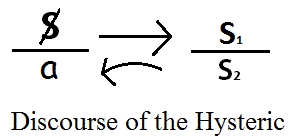
Discourse of Hysteric

The questions put to the master are bascially the same: “Tell me who I am, tell me what I want.” Although this master can be found in different places — it could be a priest, a doctor, a scientist, an analyst, even a husband — there is always one common factor: the master is supposed to know, he is supposed to know and to produce the answer. That is why we find knowledge, S2, in the position of product. Typically, this answer always misses the point. S2 as general knowledge is impotent in producing a particular answer to the particular driving force of objectA in the place of truth: a//S2. This inevitably results in a never ending battle between the hysterical subject and the particular master on duty. …

Structurally, the discourse of the hysteric results in alienation for the hysterical subject and in castration for the master. The answer given by the master will always miss the point, because the true answer concerns objectA, the object which is forever lost and cannot be put into words. The standard reaction to this failure is to produce even more signifiers but they only lead one further and further from the lost object in the position of truth. This impossibility causes the failure of the master, and entails his symbolic castration. Meanwhile, the master, in the position of the other as S1, has produced an ever increasing body of S2, of knowledge. It is this very knowledge that the hysterical subject experiences ass profoundly alienating: as an answer to her particular question she receives a general theory, …. Whether or not she complies with it, whether or not she identifies herself with it, is besides the point. In every case, the answer will be felt as alienating. Knowdledge as a product is unable to say anything important about objectA in the place of truth: a//S2 (Verhaeghe, Does the Woman 110).

[The master’s] truth is that he is also castrated, divided and subject to the Law. The paradox is that in striving to attain jouissance, the only thing he can produce is a knowledge which always falls short and which automatically makes him fail as a master. Ineed, if he wants to display his knowledge he has to speak, but the moment he does, he reveals his division. the only way for a master to say master is to keep away from the game of desire.
[…] Only he who does not desire is not submitted to castration, remains undivided and can occupy the position of master. … The idealised father of the hysteric is teh dead father, the one who, freed from all desire, is no longer subjected to the fundamental lack and can produce in his own name, S1, a knowledge, S2, concerning jouissance. Verhaeghe 112

Discourse of University (Verhaeghe, Does the Woman 116-117)

In the discourse of the university, the master functions as a formal guarantee for knowledge, thereby denying the ever-problematic division of the one who knows. In the end, this denial will be a failure. It is this knowledge that takes up the position of agent in the discourse of the university. If we turn the terms in the discourse of the master back a quarter, we obtain the discourse of the university as a regression of the discourse of the master, and as the inverse of the discourse of the hysteric. The agent is a ready-made knowlege, whereas the other is reduced to mere object, cause of desire: S2 –>a

The history of psychoanalysis illustrates this aim of the discoruse of the university: Freud is reduced to a merer guarantee of a closed and well-established knowledge. The problematic aspect of his work is put aside, only his name remans as the master signifier necessary for the guarantee: “Made in …” The unifying aspect of this S1 already shows itself in the fact that post-Freudianism reduced Freud to a massive whole, a monolith without any internal dynamic. Certainly, the ‘evolution’ in his work was recognised, but only in the sense of a cumulative progression, which began before Freud (‘dynamic’ psychiatry), and resulted after him in the pinnacle known as Ego psychology …

This knowledge is presented as an organised and transparent unity which can be applied straight from the textbook. the hidden truth is that it can only function if one can guarantee it with a master-signifier.

In the position of the other, we find the lost object, the cause of desire. The relationship between this object and the signifying chain is structurally impossible: the object is precisely that element, Das Ding, which is beyond the signifier. As a result, the product of this discourse is a growing division of the subjuct: the more knowledge one uses to reach the object, the more one becomes divided between signifiers, and the further one moves away from home, that is, from the true cause of desire: S2–>a.

The product of this discourse demonstrates its failure since the result is nothing but the divided subject $. This is a consequence of the impossible relationship between S2 –>a. Knowledge does not yield jouissance, only a subject divided by a knowledge expressed in signifiers. This subject, $, can never be identified with an S1 because it would require a state of non-division. Between truth and product, the disjunction of impotence insists: S1//$.

Moreover, there is no relationship between the subject and the master-signifier in this discourse; the master is supposed to secrete signifiers without there being any relationship with his own subjectivity: S1//$. This illusion is behind the ‘objectivity’ required in classical science.

Impossibility and impotence

Nobus, Dany. Knowing Nothing, Staying Stupid: Elements for a Psychoanalytic Epistemology. Florence, KY, USA: Routledge, 2005. p 137.

The four discourses usher in darkness and cast a shadow over knowledge. The four discourses thus direct us to an increasingly tight spiral, linking clarity and brevity of articulation to that which is ‘absolutely irreducible, completely obscure’.

The lesson for anyone interested in extraclinical applications of the four discourses is that they have an operative function, not an interpretative one. They reveal an unconscious that is present and at work, but they are not a means to describe and analyse the unconscious workings of discourse.

Nor are they an ideal device, as Bracher would have it, for analysing the discursive structure of a speech act and its socio-political impact on a receiving subject. This distinction between what we have called an ‘operative’ and an ‘interpretative’ approach to the four discourses corresponds to the division between the traumatic loss of knowledge and the ‘epistemological drive’ to know more.

The introduction of Lacanian discourse theory ought to have a limiting or circumscribing effect on knowledge itself. It should produce a better account of the irreducibly obscure and not be used as a means for producing a kind of hyper-academic knowledge out of a ‘real world’ situation. None of the authors we have mentioned go as far in the straightforward application of the four discourses as Diane Rubenstein … 138.

If we turn our attention away from an idealist standpoint on the four discourses and proceed to examine, as did Lacan, the world in which psychoanalysts have come to exist, a radically different picture presents itself. Rather than being discernible simply as controlling elements of speech within a subject, an institution or a social bond, the four discourses can be seen to exist in a hegemonic or hierarchical relationship. This relationship is determined by the division between truth as cause of speech, and truth as an effect of meaning. This division creates an invisible wall that runs across each of the four discourses in turn. One reason that we have laid such stress on the relationship of the master and the analyst is that it requires an effort to disentangle the relationship of these two discourses from the manner in which the master’s discourse is secreted within, and occluded by, the discourse of the university.

Impossibility and Impotence

One answer to this discursive hegemony and aggregation of forces is to highlight the structural importance of the functions of impossibility (impossibilité) and impotence (impuissance) in the four discourses. This emphasis takes us back to the model of a ‘traumatic epistemology’ with which we opened this chapter, insofar as it reveals the joints and seams within discourse, and the manner in which the discourses of the master, the university and the hysteric cement a relationship between connaissance and savoir by avoiding the implications of ‘knowledge as a means of jouissance’. Two of the four discourses, those of the master and the university, stave off or prevent a moment of traumatic collapse. Another of the discourses, that of the hysteric, speaks from the place of confusion and disorder, yet reconstructs the master as an idol who is asked to provide an answer to the perennial question ‘who am I?’

Only the remaining discourse, that of the analyst, is satisfied with the condition of traumatic disorder, seeing it as a place to begin, rather than as a terminal point.

The analyst’s speech, precisely because it does not aim at truth, allows truth to assume a causal or initiating role for the analysand. The first step towards understanding the role of impossibility and impotence in the four discourses is to grasp the paradox that the truth both is and is not spoken. The truth speaks, it drives and structures speech, but for that very reason the truth cannot take the form of a metalinguistic statement of ‘the truth about the truth’.

The function of truth here is causal. It sets discourse in motion through the action of the signifier on the body and the division of the field of thought. The unconscious truth that drives discourse and the conscious truth that is striven for initiate the shifting movements from one discourse to another.

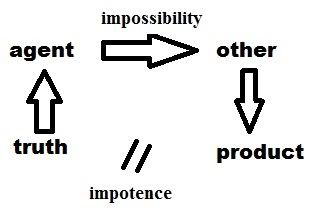
Conscious thought escapes from its causal determinations by altering its course from a discourse of mastery to one of rationalization, or from rationalization to hysterical dissidence. The four discourses thus represent four possible positions regarding the relationship between truth as an unconscious cause and truth as a consciously achieved effect. The manner in which the truth as cause sets discourse in motion is in the four relationships of truth, agency, Other and product within each discourse, which are always positioned in the same way:

Photobucket

The relationship agency–>Other represents the ideal of conscious speech, in which a speaker communicates with a receiver and produces a result. The wild card in this arrangement is the presence of truth as discursive cause at the bottom left-hand side of the diagram. The fact that truth as cause is inassimilable into the relationship agency–>Other–>product leads Lacan to posit two levels of communicative disjunction within his theory of discourse

The upper disjunction, that of impossibility, concerns the failure of a metalanguage, the failure to ‘tell the truth about truth’.

The lower disjunction, that of impotence (sometimes called ‘inability’) takes us still further from the ‘truth about truth’, since it is evident that the product of the agent’s speech, as delivered by the Other, is double-barred from access to the truth as cause of the agent’s speech.

Discourse is thus a one-way street, leading from the action of the signifier to the endless circuits of desire-in-language that it generates. The upper and lower levels of the diagram therefore posit an interpretation shadowed by its negation or, to put this another way, the relationship between connaisance and savoir is fundamentally attended by the demon of jouissance. Even before the staging points of the master, the university, the analyst and the hysteric have been introduced, we already have the two basic elements of Lacanian epistemology here, namely a desire to know (the epistemological drive) and a certain failure of knowledge, both conjoined in the speaking body as initiated by the signifier.

What is the foundation, then, of the epistemological drive, and the establishment of the modern, technocratic master? Correspondingly, what is the place of the unconscious in a technocracy? To address these questions, it is worth comparing the place of S2 (unconscious knowledge, savoir), within the discourse of the master and that of the university in order to see how it maintains the primary alienation of truth as cause, from truth as a discursive product.

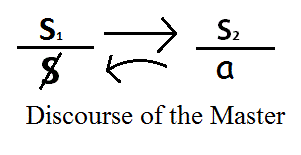
In the two diagrams, we have highlighted the position of knowledge, S2 , within these two formulas. The master signifier, S1 , occupies the position of agency in the master’s discourse, but in the university discourse it takes the role of the hidden truth. Knowledge, S2 , is situated in the ‘passive’ place of the Other in the master’s discourse, but assumes the site of agency in the university discourse.
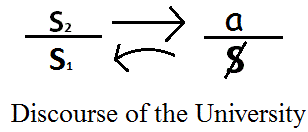
In the latter discourse, these machinations have the effect of expelling the (absent) subject of the unconscious, $, from the scene, and of constructing a hygienic barrier between $ and S1 , which limits the threat posed by $ in the place of truth in the master’s discourse. The threat posed by the subject of the unconscious to the master concerns the revelation of the master’s fundamental impotence, his self-undermining dependence on the Other to establish a sense of meaning. The discourse of the university is therefore a safeguard, a ‘castling’ manoeuvre; the master signifier is stowed away in the knapsack of the soldier/bureaucrat who rationalizes the exercise of power.

Yet, most importantly, in the transition from the master discourse to that of the university, something also happens to knowledge, inasmuch as it has been abstracted from the other and delivered back to the agency:

[I]n the initial status of the discourse of the master, knowledge is on the side of the slave…. [W]hat happens between the discourse of the classical master and that of the modern master, which is called capitalist, is a modification in the place of knowledge…. The fact that the all-knowledge [tout-savoir] has moved into the place of the master is something that, far from throwing light on it, obscures a bit more what is in question, namely, truth. Where does it come from, the fact that there is a master’s signifier in this place? For that is well and truly the S 2 of the master, revealing the bare bones of how things are in the new tyranny of knowledge. (Lacan 1991 [1969– 70]: 34– 35)

In the structure of the master’s discourse, the Other (or the slave, according to Lacan’s Hegelian formulation) is dispossessed of knowledge, just as the worker in a capitalist economy is dispossessed of his labour. 143

In the university discourse, ‘the new tyranny of knowledge’ into which mastery regresses and dissimulates itself, rationalizes these same products in an attempt to establish control over human resources, pleasures and desires. The slave is thus exploited twice, once as a member of the underclass and again as a ‘student’, an underclass subject to the tyranny of rationalization. Nowadays, a student is as likely to be someone attending benefit agencies, receiving computer training, and adopting the psycho-bureaucratic discourse of the television soap opera—‘Let’s talk it out!’—as someone paying for a higher degree of ‘finish’ at a university.

One can sum this up by saying that the discourse of the university aims to make products (outputs, students) that also ‘speak product’ and thus intellectualize their alienation. As we suggested earlier, this phenomenon is by no means confined to actual universities— modern technocratic governments make students of all their citizens, without exception.

This is another reason why the four discourses must be seen as a means of shutting down and foreclosing the possibilities of further knowledge, rather than opening them up for extra-psychological and supra-sociological adventurism.

The fatal flaw of the discourse of the university is that its product, $, the (absent) subject of the unconscious, merely reveals the vanity of the attempt to rationalize and streamline the production of human resources. As Verhaeghe puts it: ‘[T]he product of this discourse is an ever-increased division of the subject; the more knowledge one uses to reach for the object [object a] the more one becomes divided between signifiers, and the further one gets away from home, that is from the true cause of desire’ (Verhaeghe 1995: 95).

The failure of the university discourse and its inevitable return to desire also indicate the trauma and the ultimate ‘fall’ of philosophy. In Seminar XVII, Lacan first of all traces the complicity of philosophy with mastery through a reading of Aristotle’s Politics, in which, he argues, the slave’s ‘know-how’ (his support of everyday life) is colonized by philosophy in the service of the master: ‘The function of the episteme in so far as it is specified as transmissible knowledge . . . is, entirely, still borrowed from the techniques of the craftsman, that is to say of serfs. It is a matter of extracting its essence so that this knowledge becomes the master’s knowledge…. Philosophy in its historical function is this extraction, this betrayal I would almost say, of the slave’s knowledge, so as to obtain its transmutation as master’s knowledge’ (Lacan 1991 [1969– 70]: 21– 22).

The advancement of the philosopher through the dispossession of the slave meets a barrier with the emergence of the ‘subject of science’. The division between the action of the signifier and the effort of signification/communication, which, according to Lacan, was first introduced by Descartes, makes philosophy and nonsense interchangeable, because the signifying chain can generate multiple discourses, from the erudite to the foolish, quite independently of the body it colonizes. The psychoanalyst, who invites the analysand to say anything she wishes, accepts the reality of this division. The philosopher, who is locked into the drive for abstract knowledge, cannot. Lacan uses the example of Wittgenstein’s discourse, a man possessed by a férocité psychotique (Lacan 1991 [1969– 70]: 69) to illustrate the trauma of the philosopher whose work comes to grief on the distinction between the signifier and signification. … What Wittgenstein cannot admit, however, is … any further atomization of knowledge that would create a division between an autonomous chain of signifiers and the world to which they refer. Wittgenstein, like all philosophers, ‘wants to save the truth’ (ibid.: 71) and, whilst admitting the notion of a world constructed by language, draws back from the radically disarticulated scene offered by Lacanian lalangue (‘llanguage’).

By contrast, the ‘fall of knowledge’ that the Lacanian epistemology aims at changes the historical trajectory that runs from the slave to the philosopher, by using ‘know-how’ as a means to disarticulate and dispossess abstract knowledge.

It does so in the name of the possibilities introduced by the subject of science, as they are formalized in the structure of the four discourses. In this chapter we have argued that the four discourses must be seen as part of an operation conducted on knowledge which divides the signifier from signification. Furthermore, ‘the signifier is stupid’, and not only does the analyst encounter ‘a stupid of signifiers’ in the speech of the analysand but this same stupidity of the signifier is the very basis of his own discourse. This is the source of the ‘horror’ Lacan refers to in ‘Science and Truth’, namely, that the unconscious speech of ‘I, the truth, am speaking’ is as reckless, obdurate and inchoate as our own words are reasonable, rational and articulate. This point returns in Seminar XVII:

‘Knowledge— I think I have insisted upon it sufficiently to get it into your head— knowledge is a thing that says itself, that is said. Well then, the knowledge that speaks on its own— that’s the unconscious’ (ibid.: 80).

The only epistemology adequate to this knowledge is an epistemology that encounters the horror of this ‘speaking truth’ head on, as well as the traumas of the disarticulation of knowledge and the loss of meaning that it introduces. A besetting problem of commentary on Lacan is that the danger of dismemberment and loss is never worked through within the structure of the commentary, so that the four discourses are treated as interpretative options, rather than as four contingent solutions to the intrinsic collapse of the communicative act into stupidity, non-knowledge and the circuits of desire.  145

lacanian epistemology

Nobus, Dany. Knowing Nothing, Staying Stupid: Elements for a Psychoanalytic Epistemology. Florence, KY, USA: Routledge, 2005. p 132.

Doing justice to the radical difference of the model of knowledge that Lacan constructs in Seminar XVII thus also requires attention to the manner in which its positioning of the discourses of the master and that of the analyst corresponds to a distinction between a technocratic social order and the liberating potential of an unconscious.

For Marx, the ‘secret product’ of modernity is surplus value, extracted from the labour of the worker and concealed within class structures and divisions of labour.

To Lacan, following Marx’s terminology, the secret product is surplus jouissance, generated as a by-product of the technocratic orders of knowledge by which the subject is determined, and accessible in the analytic setting through a knowledge whose exercise corresponds to its acquisition. The discourse of the analyst, in which knowledge operates in the place of truth, corresponds neither to culture nor to its products and heralds the possibility of revolution and radical change.

‘Keep going. March. Keep on knowing more’ (Lacan 1991 [1969– 70]: 120). With these words, Lacan relayed the disembodied, motiveless command of the modern master. … In the master’s command, the agency that issues the order to know and the actual agents of knowledge that are set to work by this order … in the headlong pursuit of ‘knowledge for its own sake’.

However, rather than endorsing the psychoanalytic value of this command to know more, Lacan insists on the value of stupidity, ignorance, loose talk and bullshit— the disavowed waste products of the epistemological drive — and the manner in which this ‘waste of knowledge’ indicates the path from conscious knowledge (connaissance) to unconscious reason (savoir) and thence to jouissance.

Lacan’s introduction of the discourses of the master, the university, the analyst and the hysteric is subsumed within a deeper logic, which juxtaposes the position of the analyst with the changing face, or increasing facelessness, of the master within modern forms of social life. The role of the ‘master’s discourse’ is to mark the beginning of a dynamic of concealment and subterfuge, which the analyst’s discourse exposes to scrutiny. Yet this same process of concealment, alienation and dissimulation has created the analytic function itself. In the formulae of the four discourses, the discourse of the master and that of the analyst are two aspects of the state of knowledge within modernity. 132

Mastery survived, developed and dissimulated itself through the progressive and violent transformation of tacit and embodied knowledge into abstract social agency.

In turn, analytic work occupies the sites of this process in the damaged bodies and psyches of modernity’s subjects, identifying mastery’s loci of control, its causes and its divisive effects.

As such, embodied knowledge or ‘know-how’ is co-opted to mastery, which then resides as the hidden kernel of a self-perfecting technological consciousness. This technological consciousness ultimately conceals the weakness and infirmity of the classical master within a ‘master function’ that efficiently disposes of social products, bodies and of knowledge. 133

Psychoanalysis addresses the ‘master function’ by setting up camp in the very sites of epistemological division and the traces they leave in the organization of the self.

The logic of misunderstanding that exists between academics and analysts is laid out in the dynamic relationship established by the four discourses. ‘The university discourse’ is another term for an apparatus of dissimulation and concealment in which the impotence of the master is disguised by the puissance [strength power] and agency of knowledge itself, alienated into a social product that exists ‘for its own sake’ and for the sake of the master simultaneously.

Quackelbeen thus completely ignores, or fails to understand, Lacan’s injunction that the four discourses are not abstractions to be applied to real situations, but are ‘already inscribed in what functions as this reality’ (Lacan 1991 [1969– 70]: 13). The discourses are not to be used as keys to the meaning of speech, but as means of separating speech from meaning, thus isolating the reality of the unconscious from the real world as it is generally understood. 137

hysteric capitalism

Boyle, Kirk. “The Four Fundamental Concepts of Slavoj Žižek’s Psychoanalytic Marxism.”  International Journal of Žižek Studies Vol 2.1 (2008) 1-21.

Any discussion of the homology between surplus-enjoyment and surplus-value must begin with the psychoanalytic understanding of ontological difference. Contrary to popularly held theories that disclaim any notion of human nature, psychoanalysis posits a “minimal difference” that enables us to recognize a specifically-human dimension.

For Žižek, the key to the zero-degree of “humanization” is to be found in the Freudian notion of “death drive.”

Death drive represents:

the way immortality appears within psychoanalysis, for an uncanny excess of life, for an “undead” urge which persists beyond the (biological) cycle of life and death, of generation and corruption. The ultimate lesson of psychoanalysis is that human life is never “just life”: humans are not simply alive, they are possessed by the strange drive to enjoy life in excess, passionately attached to a surplus which sticks out and derails the ordinary run of things. (Žižek 2006b: 62)

The “minimalist anthropology” of death drive—the psychoanalytic conception of ontological difference—allows Žižek to develop the idea of surplus enjoyment, Lacan’s equivalent term for Marx’s concept of surplus-value. There is a certain elegance to this homology: just as surplusvalue sets capitalist production in motion, surplus enjoyment provides the object-cause of human desire, what Lacan designates objet petit a. In Lacan’s hands, surplus-value becomes a subsequent instantiation of surplus enjoyment, with the implication that the latter exists as an eternal condition of human existence. (At one point in Seminar XVII, Lacan jests that Marx would have invented the concept of surplus jouissance if he had not had to “invent” capitalism.)

Objet a introduces an important distinction in the economy of enjoyment. Objet a represents the object-cause of desire, not the object of desire. The object of desire is simply the material object, the body of another, etc. The object-cause of desire, on the other hand, is the je ne sais quoi of this object, what is in a product more than the product itself. In the latter sense, objet a signifies the promise of enjoyment-in-the-Real, of an experience of full jouissance, total fulfillment and satisfaction. The impersonal pronoun starring in the eBay ads works because it represents this object-cause of desire as opposed to the objects of desire available at the click of a mouse button. The “it,” the commodity form, is empty precisely because it can never deliver on its promise of jouissance; the objet a can never coincide with the object of desire.

If eBay promises to make “it” accessible, this promise entails the collapse of an irreducible split between what is obtained from what was expected, what was requested from what proves to be ultimately unsatisfactory. In Lacanian terms, the commodity form obfuscates the difference between desire and demand by asserting the possibility of their equivalence. Against this marketing deception, we should assert that the demand for “it” is always an obfuscated desire for objet a. Moreover, when eBay delivers on our demand—when we obtain that obscure something that we have wanted since a time before we can remember—we can rest assured that our desire will remain as restless as it was before the purchase. Objet a is the name for why we respond to “it” with “that’s not it!”

What happens when enjoyment becomes the mandate of an entire symbolic order? One result of the shift from a superego that fosters guilt to one that demands enjoyment is the emergence of new forms of subjectivity. As Jameson and other theorists of postmodernity have argued, the symptomatic subject of late capitalism is schizophrenic. Yet, prior to schizoid normativity, it was Lacan who postulated that the appearance of hysteria was concomitant with the burgeoning of consumer society. Hysteria emerges at a specific time in history when the symbolic order could no longer guarantee an answer to the subjective question, “What does the Other [the symbolic order] want from me?” The radical cutting of traditional social bonds that occurs with the rise of capitalism universalizes this adolescent question and renders it permanent. The hysteric is no longer able to rely on the symbolic order to structure his or her desire, but suffers from a so-called “identity crisis.” Capitalism exploits the hysterical response to the waning of the symbolic order’s efficiency to create meaningful identifications for the subject. Žižek writes, “The excess of doubt, of permanent questioning, can be directly integrated into social reproduction” (Žižek 2005a: 228). We can refer to the excess of doubt and permanent questioning that capitalism exploits as the “infinite metonymy of desire.”

Capitalism feeds off the historical opening up of this infinite metonymy of desire. “Lacan designated capitalism as the reign of the discourse of the hysteric,” writes Žižek. “The vicious circle of a desire whose apparent satisfaction only widens the gap of its dissatisfaction…is what defines hysteria” (Žižek 1993: 209). We can now see how the surplus-enjoyment of objet a connects with the basic functioning of capitalism.

The hysteric-consumer, in his or her permanent quest to fill the lack (a lack shared by hysteric and symbolic order alike), searches for the object cause of desire in the endless aisles of mega-marts, department stores, antique shops, thrift stores, etc. Through purchases the hysteric begins to construct an identity, but this identity is provisional and always open to alterations.

The seemingly infinite malleability for the hysterical subject to make and remake him- or herself through consumerism (the infamous lifestyle branding heralding a new step in this logic), mirrors capitalism’s constant revolutionizing of its own conditions. “The explosion of the hysterical capitalist subjectivity,” writes Žižek, “reproduces itself through permanent self-revolutionizing, through the integration of the excess into the ‘normal’ functioning of the social link (the true ‘permanent revolution’ is already capitalism itself)” (Žižek 2005a: 228). The normalization of this excess signals a primary (if not the primary) contradiction of capitalism.

What does it mean to cement the social link in surplus-enjoyment? Žižek acutely describes the unparalleled moment we currently live in, and I quote at length:

Capitalism is not just a historical epoch among others…a certain excess which was, as it were, kept under check in previous history, perceived as a local perversion, a limited deviation, is in capitalism elevated into the very principle of social life, in the speculative movement of money begetting more money, of a system which can survive only by constantly revolutionizing its own conditions—that is to say, in which the thing can survive only as its own excess, constantly exceeding its own “normal” constraints (Žižek 2006b: 297).

Žižek’s wager is that the “micro” libidinal economy of the hysteric parallels the “macro” political economy of capitalism. Both are characterized by a permanent process of self-revolutionizing through the integration of an excess,surplus enjoyment for the hysteric and surplus-value for capitalism, and both can survive only by exceeding their own normal constraints. The hysteric paradoxically maintains his or her desire by rummaging through a constant parade of object products in desperate search of “it,” the object-cause of desire. By comparison, the capitalist contradiction centers on objet a: “this inherent obstacle/antagonism as the ‘condition of impossibility’ of the full deployment of the productive forces [that] is simultaneously its ‘condition of possibility’” (Žižek 2005b: unpaginated).

Acknowledging that these surpluses are homologous presents a great challenge for the desire called utopia. Žižek writes:

If we subtract the surplus we lose enjoyment itself, just as capitalism, which can survive only by incessantly revolutionizing its own material conditions, ceases to exist it if “stays the same,” if it achieves an internal balance. This, then, is the homology between surplus-value—the “cause” which sets in motion the capitalist process of production — and surplus-enjoyment, the object-cause of desire. (Žižek 1989: 52)

To repeat Marx but not to fall into the evolutionist trap of believing that communism will spontaneously arise out of capitalism, we must envision a symbolic order that somehow eliminates surplus-value while preserving a certain degree of surplus enjoyment. Such is one task of utopian thought.

Ž four discourses four subjects

Žižek, Slavoj. “Four Discourses, Four Subjects” in Cogito and the Unconscious. ed. Slavoj Žižek, Duke UP, 1998. 75-113.

The illusion of the gesture of the Master is the complete coincidence between the level of enunciation (the subjective position from which I am speaking) and the level of the enunciated content, that is, what characterizes the Master is a speech-act that wholly absorbs me, in which “I am what I say,” in short, a fully realized, self-contained performative.

Such an ideal coincidence, of course, precludes the dimension of fantasy, since fantasy emerges precisely  in order to fill in the gap between the enunciated content and its underlying position of enunciation.

Fantasy is an answer to the question, “You are telling me this, but why? What do you really want by telling me this?”

The fact that the dimension of fantasy nonetheless persists thus simply signals the ultimate unavoidable failure of the Master’s discourse.

There is thus no reason to be dismissive of the discourse of the Master, to identify it too hastily with “authoritarian repression”: the Master’s gesture is the founding gesture of every social link.  Let us imagine a confused situation of social disintegration, in which the cohesive power of ideology loses its efficiency: in such a situation, the Master is the  one who invents a new signifier, the famous “quilting point,” which again stabilizes the situation and makes it readable; the university discourse that then elaborates the network of Knowledge that sustains this readability by definition presupposes and relies on the initial gesture of the Master.  The Master adds no new positive content — he merely adds a signifier, which all of a sudden turns disorder into order, into “new harmony,” … Therein resides the magic of a Master: although there is nothing new at the level of positive content, “nothing is quite the same” after he pronounces his Word. …

The University discourse is enunciated from the position of “neutral” Knowledge; it addresses the remainder of the real  (say, in the case of pedagogical knowledge, the “raw, uncultivated child”), turning it into the subject .   .  The “truth” of the university discourse, hidden beneath the bar, of course, is power (i.e., the Master-Signifier):
the constitutive lie of the university discourse is that it disavows its performative dimension, presenting what effectively amounts to a political decision based on power as a simple insight into the factual state of things.

What one should avoid here is the Foucaultian misreading: the produced subject is not simply the subjectivity that arises as the result of the disciplinary application of knowledge-power, but its remainder, that which eludes the grasp of knowledge-power. “Production” (the fourth term in the matrix of discourses) does not stand simply for the result of the discursive operation, but rather for its “indivisible remainder,” for the excess that resists being included in the discursive network (i.e., for what the discourses itself produces as the foreign body in its very heart). 78

Suffice it to recall the market expert who advocates strong budgetary measures (cutting welfare expenses, etc.) as a necessity imposed by his neutral expertise devoid of any ideological biases: what he conceals is the series of power-relations (from the active role of state apparatuses to ideological beliefs) that sustain the “neutral” functioning of the market mechanism. 79

In the hysterical link, the . . over a stands for the subject who is divided, traumatized, by what an object she is for the Other, what role she plays in Other’s desire: “Why am I what you’re saying that I am?” … What she expects from the Other-Master is knowledge about what she is as object (the lower level of the formula).

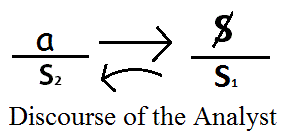
In contrast to hysteria, the pervert knows perfectly what he is for the Other: a knowledge supports his position as the object of Other’s (divided subject’s) jouissance. For that reason, the matheme of the discourse of perversion is the same as that of the analyst’s discourse.

Lacan defines perversion as the inverted fantasy (i.e., his matheme of perversion is a-$), which is precisely the upper level of the analyst’s discourse. The difference between the social link of perversion and that of analysis is grounded in the radical ambiguity of objet petit a in Lacan, which stands simultaneously for the imaginary fantasmatic lure/screen AND for that which this lure is obfuscating, for the void behind the lure.

*So when we pass from perversion to the analytic social link, the agent (analyst) reduces himself to the void, which provokes the subject into confronting the truth of his desire. Knowledge in the position of “truth” below the bar under the “agent,” of course, refers to the supposed knowledge of the analyst, and, simultaneously, signals that the knowledge gained here will not be the neutral objective knowledge of scientific adequacy, but the knowledge that concerns the subject (analysand) in the truth of his subjective position.

In this precise sense, the analyst’s discourse produces the master signifier, the swerve of the patient’s knowledge, the surplus element that situates the patient’s knowledge at the level of truth: after the master signifier is produced, even if nothing changes at the level of knowledge, the same knowledge as before starts to function in a different mode. The master signifier is the unconscious sinthome, the cipher of enjoyment, to which the subject was unknowingly subjected.

*Text here is modified according to https://www.terada.ca/discourse/?p=7106

So, if a political Leader says “I am your Master, let my will be done!” this direct assertion of authority is hystericized when the subject starts to doubt his qualification to act as a Leader (“Am I really their Master?” What is in me that legitimizes me to act like that?”); it can be masked in the guise of the university discourse (“In asking you to do this, I merely follow the insight into objective historical necessity, so I am not your Leader, but merely your servant who enables you to act for your own good. …”); or, the subject can act as a blank, suspending his symbolic efficiency and thus compelling his Other to become aware of how he was experiencing another subject as a Leader only because he was treating him as one.

It should be clear, from this brief description, how the position of the “agent” in each of the four discourses involves a specific mode of subjectivity:

– the Master is the subject who is fuly engaged in his (speech) act, who, in a way, “is his word,” whose word displays an immediate performative efficiency;

– the agent of the university discourse is, on the contrary, fundamentally disengaged: he posits himself as the self-erasing observer (and executor) of “objective laws” accessible to neutral knowledge (in clinical terms, his position is closest to that of the pervert).

– the hysterical subject is the subject whose very existence involves radical doubt and questioning, his entire being is sustained by the uncertainty as to what he is for the Other; insofar as the subject exists only as an answer to the enigma of the Other’s desire, the hysterical subject is the subject par excellence.

Again, in clear contrast to it, the analyst stands for the paradox of the desubjectivized subject, of the subject who fully assumed what Lacan calls “subjective destitution” that is, who breaks out of the vicious cycle of intersubjective dialectics of desire and turns into an acephalous being of pure drive.

objet a and the drive id-evil

Žižek, Slavoj.  Jacques Lacan’s Four Discourses also in an article in Russell Grigg and Justin Clemens Jacques Lacan and the Other Side of Psychoanalysis. 2006

Portions of this stuff are reprinted in The Parallax View starting on page 303.

Can the upper level of Lacan’s formula of the university discourse — S2 directed toward a — not also be read as standing for the university knowledge endeavoring to integrate, domesticate, and appropriate the excess that resists and rejects it?

One of the telltale signs of university discourse is that the opponent is accused of being “dogmatic” and “sectarian.” University discourse cannot tolerate an engaged subjective stance. Should not our first gesture be, as Lacanians, to heroically assume this designation of being “sectarian” and engage in a “sectarian” polemic?

University discourse as the hegemonic discourse of modernity has two forms of existence in which its inner tension (“contradiction”) is externalized: capitalism, its logic of the integrated excess, of the system reproducing itself through constant self-revolutionizing, and the bureaucratic “totalitarianism” conceptualized in different guises as the rule of technology, of instrumental reason, of biopolitics, as the “administered world.”

We should not succumb to the temptation of reducing capitalism to a mere form of appearance of the more fundamental ontological attitude of technological domination; we should rather insist, in the Marxian mode, that the capitalist logic of integrating the surplus into the functioning of the system is the fundamental fact.

Stalinist “totalitarianism” was the capitalist logic of self-propelling productivity liberated from its capitalist form, which is why it failed: Stalinism was the symptom of capitalism.

Stalinism involved the matrix of general intellect, of the planned transparency of social life, of total productive mobilization- and its violent purges and paranoia were a kind of a “return of the repressed,” the “irrationality” inherent to the project of a totally organized “administered society.” This means the two levels, precisely insofar as they are two sides of the same coin, are ultimately incompatible: there is no metalanguage enabling us to translate the logic of domination back into the capitalist reproduction-through-excess, or vice versa.

The key question here concerns the relationship between the two excesses:

1) the economic excess/surplus integrated into the capitalist machine as the force that drives it into permanent self-revolutionizing and

2) the political excess of power — exercise inherent to modern power (the constitutive excess of representation over the represented: the legitimate state power responsible to its subjects is supplemented by the obscene message of unconditional exercise of Power —laws do not really bind me, I can do to you whatever I want, I can treat you as guilty if I decide to, I can destroy you if I say so).

The master’s discourse stands not for the premodern master, but for the absolute monarchy, this first figure of modernity that effectively undermined the articulate network of feudal relations and interdependences, transforming fidelity to flattery: it is the “Sun-King” Louis XIV with his L’état, c’est moi who is the master par excellence. Hysterical discourse and university discourse then deploy two outcomes of the vacillation of the direct reign of the master:

the expert-rule of bureaucracy that culminates in the biopolitics of reducing the population to a collection of homo sacer (what Heidegger called “enframing,” Adorno “the administered world,” Foucault the society of “discipline and punish”);

the explosion of the hysterical capitalist subjectivity that reproduces itself through permanent self-revolutionizing, through the integration of the excess into the “normal” functioning of the social link (the true “permanent revolution” is already capitalism itself).

Lacan’s formula of the four discourses thus enables us to deploy the two faces of modernity

1. total administration and
2. capitalist-individualist dynamics

as two ways to undermine the master’s discourse:

doubt about the efficiency of the master-figure (what Eric Santner called the “crisis of investiture”) can be supplemented by the direct rule of the experts legitimized by their knowledge, or

the excess of doubt, of permanent questioning, can be directly integrated into social reproduction.

Finally, the analyst’s discourse stands for the emergence of revolutionary-emancipatory subjectivity that resolves the split of university and hysteria.

In it, the revolutionary agent – a – addresses the subject from the position of knowledge that occupies the place of truth (i.e., which intervenes at the “symptomal torsion” of the subject’s constellation), and the goal is to isolate, get rid of, the master signifier that structured the subject’s (ideologico-political) unconscious.

Or does it? Jacques-Alain Miller has recently proposed that today the master’s discourse is no longer the “obverse” of the analyst’s discourse. Today, on the contrary, our “civilization” itself-its hegemonic symbolic matrix, as it were-fits the formula of the analyst’s discourse. The agent of the social link is today a, surplus enjoyment, the superego injunction to enjoy that permeates our discourse; this injunction addresses $ (the divided subject) who is put to work in order to live up to this injunction. The truth of this social link is S2, scientific-expert knowledge in its different guises, and the goal is to generate S1, the self-mastery of the subject, that is, to enable the subject to cope with the stress of the call to enjoyment (through self-help manuals, etc.). Provocative as this notion is, it raises a series of questions. If it is true, in what, then, resides the difference between the discursive functioning of civilization as such and the psychoanalytic social link? Miller resorts here to a suspicious solution: in our civilization, the four terms are kept apart, isolated; each operates on its own, while only in psychoanalysis are they brought together into a coherent link: “in civilization, each of the four terms remains disjoined… it is only in psychoanalysis, in pure psychoanalysis, that these elements are arranged into a discourse.”

However, is it not that the fundamental operation of the psychoanalytic treatment is not synthesis, bringing elements into a link, but, precisely, analysis, separating what in a social link appears to belong together? This path, opposed to that of Miller, is indicated by Giorgio Agamben,Giorgio Agamben, who, in the last pages of The State of Exception, imagines two Utopian options of how to break out of the vicious cycle of law and violence, of the rule of law sustained by violence.

One is the Benjaminian vision of “pure” revolutionary violence with no relationship to the law.

The other is the relationship to the law without regard to its (violent) enforcement, such as Jewish scholars do in their endless (re)interpretation of the Law.

Agamben starts from the right insight that the task today is not synthesis but separation, distinction: nor bringing law and violence together (so that right will have might and the exercise of might will be fully legitimized), but thoroughly separating them, untying their knot.

Although Agamben confers on this formulation an anti-Hegelian twist, a more proper reading of Hegel makes it clear that such a gesture of separation is what the Hegelian “synthesis” is effectively about. In it, the opposites are not reconciled in a “higher synthesis”; it is rather that their difference is posited “as such.”

However, is this vision not again the case of our late capitalist reality going further than our dreams? Are we not already encountering in our social reality what Agamben envisages as a Utopian vision?

Isn’t the Hegelian lesson of the global reflexivization-mediatization of our lives that it generates its own brutal immediacy?

This has best been captured by Etienne Balibar’s notion of excessive, nonfunctional cruelty as a feature of contemporary life, a cruelty whose figures range from “fundamentalist” racist and/or religious slaughter to the “senseless” outbursts of violence performed by adolescents and the homeless in our megalopolises, a violence one is tempted to call Id-Evil, a violence grounded in no utilitarian or ideological reasons.

All the talk about foreigners stealing work from us or about the threat they represent to our Western values should not deceive us: under closer examination, it soon becomes clear that this talk provides a rather superficial secondary rationalization. The answer we ultimately obtain from a skinhead is that it makes him feel good to beat foreigners, that their presence disturbs him. What we encounter here is indeed Id-Evil, that is,

the Evil structured and motivated by the most elementary imbalance in the relationship between the ego and jouissance, by the tension between pleasure and the foreign body of jouissance in the very heart of it.

Id-Evil thus stages the most elementary short circuit in the relationship of the subject to the primordially missing object cause of his desire. What bothers us in the other (Jew, Japanese, African, Turk) is that he appears to entertain a privileged relationship to the object — the other either possesses the object treasure, having snatched it away from us (which is why we don’t have it), or he poses a threat to our possession of the object.

What one should propose here is the Hegelian “infinite judgment,” asserting the speculative identity of these “useless” and “excessive” outbursts of violent immediacy, which display nothing but a pure and naked (“non-sublimated”) hatred of the Otherness, with the global reflexivization of society. […] the response of the neo-Nazi skinhead who, when really pressed for the reasons for his violence, suddenly starts to talk like social workers, sociologists, and social psychologists, quoting diminished social mobility, rising insecurity, the disintegration of paternal authority, the lack of maternal love in his early childhood-the unity of practice and its inherent ideological legitimization disintegrates into raw violence and its impotent, inefficient interpretation.

This impotence of interpretation is also one of the necessary obverses of the universalized reflexivity hailed by the risk-society-theorists: it is as if our reflexive power can flourish only insofar as it draws its strength and relies on some minimal “prereflexive” substantial support that eludes its grasp, so that its universalization comes at the price of its inefficiency, that is, by the paradoxical re-emergence of the brute real of “irrational” violence, impermeable and insensitive to reflexive interpretation. So the more today’s social theory proclaims the end of nature or tradition and the rise of the “risk society,” the more the implicit reference to “nature” pervades our daily discourse: even when we do not speak of the “end of history,” do we not put forward the same message when we claim that we are entering a “postideological” pragmatic era, which is another way of claiming that we are entering a postpolitical order in which the only legitimate conflicts are ethnic/cultural conflicts?

Typically, in today’s critical and political discourse, the term worker has disappeared from the vocabulary, substituted or obliterated by immigrants or immigrant workers: Algerians in France, Turks in Germany, Mexicans in the United States.

In this way, the class problematic of workers’ exploitation is transformed into the multiculturalist problematic of “intolerance of otherness,” and the excessive investment of the multiculturalist liberals in protecting immigrants’ ethnic rights clearly draws its energy from the “repressed class dimension. Although Francis Fukuyama’s thesis on the “end of history” quickly fell into disrepute, we still silently presume that the liberal-democratic capitalist global order is somehow the finally found “natural” social regime, we still implicitly conceive conflicts in the Third World countries as a subspecies of natural catastrophes, as outbursts of quasi-natural violent passions, or as conflicts based on the fanatic identification to one’s ethnic roots (and what is “the ethnic” here if not again a code word for “nature”?). And, again, the key point is that this all-pervasive renaturalization is strictly correlative to the global reflexivization of our daily lives.

What this means, with regard to Agamben’s Utopian vision of untying the knot of the Law and violence is that, in our postpolitical societies, this knot is already untied: we encounter, on the one hand, the globalized interpretation whose globalization is paid for by its impotence, its failure to enforce itself, to generate effects in the real, and, on the other hand, explosions of the raw real of a violence that cannot be affected by its symbolic interpretation. Where, then, is the solution here, between

– the claim that, in today’s hegemonic constellation, the elements of the social link are separated and as such to be brought together by psycho-analysis (Miller),

– and the knot between Law and violence to be untied, their separation to be enacted (Agamben)?

What if these two separations are not symmetrical? What if the gap between the symbolic and the raw real epitomized by the figure of the skinhead is a false one, since this real of the outbursts of the “irrational” violence is generated by the globalization of the symbolic?

When, exactly, does the objet a function as the superego injunction to enjoy? When it occupies the place of the master signifier, that is, as Lacan formulated it in the last pages of his Seminar XI, when the short circuit between S1 and a occurs. The key move to be accomplished in order to break the vicious cycle of the superego injunction is thus to enact the separation between S1 and a.

Consequently, would it not be more productive to follow a different path, that is, to start with the different modus operandi of l’objet a, which in psychoanalysis no longer functions as the agent of the superego injunction — as it does in the discourse of perversion?

This is how Miller’s claim of the identity of the analyst’s discourse and the discourse of today’s civilization should be read: as an indication that this latter discourse (social link) is that of perversion.

That is to say, the fact that the upper level of Lacan’s formula of the analyst’s discourse is the same as his formula of perversion (a-$) opens up a possibility of reading the entire formula of the analyst’s discourse also as a formula of the perverse social link: its agent, the masochist pervert (the pervert par excellence), occupies the position of the object instrument of the other’s desire, and, in this way, through serving his (feminine) victim, he posits her as the hystericized/divided subject who “doesn’t know what she wants.”

Rather, the pervert knows it for her, that is, he pretends to speak from the position of knowledge (about the other’s desire) that enables him to serve the other; and, finally, the product of this social link is the master signifier, that is, the hysterical subject elevated into the role of the master (dominatrix) whom the pervert masochist serves.

In contrast to hysteria, the pervert knows perfectly what he is for the Other: a knowledge supports his position as the object of his Other’s (divided subject’s) jouissance.

The difference between the social link of perversion and that of analysis is grounded in the radical ambiguity of objet a in Lacan, which stands simultaneously for the imaginary fantasmatic lure/screen and for that which this lure is obfuscating, for the void behind the lure.

Consequently, when we pass from perversion to the analytic social link, the agent (analyst) reduces himself to the void, which provokes the subject into confronting the truth of his desire. Knowledge in the position of “truth” below the bar under the “agent,” of course, refers to the supposed knowledge of the analyst, and, simultaneously, signals that the knowledge gained here will not be the neutral objective knowledge of scientific adequacy, but the knowledge that concerns the subject (analysand) in the truth of his subjective position.

Recall, again, Lacan’s outrageous statements that, even if what a jealous husband claims about his wife (that she sleeps around with other men) is all true, his jealousy is still pathological. Along the same lines, one could say that, even if most of the Nazi claims about the Jews were true (they exploit Germans, they seduce German girls), their anti-Semitism would still be (and was) pathological – because it represses the true reason the Nazis needed anti-Semitism in order to sustain their ideological position.

So, in the case of anti-Semitism, knowledge about what the Jews “really are” is a fake, irrelevant, while the only knowledge at the place of truth is the knowledge about why a Nazi needs a figure of the Jew to sustain his ideological edifice.

In this precise sense, the analyst’s discourse produces the master signifier, the swerve of the patient’s knowledge, the surplus element that situates the patient’s knowledge at the level of truth: after the master signifier is produced, even if nothing changes at the level of knowledge, the same knowledge as before starts to function in a different mode. The master signifier is the unconscious sinthome, the cipher of enjoyment, to which the subject was unknowingly subjected.

The crucial point not to be missed here is how the late Lacan’s identification of the subjective position of the analyst as that of objet petit a presents an act of radical self-criticism. Earlier, in the 1950’s, Lacan conceived the analyst not as the small other (a), but, on the contrary, as a kind of stand-in for the big Other (A, the anonymous symbolic order). At this level, the function of the analyst was to frustrate the subject’s imaginary misrecognitions and to make them accept their proper symbolic place within the circuit of symbolic exchange, the place that effectively (and unbeknownst to them) determines their symbolic identity. Later, however, the analyst stands precisely for the ultimate inconsistency and failure of the big Other, that is, for the symbolic order’s inability to guarantee the subject’s symbolic identity.

One should thus always bear in mind the thoroughly ambiguous status of objet a in Lacan. Miller recently proposed a Benjaminian distinction between “constituted anxiety” and “constituent anxiety”: while the first designates the standard notion of the terrifying and fascinating abyss of anxiety that haunts us, its infernal circle that threatens to draws us in, the second stands for the “pure” confrontation with objet a as constituted in its very loss.

Miller is right to emphasize here two features: the difference that separates constituted from constituent anxiety concerns the status of the object with regard to fantasy. In a case of constituted anxiety, the object dwells within the confines of a fantasy, while we get the constituent fantasy only when the subject “traverses the fantasy” and confronts the void, the gap, filled up by the fantasmatic object.

Clear and convincing as it is. Miller’s formula misses the true paradox or, rather, ambiguity of objet a: when he defines objet a as the object that overlaps with its loss, that emerges at the very moment of its loss (so that all its fantasmatic incarnations, from breasts to voice and gaze, are metonymic figurations of the void of nothing), he remains within the horizon of desire — the true object cause of desire is the void filled in by its fantasmatic incarnations.

While, as Lacan emphasizes, objet a is also the object of the drive, the relationship is here thoroughly different. Although in both cases, the link between object and loss is crucial, in the case of objet a as the object cause of desire, we have an object which is originally lost, which coincides with its own loss, which emerges as lost, while, in the case of objet a as the object of the drive, the “object” is directly the loss itself.

In the shift from desire to drive, we pass from the lost object to loss itself as an object. That is to say, the weird movement called “drive” is not driven by the “impossible” quest for the lost object, but by a push to directly enact the “loss” – the gap, cut, distance – itself.

There is thus a double distinction to be drawn here: not only between object a in its fantasmatic and post-fantasmatic status, but also, within this post-fantasmatic domain itself, between the lost object cause of desire and the object loss of the drive. Far from concerning an abstract scholastic debate, this distinction has crucial ideologico-political consequences: it enables us to articulate the libidinal dynamics of capitalism.

Following Miller himself, a distinction has to be introduced here between lack and hole. Lack is spatial, designating a void within a space, while the hole is more radical — it designates the point at which this spatial order itself breaks down (as in the “black hole” in physics).

Therein resides the difference between desire and drive: desire is grounded in its constitutive lack, while drive circulates around a hole, a gap in the order of being. In other words, the circular movement of drive obeys the weird logic of the curved space in which the shortest distance between two points is not a straight line, but a curve: the drive “knows” that the shortest way to attain its aim is to circulate around its goal-object. At the immediate level of addressing individuals, capitalism of course interpellates them as consumers, as subjects of desires, soliciting in them ever new perverse and excessive desires (for which it offers products to satisfy them); furthermore, it obviously also manipulates the “desire to desire,” celebrating the very desire to desire ever new objects and modes of pleasure. However, even if if already manipulates desire in a way that takes into account the fact that the most elementary desire is the desire to reproduce itself as desire (and not to find satisfaction), at this level, we do not yet reach the drive.

The drive inheres to capitalism at a more fundamental, systemic level: drive propels the entire capitalist machinery; it is the impersonal compulsion to engage in the endless circular movement of expanded self-reproduction. The capitalist drive thus belongs to no definite individual – it is rather that those individuals who act as direct “agents” of capital (capitalists themselves, top managers) have to practice it. We enter the mode of the drive when (as Marx put it) the circulation of money as capital becomes “an end in itself, for the expansion of value takes place only within this constantly renewed movement. The circulation of capital has therefore no limits.” One should bear in mind here Lacan’s well-known distinction between the aim and the goal of drive: while the goal is the object around which drive circulates, its (true) aim is the endless continuation of this circulation as such.

the unconscious is the discourse of the other

Verhaeghe, Paul. Does the Woman Exist?: From Freud’s Hysteric to Lacan’s Feminine. New York: Other Press, 2009.

Qua theory, the discourses represent the pinnacle of Lacan’s thinking about psychical identity. They also mark a break with the neo-Freudians as well as with Freud himself. Until then, the psyche was thought of as a substantial essence that was buried deep ‘somewhere’ — the inner self of a personality— and the unconscious was the reservoir of all wishes constituting the basement of this inner self. For Lacan, this basement, indeed the whole house, is empty. Everything takes place on the street. Identity is always outside with the Other or, more precisely, in the particular relation to this Other.  That is the meaning of … “The Unconscious is the discourse of the Other” or “Man’s desire is the desire of the Other.” This vision is  so new that it has hardly penetrated, even within Lacanian circles. The temptation to think “I am a God in my deepest thoughts” is probably too great. The theory of discourse is a formalisation of this new vision 99

His theory is even in radical opposition to communication theory as such. Indeed, he starts from the assumption that communication is always a failure: moreover, that it has to be a failure, and that’s the reason why we keep on talking. If we understood each other, we would all remain silent. Luckily enough, we don’t understand each other, so we have to speak to one another.

In his discourse theory, Michel Foucault works with the concrete material of the signifier, which puts the accent on the content of a discourse. Lacan, on the contrary, works beyond the content and accentuates the formal relationships that each discourse establishes in the very act of speaking. This implies that the Lacanian discourse theory has to be understood in the first place as a formal system, independent of any spoken word as such.

A discourse exists before any concrete word is spoken and to go further, a discourse determines the concrete speech act. This effect of determination is the reflection of a basic Lacanian assumption, namely that each discourse incarnates a fundamental relationship, resulting in a particular social bond. As there are four discourses, there will be four different social bonds.

It is important to understand that each discourse is empty to start with. They are nothing but empty vessels with a particular form which will determine the content that one puts  into them, and then they can contain almost anything. The moment one reduces a given discourse to one interpretation, the whole theory implodes and one returns to the science of the particular.  As a vessel, each discourse has four different compartment into which one can put things. The compartments are called positions and the things are the terms.   100

There are four different positions, standing in a fixed relationship to each other. The first position is obvious: each discourse starts with somebody talking, called by Lacan the agent. If one talks, one is talking to somebody, and that is the second position, called the other. Those two position are of course nothing else but the conscious expression of each speech act, and in that sense they are at the core of every theory of communication.

Within this minimal relation between speaker and receiver, between agent and other, a certain effect is aimed at. The result of the discourse can be made visible in this effect, and that leads to the next position, called the product.

Up to this point, we are still within classical communication theory. It is only the fourth position which introduces the psychoanalytic point of view. In fact, it is not the fourth, but the very first position, namely the position of truth. Indeed, Freud demonstrated that, while man is speaking he is driven by a truth, even if it remains unknown to himself. It is this position of the truth which functions as the motor and as the starting-point of each discourse. 101

The position of truth is the Aristotelian Prime Mover, affecting the whole structure of a discourse. Its first consequence is that the agent is only apparently the agent. The ego does not speak, it is spoken. Observation of the process of free association leads to this conclusion, but even ordinary speaking yields the same result. Indeed, when I speak I do not know what I am going to say, unless I have learned it by heart or I am reading my speech from a a paper. In all other cases, I do not speak so much as I am spoken and this speech is driven by a desire with or without my conscious agreement. This is a matter of simple observation, but it wounds man’s narcissism deeply; this is why Freud called it the third great narcissistic humiliation of mankind. He expressed it very pithily: dass das Ich kein Herr sei in seinem eigenen hause,” “The ego is not master in its own house.” The Lacanian equivalent of this Freudian formula runs as follows: “Le signifiant, c’est ce qui représente le sujet pour un autre signifiant.”

In this turning of the scales — since it is not the subject but the signifier which leads in the definition — Lacan defines the subject as a passive effect of the signifying chain, certainly not the master of it.

The agent of discourse is only a fake agent, “un semblant,” a make-believe entity. The real driving force lies underneath, in the position of truth.. 102

gorilla jouissance

Verhaeghe, Paul. Does the Woman Exist?: From Freud’s Hysteric to Lacan’s Feminine. New York: Other Press, 2009.

The paradoxical result of this Freudian approach, focusing on the individual, even on the individual symptoms of one individual patient, is that Freud is the only one who
succeeded in making a general theory of the human psyche. … Indeed, the core of Freudian theory is based on classical myths and stories, with the Oedipus tragedy and the story of Narcissus being the most famous examples.

In the last volume of the Standard Edition, we find ten pages filled with references to works of art and literature. Freud goes even further with his solution: where he did not find a suitable myth, he invented one himself, and that is of course the story of Totem und Taboo, the myth of the primal father. This Freudian approach resulted in a major breakthrough, a new paradigm. … an important disadvantage has to do with the content of myths and the possibility that this content will be psychologized, which means that it becomes a substantial reality. That is what happened with Jungian and post-Jungian theory. Although we won’t go any further into that, one Lacanian quotation suffices to announce the danger of such an approach…. “If you authenticate the Imaginary, you will fill the waiting-room of madness”.

It is in light of this that we have to consider Lacanian theory as constituting a major breakthrough. Whereas Freud made the step from the individual patient to the underlying myths, Lacan will make the step from these myths to the formal structures which govern those myths. The most important Lacanian structure in this respect is, of course, the theory on the four discourses, and that is my main topic today.

The advantages of these formal structures are obvious. First of all, there is an enormous gain in level of abstraction. Just as in algebra, you can represent anything with those “petites lettres”, the small letters, the a and the S and the A, and the relationships between them. It is precisely this level of abstraction which enables us to fit every particular subject into the main frame. Secondly, these formal structures are so stripped of flesh and bones that they diminish the possibility of psychologizing.

For example, if one compares the Freudian primal father with the Lacanian Master signifier S1, the difference is very clear: with the first one, everybody sees before them an ageing silverback gorilla, running riot among his females.  It is very difficult to imagine this ape when writing S1… and it is precisely this that opens up the possibility of other interpretations of this very important function. … 98

Thirdly, the core of the system concerns jouisssance, albeit in a very strange way — each discourse is a specific method of avoiding jouisssance, of erecting a protection against it and of keeping desire intact.

Discourse of Analyst

Campbell, Kirsten. Jacques Lacan and Feminist Epistemology, New York: Routledge 2004.

In the Discourse of the Analyst, a stands in the place of the agent, the $ in the place of the Other, S2 in the place of truth, and S1 in the place of product (Seminar 20 16). In this Discourse, the excluded a puts the subject to work and is the cause of desire.  the subject addresses its unconscious as other in its recognition that the Symbolic order produces the barred subject. In this discourse, ‘the subject manifests himself in his gap, namely, in that which causes his desire’ (Seminar 20 11).  Knowledge functions in the place of truth, that is, the truth of the subject.  Savoir (S2) functions as truth and thus symbolic knowledge is the register of the Analyst. In its articulation of the truth, the subject articulates the master signifier that represents it. For this reason, the master signifer is the product of the Discourse of the Analyst (S20 16-17).

Discourse of the Hysteric

Campbell, Kirsten. Jacques Lacan and Feminist Epistemology, New York: Routledge 2004.

In the Discourse of the Hysteric, $ stands in the place of the agent, S1 in the place of the other, a in the place of truth, and S2 in the place of the product (Seminar 20 Encore 16). The barred subject (representing the unconscious of the subject) acts as its cause, because the Hysteric begins her discourse from the question of castration (Seminar 17 112). Her unconscious desire dominates her speech. Surplus jouissance is in the place of truth in her discourse, not only because of her pleasure in knowing but also because her subjectivity articulates the cost of entry into the Symbolic order (Seminar 17 37).  The Discourse of the Hysteric produces S2 because she speaks of the loss inherent to subjectivity. For Lacan, the Discourse of the Hysteric articulates the ‘truth’ of the Master’s Discourse: namely, that it is founded on the operation of castration and that its effect is the unconscious.  For this reason, Lacan argues that the Discourse of the Hysteric opens the way for the Discourse of the Analyst. (Seminar 20 41) 52

Discourse of the University

Campbell, Kirsten. Jacques Lacan and Feminist Epistemology, New York: Routledge 2004.

In the Discourse of the University, S2 stands in the place of the agent, a in the place of the other, S1 in the place of truth, and $ in the place of the product (Seminar 20 Encore). In the operation of the University’s Discourse, knowledge is the cause of the subject because the Discourse represents an attempt to master the a, its excluded term. Its truth is the master signifier, which this discourse continually reproduces. For this reason, an anti-clockwise quarter-turn of the schema of the Discourse of the Master produces the schema of the Discourse of the University. The Discourse of the University installs the Discourse of the Master, such that S2 dominates and produces an illusory “all-knowledge’ (Seminar 17: 34).  That knowledge of all is illusory because the a always escapes it. For this reason, the product of the Discourse of the University is the barred subject — the unconscious truth of the subject which the discourse refuses.   52

excentric ex-centric Discourse of the Master

Campbell, Kirsten. Jacques Lacan and Feminist Epistemology, New York: Routledge 2004.

The predication of the subject in language constitutes is as divided, radically split between the conscious and unconscious, and as ‘ex-centric‘, radically other to its conscious self of identity. É: 189 33

S/s Lacan’s algorithm emphasizes not the unity of the sign but the rupture between signifier and signified.

I read the formulae of the four discourses as a dynamic representation of the discursive social link; as devices that formalize and elucidate fundamental forms of intersubjectivity. 53

S1 represents the master signifier, the symbolic element that represents the subject for another signifier. The master signifier marks the subject’s position within the signifying chain and hence within the discursive social tie. 50

S2 designates the symbolic field, teh chain or network of signifiers that form the subject. For this reason, S2 represents the knowledge of the subject. It describes both the form of the subject’s knowledge, for example, academic, psychoanalytic and so on, and the form of knowledge of the subject, such as the differing conceptions of the subject within the unversity and psychoanalysis. 50

a represents the ‘left-over’ or remainder of discourse. That remainder is the jouissance produced by, and surrendered to, language in the taking up of a a speaking position by the subject.  The a is an unassimilable excess to the discourse.  There is no signifier of the a, as it is not possible to represent it in the signifying economy of the discourse.  The subject attempts to structure its relationship to this unassimilable remainder by rendering it as an imaginary object — the objet petit a.  The a thus both functions in the imaginary register, in which it appears as an imaginary object filled with phantasmatic content, and in the symbolic register, in which it marks the excluded term of discourse, the gap in or void of its symbolic structure. For this reason, the a ‘stands simultaneously for the imaginary fantasmic lure/screen and for that which this lure is obfuscating, for the void behind the lure’ (Žižek 1998 4 Disourses Cogito and the Unconscious).

$ designates the barred subject, in which the S of the conscious subject is struck through because of its division by the unconscious.

In the Discourse of the Master, S1 stands in the place of the agent, S2 in the place of the other, $ in the place of truth, and a in the place of the product of the disourse.  In the operation of the Master’s Discourse, the master signifier is the cause of the subject. The subject addresses its speech to the Other of the Symbolic order, S2, the network of signifiers which form the subject. The truth of the discourse is $, the unconscious of the divided subject. The product of its discourse is the a, that remant of jouissance which is forbidden to the subject. Lacan nominates teh Discourse of the Master as the fundamental relation because it represents the structure to another signifier, and hence produces it as a subject in the signifying chain, the cause of the discourse is also the ’cause’ of the speaking subject (Seminar 17: 19-20).  In this way, the S1 of the Discourse of the Master represents the ‘origin’ of discourse as such, because it is the condition of the production of discourse as enunciation.  For this reason, Lacan describes the foundational discourse as that of the Master. 51