antigone

“Ethics of Psychoanalysis – Lacan’s Antigone and the Ethics of Interpretation.” 123HelpMe.com

In 1959, Lacan presented Sophocles’ Antigone as a model of pure desire for his seminar on The Ethics of Psychoanalysis:

Antigone presents herself as autonomos, the pure and simple relationship of a human being to that which it miraculously finds itself carrying, that is the rupture of signification, that which grants a person the insuperable power of being—in spite of and against everything—what he [sic] is. . . . Antigone all but fulfills what can be called pure desire, the pure and simple desire of death as such [i.e., of that which is beyond the pleasure principle]. She incarnates this desire. (1986: 328-29)

Lacan notes that Antigone’s decision to defy Creon consciously seeks death. She makes no effort to defend Polynices’ actions (Lacan 1986: 290, 323-25).

Her choice takes her beyond the realm of rational discourse and the collective norms of human satisfaction it implies (Lacan 1986: 78, 281; Zizek 1991: 25).

Hers is a position that transcends the comfortable binary oppositions that structure our daily ethical and social lives. Because her choice of death cannot be understood according to strictly rational norms, she cannot be read as representing some simple antithesis of freedom to tyranny, or the individual to the state (Lacan 1986: 281; Zizek 1992: 77-78). In fact, as she acknowledges, she had chosen death before Creon’s decree against the burial of Polynices, and she defines herself to Ismene as one already belonging to the realm of the dead (ll. 559-60; Lacan 1986: 315, 326). Creon is not a tyrant who forces Antigone to make an impossible choice between life and freedom; rather, he embodies the civic norms that her pursuit of a desire beyond the bounds of those desires articulated within the realm of common life both requires as defining foil, and transcends.

Her choice thus represents a pure ethical act shaped neither by a self-interested selection among communally recognized goods nor the self-loathing of conforming to a code that is recognized and despised (Zizek 1992: 77).

Such an ethical choice, as Lacan acknowledges, is Kantian in its devotion to a pure concept of duty, but psychoanalytic in its predication on a highly individualized desire whose content cannot be generalized into a universal ethical maxim (Lacan 1986: 68, 365-66).

Antigone’s choice, her desire, is pure precisely to the degree that it rejects the claims of the Other. For Lacan, it is the beauty of Antigone’s choice of a Good beyond all recognized goods, beyond the pleasure principle, that gives her character its monumental status and makes her a model for an ethics of creation as opposed to conformity.

It is for this reason that he cites Antigone’s self-comparison to ever-weeping, petrified Niobe, another princess enclosed alive in stone—as the central axis around which the play turns (ll. 823-33). In this one image we see brought together the themes of beauty, monumentality, and death-in-life in a singular apotheosis of tragic transgression (Lacan 1986: 311, 315, 327). Beauty for Lacan represents the perfect moment between life and death, a moment both articulated by and beyond time and desire, a moment whose true achievement can only be imagined as the incarnation of a pure desire beyond any recognizable object.

In its beauty, Sophocles’ Antigone presents what Lacan defines as a “Sublime Object.” Our ethical obligation as readers and analysts is to be true to this object to the precise degree that it transcends all normative categories. As Antigone does not cede on her desire, neither can we assimilate her tragedy to a pre-existing set of critical categories, even psychoanalytic ones.

This is an obligation to the text, but it is simultaneously an obligation to our own desire as readers, critics, and subjects: for the encounter with the sublime object is one that must shake us to our very core if it is not to be a factitious or mechanical exercise in the application of reassuring truisms. To meet our obligation to the sublime text we must go beyond the dictates of the pleasure and reality principles, beyond good and evil to encounter pure desire: the moment in which the canons of meaning shudder before their own beyond.

Works Cited
Lacan, Jacques. 1986. Le séminaire livre VII: L’éthique de la psychanalyse. Paris.
Zizek, Slavoj. 1991. Looking Awry: An Introduction to Jacques Lacan through Popular Culture. Cambridge.
—. 1992. Enjoy Your Symptom: Jacques Lacan in Hollywood and Out. New York.

Ž four discourses four subjects

Žižek, Slavoj. “Four Discourses, Four Subjects” in Cogito and the Unconscious. ed. Slavoj Žižek, Duke UP, 1998. 75-113.

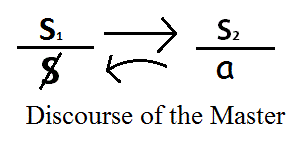
The illusion of the gesture of the Master is the complete coincidence between the level of enunciation (the subjective position from which I am speaking) and the level of the enunciated content, that is, what characterizes the Master is a speech-act that wholly absorbs me, in which “I am what I say,” in short, a fully realized, self-contained performative.

Such an ideal coincidence, of course, precludes the dimension of fantasy, since fantasy emerges precisely  in order to fill in the gap between the enunciated content and its underlying position of enunciation.

Fantasy is an answer to the question, “You are telling me this, but why? What do you really want by telling me this?”

The fact that the dimension of fantasy nonetheless persists thus simply signals the ultimate unavoidable failure of the Master’s discourse.

There is thus no reason to be dismissive of the discourse of the Master, to identify it too hastily with “authoritarian repression”: the Master’s gesture is the founding gesture of every social link.  Let us imagine a confused situation of social disintegration, in which the cohesive power of ideology loses its efficiency: in such a situation, the Master is the  one who invents a new signifier, the famous “quilting point,” which again stabilizes the situation and makes it readable; the university discourse that then elaborates the network of Knowledge that sustains this readability by definition presupposes and relies on the initial gesture of the Master.  The Master adds no new positive content — he merely adds a signifier, which all of a sudden turns disorder into order, into “new harmony,” … Therein resides the magic of a Master: although there is nothing new at the level of positive content, “nothing is quite the same” after he pronounces his Word. …

The University discourse is enunciated from the position of “neutral” Knowledge; it addresses the remainder of the real  (say, in the case of pedagogical knowledge, the “raw, uncultivated child”), turning it into the subject .   .  The “truth” of the university discourse, hidden beneath the bar, of course, is power (i.e., the Master-Signifier):

the constitutive lie of the university discourse is that it disavows its performative dimension, presenting what effectively amounts to a political decision based on power as a simple insight into the factual state of things.

What one should avoid here is the Foucaultian misreading: the produced subject is not simply the subjectivity that arises as the result of the disciplinary application of knowledge-power, but its remainder, that which eludes the grasp of knowledge-power. “Production” (the fourth term in the matrix of discourses) does not stand simply for the result of the discursive operation, but rather for its “indivisible remainder,” for the excess that resists being included in the discursive network (i.e., for what the discourses itself produces as the foreign body in its very heart). 78

Suffice it to recall the market expert who advocates strong budgetary measures (cutting welfare expenses, etc.) as a necessity imposed by his neutral expertise devoid of any ideological biases: what he conceals is the series of power-relations (from the active role of state apparatuses to ideological beliefs) that sustain the “neutral” functioning of the market mechanism. 79

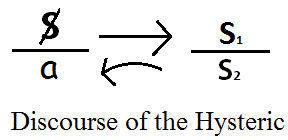
In the hysterical link, the . . over a stands for the subject who is divided, traumatized, by what an object she is for the Other, what role she plays in Other’s desire: “Why am I what you’re saying that I am?” … What she expects from the Other-Master is knowledge about what she is as object (the lower level of the formula).

In contrast to hysteria, the pervert knows perfectly what he is for the Other: a knowledge supports his position as the object of Other’s (divided subject’s) jouissance. For that reason, the matheme of the discourse of perversion is the same as that of the analyst’s discourse.

Lacan defines perversion as the inverted fantasy (i.e., his matheme of perversion is a-$), which is precisely the upper level of the analyst’s discourse. The difference between the social link of perversion and that of analysis is grounded in the radical ambiguity of objet petit a in Lacan, which stands simultaneously for the imaginary fantasmatic lure/screen AND for that which this lure is obfuscating, for the void behind the lure.

*So when we pass from perversion to the analytic social link, the agent (analyst) reduces himself to the void, which provokes the subject into confronting the truth of his desire. Knowledge in the position of “truth” below the bar under the “agent,” of course, refers to the supposed knowledge of the analyst, and, simultaneously, signals that the knowledge gained here will not be the neutral objective knowledge of scientific adequacy, but the knowledge that concerns the subject (analysand) in the truth of his subjective position.

In this precise sense, the analyst’s discourse produces the master signifier, the swerve of the patient’s knowledge, the surplus element that situates the patient’s knowledge at the level of truth: after the master signifier is produced, even if nothing changes at the level of knowledge, the same knowledge as before starts to function in a different mode. The master signifier is the unconscious sinthome, the cipher of enjoyment, to which the subject was unknowingly subjected.

*Text here is modified according to https://www.terada.ca/discourse/?p=7106

So, if a political Leader says “I am your Master, let my will be done!” this direct assertion of authority is hystericized when the subject starts to doubt his qualification to act as a Leader (“Am I really their Master?” What is in me that legitimizes me to act like that?”); it can be masked in the guise of the university discourse (“In asking you to do this, I merely follow the insight into objective historical necessity, so I am not your Leader, but merely your servant who enables you to act for your own good. …”); or, the subject can act as a blank, suspending his symbolic efficiency and thus compelling his Other to become aware of how he was experiencing another subject as a Leader only because he was treating him as one.

It should be clear, from this brief description, how the position of the “agent” in each of the four discourses involves a specific mode of subjectivity:

– the Master is the subject who is fuly engaged in his (speech) act, who, in a way, “is his word,” whose word displays an immediate performative efficiency;

– the agent of the university discourse is, on the contrary, fundamentally disengaged: he posits himself as the self-erasing observer (and executor) of “objective laws” accessible to neutral knowledge (in clinical terms, his position is closest to that of the pervert).

– the hysterical subject is the subject whose very existence involves radical doubt and questioning, his entire being is sustained by the uncertainty as to what he is for the Other; insofar as the subject exists only as an answer to the enigma of the Other’s desire, the hysterical subject is the subject par excellence.

Again, in clear contrast to it, the analyst stands for the paradox of the desubjectivized subject, of the subject who fully assumed what Lacan calls “subjective destitution” that is, who breaks out of the vicious cycle of intersubjective dialectics of desire and turns into an acephalous being of pure drive.

objet a and the drive id-evil

Žižek, Slavoj.  Jacques Lacan’s Four Discourses also in an article in Russell Grigg and Justin Clemens Jacques Lacan and the Other Side of Psychoanalysis. 2006

Portions of this stuff are reprinted in The Parallax View starting on page 303.
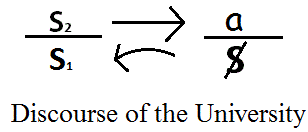
Can the upper level of Lacan’s formula of the university discourse — S2 directed toward a — not also be read as standing for the university knowledge endeavoring to integrate, domesticate, and appropriate the excess that resists and rejects it?

One of the telltale signs of university discourse is that the opponent is accused of being “dogmatic” and “sectarian.” University discourse cannot tolerate an engaged subjective stance. Should not our first gesture be, as Lacanians, to heroically assume this designation of being “sectarian” and engage in a “sectarian” polemic?

University discourse as the hegemonic discourse of modernity has two forms of existence in which its inner tension (“contradiction”) is externalized: capitalism, its logic of the integrated excess, of the system reproducing itself through constant self-revolutionizing, and the bureaucratic “totalitarianism” conceptualized in different guises as the rule of technology, of instrumental reason, of biopolitics, as the “administered world.”

We should not succumb to the temptation of reducing capitalism to a mere form of appearance of the more fundamental ontological attitude of technological domination; we should rather insist, in the Marxian mode, that the capitalist logic of integrating the surplus into the functioning of the system is the fundamental fact.

Stalinist “totalitarianism” was the capitalist logic of self-propelling productivity liberated from its capitalist form, which is why it failed: Stalinism was the symptom of capitalism.

Stalinism involved the matrix of general intellect, of the planned transparency of social life, of total productive mobilization- and its violent purges and paranoia were a kind of a “return of the repressed,” the “irrationality” inherent to the project of a totally organized “administered society.” This means the two levels, precisely insofar as they are two sides of the same coin, are ultimately incompatible: there is no metalanguage enabling us to translate the logic of domination back into the capitalist reproduction-through-excess, or vice versa.

The key question here concerns the relationship between the two excesses:

1) the economic excess/surplus integrated into the capitalist machine as the force that drives it into permanent self-revolutionizing and

2) the political excess of power — exercise inherent to modern power (the constitutive excess of representation over the represented: the legitimate state power responsible to its subjects is supplemented by the obscene message of unconditional exercise of Power —laws do not really bind me, I can do to you whatever I want, I can treat you as guilty if I decide to, I can destroy you if I say so).

The master’s discourse stands not for the premodern master, but for the absolute monarchy, this first figure of modernity that effectively undermined the articulate network of feudal relations and interdependences, transforming fidelity to flattery: it is the “Sun-King” Louis XIV with his L’état, c’est moi who is the master par excellence. Hysterical discourse and university discourse then deploy two outcomes of the vacillation of the direct reign of the master:

the expert-rule of bureaucracy that culminates in the biopolitics of reducing the population to a collection of homo sacer (what Heidegger called “enframing,” Adorno “the administered world,” Foucault the society of “discipline and punish”);

the explosion of the hysterical capitalist subjectivity that reproduces itself through permanent self-revolutionizing, through the integration of the excess into the “normal” functioning of the social link (the true “permanent revolution” is already capitalism itself).

Lacan’s formula of the four discourses thus enables us to deploy the two faces of modernity

1. total administration and
2. capitalist-individualist dynamics

as two ways to undermine the master’s discourse:

doubt about the efficiency of the master-figure (what Eric Santner called the “crisis of investiture”) can be supplemented by the direct rule of the experts legitimized by their knowledge, or

the excess of doubt, of permanent questioning, can be directly integrated into social reproduction.
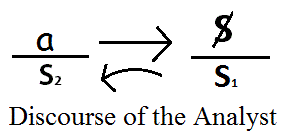
Finally, the analyst’s discourse stands for the emergence of revolutionary-emancipatory subjectivity that resolves the split of university and hysteria.

In it, the revolutionary agent – a – addresses the subject from the position of knowledge that occupies the place of truth (i.e., which intervenes at the “symptomal torsion” of the subject’s constellation), and the goal is to isolate, get rid of, the master signifier that structured the subject’s (ideologico-political) unconscious.

Or does it? Jacques-Alain Miller has recently proposed that today the master’s discourse is no longer the “obverse” of the analyst’s discourse. Today, on the contrary, our “civilization” itself-its hegemonic symbolic matrix, as it were-fits the formula of the analyst’s discourse. The agent of the social link is today a, surplus enjoyment, the superego injunction to enjoy that permeates our discourse; this injunction addresses $ (the divided subject) who is put to work in order to live up to this injunction. The truth of this social link is S2, scientific-expert knowledge in its different guises, and the goal is to generate S1, the self-mastery of the subject, that is, to enable the subject to cope with the stress of the call to enjoyment (through self-help manuals, etc.). Provocative as this notion is, it raises a series of questions. If it is true, in what, then, resides the difference between the discursive functioning of civilization as such and the psychoanalytic social link? Miller resorts here to a suspicious solution: in our civilization, the four terms are kept apart, isolated; each operates on its own, while only in psychoanalysis are they brought together into a coherent link: “in civilization, each of the four terms remains disjoined… it is only in psychoanalysis, in pure psychoanalysis, that these elements are arranged into a discourse.”

However, is it not that the fundamental operation of the psychoanalytic treatment is not synthesis, bringing elements into a link, but, precisely, analysis, separating what in a social link appears to belong together? This path, opposed to that of Miller, is indicated by Giorgio Agamben,Giorgio Agamben, who, in the last pages of The State of Exception, imagines two Utopian options of how to break out of the vicious cycle of law and violence, of the rule of law sustained by violence.

One is the Benjaminian vision of “pure” revolutionary violence with no relationship to the law.

The other is the relationship to the law without regard to its (violent) enforcement, such as Jewish scholars do in their endless (re)interpretation of the Law.

Agamben starts from the right insight that the task today is not synthesis but separation, distinction: nor bringing law and violence together (so that right will have might and the exercise of might will be fully legitimized), but thoroughly separating them, untying their knot.

Although Agamben confers on this formulation an anti-Hegelian twist, a more proper reading of Hegel makes it clear that such a gesture of separation is what the Hegelian “synthesis” is effectively about. In it, the opposites are not reconciled in a “higher synthesis”; it is rather that their difference is posited “as such.”

However, is this vision not again the case of our late capitalist reality going further than our dreams? Are we not already encountering in our social reality what Agamben envisages as a Utopian vision?

Isn’t the Hegelian lesson of the global reflexivization-mediatization of our lives that it generates its own brutal immediacy?

This has best been captured by Etienne Balibar’s notion of excessive, nonfunctional cruelty as a feature of contemporary life, a cruelty whose figures range from “fundamentalist” racist and/or religious slaughter to the “senseless” outbursts of violence performed by adolescents and the homeless in our megalopolises, a violence one is tempted to call Id-Evil, a violence grounded in no utilitarian or ideological reasons.

All the talk about foreigners stealing work from us or about the threat they represent to our Western values should not deceive us: under closer examination, it soon becomes clear that this talk provides a rather superficial secondary rationalization. The answer we ultimately obtain from a skinhead is that it makes him feel good to beat foreigners, that their presence disturbs him. What we encounter here is indeed Id-Evil, that is,

the Evil structured and motivated by the most elementary imbalance in the relationship between the ego and jouissance, by the tension between pleasure and the foreign body of jouissance in the very heart of it.

Id-Evil thus stages the most elementary short circuit in the relationship of the subject to the primordially missing object cause of his desire. What bothers us in the other (Jew, Japanese, African, Turk) is that he appears to entertain a privileged relationship to the object — the other either possesses the object treasure, having snatched it away from us (which is why we don’t have it), or he poses a threat to our possession of the object.

What one should propose here is the Hegelian “infinite judgment,” asserting the speculative identity of these “useless” and “excessive” outbursts of violent immediacy, which display nothing but a pure and naked (“non-sublimated”) hatred of the Otherness, with the global reflexivization of society. […] the response of the neo-Nazi skinhead who, when really pressed for the reasons for his violence, suddenly starts to talk like social workers, sociologists, and social psychologists, quoting diminished social mobility, rising insecurity, the disintegration of paternal authority, the lack of maternal love in his early childhood-the unity of practice and its inherent ideological legitimization disintegrates into raw violence and its impotent, inefficient interpretation.

This impotence of interpretation is also one of the necessary obverses of the universalized reflexivity hailed by the risk-society-theorists: it is as if our reflexive power can flourish only insofar as it draws its strength and relies on some minimal “prereflexive” substantial support that eludes its grasp, so that its universalization comes at the price of its inefficiency, that is, by the paradoxical re-emergence of the brute real of “irrational” violence, impermeable and insensitive to reflexive interpretation. So the more today’s social theory proclaims the end of nature or tradition and the rise of the “risk society,” the more the implicit reference to “nature” pervades our daily discourse: even when we do not speak of the “end of history,” do we not put forward the same message when we claim that we are entering a “postideological” pragmatic era, which is another way of claiming that we are entering a postpolitical order in which the only legitimate conflicts are ethnic/cultural conflicts?

Typically, in today’s critical and political discourse, the term worker has disappeared from the vocabulary, substituted or obliterated by immigrants or immigrant workers: Algerians in France, Turks in Germany, Mexicans in the United States.

In this way, the class problematic of workers’ exploitation is transformed into the multiculturalist problematic of “intolerance of otherness,” and the excessive investment of the multiculturalist liberals in protecting immigrants’ ethnic rights clearly draws its energy from the “repressed class dimension. Although Francis Fukuyama’s thesis on the “end of history” quickly fell into disrepute, we still silently presume that the liberal-democratic capitalist global order is somehow the finally found “natural” social regime, we still implicitly conceive conflicts in the Third World countries as a subspecies of natural catastrophes, as outbursts of quasi-natural violent passions, or as conflicts based on the fanatic identification to one’s ethnic roots (and what is “the ethnic” here if not again a code word for “nature”?). And, again, the key point is that this all-pervasive renaturalization is strictly correlative to the global reflexivization of our daily lives.

What this means, with regard to Agamben’s Utopian vision of untying the knot of the Law and violence is that, in our postpolitical societies, this knot is already untied: we encounter, on the one hand, the globalized interpretation whose globalization is paid for by its impotence, its failure to enforce itself, to generate effects in the real, and, on the other hand, explosions of the raw real of a violence that cannot be affected by its symbolic interpretation. Where, then, is the solution here, between

– the claim that, in today’s hegemonic constellation, the elements of the social link are separated and as such to be brought together by psycho-analysis (Miller),

– and the knot between Law and violence to be untied, their separation to be enacted (Agamben)?

What if these two separations are not symmetrical? What if the gap between the symbolic and the raw real epitomized by the figure of the skinhead is a false one, since this real of the outbursts of the “irrational” violence is generated by the globalization of the symbolic?

When, exactly, does the objet a function as the superego injunction to enjoy? When it occupies the place of the master signifier, that is, as Lacan formulated it in the last pages of his Seminar XI, when the short circuit between S1 and a occurs. The key move to be accomplished in order to break the vicious cycle of the superego injunction is thus to enact the separation between S1 and a.

Consequently, would it not be more productive to follow a different path, that is, to start with the different modus operandi of l’objet a, which in psychoanalysis no longer functions as the agent of the superego injunction — as it does in the discourse of perversion?

This is how Miller’s claim of the identity of the analyst’s discourse and the discourse of today’s civilization should be read: as an indication that this latter discourse (social link) is that of perversion.

That is to say, the fact that the upper level of Lacan’s formula of the analyst’s discourse is the same as his formula of perversion (a-$) opens up a possibility of reading the entire formula of the analyst’s discourse also as a formula of the perverse social link: its agent, the masochist pervert (the pervert par excellence), occupies the position of the object instrument of the other’s desire, and, in this way, through serving his (feminine) victim, he posits her as the hystericized/divided subject who “doesn’t know what she wants.”

Rather, the pervert knows it for her, that is, he pretends to speak from the position of knowledge (about the other’s desire) that enables him to serve the other; and, finally, the product of this social link is the master signifier, that is, the hysterical subject elevated into the role of the master (dominatrix) whom the pervert masochist serves.

In contrast to hysteria, the pervert knows perfectly what he is for the Other: a knowledge supports his position as the object of his Other’s (divided subject’s) jouissance.

The difference between the social link of perversion and that of analysis is grounded in the radical ambiguity of objet a in Lacan, which stands simultaneously for the imaginary fantasmatic lure/screen and for that which this lure is obfuscating, for the void behind the lure.

Consequently, when we pass from perversion to the analytic social link, the agent (analyst) reduces himself to the void, which provokes the subject into confronting the truth of his desire. Knowledge in the position of “truth” below the bar under the “agent,” of course, refers to the supposed knowledge of the analyst, and, simultaneously, signals that the knowledge gained here will not be the neutral objective knowledge of scientific adequacy, but the knowledge that concerns the subject (analysand) in the truth of his subjective position.

Recall, again, Lacan’s outrageous statements that, even if what a jealous husband claims about his wife (that she sleeps around with other men) is all true, his jealousy is still pathological. Along the same lines, one could say that, even if most of the Nazi claims about the Jews were true (they exploit Germans, they seduce German girls), their anti-Semitism would still be (and was) pathological – because it represses the true reason the Nazis needed anti-Semitism in order to sustain their ideological position.

So, in the case of anti-Semitism, knowledge about what the Jews “really are” is a fake, irrelevant, while the only knowledge at the place of truth is the knowledge about why a Nazi needs a figure of the Jew to sustain his ideological edifice.

In this precise sense, the analyst’s discourse produces the master signifier, the swerve of the patient’s knowledge, the surplus element that situates the patient’s knowledge at the level of truth: after the master signifier is produced, even if nothing changes at the level of knowledge, the same knowledge as before starts to function in a different mode. The master signifier is the unconscious sinthome, the cipher of enjoyment, to which the subject was unknowingly subjected.

The crucial point not to be missed here is how the late Lacan’s identification of the subjective position of the analyst as that of objet petit a presents an act of radical self-criticism. Earlier, in the 1950’s, Lacan conceived the analyst not as the small other (a), but, on the contrary, as a kind of stand-in for the big Other (A, the anonymous symbolic order). At this level, the function of the analyst was to frustrate the subject’s imaginary misrecognitions and to make them accept their proper symbolic place within the circuit of symbolic exchange, the place that effectively (and unbeknownst to them) determines their symbolic identity. Later, however, the analyst stands precisely for the ultimate inconsistency and failure of the big Other, that is, for the symbolic order’s inability to guarantee the subject’s symbolic identity.

One should thus always bear in mind the thoroughly ambiguous status of objet a in Lacan. Miller recently proposed a Benjaminian distinction between “constituted anxiety” and “constituent anxiety”: while the first designates the standard notion of the terrifying and fascinating abyss of anxiety that haunts us, its infernal circle that threatens to draws us in, the second stands for the “pure” confrontation with objet a as constituted in its very loss.

Miller is right to emphasize here two features: the difference that separates constituted from constituent anxiety concerns the status of the object with regard to fantasy. In a case of constituted anxiety, the object dwells within the confines of a fantasy, while we get the constituent fantasy only when the subject “traverses the fantasy” and confronts the void, the gap, filled up by the fantasmatic object.

Clear and convincing as it is. Miller’s formula misses the true paradox or, rather, ambiguity of objet a: when he defines objet a as the object that overlaps with its loss, that emerges at the very moment of its loss (so that all its fantasmatic incarnations, from breasts to voice and gaze, are metonymic figurations of the void of nothing), he remains within the horizon of desire — the true object cause of desire is the void filled in by its fantasmatic incarnations.

While, as Lacan emphasizes, objet a is also the object of the drive, the relationship is here thoroughly different. Although in both cases, the link between object and loss is crucial, in the case of objet a as the object cause of desire, we have an object which is originally lost, which coincides with its own loss, which emerges as lost, while, in the case of objet a as the object of the drive, the “object” is directly the loss itself.

In the shift from desire to drive, we pass from the lost object to loss itself as an object. That is to say, the weird movement called “drive” is not driven by the “impossible” quest for the lost object, but by a push to directly enact the “loss” – the gap, cut, distance – itself.

There is thus a double distinction to be drawn here: not only between object a in its fantasmatic and post-fantasmatic status, but also, within this post-fantasmatic domain itself, between the lost object cause of desire and the object loss of the drive. Far from concerning an abstract scholastic debate, this distinction has crucial ideologico-political consequences: it enables us to articulate the libidinal dynamics of capitalism.

Following Miller himself, a distinction has to be introduced here between lack and hole. Lack is spatial, designating a void within a space, while the hole is more radical — it designates the point at which this spatial order itself breaks down (as in the “black hole” in physics).

Therein resides the difference between desire and drive: desire is grounded in its constitutive lack, while drive circulates around a hole, a gap in the order of being. In other words, the circular movement of drive obeys the weird logic of the curved space in which the shortest distance between two points is not a straight line, but a curve: the drive “knows” that the shortest way to attain its aim is to circulate around its goal-object. At the immediate level of addressing individuals, capitalism of course interpellates them as consumers, as subjects of desires, soliciting in them ever new perverse and excessive desires (for which it offers products to satisfy them); furthermore, it obviously also manipulates the “desire to desire,” celebrating the very desire to desire ever new objects and modes of pleasure. However, even if if already manipulates desire in a way that takes into account the fact that the most elementary desire is the desire to reproduce itself as desire (and not to find satisfaction), at this level, we do not yet reach the drive.

The drive inheres to capitalism at a more fundamental, systemic level: drive propels the entire capitalist machinery; it is the impersonal compulsion to engage in the endless circular movement of expanded self-reproduction. The capitalist drive thus belongs to no definite individual – it is rather that those individuals who act as direct “agents” of capital (capitalists themselves, top managers) have to practice it. We enter the mode of the drive when (as Marx put it) the circulation of money as capital becomes “an end in itself, for the expansion of value takes place only within this constantly renewed movement. The circulation of capital has therefore no limits.” One should bear in mind here Lacan’s well-known distinction between the aim and the goal of drive: while the goal is the object around which drive circulates, its (true) aim is the endless continuation of this circulation as such.
post oedipal traverse the fantasy

Žižek, Slavoj. “Cyberspace, or, How to Traverse the Fantasy in the Age of the Retreat of the Big OtherPublic Culture 10:3. (1998) 483-513.

This constellation also provides the key for the problem of the historicity of psychoanalysis. From the early days of his Complexes familiaux ([1938] 1984), Lacan was fully aware of the historicity of the Oedipal complex itself, as well as of its discovery by Freud.

In the modern bourgeois nuclear family, the two functions of the father that were previously separated, or embodied in different persons

(the pacifying Ego-Ideal, the point of ideal identification, and

the ferocious superego, the agent of cruel prohibition; the symbolic function of totem and the horror of taboo), are united in one and the same person.

The previous separate personification of the two functions accounts for the apparent “stupidity” of some aborigines, who thought that the true father of a child was a stone or an animal or a spirit. The aborigines were well aware that the mother was inseminated by the “real” father; they merely separated the real father from its symbolic function.

The unification of the two functions in the bourgeois nuclear family, by giving birth to the ambiguous rivalry with the father figure, created the psychic conditions for the modern, Western, dynamic, creative individualism and, at the same time, sowed the seeds of the forthcoming “crisis of Oedipus” (or, more generally, with regard to figures of authority as such, of the “crisis of investiture” that erupted in the late nineteenth century [Santner 1996). Symbolic authority was more and more smeared over by the mark of obscenity and thus, as it were, undermined from within.

In his early theory of the historicity of the Oedipus complex, Lacan thus already establishes the connection between the psychoanalytic problematic of the Oedipus as the elementary form of “socialization,” of the subject’s integration into the symbolic order, and the standard sociopsychological topoi on how modernity is characterized by individualist competitivity -on how, in modern societies, subjects are no longer fully immersed into and identified with the particular social place into which they were born, but can, in principle at least, freely move between different “roles.” The emergence of the modern “abstract” individual who relates to his or her particular “way of life” as to something with which he or she is not directly identified, but rather which depends on a set of contingent circumstances (the feeling that the particularities of one’s birth, social status, sex, and religion do not determine one fully, do not concern one’s innermost identity) relies on the mutation in the functioning of the Oedipus complex, on the above-described unification of the two aspects of symbolic authority (Ego Ideal and the prohibitive superego) in one and the same person of the “real father.”490

The key question here is: What is going on today when this very modern form of Oedipus is disintegrating– when so-called pathological Narcissism is asserting itself more and more as the predominant form of subjectivity? On the one hand, symbolic prohibitive norms are increasingly replaced with imaginary ideals (of social success, of bodily fitness); on the other hand, this lack of symbolic prohibition is supplemented with the reemergence of the ferocious superego figures. So we have a subject who is extremely narcissistic, who perceives everything as a potential threat to his or her precarious imaginary balance. (See the universalization of the logic of victim: Every contact with another human being is experienced as a potential threat. If the other smokes, if he or she casts a covetous glance at me, he or she already hurts me.) However, far from allowing the subject to float freely in undisturbed balance, this narcissistic self-enclosure leaves him or her to the (not so) tender mercies of the superego injunction to enjoy. One is thus tempted to propose a hypothesis according to which “postmodern” subjectivity involves a kind of direct “superegoization ” of the imaginary Ideal, caused by the lack of the proper symbolic Prohibition: It is the Ideal itself that gives rise to guilty feelings when we fail to reach it, since the (imaginary) Ego-Ideal is no longer supported by the symbolic Ideal-Ego, but directly by the superego.

So, to recapitulate. There is only one consistent answer to the question “Why does the superfluous prohibition emerge, which merely prohibits the impossible?” That is: It obfuscates this inherent impossibility in order to sustain the illusion that, were it not for the externally imposed prohibition, the full (“incestuous”) gratification would be possible. Far from acting as a “repressive” agency that prevents us access to the ultimate object of desire, the paternal figure functions instead to relieve us from the debilitating deadlock of desire, to “maintain hope.” What is missing in “Oedipus on-line” is precisely this “pacifying” function of the paternal figure that enables us to obfuscate the debilitating deadlock of desire. Hence, the strange mixture of “everything is possible” (since there is no positive prohibiting figure) and an all-pervasive frustration and deadlock that characterizes the subject’s experience of cyberspace.

The ontological paradox, scandal even, of fantasy resides in the fact that it subverts the standard opposition of “subjective” and “objective.” Of course, fantasy is by definition not “objective” (in the naive sense of existing independently of the subject’s perceptions); however, it is also not “subjective” (in the sense of being reducible to the subject’s consciously experienced intuitions). Rather, fantasy belongs to the “bizarre category of the objectively subjective-the way things actually, objectively, seem to you even if they don’t seem that way to you” (Dennett 1991, 132).8 When, for example, the subject actually experiences a series of fantasmatic formations which interrelate as so many permutations of each other, this series is never complete-it is always as if the actually experienced series presents so many variations of some underlying “fundamental” fantasy that is never actually experienced by the subject. 507

This brings us back to the mystery of “commodity fetishism.” When a critical Marxist encounters a bourgeois subject immersed in commodity fetishism, the Marxist’s reproach to him or her is not, “Commodity may seem to you a magical object endowed with special powers, but it really is just a reified expression of relations between people”; rather, the actual Marxist’s reproach is, “You may think that the commodity appears to you as a simple embodiment of social relations (that, for example, money is just a kind of voucher entitling you to a part of the social product), but this is not how things really seem to you. In your social reality, by means of your participation in social exchange, you bear witness to the uncanny fact that a commodity really appears to you as a magical object endowed with special powers.”

This is also one of the ways in which to specify the meaning of Lacan’s assertion of the subject’s constitutive “decenterment.” Its point is not that my subjective experience is regulated by objective, unconscious, mechanisms that are “decentered” with regard to my self-experience and, as such, beyond my control (a point asserted by every materialist), but rather something much more unsettling — I am deprived of even my most intimate “subjective” experience, the way things “really seem to me,” the fundamental fantasy that constitutes and guarantees the kernel of my being, since I can never consciously experience it and assume it.

According to the standard view, the dimension that is constitutive of subjectivity is that of the phenomenal (self-)experience. I am a subject the moment I can say to myself “No matter what unknown mechanism governs my acts, perceptions, and thoughts, nobody can take from me what I see and feel now.”

Lacan turns this standard view around: The “subject of the signifier” emerges only when a key aspect of the subject’s phenomenal (self-)experience (the “fundamental fantasy”) becomes inaccessible to him or her, is “primordially repressed.” At its most radical, the Unconscious is the inaccessible phenomenon, not the objective mechanism that regulates my phenomenal experience. So, in contrast to the commonplace according to which we are dealing with a subject the moment an entity displays signs of “inner life”— of a fantasmatic self-experience which cannot be reduced to external behavior — one should claim that what characterizes human subjectivity proper is rather the gap that separates the two — the fact that fantasy, at its most elementary, becomes inaccessible to the subject. This inaccessibility makes the subject “empty.” We thus obtain a relationship that totally subverts the standard notion of the subject who directly experiences herself, her “inner states”— an “impossible” relationship between the empty, nonphenomenal subject and the phenomena that remain inaccessible to the subject. 509

Geneticists predict that in about ten to fifteen years they will be able to identify and manipulate each individual’s exact genome (approximately six billion genetic markers comprising the complete inherited “knowledge”). Potentially, at least, individuals will thus have at their disposal the complete formula of what they “objectively” are. How will this “knowledge in the real,” the fact that I will be able to locate and identify myself completely as an object in reality, affect the status of subjectivity? Will it lead to the end of human subjectivity? Lacan’s answer is negative:

What will continue to elude the geneticist is not my phenomenal self-experience (say, the experience of a love passion that no knowledge of the genetic and other material mechanisms which determine it can take from me), but the “objectively subjective” fundamental fantasy, the fantasmatic kernel inaccessible to my conscious experience.

Even if science formulates the genetic formula of what I objectively am, it will still be unable to formulate my “objectively subjective’’ fantasmatic identity, this objectal counterpoint to my subjectivity, which is neither subjective (experienced) nor objective.

Traversing the Fantasy

A recent English publicity spot for a brand of beer enables us to further clarify this crucial point. Its first part stages a well-known fairytale anecdote: A girl walks along a stream, sees a frog, takes it gently onto her lap, and kisses it; of course, the ugly frog miraculously turns into a beautiful young man. However, the story isn’t over yet: The young man casts a covetous glance at the girl, draws her toward him, kisses her-and she turns into a bottle of beer, which the man holds triumphantly in his hand. For the woman, the point is that her love and affection (signaled by the kiss) turn a frog into a beautiful man, a full phallic presence (in Lacan’s mathems, the big Phi); for the man, the point is to reduce the woman to a partial object, the cause of his desire (in Lacan’s mathems, the object small a). On account of this asymmetry, there is no sexual relationship.

We have either a woman with a frog or a man with a bottle of beer. What we can never obtain is the “natural” couple of the beautiful woman and man. Why not? Because fantasmatic support of this “ideal couple” would have been the inconsistent figure of a frog embracing a bottle of beer. …

This, then, opens up the possibility of undermining the hold a fantasy exerts over us through our very over-identification with it-that is, by way of embracing simultaneously, within the same space, the multitude of inconsistent fantasmatic elements. Each of the two subjects is involved in his or her own subjective fantasizing: The girl fantasizes about the frog who is really a young man, the man about the girl who is really a bottle of beer. What modern art and writing oppose to this is not objective reality but the “objectively subjective” underlying fantasy that the two subjects are never able to assume, something similar to a Magrittesque painting of a frog embracing a bottle of beer, with the title “A man and a woman” or “The ideal couple.” … And is this not the ethical duty of today’s artist-to confront us with the frog embracing the bottle of beer when we are daydreaming of embracing our beloved? Does the artist need to stage fantasies that are radically desubjectivized and which can never be assumed by the subject?

This, then, is the point we were aiming at all along. Perhaps cyberspace, with its capacity to externalize our innermost fantasies in all their inconsistency, opens up to the artistic practice a unique possibility to stage, to “act out,” the fantasmatic support of our existence, up to the fundamental “sadomasochistic” fantasy that cannot ever be subjectivized. We are thus invited to risk the most radical experience imaginable: the encounter with our “noumenal Self,” with the Other Scene which stages the foreclosed hard core of the subject’s Being. Far from enslaving us to these fantasies and thus turning us into desubjectivized, blind puppets, it enables us to treat them in a playful way and thus to adopt toward them a minimum of distance-in short, to achieve what Lacan calls la traversee du fantasme, “going-through, traversing the fantasy.”

So let us conclude with a reference to the (in)famous last proposition of Wittgenstein’s Tractatus: “Wovon man nicht sprechen kann, davon muss man schweigen” [Whereof one cannot speak, thereof must one be silent] (87). This proposition renders in the most succinct way possible the paradox of the Oedipal law that prohibits something (incestuous fusion) which is already in itself impossible (and thereby gives rise to the hope that, if we remove or overcome the prohibition, the “impossible” incest will become possible). If we are effectively to move to a region “beyond Oedipus,” Wittgenstein’s proposition is to be rephrased into: “Wovon man nicht sprechen kann, davon muss man schreiben” [Whereof one cannot speak, thereof must one write].

There is, of course, a long tradition of conceiving art as a mode or practice of writing which augurs that which “one cannot speak about”- the utopian potential “repressed” by the exis ting sociosymbolic network of prohibitions. There is also a long tradition of using writing as a means to communicate a declaration of love too intimate and/or too painful to be directly asserted in a face-to-face speech act.

The Internet is widely used as a space for the amorous encounters of shy people, and, significantly, one of the anecdotes about Edison, the inventor of the telegraph, is that he himself used it to declare love and ask the hand of his secretary (being too shy to do it directly, by the spoken word). However, what we are aiming at is not this standard economy of using cyberspace as a place in which, since we are not directly engaged in it (since we maintain a distance toward it), we feel free to externalize and stage our innermost private fantasies. What we have in mind is a more radical level, the level that concerns our very fundamental fantasy as that “wovon man nicht sprechen kann.”

The subject is never able to assume his or her fundamental fantasy, to recognize him- or herself in it, in a performance of a speech act.

Perhaps cyberspace opens up a domain in which the subject can nonetheless externalize or stage his or her fundamental fantasy and thus gain a minimum of distance toward it.

This, however, in no way suggests that inducing us to “traverse the fantasy” is an automatic effect of our immersion into cyberspace. What one should do here is, rather, accomplish a Hegelian reversal of epistemological obstacle into ontological deadlock.

What if it is wrong and misleading to ask which of the four versions of the libidinal or symbolic economy of cyberspace that we outlined (the psychotic suspension of Oedipus, the continuation of Oedipus with other means, the perverse staging of the law, and traversing the fantasy) is the “correct” one? What if these four versions are the four possibilities opened up by the cyberspace technology, so that, ultimately, the choice is ours? How will cyberspace affect us is not directly inscribed into its technological properties; it rather hinges on the network of sociosymbolic relations (e.g., of power and domination) which always and already overdetermine the way cyberspace affects us.

antigone beckett

Belsey, Catherine. Culture and the Real : Theorizing Cultural Criticism. 2005

Malone Dies, opens with the words, ‘I shall soon be quite dead at last in spite of all’ (Beckett 1994: 179). Malone is resigned to the inevitability of death, although he would prefer it to take place without struggle. ‘Throes’, he observes laconically, ‘are the only trouble, I must be on my guard against throes’ (179– 80). First published in French in 1951, and translated into English by the author in 1956, Malone Dies anticipates some of the concerns of Lacan’s Seminar 7, though in a manner entirely characteristic of its own author. The novel is also characteristic of its moment.

Lacan’s exemplary text, Antigone, shows its protagonist refusing to give ground relative to her desire. Organically linked to her dead brother, as to no other human being (a husband or a child would be replaceable, she says, but her mother and father are dead: she can have no new brothers), Antigone insists on carrying out his burial rites, contrary to Creon’s law.

Because she accepts the penalty of living burial, Antigone’s ‘incarnation’ of the death drive is heroic (Lacan 1992: 282).

Oedipus, meanwhile, enters the zone between life and death because he too has insisted on following his own desire, in this instance, ‘to know the last word on desire’. Everyone else tries in vain to discourage him from pressing his questions about who he is, but he persists. Oedipus dies cursing, unreconciled to the goods.

On the other hand, King Lear, the irascible old man who does not give up on his desire either, represents a ‘derisory’ version of the same commitment (1992: 310). The ‘old fool’ thinks he can go into the same zone with everyone’s agreement – and ‘makes the earth and ocean echo’ with his imprecations, because he fails to grasp that this is a place of dispossession (1992: 309– 10)  153

Malone, however, is a protagonist for our own ironic time. There is nothing remotely heroic about Malone except his refusal of the goods. Neither stoical nor serene, Malone makes no concessions whatever to the moral law: ‘Let me say before I go any further that I forgive nobody. I wish them all an atrocious life and then the fires and ice of hell and in the execrable generations to come an honoured name’ (Beckett 1994: 180). Malone inhabits the zone between life and death alone in an isolated room that he cannot quite locate. Could it be ‘one of heaven’s mansions’ perhaps? He thinks not (184). It seems to be in an ordinary house. There remains a doubt, however. … Finally, The ceiling rises and falls, rises and falls, rhythmically, as when I was a foetus . . . . I am being given, if I may venture the expression, birth to into death, such is my impression. The feet are clear already, of the great cunt of existence. Favourable presentation I trust. My head will be the last to die. Haul in your hands. I can’t . . . . That is the end of me. I shall say no more. (285)

To die is to be reunited with the real we came from, but the living Malone is at home neither as an organism, in the flesh, nor at the level of the signifier. ‘All my senses are trained full on me, me. Dark and silent and stale, I am no prey for them. I am far from the sounds of blood and breath’ (186).

Malone is not his body. On the other hand, he is not a consciousness either: thought seeks him out, ‘as it always has, where I am not to be found’ (187). The space he inhabits, however unstable, ill-defined, seems easier to specify than his identity. It is to the signifier, however, that Malone turns to keep his distance from the real, physical process of dying. He tells – and then writes in an exercise book – stories. … 154

Is there anything uplifting here? Not really. But there is comedy, and it pacifies. In the absence of heroism, there is at least dedication, if only in Malone’s resolute contempt for the good death. Above all, there is pleasure in the grim wit of Beckett’s prose. What are verbal dexterity, stories, jokes, satire, parody, and satirical excoriation itself, after all, but an affirmation of the signifier in the face of the real? And isn’t that exactly what, as organisms-in-culture, we speaking beings are good at? 155

A THEORY OF CULTURE?

Lacan’s account of sublimation offers a way of understanding the pleasures the signifier offers the speaking being, without reducing culture to something else: ethical instruction, ideological control, or scripted determinism. Aspects of culture may at a specific moment represent any or all of these. In itself, however, culture does not make us better or worse. If it subjects people, it does not exclude the possibility of resistance. It does not do away with our discontents, but it offers to engage with them while finding a focus for desire. And to the attentive interpreter, culture can in addition tell more than it thinks it knows about who and what we are. 156

sublimation death drive

Belsey, Catherine. Culture and the Real : Theorizing Cultural Criticism. 2005

Tracing a path through Freud’s own widely distributed observations, Lacan repudiates the binary opposition Freud holds on to so precariously between the libido and death: for Lacan the drive is both sexual and deadly, at once life-giving and destructive. In Seminar 7 sexual desire is not the central problem. Sex, Lacan says, is fine in its way, but you can’t count on it:

Sex ‘simulates’ the impossible jouissance, the encounter with the Thing, but does not in any circumstances enact it. Meanwhile, however, Seminar 7 is less concerned about sex than death. For Lacan sex was never an origin: instead, it merely ‘occupies’, like an invading army, the field of desire (1977: 287),which is brought into being with the loss of the real entailed in our subjection to the symbolic order.

In Lacan’s account, sublimation includes romantic love; there is conflict between sublimation and sex; on the contrary, sex involves the pleasurable signifier. Sublimation rails off the impossible encounter with the engulfing Thing, not the pleasures of sex. 145

A product of his time, however, in the late 1950s and early 1960s, when the world held its breath as two superpowers threatened each other with nuclear annihilation, Lacan became increasingly preoccupied by the death drive, and specifically its expression in the capacity of human beings to destroy their world with weapons of mass destruction. Sublimation pacifies the drive without pathology and without destruction.

There are two possible barriers between the subject and the object of the drive, two ways to keep at bay the death-dealing and vital Thing: on the one hand, the superego; on the other, sublimation.

True to Freud, Lacan finds the superego, ‘obscene’, ‘ferocious’ and ‘morbid’ (1992: 7). The more we concede to this ‘parasite’, the more it demands of us, he argues (302). Its ideals are ‘the goods’: conventional values, ‘family goods, domestic goods . . . the goods of our trade or our profession, the goods of the city, etc’. But psychoanalysis is not there, Lacan insists, to support the bourgeois dream, with its puritanical demands for human sacrifice (303).

If, then, we refuse the goods, one option is to go willingly with Antigone, into a heroic region beyond pleasure, a world of total dispossession, the unearthly place of the drive itself. 146

In the meantime, sublimation promises pleasure at the level of the signifier – including the pleasure offered by the plays of Sophocles, and not least, of course, Antigone.

Sublimation, then, is the ‘true’ barrier between us and absolute destruction, preferable to the goods because beauty ‘gets closer’ to the Thing (216– 17). The pleasure principle presents the beautiful as capable of alluding to the Thing, revealing the nature of the drive, and in the process offering a gratification that differs from its aim (111, 293).

There is nothing sentimental or escapist about the beautiful in Lacan. On the contrary, ‘the beautiful is closer to evil than to the good’ (217). Moreover, it is ‘precisely the function of the beautiful to reveal to us the site of man’s relationship to his own death, and to reveal it to us only in a blinding flash’ (295).

By encircling the void, which marks the place of the real that is lost to the subject, culture exercises the creative aspect of the drive to make allusions at the level of the symbolic to the inaccessible Thing, which is itself beyond pleasure. In culture the symbol comes between us and the enticing, terrifying, dangerous object of the drive.

There is in Seminar 7, however, no sublime object, unreasonably elevated to the dignity of the Thing, no fetish, no fantasy offering a focus for antagonism. On the contrary, while the Thing is best acknowledged, it is also preferable that it should be veiled by the signifier. And the signifier gives pleasure.  147

To secure the sublime object of ideology, Žižek sacrifices the version of sublimation that explains the existence of culture. If Žižek offers on the basis of Lacan a theory of human nature, what Lacan offers on the basis of Freud is a theory of human culture as the only hope of a rapprochement between the symbolic and the real. Lacan insists on the gap between the real and the signifier. … Žižek denies the existence of the real but places the sublime object at the heart of culture. 🙂 hmm don’t know about dat.

Paradoxically, however, this leads him to ignore the capacity of the signifier to give pleasure – though he demonstrates it in his own extremely pleasurable writing over and over again. Only Lacan retains a substantial positivity that the signifier cannot master, an unknown region which we encounter in fear and trembling, but with no trace of theology.

Žižek says you have to go through the fantasy to the void; Lacan says you can do that – but in the meantime, you can make things.

Making things is what culture consists of, given that the things in question include pots, beads, stories, paintings, photographs, films, essays and academic books. This is the material of cultural criticism, and only Lacan, who largely ignores the Kantian sublime, gives us a theoretical explanation of its existence. 148

Antigone don`t give ground sublimation

Belsey, Catherine. Culture and the Real : Theorizing Cultural Criticism. 2005.

THE PLEASURE PRINCIPLE

What difference does Žižek make by his intertextual conjunction of psychoanalytic sublimation with the Kantian sublime? Lacan’s Seminar 7 concerns the ethical implications of psychoanalysis. The question it asks is what psychoanalysis offers as its outcome for the analysand.

Given that ‘the goods’ – duty, self-sacrifice, the conventional virtues – solve nothing, what would it mean to be free from the symptom, which always conceals the drive towards the Thing? How, in other words, can we avoid, on the one hand, the naked aggressivity that represents the direct projection outwards of the death drive and, on the other, the effect of repression, the symptom’s deception, by which neurosis promises its own pathological version of satisfaction?

It is in answer to the question how to avoid pathology that Lacan impels us not to give ground relative to our desire (1992: 319). His instance of the tragic outcome of this ethic is Antigone, whose bond with her brother impels her to defy Creon’s law, knowing that the consequence is to be walled up alive in her own tomb.

The rest of us, less heroic, may be less ready to venture beyond everything we think we know, or more eager to postpone the moment, since we are all required to rejoin the real in the end. For us, what is deadly in desire must be acknowledged, but may also be tamed, pacified, fenced off, as a way of living with – or, indeed, surviving – the effects of that uncompromising commitment.

The beautiful, then, is the acceptable barrier to ‘the unspeakable field of radical desire that is the field of absolute destruction’ (216).

People are speaking beings, organisms-in-culture, able to find themselves fully at home neither in the organic real nor in the symbolic order. The Thing beckons with the promise of gratification at the level of the real, but the price we should pay for such jouissance would be the dissolution of the subject.

Conversely, the symbolic order, the Other which constitutes us as subjects, is empty; it cannot give a satisfaction it does not possess. Sublimation in Lacan’s account offers a way of inhabiting the symbolic without submission to the exorbitant demands of the ferocious moral Law. Sublimation, which gratifies without repression, involves the pleasure principle.  143

Sublimation appears repeatedly in Freud’s work from 1905 onwards as a diversion of part of the sexual drive towards other aims.

Under the influence of the ego, he argues, people relinquish a proportion of organic satisfaction in favour of culturally acceptable activities. Art is the effect of sublimation.

At times Freud displays all the scepticism of science in his depiction of the artist. ‘He’ (artists are characteristically male, of course, in Freud) is probably exceptionally driven, but also exceptionally socially inept. What he wants is what all men want: glory, power and the love of women. But when he fails to secure any of them, the artist retreats into fantasy, imagines the satisfaction he seeks. Whereas most people in these circumstances would have to make do with their meagre day-dreams, however, the artist, Freud explains, is especially good at making his fantasies public in acceptable forms, while disguising their origins. Artists convert imagination into works of art. By means of this skill, they go on to acquire glory, power and the love of women in the process, thus securing their objectives after all, but by another route (Freud 1976: 423– 4). Elsewhere, however, Freud’s account is more elegiac.

Something in the nature of the sexual drive, he proposes, is incompatible with civilization, so that for human beings, divorced by culture from their organic origins, perfect sexual gratification is not possible. But paradoxically, the pleasure that culture withholds in this way reappears in culture itself by means of sublimation:
[Freud quote]  The very incapacity of the sexual instinct to yield complete satisfaction as soon as it submits to the first demands of civilization becomes the source, however, of the noblest cultural achievements which are brought into being by ever more extensive sublimation of its instinctual components. For what motive would men have for putting sexual instinctual forces to other uses if, by any distribution of those forces, they could obtain fully satisfying pleasure? 144

That element of lack in the sexual relation was to reappear in Lacan’s account of unconscious desire as indestructible and insatiable, and in his repeated insistence in Seminar 20 that there was no sexual relation (rapport). But what complicates the issue further is Freud’s increasing conviction after the First World War that there are two drives, the libido on the one hand, and the death drive on the other. While Beyond the Pleasure Principle, published in 1920, holds them apart only with some degree of uncertainty, Civilization and its Discontents, ten years later, insists on the distinction and pays renewed attention to the dangerous capabilities of the death drive. Externalized, it leads to cruelty and brutality towards others; internalized, it produces the self-destructive and voracious superego, conscience, an exorbitant sense of moral obligation that can never be fully met, and which therefore creates unending anxiety:

[Freud quote]  ‘Every renunciation of instinct now becomes a dynamic source of conscience and every fresh renunciation increases the latter’s severity and intolerance’ (Freud 1985a: 321).

Civilization is necessary as a defence against unqualified aggressivity, but its effects remain disappointing. Among its discontents we must include the self-denying, self-excoriating ethical imperatives of the superego, aggression itself by another name. 144-145

desire

Belsey, Catherine. Culture and the Real : Theorizing Cultural Criticism. 2005

Lacan sees the void that architecture surrounds as the place of the lost object in the inextricable real, impossible to symbolize and equally impossible to forget. The Thing, the object of the drive, constructed retroactively as forbidden, leaves a hole in what it is possible to signify, and can be represented only by emptiness.

But its loss remains a source of dissatisfaction for the organism-in-culture which is the human being, and it is this structural discontent that gives rise to desire.

Desire in Lacan is a desire for nothing nameable, but it finds stand-ins, often a succession of them, sutured into place as love-objects, in the course of most individual lives. To be united with the Thing, even if it were possible, would be to surrender our existence as subjects, dissolving into pure absence. We need, therefore, to keep our distance.

Architecture both invokes and circumscribes the void which is the memorial to the lost real. Enclosing emptiness, surrounding it with a substantial materiality that is shaped, styled and decorated according to taste, architecture thus reaffirms the power of culture to keep the object of the drive in its place. Much like tombs, then, but on a larger scale than most of them, grand buildings at once allude to loss and contain it, render it present and absent at the same time. They are in consequence places of desire.

Art, which includes architecture, of course, neither delineates the real, nor acts as a substitute for it, but alludes at the level of the signifier to the loss of the real that is the cause of discontent in the signifying subject. All art, then, is a place of desire. We may assume that Mr Darcy’s (Pride and Prejudice) portrait owes nothing to the Baroque, and shows as much restraint as his house. Nevertheless, it is as a signifying surface that the painting arrests Elizabeth, and softens her feelings towards him.  86

thing vase of emptiness

Belsey, Catherine. Culture and the Real : Theorizing Cultural Criticism.

What gratification can we derive from images of the footwear a peasant has discarded? Where is the pleasure in a painting of these clumsy, graceless and worn shoes, he wonders. What, after all, do they mean? Not walking, not fatigue; neither passion nor a human relationship. On the contrary, Lacan continues, they mean no more than ‘that which is signified by a pair of abandoned clodhoppers, namely, both a presence and a pure absence’ (1992: 297). No one wears these shoes: they are empty. They thus indicate a temporal relationship, a difference from the past, a loss of the wearer, just as a wooden reel symbolizes the loss of the organic relationship with a beloved mother. 73

In the same way, a still life implies a temporal relationship with the future, a potential for loss there too. Milk or fruit, cream, oranges or grapes, depicted at a moment of perfection, depend for the pleasure they give on our awareness that the moment can’t last.

Does the satisfaction culture affords depend on beauty in the conventional sense, the kind of beauty we identify with high culture? Not necessarily. The archetypal cultural object, Lacan argues, is the work of the potter, who creates a space by making a vase to surround it (120– 21). And here he echoes another of Heidegger’s essays. What holds the liquid in a jug, Heidegger asks. Not, as it might appear, the sides and floor of the jug. On the contrary, the indispensable element is the hole at the centre. ‘The emptiness, the void, is what does the vessel’s holding. The empty space, this nothing of the jug, is what the jug is as the holding vessel.’ The potter ‘shapes the void’ (Heidegger 1971: 169). And Heidegger adds,since only human beings are aware of death, and specifically their own mortality, ‘Death is the shrine of Nothing’ (178). Lacan appropriates Heidegger’s interpretation of the potter’s work for his own specifically psychoanalytic account of culture.

Whenever the signifier makes a magic circle round the absent Thing, we are entitled to find a kind of beauty. In a certain context, a collection of empty matchboxes encloses and inscribes the lost real (Lacan 1992: 114)

Death is the inevitable fate of the human organism. … But death is alien to the subject of Western culture, constituted as it is in the symbolic and divided in the process from the organism that we also are.

Our languages, with their continuous present and their future tenses, enable us to imagine eternal life but, while culture survives (always subject, of course, to the effective control of weapons of mass destruction), the real withholds the possibility of immortality in this world for the individual human being. The monument, unable to make him present, alluding to loss and motivated by the annihilation of Simson himself, acknowledges that too. At the same time, however, it offers a certain consolation, in so far as it shares with A Pair of Shoes and Dutch painting, jugs, matchbox collections and macaroni the creation of a barrier to the experience, impossible for the subject, of pure absence. And perhaps, in its paradoxical signifying exuberance, the monument to the obscure apothecary (Stimson) also shares with all culture an existence as a pleasurable, pacifying alternative to renunciation, on the one hand, or aggressivity on the other. 80

world without alterity

Belsey, Catherine. Culture and the Real: Theorizing Cultural Criticism.

Why, in more general terms, should we worry about idealism? Or, to put it differently, what has cultural criticism to gain by invoking the Lacanian real? …  Lacan … offers an independent material alterity: ‘the real is what does not depend on my idea of it’ (Fink 1995: 142).   56

‘What could it possibly mean’, Lacan asks early on, ‘to say that the subject is everything?’ (1988b: 98). What indeed? Perfect sovereignty for the subject, damaged or not, of course. Idealism delivers what the free West prizes most.

In a world without alterity, I increasingly constitute my own origin; moreover, I construct my own body, cause my own diseases by bad habits or irrational worry, and bring about my own death if I am foolish enough to let either of these get out of hand. Western culture treats life as a constant process of self-fashioning, unimpeded by external constraints.

In science fiction Hollywood heroes materialize their anxieties; in cultural theory I materialize my own sex. Death, however, remains frightening, as does the threat of physical impairment that would impugn our autonomy. Idealism turns the object of desire into an increasingly prosthetic immortality, secured by remorseless self-discipline: a regime of diet and exercise, supplemented by surgery.

Lacan saw the possibility of assuming our own being-for-death as heroic, the consequence of a struggle to be what we are in the face of everything that may oppose us. His Antigone asserts her autonomy against the cultural script, and against the ‘good sense’ of other people, who urge her not to break the law.

Idealism, by contrast, leaves such autonomy there for the taking, or rules it out on the basis of cultural determinism. In the absence of any substantial alterity, how or what should we oppose? The abolition of opposition in turn does away with the heroism. 57

Critique of Žižek

Žižek, aware of the seductions of imaginary sovereignty, repeatedly insists that we should ‘traverse the fantasy’ presented by the symbolic order, go through the cultural screen to encounter the emptiness beyond it (1997: 30– 31). This bleak proposition takes Lacan’s account of the death drive to its logical conclusion, but it is his subscription to idealism in the first place that makes it all the more imperative for Žižek to prescribe suicide as the supreme ethical act. Traversing the fantasy to the void both constitutes a counterweight to the self-indulgence of an idealist culture, and at the same time installs the true sovereignty of the subject itself (see, for example, 1991: 63– 4; 1992a: 77– 8).  57

objet a

Belsey, Catherine. Culture and the Real : Theorizing Cultural Criticism.

In Beyond the Pleasure Principle Freud recounts the story of his grandson, who was greatly attached to his mother. At the age of one and a half, the child invented a game which he played again and again. This involved throwing away a wooden reel attached to a piece of string with a sound his grandfather, perhaps optimistically, interpreted as ‘fort’ (‘gone’), and then recovering it with a joyful ‘da’ (‘there’). Freud reads this game as a way for Ernst to allow his mother to go away without protesting: 47  for the child the reel compensated for her absences, took her place (Freud 1984: 283– 6). It was the first action, throwing away the reel, that the child repeated tirelessly.

This construction of a symbolic opposition between two terms, ‘fort/da’, with the emphasis on the first, marks, Lacan affirms, the advent of language, of the signifying subject, and the splitting off of the real that that entails.

What Ernst translates into representation, as he throws the symbolic reel, is not a need that might require his mother’s return. On the contrary, he does not even look at the door in expectation of her return. Nor in Lacan’s reading does the reel symbolize the child’s mother as such. Instead, the object attached to the string represents a part of himself, stands in for the child’s loss of continuity with the world around him, replaces and supplants the lost real of the connection that meets his needs, the particularity of his organic relationship with his mother. The reel takes the place of the real in the symbolic. And Lacan adds his own story to Freud’s. He too, he says, has seen a child traumatized by the fact that he was going away, and has returned to find the same child ready to fall asleep on the shoulder of ‘the living signifier that I had become’ (1979: 62– 3).

The wooden reel, this ‘privileged object’, that has emerged from the primal separation between the subject and the organism, from the ‘self-mutilation’ that cuts off the possibility of encountering the real, is the objet a (1979: 83), and it is in itself nothing much. Indeed, by way of compensation, it is nothing at all. Ernst will go on to abandon the plaything, but not the lack it symbolizes. And in later life he will no doubt seek a succession of stand-ins to fill this lack. None of them, however, will fully do so. Like the wooden reel, the object of love can never replace what is lost. Instead, ‘that’s not it’.

‘“That’s not it” means that, in the desire of every demand, there is but the request for object a, for the object that would satisfy jouissance’ (1998: 126). No such object exists. As ‘the void presupposed by a demand’, the objet a represents non-being more explicitly than the Thing (1998: 126). It constitutes the nothing that is to be found behind the veil, the object-cause, both object and cause, of desire. In love, ‘I love in you something more than you – the objet petit a’ (1979: 263). 48

Like the Thing, it has no existence in the real, since no actual object can satisfy the unconscious desire that pure loss serves to perpetuate. 49

The real, then, surrounds us. It also inhabits us as the condition of our ex-sistence. Human beings remain uneasy composites, the conjunction of an unreachable real organism and the subjects they become.

The unconscious is not the real, nor the repository of the real, but the consequence of its loss.

Driven though it is, and constituted by culturally constructed images of reality, the subject remains ultimately empty. A drive is not an instinct, but its representative in the psyche, like a delegate sent to take its place. Lacan insists that the drive is not to be understood as the pressure of a need, such as hunger or thirst. Nor is it the incursion into the mind of the real, living organism (1979: 164). But the real of the organism as lost to the subject remains the condition of the existence of the drive. ‘The real . . . is the mystery of the speaking body, the mystery of the unconscious’ (1998: 131). 50-51

antigone

Belsey, Catherine. Culture and the Real : Theorizing Cultural Criticism.

Zeuxis wanted to look behind the veil of the paint that constituted his rival’s picture. The psychoanalytic subject longs to look behind the veil of the signifier, but what it seeks there is not so much the forgotten, repressed real, not that part of itself, or its continuity with the world, cut off by the symbolic and lost. Instead, it looks for the object and cause of its own desire, an identifiable something that would fill the gap created by the loss of the real. This object that motivates and perpetuates desire took on increasing importance for Lacan. In Seminar 7 in 1959– 60, he named it the Thing (das Ding); later, the Thing disappeared, to be remodelled as the objet a. 45

We need to go back a bit. For much of his life Freud insisted that the unconscious motor force of all human life was sexual. But during and after the First World War, his work begins to demonstrate a mounting conviction that there must be another drive that presses towards death. How else to account for the sustained carnage of that extraordinary and unheralded episode of history? Beyond the Pleasure Principle, published in 1920, begins by proposing an antithesis between the life-affirming sexual drive towards pleasure and, in contrast, the death drive that seeks inertia for the organism, but may equally be projected outwards by the subject as aggression against others. As Freud’s argument here unfolds, however, the two principles refuse to stay apart. On the one hand, there often seems to be an element of aggression in the sexual act; on the other, the pleasure principle too seeks release from tension, and so shares the aim of the death drive. Do they, then, support rather than oppose each other? Jacques Derrida has brilliantly deconstructed the opposition between the two (1987a), in this instance ably supported by Freud himself, who concluded his book with disarming honesty by admitting that he was not satisfied with a theory that remained purely speculative. 45

Beginning where Freud had left off, but going back to take account of a passage from ‘Instincts and their Vicissitudes’, published five years earlier (Freud 1984: 136– 8), Lacan condensed the two drives into one. His rereading of Freud acknowledges only one drive, and it is both life-giving and deadly. Seminar 7 attends primarily to the quest for pleasure, which Lacan locates on the side of the signifier. Love is allied with pleasure, a form of sublimation, separable from desire itself. But Lacan also brings pleasure together with death here in his account of tragedy. Where Freud roots his theory in the story of Oedipus, Lacan (as a child of Freud?), defies his phallocentric reputation and takes as his heroic protagonist Antigone, daughter of Oedipus and offspring, therefore, of an incestuous marriage. On the basis of the organic bond with her brother, Antigone is impelled to bury him against Creon’s law, and to confront death as the inevitable punishment for her deed. Lacan sees Antigone as heroic because, like Marvell’s lovers, she assumes her fate, her Até, ‘atrocious’ though it is. For Lacan, she represents human sovereignty in the face of death: 46

“Antigone appears as autonomos, as a pure and simple relationship of the human being to that of which he miraculously happens to be the bearer, namely, the signifying cut that confers on him the indomitable power of being what he is in the face of everything that may oppose him.” (1992: 282)

Rather than languish as the victims of incompleteness that the signifier makes us, we are enabled by the same signifier to desire not to remain at its mercy. We can, in other words, want not to be. …  Antigone, in Lacan’s account, just as defiantly precipitates her own death. It is because she loves her brother that she ‘pushes to the limit the realization of something that might be called the pure and simple desire of death as such. She incarnates that desire’ (1992: 282).

Lacan’s death drive bears very little resemblance to Freud’s, which depends on the thesis that the organism prefers stasis, or inertia. 46 We do not seek annihilation, Lacan says, for the sake of restoring equilibrium. But he does draw on Freud’s proposal that the organism is driven to die at its own time and in its own way (Freud 1984: 311– 12). In Lacan the death drive operates in the speaking being, at the level of the signifier, and seeks what he calls ‘the second death’.

This is not just physical extinction (the first death), which might take place at any time, by accident. Instead, the second death entails the full recognition of what we are, which is to say, of course, what we are not: not complete, not knowing, not immortal. The tragic hero acts on this understanding, assumes the destiny of a being-for-death and, when the time comes, willingly accedes to the state of non-being that is the outcome of the human condition.

At this stage of Lacan’s work the object of the drive is identified as the Thing. An archaic, maternal, forbidden and impossible object of desire, the Thing is ‘both living and dead’ (1992: 300), at once life-giving and deadly. Lacan’s name for it is partly ironic, since no such object exists in the real; at the same time, there is the suggestion of a pun in French on la Chose and the cause of desire that we attribute to the Thing. The Thing is ‘that which in the real, the primordial real, I will say, suffers from the signifier’ and ‘presents itself’ to the analyst in the gap produced by the signifying cut (1992: 118). Constructed retroactively to occupy the space of pure loss that is left by the erasure of the real, the Thing marks the place where the real was, constitutes itself as filling the emptiness that resides there for the speaking being. Subsequently the object of the drive is renamed by the even more evasive term, objet a, and located more firmly at the level of demand. Lacan also calls it the petit a, to differentiate the little ‘a’ from the Autre, the big Other, which is language itself. Little Ernst’s wooden reel offers an example of the objet a.