Johnston on Tomšič

Johnston, A. (2017). From Closed Need to Infinite Greed: Marx’s Drive Theory. Continental Thought and Theory, 1(4), 270-346.

The capitalist drive for self-valorization is an unsatisfiable demand, to which no labour can live up to.” Johnston quoting Tomšič. Johnston like much of what Tomšič says. However he finds that Tomšič is not sufficiently sensitive to what Johnston points out are the specificities of capitalism. Stating:

Simply and bluntly put, the Lacanian drive-desire distinction is not, for Lacan himself, peculiar to properly capitalist socio-economic systems … whereas the Marxian greed-mania distinction is (as I show throughout the preceding) (318).

And Johnston disagrees with Tomšič’s de-historicizing tendencies. Johnston believed libidinal drive pre-dates capitalism, nevertheless with the advent of capitalism, it ramped up this drive. Here’s Johnston’s point:

Immediately identifying, as Tomšič appears to do, manic consumerism with Lacan’s désir dehistoricizes the former, tearing it out of its capitalist context by decoupling it from its dependence upon and connection with the specifically capitalist drive (i.e., abstract-qua-quantitative hedonism as the circuit M-C-M′). Likewise, greed als Mehrwertstrieb comes into effective existence and operation only in and through capitalism.

and further Johnston goes on:

As a Lacanian, I would say that the metapsychology of the libidinal economy transcends and is irreducible to merely one or several historical contexts, with capitalism (as one of these contexts) at most generating differences-in-degree between pre-capitalist and capitalist libidinal economics. But, as a Marxist, I would say that these differences-in-degree generated by capitalism are so broad and deep as to be tantamount de facto to differences-in-kind.

Continue reading “Johnston on Tomšič”

McGowan Jouissance and Logic of Enjoyment

Why Theory Podcast with Ryan and Todd

Recorded February 6, 2021

Jouissance is what is in excess of what is good or useful. Arrived at through the sacrifice of what is good or useful.

Todd McGowan

Lacan’s Seminar VII and what he says about Jouissance. Jouissance is Transgression. Lacan holds up Antigone as the example.

Capital Hill Terrorists

They were ordered by the symbolic father (Trump) so if there is jouissance, it was jouissance of obedience to the symbolic father.

Buying Gamestock and driving it up.  This is left jouissance, and the jouissance of transgression.  You can read this idea of transgression and jouissance in both these events Gamestock and Capital Hill.

The Law of the Father, Lacan is adamant where Antigone transgresses is Creon’s Law, she is transgressing the Law of the Father. Capital Hill terrorists obeyed the Father’s law and disobeyed the actual law. Z talks about the permissive father.

People in a common sense jouissance but not in a psychoanalytic way, and the Gamestock way, no actual laws were broken, but it was more a ‘rule’ you peons don’t get to manipulate the market. What was actually broken was the Law of the Father, and more on the side of the Father.  Antigone though says she is obeying the universal law of the Gods.

Seminar 7: jouissance and transgression.  This is a childish definition. George Bataille was influential, apotheosis of ‘idiotic’ rebellion, ‘go beyond Bourgeois society. So in seminar 7 Lacan was too influenced by Bataille.

Collective dimension as opposed to invidiualized rebellion. As long as you locate jouissance with transgression then you always need a Creon, somebody to play the heavy in order to get off and transgress and do jouissance. Do I always need to think of the way I need a Creon?  This undermines the whole concept.

Lacan abandons Jouissance as Transgression.

Seminar X (Anxiety Seminar) : The Symptom is Jouissance

Enjoyment as drive, so jouissance as failure, failure to have the object, the relation we have to objet(a) is the form that our jouissance takes.

Gamestock: People are enjoying the failure, how it fucked with the markets. And the capital terrorists, the enjoyment was in the FAILED coup. They had no plan to run the country. But that the capital hill happened at all was a success. So Ryan is making the point that it could be seen as a success. Todd asks “you think it could have succeeded?”  There was absolutely a chance for success, if Trump could have stayed in office was on the horizon. The people involved in the riot, power and jouissance are opposed to each other.

Todd: Power and jouissance are opposed to each other. But that’s Seminar 16. Let’s stick to 10 and 11. Jouissance is related to objet(a). Objet(a) is the remainder, the access point to jouissance.

The Thing is the holder  of radical enjoyment whereas objet(a) is a remnant of enjoyment. Seminar 13, Lacan says its on the side of the slave that jouissance remains. The Master takes up power, they lose out on jouissance.

Repetition. Moving away from the singular act.

From Big Other to the Other Seminar XVI. Cormac Gallagher is available online.

Surplus Jouissance

Seminar XVI Lacan is developing surplus value to surplus jouissance. Lacan’s point, is its only we have surplus jouissance, jouissance as EXCESS that we have access to it. If I don’t have this excess then surviving life ain’t worth it. The capitalist has no desire to sell the commodity unless it has surplus labour embodied in it, the same way we can’t go on with life unless there’s a surplus jouissance attached to it.

Your good/self interest, keeps you going but something in EXCESS of that’s Jouissance.  Capitalism is the first to focus on it, and make this EXCESS central to its survival. Other pre-capitalist societies didn’t make Jouissance central to its survival, but capitalism does. Without Jouissance, no capitalism, that’s what keeps us thinking like hmm, that’s not it, let’s go shopping.

Jouissance is always an EXCESS. But it has no use value attached to it. Surplus value and surplus jouissance think it together. Capitalism is using Jouissance more intrinsically than another socio-economic system.

Cancel Culture/Political Correctness: I want to be reduced to pure utility. I don’t want to be associated with the excess that gets pinned on me. 

What is the left’s position on Jouissance, so that we’re not just taking things away. Communism has to be more about mere utility.  Think of enjoyment as LOSS. I can’t do it this way anymore cause it’s bad for the environment, so let’s enjoy that.

The right is better at mobilizing Jouissance than the right. Because it comes off as the LEFT is out to steal our Jouissance. 

Jouissance factor the EXCESS factor, this is why the commie experiment failed. Just producing what people need, is not enough. You felt bereft of enjoyment/Jouissance.

The problem is it can’t be DIRECTLY approached, so you can’t purposely make a program. ABBA song, waterloo, you feel you win when you lose.

Jennifer Egan, Blackhawk, cigarette smoking is life giving as it kills you.

Jacques Millar skips over this totally. Instead he does his reading of Sem X and XI is drive. Seminar 17 is discursive Jouissance. He is normalizing Jouissance, discursive of Sem 17, and then Jouissance of non-relation in Seminar XX.

Seminar 14, but really developed in Seminar 20, Female Jouissance is female orgasm, and male Jouissance is enjoyment of the Idiot.

For Lacan there is only Death Drive. Ryan says the term ‘multiplicity’ is ideological. That’s why the DSM is ideological.

Counter argument: Psychoanalysis is totally invested in sexual non-relation. In order to express it you need a (not) two. Expressed as 2 different forms of Jouissance. It’s a way to be dialectical, and to avoid a monistic account of subjectivity.

Look at drive, looking at it dialectically, but just having death drive, and in the very movement churns up through its own development EROS, which is not an opposing drive, but death drive itself.

You have a thing at odds with itself, and the thing gets generated out of its own opposition to itself.

Lacan’s later, Millar is right about Jouissance as non-relation in Seminar XX. But Millar turns away from Jouissance in the middle period. Notion of feminine Jouissance, goes beyond the phallic structure. But Lacan was seeking this in Seminar 7. Woman becomes the figure, (enjoyment of transgression, of the beyond) is what woman becomes in Seminar XX a Jouissance beyond the Phallus.

Ryan thinks it might be ‘literalized’ in female Jouissance, to literal for Ryan’s taste.

Todd: Woman Jouissance is beyond the phallus but not beyond the Other.

Ryan: the formulas of sexuation are not the problem, Jouissance has an object, its what men think feminine Jouissance is like, Ryan has a problem with this.

This apotheosis of mysticism, what is the mystic? What’s it got to do with Jouissance. A transcendence out of the bind that everyone else is in.

The excess is  included within the bind that everyone is  in, a value created imminently. SO TODD IS NOT really comfortable with Lacan equating Feminine Jouissance to mysticism etc.

Yikes, we may be moving into the territory of Jung.

Hegelian corrective to Lacan: We can access the TRANSCENDENT through the everyday. That’s why Hegel is against mysticism. Lacan’s attaching mysticism to a feminine Jouissance is a mistake.

Those of us who like Seminar 7, love Seminar 20. Z rarely talks to feminine Jouissance, invested in idealization of female orgasm.

  • Repetitive enjoyment of this EXCESS, through the sacrifice of the useful or good, is the path to Jouissance excess.
  • There  is a dimension of Jouissance always to your detriment.

Jouissance is what is in excess of what is good or is useful. Arrived at through the sacrifice of what is good or useful.

McGowan Logic of Enjoyment

McGowan, T. (2019). The Lust for Power and the Logic of Enjoyment. Crisis & Critique, 1(4), 205-224.

How we enjoy cannot become conscious because it follows a logic that the structure of consciousness cannot integrate.

The unconscious is the site of enjoyment. One must conceptualize the unconscious and its alternate logic before one is able to see how enjoyment drives our activity.

We cannot achieve enjoyment by accomplishing our desire as if it were a task that we set for ourselves. This is what makes it unassimilable to consciousness, in contrast to power. Enjoyment is not the result of the successful attainment of an aim, which is the only way that consciousness can operate. Our conscious projects aim at successfully achieving a goal. This structure is not how enjoyment occurs. Instead, we enjoy the barrier to the desire’s accomplishment or realization. It works only as a task thwarted, but one cannot consciously try to thwart a task without making the thwarting of the task the goal to accomplish. Consciousness cannot escape teleology, but enjoyment cannot be reduced to it. This is why it defies any assimilation to consciousness, in contrast to Nietzsche’s will to power.

Neither the act of obtaining pleasure nor the act of exercising power need be unconscious, even if there is something disagreeable about seeing oneself as a figure of pure lust or a brute. The disagreeable doesn’t demand recourse to the unconscious.

We experience pleasure through the diminution of excitation, but we experience enjoyment through creation of it. In contrast to pleasure, we derive enjoyment from what produces a disturbance in our psychic equilibrium. But we cannot simply create excitation by wishing it into existence. The psyche becomes excited through the emergence of a problem. What makes our existence enjoyable is the posing of questions, not the answering of them.

In contrast to pleasure, we derive enjoyment from what produces a disturbance in our psychic equilibrium.

We use the orgasm to smuggle our enjoyment of the obstacles to the sex act past the suspicions of consciousness.

One could interpret orgasm as the momentary pleasure that puts an end to the enjoyment of these preliminaries. The existence of the orgasm enables our consciousness to accept all the obstacles that intervene leading up to it—the flirting, the inconvenient pieces of clothing that must be removed, the fundamental barrier of the other’s desire. These obstacles, not the big finish, make the sexual act enjoyable. The barriers to the culmination of the sexual act are what make the act enjoyable, but no one, except a perverse subject, would be able to remain contented with the barriers alone and not take the process to its concluding point. We use the orgasm to smuggle our enjoyment of the obstacles to the sex act past the suspicions of consciousness.

But pleasure functions as an alibi for enjoyment. It is a payoff that the unconscious makes to consciousness in order to slip its enjoyment past the censorship of consciousness.

The pleasure of the roller coaster occurs during the moments when one speeds down the steep slopes at a breathtaking pace. At these moments, one experiences one’s excitation diminishing and feels pleasure. But the enjoyment of the roller coaster takes place elsewhere—as one heads slowly up the ramp
to prepare for the burst of pleasure
. One finds enjoyment in the build up of excitation or the encounter with an obstacle (the large hill) that occurs in the slow movement that does not provide pleasure. No one would ride a roller coaster that only went uphill and never provided any pleasure because the psyche must find a way to translate its drive for enjoyment into the consciousness of pleasure. But at the same time, no one would ride a roller coaster that only went downhill and provided nothing but pleasure. The interruption of the pleasure is the only site at which one can enjoy. We cannot just renounce pleasure altogether. If there were no pleasure, there would also be no enjoyment. But pleasure functions as an alibi for enjoyment. It is a payoff that the unconscious makes to consciousness in order to slip its enjoyment past the censorship of consciousness.

Enjoyment is inextricable from suffering. It occurs through some form of self-destruction, which is why it is absolutely irreducible to consciousness. The self-destructive form of enjoyment necessitates its unconscious status.

because enjoyment requires suffering, because one must suffer one’s enjoyment, the pursuit of it must remain unconscious. There is no possibility for consciously resolving to enjoy oneself. Enjoyment can only be the result of one’s unconscious desire, while one’s conscious will aims to find pleasure.

McGowan’s key point

Enjoyment occurs through the encounter with the obstacle to pleasure, but one cannot make the obstacle into an object to achieve without altering its status as an obstacle.

One cannot will to encounter obstacles without eliminating the enjoyment that they would provide.

Confronted with this impossible situation, all that we can do is to recognize the primacy of enjoyment and allow for its intrusions into politics.

Enjoyment is not only distinct from the good but emerges only through its sacrifice. When we betray the good by acting against our self-interest, we create a path for our enjoyment. This fundamental psychoanalytic idea cuts against all our usual ways of thinking about politics.

When the impoverished vote for candidates who unabashedly promise to promote the interests of the wealthy, this defies contemporary common sense. … capitalist ideology has convinced them that capitalism is not a socioeconomic system at all but simply human nature. Whatever the manipulation that has occurred, the fact that people act politically against their own interest testifies that some kind of ideological intervention has occurred. Psychoanalytic theory in no way denies the existence of ideology but actually provides an essential ingredient for it. It is impossible to have a theory of ideology without the notion of an unconscious, …

Subjects are not simply duped into acting against their own self-interest. Their enjoyment depends on them not doing so. Ideology makes our betrayal of self-interest easier to rationalize, but it in no way drives this betrayal …

If we take into account the priority of enjoyment and necessity of sacrificing self-interest in order to enjoy, the problem of politics turns around completely. We don’t have to explain subjects who abandon their self-interest politically but rather those who manage to find a way to follow it. That is where the real anomaly lies.

We use self-interest as a good to sacrifice in order to enjoy.

How do the wealthy enjoy?

When members of the upper class endorse cuts in the social safety net and tax breaks to build their fortunes even larger, they wantonly destabilize these fortunes by exacerbating class antagonisms. The more desperate the lower class becomes, the more likely it will be to act out in a revolutionary way. And even if it doesn’t go this far, increased pauperization will produce an unlivable society, forcing the wealthy to retreat further and further behind their defensive walls, leaving them less capable of readily obtaining pleasure in society. In their desire for an ever increasing accumulation, they put everything that they have at risk. They produce a world in which they must live in constant fear of losing what they have all in order to gain a little bit more. But the pleasure of this little bit more exists only to justify the destruction of life in common that their political practices enacts. This destruction—the sacrifice of both the public good and their own—fuels the political activity of much of the
upper class.

In their activities oriented around the good, neither Gates nor Soros goes far enough to put the capitalist system itself at risk because they dare not upset their primary mode of enjoying. Despite all their acts of conspicuous philanthropy, they remain on the side of the destructive enjoyment that capitalist accumulation provides for them.

The arena where political enjoyment appears most openly on all sides is climate change. Those who disavow the obvious fact of human generated global warming enjoy the continued destruction of the planet.

What’s striking is that they don’t go to great lengths to hide this. From the chants of “drill baby drill” to the panegyrics to coal power, climate change deniers almost go so far as to make their enjoyment of global destruction—and thus their own self-destruction—explicit. While they do have recourse to economic concerns or jobs as a conscious alibi obscuring this unconscious enjoyment, they come very close to making enjoyment conscious, though this is ultimately impossible.

those concerned with fighting climate change also lay bare the privilege of enjoyment in their position, even if it is not quite so clear cut. They argue, of course, that saving the planet is good, that it is in the self-interest of everyone. But at the same time, they fight climate change by clamoring for renunciation. We must give up cars and planes, meat and non-local produce. We must abandon the pleasure of cheap energy and lavish consumption, opting for a minimalist ascetic regime in order to preserve the earth. Here, the enjoyment of self-sacrifice counters the enjoyment of destroying the earth proffered by the climate change deniers. But it is one form of enjoyment versus another, not a contest of competing goods or a power struggle.

Across the political and economic spectrum, we can find no one able to pursue self-interest or the good. Enjoyment always gets in the way. It is the political stumbling block that makes political activity desirable.

Rather than seeing power lurking beneath those striving for the good, we must see enjoyment hidden in the will to power.

Power exists to obscure enjoyment

When we find ourselves tempted to view politics cynically as the obscene terrain of the will to power, we should recognize this cynical interpretation as a lure that keeps us focused on consciousness rather than the unconscious.

Power exists to obscure enjoyment. Nowhere is this more the case than in the world of politics. Rather than seeing power lurking beneath those striving for the good, we must see enjoyment hidden in the will to power.

Mari Ruti book 2012, 2014

Ruti, M. (2012). The Singularity of Being. Fordham University Press.

Ruti, M. (2014). The Call of Character: Living a Life Worth Living. Columbia University Press.

The Singularity of Being

Lacan she states focuses on repetition of trauma (RoT), contrasting this to Aristotle’s cultivation of habits consciously ,where RoT are unconscious. And the Unc and RoT are linked.

On the one hand, insofar as the unconscious retains a clandestine record of painful experiences that cannot be adequately named, let alone affectively claimed, it crystallizes around trauma. On the other, it is exactly those affects that remain unconscious that persistently return in the form of traumatic repetitions. (p. 14)

They, the RoT, build up upon one another forming a “psychic landscape” and a “highly personalized tapestry of pain.”

In a way, nothing distinguishes one subject from another more decisively than the particularity of its approach to suffering. Trauma, as it were, resides at the root of the subject’s distinctive and more or less inimitable character—what I have in this book chosen to call “the singularity of being.” (p. 14)

Repetition Compulsion as an Articulation of Unconscious Desire

Ruti then brings us to the train analogy. Stays on rigid tracks, can’t turn around, has a designated destination, even if its reached it a thousand times before, or if the destination keeps receding indefinitely. “To derail it would be immensely destructive.” (p. 14)

These stations, which house the subject’s most symptomatic fixations, are likely to carry names such as Anxiety, Depression, Disenchantment, Weariness, Sorrow, Bitterness, and Misery. If the train consistently stops at them, it is because something in their vicinity remains unresolved or unprocessed. (p.15)

The RoT or repetition compulsion brings us to these stations over and over again. “The repetition compulsion translates desire into a mechanical, fully automatic force that eludes our efforts to redirect it.”

“In a way, the repetition compulsion (as a way of binding desire) is one of the basic supports of our being, which is why we cling to it, why, when all is said and done, we tend to “love” our symptoms more than we love ourselves (to paraphrase Žižek).”(p. 15)

No matter how disorienting the “life-orientation” that the repetition compulsion offers us, having this orientation is more reassuring than not having it, for the latter would mean that we would need to actively rethink our entire existential approach. We would no longer be able to count on the inevitability, or at least the high probability, of certain outcomes, but would, rather, need to face the abyss of utter unpredictability. This is why many of us keep choosing the “substance” of our symptoms over the “nothingness” of their absence. (p. 15)

The sheer reliability of the repetition compulsion is an immensely effective defense against the explosive intensity of jouissance. Paradoxically enough, even when our desire takes us in pathological directions, it protects us by barring our access to the kind of unmediated enjoyment that we would experience as unbearable.

On this view, while the “destiny” that the repetition compulsion offers us is a trap, it is at the same time also a protective shield without which our lives would be much more difficult to handle.

But how exactly does the “stain” of jouissance translate to the infinite? Surely this is not merely a matter of a persistent undeadness that does not let us rest. If we stay on this level, the idea of infinitude remains metaphoric at best, indicating merely that within our finite being there are energies that gesture towards the infinite. It may, then, help to reiterate the matter as follows: It is only insofar as jouissance precludes self closure that we long for the infinite; the fact that jouissance parasitizes our symbolic constitution, that it generates a rift (or a series of rifts) within our social intelligibility, arouses “immortal” yearnings. In other words, it is our gnawing sense of being somehow less than fully self-realized, of lacking “resolution,” as it were, that makes us reach for the transcendent.

The RoT or repetition compulsion gives structure to the subject’s jouissance so that the latter becomes more manageable.

It translates the amorphous (or polymorphously perverse) pressure of jouissance into the relatively stable “organization” of desire, thereby transforming the uncontrollable urgency of the drives to the more mediated discomfort of symptomatic fixations. Without this organizational consistency of desire, we would be compelled to ride the wave of bodily jouissance in ways that would keep us forever caught at the junction of excessive pleasure and excessive pain. (p. 16)

Desire, so to speak, gains its “fullness” (robustness, vitality) from its proximity to the drive.[ ] Desires that remain faithful to the Thing—and that therefore automatically intertwine with the drive’s trajectory—attach themselves to objects that in one way or another evoke the Thing. (18)

Even though desire is always obligated to approach the Thing obliquely, through the tangible objects it stumbles upon in the world, some of these objects come closer than others to capturing the unique aura of the Thing. Those closest to this aura are also the ones closest to the drive (and thus capable of animating not only desire but also the drive).

Drive Desire Thing

The drive and desire therefore want to the same Thing. But the drive is closer to the Thing than desire can ever be because the drive conveys the pulse of the bodily real, whereas desire, while obviously still connected to the body, is a function of the signifier and, as such, twice removed from the Thing.

This should not be taken to mean that the drive can be equated with some sort of an “inborn” instinct for, far from expressing the “natural” rhythm of the body, its relentlessness—not to mention its deadly aspect—wars against the most basic needs of the body, forcing the body into a state of over-agitation and excess stimulation even when it seeks rest and equilibrium. (18)

the (always rather nebulous) distinction between the drive and desire is not one of nature versus culture, but merely of relative nearness to the Thing.

This implies that even the most entrenched kernel of the subject’s being (the drives that define the trajectory of its jouissance) is partially “disciplined,” linked to the historically specific desire of the Other, and therefore entirely incongruous with any notion of intrinsic humanness.

Despite our culture’s obsessive eff orts to naturalize the drive by, for instance, hypothesizing (usually maddeningly stereotypical and reductive) distinctions between male and female sexuality, the drive is always somewhat sociohistorical. This, in turn, suggests that a different sociohistorical context would provide an opening for different configurations of the drive. (19)

This unattainability of unadulterated jouissance is what makes social life possible, for as enthralling as the elusive Thing may be, it is—like the Kantian sublime to which it bears a close conceptual relationship—also terrifying, overwhelming, and potentially devouring.

The task of desire, then, is to keep us at a reassuring distance from the Thing while at the same time allowing us to fantasize about attaining it. Fantasy, through desire, usurps the place of jouissance. This is why Lacan claims that “desire is a defense, a defense against going beyond a limit in jouissance” (1966, 699).

To the degree that jouissance overagitates us, preventing us from living within (the relatively harmonious) purview of the pleasure principle, we are forever attempting to purge ourselves of it even as we tirelessly aim for it. (p. 19)

desire is a defense, a defense against going beyond a limit in jouissance

Indeed, insofar as the Other generates a fantasy of jouissance as a lost state that we might one day recuperate, it protects us from the disillusioning realization that jouissance is antithetical to subjectivity not so much because we have been unfairly deprived of it, but because we are inherently incapable of managing it. This does not mean that we should meekly submit to the normative dictates of the Other without any attempt to resist or reconfigure their hegemonic dimensions. But it does clarify what Lacan means when he states that the drive is a “fundamental ontological notion” connected to “a crisis of consciousness” (Lacan, 1960, 127).

If Freud’s analysis of the unconscious already shook the foundations of the rational subject of (Cartesian) consciousness, the realization that we are constitutionally incapable of coping with the force of our drives adds yet another layer of deep ontological vulnerability to human existence. (p. 20)

It is true that, in the Lacanian universe, the sacrifice of jouissance to the signifier is what causes the subject’s lack-in-being — what brings into existence the (barred) subject as a site of pure negativity. Nevertheless, what is ultimately the bigger calamity is that the dissection or dismemberment of the real by the signifier can never be fully accomplished. The remaining traces, scraps, residues, or leftovers of jouissance continue to destabilize the subject, threatening to dismantle it from within even as they simultaneously animate and support its embodied existence. This, I would concede, is an existential “crisis” of potentially formidable proportions. (20)

If desire results from the foundational lack caused by the signifier, the drives persist as a surplus of enjoyment that continues to bubble up into the symbolic, allowing remnants of the real to seep into the domain of signification and sociality in a highly explosive manner. As both Žižek and Zupančič have pointed out, the trouble with jouissance is less that we cannot attain it than that we cannot free ourselves of its excess. (20)

The “Undeadness” of the Drives Undoubtedly our lives would be less complicated if we could figure out how to manage the excess jouissance of the drives. Yet my analysis thus far also suggests that our singularity is inextricably aligned with this excess — that our constitutive instability is merely the flipside of the fact that we are never completely absorbed by symbolic and imaginary processes of subjectivization.

This is why it would be a mistake to confuse singularity with our usual understanding of personality. Even though there are conceptual linkages between the model of singularity I am developing and our intuitive sense of what it means to possess a distinctive individuality, disposition, or temperament, Lacanian singularity cannot be equated with what we typically refer to as a given individual’s “personality.”

If we choose to envision singularity as a function of the real, we must admit that it is more likely to transmit sudden flashes of eccentricity and idiosyncrasy than to support the performative play of masks that comprises personality in its conventional sense.

To the extent that singularity communicates something about the indelible imprint of the real — that it articulates the “fragmented and panic-stricken” agitation of the drive — it by necessity relates to what is aberrant and socially anomalous about the subject.

Singularity thus relates to those parts of the drive that manage to ooze through the sieve of the various systems of organization that are designed to stabilize human life. These parts are, as it were, the “inhuman” (not fully socialized) element that chafes against the “reasonable” façade of subjectivity and personality, lending the subject’s character an uncanny “monstrousness” beyond its symbolic and imaginary mandates. (21)

our singularity is inextricably aligned with this excess — that our constitutive instability is merely the flipside of the fact that we are never completely absorbed by symbolic and imaginary processes of subjectivization.

Posthumanist theory routinely insists that the human subject can never be fully present to itself—that self-alienation or self-noncoincidence is an inherent component of subjectivity. However, a Lacanian understanding of what it means to reach the real offers us a posthumanist way of conceiving how it might be possible for us to experience an immediacy of being and to achieve an (always transitory) taste of self-presence. This is not a matter of attaining some sort of an essential core of being. Quite the contrary, the transcendent encounters I have been depicting extend the posthumanist critique of the essential self by revealing that the subject can only approach its singularity when it finds itself on the brink of utter disintegration.

In other words, they put the consistency of the self in question even more radically than do deconstructive theories of signification, for they transport us to nonlinguistic realms that liquefy the coherence of subjectivity even more effectively than the polyvalence and slipperiness of language.

In fact, it is exactly because they neutralize our usual processes of symbolization that they feel so viscerally “real” to us: Our powers of representation falter in the face of such episodes, so that we, quite simply, do not have the words to describe them. The best works of art, literature, and other cultural production may manage to convey something of their enchantment. Yet, ultimately, transcendent encounters repel or defeat the power of language as a social glue. They cannot ever be entirely incorporated into our symbolic universe. But this does not mean that they do not happen. Or that they lack reality. They may in fact be the most “real” thing we ever experience. (27)

Subject of Desire, Subject of the Drive

The subject of desire is the one who stuff s one object (objet a) after another into the lack within its being, only to discover that no object can fully make up for the loss of the Thing. The subject of the drive, in contrast, is a subject of uncontrollable jouissance, which is why its emergence results in the undoing of the culturally viable individual.

… If the subject of desire thrives on the postponement of satisfaction, the drive has no patience with deferral: It aims directly at the sublime Thing. As a result, even though neither the subject of desire nor the subject of the drive attains complete satisfaction, the subject of the drive—the “headless” subject of jouissance—comes closer to it: It grazes the nub of unmitigated bliss that the subject of desire can only circle from a distance. Yet because the drive is always, ultimately, the death drive, the closer the subject comes to full satisfaction, the closer it also comes to utter destruction. This nexus of satisfaction and self-annihilation has led critics such as Žižek and Lee Edelman to valorize the act of subjective destitution—the subject’s suicidal plunge into the unmediated jouissance of the real—as a liberatory act that, finally, grants the subject some “real” satisfaction. (60)

Edelman goes on to explain that because the sinthome cannot be substituted for any other signifier, because it “accedes to no equivalent, to no translation, and thus to no meaning,” it functions as a locus of idiosyncrasy that captures the individual’s singularity “as definitively, and as meaninglessly, as a fingerprint” (36).1 On this account, singularity emerges at the very place where meaning is refused—where social identity and intelligibility disintegrate. (61)

a site of mindless enjoyment — a node of senseless compulsion on which the subject’s singularity depends

If the sinthome represents a surge of singularity beyond the social, then the final Lacan is more interested in the subject’s capacity to access this singularity than in its ability to navigate its existential predicament of constitutive lack.

Indeed, if one of the principal lessons of Lacan’s early thought was that it is only when the subject acquaints itself with the current of its desire that it gains some agency over its life, the lesson of his later thought was more radical in that he came to connect singularity to jouissance and to advocate identification with the sinthome as a means of sidestepping the dominant economy of the symbolic order. (62)

Lacan, in other words, transitioned from theorizing the conditions under which the subject can recognize the “truth” of its desire to trying to understand the conditions under which it can forgo desire (which, even at its most counterhegemonic, is always indebted to the Other) for the sake of the drive (which represents a site of singularity that is deeply antithetical to the Other).

his later work interrogates the real as what has the potential to transport the subject beyond the reach of the Other by causing a categorical break with its injunctions.

The act represents an unfaltering refusal of the symbolic complex of meaning that legitimates the subject as a member of a given cultural fabric; simply put, the act asks the subject to relinquish all of its normative supports by hurling itself into the abyss of the real. (65)

Yet what often gets lost in post-Lacanian accounts of the act, and sometimes even in Žižek’s own work, is the fact that although Lacan certainly describes the act as a suicidal, destructive encounter with the death drive whereby the subject explicitly goes against its own well-being—whereby the subject sacrifices not only its social position but also the promises of its future—he also links the death drive to a will “to make a fresh start,” “a will to create from zero, a will to begin again”.

the act of self-negation that erases the subject is simultaneously a basis of a fresh form of subjectivity, not in the sense of serving as a prelude to some sort of a reassuring recentering of identity, but in the sense of instigating a sweeping realignment of priorities. (69)

Antigone’s desire is obviously not the desire of the Other, and she insists on following this desire to its bitter end. Yet the flipside of her self-destructiveness is a paradoxical kind of freedom—a singularity of being that does not let anyone else dictate the course of her desire. As Lacan states, Antigone “affirms the advent of the absolute individual with the phrase, ‘That’s how it is because that’s how it is’” (71)

Not ceding on one’s desire

Antigone is a heroine because she does not give ground relative to her desire, but rather pursues this desire beyond social limits, to “a place where she feels herself to be unassailable”

While most human beings situate themselves within a network of conventional signifiers, within what Lacan calls the “morality of the master” (315), the hero as a singular creature attaches herself to “the break that the very presence of language inaugurates in the life of man” (279).

This “break” (the hole in the symbolic through which jouissance gushes into the realm of sociality) is, of course, where the Thing appears as lost so that what distinguishes the hero from her less noble compatriots is her willingness to directly confront the lack (or “nothingness”) at the heart of her “being.”

In addition, while the ordinary subject tends to capitulate its desire in the face of external pressure, the hero pursues the track of this desire (the track that, as we have learned, situates her in a particular “destiny”) to its conclusion regardless of the price. The hero knows as well as the rest of us that insisting on her desire is “not a bed of roses,” yet she is willing to meet her fear head-on in order to accomplish this task. In Lacan’s words, “the voice of the hero trembles before nothing”

But how is it that we have, once again, transitioned from the drive energies
of the real to desire? Why is it that every time we try to talk about the subject of the drive, we end up back at the subject of desire?

what sets the drive apart from desire is its closer proximity to the Thing, then the subject who pursues its desire to its outmost limit by necessity catches up with the drive (ultimately, the death drive). This is why the act of subjective destitution is the logical outcome of not ceding on one’s desire.

We have discovered that, under normal circumstances, desire serves as a defense against unmanageable jouissance: The incessant circling of desire around the lost Thing shields the subject from the Thing’s more devouring aspects. Against this backdrop, the subject who undertakes an act of subjective destitution—as Antigone does—allows its desire to meet the arc of its jouissance; it allows its desire to aim directly at the fundamental fantasy. Such desire, like the mechanical pulsation of the drive that it expresses, causes the subject to “persevere” in its goal regardless of external demands to relinquish it. (73)

Will I act in conformity to what threw me out of joint?

If the service of goods” valorizes utilitarian aspirations over the specificity of the subject’s desire, Lacanian ethics asks, “Have you acted in conformity with the desire that is in you” Zupančič spins this statement as follows: “will I act in conformity to what threw me ‘out of joint’, will I be ready to reformulate what has hitherto been the foundation of my existence?

As Zupančič explains, “it is only after this choice that the subject is a subject”. “It is at this level,” she specifies, “that we must situate the ethical subject: at the level of something which becomes what ‘it is’ only in the act”

Ethical betrayal, in this context, equals social compliance.

Lacan in fact ridicules both the Aristotelian path of moderation and the Kantian notion that ethics must be “disinterested,” divorced from any idiosyncratic passions. Regarding the latter, he posits that the categorical imperative (“Act in such a way that the maxim of your action may be accepted as a universal maxim”), in today’s docile society, implies that you should never act “except in such a way that your action may be programmed” (1960, 76–77). That is, the categorical imperative dictates that you should only do what the mainstream morality of the Other has conditioned you to do.

Ethics, Copjec concludes, is “a matter of personal conversion, of the subjective necessity of going beyond oneself ”

As Joan Copjec elaborates, “The ethics of psychoanalysis is concerned not with the other, as is the case with so much of the contemporary work on ethics, but rather with the subject, who metamorphoses herself at the moment of encounter with the real of an unexpected event.” Ethics, Copjec concludes, is “a matter of personal conversion, of the subjective necessity of going beyond oneself ” (76)

These are situations where the subject of desire yields to the subject of the drive because the repetition of the same old pattern is no longer a feasible option, because the aggravation of always wanting what one cannot have (say, social justice) becomes so overwhelming that the only “reasonable” response is to rupture the endless cycle of desire and disappointment by reaching for direct (rather than socially mediated) satisfaction; these are situations where one more spin on the wheel of desire is so intolerable that the subject would rather destroy itself or its social environment than endure it. (78)

Lacanian analysis reveals that we are rarely the entirely helpless victims of our “destiny”—that the “truth” of our desire functions as an entryway to resistance—the act merely takes the attitude of not ceding on our desire to its absolute limit. (82)

If analysis relies on the signifier to reconfigure our destiny, the act (usually temporarily) ushers us beyond signification—to a place that demolishes the quilting points that customarily hold together our symbolic universe. The hope, here, is that out of the ashes of this destructiveness rises a new private or collective set of possibilities. Clearly, neither of these approaches is perfect. But both have the potential to ensure that what seems “impossible” from the point of view of the normative symbolic, however fleetingly, becomes possible.

it is only as singular creatures that we can attain “real” satisfaction—that we can develop an identity that is not entirely subsumed to the rules of social conventionality.

This is why I have tried to illustrate that if we are to engage in embarrassing displays of surplus ardor, it is better that this ardor be directed at the “truth” of our desire than at social sites of authority that seek to secure our loyalty by convincing us that, really, what we should desire is what the Other desires us to desire.

For Badiou, there is no abstract subject who exists prior to the event, but only an always particular creature, particular body, particular “some-one,” who is summoned by an extraordinary event to become a subject, to become a quasi-transcendent being driven by the fire of its commitment to the truth it has discovered. (85)

the event interpellates the subject beyond its usual ideological interpellations, beyond its usual symbolic investments, so as to make room for its singularity.

It converts a replaceable individual—an individual who, in Levinas’s terms, is a (classifiable) part of a whole—into an irreplaceable subject of truth.

To be precise, it enables the “some-one” to attain the complex status of a “universal singular,” of a subject who is at once “singular” (in the sense of being unique and inimitable) and “universal” (in the sense of being traversed by a truth that is applicable to everyone without exception).

The subject, in this sense, is a specific instance of a universal truth. Furthermore, although subjecthood is not something that everyone attains, the position of the subject is one that could in principle be inhabited by anyone; insofar as the event articulates a thoroughly generic truth, it engenders a subject whose irreplaceability consists of the fact that it is endlessly replaceable.

Peter Hallward explains the matter as follows: As far as its subjects are concerned, access to truth is . . . identical to the practice of freedom pure and simple. Ordinary individuals are constrained and justified by relations of hierarchy, obligation, and deference; their existence is literally bound to their social places. True subjects, by contrast, are first and foremost free of relations as such, and are justified by nothing other than the integrity of their own affirmations. Pure subjective freedom is founded quite literally on the absence of relation, which is to say that it is founded on nothing at all. (89)

In Badiou’s terms, Antigone’s decision to disobey Creon is what turns her from a mortal creature to an immortal one. Her defiance is an act of freedom in that it liberates her from all bonds to the sociopolitical establishment.

Such an eff ort to convert the void into a nameable community inevitably ends in totalitarianism. Because the void is, as Badiou puts it, “the place of an absence, or a naked place, the mere taking place of a place” (quoted in Hallward 2003, 263), any attempt to “fill” it by definitive content—to transform the singular burst of the event into something “repeatable”—cannot but lead to a dangerous totalization. (99)

Žižek regards the real as some sort of a positive, extrasymbolic excess that attacks the symbolic from the outside, for he repeatedly stresses that the real is internal to the symbolic: the “bone in the throat” or “immanent crack” that prevents the closure of the symbolic. Žižek remains devoted to the trope of a rebellious real that cannot be reconciled with symbolic reality. In contrast, Badiou, as I have shown, has developed the idea that the real (or the void that generates the truth-event) can be named and (to a limited extent) rewoven into the fabric of the symbolic.

Though I agree that the emphasis on the real can be an effective means to question the ideologically complacent edifice of the symbolic, I would insist that taking up permanent residency in the real is hardly a feasible option. Peering into the abyss, remaining aware of lack, tarrying with the negative, and even temporary destructiveness as a springboard to something constructive all make sense to me. But the idea of the real as an alternative to symbolic subjectivity simply does not. What would the plunge into the real achieve in tangible terms? What would it mean to “step out of the symbolic” altogether? (108)

Žižek does not entirely appreciate the full implications of his own contention that the most radical aspect of Lacanian theory is the recognition that the real renders the symbolic unreliable. As he explains with regard to the signifier, “As soon as the field of the signifier is penetrated by enjoyment it becomes inconsistent, porous, perforated—the enjoyment is what cannot be symbolized, its presence in the field of the signifier can be detected only through the holes and inconsistencies of this field” (Sublime Object 1989, 122).

Fair enough. But why not take the next logical step of conceding that the structural impossibility of symbolic closure is precisely what makes the play of (re)signification possible? (114)

Why not take the next logical step of conceding that the structural impossibility of symbolic closure is precisely what makes the play of (re)signification possible?

As a consequence, one does not always need to exit the symbolic in a grand gesture of subjective destitution (or divine violence) in order to activate the subversive potentialities of the real. One merely needs to mobilize the “overabundance” of the signifier. (115)

Joyce’s Sinthome

And we also have learned that Lacan came to think that the aim of analysis was to allow the subject to identify with its sinthome, for doing so made it possible for it to disconnect itself from the desire of the Other. Most importantly, we have learned that the sinthome resides beyond the reach of the signifier, which is why it does not respond to analytic treatment, but can only be “assumed” as the symptomatic kernel of one’s being.

Even though—as Žižek stresses—Lacan connects the sinthome to the death drive, he does not invariably regard identification with the sinthome as a matter of subjective destitution (or divine violence). In the case of Joyce, such an identification is a means of linking the symbolic and the real so as to generate fresh forms of signification

Without question, the insurrection of the real within the symbolic in Joyce’s writing conveys the destructive force of the death drive. Joyce dissolves meaning. He undoes—destroys, dismembers, and massacres—language. (117)

Joyce demonstrates that even though the real as such cannot be written, one can write in such a way as to brush against it; one’s signifiers can transmit energizing scraps of the real.

Yet if we allow for the possibility that the signifier does not invariably obey the dictates of the big Other, and that the unruly energies of the real can regenerate, rather than merely weaken, the symbolic, it becomes apparent that the signifier is not always an instrument of ideological interpellation. While it is obvious that we are often confronted by dead signifiers—signifiers that contain no trace of the real—language is by definition as much a locus of creative potential as it is of hegemonic power.

The sinthome, in short, makes polyvalent meaning possible. Even though it itself is not in the least bit concerned with the various meanings generated, it functions as a locus of enjoyment-in-meaning, enjoyment in the proliferation of meaning. (119)

Lacan thus proposes that each of us has some leeway in organizing the signifiers of the big Other. That is, we can assert our singularity not only by exchanging the symbolic for the real, but also by bringing the real into the symbolic. This is exactly what Joyce does, and it is his ability to do so that leads Lacan to characterize him as a wholly singular individual.

Lacan’s reading of Joyce implies that the “immortality” (the agitation or “undeadness”) of the real can be transformed into symbolically viable modalities of vitality; the excess (“too muchness”) of the drives can become the basis for the excess (“overabundance”) of meaning. In this sense, pioneering forms of meaning production are a way to infuse the “dead” signifier with the “undead” energies of the drive so as to keep the symbolic moving forward. This gives us yet another rendering of how what is “impossible” (jouissance) becomes the foundation of the possible (innovation). (123)

When our discourse fails to transmit the real (when it is separated from the sinthome), it obeys the master’s dominant law (thereby remaining unoriginal). Discourse that communicates the real, in contrast, crafts what I have been calling a “character.” Singularity, in this sense, is a matter of creative living, of the always-idiosyncratic ways in which we manage to activate the energies of the real within the symbolic. (124)

The sublimations of Galileo and Mary Wollstonecraft (to choose two obvious examples) were not accepted as legitimate by their social settings. But in the larger scheme of history they turned out to be exceptionally important. This is the luminous face of sublimation—the face that confirms that our failure to attain the Thing can stimulate tremendous feats of originality. (139)

Unfortunately, to the degree that the Other seeks to hide its lack by offering us a dizzying cornucopia of unnecessary objects, our life-worlds are filled with such decoys, with distractions calculated to steer our attention away from social problems to the problem of deciding which shade of lipstick, scent of aftershave, size of television screen, or box of breakfast cereal will most satisfy us.

From waste dumps to weapons of mass destruction, our world is filled with harmful objects that, in an increasingly symptomatic manner, represent the residue of human endeavors to compensate for the lost Thing—to fill the lack that founds human “being.”

As a race, we are on the brink of devastating our environment because we are overloading it by our desperate attempts to fend off the specter of nothingness.

This is why we have a pressing ethical obligation to pay attention to the difference between objects that contain an echo of the Thing and the various lures that drown out this echo. Arguably, many of our most burning environmental problems are due to the fact that we sometimes confuse the two, with the consequence that our relationship to the world is driven by sheer gluttony rather than the quest for new forms of resourcefulness. (141)

I want to be careful here to resist the temptation to demonize our symbolic universe in its entirety, for I do not think that the lures of consumer society even begin to exhaust its domain. Concluding that there is nothing worth venerating in our culture would only lead us back to the idea that the only way to assert our singularity is to relinquish all of our symbolic supports in an act of subjective destitution (or divine violence).

Most of us have cultural reference points that connect us to something more constructive than the distractions of consumerism—that provide the kinds of meaningful ideals and values that anchor us in the collective world even as we endeavor to define our singular place within that world. (142)

The fact that we are connected to specific signifieds does not mean that there is no room left for the playfulness of the signifier; it does not mean that the link between signifieds and signifiers cannot be severed and reconfigured. This severing may not always be easy, but it is entirely possible, as is proven not only by Joyce, but also by artists, intellectuals, politicians, and social activists (among others) who manage to revamp our cultural ideals and values from year to year, from decade to decade, so that someone from the nineteenth century would have a hard time fitting into our current cultural configuration.

And we also know that some circuits of desire are more “truthful” than others precisely because they are directed at objects that, however ineffably, possess this power. One might even hypothesize that those of us who are able to find objects that convey something about the Thing’s aura activate the “immortal” within ourselves better than those who live entirely on the level of empty (counterfeit) objects. (146)

Although Lacan certainly criticizes the corrupt nature of much of what our society sells as “enjoyment,” he does not ask us to shun material things in favor of some sublime ideal that will never crystallize (or even in favor of a radical act that will detach us from the world). Quite the opposite, he intimates that the various things (objects and representations) of the world are how “real” satisfaction makes its way into our lives.

Zupančič thus suggests that if we are to avoid the kind of nihilism that renders the world meaningless, we must recognize that the Thing can only be approached through things. She calls this phenomenon “desublimation” because it makes the sublime accessible within the semblances of the world (2003, 180–81).

But there may not actually be any need for a new term, given that, as I have demonstrated, Lacan’s theory of sublimation is designed to communicate this very idea, namely that the sublime enters the world through ordinary objects and representations. Ideally, this results in an enhanced capacity to fi nd value in the minutiae of everyday life. And it illustrates how drastically Lacan’s existential ethos—if I may call it that—differs from philosophies that place satisfaction beyond the world, in some ultimate moral or divine Good, for instance. In the Lacanian vision, instead of looking for satisfaction in Platonic ideals, the Christian afterlife, or any other transcendent domain, we aspire to discover it in the here and now of our existence.

what it means to persist in one’s desire. According to the latter, ethics is not a matter of seeing one’s desire to its destructive climax, but rather of keeping desire alive by refusing to close the gap between the Thing and things. By now we know that there are (at least) two ways to “access” the real: While the act aims directly at it, sublimation takes the more subtle approach of looking for the echo of the Thing in ordinary objects and representations. Both have to do with the quest for satisfaction, but while the jouissance of the act neutralizes the symbolic, sublimation aspires to reconfigure it by bringing bits of jouissance into the realm of signification.

Lacanian ethics asks us to revere the utter singularity of our relationship to the Thing even when it would be easier to capitulate to the desire of the Other.

It may in fact be that the act and sublimation are merely two different points of resistance on a continuum that runs from antisocial rebellion to meek social conformity, so that honoring the echo of the Thing through sublimatory efforts to reinvent social ideals and values is merely a less drastic (or desperate) manifestation of ethical action than the act is. Perhaps we are simply dealing with two faces of the attempt to ensure that what the cultural order considers “impossible” somehow becomes possible. (149)

Sublimation is a matter of ethics “insofar as it is not entirely
subordinated to the reality principle, but liberates or creates a space from which it is possible to attribute certain values to something other than the recognized and established ‘common good

The object that comes the closest (or remains the most loyal) to the Thing is, ethically speaking, more important than one that is merely useful. Once again, this does not mean that we have the right to expect the objects of our desire to capture the Thing’s aura with complete precision. But it does suggest that objects that most powerfully emit this aura are also the ones that most readily engage our passion.

Badiou’s fidelity to the event is nothing other than fidelity to the echo of the Thing; it is nothing other than an attempt to ensure that reality is never just reality—that there is room in human life for the “undead” (or transcendent) energies of the real. Badiou’s notion of naming the event, in turn, is one way to understand how the echo of the Thing finds its way into symbolic formations. (153)

nothing on the level of everyday reality matters, that the world is composed of mere semblances, and that we should consequently aim directly at the real. This attitude strives to separate all symbolic formations from the real and to assert that the real is the only thing that matters. Those who uphold this view rail against the notion that there could be anything in the world that is capable of giving us a little slice of the Thing (that has the power to grant us any “real” satisfaction). Zupančič characterizes this approach as a zealous “passion for the Real” that demands an end to all ideological configurations—all semblances—as a distraction from the real Thing.

It could be claimed to underlie Žižek’s contention that the big Other is nothing but a set of ideological deceptions designed to cover over and pacify the monstrous real. It fails to acknowledge that it is only through symbolic formations (semblances and even ideologies) that the real materializes as something tangible.

I have conceded that many of these materializations remain “empty.” And undeniably there are others that are deeply hegemonic. But, as I have stressed, there are also those that carry the “immortal” passion of the real into the domain of symbolization in highly transformative ways. That is, even if symbolic formations are “mere” semblances and ideologies, some of them convey “real” commitment; they communicate the kind of absolute dedication that Badiou’s event also calls for, thereby feeding our sublimatory efforts to turn the world into a less insipid place. (154)

If the beauty of sublimation consists of its power to conjure up new ideals by raising objects (and representations) to the dignity of the Thing, the decline of our ability to sublimate implies that we become more and more tightly enslaved to already existing ideals; we lose the ability to envision viable alternatives to the ideologies that govern our world—that, as it were, constitute the “reality” of our reality principle.

Although Butler specifies that being “dispossessed” by the Other (or by an array of others) does not necessarily mean that we are treated badly, but merely that we are “acted upon” by forces we cannot control, it is difficult to shake the impression that she advances an unnecessarily disempowered theory of what it means to come into being and persist as a human subject.

As fiercely as Butler and Žižek have, over the years, disagreed, they arguably
suffer from the same blind spot, namely the inability to appreciate the various ways in which we are the beneficiaries of the Other’s discourse. In Žižek’s case—as I have stressed—this blind spot leads to an overvalorization of the ethical/divine act. In Butler’s, it tends to generate a masochistic discourse of irremediable deprivation. (158)

Furthermore, because of the Derridean “overabundance” of the signifier, our acts of meaning production can be renewed indefinitely so that there are, in principle, no limits to the human capacity to fashion new meanings.

Žižek himself acknowledges, whenever the symbolic gains too much power at the expense of the real, our existence loses its passion and forward-moving cadence. But when the symbolic fails to adequately mediate the disorderly energies of the real—when the quilting points that connect us to social sites of meaning are too fragile—we feel terrorized by the overproximity of jouissance; we fail to gain a steady foothold in cultural narratives and other collective landmarks that would be able to anchor us in the symbolic world.

Intensely creative states — the kinds of states that overtake our symbolic persona and transport us into an alternative existential plane—are ones of heightened singularity because they allow jouissance to temporarily overshadow the more socially mediated texture of desire.

Such states are moments when the echo of the Thing reverberates within the symbolic with unusual passion. Some individuals (the Joyces and the Cézannes of the world) seem capable of conjuring them into existence in a fairly reliable manner. But as a rule they dissipate after a certain interval for the simple reason that they run into resistance from the requirements of sociality.

But I think that it is equally valuable to recognize that breakdowns in “normal” psychic functioning can serve as portals to innovation, opening up, on the private level, the possibility of the “impossible” that Badiou’s truth-event is meant to release on the collective level.

Is Lacan merely a more sophisticated version of Dr. Phil, conveying in unnecessarily obscure language what every self-help guru knows, namely that authenticity is a matter of reaching into the depths of the self to recover hidden gems that allow us to figure out the meaning of our lives?

Lacan does not regard singularity (or authenticity) as a matter of self-possession or self-ownership. Whether Lacanian singularity expresses itself through a miraculous interpellation beyond ideological interpellation, an ethical/divine act of absolute defiance, an uncompromising faithfulness to a truth-event, or the destabilizing jouissance of the signifier, its defining attribute is existential bewilderment rather than reassurance: There is always something about it that wars against the self-help quest for unruffled lives. (165)

Ethics

The fact that we are partially incomprehensible to ourselves—that, among other things, the often quite enigmatic “destiny” generated by our desire is something we can never completely decipher—does not absolve us of ethical accountability, but rather invites us to rethink the very meaning of this accountability. Butler in fact suggests that it is precisely to the extent that we acknowledge the limits of our self-possession and self-ownership that we can begin to forge genuinely ethical relationships to others. This is an ethics based on unqualified intersubjective generosity in the sense that our recognition of our own lack of self-consistency allows us to feel empathy for, and remain patient with, the lack of self-consistency of others, thereby allowing us to enter into a kind of solidarity of vulnerability with them.

Love

the Thing is never as powerful—as likely to enliven and exhilarate us—as when we fall in love

in a certain sense the repetition compulsion is nothing but a rigid version of our language of desire—it can induce us to see in others only what our fantasies dictate rather than what these others actually bring to the encounter.

The purpose of fantasmatic/imaginary supports, then, is to keep the coveted Thing at a reasonable distance so that the subject can relate to the other as someone comparable to itself—as someone it can feel affinity for because it seems familiar. That is, the aim of fantasy is to obfuscate the fact that the enigmas of the other cannot ever be fully resolved, that each attempt to decode an intersubjective mystery can only spawn a multitude of new mysteries.

if I am haunted by a surplus animation that agitates me while simultaneously
lending a thrilling singularity to my being, the other is also fissured by
intensities of desire (and drive) that it cannot fully discipline; it is caught
up in the same tight nexus of turbulence and singularity with which I also struggle. Likewise, in exactly the same way that I cannot access every recess of my interiority, the other cannot access every facet of its being. As a result, my demand that the other disclose its secrets is as unrealistic as it is violating. (177)

“Perhaps most importantly, we must recognize that ethics requires us to risk ourselves precisely at moments of unknowingness . . . when our willingness to become undone in relation to others constitutes our chance of becoming human. To be undone by another is a primary necessity, an anguish, to be sure, but also a chance—to be addressed, claimed, bound to what is not me, but also to be moved, to be prompted to act, to address myself elsewhere, and so to vacate the self-sufficient ‘I’ as a kind of possession”

Butler cited in Ruti (177)

On this view, ethics requires us to allow ourselves to be touched by the unknowable otherness of the other in ways that transform the basic parameters of our being; our encounter with the enigmatic other obliges us to shed our false self-sufficiency, our conviction of being securely in control of ourselves.

Lacanian ethics

Lacanian ethics demands us to confront what is most alarmingly “inhuman” (“undead”) about the other; it asks us to accept the other not only as our own likeness, but also as the grotesque Thing that cannot be assimilated into our symbolic or imaginary networks of meaning.

Lacanian ethics moves from the other as a reassuring “face” (or “neighbor”) to the much more difficult matter of the other as uncompromisingly “other” — as someone whose jouissance is potentially too close, too alien, too strong, and therefore too traumatic.

The problem with narcissism, as I have argued in this chapter, is that it prompts us to flee from any and all signs of this traumatizing otherness—an act that is made relatively simple by the fact that the world offers a whole host of convenient distractions.

As Santner states, everyday life is filled with various ways of withdrawing,
of “not really being there, of dying to the Other’s presence”.
Tragically, even though our answerability to the other’s uncanny presence may reside at the very heart of our receptivity to the world — of our ability to renew ourselves through contact with what is wholly unlike us — we frequently turn away from this answerability out of narcissistic defensiveness. If, as Silverman proposes, interpersonal ethics entails our willingness to let those we love disclose themselves in their own way, narcissism as an ethical failure makes such disclosure impossible. This is how we become incapable of discovering in the other anything besides our own image.

If post-Levinasian ethics tends to emphasize the ethical call of the face,
post-Lacanian ethics tends to stress the terror-inducing strangeness of
the face: the ways in which the face can alarm us to the point of deep
ethical ambivalence.

The political implications of this reformulation are momentous, for it shifts our attention from the nitty-gritty of pluralistic tolerance to the question of how we can relate to those who are not in the least bit similar to us and who may, consequently, make us profoundly uncomfortable.

If post-Levinasian ethics tends to emphasize the ethical call of the face,
post-Lacanian ethics tends to stress the terror-inducing strangeness of
the face: the ways in which the face can alarm us to the point of deep
ethical ambivalence

If post-Levinasian ethics tends to emphasize the ethical call of the face,
post-Lacanian ethics tends to stress the terror-inducing strangeness of
the face: the ways in which the face can alarm us to the point of deep
ethical ambivalence. (189)

On the one hand, there are those culturally intelligible qualities that “can
be formulated as an attribute” — that make the other more or less “like” us, thereby facilitating our capacity to relate to it as an entity whose existential struggles resemble our own. On the other, there is the specter of the other as Thing, as an anxiety-producing and menacing stranger.

This latter is not das Ding as the good object, as the “refound” (m)other who holds the promise of unmediated satisfaction, but rather the other who comes too close, who is disconcerting because of its consuming overproximity. This is one reason that the Lacanian face is more akin to a distorted grimace than to the beseeching face of Levinasian ethics: It expresses the “too muchness” of jouissance, the involuntary spasm, cringe, or wince that betrays the other’s discomfort and disorientation.

In post-Lacanian theory, Lacan’s reflections on the other as Thing, as
the disturbing “stain” that ruptures the (always fantasmatic) coherence of
our social world, have been recast as a political query about how we can ethically relate to what is most terrifying or off -putting (even repellent) about the other. In other words, the ethical concern is no longer how we might manage to recognize others as our equals even when they hold different values—how we might build a viable “human” community out of radically divergent opinions and outlooks—but rather how we are (or are not) able to meet the “inhuman” aspects of the other.

The political implications of this reformulation are momentous, for it shifts our attention from the nitty-gritty of pluralistic tolerance to the question of how we can relate to those who are not in the least bit similar to us and who may, consequently, make us profoundly uncomfortable.

Furthermore, this reformulation has led to a resurgence of universalist ethics that goes against the grain of today’s multicultural sensibilities. The issue is in fact so contentious that some Lacanians appear to be on a warpath against those (such as Derrida and Butler) who advocate a Levinasian perspective.

How, precisely, do we get from the “inhuman” other to universalist ethics? What is such an ethics meant to accomplish? And what are its main blind spots?

If the symbolic stabilizes social exchanges by imposing a set of normative expectations that regulate relationships between subjects, the imaginary allows us to view the other as equivalent to ourselves and, as such, as a possible object of our affection. However, even our symbolic and imaginary fortifications can never completely erase the other as Thing, as the “inhuman partner” of excess jouissance that threatens to overpower the intelligible coordinates of our existence. (192)

What is most innovative about post-Lacanian ethics is its emphasis on the idea that a properly ethical attitude must risk these supports, must risk an encounter with the unsettling “real” of the other’s being. Ethics, in other words, can no longer be merely a matter of more or less prudent interpersonal negotiations within the symbolic and imaginary registers, but instead calls for our ability to withstand the other’s devouring jouissance.

our capacity to endure the unconscious psychic intensities that get activated by the other’s jouissance and that cannot be assimilated into our schemes of symbolic and imaginary reciprocity. As Lacan puts the matter, “One would have to know how to confront the fact that my neighbor’s jouissance, his harmful, malignant jouissance, is that which poses a problem for my love”

Ethics, then, cannot avoid confronting the other’s unique madness and existential confusion, “the always contingent . . . and, in some sense, demonic way in which he contracts a foothold in Being”

The other who claims my attention may be as bewildered, as perplexed and drastically at a loss, with respect to itself as I am with respect to myself.

It is the realization that we do not relate to others merely on the symbolic
and imaginary levels, but also on the level of the real
, that has led post-
Lacanian thinkers to reorient ethics from the politics of multicultural
tolerance to ideals of universal justice.

Multiculturalism as an arm of capital assures that every subject enters the (ultimately homogenizing) sphere of consumer economics, becoming, as it were, exchangeable through the very process that professes to promote its “uniqueness.” “Singularity,” instead of summoning the subject beyond its sociosymbolic investments, traps it in an identity category (woman, black, Asian, Arab, gay, etc.) that makes it all the more exploitable.

The truth-event, as well as the process of elaboration that represents
fidelity to this event, thus renders “difference” insignificant by introducing
a truth that is universally applicable to everyone concerned
. However, this does not imply an erasure of singularity for, as we have seen, the subject of truth is always, by definition, an immortal—someone who cannot be subsumed into the (unthinking) mass of the collectivity. One might in fact say that only a person who recognizes herself as singular (in the sense of not being a part of a social category) can recognize the singularity—and therefore the equality—of others.

From this perspective, singularity is not merely what founds ethics, but also what comes into being by a faithful adherence to a universal (yet always specific) ethic of truths. Such an ethic is “ethical” precisely insofar as it raises singularity to the realm of the universal.

If class inequality cuts across gender lines, does not gender inequality also cut across class lines? How, then, do we determine the primacy of one struggle over the other? It seems to me that there is no way around the fact that any given situation lends itself to different interpretations—that what constitutes the void of a situation is ambiguous at best—and that mediating between the various voices that aspire to name this void invariably raises concerns about power disparities. (203)

no matter how genuinely “universalist” the intensions of Badiou and Žižek may be, their neo-Marxist theories repeat the masculinist and white-hegemonic weaknesses of classical Marxism so that while class (or one’s status as a member of the “proletariat”) qualifies as a “universal” basis for progressive struggle, race, ethnicity, gender, and sexuality do not.

When Saint Paul is elevated to the epitome of the “universal subject” at the same time as “woman,” “black,” “gay,” and “Arab” are relegated to the wasteland of “substance-based” (and thus politically useless) identity categories, something is rotten in Denmark. I understand the connection between Saint Paul and God’s “universal” command to love one’s neighbor, but this hardly justifies the valorization of the Judeo-Christian tradition as the linchpin of universalist ethics. (207)

The fact that the other as “inhuman” Thing inevitably derails our attempts to relate to it on a “human” level does not mean that no human bond is possible; the fact that we are asked to meet the disorienting jouissance of the other does not mean that we cannot also experience the other as a socially intelligible “fellow human being” with whom we can enter into an interpersonal rapport of some kind.

One of the dangers of the post-Lacanian insistence on the “monstrous”
aspects of the other
is that it can eclipse the realization that, ultimately, we have a great deal in common with each other, that we can to some extent understand and even sympathize with the other. The other who is unknowable is always also in many ways knowable. In short, the fact that contemporary multiculturalist ethics has trouble coming to terms with the other as Thing does not justify reversing matters so that we relate to the Thing exclusively, as if “the other as Thing” was the only thing the other was.

What keeps them from arriving at the same conclusion as Butler does, namely that it is the universality of human precariousness that founds ethics in the sense that my recognition that the other is as woundable as I am offers a starting point for my ethical indignation, outrage, and horror in the face of any and all violence done the other?

The universalist leveling of social distinctions that Badiou and Žižek advocate can be used to hide the fact that we are not, after all, “all equally oppressed.”

This is how even a marginalized subject can become an object of jealousy. This subject is resented to the degree that it is fantasized to be in possession of the kind of jouissance of suffering that the dominant subject lacks. (214)

In this scenario, the marginalized group is seen as robbing the dominant group of enjoyment that is “rightfully” theirs. Žižek understands this better than most.

Yet he, like Badiou, tends to slide into a similar position of resentment whenever the matter of the suffering “other” surfaces as an ethical concern. When this other belongs to the proletariat, things are still fine because the proletariat fulfills the specifications of universality set up by Žižek and Badiou. But the minute the other who suffers is a racial, ethnic, or sexual minority, a woman, or some sort of a postcolonial subject, the limits of universality have been breached.

The Call of Character 2014

My goal in this book is to demonstrate that the crumbling of definitive meaning does not impoverish us—that our awareness that the “point” of human existence always remains a little mysterious should not keep us from leading rewarding lives (19)

we are always in the process of becoming and that it is our existential task to cultivate the unique character that gains momentum from our continuous engagement with this process; it is our responsibility to actualize our potential by tending the spirit that, in an always provisional manner, makes us who we are. (22)

Nothing is more tempting than going with the flow. Yet there are times when the only way to authentically respond to the call of our character is to wade against the current—when the desires that most accurately speak the language of our character are entirely different from those we have been accustomed to take for granted.

In such situations, our task is to find our way out of the maze of collective desires that entrap us in complacent patterns of appreciation. Whether we are talking about our willingness to oppose an oppressive political system, our determination to defend a cause that seems doomed, or our ability to assert the singularity of our being over the predicates of social intelligibility that our cultural order insists on, we are expressing something about the almost inevitable clash between our social identity and our character.

Although none of us can have patterns of appreciation that are completely divorced from the processes of socialization and cultural conditioning that have brought us into being, there is still a big difference between choosing a particular set of values because these values somehow resonate with us, on the one hand, and adopting this set because we are afraid to do otherwise, on the other. That is, when our choices arise from a fear of punishment rather than from an undercurrent of passion, we have sacrificed too much. (35)

Against this backdrop, listening to the call of our character is important not only because it facilitates our private process of self-actualization, but also because it is one of the few ways to ensure that we do not become so immersed in the values of our cultural order that we completely lose our critical faculties. It can serve as a means of defending the liveliness of our spirit, of fending off the kind of psychic death that can ensue from becoming too dedicated to collective norms that make us narrow-minded rather than inquisitive.

There is often a lack of moderation to our character that stuns our social persona. This is exactly why it has the power to dislodge us from the “reasonable” composition of our everyday experience. It is why one of the biggest challenges of human existence is to be able to respond to the call
of our character without at the same time wrecking the rest of our lives
.

I stress this point because even though I am clearly rooting for what is singular rather than sanitized, I would never want to imply that our character should always trump our social or interpersonal commitments. Ideally, we should be able to feel authentic while simultaneously participating in the social activities, obligations, and responsibilities that bring stability to our lives. (39)

On this view, the lack within our being is the foundation not only of our personal transformation, but also— insofar as a large enough accumulation of personal transformations results in cultural transformation—of the advancement of society. (48)

In outlining the Thing’s ethical code, I stressed that the enigmatic specificity of our desire can guide us to the kinds of choices that protect our character against the banalities of conventional sociality. The repetition compulsion, in contrast, has a less felicitous outcome. Although it also articulates something about the specificity of our desire, it has frozen into a fixed attitude that strives to bar the unexpected, that strives to eliminate precisely the sort of turmoil that the Thing’s startling echo tends to introduce into our lives. (69)

In other words, if our loyalty to the Thing asks us to remain receptive to what breaks the predictable surface of our daily existence, the repetition compulsion defends this surface. As a consequence, the more intractable our compulsion, the more likely it is that we will end up rejecting the very objects (or activities) that most alluringly resurrect the Thing’s aura for us and that therefore
hold the greatest potential for transforming our lives. Because such objects touch the primordial foundation of our being, because they usher us to the vicinity of what is most vulnerable, most undefended, within us, they may seem too risky. The repetition compulsion counters this risk by keeping us at a safe distance from such objects. The problem, of course, is that by so doing it blocks
our access to objects for which we feel an unusually strong affinity; it deprives us of the possibility of the kind of incandescent satisfaction that only the Thing’s echo is capable of giving us.

hand, we can endeavor to rescue our character from the traumatic grip of the repetition compulsion so that the fixation of our desire gradually yield to new kinds of desires, including ones that carry a more clearly audible echo of the Thing.

This is why there is rarely a sense of potentiality without a degree of anxiety—why we often pay for our newly found freedom with the thumping of our hearts. Yet this thumping is also an indication that although the past exercises a great deal of influence over the present, the present does not need to replicate
it entirely faithfully. (73)

When it comes to painting our personal masterpiece, we can definitely take things too far; we can become so invested in our goals and ambitions that we never give ourselves a break. Even our quest for the notoriously elusive peace of mind can cross the line to pathology, so that we spend huge amounts of energy on spiritual practices that are supposed to guide us to our destination, but that actually keep us from living our lives. But none of this changes the fact that the pain of the past can spur us to various forms of self-reflexivity and self-development. (76)

The best we can do with the pain of the past is to turn it into a resource for living in the present.

The capacity to metabolize—not just to endure, but to metabolize—suffering is an indication of the kind of robustness of spirit that does not allow suffering to become an immovable component of our being …

When you metabolize a substance it is broken down, absorbed, and used.
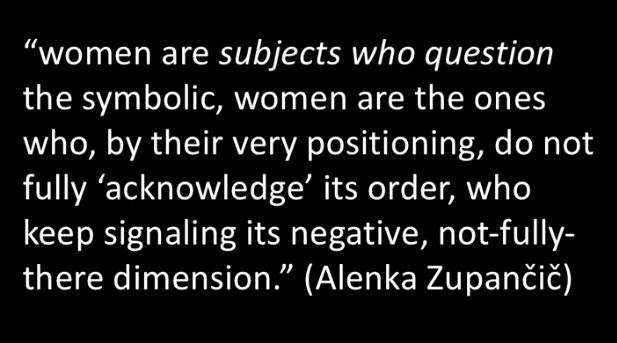
Zupančič Stand Up For Comedy

This paper was written for the conference “Beyond the Joke: Psychoanalysis and Comedy”, which took place at Freud Museum, London, in May 2019.

We live in times when comedy—and especially comedy with an edge—is often threatened from the right and from the left. Maybe even more so from the left: as Angela Nagle has pointed out, we’ve been witnessing lately a curious turn in which the new populist right is taking the side of transgression and rebellion, traditionally associated with the left: they talk about breaking the taboos (of speech, but also of conduct), they dare to speak up, say the forbidden things, challenge the established structures (including the media) and denounce the “elites”.

Continue reading “Zupančič Stand Up For Comedy”

McGowan

Why Loss?

Enjoyment and Sacrifice.

Constantly engage in self-destructive behaviour, humans fight wars, unleash loss on ourselves and others. Loss becomes enjoyable and produces something enjoyable, objects only have their worth through sacrifice and loss.

If we sacrifice something, we give the object transcendent value, in the process of losing it. Loss gives us something to desire. There are no values that just are, values come into existence through sacrifice.

Loss and sacrifice create an object to desire.

Loss gives us something to desire, it creates a value, value comes into existence through the act of sacrifice or loss.

Interview with Todd McGowan, Crisis and Critique Volume 7.2 Issue 2.

We can see now that there is no such thing as bare life. All life is politicized.
Even the attempt to protect or promote life is part of a political form of life, to use Agamben’s terms. The reluctance of conservative leaders to impose strict regulations reveals that regulating life is not inherently a conservative or ideological operation. The logic of capital demands the flow of commodities so that nothing gets in the way of accumulation. The outbreak interrupts this flow, thereby exposing how protecting life puts one at odds with the logic of capital. This means that we can see how the state—in its role of protecting life—is not just the servant of capital. If it were, we would not see the arrest of the flow of commodities. The catastrophe shows us that the state can be our friend, not just our enemy. The great revelation of the coronavirus catastrophe is the emancipatory power of the state, the ability of the state to serve as the site for collectivity rather than acting as just the handmaiden of capital. This is something that the theory of biopower can never accept. The anarchic tendencies behind this theory need to be shown as fundamentally libertarian, not leftist. This is what the virus has demonstrated to us.

McGowan

On ‘symbolic disinvestment’ as a way to resist the obscene excess of capitalism

Freedom through Conversion

Rupture with my given identity. Not all conversions are the same. No one is self-identical. But if no-one converts, this lack of self-identity never becomes evident, this act of conversion attests to this self-division and makes it explicit, and this freedom that self-division gives you.

Self-division makes us free. Conversion makes self-division or division of subject apparent.

Leap into some new form of satisfaction. Without security that this new form of authority will ground yourself like the old authority it is a Leap Of Faith. The problem is most conversions, are conversions into new forms of certainty. We convert into something that will give us even a more secure form that the old identity.

Radical Openness. Michael Clayton the movie. As a example of conversion, it leaves him a blank slate. It doesn’t give him a new sense of security, sense of wholeness.

Problem with conversion: Looking for a new form of satisfaction that will fill in their lack. Overcome their self-division. Richard Dawkins is one of the most renowned atheists in the world. Even though in that conversion to atheism, there is a way to recoup self-division, in security, he can fill in the lack with his belief in atheism. Atheism will increase one’s satisfaction, will give the person more marvels to look at in the world. Whole vistas of possibility will open up. Conversion becomes a more satisfying form of satisfaction, one without any LACK at all.

Continue reading “McGowan”

Alenka Zupančič interview

2014

Alenka Zupančič : The Lacanian concept of the Real allows for a problematization of this opposition which had become paralysing and unproductive philosophically. We must of course be wary of the tendency to see in this Lacanian move a simple affirmation of a naive realism – the Real understood in this objectivist fashion. The ‘Real’ for Lacan is not reducible to the discursive but neither is it simply an advocation of an ontological realism, understood unproblematically. Especially since Lacan introduces a key difference between the notion of the Real and that of being. They are related via a ‘third dimension’, that of the ‘signifier’, but they do not coincide.

What Lacan wants to tell us is that the signifier has ontological significance, the signifier tells us about ontology in a way that the notion of the signified is unable to (this latter being the usual realist referent; the object as the signified).

The signifier is interesting not because we could reduce everything to it and to different signifying operations (this reductionist question is completely false), but because there is something in the signifier and its operations that cannot be reduced back to the signifier and its operations.

This is the crucial point, and not some mythical or original outside of the signifier, irreducible to it. This is also what the ‘materialism of the signifier’ amounts to. Not simply to the fact that the signifier can have material consequences, but rather that the materialist position needs to do more than to pronounce matter the original principle. It has to account for a split or contradiction that is the matter. It has to grasp the concept of the matter beyond that imaginary notion of ‘something thick and hard’. I’m not saying: ‘For Lacan, the signifieris the real matter’, not at all.

I’m saying that, for Lacan, the signifier is what enables us to perceive the non-coincidence between being and the Real, and that this is what eventually leads to a new kind of materialism.

From this point of view, we can say that Lacan develops the modern moment in philosophy, but as Žižek says, ‘he develops it with a twist’. Then there is the new concept of the subject – another Lacanian ‘revolution’ in philosophy, retroactively relating the subject of the unconscious to the Cartesian cogito. This is often one of the great misunderstandings of Lacan (and psychoanalysis), that it jettisons the cogito, that it is anti-Cartesian pure and simple. This is a significant misunderstanding of the psychoanalytical concept of the ‘subject’ which was one of the main concepts for the delineation of a specific Lacanian orientation in the first place. This concept of ‘subject’ distinguished Lacan from the wider structuralist movement and their notion of a ‘subjectless structure’.

But somehow this conception of ‘subject’ is interpreted as anti-cogito, as the ‘subject’ is the unconscious subject. Therefore, it was important to clarify the connection between cogito and the unconscious and for example, there is an important anthology from the Ljubljana School of Psychoanalysis, where we explore this problematic in detail (Cogito and the Unconscious edited by Žižek [1998a] and including essays by all three thinkers as well as others in the Slovenian wider group of theorists). There is also the question of the radical break with premodern metaphysics involved in the Cartesian gesture, which Lacan judges crucial for the emergence of the subject of the unconscious.

This theme is crucial also for his understanding of ethics. In his important early seminar, Seminar VII, The Ethics of Psychoanalysis (Lacan 1992), he is discussing the history of ethical thought as it related for example to the metaphysical tradition. His specific example is Aristotle and there is obviously a debt here on one level to Aristotle’s Ethics as a text and conceptual scheme. However, there is also a clear and radical parting of the ways.

In my own work on ethics, in The Ethics of the Real: Kant, Lacan (Zupančič 2000), I draw out some of these themes. For example, I put forward a critique of what I term ‘bio-morality’ and which, in its contemporary developments, represents an allegiance (albeit in rather reduced ways) to Aristotle’s eudaimonistic ethics and metaphysics of being. This is not simply a criticism of Aristotle, but rather of what a revival of his conceptual paradigm today amounts to.

In relationship to the theme of ethics, I want to stress that what I develop out of Kant’s ethics must not be opposed or seen as completely distinct from politics. As Žižek very rightly pointed out, the contemporary fashion of playing (‘good’) ethics against (‘bad’) politics is more often than not a direct pendant of the ideology of late capitalism and its conception of democracy. Any rigorous political thought is conceived as potentially dangerous and leading to a possible ‘disaster’ (that is to say to a more fundamental change in how the present order functions), whereas ethics seems to be much safer, and centred mostly on our individual responsibility, rather than any kind of collective engagement. My own work on Kant and ethics already went against this tendency, pointing both at an unsettling dimension of Kantian ethics, as well as at its emphasis on the universal, rather than simply individual.

It is similar with psychoanalysis which supposedly also focuses on individual destinies and problems. Here, am I allowed to tell my joke about the grain of seed, or the man who thinks he is one?

He gets cured by the psychoanalysts and then he comes running back, crying that he has just been chased by a chicken. Don’t you know you are a human being, they say? Yes, I am cured. I know that I am a human being, and not a grain of seed. But, please, does the chicken know this? This is the crux of the politics (which is also an ethics) in the Ljubljana School of Psychoanalysis. It is not enough simply to deal with the plight of the ‘subject’ and fantasy, through psychoanalysis.

Rather, we must seek to transform the structures of the symbolic which sustain a given order, determine the Impossible-Real that they grapple with.

Sexuality

Alenka Zupančič: Yes, when we understand the question ‘why Freud and Lacan?’, or the question ‘why psychoanalysis?’, we come close to an understanding of the paradigmatic role which a revised notion of ‘sexuality’ must play in this discussion. Joan Copjec succinctly pointed out how, for example, in the term ‘sexual difference’ the term ‘sex’ has been replaced by the more neutered category of ‘gender’. As Joan – an allied member of the ‘Ljubljana School’ – put it: Gender theory performed one major feat: it removed the sex from sex. For awhile, gender theorists continued to speak of sexual practices, they ceased to question what sex or sexuality is; sex was no longer the subject of an ontological inquiry and reverted instead to being what it was in common parlance: some vague sort of distinction, but basically a secondary characteristic (when applied to the subject), a qualifier added to others, or (when applied to an act) something a bit naughty.

This is very far from what both Freud (from his early, 1905 text Three Essays on the Theory of Sexuality [Freud 1977]) and Lacan have been saying. For Freud, the notion of the ‘sexual’ is significantly broader than contemporary notions of sex. It is not a substance to be properly described and understood (by psychoanalysis), but more like an impasse that generates and structures different discursive edifices trying to respond to it. It is linked to a notion of a fundamental ontological impasse; this impasse is irreducible for Freud.

But we also see here all the accusations against psychoanalysis, that ‘Freud reduces everything to sex’. In one sense, this accusation is true but what it misses is the complexification and radicalization of what we mean by ‘sexuality’. Freud discovered human sexuality as a problem (in need of explanation), and not as something with which one could eventually explain every (other) problem. He ‘discovered’ sexuality as intrinsically meaningless, and not as the ultimate horizon of all humanly produced meaning. A clarification of this point is one of my ‘interventions’ in Why Psychoanalysis? Three Interventions (Zupančič 2008b). Lately, I dedicated a whole book to these questions – it came out in 2011 in Slovenia, but I’m still working on its English version.

On Materialism

The materialism of psychoanalysis is not simply materialism of the body;
and Lacan has learnt the philosophical lesson that is essential in this
respect: in order to be ‘materialist’ it is not enough to refer to the matter
as the first principle from which everything develops.

For, in this, we easily succumb to a rather idealistic notion of a somehow always-already spirited (‘vibrant’) matter. In recent debates, psychoanalysis – in the same package with all of the so-called post-structuralist thought – is often accused of relying on the formula ‘always-already’ as its magical formula. But this accusation misses the whole point: for psychoanalysis, ‘always-already’ is a retroactive effect of some radical contingency that changes given symbolic coordinates.

What a materialism worthy of this name has to do today is to propose a conceptualization of contingency (a break that comes from nowhere, ‘ex-nihilo’ so to say) in its complex relation to the structuring of the world.

Also, thinking is not simply opposed to things (and to matter), it is part of the thing it thinks, without being fully reducible to it. To advocate materialism and the ‘Real’ is not to advocate anti-thought. Quite the contrary, we might say – it calls for more and more thinking. And this is a problem that I sometimes detect in the recent flourishing of ‘new materialisms’ – a kind of abdication of thinking when it comes to more complex structures and arguments, as if common sense simplicities were inherently more ‘materialist’ than something
which is more complex and perhaps paradox ridden.

On Nietzsche

Alenka Zupančič: A key part of the Nietzschean legacy is I think working against the ‘moralisation’ of the symbolic, which Nietzsche describes so well in The Genealogy of Morals, for example, and which for example is also a key theme in relation to the thematic of the ‘moralisation of politics’, which I mentioned earlier.

Concerning nihilism and to quote Ray Brassier, from his text Nihil Unbound, there are things to be said for nihilism. It depends, of course, on what we mean by nihilism. If we mean by it a certain materialist position which recognizes contingency of, for example, our being in the world, and which points to a limit of ‘making sense of (all) things’, then we must say that to a great extent we cannot go beyond nihilism.

Yet this does not imply for Nietzsche that we sink in the depressive feelings of ‘worthlessness of all things’. On the contrary, it rather implies what he calls ‘gay science’. But, we must simultaneously avoid what Nietzsche calls ‘reactive nihilism’ and this is, of course, bound up with his whole critique of ressentiment (or ‘acting against’, reactiveness). To say that there is no ultimate cause of things is not to say that nothing itself is the ultimate cause of things, which amounts to putting the Nothing in the office of the Absolute.

Describing the difference between active and passive nihilism, Nietzsche famously says that man would ‘rather will nothingness than not will’ (On the Genealogy of Morals). And we could say that what defines (contemporary) passive nihilism is precisely that man would rather not will than will anything too strongly (because the latter supposedly inevitably leads to some kind of ‘nihilist’ catastrophe). And this seems to become synonymous with what ‘ethics’ now is in contemporary culture and society and the wider ‘moralisation of politics’, ‘biomorality’ etc. (to which I strongly oppose an ‘ethics of the Real’). There is a ‘deactivation’ of the will, which is also a deactivation of the ‘political will’, of the political as such as a paradigmatic space and temporality of antagonism, of the ‘Real’.

In my view, the genuinely new Nietzschean notion of nothingor n egativity is not simply that of ‘active nihilism’ as opposed to ‘passive nihilism’, but rather a transfiguration of nothing. Nothing/negativity is not a kind of ultimate absolute, but rather the smallest yet irreducible difference that is inscribed in being qua being. This is what I argue in my book. I use Nietzsche’s own metaphor of ‘the shortest shadow’. When speaking of going beyond the opposition real world/apparent world, Nietzsche describes this moment as ‘Midday; moment of the shortest shadow’ (Twilight of Idols).

Midday is thus not for him the moment when the sun embraces everything,
makes all shadows and all negativity disappear, and constitutes an undivided Unity of the world; it is the moment of the shortest shadow. And, what is the shortest shadow of a thing, if not this thing itself? Yet, for Nietzsche, this does not mean that the two becomes one, but, rather, that one becomes two. Why?

The thing (as one) no longer throws its shadow upon another thing; instead, it throws its shadow upon itself, thus becoming, at the same time, the thing and
its shadow, the real and its appearance. When the sun is at its zenith, things are not simply exposed (‘naked’, as it were); they are, so to speak, dressed in their own shadows. In other words: it is not simply that our representations do not coincide with things, it is rather that things do not simply coincide with themselves. There is thus an imperative to ‘think through’ this negativity. We
need to philosophize, as Žižek has said, philosophy is now more important than ever. It is not a game of textualism as some postmodernists would like to suggest perhaps.

The Subject

Alenka Zupančič: We can say that subject is ‘the answer of the Real’, as Lacan puts it somewhere, or that it is the effect of the rift/inconsistency of the structure. And we can indeed contrast this with the structuralist notion that there is a ‘structure without a subject’, a subjectless structure.

But what is at stake is above all a profound reconfiguration of what both ‘structure’ and ‘subject’ mean, refer to. We can begin with the notion of the structure which differs in Lacan from the classical structuralist notion. Very simply put: for Lacan, structure is ‘not-all’ (or ‘not whole’), which is what he articulates with the concept of the ‘barred Other’. This implies a lack, a contradiction as – so to say – ‘structuring principle of the structure’. Structure is always and at the same time more and less than structure. And this is where the new notion of the subject comes in. Subject is not the opposite of the structure, it is not some intentionality which uses structure to express itself, or which tries to get its more or less authentic voice heard through it.

Subject is a singular torsion produced by the inconsistency of the structure.

Take the simple example of the slips of the tongue: for Freud and Lacan, they do not bear witness to a hidden(unconscious) force repressed by the structure, which nevertheless betrays its presence by these slips.

Rather, they are singular existences of structure’s own inherent negativity. This is also the argument that I want to make in the context of the contemporary debates concerning realism, which often disqualify thought or thinking as something merely subjective (facing external reality). Put in a couple of formulas: Instead of taking it as something situated vis-à-vis being, we should conceive of thought as an objectivized (and necessarily dislocated) instance of the non-relation (contradiction, inconsistency) and rift inherent in being (in ‘objective reality’). Thinking is a necessarily displaced objectification (‘objective existence’) of this rift, that is, of the relation of being to its own
‘non-’, to its own negativity.

Although being is indeed independent of thinking, the rift that structures it only objectively exists as thought, and this perspective opens a new way of conceiving realism and/or materialism. This is precisely how I would also read the Lacanian subject. And this is why if we remove subject from the structure, we do not get closer to objective reality, but rather further away from it.

We can also say that the subject for Lacan is ‘objectively subjective’, there is an asymmetry in the subject, something in the subject which is not just subjective but which is also inaccessible to the subject.

We can see the connection back to Kant. The Kantian subject I would endorse is that ‘pure something, X, which thinks’, the transcendental unity of apperception. The point where subjectivity is not fully assumable and the point where the object is not reducible to or is ‘not yet’ objectivity (this is Lacan’s notion of objet petit a). Here, we see also that the Lacanian subject radicalizes the traditional ‘object’. The concept of the ‘object a’ is perhaps the most significant Lacanian conceptual invention.

Ethics

Alenka Zupančič: No, the notions of good and evil are not simply irrelevant to ethics, I would say, although they are indiscernible in advance. The responsibility we have is to decide what is good. It is difficult to overstate Kant’s significance in this respect. He did two things which may look incompatible: first, he founded ethics exclusively in human reason: no God or any other pre-established Good can serve as basis of morality. But instead of this leading to a kind of ‘relativised’, finitude-bound morality, it led to the birth of the modern thought of the absolute, the unconditional, and of the infinite as the possible, even imperative dimension of the finite.

Whatever objections we may raise to the Kantian ethics –for example, and already, from Hegel’s perspective – it was with Kant that the standing oppositions like absolute/contingent, lawful/unconditional, finite/infinite broke down, and the path was opened for a truly modern reconfiguration of these terms.

In the twentieth century, Kantian ethics has been largely domesticated to serve as an important ideological foundation of the contemporary democratic liberalism and of the gradual replacement of an emancipatory politics with the discourse of human rights or simply ethics.

I’ve always been astonished by the fact that a really radical, uncompromising and excess-ridden writing like Kant’s could be referred to in order to pacify the excess (of the political or something else). When the Nazi criminal Eichmann infamously defended himself by saying that in his doing he has been simply following the Kantian categorical imperative, this was of course an obscene perversion of Kant’s thought.

As Žižek succinctly formulated: what follows from Kant is not that we can use moral law as an excuse for our actions (‘oh, I wouldn’t do it, but the moral law commanded so’), we are absolutely responsible for the very law we are ‘executing’.

But Eichmann’s perverse defence did point at the unsettling core exposed by Kant: the unconditional law is one with (the excess of) freedom.

Lacan was probably the first to properly recognize this unsettling, excessive moment that Kant discovered at the very core of ethics.

When he wrote his famous essay ‘Kant with Sade’ (Lacan 2002b), the point was not that Kant is in truth as excessive as Sade, but rather that Sade is already a ‘taming’, a pacification – in terms perversion – of the impossible/real circumscribed by Kant. This is the thread I tried to follow in my book: Kant’s discovery of this unsettling, excessive negativity at the very core of Reason. I was not interested so much in ethics as ethics, as in this thing that Kant has formulated through his considerations of ethics.

Helena Motoh and Jones Irwin: Does this mean that the ‘ethics of psychoanalysis’ simply pits the Real against the symbolic or is there something else going on here? Also, how does the concept of ‘drive’ and especially the concept of ‘death drive’, which Žižek emphasizes,relate to an ethical dimension? Finally, what does the Lacanian concept of ‘desire’ (as he describes it in The Ethics of Psychoanalysis) have to do with this? Is ‘desire’ simply jettisoned in the later work?

Alenka Zupančič: In respect to the relation between symbolic and the Real, there are certainly oscillations and shifts at work already in Lacan, as well as in the work of the three of us (together and separately). The idea that the Real is a kind of unbearable, repulsive thickness beyond the symbolic, left out of it and inaccessible to it, may have had some presence in our work at some point. But I think it is fair to say that for many years now we are all struggling precisely with the problem of a different way of relating them as absolutely crucial. There are some differences in the way we go about it,

but the main and shared shift of perspective that orientates our work could be perhaps summed up as follows: the Real is not any kind of substance or being. It pertains to being (and to the symbolic) as its inherent contradiction/antagonism.

I started working on this issue first by getting a bit more into Nietzsche (the first, Slovene version of the Nietzsche book was published in 2001). Borrowing from Badiou his notion of the ‘minimal difference’ and relating it to Nietzsche’s notion of the ‘shortest shadow’, I tried to develop the notion of the Real as not that of some Thing, but of the fundamental non-coincidence of things with themselves. This non-coincidence is not caused by the symbolic; rather, the symbolic is already a response to it: it is discursivity as necessarily biased by the constraints of the contradiction in being.

Parallel to this work on Nietzsche was also my working on the theme of love, and later on comedy as possible ways of articulating what is at stake in the relation between the symbolic and the real. Lately, and for some time now, I have been working on this through the question of the ontological implications of the psychoanalytic notion of the sexual. I could perhaps put it in one formula: The real is part of being which is not being (or which is not qua being), but which as such dictates the (symbolic) logic of its appearance.

The real is part of being which is not being (or which
is not qua being), but which as such dictates the (symbolic) logic of
its appearance.

the Real is not any kind of substance or being. It pertains to being (and to the symbolic) as its inherent contradiction/antagonism.

Helena Motoh and Jones Irwin: Can you say a bit more about the two key Lacanian concepts (not without political ramifications of course) of ‘desire’ and ‘drive’. You have already explicated these, to some extent, but can you develop some of the tensions between them? Also, how do these concepts develop in your work, as they seem to have a paradigmatic status while undergoing some transformation for example from the ‘Ethics of the Real’ book to the book on ‘comedy’. Finally, are there philosophical tensions between your work and the other members of the troika on this fraught relationship between ‘desire’ and ‘drive’?

Alenka Zupančič: Certainly, you are right to point to these concepts as paradigmatic, and they are also crucial when it comes to the articulation of the relationship of the symbolic, the imaginary and the Real You are also correct that there are some differences here – one would expect nothing less in a philosophical movement worth its salt.

In my own work, I take up the themes of desire and drive throughout. In Ethics of the Real I focused mostly, although not exclusively, on Lacan from The Ethics of Psychoanalysis and The Transference (Seminars VII and VIII). The concept of desire is in the foreground in both, but there is also a shift that starts taking place there, a conceptual move from das Ding as the impossible/Real as the focal point of desire, to the introduction of the object a. This shift then gets a further and very complex elaboration in Lacan’s subsequent seminars. But to formulate what is at stake very briefly and simply, we could say that what is involved here is a move from the Real as the abyssal beyond of the symbolic,

to a concept (of the object a) which undermines the very logic and nature of the difference on which the previous conception of the Real was based.

Object a is neither symbolic nor Real (in the previous sense of the term). It refers to the very impossibility to sustain this kind of difference between the symbolic and the Real, and it is this impossibility that is now the Real.

This also opens the door for a more systematic introduction of the concept of the drive. The notion of the object a is crucial both for desire and drive, they are different ways of relating this impossible non-ontological dimension (a) to what is, to being. In the Seminar X (Anxiety) Lacan provides a formula that I think is absolutely crucial and which I also took as the guiding line of my work after Ethics: he says that love is a sublimation, and then defines sublimation in a very surprising way, namely that sublimation is what makes it possible for jouissance to condescend to desire. If one remembers the famous definition of sublimation from Lacan’s seminar on The Ethics of Psychoanalysis (‘sublimation is what elevates an object to the dignity of the Thing’) then the shift is indeed dramatic and surprising. This new notion of sublimation becomes directly associated with the question of the drive, for sublimation is also defined as a ‘nonrepressive satisfaction of the drive’.

Now, in Lacan, as well as in our reading of him, there is indeed perceptible a turn from the logic of desire to that of the drive as somehow truer. But this is not simply a turn (of interest) from the symbolic to the Real, as it sometimes seems. What is at stake is rather the recognition of the fact that the status of the Real as the impossible Beyond of the symbolic is actually an effect of desire and its logic. Desire casts the internal contradiction that drives it in terms of the inaccessible Beyond to which it can only approach asymptomatically. With drive, the contradiction remains internal, and the impossible remains accessible as the impossible. This, I think, is absolutely crucial, and this is what

I tried to formulate with the formula the ‘Real happens’: the point of Lacan’s identification of the Real with the impossible is not simply that the Real is some Thing that is impossible to happen. On the contrary, and in this reading, the whole point of the Lacanian concept of the Real is that the impossible happens. This is what is so surprising, traumatic, disturbing, shattering – or funny – about the Real. The Real happens precisely as the impossible. It is not something that happens when we want it, or try to make it happen, or expect it, or are ready for it. It is always something that doesn’t fit the (established or the anticipated) picture, or fits it all too well. The Real as impossible means that there is no ‘right’ time or place for it, and not that it is impossible for it to happen (‘On love as comedy’, Zupančič 2000).

The Real happens precisely as the impossible. It is not something that happens when we want it, or try to make it happen, or expect it, or are ready for it.

So what is important to stress in this whole ‘turn’ to the logic of the drive is the following: this is not simply a turn to the drive on account of its supposedly being closer, truer to the Real (as established independently), but rather a turn toward a different conception of the Real as such.

With drive, the Real is no longer a relational notion (sustaining questions like ‘what is our attitude toward the Real?’). It rather suggests something like: our relation to the Real is already in the Real. This is why questions like ‘How to get outside to the Real?’ seem to be the wrong kind of questions.

This is because there is no outside of the Real from which one would approach the Real.

Zupančič reviews McGowan

Alenka Zupančič reviews Todd McGowan’s Capitalism and Desire: The Psychic Cost of Free Markets, 2016 Columbia University Press

“With the onset of capitalism, the speaking being enters a system that promises relief from the absence that inheres within the basic structure of signification.”

According to McGowan this promise (whichs also the promise of a better future) is an essential feature of capitalism. It is also what m akes critique of it very difficult: for how are we to criticize capitalism without (at least implicitly) proposing a better (alternative) future? Yet the moment we do this, we get entrapped into the logic of capital: “The task is thus that of freeing critique from the promise of a better future.”

Interestingly, German philosopher Frank Ruda dedicates his recently published book Abolishing Freedom almost entirely to a very similar task, formulated by Ruda in slightly different terms, namely as an attack on the concept of freedom as potentiality (to be realized). Freedom as possibility, as potentiality, as capacity to do something (exemplified in the liberal capitalist freedom of choice), argues Ruda, has become a signifier of oppression and functions as the best antidote to actual freedom.

Once the mode of possibility enters the game and structures it, one should resist understanding or presenting the stakes simply in terms of possibility versus actuality (actual action), that is, in terms of the opposition between a possibility and its realization.

For this is precisely how freedom as oppression works in practice. It works following the logic of the superego, most concisely defined by Žižek as the reversal of the Kantian “you must, therefore you can” into “you can, therefore you must.”

Possibilities are here to be taken, realized, by all means an at any price: You can do it, therefore you must!

The culture (and economy) of possibilities is not suffocating simply because there are so many possibilities, but because we are supposed not to miss out on any of them. A person who just sits at home, relishing in the idea of all the possibilities and opportunities capitalism has to offer and doing nothing to realize them is not the kind of person this system needs.

What we are expected to do is to realize as many possibilities as possible (to act), but never to question the framework of these possibilities as possibilities. Which is precisely where “actual” freedom has to be situated: not simply in the actual realisation of possibilities, but in “unscrewing” the very framework which is based on the idea of freedom as possibility to be (yet) realized.

Ruda proposes to do this by advocating what he calls “comic fatalism.” He formulates several slogans of such fatalism: they suggest that a way out of this freedom-as-oppression is to act as if there were no future

  • “Act as if the apocalypse has already happened!”
  • “Act as if you were dead!”
  • “Act as if everything were always already lost!”

There is thus an interesting connection between the way in which both McGowan and Ruda see the dismantling of the promise/potentiality (set in the future) as a crucial step in undermining the ideological and libidinal power of capitalism.

This proximity goes very far, for the way in which McGowan proposes to go about this undermining could actually be formulated in a single maxim coined upon Ruda’s examples:

“Act as if you were already satisfied!”

As he notes explicitly, McGowan sees the most important novelty of his approach to the critique of capitalism in conceiving the core of the problem not in terms of the injustice or inequality (following Marx), nor in terms of repression (following the Frankfurt school) – including the Foucauldian reversal of the “repressive hypothesis” – , but it terms of satisfaction.

The promise of a better future is the promise of a future (full) satisfaction which drives our desire. Yet what we don’t see is that the repetition of the failure to find full satisfaction is precisely the real s ource of satisfaction. This real source of satisfaction is traumatic in its nature, and capitalism – with both its economic and ideological structuring – allows this traumatic source to remain unconscious. It provides a gigantic armature for the metonymy of our desire, and hence protects us against confronting the trauma of loss as constitutive (and not empirical).

The ultimate commodity sold (to us) by capitalism is not this or that commodity, but its dissatisfaction as such: “No matter how attractive it appears, there is no commodity that holds the appeal of a lasting dissatisfaction.”

Dissatisfaction, and the repetition of the failure to find full satisfaction is the very source of satisfaction that accompanies capitalism. It is the reason what we cling to it so tightly.

By accepting the psychic or psychoanalytic perspective adopted by McGowan there nevertheless remains one question that concerns what we may call “material conditions of the reproduction of our psyche”. This question is intrinsic to the psychoanalytic theory itself.

The unconscious is out there

Jacques Lacan

Lacan is famous for his statement that “the unconscious is out there”, which implies that we can perhaps also change it only out there. Commodity functions as it does because of our attitude to it, but such an attitude is already part of the commodity as its objective functioning, and this functioning continues pretty much independently of what we think and know about the object in the first instance.

Enjoy Your Work

Thomas J. Catlaw & Gary S. Marshall (2018): Enjoy Your Work! The Fantasy
of the Neoliberal Workplace and Its Consequences for the Entrepreneurial Subject, Administrative Theory & Praxis
https://doi.org/10.1080/10841806.2018.1454241

Knights and Clarke find three emergent types of fragile or insecure identities in the academic workplace: impostors, aspirants, and existentialists.

Impostors are plagued by the feeling that they are getting away with something. Their position is a result of luck or hard work rather than ability, and they are perpetually on the verge of being “found out.” They fall short of the ideal academic almost to the point of wanting to distance themselves from academic work itself. Impostors feel a strong sense of guilt for not measuring up in light of the many and varied audiences that constantly evaluate and judge them.

Continue reading “Enjoy Your Work”

Resources

Caring and Its Impossibilities: A Lacanian Perspective 2002

Our core claimis that caring causes a subjective conflict in the caregiver, because it evokes desires and tendencies that are irreconcilable with his or her best intentions. The way in which the caregiving subject deals
with this conflict determines the likelihood of his or her withdrawal from work through burnout.

Capitalist Discourse

Capitalist Discourse, Subjectivity and Lacanian Psychoanalysis

Stijn Vanheule Department of Psychoanalysis and Clinical Consulting, Ghent University, Ghent, Belgium

What is essential to the four discourses is that a desiring “agent” addresses an “other,” which is indicated by the horizontal upper arrow. In the move from “agent” to “other” we recognize the human tendency to create social bonds. However, here Lacan is not expressing some sort of romantic view on human interrelations, but is stressing that the relationship between “agent” and “other” is marked by a “disjunction of impossibility” (Verhaeghe, 2004, p. 59; Bruno, 2010): the message that the agent sends is never received as it was intended. Lacan (1969–1970, p. 174) explains this as follows: “The first line comprises a relation, indicated here by an arrow, which is always defined as impossible. In the master’s discourse, for instance, it is effectively impossible that there be a master who makes the entire world function. Getting people to work is even more tiring, if one really has to do it, than working oneself.” Indeed, the agent’s address never provokes a reciprocal reaction, which is why no returning arrow connects the “other” back to the “agent” (see Figure 1).

The lower part of the formula highlights the hidden side of discourse. The first position on the bottom left is “truth,” which is connected to the position of the “agent” by an arrow pointing upwards. This arrow indicates that all actions made by the agent in a given discourse rest on a hidden truth. Indeed, characteristic of all discourse is that a repressed element motivates the agent’s actions, and that this repression engenders the possibility of a social bond, represented at the upper level of the discourses. In a similar vein, “truth” also has an effect on the position of the “other,” which Lacan emphasizes by drawing an additional (diagonal) arrow.

The arrow pointing downwards (right side of Figure 1) indicates that the agent’s address to the other has effects: a “product” is created. This product fuels the agent, but occupies a disjunctive position in relation to the truth that set the discourse in motion.

Specifically, in the four standard discourses the position of truth is not targeted by an arrow, and the positions of “agent”/“semblance” and “other”/“jouissance” are influenced by two (not mutually related) other positions, which makes its functioning structurally lapse.

In the discourse of the master, a master signifier (S1) is formulated by the agent, and imposed onto the other who is presumed to function by means of knowledge (S2). Characteristically, such a domineering move rests on the repression of subjective division ($), and as a product the other is reduced to the position of an object (a). For example a therapist may tell his phobic client to be brave (S1) and to face the crowds he is afraid of by adhering to specific instructions as to how one might behave in groups (S2). By adopting such a directive style the therapist puts his own uncertainty in social situations ($) aside, and by obeying the therapist, the client is reduced to a pawn in the game of social interactions, which will finally produce further discontent (a) that might engender the formulation of new directives (S1).

Central to the discourse of the hysteric is the active formulation of complaints ($) and the search for an other who is presumed to have an answer (S1) for what bothers the subject. This discourse represses the truth that all desire rests on a lack that cannot be alleviated (a), and typically results in the production of narratives (S2) that don’t solve the fundamental lack (a), but actually engender further irritation ($).

The discourse of the university builds on the proclamation of knowledge (S2). Such knowledge always rests on the acceptance of dogmas and assumptions (S1), but this is neglected in this discourse. Characteristically, the other is put in the place of the object (a). This produces discontent ($), which fuels further knowledge creation (S2).

Finally, in the discourse of the analyst, the analyst qua agent confronts the other with a so-called object a, logically notated a. The object a refers to a drive or jouissance-related remainder that cannot be named and that fuels desire5. For example, the analyst’s silence, which often baffles the analysand who expects reciprocity in the interaction, can function as an object a (see Lacan, 1971, p. 25). By occupying the place of the object (a) the analyst creates a place where, via free associative speech, subjective division can be articulated ($). In order to pay close attention to the singularity of the patient the analyst puts aside pre-established ideas about patients and pathologies (S2), such that key signifiers that mark the analysand’s subjectivity (S1) can be formulated, which fuels the analyst’s positioning qua object a.

Semblance and Jouissance in Discourse

In Seminar XVIII (e.g., Lacan, 1971, p. 25) and Seminar XIX, Lacan (e.g., Lacan, 1971–1972, p. 67) somewhat rearticulated the positions he first entitled as “agent,” “other,” and “product” (see Figure 3), indicating that engaging in discourse above all means that one makes use of semblance. During his teaching Lacan interpreted the concept of semblance in various ways (Grigg, 2007). In the nineteen fifties he uses the concept semblance (“le semblant”) to refer to the world of appearances that is installed by means of the Imaginary. At that moment semblance is an imaginary phenomenon that needs to be distinguished from the Symbolic. As Lacan developed his discourse theory this all changed profoundly. At this point he suggests that the fact of social relations as such implies semblance, which is expressed in the following statement: “discourse as such is always discourse of semblance” (Lacan, 1971–1972, p. 226, my translation). Henceforth, discourse unfolds when someone forges a position in relation to another; semblance is “the proper object based on which the economy of the discourse regulates itself” (Lacan, 1971, p. 18, my translation). For example, the discourse of the master takes shape if someone plays the role of the commanding agent.

In seminar XIX, the position of the other is described as the position of jouissance (Lacan, 1971–1972, p. 193). Here Lacan defines jouissance as a disturbing dimension in the experience of the body, which renders the subject unable to experience itself as a self-sufficient enjoying entity (Lacan, 1971–1972, p. 217). Jouissance is immensely disruptive. It is a dimension of otherness that we all have to deal with. Indeed, the very idea of “dealing with it” bears witness to discourse; that is, to the fact that we treat jouissance by making an appeal to an agent or semblance, which is expected to manage it: jouissance provokes the mobilization of semblance. The root of jouissance is in the structurally dysfunctional status that the body has for the human being (Lacan, 1971–1972, p. 217).

What is typical for discourse, is that it envelopes a semblance around jouissance, and as a result jouissance is no longer unlimited, but conditioned by the element occupying the position of semblance. In this maneuver, a social bond is created: “What is discourse? It is that which, in the arrangement of what might be produced because of the existence of language, makes up the function of the social bond” (Lacan, 1972, p. 51, my translation).

Surplus-Jouissance As the Product of Discourse

In the early nineteen seventies Lacan frequently points out that the product of discourse makes up a “surplus-jouissance” (e.g., Lacan, 1971–1972, p. 193). In forging his concept “surplus-jouissance” Lacan builds on Marx’s concept “surplus value.” In Marx’s Capital (1999), the notion of surplus value is defined as the difference between the exchange value of products of labor (commodities) and the value that coincides with the effort of producing these products, i.e., the means of production and labor power. In our market economy system, Marx says, money is the pre-eminent criterion to measure the amount of the value that is realized. Within the capitalist system gaining surplus value seems to be the sole aim. Profit-making and the expansion of capital are the motives that drive capitalism. However, gaining surplus value is only possible by selling fetishized commodities for a price that is higher than the value attributed to labor that produced them. If equivalent values are exchanged, no surplus value can be realized.

Marx indicates that the realization of this aim depends on a trick, and it is this cunning trick that interests Lacan (1968–1969, pp. 64–65; Vanheule and Verhaeghe, 2004). In the market the capitalist buys labor power in order to produce merchandise. Marx states that the trick put into practice in this process is that the capitalist pays the laborer as much as he has to, but less than the market value of what the laborer actually produced. In other words, in the process of exchanging value (labor power/money) the capitalist pockets a monetary surplus behind the back of the laborer, and behaves as if he too worked hard during the process of production. Here Marx states that the capitalist must hide his smile: “after a hearty laugh, he re-assumes his usual mien” (Marx, 1999, p. 126). This laughter results from the fact that the value that is created during a workday is actually much higher than what the capitalist pays the laborer.

Capitalist production implies that one no longer works solely in order to satisfy needs, and stops once they have been met. Production continues beyond satisfying needs, which results in a fetishist relation to surplus value (Tomšič, 20122015). Lacan (1968–1969, pp. 64–65) concludes that the secret gain of surplus value is both the product and the motor of the capitalist production system. Yet, despite the appropriation of surplus value, Marx stresses that the capitalist does not personally enjoy what he gains. The capitalist is only the support that makes the system run. Therefore, what the capitalist system produces are suppositions and phantasies of gratification, while in fact nobody enjoys (McGowan, 2004). Indeed, this is what Lacan also stresses when addressing Marx’s socio-economic analyses: “There is only one social symptom: each individual actually is a proletarian” (Lacan, 1974, p. 187, my translation).

Furthermore, Lacan suggests that the general structure of discourse is “homologous” to the system of capitalism described by Marx, and this is why the above discussion of surplus value is relevant. Both systems produce an element of excess, in relation to which a fetishist relation is created. In capitalist production surplus value and/or commodities are fetishized, while in the use of discourse a fetishist relation with surplus-jouissance (plus-de-jouir) is created (Lacan, 1968–1969, p. 45; Tomšič, 2012).

Homology means that their structure is identical (Regnault, 2005): while coming in a different form, the use of discourse and capitalist production obey the same logic. As we use discourse language is produced, in the capitalist system commodities are produced. Yet, through the process of exchange something is lost. By using discourse one is robbed of something: in attempting to address jouissance by means of language, and find a solution for it through the social bond, the experience of an un-articulated “beyond” is produced. Using signifiers to name jouissance confronts the speaker with a dose of corporeal tension that is not inherent to language: a surplus-jouissance that can only be located in phantasy or delusion comes to the fore. It is precisely at this point that the function of laughter can be situated. In Marx’s system, laughter refers to the capitalist’s gain of surplus value, and to the process of alienation that this entails. In the use of discourse, laughter refers to the surplus-jouissance inherent in our alienation in the signifier.

In explaining surplus-jouissance, Lacan points to the joke. As we speak we invariably also utter nonsense, and because of this we laugh. Yet, why exactly does the joke provoke laughter? Lacan (1968–1969, p. 64, my translation) suggests the following: “it [the joke] provokes laughter, in the end, to the extent that it is actually hooked to the failure inherent to knowledge.” The pursuit of meaning through speech implies deadlocks. Speech is always a half-saying (mi-dire). It misses its point, and this failure coincides with a dose of jouissance, to which laughter bears witness. Consequently, surplus-jouissance has a status of lack and loss (Tomšič, 2015)—language use always misses the point; expressed by downward arrow in the formulae for discourse—and at the same time makes discourse function as an endless attempt to get hold of what one misses; expressed by the diagonal arrow from surplus-jouissance/product to semblance/agent. Furthermore, by connecting the manifestation of surplus-jouissance to laughter and misrepresentation, Lacan situates surplus-jouissance at the level of the unconscious (Lacan, 1971, p. 21). In Marx’s production system the capitalist laughs with the money the system generates; in Lacan’s model the user of discourse laughs to the extent that, at the level of the unconscious, a surplus of jouissance is produced which one fails to get hold of. The unconscious concerns the combined expression of half-saying and surplus-jouissance.

In the discourse of the master the object a is a component of libidinous corporeality that is delineated by the use of signifiers, but is not represented by means of the signifier. It is what remains leftover after imposing knowledge (S2) onto jouissance. Qua element of symbolic nothingness, the object a nonetheless makes itself felt as corporeal tension, gravitating around a gaze, a voice, or in the element of oral nothingness to be taken in, and anal nothingness to be given away. In the end, this surplus-jouissance is juxtaposed with the master signifier (S1), but, as mentioned previously, it doesn’t correspond to the truth that the discourse was initially fueled by. In the end the discourse of the master stresses the fact that there is no hope that subjective division can ever be transcended, or that discontent can be resolved if we address jouissance by means of language, which is what we typically do. Unbehagen is structurally unsolvable, which is expressed in the formula by the fact that none of the arrows arrive at $. It is precisely the failure that coincides with the discourse of the master that, in Lacan’s reasoning, makes analytical discourse possible. Through the exploration of subjective discord via free association, there is a return in the analysis to the signifiers that connote and mark the subject.

In most discussions of surplus-jouissance, Lacan starts from the master discourse. In the discourse of the master the object a is the surplus that the semblant is confronted with. Yet, in terms of Lacan’s later discussions of the structure of discourse (Figure 3), surplus-jouissance is not identical to the object a, but the end position of each discourse (Lacan, 1971–1972, p. 193). In the discourse of the university the divided subject occupies this place; in the discourse of the hysteric it is unconscious knowledge that emerges; and in the discourse of the analyst the master signifier makes up the surplus-jouissance.

Capitalist Discourse

On one occasion, during a 1972 lecture at the University of Milan, entitled du discours psychanalytique, Lacan articulated a model on the precise structure of capitalist discourse. This model coheres with Lacan’s initial four discourses, but cannot be seen as just another variant in the series of discourses. After all, Lacan’s four discourses have a strict structure: four positions are linked by means of five unidirectional arrows (Figures 13); and 4 elements ($, S1, S2, and a) rotate in a fixed order across these positions (Figure 2). The discourse of the capitalist disrupts this structure, and is a “mutant” of the discourse of the master. Indeed, Lacan (1972, p. 48) understands capitalist discourse as the contemporary variant of the classic discourse of the master. Yet with regard to the discourse of the master, it contains 3 mutations7 (Lacan, 1972, p. 40):

(1) $ and S1 exchange places.

(2) The arrow pointing upward on the left that makes the position of the truth unattainable in the classic discourse changes now into an arrow pointing downwards.

(3) The upper horizontal arrow that made the connection between “agent” and “other,” or “semblance” and “jouissance,” disappears.

The effect of these three changes is that a number of obstructions that are inherent to the four discourses are not characteristic of the fifth discourse. We can circulate within the capitalist discourse like go-carts on a racetrack. Indeed, in the capitalist discourse, the non-rapport is circumvented.  Tomšič describes this as follows: “The vectors show that the capitalist discourse is grounded on the foreclosure of the impossibility of totalization that marks other discourses, an impossibility that is structurally determined by the fact that the signifiers constitute an open system of differences.”

Specifically, in the four standard discourses the position of truth is not targeted by an arrow, and the positions of “agent”/“semblance” and “other”/“jouissance” are influenced by two (not mutually related) other positions, which makes its functioning structurally lapse. In the capitalist discourse, “a very small inversion between the S1 and the $, which is the subject, is enough for it to run as if it were on wheels, it can’t run better, but it actually runs too fast, it runs out, it runs out such that it burns itself out8 (Lacan, 1972, p. 48, my translation). Indeed, what is structurally characteristic of the discourse of the capitalist is that while the four positions remain intact, the pathways made up by the arrows change: in all positions one arrow arrives, such that a closed circuit of arrows is created. The structural lapse that marks the four standard discourses cannot be found at the root of this fifth discourse, which, so to speak, makes it run on wheels. Yet Lacan suggests that in the end the one functioning along the lines of this smoothly running process burns himself out, and gets consumed. One idea that the above quote articulates, is that in the capitalist discourse subjectivity is corrupted. The main structural reason for this is that in this discourse, the distance between $ and a is lost: corporeal tension that is proper to surplus jouissance disturbs the subject.

Just like in the discourse of the hysteric $ is situated at the level of the agent/semblance. Indeed, the discourse of the capitalist essentially starts from the experience of subjective division. In line with his earlier work, Lacan suggests that the subject is, on the one hand, a connotative effect of language use—“the signifier is what represents a subject for another signifier” (Lacan, 1972, p. 51, my translation). On the other hand, the subject is determined by the object a, which is the structural cause of desire—“The object a is the true support of what we have seen function, and it functions so in a more and more pure way to specify each in his desire” (Lacan, 1972, p. 52, my translation). Yet, most characteristically, man is marked by sexuality, which is not instinctively organized, and makes up “that in which man never feels at ease at all” (Lacan, 1972, p. 38, my translation). In the discourse of the hysteric the Unbehagen thus obtained results in an address to the other. Capitalist discourse, by contrast, does not capitalize on the social relation: “capitalism, that was its starting point: getting rid of sex” (Lacan, 1974, p. 34). Indeed, the capitalist discourse directly aims at the root of the problem, which is what the downward arrow on the left indicates. This discourse does not encapsulate the discomfort of subjective division as structural, but aims to recuperate discontent in its very system. It is a discourse in which there are answers for this discomfort: there exists an S1 that answers the $ and functions as a truth for the divided subject. For example, in our contemporary Western consumption culture, discontent is often deemed the upshot of having not yet obtained the right object and suggests that a state of subjective satisfaction will be reached once this object is obtained. In other words, the semblance of being dissatisfied can be answered with the S1 of a brand name or a product that offers the promise of satisfaction. Capitalist discourse actively cultivates the semblance of dissatisfaction, as well as a fantasy of self-sufficiency, completeness and vitality (Tomšič, 2015). The market9 tells us what we need: the merchandise it provides. These are all S1’s: they are isolated signifiers that consumers take to be the truth of their discontent. Indeed, within the capitalist discourse, the products that make up the market constitute a despotic truth to which the subject is subjected.

The move from $ to S1 reflects a denial of the structural quality of subjective division. On the one hand the capitalist discourse starts from subjective division, yet, on the other hand the move toward S1 suggests that subjective division might be overcome through alienation in a master signifier.

This bears witness to a perversion-like movement: while in perversion “the subject takes care himself to compensate for the flaw of the Other” (Lacan, 1968–1969, p. 265, my translation), in capitalist discourse an S1 is carefully promoted to compensate for the flaw of the subject. In both cases, subjective flaw is believed to be corrigible [fixed or repairable RT], which is why the discourse of the capitalist is often described in terms of a generalized perversion (Mura, 2015). In line with this interpretation Lacan, postulates a rejection of symbolic castration at the basis of the discourse of capitalism: “What distinguishes the capitalistic discourse is this: Verwerfung, rejection, rejection outside all fields of the symbolic …of castration.” Within the capitalistic logic, the lack at the heart of subjectivity is not seen as a structural consequence of using signifiers, but an accidental frustration that can be remedied within the market of supply and demand. The assumption that an S1 exists for each discomfort is ingrained in this discourse.

As a result, capitalist discourse implies a particularization of desire, treated as if it is a demand. Whereas in classic discourse desire is singular in that it cannot be solved by means of the signifier, the capitalist discourse suggests that particular solutions for dealing with subjective division actually exist: the market is there to satisfy customers’ demands. Consequently, at the point of desire, the capitalistic logic leads to exploitation: “the exploitation of desire, this is the big invention of capitalist discourse” (Lacan, 1973a, p. 97, my translation). This discourse exploits desire by treating it as a specific question to be answered by means of practical solutions. The superego command characteristic of capitalist times concerns an obligation to satisfy desire via consumption (McGowan, 2004).

Interestingly, following Žižek, Bryant (2008, p. 13) suggests that under the regime of capitalism, the subject’s principal question is not “what do I desire” but “what should I desire,” which is “not a question about objects, but a question of those conditions under which the subject might be desired by the Other.” Indeed, it is a basic Lacanian tenet that the desire governing the subject is essentially mediated by the desire of the Other: “man’s desire is the Other’s desire” (Lacan, 1960, p. 690). Within capitalist discourse this implies that merchandise will not so much be preferred for its intrinsic qualities, but in terms of how it is evaluated by the other. Indeed, this is often how marketing proceeds, products are presented as highly desired by celebrities, which directs the consumer’s desire.

Obviously, such exploitation of desire only works because the S1 that the capitalist discourse formulates as an answer is not at all random: S1 refers to an entire knowledge apparatus, S2, which guarantees the adequacy of the answer. Indeed, according to Lacan (1969–1970), there is compatibility between contemporary science and the capitalist discourse. In his view, the capitalist’s discourse is engaged in a “curious copulation with science” (Lacan, 1969–1970, p. 110). Science ensures10 the development of S2, through which S1 grows ever more innovative and, as a result, old answers must be constantly replaced by new ones. Within the capitalist discourse, S1 is not a fixed anchorage, but a solution that is replaced by endlessly better solutions. The fact of the matter is that the innovation of S2 continuously recreates both S1 and the demand. The only thing that the system needs is the consumer: subjects that are prepared to translate their discord $ in terms of the gap in the market that is delineated by S2, and who believe in S1.

Moreover, the switch between S1 and $ reveals something about what is taken seriously. In the discourse of the master, it is a signifier that is taken seriously: an S1 is adopted, and around this signifier a world of semblance is created through which the other and jouissance are addressed, which is what the upper horizontal arrow indicates. In the discourse of the capitalist, by contrast, it is discontent that is taken seriously. In this respect, the capitalist discourse resembles the discourse of the hysteric.