excentric ex-centric Discourse of the Master

Campbell, Kirsten. Jacques Lacan and Feminist Epistemology, New York: Routledge 2004.

The predication of the subject in language constitutes is as divided, radically split between the conscious and unconscious, and as ‘ex-centric‘, radically other to its conscious self of identity. É: 189 33

S/s Lacan’s algorithm emphasizes not the unity of the sign but the rupture between signifier and signified.

I read the formulae of the four discourses as a dynamic representation of the discursive social link; as devices that formalize and elucidate fundamental forms of intersubjectivity. 53

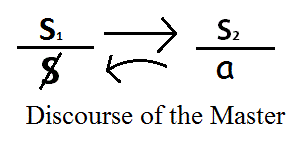
S1 represents the master signifier, the symbolic element that represents the subject for another signifier. The master signifier marks the subject’s position within the signifying chain and hence within the discursive social tie. 50

S2 designates the symbolic field, teh chain or network of signifiers that form the subject. For this reason, S2 represents the knowledge of the subject. It describes both the form of the subject’s knowledge, for example, academic, psychoanalytic and so on, and the form of knowledge of the subject, such as the differing conceptions of the subject within the unversity and psychoanalysis. 50

a represents the ‘left-over’ or remainder of discourse. That remainder is the jouissance produced by, and surrendered to, language in the taking up of a a speaking position by the subject.  The a is an unassimilable excess to the discourse.  There is no signifier of the a, as it is not possible to represent it in the signifying economy of the discourse.  The subject attempts to structure its relationship to this unassimilable remainder by rendering it as an imaginary object — the objet petit a.  The a thus both functions in the imaginary register, in which it appears as an imaginary object filled with phantasmatic content, and in the symbolic register, in which it marks the excluded term of discourse, the gap in or void of its symbolic structure. For this reason, the a ‘stands simultaneously for the imaginary fantasmic lure/screen and for that which this lure is obfuscating, for the void behind the lure’ (Žižek 1998 4 Disourses Cogito and the Unconscious).

$ designates the barred subject, in which the S of the conscious subject is struck through because of its division by the unconscious.

In the Discourse of the Master, S1 stands in the place of the agent, S2 in the place of the other, $ in the place of truth, and a in the place of the product of the disourse.  In the operation of the Master’s Discourse, the master signifier is the cause of the subject. The subject addresses its speech to the Other of the Symbolic order, S2, the network of signifiers which form the subject. The truth of the discourse is $, the unconscious of the divided subject. The product of its discourse is the a, that remant of jouissance which is forbidden to the subject. Lacan nominates teh Discourse of the Master as the fundamental relation because it represents the structure to another signifier, and hence produces it as a subject in the signifying chain, the cause of the discourse is also the ’cause’ of the speaking subject (Seminar 17: 19-20).  In this way, the S1 of the Discourse of the Master represents the ‘origin’ of discourse as such, because it is the condition of the production of discourse as enunciation.  For this reason, Lacan describes the foundational discourse as that of the Master. 51

antigone beckett

Belsey, Catherine. Culture and the Real : Theorizing Cultural Criticism. 2005

Malone Dies, opens with the words, ‘I shall soon be quite dead at last in spite of all’ (Beckett 1994: 179). Malone is resigned to the inevitability of death, although he would prefer it to take place without struggle. ‘Throes’, he observes laconically, ‘are the only trouble, I must be on my guard against throes’ (179– 80). First published in French in 1951, and translated into English by the author in 1956, Malone Dies anticipates some of the concerns of Lacan’s Seminar 7, though in a manner entirely characteristic of its own author. The novel is also characteristic of its moment.

Lacan’s exemplary text, Antigone, shows its protagonist refusing to give ground relative to her desire. Organically linked to her dead brother, as to no other human being (a husband or a child would be replaceable, she says, but her mother and father are dead: she can have no new brothers), Antigone insists on carrying out his burial rites, contrary to Creon’s law.

Because she accepts the penalty of living burial, Antigone’s ‘incarnation’ of the death drive is heroic (Lacan 1992: 282).

Oedipus, meanwhile, enters the zone between life and death because he too has insisted on following his own desire, in this instance, ‘to know the last word on desire’. Everyone else tries in vain to discourage him from pressing his questions about who he is, but he persists. Oedipus dies cursing, unreconciled to the goods.

On the other hand, King Lear, the irascible old man who does not give up on his desire either, represents a ‘derisory’ version of the same commitment (1992: 310). The ‘old fool’ thinks he can go into the same zone with everyone’s agreement – and ‘makes the earth and ocean echo’ with his imprecations, because he fails to grasp that this is a place of dispossession (1992: 309– 10)  153

Malone, however, is a protagonist for our own ironic time. There is nothing remotely heroic about Malone except his refusal of the goods. Neither stoical nor serene, Malone makes no concessions whatever to the moral law: ‘Let me say before I go any further that I forgive nobody. I wish them all an atrocious life and then the fires and ice of hell and in the execrable generations to come an honoured name’ (Beckett 1994: 180). Malone inhabits the zone between life and death alone in an isolated room that he cannot quite locate. Could it be ‘one of heaven’s mansions’ perhaps? He thinks not (184). It seems to be in an ordinary house. There remains a doubt, however. … Finally, The ceiling rises and falls, rises and falls, rhythmically, as when I was a foetus . . . . I am being given, if I may venture the expression, birth to into death, such is my impression. The feet are clear already, of the great cunt of existence. Favourable presentation I trust. My head will be the last to die. Haul in your hands. I can’t . . . . That is the end of me. I shall say no more. (285)

To die is to be reunited with the real we came from, but the living Malone is at home neither as an organism, in the flesh, nor at the level of the signifier. ‘All my senses are trained full on me, me. Dark and silent and stale, I am no prey for them. I am far from the sounds of blood and breath’ (186).

Malone is not his body. On the other hand, he is not a consciousness either: thought seeks him out, ‘as it always has, where I am not to be found’ (187). The space he inhabits, however unstable, ill-defined, seems easier to specify than his identity. It is to the signifier, however, that Malone turns to keep his distance from the real, physical process of dying. He tells – and then writes in an exercise book – stories. … 154

Is there anything uplifting here? Not really. But there is comedy, and it pacifies. In the absence of heroism, there is at least dedication, if only in Malone’s resolute contempt for the good death. Above all, there is pleasure in the grim wit of Beckett’s prose. What are verbal dexterity, stories, jokes, satire, parody, and satirical excoriation itself, after all, but an affirmation of the signifier in the face of the real? And isn’t that exactly what, as organisms-in-culture, we speaking beings are good at? 155

A THEORY OF CULTURE?

Lacan’s account of sublimation offers a way of understanding the pleasures the signifier offers the speaking being, without reducing culture to something else: ethical instruction, ideological control, or scripted determinism. Aspects of culture may at a specific moment represent any or all of these. In itself, however, culture does not make us better or worse. If it subjects people, it does not exclude the possibility of resistance. It does not do away with our discontents, but it offers to engage with them while finding a focus for desire. And to the attentive interpreter, culture can in addition tell more than it thinks it knows about who and what we are. 156

sublimation death drive

Belsey, Catherine. Culture and the Real : Theorizing Cultural Criticism. 2005

Tracing a path through Freud’s own widely distributed observations, Lacan repudiates the binary opposition Freud holds on to so precariously between the libido and death: for Lacan the drive is both sexual and deadly, at once life-giving and destructive. In Seminar 7 sexual desire is not the central problem. Sex, Lacan says, is fine in its way, but you can’t count on it:

Sex ‘simulates’ the impossible jouissance, the encounter with the Thing, but does not in any circumstances enact it. Meanwhile, however, Seminar 7 is less concerned about sex than death. For Lacan sex was never an origin: instead, it merely ‘occupies’, like an invading army, the field of desire (1977: 287),which is brought into being with the loss of the real entailed in our subjection to the symbolic order.

In Lacan’s account, sublimation includes romantic love; there is conflict between sublimation and sex; on the contrary, sex involves the pleasurable signifier. Sublimation rails off the impossible encounter with the engulfing Thing, not the pleasures of sex. 145

A product of his time, however, in the late 1950s and early 1960s, when the world held its breath as two superpowers threatened each other with nuclear annihilation, Lacan became increasingly preoccupied by the death drive, and specifically its expression in the capacity of human beings to destroy their world with weapons of mass destruction. Sublimation pacifies the drive without pathology and without destruction.

There are two possible barriers between the subject and the object of the drive, two ways to keep at bay the death-dealing and vital Thing: on the one hand, the superego; on the other, sublimation.

True to Freud, Lacan finds the superego, ‘obscene’, ‘ferocious’ and ‘morbid’ (1992: 7). The more we concede to this ‘parasite’, the more it demands of us, he argues (302). Its ideals are ‘the goods’: conventional values, ‘family goods, domestic goods . . . the goods of our trade or our profession, the goods of the city, etc’. But psychoanalysis is not there, Lacan insists, to support the bourgeois dream, with its puritanical demands for human sacrifice (303).

If, then, we refuse the goods, one option is to go willingly with Antigone, into a heroic region beyond pleasure, a world of total dispossession, the unearthly place of the drive itself. 146

In the meantime, sublimation promises pleasure at the level of the signifier – including the pleasure offered by the plays of Sophocles, and not least, of course, Antigone.

Sublimation, then, is the ‘true’ barrier between us and absolute destruction, preferable to the goods because beauty ‘gets closer’ to the Thing (216– 17). The pleasure principle presents the beautiful as capable of alluding to the Thing, revealing the nature of the drive, and in the process offering a gratification that differs from its aim (111, 293).

There is nothing sentimental or escapist about the beautiful in Lacan. On the contrary, ‘the beautiful is closer to evil than to the good’ (217). Moreover, it is ‘precisely the function of the beautiful to reveal to us the site of man’s relationship to his own death, and to reveal it to us only in a blinding flash’ (295).

By encircling the void, which marks the place of the real that is lost to the subject, culture exercises the creative aspect of the drive to make allusions at the level of the symbolic to the inaccessible Thing, which is itself beyond pleasure. In culture the symbol comes between us and the enticing, terrifying, dangerous object of the drive.

There is in Seminar 7, however, no sublime object, unreasonably elevated to the dignity of the Thing, no fetish, no fantasy offering a focus for antagonism. On the contrary, while the Thing is best acknowledged, it is also preferable that it should be veiled by the signifier. And the signifier gives pleasure.  147

To secure the sublime object of ideology, Žižek sacrifices the version of sublimation that explains the existence of culture. If Žižek offers on the basis of Lacan a theory of human nature, what Lacan offers on the basis of Freud is a theory of human culture as the only hope of a rapprochement between the symbolic and the real. Lacan insists on the gap between the real and the signifier. … Žižek denies the existence of the real but places the sublime object at the heart of culture. 🙂 hmm don’t know about dat.

Paradoxically, however, this leads him to ignore the capacity of the signifier to give pleasure – though he demonstrates it in his own extremely pleasurable writing over and over again. Only Lacan retains a substantial positivity that the signifier cannot master, an unknown region which we encounter in fear and trembling, but with no trace of theology.

Žižek says you have to go through the fantasy to the void; Lacan says you can do that – but in the meantime, you can make things.

Making things is what culture consists of, given that the things in question include pots, beads, stories, paintings, photographs, films, essays and academic books. This is the material of cultural criticism, and only Lacan, who largely ignores the Kantian sublime, gives us a theoretical explanation of its existence. 148

Antigone don`t give ground sublimation

Belsey, Catherine. Culture and the Real : Theorizing Cultural Criticism. 2005.

THE PLEASURE PRINCIPLE

What difference does Žižek make by his intertextual conjunction of psychoanalytic sublimation with the Kantian sublime? Lacan’s Seminar 7 concerns the ethical implications of psychoanalysis. The question it asks is what psychoanalysis offers as its outcome for the analysand.

Given that ‘the goods’ – duty, self-sacrifice, the conventional virtues – solve nothing, what would it mean to be free from the symptom, which always conceals the drive towards the Thing? How, in other words, can we avoid, on the one hand, the naked aggressivity that represents the direct projection outwards of the death drive and, on the other, the effect of repression, the symptom’s deception, by which neurosis promises its own pathological version of satisfaction?

It is in answer to the question how to avoid pathology that Lacan impels us not to give ground relative to our desire (1992: 319). His instance of the tragic outcome of this ethic is Antigone, whose bond with her brother impels her to defy Creon’s law, knowing that the consequence is to be walled up alive in her own tomb.

The rest of us, less heroic, may be less ready to venture beyond everything we think we know, or more eager to postpone the moment, since we are all required to rejoin the real in the end. For us, what is deadly in desire must be acknowledged, but may also be tamed, pacified, fenced off, as a way of living with – or, indeed, surviving – the effects of that uncompromising commitment.

The beautiful, then, is the acceptable barrier to ‘the unspeakable field of radical desire that is the field of absolute destruction’ (216).

People are speaking beings, organisms-in-culture, able to find themselves fully at home neither in the organic real nor in the symbolic order. The Thing beckons with the promise of gratification at the level of the real, but the price we should pay for such jouissance would be the dissolution of the subject.

Conversely, the symbolic order, the Other which constitutes us as subjects, is empty; it cannot give a satisfaction it does not possess. Sublimation in Lacan’s account offers a way of inhabiting the symbolic without submission to the exorbitant demands of the ferocious moral Law. Sublimation, which gratifies without repression, involves the pleasure principle.  143

Sublimation appears repeatedly in Freud’s work from 1905 onwards as a diversion of part of the sexual drive towards other aims.

Under the influence of the ego, he argues, people relinquish a proportion of organic satisfaction in favour of culturally acceptable activities. Art is the effect of sublimation.

At times Freud displays all the scepticism of science in his depiction of the artist. ‘He’ (artists are characteristically male, of course, in Freud) is probably exceptionally driven, but also exceptionally socially inept. What he wants is what all men want: glory, power and the love of women. But when he fails to secure any of them, the artist retreats into fantasy, imagines the satisfaction he seeks. Whereas most people in these circumstances would have to make do with their meagre day-dreams, however, the artist, Freud explains, is especially good at making his fantasies public in acceptable forms, while disguising their origins. Artists convert imagination into works of art. By means of this skill, they go on to acquire glory, power and the love of women in the process, thus securing their objectives after all, but by another route (Freud 1976: 423– 4). Elsewhere, however, Freud’s account is more elegiac.

Something in the nature of the sexual drive, he proposes, is incompatible with civilization, so that for human beings, divorced by culture from their organic origins, perfect sexual gratification is not possible. But paradoxically, the pleasure that culture withholds in this way reappears in culture itself by means of sublimation:
[Freud quote]  The very incapacity of the sexual instinct to yield complete satisfaction as soon as it submits to the first demands of civilization becomes the source, however, of the noblest cultural achievements which are brought into being by ever more extensive sublimation of its instinctual components. For what motive would men have for putting sexual instinctual forces to other uses if, by any distribution of those forces, they could obtain fully satisfying pleasure? 144

That element of lack in the sexual relation was to reappear in Lacan’s account of unconscious desire as indestructible and insatiable, and in his repeated insistence in Seminar 20 that there was no sexual relation (rapport). But what complicates the issue further is Freud’s increasing conviction after the First World War that there are two drives, the libido on the one hand, and the death drive on the other. While Beyond the Pleasure Principle, published in 1920, holds them apart only with some degree of uncertainty, Civilization and its Discontents, ten years later, insists on the distinction and pays renewed attention to the dangerous capabilities of the death drive. Externalized, it leads to cruelty and brutality towards others; internalized, it produces the self-destructive and voracious superego, conscience, an exorbitant sense of moral obligation that can never be fully met, and which therefore creates unending anxiety:

[Freud quote]  ‘Every renunciation of instinct now becomes a dynamic source of conscience and every fresh renunciation increases the latter’s severity and intolerance’ (Freud 1985a: 321).

Civilization is necessary as a defence against unqualified aggressivity, but its effects remain disappointing. Among its discontents we must include the self-denying, self-excoriating ethical imperatives of the superego, aggression itself by another name. 144-145

antigone

Belsey, Catherine. Culture and the Real : Theorizing Cultural Criticism.

Zeuxis wanted to look behind the veil of the paint that constituted his rival’s picture. The psychoanalytic subject longs to look behind the veil of the signifier, but what it seeks there is not so much the forgotten, repressed real, not that part of itself, or its continuity with the world, cut off by the symbolic and lost. Instead, it looks for the object and cause of its own desire, an identifiable something that would fill the gap created by the loss of the real. This object that motivates and perpetuates desire took on increasing importance for Lacan. In Seminar 7 in 1959– 60, he named it the Thing (das Ding); later, the Thing disappeared, to be remodelled as the objet a. 45

We need to go back a bit. For much of his life Freud insisted that the unconscious motor force of all human life was sexual. But during and after the First World War, his work begins to demonstrate a mounting conviction that there must be another drive that presses towards death. How else to account for the sustained carnage of that extraordinary and unheralded episode of history? Beyond the Pleasure Principle, published in 1920, begins by proposing an antithesis between the life-affirming sexual drive towards pleasure and, in contrast, the death drive that seeks inertia for the organism, but may equally be projected outwards by the subject as aggression against others. As Freud’s argument here unfolds, however, the two principles refuse to stay apart. On the one hand, there often seems to be an element of aggression in the sexual act; on the other, the pleasure principle too seeks release from tension, and so shares the aim of the death drive. Do they, then, support rather than oppose each other? Jacques Derrida has brilliantly deconstructed the opposition between the two (1987a), in this instance ably supported by Freud himself, who concluded his book with disarming honesty by admitting that he was not satisfied with a theory that remained purely speculative. 45

Beginning where Freud had left off, but going back to take account of a passage from ‘Instincts and their Vicissitudes’, published five years earlier (Freud 1984: 136– 8), Lacan condensed the two drives into one. His rereading of Freud acknowledges only one drive, and it is both life-giving and deadly. Seminar 7 attends primarily to the quest for pleasure, which Lacan locates on the side of the signifier. Love is allied with pleasure, a form of sublimation, separable from desire itself. But Lacan also brings pleasure together with death here in his account of tragedy. Where Freud roots his theory in the story of Oedipus, Lacan (as a child of Freud?), defies his phallocentric reputation and takes as his heroic protagonist Antigone, daughter of Oedipus and offspring, therefore, of an incestuous marriage. On the basis of the organic bond with her brother, Antigone is impelled to bury him against Creon’s law, and to confront death as the inevitable punishment for her deed. Lacan sees Antigone as heroic because, like Marvell’s lovers, she assumes her fate, her Até, ‘atrocious’ though it is. For Lacan, she represents human sovereignty in the face of death: 46

“Antigone appears as autonomos, as a pure and simple relationship of the human being to that of which he miraculously happens to be the bearer, namely, the signifying cut that confers on him the indomitable power of being what he is in the face of everything that may oppose him.” (1992: 282)

Rather than languish as the victims of incompleteness that the signifier makes us, we are enabled by the same signifier to desire not to remain at its mercy. We can, in other words, want not to be. …  Antigone, in Lacan’s account, just as defiantly precipitates her own death. It is because she loves her brother that she ‘pushes to the limit the realization of something that might be called the pure and simple desire of death as such. She incarnates that desire’ (1992: 282).

Lacan’s death drive bears very little resemblance to Freud’s, which depends on the thesis that the organism prefers stasis, or inertia. 46 We do not seek annihilation, Lacan says, for the sake of restoring equilibrium. But he does draw on Freud’s proposal that the organism is driven to die at its own time and in its own way (Freud 1984: 311– 12). In Lacan the death drive operates in the speaking being, at the level of the signifier, and seeks what he calls ‘the second death’.

This is not just physical extinction (the first death), which might take place at any time, by accident. Instead, the second death entails the full recognition of what we are, which is to say, of course, what we are not: not complete, not knowing, not immortal. The tragic hero acts on this understanding, assumes the destiny of a being-for-death and, when the time comes, willingly accedes to the state of non-being that is the outcome of the human condition.

At this stage of Lacan’s work the object of the drive is identified as the Thing. An archaic, maternal, forbidden and impossible object of desire, the Thing is ‘both living and dead’ (1992: 300), at once life-giving and deadly. Lacan’s name for it is partly ironic, since no such object exists in the real; at the same time, there is the suggestion of a pun in French on la Chose and the cause of desire that we attribute to the Thing. The Thing is ‘that which in the real, the primordial real, I will say, suffers from the signifier’ and ‘presents itself’ to the analyst in the gap produced by the signifying cut (1992: 118). Constructed retroactively to occupy the space of pure loss that is left by the erasure of the real, the Thing marks the place where the real was, constitutes itself as filling the emptiness that resides there for the speaking being. Subsequently the object of the drive is renamed by the even more evasive term, objet a, and located more firmly at the level of demand. Lacan also calls it the petit a, to differentiate the little ‘a’ from the Autre, the big Other, which is language itself. Little Ernst’s wooden reel offers an example of the objet a.

Stavrakakis Lacan and the Political pt 4

Sinthome

an identification with the symptom, a recognition in the real of our symptom of the only support of our being (Stav citing Žižek 1989) 133

Wo es war soll Ich werden: the subject must identify with the place where the syumptom already was: ‘In its pathological particularity [it] … must recognise the element which gives consistency to [its] being’ (Žižek 1989) 133

By saying ‘We are all Jews’, ‘We all live in Chernobyl!’ or ‘We are all boat people!’ — … we elevate the symptom, the excluded truth of the social field (which has been stigmatised as an alien particularity) to the place of the universal — to the point of our common identification which was up to now, sustained by its exclusion or elimination. The same happens when we say ‘We are all gypsies!’ — … What is promoted here is an attitude consistent with identifying with the symptom of the social and traversing social fantasy.

It is only by accepting such an impossible representation, by  making this declaration of impossibility, that it is possible to ‘represent’ the impossible or rather to identify with the impossibility of its representation. Identification with the symptom is thus related to the traversing of the fantasy. Going through fantasy entails the realisation of the lack or inconsistency in the Other which is masked by fantasy, the separation between objet petit a and the Other, a separation which is not only ethically sound but also ‘liberating’ for our political imagination.  134

What is clearly at stake here is the possibility of enacting symbolic gestures that institutionalise social lack, that is to say incorporate the ethical recognition of the impossibility of social closure.

Critique of Judith Butler, Will Connolly, Simon Critchley

Critchley’s Levinaisan ethics of the Other [and probably Butler’ s too]. ‘The community remains an open community in so far as it is based on the recognition of difference, of the difference of the Other’ (citing Critchley 1992).

The problem with such an analysis is that it presupposes the Other as a unifed totality or, even if this is not always the case, it seems to be offering a positive point of identification remaining thus within the limits of traditional ethical strategies or, in any case, not undermining them in a radical way.  What has to be highlighted is that it is precisely this relation — the identification with the Other — that attempts to bring closure to the social.

In order to have a non-totalisable relation to the Other we must relate — identify — with the lack in the Other and not with the Other per se. This is the radical innovation of Lacanian ethics.  And this is what democracy needs today. 139

Stavrakakis Lacan and the Political pt 3

It is the lack created by dislocation that causes the desire for a new discursive articulation. It is this lack created by a dislocation of the social which forms the kernel of the political as an antagonistic articulation of different discourses that attempt to symbolise its traumatic nature, to suture the lack it creates. In that sense the political stands at the root of politics, dislocation at the root of the articulation of a new socio-political order, an encounter with the real moment of the political at the root of our symbolisation of political reality. 74

Trapped as we are within the world of social meaning, all our representations of reality are doomed to fail due to their symbolic character. Every attempt to construct what is impossible to be constructed fails due to our entrapment within the world of construction.  The only moment in which we come face to face with the irreducible real beyond representation is when our constructions are dislocated. It is only when Nature, our construction of external reality, meets a stumbling block, something which cannot be symbolically integrated, that we come close to the real of nature, nature, constructed Nature, is nothing but “a mode of concealment, a cloak of abstractions which obscures that discomforting wildness that defies our paranoid urge to delineate the boundaries of Being” (Stav quoting Evnden 1992) 86

Recognising the constitutivity of the real does not entail that we stop symbolising; it means that we start trying to incorporate this recognition within the symbolic itself, in fact it means that since the symbolic entails lack as such, we abstain from covering it over with fantasmatic constructs — or, if one accepts that we are always trapped within the field of fantasy, that we never stop traversing it. The guiding principle in this kind of approach is to move beyond fantasy towards a self-critical symbolic gesture recognising the contingent and transient character of every symbolic constuct. 89

Fantasy negates the real by promising to ‘realise’ it, by promising to close the gap between the real and reality, by repressing the discursive nature of reality’s production.  Yet any promise of absolute positivity — the construction of an imaginarised false real — is founded on a violent/negative origin; it is sustained by the exclusion of a real — a non-domesticated real — which always returns to its place. Sustaining a promise of full positivity leads to a proliferation of negativity. As we have already pointed out, the fantasy of a utopian harmonious social order can only be sustained if all the persisting disorders can be attributed to an alien intruder. 108

The fantasmatic ideal of harmony is still with us

Can we have passion in politics without holocausts?  Furthermore, is it possible to have a politics of hope, a politics of change without utopia?  … Democratisation is certainly a political project of hope.  But democratic discourse is not (or should not be) based on the vision of a utopian harmonious society.  It is based on the recognition of the impossibility and the catastrophic consequence of such a dream.

Radical Democracy

What differentiates democracy from other political forms of society is the legitimisation of conflict and the refusal to eliminate it through the establishment of an authoritarian harmonious order.  Within this framework the antagonistic diversity between different conceptions of the good is not seen as something negative that should be eliminated, but as something to be “valued and celebrated.  … To believe that a final resolution of conflict is eventually possible, even when it is envisaged as asymptotic approaching to the regulative idea of a free unconstrained communication as in Habermas, is to put the pluralist democratic project at risk.” (Stav quoting Mouffe 1996)  111

Democratic politics — and politics in general — can never eliminate conflict and dislocation, antagonism and division.  the aim is rather to establish unity within an environment of conflict and diversity; to create a thoroughly doubtful society, beset by productive self-doubt, a society that traverses its utopian mirror image by identifying with its supposed enemy (Stav quotes Beck 1997) … accepting the anti-utopian dimension of antagonism and dislocation, the constitutivity of the politcal qua encounter with the real. 112

Lacanian political theory aims at bring to the fore, again and again, the lack in the Other, the same lack that utopian fantasy attempts to mask, [therefore] it would be self-defeating, if not absurd, to engage itself in utopian or quasi-utopian fantasy construction. 116

Democracy is not based on or guided by a certain positive, foundational, normative principle.  On the contrary, democracy is based on the recognition of the fact that no such principle can claim to be truly universal, on the fact that no symbolic social construct can ever claim to master the impossible real. Democracy entails the acceptance of antagonism, in other words, the recognition of the fact that the social will always be structured around a real impossibility which cannot be sutured. 120

Democracy provides a concrete example of what we would call a post-fantasmatic or less-fantasmatic politics. 120

Democracy entails the acceptance of antagonism, in other words, the recognition of the fact that the social will always be structured around a real impossibility which cannot be sutured.

Thus the project of radical democracy, is based not on the futile fantasmatic suture of the lack in the Other but on the recognition of its own irreducibility.  … But this is not possible as long as the ethics of harmony are still hegemonic.  What we need is a new ethical framework. This cannot be an ethics of harmony aspiring to realise a fantasy construction.

Stavrakakis Lacan and the Political pt 2

difference between Lacan and the postmodernists: Although Lacan accepts the priority of the signifier in the formation of meaning he also focuses on the ways this signifier mythologically attempts to embody the real, the ways in which it constructs the imaginary illusion of anchoring our symbolic being to a pre-symbolic level of immediate fulfilment of need.  In other words, prioritising the signifier is coupled with exploring the complex ways in which this signifier produces the effect of the signified.  The point de capiton is one of these ways. 60

If the role of the point de capiton is necessary (or universal) in structural terms, its particular content (the signified produced by its signifying predominance) is not a matter of mirroring a pre-existing objective reality but of hegemonic struggle. 61

if the level of construction is engulfing the totality of the real, what stimulates the production of new social constructions?  What stimulates the desire to articulate new constructions of reality?

Dislocation can be conceived as a confrontation with the real.

The real is what destroys, what dislocates this fantasmatic reality, what shows that this reality is lacking.

The real and the not-all

If reality constitutes the symbolically constructed and fantasmatically supported part of objectivity, the real also belongs to the objective level, it is what exceeds the domesticated portion of the objective. It is exactly what accounts for the failure of all symbolic representations of objective reality … the real is not an ultimate referent of external reality but the limit which hinders the neutral representation of external (symbolic) reality … it is exactly what keeps identification from resulting in full identity. … it is exactly what reveals all symbolic truth to be ‘NOT-ALL’, it can only be thought as the internal limit of the symbolic order. 68

… in opposition to standard versions of constructionism Lacanian theory of symbolic meaning and fantasmatic coherence can only make sense in its relation to the register of a real which is radically external to the level of construction.  This Lacanian real-ism is, however, alien to all other standard versions of epistemological realism in the sense that this real is not the ultimate referent of signification, it is not something representable but exactly the opposite, the impossible which dislocates reality from within. The real does not exist in the sense of being adequately represented in reality; its effects however are disrupting and changing reality, its consequences are felt within the field of representation. 69

The real dislocates social objectivity 70

WE MUST PRECIPITATE A CRISIS, AN EVENT, THAT CONFRONTS THE LIMITATIONS OF OUR MEANING STRUCTURES

Stavrakakis Lacan and the Political pt 1

(1-12)  How can we talk about Lacan and not fall prey to psychologistic analyses that reduce social to individual?  Freud wrote a good deal using that combined a psychoanalytic framework with a social analysis Civilization and Its Discontents, Jokes etc. and Lacan even more so, develops a socio-political conception of subjectivity that is “not reduced to individuality, a subjectivity opening a new road to understanding of the ‘objective’. 4

The million dollar question is what the hell does Stavrakakis mean here?  He quotes Laclau here to buttress the point about the impossibility of the construction of any identity.

Mirror Stage

Captivated by its image in the mirror. “But this captivation, the anticipation of synthesis, can never eliminate the real uncoordination of the body of the infant, it can never erase the external and alienating character of its own foundation. This ambiguity is never resolved” (18).

🙂 Stavrakakis here argues that the mirror image of the child is alienating, even though it is this image the infant recognizes, reaches out to as a basis of her identity, but it nevertheless remains fundamentally alienating, meaning, that there exists a gap, the infant is still uncoordinated yet his image gives him the appearance of a totality, of a wholeness that is complete and unified. Remember the imaginary is already caught up within the symbolic.  “If the ego emerges in the imaginary the subject emerges in the symbolic (19).

If the imaginary, the field of specular images, of spatial unities and totalised representations, is always built on an illusion which is ultimately alienating for the child, his or her only recourse is to turn to the symbolic level, seeking in language a means to acquire a stable identity.  By submitting to the laws of language, the child becomes a subject in language, it inhabits language, and hopes to gain an adequate representation through the world of words … ‘the subject is the subject of the signifier — determined by it” (Citing Lacan) (20).

Lack

But instead of transgressing alienation in the direction of acquiring a solid identity, the subject of the signifier, the subject constituted on the basis of the acceptance of the laws of language, is uncovered as the subject of lack par excellence. (20)

This lack can only be thought as a trace of the ineliminable ACT OF POWER at the root of the formation of subjectivity, as the trace of an ex nihilo decision entailing the loss of certain possibilities or psychic states (the imaginary relation with the mother, for example) and the formation of new ones (20). …

Already this is indicative of the political relevance of the Lacanian category of the lacking subject. This lack can only be thought as a trace of the ineliminable act of power at the root of the formation of subjectivity, as the trace of an ex nihilo decision entailing the loss of certain possibilities or psychic states (the imaginary relation with the mother, for example) and the formation of new ones.

The subject can only exist on the condition that it accepts the laws of the symbolic.

It becomes an effect of the signifier. In that sense it is a certain subordination, an exercise of POWER, that constitutes the condition of possibility for the constitution of subjectivity.

Judith Butler is right when, in her recent book The Psychic Life of Power, she argues that there is no formation of subjectivity without subordination, the passionate attachment to those by whom she or he (the subject in question) is subordinated (Butler, 1997:7).

[However Butler] remains within the limits of a somewhat traditional conceptualisation of power when she is personalising her account (those to whom we are subordinated are presumably our parents, especially during our early formative years).

In Lacan, it is the signifier that is revealed as the locus of this power forming the subject: ‘‘power is coterminous with the logic of the signifier’’ (Dyrberg, 1997:130).

This POWER of the signifier cannot be reduced to the physical presence or the behaviour of the biological parents.  It is the NAME-OF-THE-FATHER, the symbolic and not the real father, who is the agent of this POWER, the agent of symbolic Law (20).

Signifier and Signified

Meaning is produced by signifiers; it springs from the signifier to the signified and not vice versa … 25

What happens then to the signified in the Lacanian schema? Lacan understands the signified as an effect of transference. If we speak about the signified it is only because we like to believe in its existence.

[T]he signified disappears because it is no longer associated with the concept, as in Saussure, but is conceived as belonging to the order of the real; that’s why the bar dividing signifier and signified, … is understood as a barrier resisting signification, as a limit marking the intersection of the symbolic with the real (citing Boothby 1991). 26

Loss of the Signified

In Lacan, … the signified disappears as such, that is to say as the epicentre of signification, exactly because in its real dimension it is situated beyond the level of the symbolic.

What is retained is the locus of the signified which is now designated by a constitutive lack. What is also retained is the promise or the aspiration of attaining the lost/impossible signified, to fill in the vacuum in the locus of the absent signified.

Signification is articulated around the illusion of attaining the signified; but this illusion itself is a result of the signifying play. The signified, as we have pointed out, is an effect created by the signifier in the process of signification. 26-27

… if there is a signified it can only be a signifier to which we attribute a transferential signified function.

The signified, what is supposed to be, through its links to external reality, the source of signification, indeed belongs to the real. But this is a real that resists symbolisation — this is the definition of the real in Lacan; the real is what cannot be symbolised, the impossible.  Surely, if this real is always absent from the level of signification it cannot be in itself and by itself the source of this same signification. Its absence however, the constitutive lack of the signified as real can. This lack constitutes something absolutely crucial for signification.

This absence has to be compensated if signification is to acquire any coherence. It is the absence of the signified in its real dimension which causes the emergence of the transference of the signified. What emerges is the signified in its imaginary dimension.

There is, however, one more dimension to this signifying play.  This transference of the signfiied, the emergence of the imaginary signified can only be the result of the play between signifiers. This is how the third dimension, the dimension of the symbolic, determines signification. It is the predominance of the signifier that produces the imaginary signified in order to cover over the absence of the real signified or rather of the signified as real. 27

Here we need to introduce lack.

[I]rreducible lack is inscribed within the symbolic structure, a lack due to the priority of the signifier and the nature of the symbolic order; the subject becomes identical to this lack … by being born with the signifier, the subject is born divided. 28

The fact that we speak itself divides the subject: the gap between the subject of the enunciation and the subject of the statement can never be bridged.

From Identity to Identification

The fullness of identity that the subject is seeking is impossible both in the imaginary and in the symbolic level.  The subject is doomed to symbolise in order to constitute her- or himself as such, but this symbolisation cannot capture the totality and singularity of the real body, the close-circuit of the drives.

Symbolisation, that is to say the pursuit of identity itself, introduces lack and makes identity ultimately impossible. For even the idea of identity to become possible its ultimate impossibility has to be instituted. Identity is possible only as a failed identity; it remains desireable exactly because it is essentially impossible. It is this constitutive impossibility that, by making full identity impossible, makes identification possible, if not necessary. Thus, it is rather misleading to speak of identities within a Lacanian framework. 29

What we have is only attempts to construct a stable identity, either on the imaginary or the symbolic level, through the image or the signifier. The subject of lack emerges due to the failure of all these attempts. What we have then, if we want to be precise and accurate, is not identities but identifications, a series of failed identifications or rather a play between identification and its failure, a deeply political play. 29

The concept of identification becomes crucial then for any understanding of the Lacanian conception of subjectivity, … The ontic horizon of identification is that of ultimate failure; its ontological horizon that of impossibility.  Yet this is not, strictly speaking, a failure of identification, but a failure of identity, that is to say a failure to achieve identity through identification.

It is, however, this same impossibility to achieve identity (substance) that that makes identification (process) constitutive. This is not only true for the life of the child but for the life of the adult as well, something which reveals the relevance of the concept of identification for social and political analysis.

Since the objects of identification in adult life include political ideologies and other socially constructed objects, the process of identification is revealed as constitutive of socio-political life. It is not identity which is constitutive but identification as such; instead of identity politics we should speak of identification politics.

Name-of-the-Father introduces a certain lack, the Name-of-the-Father is a signifier that disrupts the imaginary relation between mother and child by erecting the prohibition of incest, the Paternal Function isntitutes a new order, an order structurally different from the natural order, an order instituting human society, a certain community of meaning (32).

… in order to gain the signifer we have to sacrifice the signified

Symbolic identification is an identification structured around the acceptance of this constitutive lack.

But the objective sphere is also lacking, how?

40 In a section entitled The objective is also lacking. Stav insists that even though Lacan made innovative theoretical strides on subjective side, the importance of Lacan for political theory comes through with his work on the ‘objective’ side.  Roughly the social.

These two levels are not, of course identical but in any case they are not antithetical; there is something linking the individual to the collective, … it is the subject, symbolic lack itself, which splits the essentialist conceptions of individuality; it is the same subject as lack that introduces division into human collectivity. 40
How does the subject ‘introduce division into human collectivity”?

Laclau is quoted by Stav, “‘Objectivism’ and ‘subjectivism’ are symmetrical expressions of the desire for a fullness that is ultimately impossible.” HSS 13

Lack in the Other

It is the Lacanian subject of the signifier, the lacking subject, that provides the first link between psychoanalysis, society and politics, and this precisely because it highlights its dependence on the socio-symbolic order: …

By locating, at the place previously assigned to an essence of the individual psyche, a constitutive lack, Lacanian theory avoids the essentialist reductionism of the social to the individual level and opens the way to the confluence of psychoanalysis and socio-political analysis, since this lack can only be filled by socio-political objects of identification. 37

If I need to identify with something it is not only because I don’t have a full identity in the first place, but also because all my attempts to acquire it by identifying with a supposedly full Other are failing.

Identification only becomes thinkable as a result of the lack within the structure, the structure of the social Other.  The objective as a closed totality is a semblance; the objective Other is lacking. 41

This then takes Stav into a discussion of the nature of this lack, and hence the introduction of jouissance and desire. Lack is a lack of jouissance, “lack of a pre-symbolic real enjoyment which is always posited as something lost, as a lost fullness, the part of ourselves that is sacrificed/castrated when we enter the symbolic system of language and social relations” 42

As soon as we enter the symbolic, the pre-symbolic – that which is impossible to integrate in the symbolic – is posited as an external prohibited object. “The universality of language cannot capture the singular real of the pre-symbolic mythical subject. The most intimate part of our being is experienced as something lost.” 42

The emergence of desire cannot be conceived independently of the family drama of the subject. The Name-of-the-Father demands the sacrifice of jouissance. … This loss … the prohibition of jouissance, is exactly what permits the emergence of desire, a desire that is structured around the unending quest for the lost/impossible jouissance. The paradox here is that what is prohibited is by definition impossible. 42

The trick of the Law is that it creates desire as a result of the lack imposed by the prohibition of incest. … it is the prohibition itself, the performative institution of symbolic Law, that makes possible the desire to ‘recapture’ this impossible jouissance. 43

This is the nodal point of the Oedipus complex … The Law makes us believe that what is impossible really exists and it is possible for us to encounter it again …  What is revealed here is a dialectic between desire and the Law.  The prohibition of an impossible jouissance creates the desire for its attainment …

It means that it is lack that introduces the idea of fullness and not vice-versa. It means that it is an act of power, an act of exclusion, that retroactively produces the fullness we attribute to what was excluded, to that unknown impossibility. 43

“It is … lack that introduces the idea of fullness and not vice-versa” 43

The individual’s entry into symbolic means a loss of jouissance (pre-symbolic real).  Is thus always seeking identification, and thus this is what is behind the emergence of the subject and yet “if full identity is proven ultimately impossible, what makes us identify again and again? … What stimulates our desire for new identification acts? ” 45

It is this repetition of failure that sustains desire as a promise to attain the mythical jouissance; if the realisation, the full satisfaction of desire is impossible, then the promise of this realisation becomes necessary; without it no desire can be sustained.  But what is the exact nature of this promise? … the name for this promise is fantasy. 45

Fantasy veils the lack in the Other

Fantasy is a scenario that veils the lack in the Other effected by castration. If the human condition is marked by a quest for a lost/impossible enjoyment, fantasy offers the promise of an encounter with this precious jouissance, an encounter that is fantasised as covering over the lack in the Other and, consequently, as filling the lack in the subject. 46

fantasy emerges as a support exactly in the place where the lack in the Other becomes evident; it functions as a support for the lacking Other of the symbolic.  … In short, it attempts to take the place of the lacking Other of the Other, of the missing signification that would, this is our mythology, represent our sacrificed enjoyment.  It is because reality is articulated at the symbolic level and the symbolic is lacking, that reality can only acquire a certain coherence and become desirable as an object of identification, by resorting to fantasy; the illusory nature of fantasy functions as a support for the desire to identify. 46

What has to be stressed … is that the domain of fantasy does not belong to the individual level; fantasy is a construction that attempts, first of all, to cover over the lack in the Other. As such it belongs initially to the social world; it is located on the objective side, the side of the Other, the lacking Other. 51

Fantasy sustains our sense of reality.  Our social construction of reality acquires its ontological consistency due to its dependence on a certain fantasy frame. When this frame disintegrates, the illusion – the promise – of capturing the real that sustains reality, the illusion that closes the gap between the real and our symbolisations of it, between signifier and signified, is dislocated 51-52

How can we preserve within our symbolisations a space for the recognition of the impossibility of their closure? 93

The Lacanian system is perhaps the closest we can get to a discourse opening itself up to what exceeds its limits. 93

The elimination of lack through a definite symbolisation of the real is impossible. Yet this is the condition of possibility of our freedom because it means that no order, no matter how repressive it might be, can acquire a stable character … 95
carlson butler Antigone pt. 3

Carlson, Shanna T. “Transgender Subjectivity and the Logic of Sexual Difference” Volume 21, Number 2, 2010 d i f f e r e n c e s: A Journal of Feminist Cultural Studies

Butler is quite right to turn to Antigone as an alternative to the Oedipal solution. In Butler’s reading, Antigone helps us envisage new forms of kinship and, correspondingly, the “possibility of social transformation” (24).

Butler indicates that Antigone’s own position in her family represents one of kinship incoherence (22), insofar as Antigone could be read to love her brother incestuously (6), and insofar as her father is also her brother. Butler notes that she is not advocating incest per se as a new, radical form of kinship (24); rather, in reflecting on the end of Sophocles’ play, she writes, “In this light, then, it is perhaps interesting to note that Antigone, who concludes the oedipal drama, fails to produce heterosexual closure for that drama, and that this may intimate the direction for a psychoanalytic theory that takes Antigone as its point of departure” (76).Perhaps Butler is exactly right on this count as well.

Perhaps psychoanalysis should take Antigone as its point of departure. Through the figure of Antigone, Butler explores a non-Oedipal solution to the failure of the sexual relation, one that in Lacan’s reading entails a specifically feminine encounter with the signifier. However, she does so without avowing that this solution was available to subjects from the start, that it was not the Oedipal drama that engendered it. (61)

Lacan is more explicit: the form the nonworking of the incest prohibition takes is femininity. Feminine figures testify precisely to the failure of the prohibition, for, as Copjec eloquently plots out, “Lacan answers that the woman is not-all because she lacks a limit, by which he means she is not susceptible to the threat of castration; the ‘no’ embodied by this threat does not function for her” (226).

While the “universal” incest prohibition does not “work” for the feminine subject, this does not necessarily mean that she has incestuous relations with or desires toward someone in her family (which may be
composed as radically or as porously as permitted by the limits of our imaginations)—though she very well may, and I see no reason to shy away from Butler’s suggestion that Antigone’s desire for her brother Polynices is incestuous: “Is it perhaps the unlivable desire with which she lives, incest itself, that makes of her life a living death, that has no place within the terms that confer intelligibility on life?” (Antigone’s 23).

Nonetheless, I would emphasize that incest as one possible disruptive form of radical kinship is not the only stake here. Rather, according to Lacan, no object— mother, father, brother, sister—is marked as prohibited for the feminine subject. Not only is incest not prohibited; no one thing is prohibited.

Thus, for the masculine subject, the point is not that he need necessarily be a heterosexual, ostensibly “biological” boy barred access to his heterosexual, “biologically” female mother, but that he be a subject who has fallen under the blow of some prohibition and by consequence takes up a position as unconsciously masculine.

And as McNulty has noted, “To believe that [the prohibited object is] the mother is a specific symptom, a particular way of resolving castration [. . .] by attributing it to the father and thereby making it ‘avoidable’ through obedience or submission to norms. [In other words,] it also reveals the ideology of norms as a way of avoiding castration”.

On the other hand, for the feminine subject, the point is perhaps even more radical: regardless of her “gender,” the feminine subject is she to whom no prohibition is addressed. No universal can be made of or for her. The relief given the masculine subject, composing prohibitions as limits, does not transpire for the feminine subject. Instead, the nonworking of the prohibition is what ushers the feminine subject toward . . . maybe (who knows?) her brother/half-sister/stepmother/adoptive cousin/grandfather, and definitely toward a contingent encounter with the symbolic.

With this in mind, I would suggest that Antigone’s claim on a future for kinship, or a future for relationality, as well as a future for psychoanalysis, has just as much, if not more, to offer by way of what she does as a feminine figure confronting a symbolic that she is “totally, that is, limitlessly inscribed within” (Copjec 227) as with what she does as a would-be incestuous figure that “represents not kinship in its ideal form but its deformation and displacement” (Butler, Antigone’s 24).

Curiously, then, if we attempt a still more fragile point of contact between Lacanian psychoanalysis and gender studies, a contact on the question of femininity, we open onto the sort of radical clearing wished
for and envisaged by gender theorists’ calls for a safer, more just world for queer and transgender subjectivities and relations.

What has been overlooked in Dean’s narration of desire and disavowed in Butler’s reading of kinship is the possibility and exploration of a feminine perspective. The feminine perspective brings with it a relation both to the radically contingent and to intractability, or the real, precisely by virtue of the fact that the feminine subject is not afforded the same sort of support and limits by the phallic function spared the masculine subject. (63)

Where psychoanalysis may appear limited resides in part in what I interpret as the too easy capitulation of the terms feminine and masculine to “gendered” readings.

As we saw earlier, some Lacanians participate in a logic of sexual difference whereby it magically turns out again and again that subjects with apparently female genitalia “are” “women,” and so on. Butler damningly maps out the consequences of such readings with respect to family relations:

And when there are two men or two women who parent, are we to assume that some primary division of gendered roles organizes their psychic places within the scene, so that the empirical contingency of two same-gendered parents is nevertheless straightened out by the presocial psychic place of the Mother and
the Father into which they enter? Does it make sense on these occasions to insist that there are symbolic positions of Mother and Father that every psyche must accept regardless of the social form that kinship takes? (Antigone’s 69)

It seems important to imagine a queerer future for Lacanian psychoanalysis wherein terms like “the desire of the mother” and “the law of the father,” still very much in currency, might be replaced (not, of course, without haunting remainders) by some new terminology that would better reference the psychical functions these terms index. But terminology shifts alone will not a queer theory make of contemporary deployments of psychoanalysis; we must also bear in mind Dean’s rigorous reminder that

objects a emerge outside of and in excess to the frame of gender. And with respect to sexual difference, we must insist on the ways in which, for Lacan, the terms masculine and feminine signal two different logics, two different modes of ex-sistence in the symbolic, two different approaches to the Other, two different stances with respect to desire, and (at least) two different types of jouissance. Nothing here indicates “gender” as we might more conventionally conceive of it. 64

carlson pt 4

Carlson, Shanna T. “Transgender Subjectivity and the Logic of Sexual Difference” Volume 21, Number 2, 2010 d i f f e r e n c e s: A Journal of Feminist Cultural Studies

What would it look like to consider transgender identity as an expression of the logic of sexual difference?

I would like to define the transsexual subject as a person who identifies with a gender that is not consonant with the gender assigned at birth. In some cases, but certainly not all, the transsexual subject will go to whatever efforts possible (hormone therapy, sex or genital reassignment surgery, etc.) to “pass” as that gender. Inasmuch as the transsexual subject strives to pass and/or (for not all transsexuals strive to pass) identifies with one gender or another with an apparent degree of certainty, he or she is psychically no different than any other subject who lines up under one banner or the other.

Ostensibly “nontranssexual” subjects also strive to pass; they also identify with an apparent degree of certainty with one gender or another. In other words, “transsexuality” is not in and of itself any more extreme a type of symptom than is “man” or “woman.” Where transsexual subjects’ experiences may be different from those of ostensibly nontranssexual subjects, of course, arises in part from the fact that the latter have not, so far, proven particularly welcoming: from under the meager protection of their banners, they have not yet realized that they have no monopoly on the psychic experience of the semblance of “gender certainty.” Oftentimes, the upshot of this false monopoly on a piecemeal “certainty” is that transsexual subjects—particularly those who do not rigorously fit the demands of the public’s “incessant need to gender every person they see as female or male” (Serano 117)—are excluded, objectified, exploited, scapegoated, and silenced. 65

Transgenderism presents a slightly different situation, and this is the one with which this article has been occupied. For it could be argued that the
transgender subject—as someone who is not necessarily or only very strategically invested in “passing” as one gender or another (e.g., someone who could be described as “bigendered” or “gender-fluid” [Serano 27]), as someone who may be invested in embodying a gender that would attest to what he or she may define as the constructedness of gender (e.g., “genderqueer” [Serano 27])—would be the human subject as such, the unconsciously bisexual subject for whom sexual difference is only ever an incomplete, unsatisfactory solution to the failure of the sexual relation. In this way, transgenderism would figure as a solutionless solution to the impasses of sexual difference, a sort of unconscious scene of undecideability, but an undecideability fundamentally shared by all human subjects, no matter their seeming “gender.” 65

But there is another way of reading transgenderism, or another transgenderism available to subjects, wherein transgenderism figures not as a solutionless solution to the impasses of sexual difference, but rather as an expression of the logic of sexual difference: a feminine solution. Hysteria as it is defined by Lacan is a profoundly feminine phenomenon and is characterized by the question, “Am I a man, or am I woman, and what does that mean?” The hysteric tends to interrogate societal norms at large, oftentimes embodying a subversive attitude that arises in part from a profound suspicion that her own sexed and sexual body is incommensurate to cultural injunctions regarding gender identities.

As Ellie Ragland- Sullivan writes, “Lacan saw the hysteric as embodying the quintessence of the human subject because she speaks, as agent, from the lack and gaps in knowledge, language and being” (164).

The hysteric is, in some senses, interested in nothing but the lack that, for example, Dean may be read to circumvent by focusing on the apparent multiplicity of object a.

The failure, deadlock, and trauma of sexual difference returns for the hysterical/feminine transgender subject, irreducibly, in her insistent interrogation of the phallic function and in her very queer relation to the lacking Other. 66

Our question, then, might read as follows: what will the feminine/transgender subject do confronting a symbolic that she is “totally, that is, limitlessly inscribed within” (Copjec 227)?

For this, we do not have to look far—we might consider Antigone, or, if we wish to be more timely, we might pay attention to art, writings, memoirs, and scholarship by various present-day transgender or, sometimes, transsexual-identified subjects.

If part of the point this essay is trying to make, though, is that there is something transgendered about the human subject, and that this transgenderism transcends notions of gender, it follows that we need not be restricted by rigid definitions of gender identities to encounter the question, “Am I a man, or am I woman, and what does that mean?” Feminine subjects identify in multiple directions. More importantly, they demonstrate another sort of agility as well: “[Lacan] implied that for all the difficulties woman had with speech and the signifier, mistrusting its promises because they de facto fail her, a certain freedom to play was available to woman [. . .]

[A]ccording to Lacan, ‘Women are less enclosed by discourse than their partners in the cycle of discourse’” (MacCannell 198–99). When we recall that discourses are “forms of the social tie” (Lacan qtd. in MacCannell
235) and that discourses as social ties move to cover over the lack of the sexual relation, we could argue by extension that

the hysteric feminine subject in particular is structurally well situated to cycle through and fall between the cracks of discourses. Preoccupied as the hysteric is with the very question that discourse wishes to mask, she may be particularly well situated to “do something” to the social tie itself.

And yet, despite (but also because of) her “freedom to play,” the feminine/transgender subject’s speech does not stop insisting that discursive flexibility, lest it be mistaken for a merry-go-round of liberating multiplicity, is a flexibility borne of and about at least two overlapping lacks: castration and a certain exclusion.

Feminine/transgender speech materializes (sometimes, painfully silently) hollowed out by the deafening significance of what it “is” to “be” a (divided) (feminine) subject, a truth that echoes across gender divides and blurs.

Ragland cautions as well: “Given that the hysteric’s fundamental question in the signifier is ‘Am I a woman or a man?’ she is at risk of being overtaken by the real in both the symbolic and the imaginary” (69). She later adds more pointedly:

How, then, does the hysteric reveal a truth worth noting? Subversion for its own sake or acting out is not admirable […]. It is rather, this, that the subject, any subject except a psychotic, is divided. In varying ways, all individuals who are divided suffer from this. The master represses it in the place of truth. The academic puts it inthe place of repressed knowledge. The analyst interrogates it. Bu tthe hysteric lives it; it is her bade of honor that she lives castration at the surface of her life and discourse […]. The hysteric does not say, as poststructuralists would claim, I am man and woman, the difference makes no difference [. . .]. For her it is an either/or question. This is the heart of Lacanianism: either/or. Either one is masculine or one is feminine. One is not both, except in the suffering of hysteria. Both is the position of suffering, not liberation. It is this truth of the hysteric to which Lacan pays heed. (85)

If we are to dream of some liberatory remainder to this suffering subversion, it may — as Butler suggests from from a different perspective — be locatable precisely there where Antigone speaks her “aberrant” words (Psychic 58) — yes, where, sometimes, “gender is displaced” (82), but sexual difference is not. As Slavoj Žižek writes in response to Butler’s Psychic Life of Power:

“The Lacanian answer to this is clear — “to desire something other than its continued ‘social existence'” and thus to fall “into some kind of death,” that is, to risk a gesture by means of which death is “courted and pursued,” points precisely towards the way Lacan reconceptualized the Freudian death-drive as the elementary form of the ethical act. Note that the act, insofar as it is irreducible to a “speech act,” relies for its performative power on the preestablished set of symbolic rules and/or norms. Is this not the whole point of Lacan’s reading of Antigone?”

At the beginning of this essay, I asked what gender studies and Lacanian psychoanalysis have to offer one another and whether it might be possible to integrate the two domains. To answer quite simply,

Lacanian psychoanalysis offers gender studies what I read as a richly malleable framework for thinking through matters of sex, subjectivity, desire, and sexuality. Likewise, gender studies offers Lacanian psychoanalysis readers who are deeply, productively mistrustful and whose compelling perspectives on diverse social issues are driven by passionate commitment.

Integration of the two domains can only ever be a scene of fruitful contestation, but it could also go further if contemporary psychoanalytic thinkers were willing to listen to their compatriots’ desires and to redefine some of their more exclusionary “shibboleths” (Dean, Beyond 226), and if gender theorists were willing to reread psychoanalysis, again.