hysterical

Žižek, Slavoj. First as Tragedy Then as Farce. New York: Verso, 2009.  Print.

The incessant pressure to choose involves not only ignorance about the object of choice, but, even more radically, the subjective impossibility of answering the question of desire. When Lacan defines the object of desire as originally lost, his point is not simply that we never know what we desire and are condemned to an eternal search for the “true” object, which is the void of desire as such, while all positive objects are merely its metonymic stand-ins. His point is a much more radical one: the lost object is ultimately the subject itself, the subject as an object; which means that the question of desire, its original enigma, is not p rimarily “What do I want?” but “What do others want from me? What object — objet a— do they see in me?” Which is why, apropos the hysterical question “Why am I that name? ” (ie., where does my symbolic identity originate, what justifies it? ) , Lacan points out that the subject as such is hysterical. He defines the subject tautologically as “that which is not an object:’ the point being that the impossibility of identifying oneself as an object (that is, of knowing what I am libidinally for others) is constitutive of the subject. In this way, Lacan generates the entire diversity of “pathological” subjective positions, reading it as the diversity of the answers to the hysterical question: the hysteric and the obsessive enact two modalities of the question — the psychotic knows itself as the object of the Other’s jouissance, while the pervert posits itself as the instrument of the Other’s jouissance (64).

Herein resides the terrorizing dimension of the pressure to choose — what resonates even in the most innocent inquiry when one reserves a hotel room (“Soft or hard pilows? Double or twin beds?”) is the much more radical probing: “Tell me who you are? What kind of an object do you want to be? What would fill in the gap of your desire?” This is why the “anti-essentialist” Foucauldian apprehension about “fixed identities” -the incessant urge to practise the “care of the Self,’ to continuously re- invent and re- create oneself-finds a strange echo in the dynamics of “postmodern” capitalism.

Of course, good old existentialism had already claimed that man is what he makes of himself, and had linked this radical freedom to existential anxiety. Here the anxiety of experiencing one’s freedom, the lack of one’s substantial determination, was the authentic moment at which the subject’s integration into the fixity of its ideological universe is shattered. But what existentialism was not able to envisage is … namely how,

by no longer simply repressing the lack of a fixed identity, the hegemonic ideology directly mobilizes that lack to sustain the endless process of consumerist “self-re-creation.” (65)

Žižek neighbor belief

Žižek, Slavoj. First as Tragedy, Second as Farce. New York: Verso.  2009.  Print.

… what is toxic is ultimately the Neighbor as such, the abyss of its desire and its obscene enjoyment.

The ultimate aim of all rules governing interpersonal relations, then, is to quarantine or neutralize this toxic dimension, to reduce the Neighbor to a fellow man.

It is thus not enough to search for contingent toxic components in (another) subject, for the subject as such is toxic in its very form, in its abyss of Otherness-what makes it toxic is the objet petit a on which the subject’s consistency hinges.

When we think we really know a close friend or relative, it often happens that, all of a sudden, this person does something-utters an unexpectedly vulgar or cruel remark, makes an obscene gesture, casts a cold indifferent glance where compassion was expected-which makes us aware that we do not really know them; we become conscious of a total stranger in front of us. (46)

At this point, the fellow man changes into a Neighbor.

Is not this same attitude at work in the way our governments are dealing with the “immigrant threat”? After righteously rejecting populist racism as “unreasonable” and unacceptable given our democratic standards, they endorse “reasonably” racist protective measures . . . even the Social Democrats, tell us: “We grant ourselves permission to applaud African and East European sportsmen, Asian doctors, Indian software programmers. We don’t want to kill anyone, we don’t want to organize any pogrom. But we also think that the best way to hinder the always unpredictable actions of violent anti- immigration protests is to organize reasonable anti-immigrant protection:’ This vision of the detoxification of the Neighbor presents a clear passage from direct barbarism to Berlusconian barbarism with a human face. (48)

Kung Fu Panda, the 2008 cartoon film hit, provides the basic coordinates of the functioning of contemporary ideology. The fat panda bear dreams of becoming a sacred Kung Fu warrior, and when, through blind chance (beneath which, of course, lurks the hand of Destiny), he is chosen to be the hero to save his city, he succeeds . . . However, throughout the film, this pseudo-oriental spiritualism is constantly being undermined by a vulgar-cynical sense of humor.  (50)

Niels Bohr anecdote

The surprise is how this continuous self-mockery in no way impedes on the efficiency of the oriental spiritualism—the film ultimately takes the butt of its endless jokes seriously. Similarly with one of my favorite anecdotes regarding Niels Bohr: surprised at seeing a horseshoe above the door of Bohr’s country house, the fellow scientist visiting him exclaimed that he did not share the superstitious belief regarding horseshoes keeping evil spirits out of the house, to which Bohr snapped back: “I don’t believe in it either. I have it there because I was told that it works even when one doesn’t believe in it:

This is indeed how ideology functions today: nobody takes democracy or justice seriously, we are all aware of their corrupted nature, but we participate in them, we display our belief in them, because we assume that they work even if we do not believe in them.

This is why Berlusconi is our own big Kung Fu Panda. Perhaps the old Marx brothers quip, “This man looks like a corrupt idiot and acts like one, but this should not deceive you-he is a corrupt idiot,” here stumbles upon its limit: while Berlusconi is what he appears to be, this appearance nonetheless remains deceptive. (51)

Žižek desire drive review of Fink 1996

On the web here at lacan.com

This paper was first published in the Journal for the Psychoanalysis of Culture and Society 1 (1996), 160-61, as a review of Bruce Fink’s The Lacanian Subject: Between Language and Jouissance (Princeton: Princeton University Press, 1995).

Insofar as, according to Lacan, at the conclusion of psychoanalytic treatment, the subject assumes the drive beyond fantasy and beyond (the Law of) desire, this problematic also compels us to confront the question of the conclusion of treatment in all its urgency. If we discard the discredited standard formulas (“reintegration into the symbolic space”, etc.), only two options remain open: desire or drive.

– That is to say, either we conceive the conclusion of treatment as the assertion of the subject’s radical openness to the enigma of the Other’s desire no longer veiled by fantasmatic formations,

– or we risk the step beyond desire itself and adopt the position of the saint who is no longer bothered by the Other’s desire as its decentred cause.

In the case of the saint, the subject, in an unheard-of way, “causes itself”, becomes its own cause. Its cause is no longer decentred, i.e., the enigma of the Other’s desire no longer has any hold over it.

How are we to understand this strange reversal on which Fink is quite justified to insist? In principle, things are clear enough: by way of positing itself as its own cause, the subject fully assumes the fact that the object-cause of its desire is not a cause that precedes its effects but is retroactively posited by the network of its effects: an event is never simply in itself traumatic, it only becomes a trauma retroactively, by being ‘secreted’ from the subject’s symbolic space as its inassimilable point of reference.

In this precise sense, the subject “causes itself” by way of retroactively positing that X which acts as the object-cause of its desire. This loop is constitutive of the subject.

That is, an entity that does not ’cause itself’ is precisely not a subject but an object. However, one should avoid conceiving this assumption as a kind of symbolic integration of the decentred Real, whereby the subject ‘symbolizes’, assumes as an act of its free choice, the imposed trauma of the contingent encounter with the Real.

One should always bear in mind that the status of the subject as such is hysterical: the subject ‘is’ only insofar as it confronts the enigma of Che vuoi? -“What do you want?”- insofar as the Other’s desire remains impenetrable, insofar as the subject doesn’t know what kind of object it is for the Other. Suspending this decentring of the cause is thus strictly equivalent to what Lacan called “subjective destitution”, the de-hystericization by means of which the subject loses its status as subject.

The most elementary matrix of fantasy, of its temporal loop, is that of the “impossible” gaze by means of which the subject is present at the act of his/her own conception. What is at stake in it is the enigma of the Other’s desire: by means of the fantasy-formation, the subject provides an answer to the question, ‘What am I for my parents, for their desire?’ and thus endeavours to arrive at the ‘deeper meaning’ of his or her existence, to discern the Fate involved in it.

The reassuring lesson of fantasy is that “I was brought about with a special purpose”. Consequently, when, at the end of psychoanalytic treatment, I “traverse my fundamental fantasy”, the point of it is not that, instead of being bothered by the enigma of the Other’s desire, of what I am for the others, I “subjectivize” my fate in the sense of its symbolization, of recognizing myself in a symbolic network or narrative for which I am fully responsible, but rather that I fully assume the uttermost contingency of my being.The subject becomes ’cause of itself’ in the sense of no longer looking for a guarantee of his or her existence in another’s desire.

Another way to put it is to say that the “subjective destitution” changes the register from desire to drive. Desire is historical and subjectivized, always and by definition unsatisfied, metonymical, shifting from one object to another, since I do not actually desire what I want. What I actually desire is to sustain desire itself, to postpone the dreaded moment of its satisfaction.

Drive, on the other hand, involves a kind of inert satisfaction which always finds its way. Drive is non-subjectivized (“acephalic”); perhaps its paradigmatic expressions are the repulsive private rituals (sniffing one’s own sweat, sticking one’s finger into one’s nose, etc.) that bring us intense satisfaction without our being aware of it-or, insofar as we are aware of it, without our being able to do anything to prevent it.

In Andersen’s fairy tale The Red Shoes, an impoverished young woman puts on a pair of magical shoes and almost dies when her feet won’t stop dancing. She is only saved when an executioner cuts off her feet with his axe. Her still-shod feet dance on, whereas she is given wooden feet and finds peace in religion.

These shoes stand for drive at its purest: an ‘undead’ partial object that functions as a kind of impersonal willing: ‘it wants’, it persists in its repetitive movement (of dancing), it follows its path and exacts its satisfaction at any price, irrespective of the subject’s well-being. This drive is that which is ‘in the subject more than herself’: although the subject cannot ever ‘subjectivize’ it, assume it as ‘her own’ by way of saying ‘It is I who want to do this!’ it nonetheless operates in her very kernel.

As Fink’s book reminds us, Lacan’s wager is that it is possible to sublimate this dull satisfaction. This is what, ultimately, art and religion are about.

Žižek Marx’s mistake

Žižek, Slavoj. “Object a in Social Links.” Clemens, Justin, and Russell Grigg eds. Reflections on Seminar XVII: Jacques Lacan and the Other Side of Psychoanalysis. Durham: Duke University Press, 2006. 107-128. Print.

However, precisely as Marxists … we should discern the mistake of Marx. On the one hand, he perceived how capitalism unleashed the breathtaking dynamics of self-enhancing productivity — see his fascinated descriptions of how, in capitalism, “all that is solid melts into air,” of how capitalism is the greatest revolutionizing force in the entire history of humanity. On the other hand, he also clearly perceived how this capitalist dynamic is propelled by its own inner obstacle or antagonism, so that the ultimate limit of capitalism (of the capitalist self-propelling productivity) is capital itself. the incessant development and revolutionizing of capitalism’s own material conditions, the mad dance of its unconditional spiral of productivity, is ultimately nothing but a desperate flight forward to escape its own debilitating inherent contradiction (125).

Marx’s fundamental mistake was to conclude, from these insights, that a new, higher social order (communism) is possible, an order that would not only maintain, but even raise to a higher degree and effectively fully release the potential of the self-increasing spiral of productivity which, in capitalism, on account of its inherent obstacle (“contradiction”), is again and again thwarted by socially destructive economic crises.

In short, what Marx overlooked is that, to put it in the standard Derridean terms, this inherent obstacle/antagonism as the “condition of impossibility” of the full deployment of the productive foreces is simultaneously its “condition of possibility”: if we abolish the obstacle, the inherent contradiction of capitalism, we do not get the fully unleashed drive to productivity finally delivered of its impediment, but we lose precisely this productivity that seemed to be generated and simultaneously thwarted by capitalism. If we take away the obstacle, the very potential thwarted by this obstacle dissipates. (Therein would reside a possible Lacanian critique of Marx, focusing on the ambiguous overlapping between surplus value and surplus enjoyment.) (126)

… what if his [Marx’s] mistake was also to assume that the object of desire (unconstrained expanding productivity) would remain even when deprived of the cause that propels it (surplus value)?

For Lacan, however, desire has to be sustained by an object cause: not some primoridal incestuous lost object on which desire remains forever transfixed and whose unsatisfying substitutes all other objects are, but a purely formal object that causes us to desire objects that we encounter in reality. As in the case with Marx, Deleuze’s failure to take into account this object cause sustains the illusory vision of unconstrained productivity of desire … (127)

dean democracy

Dean, Jodi. Žižek’s Politics. New York: Routledge. 2006. Print.

🙂 Why do we all have such a hard on for democracy?

Žižek’s answer is

democracy is the form our attachment to Capital takes; it is the way we organize our enjoyment.  He writes, “what prevents the radical question of ‘capitalism’ itself is precisely belief in the democratic form of the struggle against capitalism.” Faithful to democracy, we eschew the demanding task of politicizing the economy and envisioning a different political order. (102)

With respect to the moral law, the stain of enjoyment does not involve any pathological content or empirical object. Rather, the wiping out of all pathological objects produces a new kind of nonpathological object — objet petit a, the object-cause of desire. (108)

Thus, the crucial link between Kant and the Jacobins, between the categorical imperative and democratic invention, involves objet petit a: just as superego stains the moral law, so does it appear as a stain on the empty place of democracy. … This stain onthe empty place of democracy takes the form of the sublime, pure, body of the People, that is, of the Nation. … In this way, formal democracy is tied to a contingent, material contnet, to some sort of nation or ethnicity, to a fantasy point that resists universalization (109).

… democracy is ultimately inseparable from nationalist violence.  It is linked to the fantasy point of a people that calls it into being (113).

Once cultural politics morphed into capitalist culture, identity politics lost its radical edge (116).

dean discourse of analyst pervert on lenin

Dean, Jodi. Žižek’s Politics. New York: Routledge. 2006. Print.

Discourse of the Analyst

The discourse of the analyst has the same structure as the perverse discourse. The difference between the discourse of the analyst and the perverse discourse rests in the ambiguity of objet petit a (occupying here the position of agent).

  • In the perverse discourse, objet petit a designates the subject’s ($ in the position of addressee) enjoyment. That is, the pervert is the one who knows what the subject desires and makes himself into an instrument of that desire.  Accordingly we see how the formula places knowledge (S2) in the position of truth, supporting the object that speaks. (89)
  • In the discourse of the analyst, this knowledge (S2) is the “supposed knowledge of the analyst.” This means that in the analytic setting, the subject presumes that the analyst knows the secret of its desire. But, this presumption is false.  The enigmatic analyst simply adopts this position, reducing himself to a void (objet petit a) in order that the subject will confront the truth of her desire.  The analyst is not supported by objective or historical knowledge. rather, the position is supported only by the knowledge supposed by the subject through transference. Analysis is over when the subject comes to recognize the contingency and emptiness of this place. Žižek follows Lacan in understanding this process as “traversing the fantasy,” of giving up the fundamental fantasy that sustains desire. (89)

Thus, whereas the pervert knows the truth of desire, the analyst knows that there is no truth of desire to know.

The process of traversing the fantasy, of confronting objet petit a as a void, involves “subjective destitution” As the addressee of the speaking object, the subject gives up any sense of a deep special uniqueness, of certain qualities that make him who he is, and comes to see himself as an excremental remainder, to recognize himself as an object. Neither the symbolic order nor the imaginary realm of fantasy provides any ultimate guarantees. They cannot establish for the subject a clear, certain, and uncontested identity. they cannot provide him with fundamental, incontrovertible moral guidelines. What is left out, then, is the authority of the Master (S1, now in the position of production). (89)

Žižek views the discourse of the analyst as homologous to revolutionary emancipatory politics. What speaks in revolutionary politics is thus like objet petit a, a part that is no part, a part that cannot be recuperated into a larger symbolic or imaginary unity. Such a part, in other words, is in excess of the whole.

In emphasizing the structural identity between revolutionary politics and the discourse of the analyst, moreover, Žižek is arguing that the revolutionary act proper has no intrinsic meaning. It is a risk, a venture that may succeed or fail. Precisely what makes revolution revolutionary is that it leaves out (produces as remainder) the authority of a Master: there are no guarantees.(90)

For Žižek, what was remarkable about Lenin was his willingness to adopt this position. Žižek emphasizes two specific moments: 1914 and 1917. In 1914 Lenin was shocked and alone as all the European Social Democratic parties (excluding the Russian Bolsheviks and the Serb Social Democrats) turned to patriotism … falling ini with the prevailing nationalist fervor. Yet this very catastrophic shattering of a sense of international workders’ solidarity, … “cleared the ground for the Leninist event, for breaking the evolutionary historicism of the Second International — and Lenin was the only one who realized this, the only one who articulated the Truth of the catastrophe” … Likewise in April 1917, most of Lenin’s colleagues scorned his call for revolution. Even his wife, Nadezhda Krupskaya, worried that Lenin had gone mad, but Lenin knew that there was no proper time for revolution, that there are no guarantees that it will succeed.  More importantly he knew that waiting for such an imagined proper time was precisely the way to prevent revolution from occuring. … Lenin is remarkable in his willingness to take the risk and engage in an act for which there are no guarantees. We should recall that the odds were fully against Lenin — in peasant Russia he did not even have a working class that could take power. (90)

Against communist dogma regarding the laws of historical development and the proper maturity of the working class, Lenin urged pushing through with the revolution. He did not rely on objective laws of history. He also did not wait for permission or democratic support.  He acted without grounds, inventing new solutions in a moment when it was completely unclear what would happen. He refused to wait for authorization or do what other thought he “ought” to do, doing instead what he had to do. Lenin, then, takes the position of objet petit a. The truth of his view does not rest in  laws of history but in its own formal position in an uncertain situation, a position marked by the Leninist Party (91).

Unlike (Agamben), Žižek does not abandon law and sovereignty. Lenin’s greatness is not simply that of a risk taker but of a founder, one who takes responsibility for introducing a new order. … addressing the fundamental political problems of the day — antatgonism in an era post-property and the exclusions and violence of neoliberal capitalism — is a matter not of escaping or abandoning the law but of traversing the fantasies that support the law, confronting the  perversity and enjoyment in our relations to law.  … possibility of moving from law to love. (92-93)

real of woman

Campbell, Kirsten. Jacques Lacan and Feminist Epistemology. Florence, KY, USA: Routledge, 2004. p 127-131

The production of the excluded ‘reality’ of women is evident in, for example, the case of sexual harassment.

Before feminist activism in this area, social discourses did not represent the ‘experience’ of sexual harassment. Sexual harassment existed as a social practice, but it was not possible to articulate that experience as such within the symbolic economy of existing social discourses. These experiences were literally ‘not spoken of’.

Yet at the same time, the sexual harassment of women is a social practice that is produced by gendered social relations. The social discourse produces both the practice and its disavowal. The exclusions of social fictions can be traced to the operation of a phallic Symbolic order that produces discourse as discourse and subject as subject.

In Lacanian terms, the production of the real of women as an excluded term of discourse is linked to the impossibility of symbolically rendering women in a phallocentric Symbolic order. The Lacanian position links the excluded real of women to the symbolically repudiated female body of the Mother in a phallic Symbolic order. In feminist terms, this symbolic economy renders ‘women’ as either the phantasy of The Woman or as an excluded term. In this formulation, feminist discourses articulate the founding symbolic repudiation of the excluded real of women.

Unlike social fictions, feminist discourses render the real of women not as lack but symbolize and reinscribe it into the signifying chain. This reinscription shifts the relation of symbolic elements within the chain, producing a new chain of signifiers. This reinscription produces a new discourse and thus a different representation of women.

Instead, the a should be understood as analogous to the Lacanian concept of the Real. This concept is one of Lacan’s most difficult and complex, as he uses it in many linked senses and its meaning changes over the course of his work. … Lacan posits the Real as excess, impossibility and lack. In Lacan’s earlier work, it is a material plenitude which exceeds the Symbolic order, and in which nothing is lacking … In Lacan’s later work, the real is impossible (‘le réel, c’est impossible’) (S17: 143). It is a logical obstacle that cannot be represented within the symbolic (S17: 143). For this reason, the Real is also lack in language, because it marks that which the Symbolic cannot symbolize. No signifying chain can represent it in its totality – hence its impossibility. Something must always fall out of discourse, which is its excluded a. 131

In this way, the Real can also be understood as the hole in the Symbolic order, the impossibility on which that order is predicated and the absence that it encircles. 131

It is not the matching of a signifier to its correlative signified, because there is no metalanguage able to tell the truth about truth and no transcendental signifier that can fix meaning as a correlate of reality (Lacan 1965: 16, Éc: 867– 868). Knowledge is a discourse of the Real, diffracting it through the prism of discursive structures. The production of a new signifying chain represents a different relation to the Real, and with it a new ‘real’.

My account of feminist knowledge does not understand the Real as a fixed entity that the act of knowing passively uncovers. Rather, it is the constitutive ‘outside’ of the existing limits of discourse. An effect of the excess plenitude of the Real is theoretical and political possibility.

If the Symbolic order does not represent the totality of being, then language can take a different form, can represent a different relationship to the Real, and can represent a different Real. It becomes possible to signify the Real differently. Such a conception grants a utopian dimension to knowledge, for if it is not immutable, then the world that it represents is not given, and it can describe a different Real.

Accordingly, knowledge exists in both a present and a future signifying relation to the Real. If the Real is an impossible plenitude, it becomes possible to accept that we can never fully know or represent it, while also accepting that it offers a multiplicity of possibilities.

There can be other symbolic exclusions from discourse, such that the operations of discourse are less costly to those excluded others of the Symbolic order.

We need not conflate the lack in the symbolic with a Symbolic that represents femininity as lack. To claim that it is possible to change a signifying relation to the Real (and with it the signifying relation to object, self and others) is not to claim that it is possible to obtain a mystical fusion with the plenitude of the Real, in which language is adequate to its all and the speaking being suffers no loss. My conception of feminist discourse assumes that there is no knowledge that can ever provide a full and adequate representation of the world. Rather, knowledge is necessarily incomplete, situated and partial, such that it cannot ever represent all, or be a transcendental Truth.

Campbell, Kirsten. Jacques Lacan and Feminist Epistemology.
Florence, KY, USA: Routledge, 2004. p 132.
http://site.ebrary.com/lib/oculryerson/Doc?id=10098962&ppg=145

Copyright ? 2004.  Routledge.  All rights reserved.

discourse social fictions excluded objet a

Campbell, Kirsten. Jacques Lacan and Feminist Epistemology. Florence, KY, USA: Routledge, 2004. p 127-128

In my earlier model of feminist discourse, I propose that feminist knowledges articulate what a phallocentric Symbolic order does not represent. In this model, these knowledges articulate the symbolic a of discourse. By linking this model to the theory of social fictions, it becomes possible to include an account of intersubjective relations. The theory of social fictions gives social content to the concept of ‘discourse’, which otherwise functions as an abstract term.

Social fictions produce imaginary identities. These identities collapse fantasies of self and the ‘idealizing capital I of identification’ (S11: 272), so that they operate as the phantasy that ‘I am a woman’ or ‘I am a man’ and so on. We can therefore understand social fictions as producing the self as imaginary a – an imaginary object filled with phantasmic content (the objet petit a):

Social fictions: s-s-s-s-s-s identity (imaginary a)

However, Zizek points out that the a ‘stands simultaneously for the imaginary fantasmic lure/screen and for that which this lure is obfuscating, for the void behind the lure’ (1998a: 80). Social fictions therefore have imaginary and symbolic registers:

Social fictions: s-s-s-s-s-s identity | symbolic a

That ‘void behind the lure’ is the symbolic a, that which marks the excluded term of discourse, the gap in or void of its symbolic structure.

Feminism traverses the phantasies of identities that social fictions produce, insisting that those social discourses found themselves upon a repudiated term. This recognition of the symbolic a of social fictions symbolizes it, so that it no longer functions as a term which social discourse excludes. Like psychoanalytic discourse, feminist discourse seeks to sustain the distance between the imaginary object and identity so that it becomes possible to articulate the repudiated a of discourse. Unlike psychoanalytic discourse, feminism seeks to interrogate social discourses. Feminist discourse symbolizes the excluded a in relation to social fictions as descriptions of social relations. A feminist politics permits recognition of this founding lack or excluded a term of social fictions. This repudiated other is the a, the excluded and necessary term of that discourse. Feminist knowledges link that excluded a to women.

For example, two classical themes of feminist analysis concern the exclusion of particular realities of gendered identity from the social representation of women, whether the unequal distribution of wealth between men and women, or the cost of a normative ‘feminine’ identity. In each case, feminist discourses identify the social discourses of gender and the reality of the social experience of women that those discourses exclude. Social fictions represent a fictional identity that excludes from that representation the complex and specific social experiences of women.

An example of this operation can be seen in sexual difference. The operation of social fictions substitutes an imaginary and fictional myth of ‘The Woman’ for the complexity of social experience of women. In their operation, social fictions repudiate that reality and put in its place certain fictional ways to be a female subject. For example, those fictional representations of ‘The Woman’ render her as ‘sexuality’. Yet at the same time, those representations refuse the real bodies of women that have physical existence and functions, a refusal that manifests itself in an array of social taboos that surround the female body. This conception of social fictions does not claim that ‘women’ do not exist (either as fact or in discourse). However, social fictions produce their social experiences as the excluded of discourse, namely as its repudiated a term.

This excluded a of social fictions is the ‘real’ of women. Social fictions do not represent the ‘reality’ of women’s experience – an experience of oppression and domination as well as pleasure and desire …

That excluded term, the symbolic a, is an effect of discourse, just as much as the social fiction is. Social discourses produce it as a term that is excluded from a hegemonic ordering of representation.

phallic signifier

Campbell, Kirsten. Jacques Lacan and Feminist Epistemology. Florence, KY, USA: Routledge, 2004. p 122.

Social fictions are not seamless and unitary, but multiple and contradictory. For example, Gloria Anzaldúa argues that for the Hispanic lesbian markers of ‘identity’ often conflict, and that ‘self’ is negotiated in those conflictual identificatory demands (1987: 77– 91). Anzaldúa describes a process in which master signifiers of the subject – those markers of ‘self’ – produce a subject with multiple discursive interpellations.

Anzaldúa’s account is in clear contrast to the white bourgeois and heterosexual masculine subject whose markers of identity seem to ‘match’ the master signifiers of social fictions of modern Western society. The subject is produced in both personal and social histories that are fundamentally imbricated. In this way, social fictions are discourses of both the subjective and the social, because an imaginary and symbolic relation to other subjects always produces the subject.

This description of the subject draws on the Lacanian psychoanalytic insight that the psychic and the social are moments of each other, produced in the basic ‘nature’ of humans not to be natural.

However, the concept of the social fiction does not imply the liberal idea of the social contract in which individual subjects of consciousness agree at a mythical moment of origin to enter rational social arrangements. Rather, it retains the Lacanian insistence that there is no pre-discursive reality since the world is always already inscribed in discourse (S20: 32).

The subject does not therefore emerge into a neutral social world but is inserted into already existing social relations. Social fictions exist prior to the subject and its very existence is contingent upon them. Social fictions are discursive relations between subjects that have material effect because they are ‘lived’ by subjects. This material effect can be seen in the operations of fictions of gender.

For example, while the Symbolic order is a symbolic relation between subjects, the phallic signifier orders that relation, positing some subjects as having the phallus and others as not having it.

At this symbolic level, the possession or absence of the phallus defines subjects. However, at a discursive level, the symbolic relation is filled with content as to the ‘nature’ of sexed identity. The social fictions of ‘masculinity’ and ‘femininity’ attach respectively to a subject with or without the phallus. The fictions of gender interpellate male and female bodies as masculine and feminine subjects, so that it fixes the contingency of the relation between phallus and penis. The fictions of gender render penis, phallus and masculinity as male subjectivity. In the Western social world, the phallus is a signifier that proliferates in a multitude of discourses of masculinity, which in turn produce a number of recognizably ‘masculine’ subjects.

Male subjects can recognize themselves as ‘masculine’, and equally importantly, other subjects are able to recognize them as ‘masculine’. Social fictions are symbolic relations that have material effects, and those material effects give substance, reality and existence to these symbolic relations between subjects.

Jane Gallop points out that it is not just the referentiality of phallus/penis that produces ‘masculinity’ but also the social arrangements that attach power of many forms to the masculine subject (1988: 53). The social world of the fictions of gender is still riven with material and structural inequality for women.

… The social fiction of gender operates such that even if a female subject were to want to take up a ‘masculine’ position, she would find innumerable difficulties in doing so. These difficulties arise not only because she may not identify with the social fiction of masculinity, but also because other subjects may insist on her insertion into the social discourses of femininity, regardless of her identificatory position.

In this sense, the subject is not its own creation, for it must always contend with the realities of social life. The world of the social fiction has facticity, in the sense that it is prior to the subject and has a material and psychic reality for the subject.

Positing the subject
Social fictions produce a subjective position of social identity, in which ‘position’ describes a temporal and spatial moment of subjectivation rather than an ontological foundation. The true subject of the social fiction, like the subject of the Lacanian account it draws upon, is empty.

Fraser claims that ‘Lacan’s account of identity construction cannot account for identity shifts over time’ (1992: 183). However, the Lacanian subject is never an ‘essence’, not even an Oedipal essence. Identity is fictional, for otherwise psychoanalysis could not have as its aim ‘identity shifts’. The Lacanian account fundamentally engages with the spatial and temporal formation of subjectivity and intersubjectivity, and my model of the subject of social fictions takes up the Lacanian emphasis upon its continual production.

In this model of the social fiction, two key and ongoing processes of interpellation produce a speaking position of the subject. The first key process is the personal history of the subject, that is, its production within familial networks. However, these familial relationships are not ‘outside’ the symbolic networks of social fictions, so that a personal history describes a position formed at the intersection of both psychic and social histories.

In this first process of interpellation, the subject comes into existence as a ‘being’ which possesses a ‘self’. These imaginary relations to self and others make discursive relations lived or ‘real’. That child becomes an adult, a social being that lives in and through its formative social fictions.

In this second key process of interpellation, the subject ‘mis/recognizes’ itself in discourse, in terms of its already given ‘identity’ and ‘self’. In this sense, identification with the master signifiers of social fictions reproduces the subject, because it reiterates the imaginary and symbolic relations which were formative of the subject and which capture the subject in social fictions. That capture is a process both of an experience of ‘identity’ and of an enactment of an ‘identity’ for others. This subject does not simply reflect existing social identities, because it also has agency. It can ‘read’ social fictions for their representation of dominant identities and act on that reading, such that the subject can represent itself through different master signifiers of social identity and come to occupy a different position of identity.

An example of this process can be seen in class mobility, in which the subject takes on the cultural markers of its aspirant class.

‘Identity’ in social fictions is not a social construct imposed upon a passive subject. The subject itself acts to produce its identity by reproducing or resisting fictive identities. Nevertheless, it is not necessarily easy to attain subjective mobility, particularly in relation to sexualized and racialized bodies, since sexuality and race are read on to and mark the body itself.

Transsexuals recognize that social fact in their desire to be bodily ‘men’ or ‘women’, rather than only presenting the signs of ‘masculinity’ or ‘femininity’. The desire for surgical intervention shows how immobile gender ‘mobility’ can be. In transsexuality, the subject represents itself to others through master signifiers of ‘masculinity’ or ‘femininity’. In this example, the subject is concerned with its representation of its ‘self’ to others. However, those others may insist that the subject embody particular and ‘fixed’ master signifiers of sexual difference, and it is this insistence that the transsexual often seeks to evade. In its relations to others, the subject engages with the imaginary and symbolic relations of social fictions that others seek to impose upon it. Because of sexist or racist others, it may not be possible to evade another’s signification of our ‘selves’ in discourses of social fictions.

Subjective engagement with social fictions is performative in Butler’s sense and is therefore open to change. However, others will constrain the mobility of that performance of identity. The subject has agency in relation to social fictions because of their contingency. The relation of subject to social fictions is a contingent one, as it is fixed by imaginary and symbolic relations. For example, the relation between the female body and ‘femininity’ is conditional upon the fixing of cultural difference to bodily difference (Chanter 1997: 59). However, to argue that this relation is contingent is not to argue within a sex/gender model that has generally dominated feminist thinking.

The psychoanalytic inflection of the social fiction emphasizes the production of sexed subjectivity within imaginary and symbolic relations. If the subject is always already sexed, then feminist resistance is not merely a matter of reinscribing the female body (although this may be a strategy of that resistance), but also requires intervention in the symbolic and imaginary orders that produce our relation to ourselves and others.

For this reason, my account of the social fiction should not be misread as a social constructivist account of the imposition of a social order upon a passive being, with an additional psychoanalytic emphasis on the psychic mechanisms that produce social identity. … Joan Copjec points out that if the constructivist model was an accurate description of the production of subjects, the social world would create content and happy beings whose pleasures were commensurate with its normative roles (1994: 53– 54). This clearly is not the case. 125

My account of the social fiction is distinguishable from that influential sociological account by its Lacanian insistence that social integration is neither ‘successful’ nor complete. As a psychoanalytic social theory, the social fiction emphasizes the cost and failure of production of the subject in social (re)production.

Psychoanalysis posits a moment of failure of and excess to the social that is produced in the social order itself: the unconscious. The unconscious marks the failure of the social order to complete and fix the subject. The unconscious marks that failure of the social order to integrate the subject fully or satisfactorily into its discursive demands. However, the unconscious also marks an excess to the social. Unconscious desires, fantasy and identification interpellate the subject in discursive formations, but they also mark subjective demands that exceed those social discourses, as the unconscious describes culturally repudiated desires of the subject.

For this reason, Jacqueline Rose is right to argue that a political project which is also psychoanalytically inflected cannot reify the unconscious – for the unconscious represents what we (and the social order) do not want as much as that which we do (1986: 8).

For example, the hysteric’s dilemma is an outcome of that repudiation of desire. In this sense, the unconscious marks that which the social order repudiates and represses, and so represents its excess. Psychoanalysis recognizes the anti-social, aggressive and solipsistic nature of an unconscious for which there is no negation.

In my psychoanalytic model of intersubjective relations, the subject is fictional and the signifier ambiguous. The subject and meaning are never determined; where they are fixed in a monologic symbolic economy, it is always at some cost to the subject.

The psychoanalytic insight of the cost of civilization concerns the suffering of the subject that the fixity of repetition causes. This failure of complete interpellation not only reveals the cost of securing social identity, but also creates the possibility of its contestation. If social integration is never complete, then the dominant fictions of our social order cannot ever entirely succeed, and where they are secured, it is only at a cost to the subject itself. Most importantly, in this account a moment of failure founds social relations themselves.

Social relations as symbolic relations fail because they are structured by an order which itself suffers a limit and concomitant failure in its symbolic logic. The Symbolic order is structured in an absence – a lack that founds and produces that order. Rose argues that both psychoanalysis and feminism share the position that a limit and a failure of the social order is sexual difference – specifically, the sexual difference of women (1986: 91).

In the modern socio-symbolic order, the social stumbles upon ‘Woman’ which functions as an unstable ‘break’ upon which it is founded and founders. If the cost of sociality is borne by all subjects, that cost is borne differently by sexuated subjects. Subjects may exchange a common loss which is the price of sociality, but the bearer of that loss is the female subject who represents all subjects’ lackin-being. For this reason, Freud is correct to see ‘women’ as a problem of the social, since ‘women’ represent its limit as well as its ground (1930: 293). Yet this position of women can also be reread as possibility – for the possibility that the phallic social order fails to define all that women are produces feminist knowledge. In this reading, women do not represent the ‘problem’ of sociality, but rather that ‘problem’ is a symbolic and social order that would posit women as a defining limit. This political shift is made by feminism. While social fictions of gender may constitute female subjectivity, feminist discourse articulates their inability to symbolize the ‘not all’ of women. It represents the possibility that a social fiction is fictional, and as such it is possible to contest and change it. 126-127

symbolic cuts the real

Campbell, Kirsten. Jacques Lacan and Feminist Epistemology. Florence, KY, USA: Routledge, 2004. page 108

Feminist discourse

In the Lacanian account of language, the Symbolic order is that which literally orders an undifferentiated Real (É: 71– 72). 2 An effect of that arrangement of signifiers is to ‘cut’ the Real, such that the Symbolic order structures signification of the Real in one way rather than another.

In Lacan’s later reformulation of the discursive operation of the Symbolic order, signification is structured so that it privileges certain discursive operations while excluding others. The Symbolic order delimits discursive operation because it inscribes certain subjects but not others, and certain social relations but not others. 107

However, it is that which the socio-symbolic order does not represent that puts feminism to work.

In many different practices, feminist knowledges attempt to reinscribe the object as subject through the tropes of the ‘impossible’ feminine, the repressed maternal, the refused body, the banished other, a misrecognized difference, an ‘unimaginable’ utopia. As the third-waver Barbara Findlen describes it, feminism has named ‘the problem that had no name’: by the time that I was discovering feminism, naming had become a principle occupation of feminists.

Everywhere you looked feminists were naming things – things like sexual harassment, date rape, displaced homemakers and domestic violence – that used to be called, as Gloria Steinem pointed out, just life. (1995a: xi)

In Lacanian terms, feminist knowledges represent that which the Symbolic order does not represent, and bring into the signifying order that which it previously refused. Applying the Lacanian model, how then might we understand the structure of this discourse? In its most structural and minimal terms, we might say that feminist discourse represents the a, the excluded of discourse. We can represent existing discourse and its relationship to its excluded term like this:

Existing discourse: s-s-s-s-s-s|a

Feminism recognizes that the Other is lacking; that it excludes from its symbolic economy the a. Feminism sets the knower to work, and the product of that work is a new signifier. Feminist knowledges articulate the a and produce a new signifier. 3 This new symbolic element represents that which the signifying chain did not previously articulate, the a:
Feminist discourse: Feminist knowledge affirms the existence of this excluded term, in an act that Freud (1925a: 438– 439), and Lacan (S1: 57– 58) following him, describe as a judgment of existence. By such a judgment ‘we symbolically affirm the existence of an entity: existence is here synonymous with symbolization, integration into the symbolic order – only what is symbolized fully “exists” ’ (Zizek 1992: 136). It is possible, then, to describe a feminist act of knowing as an act of symbolization, which articulates the a of discourse in a judgment of existence. This symbolic affirmation gives the a existence, producing a new signifier. 108
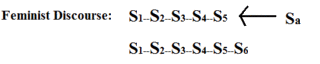
In the Lacanian model, the inscription of a new signifier into the signifying chain produces new discourses. Because the differential relation of symbolic elements in the signifying chain produces meaning, its production is contingent upon a particular relationship of signifiers. However, the inscription of the excluded term reorders the relation of those symbolic elements. The insertion of the otherwise excluded term changes the previously closed order of these elements, creating a new discursive structure and so a new signifying chain. In this way, the analysand produces a new discourse and hence new meaning. From this model, it is possible to understand how the feminist articulation of the a can produce a new discourse. In the operation of feminist discourse, the act of knowing inserts a new signifier into the existing structure of symbolic elements, and thus forms a new signifying chain:

taken from page 109

The disruption and rearrangement of the prior signifying order produces a new relation of symbolic elements, and hence a new discourse. This new discourse produces new meaning, and hence a different representation of the world. This new representation of the world provides a new way to understand it. If knowing is a discursive practice, then the production of new discourses permits the creation of new knowledges by which to know the world.

In the 1970s, the feminist movement began to name the sexual violence many women experienced, but which was perceived neither as a political issue nor as being related to gender politics. This naming is the signification of the a of discourse, because it represents a violence against women which had previously not been articulated. The naming of gendered harms produces a signifier of an otherwise unsignified a of social discourses. …, Deirdre Davis argues that ‘[i]n order to address, deconstruct, and eradicate a harm, we must give the harm a name’ (1997: 200). This naming of the a is then inscribed into the signifying chains of social discourses, which produces a new signifying chain, or knowledge, around the issue of gendered harms. In this way, feminism produces new discourses of gendered harms that fundamentally shift the social meaning of sexual violence.

campbell sexuation

Campbell, Kirsten. Jacques Lacan and Feminist Epistemology. Florence, KY, USA: Routledge, 2004. p 86.

Similarly to the earlier accounts of the sexed subject, the phallus remains the pivot of the later Lacanian account of sexual difference. Lacan’s ‘Graph of Sexuation’ represents sexed identity in relation to the phallic function (S20: 79).

The phallic function is ‘the function that institutes lack, that is, the alienating function of language’ (Fink 1995: 103).

A relation to the phallus structures the masculine and feminine positions, which the formulae of sexuation represent (S20: 79– 80). Because it turns on the phallic function (S20: 59), ‘there is no such thing as a sexual relationship’ (S20: 12).For this reason, a relation between the sexes is an impossibility.

Lacan claims that the ‘male way’ of jouissance produces the non-relation between the sexes (S20: 56– 57). The phallic function produces the jouissance of the masculine subject, the enjoyment of the (phallic) organ on which ‘all’ turns.

Lacan argues that the phallic function inscribes the male subject ‘man as whole’ or ‘as all’ (l’homme comme tout) (S20: 79).

Joan Copjec describes that inscription as producing ‘a universe of men’, a masculine universal (1994: 235).

The masculine subject claims to be a man who is whole and all, a master of himself who ‘[b]y denying the trauma of primary Castration . . . unconsciously perpetuates the suppression of the person’s own division and the belief in her or his autonomy’ (Ragland-Sullivan 1987: 305).

The masculine claim rests on the exception of castration – such that he defines his universality in relation to an other without the phallus. The masculine subject represents his ontological lack as the castration of the feminine other.

That other position of the subject is that of  — a fantasy that affirms that the masculine subject has the phallus.
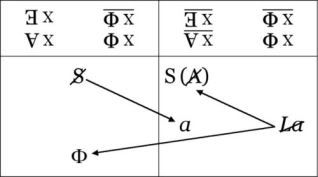
In this fantasy, desires the phallus, confirming that he has it. If the whole of the sexual relation is a fantasy, it is a masculine fantasy of as the cause of his desire (S20: 131). The cause of his desire is the objet a – the originary missing object that can never be found (S20: 86).

Zizek identifies that missing object as the Mother-Thing on which masculine fantasy turns (1989: 119). For the masculine subject, the feminine represents a fantasy object that can answer his desire for universality and completeness: she confirms that he does not suffer castration.

In its relation to the masculine subject, the feminine is a fantasy of a castrated other that confirms that she is castrated and he is not. The operation of the phallic function produces this fantasy.

For this reason, Lacan argues that does not exist. She exists only as a fantasy of the masculine subject, formed in his phallic jouissance and in his desire (86).

No woman can fulfil that fantasy. In this way, The fantasy Woman does not exist in the real, because no woman could enact the fantasy that he substitutes for her. Lacan points out in his earlier work on feminine masquerade that women may attempt to fulfil that fantasy (É: 321). However, while a woman may attempt to play out the masculine fantasy, in doing so she does not exist as other than in and through fantasy.

Lacan indicates the impossibility of by his bar through the definite article ‘The’. When interviewed in 1973, Lacan formulates the impossibility of ‘Woman’ as ‘The Woman does not exist’ (1974: 38). In Encore, Lacan makes it clear that, by that formulation, he does not mean that women do not exist but that the masculine fantasy of is an impossibility (S20: 72– 73).

If Lacan’s later account of the sexuated subject went no further than this description of masculine and feminine subjects, then it would only be a more elaborated version of the classical Lacanian theory of sexuation. As such, the phallus would still function as a transcendental guarantee of subjectivity and the Symbolic order. Such an account would therefore remain vulnerable not only to the feminist objection of androcentrism, but also to the compelling deconstructionist critique of ‘phallogocentrism’ (Derrida 1980).

However, in Encore, Lacan confronts the question of ‘What does woman want?’, which leads to a reworking of his theory of the female subject. In Encore, Lacan describes how ‘what I am working on this year is what Freud expressly left aside: Was will das Weib? “What does woman want?”’ (S20: 80). Lacan responds to that question with some of his most misogynist statements. He suggests that women tell nothing of their body or their pleasure, and that in fact they know nothing of their bodies or their pleasures (S20: 74– 75). Ultimately, Lacan reduces this mystical unknown Other to the unknowable maternal Thing (S20: 99). The question of what do women want implies a desire to know women, insofar as Lacan wants to know what women want. What is in question is Lacan’s knowledge of women. However, what Lacan puts into question is what women themselves know. His answer? Nothing. What emerges in Lacan’s discussion of what women want is a succession of gestures of rhetorical mastery, which understand this unknown object as ignorant of itself, and finally as unknowable. The drive to master that object is evident in Lacan’s claimed status of Knowing Master: ‘[i]t’s just that they don’t know what they’re saying – that’s the whole difference between them and me’ (S20: 73). However, these gestures of mastery are at play within the same text in which the ‘truth’ of women is in excess of a phallic regime, and constantly threatens to breach its symbolic logic.

The question of what women want opens the way for Lacan’s conception of the female subject as ‘not all’ (pas toute). In Encore, the position of the female subject is not rendered as nothing, but as not all of the phallus: ‘I said “of woman”, whereas in fact woman does not exist, woman is not whole (pas toute)’ (S20: 7).  (87)

In this formulation, the not all of the female subject is a not all of the phallic function. Lacan argues that ‘when any speaking being whatsoever situates itself under the banner “women”, it is on the basis of the following – that it grounds itself as being not-whole in situating itself in the phallic function’ (S20: 72). If the exception of castration defines ‘all’ of the masculine position (S20: 79), then the position of the female subject is that of an exception.

The masculine rests on the exception of feminine (castration). It rests on her being other than the phallic all. With this exception, the phallus cannot be posited as a universal and so cannot define all, because it has the status of a universal that rests on a non-universal.

Reading the Graph of Sexuation in Encore from the side of the masculine subject positions the female subject as an exception to the phallic signifier and hence as a signification of its limit. The phallus does not define her sexed subjectivity, because she comes to be a sexed subject through normative identifications with a member of the opposite sex.

It does not define her body, for the phallus does not symbolize her body (S3: 176). It does not represent her sexuality, since her jouissance is not a phallic jouissance (S20: 74). Lacan argues that ‘[a] woman can but be excluded by the nature of things, which is the nature of words and it must be said that if there is something that women complain about enough for the time being, that’s it’ (S20: 73).

To be a woman is not to be excluded from language. For Lacan, ‘[i]t’s not because she is not wholly in the phallic function that she is not there at all. She is there in full (à plein). But there is something more (en plus)’ (S20: 74). The paradox of the female subject is that she is within the phallic law of the signifier and yet ‘there is something more’.

The not all of the female subject should therefore be understood as the failure of the law of the signifier to represent her sexed subjectivity. The not all of the female subject is constituted in its failure to represent her subjectivity as other than phallic.

Her position of ‘Other’ is then a position of being other than the phallic subject. Therefore, the phallic signifier does not define the female subject. The not all is not that which is Other to the phallus, but that which it does not define. The Lacanian account of the position of the female subject is the failure of the symbolic to represent that subjectivity.

The Graph of Sexuation should therefore be read as a Graph of Male Sexuation and of the operation of masculine subjectivity. It does not describe the female subject other than in terms of the phallic function. For this reason, Lacan’s Graph can only represent the female subject as not defined by the law of the signifier.

In this later model of sexuation, the phallus only guarantees a masculine subject and symbolic order. The subjective and symbolic structures that it supports are therefore incomplete – there is always ‘something more’, such that the phallic order always produces an excess to itself. The phallus fails to effect closure of what otherwise appears to be a transcendental Symbolic order. For this reason, the not all provides a means to reconceive the female subject. (88)

pluth object a the act

Pluth, Ed. Signifiers and Acts: Freedom in Lacan’s Theory of the Subject. Albany: State University of New York Press, 2007.

By keeping object a separate from the ideal ego, the analyst emphasizes the originally separating role of object a itself.  I take this to mean that another dimension of object a is brought to the fore — not its dimension as something that the Other is supposed to desire, and that I must therefore desire or identify myself with in order to get recognized by the Other.  Rather what we see here is the dimension of object a as the Other’s desire as such, in its very inscrutability.  This means that the object a refers one to the originally inscrutable and eventlike nature of the Other’s desire.

A subject can perhaps only be separated from its identity, from its ego-ideal, as well as from object a as something that is desired by the Other, when the eventlike nature of the Other’s desire is recalled. This shows that the other aspect of object a, it’s imaginary aspect as an object that the Other desires, is an invention. When the object a as the Other’s desire as such is recalled, the ego ideal loses its ground. The plane of identification would then be crossed.  The subject would no longer have any motivation to identify with the analyst or with any particular signifier (131).

What crossing the plane of identification, traversing the fantasy, or an act amounts to is a return to an original position, one in which a subject is first subjected to a signifier.  Does this not also mean to the moment at which a subject is first produced by a signifier?

WE KNOW THAT AN ACT IS SUPPOSED TO TRANSFORM AND ALSO RECREATE A SUBJECT.

There is a fundamental difference between fantasy and act, and what happens during an act is perhaps not simply the continuation of a fantasy structure. …  An act entails an entirely different relation to the Other’s desire, and that, as a result, the relation to the Other entailed in an act is such that one cannot speak about an identification occurring in it (132).

In an act, there is a relation to the Other’s desire that does not consist of identifying with what that desire is supposed to be for — a quest for the signified of that desire.  Rather, the signifying impasse characteristic of the Other’s desire is preserved and handled in a new way in an act, instead of being merely avoided or covered up, which is what an identification does, and this would be the “real” dimension of an act the way in which the real “excedes” in an act, as Badiou would put it.

If identification can still be spoken of here, then what we have is not an identification with a particular signifier that functions as an object of the Other’s desire but an “identification” with desire as such.  The end of analysis can then be seen not as a mere repetition of the subject’s origin, but a repetition that recreates, bringing about a new way for the subject to be in relation to signifiers, the Other, and the real.

A distinction needs to be made between:

  • the Other as a site that can function to guarantee meanings and grant recognitions and
  • the Other’s desire, which ruins any such site.