review of johnston

2013.12.13
Adrian Johnston, Prolegomena to Any Future Materialism, Volume One: The Outcome of Contemporary French Philosophy Northwestern University Press, 2013, 257pp., $45.00 (pbk), ISBN 9780810129122.

Reviewed by Jeffrey A. Bell, Southeastern Louisiana University

In this first of a projected three-volume Prolegomena to Any Future Materialism, Adrian Johnston places his materialist philosophy into the lineage of contemporary French philosophy. The French philosophers Johnston has most in mind are Jacques Lacan, Alain Badiou, and Quentin Meillassoux, and each of them fails, on Johnston’s reading, despite professed intentions to the contrary, to develop a thoroughly materialist philosophy. In one way or another, each ultimately “backslides” into a form of religious thinking that is also coupled with an under-appreciation of, if not outright hostility to, the life sciences. It is precisely by developing the philosophical implications of recent developments in the life sciences, and in particular the neurosciences (on this point Johnston follows Catherine Malabou), that a proper materialist philosophy can be established without backsliding into quasi-religious explanations.

Johnston’s focus upon the work of Lacan and his disciples is not simply to lay out a critical exegesis but rather to fulfill the promise of a materialist philosophy that can only be accomplished, Johnston argues, if one properly harnesses Lacan’s central insight — namely, the idea that the real entails an irreducible gap or rupture. By contrast, a common metaphysical assumption that is shared by both naïve scientific materialism and religious theism, Johnston argues, is the notion that Nature/God is an inviolable “One-All.” As he puts it, “It is not much of a leap to propose that the scientism accompanying modern natural science as a whole . . . tends to be inclined to embrace the nonempirical supposition of the ultimate cohesion of the material universe as a self-consistent One-All.” (16) From here Johnston seconds Lacan’s “assertion that science, even in the current era, relies upon ‘the idea of God’”. (16).

If one aligns one’s metaphysical views of materialism with contemporary life sciences, however, Johnston claims that we no longer have the “big Other,” the “self-consistent One-All” that provides the metaphysical foundation for science; to the contrary, “what remains,” Johnston argues, “lacks any guarantee of consistency right down to the bedrock of ontological fundaments.” (23).

Instead of a material being that is a consistent One-All and a continuation of the “idea of God,” we have “antagonisms and oppositions at the very heart of material being.” (24). It is only by way of such “antagonisms and oppositions,” Johnston claims, that we are able to offer a nonreductive yet materialist account of the emergence of conscious subjectivity.

Key to this effort is the development of the concept of weak nature, a concept that Johnston derives from Hume’s project (of which more below) and which will become the central topic of the second volume of Johnston’s Prolegomena, titled Weak Nature.

To set the stage for the necessity of formulating the concept of weak nature, Johnston first lays out the inadequacies of Lacan’s, Badiou’s, and Meillassoux’s efforts to follow through on their intention to establish a materialist philosophy. Due to the constraints of space, I will simply sketch the problems Johnston has with these efforts, highlighting along the way some potential problems and oversights with Johnston’s own approach.

Despite what Johnston takes to be Lacan’s correct insight regarding the common metaphysical assumptions regarding the “One-All” in both science and religion, Lacan’s thought itself, Johnston argues, is “clouded by occasional bouts of backsliding into dangerous flirtations with Catholicism and a virulent hostility to the life sciences.” (4).

There are two places where this clouding becomes especially evident. The first occurs with respect to what Johnston sees as Lacan’s outdated view of science. He claims that Lacan’s understanding of science relies upon an “odd materialism” that rules out on principle any account of how the natural body may be “exogenously impacted and subjectified by the denaturalizing signifiers of the sociosymbolic orders.” (50)

This then leads to Lacan’s claim that “language is there before man . . . Not only is man born in language, exactly as he is born into the world, but he is born by language,” (63) and as a result Lacan admits to having no interest in “prehistory” (63), for such a history would entail moving beyond the symbolic order, a move that would have to occur by way of the symbolic order.

This is the second place where Lacan encounters difficulties according to Johnston, for he falls into what Meillassoux will call the correlational circle — namely, the circle whereby the real is always the real as correlated with a subject for whom it is given, and hence we are never given the real as it is in itself.

In the case of Lacan we have what Johnston calls “a structural linguistic correlationist for whom the pre-Symbolic . . . Real exists solely in and through a (co)constituting correlation with the Symbolic.” (69). It is here where the “One-All” and the “idea of God” resurfaces in Lacan’s thought, for the “One-All” is the Symbolic order of language itself.

Lacan, in other words, did not remain true to his initial insight regarding the need for discontinuities, gaps, and ruptures at the heart of the real. Johnston then turns to Lacan’s disciples to see if they fare any better in developing a materialist philosophy.

Before turning to Badiou a brief comment is in order. It is certainly natural to see Badiou, Meillassoux, and others (most notably, Žižek) as Lacan’s primary disciples carrying forward the master’s central insights, and yet Johnston pays little attention to the work of Gilles Deleuze in his book. As Daniel Smith reminds us in his essay on Lacan, when Deleuze recounted a meeting he had with Lacan not long after the publication of Anti-Oedipus, he claimed that after having gone through “a list of all his disciples,” whom Lacan said were all “worthless,” Lacan concluded that when it came to disciples he needed “someone like you [Deleuze].”[1]

In particular, in Anti-Oedipus Deleuze and Guattari explicitly wonder “How many interpretations of Lacanianism [are] overtly or secretly pious, [and] have in this manner invoked . . . a gap in the Symbolic? . . .

Despite some fine books by certain disciples of Lacan, we wonder if Lacan’s thought really goes in this direction.”[2]

The reason for Lacan’s hesitation to move in this direction, as Deleuze and Guattari put it in What is Philosophy?, is precisely Lacan’s effort to develop an immanent materialism and avoid a transcendence of the gap or rupture whereby “immanence is [taken to be] a prison from which the Transcendent [breach or rupture] will save us.”[3] In other words, remaining true to Lacan’s efforts to avoid a return of the “secretly pious” and theological would entail avoiding this form of transcendence.

I will return to this theme below, but for Žižek and Badiou, at least, developing Lacan’s thought does entail affirming the breach or rupture and a rejection of Deleuze, who is mistakenly assumed to be continuing with the very metaphysics of the One-All that has been a hindrance to developing a proper materialism.

Johnston’s view, however, is more sophisticated, and one of the great strengths of his book is the attention he draws to the premise that motivates Badiou’s turn to formal mathematics in developing an ontology of events.

As Johnston puts it, “Badiou depicts naturalism-organicism-vitalism, on the one hand, and formalism-mathematicism, on the other hand, as mutually exclusive ontological options.” (85)

Badiou adopts the latter approach and rejects the former; and since Deleuze is associated with the former approach, his thought is rejected as well. Johnston, however, will call into question Badiou’s “reasons for rejecting the naturalism-organicism-vitalism option.” (85)

Put briefly, for Johnston the choice is not between formalism and vitalism but rather “between spiritualist obscurantism and scientific clarity,” (98) and Johnston argues that, unfortunately for Badiou’s project, Badiou falls decidedly on the side of “spiritualist obscurantism.”

Badiou’s slip into “spiritualist obscurantism” occurs when he attempts to account for the process whereby an “inconsistent multiplicity” becomes a “consistent multiplicity.”

An inconsistent multiplicity is a consequence of Cantor’s theory of transfinite numbers, which entails, as Johnston puts it, an uncountable, nondenumerable “infinite infinities of inconsistent multiplicities-without-oneness.” (111)

The “counting-for-one” operation “imposes certain constraints and limitations on thought’s relation to (inconsistent) multiplicities of being per se,” (115) and renders them into countable, consistent multiplicities.

The problem for Badiou, however, is to account for this operation itself. Who or what performs the operation? Johnston claims that ultimately this “counting-for-one” remains unaccounted for, and is “a unity-producing synthesizing function or process as an ephemeral non-being arising from God-knows-where.” (128) Despite his efforts to avoid Kantian idealism, it “remains just around the corner” (128) in Badiou’s own thought.

Johnston next turns to Meillassoux, a move that is crucial, for not only was Meillassoux Badiou’s student, but Badiou himself calls upon Meillassoux’s book, After Finitude, to do the heavy lifting in decoupling a transcendental philosophy from Kantian transcendental idealism. Since Badiou was unsuccessful in carrying out this decoupling, the turn to Meillassoux becomes all the more important, or as Johnston argues, “whether Badiou succeeds in entirely stepping out from under Kant’s long shadow arguably depends on whether Meillassoux succeeds in thoroughly debunking Kantian and post-Kantian correlationism.” (132)

Central to Meillassoux’s effort to establish what he calls a speculative materialism is an appropriation and transformation of Hume’s philosophy, or more precisely the “core maneuver,” Johnston argues, “lying at the very heart of Meillassoux’s project is an ontologization of Hume’s epistemology.” (150).

Johnston argues quite convincingly that this maneuver fails. In particular, he disputes Meillassoux’s use of the chance/contingency distinction. Chance refers to the calculation of probabilities relative to a One-All set of possibilities, and thus for instance the chance a flipped coin will show up heads approaches 50% as the number of throws approaches infinity, the infinite One-All set of throws.

Contingency, on the other hand, is what one has when one adopts Cantor’s “unbounded infinite of multiplicities-without-limits”, for then one undoes the very One-All totality “upon which the probabilistic aleatory reasoning of chance allegedly depends, namely, the presumed existence of a totality of possible outcomes.” (163).

The problem for this view, however, is to account for stability at all, a stability Meillassoux himself relies upon when he calls upon the findings of science (e.g., carbon dating) to argue for what he calls arche-facts, or the fact that there were realities that pre-date being given to any consciousness (and hence a reality beyond and irreducible to any form of correlationism).

If anything, Johnston argues, the ontology Meillassoux draws from Cantor, what Meillassoux calls “hyper-chaos,” makes it less rather than more likely that stability would emerge at all.

“Why,” Johnston asks, “should the detotalization of the totality posited in connection with chance . . . make the flux of inconstancy less rather than more likely?” (163)

If there are infinite infinities of hyper-chaos, and if anything can emerge at any time without any reason or explanation (for such a reason or explanation depends upon a stability of relationships), then Meillassoux himself ultimately ends up falling into “spiritualist obscurantism” rather than offering, as Johnston seeks to do, a position grounded in “scientific clarity.”

For instance, Johnston points out that Meillassoux simply accepts without explanation or reasons a conscious subjectivity. In other words, Meillassoux is completely immune to the “hard problem” as has been formulated in the work of David Chalmers. This immunity is not a virtue, however, but rather a crippling vice that infects Meillassoux’s entire project. If anything can emerge at any time without reason or explanation, then what Meillassoux leaves us with, Johnston claims, “amounts to an antiscientific sophistical sleight-of-hand that places Meillassoux in undeniable proximity to the same Christian creationists he mocks in After Finitude.” (152-3).

In the final section, the Postface, Johnston sets the stage for the two volumes that will follow through on the promise to offer a materialism that does not reproduce the “idea of God” in any form. As with Meillassoux, Hume looms large in Johnston’s efforts. Instead of offering an ontologization of Hume’s epistemology that leads to a Cantorian metaphysics of hyper-chaos, Johnston offers an ontologization of Hume’s skepticism that lays the basis for the concept of weak nature. With this concept in hand, Johnston believes he will be able to offer, in subsequent volumes, a proper materialist philosophy, what he calls “transcendental materialism” and takes to be the position that “affirms the immanence to material nature of subjects nonetheless irreducible to such natural materialities.” (178)

Integral to transcendental materialism is the idea that “splits [are] real and ineliminable.” (180) Transcendental materialism is to be contrasted with “Hegelian-Marxian dialectical materialism” in that whereas the former sees splits as “real and ineliminable,” dialectical materialism “favors emphasizing eventual unifying syntheses of such apparent splits as that between, simply put, mind and matter.” (180).

The concept of weak nature provides a way of incorporating the ineliminability of splits in that it assumes Hume’s skeptical arguments have successfully weakened “the appearance of humans as free, as capriciously spontaneous” and weakened “the appearance of nature as determined, as ruled without exception.” (207)

What this “ontological weakening of nature” leaves us with, Johnston concludes, is an “opening within being qua being an sich [of] the possibility of a gap,” a gap that makes possible “a subjectivity fully within but nonetheless free at certain levels from material nature.” (209)

In closing I return to my earlier point regarding Deleuze’s claim that a proper Lacanian metaphysics would not embrace ineliminable splits, for in doing so one ineluctably brings the transcendent in through the back door, and this in turn threatens to undermine the transcendental materialism Johnston hopes to establish.

These questions may be addressed in the second volume, Weak Nature, and Johnston may well take on some of the Deleuzian questions raised here. To do so would make sense, for in many ways Deleuze and Johnston are fellow travelers in that their interest in Hume was motivated precisely by the problematic that leads Johnston to propose the concept of weak nature — that is, it provides for an account of a subjectivity that is “fully within but nonetheless free at certain levels from material nature.” (209)

As Deleuze states the Humean problematic in Empiricism and Subjectivity, it is, as for Johnston, to show how a “subject transcending the given [can] be constituted in the given?”[4] Much of the rest of Empiricism and Subjectivity, and much of Deleuze’s subsequent work, can be understood in the light of this problematic. Whether or not Johnston addresses these questions in the next volume, he has certainly shown that a Humean metaphysics of weak nature offers a promising way forward in establishing a materialist philosophy. Johnston’s subsequent volumes promise to offer a significant contribution to debates in contemporary philosophy and will be eagerly anticipated.

[1] Daniel Smith, “The Inverse Side of the Structure: Žižek on Deleuze on Lacan,” in Essays on Deleuze (Edinburgh: Edinburgh University Press, 2012), p. 312.

[2] Ibid. p. 317.

[3] Gilles Deleuze and Felix Guattari, What is Philosophy?, translated by Hugh Tomlinson and Graham Burchell (New York: Columbia University Press, 1994), p. 47.

[4] Gilles Deleuze, Empiricism and Subjectivity, translated by Constantin Boundas (New York: Columbia University Press, 1991), p. 83.
foucault copjec

Christopher Lane, “The Experience of the Outside: Foucault and Psychoanalysis” Lacan in America edited by Jean-Michel Rabaté, New York: Other Press, 2000. 309-348.

the subject is constructed by forces lying beyond conscious apprehension and social meaning. 321

The difficulty of establishing where psychoanalysis stands relative to experience and its interpretation not only haunted Foucault’s career but partly determined it. One strand of Foucault’s intellectual project was aimed at complicating historical materialism by building on Nietzsche’s work. Another strand—tied conceptually to the first—focused on challenging the intellectual sovereignty in France of Jean-Paul Sartre. But a third and less successful strand devolved on establishing the importance of psychoanalysis for modern thought without at the same time endorsing Lacan’s “return to Freud.”

In refusing the psychoanalytic argument that sexuality isn’t determined wholly by discourse and social practices, however, Foucault could understand the ontological difficulty of sexuality only the way antiquity represented this phenomenon — that is, as an “effect.. . of errors of regimen [les erreurs de regime]” (UP, p. 16; UPS, p. 23).

Foucault’s insistence even here in approaching sexuality from primarily a culturalist perspective exacerbated his self-acknowledged difficulties. Yet his commitment to engaging some of the psychic repercussions of subjectivation — which dovetailed into his study of the modes of subjection (mode d’assujettisement, G, p. 353) — ironically obliged him to return to psychoanalysis for a better understanding of their diverse effects. I am suggesting that throughout Foucault’s career this pincer-like approach to psychoanalysis overdetermined his perspective on subjectivity. While his first published essay critiqued works by Ludwig Binswanger and Freud, for example, it didn’t dispute the appearance or effect of the unconscious. 328

While subtle differences therefore arise between The Archaeology of Knowledge (1969) and Discipline and Punish (1975) concerning the role of the dispositif … the thread linking these books is Foucault’s suggestion that “[t]he individual is the product of power.” The underside to this conception of subjectivity — and, perhaps, the obvious extension of it is the near-metaphysical idea that subjectivity, once freed from outside regulation, would lack “inner conviction” (MF, pp. 89,42). This idea surfaces periodically in Foucault’s 1954 essay on dreams, and it culminates logically with the demand that subjectivity be let alone, whether to silence, abstraction, or pleasure. 331

Bersani valuably represents Foucault’s claims about subjecti vation in the following way: “The mechanisms of power studied by Foucault produce the individuals they are designed to dominate” (S, p. 3).

“The fundamental thesis of Lacanian psychoanalysis,” adds Zizek, “is that what we call ‘reality’ constitutes itself against the background of [symbolic] ‘bliss,’ i.e., of such an exclusion of some traumatic Real. This is precisely what Lacan has in mind when he says that fantasy is the ultimate support of reality: ‘reality’ stabilizes itself when some fantasy frame of a ‘symbolic bliss’ closes off the view into the abyss of the Real.” Žižek, Tarrying with the Negative: Kant, Hegel, and the Critique of Ideology (Durham, NC: Duke University Press, 1993), p. 118

… psychoanalysis departs conclusively from materialist accounts of reality and consciousness, as well as from related critiques of reality’s many shortcomings. By insisting on the ego’s basic ” [in]aptitude for dealing with reality,” Bersani — like Freud and Lacan — shows us why the subject’s alienation is neither explained nor repaired by altering the diverse forms of political oppression that impede and partly shape us, an argument quite different from the frequent and unjustified claim that psychoanalysis is uninterested in our oppression.

Owing to their faith in the underlying influence of these external causes on the subject, Foucauldian and materialist approaches to subjectivity argue that factors such as gender, ethnicity, and even sexuality are egoic effects of varied, contradictory, and unjust social demands.

From this perspective, however, the ego is invested with an ability to modify, subvert, and even repair these demands in order to diminish their effects and sometimes render them meaningless.

The Psychic Life of Power displays at the outset ambivalence about the psychoanalytic argument that only a nonsocial factor — the drive — is capable of determining psychic life. More important for us here, The Psychic Life of Power restates the logic of external causation, which paradoxically restores in principle the forms of social influence that 1 am challenging here. For invaluable discussion of this point, published just before this essay went to press, see S. Zizek, The Ticklish Subject: The Absent Centre of Political Ontology (New York: Verso, 1999), especially pp. 247-312.

Although this faith in the influence of external causes relies erroneously on the ego’s capacity for congruency with the outside, I should stress that in opposing this faith I am
not refuting the influence of external factors. To do so would undercut my emphasis on the asymmetry of psychical and physical reality; it would reproduce another form of voluntarism, generating precisely the characterizations of psychoanalysis that I am objecting to here. The fantasy that the ego determines consciousness slips easily into solipsism and epistemic relativism, a fantasy that we simply make our own reality.

I am objecting instead to the crass suggestion—voiced repeatedly by constructivists and Foucauldians—that subjectivity is merely an “effect” of discourse, a suggestion that renders subjectivity politically transparent, devoid of drives and unconscious causes. 343

This suggestion culminates in a conceptual deadlock, in which social practices and power are caught in a circular relationship that thwarts the possibility of transformation. Let us iterate that Foucault wrote The Archaeology of Knowledge precisely in an atttempt to shatter this deadlock.

One way that psychoanalysis departs conclusively from materialism is by insisting that we can’t test our reality without confronting our perception of the external world. According to Freud, the structure of loss that frames our perception and desire serves as a guide for all subsequent perspectives on reality.

As he argued in “Negation,” building on a related and now famous claim in Three Essays on the Theory of Sexuality:

The first and immediate aim … of reality-testing is, not to find an object in real perception which corresponds to the one presented, but to re-find such an object, to convince oneself that it is still there.” 66

S. Freud, “Negation,” Standard Edition 19:233-238, 1925, paraphrasing his earlier claim in Three Essays and the Theory of Sexuality (1905), Standard Edition 7:

“The finding of an object is in fact a refinding of it” (p. 222).

This statement shows us clearly why Freudian psychoanalysis differs from the conservative idea that therapy consists in adapting the patient’s ego to reality.

For Freud and Lacan, the idea of patient adaptation was preposterous, because egregiously coercive. Indeed, the very question of adaptation returns us to The Order of Things, where Foucault usefully points up a conclusive split between psychoanalysis and psychiatry. Poised between rationalism and unreason in <em>Madness and Civilization</em>, Freudian psychoanalysis surfaces in <em>The Order of Things</em> and even Volume 1 of <em>The History of Sexuality</em> as one of the primary fields that avoids, and even preempts, the coercive logic of psychiatry.

It is psychiatry, Foucault insists, that claims the patient must sacrifice his or her reality for pre-existing forms of social reality.

Lacan of course agreed, arguing in the 1930s — long before Foucault began publishing — that the very idea of “sacrifice” is both manipulative and delusive, insofar as “adaptation” merely substitutes one fantasy about reality for another.

JOAN COPJEC SPEAKS

Contrary to the common misperception, reality testing is not described here as a process by which we match our perceptions against an external, independent reality.

In fact, it is the permanent loss of that reality—or real: a reality that was never present as such—that is the precondition for determining the objective status of our perceptions.

Not only is the real unavailable for comparison with our perceptions but, Freud concedes, we can assume that the latter are always somewhat distorted, inexact.   [<em>Read My Desire</em>, p. 233]

Copjec shows us here why psychoanalysis and historicism offer quite different perspectives on reality; she illustrates too that by highlighting the profound repercussions of Freud’s argument about reality, Lacan completely discredited the idea that reality can ever be reparative for the subject.

“In the name of what is social constraint exercised?” he asks in Seminar VII. “[Reality isn’t just there so that we bump our heads up against the false paths along which the functioning of the pleasure principle leads us.”

“In truth,” Lacan continues, “we make reality out of pleasure” (EP y p. 225), a statement inverting the standard materialist claim that we extract whatever pleasure we can from a reality that pre-exists us.

That the ego exists in relation to a structural méconnaissance overturns all existing claims about false consciousness: “By definition,” Lacan says in Seminar II, “there is something so improbable about all existence that one is in effect perpetually questioning oneself about its reality.”

… Foucault’s and Lacan’s rather different perspectives on the subject’s structural relationship to reality and axiomatic dependence on resistance. To my mind the kernel of this difference arises in Freud’s claim, near the end of his study of the Wolfman, that “[a] repression is something very different from a condemning judgement.”

What Freud brings to our attention here is that repression’s importance lies less in what we contain, than in what we can’t evade.

“I’d say that that is the very essence of the Freudian discovery,” remarks Lacan in Seminar I.

To put this another way, repression, for psychoanalysis, doesn’t signify what we can possess of the past; it dramatizes the effort it takes to accomplish forgetting, to remove or dislodge us from a past—and thus a history — that threatens to overwhelm us.

This claim points up a form of difficulty that isn’t altered or resolved by will, whether individual or collective, and the difficulty helps us refute the simplistic objection that psychoanalysis is ahistorical. … our failure to rid ourselves of the past is one of the factors binding us involuntarily to history.

johnston on copjec

Adrian Johnston’s Review of Lacan in America 2002

Joan Copjec, a familiar name in English-language Lacanian scholarship, addresses the link (or, perhaps, non-rapport) between psychoanalysis and “embodiment theory” as a general anti-Cartesian trend permeating the American academy.

Proponents of the “embodied subject” endlessly rant and rail against the Cogito’s haunting of Western thought, continually issuing emphatic reminders to themselves and others that “bodies matter.”

Lacanian psychoanalysis is seen as yet another Cartesian marginalization of the body; Lacan gives pride of place to “the signifier” and its structure, thereby ignoring corporeality, affectivity, and so on.

But, Copjec asks in “The Body as Viewing Instrument, or the Strut of Vision,” what kinds of “bodies” are embodiment theorists talking about? Simply affirming that “the body” is important, that human beings have bodies, is a trivial point not worth paying attention to when taken at face value. What sort of insights could the brute declaration “I have a body” possibly hope to produce?

One of Copjec’s central theses is that Freudo-Lacanian psychoanalysis promises a far more philosophically satisfying investigation into embodiment than what comes out of the mouths of the agitated advocates of a “return to the body.”

These advocates usually offer a choice between two flawed options: either an experiential “lived body” entwined with an amorphous perceptual self of sorts (i.e., the phenomenological option), or, alternatively, an empty, socially constructed husk, a tabula rasa for the transcription of “power” (i.e., a vaguely Foucauldian option).

Copjec maintains that the psychoanalytic concept of Trieb poses a direct challenge to these ways of envisioning embodiment that has yet to be genuinely thought through by those who so frequently babble about bodies—“of all Freud’s notions, that of the drive has had the least success in attracting supporters; it obliges a kind of rethinking that only the boldest of thinkers would dare to undertake. The question one must ask is: How does drive determine human embodiment as both a freedom from nature and a part of it?” (pg. 279).

Or, similarly, how should one set about explaining the manner in which “human nature” is, by being simultaneously and always-already entangled in “soma” as well as “psyche” (the latter including the concrete impacts of the socio-symbolic order on the individual), neither a pure corporeal substantiality nor a constructed, virtual epiphenomenon?

Copjec uses discussions of gaze and body, particularly the issues raised by Jonathan Crary’s Techniques of the Observer: On Vision and Modernity in the Nineteenth Century and subsequently taken up by film theory, in a struggle to work through the implications that metapsychology harbors as regards embodiment (in this task, she relies on Lacan’s analyses of the gaze, the visual field, perspective, and subjectivity from seminars eleven and thirteen).

As one might have already sensed prior to the present juncture, a contemporary figure playing in the background of many of these ongoing debates is Judith Butler.

Certain arguments mentioned above are echoed in Butler’s exchanges with Slavoj Žižek in Contingency, Hegemony, Universality: Contemporary Dialogues on the Left, particularly the problem of negotiating between structural and historical axes of analysis in Lacanian theory.

Part of her project, as spelled out in The Psychic Life of Power: Theories in Subjection, is to wed Foucault and psychoanalysis so that they mutually supplement each other. Why should one combine these positions?

Foucault’s delineations of the workings of “power” lack any carefully-explained model of psychical subjectivity as the object of these forces; however, psychoanalysis fails acknowledge and incorporate Foucauldian insights into the fundamentally historical, contingently-mediated nature of the subject.

In short, Butler is searching for a metapsychology of the socially constructed psyche (on a related note, Frances L. Restuccia’s piece “The Subject of Homosexuality: Butler’s Elision” succinctly blows holes in Butler’s claim, also from The Psychic Life of Power, that heterosexual identity is erected upon the foundations of a fundamentally disavowed “passionate attachment” to the same gender, that “foreclosed” homosexuality underlies society’s artificial sexual norms).

Going back to the texts of Foucault, according to Christopher Lane in “The Experience of the Outside: Foucault and Psychoanalysis,” reveals the ultimate futility of this Butlerian endeavor. Any marriage between Foucault’s constructivist position and Lacanian psychoanalysis can only result in the suppression of the latter’s explanatory potentials.

Lane’s argument is clear, straightforward, and easy enough to grasp. He contends that an absolutely fundamental assertion/assumption in psychoanalysis is that the subject is constitutively “out of joint” with “reality.” What else could Freud mean when he speaks of the impossibility of “educating” the unconscious, or when he later depicts the id as utterly ignorant of the external world?

Of course, this isn’t to deny that the psyche is profoundly affected and modified by the sensations, experiences, and influences constantly streaming into it from “the Outside.”

Nonetheless, what Lane does deny is the notion that subjectivity is a passive, receptive surface, a malleable receiver or container of normative, socio-cultural patterns and processes.

Copjec cites Lacan’s remarks from the eleventh seminar about “failures of causality” and “gaps” between causes and effects as fundamentally important conceptualizations to keep in mind when approaching the unconscious.

Similarly, Lane stresses that the interactions between psychoanalytically conceived “human nature” and its trans-individual environment cannot be mapped out along the lines of predictable pathways, such as, for example, ideological stimulus “x” always leading to subjectivity effect “y.”

Although “power” may indeed perpetually and continually press upon subjects, a carbon-copy imprint of these socio-ideological mechanisms, a flawless reproduction of the macro-level at the micro-level, doesn’t smoothly and invariably take root.

Lane effectively shows how any constructivist position repeats, on nothing more than a quantitatively enlarged scale, the narcissistic enclosure of solipsism by presenting a picture of humans unproblematically manufacturing their own reality as a collectivity.

If everything is socially constructed, then what motivates this constructing activity in the first place? What sets it in motion, and why is society constructed in the specific ways that it is, rather than being constructed in other possible ways?

Lane explains Foucault’s well-known ambivalence towards psychoanalysis as a result of his failure to resolve these sorts of criticisms and questions to his own satisfaction. Although Lane concedes that Foucault himself sensed these problems and made sophisticated attempts to deal with them, he argues that Foucault’s followers tend to pass over them in silence.


mcgowan notes 3

psychoanalysis frees the subject to find satisfaction through the subject’s symptomatic disruption rather than continuing to view the disruption as the obstacle to the ultimate satisfaction that the subject is constantly missing. 56-57

🙂 – McGowan is using satisfaction and enjoyment interchangeably, point is satisfaction in symptom rather than viewing the symptomatic disruption as obstacle to something better.

The neurotic mistakes the experience of the death drive for the experience of desire, and psychoanalysis attempts to reveal the drive where the neurotic mistakenly sees desire.

Desire is nothing but a misrecognition of the death drive. 60

🙂 – McGowan’s point: consistency between 1895 Project and 1920 Beyond is emphasis on subject’s satisfaction. The subject attains satisfaction. Difference is 1895 it was discharge of excitation, but with the 1920 discovery of death drive, satisfaction is attained via repetition and return to original loss. The second point is the analytic cure does not consist in ridding analysand of symptom, rather the analytic cure consists in executing a more efficient route to her satisfaction. McGowan argues that analysand enters analysis due to symptom malfunctioning in her life, in other words she or he is dissatisfied with their satisfaction, they are satisfied, but dissatisfied with the circuitous nature of the route to satisfaction.

The cure McGowan suggests consists in  freeing “the subject to find satisfaction through the subject’s symptomatic disruption rather than continuing to view the disruption as the obstacle to the ultimate satisfaction that the subject is constantly missing.” 56-57

mcgowan notes 2

Typical neurotics enter into analysis believing in their dissatisfaction. They complain of a symptom – insomnia, say – that functions as a barrier to their enjoyment. They view the analyst as a subject supposed to know, that is, as a subject who knows the secret of the symptom. Through the transmission of this knowledge, neurotics hope to overcome their symptom and become able to freely enjoy themselves without this hindrance. Through the duration of a neurosis, symptoms serve as a source of satisfaction for the neurotic.

Analysis emerges as a possibility only when this satisfaction becomes too troublesome, when the symptom begins to debilitate the neurotic and intrude on all aspects of the neurotic’s life.

What neurotics don’t see, however, is the satisfaction that the disruptiveness of the symptom offers.

🙂 – Here McGowan makes the claim that the symptom actually offers satisfaction

The goal of analysis does not consist in eliminating this disruptiveness but in changing the subject’s relation to it.

Rather than seeing the disruptiveness of the symptom as the barrier to a truly satisfying life, the subject must come to grasp this disruptiveness as the source of the subject’s satisfaction. 56

The relationship between psychoanalytic thought and the symptom marks the former’s most dramatic point of rupture from forms of healing (including both other kinds of therapy and medicine). When patients come to their doctors exhibiting a symptom, doctors ideally attempt to treat the underlying illness in order to eliminate the symptom. The symptom is valuable for the doctor insofar as it proves an indication of the underlying illness that can be addressed. For psychoanalytic thought, the symptom is the indication of an underlying disorder, but at the same time it coalesces the subject’s psychic existence.

mcgowan notes

In the Project, Freud sees the psyche as a system designed to discharge psychic energy that is transmitted through neurones. Energy bombards the psyche from both inside and out – through endogamous forces and external stimuli. At this point in his thought, Freud believes that the aim of psychic life involves returning to a zero level of excitation, an aim that he later aligns with the pleasure principle. By warding off excitation, the psychic process free the psyche from unpleasure and return it to a state of satisfaction. 53

🙂 – Freud of 1895 Project focused on warding off excitation from external stimuli, too much excitation leads to unpleasure, less excitation more satisfaction

Once Freud conceived of the death drive in 1920, his conception of satisfaction underwent a fundamental shift. Whereas in the vision of the Project and his other pre-1920 work (which views the psyche in terms of the pleasure principle) satisfaction is a state tha the psyche arrives at through the discharge of excitation, after the discovery of the death drive in Beyond the Pleasure Principle satisfaction will consist in the movement of the drive itself, not in the aim that it attains. Nonetheless, what remains constant in these two different economic modes is the absolute psychic primacy of satisfaction. The psyche strives above all to sustain its satisfaction, and it is successful at doing so.

🙂 – pre 1920 Freud said satisfaction = discharge of excitation : post 1920 in Beyond satisfaction = movement of the drive itself
– what is common or constant to both is psychic primacy of satisfaction.

Satisfaction occurs in the operations of the psyche because, as Freud sees it in 1895, the discharge of excitation always occurs. Though there are infinite differences among individual subjects, we can say that all subjects are satisfied subjects insofar as they partake in the process of discharging excitation. For every subject, this process finds a way to occur successfully, even if it encounters a circuitous path in the psyche. Individual difference manifests itself in different psychic paths, but not in the fundamental fact of discharging excitation. 53-54

That is, what the psyche does in universal, but how the psyche goes about doing this varies in each particular case. The universality of what the psyche does allows Freud to recognize that the economy of the psyche produces satisfaction for every subject, even if the subject is unaware of its own satisfaction.

This remains true when Freud turns from the 1895 model of the psyche to the later one centered on the death drive, though in the later theory satisfaction derives from the drive’s constant force rather than from a discharge of excitation. The drive provides an inescapable satisfaction of never letting up.

🙂 – Mcgowan says here that Freud breaks from 1895 Project discharge of excitation : opts for 1920 drive’s constant force provides satisfaction and satisfaction of death drive is constant repetition

The satisfaction that the death drive produces stems from its circular structure: rather than trying to attain satisfaction through an external aim, the drive produces that satisfaction through the process of the repeated movement itself. … The aim of the psychoanalyst – the analyst’s desire – must be to remove the detours that the analysand has placed along the path of the drive in order to allow the analysand to take up completely her or his position in the drive. 55

In Seminar XI, Lacan lays out the situation confronting the analyst: “What we have before us in analysis is a system in which everything turns out all right, and which attains its own sort of satisfaction. If we interfere in this, it is only in so far as we think that there are other ways, shorter ones for example.”

In submitting to analysis, the analysand submits, albeit unknowingly, to this desire for shortening or economizing the path of the drive. This shortening is the analytic cure, and Freud first comes to understand it as such in the 1895 Project where he emphasizes the costs of psychic detours that the subject erects to the flow of psychic energy. 55

verhaeghe

Psychoanalysis in times of Science An Interview With Paul Verhaeghe, 2011

When you are working analytically, you have the so-called preliminary conversations. That means that you postpone the moment when you have someone lying on the sofa, on the couch. You have to have an indication of when to begin, a point where you can say: now is the time that I can put someone on the couch. With a number of people this point was never reached because the problem for which they came was of such a nature that putting them on the couch would have had a contra-therapeutic or contra-analytic effect. Then I ask myself why this is the case. What problem am I dealing with here? Which diagnosis, with all the nuances of the word diagnosis, which diagnostic structure is facing me? The first answer that I could defend, that I could do something with and which I still defend, was an old Freudian category, Aktualpathologie. Here I found a description in part of a number of symptoms present among these people, primarily panic attacks and somatisation, in combination with an inadequate potential to symbolise, to work through something, to put something into words. This entailed that our most important instrument, namely free association, was disabled. You then have to deal with, as it were, meaningless symptoms, panic attacks, and you had people that could not express it — whatever ‘it’ may be.

That is why I continued working face-to-face with this group and very consciously sought other ways to deal with them. To make a long story short, as concerns the method of treatment, with this group you have to, so to say, do the opposite as with the other group. The classic group of psychoneurosis suffer from an excess of meaning, an excess of history, an excess of the imaginary, and this you have to deconstruct. With the new group there is a lack on all these levels. They do not trust the other. If there is transference, it is negative transference. They hardly have the potential for symbolising. They hardly have a history. They have a history, but they cannot verbalise that history. You have to provide them as it were the instruments and in particular develop a relationship with them by which they can work through a number of things. That means that I indeed work psychoanalytically, but in the opposite direction. To return to the social aspect, I ask myself why the radical shift?

Why is it that we see classical hysteria and obsessional neurosis far less than before? Then we arrive at your question about the risk of psychologisation, the risk of decontextualisation. The most obvious answer is found in psychology and to some extent in contemporary attachment theory, which is more or less psychoanalytic, although it is becoming increasingly cognitive. The answer there is the reference to the mother, the processes of reflection that occur between mother and child — mirroring. Although with this you all too quickly end up in a psychologising model, in a decontextualising model and in the mother-blaming model, because it is the fault of the mother. Consequently, we have to widen our scope: if it is indeed the case that mothers no longer function as they used to function, then that must have to do with a different social context. Then you have to try — and this is very difficult for a classically trained analyst/psychologist — to obtain some insight into those social factors.
[—]
The most common term of abuse used these days on the playground at primary school is ‘loser’. Isn’t that terrible? It has to do with children eight, nine years old. If they call each other loser, what does that say about the model of our society? Can I do something with this psychoanalytically? Yes, psychoanalysis always works on the tension between individual and society on the level of enjoyment and desire. If you want to summarise the core of Freud’s theory, this is what it is about. There is the individual, there is society, and society ensures certain rules when it comes to pleasure and desire. The individual resists them, but at the same time also needs them. But the social model in which we are now living is exactly the opposite of the model in Freud’s time. In his day, all emphasis was on desire. Pleasure was for the afterlife, by way of speaking. These days the accent is on pleasure. We should enjoy ourselves immensely; pleasure has become a commodity, on credit if need be, but in any case pleasure is everywhere. Desire has been killed….

mellard beast in jungle henry james

James, Henry. The Beast in the Jungle.
Project Gutenberg
Audiobook on youtube

Below are excerpts from an article by James Mellard, “A ‘Countable Unity’: The Lacanian Subject in ‘The Beast in the jungle'” Using Lacan, Reading Fiction. 1991.

If this analysis of “The Beast in the Jungle” accomplishes anything it should be the demonstration that the subject is a creation of a social relationship, the creature not only of language, but also of the Other in whom language resides for the subject. John Brenkman has discussed this aspect of Lacanian theory. ” Lacan’s project,” says Brenkman, “has been the attempt to give language and intersubjectivity primacy within the theory as well as the practice of psychoanalysis.” Brenkman goes on to consider that what Lacan calls “the Umwelt, the environment or outer world, of even the newborn is preeminently social . From birth,” says Brenkman, “the human being is affected by actions, gestures, wishes, and intentions that are already i mbued with the symbolic and that occur within the constraints of specific, historically determined institutions. In Lacan’s terms, the subject is, from the outset, radically dependent on the field of the Other-for objects of one’s satisfactions, for the benchmarks of one’s i dentity, and for the language that will make one’s interaction with others possible”.

It is easy enough to fit James’s tale into this model. As we have seen, May Bartram becomes the other, the mother, and the community of one within which john Marcher has his being as a subject. His extreme dependence upon her has the larger significance, one might suggest, of indicating just how dependent the individual subject is upon the community that provides him or her a place as a signifier within a system of signifiers. But his dependence also suggests that there must be a signifier beyond, above, or outside the community as well.

The dyad of the mother and child may represent the origin of the social community, but it must be breached by the signifier of the father if there is to be the Symbolic triangulation that will permit change, growth, transformation within that social structure. Neither a community nor a person should remain locked within a narcissistic self-worship. It is not that Paternity — the signifier of the Father — is “better” than Maternity — the signifier of the Mother; it is only that the subject, whether individual or community, must be able to see around the other, to envision possibilities of thirdness, of an other kind of otherness, to permit the transformations of culture that have marked human history.

*********************************
Figuratively, Marcher as subjectivity is at locus zero and awaits the countable unity conferred by another who bounds the set of zero and 1 ; in this move, he achieves “oneness.” As Ragland-Sullivan says, “One, by contrast [to zero], is the number marking the infant’s attainment of a sense of body unity by [its] mentally identifying with a Gestalt exterior to it. Therefore, it is the number of symbiosis, denoting both mirror-stage psychic fusion and corporal identification with the human form. 114

What Marcher has encountered in this metaphorical moment of his constitution as a subject is the phenomenon Lacan, borrowing the term from Ernest Jones, calls aphanisis. Aphanisis is the name Lacan gives to the moment in which the subject comes into being as a result of a signifier-and not j ust any signifier, either, but a signifier of/from the other-and simultaneously disappears under it. There is no a priori ego, in other words; there is only a subject represented as a signifier for another signifier. The subj ect is constituted, Lacan i nsists, in what can only be regarded as fundamentally a social relation. For Lacan, ”a signifier is that which represents a subject for another signifier” (FFC 207), and that other signifier is taken from the social order.

May Bartram is that other, of course, but the consequence of Marcher’s realization is his disappearance beneath that signifier she has provided. He is now, in May’s view, at an indeterminate place. “What we find,” says Lacan, “is the constitution of the subject i n the field of the Other . . . . If he is apprehended at his birth i n the field of the Other, the characteristic of the subject of the u nconscious is that of being, beneath the signifier that develops its networks, its chains and its history, at an indeterminate place” (FFC 208). Marcher counts to one reaches oneness, that is-by covering over a void, a zero, a locus that he is incapable of filling by himself or even of recognizing without the other – the second person – who calls him into being. The scene with May in Naples is momentous, then, not because it really exists-Lacan would say, Who cares?-but because it calls into existence John Marcher as a subject, Marcher as a subject for another, a subject for another signifier identified in May Bartram.

For it is castration-always subjective, rather than physical-that Marcher aims to evade. Indeed, one may say that virtually the entire tale after Marcher’s “birth” as a subject from the meeting with May at Weatherend is involved in Marcher’s determination to avoid castration, that is, the structure of alienation that embodies Lacan’s concept of castration. His aim is forever to live in the fullness of the eyes of the (m)other-here represented by May.

May thus is involved in Marcher’s denial of castration, not merely in permitting him to avoid anxiety, but also in permitting him to feel he has in fact avoided castration altogether. Thus May plays the role of the mother who permits the child to believe that he is all to or for her. 120

So, one asks, why is marrying a problem? James answers for Marcher: that about which Marcher, narcissistically, is obsessed-though that is not how James says it-is “a privilege he coul d [not] invite a woman to share” (79). In his narcissism and from the vantage of the Imaginary unity May has conferred upon him, Marcher thinks he has the privileged it, the phallus, the “little old thing.” But of course he neither is it nor has it; he may have only its replacement, and that replacement (part or part-object) is signified by or in May herself. What he ought to realize is that he can have “it” by having May. But to take her on as a lover would be to give her up as a figure of the mother. And that he works hard to avoid, for it would bring into the picture the necessity of a phallic father to replace the desire of the phallic mother. 123-124

Protecting himself from the spectre of the Oedipus and castration, he thus, in a complex transformation, turns May into the phallic mother who needs his protection […]

His anxiety before her answer is an anxiety of castration, of loss of the one in whom he woul d remain whole. Having decided that, indeed, she knows, that she possesses knowledge, he begs her for it before she departs from him forever. Again, he looks to her face, starting with her eyes, “beautiful with a strange cold light”, eyes “one of the signs” that she now possesses what he wants-knowledge of a fate even more “monstrous” than the beast he h imself had enfigured. He had thought that the two of them together had “looked most things in the face”, and he even thinks he could have “faced” the worst alone, but he fears what she must now know: ” I see in your face and feel here, in this air and amid these appearances, that you’re out of it. You’ve done. You’ve had your experience. You leave me to my fate”. His is the anxiety of the child “abandoned” by the mother before the child has realized that he cannot have her, cannot be her everything, cannot be the phallus for her. 127

This loss, in Lacanian terms, represents castration in the subject’s recognition not of its own lack, but the mother’s lack. Lacan says that the “signification of castration” is clinically important because it represents the “discovery [of] the castration of the mother” (Ecrits: A Selection 282). Castration also insists upon the differentiation of the subject from the mother, who as phallic mother has to this point in the subj ect’s life represented the object of every need, demand, desire. In these connections Julia K risteva has said, “As the addressee of every demand, the mother occupies the place of alterity. Her replete body, the receptacle and guarantor of demands, takes the place of all narcissistic, hence imaginary, effects and gratifications; she is, in other words, the phallus. The discovery of castration, however, detaches the subject from his dependence on the mother, and the perception of this lack [manque] makes the phallic function a symbolic function-the symbolic function” (47). In Lacan, the mirror phase and acceptance of castration are successive moments in the constitution of the subject. The latter moment-which Lacan sometimes calls “the phallic stage” (Ecrits: A Selection 282)-purs “the finishing touches on the process of separation that posits the subject as signifiable, which is to say, separate, always confronted by an other” (Kristeva 47). 129

Thus, it seems plain that while Marcher has entered the mirror phase of identification with an imaginary other, with May as imago and mother, he has yet to pass through castration and, therefore, overlay the Imaginary with the register of the Symbolic. Book 5 of James’s text, in its vitiating, “merely” Imaginary repetition of Marcher’s primary narcissism, illustrates profoundly the way in which Marcher is virtually trapped in the first, identificatory moment of the mirror phase, seemingly unable ever to give over his identity to the Symbolic, triangulating knowledge of castration.s As in the tale’s previous books, book 5 shows again and again how Marcher sees his life absorbed by May Bartram. Caught in his mirror-stage, narcissistic repetitions, he does not regard her as independent other so much as
merely an extension of himself. 129

… from his still narcissistic perspective, “she was dying and his life would end” ( 1 08; my emphasis). He begins to see some glimmering of what loss, loss of the desire of the (m)other, might mean, but he does not yet accede to such knowledge: “What could the thing that was to happen to him be, after all, but just this thing that had begun to happen? Her dying, her death, his consequent solitude-that was what he had figured as the Beast in the Jungle, that was what had been in the lap of the gods” ( 1 08). The Oedipal moment is out there, but Marcher shall deny as long as possible.

So long as Marcher is stuck in merely Imaginary relations as laid out in the mirror stage, May Bartram can be for him only a symbol of a mother assumed still to possess that phallus which can deny his own “deficiency.” She dies, true enough, and is lost to Marcher, but that does not prevent his assuming that somehow he can fill his lack and regain the totality of being she had represented. In this maternal guise, she is indeed-as K risteva says of the mother-the phallus for Marcher. Consequently, in a predictable metonymic transfer, May, who originally helped Marcher see the beast, but who then was to be saved from the beast, eventually becomes the beast.

What Marcher envies in the man is his acknowledged loss, his ability to feel lack, privation. Marcher finally understands, moreover, that what he has missed in life is knowledge of the lack and the passion that such knowledge permits-a passion associated, in his case, with loving a woman for herself and, it follows, the ability to mourn her for herself when that time comes, too: “what he presently stood there gazing at wasthe sounded void of his life. He gazed, he drew breath, in pain; he turned in his dismay, and, turning, he had before him in sharper incision than ever the open page of his story. The name on the table [of May’s tomb] smote him as the passage 132-133

of his neighbor had done, and what it said to him, full in the face, was that she was what he had missed” ( 1 25). To sound that void is not only to face the death of the other, but also to face the fact that one’s being is founded upon a void.

Marcher’s belated knowledge is that May Bartram was not only an other in whom he might see himself (as the child sees itself in the  mirror of the mother’s face or gaze); she also might have signified an Other whose presence could have formed in him-instead of a law of narcissism, which was the “law that had ruled him” – a recognition of castration and the Law of the Father. We may see that inchoate recognition in his last scene with May while she is alive. There, Marcher persuades himself that she is indeed his “sibyl” who speaks with “the true voice of the law”, but he never understands what that law is until the stranger’s face-no doubt, as some Freudians have said, the resurrected image of the father-makes the “incision” that cuts him to the void. This knowledge of both the other and the Other casts Marcher back upon the tomb, no longer empty now and now destined to suffer under the sign of the phallic Law in which we see the final transformation of the beast: […] Thus, finally, in the beast, Marcher recognizes his castration and the Law of the Father, and therefore he learns, as it were, to count to three: moi, mother, and father; image, difference, identity myth. But it is a counting-or an  accounting-too little and too late for Marcher to enjoy the fruits of his triumph, though, narcissistically, readers can do so in his stead.

nobus schema L

Nobus, Dany. Jacques Lacan

Schema L

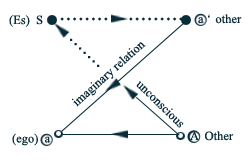
schemaLIn Lacan’s purportedly Freudian alternative, patients had to be approached as subjects with an unconscious, rather than unitary objectified others. In Schema L, the subject (S) is identified with the Freudian Id (Es) and the unconscious is emanating from the Other (A) according to a symbolic vector which crosses the imaginary axis.

This means that the intervention of the Other (the unknown dimension of the other) is necessary for the revelation of the unconscious.

The idea is that if human beings can wonder about the hidden intentions of a fellow being, or if the latter answers their questions in a way which they had never expected, they will also be driven to investigate the (hitherto unconscious) mainspring of their own intentions.

Whereas on Lacan’s account an ego-psychologist attributed a patient’s symptom to a weakness of the ego, or an incomplete self-realization, and remedied this problem by increasing the patient’s self-awareness, a truly Freudian analyst defined the symptom as a compromise between unconscious knowledge (the repressed representations) and conscious ignorance.

To open up this realm of unconscious knowledge, Lacan posited that the analyst’s task is to be somewhere in the place of the Other (Seminar III The Psychoses 1955-56 [1993 trans. Russell Grigg 161])

Page 68: Lacan conceded that even at the end of analysis the subject ‘refers to this imaginary unity that is the ego … where he knows himself and misrecognizes himself, and which is what he speaks about’ (Lacan Sem III, Russell 161). This ongoing entanglement of the subject with the ego is represented within Schema L. in the vector from S to a’ (the identification with the imaginary counterparts on which the ego is based). The emergence of the patient’s ego will also reawaken the ego of the analyst, on whose presence it depends during the analytic session.


nobus Name-of-the-Father

Nobus, Dany. Jacques Lacan and the Freudian Practice of Psychoanalysis. 2000.  pp. 15 – 16

foreclosure as the best translation of Freud’s term Verwerfung. (Lacan 1955-56 Sem III)

Indeed, whereas foreclosure is a juridical term expressing the expiration of a person’s assigned rights (for instance, the legal access to one’s children after a divorce) when he does not exercise them, Lacan took it and developed it in 1957-58 text on psychosis.

Lacan introduced the concept of the Name-of-the-Father in a 1953 lecture on the neurotic’s individual myth, in order to separate the real fathe, a flesh and blood man, from the symbolic ‘function of the father’, which he interpreted a sthe culturally determined regulation fo the natureal order of things. In the “Rome Discourse” bears a striking resemblance to how the Jerish God Yahweh was understood by Freud in his Moses and Monotheism. 16

On occasion, people commenting on Lacan’s theory have argued that the mother’s refusal to accept the paternal authority is sufficient for psychosis to occur in the child, by which they have reduced Lacan’s complex Oedipal schema to its simple triangular roots, and by which they have also realigned it with the post-Freudian view that a child’s psychic normality is predicated upon its separation from the pre-Oedipal dyadic relation with the mother, through the intervention of the father and the concurrent ‘triangulation’. Nowhere does Lacan’s work allow us to make these kinds of inferences, yet neither does it suggest a good alternative answer to the problem. 18

The foreclosure of the Name-of-the-Father does not only affect the individual’s speech, but also influences his sexual identity and relationships with others.

zupancic freud lacan

Zupančič, Alenka. “Psychoanalysis” in Columbia Companion to Twentieth-Century Philosophies. Edited by Constantin V. Boundas, New York: Columbia UP. 2007. 457-468.

If we focus on the signifying chain, precisely in its independece and autonomy, we are bound to notice that it constantly produces, from itself, quite unexpected effects of meaning, a meaning which is, strictly speaking, a surplus meaning that stains signifiers from wihin. This surplus meaning is also a carrier of certain quotas of affect or enjoyment, ‘jouissance‘: Lacan points at the coincidence of the two by writing jouissance as joui-sens, ‘enjoy-meant.’

It is precisely through this surplus meaning as enjoyment that signifiers are intrinsically bound to reality to which they refer.

Incidentally, this is also the kernel of Lacan’s insistence on the truth being not-all: the effect of the signifier cannot be fully reduced back to the signifier as its cause.

Master signifier (signifier falls into the signified) is representation AS enjoyment. This is Lacan’s solution of the point that Freud was struggling with, when he came to realize that his early optimistic belief in the sole powers of interpretation (presenting the patients with the right interpretation of their symptoms should bring about the dissolution of the latter) was premature: symptoms persisted beyond their ‘being deciphered.’

Freud thus started to distinguish between the (repressed) representation and the quota of affect attached to it, suggesting that their destinies could be very different, and that the destiny of the affect is much more important in the process of repression. With the ‘master-signifier’ Lacan conceptualizes the point where the two destinies are nevertheless inseparably bound together.

objet a

To put it simply, object a will come to name the other (the real) object of the drive as ‘independent of its object’: object a ‘satisfaction as an object’. And it is also as such that it can function as the CAUSE of desire (as different from the need), so that the cause of desire should be distinguished from its object or objective. It is not what the desire ‘wants,’ but what keeps it going. 465

One could even say that human sexuality is ‘sexual’ (and not simply ‘reproductive’) precisely insofar as the unification at stake, the tying of all the drives to one single Purpose, never really works, but allows for different partial drives to continue their circular, self-perpetuating activity.

Death Drive

Nothing could be further from from the Lacanian notion of death drive than the idea that something in us ‘wants to dies,’ and aims at death and destruction. If the death drive can be lethal, it is because, on the contrary, it is altogether indifferent to death.

In the human subject, there is something that has for its one and only purpose to go on living and perpetuating itself, regardless of the question of whether it kills the subject or makes her prosper (JOUISSANCE being one of the principle names for this something).

This is why the image that Lacan chooses for the death drive (the myth of lamella) is not an image of destruction, but instead the image of an ‘indestructible life’ (Lacan 1979: 198).

Since this notion of death drive is often at issue in contemporary philosophical debates, and has earned Lacan the reputation of assigning to death the determinant role in human subjectivity ( along the lines of the Heideggerian Being-toward-death), we cannot stress this point too much.

Lacan’s ‘death drive’ is precisely that on account of which a subject can never be reduced to the horizon of her death, or determined by it. This is not to say, on the other hand, that the death drive saves us from our finitude, but rather that it transposes its configuration. We are not finite simply because we die, we are finite because something that wouldn’t die introduces a limit to our life, a limit that divides it from within.

Subject is what lives — and dies — on both sides of this limit. 467
To be continued …

autism

From the London Society of the New Lacanian School

The question of autism in the UK has traditionally been situated within the clinical field of learning difficulties. Autism has thus been considered primarily as a developmental disorder, assessed in terms of failure to achieve expected developmental milestones. Treatments offered then tend to be programmes of re-education aimed at making up for these supposed deficiencies.

Clinical approaches to autism inspired by the work of French psychoanalyst Jacques Lacan emphasize instead the primacy of the speaking subject.

Like all of us, the autistic subject is a subject situated in the field of language.

Foregrounding the speaking subject allows Lacanian psychoanalysis to consider autism as a subjective choice, as a particular way of being in the world.

The symptomatic presentation associated with autism is then considered in terms of the functional elements that the subject makes use of in order to manage his or her experience of insertion in a world perceived as hostile, threatening or unmanageable.

This approach can perhaps be briefly summed up in the notion of listening to autism.

Rather than setting out to cure autism, to master the problem of autism, perhaps we would do better to ask whether there is something that we can all learn from autism, something that we struggle to hear, but which concerns each one of us, whether as parents, as clinical practitioners, or simply as human subjects each struggling to do the best we can with the world we find ourselves in.

Spanish film maker Ivan Ruiz will be at the October Gallery in December to present his new film Other Voices – A Different Outlook on Autism. This is a film inspired by personal experience of autism as well as by his engagement with Lacanian psychoanalysis.

In this film he has taken on the challenge of listening to autism and of finding ways to convey something about the message at stake to a wider audience. Ivan will be available after the screening to answer your questions and to say something about what he discovered along the way.

By bringing to us the testimony of these other voices, this film thus addresses each one of us with a unique challenge. Are we ready to hear what it is that autism might be trying to say to us and learn a little bit about what it might have to teach us?