zupančič antigone

Zupančič, Alenka. The Ethics of the Real. New York: Verso. 2000.

In relation to Lacan’s commentary on Antigone, stress is often laid on the formula ‘ne pas céder sur son desir‘ and on Antigone as a figure of desire. 250

But another, very unusual phrase in Lacan’s commentary deserves our attention: ‘the realization of desire’.

We might say that what makes Antigone Antigone is not simply that she does not give up on her desire but, more precisely, that she realizes her desire.

This implies that she is not simply a figure of desire, since desire opposes itself, in its very nature, to the realization of desire. So what does this ‘realization of desire’ mean?

It is clear that it does not mean the fulfilment of desire: it does not mean the realization of that which the subject desires. In Lacanian theory, there is no such thing as the desired object.

There is the demanded object, and then there is the objet-cause of desire which, having no positive content, refers to what we get if we subtract the satisfaction we find in a given object from the demand (we have) for this object.

Essentially linked to this logic of subtraction which gives rise to a (possibly) endless metonymy, desire is nothing but that which introduces in to the subject’s universe an incommensurable or infinite measure (Lacan’ s terms).

infinite of desire jouissance

Zupančič, Alenka. The Ethics of the Real. New York: Verso. 2000.

The problem of the infinite is not how to attain it but, rather, how to get rid of its stain, a stain that ceaselessly pursues us. The Lacanian name for this parasitism is enjoyment [jouissance]. 249

The death drive is not a drive that aims at death. It aims neither at life nor at death. The drive can be ‘mortal’ precisely because it is indifferent to death (as well as to life); because it is not preoccupied with death, because death does not interest it. …  it is indifferent to death. 250

How, then, does the infinite parasitize the finite, our existence as ‘finite beings’ ?

there are two modes of this parasitism, each of them resulting in a different figure of the infinite: first, there is the infinite of desire, which might be described as a ‘bad infinity’

there is the infinite of jouissance (linked to the logic of the Real, and of the realization). Ethics itself can be situated in the passage from the one to the other.

This passage, however, can itself take two different paths.

The paradigm of the first is indicated by the figure of Antigone, and brings out the co-ordinates of ‘classical ethics’ .

The paradigm of the second is evident in the figure of Sygne de Coûfontaine, and constitutes what we might call ‘modern ethics’. 250

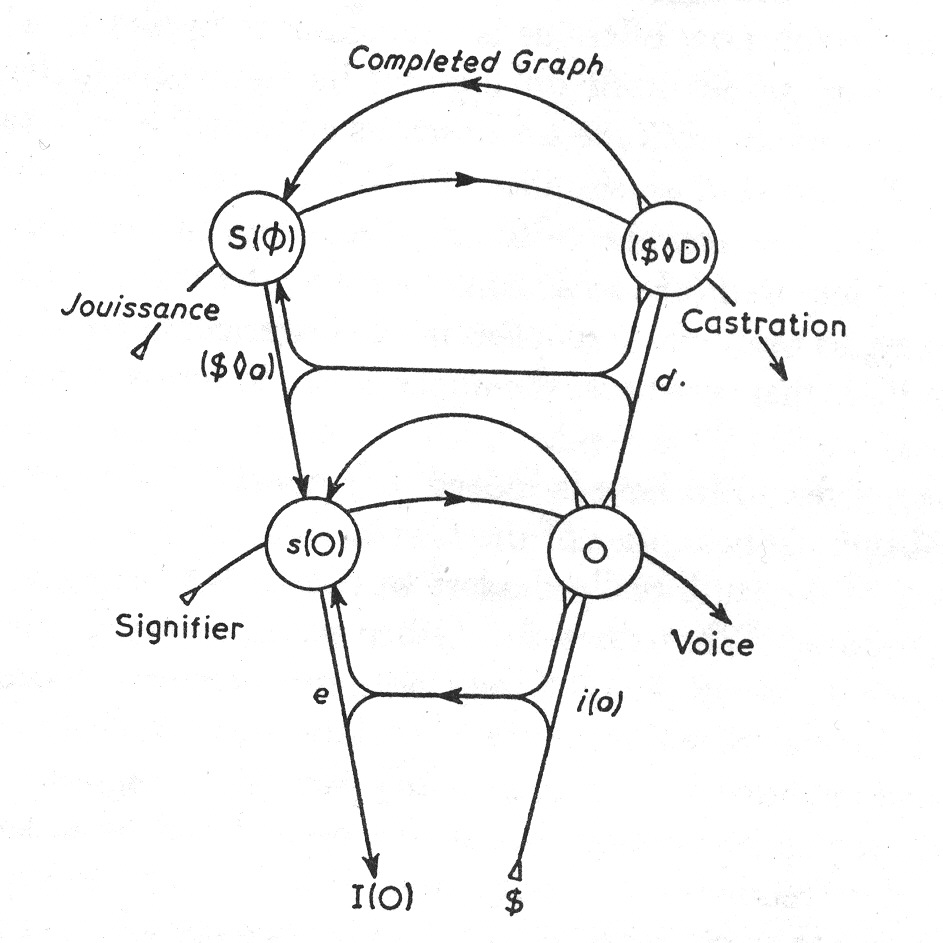
complete graph of desire

Lacan, Jacques. “The Subversion of the Subject and the Dialectics of Desire.” in Jacques Lacan Écrits A Selection. Trans. Bruce Fink, New York: W.W. Norton, 2002. 281-312.

12
Lacan_Graphs_Desire_All
Žižek: The complete graph is divided into two levels: level of meaning and level of enjoyment. THe problem of first (lower) level is how intersection of signifying chain and of a mythical intention (Δ) produces the effect of meaning, with all its internal articulation: the imaginary (i(o)) and symbolic I(O) — identification of the subject based on this retroactive production of meaning, and so on. The problem of the second (upper) level is what happens when this very field of the signifier’s order, of the big Other, is perforated, penetrated by a pre-symbolic (real) stream of enjoyment — what happens when the pre-symbolic ‘substance’, the body as materialized, incarnate enjoyment, becomes enmeshed in the signifier’s network.

Its general result is clear: by being filtered through the sieve of the singifier, the body is submitted to castration, enjoyment is evacuated from it, the body survives as dismembered, mortified. In other words, the order of the signifier (the big Other) and that of enjoyment (the Thing as its embodiment) are radically heterogeneous, inconsistent; any accordance between them is structurally impossible.

This is why we find on the left-hand side of the upper level of the graph — at the first point of intersection between enjoyment and signifier S(Ø) — the signifier of the lack in the Other, of the inconsistency of the Other, as soon as the field of the signifier is penetrated by enjoyment it becomes inconsistent, porous, perforated — the enjoyment is what cannot be symbolized, its presence in the field of the signifier can be detected only through the holes and inconsistencies of this field, so the only possible signifier of enjoyment is the signifier of the lack in the Other, the signifier of its inconsistency (Sublime Object 122).

or S(Ø) as written above. Signifier_Lack_Other“It designates the fact that there is no Other of the Other, no guarantee (or guarantor such as God) of what the Other says — whether the familial, juridical, religious, or analytic Other. NO statement has any other guarantee that its very enunciation, he suggests.” (Fink Reading Écrits 122-3

Žižek: Today, it is a common place that the Lacanian subject is divided, crossed-out, identical to a lack in a signifying chain. However, the most radical dimension fo Lacanian theory lies … in realizing that the big Other, the symbolic order itself, is also barré, crossed-out, by a fundamental impossibility, structured around an impossible/traumatic kernel, around a central lack. Without this lack in the Other, the Other would be a closed structure and the only possibility open to the subject would be his radical alienation in the Other. So it is precisely this lack in teh Other which enables the subject to achieve a kind of ‘de-alenation’ called by Lacan separation: not in the sense that the subject experiences that now he is separated for ever from the object by the barrier of language, but that the object is separated from the Other itself, that the Other itself ‘hasn’t got it’, hasn’t got the final answer — that is to say, is in itself blocked, desiring; that there is also a desire of the Other.

This lack in the Other gives the subject — so to speak — a breathing space, it enables him to avoid the total alienation in the signifier not by fill out out his lack but by allowing him to identify himself, his own lack with the lack in the Other.

(more to come)

Graph of Desire I and II

Lacan, Jacques. “The Subversion of the Subject and the Dialectics of Desire.” in Jacques Lacan Écrits A Selection. Trans. Bruce Fink, New York: W.W. Norton, 2002. 281-312.

pg.

graph desire 2

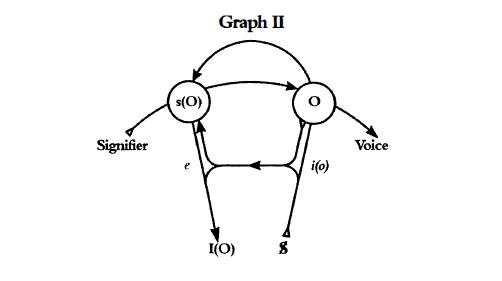
O Treasure trove of signifiers

s(O) :  the punctuation, here signification ends as a finished product, and some commentators have labeled this the point de capiton or button tie or anchor point.

Bruce Fink interprets s(O) or s(A) as the as “meaning of the subject’s demand as determined by the Other.”

Fink: “It should be kept in mind that the Graph of Desire is designed to depict the advent of the subject through language. In it, we see the transformation of need into need addressed to another person, a person who is not as helpless as oneself (that is, who is not a semblable) but who is, instead, considered to be qualitatively different, capable of satisfying one’s needs

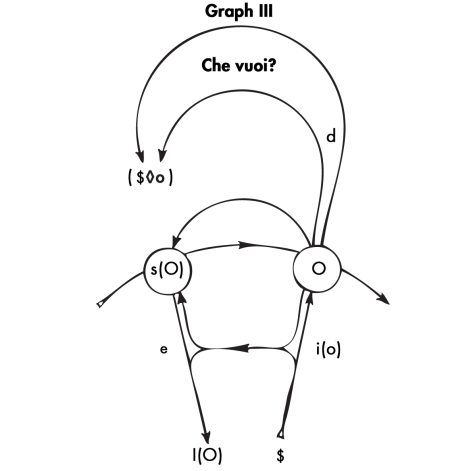
A disjunction is introduced at the moment at which need turns into demand: Due to the fact that we must express ourselves in language, need is never fully expressed in demand. Our need is never completely expressed in the request or demand we make of another; that request or demand always leaves something to be desired. There is always a leftover — a leftover Lacan calls “desire”—and it is here that the upper level of the graph comes into play. (Fink Reading Écrits 118)

Lacan refers to need addressed to this Other (or simply the addressing of the Other) as demand, and what the subject is demanding is not self-evident in and of itself. It must be interpreted by the Other, and the matheme for the Other’s interpretation of the subject’s demand is s(A) , which can be read as the signified (or meaning) supplied by the Other. It is the meaning of the subject’s demand or request as interpreted by the Other.

I(O) or I(A) ego-ideal means one learns to see oneself as the Other sees one, and identifies with those traits that make them loveable/acceptable to the Other. Its when the child turn around after seeing itself in the mirror for confirmation of its status from the mother. As Fink notes: she comes to see herself as from the adult’s vantage point, comes to see herself as if she were the parental Other, comes to be aware of herself as from the outside, as if she were another person (Reading Écrits 108) and further “It can also be understood as the subject’s identification with the Other’s ideals. The subject comes into being here insofar as she identifries with the Other’s view of her (replete as it is with the Other’s ideals and values); in other words, she internalizes the ideal for her that the Other has, what she would have to be in order to be ideal in the Other’s eyes: the ego-ideal” (116-7).

pg. 293 But an animal does not feign feigning.

pg. 295 Lacan’s famous “American way of life” quote.  Ideal ego and ego-ideal

pg. 293

zupančič 7 subjectivation without subject

Zupančič, Alenka. The Ethics of the Real. New York: Verso. 2000.

‘Act so that the maxim of your will can always hold at the same time as the principle giving universal law’ — what is the paradox implicit in this formulation of the categorical imperative?

The paradox is that, despite its ‘categorical’ character, it somehow leaves everything wide open .

For how am I to decide if (the maxim of) my action can hold as a principle providing a universal law, if I do not accept the presupposition that I am originally guided by some notion of the good (i.e. some notion of what is universally acceptable)?

In other words, there is no a priori criterion of universality. It is true that Kant was convinced that he had found this criterion in the principle of non-contradiction. However, there is an impressive body of commentary demonstrating the weakness of this criterion. 92

Kant invents two stories which are supposed, first, to ‘prove’ the existence of the moral law  and, secondly, to demonstrate that the subject cannot act contrary to his pathological interests for any reason other than that of the moral law. The first story concerns a man who is placed in the situation of being executed on his way out of the bedroom as a condition of spending the night with the woman he desires . The other story, which we have already discussed, concerns a man who is put in the position of either bearing false witness against someone who, as a result, will lose his life, or being put to death himself if he does not do so.

As a comment on the first alternative , Kant simply affirms: ‘We do not have to guess very long what his [the man’s in question] answer would be.’

As for the second story, Kant claims that it is at least possible to imagine that a man would rather die than tell a lie and send another man to his death.

It follows from these two comments that there is no ‘force’ apart from the moral law that could make us act against our well-being and our ‘pathological interests’. Lacan raises the objection that such a ‘force’ — namely, jouissance (as distinct from pleasure ) – does exist:

The striking significance of the first example resides in the fact that the night spen t with the lady is paradoxically presented to us as a pleasure that is weighed against a punishment to be undergone … but one only has to make a conceptual shift and move the night spent with the lady from the category of pleasure to that of jouissance, given that jouissance implies precisely the acceptance of death … for the example to be ruined. (Lacan, The Ethics of Psychoanalysis. 1992, 189). 99

For Kant, it is unimaginable that someone would want his own destruction — this would be diabolical — Lacan’s answer is not that this is nevertheless imaginable, and that even such extreme cases exist, but that there is nothing extreme in it at all: on a certain level every subject, average as he may be, wants his destruction, whether he wants it or not. 100

Kant’s point can be formulated more generally: there is no (ethical) act without a subject who is equal to this act. This, however, implies the effacement of the distinction between the level of the enunciation and the level of the statement: the subject of the statement has to coincide with the subject of the enunciation – or, more precisely, the subject of enunciation has to be entirely reducible to the subject of the statement. 102

The am lying is a signifier which forms a part, in the Other, of the treasury of vocabulary. This ‘vocabulary’ is something that I can use as a tool, or something that can use me as a ‘talking machine’. As subject, I emerge on the other level, the level of enunciation, and this level is irreducible.

Here we come, once again, to the point which explains why the subject cannot ‘hide behind’ the Law, presenting himself as its mere instrument: what is suspended by such a gesture is precisely the level of the enunciation.

That ‘there is no deposit without a depositor who is equal to his task’, or ‘there is no (ethical) act without the subject who is equal to his act’, implies that we set as the criterion or the condition of the ‘realization’ of an act the abolition of the difference between the statement and the enunciation. 102

But the crucial question is why the abolition of this difference should be the criterion or the necessary condition of an act.

Why claim that the accomplishment of an act presupposes the abolition of this split?

It is possible to situate the act in another, inverse perspective: it is precisely the act, the (‘successful’) act, which fully discloses this split, makes it present. From this perspective, the definition of a successful act would be that it is structured exactly like the paradox of the liar: this structure is the same as the one evoked by the liar who says ‘I am lying’, who utters ‘ the impossible’ and thus fully displays the split between the level of the statement and the level of the enunciation, between the shifter ‘I’ and the signifier ‘am lying’.

To claim, as we are claiming here, that there is no subject or ‘hero’ of the act means that at the level of ‘am lying’, the subject is always pathological (in the Kantian sense of the word), determined by the Other, by the signifiers which precede him. At this level, the subject is reducible or ‘dispensable’.

But this is not all there is to it. Whereas the ‘subject’ of the statement is determined in advance (he can only use the given signifiers), the (shifter) I is determined retroactively: it ‘becomes a signification, engendered at the level of the statement, of what it produces at the level of the enunciation‘.

It is at this level that we must situate the ethical subject: at the level of something which becomes what ‘it is’ only in the act (here a ‘speech act) engendered, so to speak, by another subject. 103

However, the fact that the act ‘reveals’ the difference between the level of the statement and the level of the enunciation does not imply that the subject of the act is a divided subject. On the contrary, we know very well that when we are really dealing with an act, the subject ‘is all there in his act’.

What reveals the distinction between the statement and the enunciation, between the subject who says or does something and the subjective figure which arises from it, is precisely the abolition of the division of the subject. Of course, this does not mean that the subject of an act is a ‘full ‘ subject who knows exactly what he wants but, rather, that the subject ‘is realized’, ‘objectified‘ in this act: the subject passes over to the side of the object. The ethical subject is not a subject who wants this object but, rather, this object itself.  In an act, there is no ‘divided subject’: there is the ‘it’ (the Lacanian ça) and the subjective figure that arises from it.

We may thus conclude that the act in the proper sense of the word follows the logic of what Lacan calls a ‘headless subjectivation’ or a ‘subjectivation without subject’.

zupančič 4

Zupančič, Alenka. Ethics of the Real: Kant and Lacan. New York: Verso, 2000.

The advent of the subject of practical reason coincides with a moment that might be called a moment of ‘forced choice’.

Paradoxical as this may seem, the forced choice at issue here is none other than the choice of freedom, the freedom that first appears to the subject in the guise of psychological freedom.

It is essential to the constitution of the subject that she cannot but believe herself free and autonomous.

The subject is presumed to be free , yet she cannot disclose this freedom in any positive way, cannot point to it by saying:’This act of mine was free; this precise moment I was acting freely.’

Instead, the more she tries to specify the precise moment at which freedom is real, the more it eludes her, ceding its place to (causal) determination, to the pathological motives which were perhaps hidden from view at first glance.


KantSubject1
The left side of the schema presents the ‘fact of the subject’, the fact that the subject is, so to speak, free by definition, that the subject cannot but conceive of herself as free.

The right side illustrates the choice the ethical subject faces, in which she must choose herself either as pathological or as divided.

The paradox, however, is that the subject cannot choose herself as pathological (S) without ceasing to be a subject as a result. The choice of the S is an excluded, impossible choice.

🙂 Pathological means here to be fully determined by internal causes, hate/love/jealousy/fear/anger etc, and to be determined strictly by pathological motives would preclude freedom.

The other choice would simply be that of choosing oneself as subject, as the ‘pure form’ of the subject, which is the form of the division as such.

We might also say that in this case the subject chooses herself as subject and not as (psychological) ‘ego’, the latter being understood — in all its profundity and authenticity — as the locus of the pathological. 32

swales disavowal

Swales, Stephanie S. Perversion: A Lacanian Psychoanalytic Approach to the Subject. Routledge, 2012.

The mechanism of disavowal should be understood as a defense, not against the lawgiving Other’s demand that the child sacrifice jouissance, but against the inadequacy of the lawgiving Other.

Disavowal is a creative attempt to prop up the Law and to set limits to the excess in jouissance experienced due to the child’s problematic relation to the first Other.

The disavowal of the lawgiving Other might be described in the following terms: “I know very well that my father [or father figure] hasn’t forced me to give up my mother and my corresponding jouissance, but I’m going to make believe that the force of Law exists with someone or something that represents my father.” 78

The mechanism ofdisavowal, as I have said, involves the maintenance of two contradictory pieces of knowledge together with a strongly held belief that one of the two pieces of knowledge is true. In matters of superstition — in which a belief is held despite evidence to the contrary—therefore, disavowal is often pertinent.

For example, “I know very well that if, in one breath, I blow out all the flames of the candles on my birthday cake, my wish won’t really come true, but nevertheless I believe it’s true. Consequently, I make a wish every year and try my best to blow out all the candles with one breath.”

swales pervert

Swales, S. (2012). Perversion: A Lacanian Psychoanalytic Approach to the Subject. New York: Routledge.

Encountering a patient who in the initial sessions does not see himself as lacking is by no means an uncommon event. Most often, this type of patient is obsessive, and his difficulty in seeing himself as lacking in relation to the therapist can be attributed to his structural reasons for negating the Other and attempting to neutralize the Other’s desire.

Correspondingly, the obsessive often fears seeing himself as dependent (even in terms of knowledge) upon the therapist Other.

The obsessive prefers not to see himself as desiring because it threatens him with aphanisis and reveals to him that he is a subject lacking in being.

The process of getting the obsessive to face his own lack in the process of analysis is referred to as hystericizing his desire, and this involves regularly reminding the obsessive of the Other’s presence and desire. 241

However, the perverse patient, as mentioned above, can have a sure answer to the question of identity at the level of jouissance while remaining perplexed at the level of desire. The therapist, then, should foster the perverse patient’s curiosity in himself. Why does he desire what and how he desires?

It is thus important for the therapist to highlight manifestations of the pervert’s putting himself into question, for instance by ending a session when a pervert says, “I don’t know why I …” The therapist’s task of inscribing lack into the pervert will be an ongoing one throughout the process of therapy. 242

For instance, a masochistic patient who has undergone several months of therapy might escalate the dangerous practices in which he engages in the (usually unconscious) hope that the therapist’s anxiety will peak and s/he will enunciate a prohibition of those activities.

In this example, the masochist’s actions put the therapist in somewhat of a bind: if the therapist enunciates a prohibition, s/he deviates from analytic neutrality and the therapy might suffer from the associated risks (e.g., that the pervert attribute to the therapist a lasting wish that he stop engaging in those especially dangerous masochistic practices such that the pervert will repeatedly demand via his actions that the therapist play the role of lawgiving Other and the treatment will become stuck at the levels of perverse enactment and of demand);

if, on the other hand, the therapist does not prohibit the masochist’s dangerous practices, at the most the masochist might end up getting a serious injury or even getting killed and the therapist might face malpractices charges. At the least, the therapist risks being put into the position (illustrated in Jiménez’s 1993 case of Matías) of impotent witness of the pervert’s dangerous and/or criminal activity. 244

swales perverse patient

Swales, Stephanie S. Perversion: A Lacanian Psychoanalytic Approach to the Subject. Routledge, 2012.

A perverse patient will be especially likely to heed prohibitions if they are given by a trusted group psychotherapist whom the patient has put in the position of symbolic Other. In many cases, perverse patients are looking for ways to bolster their paternal functions, and a group therapist whom the pervert “elects” to the position of symbolic Other can have a good deal of influence on the patient as the subject-supposed-to-No!

This will only be possible, however, if the patient puts the therapist in the position of symbolic Other; if the patient relates to the therapist on the imaginary plane—as an other like himself—then the group therapist’s prohibitions will have no therapeutic effect. 236

Consequently, the therapist should look for signs that the patient is speaking to her or him as a symbolic Other before advising the patient to abstain from doing something. Such signs often include the patient’s admissions that there is some kind of knowledge—namely, unconscious knowledge — that is at work in her or him of which s/he her- or himself is ignorant, but about which the therapist is a knowledgeable authority. So too is symbolic transference evident when the patient thinks of the therapist as being the cause of her or his desire to be curious about himself and put his understandings of his life into question.

The necessary condition for true analytic or psychodynamic work is the patient’s having a question about himself that he addresses to an Other (the analyst or therapist) with the expectation that the Other (as subject-supposed-to-know) knows something about the answer that eludes the patient himself.

In my work with Ray, that question was “Why am I an exhibitionist, and how can I prevent committing future acts of exhibitionism?” Even though we understand the “constancy of [the pervert’s] jouissance as an answer, an answer which is already there” (Miller 1996b, p. 310) the pervert’s desire enables him to have a question that drives the progress of the analysis or therapy. 238

While the pervert may seem to want to get away with murder, what he really desires is to bolster the lawgiving Other’s existence. In his article, Clavreul made no mention of the pervert’s suffering due to the inadequacy of the paternal function. When the pervert’s subject position is seen as an attempt to prop up the paternal function, one can no longer maintain that the pervert cannot undergo traditional Lacanian analysis and that the only two positions available to the analyst of a pervert are those of moralizer and impotent voyeur. 239

Certainly, it is difficult to do analytic work with perverts. This is largely because the pervert prefers to play the role of object a (object cause of the Other’s jouissance) in relation to the therapist, causing her anxiety and jouissance. Analytic work with a pervert requires that the therapist maneuver the pervert into the role of split subject (as someone who sees himself as lacking at a certain level) so that the therapist can take up the role of object a as object cause of the patient’s desire to do therapeutic work. In working with a pervert, the therapist must be alert to ways to get the patient intrigued by his own unconscious manifestations when the pervert occasionally lapses back into the role of object a. 239

Situating the work at the symbolic level of desire means, for one thing, that the therapist should avoid responding to the patient’s requests for advice and interpretation.

Although it is common for a patient at the beginning stages of his psychotherapy to see his psychotherapist as a subject-supposed-to-know, the psychotherapist should not fall prey to the trap of believing that s/he holds privileged knowledge about the patient and what is good for him (or that if s/he does not give him advice, no one else in the patient’s life will do so; in the vast majority of cases, the patient gets plenty of advice from his PO, his group therapist and fellow participants, and his friends and family).

Interpreting from the position of subject-supposed-to-know incites an imaginary order relationship of rivalry with the patient in which the patient sooner or later tries to disprove the therapist’s theories and interpretations. Working at the level of demand means giving knowledge to the patient and fostering a relationship which is based on the patient’s dependency on that knowledge. In providing the patient with ready-made interpretations, the therapist puts words into the patient’s mouth and stymies the patient’s own curiosity about himself.

Working at the symbolic level of desire, however, involves the therapist’s expressions of desire that the patient do the work of psychotherapy.

Correspondingly, the therapist should aim to be positioned in the transference as the object-cause of the perverse patient’s desire to participate in psychotherapy and as the placeholder for the patient’s unconscious. This transferential position enables the patient to work through (via emotive speech) his issues with the Other.

Another way in which Lacan described the analytic progress of a subject is “the constant culmination of the subject’s assumption of his own mirages” (1953/2006a, p. 251).

One of the functions of the analytic method is to enable the subject to discover something about his unconscious, realizing that what he took to be his own individual thoughts and desires are actually ones he appropriated from the Other.

The subject calls who he thinks he is—the sum total of his ego misidentifications — radically into question.

The therapist aims to get the patient to speak about his experiences, fantasies, and dreams, to associate to them, and to be interested in possible Other, unconscious meanings of his utterances.

A difficult and delicate stage of the pervert’s treatment is the beginning stage. It is more difficult to get a perverse patient than a neurotic patient to question who he is and why he has become who he is. This is the question that psychoanalysis and psychodynamic psychotherapy aims to answer. This question, when unanswered, is what drives the patient to undergo psychotherapy. 241

chiesa chapter 2

Chiesa, Lorenzo. Subjectivity and Otherness: A Philosophical Reading of Lacan. MIT Press. 2007

Lacan relates the notions of full and empty speech to his well-known dictum according to which “The sender receives his own message back from the receiver in an inverted form.”

Here I intend to demonstrate, through a close reading of this formula, that for Lacan what is really at stake in its varying significations is the gradual passage from an individual conception of the unconscious revolving around the notion of speech to a transindividual one revolving around the notion of language.

It would, however, be wrong to equate Lacan’s transindividual unconscious with any sort of quasi-Jungian archetypal unconscious—“collective” by definition. The former corresponds to a symbolic signifying structure; the latter coincides with the pregiven significationof a set of primordial images. For Lacan, the unconscious as signifying structure produces conscious signification. Jungian psychoanalysis reverses this Freudian principle: it is the unconscious as primordial signification that produces the linguistic structure.

In the final part of this section, I intend to argue that the emergence of the notion of a transindividual unconscious—as universal structure of language — renders explicit the covert paradox on which Lacan’s conception of the aim of analysis as the individual subject’s realization of his own true, unconscious desire through full speech was implicitly based.

In fact, if on the one hand Lacan repeatedly warns us against misinterpreting the unconscious as a subjective hidden substance, on the other, at this stage of his production, he does not seem to realize that the full realization of the subject’s substanceless unconscious would inevitably correspond to its utter desubjectivization into a substantial structure.

Adopting Lacan’s own contemporaneous definition of psychosis, we could argue that this would inevitably correspond to a “being passively spoken by language,” language to be understood as the transindividual locus of the unconscious.

In other words, Lacan’s notion of an individual unconscious that would be equated with full speech seems to give rise to a vicious circle: the aim of analysis is to overcome empty speech and the imaginary wall of language, but, in parallel, the more one’s individual speech is symbolized, the more it is integrated into the transindividual symbolic dimension of language.

Language is never imaginary per se: the wall is erected solely by the individual subject’s own imaginary identifications. Once these are fully revoked, the subject is absorbed by language, the transindividual unconscious.

I do not believe it is possible to reconcile this dis-identifying de-subjectivization with the optimism evoked by the pseudo-Hegelian “humanist” leitmotiv of dis-alienation as presented by Lacan in “Function and Field.” 44

The second part of Seminar III—and, above all, the article “The Agency of the Letter”—suggests that by 1956 Lacan’s return to the Freudian discovery of the unconscious no longer revolved primarily around the pseudo-Hegelian dialectical function of speech, but instead became increasingly dependent on the structuralist notion of language as initially formulated by Saussure. As Lacan states: “Firstly there is a synchronic whole, which is language as a simultaneous system of structured groups of opposition, then there is what occurs diachronically, over time, and which is discourse.” 46-47

chiesa I think where I am not

Chiesa, Lorenzo. Subjectivity and Otherness: A Philosophical Reading of Lacan. MIT Press. 2007

The fact that the conscious subject is subjected to the unconscious can initially be explained by answering the following naïve question: why does psychoanalysis take the trouble to think about the unconscious in the first place?

The answer is to say that an unconscious topos separated from consciousness must exist because something which is not conscious tangibly manifests itself within consciousness.

What is more, these manifestations, the so-called “formations of the unconscious,” are far from “irrational”: they can be seen to follow certain regular patterns, which Freud had already considered to be fundamentally linguistic. 35

The key reference for Lacan here is Hegel’s dialectics as mediated by Kojève. On the other hand, a few years later, in his article “The Agency of the Letter in the Unconscious” (1957) — as well as in Seminars IV and V — Lacan appears to assume that alienation in language cannot be overcome. In other words, the subject’s individual speech is irremediably subjected to the universal field of language, and to its laws. Lacan’s key reference for this second phase … is Saussure’s structural linguistics, largely in the form of Jakobson’s reelaboration. 37

As we have already noted, Lacan believes that the subject is necessarily alienated in language insofar as language already exists before his birth and insofar as his relations with other human beings are necessarily mediated by language. But how is the fact that language precedes the subject — and, above all, imposes itself as an irreducible mediator of the subject’s relation with other subjects — automatically linked to the fact that he is alienated in language? 37

(1) Lacan begins from a very clear-cut empirical observation. First of all, the subject is alienated in language because he never manages to say exactly what he really wants to say. His interlocutor is unable to grasp fully what the subject actually means to tell him: words do not suffice to convey the subject’s desire appropriately, and consequently fully to satisfy it. At the same time, the subject’s individual speech — his perpetually addressing a counterpart in discourse — also always says more than the subject wants to say. The counterpart can read in the subject’s words something that he did not intend to tell him. (Furthermore, the counterpart is usually unaware of his interpreting beyond the subject’s conscious intention.)

Lacan believes it is precisely the thematization of such a surplus of speech with respect to conscious intention that led Freud to discover the efficaciousness of the “talking cure,” psychoanalytic treatment. Before Freud, Lacan argues, “intention was confused with the dimension of consciousness, since it seemed that consciousness was inherent to what the subject had to say qua signification [signification].” In simple terms: before Freud, it was assumed that the subject could consciously say what he wanted to say.

The mistaken equation between intentionality and consciousness (the fact that the unconscious was overlooked) relied precisely on the unquestioned equation between consciousness and signification. 38

(2) From the same empirical recognition of the misunderstandings caused by language in speech, Lacan comes to the conclusion that linguistics is correct in distinguishing a subject of the statement (roughly attributable to language) from a subject of the enunciation (roughly attributable to full speech). To put it bluntly, the “I” which functions as the grammatical subject of a given statement may not be identified with the “I” which carries out this act of speech. The former is nothing but the linguistic correspondent of the ego. … “the personal pronoun ‘I’ designates the person who identifies his or herself with a specific ideal image. Thus the ego is what is represented by the subject of the statement.”Lacan defines the speech of such an I as empty speech: consequently, empty speech is nothing but speech alienated in language, subjugated to its imaginary deformation. In everyday life, human beings communicate through empty speech.

(3) Lacan extends to every subject the Freudian concept of the Ich-Spaltung (confined by Freud to the pathological sphere of fetishism and the psychoses) precisely by referring to the linguistic distinction between the subject of the statement and the subject of the enunciation. The subject undergoes a split (Spaltung) “by virtue of being a subject only insofar as he speaks.”

In speech and because of speech, the subject is never fully present to himself.

That which is not present in the statement but is presupposed and evoked by it (the enunciation) indicates the locus of “another scene” in the subject: the subject of the unconscious which, as I have already indicated, depends on specific linguistic laws, and sustains a particular “thought.”

(4) The discovery of a structural split in/of the subject subverts the Cartesian cogito while, at the same time, revealing its intimate relation to psychoanalysis. As Lacan repeatedly states, “I think where I am not, therefore I am where I do not think.”

This is to say that the unconscious I, the subject of the enunciation, really thinks at the unconscious level: it (ça) thinks where the I qua ego and qua subject of the statement is not (conscious).

Conversely, the I qua linguistic ego is (conscious) where it,the unconscious subject, does not think.

Most importantly, the subversion of the Cartesian ego shows that its illusion of unity is possible only because of its strict interdependence with the Spaltung. There is no self-consciousness without the unconscious, and vice versa.

Descartes’s formulation of a fundamental principle of self-consciousness could be said contemporaneously to decree, at the level of the history of thought, the formal birth of the unconscious (although this birth will remain implicit until Freud).

Consequently, it is strictly speaking senseless to speak of a pre-Cartesian notion of the unconscious.

(5) The strong interdependence between the Cartesian ego and the Freudian unconscious indicates, for Lacan, that the subject of the unconscious is not simply an alternative ego, concealed by repression. Neither does the subject of the unconscious correspond to any sort of “unknowable substance” that would represent the buried core of one’s repressed desires, and would simply be awaiting liberation from the constraints of Cartesian self-consciousness.

In “Function and Field,” Lacan affirms that the subject’s alienation in language — empty speech as delineated above — can be superseded by full speech. The latter’s emergence coincides with the subject’s assumption of his unconscious desire. It is also clear that, in this article, Lacan superimposes truth upon unconscious desire.

How can this realization of the unconscious be achieved? Lacan opposes the specular dialectic of a desire based on the ego’s imaginary alienation to the symbolic dialectic of a desire conveyed by the function of full speech. 39-40

To cut a long story short, full speech is able to offer the subject a different, non-narcissistic satisfaction of his desire. Beyond the emptiness of speech that accompanies ego-logical imaginary objectifications, the subject is constantly speaking with his unconscious, even if he is unaware of it.

One should then ask the following naïve question: what does the unconscious subject say, and what does he want? He (unconsciously) addresses the Other (subject) so that the truth about his speech — the specificity of his unconscious, repressed desire—may be recognized by the Other.

This is what full speech fundamentally is: more precisely, it corresponds to the subject’s full assumption of a speech which he normally utters without being aware of it. Consequently, full speech is inextricable from symbolic intersubjectivity, which is indeed in turn—as I have already outlined in Chapter 1—inseparable from mutual recognition of one’s desire and the related dimension of pact as the instauration of the Law.

To quote Lacan: (a) “[Full] speech is the founding medium of the inter-subjective relation”; (b) “We must start off with a radical intersubjectivity, with the subject’s total acceptance by the other subject”; (c) there exists a common “function of recognition, of pact, of interhuman symbol.”

It is therefore clear that, in the early 1950s, Lacan’s notion of the Symbolic is profoundly indebted to the Hegelian-Kojèvian principle for which human desire corresponds to the desire to be recognized by the Other. It should equally be clear by now why, according to Lacan, an actual return to Freud’s original discoveries entails a resumption of the often underestimated practical importance of speech in psychoanalytic treatment, in contrast to the importance bestowed on the subject’s physical reactions during the course of treatment by many psychoanalytic schools. Psychoanalysis aims to symbolize through full speech the imaginary identifications that objectify the subject in his ego.

More precisely, in the specificity of the analytic setting, the general, apparently unspecified symbolic desire for recognition — which implicitly underlies all everyday intersubjective interactions insofar as they presuppose the symbolic dimension — is transformed by the analyst into a recognition of the analysand’s particular imaginary alienating identifications that ensnare his individual unconscious desire. Psychoanalysis should therefore dis-identify the subject from his imaginary identifications.

Dis-alienation can be attained only through dis-identification. Dis-alienation — from imaginary identifications and, therefore, also from the imaginary “wall of language”— will ultimately coincide with an integration of the individual’s desire (for symbolic recognition of his unconscious desire) into the universal Symbolic.

At this stage, Lacan appears to believe that unconscious desire can be fully realized: it is enough for it to be recognized by the Other (subject). 40

A calibrated orthopedics of (mutual) recognition is thought to suffice to dis-alienate desire. As I shall soon attempt to show, such an optimistic solution seems, at least partially, to contradict Lacan’s continual warnings against ingenuously conceiving of the unconscious as a “true” substance which should be substituted for the ego. 41