johnston desire ethics Kant Antigone seminar VII

Johnston, Adrian. “The Vicious Circle of the Super-Ego: The Pathological Trap of Guilt and the Beginning of Ethics.” Psychoanalytic Studies. 3.3/4 (2001): 411-424.

🙂 In this article Johnston takes on Lacan’s “Do not give way on your desire!” What does this mean? It does not mean, “do not give way on your jouissance!”

AJ starts with Nietzsche. Why? Because Nietzsche is totally against Kant.

In the standard version of the Kantian schema, the subject’s intentions are most ethical when they are least tied to the particularity of the individual (i.e., his/her inclinations, desires, wishes, circumstances, etc.).

The categorical imperative (“I am never to act otherwise than so that I could also will that my maxim should become a universal law”) functions as a kind of ‘sieve’ meant to strain out, as much as possible, these pathological materials tainting the intentional purity of duty.

Conversely, the injunction of the eternal return—perhaps this injunction is capable of being rendered in the imperative form as “I am never to act otherwise than so that I could also will that my concrete, unique , and utterly individual act should be ‘universalized’, namely, should endlessly recur for all eternity ”—demands exactly the opposite of the categorical imperative.

In a Nietzschean ‘system of valuation’, rather than being the basest, most unworthy of intentional states , the particular, idiosyncratic desires of the individual subject are the highest standards by which to measure actions.

Only if an action expresses the strongest of subjective urges, urges so strong that the subject would will them to infinitely manifest themselves again and again in all their singular uniqueness, is it of any worth.  412

Most reading s of the Lacanian dictum “Do not give way on your desire!” understand him to be proposing something similar to Nietzsche: (pure) desire is conceived of as jouissance, as the uncompromising , unconditional thrust of Trieb once operative outside the confining consequentialist calculus of the pleasure principle.

The subjective particularity of pure desire is ethical precisely when its strength overwhelms the mitigating influence of the pleasure-oriented ego.

Various commentaries on the seventh seminar point to the tragic Žfigure of Antigone as proof that this is exactly what Lacan intends to convey. Antigone’s passionate attachment to her dead brother Polyneices drives her to transgress Creon’s edict forbidding the burial of the corpse. Her excessive ‘love’ is then compared with the Todestrieb, since Antigone is compelled to disregard the tragic consequences that she is fully aware await her in the wake of her act.

A Real passage á l’acte (i.e., Antigone’s burial of her brother as a result of her desire) transgressively disrupts the reign of a Symbolic system of Law (i.e., Creon’s denial of funerary rites for Polyneices on the grounds of the interests of the polis).

Is this the distilled essence of Lacan’s ‘ethics of psychoanalysis?’ Is he, like Nietzsche, simply interested in turning Kant on his head, in unreservedly transforming Kant into Sade?

Lacan explicitly states that desire arises from the sacrifice of jouissance: <span style=”font-weight: bold; font-size: 11pt;”>not ceding on one’s desire</span> would seem to entail not surrendering to the siren-song of jouissance, not capitulating to the uncompromising demands of Trieb.

Lacan describes desire as opposing jouissance—“desire is a defense, a prohibition against going beyond a certain limit in jouissance” 413

Lacan means, then “not giving ground on desire” is a translation of Kant’s insistence on the exclusion of pathological drives from properly ethical intentionality, with the psychoanalytic qualiŽfication that the detachment from these drives is itself achieved through and sustained by a subl(im)ation of inclination, a ‘self-subversion’ of Trieb. 413

Lacanian Desire

One of the easiest ways to gain a preliminary understanding of Lacanian desire is by returning to the Freudian concepts of Trieb and sublimation. For Freud, sublimation is the typical means by which Trieb adapts itself to the constraints and obstacles it comes to encounter at the level of the reality principle. Reality forbids certain drive-aims qua the attainment of satisfaction linked to determinate drive-objects. Thus, reality is said to be responsible for what Freud designates as ‘aim-inhibition ’ (a catalyst for sublimation).

The aim-inhibited drive then seeks other forms of satisfaction via different objects; and, if these alternate modes of securing gratiŽcation are not at odd s with the various prohibitions of the reality principle (usually, socio-cultural laws and norms), then the new libidinal arrangement is dubbed a successful sublimation of the drive .

Furthermore in Civilization and Its Discontents, he argues that ‘instinctual renunciation’ (i.e., the aim-inhibition of the drives demanded by human reality) is, despite appearances to the contrary, an unavoidable libidinal fate for all subjects.

As such, the Freudian subject lives in a state of unsatisfactory compromise: sublimation provides pleasurable outlets for Trieb, but Trieb itself is incapable of ever being fully satisfied with these compromises, since they are, by the very definition of the mechanism of sublimation, deviations from the original cathetic trajectory (i.e., the ‘earliest state of affairs’ which all drives struggle in vain to recover; in the seventh seminar, Lacan designates this posited ‘ground zero’ of the libidinal economy das Ding). The libidinal life of the human being is therefore marked by certain constitutive ‘lacks’ or ‘absences’—as Lacan puts it, the ‘sovereign Good’ of das Ding is always missing from the reality of subjective ‘ex-sistence’ — and this condition of (non-)existence is precisely what Lacan intends for his notion of ‘desire’ to designate.  413

Desire is the residual remainder/by-product of the subjection of jouissance (i.e., Trieb an sich, the unconditional attachment to das Ding) to the ego-mediated negotiations between the pleasure and reality principles. 414

In other words, desire is symptomatic of the drives’ dissatisfaction with the pleasure-yielding compromises of sublimation. 414

Lacan’s seventh seminar contains two separate lines of argumentation:

1. Lacan seeks to clarify and further develop Freud’s analyses of conscience as a manifestation of a pathological ‘moral masochism’ fueled by an insatiable super-ego;

2. Lacan lays down the preliminary groundwork for a psychoanalytic meta-ethical theory based on the possibility of desire coming to function in a ‘pure’, properly ethical fashion.

These two dimensions of Lacan’s so-called ‘ethics of psychoanalysis’ must not be conflated, since doing so results in either muddleheaded confusion or outright error.


To be continued …
inter-subjectivity trans-subjectivity

Hook, Derek.  “Towards a Lacanian Group Psychology: The Prisoner’s Dilemma and the Trans-subjective.”  Journal for the Theory of Social Behaviour. 2012.

Lacan (Sem I and Sem II) is constantly wary of subjective meaning as a questionable ego-construction designed to substantiate effects of knowledge and stability. He will approach a discourse not as a set of thematic or narrative contents, but rather in view of the set of relations, in terms of the particular social links, the structural positions between people that it holds together (Lacan, 2007).

His attention is not drawn by the “descriptive materials” of a discourse, i.e. its narratives, meanings, stories, etc., butby the relations established between participants, hence his (2007) model of four fundamental social bonds (the discourses of the master, university, analyst and hysteric) in which the thematic contents may vary widely despite that the structural positions remain intact (master and subject; doctor and patient; teacher and pupil, etc).

Lacan is thus interested in structural positions that are not simply “secured” by meaning or by the contents of discursive practices, but which remain in question, uncertain, reliant on others” views which are themselves contingent on the pre sumption of given social norms and values. His attempt is precisely to circumvent the psychological (or in his jargon “imaginary”) concerns of subjective sense-making and meaning by looking to an underlying grid of inter-linked symbolic positions. These positions are both more precarious and opaque than those afforded by subjective attempts at making-meaning. They are, furthermore, always linked, as in the prisoner’s dilemma, to other positions (indeed, to a chain of interlinked positions). Furthermore, each of these related positions remains uncertainly related to a key signifier—in the prisoner’s dilemma, the white disk—which remains both conventional (it embodies a certain consensus) and yet uncer-tain (in the pragmatic sense of what it may mean here and now). Lacan’s focus on the trans-subjective, certainly inasmuch as it prioritizes structural positions and the contingency of symbolic values, exists always at a step’s remove from the (inter)subjectivity of discursive positioning that focuses on subjective forms of meaning, narrative and sense-making.  9

[ To be continued]

belief materialism subjectivity neighbour no big Other

Simon Critchley on love and self-loss

spiritual daring that attempts to eviserate and excoriate the old self, love dares the self to leave the self behind, to hue and hack to make a space large enough for love to enter love is an enrichment through impoverisment.

Slavoj Žižek, Tilton Gallery, New York City, 19 Nov. 2006

Belief

Steve Martin in Leap Of Faith: He really produced a miracle and breaks down
Atheism is secret inner conviction of believers. Internal doubt, but believe in external rituals.
Either we are alone in universe or there are aliens/God. Both situations are toally unbearable. WE would break down if aliens visited us, but we can’t stand that nobody is there too.
Ecology We can’t be sure or its the big multinationals. No we know but we are not ready to believe, you know global warming, but you look outside and see the sun and flowers. WE are wired, we can’t accept because our BEING itself disappears.
Free is a true human who is ready to make this step. One guy did it Mao in 1955. Why chinese people should not be afraid of American Atom Bomb. “But eve in atom bombs so powerful, they would blow the earth up, it would just be a minor event for the solar system.” This totally crazy position where you are ready to put everything at risk is the true radical position.

In order to truly confront global warming, we must cut our organic embeddedness. Gap between poetic universe and scientific results. Even if we know something to be NOT true, our poetry is naive. WE know there is no sunset, the earth rotation which moves, not sun, not sunset. The true tasks of poetry today is to make poetry at level of results. Oh my darling let’s meet a last quarter turn of earth.

Only in Christianity God himself for a moment becomes an atheist.
This idea of imperfect God. Wait a minute let’s call God. Wait a minute this is a old stupid man who screwed up creation. God accepts, yes you are right … What is the underlying message?
What is materialism
A particle position/velocity. REALITY IS IN-ITSELF UNDETERMINED. THINGS GET FUZZY as if they disappear into nothingness.  Here he uses the famous video game analogy but doesn’t mention or credit that guy Nicholas somebody’s book.

We should read reality like this computer game?  What if God underestimated us.  God thought when he programmed the universe, a don’t have to program all the way down, I ‘ll go so far as atoms.  God was too lazy to program further.  He cheated a bit.

Materialism at its purest

The movie 13th floor.  You reach the end, earth is no longer earth, it slowly moves into digital coordinates.  Now this would be the true materialism.  To think the unfinished character of reality, we don’t need God to imagine it.  Reality is in-itself unfinished.

When you approach too close an image, all you see are stains.     Modernism is an event, postmodernism is NOT.

Badiou and Multiplicity
His ontology of multiplicity, this dispersal multiplicity is fundamental of ontology, but it is not a multiplicity of ONES, his ontology is an ontology the oppositie of zero is not ONE, the primoridal fact is multiple in a void and then comes ONE.

What are the consequences for subjectivity, what kind of subjectivity fits this universe?
It is an EMPTY SUBJECTIVITY.  Recently a publisher asked me to do what I hate.  Books have on the back cover, personal idiosyncracies, John Irving is a wrestler and gardens in his spare time … Ž wanted to test them: in his free time Ž surfs internet for child porn and teaches his son to pull the legs off of spiders.  This supplement is a FUNDAMENTAL LIE.
The core of the subject is the THING and that’s the neighbour.

Neighbour is a THING. THING is the Impenetrable abyss of the Other’s desire. Everything else like gardening is to cover it up.

Here is the famous phone call on the plane about to crash
You call your beloved and say “I love you.” when the whole world is falling apart, what remains is love.  No, I am more a pessimist.  I claim that in that totally desperate scary position, you lie to yourself, you want to die with a clear account in good memory, at that point you lie.

A truly atheist crazy thing: imagine somebody who, the plane is falling down you are married, Honey just so that it is clear, the marriage was hell I want to divorce you. Bye.  That would be an act.
Decentrement of subjectivity
When you are at your innermost yourself, you are NOT yourself, you are LYING. You are at a distance from TRUTH.
Woman is a SYMPTOM OF MAN. It means for Lacan the symptom pre-exists what it is a symptom of. If woman is a symptom, imagine a woman walking around, do you want me to be your symptom. TO be an empty pure symptom, a NUN, A truly AUTHENTIC position, it could be a radical feminine position, I will remain a pure symptom. Woman can do it, man can’t do it. Man needs a symptom.
DaVINCI Code the movie
X-files of Darian Leader.  Why do some many things happen OUT THERE. To cover up the fact that nothing happens here.  Nothing happens here, no sex between the characters.
Abyss of subjectivity
Openness, our elementary reaction is FEAR, especially today the inexistence of the big OTHER is more marked than ever.  Not just symbolic, but what is truly horrifying, in ecology, that nature itself as ultimate big Other is disappearing.  NATURE is impenetrable density of our background, but the moment through genome and bio-genetic manipulations, NATURE itself turns into something else, it is no longer nature in terms of dense impenetrability.
Predominant mode of politics FEAR
Expert administration, to go a little bit up, to mobilize people, is to mobilize them with some kind of a fear, fear of immigrants/state/crime/terrorists
PReviously science nonetheless wanted to understand reproduce, now it can reproduce new forms of monsters. Cows with 2 heads, freaks of nature. Things will explode out of control. YET Behind all this is FEAR OF THE NEIGHBOUR
Control the explosive dimension of the neighbour.

Sam Harris the End of Belief; justifies torture.  Truth Pill, a de-caffeinated torture.  Subjectively the person who takes the pill would suffer incredibly, but outwardly it looks like he just took a nap.  Fat-free cakes, alcohol without beer.

Why is this reasoning wrong.  When Sam Harris talks about this proximity, is the Other too close to us or not.  He’s too short there. This proximity is not physical proximity. It’s the proximity precisely of the neighbour who can be too close even if he is far away.   That’s the definition of the neighbour.  The neighbour INTRUDES.  So I claim that this argument only works if the Other human beings are no longer treated as neighbours, they simply become objectivized in this field of calculation where you can say Ok I can torture you here to prevent a greater number of suffering …  The dimension of the neighbour gets lost.  For Sam Harris the dimension of the neighbour gets lost.

All our outbursts of violence are ultimately outbursts against the neighbour. The neighbour being not simply the other person in front of us but the ABYSS of the OTHER which can be detected from our fantasmatic symbolic space.

It’s easy to praise today’s global capitalism, oh a big village, but we are still Neighbours, with our own symbolic universe, our own way of enjoying, what we need today is not more communication, but more distance, we need a NEW CODE OF DISCRETION. We need to ignore others more. This is the great art today.

SOLUTIONS to proximity of neighbour is TOLERANCE. Ž criticizes new book by Wendy Brown. Tolerance as a solution to the neighbour is a problem.

Culturalization of politics, politics is culturalized.  Fukuyama and Huntington, Clash of Civilizations is not opposed to End of History.  Politics as rational administration, the only true conflicts are ones of culture.

Part 8 is a good discussion by Žižek
Good discussion of Amish and subjectivity
The moment you change them substantially, the whole attitude to community changes, you undermine communal identity and change into liberal subject, he made have freedom of choice but its no longer Amish culture.

Problem with Wendy Brown: They remain caught in pseudo-Marxist denouncing false universality, it goes like this, what appears to be a neutral universality really privleges a certain strata. Human rights not really universal human rights, the privlege male white of certain property, human rights are natural to every man, insofar as they are resonable human man, woman nope to passionate, workers have no time, criminals are out, savages are out …

I claim two things should be opposed, of course there is a GAP between universal human rights and how they truly function.  Nonetheless this very GAP has its positive aspects

It allows for a re-writing of it.  Mary Wollstencraft, Haiti revolution.

if you read closely the great idealist tradition of Hegel, its that this is only one side of the story, this denouncing universality as false universality.  We also have the opposite mystification which is much more interesting: your particular interests is already the tool for the actualization of universality.

Its not that formal universality masks you particular interests, its the opposite, your particularity you are not aware of the universal dimension of what you are doing, you think you are following particular interests, but you don’t see the universal nature of you acts.

So it is totally wrong to play the game capitalism is Eurocentric

As a capitalist subject, in your OWN INDIVIDUAL SELF-EXPERIENCE, you relate yourself to yourself as UNIVERSAL.

I am in myself an abstract universal, what I am in my particular identity, a teacher is something contingent, not part of my nature.  You experience yourself in the core of your being as universal.  Capitalist is universal in this way, it undermines the culture from within.

Example TIBETAN CULTURE and the Chinese onslaught
Descartes At first foreign cultures appeared strange, but then I asked myself, what if I’m viewed from foreign gaze, I must appear to them stupid idiosyncratic. Core of modernity, when you see your core of your identity as something as ultimately something contingent.
Feminism outside of modernity as Ying-Yang, we should reassert the feminine aspect etc.

The Neighbour
The way to break out this eternal Levinasian problematic, oh neighbour, abyss, otherness, should we respect/tolerate the other or not, This is a false problem
We should embrace this RADICAL UNIVERSALITY, Not i’m difference, we share common concerns
What interests me is my culture has some fights in it, your culture has some fights, what I want to share with you is the universality of our struggles.

Cultural solipsism: how can I be sure I’m not imposing, I am not fully myself, and can I share it with you
I am not myself, there is in the very core of myself a universality that surpasses me.

Ethics

Lacan: Have you acted in conformity with your desire, do not compromise/betray your desire.  THIS IS AMBIGUOUS.
Psychoanalysis can justify anything.  Stupid psychoanalysts, oh end oppression, liberate it and everything will be ok.
Israel Defense Forces: main theoretical references is Deleuze Guttari.  Strange things are happening.

Immoral Ethics: Nietzschean ethics
It doesn’t matter what you do, be authentic, be engaged.

Kantian Ethics: you not only responsible to do you duty, but you are responsible to determine what is your duty

There is no big Other, you can’t put on the big Other to tell you what is your duty, you have to be fully responsible for it.  Hannah Arendt is wrong, Eichmann said I just did my duty.  No you can’t do this.  YOU ARE NOT ALLOWED to use duty as an excuse to do my duty.  You have to FULLY STAND BEHIND your duty. No Guarantee behind the big Other.

Questions
Violent imposition of a universal will
Native Americans and white stupidity

Abandon that which you are afraid to lose Accept the loss, become universal. You are afraid to lose you particular identity, my solution is NOT identity politics. What if what you are so passionately protecting is in itself worthless, abandon that. As an attitude, I refer to Mao, “So what, a minor disturbance in the solar system.”
I think that again, the solution is don’t fear, be calm enjoy your life.  No the solution is more radical, accept that the big Other does NOT exist.

Nature, there is no balanced nature
There is no way to return.
We need to re-assert BIG COLLECTIVE decisions. without this we are lost

We have a struggle you have a struggle, let’s see how we can join our struggles. Universality is the universality of struggle.

Chinese Model of Capitalism

johnston on lacan

Johnston, Adrian, “Jacques Lacan”, The Stanford Encyclopedia of Philosophy (Summer 2013 Edition), Edward N. Zalta (ed.).

Download the MS doc here

Jacques Lacan

First published Tue Apr 2, 2013

Jacques Lacan (April 13, 1901 to September 9, 1981) was a major figure in Parisian intellectual life for much of the twentieth century. Sometimes referred to as “the French Freud,” he is an important figure in the history of psychoanalysis. His teachings and writings explore the significance of Freud’s discovery of the unconscious both within the theory and practice of analysis itself as well as in connection with a wide range of other disciplines. Particularly for those interested in the philosophical dimensions of Freudian thought, Lacan’s oeuvre is invaluable. Over the course of the past fifty-plus years, Lacanian ideas have become central to the various receptions of things psychoanalytic in Continental philosophical circles especially.

Continue reading “johnston on lacan”

dolar beyond interpellation 1

Dolar, Mladen. “Beyond Interpellation” Qui Parle 6.2 (1993): 75-96.

But the famous formula of interpellation – “the ideology interpellates individuals into subjects” – implies a clean cut as well. There is a sudden and abrupt transition from an individual- a pre-ideological entity, a sort of materia prima — into the ideological subject, the only kind of subject there is for Althusser.

One becomes a subject by suddenly recognizing that one has always already been a subject: becoming a subject has always takes effect retroactively — it is based on a necessary illusion, an extrapolation, an illegitimate extension of a later state into the former stage.  A leap — a moment of sudden emergence — occurs. 76

… there is a part of individual that cannot successfully pass into the subject, an element of “pre-ideological” and “presubjetive” materia prima that continues to haunt subjectivity once it is constitued as such. A part of external materiality that cannot be successfully integrated in the interior.

Interpellation was based on a happy transition from a pre-ideological state into ideology: successfully achieved it wipes out the traces of its origin and results in a belief in the autonomy  and self-transparency of the subject. The subject is experienced as  <em>causa sui</em> — in itself an inescapable illusion once the operation is completed.

How exactly would materiality entail subjectivation? Why would interpellation require materiality? One could say that materiality and subjectivity rule each other out: if I am (already) a subject, I am necessarily blinded in regard to materiality.

The  psychoanalytic point of departure is the remainder produced by the operation; psychoanalysis does not deny the cut, it only adds a remainder.   The clean cut is always unclean, it cannot produce the flawless interiority of an autonomous subject. The psychoanalytic subject is coextensive with that very flaw in the interior. (One could say that the psychoanalytic symptom, the starting point of analysis, is its most obvious manifestation). In short, the subject is precisely the failure to become the subject, — the psychoanalytic subject is the failure to become an Althusserian one.

For Althusser, the subject is what makes ideology work; for psychoanalysis, the subject emerges where ideology fails. The il1usion of autonomy may wel1 be necessary, but so is its failure; the cover-up never holds fast. The entire psychoanalytic apparatus starts from this point: different subjective structures that the psychoanalysis has discovered and described – neurosis (with its two faces of hysteria and obsession), psychosis, perversion — are just so many different ways to deal with that rest, with that impossibility to become the subject.

On the social level as well — on the level of discourse as a social bond — the four basic types of discourse pinpointed by Lacan are four different ways to tackle that remainder.  Interpellation, on the other hand, is a way of avoiding it: it can explain its proper success,  but not how and why it does not work.

ethics is not w/in framework of law

We might say that the ethical dimension of an action is ‘supernumerary’ to the conceptual pair legal/illegal.

This in turn suggests a structural connection with the Lacanian notion of the Real. As Alain Badiou has noted, Lacan conceives of the Real in a way that removes it from the logic of the apparently mutually exclusive alternatives of the knowable and the unknowable. The unknowable is just a type of the knowable; it is the limit or degenerate case of the knowable; whereas the Real belongs to another register entirely.

Analogously, for Kant the illegal still falls within the category of legality -they both belong to the same register, that of things conforming or failing to conform with duty. Ethics – to continue the analogy – escapes this register.

Even though an ethical act will conform with duty, this by itself is not and cannot be what makes it ethical. So the ethical cannot be situated within the framework of the law and violations of the law. Again, in relation to legality, the ethical always presents a surplus or excess. The question then becomes: ‘what exactly is the nature of this excess?’ The simple answer is that it has something to do with the Kantian conception of ‘form’. The exact meaning of this requires more careful consideration. EOR 12

Verhaeghe pre-ontological cocktail

Verhaeghe, Paul. “Causation and Destitution of a Pre-ontological Non-entity: On the Lacanian Subject.” Key Concepts of Lacanian Psychoanalysis. Ed. Dany Nobus. 1999. 164-189

The important thing about the divided subject is that it has no essence, no ontological substance, but, on the contrary, comes down to a pre-ontological, indeterminate non-being which can only give rise to an identity, an ego, in retrospect. Difficult as this may seem, it is rather easy to grasp.

Just think of what we will call ‘the cocktail experience.’ You are invited for a drink with a group of people you do not know. You have to introduce yourself, and so you have to produce signifiers. This production of signifiers will never be satisfactory. Furthermore, the more signifiers produced, the more contradictions, gaps and difficulties will become clear.

Therefore, the ‘Experienced Cocktail Consumer’, will stick to the proverbial ‘That’s me!’ and produce a stock introduction.

From a Lacanian point of view, it would be wrong to assume that the difficulty lies in finding the correct signifiers to present oneself. On the contrary, one is produced by the uttered signifiers, which are coming from the field of the Other, albeit in a divided way. It would also be a mistake to assume that the subject is identical to the produced signifier(s).

The identification with a number of signifiers, coming from the Other, presents us with the ego. The subject, on the contrary, is never realised as such; it joins the pre-ontological status of the unconscious, the unborn, non-realised etc.

In this sense, the Lacanian subject is exactly the opposite of the Cartesian one. In the formula ‘I am thinking, therefore I exist’ Descartes concludes from his thinking that he has a being, whereas for Lacan, each time (conscious) thinking arises its being disappears under the signifier.

This explains two basic characteristics of the Lacanian subject: it is always at an indeterminate place and it is essentially divided:

Alienation consists in this vel, which - if you do not object to the word condemned, I will use it - condemns the subject to appearing only in that division which, it seems to me, I have just articulated sufficiently by saying that, if it appears on one side as meaning, produced by the signifier, it appears on the other as aphanisis.74

Again, Lacan distances himself from any idea of substantiality.

The subject is not an unconscious intention that will interrupt the normal conscious discourse.

The interruption or division does not take place between a real or authentic part and a false, external one, but the split defines the subject as such. The subject is split from its real being and forever tossed between eventually contradicting signifiers coming from the Other.

This rather pessimistic view confronts us with the issue of therapeutic and psychoanalytic possibilities.

Paradoxical as this may seem, Lacan’s point of view is more optimistic than the Freudian one. Freud’s theory is by and large deterministic, whereas Lacan leaves an element of choice, albeit a ‘forced’ choice.

It is this element that brings us to the second operation, separation, and to the theme of our final investigation: the goal of psychoanalytic treatment.

Verhaeghe pre-ontological non-entity

Verhaeghe, Paul. (1998). Causation and Destitution of a Pre-ontological Non-entity: On the Lacanian Subject.  Key Concepts of Lacanian Psychoanalysis. Ed. Dany Nobus. 1999. 164-189.

Until  the  early  1960 ‘s,  Lacan focused  upon this opposition between the imaginary and the symbolic.

Yet there is a shift in attention: instead of the opposition and division between ego and subject, the division and splitting  within the subject itself comes to the fore. Instead of the term  ‘subject,’  the expression ‘divided  subject’ appears — that  is, divided by language.

With the conceptualisation of the category of the real, another major shift occurs. From the 1964 Seminar Xl onwards, the real becomes a genuine Lacanian concept, within a strictly Lacanian theory, and changes the theory of the subject in a very fundamental way.

In the first part, we will study the  causal background of the subject: how does it come into being? It will be demonstrated that the causation of the subject has everything to do with the drive, and that it has strong links with the status of the unconscious.

In the second part, we will discuss the ontological status of the subject, which is radically different from the traditional conceptions. Lacan ‘s ontology is an ‘alterology,’  alienation being the  grounding mechanism and identity always coming from the Other

Moreover, the subject has a mere pre-ontological status, which is again closely linked to the status of the unconscious. The ever divided subject is a fading, a vacillation, without any substantiality.

In the third and final part, we will discuss the link between Lacan’s theory of the  subject and his theory of the aims and goals of  psychoanalysis. Here, the central mechanism is separation,  as first formalized by Lacan in Seminar Xl and further developed during the 1960’s.  165

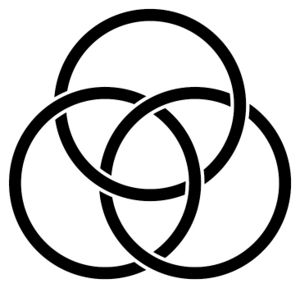
BorromeanKnot3Rings

Freud assumed that there is an original state of primary satisfaction, which he considered to be a state of homeostasis .

The inevitable loss of this state sets the development in motion and provides us with the
basic characteristic of every drive: the tendency to return to an original state.

Thus, the entire development is motivated by a central loss,around which the ego is constituted.  The lack is irrevocable. Freud’s key denomination for this lack is castration.

Freud’s key denomination for this lack is castration, which is his attempt at formulating the link between the original, pregenital loss and the oedipal elaboration thereof. For several reasons, the Freudian castration theory itself will never be fully satisfying. Freud’s focus on the real, that is to say the biological basis of castration, did not help him any further either, and inevitably brought him to the pessimistic conclusion of 1 937, concerning the ‘biological bedrock’ as the limit of psychoanalysis .

Freud’s theory is quite unidimensional and Freud himself remained remarkably obstinate in this respect. He refused to take other losses than the loss of a penis into account – with one exception, as becomes clear from his affirmation of Aristophanes’ fable about the search for the originally lost counterpart. This one-sidedness was directed by his conviction regarding the universality of the pleasure principle, i .e. of the desire to restore the original homeostasis. Things became more complicated once he discovered that there is a ‘beyond’ to the pleasure principle, in which yet another kind of drive is at work, also striving to restore an original condition, ·albeit a totally different one.

Things became more complicated once he discovered that there is a ‘beyond’ to the pleasure principle, in which yet another kind of drive is at work, also striving to restore an original condition, ·albeit a totally different one.

The duality of life versus death drives opened up a dimension beyond the one-sidedness of neurosis, castration and desire.

It is this dimension that is taken into account by Lacan. Indeed, Lacan’s starting-point is also the very idea of lack and loss, but he will recognize a double loss and a double lack.

Moreover, the interaction between those two losses will determine the constitution of the subject. 165

(to be continued Sept 17 2014)

ethical maxim discourse of master

The ethical maxim behind the discourse of the master is perhaps best formulated in the famous verse from Juvenal: ‘Summum crede nefas animam praeferre pudori, et propter vitam vivendi perdere causas

Count it the greatest of all sins to prefer life to honour, and to lose, for the sake of living, all that makes life worth living.

Another version of this credo might be found in Paul Claude!: ‘Sadder than to lose one’s life is it to lose one’s reason for living.’

In ‘Kant with Sade’ Lacan proposes his own ‘translation’ of this ethical motto:’desire, what is called desire, suffices to make life have no sense in playing a coward.’ (EOR 5)

zizek on malabou descartes malabranche autism

Žižek. S. “Descartes and the Post-Traumatic Subject.” Filozofski vestnik. 29. 2 (2008): 9-29.
Žižek. S. “Descartes and the Post-Traumatic Subject: On Catherine Malabou’s Les Nouveaux Blessés.” Qui Parle. 17.2 (2009): 123–147.
online
PDF download

Catherine Malabou Replies to Žižek

In the new form of subjectivity (autistic, indifferent, without affective engagement), the old personality is not “sublated” or replaced by a compensatory formation, but thoroughly destroyed — destruction itself acquires a form, becomes a (relatively stable) “form of life” – what we get is not simply the absence of form, but the form of (the) absence (of the erasure of the previous personality, which is not replaced by a new one).

More precisely, the new form is not a form of life, but, rather, a form of death – not an expression of the Freudian death drive, but, more directly, the death drive. 15

does she not forget to include herself, her own desire, into the observed phenomenon (of autistic subjects)? in an ironic reversal of her claim that the autistic subject is unable to enact transference, it is her own transference she does not take into account when she portrays the autistic subject’s immense suffering. This subject is primordially an enigmatic impenetrable thing, totally ambiguous, where one cannot but oscillate between attributing to it immense suffering and blessed ignorance.

What characterizes it is the lack of recognition in the double sense of the term: we do not recognize ourselves in it, there is no empathy possible, AND the autistic subject, on account of its withdrawal, does not enact recognition (it doesn’t recognize US, its partner in communication). 17

Žižek poetry Midsummer nights dream 2009 and 2012

Madman, Lover and the Poet Midsummer’s Night Dream Act 5

THESEUS
A gap between ordinary reality and some ethereal dimension, but this gap is gradually reduced starting with madman, then lover and then finally closed?? with the Poet.

The lunatic, the lover and the poet
Are of imagination all compact:
One sees more devils than vast hell can hold,
That is, the madman:
[A madman simply sees madmen, devils everywhere. He misperceives a bush for a bear]

the lover, all as frantic,
Sees Helen’s beauty in a brow of Egypt:
[Transubstantiated into appearance of sublime dimension, the face appears as it is, but still the lover its sees beauty as you are as such, at the same time you are something sublime, true love doesn’t idealize. Lover sees beauty in an ordinary face.]

The poet’s eye, in fine frenzy rolling,
Doth glance from heaven to earth, from earth to heaven;
And as imagination bodies forth
The forms of things unknown, the poet’s pen
Turns them to shapes and gives to airy nothing
A local habitation and a name.

[Transcendence is reduced to zero. Empirical reality is not transubstantiated into a materialization of a higher reality, but into materialization of nothing. In ordinary life appearance means the appearance of something behind. Poetry is appearance against the background of nothing, the moment you are looking for something behind as it were, you lose the point. ]

Such tricks hath strong imagination,
That if it would but apprehend some joy,
It comprehends some bringer of that joy;
Or in the night, imagining some fear,
How easy is a bush supposed a bear!

Ž in Iran 2012
Talks about Shakespeare’s Midsummer here
We have a gap between ordinary reality and some transcendent ethereal dimension.  But in all 3 cases this distance is reduced.

Madman false realty misperceived as reality, bush misperceived as bear.
Lover retains the transubstantiated appearance into a sublime dimension. This imperfect frail being is the absolute.
The Poet we also get appearance, but we don’t misperceive it, its not transcendence in ordinary as in love, it is a MATERIALIZATION OF NOTHING.  You have an appearance, it is not some substantial X that appears, its nothing, nothing appears.  This is a nice formula for political revolution.  To give shape to nothing.  The opening of the new.

Ž begin at the beginning pt 1

The only true question today is: do we endorse the predominant naturalization of capitalism, or does today’s global capi­talism contain antagonisms powerful enough to prevent its indefinite reproduction? 212

Žižek, Slavoj. “How to Begin from the Beginning.” The Idea of Communism. Eds. Costas Douzinas, and Slavoj Žižek, New York: Verso, 2011. 209-226.  Print.

There are four such antagonisms:

  1. the looming threat of ecological catastrophe,
  2. the inappropriateness of the notion of  private prop­erty for so-called ‘intellectual property’,
  3. the socio-ethical implications of new techno-scientific developments(especially in biogenetics),
  4. new forms of apartheid,new Walls and slums.   212-213

There is a qualitative difference between the last feature — the gap that separates the Excluded from the Included — and the other three, which designate the domains of what Hardt and Negri call the ‘commons’, the shared substance of our social being, the privatization of which involves violent acts which should also, where necessary, be resisted with violent means:

— the commons of culture, the immediately socialized forms of ‘cognitive’ capital, primarily language, our means of communication and educa­tion, but also the shared infrastructure of public transport, electricity, post, etc. (if Bill Gates were to be allowed a monopoly, we would have reached the absurd situation in which a private individual would liter­ally own the software texture of our basic network of communication);

— the commons of external nature, threatened by pollution and exploitation (from oil to rain forests and the natural habitat itself);

— the commons of internal nature (the biogenetic inheritance of human­ity); with new biogenetic technology, the creation of a New Man in the literal sense of changing human nature becomes a realistic prospect.

… one should give all weight to the terms ‘global citizenship’ and ‘common concern’ — the need to establish a global politi­cal organization and engagement which, neutralizing and channelling market mechanisms, expresses a properly communist perspective.

Today’s historical situation not only does not compel us to drop the notion of proletariat, of the proletarian position — on the contrary, it compels us to radicalize it to an existential level well beyond Marx’s imagination.

We need a more radical notion of the proletarian subject, a subject reduced to the evanescent point of the Cartesian cogito, deprived of its substantial content.  213

For this reason, the new emancipatory politics will no longer be the act of a particular social agent, but an explosive combination of differ­ent agents. What unites us is that, in contrast to the classic image of proletarians having ‘nothing to lose but their chains’, we are in danger of losing everything: the threat is that we will be reduced to an abstract empty Cartesian subject deprived of all substantial content, dispossessed of our symbolic substance, our genetic base heavily manipulated, vegetating in an unlivable environment.

This triple threat to our entire being makes us all in a way proletarians, reduced to ‘substanceless subjectivity’, as Marx put it in the Grundrisse.

The figure of the ‘part of no-part’ confronts us with the truth of our own position, and the ethico-political challenge is to recognize ourselves in this figure — in a way, we are all excluded, from  nature as well as from our symbolic substance. Today, we are all poten­tially a homo sacer,and the only way to defend against actually becoming so is to act preventively.  214

There can be a socialist anti-Semitism, there cannot be a communist one. 214

Socialism wants to solve the first three antagonisms without the fourth one, without the singular universality of the proletariat.

The only way for the global capi­talist system to survive its long-term antagonism and simultaneously to avoid the communist solution, will be to reinvent some kind of social­ism — in the guise of communitarianism, populism, capitalism with Asian values, or whatever. The future will be communist… or socialist. 214

This is why we should insist on the qualitative difference between the last antagonism, the gap that separates the Excluded from the Included, and the other three: it is only the reference to the Excluded that justi­fies the term communism. There is nothing more ‘private’ than a State community which perceives the Excluded as a threat and worries how to keep them at a proper distance.

In other words, in the series of the four antagonisms, that between the Included and the Excluded is the crucial one: without it, all others lose their subversive edge. 214-215

  1. Ecology turns into a problem of sustainable development,
  2. intellectual property into a complex legal challenge,
  3. biogenetics into an ethical issue.

One can sincerely fight to preserve the environment, defend a broader notion of intellectual property, oppose the copyrighting of genes, without confront­ing the antagonism between the Included and the Excluded.

Whats more, one can even formulate some of these struggles in terms of the Included being threatened by the polluting Excluded. In this way, we get no true universality, only private’ concerns in the Kantian sense of the term. 215

In short, without the antagonism between the Included and the Excluded, we may well find ourselves in a world in which Bill Gates is the greatest humanitarian fighting poverty and diseases and Rupert Murdoch the greatest environmentalist, mobilizing hundreds of millions through his media empire. 215