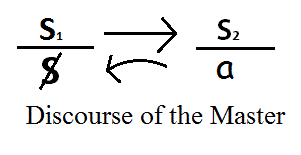
excentric ex-centric Discourse of the Master

Campbell, Kirsten. Jacques Lacan and Feminist Epistemology, New York: Routledge 2004.

The predication of the subject in language constitutes is as divided, radically split between the conscious and unconscious, and as ‘ex-centric‘, radically other to its conscious self of identity. É: 189 33

S/s Lacan’s algorithm emphasizes not the unity of the sign but the rupture between signifier and signified.

I read the formulae of the four discourses as a dynamic representation of the discursive social link; as devices that formalize and elucidate fundamental forms of intersubjectivity. 53

S1 represents the master signifier, the symbolic element that represents the subject for another signifier. The master signifier marks the subject’s position within the signifying chain and hence within the discursive social tie. 50

S2 designates the symbolic field, teh chain or network of signifiers that form the subject. For this reason, S2 represents the knowledge of the subject. It describes both the form of the subject’s knowledge, for example, academic, psychoanalytic and so on, and the form of knowledge of the subject, such as the differing conceptions of the subject within the unversity and psychoanalysis. 50

a represents the ‘left-over’ or remainder of discourse. That remainder is the jouissance produced by, and surrendered to, language in the taking up of a a speaking position by the subject.  The a is an unassimilable excess to the discourse.  There is no signifier of the a, as it is not possible to represent it in the signifying economy of the discourse.  The subject attempts to structure its relationship to this unassimilable remainder by rendering it as an imaginary object — the objet petit a.  The a thus both functions in the imaginary register, in which it appears as an imaginary object filled with phantasmatic content, and in the symbolic register, in which it marks the excluded term of discourse, the gap in or void of its symbolic structure. For this reason, the a ‘stands simultaneously for the imaginary fantasmic lure/screen and for that which this lure is obfuscating, for the void behind the lure’ (Žižek 1998 4 Disourses Cogito and the Unconscious).

$ designates the barred subject, in which the S of the conscious subject is struck through because of its division by the unconscious.

In the Discourse of the Master, S1 stands in the place of the agent, S2 in the place of the other, $ in the place of truth, and a in the place of the product of the disourse.  In the operation of the Master’s Discourse, the master signifier is the cause of the subject. The subject addresses its speech to the Other of the Symbolic order, S2, the network of signifiers which form the subject. The truth of the discourse is $, the unconscious of the divided subject. The product of its discourse is the a, that remant of jouissance which is forbidden to the subject. Lacan nominates teh Discourse of the Master as the fundamental relation because it represents the structure to another signifier, and hence produces it as a subject in the signifying chain, the cause of the discourse is also the ’cause’ of the speaking subject (Seminar 17: 19-20).  In this way, the S1 of the Discourse of the Master represents the ‘origin’ of discourse as such, because it is the condition of the production of discourse as enunciation.  For this reason, Lacan describes the foundational discourse as that of the Master. 51

Copjec, Joan. Read My Desire: Lacan Against the Historicists. Cambridge Mass: MIT Press, 1994.

I always speak the truth. Not the whole truth, because there’s no way to say it all. Saying the whole truth is materially impossible: words fail. Yet it’s through this very impossibility that the truth holds onto the real.  Lacan Television

In Foucault’s work the techniques of disciplinary power (of the construction of the subject) are conceived as capable of ” materially penetrat[ing] the body in depth without depending even on the mediation of the subject’s own representations. If power takes hold on the body, this isn’t through its having first to be interiorized in people’s consciousness. “8 For Foucault, the conscious and the unconscious are categories constructed by psychoanalysis and other discourses (philosophy, literature, law, etc. ): like other socially constructed categories, they provide a means of rendering the subj ect visible. governable, trackable. They are categories through which the modern subj ect is apprehended and apprehends itself rather than (as psychoanalysis maintains) processes of apprehension; they are not processes that engage or are engaged by social discourses (film texts, for example).

What is the difference, then, between Foucault’s version and psychoanalysis’s version of the law/desire relation? Simply this : while Foucault conceives desire not only as an effect but also, as I have pointedly remarked, as a realization of the law, psychoanalysis teaches us that the conflation of effect and realization is an error. To say that the law is only positive, that it does not forbid desire but rather incites it, causes it to flourish by requiring us to contemplate it, confess it, watch for its various manifestations, is to end up saying simply that the law causes us to have a desire for incest, let us say.

This position recreates the error of the psychiatrist in one of Mel Brooks’s routines. In a fit of revulsion the psychiatrist throws a patient out of his office after she reports having a dream in which, he relates in disgust, “she was kissing her father! Kissing her father in the dream! ” The feeling of disgust is the humorous result of the psychiatrist’s failure to distinguish the enunciative position of the dreaming patient from the stated position of the dreamed one. The elision of the difference between these two positions enunciation and statement causes desire to be conceived as realization in two ways. First, desire is conceived as an actual state resulting from a possibility allowed by law. Second, if desire is something one simply and positively has, nothing can prevent its realization except a purely external force. The destiny of desire is realization, unless it is prohibited by something outside it. 24

Psychoanalysis denies the preposterous proposition that society is founded on desire — the desire for incest, let us say once again. Surely, it argues, it is the repression of this desire that founds society. The law does not construct a subject who simply and unequivocably has a desire, but one who rejects its desire, wants not to desire it. The subject is thus conceived as split from its desire, and desire itself is conceived as something — precisely — unrealized; it does not actualize what the law makes possible. Nor is desire committed to realization, barring any external hindrance. For the internal dialectic that makes the being of the subject dependent on the negation of its desire turns desire into a self hindering process.

Foucault’s definition of the law as positive and nonrepressive implies both that the law is (1) unconditional, that it must be obeyed, since only that which it allows can come into existence-being is, by definition, obedience- and that it is (2) unconditioned, since nothing, that is, no desire, precedes the law; there is n o cause of the law and we must not therefore seek behind the law for its reasons . Law does not exist in order to repress desire. 25

Now, not only have these claims for the law been made before, they have also previously and prominently been contested.  For these are precisely the claims of moral conscience that Freud examines in Totem and Taboo. There Freud reduces these claims to what he takes to be their absurd consequences: ” If we were to admit the claims thus asserted by our conscience [that desire conforms to or always falls within the law], it would follow, on the one hand, that prohibition would be superfluous and, on the other, the fact of conscience would remain unexplained.” 20

On the one hand, prohibition would be superfluous. Foucault agrees: once the law is conceived as primarily positive, as producing the phenomena it scrutinizes, the concept of a negative, repressive law can be viewed as an excess — of psychoanalysis. On the other hand, the fact of conscience would remain unexplained. That is, there is no longer any reason for conscience to exist; it should, like prohibition, be superfluous . What becomes suddenly inexplicable is the very experience of conscience — which is not only the subjective experience of the compulsion to obey but also the experience of guilt, of the remorse that follows transgression — once we have accepted the claims of conscience that the law cannot fail to impose itself and cannot be caused. Foucault agrees once again: the experience of conscience and the interiorization of the law through representations is made superfluous by his theory of law. 25

The subject is and can only be inculpable (blameless). The relation between apparatus and gaze creates only the mirage of psychoanalysis . There is, in fact, no psychoanalytic subject in sight.

primal father realtight

Copjec, Joan. Read My Desire: Lacan Against the Historicists. Cambridge Mass: MIT Press, 1994.

The startling claim made by Lacan is that the structures he is diagraming are real. This claim can only have met with the same incomprehension that it continues to elicit today. For those schooled in structuralism, which teaches us to think of structure as nearly synonymous with symbolic, the proposition presents itself as a solecism, an abuse of language. Lacan was not, naturally, ignorant of the structuralist position, which he shared at the beginning of his teaching . Later, however, his work aimed at critiquing this position, and his argument to the students and to us could at this point be formulated thus : you are right to rebel against structuralism, to complain that it diagrams only moribund relations. You are therefore right to proclaim that structures don’t march in the streets but not for the reasons you think. For the point is not, by changing your analytical model, to make structures take to the streets, to understand them as embedded or immanent in social reality. The point is rather to heed the lesson the original model had to teach:

structures do not and should not-take to the streets. They are not to be located among the relations that constitute our everyday reality; they belong, instead, to the order of the real.

This argument may be too abstract, even still. What, you may wonder, would an analysis that proceeds from this assumption look like? What difference does it make to our understanding of the actual functioning of a society? In order to answer these questions , we ask you to contemplate two examples of just such an analysis. Each is drawn from the work of Freud, and, significantly, each is associated with an inglorious history of ridicule and incomprehension. Our suggestion is that it is the proposition that underwrites them-” structures are real, ” or “every phenomenal field occludes its cause” which causes them to be so radically unassimilable within, and such valuable antidotes against, everyday historicist thought. 11-12

The first example is taken from Totem and Taboo, where Freud provides an analysis of a society in which relations of equality and fraternity prevail among its citizens, no one is distinguished above the others , and power is shared rather than accumulated in one place. What strikes us as most remarkable about Freud’s analysis is that it does not limit itself to a description of these relations, does not attempt to make this “regime of brothers ” coincide simply with the relations that exist among them. Instead Freud insists on going beyond these relations to posit the existence of some preposterous being, a primal father who once possessed all the power the brothers now equally share and whose murder is supposed to have issued in the present regime. No wonder so many have taken this to be one of Freud’s most crackpot ideas … But to call it crackpot is to miss the point that if this father of the primal horde is indeed preposterous, then he is objectively so. That is to say, he is unbelievable within the regime in which his existence must be unthinkable if relations of equality are to take hold. That he is unthinkable within this regime of brothers does not gainsay [contradict] the fact that the institution of the regime is inexplicable without him.

For if we did not posit his existence, we would be incapable, without resorting to psychologism, of explaining how the brothers came together in this fashion.

What Freud accounts for in Totem and Taboo is the structure, the real structure, of a society of equals, which is thus shown to be irreducible to the labile [fluid changing] relations of equality that never obtain absolutely. The petty jealousies and feelings of powerlessness that threaten these relations, that block their permanent realization, betray their guilty origin, the cause that they must efface. 12
The second example is taken from Beyond the Pleasure Principle, in which Freud develops one of his other massively misunderstood notions: the death drive. The common interpretation of this text is that he develops this notion in order to counter the belief that humans are all too humanly ruled by a principle of pleasure. According to this reading, the death drive would be a second principle, co-present and at war with the pleasure principle; that is, the two principles would be seen to occupy the same space, the territory of their struggle with each other.

Yet this is not what Freud says . Rather than contesting the importance of the pleasure principle, he admits its centrality in psychical life; he then seeks, by means of the death drive, to account for this centrality, to state the principle by which the principle of pleasure is installed. 10

In other words, Freud’s positing of the death drive parallels his positing of the father of the primal horde in that both are meant to answer to the necessity of accounting aetiologically for an empirical field, where the pleasure principle reigns, in one case, and where a fraternal order obtains, in the other.

In each case the transcendental principle, or the principle of the principle of rule, is in conflict with the principle of rule itself, though this conflict cannot be conceived to take place on some common ground, since the first order principle and the second order principle are never co-present

Nor can either of these two “warring” principles ever ultimately win out over the other, since the very existence of the empirical field always presupposes the existence of its cause, and since no cause can ever exist abstractly, in the absence of that which it effects.

But we must also acknowledge that these two powerful modern discourses — psychoanalysis and historicism, represented here by Lacan and Foucault, respectively — have in common the conviction that it is dangerous to assume that the surface is the level of the superficial. Whenever we delve below this level, we are sure to come up empty. Yet the lessons each discourse draws from this conviction are strikingly divergent.

Psychoanalysis, via Lacan, maintains that the exclusivity of the surface or of appearance must be interpreted to mean that appearance always routs or supplants being, that appearance and being never coincide. It is this syncopated relation that is the condition of desire.

Historicism, on the other hand, wants to ground being in appearance and wants to have nothing to do with desire.

Thus, when Lacan insists that we must take desire literally, we can understand him to be instructing us about how to avoid the pitfall of historicist thinking. To say that desire must be taken literally is to say simultaneously that desire must be articulated … For if it is desire rather than words that we are to take literally, this must mean that desire may register itself negatively in speech, that the relation between speech and desire, or social surface and desire, may be a negative one. As Lacan puts it, a dream of punishment may express a desire for what that punishment represses. This is a truth that cannot be tolerated by historicism, which refuses to believe in repression and proudly professes to be illiterate in desire. The emergence of a neopopulism cannot be blamed on Foucault, but the historicism he cultivated is guilty of effacing the pockets of empty, inarticulable desire that bear the burden of proof of society’s externality to itself.

Disregarding desire, one constructs a reality that is realtight, that is no longer self external. One paves the way for the conception of a self enclosed society built on the repression of a named desire.

If this book may be said to have one intention, it is this: to urge analysts of culture to become literate in desire, to learn how to read what is inarticulable in cultural statements .
a surplus existence that cannot be caught up in the positivity of the social

Copjec, Joan. Read My Desire: Lacan Against the Historicists. Cambridge Mass: MIT Press, 1994.

In other words , power was no longer conceived by Foucault as an external force that exerted itself on society, but as immanent within society, the “fine, differentiated, continuous ” network of uneven relations that constituted the very matter of the sociaL Society now neatly coincided with a regime of power relations, and the former was thus conceived to structure itself by itself rather than to be structured by an external power. Now, it is this notion of immanence, this conception of a cause that is immanent within the field of its effects, with which this book quarrels and repeatedly condemns as historicist.

Yet some notion of transcendence is plainly needed if one is to avoid the reduction of social space to the relations that fill it. A rethinking of this notion is foreclosed, however, by Foucault’s substitution of a battle based model of analysis for the language based one he inherited from structuralism and which he emphatically rejects for what he takes to be its inherent idealism. In fact the opposite is true; it is the rejection of the linguistic model, properly conceived, that leads to idealism. For the argument behind the adoption of this model-something cannot be claimed to exist unless it can first be stated, articulated in language — is no mere tautology; it is a materialist argument parallel to the rule of science which states that no object can be legitimately posited unless one can also specify the technical means of locating it. The existence of a thing materially depends on its being articulated in language, for only in this case can it be said to have an objective — that is to say, a verifiable — existence, one that can be debated by others. 7-8

[A]n acknowledgment of metalanguage’s impossibility compels us to realize that the whole of society will never reveal itself in an analytical moment; no diagram will ever be able to display it fully, once and for all. At the same time this acknowledgment does not compel us to imagine a society that never quite forms, where — as the deconstructionists would have it — events never quite take place, a society about which we can say nothing and do so in an endless succession of statements that forever fail to come around to the same relevant point. To say that there is no metalanguage is to say, rather, that society never stops realizing itself, that it continues to be formed over time. 8-9

For, what we do when we recognize the impossibility of meta language is to split society between its appearance — the positive relations and facts we observe in it — and its being, that is to say, its generative principle, which cannot appear among these relations. What we do, in essence, is install society’s generative principle, provide for it a place beyond ‘the . .realm of positive appearances. Fitted out thus with a generative principle, society ceases to be conceived as a dead structure, mappable on some flat surface; society is finally by this means brought to life. 9

the generative principle of a society is never statable as such, the way the contents of that society are. It is only a certain quashing of its force or blockage in its functioning that allows us to suppose a regime of power to be governed by a principle that cannot be absorbed by that regime. We must not fail to notice that this says more than we have been claiming up until this point. Our position notes not only the negative fact that its principle cannot be made visible within a functioning regime but another, positive fact as well:

the principle of a regime’s institution always in some way negates the regime it institutes . 10

If all this has become a bit too abstract, I invite you to picture it another way. Let us return to May 1968 and the dissenting students, not writing their revolutionary slogans this time but watching with bemusement and an exasperation mounting to disbelief as one of their professors draws on the blackboard four cryptic diagrams that he calls “the four discourses .”  The professor is, as you’ve guessed, Jacques Lacan, and many of the students gathered before him are unquestionably thinking that what they are witnessing is the very epitome of that academic structuralism against which they are now in revolt. But they are mistaken about this, and, unfortuntely, others after them will perpetuate their error. Lacan’s diagrams bear no resemblance to the scientistic maps drawn by the structuralists; his diagrams are offered to the audience as antistructuralist.

antigone beckett

Belsey, Catherine. Culture and the Real : Theorizing Cultural Criticism. 2005

Malone Dies, opens with the words, ‘I shall soon be quite dead at last in spite of all’ (Beckett 1994: 179). Malone is resigned to the inevitability of death, although he would prefer it to take place without struggle. ‘Throes’, he observes laconically, ‘are the only trouble, I must be on my guard against throes’ (179– 80). First published in French in 1951, and translated into English by the author in 1956, Malone Dies anticipates some of the concerns of Lacan’s Seminar 7, though in a manner entirely characteristic of its own author. The novel is also characteristic of its moment.

Lacan’s exemplary text, Antigone, shows its protagonist refusing to give ground relative to her desire. Organically linked to her dead brother, as to no other human being (a husband or a child would be replaceable, she says, but her mother and father are dead: she can have no new brothers), Antigone insists on carrying out his burial rites, contrary to Creon’s law.

Because she accepts the penalty of living burial, Antigone’s ‘incarnation’ of the death drive is heroic (Lacan 1992: 282).

Oedipus, meanwhile, enters the zone between life and death because he too has insisted on following his own desire, in this instance, ‘to know the last word on desire’. Everyone else tries in vain to discourage him from pressing his questions about who he is, but he persists. Oedipus dies cursing, unreconciled to the goods.

On the other hand, King Lear, the irascible old man who does not give up on his desire either, represents a ‘derisory’ version of the same commitment (1992: 310). The ‘old fool’ thinks he can go into the same zone with everyone’s agreement – and ‘makes the earth and ocean echo’ with his imprecations, because he fails to grasp that this is a place of dispossession (1992: 309– 10)  153

Malone, however, is a protagonist for our own ironic time. There is nothing remotely heroic about Malone except his refusal of the goods. Neither stoical nor serene, Malone makes no concessions whatever to the moral law: ‘Let me say before I go any further that I forgive nobody. I wish them all an atrocious life and then the fires and ice of hell and in the execrable generations to come an honoured name’ (Beckett 1994: 180). Malone inhabits the zone between life and death alone in an isolated room that he cannot quite locate. Could it be ‘one of heaven’s mansions’ perhaps? He thinks not (184). It seems to be in an ordinary house. There remains a doubt, however. … Finally, The ceiling rises and falls, rises and falls, rhythmically, as when I was a foetus . . . . I am being given, if I may venture the expression, birth to into death, such is my impression. The feet are clear already, of the great cunt of existence. Favourable presentation I trust. My head will be the last to die. Haul in your hands. I can’t . . . . That is the end of me. I shall say no more. (285)

To die is to be reunited with the real we came from, but the living Malone is at home neither as an organism, in the flesh, nor at the level of the signifier. ‘All my senses are trained full on me, me. Dark and silent and stale, I am no prey for them. I am far from the sounds of blood and breath’ (186).

Malone is not his body. On the other hand, he is not a consciousness either: thought seeks him out, ‘as it always has, where I am not to be found’ (187). The space he inhabits, however unstable, ill-defined, seems easier to specify than his identity. It is to the signifier, however, that Malone turns to keep his distance from the real, physical process of dying. He tells – and then writes in an exercise book – stories. … 154

Is there anything uplifting here? Not really. But there is comedy, and it pacifies. In the absence of heroism, there is at least dedication, if only in Malone’s resolute contempt for the good death. Above all, there is pleasure in the grim wit of Beckett’s prose. What are verbal dexterity, stories, jokes, satire, parody, and satirical excoriation itself, after all, but an affirmation of the signifier in the face of the real? And isn’t that exactly what, as organisms-in-culture, we speaking beings are good at? 155

A THEORY OF CULTURE?

Lacan’s account of sublimation offers a way of understanding the pleasures the signifier offers the speaking being, without reducing culture to something else: ethical instruction, ideological control, or scripted determinism. Aspects of culture may at a specific moment represent any or all of these. In itself, however, culture does not make us better or worse. If it subjects people, it does not exclude the possibility of resistance. It does not do away with our discontents, but it offers to engage with them while finding a focus for desire. And to the attentive interpreter, culture can in addition tell more than it thinks it knows about who and what we are. 156

sublimation death drive

Belsey, Catherine. Culture and the Real : Theorizing Cultural Criticism. 2005

Tracing a path through Freud’s own widely distributed observations, Lacan repudiates the binary opposition Freud holds on to so precariously between the libido and death: for Lacan the drive is both sexual and deadly, at once life-giving and destructive. In Seminar 7 sexual desire is not the central problem. Sex, Lacan says, is fine in its way, but you can’t count on it:

Sex ‘simulates’ the impossible jouissance, the encounter with the Thing, but does not in any circumstances enact it. Meanwhile, however, Seminar 7 is less concerned about sex than death. For Lacan sex was never an origin: instead, it merely ‘occupies’, like an invading army, the field of desire (1977: 287),which is brought into being with the loss of the real entailed in our subjection to the symbolic order.

In Lacan’s account, sublimation includes romantic love; there is conflict between sublimation and sex; on the contrary, sex involves the pleasurable signifier. Sublimation rails off the impossible encounter with the engulfing Thing, not the pleasures of sex. 145

A product of his time, however, in the late 1950s and early 1960s, when the world held its breath as two superpowers threatened each other with nuclear annihilation, Lacan became increasingly preoccupied by the death drive, and specifically its expression in the capacity of human beings to destroy their world with weapons of mass destruction. Sublimation pacifies the drive without pathology and without destruction.

There are two possible barriers between the subject and the object of the drive, two ways to keep at bay the death-dealing and vital Thing: on the one hand, the superego; on the other, sublimation.

True to Freud, Lacan finds the superego, ‘obscene’, ‘ferocious’ and ‘morbid’ (1992: 7). The more we concede to this ‘parasite’, the more it demands of us, he argues (302). Its ideals are ‘the goods’: conventional values, ‘family goods, domestic goods . . . the goods of our trade or our profession, the goods of the city, etc’. But psychoanalysis is not there, Lacan insists, to support the bourgeois dream, with its puritanical demands for human sacrifice (303).

If, then, we refuse the goods, one option is to go willingly with Antigone, into a heroic region beyond pleasure, a world of total dispossession, the unearthly place of the drive itself. 146

In the meantime, sublimation promises pleasure at the level of the signifier – including the pleasure offered by the plays of Sophocles, and not least, of course, Antigone.

Sublimation, then, is the ‘true’ barrier between us and absolute destruction, preferable to the goods because beauty ‘gets closer’ to the Thing (216– 17). The pleasure principle presents the beautiful as capable of alluding to the Thing, revealing the nature of the drive, and in the process offering a gratification that differs from its aim (111, 293).

There is nothing sentimental or escapist about the beautiful in Lacan. On the contrary, ‘the beautiful is closer to evil than to the good’ (217). Moreover, it is ‘precisely the function of the beautiful to reveal to us the site of man’s relationship to his own death, and to reveal it to us only in a blinding flash’ (295).

By encircling the void, which marks the place of the real that is lost to the subject, culture exercises the creative aspect of the drive to make allusions at the level of the symbolic to the inaccessible Thing, which is itself beyond pleasure. In culture the symbol comes between us and the enticing, terrifying, dangerous object of the drive.

There is in Seminar 7, however, no sublime object, unreasonably elevated to the dignity of the Thing, no fetish, no fantasy offering a focus for antagonism. On the contrary, while the Thing is best acknowledged, it is also preferable that it should be veiled by the signifier. And the signifier gives pleasure.  147

To secure the sublime object of ideology, Žižek sacrifices the version of sublimation that explains the existence of culture. If Žižek offers on the basis of Lacan a theory of human nature, what Lacan offers on the basis of Freud is a theory of human culture as the only hope of a rapprochement between the symbolic and the real. Lacan insists on the gap between the real and the signifier. … Žižek denies the existence of the real but places the sublime object at the heart of culture. 🙂 hmm don’t know about dat.

Paradoxically, however, this leads him to ignore the capacity of the signifier to give pleasure – though he demonstrates it in his own extremely pleasurable writing over and over again. Only Lacan retains a substantial positivity that the signifier cannot master, an unknown region which we encounter in fear and trembling, but with no trace of theology.

Žižek says you have to go through the fantasy to the void; Lacan says you can do that – but in the meantime, you can make things.

Making things is what culture consists of, given that the things in question include pots, beads, stories, paintings, photographs, films, essays and academic books. This is the material of cultural criticism, and only Lacan, who largely ignores the Kantian sublime, gives us a theoretical explanation of its existence. 148

Antigone don`t give ground sublimation

Belsey, Catherine. Culture and the Real : Theorizing Cultural Criticism. 2005.

THE PLEASURE PRINCIPLE

What difference does Žižek make by his intertextual conjunction of psychoanalytic sublimation with the Kantian sublime? Lacan’s Seminar 7 concerns the ethical implications of psychoanalysis. The question it asks is what psychoanalysis offers as its outcome for the analysand.

Given that ‘the goods’ – duty, self-sacrifice, the conventional virtues – solve nothing, what would it mean to be free from the symptom, which always conceals the drive towards the Thing? How, in other words, can we avoid, on the one hand, the naked aggressivity that represents the direct projection outwards of the death drive and, on the other, the effect of repression, the symptom’s deception, by which neurosis promises its own pathological version of satisfaction?

It is in answer to the question how to avoid pathology that Lacan impels us not to give ground relative to our desire (1992: 319). His instance of the tragic outcome of this ethic is Antigone, whose bond with her brother impels her to defy Creon’s law, knowing that the consequence is to be walled up alive in her own tomb.

The rest of us, less heroic, may be less ready to venture beyond everything we think we know, or more eager to postpone the moment, since we are all required to rejoin the real in the end. For us, what is deadly in desire must be acknowledged, but may also be tamed, pacified, fenced off, as a way of living with – or, indeed, surviving – the effects of that uncompromising commitment.

The beautiful, then, is the acceptable barrier to ‘the unspeakable field of radical desire that is the field of absolute destruction’ (216).

People are speaking beings, organisms-in-culture, able to find themselves fully at home neither in the organic real nor in the symbolic order. The Thing beckons with the promise of gratification at the level of the real, but the price we should pay for such jouissance would be the dissolution of the subject.

Conversely, the symbolic order, the Other which constitutes us as subjects, is empty; it cannot give a satisfaction it does not possess. Sublimation in Lacan’s account offers a way of inhabiting the symbolic without submission to the exorbitant demands of the ferocious moral Law. Sublimation, which gratifies without repression, involves the pleasure principle.  143

Sublimation appears repeatedly in Freud’s work from 1905 onwards as a diversion of part of the sexual drive towards other aims.

Under the influence of the ego, he argues, people relinquish a proportion of organic satisfaction in favour of culturally acceptable activities. Art is the effect of sublimation.

At times Freud displays all the scepticism of science in his depiction of the artist. ‘He’ (artists are characteristically male, of course, in Freud) is probably exceptionally driven, but also exceptionally socially inept. What he wants is what all men want: glory, power and the love of women. But when he fails to secure any of them, the artist retreats into fantasy, imagines the satisfaction he seeks. Whereas most people in these circumstances would have to make do with their meagre day-dreams, however, the artist, Freud explains, is especially good at making his fantasies public in acceptable forms, while disguising their origins. Artists convert imagination into works of art. By means of this skill, they go on to acquire glory, power and the love of women in the process, thus securing their objectives after all, but by another route (Freud 1976: 423– 4). Elsewhere, however, Freud’s account is more elegiac.

Something in the nature of the sexual drive, he proposes, is incompatible with civilization, so that for human beings, divorced by culture from their organic origins, perfect sexual gratification is not possible. But paradoxically, the pleasure that culture withholds in this way reappears in culture itself by means of sublimation:
[Freud quote]  The very incapacity of the sexual instinct to yield complete satisfaction as soon as it submits to the first demands of civilization becomes the source, however, of the noblest cultural achievements which are brought into being by ever more extensive sublimation of its instinctual components. For what motive would men have for putting sexual instinctual forces to other uses if, by any distribution of those forces, they could obtain fully satisfying pleasure? 144

That element of lack in the sexual relation was to reappear in Lacan’s account of unconscious desire as indestructible and insatiable, and in his repeated insistence in Seminar 20 that there was no sexual relation (rapport). But what complicates the issue further is Freud’s increasing conviction after the First World War that there are two drives, the libido on the one hand, and the death drive on the other. While Beyond the Pleasure Principle, published in 1920, holds them apart only with some degree of uncertainty, Civilization and its Discontents, ten years later, insists on the distinction and pays renewed attention to the dangerous capabilities of the death drive. Externalized, it leads to cruelty and brutality towards others; internalized, it produces the self-destructive and voracious superego, conscience, an exorbitant sense of moral obligation that can never be fully met, and which therefore creates unending anxiety:

[Freud quote]  ‘Every renunciation of instinct now becomes a dynamic source of conscience and every fresh renunciation increases the latter’s severity and intolerance’ (Freud 1985a: 321).

Civilization is necessary as a defence against unqualified aggressivity, but its effects remain disappointing. Among its discontents we must include the self-denying, self-excoriating ethical imperatives of the superego, aggression itself by another name. 144-145

desire

Belsey, Catherine. Culture and the Real : Theorizing Cultural Criticism. 2005

Lacan sees the void that architecture surrounds as the place of the lost object in the inextricable real, impossible to symbolize and equally impossible to forget. The Thing, the object of the drive, constructed retroactively as forbidden, leaves a hole in what it is possible to signify, and can be represented only by emptiness.

But its loss remains a source of dissatisfaction for the organism-in-culture which is the human being, and it is this structural discontent that gives rise to desire.

Desire in Lacan is a desire for nothing nameable, but it finds stand-ins, often a succession of them, sutured into place as love-objects, in the course of most individual lives. To be united with the Thing, even if it were possible, would be to surrender our existence as subjects, dissolving into pure absence. We need, therefore, to keep our distance.

Architecture both invokes and circumscribes the void which is the memorial to the lost real. Enclosing emptiness, surrounding it with a substantial materiality that is shaped, styled and decorated according to taste, architecture thus reaffirms the power of culture to keep the object of the drive in its place. Much like tombs, then, but on a larger scale than most of them, grand buildings at once allude to loss and contain it, render it present and absent at the same time. They are in consequence places of desire.

Art, which includes architecture, of course, neither delineates the real, nor acts as a substitute for it, but alludes at the level of the signifier to the loss of the real that is the cause of discontent in the signifying subject. All art, then, is a place of desire. We may assume that Mr Darcy’s (Pride and Prejudice) portrait owes nothing to the Baroque, and shows as much restraint as his house. Nevertheless, it is as a signifying surface that the painting arrests Elizabeth, and softens her feelings towards him.  86

thing vase of emptiness

Belsey, Catherine. Culture and the Real : Theorizing Cultural Criticism.

What gratification can we derive from images of the footwear a peasant has discarded? Where is the pleasure in a painting of these clumsy, graceless and worn shoes, he wonders. What, after all, do they mean? Not walking, not fatigue; neither passion nor a human relationship. On the contrary, Lacan continues, they mean no more than ‘that which is signified by a pair of abandoned clodhoppers, namely, both a presence and a pure absence’ (1992: 297). No one wears these shoes: they are empty. They thus indicate a temporal relationship, a difference from the past, a loss of the wearer, just as a wooden reel symbolizes the loss of the organic relationship with a beloved mother. 73

In the same way, a still life implies a temporal relationship with the future, a potential for loss there too. Milk or fruit, cream, oranges or grapes, depicted at a moment of perfection, depend for the pleasure they give on our awareness that the moment can’t last.

Does the satisfaction culture affords depend on beauty in the conventional sense, the kind of beauty we identify with high culture? Not necessarily. The archetypal cultural object, Lacan argues, is the work of the potter, who creates a space by making a vase to surround it (120– 21). And here he echoes another of Heidegger’s essays. What holds the liquid in a jug, Heidegger asks. Not, as it might appear, the sides and floor of the jug. On the contrary, the indispensable element is the hole at the centre. ‘The emptiness, the void, is what does the vessel’s holding. The empty space, this nothing of the jug, is what the jug is as the holding vessel.’ The potter ‘shapes the void’ (Heidegger 1971: 169). And Heidegger adds,since only human beings are aware of death, and specifically their own mortality, ‘Death is the shrine of Nothing’ (178). Lacan appropriates Heidegger’s interpretation of the potter’s work for his own specifically psychoanalytic account of culture.

Whenever the signifier makes a magic circle round the absent Thing, we are entitled to find a kind of beauty. In a certain context, a collection of empty matchboxes encloses and inscribes the lost real (Lacan 1992: 114)

Death is the inevitable fate of the human organism. … But death is alien to the subject of Western culture, constituted as it is in the symbolic and divided in the process from the organism that we also are.

Our languages, with their continuous present and their future tenses, enable us to imagine eternal life but, while culture survives (always subject, of course, to the effective control of weapons of mass destruction), the real withholds the possibility of immortality in this world for the individual human being. The monument, unable to make him present, alluding to loss and motivated by the annihilation of Simson himself, acknowledges that too. At the same time, however, it offers a certain consolation, in so far as it shares with A Pair of Shoes and Dutch painting, jugs, matchbox collections and macaroni the creation of a barrier to the experience, impossible for the subject, of pure absence. And perhaps, in its paradoxical signifying exuberance, the monument to the obscure apothecary (Stimson) also shares with all culture an existence as a pleasurable, pacifying alternative to renunciation, on the one hand, or aggressivity on the other. 80

thing the Law

Belsey, Catherine. Culture and the Real: Theorizing Cultural Criticism.

Beyond the signifier, alien to the subject, the Thing also constitutes the absence that appears at the heart of the subject with the advent of signification. An archaic, maternal construct from the subject’s prehistory, the unforgettable Thing is the source of an impulsion towards life and death, the (non-existent) object of the single drive that comprehends both. 70

As the nothing at the centre of the speaking being, the Thing is what we unconsciously want in the lost real. But it can never be found, Lacan insists. On the contrary, the subject must keep its distance from the Thing. Too close an encounter, he affirms, even supposing it were possible, would bring about the dissolution of the subject, the symbolic order and culture in its entirety. But its converse, the Law, conscience, the order represented by the symbolic Father, offers no satisfaction either. As Lacan’s appropriation of the Freudian superego, the Father in Lacan’s account is consistently dead, a ‘morbid’ tyrant whose demands for renunciation are insatiable, exorbitant. Like the Thing, the Law is a stranger, but it is also the source of an ‘obscene and ferocious’ jurisdiction (1992: 7).

Conscience is a ‘parasite’ that feeds on the satisfactions we give it and still demands more (89). Lacan contemptuously dismisses its ethical values of self-sacrifice, duty and discipline as ‘the goods’. 71

There is no ‘Sovereign Good’. Instead, the forbidden, deadly Thing is also the source of good, and ‘there is no other’ (70). Since Lacan joins Freud’s two imperatives of desire and death in a single drive, the object of the drive, the maternal Thing gives life as well as death. Hostile to the subject (52), and yet ‘on its side’ (1986: 125), the Thing constitutes the source of love and hate alike, its place both living and dead (300). It thus initiates the will to create as well as destroy – to destroy, indeed, Lacan argues, in order to create anew.

Creativity is the project of culture. By this means, culture offers a detour that keeps the Thing itself at bay, defers with its own signifying presence the impossible jouissance of the encounter with pure absence, and gives pleasure in the process. Lacan sees cultural objects as encircling the lost Thing, keeping it within bounds, without denying its existence. Funeral monuments go back a long way as a paradigm instance of culture. John Simson’s surrounds absence with the signifier, and offers a certain pleasure as it does so. 71

As Freud points out in Beyond the Pleasure Principle, and Lacan reiterates, pleasure for the subject is to be found on the side of the symbolic, not the real (Lacan 1992: 12). The object of the drive, the Thing, missing from the symbolic, outside representation, absent, is both inconceivable and terrifying. But the symbolic order, which in the first instance divorced the human infant from gratification in the real, goes on to form a ‘magic circle’, which separates us from the Thing (134). Little Ernst replaced the organic connection to his mother with the signifying wooden reel, and thus came to accept her absences. But it is important to note that, while this process named the pain of absence, it did not do away with it. It is in the context of this story that Freud mentions the artistic pleasures of grown-ups. These often incorporate loss at the level of the signifier, he points out. His instance is tragedy, which dramatizes suffering and death, and yet may be experienced as enjoyable (Freud 1984: 287).

The pleasure principle does not repress the drive, but deflects it, imposing the signifying screen that protects us from a direct encounter with the desired, impossible, deadly Thing. At the same time, the pleasurable signifier alludes to its loss. Even comedy, from Shakespeare to Four Weddings and a Funeral, notoriously also recognizes the dark side of human experience. The pleasure principle is aligned with culture in the broadest sense of that term. 72

Belsey, Catherine. Culture and the Real : Theorizing Cultural Criticism.

That idealist complacency, the certainty that we not only make ourselves, but also make the world in our own minds, confining what exists to consciousness and erasing the real in the process, may be one of the most dangerous features of Western culture in the twenty-first century.

While idealism does not overtly ally itself with the West’s depredation of the planet or its militaristic foreign policy, a theory that materiality is no more than the effect of culture offers no grounds for repudiating either of these practices. On the contrary, the conviction that what exists depends on our idea of it helps to disconnect our lifestyle from the damage it causes.  58

THE INCURSION OF THE REAL

There is some evidence, however, that the irreducible real is beginning to put up a resistance to our wasteful, culturally scripted habits, and to make itself knowable in the form of melting icecaps, floods, forest fires and high levels of skin cancer. Sadly, the West, which has done most to bring this about, only grudgingly acknowledges the situation, at least explicitly, while at the same time scrambling for control of the planet’s remaining natural resources. 60

Why was 9/11 so shocking? Perhaps because it represented the momentary incursion of the unknowable real into an increasingly idealist culture. The destruction of the twin towers seemed unheralded, inexplicable, unaccountable, out of our control. In the immediate aftermath of the event, sophisticated commentators, including Žižek, delighted in maintaining that 9/11 was first and foremost a media spectacle, reproducing in actuality an already-familiar Hollywood fantasy.  … These planes were not a repressed fragment of our own psyche but, on the contrary, a violent material intrusion from outside. Idealism could not accommodate them.

Paradoxically, to deny the real is also to claim to know for sure. The subject can never achieve such surety, the correspondence between world and consciousness that was Hegel’s goal. Nor can it confidently assert even the more modest conviction that what we don’t know doesn’t matter. How can we be sure even of that, when we can be certain of nothing? 61

What idealism misses, he maintains, is the crucial contribution of psychoanalysis, its understanding of the continuity between the subject and the world, interrupted but not finally erased by the advent of the symbolic order. We remain marked by the lost but inextricable real. The subject is alienated by the Otherness of the signifier and the consequent lack in being, with its propensity at any moment to subtract something from coherent thought or speech. We are subject to temporary disappearances from the signifying chain, liable at any moment to fade. Indeed,

[Lacan quote] “this is the essential flaw in philosophical idealism which, in any case, cannot be sustained and has never been radically sustained. There is no subject without, somewhere, aphanisis [fading] of the subject, and it is in this alienation, in this fundamental division, that the dialectic of the subject is established.” (1979, 221) 62

world without alterity

Belsey, Catherine. Culture and the Real: Theorizing Cultural Criticism.

Why, in more general terms, should we worry about idealism? Or, to put it differently, what has cultural criticism to gain by invoking the Lacanian real? …  Lacan … offers an independent material alterity: ‘the real is what does not depend on my idea of it’ (Fink 1995: 142).   56

‘What could it possibly mean’, Lacan asks early on, ‘to say that the subject is everything?’ (1988b: 98). What indeed? Perfect sovereignty for the subject, damaged or not, of course. Idealism delivers what the free West prizes most.

In a world without alterity, I increasingly constitute my own origin; moreover, I construct my own body, cause my own diseases by bad habits or irrational worry, and bring about my own death if I am foolish enough to let either of these get out of hand. Western culture treats life as a constant process of self-fashioning, unimpeded by external constraints.

In science fiction Hollywood heroes materialize their anxieties; in cultural theory I materialize my own sex. Death, however, remains frightening, as does the threat of physical impairment that would impugn our autonomy. Idealism turns the object of desire into an increasingly prosthetic immortality, secured by remorseless self-discipline: a regime of diet and exercise, supplemented by surgery.

Lacan saw the possibility of assuming our own being-for-death as heroic, the consequence of a struggle to be what we are in the face of everything that may oppose us. His Antigone asserts her autonomy against the cultural script, and against the ‘good sense’ of other people, who urge her not to break the law.

Idealism, by contrast, leaves such autonomy there for the taking, or rules it out on the basis of cultural determinism. In the absence of any substantial alterity, how or what should we oppose? The abolition of opposition in turn does away with the heroism. 57

Critique of Žižek

Žižek, aware of the seductions of imaginary sovereignty, repeatedly insists that we should ‘traverse the fantasy’ presented by the symbolic order, go through the cultural screen to encounter the emptiness beyond it (1997: 30– 31). This bleak proposition takes Lacan’s account of the death drive to its logical conclusion, but it is his subscription to idealism in the first place that makes it all the more imperative for Žižek to prescribe suicide as the supreme ethical act. Traversing the fantasy to the void both constitutes a counterweight to the self-indulgence of an idealist culture, and at the same time installs the true sovereignty of the subject itself (see, for example, 1991: 63– 4; 1992a: 77– 8).  57