phallic signifier

Campbell, Kirsten. Jacques Lacan and Feminist Epistemology. Florence, KY, USA: Routledge, 2004. p 122.

Social fictions are not seamless and unitary, but multiple and contradictory. For example, Gloria Anzaldúa argues that for the Hispanic lesbian markers of ‘identity’ often conflict, and that ‘self’ is negotiated in those conflictual identificatory demands (1987: 77– 91). Anzaldúa describes a process in which master signifiers of the subject – those markers of ‘self’ – produce a subject with multiple discursive interpellations.

Anzaldúa’s account is in clear contrast to the white bourgeois and heterosexual masculine subject whose markers of identity seem to ‘match’ the master signifiers of social fictions of modern Western society. The subject is produced in both personal and social histories that are fundamentally imbricated. In this way, social fictions are discourses of both the subjective and the social, because an imaginary and symbolic relation to other subjects always produces the subject.

This description of the subject draws on the Lacanian psychoanalytic insight that the psychic and the social are moments of each other, produced in the basic ‘nature’ of humans not to be natural.

However, the concept of the social fiction does not imply the liberal idea of the social contract in which individual subjects of consciousness agree at a mythical moment of origin to enter rational social arrangements. Rather, it retains the Lacanian insistence that there is no pre-discursive reality since the world is always already inscribed in discourse (S20: 32).

The subject does not therefore emerge into a neutral social world but is inserted into already existing social relations. Social fictions exist prior to the subject and its very existence is contingent upon them. Social fictions are discursive relations between subjects that have material effect because they are ‘lived’ by subjects. This material effect can be seen in the operations of fictions of gender.

For example, while the Symbolic order is a symbolic relation between subjects, the phallic signifier orders that relation, positing some subjects as having the phallus and others as not having it.

At this symbolic level, the possession or absence of the phallus defines subjects. However, at a discursive level, the symbolic relation is filled with content as to the ‘nature’ of sexed identity. The social fictions of ‘masculinity’ and ‘femininity’ attach respectively to a subject with or without the phallus. The fictions of gender interpellate male and female bodies as masculine and feminine subjects, so that it fixes the contingency of the relation between phallus and penis. The fictions of gender render penis, phallus and masculinity as male subjectivity. In the Western social world, the phallus is a signifier that proliferates in a multitude of discourses of masculinity, which in turn produce a number of recognizably ‘masculine’ subjects.

Male subjects can recognize themselves as ‘masculine’, and equally importantly, other subjects are able to recognize them as ‘masculine’. Social fictions are symbolic relations that have material effects, and those material effects give substance, reality and existence to these symbolic relations between subjects.

Jane Gallop points out that it is not just the referentiality of phallus/penis that produces ‘masculinity’ but also the social arrangements that attach power of many forms to the masculine subject (1988: 53). The social world of the fictions of gender is still riven with material and structural inequality for women.

… The social fiction of gender operates such that even if a female subject were to want to take up a ‘masculine’ position, she would find innumerable difficulties in doing so. These difficulties arise not only because she may not identify with the social fiction of masculinity, but also because other subjects may insist on her insertion into the social discourses of femininity, regardless of her identificatory position.

In this sense, the subject is not its own creation, for it must always contend with the realities of social life. The world of the social fiction has facticity, in the sense that it is prior to the subject and has a material and psychic reality for the subject.

Positing the subject
Social fictions produce a subjective position of social identity, in which ‘position’ describes a temporal and spatial moment of subjectivation rather than an ontological foundation. The true subject of the social fiction, like the subject of the Lacanian account it draws upon, is empty.

Fraser claims that ‘Lacan’s account of identity construction cannot account for identity shifts over time’ (1992: 183). However, the Lacanian subject is never an ‘essence’, not even an Oedipal essence. Identity is fictional, for otherwise psychoanalysis could not have as its aim ‘identity shifts’. The Lacanian account fundamentally engages with the spatial and temporal formation of subjectivity and intersubjectivity, and my model of the subject of social fictions takes up the Lacanian emphasis upon its continual production.

In this model of the social fiction, two key and ongoing processes of interpellation produce a speaking position of the subject. The first key process is the personal history of the subject, that is, its production within familial networks. However, these familial relationships are not ‘outside’ the symbolic networks of social fictions, so that a personal history describes a position formed at the intersection of both psychic and social histories.

In this first process of interpellation, the subject comes into existence as a ‘being’ which possesses a ‘self’. These imaginary relations to self and others make discursive relations lived or ‘real’. That child becomes an adult, a social being that lives in and through its formative social fictions.

In this second key process of interpellation, the subject ‘mis/recognizes’ itself in discourse, in terms of its already given ‘identity’ and ‘self’. In this sense, identification with the master signifiers of social fictions reproduces the subject, because it reiterates the imaginary and symbolic relations which were formative of the subject and which capture the subject in social fictions. That capture is a process both of an experience of ‘identity’ and of an enactment of an ‘identity’ for others. This subject does not simply reflect existing social identities, because it also has agency. It can ‘read’ social fictions for their representation of dominant identities and act on that reading, such that the subject can represent itself through different master signifiers of social identity and come to occupy a different position of identity.

An example of this process can be seen in class mobility, in which the subject takes on the cultural markers of its aspirant class.

‘Identity’ in social fictions is not a social construct imposed upon a passive subject. The subject itself acts to produce its identity by reproducing or resisting fictive identities. Nevertheless, it is not necessarily easy to attain subjective mobility, particularly in relation to sexualized and racialized bodies, since sexuality and race are read on to and mark the body itself.

Transsexuals recognize that social fact in their desire to be bodily ‘men’ or ‘women’, rather than only presenting the signs of ‘masculinity’ or ‘femininity’. The desire for surgical intervention shows how immobile gender ‘mobility’ can be. In transsexuality, the subject represents itself to others through master signifiers of ‘masculinity’ or ‘femininity’. In this example, the subject is concerned with its representation of its ‘self’ to others. However, those others may insist that the subject embody particular and ‘fixed’ master signifiers of sexual difference, and it is this insistence that the transsexual often seeks to evade. In its relations to others, the subject engages with the imaginary and symbolic relations of social fictions that others seek to impose upon it. Because of sexist or racist others, it may not be possible to evade another’s signification of our ‘selves’ in discourses of social fictions.

Subjective engagement with social fictions is performative in Butler’s sense and is therefore open to change. However, others will constrain the mobility of that performance of identity. The subject has agency in relation to social fictions because of their contingency. The relation of subject to social fictions is a contingent one, as it is fixed by imaginary and symbolic relations. For example, the relation between the female body and ‘femininity’ is conditional upon the fixing of cultural difference to bodily difference (Chanter 1997: 59). However, to argue that this relation is contingent is not to argue within a sex/gender model that has generally dominated feminist thinking.

The psychoanalytic inflection of the social fiction emphasizes the production of sexed subjectivity within imaginary and symbolic relations. If the subject is always already sexed, then feminist resistance is not merely a matter of reinscribing the female body (although this may be a strategy of that resistance), but also requires intervention in the symbolic and imaginary orders that produce our relation to ourselves and others.

For this reason, my account of the social fiction should not be misread as a social constructivist account of the imposition of a social order upon a passive being, with an additional psychoanalytic emphasis on the psychic mechanisms that produce social identity. … Joan Copjec points out that if the constructivist model was an accurate description of the production of subjects, the social world would create content and happy beings whose pleasures were commensurate with its normative roles (1994: 53– 54). This clearly is not the case. 125

My account of the social fiction is distinguishable from that influential sociological account by its Lacanian insistence that social integration is neither ‘successful’ nor complete. As a psychoanalytic social theory, the social fiction emphasizes the cost and failure of production of the subject in social (re)production.

Psychoanalysis posits a moment of failure of and excess to the social that is produced in the social order itself: the unconscious. The unconscious marks the failure of the social order to complete and fix the subject. The unconscious marks that failure of the social order to integrate the subject fully or satisfactorily into its discursive demands. However, the unconscious also marks an excess to the social. Unconscious desires, fantasy and identification interpellate the subject in discursive formations, but they also mark subjective demands that exceed those social discourses, as the unconscious describes culturally repudiated desires of the subject.

For this reason, Jacqueline Rose is right to argue that a political project which is also psychoanalytically inflected cannot reify the unconscious – for the unconscious represents what we (and the social order) do not want as much as that which we do (1986: 8).

For example, the hysteric’s dilemma is an outcome of that repudiation of desire. In this sense, the unconscious marks that which the social order repudiates and represses, and so represents its excess. Psychoanalysis recognizes the anti-social, aggressive and solipsistic nature of an unconscious for which there is no negation.

In my psychoanalytic model of intersubjective relations, the subject is fictional and the signifier ambiguous. The subject and meaning are never determined; where they are fixed in a monologic symbolic economy, it is always at some cost to the subject.

The psychoanalytic insight of the cost of civilization concerns the suffering of the subject that the fixity of repetition causes. This failure of complete interpellation not only reveals the cost of securing social identity, but also creates the possibility of its contestation. If social integration is never complete, then the dominant fictions of our social order cannot ever entirely succeed, and where they are secured, it is only at a cost to the subject itself. Most importantly, in this account a moment of failure founds social relations themselves.

Social relations as symbolic relations fail because they are structured by an order which itself suffers a limit and concomitant failure in its symbolic logic. The Symbolic order is structured in an absence – a lack that founds and produces that order. Rose argues that both psychoanalysis and feminism share the position that a limit and a failure of the social order is sexual difference – specifically, the sexual difference of women (1986: 91).

In the modern socio-symbolic order, the social stumbles upon ‘Woman’ which functions as an unstable ‘break’ upon which it is founded and founders. If the cost of sociality is borne by all subjects, that cost is borne differently by sexuated subjects. Subjects may exchange a common loss which is the price of sociality, but the bearer of that loss is the female subject who represents all subjects’ lackin-being. For this reason, Freud is correct to see ‘women’ as a problem of the social, since ‘women’ represent its limit as well as its ground (1930: 293). Yet this position of women can also be reread as possibility – for the possibility that the phallic social order fails to define all that women are produces feminist knowledge. In this reading, women do not represent the ‘problem’ of sociality, but rather that ‘problem’ is a symbolic and social order that would posit women as a defining limit. This political shift is made by feminism. While social fictions of gender may constitute female subjectivity, feminist discourse articulates their inability to symbolize the ‘not all’ of women. It represents the possibility that a social fiction is fictional, and as such it is possible to contest and change it. 126-127

Oedipal complex reformulated using mirror stage

Campbell, Kirsten. Jacques Lacan and Feminist Epistemology. Florence, KY, USA: Routledge, 2004. p 120.

Discourses of the subject

How do discourses produce subjective identity? In his later work on the four discourses, Lacan suggests that symbolic identification with a master signifier produces the subject. As I discussed in Chapter 3, the master signifier is a symbolic element that represents the subject to itself and to other subjects. It is the ‘unifying’ trait which constitutes the subject and which functions as the signifiant-m’être, that signifier which masters the subject. This represents, in Lacan’s account, the signifier of my ‘being’ (S17: 178).

Identification with that master signifier which ‘names’ the subject produces it within discourse, and so produces its speaking position.

In this reformulation of the Oedipus complex, the imaginary I becomes the social I of identity in its identificatory attachment to those master signifiers which structure the signifying chains of discourse. This account of subject formation explains how the Freudian bodily ego becomes a social identity.

In Lacanian theory, a symbolic representation of the imaginary morphology of the ego of the mirror stage produces the subject as a ‘self’. This symbolic representation is articulated through the master signifiers of the Symbolic order that enable the subject to experience itself as a self – as an I of identity. Identification with the master signifiers of social fictions produces that experience of self.

Social fictions are both imaginary and symbolic. In social fictions, the Symbolic order is given content by the imaginary: ‘at the level of the Imaginary, the subject believes in the transparency of the Symbolic; it does not recognize the lack of reality in the Symbolic . . . in effect, the Imaginary is where the subject mis-recognises (méconnait) the nature of the Symbolic’ (Lechte 1994: 68– 69).

Social fictions reproduce the Symbolic order because the production of the subject in identification with its master signifiers gives the fictional Symbolic order ‘flesh’ and so ‘life’. The discourses of social fictions produce subjects through a process of introjection of their master signifiers. If discourse produces the subject, it cannot be separate from the subject but must be integral to subjective formation.

Through that formation, the subject comes to have imaginary relations of phantasy and identification to its symbolic master signifiers and hence to discourse. Psychic mechanisms operate to produce the subject in relation to discursive master signifiers and, in particular, to the social fictions of identity that they represent. Identification with the master signifiers of discourse constitutes subjects, since that is how the subject becomes a subject.

While the Lacanian model addresses the sexuation of the subject, this conception of the social fiction includes other master signifiers of identity, such as sexuality, ethnicity or class. Butler points out that it is necessary to recognize that ‘the order of sexual difference is not prior to that of race or class in the constitution of the subjects; indeed that the symbolic is also at and at once a racializing set of norms, and that norms of realness by which the subject is produced are racially informed conceptions of “sex”’ (1993b: 130).

Social fictions represent discourses of social identity that intersect in overdetermined master signifiers. The theory of social fictions enables us to understand how discourses reproduce the racialized and sexualized subject and intersubjective relations of the Symbolic order. As a discourse, social fictions rest on a foundational and excluded term a. This excluded term is a discursive construct, since it is produced by the operations of social fictions. Social fictions of identity rest on the positing of difference – ‘I am a man (because I am not a woman).’

The assertion of difference is itself filled with imaginary content: ‘If I am a man (because I am not a woman), then I must possess this set of associated masculine qualities.’ In this way, the positing of identity in social discourses is productive because those discourses describe practices which signify how ‘to be’ a subject. At the same time, that ‘being’ rests on the production of a repudiated other – ‘I am not a woman’ – for social fictions rest on symbolic relations of identity and non-identity. The repudiated other functions as the foundational and excluded term a.

Social fictions themselves produce the repudiated term – for that repudiation founds their signifying structure. For example, the social fictions of masculinity rest on the excluded and foundational term of the feminine – a masculine subject defines itself in terms of another which is castrated. The ‘castrated’ ‘feminine’ functions as the excluded a. We can see other examples of the operation of social fictions in Drucilla Cornell’s description of the production of ‘white’ identity that is founded on its repudiated other of ‘black’ identity (1992: 67), and Butler’s description of a ‘heterosexual’ identity that rests on a repudiated ‘homosexual identification’ (1993b: 111).

social fictions symbolic

Campbell, Kirsten. Jacques Lacan and Feminist Epistemology. Florence, KY, USA: Routledge, 2004. p 119.

Social fictions are culturally dominant representations of how to be a subject and how to exist as a subject in relation to other subjects.

… Lacan links what he describes as the dominant discourse of our age – the Discourse of the Master – to the rise of capitalism and the modern ego (S17: 207), indicating that discourses are historically and culturally specific. Accordingly, social fictions can be understood as historically and culturally specific forms of the Symbolic order, which articulate particular historical and cultural discourses.

Judith Butler offers a useful reading of the Symbolic order as ‘a register of regulatory ideality’, which includes not only sexualized but racialized interpellations (1993b: 18). For Butler, the Symbolic produces ‘regulatory norms’ which demarcate and delimit forms of family, identity and love (1997b: 66). It represents ‘reigning epistemes of cultural intelligibility’ (1997b: 24), suggesting that it is a set of cultural rules which constitute social norms.

However, in this formulation, the Symbolic remains a closed and monolithic structure that produces a single normative subject. Such a conception of the Symbolic does not explain the many discourses of identity, or their historical specificity – which are precisely the grounds of Butler’s critique of the Lacanian notion of the Symbolic.

‘Social fictions’ help us to understand the ‘register of regulatory ideality’ as a discursive register of social fictions, as discourses of identity that produce it through the identification with master signifiers of sexualized and racialized subjectivity. The Symbolic order also produces racialized and sexualized relations between subjects, operating as a register of regulatory relations. While the Symbolic order structures discourses in terms of the production of sexualized and racialized subjects and intersubjective relations, the ‘content’ of those identities and social relations will be historically and culturally articulated as social fictions. Social fictions are therefore specific to a historical moment of that social order. In this way, social fictions are contingent in the sense that they represent particular cultural and historical forms of the discursive production of identity. If social fictions are contingent and mobile, then they are open to political contestation and change.

social fictions

Campbell, Kirsten. Jacques Lacan and Feminist Epistemology. Florence, KY, USA: Routledge, 2004. p 118.

Nancy Fraser claims that in the Lacanian model of discourse, ‘one cannot even pose the question of cultural hegemony’ (1992: 184). However, by using the concept of the social fiction it is possible not only to pose the question of cultural hegemony using Lacan’s model of discourse, but also to see the productivity of its answer.

Social fictions

‘Social fiction’ emphasizes the formation of subjectivity and intersubjectivity in social discourses. This concept stresses the social and ultimately fictive nature of social discourses, which are fictional in the sense that they are contingent upon a symbolic field that gives them meaning. The concept focuses upon the discursive production of forms of subjectivity and the relations between subjects, developing the Lacanian theory of discourse as a description of the structure and operation of social discourses.

This concept ofsocial fictions’ describes the dominant social discourses that constitute a subject, such that the term names the multiplicity of socially produced and sanctioned ideas about how one ‘is’ a subject. A social fiction is a socio-symbolic representation of subjective identity. Social fictions work to produce a subject as subject, with a gendered and racialized identity. With that identity, a subject (mis)recognizes itself in particular dominant signifiers of social discourses. Dominant social fictions include discourses of ethnicity, sexuality, class and gender. As discursive formations, social fictions produce  the speaking position of subjects. They represent an enunciative position, for example, ‘I am Scottish’, or ‘I am a woman’, and so on. This I of the speaking subject is an imaginary position of consciousness or ‘self’. These social fictions produce a subject’s relation to itself and its others, and so enable the subject to think of itself as a self and as distinct from, or the same as, its others. As an I, the subject experiences itself as a unified self that possesses identity. However, the production of the identity of the subject in social fictions generates not only its relation to itself, but also its relations to other subjects. For example, in the Lacanian schema, the Discourse of the Master describes a relation of mastery of ‘self’ and others. In this way, social fictions can be understood as a symbolic relation of subject to other subjects. Social fictions represent the discursive relation of the subject to itself and to other subjects, because their discourses are socio-symbolic representations of subjectivity and intersubjectivity.
In the Lacanian model, master signifiers ‘dominate’ discourses, holding a discourse together and giving it a distinctive shape by ordering its structure of signifiers. The subject takes up a speaking position according to the master signifier of its discourse (in the Lacanian model, that of Master, Hysteric, Analyst and Academic).

I understand social fictions as discourses, which a dominant signifier structures and gives its distinctive shape. Social fictions operate as a sequence of master signifiers that, as Mark Bracher describes, have other signifiers attaching to them in metonymic and metaphorical movement of signification (1993: 49). Every social fiction has a discursive structure, and a dominant master signifier that produces the subject. The master signifier functions as the interpellative ‘hook’ of subjective identity, since it represents that moment at which the subject (mis)recognizes itself in social fictions. The master signifier enables the subject to perceive itself reflected (or otherwise) in social discourse. This identificatory and phantasmic ‘interpellation’ gives social fictions their power – for subjects literally recognize themselves or, in Althusserian terms, are ‘hailed’ by social discourses of identity. The master signifier serves as a mechanism of identification with social fictions, and so as a mechanism of psychic and social identification. Master signifiers enable the subject to represent its self to itself and also to other subjects. As social subjects, we recognize the master signifiers of other subjects, whether similar or different to our own, because the master signifier represents the subject for another subject. In this way, master signifiers serve to anchor social fictions as discourses, both in the production of the subject and in the production of its relation to other subjects.

In this way, this notion of the ‘social fiction’ reworks the Lacanian conception of discourse as a social bond in terms of socio-symbolic relations between subjects. As discourses, social fictions produce meaning, as well as relations between subjects. 118

campbell symbolic

Campbell, Kirsten. Jacques Lacan and Feminist Epistemology. Florence, KY, USA: Routledge, 2004. p 116.

In Lacanian theory, contestatory knowledge is psychoanalytic and subversion emerges from each individual’s psychoanalysis. If we follow Lacan to the letter, then it seems a critical or collective politics outside psychoanalysis will fail. In contrast, feminism is a collective politics that contends that it is possible to create knowledges that do not reproduce the Discourse of the Master.

Lacan does not intend his psychoanalytic theory to be a social theory. Nevertheless, his work presents a series of explicit and implicit claims as to the nature of the social in its account of the Symbolic order. .. While Lacanian knowledge is by definition a social practice, his work presents an unelaborated concept of sociality. For this reason, Lacan does not develop the radical implications of his epistemological theory. Rather, this theory of knowledge removes the knowing subject and knowledge from their social frame and so fails to address their social and political production, a central contemporary epistemological concern (Doyle McCarthy 1996).  Linda Alcoff and Elizabeth Potter argue that ‘to be adequate, an epistemology must attend to the complex ways in which social values influence knowledge’ (1993a: 13) … A theory of feminist knowledge requires a more complex account of the social than Lacan’s unelaborated notion of the Symbolic order. … In the next section, I address these problems in the theory of the Symbolic order, using two strategies. The first elaborates the theory of the Symbolic order through Lacan’s later concept of discursive intersubjectivity. The second develops this Lacanian theory of the social relation through a feminist theory of social relations. These two strategies represent the first part of a rereading of the Symbolic order as a social order. 114

The Lacanian account of subjectivity contains within it a theory of intersubjectivity because it provides an account of the production of relation between subjects. However, in his later work Lacan characterizes ‘intersubjectivity’ as an imaginary relation between subjects. By the 1960s, the concept of intersubjectivity acquires negative connotations, as Lacan associates it with the imaginary and dual relation of two selves trapped in the méconnaissance of their egos (Evans 1996: 90).

Lacan develops his critique of this imaginary intersubjectivity from the Hegelian account of the battle for recognition between the master and the slave. Žižek points out that ‘[w]hat the late Lacan does with intersubjectivity is to be opposed to the early Lacan’s Hegelo-Kojèvian motifs of the struggle for recognition’ (1998 Seven Veils of Fantasy in Nobus Key Concepts: 194).

Žižek counterposes the intersubjective character of fantasy – the imaginary relation to the other as object – and the field of intersubjectivity of the symbolic Other (1998b: 195– 196). This later account of the symbolic field of intersubjectivity differs from the Hegelian model of imaginary recognition. An example of Lacan’s concept of symbolic intersubjectivity is found in his description of the transference between analyst and analysand. In the relation between analyst and analysand, there is always a third party – that of language as the order of culture which intervenes in the imaginary relation. This third party is the Symbolic order, a symbolic relation between subjects. 115

Symbolic Order

The Symbolic order represents a symbolic rather than an imaginary relation between subjects. The Symbolic is ‘a point beyond the specular oscillation of intersubjective rivalry – a purely symbolic point’ (Lechte 1996: 12). The Symbolic order forms the subject and its relations to others. In this formulation, Lacan presents a model of intersubjectivity in which language constructs the relation between subjects. In this sense, intersubjectivity implies a symbolic relation between subjects that makes possible their social relation. The theory of the four discourses is an example of such a model of intersubjectivity, as the four discourses describe the foundational discursive bonds between subjects. This formulation reflects a classical concept of intersubjectivity in critical theory, drawing upon its most minimal formulation as a relation between subjects. 116

The concept of symbolic intersubjectivity offers a means of rereading the Symbolic order through the later theory of discourse. The later theory shifts its emphasis from the Symbolic as a monolithic and closed structure to the open and incomplete nature of both discourse and the Symbolic order.

For Lacan, discourse always produces a remainder, which represents its foundational and excluded term, as ‘[n]o matter how many signifiers one adds to the signifying chain, the chain is always incomplete; it lacks the signifier which could complete it’ (Evans 1996: 96).

An excluded term structures discourse because there is a lack in its foundation, the Symbolic order. With this poststructuralist inflection, we can use Lacan’s later work on discourse to reformulate a concept of the Symbolic order that does not imply that it is a singular or total structure of language, and so to develop from it a feminist and psychoanalytic social theory.

The theory of the four discourses reconceives the Symbolic order as producing different discursive structures, giving more complexity to the account of the symbolic relations between subjects. It permits us to reformulate the concept of the Symbolic order as a mobile system of signifying chains – or discourses – which produce social relations and subjects.

This model of the Symbolic order accepts Lacan’s proposition that it founds the stable structures of discourse. However, it also proposes that these stable structures take different discursive forms, which in turn produce different symbolic forms of subjectivity and intersubjectivity. In this way, I develop the concept of the Symbolic order to describe the structure and operation of social discourses; and their production of subjects and social relations.

My reformulation of the notion of the Symbolic order retains the later Lacanian conception of discourse as constructing possible subjective positions and discursive acts. However, it emphasizes the productivity of discourses, in the sense that it emphasizes their production and reproduction in subjective and intersubjective discursive practices, rather than being fixed or frozen structures that are imposed upon the subject. In this way, it understands discourse as constitutive of, and articulated in, subjectivity and intersubjectivity; as producing and being reproduced by subjects and the relations between them.

symbolic cuts the real

Campbell, Kirsten. Jacques Lacan and Feminist Epistemology. Florence, KY, USA: Routledge, 2004. page 108

Feminist discourse

In the Lacanian account of language, the Symbolic order is that which literally orders an undifferentiated Real (É: 71– 72). 2 An effect of that arrangement of signifiers is to ‘cut’ the Real, such that the Symbolic order structures signification of the Real in one way rather than another.

In Lacan’s later reformulation of the discursive operation of the Symbolic order, signification is structured so that it privileges certain discursive operations while excluding others. The Symbolic order delimits discursive operation because it inscribes certain subjects but not others, and certain social relations but not others. 107

However, it is that which the socio-symbolic order does not represent that puts feminism to work.

In many different practices, feminist knowledges attempt to reinscribe the object as subject through the tropes of the ‘impossible’ feminine, the repressed maternal, the refused body, the banished other, a misrecognized difference, an ‘unimaginable’ utopia. As the third-waver Barbara Findlen describes it, feminism has named ‘the problem that had no name’: by the time that I was discovering feminism, naming had become a principle occupation of feminists.

Everywhere you looked feminists were naming things – things like sexual harassment, date rape, displaced homemakers and domestic violence – that used to be called, as Gloria Steinem pointed out, just life. (1995a: xi)

In Lacanian terms, feminist knowledges represent that which the Symbolic order does not represent, and bring into the signifying order that which it previously refused. Applying the Lacanian model, how then might we understand the structure of this discourse? In its most structural and minimal terms, we might say that feminist discourse represents the a, the excluded of discourse. We can represent existing discourse and its relationship to its excluded term like this:

Existing discourse: s-s-s-s-s-s|a

Feminism recognizes that the Other is lacking; that it excludes from its symbolic economy the a. Feminism sets the knower to work, and the product of that work is a new signifier. Feminist knowledges articulate the a and produce a new signifier. 3 This new symbolic element represents that which the signifying chain did not previously articulate, the a:
Feminist discourse: Feminist knowledge affirms the existence of this excluded term, in an act that Freud (1925a: 438– 439), and Lacan (S1: 57– 58) following him, describe as a judgment of existence. By such a judgment ‘we symbolically affirm the existence of an entity: existence is here synonymous with symbolization, integration into the symbolic order – only what is symbolized fully “exists” ’ (Zizek 1992: 136). It is possible, then, to describe a feminist act of knowing as an act of symbolization, which articulates the a of discourse in a judgment of existence. This symbolic affirmation gives the a existence, producing a new signifier. 108
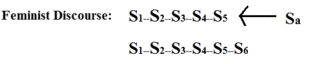
In the Lacanian model, the inscription of a new signifier into the signifying chain produces new discourses. Because the differential relation of symbolic elements in the signifying chain produces meaning, its production is contingent upon a particular relationship of signifiers. However, the inscription of the excluded term reorders the relation of those symbolic elements. The insertion of the otherwise excluded term changes the previously closed order of these elements, creating a new discursive structure and so a new signifying chain. In this way, the analysand produces a new discourse and hence new meaning. From this model, it is possible to understand how the feminist articulation of the a can produce a new discourse. In the operation of feminist discourse, the act of knowing inserts a new signifier into the existing structure of symbolic elements, and thus forms a new signifying chain:

taken from page 109

The disruption and rearrangement of the prior signifying order produces a new relation of symbolic elements, and hence a new discourse. This new discourse produces new meaning, and hence a different representation of the world. This new representation of the world provides a new way to understand it. If knowing is a discursive practice, then the production of new discourses permits the creation of new knowledges by which to know the world.

In the 1970s, the feminist movement began to name the sexual violence many women experienced, but which was perceived neither as a political issue nor as being related to gender politics. This naming is the signification of the a of discourse, because it represents a violence against women which had previously not been articulated. The naming of gendered harms produces a signifier of an otherwise unsignified a of social discourses. …, Deirdre Davis argues that ‘[i]n order to address, deconstruct, and eradicate a harm, we must give the harm a name’ (1997: 200). This naming of the a is then inscribed into the signifying chains of social discourses, which produces a new signifying chain, or knowledge, around the issue of gendered harms. In this way, feminism produces new discourses of gendered harms that fundamentally shift the social meaning of sexual violence.

imaginary identification

Campbell, Kirsten. Jacques Lacan and Feminist Epistemology. Florence, KY, USA: Routledge, 2004. page 101

The relation of aggression to, and mastery of, the other can be seen in feminist identifications. For example, in 1981 bell hooks described how: “as I moved from one women’s group to another trying to offer a different perspective, I met with hostility and resentment. White women liberationists saw feminism as ‘their’ movement and resisted any efforts by non-white women to critique, challenge or change its direction.” (1981: 190)

hooks’s description of the aggression and hostility that greet her reveals the other side of feminist identifications. hooks describes imaginary perceptions of commonality that construct the feminist subject as ‘white’ and women of ‘colour’ as an other to the white feminist. When the ‘other’ insists on her difference, she is met with the aggression of an imaginary identification that seeks to master difference and reduce it to identity. Typically of the next feminist generation, Chambers (1995: 27) and Jee Yuan Lee (1995: 209) identify the aggression and fixity of such imaginary identifications as one of the most difficult problems facing the third-wave reconstruction of feminism. However, Lee also points out that an acknowledgement of the multiple axes of oppression is crucial to the contemporary rearticulation of feminist politics (1995: 211). Because an imaginary relation to the other refuses to acknowledge the politics of the differences between women, it prevents that rearticulation. … Without such a recreation, feminist politics will enact the imaginary mastery of an other which reproduces the social relations of power that enable a subject to enact that mastery. That reproduction does not challenge the operation of power within the feminist movement.

In its refusal to recognize the politics of power within the feminist movement, imaginary identification condemns feminists to reproducing rather than resisting those politics of power. 102

A feminist identification that operates in the imaginary order thus reproduces the violence of contemporary social relations. It imagines the feminist movement as the relation of a woman to another identical to herself, rather than as formed in the negotiated relations between women.

That woman treats her relation to other women with all the contempt that power gives – the power to refuse another’s subjectivity. An imaginary feminist identification, which leads a subject to refuse the particularity and specificity of another subject, condemns her to participating in ‘the same falsely universalizing pretensions as the masculine knowledge’ (Lennon and Whitford 1994a: 3). In an identification in the imaginary register, ‘feminism’ shifts from being an identificatory object to being an object of idealization. It renders the discourses of feminism in the singular, feminisms as feminism, and the many feminist subjects as a universal ‘feminist’ subject. It fixes feminism in the narcissistic gaze of a subject, who is able to gaze at others in this way because the social order gives her the power to do so. Such an act of aggression and mastery militates against an ethics of mutual recognitions.

Without a recognition of the difference of an other, a feminist subject cannot have an ethical relation to that other. An ethical relation is not possible because the other is denied its existence as other and as such can exist only as the subject desires it to. Reciprocal relations require two subjects, not one. The other woman is not allowed to be herself, but only to reflect the self of the powerful subject.

Imaginary identifications constitute the possibility of the recognition of, and relation to, others because they form relations between subjects. However, in the relation of self to other women, there also needs to be recognition of the alterity of the other woman. She must be recognized not only in her similarity and commonality but also in her difference and non-identity.102

group psychology identification

Campbell, Kirsten. Jacques Lacan and Feminist Epistemology. Florence, KY, USA: Routledge, 2004.

For Freud, vertical identification secures the relation of the leader to the members of the group. Each member of the group adopts the perceived attributes of its leader, and in so doing replaces his or her ego-ideal with that of an idealized model of the leader. In this way, each member of the group comes to possess the same ego-ideal. Horizontal identification secures the relation between members of the group, as each member of the group identifies with the ego-ideal of other members. However, the feminist movement cannot be said to have a leader of the type that Freud describes (that is, the prescribed, fixed status of a Pope of the Church or a General of the Army). Rather, it generally rejects ‘leaders’ because it insists upon an anti-hierarchical politics, in which ‘groups’ attempt to organize themselves within models of co-operative and collective decision-making.

In this sense, feminism attempts to resist the vertical tie of group member to leader while emphasizing the horizontal tie between members of its communities. How then is it possible to account for the operation of identifications within the feminist movement? Freud suggests that what he calls ‘leading ideas’ can serve in the place of the ego-ideal provided by the leader of a group, and as such can secure the intersubjective relations of the members of a group (1921: 125).

Drawing on Freud, Teresa Brennan suggests that a feminist ‘body of writing’ can serve as an ego-ideal (1986: 10). In terms of the subject, then, the ‘leading ideas’ of feminism can serve as the ego-ideal of the vertical tie of identification. The identification is with the political ideas of feminism. For example, bell hooks (1981) argues that many women of colour identify with and enact feminist ideas, even while disidentifying with second-wave feminism because of their perception of its racism. More recently, Rebecca Walker (1995a) put forward a similar argument in relation to her third-wave generation. Despite the complexity of naming them, there is a set of commitments or ‘leading ideas’ that the term ‘feminism’ represents. According to this model, each subject identifies with, and thus incorporates, these ‘leading ideas’ of feminist politics. In this way, the body of ideas that forms ‘feminist politics’ serves as the ego-ideal for the subject. They function as the object that the subject identifies with and ‘wants to be like’. For example, Veronica Chambers offers a typical third-wave description of her encounter with feminist ideas, in which she discovers ‘a context for my political existence. A vocabulary for my situation. An agenda to empower myself and others’ (1995: 21). However, Brennan suggests that this process is more complex than the assimilation of the abstraction called ‘feminist politics’. Brennan perceives not only a body of ideas but also ‘a person, people’ as objects of feminist identifications (1986: 10). For example, third-wave feminist Rebecca Walker describes how ‘[l]inked with my desire to be a good feminist was a deep desire to be accepted, claimed and loved by a feminist community that included my mother, godmother, aunts and close friends’ (1995a: xxx). 97

However, the feminist movement is not simply constituted by a series of identificatory ties of each member to an ‘ideal’. The collective nature of a political movement implies more than each individual’s commitment to a set of ideas or role model. It also implies that these individuals perceive themselves as members of a political movement and that these individuals identify with each other as members of that movement. This relation is an identification with the other members of the movement, as well as with the ideals that produce political engagement. There is, it seems, another ‘emotional tie’ at work in the feminist movement. How do we understand that emotional tie? In his discussion of the psychology of the group, Freud argues that, in addition to the vertical tie of identification to the ‘ideal’, there is also a tie between group members. Freud argues that in this relation between group members, each member has ‘put one and the same object in the place of their ego-ideal and have consequently identified themselves with one another in their ego’ (1921: 147). This horizontal tie between members of a group can be seen within the feminist movement. Members recognize others as ‘feminists’ because of a shared commitment to a political project. Each member identifies in others a shared ego-ideal of ‘feminist politics’. In this sense, each subject has put ‘one and the same object’ – feminism – in the place of their ego-ideal and ‘have consequently identified themselves with one another in their ego’. That identification creates a relation between subjects as members of a collective movement. For example, in the introduction to the anthology, To Be Real, Walker argues that ‘these thinkers stake out an inclusive terrain from which to actively seek the goals of social equality and individual freedom they all share’ (1995a: xxxv). These ego-ideal identifications construct both a feminist subject and its relation to other feminist subjects, forming a feminist ‘we’. Brennan suggests that the ego-ideal identification of feminists offsets the categorical imperatives of the patriarchal super-ego, which permits an evasion of the commands of the Father, and makes it possible to think ‘outside’ patriarchy (1986: 10). Certainly, it appears that a feminist ego-ideal displaces the patriarch’s. However, the possibility of such a process also suggests that the Father’s intervention may not be as effective as he would wish.

If, as I have argued, the paternal super-ego is not necessarily effectively secured in, or does not secure, the formation of the female subject, its failure permits an evasion of its normative injunctions and hence creates a possibility of feminist ego-ideal identification.

In this model, feminist identifications take three forms. The first is an affective primary relation with other women. The second and third involve ego-ideal identifications with the ‘ideals’ of feminist politics and with others as members of a political movement. In Freudian terms, both horizontal and vertical ties form feminist subjects. An example of this process can be seen in Elissa Marder’s description of the label ‘feminist’ as ‘seemingly personally conferred (I declare myself a feminist) and collectively confirmed (I am acknowledged by others as participating in feminism)’ (1992: 149). This personal conferral – ‘I identify myself as’ – and that collective confirmation – ‘I identify myself with others and others identify me as’ – produce feminist subjects and the relation between them.

If identification is ‘the detour through the other that defines a self’, then that process forms a feminist ‘self’. Primary identification enables a feminist subject to engage with other women. It institutes a relation between female subjects, and enables a recognition of, as well as a relation to, other women. In this way, it enables feminists to identify with other women and to imagine a relation to them.

Fuss describes how Fanon’s psychoanalytic theory repeatedly calls for ‘“an ethics of mutual identifications”…a world of reciprocal recognitions’ (1995: 144). The construction of an affective relation to other women provides the possibility of an ethics of mutual identifications with, and reciprocal recognitions of, other women. The operations of ego-ideal identifications enable feminist subjects to recognize and imagine themselves as a political movement. After all, feminism is a movement of people, an imagined community that coheres in demonstrations, writing, meetings, actions, projects, conferences, and other forms of activism. The mechanism of ego-ideal identifications enables feminists to perceive themselves as members of a movement. The identifications of its members form this collectivity, both with the ideals of feminist politics and with other subjects identifying with those ideals. This political relation enables feminist conversations to take place, because it forms a feminist ‘I’ and a feminist ‘we’. Therefore feminist subjects are not ‘autonomous, self-making, self-determining subject[s]’ (Alarcón 1994: 141). Rather, a relation to other subjects and to feminist politics produces feminist subjects. 99

Loving the self as other: imaginary identification

This description of identificatory relations between political subjects should not be mistaken for a second-wave ‘sisterhood’ of women united by their identity. Identificatory ties are a means of establishing both commonality and difference, which work to produce both unity with, and differentiation from, others. Lacanian theory provides a means of further understanding this complicated process. While drawing on the Freudian theory, Lacan’s account provides a more complex distinction between imaginary and symbolic identification. This distinction enables us to understand the different identificatory processes at work in the production of feminist subjects, and to draw out the politics of feminist identifications. Like Freud, Lacan recognizes the importance of identification in the formation of the subject, but inflects the Freudian theory through his own theory of the mirror stage. Malcolm Bowie points out that Lacan understands primary identification as being formed in the mirror stage, and accordingly emphasizes its narcissistic and egoistic aspects (1991: 33– 34). For Lacan, the mirror stage can be understood ‘as an identification’ which forms the ego-ideal and hence precipitates the ego (É: 2). For Lacan, identifications are always situated in the imaginary order because they reflect the ego’s narcissistic perceptions.

This Lacanian theory is crucial to understanding feminist identifications because it describes the other side of identification – the desire of the ego that the other mirror the self. 10

Lacan argues that in imaginary identifications, the object is caught in the ego’s méconnaissance or misrecognition of the other as self. The ego misrecognizes the other in its specular reflections, perceiving the other as identical to itself. The identificatory object is known only as the same as self, and with that misrecognition comes a refusal of difference.

In a desire for sameness, the ego perceives only those qualities that are identical to it, so that it refuses difference in the object. The identificatory object functions not as an Other but as an imaginary counterpart, an other that the self imagines to reflect it.

Those imaginary misrecognitions can be seen at work in the feminist movement when a knower, while identifying with other women, does not perceive another woman’s difference, but instead only her similarity. An example of a literal méconnaissance can be seen in Veronica Chambers’s critique of Naomi Wolf’s failure to ‘see’ the colour of her beauty myth (1995: 27). Such an imaginary identification produces the effect of a refusal to recognize the differences between women. In refusing the differences between women, imaginary relations do not recognize other identifications that women may themselves have.

Rightly or wrongly, the third wave emerges from a perception of second wave refusal of difference. It contends that feminism cannot reflect only the concerns of white, middle-class women, but must recognize ‘the multiple, interpenetrating axes of identity’ (Drake and Heywood 1997a: 3). This refusal of the difference between women is symptomatic of the relation of aggressivity to, and mastery of, others of imaginary identification. In this relation to others, the self appropriates the other in an act of violence, reducing the other to an imaginary counterpart whose difference has been mastered. If the other insists upon her difference, the egoistic self greets her with hostility arising from an anxiety of difference. Such an identificatory operation ‘is itself an imperial process, a form of violent appropriation in which the Other is deposed and assimilated into the lordly domain of self’ (Fuss 1995: 145). 100

primary secondary identification

Campbell, Kirsten. Jacques Lacan and Feminist Epistemology. Florence, KY, USA: Routledge, 2004.

In both Freudian and Lacanian theory, the primary and secondary identifications structure the female subject in relation to the mother. Primary identification occurs prior to the object-cathexes of the Oedipus complex and involves an affective relation to the parent, who is then incorporated into the subject to form the nucleus of the ego and the ideal ego. The parent is assimilated as an object ‘inside’ the subject, forming a prototypical self. This process is the ‘individual’s first and most important identification…a direct and immediate identification’ (Freud 1923: 370).

For Freud, the young girl’s formation of a prototypical self ‘rests on her primary affectionate attachment to her mother and takes her as a model’ (1933: 168). Lacan argues that this process takes place in the mirror stage. He also suggests that this primary constitution of the subject involves identification with desire of the phallic mother (É: 320). In these accounts, the first and primary identification of the young girl with her mother forms her prototypical ‘self’. Secondary identification also involves the process of the incorporation of the parental object into the ego. However, in contrast to primary identification, this secondary process takes place in the context of the object-cathexes of the Oedipus complex. It marks the dissolution of the Oedipus complex, since it is a process of identification with the same-sex parent (Freud 1923: 373). For both Freud and Lacan, that identification forms the super-ego. 9 Lacan argues that this secondary identification is symbolic, a process of introjection of the paternal signifier of the father. Lacan perceives these oedipal identifications as having a secondary ‘pacifying and normalising role’ (Bowie 1991: 33). This outcome of the Oedipus complex is an ideal one, and represents its masculine resolution.

The resolution of the Oedipus complex for the young girl poses great difficulty for Freud and Lacan. In his later paper ‘Femininity’, Freud argues that the young girl turns from her mother in rivalry and resentment. However, in that paper he also argues that the young girl takes her mother as a model of femininity in primary identification, and then identifies with the mother as a feminine rival for the father (1933: 168). This description of maternal identification is in keeping with Freud’s earlier description of secondary identification as taking the same-sex parent as its object. Lacan recognizes the contradictions within Freud’s account and attempts to evade them by arguing that the young girl does not identify with the mother but with the paternal object the mother desires, the phallus (S3: 172). However, this argument has the effect that he faces similar difficulties to Freud, but in relation to the paternal rather than maternal identification of the young girl (S2: 262). Moreover, his account implies a maternal identification in that the young girl identifies with the mother’s desire for the phallus, and so takes up a feminine position and becomes a sexed subject. Despite the contradictions within and between the Freudian and Lacanian accounts of the production of female subjectivity, central to both theories is the production of female subjectivity through the primary and secondary maternal identification of the young girl. Unlike the boy, the girl becomes a subject through a series of identifications with her mother. That relation to the maternal forms the female subject through an identificatory relation to an other woman. 92

In these accounts, an incorporation of the maternal figure structures the female subject in a relation to the mother. That formation, and the resulting subjective structure which sustains that relation to the maternal figure, forms and structures the female subject in a relationship to another woman. But what of the Father?

In the Freudian and Lacanian accounts, the Father intervenes in the child’s matriarchal universe to secure phallic identification, such that a ‘successful’ resolution of the Oedipus complex involves an incorporation of the figure of the Father. Yet, for the young girl, that resolution involves identification with the parent of the opposite sex, namely, by identifying with what she is not. Moreover, she must also identify with her mother in order to assume a ‘feminine’ position.

Freud admits that the Oedipus complex is often not resolved as such for the girl, and her incorporation of the paternal figure is less ‘successful’ than the boy’s. Lacan also perceives the ‘successful’ resolution of the Oedipus as problematic for women because of its phallic ordering (S17: 85). In these formulations, ‘feminine’ identification with the Law of the Father is not as efficacious or as immediate for the female subject. Accordingly, the paternal super-ego does not work as effectively in securing ‘feminine’ phallic identification. Freud proposes that the super-ego is less developed in women than in men – a suggestion that he acknowledges will not please feminists (1925b: 342). Nevertheless, if we remember that the super-ego is formed by the introjection of the figure of the father, the representative of paternal, cultural authority, then that ‘lesser’ development suggests not a weaker morality but a weaker paternal super-ego. As the work of the psychologist Carol Gilligan (1982) on moral reasoning in men and women suggests, it may be that women follow other ‘moral’ imperatives besides those proclaimed by the Father. For Lacan, the paternal super-ego is the bearer of Kantian morality (S1: 102; 1958). Gilligan’s critique of a Kantian moral framework suggests that, for a female subject …  94

This description of the production of the female subject recognizes that the young girl may (and most often will) undertake paternal identification and so resolve the otherwise ‘indeterminate’ position of not all in either normative masculine or feminine identifications.

However, a primary and secondary identification with the mother, and a less successful paternal identification, also forms that subject. For this reason, the female subject does not necessarily reproduce normative phallic identifications because she may not identify with the Law of the Father.

An effect of the failure to secure female subjectivity in phallic identification is that the female subject has a certain identificatory mobility. Her identifications are not necessarily exhausted or made rigid by phallic identification. Rather, the formation of the female subject in maternal identification produces an identificatory relation to another woman, which has the possibility of being non-phallic.

The production of the not all of the female subject offers the potential for a non-phallic identification, and hence for an identification with other women. How then do we understand the relationship between this formation of the female subject and the formation of feminist subjects? 94

female feminine feminist

Campbell, Kirsten. Jacques Lacan and Feminist Epistemology. Florence, KY, USA: Routledge, 2004.

How does that subject become a political subject? Is there a relationship between female and feminist subjects? To answer these questions, we need next to consider the relationship between the formation of female and feminist subjects. In the Lacanian account of the production of the female subject, while the phallic function may fail to secure the position of the not all, that position may also resolve into normative ‘masculine’ or ‘feminine’ Oedipal identifications. These ‘normative’ identifications reflect norms of how to be a sexuated subject, and as such are fictional representations of ‘masculinity’ and ‘femininity’. While these Oedipal norms may (and do) fail, they nevertheless represent masculine and feminine identity. Although all identifications are labile, they work to secure the otherwise ‘unstable’ female subject within the ideals of ‘masculinity’ or ‘femininity’.

For Lacan, all speaking beings are inscribed on either side of the Graph of Sexuation (S20: 79). Subjects are by definition sexed, and therefore have masculine or feminine structures.

The female subject can ‘choose’ to take up a place on the masculine side of sexuation. Lacan describes how ‘[o]ne ultimately situates oneself there by choice – women are free to situate themselves there if it gives them pleasure to do so. Everyone knows there are phallic women’ (S20: 71). This female subject takes up a masculine position in phallic identification. This is a subject position of identification with the Law of the Father. 90

In this position, it is not that the female subject exhibits ‘masculine’ traits, but rather that she refuses to recognize that she does not have the phallus. In this position, the subject accepts the terms by which the Law of the Father defines ‘masculinity’ and ‘femininity’, with a concomitant privileging of masculine identity and consolidation of the father’s law.

Alternatively, the female subject can take up a feminine position. That position also requires a masculine identification, insofar as the female subject identifies with the Law of the Father and the operation of the phallus (as the mark of desire) (Evans 1996: 220). In the Lacanian account, the female subject recognizes that the father has what she does not, the phallus. She arrives at the feminine position through the desire for the phallus and its symbolic substitute, the child of the father. For that female subject, the phallus/child operates as the objet a, or the object of desire. Unsurprisingly, that position is arrived at with difficulty because of the absence of the threat of castration and the necessity of identification with the other (masculine) sex. These operations of normative Oedipal identification confront the female subject with a Symbolic order that says all and nothing. In both positions, the female subject identifies with the Law of the Father, the phallic signifier becomes a masculine all, rendering her not all as a nothing.

The female subject appears to be caught within a symbolic field that appears as a universal and transcendental, rather than a contingent, order. These normative identifications do not disrupt a phallocentric subject or socio-symbolic order. They do not disrupt the operation of the phallic signifier, nor contend that other signifiers could structure the subject or the Symbolic order.

However, a fundamental tenet of psychoanalytic theory is the ‘problematic, if not impossible, nature of sexual identity’; the contingency of sexuation, the failure of identity, and the incompleteness of the symbolic field (Rose 1982a: 28). For psychoanalysis, ‘femininity’ is a symptom of that contingency, failure and incompleteness. It is a symptom because female subjectivity is an ‘indetermination’ of a not all, posited as an exception to the phallic function.

For this reason, the ‘riddle’ of femininity has proven to be a source of much difficulty for psychoanalysis. For example, both Freud and Lacan begin by understanding the production of the female subject in the same identificatory structures as the male subject, but in their later work come to recognize the inadequacy of this account. They encounter the difficulty that the phallus ‘guarantees’ the masculine but not feminine subject.

Phallic identification does not determine the female subject because it does not necessarily secure, nor is it secured in, her formation. How, then, do we provide an account of the identificatory instability of the female subject? 91

not all

Campbell, Kirsten. Jacques Lacan and Feminist Epistemology. Florence, KY, USA: Routledge, 2004.

Lacan argues that the position of exception to the phallic signifier is not that of negation or contradiction but of indeterminacy (S20: 103).

The not all of the female subject is a position which the symbolic does not capture. As a position which the law of the signifier does not determine, the not all is a limit to its claim to represent an infinite set of all (S20: 103). It marks both the limit of the phallic signifier (as its exception) and the failure of that limit (as its infinite excess). The not all is an objection to the universal claim of the masculine (S20: 103). The not all of a female subject is a position of a non-universal subject, and so is a position of specificity and particularity. The logic of that position is ‘one by one’ (S20: 10). In the position of not all, the female subject is a specific and particular subject: women ‘do not lend themselves to generalization. Not even, I say this parenthetically, to phallocentric generalization’ (1975e: 18). For Lacan, women do not lend themselves to generalization ‘since we cannot speak of more than one’ (1974: 40). 89

De Lauretis objection which sounds alot like Butler’s

De Lauretis emphasizes the radically indeterminate and unstable nature of this subject, and for this reason rejects a Lacanian theory of the subject. She argues that it proposes ‘a subject constructed in language alone, an “I” continuously prefigured and preempted by an unchangeable symbolic order’, and so cannot address a feminist notion of the subject as ‘a multiple, shifting, and often self-contradictory identity’ (1988: 9).

However, my reformulation of the later Lacanian account of the sexed subject emphasizes its social production as an unstable subject that can therefore be engendered as political. It does not conceive the female subject as an ontological femininity, nor as founded in sexual difference.

The position of the not all is not an ontological description of women, but rather a description of the position of the female subject in socio-symbolic relations. This concept of the female subject locates women neither ‘outside’ nor ‘inside’ the socio-symbolic order. Rose points out that ‘the former relegates women outside language and history, the latter simply subordinates them to both’ (1982a: 57). Rather, resistance can be found in the faltering of the phallic function, which provides the possibility for imagining the socio-symbolic contract otherwise. This possibility is that the phallic Symbolic order does not define all (others) because it fails to know the female subject.

The not all is a position that is neither ‘inside’ nor ‘outside’ the Symbolic order but is in excess of its phallic imaginary. It represents the failure of a metaphysics of phallic identity, and in that failing lies the possibility of an epistemological shift that is able to account for, and move beyond, its limits. This strategy recognizes that is a masculine fantasy that does not represent women. As such, does not describe ‘women’, but is rather a site of feminist contestation. The female subject becomes a position of strategic engagement that recognizes that in ‘feminist theory one speaks as a woman, although the subject “woman” is not a monolithic essence defined once and for all, but rather a site of multiple, complex and potentially contradictory sets of experience’ (Braidotti 1992: 182). This conception of the not all of women requires understanding the female subject not as an ontological ground of the feminist subject, but as a political project which aims to ‘bring about new forms of representation and definition of the female subject’ (Braidotti 1992: 182). It thereby reveals that the possibility of the feminist knower – a knower engaging in the transformation of the failure of the phallic signifier and the socio-symbolic order which it guarantees – is contingent upon a political project of new forms of the socio-symbolic relations and subjectivity.  89-90
campbell sexuation

Campbell, Kirsten. Jacques Lacan and Feminist Epistemology. Florence, KY, USA: Routledge, 2004. p 86.

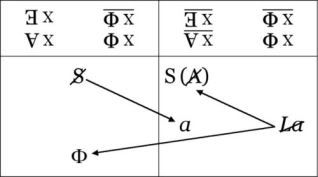
Similarly to the earlier accounts of the sexed subject, the phallus remains the pivot of the later Lacanian account of sexual difference. Lacan’s ‘Graph of Sexuation’ represents sexed identity in relation to the phallic function (S20: 79).

The phallic function is ‘the function that institutes lack, that is, the alienating function of language’ (Fink 1995: 103).

A relation to the phallus structures the masculine and feminine positions, which the formulae of sexuation represent (S20: 79– 80). Because it turns on the phallic function (S20: 59), ‘there is no such thing as a sexual relationship’ (S20: 12).For this reason, a relation between the sexes is an impossibility.

Lacan claims that the ‘male way’ of jouissance produces the non-relation between the sexes (S20: 56– 57). The phallic function produces the jouissance of the masculine subject, the enjoyment of the (phallic) organ on which ‘all’ turns.

Lacan argues that the phallic function inscribes the male subject ‘man as whole’ or ‘as all’ (l’homme comme tout) (S20: 79).

Joan Copjec describes that inscription as producing ‘a universe of men’, a masculine universal (1994: 235).

The masculine subject claims to be a man who is whole and all, a master of himself who ‘[b]y denying the trauma of primary Castration . . . unconsciously perpetuates the suppression of the person’s own division and the belief in her or his autonomy’ (Ragland-Sullivan 1987: 305).

The masculine claim rests on the exception of castration – such that he defines his universality in relation to an other without the phallus. The masculine subject represents his ontological lack as the castration of the feminine other.

That other position of the subject is that of  — a fantasy that affirms that the masculine subject has the phallus.

In this fantasy, desires the phallus, confirming that he has it. If the whole of the sexual relation is a fantasy, it is a masculine fantasy of as the cause of his desire (S20: 131). The cause of his desire is the objet a – the originary missing object that can never be found (S20: 86).

Zizek identifies that missing object as the Mother-Thing on which masculine fantasy turns (1989: 119). For the masculine subject, the feminine represents a fantasy object that can answer his desire for universality and completeness: she confirms that he does not suffer castration.

In its relation to the masculine subject, the feminine is a fantasy of a castrated other that confirms that she is castrated and he is not. The operation of the phallic function produces this fantasy.

For this reason, Lacan argues that does not exist. She exists only as a fantasy of the masculine subject, formed in his phallic jouissance and in his desire (86).

No woman can fulfil that fantasy. In this way, The fantasy Woman does not exist in the real, because no woman could enact the fantasy that he substitutes for her. Lacan points out in his earlier work on feminine masquerade that women may attempt to fulfil that fantasy (É: 321). However, while a woman may attempt to play out the masculine fantasy, in doing so she does not exist as other than in and through fantasy.

Lacan indicates the impossibility of by his bar through the definite article ‘The’. When interviewed in 1973, Lacan formulates the impossibility of ‘Woman’ as ‘The Woman does not exist’ (1974: 38). In Encore, Lacan makes it clear that, by that formulation, he does not mean that women do not exist but that the masculine fantasy of is an impossibility (S20: 72– 73).

If Lacan’s later account of the sexuated subject went no further than this description of masculine and feminine subjects, then it would only be a more elaborated version of the classical Lacanian theory of sexuation. As such, the phallus would still function as a transcendental guarantee of subjectivity and the Symbolic order. Such an account would therefore remain vulnerable not only to the feminist objection of androcentrism, but also to the compelling deconstructionist critique of ‘phallogocentrism’ (Derrida 1980).

However, in Encore, Lacan confronts the question of ‘What does woman want?’, which leads to a reworking of his theory of the female subject. In Encore, Lacan describes how ‘what I am working on this year is what Freud expressly left aside: Was will das Weib? “What does woman want?”’ (S20: 80). Lacan responds to that question with some of his most misogynist statements. He suggests that women tell nothing of their body or their pleasure, and that in fact they know nothing of their bodies or their pleasures (S20: 74– 75). Ultimately, Lacan reduces this mystical unknown Other to the unknowable maternal Thing (S20: 99). The question of what do women want implies a desire to know women, insofar as Lacan wants to know what women want. What is in question is Lacan’s knowledge of women. However, what Lacan puts into question is what women themselves know. His answer? Nothing. What emerges in Lacan’s discussion of what women want is a succession of gestures of rhetorical mastery, which understand this unknown object as ignorant of itself, and finally as unknowable. The drive to master that object is evident in Lacan’s claimed status of Knowing Master: ‘[i]t’s just that they don’t know what they’re saying – that’s the whole difference between them and me’ (S20: 73). However, these gestures of mastery are at play within the same text in which the ‘truth’ of women is in excess of a phallic regime, and constantly threatens to breach its symbolic logic.

The question of what women want opens the way for Lacan’s conception of the female subject as ‘not all’ (pas toute). In Encore, the position of the female subject is not rendered as nothing, but as not all of the phallus: ‘I said “of woman”, whereas in fact woman does not exist, woman is not whole (pas toute)’ (S20: 7).  (87)

In this formulation, the not all of the female subject is a not all of the phallic function. Lacan argues that ‘when any speaking being whatsoever situates itself under the banner “women”, it is on the basis of the following – that it grounds itself as being not-whole in situating itself in the phallic function’ (S20: 72). If the exception of castration defines ‘all’ of the masculine position (S20: 79), then the position of the female subject is that of an exception.

The masculine rests on the exception of feminine (castration). It rests on her being other than the phallic all. With this exception, the phallus cannot be posited as a universal and so cannot define all, because it has the status of a universal that rests on a non-universal.

Reading the Graph of Sexuation in Encore from the side of the masculine subject positions the female subject as an exception to the phallic signifier and hence as a signification of its limit. The phallus does not define her sexed subjectivity, because she comes to be a sexed subject through normative identifications with a member of the opposite sex.

It does not define her body, for the phallus does not symbolize her body (S3: 176). It does not represent her sexuality, since her jouissance is not a phallic jouissance (S20: 74). Lacan argues that ‘[a] woman can but be excluded by the nature of things, which is the nature of words and it must be said that if there is something that women complain about enough for the time being, that’s it’ (S20: 73).

To be a woman is not to be excluded from language. For Lacan, ‘[i]t’s not because she is not wholly in the phallic function that she is not there at all. She is there in full (à plein). But there is something more (en plus)’ (S20: 74). The paradox of the female subject is that she is within the phallic law of the signifier and yet ‘there is something more’.

The not all of the female subject should therefore be understood as the failure of the law of the signifier to represent her sexed subjectivity. The not all of the female subject is constituted in its failure to represent her subjectivity as other than phallic.

Her position of ‘Other’ is then a position of being other than the phallic subject. Therefore, the phallic signifier does not define the female subject. The not all is not that which is Other to the phallus, but that which it does not define. The Lacanian account of the position of the female subject is the failure of the symbolic to represent that subjectivity.

The Graph of Sexuation should therefore be read as a Graph of Male Sexuation and of the operation of masculine subjectivity. It does not describe the female subject other than in terms of the phallic function. For this reason, Lacan’s Graph can only represent the female subject as not defined by the law of the signifier.

In this later model of sexuation, the phallus only guarantees a masculine subject and symbolic order. The subjective and symbolic structures that it supports are therefore incomplete – there is always ‘something more’, such that the phallic order always produces an excess to itself. The phallus fails to effect closure of what otherwise appears to be a transcendental Symbolic order. For this reason, the not all provides a means to reconceive the female subject. (88)