Slavoj Zizek: What is a Master-Signifier
By Rex Butler
http://www.lacan.com/zizek-signifier.htm
[…]
And what Laclau and Mouffe’s ‘radical democracy’ marks is this paradox whereby the very success of a signifier in casting its light over others is also its failure, because it can do so only at the cost of increasingly emptying itself of any determinate meaning, or because in doing so it can always be shown not to be truly universal, to leave something out.
What this means is that, because there is no underlying society to give expression to, each master-signifier works not because it is some pre-existing fullness that already contains all of the meanings attributed to it, but because it is empty, just that place from which to see the ‘equivalence’ of other signifiers. It is not some original reserve that holds all of its significations in advance, but only what is retrospectively recognized as what is being referred to. Thus, to take the example of ‘democracy’, it is not some concept common to the liberal notion of democracy, which asserts the autonomy of the individual over the State, and the socialist notion of democracy, which can only be guaranteed by a Party representing the interests of the People. It is not a proper solution to argue either that the socialist definition travesties true democracy or that the socialist alternative is the only authentic form of democracy. Rather, the only adequate way to define ‘democracy’ is to include all political movements and orientations that legitimate themselves by reference to ‘democracy’ – and which are ultimately defined only by their differential relationship to ‘non-democracy’. As Zizek writes:
The only possible definition of an object in its identity is that this is the object which is always designated by the same signifier – tied to the same signifier. It is the signifier which constitutes the kernel of the object’s ‘identity’. (SO, 98)
In other words, what is crucial in any analysis of ideology is to detect, behind the apparently transcendental meaning of the element holding it together, this tautological, performative, fundamentally self-referential operation, in which it is not so much some pre-existing meaning that things refer to as an empty signifier that is retrospectively seen as what is being referred to. This ideological point de capiton or master-signifier is not some underlying unity but only the difference between elements, only what its various mentions have in common: the signifier itself as pure difference (SO, 99).
Laclau and Mouffe’s ‘radical democracy’ is a recognition that ideological struggle is an attempt to ‘hegemonize’ the social field: to be that one element that not only is part of the social field but also quilts or gives sense to all the others – or, in Hegelian terms, to be that ‘species which is its own universal kind’ (SO, 89). But, if this is the way ideology works, it is also this contingency, the notion that the meaning of any ideological term is fundamentally empty, not given in itself but able to be interpreted in various ways, that Laclau and Mouffe argue for. That is, ‘radical democracy’ would be not only one of the actual values within the ideological field, but also that in which other values recognize themselves, that for which other values stand in. It would be not only one of the competing values within the ideological struggle, but would speak of the very grounds of this struggle. As Zizek writes:
The dialectical paradox [of ‘radical democracy’] lies in the fact that the particular struggle playing a hegemonic role, far from enforcing a violent suppression of differences, opens the very space for the relative autonomy of particular struggles: the feminist struggle, for example, is made possible only through reference to democratic-egalitarian political discourse. (SO, 88-9)
It is with something like this paradox that we can see Zizek grappling in his first two books. In Sublime Object, he thinks that it is only through the attempt to occupy the position of metalanguage that we are able to show the impossibility of doing so (SO, 156) and the phallus as what ‘gives body to a certain fundamental loss in its very presence’ (SO, 157). In For They Know Not, he thinks the king as guaranteeing the ‘non-closure of the social’ insofar as he is the ‘place-holder of the void’ (TK, 267) and the ‘name’ as what by standing in for the New is able to preserve it (TK, 271-3). And, in a way, Zizek will never cease this complicated gesture of thinking the void through what takes its place. In this sense, his work remains profoundly indebted to the lesson of Hegemony and Socialist Strategy. But in terms of Laclau and Mouffe’s specific project of ‘radical democracy’, Zizek’s work is marked by an increasing distance taken towards it. In “Enjoyment within the Limits of Reason Alone”, his Foreword to the second edition of For They Know Not, he will speak of wanting to get rid of the ‘remnants of the liberal-democratic stance’ of his earlier thought, which ‘oscillates between Marxism proper and praise of ‘pure democracy’ (TK, xviii). And, undoubtedly, Zizek’s work becomes more explicitly Marxist after his first two books. But, more profoundly, this change in political orientation is linked to certain difficulties he begins to have with Laclau and Mouffe’s notion of ‘hegemony’ itself. They might be summarized as: if political struggle is defined as the contest to put forward that master-signifierwhich quilts the rest of the ideological field, then what is it that keeps open that frame within which these substitutions take place? What is it that ‘radical democracy’ does not speak of that allows the space for their mutual contestation? As Zizek writes later in Contingency, Hegemony, Universality, we need to ‘distinguish more explicitly between contingency/substitutability within a certain historical horizon and the more fundamental exclusion/foreclosure that grounds this very horizon’ (CHU, 108). And this leads to Zizek’s second major criticism of Laclau and Mouffe: that for all of their emphasis on the openness and contingency of signification, the way the underlying antagonism of society is never to be resolved, nothing is really contemplated happening in their work; no fundamental alteration can actually take place. There is a kind of ‘resignation’ in advance at the possibility of truly effecting radical change, a Kantian imperative that we cannot go too far, cannot definitively fill the void of the master-signifier, cannot know the conditions of political possibility, without losing all freedom (CHU, 93, 316-7).
But, again, what exactly are Zizek’s objections to Laclau and Mouffe’s notion of ‘radical democracy’? And why is Marxism seen as the solution to them? As we have said, underlying the project of radical democracy is a recognition that society does not exist, cannot be rendered whole. It cannot be rendered whole not because of some empirical excess but because any supposed unity is only able to be guaranteed from some point outside of it, because the master-signifier that gathers together the free-floating ideological elements stands in for a void. As with the order of language, this empty signifier or signifier without signified is the way for a self-contained, synchronic system, in which the meaning of each element is given by its relationship to every other, to signify its own outside, the enigma of its origin (TK, 198). This means that any potential master-signifier is connected to a kind of hole or void that cannot be named, which all the elements stand in for and which is not defined by its relationship to others but is comparable only to itself: objet a. But for Zizek, finally, Laclau and Mouffe’s ‘radical democracy’ remains too much within an horizon simply defined by these elements. It does not do enough to think that frame which allows their exchangeability. More importantly, it does not do enough to change this frame, to bring what is excluded from it inside. It is not, in other words, that true ‘concrete universality’, in which the genus meets itself amongst its species in the form of its opposite (CHU, 99-101). For Zizek, it is not ‘radical democracy’ but only ‘class struggle’ that is able to do this, that is able to signal this antagonism – void – that sutures the various ideological elements. It is only ‘class struggle’ that is at once only one of the competing master-signifiers – class, race, gender – and that antagonism to which every master-signifier is an attempt to respond (CHU, 319-20).
Of course, at this point several questions are raised, to which we will return towards the end of this chapter and in Chapter 5. First of all, how fair are Zizek’s accusations against Laclau and Mouffe when, as we have seen, radical democracy just is this attempt to think that ‘void’ that allows all requiltings, including that of ‘radical democracy’ itself? Is Zizek in his advocacy of ‘class struggle’ only continuing the principle already at stake in ‘radical democracy’? Is he not with his insistence on ‘class struggle’ merely proposing another requilting of ‘radical democracy’, another renaming of the same principle? And yet, Zizek insists, it is only in this way that we can truly bring out what is at stake in ‘radical democracy’. It is only in this way that we can make clear that no master-signifier is final, that every attempt to speak of the void is subject to further redefinition. It is only in this way that the process of contesting each existing master-signifier can be extended forever. (It is for this reason that Zizek will accuse Laclau in Contingency, Hegemony, Universality of a kind of Kantian ‘formalism’ (CHU, 111-2, 316-8), of excepting a transcendental, ahistorical space from the consequences of his own logic.) And yet, if Zizek challenges Laclau and Mouffe’s ‘radical democracy’ on the basis of ‘class’, class is not exactly what he is talking about but would only stand in for it. As we have already seen, class is not to be named as such because the very effect of its presence is that it is always missed. In this sense, class is both master-signifier and objet a, both master-signifier and what contests the master-signifier, both that void the master-signifier speaks of and that void the master-signifier covers over. Is there not therefore a similar ‘resignation’ or failure in Zizek, a continual falling short of that act that would break with the symbolic and its endless substitution? Or is this ‘failure’ only the symbolic itself? Is Zizek finally not proposing an end to the symbolic but rather insisting on the necessity of thinking its ‘transcendental’ conditions, the taking into account of that ‘outside’ that makes it possible?
Accordingly, in this chapter we look at how the master-signifier works. We examine the ways in which Zizek takes it further than Laclau and Mouffe’s similar notion of the hegemonic ‘universal signifier’. And how he takes it further – to begin to head toward those issues we have previously signalled – is that it is not a mere extension of an existing concept tending towards emptiness, but is ’empty’ from the very beginning, a pure ‘doubling’ of what is. That is, implicit in the idea of the master-signifier is that it is not so much an empirical observation that comes out of the world or a formal structure that precedes it as what at once makes the world over in its image and is the secret explanation of the world just as it is; something that is neither to be verified or refuted but, as we saw in Chapter 1 with regard to class and the unconscious, is its own absence or difference from itself. And it is for this reason that later in this chapter we look at the relationship of this master-signifier to objet a around two privileged examples in Zizek’s work: the figure of the ‘shark’ in the film Jaws and the ‘Jew’ in anti-Semitism. In both cases, we can see that objet a that is behind the master-signifier and that allows us to recoup its difference from itself, to say that all its variants speak of the same thing. And this will lead us to the innovative aspect of Zizek’s treatment of ideology: his analysis of how a certain ‘distance’ – or what he calls ‘enjoyment’ – is necessary for its functioning. It is a distance we already find with regard to Jaws and Jews; but it can also be seen as a feature of ideological interpellation, as analysed by Althusser. Finally, following on from this, in the last section of this chapter, we pursue the idea that there is always a certain necessary openness by which we are able to contest any ideological closure, that the same element that sutures the ideological field also desutures it, that we are always able to find a species within it that is more universal than its genus. This again is the ambiguity of objet a as at once what indicates that void at the origin of the symbolic constitution of society and what stands in for it. And it is this that leads us towards Chapter 3, which raises the question of objet aas that act that would break or suspend the symbolic order of the master-signifier.
Some examples of the master-signifier
So what is a master-signifier and how does it operate in ideology? In order to answer this question, let us begin, perhaps surprisingly, with three examples taken from the realm not of politics but of art. In the chapter “The Wanton Identity” from For They Know Not, in the middle of a discussion of what he calls the ‘re-mark’, Zizek speaks of the famous third movement of the Serenade in B flat major, KV 361, by Mozart. In it, a beautiful introductory melody, played by the winds, is joined by another, played by the oboe and clarinet. At first, this second melody appears to be the accompaniment to the first, but after a while we realize that this first is in fact the accompaniment to the second, which as it were ‘descends ‘from above’ (TK, 76-7). Zizek then considers the well-known ‘bird’s eye’ shot of Bodega Bay in flames during the attack of the birds in Hitchcock’s film The Birds. We have what initially appears to be an unclaimed point of view, but at first one bird, then another, and then another, enters the screen, until there is a whole flock hovering there before us. We soon realize that those birds, which originally appeared to be the subject of the shot, much more disquietingly provide its point of view (TK, 77). Finally, Zizek looks at what appears to be the reverse of this procedure, the opening scene of Francis Ford Coppola’s espionage thriller, The Conversation. The film begins with a seemingly conventional establishing shot of workers in a square during their lunch break, over which play random snatches of conversation. It is not until the end of the film that we realize that what we took to be mere background noise there holds the key to the plot (and to the survival of the agent who recorded it): the bugging of a furtive lunchtime liaison of an adulterous couple and their plans to murder the woman’s husband (TK, 77).
There is a surprising turnaround in each case here – close to what a number of contemporary theorists have characterized as simulation – but we should try to explain in more detail how this ‘reversal’ actually occurs. In each case, we can see that it works neither by adding something to the original, proposing some complement to it, nor by inverting the original, suggesting some alternative to it. In Mozart, that second melodic line is not a variation upon or even the counterpoint to the first. In The Birds, we never see whose point of view the ‘bird’s eye’ shot represents. In The Conversation, no one is sure until the end of the film what the significance of the conversation is. The ‘re-mark’ does not so much ‘add’ as ‘subtract’ something – or, more subtly, we might say that it adds a certain ‘nothing’. What the addition of that second, ‘re-marking’ element reveals is that something is missing from the first, that what was originally given is incomplete. That order we initially took to be self-evident, ‘unre-marked’, is shown to be possible only because of another. That place from which the world is seen is reflected back into the world – and the world cannot be realized without it (TK, 13). Or, to put this another way, the world is understood not merely to be but to signify, to belong to a symbolic economy, to be something whose presence can only be grasped against the potential absence or background of another (TK, 22).
Thus, to return to our examples, the genius of Mozart in the third movement of the Serenade is not that the second motif retrospectively converts the first into a variant of it, but that it suggests that both are ultimately variants of another, not yet given, theme. It reveals that the notes that make up the first are precisely not other notes, for example, but only for example, those of the second. This is the ‘divine’ aspect of Mozart’s music: it is able to imply that any given musical motif only stands in for another, as yet unheard one that is greater than anything we could imagine. And this is the genius of Hitchcock too in The Birds (of which The Conversation is an aural variant), for in that Bodega Bay sequence the ultimate point of view is not that of the birds but that of off-screen space itself, for which the birds are only substitutes. Indeed, the French film theorist Pascal Bonitzer speaks of this ‘doubling’ or ‘re-marking’ of what is in terms of the ‘gaze’ in the essay ‘Hitchcockian Suspense’ he writes for the Zizek-edited collection Everything You Always Wanted to Know. He begins by conjuring up that archetypal scene from early cinema, in which we see a young nanny pushing a pram being courted by an amorous soldier in a park. He then speaks of the way that, signalled by an intervening crime, what at first seemed innocent and sentimental becomes:
Troubled, doubled, distorted and ‘hollowed out’ by a second signification, which is cruel and casts back every gesture on to a face marked by derision and the spirit of the comic and macabre, which brings out the hidden face of simple gestures, the face of nothingness. (H, 20)
That is, the soldier and the nanny can now be seen to be playing a dangerous and ambiguous game: the nanny wishing to drown the baby, the soldier dreaming of assaulting the nanny. But, again, the crucial aspect here is that none of this actually has to happen, nor does the crime even have to take place. The peculiar form of Hitchcockian ‘suspense’ lies in what is left out of the scene, what does not happen; this other place or possibility – which we might call the ‘death’s head’ (H, 20) of the gaze – for which what we do see stands in.
It is this reversal of meaning that we also have in Zizek’s other examples of the master-signifier in For They Know Not, which is that book of his where he deals most extensively, as he says, ‘on the One’ (TK, 7-60). The first is the notorious Dreyfus Affair, which in 1898 saw an innocent Jewish captain of the French Army, Alfred Dreyfus, sent to Devil’s Island for being part of a plot to overthrow the government of the day. It is an episode that even now has its effects: the separation of Church and State in modern democracies, Socialist collaboration in reformist governments, the birth of both Zionism and right-wing populist political movements. The decisive incident of the whole affair, argues Zizek, did not occur when we might at first think, during that moment when Dreyfus was initially accused and then vigorously defended by the writer Zola, when the facts were weighed up and appeals made to the rule of law. Rather, the turning point came later, when all was seemingly lost for the anti-Dreyfus forces, when the evidence seemed most stacked against them. It was the episode in which the Chief of French Intelligence, Lieutenant Colonel Henry, who had just been arrested for forging documents implicating Dreyfus, committed suicide in his cell. Of course, to an unbiased observer, this could not but look like an admission of guilt. Nevertheless, it was at this point that the decisive intervention occurred. It was that of the little-known journalist Charles Maurras who, outwitting his better credentialled opponents, argued that this action by Henry was not evidence against the plot in which Dreyfus was implicated but evidence for. That is, looked at in the right way – and here the connection with Hitchcock’s notion of the ‘gaze’ – Henry’s forgery and suicide were not an admission of guilt but, on the contrary, the heroic actions of a man who, knowing the judiciary and press were corrupt, made a last desperate attempt to get his message out to the people in a way they could not prevent. As Zizek says of Maurras’ masterstroke: ‘It looked at things in a way no one had thought or dared to look’ (TK, 28) – and, we might even say, what Maurras added, like Hitchcock, is just this look itself; what he makes us see is that Henry’s actions were meant for our look and cannot be explained outside of it.
We find the same sudden reversal of meaning – the same turning of defeat into victory – in our next example from For They Know Not. It is that of St Paul, the founder of the Christian Church. How is it, we might ask, that St Paul was able to ‘institutionalize’ Christianity, give it its ‘definitive contours’ (TK, 78), when so many others had tried and failed before him? What is it that he did to ensure that Christ’s Word endured, would not be lost and in a way could not be lost? As Zizek writes, in a passage that should remind us of what we said in our Introduction about how the messages of our great philosophers cannot be superseded or distorted:
He (St Paul) did not add any new content to the already-existing dogmas – all he did was to re-mark as the greatest triumph, as the fulfilment of Christ’s supreme mission (reconciliation of God with mankind), what was before experienced as traumatic loss (the defeat of Christ’s mundane mission, his infamous death on the cross) . . . ‘Reconciliation’ does not convey any kind of miraculous healing of the wound of scission; it consists solely in a reversal of perspective by means of which we perceive how the scission is already in itself reconciliation. To accomplish ‘reconciliation’ we do not have to ‘overcome’ the scission, we just have to re-mark it. (TK, 78)
We might say that, if St Paul discovers or institutes the word of Christ here, it is in its properly Symbolic sense. For what he brings about is a situation in which the arguments used against Christ (the failure of His mission, His miserable death on the cross) are now reasons for Him (the sign of His love and sacrifice for us). Again, as opposed to the many competing prophets of the time, who sought to adduce evidence of miracles, and so on, it is no extra dimension that St Paul provides (that in fact Christ succeeded here on earth, proof of the afterlife). Rather, he shows that our very ability to take account of these defeats already implies a kind of miracle, already is a kind of miracle. Defeat here, as understood through the mediation of Christ’s love, is precisely not a sign of a victory to come but already a form of victory. St Paul doubles what is through the addition of an empty signifier – Christ’s worldly mission – so that henceforth the very lack of success is success, the failure of proof is proof. Through this ‘re-mark’, the very fact that this defeat is seen means that it is intended to be seen, that a lesson or strength is sought to be gained from it. This gaze on to events becomes part of these events themselves. It is what Lacan in his Seminar on The Ethics of Psychoanalysis calls the ‘point of view of the Last Judgement’ (S7, 294). And in this would lie the ‘superiority’ of Christianity over both atheism (St Paul) and Jewishness (Maurras). Exactly like the figure of the king for Hegel, through Christ we are able to bring together the highest and the lowest, the Son of God and the poorest and most abject of men (TK, 85). Indeed, this is what Hegel means by dialectical sublation – or this is what allows dialectical sublation – not the gradual coming-together of two things, but a kind of immediate doubling and reversal of a thing into its opposite. Seen from another hitherto excluded perspective, the one already is the other, already is ‘reconciled’ to the other (although, as we have seen, it is also this that allows us to think their separation, what cannot be taken up or sublated).
We might just offer here one more example of this kind of ‘conversion’ from For They Know Not, which originally derives from Lacan’s Seminar on The Psychoses. It is another instance, like St Paul, of the Symbolic power of speech, or what Lacan calls ‘full speech’; but it is a ‘full speech’, paradoxically – and here again we return to the lesson of our great philosophers – that is ‘full’ in being ’empty’. (Or, more accurately, it is a speech that is able to bring about the effect of Imaginary misrecognition, of always referring to present circumstances, through its Symbolic ability to turn failure into success. That is, as Zizek insists in For They Know Not, the Imaginary and the Symbolic are not two opposed registers, for within the Imaginary itself there is always a point of ‘double reflection’ (TK, 10), where the Imaginary is hooked on to the Symbolic.) 1 It is exactly in saying ‘nothing’ that the word lives on, is transmitted. This last example is from the play Athalie by Racine – and it too involves a certain ‘plot’. The master-signifier this time is to be found in the words of one of the play’s characters, the high priest Jehoiada, to the recent convert Abner who, despite his brave actions, still fears what is being done to the Christians under King Athaliah and is unsure as to the ultimate outcome of their struggle. In response to Abner’s doubts, Jehoiada replies:
The one who puts a stop to the fury of the waves Knows also of the evil men how to stop the plots. Subservient with respect to his holy will, I fear God, dear Abner, and have no other fear. (TK, 16)
As Zizek emphasizes, faced with the anxiety and uncertainty of Abner, who in fact is always waiting to be discouraged, Jehoiada does not attempt logically to persuade him. He does not argue that Christianity is winning or promise him heaven (both of which, as it were, would be only the consequence of belief and not its explanation). Rather, he simply states that all of these earthly fears and hopes are as nothing compared to the fear of God Himself. Suddenly – and, again, it is the notion of ‘conversion’ that Zizek is playing on – all of these worldly concerns are seen in a different light. What allows religious conversion is not the prospect of imminent success on earth or the future promise of heaven, but the fear of God Himself, by comparison to which the worst here is already like being in heaven. (At the same time – and this is why Zizek is able to repeat Feuerbach’s critique of religion as offering a merely specular, reversed image of the world, secretly determined by what it opposes (TK, 17) – it is through this impossible, virtual space that we would be able to mark the failure of any actual heaven to live up to its ideal, that we can know that any heaven we can actually grasp is not yet it.) It is only at this point that the proper gesture of ‘quilting’ or point de capiton takes place. Abner is transformed from an uncontrolled zealot, whose fervour marks a deep insecurity, to a true and faithful adherent, who is convinced of his mission and who neither needs the reward of heaven nor is shaken by events that appear to go against him.
This is, indeed, the suddenness or immediacy of Symbolic conversion, as emphasized by Zizek (and intimated in various ways by St Paul and Hegel). It does not properly work by reason, argument, persuasion. It can never be grasped as such. We are always too late to catch it in action because it has already erased itself, made it seem as though it is merely describing things as they are. Any evidence or confirmation would remain only at the level of the Imaginary, always in the form of horoscopes, predictions, self-fulfilling prophecies. And, equally, it is not even a matter of subjective belief, as all the great theologians already knew. The Word, the Other, already believes for us, and we can only follow. There is always a belief before belief. Self-knowledge and self-reflection come about only afterwards. And all of this is why, if St Paul is able to found an institution on the Word of God, he also cannot, because there is always something about the master-signifier that resists being fixed in this way. But this is what God, this is what the institution, this is what the master-signifier, is. The master-signifier is the name for its own difference from itself. The master-signifier names its own difference from itself. And to go back to Lacan’s Seminar on The Psychoses, in which he first begins to formulate his theory of the master-signifier, this is just what the psychotic is unable to do. As Lacan comments there, a little psychosis, as seen in something like paranoia, is normal: the constitution of a coherent symbolic reality requires a certain reading in of plots, of hidden meanings, behind the apparent surface of things. And, of course, what this suggests is the possibility of another plot behind this plot, and so on. But what the psychotic is unable to do is stop at a certain point and say that this infinite regress is what the plot is: the symbolic closure of the Name-of-the-Father or master-signifier has been foreclosed to them. 2 It is in this regard that the Church is necessarily in touch with something that goes beyond it, a sort of performative miracle outside of any institutionalization, which at once opens up and closes down the difference of the master-signifier from itself: objet a. As Lacan notes admiringly of Christianity and its point de capition: “You will say to me – That really is a curate’s egg! Well, you’re wrong. The curates have invented absolutely nothing in this genre. To invent a thing like this you have to be a poet or a prophet.” (S3, 267).
Jaws and Jews
But, despite all we have said so far, we have not perhaps spoken enough about the master-signifier. Are not the examples we have given far-fetched, not typical of the way contemporary society actually operates? Do we really see such conspiracies as the Dreyfus case any more? Can a situation suddenly be ‘converted’ and turned around, as in St Paul and Athalie? Do such points de capiton as the ‘Jewish plot’ and the ‘fear of God’ truly exist in today’s world? Is there a single ‘quilting’ point that is effectively able to condense an entire ideological field and make us see it in its terms? And, along these lines, how are we to obtain any critical distance on to the master-signifier? How are we to speak of its failure when it is just this ‘failure’ that the master-signifier already takes into account, that the master-signifier is? How to oppose anything to the master-signifier when one of the first things affected by it is the ‘very standard by means of which we measure alienation’ (TK, 15)? How to step outside of this ideological space when the very idea of some non-ideological space is the most ideological illusion of all (MI, 19-20)? And what of the role of objet a in all of this, as what allows this differential structure according to which the master-signifier is defined by what it is not, in which the outside is inside (extra-ideological space is ideological) and the inside is outside (the symbolic order works only insofar as there is some distance on to it)? How does objet a function to ensure that there is no outside to the symbolic order, but only insofar as there is a certain ‘outside’ to it?
In order to answer these questions, let us begin by taking up undoubtedly Zizek’s best known example of the master-signifier in action: the figure of the shark from Jaws. Of course, like all great movie monsters, the shark can be seen as representative of many things, from the forces of nature fighting back (as humans increasingly encroach on its territory), to the eruption of sexuality (it appears after two teenagers attempt to have sex in the water), from the threat of the Third World to America (the shark, like illegal immigrants, arrives by the sea) to the excesses of capitalism (as revenge for the greed of the town mayor and resort owners in refusing to close the beach during a holiday weekend). In this sense, the shark can be understood as allowing the expression of ordinarily repressed desires and impulses within society, making explicit its usually unspoken ideologies and beliefs. And it is into this interpretive milieu that the analyst enters when they argue that it is their conception of the shark that best offers an insight into the society that produced it. However, as we have already seen with the ‘rise’ of the Nazi narrative in Germany in the 1930s, it is exactly here not a matter of deciding which account of the shark best corresponds to the truth of contemporary society, for it is the shark itself that each time constructs society in its image. Or, to put it another way, the analyst already has something to say about society (some point to make about the environment, sexuality or capitalism), which they then attribute to the shark. In both cases, what is not questioned – what the overwhelming physical presence of the shark allows us to forget – is that this is only an interpretation of society. What is not seen is that circularity according to which the shark is seen as embodying certain tendencies that have already been attributed to the shark. As Zizek says of what he calls this ‘direct content analysis’: ‘(It) proceeds too quickly and presupposes as self-evident the fantasy surface itself, the empty form/frame which offers space for the appearance of the monstrous content’ (E!, 133).
That is, the true ideological effect of the shark, how it functions as a master-signifier, is to be found not in the way it represents certain tendencies in society that are already recognized but in the way it allows us to perceive and state these tendencies for the first time. It is the shark itself that allows the various fantasies and desires of the analyst – the true ‘monstrous content’ Zizek speaks of – to be expressed as though with some evidence, as though speaking of something that is actually there. As we saw with the re-mark, if the shark appears merely the expression of social forces that already exist, these forces would also not exist without the shark. If the shark appears simply to put a name to things, these things could also not be perceived before being named. (Zizek says the same thing about Hitchcock’s The Birds: that if the film dramatizes certain pre-existing family tensions, these tensions could not be seen without the birds (LA, 104-6). 3 But, again – this is the very ‘fantasy frame’ that allows these ‘monstrous contents’ to be registered – in this circularity something new is brought about. If the shark expresses only what is already attributed to it by various interpreters, it also appears to be what they are all talking about, what they all have in common, even in their very differences from and disagreements with each other. It is over the meaning of the shark that they dispute, as though it is real, as though it is more than others see in it. And it is in this way, finally, that the shark acts as a master-signifier, as what various ideological tendencies recognize themselves in, what ‘quilts’ them, makes them equivalent. As the critic Fredric Jameson writes, in a passage cited by Zizek:
The vocation of the symbol – the killer shark – lies less in any single message or meaning than in its very capacity to absorb and organize all of these quite distinct anxieties together. As a symbolic vehicle, then, the shark must be understood more in terms of its essentially polysemous function rather than as any particular content attributable to it by this or that spectator. (E!, 133)
However, to try to draw out what Jameson is saying a little more, what is implied here is that there is some ‘real’ shark behind all of the various interpretations of it. It would be a shark that is not only what is in common to all of these interpretations but what all of them try (and fail) to take account of. It would be a shark that is more than any of these interpretations and that is unable to be captured by any one of them – something that in a sense cannot be named, and for which the shark itself is only a substitute (TN, 149). 4 It is what Zizek calls in similar circumstances what is ‘in shark more than shark’, the shark as objet a. And it is what we have already seen make it so hard to think outside of the master-signifier, because this outside is what the master-signifier is. From now on, the very differences or even incommensurabilities in interpretation (of society) are only able to take place as though they are arguing over the ‘same’ shark. But let us try to analyse how this objet a works to allow the master-signifier, and how, if it closes off any simple outside, it might also open up a certain ‘alternative’ to it. As we say, the shark is merely a tissue of differences. In a circular way, it is not what various interpretations seek to describe but what is retrospectively seen to fill out various interpretations. To this extent, there is a kind of infinite regress implied in trying to speak the truth of the various interpretations of the shark, insofar as they correspond to the social, because this social can only be seen through the shark. As with the system of language, the shark and these various interpretations of the social are mutually defining. And yet, as with the system of language, we must also try to find what all of these elements attempt to stand in for, what initiates this process of definition. And this is what Zizek calls the shark as objet a: what holds the place of that ‘pure difference’ (SO, 99) that both the shark and its interpretations seek to exchange themselves for.
We might put this another way – and begin to think what Zizek means when he says that ideology today already incorporates its own distance from itself. We have spoken of how the shark is never a neutral or natural object but always from the beginning only a reflection or expression of competing ideologies. And it is into this contested field that the analyst necessarily enters. That is, even the first description of the shark is already an attempt to speak of, displace, other interpretations. Each description is not merely a description but as it were a meta-description, an attempt to provide that point de capiton that quilts all the others. Thus, when it speaks of the shark, it also wants to speak of what all those others that speak of it have in common, what they all stand in for. And it is in this sense – it is just this that we see in cultural studies-style analyses of such objects as Jaws – that each attempt not only is ideological but also attempts to break with ideology, to take a certain distance from those other accounts which it perceives as ideological, to speak of what they leave out. But it is precisely in this way that the shark once again weaves its magic, for we are only able to criticize others for being ideological by assuming that there is some real shark that others – and perhaps, in a final ‘postmodern’ twist, even we – get wrong. That is, in order to criticize others for being ideological, for seeing the shark only as a reflection of their own interests, we have to assume a ‘true’ shark that they do not speak of, which can only be a reflection of us. As Zizek writes: ‘This tension introduces a kind of reflective distance into the very heart of ideology: ideology is always, by definition, ‘ideology of ideology’… There is no ideology that does not assert itself by means of delimiting itself from another mere ‘ideology’ (MI, 19).
To be more exact, what each master-signifier attempts to speak of is that difference – that gap or void in the signifying order – that allows others (and even itself) to speak of it. In a paradoxical way, at once each master-signifier begins by attempting to displace the others, to speak of that difference excluded to allow any of them to speak of the others, and this difference would not exist until after it. This, again, is Zizek’s insight that the shark as master-signifier does not precede the various attempts to speak of it, but is only the after-effect of the failure to do so, is nothing but the series of these failures. However, it is just this that provokes a kind of infinite regress, with a certain lack – objet a – always to be made up, as each successive master-signifier attempts to speak of what precedes and allows the one before. And in this context the anti-ideological gesture par excellence is not at all to speak of what is left out of each master-signifier, of how it ‘distorts’ reality, but to show how it structurally takes the place of a certain void, is merely ‘difference perceived as identity’ (SO, 99). But, again, this is very complex – and we return to those questions we raised in our Introduction – in that this attempt to speak of that void that precedes and makes possible the master-signifier can only be another master-signifier. In that ambiguity that runs throughout this book, that objet a we speak of that allows this differential structure of the master-signifier, as what all of these differences have in common, at once is the only way we have of exposing the master-signifier and is only another master-signifier, reveals the emptiness that precedes the master-signifier and can do this only by filling it up again.
All of this points towards the very real difficulties involved in the analysis of ideology – not only, as Zizek often indicates, in so-called ‘discourse analysis’, whose presumption of a non-ideological space can always be shown to be ideological, but even in Zizek’s own project of uncovering the ‘sublime object’ or objet a of ideology. But in order to consider this in more detail, let us turn to perhaps the privileged example of the master-signifier (and of objet a) in Zizek’s work: the anti-Semitic figure of the ‘Jew’. We have already, of course, looked at the notion of the ‘Jewish plot’ with regard to the Dreyfus case. It is the idea that, behind the seemingly innocent surface of things, events are secretly being manipulated by a conspiracy of Jews. More specifically, as we see for instance in Nazism, it is the idea that the series of different reasons for Germany’s decline in the 1930s, reasons that would require detailed social and historical – that is, political – analysis, are ultimately to be explained by the presence of Jews. And yet, as with the shark in Jaws, it is not as though these ‘Jews’ embody any actual qualities, correspond to any empirical reality; or they are only to be defined by their very ‘polysemousness’, their contradictoriness – as Zizek says, Jews are understood to be both upper and lower class, intellectual and dirty, impotent and highly sexed (SO, 125). This is why the anti-Semite is not to be discouraged by the lack of empirical evidence, the appeal to facts, the way that Jews are not really as they describe them. The notion of the ‘Jewish plot’, like all of our master-signifiers, functions not directly but only indirectly, incorporates our very disbelief or scepticism into it. It is for this reason, as Zizek writes, that even when confronted with evidence of the ‘ordinariness’ of his archetypal Jewish neighbour, Mr Stern, the anti-Semite does not renounce their prejudices but, on the contrary, only finds in this further confirmation of them:
You see how dangerous they really are? It is difficult to recognize their true nature. They hide it behind the mask of everyday appearance – and it is exactly this hiding of one’s real nature, this duplicity, that is a basic feature of the Jewish nature. (SO, 49)
And this is why, behind the obvious conspiracy – that of the master-signifier – there needs to be another, of which the master-signifier itself is part. As Zizek writes in the essay “Between Symbolic Fiction and Fantasmatic Spectre: Towards a Lacanian Theory of Ideology”:
This other, hidden law acts the part of the ‘Other of the Other’ in the Lacanian sense, the part of the meta-guarantee of the consistency of the big Other (the symbolic order that regulates social life). The ‘conspiracy theory’ provides a guarantee that the field of the big Other is not an inconsistent bricolage: its basic premise is that, behind the public Master (who, of course, is an imposter), there is a hidden Master, who effectively keeps everything under control. (BS, 50)
But what exactly is wrong with the empirical refutation of anti-Semitism? Why do we have the feeling that it does not effectively oppose its logic, and in a way even repeats it (just as earlier we saw the cultural studies-style rejection of competing interpretations of the shark – ‘It is not really like that!’ – far from breaking our fascination with the shark, in fact continuing or even constituting it)? Why are we always too late with regard to the master-signifier, only able to play its interpretation against the object or the object against its interpretation, when it is the very circularity between them that we should be trying to grasp? Undoubtedly, Zizek’s most detailed attempt to describe how the master-signifier works with regard to the Jew is the chapter “Does the Subject Have a Cause?” in Metastases of Enjoyment. As he outlines it there, in a first moment in the construction of anti-Semitic ideology, a series of markers that apparently speak of certain ‘real’ qualities is seen to designate the Jew, or the Jew appears as a signifier summarizing – Zizek’s term is ‘immediating, abbreviating’ – a cluster of supposedly effective properties. Thus:
(1) (avaricious, profiteering, plotting, dirty . . .) is called Jewish.
Then, in a second moment, we reverse this process and ‘explicate’ the Jew with the same series of qualities. Thus:
(2) X is called Jewish because they are (avaricious, profiteering, plotting, dirty . . .).
Finally, we reverse the order again and posit the Jew as what Zizek calls the ‘reflexive abbreviation’ of the entire series. Thus:
(3) X is (avaricious, profiteering, plotting, dirty . . .) because they are Jewish (ME, 48-9).
In this third and final stage, as Zizek says, Jew ‘explicates’ the very preceding series it ‘immediates’ or ‘abbreviates’. In it, ‘abbreviation and explication dialectically coincide’ (ME, 48). That is, within the discursive space of anti-Semitism, Jews are not simply Jews because they display that set of qualities (profiteering, plotting . . .) previously attributed to them. Rather, they have this set of qualities because they are Jewish. What is the difference? As Zizek emphasizes, even though stage (3) appears tautological, or seems merely to confirm the circularity between (1) and (2), this is not true at all. For what is produced by this circularity is a certain supplement ‘X’, what is ‘in Jew more than Jew’: Jew not just as master-signifier but as objet a. As Zizek says, with stage (3) we are not just thrown back on to our original starting point, for now Jew is ‘no longer a simple abbreviation that designates a series of markers but the name of the hidden ground of this series of markers that act as so many expression-effects of this ground’ (ME, 49). Jew is not merely a series of qualities, but what these qualities stand in for. Jew is no longer a series of differences, but different even from itself. But, again, what exactly is meant by this? How is the Jew able to move from a series of specific qualities, no matter how diverse or even contradictory, to a master-signifier covering the entire ideological field without exception? How is it that we are able to pass, to use an analogy with Marx’s analysis of the commodity form that Zizek often plays on, from an expanded to a ‘general’ or even ‘universal’ form of anti-Semitism (ME, 49)?
The first thing to note here is that stages (1) and (2) are not simply symmetrical opposites. In (1), corresponding perhaps to that first moment of ideological critique we looked at with Jaws, a number of qualities are attributed to the Jew in an apparently immediate, unreflexive way: (profiteering, plotting . . .) is Jew. In (2), corresponding to that second moment of ideological critique, these same qualities are then attributed to the Jew in a mediated, reflexive fashion: Jew is (profiteering, plotting . . .). In other words, as with the shark in Jaws, we do not so much speak directly about the Jew, but about others’ attempts to speak of the Jew. Each description before all else seeks to dispute, displace, contest others’ attempts to speak of the Jew. Each description is revealed as a meta-description, an attempt to say what the Jew and all those others have in common. Each description in (1) is revealed to be an implicit explication in (2). Each attempts to name that difference – that ‘Jew’ – that is left out by others’ attempts to speak of the Jew. Each attempts to be the master-signifier of the others. And yet – this is how (3) ‘returns’ us to (1); this is how the Jew is not just a master-signifier but also an objet a – to the very extent that the Jew is only the relationship between discourses, what allows us to speak of others’ relationship to the Jew, there is always necessarily another that comes after us that speaks of our relationship to the Jew. Jew in this sense is that ‘difference’ behind any attempt to speak of difference, that ‘conspiracy’ behind any named conspiracy. That is, each description of the Jew can be understood as the very failure to adopt a meta-position vis-à-vis the Jew. Each attempt to take up a meta-position in (2) is revealed to be merely another in an endless series of qualities in (1). That master-signifier in (2) that tries to name what all these different descriptions have in common fails precisely because we can always name another; the series is always open to that difference that allows it to be named. And ‘Jew’, we might say, is the name for this very difference itself: objet a.
We might put this another way in thinking how we finally get to the master-signifier in its ‘universal’ form, the master-signifier as where ‘abbreviation and explication dialectically coincide’. As we have already said, each description of the master-signifier is before all else an attempt to stand in for the other, to take the place of that void which the Jew and its previous descriptions have in common. And yet each description necessarily fails. For any attempt to say what a Jew is we can always find an exception; we can always be accused once again of leaving out the Jew. Indeed, in a certain way, our own list is made up of nothing but exceptions, attempts to say what those previous descriptions left out. We ultimately have only an endless series of predicates with nothing in common or, as Zizek says, a “never-ending series of ‘equivalences’, of signifiers which represent for it [the master-signifier] the void of its inscription’ (TK, 23). Nevertheless, as we say, each new predicate, if it attempts to stand in for this void, also opens it up again. It too will require another to say what it and all those others have in common. As before, we can never finally say what all those descriptions share, what is behind them all. There is no way of saying what a Jew is or even how this sequence began in the first place. The only way out of this impasse – this, again, is how the master-signifier comes to be supplemented by objet a– is to reverse this, so that the Jew just is this difference, the void of its inscription, what allows us to speak of the failure to symbolize the Jew. As Zizek says, the only way out is to ‘reverse the series of equivalences and ascribe to one signifier the function of representing the object (the place of inscription) for all the others (which thereby become ‘all’ – that is, are totalized). In this way, the proper master-signifier is produced.” (TK, 23)
However, to put all of this in a more Hegelian perspective – in which scission is already reconciliation – it is not as though this reversal actually has to take place. Rather, our very ability to mark these attempted descriptions as failures, as exceptions, that is, our very ability to re-mark them at all (close to the idea that there is not a ‘crisis’ until the narrative of Nazism or that those various ideological forces cannot be articulated until the arrival of the shark), already indicates that they stand in for an absent signifier. We cannot even have this endless series of predicates unless they are all speaking about the ‘same’ Jew. If we can never say what the Jew is, then, this is only because, as Zizek says of the letter (SO, 160) – and the Jew is only a letter or a signifier (TN, 150)- we have already found it. The Jew is nothing else but this endless series of predicates, this perpetual difference from itself. Crucially, however, if the Jew cannot be made into a ‘figure’ (named as such), neither can it be designated a ‘ground’ (that for which things stand in). For, in that way we have just seen, any attempt to say what a Jew is, even as a series of qualities, is only to open up an exception, raise the necessity for another ground against which this can be seen. Rather, the ‘Jew’ as objet a, the ‘sublime object’ of ideology, is what allows (and disallows) the relationship between ground and figure, is that void for which both stand in. If in one way, that is, the Jew can only be seen as either (1) or (2), figure or ground, in another way, as we have seen with the shark, it is the very circularity between them. And in speaking of the Jew as the ‘dialectical coincidence’ of ‘abbreviation’ (figure) and ‘explication’ (ground), Zizek does not mean that they become the same or are ever finally reconciled, but that each exchanges itself for the other, holds the place of the other. The description of the empirical Jew in (1) is only possible because of the underlying Jew of (2). And every attempt to say what the Jew as master-signifier is in (2) fails, reveals itself only to be the Jew of (1). (1) is only possible because of (2) and (2) can only be seen as (1), but this only because of the Jew of (3), the Jew not only as the various signifiers of (2), what they all have in common, but the very difference between them, what they all stand in for. It is Jew as the name for this difference, as what is always different from itself. It is Jew not only as present in its absence but absent in its presence, as what everything, including any named Jew, tries and fails to represent: the Jew as truly ‘universal’. 5
Identification with the master-signifier
We see the same thing in terms of how we identify with the master-signifier. Just as Zizek shows the necessity of something outside of the symbolic order (objet a) for the constitution of the master-signifier, so he will show the necessity of something outside of meaning (what he will call ‘enjoyment’) for ideological identification to occur. It is by means of this ‘enjoyment’ that ideology can take its failure into account in advance, that deliberate ignorance or cynicism (pre- or post-ideology) is not outside of ideology but is the very form it takes today. And it is by theorizing this ‘self-reflexive’ aspect of ideology, the way it is able to incorporate its own distance from itself, that Zizek has been able to revivify and extend the traditional categories of ideology-critique. But a complex question is raised at this point, close to the one Zizek puts to Laclau in Contingency, Hegemony, Universality: is what is being described here a new, post-modern variant upon ideological identification, or has it always been the case? Is this addition of what appears to be ‘beyond ideology’ only what is required for it to work in a time of widespread disbelief, or has it always been necessary? And another series of questions is further suggested: if this ‘distance’ returns us to ideology, is part of its operation, might it not also offer a certain admission by ideology of its weakness? Might not this ‘distance’, if it closes off any simple alternative to ideology, also open up an internal limit on to it, the fact that it can operate only through this ‘outside’? And would this not point to – to use a ‘feminine’ logic we will return to throughout what follows – not an exception allowing a universal but the ambiguity of the entire system of ideology, in which every element at once reveals and attempts to cover over this ‘outside’?
Zizek’s most extensive explanation of ideological identification is to be found in the chapter Che Vuoi? of Sublime Object. He offers there a three-part account of the workings of ideology that in many regards corresponds to the three stages in the constitution of the master-signifier. In a first, instinctive conception of identification, we see it as taking place on the level of the Imaginary, in which we identify with the image of the Other. It is an image in which ‘we appear likeable to ourselves, with the image repeating ‘what we would like to be’ (SO, 105). It is an image that we feel potentially reflects us: movie stars, popular heroes, great intellectuals and artists. However, as Zizek emphasizes, not only is this not factually true – we often identify with less-than-appealing characters – but this Imaginary identification cannot be grasped outside of Symbolic identification. In Symbolic identification, we identify not with the image but with the look of the Other, not with how we see ourselves in them but with how we are seen by them. We see ourselves through the way that others see us. We do not identify directly with ourselves but only through another. Zizek provides an example of this in Sublime Object when he speaks of religious belief. Here we do not believe directly but only because others do. We do not believe ourselves, but others believe for us. As Zizek writes: ‘When we subject ourselves to the machine of a religious [we might also say social] ritual, we already believe without knowing it; our belief is already materialized in the external ritual; in other words, we already believe unconsciously’ (SO, 43).
We find another example of this Symbolic identification in Woody Allen’s film Play it Again, Sam, in which a neurotic and insecure intellectual (played by Allen) learns life lessons from a fictitious Bogart figure, who visits him from time to time. At the end of the film, in a replay of the famous last scene of Casablanca, after an affair with his best friend’s wife, Allen meets her at an airport late at night and renounces her, thus allowing her to leave with her husband. When his lover says of his speech: ‘It’s beautiful’, he replies: “It’s from Casablanca. I’ve waited my whole life to say it.” And it is at this point that the Bogart figure appears for the last time, saying that, by giving up a woman for a friend, he has ‘finally got some class’ and no longer needs him’ (SO, 109). Now, the first point to realize here is that the Allen character is not so much speaking to the woman in this final scene as to Bogart. He is not acting selflessly in forsaking her but in order to impress Bogart. That is, he does not identify with Bogart on the Imaginary level – with whatever qualities he possesses – but with the Symbolic position he occupies. He attempts to see himself from where he sees Bogart. As Zizek writes: “The hero realizes his identification by enacting in reality Bogart’s role from Casablanca – by assuming a certain ‘mandate’, by occupying a certain place in the intersubjective symbolic network” (SO, 110). More precisely, he identifies with Bogart’s seeming position outside of the symbolic order. It is his apparent difference from other people that changes everything about him and converts those qualities that would otherwise be unattractive into something unique and desirable. It is just this that we see at the end of the film, when Allen has his last conversation with Bogart, telling him that he no longer needs him insofar as he has become like him: “True, you’re not too tall and kind of ugly but what the hell, I’m short enough and ugly enough to succeed on my own” (SO, 110).
However, this Symbolic is still not the final level of identification. Like every other master-signifier (freedom, democracy, the environment), Bogart always falls short, proves disappointing, fails to live up to his promise. As a result, we are forced to step in, take his place, complete what he is unable to. (It is this that we see at the end of the film when the Allen character says that he no longer needs Bogart.) And yet this is not at all to break with transference but is its final effect. (It is just when Allen is most ‘himself’ that he is most like Bogart.) As we have already seen in ‘Why is Every Act?’, it is not simply a matter of identifying with some quality or gaze of the Other as though they are aware of it. Rather, the full effect of transference comes about through an identification with something that the Other does not appear aware of, that seems specifically meant for us, that comes about only because of us. To use the language of the previous section, we do not so much identify with the Other as holder of the symbolic (as differentially defined from others, as master-signifier) as with what is in the Other ‘more than themselves’ (with what is different from itself, objet a). If in the Imaginary we identify with the image of the Other, and in the Symbolic with the look of the Other, here in this final level we return almost to our original look upon the Other. Or it is perhaps the very undecidability as to whether the Other is looking at us or not that captivates us and makes us want to take their place.
To put this another way, because symbolic authority is arbitrary, performative, not to be accounted for by any ‘real’ qualities in its possessor, the subject when appealed to by the Other is always unsure (SO, 113). They are unsure whether this is what the Other really does want of them, whether this truly is the desire of the Other. And they are unsure of themselves, whether they are worthy of the symbolic mandate that is bestowed upon them. As Zizek writes:
The subject does not know why he is occupying this place in the symbolic network. His own answer to this Che vuoi? of the Other can only be the hysterical question: “Why am I what I’m supposed to be, why have I this mandate? Why am I… [a teacher, a master, a king…]?” Briefly: “Why am I what you [the big Other] are saying that I am?” (SO, 113)
And this is an ambiguity, a ‘dialectic’ (SO, 112), that Zizek argues is ineradicable. It is always possible to ask of any symbolic statement, like Freud’s famous joke about a man telling another man he is going to Cracow when he is in fact going to Cracow (SO, 197): what does it mean? What is it aiming at? Why is the Other telling me this? It is always possible to find another meaning behind the obvious one. It is never possible to speak literally, to occupy the Symbolic without remainder, to have the empty place and what occupies it fit perfectly. It is a mismatch that Zizek associates with a certain enunciation outside of any enunciated. As he writes:
The question mark arising above the curve of ‘quilting’ thus indicates the persistence of a gap between utterance [the enunciated] and its enunciation: at the level of utterance you are saying this, but what do you want to tell me with it, through it? (SO, 111),/p>
In other words, there is always a certain ‘gap’ or ‘leftover’ in any interpellation – but it is not a gap that can be simply got rid of, for it is just this that makes interpellation possible, that is the place from where it speaks. It is a gap that is not merely an empirical excess, something that is greater than any nomination – this is the very illusion of the master-signifier – but a kind of internal absence or void, a reminder of the fact that the message cannot be stated in advance but only after it has been identified with, is only a stand-in for that differentiality which founds the symbolic order. It is not something ‘outside’ or ‘beyond’ ideology, but that ‘difference’ that allows the master-signifier’s naming of its own difference. (That is – and this is brought out by Zizek’s successive parsing of Lacan’s ‘graph of desire’ (SO, 100) in Che Vuoi? – if the Symbolic makes the Imaginary possible, so this other dimension, that of the Real, makes the Symbolic possible.) As Zizek says of this relationship between ideology and what appears ‘outside’ of it:
The last support of the ideological effect (of the way an ideological network of signifiers ‘holds’ us) is the non-sensical, pre-ideological kernel of enjoyment. In ideology, ‘all is not ideology (that is, ideological meaning)’, but it is this very surplus which is the last support of ideology. (SO, 124)
There is thus always a gap between interpellation and any defined symbolic meaning. Any named cause can only come up short; there is always a difference between enunciation and utterance. And yet, as we saw with the master-signifier, interpellation works best when it appears mysterious, nonsensical, incomplete, not only to us but even to the Other. For it is just this that appears to open it up to us, allow us to add to it, make it our own. It is just in its lack and unknowability that it calls upon us to realize it, take its place, say what it should be saying. However, as we saw in our Introduction, whatever we do in response to it will always in retrospect be seen to be what it was already about. It is in its ’emptiness’ that it is able to speak to all future interpretations of it, that any ‘going beyond’ is able to occur only in its name. It is not so much a match between a subject entirely contained within the Symbolic and a master-signifier that quilts the entire social field without remainder that we have here, but a match between a subject that feels themselves outside of the Symbolic and a master-signifier that is always different from itself. We identify not so much with any enunciated as with the position of enunciation itself. The fact that the Other does not have it, is divided from itself, is not a barrier to identification but its very condition, for just as we are completed by the Other, so this Other is completed by us. As Zizek writes:
This lack in the other gives the subject – so to speak – a breathing space; it enables him to avoid total alienation in the signifier not by filling out his lack but by allowing him to identify himself, his own lack, with the lack in the other. (SO, 122)
This is the ambiguity of that fantasy with which Zizek says we fill out the gap in interpellation, just as that ‘sublime object’ fills out what is missing in the master-signifier. And, as with the master-signifier, the particular fantasy that Zizek takes up in order to analyse this is the anti-Semitic one. That is, in terms that almost exactly repeat what we said earlier about a certain ‘in Jew more than Jew’ that supplements the master-signifier of the Jew, so here with interpellation there is a kind of fantasy that behind any actual demand by Jews there is always another, that there is always something more that they want (SO, 114). But, again, the crucial aspect of this fantasy – as we have seen earlier with our mythical Jewish neighbour, Mr Stern – is that Jews themselves do not have to be aware of this. This is the meaning of Zizek’s argument connecting Jews as the privileged target of such racist fantasies and the particular form of their religion. He is precisely not making the point that there is anything actually in their beliefs that would justify or explain these fantasies, but rather that the Jewish religion itself ‘persists in the enigma of the Other’s [that is, God’s] desire’ (SO, 115), that this Other is also a mystery to Jews themselves, that to paraphrase Hegel the mystery of the Jews is a mystery to Jews themselves. Nevertheless, it is this fantasy that Jews somehow do know what they want that operates as a supplement to interpellation. It attempts to fill out the void of the question Che vuoi? with an answer. And even if we have to speak for the Other ourselves, admit the knowledge they do not recognize, this is not to break the anti-Semitic fantasy but only to render it stronger. The very incompleteness of our interpellation, the fact that things make no sense to us or that we can take a cynical distance on to the values of our society, is not at all to dispel the promise of some underlying meaning but only to make us search for one all the more.
And yet, if this distance from society and our positing of the Other are how we are interpellated, all this can also be read another way, as opening up a certain ‘outside’ to the system. It is not simply a matter of doing away with the ideological fantasy but of thinking what makes it possible. For if the Jew as fantasy, just as the Jew as objet a, is able to recoup otherness and return it to the system, it also points to something else that would be required to make this up. That is, if the Jew as objet a or fantasy allows the master-signifier or interpellation to be named as its own difference, it also raises the question of what allows it to be named. And it is this, finally, that Lacan means by his famous statement that ‘There is no Other of the Other’ (E, 311). It does not mean that there is no guarantee to the Other but that there is no final guarantee, that any such guarantee would always have to be underwritten in turn from somewhere else. It means that the same element that closes off the system also opens it up, in a kind of infinite regress or psychotic foreclosure of the Name-of-the-Father. And it is at this point, as we say, that the entire system becomes ambiguous, that the same element that provides an answer to the Che vuoi? also restates the question (SO, 124). 6 And what this in turn raises – in a theme we pursue throughout this book – is that, beyond thinking of the Jew as an exception that allows the universal to be constituted, we have the Jew as the sinthome of a drive: the universal itself as its own exception (ME, 49). It is close to the ambiguity of Zizek’s own work, in which the critique he proposes of the system almost repeats the system’s own logic; but in repeating the system in this manner he also opens it up to something else. Again, taking us back to questions we first raised in our Introduction – that we can reveal the ’emptiness’ at the heart of the Symbolic only by filling it in; that it is never to be seen as such but only as a retrospective effect – we would say that not only is any act or positing of the Symbolic only a repetition of it, but that it is only through such a repetition that we might produce an ‘act’.
Concrete universality
As we have seen, the master-signifier is always different from itself and is the name for this difference. It both reveals the void for which everything stands in and covers over this void. But in order to try to explain this in more detail, let us turn to Zizek’s analysis of the difficult Hegelian concepts of ‘concrete universality’ and ‘oppositional determination’ in For They Know Not. ‘Concrete universality’ stands as the high point of the Hegelian thinking of identity – what Hegel calls ‘identity-with-itself’ after ‘identity-in-itself’ and ‘identity-for-the-other’ – but it is identity as the very ‘impossibility of predicates, nothing but the confrontation of an entity with the void at the point where we expect a predicate, a determination of its positive content’ (TK, 36). To take Hegel’s example of ‘God is God’, which repeats that tautology we find in the master-signifier, in a first stage certain predicates are attributed to Him, while in a second stage He is seen as exhibiting just these attributes (but only in the form of their absence or opposite). As Hegel writes:
Such identical talk therefore contradicts itself. Identity, instead of being in its own self truth and absolute truth, is consequently the very opposite; instead of being the unmoved simple, it is the passage beyond itself into the dissolution of itself. (TK, 35)
And it is this that – as part of a general attack on deconstructionism – distinguishes Hegel from Derrida for Zizek. It is – again, as part of the general question of how to think ‘outside’ of the master-signifier – only through the self-contradiction involved in identity that we are able to grasp its limit, and not through its simple impossibility or deferral. As Zizek writes:
Derrida incessantly varies the motif of how full identity-with-itself is impossible; how it is always, constitutively, deferred, split . . . Yet what eludes him is the Hegelian inversion of identity qua impossible into identity itself as the name for a certain radical impossibility. (TK, 37)
But, before we develop the consequences of this, what is ‘concrete universality’? How do we see it in practice? Zizek provides an example of it in Marx’s classic analysis in ‘The Class Struggles in France’ of how in the 1848 Revolution Republicanism emerged as the surprise outcome of the struggle between the two competing Royalist factions, the Orléanists and the Legitimists. As he outlines the situation there, each faction was confronted with a problem: how best to win the battle with the other? How to speak not merely for their own particular interpretation of the proper royal lineage but for their opponent’s as well? That is, as we have previously seen, how not so much to refute the other empirically as to win by proposing the very grounds of the dispute, so that no matter how the other side argued they would ultimately be agreeing with them? And the extraordinary thing, as Marx shows, was that each side of the Royalist split sought to prevail by putting forward Republicanism as their common ground. As Zizek summarizes:
A royalist is forced to choose between Orléanism and Legitimism – can he avoid the choice by choosing royalism in general, the very medium of the choice? Yes – by choosing to be republican, by placing himself at the point of intersection of the two sets of Orléanists and Legitimists. (TK, 34)
In other words, both Orléanism and Legitimism attempt to quilt the field by claiming that they are seen even in their difference or absence. Each argues that it is not so much either ‘Orléanism’ or ‘Legitimism’, or even that ‘Republicanism’ they have in common, as the very relationship between these. It is what would be different from every statement of itself, even as ‘Republicanism’. As Zizek goes on:
‘Republican’ is thus, in this logic, a species of the genus royalism; within the level of species, it holds the place of the genus itself – in it, the universal genus of royalism is represented, acquires particular existence, in the form of its opposite. (TK, 34)
Or let us take another example of this ‘concrete universality’, this time starting with G.K. Chesterton’s famous aphorism from “A Defence of Detective Stories”: ‘Morality is the most dark and daring of conspiracies’ (TK, 29). At first, we might understand law (morality) here simply as opposed to crime; law as what regulates crime from the outside, as though it could know what it is in advance. But, as Zizek says, paraphrasing Hegel, this would be law only in its ‘abstract’ identity, in which ‘all actual, effective life remains out of reach’ (TK, 33). And what this means is that, as opposed to the supposed opposition between them, the law cannot be known outside of crime; that not only (as the advance of common law attests) can we not know all crime in advance, but that the very institution of law allows crime, opens up the possibility of further crime. This would be law in its ‘concrete’ identity, which includes crime as a ‘sublated moment of the wealth of its content’ (TK, 33). And this would be a little as we saw with the second stage in the constitution of the master-signifier, in which the law is never to be grasped as such but only as crime, as what all various crimes have in common. Law is never to be seen as such but only as its exception; and yet this is what the law is. Law is the name for its own exception, its difference from itself. However, we have still not got to the final ‘concrete universal’ – like that third stage of the master-signifier – until we understand that no statement of the law, even as its own exception, even as what all crimes have in common, can ever take anything but the form of another crime or exception. Law is not merely the difference between crimes, but is always different from itself. The very relationship between law and crime – the ability of law to be the genus of the species crime – can only take the form of a crime, an exception. The universal (law) itself is only another crime. As Zizek writes:
Law ‘dominates’ crime when some ‘absolute crime’ particularizes all other crimes, converts them into mere particular crimes – and this gesture of universalization by means of which an entity turns into its opposite is, of course, precisely that of point de capiton. (TK, 33)
To put this another way, ‘concrete universality’ is that ‘uncanny point at which the universal genus encounters itself within its own particular species’ (TK, 34) – and encounters itself in the form of its opposite. And two conclusions can be drawn from this dialectical ‘coincidence’ of genus and species. First, any attempt to speak of this genus only turns it into another species; and, second, this occurs because of the opposite of this genus, or that of which this genus is the opposite, the very difference between genus and species, which both stand in for. And the final ‘identity-with-itself’ of this universal genus is that it is the void of its inscription in this sense. The universal just is this problem of being able to relate to itself only in the form of the particular. It is only its impossibility, the fact that any statement of it can only be particular. The universal is at once what ensures that there are only particulars and what means that the particular is never merely particular, but always stands in for something else, is the failure to be universal (CHU, 216-7). However, what this implies is that there is a kind of infinite regress at stake in concrete universality, in a continual ‘doubling of the universal when it is confronted with its particular content’ (TK, 34). Any statement of the universal is only to stand in for that void that would allow it, is only the real universal’s absence or opposite. And, again, this infinite regress, this failure of identity, would be what the master-signifier is; but this itself cannot be stated without a certain ‘remainder’; there is always left out that difference or ’empty place’ (TK, 44) that allows this to be said. We never actually have that final ‘reconciliation’ between figure and ground or species and genus, for there is always something excluded – the place of enunciation – that enables this.
This is the complexity – to return to those issues we raised at the beginning of this chapter – of Zizek’s attempt to think antagonism (objet a) outside of the master-signifier. As we have already seen, in the early part of his career, at the time of Sublime Object, Zizek follows Laclau and Mouffe’s project of ‘radical democracy’: the elevation of one particular term from the ideological field and making it the master-signifier of the rest. But the decisive ‘anti-essentialist’ gesture – this is how it differs from Marx’s and Althusser’s concept of over-determination – is that it is not one element given in advance that quilts the others, but that any one of them might be it (SO, 4). And yet, as Zizek’s work goes on – and this is perhaps made most explicit in his dialogue with Laclau in Contingency, Hegemony, Universality – he begins to take a distance from this ‘radical democracy’ for not properly taking into account what he calls ‘external difference’ (CHU, 92), which is not that difference between competing signifiers within the existing symbolic horizon but what is excluded to allow this horizon. That is, Zizek wants to think not how one master-signifier speaks for others, but what allows the master-signifier as such. He wants to think not the master-signifier as that void for which others stand in, but that void for which the master-signifier itself stands in (CHU, 108). And it is at this point that Zizek unexpectedly turns to the once-rejected notion of ‘class’ as the best way of thinking this difference outside of the symbolic, this void which allows the master-signifier. As he writes, citing Marx against Laclau’s argument against ‘class’ as the ultimate master-signifier:
One should counter [Laclau’s objections] by the already-mentioned paradox of ‘oppositional determination’, of the part of the chain that sustains its horizon itself: class antagonism certainly appears as one in the series of social antagonisms, but it is simultaneously the specific antagonism which ‘predominates over the rest, whose relations thus assign rank and influence to the others’. (CHU, 320)
But, in this context, what exactly does Zizek mean by ‘class’? What is at stake in conceiving the constitution of the social not in terms of ‘radical democracy’ but ‘class’? As we suggest, it is for Zizek a way of thinking not so much the universality allowed by the master-signifier as what allows this universality. It is a way of thinking the underlying ‘antagonism’ of society, which is not some empirical excess outside of the social but a kind of impossibility within it. In other words, what Zizek fundamentally accuses Laclau of is that he does not think the third and final stage of the master-signifier: that ‘concrete universality’ in which a thing includes itself, is not merely that difference that allows the identity or equivalence of others but is always different from itself (CHU, 130-1). Class is, in that contest of hegemonization that Laclau speaks of, that which explains the values of ‘radical democracy’ and all those other signifiers and quilts them together. But it is also an attempt to speak of the void that allows any master-signifier, that any master-signifier only stands in for. And it is just this, again, that ‘radical democracy’ does not do in operating only within the horizon of an already-existing universality. It is unable to imagine a truly radical social ‘act’, the realization or incorporation of this ‘antagonism’ in making the universal and particular the same, but only an endless series of substitutions within this universality. As Zizek will say in his collection Revolution at the Gates, in pointing out the status of ‘class’ as the impossible ‘coincidence’ of species and genus, particular and universal, internal and external difference:
For Marx, of course, the only universal class whose singularity (exclusion from the society of property) guarantees its actual universality is the proletariat. This is what Ernesto Laclau rejects in his version of hegemony: for Laclau, the short circuit between the Universal and the Particular is always illusory, temporary, a kind of ‘transcendental paralogism’. (L, 297)
But to make the ambiguity of Zizek’s gesture of thinking ‘class’ clearer, he will go on to speak of it as a ‘symptom‘ in Revolution at the Gates (L, 254-6, 267-8, 332). It is a symptom that, as we have seen when we looked at the Jew, is the sign for a certain impossibility of society. It is what allows us to think an ‘outside’ to the social, what has to be excluded from it in order for it to be constituted. And yet we can see the ‘virtuality’ of this symptom, the difficulty of speaking in its name, in another example of it that Zizek discusses in Sublime Object: the notion of ‘freedom’, as analysed by Marx (SO, 21-3). In bourgeois society, we have a number of freedoms, including the freedom to sell our labour – but this last is a freedom that leads to the enslavement of the worker and the negation of all those other freedoms. Here, as Zizek puts it, in a ‘concrete’ as distinct from an ‘abstract’ freedom, the genus of (bourgeois) freedom meets its opposite in the form of one of its species: the freedom to sell our labour. And it is now this freedom that becomes the true universal, of which bourgeois freedom is only a particular. That is, the various bourgeois freedoms (the freedom of speech, of assembly, of commerce) are only guaranteed within capitalism by this other freedom: the freedom to sell our labour. It is this ‘freedom’ that makes all the others possible, for which they all stand in. But, of course, this leads to the problem that we cannot really say that this freedom to sell our labour is a distortion of some ‘true’ quality of freedom, because this freedom is only possible because of it. And this is to say that antagonism is not really outside of the master-signifier because it can only be expressed in terms of it. If it can only be experienced in a ‘distorted’ way – as with ‘freedom’ here – this is not because we actually see it as distorted, but because we see it as a master-signifier. Antagonism is not so much the failure of the master-signifier as it is the master-signifier itself. Just as the master-signifier is seen in its very absence or impossibility, so this antagonism exists as what it is not: the master-signifier. Antagonism is not some opposition or alternative to what is; but what is arises only in response to antagonism. 7 As Zizek says, antagonism as the true difference, as what is more universal than any universal, is only those ‘particular differences internal to the system’ (CHU, 92).
So, to return to class, what really is at stake in thinking of antagonism in terms of class? We might begin here with Zizek’s description of class as the ‘properly temporal-dialectical tension between the universal and the particular’ (L, 298) (terms which are, incidentally, almost exactly the same as those he uses to describe the Jew in Metastases). In one sense, then, it is impossible to bring the universal and the particular together: as Laclau says, any attempted equivalence between them is always illusory. And Zizek in his early work agrees with this: it is what he means by the ‘king as the place-holder of the void’ (TK, 267) revealing the locus of power to be empty. But, in another sense, we must keep on trying to make the universal and the particular the same. It is only through this attempted making-equivalent that we can reveal the true universal, which is not some empty frame that the particular seeks to fill (as it is for Laclau), but only that place from where this equivalence is stated. (And this is what Zizek can already be understood to mean by the ‘king as the place-holder of the void’: that it is only through the king’s filling out of this empty place that we are able to see that void which allows it.) It is a question no longer of an exception (what cannot be spoken of or filled in) that allows a universal, but of a sinthome connected to a drive (in which any universal is always revealed as an exception). And it is this that Zizek means by class: not a master-signifier that is proved by its exception (by its own absence or impossibility), but – only the slightest twist – this constant process of self-exception itself, in which at once there is no exception to this process and we cannot exactly say what this process is because it is its own exception.
This is why, to conclude, if Zizek speaks of ‘class’, he insists that it is not to be thought of in the old scientific, objectivist way. He agrees with Laclau on this, and even goes further than him (CHU, 319-20). That is, if he speaks of class, it is not finally to go back to the notion of over-determination, or even to say what is excluded from society, as though this could be named. Rather, it is to argue that the social is complete only because of class (struggle), takes the place of class (struggle). The social is explained by class, just as with any master-signifier; but class is not some exception that would render it whole, precisely because it does not stand outside of it. Instead, class renders the social ‘not-all’ (TK, 44): there is at once no exception to the social and the social (as represented by the proletariat) is its own exception. To put this another way, one of Hegel’s arguments – this is his concept of ‘concrete universality’ – is that, if a certain notion does not add up to itself, this lack is reflected back into the notion and the notion itself changes (CHU, 99-100). And we could say the same about class: unlike ‘radical democracy’, which ultimately wants to take its own failure into account from somewhere outside of it, with the ‘failure’ of class the notion itself changes. Class – as universal – is nothing but its own failure. And this is what Hegel means by the Absolute Spirit: not the panlogist sublation of every difference but simply the ‘succession of all dialectical transformations, the impossibility of establishing a final overlapping between the universal and the particular’ (CHU, 60). And this is indicated by the fact that in Contingency, Hegemony, Universality Zizek has several names for this ‘class’ as universal: sexual difference, the Real, even capital itself. And perhaps even ‘behind’ all of these, as another word for it, is the subject (just as the proletariat is the universal ‘subject’ of history). It is subject in that sense we spoke of in Chapter 1 as the only true topic of philosophy. Class as split between the master-signifier and objet a is exactly like that ‘split subject’ we looked at there. This is the final ambiguity of the master-signifier: it is its own opposite (objet a); but it is an opposite – this is perhaps what Zizek does not pay enough attention to in “Why is Every Act?” – that leads only to another master-signifier, that can be seen only through another master-signifier. And in our next chapter, we turn to the ‘other’ side of this in trying to think this objet a as that ‘act’ that allows or results from the master-signifier.
Footnotes
1 As an example of this we might think of George Orwell’s novel 1984. In a first (Imaginary) reading, it is about another, totalitarian country (Russia); but in a second (Symbolic) reading, it is actually about us. It is the liberal, democratic West that is already the dystopia Orwell describes; it is this world that is seen through 1984.
2 As for historical instances of this ‘paranoia’, we might think of the necessity for the Khmer Rouge incessantly to rewrite its origins (T?, 97-9) or the infamous spy within the CIA, James Jesus Angleton, whose job was to look for spies within the CIA (TK, xxxvi-vii). This ‘paranoia’, indeed, is close to that drive Zizek wants, in which we always try to find that void or enunciation behind any enunciated; not simply the Other to the Other, but the Other to the Other to the Other . . . And yet Zizek in the end does not advocate this paranoia, which remains a kind of Hegelian ‘bad infinity’ in its simple denial of symbolic closure (in this regard, deconstruction is perhaps more like paranoia). Rather, Zizek’s challenge is somehow to produce this ‘openess’ through closure, not to say that the Symbolic is impossible but that the Symbolic is its own impossibility (TK, 87-8).
3 The point here is that the birds in The Birds are precisely not ‘symbolic’, suggesting different readings of the film, for example, cosmological, ecological, familial (LA, 97-8). Rather, the birds as master-signifer allow all of these different readings at once. The birds of The Birds would lose their power if they were reduced to any one of these possibilities – and it is part of the effect of the master-signifier that it is able to cover up their radical inconsistency, the fact that they cannot all equally be true (PF, 158).
4 In fact, this is why so many movie monsters are already shape-shifting, ‘second degree’ creatures, not so much any content in particular as able to move between guises and forms: Howard Hawks’ and John Carpenter’s The Thing, Stephen King’s It, Woody Allen’s Zelig (who was also Jewish). All this, as Zizek suggests in his essay on the subject, “Why Does the Phallus Appear?”, is exactly like the phallus itself, which is the ultimate ‘monster’ and what all monsters ultimately resemble (E!, 128-9).
5 Undoubtedly, the greatest example of the master-signifier and its accompanying objet a in literature is to be found in Borges’ essay ‘Kafka and His Precursors’, in which he lists Kafka’s various antecedents: ‘If I am not mistaken, the heterogeneous pieces I have enumerated resemble Kafka; if I am not mistaken, not all of them resemble each other’, Jorges Luis Borges, ‘Kafka and His Precursors’, in Labyrinths, Harmondsworth: Penguin, 1981, p. 236. The first point to be understood here is that Kafka is not simply something in common to his various precursors – because they do not all have something in common – but the very difference between them. The second point is that Kafka is in fact less ‘Kafkaesque’ than some of his precursors: ‘The early Kafka of Betrachtung is less a precursor of the Kafka of sombre myths and atrocious institutions than is Browning or Lord Dunsany’ (p. 236). That is, every attempt to say what Kafka is only reduces him to the status of one of his precursors; any attempted meta-statement concerning Kafka becomes merely another statement. Here, if Kafka’s precursors are ‘immediated-abbreviated’ by Kafka, and Kafka ‘explicates’ them, the true ‘Kafkaesque’ quality Borges is trying to put his finger on is the relationship between these: that ‘nothing’ Kafka and his various precursors have in common. ‘Kafka’ is the relationship between Kafka and his precursors.
6 See on this Robert Pfaller’s essay “Negation and its Reliabilities: An Empty Subject for Ideology?” (CU, 225-46), which criticizes Zizek’s quoting of the line from the film Bladerunner, ‘I am a replicant’, as an extra-ideological statement. Pfaller’s point is not that Zizek is simply incorrect, but that he does not make that extra turn and ask from where his statement is being said.
7 This is Zizek’s point: not that there is no freedom, but that any expression of freedom is only a distortion of it; that freedom is only what allows us to speak of its distortion. And this is the meaning of Zizek saying that the worker is exploited even when he is fully paid (TS, 179-80). Here class or class struggle is a kind of ‘symptom‘ that is present in its absence, that is manifest only in its distortion.
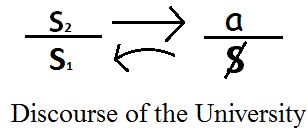
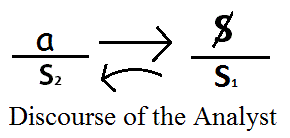
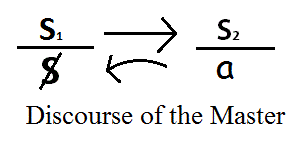 In the Discourse of the Master, S1 stands in the place of the agent, S2 in the place of the other, $ in the place of truth, and a in the place of the product of the disourse. In the operation of the Master’s Discourse, the master signifier is the cause of the subject. The subject addresses its speech to the Other of the Symbolic order, S2, the network of signifiers which form the subject. The truth of the discourse is $, the unconscious of the divided subject. The product of its discourse is the a, that remant of jouissance which is forbidden to the subject. Lacan nominates teh Discourse of the Master as the fundamental relation because it represents the structure to another signifier, and hence produces it as a subject in the signifying chain, the cause of the discourse is also the ’cause’ of the speaking subject (Seminar 17: 19-20). In this way, the S1 of the Discourse of the Master represents the ‘origin’ of discourse as such, because it is the condition of the production of discourse as enunciation. For this reason, Lacan describes the foundational discourse as that of the Master. 51