social fictions

Campbell, Kirsten. Jacques Lacan and Feminist Epistemology. Florence, KY, USA: Routledge, 2004. p 118.

Nancy Fraser claims that in the Lacanian model of discourse, ‘one cannot even pose the question of cultural hegemony’ (1992: 184). However, by using the concept of the social fiction it is possible not only to pose the question of cultural hegemony using Lacan’s model of discourse, but also to see the productivity of its answer.

Social fictions

‘Social fiction’ emphasizes the formation of subjectivity and intersubjectivity in social discourses. This concept stresses the social and ultimately fictive nature of social discourses, which are fictional in the sense that they are contingent upon a symbolic field that gives them meaning. The concept focuses upon the discursive production of forms of subjectivity and the relations between subjects, developing the Lacanian theory of discourse as a description of the structure and operation of social discourses.

This concept ofsocial fictions’ describes the dominant social discourses that constitute a subject, such that the term names the multiplicity of socially produced and sanctioned ideas about how one ‘is’ a subject. A social fiction is a socio-symbolic representation of subjective identity. Social fictions work to produce a subject as subject, with a gendered and racialized identity. With that identity, a subject (mis)recognizes itself in particular dominant signifiers of social discourses. Dominant social fictions include discourses of ethnicity, sexuality, class and gender. As discursive formations, social fictions produce  the speaking position of subjects. They represent an enunciative position, for example, ‘I am Scottish’, or ‘I am a woman’, and so on. This I of the speaking subject is an imaginary position of consciousness or ‘self’. These social fictions produce a subject’s relation to itself and its others, and so enable the subject to think of itself as a self and as distinct from, or the same as, its others. As an I, the subject experiences itself as a unified self that possesses identity. However, the production of the identity of the subject in social fictions generates not only its relation to itself, but also its relations to other subjects. For example, in the Lacanian schema, the Discourse of the Master describes a relation of mastery of ‘self’ and others. In this way, social fictions can be understood as a symbolic relation of subject to other subjects. Social fictions represent the discursive relation of the subject to itself and to other subjects, because their discourses are socio-symbolic representations of subjectivity and intersubjectivity.
In the Lacanian model, master signifiers ‘dominate’ discourses, holding a discourse together and giving it a distinctive shape by ordering its structure of signifiers. The subject takes up a speaking position according to the master signifier of its discourse (in the Lacanian model, that of Master, Hysteric, Analyst and Academic).

I understand social fictions as discourses, which a dominant signifier structures and gives its distinctive shape. Social fictions operate as a sequence of master signifiers that, as Mark Bracher describes, have other signifiers attaching to them in metonymic and metaphorical movement of signification (1993: 49). Every social fiction has a discursive structure, and a dominant master signifier that produces the subject. The master signifier functions as the interpellative ‘hook’ of subjective identity, since it represents that moment at which the subject (mis)recognizes itself in social fictions. The master signifier enables the subject to perceive itself reflected (or otherwise) in social discourse. This identificatory and phantasmic ‘interpellation’ gives social fictions their power – for subjects literally recognize themselves or, in Althusserian terms, are ‘hailed’ by social discourses of identity. The master signifier serves as a mechanism of identification with social fictions, and so as a mechanism of psychic and social identification. Master signifiers enable the subject to represent its self to itself and also to other subjects. As social subjects, we recognize the master signifiers of other subjects, whether similar or different to our own, because the master signifier represents the subject for another subject. In this way, master signifiers serve to anchor social fictions as discourses, both in the production of the subject and in the production of its relation to other subjects.

In this way, this notion of the ‘social fiction’ reworks the Lacanian conception of discourse as a social bond in terms of socio-symbolic relations between subjects. As discourses, social fictions produce meaning, as well as relations between subjects. 118

campbell symbolic

Campbell, Kirsten. Jacques Lacan and Feminist Epistemology. Florence, KY, USA: Routledge, 2004. p 116.

In Lacanian theory, contestatory knowledge is psychoanalytic and subversion emerges from each individual’s psychoanalysis. If we follow Lacan to the letter, then it seems a critical or collective politics outside psychoanalysis will fail. In contrast, feminism is a collective politics that contends that it is possible to create knowledges that do not reproduce the Discourse of the Master.

Lacan does not intend his psychoanalytic theory to be a social theory. Nevertheless, his work presents a series of explicit and implicit claims as to the nature of the social in its account of the Symbolic order. .. While Lacanian knowledge is by definition a social practice, his work presents an unelaborated concept of sociality. For this reason, Lacan does not develop the radical implications of his epistemological theory. Rather, this theory of knowledge removes the knowing subject and knowledge from their social frame and so fails to address their social and political production, a central contemporary epistemological concern (Doyle McCarthy 1996).  Linda Alcoff and Elizabeth Potter argue that ‘to be adequate, an epistemology must attend to the complex ways in which social values influence knowledge’ (1993a: 13) … A theory of feminist knowledge requires a more complex account of the social than Lacan’s unelaborated notion of the Symbolic order. … In the next section, I address these problems in the theory of the Symbolic order, using two strategies. The first elaborates the theory of the Symbolic order through Lacan’s later concept of discursive intersubjectivity. The second develops this Lacanian theory of the social relation through a feminist theory of social relations. These two strategies represent the first part of a rereading of the Symbolic order as a social order. 114

The Lacanian account of subjectivity contains within it a theory of intersubjectivity because it provides an account of the production of relation between subjects. However, in his later work Lacan characterizes ‘intersubjectivity’ as an imaginary relation between subjects. By the 1960s, the concept of intersubjectivity acquires negative connotations, as Lacan associates it with the imaginary and dual relation of two selves trapped in the méconnaissance of their egos (Evans 1996: 90).

Lacan develops his critique of this imaginary intersubjectivity from the Hegelian account of the battle for recognition between the master and the slave. Žižek points out that ‘[w]hat the late Lacan does with intersubjectivity is to be opposed to the early Lacan’s Hegelo-Kojèvian motifs of the struggle for recognition’ (1998 Seven Veils of Fantasy in Nobus Key Concepts: 194).

Žižek counterposes the intersubjective character of fantasy – the imaginary relation to the other as object – and the field of intersubjectivity of the symbolic Other (1998b: 195– 196). This later account of the symbolic field of intersubjectivity differs from the Hegelian model of imaginary recognition. An example of Lacan’s concept of symbolic intersubjectivity is found in his description of the transference between analyst and analysand. In the relation between analyst and analysand, there is always a third party – that of language as the order of culture which intervenes in the imaginary relation. This third party is the Symbolic order, a symbolic relation between subjects. 115

Symbolic Order

The Symbolic order represents a symbolic rather than an imaginary relation between subjects. The Symbolic is ‘a point beyond the specular oscillation of intersubjective rivalry – a purely symbolic point’ (Lechte 1996: 12). The Symbolic order forms the subject and its relations to others. In this formulation, Lacan presents a model of intersubjectivity in which language constructs the relation between subjects. In this sense, intersubjectivity implies a symbolic relation between subjects that makes possible their social relation. The theory of the four discourses is an example of such a model of intersubjectivity, as the four discourses describe the foundational discursive bonds between subjects. This formulation reflects a classical concept of intersubjectivity in critical theory, drawing upon its most minimal formulation as a relation between subjects. 116

The concept of symbolic intersubjectivity offers a means of rereading the Symbolic order through the later theory of discourse. The later theory shifts its emphasis from the Symbolic as a monolithic and closed structure to the open and incomplete nature of both discourse and the Symbolic order.

For Lacan, discourse always produces a remainder, which represents its foundational and excluded term, as ‘[n]o matter how many signifiers one adds to the signifying chain, the chain is always incomplete; it lacks the signifier which could complete it’ (Evans 1996: 96).

An excluded term structures discourse because there is a lack in its foundation, the Symbolic order. With this poststructuralist inflection, we can use Lacan’s later work on discourse to reformulate a concept of the Symbolic order that does not imply that it is a singular or total structure of language, and so to develop from it a feminist and psychoanalytic social theory.

The theory of the four discourses reconceives the Symbolic order as producing different discursive structures, giving more complexity to the account of the symbolic relations between subjects. It permits us to reformulate the concept of the Symbolic order as a mobile system of signifying chains – or discourses – which produce social relations and subjects.

This model of the Symbolic order accepts Lacan’s proposition that it founds the stable structures of discourse. However, it also proposes that these stable structures take different discursive forms, which in turn produce different symbolic forms of subjectivity and intersubjectivity. In this way, I develop the concept of the Symbolic order to describe the structure and operation of social discourses; and their production of subjects and social relations.

My reformulation of the notion of the Symbolic order retains the later Lacanian conception of discourse as constructing possible subjective positions and discursive acts. However, it emphasizes the productivity of discourses, in the sense that it emphasizes their production and reproduction in subjective and intersubjective discursive practices, rather than being fixed or frozen structures that are imposed upon the subject. In this way, it understands discourse as constitutive of, and articulated in, subjectivity and intersubjectivity; as producing and being reproduced by subjects and the relations between them.

symbolic cuts the real

Campbell, Kirsten. Jacques Lacan and Feminist Epistemology. Florence, KY, USA: Routledge, 2004. page 108

Feminist discourse

In the Lacanian account of language, the Symbolic order is that which literally orders an undifferentiated Real (É: 71– 72). 2 An effect of that arrangement of signifiers is to ‘cut’ the Real, such that the Symbolic order structures signification of the Real in one way rather than another.

In Lacan’s later reformulation of the discursive operation of the Symbolic order, signification is structured so that it privileges certain discursive operations while excluding others. The Symbolic order delimits discursive operation because it inscribes certain subjects but not others, and certain social relations but not others. 107

However, it is that which the socio-symbolic order does not represent that puts feminism to work.

In many different practices, feminist knowledges attempt to reinscribe the object as subject through the tropes of the ‘impossible’ feminine, the repressed maternal, the refused body, the banished other, a misrecognized difference, an ‘unimaginable’ utopia. As the third-waver Barbara Findlen describes it, feminism has named ‘the problem that had no name’: by the time that I was discovering feminism, naming had become a principle occupation of feminists.

Everywhere you looked feminists were naming things – things like sexual harassment, date rape, displaced homemakers and domestic violence – that used to be called, as Gloria Steinem pointed out, just life. (1995a: xi)

In Lacanian terms, feminist knowledges represent that which the Symbolic order does not represent, and bring into the signifying order that which it previously refused. Applying the Lacanian model, how then might we understand the structure of this discourse? In its most structural and minimal terms, we might say that feminist discourse represents the a, the excluded of discourse. We can represent existing discourse and its relationship to its excluded term like this:

Existing discourse: s-s-s-s-s-s|a

Feminism recognizes that the Other is lacking; that it excludes from its symbolic economy the a. Feminism sets the knower to work, and the product of that work is a new signifier. Feminist knowledges articulate the a and produce a new signifier. 3 This new symbolic element represents that which the signifying chain did not previously articulate, the a:
Feminist discourse: Feminist knowledge affirms the existence of this excluded term, in an act that Freud (1925a: 438– 439), and Lacan (S1: 57– 58) following him, describe as a judgment of existence. By such a judgment ‘we symbolically affirm the existence of an entity: existence is here synonymous with symbolization, integration into the symbolic order – only what is symbolized fully “exists” ’ (Zizek 1992: 136). It is possible, then, to describe a feminist act of knowing as an act of symbolization, which articulates the a of discourse in a judgment of existence. This symbolic affirmation gives the a existence, producing a new signifier. 108
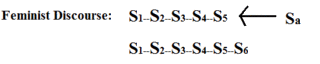
In the Lacanian model, the inscription of a new signifier into the signifying chain produces new discourses. Because the differential relation of symbolic elements in the signifying chain produces meaning, its production is contingent upon a particular relationship of signifiers. However, the inscription of the excluded term reorders the relation of those symbolic elements. The insertion of the otherwise excluded term changes the previously closed order of these elements, creating a new discursive structure and so a new signifying chain. In this way, the analysand produces a new discourse and hence new meaning. From this model, it is possible to understand how the feminist articulation of the a can produce a new discourse. In the operation of feminist discourse, the act of knowing inserts a new signifier into the existing structure of symbolic elements, and thus forms a new signifying chain:

taken from page 109

The disruption and rearrangement of the prior signifying order produces a new relation of symbolic elements, and hence a new discourse. This new discourse produces new meaning, and hence a different representation of the world. This new representation of the world provides a new way to understand it. If knowing is a discursive practice, then the production of new discourses permits the creation of new knowledges by which to know the world.

In the 1970s, the feminist movement began to name the sexual violence many women experienced, but which was perceived neither as a political issue nor as being related to gender politics. This naming is the signification of the a of discourse, because it represents a violence against women which had previously not been articulated. The naming of gendered harms produces a signifier of an otherwise unsignified a of social discourses. …, Deirdre Davis argues that ‘[i]n order to address, deconstruct, and eradicate a harm, we must give the harm a name’ (1997: 200). This naming of the a is then inscribed into the signifying chains of social discourses, which produces a new signifying chain, or knowledge, around the issue of gendered harms. In this way, feminism produces new discourses of gendered harms that fundamentally shift the social meaning of sexual violence.

pluth on sexuality sexual difference

Pluth, Ed. “On Sexual Difference and Sexuality “As Such”: Lacan the and the case of lilttle hans.” Angelaki 12:2 (2007): 69-79.

Sexual difference is traumatic. No doubt, but what is so traumatic about it? Lacanians have had to dance around this forever because of a strong feminist current of critique whose vigilance with regards to spotting forms of essentialism and male bias in Lacanian theory, particularly any time a Lacanian talks about ‘sexual difference.’

Ed Pluth, a Lacanian, is doing more to shed some sort of repectable coherence and understanding to this freakin can of worms:

… what makes sexual difference “real” is the function it plays in the symbolic as a place-holder for something else. … The impasse or “trauma” that sexual difference marks in Lacanian theory is not really a trauma about sexual difference at all. … It is a trauma that, more originally, is about sexuality as such … In other words, if sexual difference is a symbolic impasse, and thus real, it is because it is the repetition of another impasse, one that Lacan describes as sexuality “as such.” 70

Here Pluth is saying that before sexual difference, there is the trauma of sexuality. Sexual difference is a way of taming sexuality as such

It [sexual difference] is less a way of making sense of sexuality than a way of doing something with sexuality, just by putting the enigma of sexual difference in the place of the enigma of sexuality itself (72).

Sexual difference is not a way of representing sexuality as such. A better way to put it is to say that the impossibility introduced by sexuality as such — an impossibility in the sense that its emergence defies symbolization — is replaced by another impossibility in signifiers: what Lacan ends up calling the impossibility of the sexual relationship. (76)

Sexual difference … is a translation or repetition of the impasse of sexuality as such in the symbolic. … a displacing or transferring of an impasse between the real as such and the symbolic as such into purely symbolic terms. (77)

sharpe subjectivity hegelian

The Jacobin Reign of Terror … for Hegel, is that within it for the first time subjects could at any moment ‘lose everything’ with no hope of any equivalent return. To quote The Phenomenology of Spirit

… all these determinations [that the subject receives in its ‘acculturation’ hence] have vanished in the loss suffered by the self in absolute freedom: its negation is the death that is without meaning, the sheer terror of the negative that contains nothing positive … [Hegel, 1997:362]

… it is only when the individual has experienced this ‘terror of the negative’, and had the courage to see in what appeared to him qua particular Self as a groundless alien force something which is ‘immediately one with self-consciousness’, that full ‘self-consciousness’ emerges. [Žižek 1999a: 94] (139).

‘Subject’ [thus] emerges at this very point of utterly meaningless voidance brought about by a negativity which explodes the frame of balanced exchange.  That is to say, what is ‘subject’ [in Hegel] if not the infinite power of absolute negativity/mediation … [for] whom every ‘pathological’ particular positive content [henceforth] appears as ‘posited’, as something externally assumed? [Žižek, 1993, 27; Hegel 1997: 355-63] (139)

Žižek thus comments that what ‘… Bataille fails to … note … is that the modern (Cartesian) subject no longer needs to sacrifice goats intestines, his children, and so on, since his very existence already entails the most radical … sacrifice, the sacrifice of the very kernel of his being’. [Žižek, 1996a 125 … ] (139).

In Hegel, who for Žižek most consistently thought through this subject’s philosophical subversion, the ‘Cartesian’ subject corresponds to: ‘.. the purely negative gesture of limiting phenomena without providing any positive content that would fill out the space beyond the limit.’ [Žižek, 1993, 21]

From Hegel’s Realphilosophie of 1805-6:

The human being is this night, this empty nothing, that contains everything in its simplicity — an unending wealth of presentations, images, none of which occurs to him or is present … here shoots out a bloody head, there a white shape … [Žižek, 1991a, 87; 1997b:8; 1992: 50; 1999b: 136] (139)

sharpe the Other is itself divided the Other does not exist

Sharpe, Matthew. Slavoj Žižek: a little piece of the real. Burlington Vt: Ashgate, 2004.

Žižek’s position is that ideology primarily captures subjects at the level of their unconscious beliefs, and that it does this by structuring their access to jouissance (99).

Žižek proposes … that the answer to how one can still speak from ‘outside’ of the big Other of a hegemonic ideological system comes from a more detailed ontology of this Other itself.  … the Other is itself divided and/or inconsistent, and so contains the resources of its own critique (100).

Modernity, Žižek repeats, is that ‘enlightened’ epoch wherein: “… the symbolic substance (the “big Other” qua texture of symbolic tradition) can no longer contain the subject, can no longer hold him to his symbolic mandate. [Žižek, 1992: 134 (Sharpe’s italics)]

Žižek’s argument is that sexuality only emerges in the first place at the points of the failure of what can be sanctioned by social discourse (113).

sharpe real of jouissance

Sharpe, Matthew. Slavoj Žižek: a little piece of the real. Burlington Vt: Ashgate, 2004.

Žižek’s contention is that the social conditions of the contemporary would demand nothing less than a radical rethinking of the discursive constitution of subjectivity as such. … what risk theory fails to register, and what it falls to a psychoanalytically based analysis to register, is the changed situation of contemporary subjectivity vis-à-vis the ‘Real of jouissance’ (86).

I know very well that symbolic conventions are empty, yet I continue to follow the social expectations [as the only means to attain to money, power, sex (etc.) = because I believe through the duped other(s)].

So Žižek’s position is that we should defitely not be taken in by the contemporary subject’s conscious sense of himself as something of ‘an outlaw … staying clear of binding commitment’ (Žižek, 1991b: 103, 102) Perhaps more than ever, Žižek argues, today’s subjectivity is radically conformist. “… instead of the symbolic Law, we have a multitude of rules to follow” What Žižek is referring to are the multitude of  ‘… imaginary ideals (of social success, of bodily fitness…)’ with which the multimedia, and in particular advertising discourse, solicit us.

From Žižek in 1991:

… [w]hat usually goes unnoticed [by social psychology] is that this disintegration of the ego-ideal entails the installation of a ‘maternal‘ superego taht does not prohibit enjoyment, but, on the contrary imposes it and punishes ‘social failure’ in a far more cruel and severe way, through an unbearable and self-destructive anxiety.  All the babble about the decline nof ‘paternal authority’ merely conceals the resurgnece of this incpmparably more oppressive agency. 89

pluth sinthome

Pluth, Ed. Signifiers and Acts: Freedom in Lacan’s Theory of the Subject. Albany: SUNY Press, 2007.

… Miller’s contention is that the analytic act in Lacanian theory was thought primarily as traversal, and thus as negation, as disinvestment. As we have seen, this is also how Žižek describes the act. If the fantasy is something in which one makes oneself subject, in which there is some procurement of enjoyment that comes along with a position recognized by the Other, then the disinvestment in question in an act is a separation from this position. Thus an act would entail a dissolution of the subject of fantasy and its replacement by a new subject. But what, if anything, does an act do to something like a sinthome? 160-161

Nothing at all, according to Miller. The sinthome does not budge after the libidinal disinvestment in fantasy that characterizes an act.

On of the problems explored in my closing chapters was the question of what remains of the Other after the act and what can be done with what could be considered a de-Othered symoblic.

Miller claims that in the sinthome one forms a partnership with something of the Other at the level of enjoyment — one enjoys the Other through one’s sinthome, and this enjoyed Other, which seems to occur in the form of an “enjoyed meaning” or sens-jouis, is contrasted to the Other as a site that guarantees meaning and confers recognition. What happens after the voiding of the Other is that rather than an investment in fantasy, which is mediated by the Other, there is a direct investment in signifiers as such; and it is on this basis that a partnership with the Other, on the level of enjoyment is forged (163).

pluth politics calls into question the very organizing principle of the political

Pluth, Ed. Signifiers and Acts: Freedom in Lacan’s Theory of the Subject. Albany: SUNY Press, 2007.

Politics is about a presentation that causes an impasse in representation. Such a presentation occurs, Badiou argues, when migrant workers say, “We want our rights.”

… politics for Badiou is not about the assertion of identity and the procuring of representation, and in this respect I see it as a continuation of Lacan’s project and a contrast to Butler’s work.  With a theory of politics that includes a notion like the real as an impasse in signification, Badiou is able to highlight the kinds of effects politics has outside of calls for the recognition of identity. (154)

The resemblance between Lacan’s theory of the act and what Badiou calls politics should, then, be clear. Although the term Other is not used by Badiou in this context, the places where it would fit are obvious. The domain of the political — the state — resembles the Lacanian Other as a subject-supposed-to-know.  Politics sustains an impasse in this Other, just as a Lacanian act emphasizes the Other’s lack of consistency, coherence, and totality.

Politics does not consist of repeating the circumstances of an event, of, for example, trying to bring about again what happened at Talbot. Instead, politics as a signifying act preserves the impasse in signification caused by the event.

Politics does not let this event stop being an event for the social. In other words, it does not let an event get fully absorbed or placed in the Other. Politics, then, is a signifying practice that remains faithful to the subjective rupture an event brings about. Politics’ reminder to the Other that all cannot be represented is what Badiou calls the subject-effect of politics.  Thus the political subject for Badiou is essentially linked to rupture. The consistency of a political subject, oddly is nothing other than a consistency of a rupture.  As Badiou (1982) described it in Théorie du sujet, the subject is a destructive consistency. 155

I argued in chapter 7 that in Lacanian theory the subject of an act is not something from which the real is excluded or repressed. While a signifying act does not present us with the real in the raw, it is not a completely tame real that it presents either. It is precisely the real’s status as an impasse in formalization and signification that is presented in an act. I opened this chapter by asking what the signifying practice of an act does if it does not make demands. If it does not seek recognition by the Other, then is it just a meaningless blah blah blah?

Badiou’s discussion of politics shows us how an act is not like this. Politics, as Badiou conceives it, does something to the social without articulating a demand to the social Other.

While such an act, strictly speaking, has no place, no meaning, in the Other, and while Badiou does not refrain from calling such an act “nonsensical,” such acts are not simply meaningless and are reminiscent of the way Lacan described puns. As Lacan described it, a pun contains a pas-de-sens, a step toward meaning that never gives a full incarnation of meaning in one signifier.  This step, far from simply negating the Other, engages in something like a reinvention of the Other.  Certainly since an act avoids making demands it does not engage with the Other as a subject-supposed-to-know, and it can be said to be in a negative relation to such an Other.

But by preserving some  kind of relation to the creation of a new meaning, it manages to go toward the establishment of a different Other in the place of this Other-who-knows: an Other whose inconsistency and incoherence are laid bare.

Once again we can see how an act is not like the production of meaning in a metaphor. In chapter 2, I claimed that a metaphor succeeds in creating the illusion that there is an incarnation of an absent signified in one particular signifier (latent or manifest) in a signifying chain. this signifier then appears as an enigma, containing within it the keys to its own interpretation, an interpretation that only succeeds in giving more signifiers and never a final signified. Is the signifying production of  an act doing something like this?

A distinction between creating a new signifier in an act and creating a new signified in metaphor ought to be maintained. A metaphor exploits signifiers that are already recognizable by the Other. It just deploys them in an unusual way. An act (like a pun) creates a signifier whose place in the Other itself is not assured, a signifier without well-established links to other signifiers that might be able to provide it with meaning. The signifier used in an act (and the phrase “We want our rights,”  in Badiou’s discussion, can be taken as a signifier) is something less than an enigma, because it does not appear to be pregnant with any sense at all. It appears to be nonsensical, and yet it could make sense. So this is why I am saying that an act seems to bear more resemblance to the punning pas-de-sens than to metaphor. 156

pluth badiou example of an event

Pluth, Ed. Signifiers and Acts: Freedom in Lacan’s Theory of the Subject. Albany: SUNY Press, 2007.

Between November 1983 and February 1984, an automobile factory in talbot, France, was occupied by striking workers. Clashes occurred among the strikers themselves, as well as with the police. An attack happened on one of the shop floors by what the press called “non-strikers” — a group composed of predominantly North African migrant laborers, in fact. The attack was condemned by one of the largest unions in France, which, under some pressure, soon decided to encourage the acceptance of one of management’s earlier offers. Another major union called for an end to the occupation of the factory shortly thereafter.

As Badiou points out, the objective fact surrounding this event are quite simple and not all that unusual or unimaginable. What makes it an event in Badiou’s particular sense is what he calls the subjective break that followed from it. In the next elections, the Socialist Party, which was in power at the time, plummeted in the polls, the Communist Party became a nonentity, and the extreme Right of Le Pen gained ground. Badiou attributes these post-Talbot election results to several factors. The socialist government’s policy of industrial “restructuring” had been a manifest failure. The other left-wing parties had no ability to control the migrant workers, as Talbot showed.  And finally, the Right was successfully able to rally the French public against the migrant workers at Talbot.  The right wing was in fact doubly successful, because it did not only win votes with its racist appeals. Its attractiveness to the electorate even forced the Socialist Party to start talking about toughening up on immmigration (1985, 72). In other words, after Talbot the right wing was controlling the political debate within France, with everyone focusing on the “immigrant problem.”

These are some of the repercussions Talbot had in the political domain in France, but they do not tell us why Talbot was something that could be the source of a contemporary politics. What Badiou focuses on is anapparently straightforward statement the migrant workers were making at the time: “We want our rights” (1985, 73).

Yet this statement, Badiou claims, had no resonance at all in the French electorate, and he argues that structurally it could hot have any resonance within France.  This is what makes Talbot so interesting for Badiou. “This statement, which does however bear on rights, is intrinsically unrepresentable, and it is in this unrepresentability that the politics of this statement consists.” (1985, 74).

Why this should be the case is not so clear. The statement had no place in the political discourse in France, according to Badiou, since a parliamentary democracy is about obtaining representation for different constituent groups in the state. One of the things at stake in the claims made by the Talbot workers is precisely which groups are officially in the state and which are not. While many of the workers had been living and working in France for over twenty years, they were still not citizens and had illegal status. The problem, then, was that “as the government and unions said in chorus: the rights in question do not exist” (1985, 75).

… the status of the statement in this particular example, and this particular context — “We want our rights” — can be compared to a Lacanian act. (152-153).

… The rights in question simply did not exist, and there was thus no political basis on which the workers could make such claims within France (153).

In other words, Talbot brought out the structural inability of “the political” to take into account demands from non-French workers in France (154).

pluth there is more to the subject than identity (on badiou)

Pluth, Ed. Signifiers and Acts: Freedom in Lacan’s Theory of the Subject. Albany: SUNY Press, 2007.

There is more to the subject than identity, and I have been discussing how Judith Butler’s theory of identity and the subject does not describe a subject who does anything other than perform its identity.  Lacan’s theory of the act, I am arguing, gives us a portrait of a subject doing something other than this.  My study of the Fort-Da game … already showed this. … In the last chapter I portrayed Badiou, somewhat provocatively, as someone who is closer to Lacan’s theory of the subject than the most prominent of Lacanian advocates, Slavoj Žižek (149).

Badiou’s description of politics in his 1985 Peut-on-penser la politique? contrasts well with Butler’s description of an ethic of dis(identification) and is also useful for demonstrating what a Lacanian act beyond identification and recognition might look like when it is something other than a  private affair, as the child’s Fort-Da game and Xénophon’s cross were (149).

Lenin claimed that there were three key sources of Marxist thought: German Idealism, the revolutionary French workers’ movement, and English political economy.

Marx’s originality consisted of using these three sources to elaborate on what Badiou calls a fundamental declaration of a social fact: “There is a revolutionary worker’s movement”

Badiou characterizes this declaration as follows: “It is not a matter of separating out and structuring a part of the existing phenomenon. It is a matter of a “there is,” of an act of thought cutting across a real [en coupure d’un réel]”

The declaration in the nineteenth century, that “there is a revolutionary worker’s movement,” is read by Badiou as a signifying act, as an attempt on Marx’s part to signify something that had not yet received signification in his time, thus its association with an act “cutting across a real.” 150

If much in Marx is effectively dead, then Badiou argues that this is because the original force of the founding declaration of Marxism has been exhausted. the existence of a revolutionary workers’ movement is no longer so evident, and, more importantly, it is no longer “traumatic” for us: The status of such a declaration in contemporary culture no longer has the effect of bringing a signifying impasse to bear on contemporary political discourse. That is, the existence of such a movement would no longer press upon  us, forcing us into a new signifying production in order to make sense of it. In fact, we have an entire history of Marxist theory and practice in terms of which such a movement could be interpreted. But even the contemporary explanatory power of classical Marxist theory is exhausted, according to Badiou, because it has lost its real historical power. the historical referents upon which marxism was founded — German philosophy, French politics, and English economic theory — are no longer major referents for contemporary culture, to say the least!

Obviously, what Badiou suggests is that the emergence of politics now would have to occur from a different type of declaration, one that formally or structurally resembles Marx’s: that is, it would have to bring into signifiers something that has no representation in the political, or the state. With such a signifying act, Badiou believes that one would be more faithful to Marxism than a classical Marxist is, for one would then be developing a politics on the basis of a declaration that would again, cut across the real, which is precisely the kind of relationship between signifiers and the real described in Lacan’s theory of the act. (150-151).

Marxism applied a theoretical framework to what was at the time a new event. Badiou argues that the way to revive Marxism today is to apply a contemporary theoretical framework to what, for us, has the status of an event. 151

pluth butler the real2

Pluth, Ed. Signifiers and Acts: Freedom in Lacan’s Theory of the Subject. Albany: New York, 2007.

On Butler’s conception of the body

As she describes it, the body presents language with a problem and is certainly not reducible to language, but the body is also not radically distinct from language, otherwise we would never be able to account for the body as a resistance to signification. Butler is trying to think of the materiality of the body as something experienced within language, and this actually sounds very much like the Lacanian understanding of the real as an impasse in signification (real2).

Only whenever Butler comes across the term real she systematically understands it to be a domain radically distinct from language and does not seem willing to acknowledge that there is another approach to the real in Lacan’s work, one where the real is just an “impasse in formalization.” 145

In Lacan’s work, the real is an “impasse in formalization” that can be handled in two different ways —

1. it can be covered up by creating a signified for it, or

2. it can be preserved in a particular type of signifying practice.

Badiou argued that Lacan’s theory embraced a covering up of, or a distancing of the subject from, the real, and I countered with the claim that Lacan actually embraced the alternative position in his theory of the act.

Butler’s notions of the body and passionate attachments to identity do not lead her to develop a theory of the act, which would be in part about renewing and rewriting our very attachment to identity itself. In other words, Butler does not seem to consider the possibility that certain signifying practices may be entirely outside the domain of identification. According to Butler, we remain committed to subjection, and thus identification, at the psychic or unconscious level.  In fact, [for Butler] this is the very condition for us to be subjects at all. 146