ethics zupancic review

Jason B. Jones. “The Real Happens” Emory University jbjones AT emory.edu Review of: Alenka Zupančič, Ethics of the Real: Kant, Lacan. New York: Verso, 2000.

The point of Lacan’s identification of the Real with the impossible is not simply that the Real is some Thing that is impossible to happen. On the contrary, the whole point of the Lacanian concept of the Real is that the impossible happens. This is what is so traumatic, disturbing, shattering–or funny–about the Real. The Real happens precisely as the impossible. (“Signs”)

Ethics of the Real merits the serious attention of anyone interested in one of the great ethical crises of our time: Why is nothing but fundamentalism deemed worth dying for any longer?
Continue reading “ethics zupancic review”

Paul Verhaeghe

Verhaeghe, Paul. Does the Woman Exist? from Freud’s Hysteric to Lacan’s Feminine  Trans. by Marc du Ry (1997, 1999) pp. 114-115.

The Discourse of the Analyst

Within the structural framework of the four discourses, the discourse of the analyst is the exact opposite of that of the master and is the last in the series of permutations or revolutions. This does not necessarily imply that it brings a solution to the latter; the etymological meaning of revolution is after all a return to the point of departure. The product of analytic discourse is the master signifier S1, which means that it brings us back to the starting point, the discourse of the master. This is the danger inherent in the discourse of the analyst which is all too often realised. The general structure is as follows.

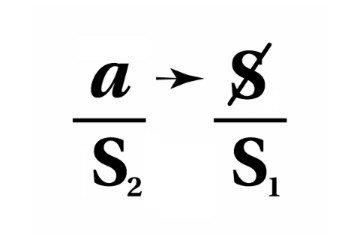
In the place of the agent we find objet a, the cause of desire. It is this lost object which grounds the listening position of the analyst; it obliges the other to take his own divided being into account. That is why we find the divided subject in the position of the other: a —> $.

This relationship between agent and other is impossible because it turns the analyst into the cause of desire of the other, eliminating him as a subject and reducing him to the mere residue, the waste of the signifying chain.

That is one of the reasons why Lacan stated that it is impossible to be an analyst. The only thing you can do is to function as such for somebody for a limited period of time. This impossible relationship from a to divided subject is the basis for the development of the transference, through which the subject will be able to circumscribe his object. This is one of the goals of an analysis. It is what Lacan has called “la traversee du fantasme,” the crossing of the fundamental fantasy.  Normally — that is, following the discourse of the master who sets the norm — this relationship is unconscious and partakes of the disjunction of impotence: $ // a.  The discourse of the analyst, as the inverse of that of the master, brings this relationship to the forefront in an inverted form: a —> $. From impotence it goes to impossibility, with the difference that it is an impossibility whose effects can be explored: qui ne cesse pas de ne pas s’écrire.” The product of this discourse is the master signifier or, in Freudian terms, the Oedipal determinant particular to that subject. It is the function of the analyst to bring the subject to that point, albeit in a paradoxical way: the analytical position functions by means of a non-functioning of the analyst as subject, which reduces him to the position of object. That is why the end result of analytic discourse is radical difference: in the world of make-believe, “le monde du semblant,” we are all narcissistically alike, but beyond this world we are all fundamentally different. Analytic discourse yields a singular subject, constructing and deconstructing itself throughout the process of analysis; the other party is nothing but a stepping stone. This reminds me of several folk tales and fairy tales in which the beloved, the object of desire, can no longer speak for one reason or another; in this situation the hero has to create a solution in which he is essentially confronted with his own being, a being which was unknown to him before.

The position of knowledge is remarkable in this discourse. One of the major twists in Freud’s theory and practice concerned precisely this; the way an analyst makes use of his knowledge. This way, indicated by the discourse of the analyst, is a paradoxical way; knowledge functions in the position of the truth, but — as the place of the agent is taken by object a this knowledge cannot be brought into the analysis.

The analyst knows, oh yes, he does know, but he cannot do much with it as long as he takes up the position of analyst. That is why this knowledge can be termed a Docta Ignorantia, a “learned ignorance,” as Nicholas of Cusa called it in the Fifteenth century. The analyst has wisely learned not to know, and in so doing he opens up a way for another to gain access to what determined his or her subjectivity.

The product of the discourse of the analyst is an S1 a master signifier. The revelation of this signifier, which determines the vicissitudes of the analysand, is meant to annihilate its effects. It is strange, says Lacan, that the discourse most opposed to that of the master yields a product which is precisely the basis of the master discourse itself.  Obviously, this has to take place in a completely different style: “II doit se trouver a l’ oppose de toute volonte au moins avouee de maitrise,” the analyst has to function at the opposite pole from any conscious desire for mastery.  This is a structural expression of what is peculiar to the analytic position, even though it is all too often precisely on this point that the analyst fails …

The particularity of the discourse of the analyst resides not only in the avoidance of the classical hysterical solution — the introduction and removal of a master figure — but also in a structural working through of its necessary failure. The effectiveness of the discourse of the analyst is twofold. On the one hand, it forces the patient in the direction of the discourse of the hysteric: the answer to a —> $ can only result in $ —>S1 which obliges the patient to subjectivise, to come to terms with the hidden truth of his symptom. Instead of offering his problems to someone else to solve, the patient is confronted with a permutation through which he has to see himself as the centre of the problem. In this way, it is possible for the analysand to come to the truth of his symptom, by exploring his fundamental fantasy. On the other hand, in the discourse of the analyst, the impossibility at the heart of hysterical structure shows up very explicitly as the impossibility of setting up and simultaneously refusing the master. Between S2 // S1 in the discourse of the analyst there is a barrier on jouissance: one has to choose, the two together are impossible.

This is where one can experience the dialectical value of this formalisation of discourse: based on the reactions of the analysand to an interpretation, the analyst knows quite quickly which position is ascribed to him. If he is situated on the axis S1 —> S2 then he will be taken up in the hysterical series: $ —> S1 —> S2

Only the analytical sequence is able to deliver the truth of the symptom:

a —> $ —> S1.

This is on condition that it does not topple over into the “envers,” its other side: the discourse of the master. Insofar as this toppling does happen, it always ends up as a diluted form of the master discourse, namely, the discourse of the university. (114-115)

Discourse of Hysteric

The questions put to the master are basically the same: “Tell me who I am, tell me what I want.” Although this master can be found in different places — it could be a priest, a doctor, a scientist, an analyst, even a husband — there is always one common factor: the master is supposed to know, he is supposed to know and to produce the answer. That is why we find knowledge, S2, in the position of product. Typically, this answer always misses the point. S2 as general knowledge is impotent in producing a particular answer to the particular driving force of objet a in the place of truth: a//S2. This inevitably results in a never ending battle between the hysterical subject and the particular master on duty. …

Structurally, the discourse of the hysteric results in alienation for the hysterical subject and in castration for the master. The answer given by the master will always miss the point, because the true answer concerns objet a, the object which is forever lost and cannot be put into words. The standard reaction to this failure is to produce even more signifiers but they only lead one further and further from the lost object in the position of truth. This impossibility causes the failure of the master, and entails his symbolic castration. Meanwhile, the master, in the position of the other as S1, has produced an ever increasing body of S2, of knowledge. It is this very knowledge that the hysterical subject experiences as profoundly alienating: as an answer to her particular question she receives a general theory, …. Whether or not she complies with it, whether or not she identifies herself with it, is besides the point. In every case, the answer will be felt as alienating. Knowledge as a product is unable to say anything important about objet a in the place of truth: a//S2 (Verhaeghe, Does the Woman 110).

[The master’s] truth is that he is also castrated, divided and subject to the Law. The paradox is that in striving to attain jouissance, the only thing he can produce is a knowledge which always falls short and which automatically makes him fail as a master. Indeed, if he wants to display his knowledge he has to speak, but the moment he does, he reveals his division. the only way for a master to say master is to keep away from the game of desire.
[…] Only he who does not desire is not submitted to castration, remains undivided and can occupy the position of master. … The idealised father of the hysteric is the dead father, the one who, freed from all desire, is no longer subjected to the fundamental lack and can produce in his own name, S1, a knowledge, S2, concerning jouissance. Verhaeghe 112

Discourse of University (Verhaeghe, Does the Woman 116-117)

In the discourse of the university, the master functions as a formal guarantee for knowledge, thereby denying the ever-problematic division of the one who knows. In the end, this denial will be a failure. It is this knowledge that takes up the position of agent in the discourse of the university. If we turn the terms in the discourse of the master back a quarter, we obtain the discourse of the university as a regression of the discourse of the master, and as the inverse of the discourse of the hysteric. The agent is a ready-made knowlege, whereas the other is reduced to mere object, cause of desire: S2 –>a

The history of psychoanalysis illustrates this aim of the discourse of the university: Freud is reduced to a merer guarantee of a closed and well-established knowledge. The problematic aspect of his work is put aside, only his name remains as the master signifier necessary for the guarantee: “Made in …” The unifying aspect of this S1 already shows itself in the fact that post-Freudianism reduced Freud to a massive whole, a monolith without any internal dynamic. Certainly, the ‘evolution’ in his work was recognised, but only in the sense of a cumulative progression, which began before Freud (‘dynamic’ psychiatry), and resulted after him in the pinnacle known as Ego psychology …

This knowledge is presented as an organised and transparent unity which can be applied straight from the textbook. the hidden truth is that it can only function if one can guarantee it with a master-signifier.

In the position of the other, we find the lost object, the cause of desire. The relationship between this object and the signifying chain is structurally impossible: the object is precisely that element, Das Ding, which is beyond the signifier. As a result, the product of this discourse is a growing division of the subjuct: the more knowledge one uses to reach the object, the more one becomes divided between signifiers, and the further one moves away from home, that is, from the true cause of desire: S2–>a.

The product of this discourse demonstrates its failure since the result is nothing but the divided subject $. This is a consequence of the impossible relationship between S2 –>a. Knowledge does not yield jouissance, only a subject divided by a knowledge expressed in signifiers. This subject, $, can never be identified with an S1 because it would require a state of non-division. Between truth and product, the disjunction of impotence insists: S1//$.

Moreover, there is no relationship between the subject and the master-signifier in this discourse; the master is supposed to secrete signifiers without there being any relationship with his own subjectivity: S1//$. This illusion is behind the ‘objectivity’ required in classical science.

reinhard lacan with levinas

Reinhard, Kenneth. “Kant with Sade, Lacan with Levinas” MLN The Johns Hopkins University Press, 110.4 (1995) 785-808.

Hence for Lacan the sixties did not signal the libido’s momentary liberation from the constraints of repressive cultural ideals, but the construction of yet one more line of defense against the disturbing impossibility of intersubjective sexuality, the inconsistency in the symbolic order that materializes as a factum or “Thing” whose concealment, according to Lacan, both defines human relations and marks their limit.

“Love” has at least two distinct and perhaps contradictory valences for Lacan. On the one hand, love can dissimulate the unavailability of a sexual relationship by imagining a relationship between the self and the other. This version of love projects a “specular mirage” that simulates symbolic interaction by addressing me from a hypothetical point where I am seen in the way I would like to be seen, thereby fostering an illusion of reciprocity that is “essentially deception” (Seminar XI 268).

footnote: In Seminar VIII: Transference (1960-1) and Seminar XI: The Four Fundamental Concepts of Psychoanalysis (1963-4), Lacan distinguishes between the two modalities of love in terms of two aspects of transference. The goal of analysis that emerges in the later sixties and seventies involves “traversing the fantasy,” the process in which the analyst, idealized in the first moment of transference as a supposed subject of knowledge, is de-idealized or “de-completed” in transference’s second moment of “separation,” in which love’s effect of imaginary coherence is stripped away to reveal love as pure drive.

On the other hand, Lacan suggests that there is another love, a love not bound by the circulation of images, but which arises, as Juliet Flower MacCannell has written, “outside the limits of the law” (25)–neither within nor beyond specularity, but on what we might call, after Levinas, the “hither side” of the mirror, more proximate to me than either myself or my alter-ego.3 Insofar as it aims precisely at the traumatic lack of a sexual relationship, this love is closely allied with the sublimation of the excessive enjoyment or jouissance that in Lacan’s Seminar VII forms the imperative of the ethics of psychoanalysis.4 At the conclusion of Seminar XI, Lacan warns that specular love barely conceals an internecine aggressivity that culminated most horrifically in the sacrificial fury of the Holocaust (274-6). 5

The “other” love, on the other hand, in aiming, as Renata Salecl writes, at “what remains of the object when all the imaginary and symbolic features are annihilated,” sacrifices precisely those illusory characteristics of the other person that fuel the love of sacrifice. 6

For both Lacan and Levinas, substitution does not imply an act of self-sacrifice within an economy of expiation and redemption, but rather the sacrifice of sacrifice. The moral economy of sacrifice entails giving up enjoyment for a place in the symbolic order (always advertised as a “higher” pleasure). The sacrifice of sacrifice, on the other hand, insists not on the enjoyment that attends responsibility, but rather on the responsibility for enjoyment, the obligation to maintain the jouissance that makes responsibility possible. In Lacan’s dictum, “the only thing one can be guilty of is giving ground relative to one’s desire” (SVII 321); renunciation in the name of the symbolic order to morality is merely a ruse, a resistance to desire and the trauma that is its cause. For Levinas, enjoyment is not simply renounced by the subject of responsibility, but remains its intimate and ongoing condition: “only a subject that eats can be for-the-other, or can signify” (OTB E 74). Levinas articulates the responsibility of “for-the-other” as a substitution that determines not one meaning among others, but rather opens the field of signification as such. Like Lacan’s substitutive love, Levinasian responsibility institutes the process of metaphorization without abandoning jouissance, which indeed depends on the primal signification of substitution: “I can enjoy and suffer by the other only because I am for-the-other, am signification” (OTB 90). For Levinas the subject’s passive responsibility for its neighbor is experienced as a “deafening trauma” that creates the subject as the response to a call so loud or so close that it cannot be heard, cannot be fully translated into a message. In the deferred temporality that places ethics before ontology, responsiveness before being, the subject is produced as “the echo of a sound that would precede the resonance of this sound” (OTB 111)

zizekian critique of butler

Behi, Kambiz. “The “Real” in Resistance: Transgression of Law as Ethical Act” Unbound Vol. 4: 30, 2008.

Foucault’s pluralistic notion of power discourse as a heterogeneous field of multiple resistances only allows for the subversion and rearticulation of power relations within the symbolic field. In other words, the Foucauldian notion of
resistance is always immanent to power and therefore any new Symbolic order created after a successful resistance (revolution) is inherently of the same structural bases of juridico-political order as the previous one. Psychoanalytic theory, … points to a third conception of resistance — beyond structuralist or poststructuralist conceptions—by introducing the possibility for a radical rearticulation of the entire Symbolic order by means of an act proper: through passing into “symbolic death” (Žižek Ticklish Subject. 1999:262). From the perspective of Lacanian theory, Foucault’s notion of resistance is a “false transgression that reasserts the symbolic status quo and even serves as a positive condition of its functioning” (262).

Žižek points out that resistance of the Real is much more than just a performative act that reconfigures “one’s symbolic condition via its repetitive displacements”:

one should maintain the crucial distinction between a mere ‘performative reconfiguration’, a subversive displacement which remains within the hegemonic field and, as it were, conducts an internal guerrilla war of turning the terms of the hegemonic field against itself, and the much more radical act of a thorough reconfiguration of the entire field which redefines the very conditions of socially sustained performativity (Ticklish Subject 1999:264).

Žižek reiterates that performative reconfigurations “ultimately support what they intend to subvert, since the very field of such ‘transgressions’ is already taken into account, even engendered, by the hegemonic form” of symbolic norms and their codified transgressions (1999:264). The matrix of the Symbolic order is deeply invested in a set of ideological institutions, rituals, and practices, which cannot be effectively undermined by linguistic transgressions or performative gestures because they are of the same Symbolic type. Through the Lacanian concept of Real, it is possible to conceptualize resistance to law as an already completed act which originates from the remainder of subjection process—a bit of the Real that is refused in the Symbolic.

A Real act of resistance opens up the possibility for articulating an ethics of the Real that is irreducible to a speech or performative act, which relies on a pre-established set of symbolic rules. Resistance of the Real is an already completed act, originating from that bit of the Real that always refuses the Symbolic.

Žižek cartestian subject cogito

Žižek, Slavoj. SIC Cogito and the Unconscious. Durham: Duke University Press 1998

Introduction: Cogito as a Shibboleth

There  are  two  standard  ways  to  approach  the  relationship  between  philosophy  and psychoanalysis.  Philosophers  usually  search  for  so-called philosophical  foundations  of psychoanalysis”:  their  premise  is  that,  no  matter  how  dismissive  psychoanalysis  is  of philosophy, it nonetheless has to rely on a series of conceptual presuppositions (about the nature  of  drives,  of  reality,  etc.)  that  psychoanalysis  itself  does  not  render  thematic  and that  bear  witness  to  the  way  in  which  psychoanalysis  is  only  possible  within  a  certain philosophical  horizon.

On  the  other  hand,  psychoanalysts  at  their  worst,  indulge  in  so-called “psychoanalyzing of philosophers,” trying to discern pathological psychic motivations beneath  fundamental  philosophical attitudes  (philosophical  idealism  as  the  last  vestige  of the  childish  belief  in  the  omnipotency  of  thoughts;  paranoiac  systematizing  as  the foundation  of  the  need  to  form  all-embracing  philosophical  systems,  etc.).  Both  these approaches  are  to  be  rejected.  While  the  psychoanalytic  reduction  of  philosophy  to  an expression of psychic pathology is today, deservedly, no longer taken seriously, it is much more difficult to counter the seemingly self-evident claim that psychoanalysis cannot relate anything  truly  relevant  to  philosophy,  since  psychoanalysis  must  itself  rely  on  a  set  of philosophical presuppositions that it is unable to reflect upon.

What if, however, references to the Freudian subject are not external to philosophy, but can, in fact, tell us something about  the  modern,  Cartesian  subject?

What  if  psychoanalysis  renders  visible  something that  the  modern  philosophy  of  subjectivity  accomplishes  without  knowing  it,  its  own grounding  gesture,  which  philosophy  has  to  disavow  if  it  is  to  assume  its  place  within academic  knowledge?

To  use  Lacan’s  pun,  what  if  psychoanalysis  renders  visible  the ex-timate  kernel  of  modern  subjectivity,  its  innermost  core  that  philosophy  is  not  ready  to assume, which it tries to keep at a distanceor, to put it in a more fashionable way, what if psychoanalysis  renders  visible  the  constitutive  madness  of  modern  philosophy?

We  are thus  playing  a  double  strategic  game:  this  ex-timate  kernel  of  philosophy  is  not  directly accessible  to  the  psychoanalysis  conceived  of as a  branch  of psychology  or psychiatry  — what we encounter at this level are, of course, the “naive” pre-philosophical theses. What one has to do, is to bring to light the philosophical implications of psychoanalysis, that is, to  retranslate,  to  transpose psychoanalytic  propositions  back  into  philosophy, to “elevate them  to  the  dignity  of  philosophical  propositions”:  in  this  way,  one  is able  to discern  the ex-timate  philosophical  kernel  of  psychoanalysis,  since  this  transposition  back  into philosophy explodes the standard philosophical frame. This is what Lacan was doing all the time:  reading  hysteria  or  obsessional  neurosis  as  a philosophical  “attitude  of  thought towards  reality”  (the  obsessional  compulsion  to  think” if  I  stop  thinking,  I  will  cease  to exist” — as the truth of the Cartesian cogito ergo sum), etc., etc. Are we thus not again engaged in “psychoanalyzing philosophy”? No, since this reference to  madness  is  strictly  internal  to  philosophy  —  the  whole  of  modern  philosophy,  from Descartes onward, involves an inherent reference to the threat of madness, and is thus a desperate attempt to draw a clear line that separates the transcendental philosopher from the madman ( Descartes: how do I know I’m not hallucinating reality? Kant: how to delimit metaphysical  speculation  from  Swedenborgian  hallucinatory  rambling?  ).

This  excess  of madness against which modern philosophy fights is the very founding gesture of Cartesian subjectivity.

…At  this point,  anyone  versed  in  postmodern  deconstructionism will  utter  a sigh  of  bored  recognition:  of  course,  the  Cartesian  ego,  the  selftransparent  subject  of Reason,  is  an  illusion;  its  truth  is  the  decentered,  split,  finite  subject  thrown  into  a contingent,  nontransparent  context,  and  this  is  what  psychoanalysis  renders  visible…. Things,  however,  are  more  complicated.

[…]

1

It  is  against  this  background  that  one  should  appreciate  the  paradoxical  achievement  of Lacan,  which  usually  passes  unnoticed  even  by  his  advocates:  on  the  very  behalf  of psychoanalysis, he  returns  to  the  modern  rationalist  notion  of  subject.  Philosophers  and psychoanalysts,  of  course,  promptly  exclaim  “We  are  here  on  our  home  terrain!”  and proceed  to  reduce  the  Freudian  subject  to  a  psychological  subject  of  introspection,  to philosophical self-consciousness, to Nietzschean will to power…. Lacan’s underlying thesis here  is  even  more  radical  than  with  the  unconscious:

not  only  has  the  Freudian  subject nothing  to  do  with  the  self-transparent,  unified  self-consciousness,  it  is  the  Cartesian subject  itself  (and  its  radicalization  in  German  Idealism,  from  Kant’s  transcendental apperception to self-consciousness from Fichte onward) … the  standard  philosophy  of  subjectivity, … misrecognize the gap that separates the Cartesian subject (when it is “brought to its  notion”  with  Kant)  from  the  self-transparent  ego,  or  from  man,  from  the  “human person.”

What  they fail to  see  is that  the Cartesian subject  emerges  precisely  out of  the “death of man” “transcendental subjectivity” is philosophical antihumanism at its purest.

One  can  see,  now,  why,  in  his  seminar  on  The  Four  Fundamental  Concepts  of  Psycho-Analysis, Lacan asserts that the subject of psychoanalysis is none other than the Cartesian cogito:  the  Freudian  unconscious  emerges  through  the  very  reduction  of  the  “person’s” substantial content to the evanescent punctuality of the cogito.

In  this  precise  sense, one  could  say  that  Martin Luther  was  the first  great antihumanist: modern subjectivity is not announced in the Renaissance humanist celebration of man as the  “crown  of  creation”, that  is,  in  the  tradition  of  Erasmus  and  others  (to  which  Luther cannot but appear as a “barbarian”), but rather in Luther’s famous statement that

man is the excrement who fell out of God’s anus.

Modern subjectivity has nothing to do with the notion of man as the highest creature in the “great chain of being,” as the final point of the  evolution  of  the  universe:  modern  subjectivity  emerges  when  the  subject  perceives himself  as  “out  of  joint,”  as  excluded  from  the  “order  of  the  things,”  from  the  positive order of entities. For that reason, the ontic equivalent of the modern subject is inherently excremental:  there  is  no  subjectivity  proper  without  the  notion  that,  at  a  different  level, from  another  perspective,  I  am  a  mere  piece  of  shit.

For  Marx,  the  emergence  of  working-class subjectivity is strictly codependent to the fact that the worker is compelled to sell the very substance of his being (his creative power) as a commodity on the market, that is, to reduce the agalma, the treasure, the precious kernel of his being, to an object that can be bought for a piece of moneythere is no subjectivity without the reduction of the  subject  positive-substantial  being  to  a  disposable  “piece  of  shit.”

In  this  case  of  the correlation between the Cartesian subjectivity and its excremental objectal counterpart, we are  not  dealing  merely  with  an  example  of  what  Foucault  called  the  empirico- transcendental couple that characterizes modern anthropology, but, rather, with the split between  the  subject  of  the  enunciation  and  the  subject  of  the  enunciated:

2

If  the Cartesian subject is to emerge at the level of the enunciation, he is to be reduced to the “almost-nothing” of a disposable excrement at the level of the enunciated content.

Or,  to  put  it  in  a  slightly  different  way,  the  intervention  of  the  subject  undermines  the standard premodern opposition between the universal order and the hubris of a particular force whose egotistic excess perturbs the balance of the universal order: “subject” is the name  for  the  hubris,  the  excessive  gesture,  whose  very  excess  grounds  the  universal order;  it  is  the  name  for  the  pathological  abject,  clinamen,  deviation  from  the  universal order,  that  sustains  this  very  universal  order.  The  transcendental  subject  is  the “ontological  scandal,”  neither  phenomenal  nor  noumenal,  but  an  excess  that  sticks  out from the “great chain of being,” a hole, a gap in the order of reality, and, simultaneously, the agent whose “spontaneous” activity constitutes the order of (phenomenal) reality. If, for  the  traditional  ontology,  the  problem  was  how  to  deduce  chaotic  phenomenal  reality background image from the eternal order of the true reality (how to account for the gradual “degeneration” of the  eternal  order),  the  problem  of  the  subject  is  that  of  the  imbalanced  excess,  hubris, deviation, that sustains the order itself. The central paradox of the Kantian transcendental constitution  is  that  the  subject  is  not  the  absolute,  the  eternal  grounding  principle  of reality, but a finite, temporal entity — precisely as such, it provides the ultimate horizon of reality.

The very idea of the universe, of the all of reality, as a totality that exists in itself, is  thus  rejected  as  a  paralogism:  what  appears  as  an  epistemological  limitation  of  our capacity  to  grasp  reality  (the  fact  that  we  are  forever  perceiving  reality  from  our  finite, temporal standpoint), is the positive ontological condition of reality itself. Our  philosophical  and  everyday  common  sense  identifies  the  subject  with  a  series  of features:  the  autonomous  source  of  spontaneous,  self-originating  activity  (what  German Idealists called “self-positing”); the capacity of free choice; the presence of some kind of “inner  life”  (fantasizing);  etc.

Lacan  endorses  these  features,  but  with  a  twist:  the autonomous  source  of  activity  —  yes,  but  only  insofar  as  the  subject  displaces  onto  an Other the fundamental passivity of his being (when I am active, I am simultaneously interpassive, i.e., there is an Other who is passive for me, in my place, like the weepers, the hired women who cry for me at funerals in so-called “primitive” societies); the free choice —  yes,  but,  at  its  most  radical,  the  choice  is  a  forced  one  (i.e.,  ultimately,  I  have  a freedom of choice only insofar as I make the right choice); the presence of fantasizing — yes,  but,  far  from  coinciding  with  the  subject  in  a  direct  experience  of  “inner  life,”  the fundamental fantasy is that which cannot ever be “subjectivized,” that which is forever cut off from the subject….

What Lacan focuses on is this specific twist, this additional turn of the screw that confronts us with the most radical dimension of subjectivity. How, then, does this endeavor of ours relate to Heidegger’s well known attempt to “think through” the horizon of subjectivity? From our perspective, the problem with Heidegger is, in  ultima  analisi,  the  following  one:

the  Lacanian  reading  enables  us  to  unearth  in  the Cartesian subjectivity its inherent tension between the moment of excess (the “diabolical Evil” in Kant, the “night of the world” in Hegel) and the subsequent attempts to gentrify-domesticate-normalize  this  excess.

Again  and  again,  post-Cartesian  philosophers  are compelled,  by  the  inherent  logic  of  their  philosophical  project,  to  articulate  a  certain excessive moment of “madness” inherent to cogito, which they then immediately endeavor to “renormalize.” And the problem with Heidegger is that his notion of modern subjectivity does not seem to account for this inherent excess — in short, this notion simply does not “cover” that aspect of cogito on account of which Lacan claims that cogito is the subject of the unconscious.

3

One of the basic presumptions of contemporary doxa is that the Cartesian cogito paved the way for the unheard-of progress of modern science that profoundly affected the everyday life of mankind. Today, however, it seems as if the Cartesian cogito itself has acquired the status of a prescientific myth, superseded by the very progress of knowledge it unleashed. For  that  reason,  the  title  Cogito  and  the  Unconscious  is  bound  to  give  rise  to  two immediate associations: that it is to be understood as designating the antagonism between cogito  (the  transparent  subject  of  self-consciousness)  and  the  unconscious,  its  opaque Other that subverts the certitudes of consciousness; and, consequently, that cogito is to be repudiated  as  the  agency  of  manipulative  domination  responsible  for  all  present  woes, from  patriarchal  oppression  to  ecological  catastrophes.  The  specter  of  the  “Cartesian paradigm”  roams  around,  simultaneously  proclaimed  dead  and  feared  as  the  ultimate threat  to  our  survival.

In  clear  contrast  to  this  predominant  doxa,  Lacan  pleads  for  a psychoanalytic return to cogito.

Today’s  predominant  position  involves  the  assertion  of  multiple  subjectivities  against  the specter  of  (transcendental)  Subject:  the  unified  Subject,  the  topic  of  transcendental philosophy, the constitutive source of all reality, is dead (or so we are told), and the void of its absence is filled in by the liberating proliferation of the multiple forms of subjectivity– feminine, gay, ethnic….

One should thus abandon the impossible search for the Subject that  is  constitutive  of  reality,  and,  instead,  focus  attention  on  the  diverse  forms  of asserting  one’s  subjectivity  in  our  complex  and  dispersed  postmodern  universe….

What, however,  if  we  perform  the  exact  opposite  of  this  standard  operation,  and  endeavor  to think a subject bereft of subjectivity (of the self-experience of a historical agent embedded in a finite horizon of meaning)?

What kind of monster remains when we subtract from the background image subject  the  wealth  of  self experience  that  constitutes  subjectivity?  The  present  volume provides an answer to this question: its underlying premise is that

the Cartesian subject is this monster, that it emerges precisely when we deprive the subject of all the wealth of the “human person.”

Notes […]

2. See Jacques Lacan, Érits: A Selection ( New York: Norton, 1977), 300.

3. For a more detailed account of this excess, see, in the present volume, Slavoj Žižek, The Cartesian Subject versus the Cartesian Theater.
Bosteels on Žižek

Bosteels, Bruno. The Actuality of Communism.  New York: Verso, 2011.

To envision a new positive order beyond the present horizon thus requires that we take a step back to grasp the moment of genesis of order out of disorder.  “In the end, teh alternative here is between idealism and materialism: is the ‘big Other’ (the ideal symbolic order) always already here as a kind of insurmountable horizon, or is it possible to deploy ts ‘genesis’ out of the dispersed ‘non-all’ network of contingent material singularities?”  Žižek also asks, before answering his own question in the positive: “The answer is a definite ‘yes’ — it is contained in Lacan’s unexpected vindication of the notion of creativity at its most radical, that is, as creatio ex nihilo: by means of reference to the void of the Thing in the midst of the symbolic structure, the subject is able to ‘bend’ the symbolic space she inhabits, and thus to define his/her desire in its idiosyncrasy.”

To justify his belief in the possibility of a transformative act that would open up a new order not limited to the alternative of either the pure lack of desire or else the pure positivity of drives, Žižek thus raises the question of the originary act that brings order out of disorder and breaks with the constraints of the always already existing state of affairs. 204

Žižek the real, anamorphosis

Paul Bowman and Richard Stamp eds. The Truth of Žižek  London: Continuum. 2007

With Lenin, as with Lacan, the point is that the revolution ne s’autorise que d’elle-même; one should assume the revolutionary act not covered by the big Other — the fear of taking power ‘prematurely’, the search for the guarantee, is the fear of the abyss of the act. 240

🙂 Laclau and his followers claim that every fundamental social antagonism “will always be displaced to some degree since, … antagonism can never be approached directly without political mediation.”

All we have is a series of antagonisms which (can) build a chain of equivalences, metaphorically ‘contaminating’ each other, and which antagonism emerges as ‘central’ is the contingent result of a struggle for hegemony. So does this mean that one should reject the very notion of fundamental antagonism’ (as Laclau does)? 242

In order to explicate the concept of ‘fundamental antagonism’ Žižek cites Lévi-Strauss from his Structural Anthropology.  The famous example of the ZERO INSTITUTION.

the very splitting into the two ‘relative’ perceptions implies a hidden reference to a constant — not the objective, ‘actual’ disposition of buildings but a traumatic kernel, a fundamental antagonism the inhabitants of the village were unable to symbolize, to account for, to ‘internalize’ to come to terms with — an imbalance in social relations that prevented the community from stabilizing itself into a harmonious whole. The two perceptions of the ground plan are simply two mutually exclusive endeavours to cope with this traumatic antagonism, to heal its wound via the imposition of a balanced symbolic structure.

It is here one can see in what precise sense the real intervenes through anamorphosis. We have first the ‘actual’, ‘objective’, arrangement of the houses, and then its two different symbolizations which both distort in an anamorphic way the actual arrangement. However, the ‘real‘ is here not the actual arrangement, but the traumatic core of the social antagonism which distorts the tribe members’ view of the actual social antagonism. The real is thus the disavowed X on account of which our vision of reality is anamorphically distorted. It is simultaneously the thing to which direct access is not possible and the obstacle which prevents this direct access; the thing which eludes our grasp and the distorting screen which makes us miss the thing. More precisely the real is ultimately the very shift of perspective from the first to the second standpoint: the Lacanian real is not only distorted, but the very principle of distortion of reality. 243

Žižek comment on Butler 2001

Hanlon,Christopher. “Psychoanalysis and the Post-Political: An Interview with Slavoj .” New Literary History, 32 (2001): 1-21. PDF  rest of interview in this blog is here

Question: Judith Butler—with whom you have engaged in ongoing if cordial debate—maintains that the Lacanian topology is itself dubious for its nonhistorical, transcultural presuppositions. You yourself have written that “jouissance is nonhistorical” How do you respond to complaints such as Butler’s?

Žižek: Ah! This is what we are struggling with for dozens, maybe hundreds of pages, in this book. My answer is to say that she is nonhistorical. That is to say, she presents a certain narrative, the same as Ernesto [Laclau]. With Ernesto, it’s that we have an older type of essentialist class politics, then slowly, slowly, essentialism starts to disintegrate, and now we have this contingent struggle for hegemony where everything is open to negotiation . . . . With Judith Butler, there is the same implicit narrative: in the old times, there was sex essentialism, biologically-identified; then slowly, slowly, this started disintegrating into a sex/gender distinction, the awareness that gender is not biologically— but rather culturally—constructed; finally, we come to this performativity,contingency, and so on and so on. So the same story, from essentialist zero-point to this open contingency where we have struggles for hegemony which are undecided. My first reproach as a philosopher to this is that here, some metanarrative is missing. To ask a very stupid, naïve question: why were people one hundred and fifty years ago essentialists? Were they simply stupid? You know what I mean? There is a certain, almost teleological narrative here, in which from the “bad” zero-point of essentialism, slowly we come to the “good” realization that everything is a performative effect, that nothing is exempted from the contingent struggle for hegemony. But don’t you need a metanarrative if you want to avoid the conclusion that people were simply stupid one hundred and fifty years ago?

CH: Well, perhaps not a metanarrative in the sense of a guiding historical trajectory, but an acceptance of a loosely Foucauldian premise, that one hundred and fifty years ago there were in place certain institutional mechanisms, powerdiscourses, which coerced belief from their subjects, engendered them . . .

Žižek: Ah! But if you accept this Foucauldian metanarrative, then things get a little complicated. Because Foucault is not speaking about truth value; for him, it is simply the change from one episteme to another. Then . . . OK, I ask you another question—let’s engage in this discussion, with you as Butler. So: is there a truth-value distinction between essentialism and the performativity of gender or is it simply the passage from one episteme to another? What would you say?

CH: I won’t speak for Butler, but if I were a Foucauldian, I would say that the latter is the case, though I may prefer the later episteme in light of my own political objectives.

Žižek: Yeah, but Butler would never accept that.

CH: You don’t think so?

Žižek: You think she would? Because I think that the epistemic presupposition of her work is implicitly—even explicitly, at least in her early work—that, to put it bluntly, sex always already was a performative construction. They just didn’t know it then. But you cannot unite this with Foucauldian narrative, because Foucauldian narrative is epistemologically neutral, in which we pass from one paradigm to the other. You know, sex was confessionary then; sex is now post-confessionary, pleasurable bodies, whatever . . . . But OK: Foucault would be one possible metanarrative. Marxism would provide the other one, in the sense that “the development of capitalism itself provoked a shift in subjectivity,” whatever. But again, what I claim is that there is some unresolved tension concerning historicity and truth-value. I ask you a different question. Both in Laclau and in Butler, there is a certain theory: Butler—and I’m speaking of early Butler; later, things get much more complex, much more interesting, a more intense dialogue becomes possible . . .

CH: So we’re talking about Gender Trouble, parts of Bodies That Matter . . .

Žižek: Yeah, I’m talking about Gender Trouble with Butler, and about Hegemony and Socialist Strategy with Laclau. Why? Because let’s not forget that these two books were the only two authentic “big hits” of the time. . . . I’ll tell you why: both Gender Trouble and Hegemony and Socialist Strategy were read as a model for a certain political practice. With Gender Trouble, the idea was that performativity and drag politics could have a political impact; it was, to put it in naïve, Leninist terms, “a guideline for a certain new feminist practice.” It was programmatic. It was the same with Hegemony and Socialist Strategy. It was a justification for the abandonment of so-called essentialist class politics, after which no specific struggle takes priority, we just have to coordinate our practices, cultivate a kind of “rainbow coalition,” although Ernesto rejects the term . . . . Now, what are these theories? Are they universal theories—of gender or of social/political processes—or are they specific theories about political practice, sex practice, within a certain historical/political moment? I claim that the ambiguity is still irreducible. At the same time that it’s clear that these theories are rooted in a certain historical moment, it’s also clear that they touch upon a universal dimension. Now my ironic conclusion is that, with all this anti-Hegelianism, what both Ernesto and Judith do here is the worst kind of pseudo-Hegelian historicism. At a certain point, it’s as if the access to truth or what always already was true is possible only in a certain historical situation. So in other words, philosophically, I claim that beneath these theories of contingency, there is another narrative that is deeply teleological.

CH: But either Butler or Laclau might rebut this reproach by pointing out that even such an embedded teleology is no worse than a matrix of non-historical Lacanian presuppositions.

Žižek: But my God, this is the big misunderstanding with her! Butler systematically conflates what she calls “Real” with some nonhistorical symbolic norm. It’s interesting how, in order to qualify the Lacanian notion of sexual difference as a nonhistorical Real, she silently slips in this nonhistorical gender norm, to then claim that “we homosexuals are excluded from this,” and so on. So her whole criticism inveighs against this notion that Lacan thinks of sexual difference as part of a nonhistorical, heterosexual normativity, and that this is what should be subverted . . . .

Of course, my counterpoint is that “Real,” for Lacan, is the exact opposite.

Real” is that on account of which every norm is undermined. When [Butler] speaks of historicity, my point is not that there is something nonhistorical which precedes us. My point is that the Lacanian Real, in a way, is historical, in the sense that each historical epoch, if you will, has its own Real. Each horizon of historicity presupposes some foreclosure of some Real.

Now, Judith Butler would say “OK, I agree with this, but doesn’t this mean that we should re-historicize the Real, include it, re-negotiate it?” No, the problem is more radical . . . . Maybe the ultimate misunderstanding between us—from my perspective— is that for her, historicity is the ultimate horizon. As an old fashioned Freudian, I think that historicity is always a certain horizon which has to be sustained on the basis of some fundamental exclusion. Why is there historicity? Historicity doesn’t simply means that “things change,” and so on. That’s just stupid evolutionism; not in the biological sense, but common sense.

Historicity means that there must be some unresolved traumatic exclusion which pushes the process forward. My paradox would be that if you take away the nonhistorical kernel, you lose history itself.

And I claim that Judith Butler herself, in her last book, is silently approaching this position. Because in Gender Trouble, the idea that your psychic identity is based on some primordial loss or exclusion is anathema; it’s the Big Bad Wolf. But have you noticed that, if you read it closely, in The Psychic Life of Power she now accepts this idea of a primordial loss when she speaks of these “disavowed attachments”? The idea is now that we become subjects only through renouncing the fundamental passionate attachment, and that there’s no return, no reassumption of the fundamental attachment. It’s a very Freudian notion. If you lose the distance, the disavowal . . . it’s psychosis, foreclosure. The big problem I have with this shift is that it’s a very refined political shift of accent. What I don’t quite accept in her otherwise remarkable descriptions is how, when she speaks about the “marginalized disavowed,” she always presupposes—to put it in very naïve terms—that these are the good guys. You know: we have Power, which wants to render everything controllable, and then the problem is how to give voice to those who are marginalized, excluded . . .

CH: You see it as a kind of vulgar Bakhtinianism?

Žižek: Yeah, yeah—you know what I’m aiming at. What I’m aiming at is . . . aren’t racist, anti-Semitic pogroms also Bakhtinian carnival? That’s to say that what interests me is not so much the progressive other whom the power is controlling, but the way in which power has to disavow its own operation, has to rely on its own obscenity. The split is in the power itself. So that . . . when Butler argues very convincingly against—at least she points to the problematic aspects of—legal initiatives that would legalize gay marriages, claiming that in this way, you accept state authority, you become part of the “visible,” you lose solidarity with all those whose identity is not publicly acknowledged . . . I would say, “Wait a minute! Is there a subject in America today who defines himself as marginalized, repressed, trampled by state authority?” Yes! They are called survivalists! The extreme right! In the United States, this opposition between public state authority and local, marginalized resistances is more and more an opposition between civil society and radical rightwing groups. I’m not saying we should simply accept the state. I’m just saying that I am suspicious of the political pertinence of this opposition between the “public” system of power which wants to control, proscribe everything, and forms of resistance to subvert it. What I’m more interested in are the obscene supplements that are inherent to power itself.

Ž the abyss of the Other desire 4

Žižek, S. The Plague of Fantasies. New York: Verso, 1997.
Fiat iustitia, pereat mundus is a Latin phrase. It means: “Let there be justice, though the world perish.”

Hegel’s (and Lacan’s, incidentally) point is that it is possible to move ‘beyond Good and Evil’, beyond the horizon of the Law and constitutive guilt, into drive

Hegel’s implicit thesis is that

diabolical Evil is another name for the Good itself; for the concept ‘in itself’, the two are indistinguishable, the difference is purely formal, and concerns only the point of view of the perceiving subject.

In short ‘diabolical evil’ is simply Kant’s name for what Freud [calls] the death drive.

I become aware of my freedom only through the experience of how, on behalf of the moral law, I am able to withstand the pressure of the pathological motivations which tie me to innerworldly phenomenal causality.

the pure moral act is impossible, of how one can never be sure that one is acting solely out of consideration for duty, is the far more uncanny fact that the moral act, precisely as impossible, is simultaneously unavoidable, that which is in a way impossible to transgress.

it is only my failure to act ethically which guarantees that I remain an ethical subject, since were I to accomplish a pure ethical act, I would change into a being of diabolical Evil (in a Sadeian Supreme-Being-of-Evilness). 230

true evil involves precisely the blurring of distinctions between Good and Evil — that is, the elevation of Evil into a consistent ethical Principle. A revolutionary terrorist, for example, is of aesthetic interest if he is not merely a bloodthirsty executioner killing and torturing out of pure egotistical baseness, but a sincere idealist ready to sacrifice everything for his Cause, convinced that he is doing a service to humanity, and thus caught in the tragic deadlock of his predicament. … … such an ‘ethical evil’ is the true diabolical Evil, much worse than the evil of simple egotistical baseness: the cleaner you are (the more your motives are selfless-humanitarian), the greater your evil. 234-235

abyss of the Other’s desire 3

Žižek, S. The Plague of Fantasies. New York: Verso, 1997.

The standard subject’s reaction to the act is that of aphanasis, of his/her self-obliteration, not of heroically assuming it: when the awareness of the full consequences of ‘what I have just done’ hits me, I want to disappear.  At this precise point Lacan (and already Freud’s notion fo the death drive) parts with the Romantic ideology of a ‘demonic’ self-destructive Will: the death drive is not a ‘will to die’, radical Evil is not a ‘diabolical’ intention that seeks pleasure in inflicting pain on one’s neighbour

abyss of the Other’s desire 2

Žižek, S. The Plague of Fantasies. New York: Verso, 1997.

.. the unique strength of Kant’s ethics lies in this very formal indeterminacy: moral Law does not tell me what my duty is, it merely tells me that I should accomplish my duty. That is to say, it is not possilbe to derive the concrete norms I have to follow in my specific siutation from the moral Law itself —

which means that the subject himself has to assume the responsibility of ‘translating’ the abstract injunction of the moral Law into a series of concrete obligations. 221

The fact that the Subject is a Universal Being means that, precisely, he cannot simply rely on some determinate substantial content (‘universal’ as it may be) which would fix the co-ordinates of his ethical activity in advance, but that the only way for him to arrive at Universality is to accept the objective indeterminacy of his situation — I become ‘universal’ only through the violent effort of disengaging myself from the particularity of my situation: through conceiving this situation as contingent and limiting, through opening up in it the gap of indeterminacy filled in by my act. 222

Subjectivity and universality are thus strictly correlative: the dimension of universality becomes ‘for itself’ only through the ‘individualist’ negation of the particular context which forms the subject’s specific background.

… compels us to reject any reference to ‘duty’ as an excuse: “I know this is difficult, and might be painful, but what can I do? It’s my duty…” … The reference to duty as the excuse for doing our duty should be rejected a hypocritical … The obscene jouissance of this situation is generated by the fact that I conceive of myself as exculpated from what I am doing: isn’t it nice to be able to inflict pain on others in the full awareness that I’m not responsible for it, that I am merely fulfilling the Other’s Will … this is what Kantian ethics prohibits. 221-222

The Kantian law is thus not merely an empty form applied to a random empirical content in order to ascertain if this content meets the critieria of ethical adequacy— rather, the empty form of the Law functions as the promise of an absent content (never) to come. … the form is not only a kind of neutral universal mould of the pluality of different empirical contents; the autonomy of the Form, rather, bears witness to the uncertainty which persists with regard to the content of our acts — we never know if the determinate content which accounts for the specificity of our acts is the right one: that is, if we have really acted in accordance with the Law and have not been guided by some hidden pathological motive. … the subject finds himself in a situation in which, although he knows there is a Law, he never knows (and a priori cannot know) what this Law is — a gap forever separates the Law from its positive incarnations. The subject is thus a priori, by virtue of his very existence, guilty: guilty without knowing what he is guilty of (and for that very reason guilty), infringing the law without knowing its exact regulations.

What we have here is, for the first time in the history of philosophy, the assertion of the Law as unconscious: the experience of Form without content is always the index of a repressed content — the more intensely the subject sticks to the empty form, the more traumatic the repressed content becomes. 226