social fictions

Campbell, Kirsten. Jacques Lacan and Feminist Epistemology. Florence, KY, USA: Routledge, 2004. p 118.

Nancy Fraser claims that in the Lacanian model of discourse, ‘one cannot even pose the question of cultural hegemony’ (1992: 184). However, by using the concept of the social fiction it is possible not only to pose the question of cultural hegemony using Lacan’s model of discourse, but also to see the productivity of its answer.

Social fictions

‘Social fiction’ emphasizes the formation of subjectivity and intersubjectivity in social discourses. This concept stresses the social and ultimately fictive nature of social discourses, which are fictional in the sense that they are contingent upon a symbolic field that gives them meaning. The concept focuses upon the discursive production of forms of subjectivity and the relations between subjects, developing the Lacanian theory of discourse as a description of the structure and operation of social discourses.

This concept ofsocial fictions’ describes the dominant social discourses that constitute a subject, such that the term names the multiplicity of socially produced and sanctioned ideas about how one ‘is’ a subject. A social fiction is a socio-symbolic representation of subjective identity. Social fictions work to produce a subject as subject, with a gendered and racialized identity. With that identity, a subject (mis)recognizes itself in particular dominant signifiers of social discourses. Dominant social fictions include discourses of ethnicity, sexuality, class and gender. As discursive formations, social fictions produce  the speaking position of subjects. They represent an enunciative position, for example, ‘I am Scottish’, or ‘I am a woman’, and so on. This I of the speaking subject is an imaginary position of consciousness or ‘self’. These social fictions produce a subject’s relation to itself and its others, and so enable the subject to think of itself as a self and as distinct from, or the same as, its others. As an I, the subject experiences itself as a unified self that possesses identity. However, the production of the identity of the subject in social fictions generates not only its relation to itself, but also its relations to other subjects. For example, in the Lacanian schema, the Discourse of the Master describes a relation of mastery of ‘self’ and others. In this way, social fictions can be understood as a symbolic relation of subject to other subjects. Social fictions represent the discursive relation of the subject to itself and to other subjects, because their discourses are socio-symbolic representations of subjectivity and intersubjectivity.
In the Lacanian model, master signifiers ‘dominate’ discourses, holding a discourse together and giving it a distinctive shape by ordering its structure of signifiers. The subject takes up a speaking position according to the master signifier of its discourse (in the Lacanian model, that of Master, Hysteric, Analyst and Academic).

I understand social fictions as discourses, which a dominant signifier structures and gives its distinctive shape. Social fictions operate as a sequence of master signifiers that, as Mark Bracher describes, have other signifiers attaching to them in metonymic and metaphorical movement of signification (1993: 49). Every social fiction has a discursive structure, and a dominant master signifier that produces the subject. The master signifier functions as the interpellative ‘hook’ of subjective identity, since it represents that moment at which the subject (mis)recognizes itself in social fictions. The master signifier enables the subject to perceive itself reflected (or otherwise) in social discourse. This identificatory and phantasmic ‘interpellation’ gives social fictions their power – for subjects literally recognize themselves or, in Althusserian terms, are ‘hailed’ by social discourses of identity. The master signifier serves as a mechanism of identification with social fictions, and so as a mechanism of psychic and social identification. Master signifiers enable the subject to represent its self to itself and also to other subjects. As social subjects, we recognize the master signifiers of other subjects, whether similar or different to our own, because the master signifier represents the subject for another subject. In this way, master signifiers serve to anchor social fictions as discourses, both in the production of the subject and in the production of its relation to other subjects.

In this way, this notion of the ‘social fiction’ reworks the Lacanian conception of discourse as a social bond in terms of socio-symbolic relations between subjects. As discourses, social fictions produce meaning, as well as relations between subjects. 118

campbell discourse of the master

Campbell, Kirsten. Jacques Lacan and Feminist Epistemology. Florence, KY, USA: Routledge, 2004.
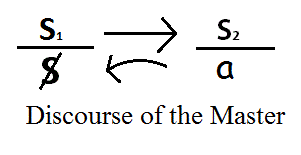

For Lacan, the Discourse of the Master describes the production of the speaking subject in the symbolic field. The subject comes into being when it enters the signifying chain through identification with a signifier, S1. The S1 is a fundamental symbolic element which ‘knots’ signifier and signifed and thereby arrests their constant sliding.  It represents the signifier that gives the subject its symbolic coherence and situates it within language.  For this reason, the marks the point of the ‘origin’ of the subject’s speech, because the identification with the I of speech, the S1 that symbolizes the I of the master, constitutes the subject (Seminar 17: 70).  In this way, identification with the I of the Master forms the subject in the symbolic field.  The Discourse of the Master thereby inaugurates a speaking subject which is identical to its proper signifer and which ‘names’ it.  For Lacan, this discourse binds the subject to the master signifier and all its illusions. 65

In the Discourse of the Master, the subject refuses knowledge of its formation in signifying networks. In his schema, Lacan represents this refusal to know by an arrow S1—>S2 labelled impossibility. Given this structure, it is impossible for the subject to know its relation to the signifier. For this reason, Lacan represents that impossibility by his figure of the barred subject, $He represents the subject as barred because it refuses to acknowledge the truth of its unconscious division. That lack is a consequence of its constitution as a speaking being, because castration is the price of entering the Symbolic order. The discourse of the Master hides the truth of the lack-in-being of the subject (S17 90). The Master does not want to know, and cannot know, the truth of its unconscious.  The subject perceives itself as an I, that is, as a unified subject, and hence refuses to acknowledge that it is in fact a Master that suffers castration.

The Discourse produces a subject who wishes to master its self, its others, its desire, and its unconscious. For Lacan, the Master wishes to dominate that which it excludes form its discourse (S17 110).

Fink describes how this subject must show no weakness, in this sense carefully hides the fact that he or she, like everyone else, is a being of language and has succumbed to symbolic castration’ (Fink in Nobus Key Concepts 1998). The castrated Master refuses to believe that it is castrated. 66

It veils over its lack with the illusion that it is whole and complete; the méconnaissance of a self that imagines that it is identical to itself and to its master signifier (S17 70). It imagines that it has mastery of a ‘univocal’ discourse that masks its unconscious division. 66

The Knowing Master is a position in which the imaginary order captures the knower such that it perceives its self and its objects in the mirror of the ego. The Master subject claims to be a unified subject which creates itself in an act of mastery. It imagines itself to be whole and identical to itself, and perceives its self and its others as identical to its egoistic projections. The knower constructs its relationship to its others as an objectifying identification in which the other is an object that it seeks to master. Its knowledge is an aggressive, objectifying and distorting domination of its known object. The knowing subject attempts to gain omnipotent control of itself and its world, so as to imagine itself as the ‘Absolute Master’ (Lacan 1955: 47, Éc: 33). It posits itself as omniscient, the possessor of absolute knowledge. 66

Lacan’s description of the knowing subject of the Discourse of the Master presents it as the universal, disembodied knower. However, given that the Lacanian account of subjectivity posits sexuation as its condition, then the knower is necessarily sexed.

Following a feminist deconstructive strategy leads us to ask, how is sexuation inscribed into the Lacanian theory of the knowing subject? (66)

To answer that question requires the reinscription of sexual difference into Lacan’s account of the production of the Master subject. 67

🙂 Here we go

For Lacan, the Master subject is produced through identification with a symbolic term, the trait unaire, translated as the unitary, unary or ‘single-stroke’ trait. Lacan’s theory draws on Freud’s account in Group Psychology (1921) of the process of the assimilation of an aspect or characteristic of another, in which the subject identifies with a trait of another subject. Lacan argues that an identification with the unitary trait ‘marks’ each one of us as a singular and unified identity. (S17 180)

He links this concept of the unifying mark to the signfier of ‘L’Un’ (The One).  ‘The One’ is the signifier that institutes the symbolic structure of the subject (S17 12, S20 143-144).

In the Discourse of the Master the unitary trait appears as S1, the master signifier.  The master signifier functions as the signifier that represents the subject as subject.67

However Lacan also links S1 to the phallic signifier. In his discussion of sexuation, Lacan describes the phallus as ‘that which is also incarnated in S1, which, of all the signifiers, is the signfier for which there is no signified (S20 80). The phallus incarnates or ‘makes flesh’ the S1 of the master signifier.

For this reason, identification with the phallic signifier operates as identification with the master signifier. What links these terms is the process of symbolic identification in which the phallic signifier is a master signifier that produces the subject.

Lacan argues that in the formation of the subject, the signification of the phallus [is evoked by the paternal metaphor]. The paternal metaphor is the attribution of procreation to the Name-of-the-Father and the signification of the paternal relation.

A moment of the Oedipus complex, the paternal metaphor represents the intervention of the Symbolic order (signified by The-Name-of-the-Father) in the subject’s imaginary relation to the mother (and her desire).

In the operation of the paternal metaphor, the desire for the mother is repressed and the phallic signifier stands in for that desire in the subject’s unconscious (Muller and Richardson 1994 213). This process forms the subject in a relation to the phallic signifier and hence as a sexed identity which has or does not have the phallus (S5 186). In this account, the masculine subject has the phallus, a position of possessing the signifier of the phallic object, while the feminine subject does not have the phallus, a position of lack and hence castration. 67

Lacan argues that the dissolution of the Oedipus complex involves symbolic interjection, in which ‘what was outside becomes the inside, what was the father becomes the super-ego’ (S1 169).  In symbolic identification the subject introjects the signifier of the father, forming the super-ego.  The subject assimilates the phallic signifier as the mark of the Father, and thereby incorporates the Symbolic father as an I. (S11 256-257)

Presenting the reformulation of the paternal metaphor (and of the Oedipus complex) in the theory of the Discourse of the Master.

In the Discourse of the Master, identification with the phallic signifier — S1 — of the Father produces a ‘unified’ subject. It is an identification with the paternal signifier because the phallic signifier is the mark of the Father, and hence of his Law. This symbolic identification ‘marks’ and names the subject with and by the Name-of-the-Father. Identification with S1 involves an assimilation of the Symbolic father. For this reason, Lacan describes ‘the law’, that is, the Law of the Father, as dominating the Discourse of the Master (S17 48). 68

The process of symbolic identification with the Father produces the illusion of a conscious self. It establishes a subjective relation of I and ego in which the I of the speaking subject appears to be co-extensive with the ego because of the operation of repression. For the Master subject, consciousness founds illusion of the transcendental I (S17 70). Identification with the Symbolic Father who has the phallus and is not castrated structures this position of mastery, forming the master subject in terms of a psychic structure of defence against the unconscious. The identification with the Symbolic father produces a subject structured by a méconnaissance of its origniary and ontological lack.

However, in the Lacanian account identification with the Symbolic father operates differently in formation of masculine and feminine subjects. In the logic of castration, the model of a typical ‘successful’ resolution fo the Oedipus complex is that of the paternal identification of the little boy because of the tie of the symbolic phallus and the real penis. (S4 209). In the third stage of the Oedipus complex, the little boy identifies with the father who possesses the penis while the little girl recognizes that he has it (S5 196) For Lacan, if masculinity and femininity both ‘fail’, they fail differently. The difference concerns the more or less ‘problematic’ assumption of Oedipal subjectivity, because the master signifier that represents the subject is masculine (S17 107).

In Lacan’s account, the masculine subject has the phallus (S20 80). That is, the masculine subject possesses the phallus and, in this sense, is not castrated.  The male subject defines its masculine position through the exception of castration such that his ‘all’ is defined through an other position of ‘not-being-all’.  This other position is that of castration, which is the feminine position of a being that does not have the phallus.  The phallus is the master signifier by which the masculine subject refuses the (lacking) body.  …The phallus ‘that props him up as signifier and is also incarnated in S1 which of all the signifier, is the signifier for which there is no signified (S20 80).  His ontological loss cannot be acknowledged without being symbolized as castration, for otherwise hts fantasy of omnipotence, unity and universality would unravel.

The displacement of ontological loss through the representation of castration in a symbolic function allows the masculine subject the illusion of mastery (S17 144).

In that illusion of mastery, the masculine subject misrecognizes itself as a being whole and complete of itself. It is a position of (masculine) mastery. 69

It is a position of presence, of the universal masculine subject which is ‘whole’ and which does not suffer loss or lack. The Discourse of the Master describes the production of the knowing master, a masculiine subject that secures its identity through identification with the Symbolic father in a repudiation of castration. 69

Reconceiving the knowing master as a masculine subject explains the formation of the masculine knower and its imaginary méconnaissance.  It explains the relation between the knowing subject of consciousness and the masculine knower … showing the link between the formation of masculine subjects and knowers.  In this way, it provides an account of the constitution of the knower as a masculine subject by providing the feminist deconstructive project with a means of understanding the formation fo the subject of ‘masculine’ knowledges.

Campbell, Kirsten. Jacques Lacan and Feminist Epistemology. Florence, KY, USA: Routledge, 2004. p 75.

My account of the discourses of mastery provides a means of retaining these insights of deconstructive theories, while also not reducing masculine knowledge to an effect of individual experience or familial objects. In the later Lacanian epistemology, different discursive social links produce particular forms of knowledges and knowing subjects. Those symbolic relations between subjects represent different forms of the social bond. In a Western culture, a phallocentric Symbolic order structures those social relations between subjects. In particular, it founds the Discourse of the Master as a dominant discourse of Western culture. The Discourse of the Master produces dominant forms of knowledge and the masculine knowing subject.

These masculine subjects need not be men. Both men and women can, and do, become knowing Masters. However, men are more likely to assume this position than women for two reasons.

First, the Master is a paradigmatic knower because of the material and cultural privileging of particular forms of masculine identity.
Second, the normative production of identity attaches masculinity to biologically male subjects.

My account of the discourses of mastery provides an explanation for this ‘demonstrable alignment’ between masculine knowers and knowledges. For example, following Scheman’s description of the Cartesian knower, it explains how identification with the Symbolic father forms this egoistic, defensive Knowing Master. Similarly, following Bordo’s description of the masculine Cartesian subject, it explains why the knowledges of the masculine knower repudiate its feminine others (indeed, all others), the better to control their difference (1986: 452).

Rather than seeing masculine knowledges as a reflection of the privilege of men in social relations (as in standpoint theory), my account explains how those social relations produce masculine discourses of mastery. Those social relations produce discourses of knowledge that form the knower and its objects. These forms of knowing are discursive practices that do not describe the nature of ‘knowledge’, but rather the production of particular knowers and forms of knowing. (76)

pluth an act entails the demolition of the other as subject-supposed-to-know

Pluth, Ed. Signifiers and Acts: Freedom in Lacan’s Theory of the Subject. Albany: SUNY Press, 2007.

An act entails the demolition of the Other as a subject-supposed-to-know, the Other as a support of identification, capable of providing that treasure of treasures, recognition. 157

One important thing about the act as Lacan portrays it is that the subject is an effect of it and does not produce it.  I still think that it is important to keep this in mind, lest something fundamental be misunderstood about what happens during a psychoanalytic cure — as well as elsewhere, in those moments when we humans, now and then, find ourselves in the process of an act.

I have been arguing that an act offers a way of thinking about manifestations of freedom without the usual presupposition of a sovereign, conscious subject exercising the freedom, or a structure of some type exercising its freedom in the subject’s place. An act is a production of the unconscious, which is, of course, not an irrational thing but a calculating, thoughtful thing — if it can be called a thing at all.  …

While an act is signifying, and very much an affair of signifiers, it is not the result of a decision or an act of will or any conscious deliberation but should be seen as a production of the unconscious, a production whose conditions for emergence can be enhanced by certain things (such as what goes on in analytic discourse) (161).

pluth politics calls into question the very organizing principle of the political

Pluth, Ed. Signifiers and Acts: Freedom in Lacan’s Theory of the Subject. Albany: SUNY Press, 2007.

Politics is about a presentation that causes an impasse in representation. Such a presentation occurs, Badiou argues, when migrant workers say, “We want our rights.”

… politics for Badiou is not about the assertion of identity and the procuring of representation, and in this respect I see it as a continuation of Lacan’s project and a contrast to Butler’s work.  With a theory of politics that includes a notion like the real as an impasse in signification, Badiou is able to highlight the kinds of effects politics has outside of calls for the recognition of identity. (154)

The resemblance between Lacan’s theory of the act and what Badiou calls politics should, then, be clear. Although the term Other is not used by Badiou in this context, the places where it would fit are obvious. The domain of the political — the state — resembles the Lacanian Other as a subject-supposed-to-know.  Politics sustains an impasse in this Other, just as a Lacanian act emphasizes the Other’s lack of consistency, coherence, and totality.

Politics does not consist of repeating the circumstances of an event, of, for example, trying to bring about again what happened at Talbot. Instead, politics as a signifying act preserves the impasse in signification caused by the event.

Politics does not let this event stop being an event for the social. In other words, it does not let an event get fully absorbed or placed in the Other. Politics, then, is a signifying practice that remains faithful to the subjective rupture an event brings about. Politics’ reminder to the Other that all cannot be represented is what Badiou calls the subject-effect of politics.  Thus the political subject for Badiou is essentially linked to rupture. The consistency of a political subject, oddly is nothing other than a consistency of a rupture.  As Badiou (1982) described it in Théorie du sujet, the subject is a destructive consistency. 155

I argued in chapter 7 that in Lacanian theory the subject of an act is not something from which the real is excluded or repressed. While a signifying act does not present us with the real in the raw, it is not a completely tame real that it presents either. It is precisely the real’s status as an impasse in formalization and signification that is presented in an act. I opened this chapter by asking what the signifying practice of an act does if it does not make demands. If it does not seek recognition by the Other, then is it just a meaningless blah blah blah?

Badiou’s discussion of politics shows us how an act is not like this. Politics, as Badiou conceives it, does something to the social without articulating a demand to the social Other.

While such an act, strictly speaking, has no place, no meaning, in the Other, and while Badiou does not refrain from calling such an act “nonsensical,” such acts are not simply meaningless and are reminiscent of the way Lacan described puns. As Lacan described it, a pun contains a pas-de-sens, a step toward meaning that never gives a full incarnation of meaning in one signifier.  This step, far from simply negating the Other, engages in something like a reinvention of the Other.  Certainly since an act avoids making demands it does not engage with the Other as a subject-supposed-to-know, and it can be said to be in a negative relation to such an Other.

But by preserving some  kind of relation to the creation of a new meaning, it manages to go toward the establishment of a different Other in the place of this Other-who-knows: an Other whose inconsistency and incoherence are laid bare.

Once again we can see how an act is not like the production of meaning in a metaphor. In chapter 2, I claimed that a metaphor succeeds in creating the illusion that there is an incarnation of an absent signified in one particular signifier (latent or manifest) in a signifying chain. this signifier then appears as an enigma, containing within it the keys to its own interpretation, an interpretation that only succeeds in giving more signifiers and never a final signified. Is the signifying production of  an act doing something like this?

A distinction between creating a new signifier in an act and creating a new signified in metaphor ought to be maintained. A metaphor exploits signifiers that are already recognizable by the Other. It just deploys them in an unusual way. An act (like a pun) creates a signifier whose place in the Other itself is not assured, a signifier without well-established links to other signifiers that might be able to provide it with meaning. The signifier used in an act (and the phrase “We want our rights,”  in Badiou’s discussion, can be taken as a signifier) is something less than an enigma, because it does not appear to be pregnant with any sense at all. It appears to be nonsensical, and yet it could make sense. So this is why I am saying that an act seems to bear more resemblance to the punning pas-de-sens than to metaphor. 156

pluth badiou example of an event

Pluth, Ed. Signifiers and Acts: Freedom in Lacan’s Theory of the Subject. Albany: SUNY Press, 2007.

Between November 1983 and February 1984, an automobile factory in talbot, France, was occupied by striking workers. Clashes occurred among the strikers themselves, as well as with the police. An attack happened on one of the shop floors by what the press called “non-strikers” — a group composed of predominantly North African migrant laborers, in fact. The attack was condemned by one of the largest unions in France, which, under some pressure, soon decided to encourage the acceptance of one of management’s earlier offers. Another major union called for an end to the occupation of the factory shortly thereafter.

As Badiou points out, the objective fact surrounding this event are quite simple and not all that unusual or unimaginable. What makes it an event in Badiou’s particular sense is what he calls the subjective break that followed from it. In the next elections, the Socialist Party, which was in power at the time, plummeted in the polls, the Communist Party became a nonentity, and the extreme Right of Le Pen gained ground. Badiou attributes these post-Talbot election results to several factors. The socialist government’s policy of industrial “restructuring” had been a manifest failure. The other left-wing parties had no ability to control the migrant workers, as Talbot showed.  And finally, the Right was successfully able to rally the French public against the migrant workers at Talbot.  The right wing was in fact doubly successful, because it did not only win votes with its racist appeals. Its attractiveness to the electorate even forced the Socialist Party to start talking about toughening up on immmigration (1985, 72). In other words, after Talbot the right wing was controlling the political debate within France, with everyone focusing on the “immigrant problem.”

These are some of the repercussions Talbot had in the political domain in France, but they do not tell us why Talbot was something that could be the source of a contemporary politics. What Badiou focuses on is anapparently straightforward statement the migrant workers were making at the time: “We want our rights” (1985, 73).

Yet this statement, Badiou claims, had no resonance at all in the French electorate, and he argues that structurally it could hot have any resonance within France.  This is what makes Talbot so interesting for Badiou. “This statement, which does however bear on rights, is intrinsically unrepresentable, and it is in this unrepresentability that the politics of this statement consists.” (1985, 74).

Why this should be the case is not so clear. The statement had no place in the political discourse in France, according to Badiou, since a parliamentary democracy is about obtaining representation for different constituent groups in the state. One of the things at stake in the claims made by the Talbot workers is precisely which groups are officially in the state and which are not. While many of the workers had been living and working in France for over twenty years, they were still not citizens and had illegal status. The problem, then, was that “as the government and unions said in chorus: the rights in question do not exist” (1985, 75).

… the status of the statement in this particular example, and this particular context — “We want our rights” — can be compared to a Lacanian act. (152-153).

… The rights in question simply did not exist, and there was thus no political basis on which the workers could make such claims within France (153).

In other words, Talbot brought out the structural inability of “the political” to take into account demands from non-French workers in France (154).

pluth there is more to the subject than identity (on badiou)

Pluth, Ed. Signifiers and Acts: Freedom in Lacan’s Theory of the Subject. Albany: SUNY Press, 2007.

There is more to the subject than identity, and I have been discussing how Judith Butler’s theory of identity and the subject does not describe a subject who does anything other than perform its identity.  Lacan’s theory of the act, I am arguing, gives us a portrait of a subject doing something other than this.  My study of the Fort-Da game … already showed this. … In the last chapter I portrayed Badiou, somewhat provocatively, as someone who is closer to Lacan’s theory of the subject than the most prominent of Lacanian advocates, Slavoj Žižek (149).

Badiou’s description of politics in his 1985 Peut-on-penser la politique? contrasts well with Butler’s description of an ethic of dis(identification) and is also useful for demonstrating what a Lacanian act beyond identification and recognition might look like when it is something other than a  private affair, as the child’s Fort-Da game and Xénophon’s cross were (149).

Lenin claimed that there were three key sources of Marxist thought: German Idealism, the revolutionary French workers’ movement, and English political economy.

Marx’s originality consisted of using these three sources to elaborate on what Badiou calls a fundamental declaration of a social fact: “There is a revolutionary worker’s movement”

Badiou characterizes this declaration as follows: “It is not a matter of separating out and structuring a part of the existing phenomenon. It is a matter of a “there is,” of an act of thought cutting across a real [en coupure d’un réel]”

The declaration in the nineteenth century, that “there is a revolutionary worker’s movement,” is read by Badiou as a signifying act, as an attempt on Marx’s part to signify something that had not yet received signification in his time, thus its association with an act “cutting across a real.” 150

If much in Marx is effectively dead, then Badiou argues that this is because the original force of the founding declaration of Marxism has been exhausted. the existence of a revolutionary workers’ movement is no longer so evident, and, more importantly, it is no longer “traumatic” for us: The status of such a declaration in contemporary culture no longer has the effect of bringing a signifying impasse to bear on contemporary political discourse. That is, the existence of such a movement would no longer press upon  us, forcing us into a new signifying production in order to make sense of it. In fact, we have an entire history of Marxist theory and practice in terms of which such a movement could be interpreted. But even the contemporary explanatory power of classical Marxist theory is exhausted, according to Badiou, because it has lost its real historical power. the historical referents upon which marxism was founded — German philosophy, French politics, and English economic theory — are no longer major referents for contemporary culture, to say the least!

Obviously, what Badiou suggests is that the emergence of politics now would have to occur from a different type of declaration, one that formally or structurally resembles Marx’s: that is, it would have to bring into signifiers something that has no representation in the political, or the state. With such a signifying act, Badiou believes that one would be more faithful to Marxism than a classical Marxist is, for one would then be developing a politics on the basis of a declaration that would again, cut across the real, which is precisely the kind of relationship between signifiers and the real described in Lacan’s theory of the act. (150-151).

Marxism applied a theoretical framework to what was at the time a new event. Badiou argues that the way to revive Marxism today is to apply a contemporary theoretical framework to what, for us, has the status of an event. 151

pluth on butler her lack of act

Pluth, Ed. Signifers and Acts: Freedom in Lacan’s Theory of the Subject. Albany: State University of New York Press, 2007.

Blog post originally published on May 14, 2009 at 15:16

Even attempts to avoid alienation by coming up with our own identities (say, in a project of aesthetic self-creation, or … in a Butlerian politics that affirms the openness of identity) are still always going to be geared toward getting recognition from the Other.

If we are interested in identity, in determining or asserting what we are (or even what we want to be), then we are interested in being objects of the Other’s desire.  This interest relies upon an Other construed as a subject-supposed-to-know.  No pursuit of the self, no matter how apparently subversive it may be, can avoid making an implicit appeal to this kind of Other. Both Butler and Lacan pursue the implications of this impasse, yet despite these similarities, there is an important difference in their results. (140)

Žižek points out (CHU: 124), that the dimension of the act is missing from Butler’s work … and that this is the real flaw … While Butler argues that the subject has no core, unchangeable identity, she does argue that the subject has an unchangeable fixation to identity as such. Her characterization of this fixation leads me to claim that despite her attempts to include a notion of agency in her work, her theory possesses a deterministic streak.  The inclusion of a consideration of how acts use signifiers in a way THAT IS NOT BOUND UP WITH IDENTIFICATION AND RECOGNITION would remedy this. (141)

Butler’s accounts of agency and the subject do not require any notion of something external to or other than discourse. She can account for subjects and agents as well as transformations within the “matrix of intelligibility” from a perspective that only considers the discursively constructed nature of identity.   Nevertheless Butler wants to avoid giving the impression that she adheres to an extreme “linguisticism.” … Butler wants to include some notion of the body in her account of identification while avoiding two things:

– On the one hand, she wants avoid making the body into a purely linguistic construct

– she also wants to avoid making the body into something simply outside of discourse. 144

In the Psychic Life of Power, the paradox of having to be subjected to power in order to be a subject comes under further scrutiny: “If the terms by which we gain social recognition for ourselves are those by which we are regulated and gain social existence then to affirm one’s existence is to capitulate to one’s subordination a sorry bind” (Butler Psychic 79, quoted in Pluth 147).

Butler reiterates here that it is only by being subjected to a signifier that identifies us that we can be subjects capable of resisting that identification, resisting a reduction to that signifier, and acting as agents. Once again, the preservation of some kind of relation to identity is absolutely crucial for Butler. Without a relation to an alienating identification, the kind of subversive activity she wants to affirm would not be possible. In fact, there would be no “subject” at all, and thus no chance for agency, without both an identity and the preservation of a frustrated relationship to this identity. 147

Because of being wed to the real in a different fashion, an act involves the realization that there is no Other of the Other, nothing behind the Other, as it were, acting as a ground.

Consequently an act transforms the subject (of fantasy) and consists of a signifying practice that does not rely on the Other as a guarantee of meaning and recognition.  As … the Fort-Da game .. showed, an act is not for the Other.

Is Lacan’s idea of a desiring Other just like Butler’s idea of identity as a conflicted cultural field?  They sound alike insofar as both involve a rejection of the fiction of an Other who is a subject-supposed-to-know.  But the resemblance does not go much father. Butler’s “matrix of intelligibility,” out of which identity is forged, contains a multiplicity of signifiers whose interrelations can lead to unpredictable possibilities for identity.

But in Lacan’s work, an encounter with the Other’s desire is not an encounter with a multiplicity of signifiers offering various possibilities for identity. Rather, an encounter with the Other’s desire is an encounter with the absence of any signifier offering a support, guarantee, and recognition point for identity. It is such an absence that makes an encounter with the Other’s desire into an encounter with an impasse in symbolization, which is the mode in which the real appears in an act.  Thus the encounter with the Other’s desire can be thought of as an encounter with the real. (148)

The difference between Lacan’s notion of a split, desiring Other and Butler’s notion of a multiple, conflicted social order is the difference between not having a signifier and having a cornucopia of signifiers, which is one way to figure the difference between a theory that includes the real in the symbolic, and a theory that overemphasizes the symbolic (although Butler would not use this term to describe her theory). While her discussion of the body as an impasse is an attempt to resolve this issue, it does not lead Butler to focus on how the subject may have a relation to something other than identity, and how the subject may be doing something other than performing identity —at least sometimes (148).

pluth butler the real2

Pluth, Ed. Signifiers and Acts: Freedom in Lacan’s Theory of the Subject. Albany: New York, 2007.

On Butler’s conception of the body

As she describes it, the body presents language with a problem and is certainly not reducible to language, but the body is also not radically distinct from language, otherwise we would never be able to account for the body as a resistance to signification. Butler is trying to think of the materiality of the body as something experienced within language, and this actually sounds very much like the Lacanian understanding of the real as an impasse in signification (real2).

Only whenever Butler comes across the term real she systematically understands it to be a domain radically distinct from language and does not seem willing to acknowledge that there is another approach to the real in Lacan’s work, one where the real is just an “impasse in formalization.” 145

In Lacan’s work, the real is an “impasse in formalization” that can be handled in two different ways —

1. it can be covered up by creating a signified for it, or

2. it can be preserved in a particular type of signifying practice.

Badiou argued that Lacan’s theory embraced a covering up of, or a distancing of the subject from, the real, and I countered with the claim that Lacan actually embraced the alternative position in his theory of the act.

Butler’s notions of the body and passionate attachments to identity do not lead her to develop a theory of the act, which would be in part about renewing and rewriting our very attachment to identity itself. In other words, Butler does not seem to consider the possibility that certain signifying practices may be entirely outside the domain of identification. According to Butler, we remain committed to subjection, and thus identification, at the psychic or unconscious level.  In fact, [for Butler] this is the very condition for us to be subjects at all. 146

pluth for butler is the subject anything other than language

Pluth, Ed. Signifiers and Acts: Freedom in Lacan’s Theory of the Subject. Albany: New York, 2007.

Butler does not, as far as I am aware, ever say anything like “the subject is language,” and I do not believe her theory ever suggests such an equation. In fact, at some points Butler seems to suggest that a subject is not identical to its identity. If identity is discursively constructed, then this might lead one to think that the subject is also something other than discourse. One could have an identity constituted by language and a subject who is not entirely absorbed by this identity (142).

I have been arguing that when Lacan makes the subject something separate from identity, he also means that  the subject is not reducible to language or discourse. This is because he also takes the event of sexuality into account when describing the subject’s genesis. Lacan’s theory is an example of a nontranscendental view of the subject that does not reduce the subject to language or any other of its elements (the real, or jouissance). Neither transcendental to the field that constitutes it, nor immanent in that field, the subject according to Lacan is a function that results from language’s effects on the body.

Instead of understanding the subject in terms of a function or effect, Butler opts for an immanent view of the subject. 142

But equally essential to Lacan’s theory is the idea that the subject is neither reducible to nor immanent in language.  This means that an outside of discourse, an outside found in the body, the real, or jouissance, is a necessary component of Lacan’s theory of the subject (143).

pluth object a the act

Pluth, Ed. Signifiers and Acts: Freedom in Lacan’s Theory of the Subject. Albany: State University of New York Press, 2007.

By keeping object a separate from the ideal ego, the analyst emphasizes the originally separating role of object a itself.  I take this to mean that another dimension of object a is brought to the fore — not its dimension as something that the Other is supposed to desire, and that I must therefore desire or identify myself with in order to get recognized by the Other.  Rather what we see here is the dimension of object a as the Other’s desire as such, in its very inscrutability.  This means that the object a refers one to the originally inscrutable and eventlike nature of the Other’s desire.

A subject can perhaps only be separated from its identity, from its ego-ideal, as well as from object a as something that is desired by the Other, when the eventlike nature of the Other’s desire is recalled. This shows that the other aspect of object a, it’s imaginary aspect as an object that the Other desires, is an invention. When the object a as the Other’s desire as such is recalled, the ego ideal loses its ground. The plane of identification would then be crossed.  The subject would no longer have any motivation to identify with the analyst or with any particular signifier (131).

What crossing the plane of identification, traversing the fantasy, or an act amounts to is a return to an original position, one in which a subject is first subjected to a signifier.  Does this not also mean to the moment at which a subject is first produced by a signifier?

WE KNOW THAT AN ACT IS SUPPOSED TO TRANSFORM AND ALSO RECREATE A SUBJECT.

There is a fundamental difference between fantasy and act, and what happens during an act is perhaps not simply the continuation of a fantasy structure. …  An act entails an entirely different relation to the Other’s desire, and that, as a result, the relation to the Other entailed in an act is such that one cannot speak about an identification occurring in it (132).

In an act, there is a relation to the Other’s desire that does not consist of identifying with what that desire is supposed to be for — a quest for the signified of that desire.  Rather, the signifying impasse characteristic of the Other’s desire is preserved and handled in a new way in an act, instead of being merely avoided or covered up, which is what an identification does, and this would be the “real” dimension of an act the way in which the real “excedes” in an act, as Badiou would put it.

If identification can still be spoken of here, then what we have is not an identification with a particular signifier that functions as an object of the Other’s desire but an “identification” with desire as such.  The end of analysis can then be seen not as a mere repetition of the subject’s origin, but a repetition that recreates, bringing about a new way for the subject to be in relation to signifiers, the Other, and the real.

A distinction needs to be made between:

  • the Other as a site that can function to guarantee meanings and grant recognitions and
  • the Other’s desire, which ruins any such site.

pluth the act the other

Pluth, Ed. Signifers and Acts: Freedom in Lacan’s Theory of the Subject. Albany: State University of New York Press, 2007.

Blog post originally published May 13, 2009 at 13:30

The subject associated with Lacan’s theory of the act is a subject that is negative yet nevertheless consists in some way. It consists in a sustained signifying activity or process that is still not like the signifying practice that characterizes the subject-as-meaning. Žižek is right to see the Lacanian subject in negative terms, but the subject in an act is negative with respect to a particular configuration of the Other, to the Other as a subject-supposed-to-know. In this way it makes sense to speak of the subject in terms of a negative or destructive consistency or process (116).

  • An act does not make any demand on the Other, and is thus not about getting recognition from the Other.
  • Acts then, are ways of using signifiers in which identification is not at stake at all.

The problem with Žižek’s interpretation is that he does not allow for the subject of an act to consist of anything more than a “no!” — ultimately a “no” to signifiers as such. This makes the subject in Lacanian theory out to be more negative than it is (117).

  • The subject of an act is a product of a particular type of signifying process … a process that is not simply saying “no” to something, but a more nuanced “no … but.” (117)

The Other in Lacan’s later theory is not just the field of any signifying practice whatsoever but is a name for a particular organization within which some signifying practices are recognized as legitimate and others are not. This can be thought of as the Other who is a “subject-supposed-to-know.” An act’s use of signifiers, which is punlike insofar as the signifiers used are not immediately recognicable and able to be situated in the linguistic code, is not oriented toward obtaining recognition by the Other.

An act creates new signifiers and new significations, ones that do not involve getting recognized by the Other. But since acts, like puns, are not entirely nonsensical either, and since they are using signifiers and creating sense, something of the Other is used in them, without that Other being posited as a subject-supposed-to-know. This is the point that is overlooked in Badiou’s reading of Lacan. The very insistent or “ex-ceding” real that Badiou wishes to see taken into account in, and included in, a theory of the subject is present in Lacan’s theory of the act —precisely in the form of the creation of new signifiers, which is not simply a symbolic activity but includes the real in the symbolic (in the kind of exceeding Badiou is after, I believe) insofar as it brings about a signifying “tension.” (128)

pluth the act is not the result of a conscious decision

Pluth, Ed. Signifiers and Acts: Freedom in Lacan’s Theory of the Subject. Albany: SUNY Press, 2007.

The act in Lacanian theory is not the result of a conscious decision, nor is it identical to a conscious deliberative process. (116)

Lacan’s theory of the act requires us to conceive of a freedom that is not a metaphysical attribute of a subject but rather a phenomenon that may sometime occur to people.  In this respect, Lacan breaks with humanism: Freedom is not an essential or a definitive attribute of “man.”

While such a theory can hardly answer in precise terms questions such as “What should we do?” or “How can we effect change?” it does offer a way to describe the structures and processes at work in individual and social changes. In this respect, it is doing something rather unique on the contemporary theoretical scene (116).