stavrakakis 8 of 8

Stavrakakis, Yannis. Subjectivity and the Organized Other: Between Symbolic Authority and Fantasmatic Enjoyment Organization Studies 2008 29: 1037

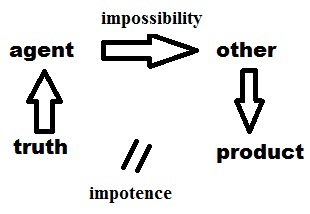
This is not to say that resistance is impossible. It is merely to imply that our dependence on the organized Other is not reproduced merely at the level of knowledge and conscious consent, and thus a shift in consciousness through knowledge transmission is not enough to effect change. What is much more important is the formal (symbolic) structure of power relations that social ordering presupposes. The subject very often prefers not to realize the performative function of the symbolic command — the fact that what promises to deal with subjective lack is what reproduces this lack perpetuating the subject’s desire for subjection. Most crucially, the reproduction of this formal structure relies on a libidinal, affective support that binds subjects to the conditions of their symbolic subordination. What makes the lack in the Other ‘invisible’ — and thus sustains the credibility of the organized Other — is a fantasmatic dialectic manipulating our relation to a lost/impossible enjoyment. It is impossible to unblock and displace identifications and passionate attachments without paying attention to this important dimension.

[A]ny analysis that purports to capture the complex relation between subject and structure cannot remain at the level of signification, although the role of the symbolic command remains extremely important. But, then, how exactly should one theorize the ‘material’ irreducible to signification?

The importance of this question appears to be elevated in a context in which passion and affect are given increasingly prominent roles in the study of society and politics. Here, contrary to what is widely believed, Lacan does not limit his insights within the level of representation and signification.

One needs to stress the productivity of the Lacanian distinction between the ‘subject of the signifier’ and the ‘subject of enjoyment/jouissance’ in addressing this question, and to develop its implications for how we can or should consider the relation between subject and organized Other.

… Lacanian theory accounts for the … lack in the Other, the lack that splits subjective and objective reality, as a lack of jouissance … This lack is always posited as something lost, as a lost fullness, the part of ourselves that is sacrificed — castrated — when we enter the symbolic system of language and social relations. As we have already seen, however, this lack of jouissance should not be viewed as a nihilistic conclusion. It is, rather, what constitutes and sustains human desire: the prohibition of jouissance — the nodal point of the Oedipal drama — is exactly what permits the emergence of desire, a desire structured around the unending quest for the lost, impossible jouissance.

Even after symbolic castration — or, rather, because of it — jouissance remains the catalyst of inter-subjective interaction, a potent political factor.

According to this schema, it is only by sacrificing her pre-symbolic enjoyment that the social subject can develop her desire (including the desire to identify with particular political projects, ideologies and discourses).

The fact, however, that this enjoyment is excised during the process of socialization does not mean that it stops affecting the politics of subjectivity and identification. On the contrary; first of all, it is the imaginary promise of recapturing our lost/impossible enjoyment which provides the fantasy support for many of our political projects and social choices. Almost all political discourse focuses on the delivery of the ‘good life’ or a ‘just society’, both fictions (imaginarizations) of a future state in which current limitations thwarting our enjoyment will be overcome.

… During this imaginary period, which we could call ‘original state’, the nation was prosperous and happy. However, this original state of innocence was somehow destroyed and national(ist) narratives are based on the assumption that the desire of each generation is to try and heal this (metaphoric) castration in order to give back to the nation its lost full enjoyment.

But this is not the full story. Apart from the promise of fantasy, what sustains desire, what drives our identification acts at the level of affectivity/jouissance, is also our ability to go through limit-experiences related to a jouissance of the body.

Otherwise, without any such experience, our faith in fantasmatic political projects — projects which never manage to deliver the fullness they promise — would gradually vanish. A national war victory or the successes of the national football team are examples of such experiences of enjoyment at the national level. However impressive, this jouissance remains partial:

That’s not it

‘“That’s not it” is the very cry by which the jouissance obtained is distinguished from the jouissance expected’ (Lacan 1998: 111); its momentary character, unable to fully satisfy desire, fuels dissatisfaction. It reinscribes lack in the subjective economy, the lack of another jouissance, of the sacrificed jouissance qua fullness, and thus reproduces the fantasmatic promise of its recapturing, the kernel of human desire.

Precisely because the partiality of this second type of enjoyment threatens to reveal the illusory character of our fantasies of fullness, the credibility and salience of any object of identification — and of the organized Other offering it — relies on the ability of providing a convincing explanation for the lack of total enjoyment.

It is here that the idea of a ‘theft of enjoyment’ is introduced (Zizek 1993). If we seem unable to access our lost/impossible enjoyment this is not because castration is constitutive of our symbolic reality, it is not because fullness is impossible, it is only because somebody else is obstructing our access; what we are lacking has been stolen by this satanic other. It may be a foreign occupier, the ‘national enemy’, those who ‘always plot to rule the world’, some dark powers and their local sympathizers ‘who want to enslave our proud nation’, immigrants ‘who steal our jobs’, etc.

The obstacle to full enjoyment shifts depending on the specificity of the fantasmatic narrative at stake, but the logic operating here remains the same.

Conclusion

I have tried in this paper to outline the ways in which Lacanian theory moves beyond subjectivism and objectivism in illuminating the dialectic between subject and organized Other. By understanding the subject as a subject of lack,

Lacan’s negative ontology provides a solution to the paradox of a desire for subjection. There is no desire without lack. And the Other — embodied in the symbolic command — is both what consolidates this lack in the symbolic and what promises to ‘manage’ this lack. At the same time, by understanding the Other as an equally lacking domain Lacan helps us to explain the failure of subjection, the possibility of escaping a full determination of the subject by the socio-symbolic structure.

Why is it then that this option only rarely enacts itself?

To the extent that the lack marking both subject and Other is always a lack of real jouissance, forms of identification offered by the organized Other are obliged to operate at this level also, adding the dimension of a positive incentive to the formal force of the symbolic command. We have thus seen how Lacanian theory illuminates the dialectic between subject and organized Other not only by focusing on the symbolic presuppositions of authority (the irresistibility of the Other’s command), but also by exploring the fantasmatic administration of real enjoyment and its lack, which sustains the credibility of the lacking Other and defers resistance.

Only by taking into account both these dimensions, lack and enjoyment, symbolic command and fantasy, can we start envisaging a comprehensive explanation of what drives identification acts sustaining structures of subjection and, simultaneously, allows a margin of freedom, which, however, can only be enacted with difficulty.

And, of course, the reason for this difficulty is that the symbolic and fantasmatic force of orders of subjection is so overwhelming that resistance or non-compliance itself (when it manages to occur) is usually guided by and ends up instituting a new order of subjection and rarely engages in attempts to encircle lack in a radically democratic ethico-political direction.

Lacan’s reaction to May 1968 is absolutely relevant here (and not only because of the 40th anniversary of the May events). I will very briefly refer to it by way of concluding this essay. During the May events, Lacan observed the French teachers’ strike and suspended his seminar; it seems that he even met Daniel Cohn-Bendit, one of the student leaders (Roudinesco 1997: 336). One way or the other, his name became linked to the events. However, the relation was not an easy one. In 1969, for instance, Lacan was invited to speak at Vincennes, but obviously he and the students operated at different wavelengths. The discussion ended as follows:

‘The aspiration to revolution has but one conceivable issue, always, the discourse of the master. That is what experience has proved. What you, as revolutionaries, aspire to is a Master. You will have one… for you fulfil the role of helots of this regime. You don’t know what that means either? This regime puts you on display; it says: “Watch them fuck”.’ (Lacan 1990: 126)

A similar experience marks his lecture at the Université Catholique de Louvain on 13 October 1973, when he is interrupted and eventually attacked by a student who seizes the opportunity to transmit his (situationist) revolutionary message. The episode, which has been filmed by Françoise Wolff, concludes with Lacan making the following comment:

‘As he was just saying, we should all be part of it, we should close ranks together to achieve, well, what exactly? What does organization mean if not a new order? A new order is the return of something which — if you remember the premise from which I started — it is the order of the discourse of the Master … It’s the one word which hasn’t been mentioned, but it’s the very term organization implies.’ A grim picture, but one that has to be seriously taken into account in reflecting our current theoretico-political predicament.

stavrakakis subject of enjoyment 7

Stavrakakis, Yannis. Subjectivity and the Organized Other: Between Symbolic Authority and Fantasmatic Enjoyment Organization Studies 2008 29: 1037

Beyond Identification,Yet Internal to It: The Subject of Enjoyment

If this structural and structuring role of the command provides the ontological nexus within which the subject learns to interact with their social environment — the symbolic preconditions of subjection and obedience it cannot explain, however, why some commands produce obedient behaviour and others are ignored. It cannot account for the occurrence of disobedience and for instances of resistance. In fact, if we were to stay at this level, it would be impossible to account both for the failure of certain commands and for the complex ‘extrasymbolic’ means through which the organized Other supports and/or attempts to reinstitute its authority. Here, the Lacanian answer is simple. On the one hand, the real exceeds the subject and the lack this inscribes within subjective identity is what stimulates desire (for subjection to the Other).

On the other hand, the real also exceeds the Other and the lack this inscribes in the Other explains the ultimate failure of fully determining subjectivity. It is this second failure that makes resistance possible, at least in principle. It is in the traumatic fact that the Other cannot fully determine the subject that a space for freedom starts to emerge. But this is a freedom that the subject has learned to fear.

As Judith Butler has formulated it, this predicament of the subject is usually resolved with the adoption of the following stance: ‘I would rather exist in subordination than not exist’ (Butler 1997b: 7).

Both the Other and the subject prefer to repress or disavow, to defer this realization of the lack in the Other.

But in order to attempt that in a persuasive manner, the symbolic command is not enough. Something more positive is needed, given the fact that the lack marking subject and Other is a lack of jouissance. This is what fantasy attempts to offer. Let us examine in some more detail the basis of this argument. In order to sustain its hegemony, the performative, formal aspect of the command has to be supported by a fantasy scenario investing it with some supreme value at the level of enjoyment. We have seen in the previous section how Lacanian theory conceives of the different planes operating in identity formation at the intersection of subject and organized Other. We have also seen how Lacan’s negative ontology of lack leads to an attempt to encircle the real of enjoyment, a real which provides the (absent) cause of the dialectic of (failed) identifications partially constituting subjective and social reality.

Here is where Lacan’s originality — in relation to the general field of poststructuralism — is most clearly located. Why? Precisely because poststructuralism remains largely attached to what Harpham has described as ‘the critical fetish of modernity’: Language. … As a result of the linguistic turn … Language has become ‘the critical fetish of modernity’.

However, focusing on the symbolic aspects of identity … is not sufficient in order to reach a rigorous understanding of the drive behind identification acts, to explain why certain identifications prove to be more forceful and alluring than others, and to realize why none can be totally successful. In fact, poststructuralism has often employed models of subjectivity reducing it to a mere linguistic structure (reproducing a rationalist idea that control of talk and discourse means control of political belief) (Alcorn 2002: 97):

‘When poststructuralist theory imagines a subject structured by discourse, it has great difficulty making sense of subjects caught in patterns of repetition unresponsive to dialectic. To understand discourse fully is to understand the limitations of discourse … its inability to persuade the anorexic to eat, and its inability to intervene in those mechanisms of subjectivity that drive actions inaccessible to dialectic.’ (Alcorn 2002: 101)

‘Because of a kind of adhesive attachment that subjects have to certain instances of discourse, some discourse structures are characteristic of subjects and have a temporal stability. These modes of discourse serve as symptoms of subjectivity: they work repetitively and defensively to represent identity … some modes of discourse, because they are libidinally invested, repeatedly and predictably function to constitute the subject’s sense of identity.’ (Alcorn 2002: 17)

The libidinal, fantasmatic character of these attachments is also deeply implicated in processes of social change, which, under this light, can only be described in terms of a dialectic of dis-investment and re-investment … ‘to disinvest social constructions, one must do more than use language or be rational, one must do the work of withdrawing desire from representations.

This work is the work of mourning’ (Alcorn 2002: 117). Discursive shifts presuppose the ‘unbinding of libido’ and the re-investment of jouissance (Alcorn 2002: 118).

When Milgram perceptively writes that the experimenter fills a gap experienced by the subject, the association with Lacan’s formula of fantasy is unavoidable, since fantasy entails a link between the split (castrated) subject of the signifier and his objet-cause of desire, an object purporting to cover over its lack and ‘heal’ or, at least, domesticate castration.

The obvious question thus becomes: is there a fantasmatic frame that supports the symbolic command and binds the subject to the elementary structure of obedience revealed in Milgram’s experiment?

It is far from surprising that Milgram does isolate such a fantasmatic frame; he even highlights its ideological nature. This frame is science itself. What guarantees that the command of the experimenter will be taken seriously, what defers resistance, is that it is presented as part of a scientific experiment. Whatever happens in the experiment is commanded and justified by Science. As Milgram puts it, ‘the idea of science and its acceptance provide the overarching ideological justification for the experiment’ (Milgram 2005: 143).

Of course such a justification is always culturally specific: ‘if the experiment were carried out in a culture very different from our own — say, among Trobrianders — it would be necessary to find a functional equivalent of science in order to obtain psychologically comparable results’ (Milgram 2005: 144). It is also socially and politically specific: when the Yes Men, for example, make an outrageous WTO presentation to a group of students in New York they are met with hostility and not with acceptance (The Yes Men 2004: 146–7).

However, what is most important here is that this fantasmatic frame adds a positive support to the negative/formal character of the symbolic command since science is obviously invested with a positive value: ‘Ideological justification is vital in obtaining willing obedience, for it permits the person to see his behaviour as serving a desirable end’ (Milgram 2005: 144).

What seems to be implied is a particular form of attachment that can only be thought of in terms of positive investment. Thus, the experiment can function only because in the experimenter’s face the empty gesture of symbolic power and the fullness of its fantasmatic support seem to unite.

The other side of the negative force of castration implicit in the command is the fantasy channelling and sustaining in a much more positive and productive way the desire stimulated by this castration itself.

In Milgram’s words, ‘once people are brought into a social hierarchy, there must be some cementing mechanism to endow the structure with at least minimal stability’ (Milgram 2005: 149), and this mechanism involves a certain reward structure (Milgram 2005: 139), which can obviously be conceptualized in ways far more sophisticated than the ones Milgram himself could envisage. Only now can one begin to make real sense of the bond developed between experimenter and subject.

The subject of the experiment submits to the command not merely because it is a symbolic command but also because it is supported by an (imaginarized) supreme knowledge projected onto the person of the experimenter; in this case the experimenter is accepted as an agent of Science.

This projection, however, does not depend exclusively on the particular fantasy present here: it also reveals a more general condition relating to the nature of the bond between authority and subject. In Milgram’s own words, ‘Because the experimenter issues orders within a context he is presumed to know something about, his power is increased. Generally, authorities are felt to know more than the person they are commanding; whether they do or not, the occasion is defined as if they do’ (Milgram 2005: 143).

My reading may be guided by my Lacanian bias, but isn’t Milgram implying that the relation between experimenter and subject is a relation of transference? Isn’t he demonstrating that the experimenter functions as a subject supposed to know?

And, as we know from psychoanalysis, a transferential relation is never purely cognitive: it is primarily affective and libidinal; it also involves a certain enjoyment. Without such an emotional tie obedience would easily break down and disobedience would occur. Besides, how else can we explain the ‘curious’ feelings of compassion towards the experimenter, who issues the commands, and not so much towards the (supposedly) suffering person who receives the (fake) electric shocks, that Milgram detects in his subjects? The ‘unwillingness to “hurt” the experimenter’s feelings, are part of those binding forces inhibiting disobedience’ (Milgram 2005: 152).

In that sense, Milgram can contribute two major points to our inquiry.

1. obedience to authority has a lot to do with the symbolic source of the command and very little with its concrete (rational or irrational, factual or fictional) content.

2. our attachment to this symbolic source is, to a large extent, extimate to the symbolic itself.

Beyond the formal force of the symbolic command, Milgram reveals a lot about the more positive aspects of attachment and obedience to power structures. Not only are these formal structures supported by a fantasy frame manipulating our desire, but the nature of this attachment itself is also of a libidinal, transferential nature.

Symbolic power presupposes a particular type of relation between those who exercise power and those who are subjected to it, a relation of belief which results in complicity.

Such a belief cannot be cultivated and sustained without the mobilization and fantasmatic manipulation of affect and enjoyment; it is clearly located in an extimate position with regard to symbolic structure: ‘What creates the power of words and slogans, a power capable of maintaining or subverting the social order, is the belief in the legitimacy of words and of those who utter them. And words alone cannot create this belief’ (Bourdieu 1991: 170).

This is why it is so difficult — although, fortunately, not impossible — for subjects to withdraw from the experiment: ‘Though many subjects make the intellectual decision that they should not give any more shocks to the learner, they are frequently unable to transform this conviction into action’ (Milgram 2005: 150).

In other words, resistance cannot rely on a shift in consciousness and knowledge. Resistance is not an intellectual issue precisely because obedience is also not sustained at an intellectual level.

Even those who decide to ignore the command cannot do so without enormous emotional strain: ‘As the subject contemplates this break, anxiety is generated, signalling him to step back from the forbidden action and thereby creating an emotional barrier through which he must pass in order to defy authority’ (Milgram 2005: 154).

It is here, I believe, that one encounters the most disturbing aspect of Milgram’s experiment. It is clearly located in the difficulties in passing from acceptance to dissent and from dissent to disobedience. In other words, the subject has to overcome two emotional barriers in order to resist the violent command.

The first barrier leads to the expression of dissent. But dissent does not necessarily lead to disobedience: ‘Many dissenting individuals who are capable of expressing disagreement with authority still respect authority’s right to overrule their expressed opinion. While disagreeing, they are not prepared to act on this conviction’ (Milgram 2005: 163).

stavrakakis yes men 6

Stavrakakis, Yannis. Subjectivity and the Organized Other: Between Symbolic Authority and Fantasmatic Enjoyment Organization Studies 2008 29: 1037

Very often, however, experiencing such alienation is not enough to effect a lessening of the bonds attaching us to the socio-symbolic Other. In other words, subjects are willing to do whatever may be necessary in order to repress or disavow the lack in the Other.

This insight is crucial in understanding power relations. Moving beyond the banal level of raw coercion, which (although not unimportant) cannot form the basis of sustainable hegemony, everyone seeking to understand how certain power structures manage to institute themselves as objects of long-term identification and how people get attached to them is sooner or later led to a variety of phenomena associated with what, since de la Boetie, has been called ‘voluntary servitude’. The central question here is simple:

Why are people so willing and often enthusiastic — or at least relieved — to submit themselves to conditions of subordination, to the forces of hierarchical order? Why are they so keen to comply with the commands of authority often irrespective of their content?

The famous words of Rousseau from the second chapter of The Social Contract are heard echoing here: ‘A slave in fetters loses everything — even the desire to be freed from them. He grows to love his slavery …’   Obviously, the Oedipal structure implicit in the social ordering of our societies, the role of what Lacan calls ‘the Name-of-the-Father’ in structuring reality through the (castrating) imposition of the Law, predisposes social subjects to accept and obey what seems to be emanating from the big Other, from socially sedimented points of reference invested with the gloss of authority and presented as embodying and sustaining the symbolic order, organizing (subjective and objective) reality.  This central Freudian-Lacanian insight can indeed explain a lot. And this can be very well demonstrated through some empirical examples.

Consider, for instance, the story of The Yes Men, two anti-corporate activistpranksters who have set up a fake ‘World Trade Organisation’ website. Believing that the site is the official WTO site, many visitors have sent them speaking invitations addressed to the real WTO. Mike and Andy decided to accept some of the invitations and soon started attending business meetings and conferences throughout the world as WTO representatives. Although intending to shock and ridicule they soon discovered that their ludicrous interventions generated other types of reaction. This is how they describe their experience themselves:

Neither Andy nor Mike studied economics at school. We know very little about the subject, and we won’t attempt to convince you otherwise; if you are of sound mind, you would see through us immediately. Yet, to our surprise, at every meeting we addressed, we found we had absolutely no trouble fooling the experts — those same experts who are ramming the panaceas of ‘free trade’ and ‘globalization’ down the throats of the world’s population. Worse: we couldn’t get them to disbelieve us.

Some of our presentations were based on official theories and policies, but presented with far more candour than usual, making them look like the absurdities that they actually are. At other times we simply ranted nonsensically. Each time, we expected to be jailed, kicked out, silenced, or at the very least interrupted. But no one batted an eye. In fact, they applauded. (The Yes Men 2005)

Simply put, people seem to be ready to accept anything insofar as it is perceived to be transmitted from a source invested with authority: for businessmen and many academics the WTO is obviously such a source. In other words, the content of a message is not as important as the source from which it emanates. Likewise, the subject’s autonomy in filtering and consciously managing its beliefs seems to be undermined by a dependence on symbolic authority per se.

We saw in the activities staged by the Yes Men how easily people are prepared to accept whatever is perceived as coming from an authority. Obviously, what is at stake here is not only acceptance but also compliance and obedience.

Most people, as is shown in their activities, are indeed prepared to accept and obey anything coming from a source of authority irrespective of the actual content of the command. In fact, this structure of authority seems to be a frame presupposed in every social experience.

As Milgram points out, already before the experiment starts, ‘the subject enters the situation with the expectation that someone will be in charge’. Now, and this is the most crucial point, the role of this someone is structurally necessary, without him the identity of the subject itself remains suspended and no functional social interaction can take place: ‘the experimenter, upon first presenting himself, fills a gap experienced by the subject’.  This quasi-Lacanian formulation reveals something essential. First of all, it lends support to the Lacanian understanding of the Name-of-the-Father, the signifier representing authority and order, as instituting the reality of the subject. In his brief Lacanian analysis of the Milgram experiment, David Corfield is right to point out that it ‘reveals something of the super-egoical consequences of the establishment of the paternal metaphor in a clear, albeit brutal fashion’ (Corfield 2002: 200).

The founding moment of subjectivity proper, the moment linguistic/social subjects come to being, has to be associated with symbolic castration, with the prohibition of incest that resolves imaginary alienation and permits our functional insertion into the social world of language.

In other words, the command embodied in the Name-of-the-Father offers the prototype of symbolic power that structures our social reality in patriarchal societies. This is a power both negative and positive, both prohibitive and productive (à la Foucault). The performative prohibition of the paternal function is exactly what makes possible the development of (sexual) desire. Furthermore, it is a power that presupposes our complicity or rather our acceptance; only this acceptance is ‘forced’ since without it no social subject can emerge and psychosis seems to be the only alternative.

And this is a dialectic which is bound to affect our whole life: ‘A power exerted on a subject, subjection is nevertheless a power assumed by the subject, an assumption that constitutes the instrument of that subject’s becoming’ (Butler 1997b: 11).

Without the assumption of castration no desire can emerge. In that sense, if Giorgio Agamben links biopolitics (a characteristically modern phenomenon according to Foucault) with sovereignty per se (Agamben 1998), Lacan seems to be highlighting the inextricable bond between repressive and productive (symbolic) power. Hence, symbolic castration marks a point of no return for the subject.

It is the command of prohibition and our subjection to it that institutes our social world as a structured meaningful order. Without someone in command reality disintegrates.

What Lacan, in his ‘Agency of the Letter’, describes as the ‘elementary structures of culture’ (Lacan 1977: 148), meaning a linguistically determined sense of ordering, are now also revealed as elementary structures of obedience and symbolic power. The intersubjective effects of this logic are immense: ‘It is not only the subject, but the subjects, caught in their intersubjectivity, who line up … and who, more docile than sheep, model their very being on the moment of the signifying chain that runs through them’ (Lacan 2006: 21).

Without such an elementary structure of obedience — instituted and reproduced in what Milgram calls ‘antecedent conditions’: the individual’s familial experience, the general societal setting built on impersonal relations of authority — the experiment would collapse. And these antecedent conditions have to be understood in their proper Lacanian perspective: they refer primarily to the whole symbolic structure within which the subject is born: ‘the subject … if he can appear to be the slave of language is all the more so of a discourse in the universal movement of which his place is already inscribed at birth, if only by virtue of his proper name’ (Lacan 1977: 63–4).

stavrakakis subjective lack 5

Stavrakakis, Yannis. Subjectivity and the Organized Other: Between Symbolic Authority and Fantasmatic Enjoyment Organization Studies 2008 29: 1037

Administering Subjective Lack: Symbolic Authority

I have already pointed out that subjective lack is what forces the subject to enter into a dynamic dialectic with the social world and the organized Other. Now, the resources available to the lacking subject in order to constitute her identity are, broadly speaking, of two distinct types: imaginary and, primarily, symbolic. Hence the distinction Lacan draws between imaginary and symbolic identification: 1. The imaginary register is first approached by Lacan in his work on the ‘mirror stage’.

This stage refers to a particular (early) period in the infant’s psychic development in which the fragmentation experienced by the infant is, for the first time, transformed into an affirmation of her bodily unity (through the assumption of her image in the mirror or through similar experiences). In that sense the mirror stage has to be understood as an identification: ‘We have only to understand the mirror stage as an identification, in the full sense that analysis gives to the term: namely the transformation that takes place in the subject when he assumes an image’. This assumption of a spatial imaginary identity is, however, indicative of the ambivalence involved in ego formation. As Lacan observes, acquiring a first sense of identity is not only cause for jubilation but also of alienation. At first the infant appears jubilant due to her success in integrating her fragmentation into an imaginary totality and unity. Later on, however, jubilation is followed by alienation: By virtue of its inability to represent and control the turbulent real of the infant’s body and of its exteriority, imaginary identification ‘prefigures its alienating dimension’ (Lacan 1977: 2).

If the imaginary representation of ourselves, the mirror image — and imaginary relations in general, such as the one between mother and child — is ultimately incapable of providing us with a stable and functional identity, if it reproduces instead of resolving alienation, the only option left for acquiring one seems to be the field of linguistic representation, the symbolic register. After all, the symbolic is already presupposed in the functioning of the mirror stage since the infant, even before her birth, is inserted into a symbolic network constructed by her parents and family (her name is often discussed and decided in advance, inserting her into a pre-existing family mythology). In Lacan’s work it is clear that the symbolic has a far more important structuring role than the imaginary: ‘While the image equally plays a capital role in our domain, this role is completely taken up and caught up within, remoulded and  reanimated by, the symbolic order’ (Lacan 1993: 9). By submitting to the laws of language the child becomes a subject in language, it inhabits and is inhabited by language, and hopes to gain an adequate representation through the world of words: ‘the symbolic provides a form into which the subject is inserted at the level of its being. It’s on this basis that the subject recognizes himself as being this or that’ (Lacan 1993: 179).

This, however, should not lead to the conclusion that entering the symbolic overcomes alienation by producing a solid identity. On the contrary, the subject constituted on the acceptance of the laws of language, of symbolic Law — a function embodied, within the Oedipal setting, by what Lacan calls ‘the Name-of-the-Father’, the agent of symbolic castration — is the subject of lack par excellence. Alienation is not resolved but displaced into another (symbolic) level, to the register of the signifier. On the one hand, due to the ‘universality’ of language, to the linguistic constitution of human reality, the signifier offers to the subject an almost ‘immortal’, ‘neutral’ representation; only this representation is incapable of capturing and communicating the real ‘singularity’ of the subject. In that sense, it is clear that something is always missing from the symbolic, the Other is a lacking Other.

The emergence of the subject in the socio-symbolic terrain presupposes a division between reality and the real, language and jouissance (a pre-symbolic, realenjoyment), a division that consolidates the alienation of the subject in the signifier and reveals the lack in the Other.

The Other, initially presented as a solution to subjective lack, is now revealed as what retroactively produces/consolidates this lack. It promises to offer the subject some symbolic consistency, but the price to be paid is the sacrifice of all access to pre-symbolic real enjoyment — which now becomes the object of fantasy. Fantasy, in this context, signifies a scenario promising to cover over lack or, at any rate, to domesticate its trauma.

stavrakakis lack in the Other 4

Stavrakakis, Yannis. Subjectivity and the Organized Other: Between Symbolic Authority and Fantasmatic Enjoyment Organization Studies 2008 29: 1037

Indeed, as Laclau and Mouffe have put it, objectivism and subjectivism are symmetrical expressions of the desire for a fullness that is ultimately impossible. In Lacanian theory, moving beyond the Scylla of objectivism and the Charybdis of subjectivism entails the formulation of a novel conception of subjectivity; in fact, it is this new subject, the subject as lack that, through its continuous dialectic with the (equally lacking) Other, symbolic reality, signifies the collapse of subjectivism and objectivism.

Already from his Rome Discourse Lacan formulates his strong objection towards any reference to a closed totality both at the collective and the individual level. And he concludes: ‘it is the subject who introduces division into the individual, as well as into the collectivity that is his equivalent. Psychoanalysis is properly that which reveals both the one and the other to be no more than mirages’. Cederstrom and Willmott are correct to point out that this way in which Lacan intervenes in the agency/structure debate ‘holds out the promise of allowing us to deal with issues of desire and de-centring without falling prey to determinism’. And this applies both to subjective determinism and objective determinism: ‘By advancing a notion of the agent that is predicated on a negative ontology, we challenge the common assumption that the agent either is a free and self-reflexive entity or is a constrained and fully pre-determined category’.

Lacan’s theory of the subject emphasizes thus the notions of ‘desire’ and ‘lack’, the constitutive dialectic between lack and desire. This helps theorists avoid the usual traps of reductionism and essentialism when trying to consider the relationship between subjectivity, society and politics. This relationship is theorized as a function of political identification, leading to a picture of the socio-political field characterized by a complex play of (ultimately failed) identifications, disidentifications and renewed identifications.

Isn’t Ernesto Laclau pointing to the same necessary/impossible dialectic when he highlights the fact that the obstacle limiting my identity and showing its ultimate impossibility is also its condition of possibility insofar as there is no identity without difference and no desire without lack (Laclau 1990: 39)?   True, ideological/discursive determination is unavoidable, even necessary. No social reality and subjective identity can emerge without it; and no management of subjective lack.  At the same time it is ultimately impossible.

No ideological determination is ever complete. Social construction is always an imperfect exercise, and the social subject cannot transcend the ontological horizon of lack. Something always escapes from both orders — Lacan reserves a special name for that: the Real, an excessive quantum of enjoyment (jouissance) resisting representation and control. Something that the subject has been forced to sacrifice upon entering organized society, and which, although lost and inaccessible/unrepresentable for ever, does not stop causing all our attempts to encounter it through our identification acts.

Subjectivism posits a source of power external to the subject, immanentism posits a source of power internal, intimate to the subject, while what is needed is to conceptually grasp a form of external intimacy, what Lacan calls extimité. This is the realm of the real as extimate kernel of the subject, as the lost/impossible enjoyment that, through its constitutive lack, kicks off a whole socio-political dialectic of identifications aiming to recapture it.

In other words, the administration of this constitutive lack of enjoyment takes place in a field transcending simplistic dichotomies (individual vs. collective). How can we access this field? And what can Lacanian theory contribute to our understanding of its constitution and functioning? Of how subjects are constituted, human lives lived and social orders and institutions organized and sustained?

Where is power and authority exactly located in this play? And how are their symbolic and fantasmatic dimensions, language and enjoyment, interimplicated?

glynos 2

Glynos, Jason. in Carl Cederström and Casper Hoedemaekers (eds) Lacan and Organization London: MayFlyBooks, 2010

There is a general consensus in the literature that the mode of engagement associated with an ethics of ‘openness’ is to be preferred, especially when thinking critically about the political economy and about the transformation of the organization of work more specifically. What receives much less attention in this literature, however, are questions about

(1) what these alternative modes of engagement actually look like in practice; and (2) the conditions under which a transition is made from one to another mode of engagement.

There is of course considerable theoretical reflection on the concept of ethics in Lacan, which for many has become synonymous with the idea of ‘traversing the fantasy’. But there is a need to add to these ontological discussions a more robust ontical base by, for example, building up a corpus of empirical examples, exemplars, or paradigms of different sorts of ethical engagement associated with the ‘dissolution’ of the logic of fantasy. This would entail supplementing existing studies that furnish negative critiques of modes of engagement characterized by ‘closure’ with rich phenomenological accounts of what appears on the ‘other side’ of posited fantasmatic traversals.

What conditions and devices, for example, might promote a specifically democratic ethos in organizations akin to a Lacanianethics of the real’?

For a call to explore the relation between a radical democratic ethos and an ‘ethics of the real’, see Mouffe, C. (2000) The Democratic Paradox,(conclusion); on this, see also Glynos, J. (2003) ‘Radical democratic ethos, or, what is an authentic political act?’, Contemporary Political Theory, 2(2): 187-208.

lack in the other

Tutt, Daniel. The Object of Proximity: The Ethics of Psychoanalysis in Žižek and Santner via Lacan. American University Also available here danielp.tutt(at)gmail.com

For Lacan, symbolic identity inhabits an empty place, or the “point de capiton,” which occurs when the subject functions as a signifier embodying a function beyond its own concreteness. The subject is emptied of its particular signification in point de capiton, in order to represent fullness in general. Point de capiton operates in national, religious, political, or ethnic signifiers such as “the nation” or “communism” or even religious identity groupings such as “Christian” or “Muslim,” yet they function as pure negativity, and represent what has to be excluded or negated.

As Yannis Stavrakakis points out in the Lacanian Left, the Name of the Father functions as an insertion into point de capiton, as an operation tied to power relations in late capitalism. Lacan’s Seminar on the Four Discourses introduces the “university discourse” as arising in the wake of the chaotic revolutionary protests of May 1968 in France, and across Europe. The university discourse is a mode of discourse that incorporates scientific discourse to legitimize relations of power. The subject in university discourse becomes equivalent with the social totality, and is situated in the particular historical and late capitalist symbolic space, where the movement occurs, mainly apart from the Master’s discourse, and into university discourse.

An excellent example that reveals the procedure of Name of the Father filing in the point de capiton into empty symbolic identity are the popular “culture jamming” Yes Men. The Yes Men are a group of activists who inhabit false symbolic authority by assuming the identity of powerful businessmen, activists, and politicians. They deliver totally ludicrous presentations that are in actuality totally empty of legitimate content. What they have discovered through these presentations to power holders is that their audiences end up listening attentively to their presentations, and more importantly, they end up taking their statements for total fact without question and most often end up agreeing with their absurd findings.

What this indicates more than anything is that symbolic identity construction functions as an empty gesture of symbolic power supported by a fantasmatic supplement, and both unite to form reality. What the Yes Men and the case of Schreber both indicate is that the commands of identity, deployed from the level of fantasy will always be filled up as an empty vessel. The “crisis of investiture” for both Schreber and the Yes Men occur when “the kernel of invasiveness of too much reality” functions on the side of symbolic identity as an empty space that can be filled in with an inherent negativity. This crisis of identity problematizes attempts to adequately symbolize oneself in everyday reality. 🙂 His use of Yes Men here is confusing.

Lack and Desire in the real

In the Ethics of Psychoanalysis, the mediating force of the Other is desire. Desire is posited as universal,  “all desire is desire of the Other,” since all desire is structured around a missing jouissance, around a lack; it is important to understand the way that lack of the Other structures symbolic identities.

Lack is always introduced through an act of exclusion, an exclusion in part responsible for the fundamental disequilibrium between integrating the Other into the symbolic realm, yet we find that there is something that does fill in the symbolic: fantasy

The imposition of fantasy arises precisely when the desire for filling in, or covering over lack arises. On a structural level, fantasy stimulates and promises to cover over the lack in the Other created by the loss of jouissance.

Since fantasy is also an effect of symbolic castration, it is also a defense mechanism against the fear of symbolic castration. Symbolic castration is defined by Lacan as, “a symbolic lack of an imaginary object,” and symbolic castration is the subject’s first perception of the Other, as not complete, but lacking.

Lacan argues that the subject can only maintain psychic normality by accepting this inherent lack of the other; hence symbolic castration plays a normalizing effect on the subject.

Fantasy then becomes crucial to understanding the role of the “I-Other” relationship and to determining how the Other serves as a support that fills in the void for the lack in the Other, in the realm of the symbolic. The illusory nature of fantasyserves as the central support for the desire to identify, which is inherently impossible in the real, as discussed above.

The Other of fantasy takes on the role of an object, or das Ding to sustains desire itself, and since the Other appears as a remainder, the Other is in an almost mythological status to the subject. The Other promises to provide what the subject lacks and thus unify both as subjects.

The other takes on the role of the object that can potentially unify both the split psyche (of the subject) and of unifying the split social field itself.

over-proximity

Tutt, Daniel. The Object of Proximity: The Ethics of Psychoanalysis in Žižek and Santner via Lacan. American University Also available here danielp.tutt(at)gmail.com

The Psychotheology of Over-Proximity

The ethical problem of proximity to the neighbor introduces a number of ethical implications for ethics, and the ethical relation to the Other in Eric Santner’s work, The Psychotheology of Everyday Life. For Santner, the ultimate problem of the neighbor is based on the whether the subject accepts the Other (or neighbor) in their jouissance, or REAL excess, and in so doing, how they come to handle this over-proximity. Santner characterizes the Freudian “mental excess” (what Lacan would later deem jouissance) as an “excess of validity over meaning,” as the “undeadness of biopolitical life,” and his primary ethical concern is in how to convert the excess into a “blessings of more life.”[25] This mental excess that the subject inhabits, or what Santner refers to as “undeadness” colors everyday life as “a paradoxical kind of mental excess that constrains by means of excess.”[26] Santner develops a slightly different type of Otherness than that of Lacan, based on Jean Laplanche’s psychoanalytic theory of “seduction. ” Laplanche was an intimate student and colleague of Lacan, and in his conception of the Other, or the “enigmatic signifier” the traumatic encounter with the Other’s desire becomes constitutive of the inner strangeness we call the unconscious itself. Therefore, unlike the Lacanian Other, Santner’s Other is stripped of its material properties, a position that evokes Derrida’s notion of the spectral aura of the Other:

“the other is not reducible to its actual predicates, to what one might define or thematize about it, anymore than the I is. It is naked. Bared of every property, and this nudity is also its infinitely exposed vulnerability: its skin. This absence of determinable properties, of concrete predicates, of empirical visibility, is not doubt what gives to the face of the other a spectral aura.” [Derrida, Adieu. To Emmanuel Levinas, pg. 111]

The subject is placed in a relationship with the enigma of the Other’s desire not through language (as in Lacan) but through an unconscious transmission that is neither simply enlivening nor simply deadening but rather “undeadening” – the encounter with the Other produces an internal alienness that has a sort of vitality, and yet belongs to no life at all. This “undeadness” creates an encounter with legitimation, or what Freud referred to as the death drive, a “too much-ness” of pressure and the build of an urge to put an end to it.

Santner’s ethics at this point, in light of the crisis of symbolic identity is concerned with whether we ought to assume our identity in the social body based on the symbolic mandates that determine our identity, or whether the subject ought to break with this system. The two poles of ethical action he develops are the “sciences of symbolic identity,” and the “ethics of singularity.” The strength of Santner’s ethical position is that only when we “truly inhabit the midst of life” are we able to “loosen the fantasy” that structures everyday life.

Thus, similar to what we see in Lacan, to own one’s fantasy is to really live as a free subject, aiming at the truly ethical question that Lacan poses: “have you acted in conformity with the desire which inhabits you?” for it is desire that aims at the real.

The Crisis of Symbolic Investiture

How the subject in Santner’s the Psychotheology, as well as Lacan’s ethical subject deals with “the crisis of symbolic investiture” are a matter of ethics, which we will explore below.

For both Lacan and Santner, ethics requires a confrontation with the Other to free oneself of the Other and then surrender to the real, or everyday life. The confrontation with everyday life, or the Lacanian real is a collapse of the subject’s symbolic constructed identity.

The symbolic identity crisis that Lacan and Santner refer to can be more clearly understood through Santner’s reading of the book Soul Murder, and Lacan’s theory of the Name of the Father. Soul Murder and Name of the Father are instructive to understanding how “the crisis of symbolic investiture” operates through psychoanalytic theory.   Both Lacan and Santner refer to the crisis of symbolic identity when discussing the infamous case of the Judge Daniel Schreber, who upon receiving the symbolic authority in society as a Judge experienced a total psychotic breakdown where his very ability to assume a symbolic identity rooted in authority became penetrated with “a kernel of invasiveness, which introduced the subject into too much reality.” What is it about this “too much reality” that created the conditions for the “the crisis of symbolic investiture?” To fully understand this crisis, a reading of Lacan’s late capitalist “university discourse” and the complex insertion of the Name of the Father bring the crisis into more clarity.

ethics pluth

Tutt, Daniel. The Object of Proximity: The Ethics of Psychoanalysis in Žižek and Santner via Lacan. American University Also available here danielp.tutt(at)gmail.com

In the Ethics of Psychoanalysis, Lacan develops the neighbor as “das Ding”, (the Thing) a pre-symbolic object characterized primarily by affect and appearing in the symbolic realm prior to any and all representation.[5]

Das Ding is a substanceless void, and in structure it is equivalent to the neighbor, or the Other.

The Other[6] takes on a “thing-like” character based on an excess materiality that always resists symbolization in the register of the real. This Other as object is filled in by a certain distance, what Lacan refers to as proximity, a proximity that is identical to the neighbor. As Lacan comments, “the neighbor is identical to the subject, in the same way that one can say the Nebenmensch that Freud speaks of as the foundation of das Ding as his neighbor.”[8] Lacan’s theory of the neighbor-as-das-Ding is rooted in Freud’s conception of das Ding: “and so the complex of the neighbor divides into two constituent parts the first of which impresses through the constancy of its compos[i]tion, its persistence as a Thing, while the other is understood by means of memory-work…”[9]

Lacan characterizes das Ding as “a primordial function located at the level of the unconscious Vorstellungen.”[10] Das Ding ultimately indicates that there is no sovereign good; and thus no possibility to constitute the good in the realm of the subject. “There is good and bad and then there is das Ding” – the Thing remains unfathomable, an excess, outside of the moral relationship.

Lacan’s Ethics: A Matter of Form and Freedom

… Lacanian ethics, as Zupancic correctly points out,… it is something that happens to us, it throws us out of joint, because it always inscribes itself in a given continuity as a rupture, a break or interruption. This is when ethics comes into play; i.e. will I act in conformity to what threw me out of joint? For Lacan, emphasis is placed on desire, “have you acted in conformity with the desire which inhabits you?” for after all, it is desire that aims at the real.[17]

Das Ding, in The Ethics of Psychoanalysis … [is] that which manifests desire for the real. Thus, the real, in ethical terms is an extra moral matter, similar to what we find in Kant’s moral system.

“If a man is to become not merely legally, but morally, a good man… this cannot be brought about by gradual reformation so long as the basis of the maxims remain impure, but must be affected through a revolution in the man’s disposition… He can become a new man only by a kind of rebirth, as it were through a new creation.”[Kant, Immanuel Religion Within the Limits of Reason Alone, Pg. 42 – 43]

Kant and Lacan are both placing ethics, and ethical change ex nihilo, and both develop their ethical systems out of a material excess, for Kant the excess is pathology, and for Lacan it is objet petite a. [21] Both systems are seeking to manage the “excess of the real,” and Zupancic argues, Lacan’s passage a la act is identical to Kant’s allegiance on form in his development of the Groundwork. For Lacan, the faculty of desire does not point to any particular act of desiring but to the frame of desiring as such, similar to how Kantian form points to duty.

The surplus in relation to legality and to the ethical is what is dealt with by form – the main point being that for Kant it is incumbent to follow the form of duty. Kantian ethics demands that an action not only conform to duty, but it mandates this conformity be the only content or motive of that action. Form itself must be appropriated as a material surplus, in order for it to determine the will, and Kantian form is the same as Lacan’s conception of objet petite a, the thing that persists beyond surplus enjoyment. The metaphysical question to both systems of ethics is virtually the same, how can form become matter?

Yet, both Lacanian and Kantian ethics seek to solve the problem of form, or how if Kantian form and Lacanian objet petite a force the subject to follow a sort of second nature, then ethics functions as a drive and isn’t ethics at all. As Zupancic argues, how Lacan dealt with objet petite a, or the surplus enjoyment left over in the domain of the real that persists for the sake of enjoyment is similar to how Kant dealt with the excess of pathology. Since the Kantian object drive is nothing but the drive of the will, and the Lacanain subject’s separation from the pathological objet petite a produces a certain remainder, a remainder that constitutes the drive of the ethical subject, both systems of thought construct ethics from very similar conceptual problems.

We are beginning to see the contours of a Lacanian subject forming that is not rooted in a nightmarish ontological rut as many have criticized Lacan, particularly those that argue his subjectivity is purely a subject constructed from language.

To the contrary, as Ed Pluth has noted in Signifiers and Acts: Freedom in Lacan’s Theory of the Subject, Lacan’s ethics are rooted in a view of freedom of the subject. Importantly, the Lacanian subject can change the destiny of an unconscious desire to the point of “being verbal to the second power” – since “every act of speaking involves an act of addressing an other – always implying a search for recognition from a third party other,” a true ethical act is one that does not address the big Other.

As Pluth observes, “an act does not receive recognition for its identity from an other… it is thus not the subject that acts, an ‘act subjects.’” Thus, the Lacanain subject can never locate the good in the subject, but the subject is able to overturn their lack of capacity to assume their own symbolic identity. The capacity of the subject to overturn their symbolic situation will be examined via Slavoj Žižek and Eric Santner’s reading of the ethics of psychoanalysis.

ethics Ž

Tutt, Daniel. The Object of Proximity: The Ethics of Psychoanalysis in Žižek and Santner via Lacan. American University Also available here danielp.tutt(at)gmail.com

Proximity towards the jouissance of the Other, or the neighbor, in Lacan’s seminar The Ethics of Psychoanalysis becomes a matter of ethical concern because the Other as das Ding (the thing) poses problems outside of the moral relationship. In this paper I will examine the ethical positions of two psychoanalytic theorists, Eric Santner and Slavoj Žižek. The proximity towards the excessive jouissance of the neighbor as das Ding presents a number of interesting ethical problems. Žižek’s confrontation with das Ding is a complex procedure that remains ambiguous, particularly in light of his sympathies towards the Christian Pauline agape version of radical love. Žižek’s treatment of proximity towards the Other seeks a total escape from the fantasmatic symbolic coordinates of the oppressive symbolic order, whereas with Santner, in his text The Psychotheology of Everyday Life, the “mental excess” of jouissance caused by confrontation with the Other as das Ding is sought to be converted into an owning of the excessive proximity into a “blessings of more life.”

This paper first identifies and describes the Lacanian subject – a subject rooted in lack and the crisis of symbolic investiture and argues that Lacanian subjectivity is capable of radical freedom from the fantasmatic symbolic coordinates that sustain its relationship to its own freedom. There are several meta-ethical questions that arise in light of Lacan’s notion of ethics for subjectivity inhabited by fantasmatic symptoms and a symbolic order structured by oppressive fantasy relations. These problems will be explored in this paper as they guide both Žižek’s and Santner’s work, particularly the superego demand to “love thy neighbor as thyself.” The question of politics in relation to the Other for Santner is centered on how to convert the “superego ban” into a blessings of more life.

Whereas with Žižek, the meta-ethical subject ought to be positioned in relation to the Other to enable a radical break from the fantasmatic symbolic coordinates into a new symbolic relationship to the Other, a position highly reminiscent of Antigone’s.

To what extent does Žižek’s ethics reflect Lacan’s sympathies towards Antigone’s reluctance to renounce her fundamental desire? Furthermore, how does Santner in the Psychotheology of Everyday Life position his meta-ethical subject in allegiance to the desire of the Other, and what are the political implications for both of these positions? Admittedly, this is an especially speculative question considering Santner does not deal directly with Lacan’s ethics seminar.

With the rise of the Lacanian left, and a number of texts beginning to identify the relationship between psychoanalysis and politics, we are presented with a powerful critique of the undergirding assumptions behind liberal theory. Perhaps most importantly is the notion that transitive recognition from the Other as the constituting ground of intersubjectivity is inherently blocked by the functioning of desire.

Das Ding and the Impossible Good of the Lacanian Subject

The ethical injunction to “love thy neighbor as thyself” is problematized in Lacan’s seminar The Ethics of Psychoanalysis, as the very core of the intersubjective relation is rooted in an unconscious structural relation to the realm that Lacan refers to as the symbolic. The Lacanian register of the symbolic is an often-difficult concept to unpack. One of the more cogent descriptions of the symbolic is found in popular culture through the example of Woody Allen’s public divorce with Mia Farrow. Allen is said to have dealt with the media in the same hyperactive, idiosyncratic ways as the characters in his films. A traditional psychoanalytic reading of this occurrence would argue that Woody Allen’s actions are merely repressed character traits of his own self put down onto the big screen and then reappearing as a result of a psychical and emotional breakdown. The Lacanian reading would argue something different; that Allen’s incorporation of his symbolic behavior patterns from symbolic art is real life as such. The Lacanian subject is deprived of that which it believes to be the most intimate part of himself, and this happens in the realm of the symbolic.  [ 🙂 Ž makes this point in CHU pg. 250 ]

When faced with the ethical injunction “to love thy neighbor as thyself,” the primary procedure for the multicultural and Judeo-Christian models are to keep at bay the proximity of the neighbor, as the neighbor is inhabited with an uncanny jouissance. To Lacan, one truly encounters the Other not when one discover her values, dreams, and wishes, but when the subject encounters the neighbor as jouissance. As Žižek has suggested, what the predominant liberal multiculturalist model has neglected is this very direct encounter with the “traumatic kernel” of the Other in favor of PC engagement with the “decaffeinated Other.”

“I encounter the other in her moment of jouissance. When I discern in her a tiny detail – a compulsive gesture, an excessive facial gesture – that signals the intensity of the real of jouissance. This encounter is always traumatic, there is something at least minimally obscene about it, I cannot simply integrate it into my universe, there is always a gap separating me from it.”[1]

The postmodern multiculturalist mode of engaging the other, as Zizek has noted, runs along two primary modes, that of the New Age, and the Judeo-Christian, both of which are merely displacing a form of pathos onto an Other that is more authentic, and this ends up causing a sort of inverted racism.

Encountering the Other at the level of das Ding, without depriving that Other of its symbolic jouissance, which the liberal multiculturalist requires, is by definition an exclusivist act by the distance it maintains towards the Other. This distance towards the other is the basis of the ethics of Eric Santner and Slavoj Žižek, but before examining them, we turn to Lacan’s ethical system.

Fink Stavrakakis Van Haute

Fink, Bruce. The Lacanian Subject. New Jersey: Princeton UP, 1995. [LS]
Stavrakakis, Yannis. Lacan and the Political. New York: Routledge, 1999. [LP]
Van Haute , Phillipe. Against Adaptation. New York: Other Press, 2002. [AA]

Alienation [LS 48]
By submitting to the Other, the child nevertheless gains something: he or she becomes, in a sense, one of tf language’s subjects, a subject “of language” or “in language.” Schematically represented, the child, submitting tothe Other, allows the signifier to standin for him or her.
Other/child
The child, coming to be as a divided subject, disappears beneath or behind the signifier, S.
S/$
“Your money or your life!”
… it is clear that your money is as good as gone. … You will thus, no doubt, be more prudent and hand over your wallet or purse; but you will nonetheless suffer a restriction of your enjoyment, insofar as money buys enjoyment. … in his or her confrontation with the Other, the subject immediately drops out of the picture. While alienation is the necessary “first step” in acceding to subjectivity, this step involves choosing “one’s own” disappearance.

Lacan’s concept of the subject as manqué-à-être is useful here: the subject fails to come forth as someone, as a particular being; in the most radical sense, he or she is not, he or she has no being. The subject exists — insofar as the word has wrought him from nothingness, and he or she can be spoken of, talked about, and discoursed upon — yet remains beingless.

Prior to the onset of alienation there was not the slightest question of being … Alienation gives rise to a pure possibility of being, a place where one might expect to find a subject but which nevertheless remains empty. Alienation engenders, in a sense, a place in which it is clear that there is, as of yet, no subject: a place where something is conspicuously lacking. The subject’s first guise is this very lack. [LS52]

Lack in Lacan’s work has, to a certain extent, an ontological status, it is the first step beyond nothingness.
… the subject is completely submerged by language, his or her only trace being a place-marker or place-holder in the symbolic order.

The process of alenation may, as J.A. Miller suggests, be viewed as yielding the subject as empty set, {0}, in other words, a set which has no elements, a symbol which transforms nothingness into something by marking or representing it. [LS52]

The empty set as the subject’s place-holder within the symbolic order is not unrelated to the subject’s proper name. That name is often selected long before the child’s birth, and it inscribes the child in the symbolic. A priori, this name has absolutely nothing to do with the subject; it is as foreign to him or her as any other signifier. But in time this signifier – more, perhaps, than any other—will go to the root of his or her being and become inextricably tied to his or her subjectivity. It will become the signifier of his or her very absence as subject, standing in for him or her.


“Imaginary relations” are not illusory relationships – relationships that don’t really exist – but rather relations between egos, wherein everything is played out in terms of but one opposition: same or different. They involve other porple who you consider to be like yourself for a variety of reasons. It could be because the two of you look very much alike, are similar in size or age, and so on.

Imaginary relationships are characterized by two salient features: love (identification) and hate (rivalry). Insofar as the other is like me, I love and identify with him or her, feeling his or her joy and pain as my own. In the case of identical twins, one often finds that one twin cathects the other twin’s ego almost as much as his or her own.

Difference inevitably creeps between even the most identical of twins, whether due to differential treatment by parents or changes in appearance over time, and the closer the relationship at the outset, the greater the rage over minute differences is likely to be.

Sibling rivalry is the best-known example of imaginary relations involving hatred. Whereas very young children usually do not call into question their subordination to their parents — perceiving a clear difference between their parents and themselves — they do regularly contest, right from a very tender age, their rank and status among their siblings.  Children generally consider their siblings as in the same category as themselves, and cannot abide overly preferential treatment by the parents of anyone other than themselves, double standards, and so on. They come to hate their siblings for taking away their special place in the family, stealing the limelight, and perfomring better than they do in activities valued by the parents. That same kind of rivalry generally esxtends in time to classmates, cousings, neighborhood friends, and so on. The rivalry in such relationships very often revolves around status symbols and implies all kinds of other symbolic and linguistic elements as well.  LS 84-85

calum Antigone the act part 7

It is as an example of the beautiful that Lacan reads Antigone and, particularly, within the play, Antigone. It is as such that, with Lacan, we find something in the text ‘other than a lesson on morality’.

This is not to claim that Antigone has, for Lacan, no ethical import. It is, after all, in the context of his seminar on the ethics of psychoanalysis that he spends considerable time discussing the play.

It is rather to stress that the ethical import of the play lies not in the moralising arguments it might be understood to put forward, whether these be in the sense of a discourse between competing conceptions of the just or (moral) good or in the sense of an advocation of a position of transgression.

While both these positions are, of course, possible, neither addresses the question of ethics. They remain, rather, on the side of (questions of) the law.

The ethical is by definition a subjective moment, the moment of subjective assumption in response to the lack encountered in the Other and the other.

The ethical, that is, is the moment of assumption of that point which refuses recuperation to an image or to a rule, that point where the Symbolic and the Imaginary break down or break open upon the Real.

In terms of the moral law, the ethical is the point at which the subject assumes upon itself the impossible place of that which would guarantee the law. In terms of the Imaginary, ethics is the response to that in the other which refuses recuperation to a coherent image of identification. To render Antigone or Antigone as an ethical example, or as the ethical example par excellence, is to assume to generalise that which is by definition beyond generalisation.

That is to say, to confer upon Antigone the status of example would be to make of Antigone and her act a rule which might be followed; thou shalt transgress the symbolic. But such an example is clearly not an ethical example at all. The ethical moment would necessarily resist any such generalisation and return in the form of the necessity of the subject assuming upon itself the impetus to follow (or reject) the example.

It is not especially that Antigone or Antigone’s act cannot function as an ethical example. It is rather that the ethical cannot be exemplified without recuperating it to a law. Which is to say, precisely, without rendering it other than ethical.

As beautiful, as that which would simultaneously reflect and lure our desire, Antigone would demand a response. This demand would be the subject’s confrontation with the desire that is in it. That is to say, in its location at and as the limit point of the Real, that at which desire would impossibly aim, the beautiful can be understood to be that which would ask of the subject, ‘Have you acted in conformity with the desire that is in you?’ (Lacan Seminar VII p. 314)

As, that is, that which can simultaneously support and lure desire, that which allows the subject to confront das Ding without it destroying the subject, the beautiful would be that which would allow the subject to confront the desire that is in it and thus begin to name this desire, to bring it into the world.

That is to say, it is precisely insofar as the beautiful allows the possibility of encountering the limit of the Real without subsuming the subject in the Real and thus rendering the subject impossible, that it allows the subject the possibility of both confronting its desire and inscribing its desire in the Symbolic.

It is in this sense that the beautiful would entail a cathartic function. The beautiful would allow the possibility of the purification of desire, not in the sense of allowing the subject to attain and occupy pure desire but in the sense of allowing the subject to experience its desire stripped of the trappings of the Symbolic and Imaginary orders and, significantly, to return to the Symbolic and Imaginary orders, bringing with it ‘a new presence’, something which cannot simply be accommodated as though it had always already been there.

The ethical significance of Antigone lies, therefore, not in Antigone’s act in the sense that her act would function as the quintessential ethical example but, rather,

the ethical significance of the play lies in the manner in which it would relate to the desire of the spectator.

The extent to which we can discuss Antigone’s act at all is the extent to which it has been or is being (re)inscribed in the Symbolic. This should alert us to the ambiguity of the act insofar as it can become a topic for discussion.

Antigone’s act, in the proper Lacanian sense, is her act. It is only available for her. What impacts of Antigone’s act on others is either/both a moment of emergence of the Real and/or a Symbolic recuperation depending on the moment of logical time from which it is perceived.

That is to say, we might discern separate moments in Antigone’s so called act.

  • There would be the moment of incomprehension wherein the act disrupts and cannot be explained.
  • There would also be the moment of comprehension wherein the act is slotted into a framework of explanation – e.g. Antigone promotes an alternative discourse on what is just, Antigone constitutes the revolutionary stance par excellence precisely because she promotes no discourse on justice at all but is understood to have introduced a moment of radical disruption for the social weave of Thebes.

Neither of these perspectives, however, can be adequate to the act as it is assumed by Antigone, if it is in fact an act at all.

Given that she is never more than a fictional character, one might be justified in pointing out that ‘she’ cannot assume anything. The pertinent ethical question in Antigone is how we, the audience, the spectator, the reader, respond to the play and respond beyond the play.

The only true act in Antigone is precisely not in Antigone, it is in response to Antigone.