calum Lacan’s Antigone part 6

Neill, Calum. “An Idiotic Act: On the Non-Example of Antigone.” The Letter , 34, 2005, 1-28.

For Lacan, the significance of Antigone lies precisely in its ability to convey the limit point which would mark the intersection of the realms of the Symbolic, the Imaginary and the Real.

It is crucial to acknowledge here that this limit point does entail but cannot be reduced to the limit of the Symbolic. To so reduce the limit point to the gap where the Symbolic opens onto the Real, to, that is, occlude the Imaginary, results in those notions of the play as a contest or opposition between different approaches to the law or convention, whether this be in the sense of two
competing conceptions of justice (Hegel) or between two competing approaches to the law, that is to say, between fidelity to and transgression of the law (Žižek).

While such approaches are not without significant insights, it is only in reinstating the imaginary dimension that we can really begin to appreciate the ethical, as opposed to moral-juridical, significance of the play.

Those readings which would emphasise exclusively the rent in the Symbolic cannot but render the play a discourse on law to the exclusion of the ethical. As such, the so-called ethical example of Antigone cannot but falter. Where there is no ethics, where
ethics is foreclosed, there can be no example of the ethical. It is only in reintroducing the imaginary dimension that the ethical import of the play can be brought to light.

It will, however, be brought to light in a manner which directly occludes the possibility of commandeering it as an  example. That is to say, through Lacan’s reading of Antigone we can begin to appreciate that the ethical avails itself of no examples.

For Lacan the figure of the other necessarily entails the correlation of the Symbolic, the Imaginary and the Real. The encounter with the other, that is, can be reduced to neither the dimension of the Symbolic nor the Imaginary but rather, insofar as it entails both, it indicates the limit point where they would open onto the Real.

That is to say, there is imaginary identification and there is symbolic comprehension, there is an overlap wherein imaginary identification would partake of a minimum of symbolic ordering and, beyond this, something insists which would refuse any such recuperation.

This would be the limit point of das Ding and, for Lacan, ‘[i]t is around this image of the limit that the whole play turns’. The image of the limit is dispersed so thoroughly through the play that it, quite literally, cannot be contained. It cannot, that is, be recuperated to a straightforward symbolisation. The play, in this sense, demonstrates the insistence of the limit without itself becoming a self-contained discourse on the limit.

One example of the functioning of the limit in the play would be the sentence passed on Antigone, that she is to be entombed alive. Not only is the sentence itself to place Antigone in the realm between life and death – she is to be placed in a chamber reserved for the dead while still alive, she is to be made to experience that whichwould be the reserve of the already dead before she is dead – but, in addition, the passing of the sentence itself already situates her in a living relation to death such that her anticipation of certain death must be borne while she still lives. Hers is a ‘situation or fate of a life that is about to turn into
certain death, a death lived by anticipation, a death that crosses over into the sphere of life, a life that moves into the realm of death
’.

What makes the character of Antigone exceptional within the play is that she is presented as that which would be situated, impossibly, on the other side of the limit, in the realm of the Real. It is in this sense that Antigone comes to figure as or is raised to the status of das Ding. This is to say, in Lacan’s terms, that Antigone is presented as ‘inhuman’. This is not, however, to situate her as something monstrous or abhorrent.

It is precisely insofar as Antigone cannot be situated, cannot be recuperated to a fixed idea that she functions for Lacan as the beautiful. It is important here to grasp that the notion of ‘beauty’ is not meant to refer to any convention, any delimited conception of (what would count as) physical or idealised beauty. Beauty cannot be captured in an image as such.

Beauty, for Lacan, is rather a function and to speak, then, of Antigone’s beauty is to relate something of her function. That is to say, what is important in the character of Antigone is how she functions in relation to desire. Not, that is, how Antigone functions in relation to her desire but rather how Antigone, as beauty, functions in relation to the desire of the one who watches her. In relation, that is, to the desire of the spectator.

In its status as limit point, the beautiful is that which would split desire, or in the terminology of later Lacan, that which would render the separation and, at the point of separation, the conjunction of desire and the drive.

Desire is that which defines the subject in relation to lack. Desire, as such, cannot attain satisfaction.

The drive, on the contrary, is that which maintains satisfaction through continuously circulating its object. The beautiful is that which would encompass both such points, thus, simultaneously reflecting the drive and allowing it to continue on its route and maintaining desire as unsatisfied. There is thus in the object of beauty both a moment of transfixion and a moment of satisfaction.

If the object of beauty were capable of entirely satisfying desire it would be destructive of the subject but if it were incapable of providing satisfaction, it would lose its attraction.

It is this conjunction of seemingly incommensurate characteristics which sets the beautiful apart.
calum on Ž the Other part 5

Neill, Calum. “An Idiotic Act: On the Non-Example of Antigone.” The Letter , 34, 2005, 1-28.

The Symbolic order is necessarily experienced by the subject as Other, as an Other of which there is available no objective and totalising conception. That is to say, the Symbolic as Other figures only insofar as it figures in relation to the subject who would encounter it. The Symbolic order is a structural condition which, as it manifests for and in relation to the subject, can only be seen to exist insofar as it exists for that subject.

Conjoined with this, the Symbolic would be the field in which the subject would assume its constitution and, thus, from which it would retroactively posit its emergence. While, then, the Symbolic and the subject obviously cannot be reduced to (aspects of) one another, neither can they, in this context, be separated from one another.

The conception of the act as a reconfiguration of the Symbolic would then have to figure as a subjective undertaking. In terms of Antigone’s act, the act would not only be Antigone’s in the sense that she performs it but it would be hers in the sense that it is performed in relation to the Symbolic order as it manifests for her. This would be to acknowledge that the act can only be experienced by the subject. But even in order for the subject to be understood to have experienced the act or to have experienced itself as acting this would necessitate the act’s (re)inscription in the Symbolic.

The act, as coterminous with the assumption of subjectivity, is necessarily pulsational. One cannot (permanently) occupy the act.

We should perhaps remember here Lacan’s claim from Television that ‘Suicide is the only act which can succeed without misfiring’. Suicide would be such an act precisely because it is not, from the subjective perspective, reinscribed in the Symbolic.

There is in suicide no continuation, no possibility of recuperation by or to the Symbolic but also, quite clearly, no possibility of subjectivity either. That suicide is the only act which can succeed without misfiring is not to advocate suicide, it is, rather, to recognise the impossibility of other acts not misfiring. Suicide is the only act which would not entail a recuperation to the Symbolic by the subject who would have committed it.

The point remains here, however, even acknowledging this subjective relation to the Other , that any act at all, in Žižek’s understanding of it, might figure as ethical even if this means that it only figures as ethical for the particular subject who has acted. Which is precisely to say that there is available no means to differentiate the ethical from the unethical. To paraphrase Simon Critchley’s question concerning Badiou’s notion of the event, and there does appear to be some theoretical resemblance between Žižek’s ‘act’ and Badiou’s ‘event’, how and in virtue of what is one to distinguish an ethical act from a non-ethical act?

Invoking Kant, Žižek represents the ‘proper ethical act’ as ‘doubly
formal: not only does it obey the universal form of law, but this universal form is also its sole motive’. 45

Moreover, the proper ethical act is inherently transgressive. It is not merely a matter of allegiance to a universal duty without pathological motives but it is an allegiance to a form of action which will redefine the very form of the prior conception of what would constitute the good, the norm, the Symbolic order. Žižek’s ‘moral law does not follow the Good – it generates a new shape of what counts as ‘Good’’. The proper ethical act is then, for Žižek, not so much defined by its irrational nature but is that which would institute a new conception or criteria for what counts as rational at all. Nothing which precedes an act is adequate to the task of judging the act.

As Žižek himself makes clear, the act is radically distinguished from ‘a simple criminal violation’. This, not because the act is necessarily a violation without pathological intent or because the act is a violation in the name of a competing conception of right or justice but precisely because the act entails the assumption of cause by the subject without illusory appeal to some other (or Other) foundation for action. It is in this sense that the act would be properly described as a suspension of the Other.

The act is located at the limits of the authority of the Other, the act is the point of subjective intervention without appeal to an Other authority.

The Other, as we have seen, can be understood as coterminous with the Symbolic order insofar as it manifests as a subjective experience. The Other, that is, is the Symbolic order as it is, and with the specificity with which it is, encountered by the subject.

Das Ding is that which cannot be recuperated to either the Symbolic order or to the Imaginary order. It is that of the Real which would insist at the limits of subjective experience. It is, in the context of ‘intersubjectivity’, that of the other which cannot be accommodated to a point of recognition, that in the other which can neither form an aspect of identity nor be reduced to a point of signification. It is also, then, that in and of the subject which can neither be reduced to imaginary identification nor recuperated to a system of signification.

What Žižek characterises as the insistence of ‘the Other-Thing’ would be more accurately described as that in any encounter which cannot be recuperated to a totalising comprehension. It is the insistence of this Thing which cannot adequately be accommodated which would be indicative of the lack in both the other and the Other.

In the encounter with the Other, the Other is experienced as demanding of the subject. It is such a demand which would be indicative of das Ding, insofar as das Ding might be that which would satisfy this demand. In this sense, das Ding can be understood to be a name for that which the Other is experienced as lacking.

It is clear then that, as Žižek appears to acknowledge, there is no possible correlation between the (particular) insistence of the subject and das Ding. If there were, then this would be to simultaneously ‘solve’ the lack in the Other and the lack in the subject.

Which would be to say that there is no subject and no Other for the subject. There would be, that is, no Symbolic order in which the act could be (re)inscribed.

The act should rather be understood as the subject’s always inadequate response to the Other (and the other).

The act is the moment of production of something in response to the other and the Other, precisely in the sense that that something is not the Thing, is not adequate to das Ding. The act would be the moment of subjective assumption, the moment of the subject’s causing its desire to come forth.

But such desire is never something which would be ‘entirely given’,  it is something which must be brought into the world anew. Insofar as the subject’s act is to be understood, it must be reinscribed in the Symbolic and, in being so inscribed, it does necessarily alter the Symbolic. It is in this sense that, as Žižek correctly notes, the act is a creatio ex nihilo.

It is in the act that ‘the subject creates, brings forth, a new presence in the world’.

It must however by emphasised that it, the act, is commensurate with the moment of subjective assumption.

That is, that the act is the act for the subject who would have constituted itself in the act.

Or, phrased otherwise, the act is the subjective moment of assumption and is thus only experienced as such by the subject.

This is not to argue that Antigone is a non-ethical example.

It is rather to emphasise that the very concept of an ethical example is nonsensical.

The ethical consists in the moment of assumption of and as the cause of one’s existence as subject. It is availed of no exterior support or justification.

calum on Ž part 4

Neill, Calum. “An Idiotic Act: On the Non-Example of Antigone.” The Letter , 34, 2005, 1-28.

A ‘truth’ which is clearly, then, not ‘true’ in the Platonic sense of corresponding to some perpetual higher order but is rather ‘true’ in the sense of the moment of a pure creation which would ‘expose’ the conventions of knowledge to be inadequate and force their reconfiguration. For Žižek, the act would be such a truth insofar as the act
would be that which would resist and refuse recuperation to the preexistent symbolic matrix.

Where something like a speech act would, by definition, rely ‘for its performative power on the pre-established set of symbolic rules and/or norms’, the Žižekian act would signal a break with any preestablished or given order.

(quoting from The Ticklish Subject)…  Žižek emphasises Antigone’s willingness to risk her ‘entire social existence’, her defiance of the ‘social-symbolic power of the City embodied in the ruler (Creon)’. Through so doing, Antigone could be understood to have entered the realm of ‘symbolic death’, that is to say, she can be understood to have situated herself outside the symbolic space of what was, previously, her society. For Žižek, such a moment of self-expulsion is tantamount to a ‘suspension of the big Other’, a radical break with and from the Symbolic order.

Žižek and Butler

In order to emphasise and clarify this radical character of the act, the fact that the act should be radically divorced from the Symbolic, that it should be envisaged as irrecuperable to the Symbolic, Žižek contrasts it with what he terms the performative ‘staging’ of revolt, or ‘performative reconfiguration’ 39 of the Symbolic order. Such performative reconfiguration would be exemplified in the position taken by Judith Butler in The Psychic Life of Power where she discusses the possibilities of subjective ‘resistance to given forms of social reality’.  In The Ticklish Subject Žižek responds to Butler’s advocation of forms of resistance which would successfully reconfigure and thus, contingently at least, offer the potential of ameliorating one’s social condition(s), warning against the illusion of assuming to have successfully challenged from within that which is always already in a position to recuperate any such challenge. The distinction here, for Žižek, is that between a reconfiguration which would maintain the terms of the Symbolic and a reconfiguration which would transform the very contours of the Symbolic and thus the terms in which the reconfiguration might be understood.41

Žižek’s point can perhaps be illustrated in the common-place notion of reverse discrimination where the very points of discrimination are precisely upheld in the process of their supposedly politically correct reversal. Some negative aspects of discrimination against ‘the disabled’, for example, may be addressed through the implementation of quotas for the employment of a certain percentage of ‘disabled’ workers but such regulation cannot but uphold the demarcation of certain people as ‘disabled’ and potentially stigmatised and maintain the significance of factors otherwise deemed ‘irrelevant’ to the criteria of employment or ability to ‘do the job’.

A position like Butler’s entails, for Žižek, both an overestimation of the effectivity of ‘performative reconfiguration’ and an underestimation of the potential for the more thoroughgoing revolt which would be exemplified in the character and act of Antigone.

For Žižek, it seems, it is this thoroughgoing rupturing status of the act with regard to the Symbolic, the impossibility of situating the act in or recuperating the act to the Symbolic which renders it ethical.

What, however, are we to make of Žižek’s insistence on the act as irrecuperable to the Symbolic? In the distinction that he puts forward between performative reconfiguration and absolute reconfiguration, one might be justified in asking how the latter might be possible. Clearly here Žižek is not suggesting that everything of the Symbolic is razed. He is not suggesting, for example, that the Greek spoken in Thebes would cease to be spoken after Antigone’s act. He appears, rather, to be suggesting that the meaning of the symbolic or social edifice is unavoidably altered.

calum on Ž the act derrida part 3

Neill, Calum. “An Idiotic Act: On the Non-Example of Antigone.” The Letter , 34, 2005, 1-28.

Knowledge, for Derrida, is an indispensable prerequisite for the decision and, subsequently, for the assumption of responsibility but the decision cannot itself be reduced to knowledge without this rendering it ‘less’ than decisive, rendering it, that is, in the realm of pure calculation. On the other hand, without knowledge, there remains no possibility of responsibility insofar as responsibility would entail a context, a conception of that for and towards which one would be responsible and how.

Responsibility thus figures and can only arise between the closed automaticity of the system of knowledge and the ‘meaninglessness’ that would be beyond any systematisation.

Without exceeding knowledge, the decision is but a part of knowledge and thus not of the subject. Without returning to knowledge, the decision has no sense; it is purely arbitrary.

Is not this notion of the decision commensurate with the notion of the ethical in Lacan, with the notion of the ethical act as that which can appeal to no guarantor in the Other, as that which by definition takes place at the limits of the Symbolic order, as that which cannot be reduced to the law and yet, at the same time, must be inscribed in the Symbolic order? Is this not commensurate with the notion of the ethical as a pulsational moment which emerges from but must also assume a place in the Symbolic?

Neill’s Argument

Contra Žižek’s notion of the act which must be located absolutely beyond the Symbolic order, both Derrida’s ‘decision’ and Lacan’s ‘act’ are such that, in order to be understood as ethical, they must entail a moment of (re)inscription in the order of the comprehensible, or, for Derrida, knowledge, and for Lacan, the Symbolic.

That is to say, in insisting on the exclusivity of what he terms identification with the ‘Other-Thing’ as the defining moment of the act, Žižek might be understood to precisely
occlude the ethical potential from the act.

Returning to Antigone, if, in Žižek’s terms, her act is possible because of ‘the direct identification of her particular/determinate decision with the Other’s (Thing’s) injunction/call’, 26 then it is difficult to see in what sense such an act might be considered ethical.

It is, however, for Žižek, precisely this exclusivity, the radical suspension of the Other without recourse to a further moment of reinscription which does render the act ethical.

Antigone figures here, as we have noted, as the paramount example of the act as a moment of absolute suspension. Antigone, for Žižek, ‘does not merely relate to the Other-Thing, she – for a brief, passing moment of, precisely, decision – directly is the Thing, thus excluding herself from the community regulated by the intermediate agency of symbolic regulations’.27

It is in so excluding herself from the community, in situating herself beyond the regulations of the Symbolic order, that Antigone can be understood, for Žižek, to have engaged in a proper act, precisely because the act, for Žižek, is not simply ‘beyond the reality principle’ in the sense that it would be the engagement of a performative reconfiguration of reality, of, that is, the Symbolic.

Rather, the act is that which would ‘change the very co-ordinates of the “reality principle’’. This is not to suggest that for Žižek the act entails performing the impossible.

Žižek’s point concerns the very structuration of what would be considered (im)possible in the first place. The radical character of the act lies in the fact that it would be that which alters the very contours of what would be considered possible.

Or in moral terms, it would not be that which would challenge the received notion of the good but rather it would be that which would redefine what might be considered as good.

phallic enjoyment the thing

Bailly, Lionel. Lacan: A Beginner’s Guide. Oxford: One World, 2009.

In the seminar in 1957, the objet petit a begins to take on the meaning of the object of desire, which means not this or that specific object that you think you desire, but what is aimed at or sought after that seems to be contained within a particular object – for convenience, one may begin to think of it as the ‘desirable quality’ of the object, or what is desirable in the real-world object. 129

“the object of desire in the usual sense is either a fantasy which supports the desire, or a lure.” Lacan specifies here that the objet petit a is the “imaginary cause of desire” rather than “what the desire tends towards”, to emphasise that this is not a “real world object” (a thing), but an object in the sense of “object relations” – that is, the vehicle upon which a function is exercised (the breast, the stool, the genitalia), and whose relational properties (e.g. controllability for the stool, excitability for the genitalia) form the basis of the different kinds of relationship one may have with the exterior world.

Lacan never suggested that the objet petit a was derived from part objects, only that real-world objects which have something of the properties of part objects are often the ‘receptacles’ for the objet petit a. For example, money shares the property of the stool (the object of the anal function) in being something that may be lost or retained, the unexpected loss of which may be a cause of anxiety, the ‘spending’ of which may be a cause of enjoyment in its own right (how common is the phenomenon of ‘spending money for its own sake’?), and giving and retention of which both have meaning for other people. In other words, it is not money in itself that is an object cause of desire, but its stool-like properties make it a good receptacle for the object cause of desire. 129

The objets petit a may be seen as a fragment of the Phallus, which arises from castration, when the child understands that the Phallus is possessed neither by itself nor its father, nor yet any living person.

However, the lost Phallus cannot be forgotten – the Subject knows it must have existed from the fact that it has lost it.

The Phallus leaves traces of itself everywhere – a little like the mirror of the Snow Queen in the fairy tale, which breaks into a thousand pieces that lodge themselves in objects and people. These Phallic fragments are the objet petit a – the object cause of desire—and can be found in many things: fast cars, the latest technological gadget, the ‘perfect’ cocktail dress … and in other people – a woman who hankers after the love of a powerful man may well be attracted to the Phallic fragment he appears to possess.

The quest to possess the Phallic fragment is a well-spring of creativity and effort: the search for the solution to the insoluble maths problem, to invent a new chess strategy, to perfect your skill at the piano, to discover the structure of DNA …

The pursuit of the Phallus is qualitatively different from the pursuit of fame or social recognition, as it is object-focused (or objective-focused) rather than purely narcissistic (although there will necessarily be a narcissistic element in everything we do); it is to do with the attempt to incorporate in oneself the Phallic fragments.

The Name-of-the-Father is an object of identification for the Subject, as well as the representative of the Other: it is central to the construction of both Subject and its ego. It is the signifier that the Subject can enunciate as representing the object of desire; the master signifiers that take its place will have exactly the same character. This is why Lacan attributes such an important structural role to the master signifiers as being the backbone upon which the Subject is built. Consider the following example:

A man loves sailing and has built much of his image and identity around this; many of his desires revolve around the sea and sailing and the sort of society that goes with it – all this is observable in his choices of clothes, homes, women, etc. ‘Sailing’ is among his master signifiers. In his early life, this man’s father was a keen sailor, and in his identification with his father and fierce rivalry with his brothers for his father’s attention, the boy’s skill at the helm became his main ‘weapon’ of power – his representation of the Phallus (or objet petit a).

If you think of how the Name-of-the-Father hides the true object of the mother’s desire (who was, after all a seaman), one can easily see how ‘sailing’ has replaced the Name-of-the-Father as the metaphorical representation of the object of desire. 133

Just as the master signifiers are substitutes for the Name-of-the-Father, the object cause of desire replaces the lost Phallus as the only thing that can answer the subject’s lack that causes anxiety. I hope this final example will show clearly the relationship between these elements:

A woman in her forties suffered chronic insomnia, caused by her inability to stop thinking, or to ‘switch off her mind’. She was a mathematician by career, and her master signifiers included ‘rationality’ and ‘logic’: she was almost exasperatingly rational.

Beneath the bar of her master signifiers was hidden her great desire for a rational universe, for achievable solutions to problems; the Phallic enjoyment of her life revolved around this. Analysis revealed a child hood in which she had suffered greatly from a mother whose apparently illogical decisions had cost the family greatly and whose ‘childish irrationality’ was a great source of suffering and anger to the child, who proceeded to build her own personality around the signifier and the objects that she felt were her best defence. Beneath the bar of ‘irrationality’ in her unconscious was, as ever the anxiety of the helplessness – castratedness—she had experienced as a result of it as child. Because there is jouissance in the functioning of the psychological apparatus, part of the woman’s problem was that she enjoyed thinking too much (in her insomniac moments, she would solve chess problems in her mind). The defence mechanism she had developed in childhood against the anxiety caused by her helplessness against irrationality had got out of control: her jouissance was transgressing both the pleasure and reality principles. The insomnia became particularly bad whenever situations arose that caused her to re-experience castration anxiety: difficulties at work that she could not ‘solve’ however much she thought would cause her completely sleepless nights, resulting in exhaustion and a vicious circle of not being able to think clearly, and feeling even more anxious about this. 135-136

The Thing (das Ding)

The Thing attracts desire perhaps because it is the object of loss itself: the unsymbolisable and unimaginable reality of loss.

Freud’s Thing is the object of yearning, of desire; it creates jouissance, and is the object of language, while being unsymbolisable. We seek to approach it all the time in what we say, but we can only circle it. Freud held that the Thing was the ‘sovereign good’ to which subjects aspire, but which is always unattainable, because attaining it would transgress the reality principle and will be experie3nced as suffering or evil. …

Lacan’s innovation was to equate the Thing with the mother – not the real mother, obviously, but the mother-who-is-lost: the absence of mother. … the Subject is constituted by its separation from and emotional relationship with the Thing, which is unsymbolisable and therefore cannot be repressed. This relationship with the Thing is so charged with primary affects characteristic of the mother-baby relationship

I would postulate that if a primary characteristic of the Thing is to be unsymbolised and unsymbolisable, then perhaps the Thing is what is lost at the point of birth: the environment in utero, a state in which the baby had no needs, because all its needs were being met by the functioning of the mother. … 138

Although the Thing has something of the effects of the objet petit a arises from the Phallus, and thereby indirectly from the desire of the mother, the Thing arises from the primary affects of a relationship with what is not-yet-represented – the unforgettable-but-already-forgotten other. To return to a total enjoyment of this phantasmatic mother – this mother-as-world – would require a dismantling of the Subject – a kind of regression to a pre-language state that is simply impossible.

Because the Subject is brought into being by signifiers, and the Thing exists outside the Symbolic realm, absolute jouissance in the Thing would require an exit from the realm of signifiers, which is the realm of subjectivity, and the Subject itself would be erased, annihilated. 139

… what is the most intimate thing for a Subject, and yet the most threatening, in terms of its potential to block its access to the Symbolic? The mother is in many ways the gatekeeper of the Symbolic – it is her presence/absence that creates the polarities in which proto-thinking can begin, it is she who embodies the Other, and only she can invoke the Name-of-the-Father.

Therefore, the mother – structurally inaccessible, signified as prohibited, and imagined by the baby Subject as the sovereign good – constitutes, in her absence and in the impossibility of fully accessing her, the Thing. 139-140

The Thing is therefore an object of transgression, which is observable in behaviours that begin as seeking jouissance, and end in self-destruction. The Thing may be thought of as the object of the death drive: those who seek oblivion in heroin or people who strangle themselves in the name of sexual excitement may be acting out their search for the Thing. The search for the Thing exists in tension with the pursuit of the Phallus, and of the objet petit a; this dynamic of tensions set up between the different objects can be seen as the sum of the forces of creativity. 140

failure of mirror stage autism

Bailly, Lionel. Lacan: A Beginner’s Guide. Oxford: One World, 2009.

At first, the baby appears only to need mild, attention to its hygiene, and rest. Psychoanalysis has made much of the breast, because it is a perfect object for the newborn baby: it is food, drink, warmth, comfort, and love. The newborn, drunk on mild, hardly knows it’s been born.  Psychoanalysts point to that state of contentment as something that can never be found again, they point to the breast as a lost perfect object, although not in the same way that the Phallus is a lost perfect object. But that perfect state cannot persist, because the child is growing, and as it does so, its needs become more complex. After a while, it needs to use its developing muscles, and it needs stimulation.  Those needs can be met quite easily: a safe room with space to crawl about, furniture to hold onto so that it may pull itself onto its feet, a television and a couple of of toys should suffice … but they don’t.

Studies … of institutionalised babies showed that even when adequately cared for, they failed to thrive: they became listless and depressed … Lacan – and perhaps everyone else – would say that from day one, the child also needs love, but this begs the question why; love is, anyway, a lot of different things, that is so essential to the formation of the child’s mental health?  The answer may lie in Lacan’s Mirror Stage, in which the mother’s loving gaze is the child’s first mirror and crucial to the formation of the infant’s sense of identity.

… the failure of this first mirror can lead to a deep fault in the foundation of the baby’s sense of identity, which is the ability to conceive of itself as an object, and a beloved object. Without the means of forming the proto-concept of ‘self’ at the right moment in infancy, there may be severe delays in cognitive development or even a complete failure to develop the concept of ‘subject’ and by extension ‘object’ and all the conceptualisations that follow, resulting in severe autism.  All this would imply that ‘love’ is a primary need – perhaps the primary need – with respect to the construction of the human Subject. 113-114

But it is in the dimension of love that demand can never ‘match’ the need, and therefore the dimension in which desire flourishes.

One can only demand love obliquely, because in its very nature, it eludes language. It is not that the child does not try to ask for it, indeed, once a child is able to speak, most of its demands are expressions of its need for love.  If you think about it, outside circumstances of extreme economic hardship (in the developing world or in war), it is rare for a child to have to demand something fundamental to its physical survival. Most of the time, what it asks for is ‘extra’: every day and at every opportunity, ‘plain past not filled’ or ‘chocolate cake’ or ‘not the yoghurt with bits in but that one’.  It is in the inessential ‘extra’ that is coded the demand for love: in Lacan’s words, ‘the demand cancels the particularity of whatever is given by changing it into a proof of love’.

But why cannot love be demanded directly?  Lacan would say that it is because love consists in ‘giving what one doesn’t have’ (Ecrits) – in other words, it can only be seen in the effort put in by the giver of love. Thus, the child ‘deduces’ the mother’s love by the effort and will she puts into satisfying the inessential part of the demand; her love is read in her proofs that her greatest desire is to be with and satisfying to the child.  In this relationship, therefore, the child sees the mother’s love as depending upon the existence of a need (Lacan calls it a lack-in-being) and a desire in her – a desire the child thinks it fulfills. 115

unconscious the Other

Bailly, Lionel. Lacan: A Beginner’s Guide. Oxford: One World, 2009.

For Lacan, the Subject remained that elusive thing that hides behind the ego, that is alienated from it, that is created in an act of language, and that is largely unconscious. It is the Subject that speaks, but when it speaks, it barely knows what it is saying. And I am no longer referring here to the ‘unconscious discourse’ that appears in clips of the tongue, dreams and pathological symptoms, I am referring to what the speaker (Subject) would think of as ‘conscious speech’. This is because for the most part, the Subject is unconscious of itself.

This view may seem like overstatement: one feels provoked to say, ‘But I do know what I’m talking about … I only make a slop of the tongue very rarely, 99% of the time I mean exactly what I’m saying’, etc.

But the experienced analyst knows instantly when she/he hears denegation (‘Of course, he’s likeable enough’ nearly always means I don’t like him); and even the most common everyday use of language is closely governed by the unconscious. Most of the time, there is an interplay of conscious and unconscious in our speech: we may mean exactly what we say, but we hardly ever know why we say it.

Consider the following examples:

‘Has so-and-so got a partner’ appears a simple question, but what motivates it? Is the questioner a woman worried that the so-and-so in question is interested in her man? Or is it a man interested in so-and-so? Or is it a woman who, motivated by jealousy, hopes to learn that so-and-so is unlucky in love where she herself is not? Whichever it is, the speaker is bound to deny it, and say it’s an innocent question motivated by altruistic concern or curiosity? We can never escape the unconscious – even when it is harmless. 70

‘We’ve cooked a roast for you – we got the joint from such-and-such specialist butcher’ could provoke guilt in a prodigal child, or encourage a guest to bring a bottle of better quality wine than usual (why not just ‘a roast’? Why mention the quality of it?), etc. But again, in both cases, the speaker’s intentions are entirely unconscious.

‘I’m still recovering from the weekend’ is a commonly heard phrase, but why does the speaker think the listener needs to know this? Is she/he boasting about her/his exciting social life, bolstering the edifice of an ego which includes the master signifiers ‘socially successful’ or ‘popular’? or is she/he trying to convince her/himself that she/he had a good time, when in fact she/he was very bored? 70

Even ‘Please may I have a kilo of potatoes’ could be multilayered statement: why not simply, ‘a kilo of potatoes’ – why the time spent on a formula of politesse? Is the questioner trying to show her/his good breeding? Or if, on the contrary, all politesse is dispensed with – they why the rudeness?  Might that be a way of establishing higher status over the lowly greengrocer? And is a kilo enough – or is the speaker being mean and not buying enough, or displaying an anxiety about inadequacy and asking for too many? 70
These trivial examples only underline the power of the unconscious in directing the selection and combination of signifiers into chains with or without our conscious ‘will’; Lacan saw this interplay between conscious and unconscious in the Subject as being like the continuum of the surface of a moebius strip.

The Other is manifest not only in language (even though this may be its principal domain), but also in the whole set of hypotheses that exert their influence upon the Subject. The Law, societal rules, taboos, mores and expectations, and even Time are different faces of the Other. The Other is constituted by the entire symbolic realm of human productions; accessing the Other involves the crossing of the bar described in chapter 3; it also involves the act of alienation described in the Mirror Stage, which situates the Subject within the Other. These processes of alienation and symbolisation which tie together Subject and Other are the essential basis of human creativity. 70-71

mirror stage

Bailly, Lionel. Lacan: A Beginner’s Guide. Oxford: One World, 2009.

… Lacan’s subject … depends on the user accepting that there are elements of one’s identity of which one is unconscious; anyone who thinks that one’s identity is only what one wishes to say about oneself (‘I am Irish, I am an independent career woman’, etc.) is talking about what Lacan would have called the ego. Lacan’s Subject is composed of and revealed by signifiers, which it utters without knowing what they mean.

As developmental psychologies Henri Wallon pointed out, the human baby is very premature at birth compared with other animals, including the higher primates, from birth up until maybe eighteen or more months, the infant is unable to stand up, walk, or handle objects with dexterity, and the sense of ‘self’ and ‘wholeness’ that is allowed by mature proprioception (perception of the whole body within its environment) is absent.  However, this human baby – immature, helpless, perceiving itself only in a fragmented way – is, at some point between the ages of six and eighteen months, going to see an image in the mirror, and realise that it is itself.  This will be the first time the baby discovers itself as a unitary being, and this discovery is the source of an intense feeling of joy and excitement, which is usually shared with the adult present; the infant, having made this discovery, turns back to look at it smother, for example, and shares with her its pride and surprise. This founding act, leading to the formation of the ego and the perception of the Subject, is attended by powerful emotion. 29

Lacan said: ‘we have to understand the mirror stage as an identification … the transformation that takes place in the subject when he assumes an image’.  The baby’s discovery of self is an intellectual act; it involves the translation of an image into an idea – the idea of ‘me’ or ‘self’; hence, human identity is based on a primary act of intellect.  But this is not a restatement of Descartes’s cogito ergo sum: I think, therefore I am.  Indeed, Lacan was completely opposed to ‘any philosophy issuing directly from the cogito’: for him, the opposite was true – I think, therefore I am not, or I am fully a subject only when I am not thinking – the very act of thinking about oneself nullifies the Subject. 30

While identifying itself in the mirror, the child also identifies with something from which it is separated: it is as an ‘other’ that the Subject identifies and experiences itself first.  The founding act of identity is therefore not just emotional and intellectual, it is also schismatic, separating the Subject from itself into an object. For Lacan, the Mirror Stage is ‘the symbolic matrix in which the I is precipitated in a primordial form, prior to it being objectified in the dialectic of identification with the other, and before language restores to it, in the universal, its function as subject’.  At the Mirror Stage, the intellectual perception of oneself is an alienating experience and the beginning of a series of untruths; but it is a necessary alienation that allows the Subject access to the symbolic realm. 30

Méconnaissance is a French word encompassing non-recognition of and obliviousness to something; it is sometimes translated as ‘misrecognition’ – a translation I find goes wide of the mark.  ‘Misrecognition’ suggests that something has been recognised, only wrongly.  In my preferred translation of obliviousness or non-recognition, the subject is completely blind to the object.  One of Lacan’s most important maxims is that human beings are very largely oblivious of their own Subject; the ego is what a person says of him/herself; the Subject is the unrecognised self that is speaking.  Psychoanalysis is about accompanying the patient towards his/her subjective truth, or towards the point where the objective ‘me’ and the subjective ‘I’ can be united.  35

As the child’s language develops, it begins to attach ideas to the objectified self, which is to become the ego or ‘le moi’: the ideas it attaches are often produced by a denial of reality, denegation, or wishful thinking.  The three year old who cries, ‘Race you, Daddy! I’m winning!’ is showing his/her desire to win, in the face of an easily observed reality – that Daddy’s legs are four times longer and much faster.  The father is likely, for his part, to let the child win – precisely because he wishes to help the development of the child’s image of itself as a winner, he is, in fact, aiding and abetting the fiction of his child’s ego (in this case a necessary defence against the anxiety of being so small and helpless).  And this fiction is maintained and nurtured throughout one’s life; denegation too helps: ‘I’ve got no problem with so-and-so’ is almost always a contradiction of the truth; but it helps the speaker maintain his/her fiction that she/he is easygoing/unaffected by the so-and-so in question.  36

The factitious, ‘created’ nature of the ego is behind Lacan’s opposition to ‘any philosophy directly issuing from the Cogitio’: the cogito of Cartesian thinking relies mostly on the status of consciousness – the status in which the ego believes itself most to be in control.  But for Lacan, the real ‘I’ is the Subject – I in ‘I am’ – and this is necessarily hidden by conscious thought about itself.  At the Mirror Stage, one may think of the Subject as the part that ‘invents’ the stories about its image-self or ego, affixing to it signifiers as it acquires language: girl, blonde, pretty, likes chocolate, hates pink, good at drawing, etc.; but it also represses as many signifiers as it selects, and in doing so, tries to hide something of itself. Indeed, the Subject can only come into being when it is not thinking, because the very act of any thinking that involves its ego creates a smokescreen behind which it disappears. 36

Kant Hegel

Schroeder, Jeanne L. The Four Lacanian Discourses or Turning Law Inside-Out. New York: Routledge-Cavendish, 2008.

Being finite, we can never really know our “true” motives. In Henry Allison’s words, “[F]ar from asserting a doctrine of unqualified noumenal freedom … Kant explicitly asserts that since the intelligible character is inaccessible to us, we can never be certain whether, or to what extent, a given action is due to nature or freedom.” The pure reason that is essential to man is itself a noumenon, a thing-in-itself. Each person as an empirical individual is a phenomenon who does not have direct contact with his own noumenal, essential self. In Kant’s words, “The depths of the human heart are unfathomable.” No one can directly now his own self. “For a human being cannot see into the depths of his own heart so as to be quite certain, in even a single action, of the purity of his moral intention and the sincerity of his disposition, even when he has no doubt about the legality of the action.” Kant’s idea of a radical split between our conscious selves and another essential “true” inner self will reappear in Lacan’s rewriting of Freud in light of speculative thought. 81-82

For a Kantian, a preference is an inclination and is antithetical to morality, which must be served regardless of preferences. 83

Kant recognizes that it is precisely this impossibility of knowing and achieving the morality which is the reciprocal of freedom, that creates the actuality of human free will in the world. If man could actually see into the mind of God and know the ethical law, he would no longer be self-legislating (i.e. free). He would be submitting himself to an external force. In Kant’s metaphor, “Man would be a marionette or an automaton.” Ironically, it is man’s sin, his failure, his radical evilness, his inability to be truly free, that results in his practical freedom. As the common law tradition understands, law, as well as freedom, is a work in process.

In order for the subject to be free, she must be self-legislating, constantly creating new law. If, however she ever succeeded in the task of finishing and completely filling her world with law, it would bind her and prevent her from spontaneously creating new law. She would no longer be free.

Paradoxically, the reason the individual is able to liberate herself from nature’s causal chains, so that she might freely bind herself to the ethical law, is that every time she tries to bind herself to the ethical law, its chains slip her wrists. Man is always a moral Houdini despite himself. Lacan identifies this fundamental paradox that characterizes the moral universe as the sexual impasse. The part of personality that imagines itself completely bound by law is the “masculine,” and the part that knows that she slips away is the “feminine.” 83-84

Though Hegel agrees with Kant that the essence of personality is free will, he thinks that freedom of the Kantian individual in the state of nature could only be potential. Pure Kantian freedom is radically negative; indeed it is negativity per se.

To be completely free from bounds is to be totally lacking in content, to be a pure abstraction without individuality (i.e. noumenal). Hegel believes that in order for freedom to become actual, the individual must become concrete (i.e. phenomenal). …. Hegel thinks that this can only be achieved through intersubjective relationships with other subjects.

Consequently, because the individual rationally seeks to actualize her freedom, she passionately desires human contact. Lacan will rephrase Hegel’s sublime hysteria as “the desire of man is the desire of the Other.” 85

castration oeidipal

Kotsko, Adam. “Empire & Eschaton”  Journal of Philosophy and Scripture Volume 2, Issue 1. Fall 2004

Lacanian psychoanalysis understands the human being as constitutively misshapen by the very process of entering the linguistic space of human interaction.

Rather than longing for the impossible pre-linguistic experience that Deleuze and Guattari glorify under the name of a “schizophrenia,” psychoanalysis seeks to reshape the subject’s relationship to the symbolic order, the social substance, to turn the constitutive division in the subject into an opportunity rather than a burden.

As Zizek says in his recent book on Deleuze, Organs Without Bodies:

“Is the Freudian Oedipus complex (especially in terms of its Lacanian interpretive appropriation) not the exact opposite of the reduction of the multitude of social intensities onto the mother-father-and me matrix: the matrix of the explosive opening up of the subject onto the social space?

Undergoing “symbolic castration” is a way for the subject to be thrown out of the family network, propelled into a wider social network….” Organs 12

antigone

“Ethics of Psychoanalysis – Lacan’s Antigone and the Ethics of Interpretation.” 123HelpMe.com

In 1959, Lacan presented Sophocles’ Antigone as a model of pure desire for his seminar on The Ethics of Psychoanalysis:

Antigone presents herself as autonomos, the pure and simple relationship of a human being to that which it miraculously finds itself carrying, that is the rupture of signification, that which grants a person the insuperable power of being—in spite of and against everything—what he [sic] is. . . . Antigone all but fulfills what can be called pure desire, the pure and simple desire of death as such [i.e., of that which is beyond the pleasure principle]. She incarnates this desire. (1986: 328-29)

Lacan notes that Antigone’s decision to defy Creon consciously seeks death. She makes no effort to defend Polynices’ actions (Lacan 1986: 290, 323-25).

Her choice takes her beyond the realm of rational discourse and the collective norms of human satisfaction it implies (Lacan 1986: 78, 281; Zizek 1991: 25).

Hers is a position that transcends the comfortable binary oppositions that structure our daily ethical and social lives. Because her choice of death cannot be understood according to strictly rational norms, she cannot be read as representing some simple antithesis of freedom to tyranny, or the individual to the state (Lacan 1986: 281; Zizek 1992: 77-78). In fact, as she acknowledges, she had chosen death before Creon’s decree against the burial of Polynices, and she defines herself to Ismene as one already belonging to the realm of the dead (ll. 559-60; Lacan 1986: 315, 326). Creon is not a tyrant who forces Antigone to make an impossible choice between life and freedom; rather, he embodies the civic norms that her pursuit of a desire beyond the bounds of those desires articulated within the realm of common life both requires as defining foil, and transcends.

Her choice thus represents a pure ethical act shaped neither by a self-interested selection among communally recognized goods nor the self-loathing of conforming to a code that is recognized and despised (Zizek 1992: 77).

Such an ethical choice, as Lacan acknowledges, is Kantian in its devotion to a pure concept of duty, but psychoanalytic in its predication on a highly individualized desire whose content cannot be generalized into a universal ethical maxim (Lacan 1986: 68, 365-66).

Antigone’s choice, her desire, is pure precisely to the degree that it rejects the claims of the Other. For Lacan, it is the beauty of Antigone’s choice of a Good beyond all recognized goods, beyond the pleasure principle, that gives her character its monumental status and makes her a model for an ethics of creation as opposed to conformity.

It is for this reason that he cites Antigone’s self-comparison to ever-weeping, petrified Niobe, another princess enclosed alive in stone—as the central axis around which the play turns (ll. 823-33). In this one image we see brought together the themes of beauty, monumentality, and death-in-life in a singular apotheosis of tragic transgression (Lacan 1986: 311, 315, 327). Beauty for Lacan represents the perfect moment between life and death, a moment both articulated by and beyond time and desire, a moment whose true achievement can only be imagined as the incarnation of a pure desire beyond any recognizable object.

In its beauty, Sophocles’ Antigone presents what Lacan defines as a “Sublime Object.” Our ethical obligation as readers and analysts is to be true to this object to the precise degree that it transcends all normative categories. As Antigone does not cede on her desire, neither can we assimilate her tragedy to a pre-existing set of critical categories, even psychoanalytic ones.

This is an obligation to the text, but it is simultaneously an obligation to our own desire as readers, critics, and subjects: for the encounter with the sublime object is one that must shake us to our very core if it is not to be a factitious or mechanical exercise in the application of reassuring truisms. To meet our obligation to the sublime text we must go beyond the dictates of the pleasure and reality principles, beyond good and evil to encounter pure desire: the moment in which the canons of meaning shudder before their own beyond.

Works Cited
Lacan, Jacques. 1986. Le séminaire livre VII: L’éthique de la psychanalyse. Paris.
Zizek, Slavoj. 1991. Looking Awry: An Introduction to Jacques Lacan through Popular Culture. Cambridge.
—. 1992. Enjoy Your Symptom: Jacques Lacan in Hollywood and Out. New York.

Ž four discourses four subjects

Žižek, Slavoj. “Four Discourses, Four Subjects” in Cogito and the Unconscious. ed. Slavoj Žižek, Duke UP, 1998. 75-113.

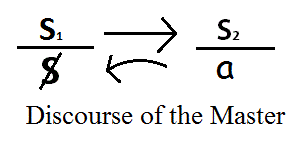
The illusion of the gesture of the Master is the complete coincidence between the level of enunciation (the subjective position from which I am speaking) and the level of the enunciated content, that is, what characterizes the Master is a speech-act that wholly absorbs me, in which “I am what I say,” in short, a fully realized, self-contained performative.

Such an ideal coincidence, of course, precludes the dimension of fantasy, since fantasy emerges precisely  in order to fill in the gap between the enunciated content and its underlying position of enunciation.

Fantasy is an answer to the question, “You are telling me this, but why? What do you really want by telling me this?”

The fact that the dimension of fantasy nonetheless persists thus simply signals the ultimate unavoidable failure of the Master’s discourse.

There is thus no reason to be dismissive of the discourse of the Master, to identify it too hastily with “authoritarian repression”: the Master’s gesture is the founding gesture of every social link.  Let us imagine a confused situation of social disintegration, in which the cohesive power of ideology loses its efficiency: in such a situation, the Master is the  one who invents a new signifier, the famous “quilting point,” which again stabilizes the situation and makes it readable; the university discourse that then elaborates the network of Knowledge that sustains this readability by definition presupposes and relies on the initial gesture of the Master.  The Master adds no new positive content — he merely adds a signifier, which all of a sudden turns disorder into order, into “new harmony,” … Therein resides the magic of a Master: although there is nothing new at the level of positive content, “nothing is quite the same” after he pronounces his Word. …

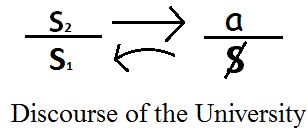
The University discourse is enunciated from the position of “neutral” Knowledge; it addresses the remainder of the real  (say, in the case of pedagogical knowledge, the “raw, uncultivated child”), turning it into the subject .   .  The “truth” of the university discourse, hidden beneath the bar, of course, is power (i.e., the Master-Signifier):
the constitutive lie of the university discourse is that it disavows its performative dimension, presenting what effectively amounts to a political decision based on power as a simple insight into the factual state of things.

What one should avoid here is the Foucaultian misreading: the produced subject is not simply the subjectivity that arises as the result of the disciplinary application of knowledge-power, but its remainder, that which eludes the grasp of knowledge-power. “Production” (the fourth term in the matrix of discourses) does not stand simply for the result of the discursive operation, but rather for its “indivisible remainder,” for the excess that resists being included in the discursive network (i.e., for what the discourses itself produces as the foreign body in its very heart). 78

Suffice it to recall the market expert who advocates strong budgetary measures (cutting welfare expenses, etc.) as a necessity imposed by his neutral expertise devoid of any ideological biases: what he conceals is the series of power-relations (from the active role of state apparatuses to ideological beliefs) that sustain the “neutral” functioning of the market mechanism. 79

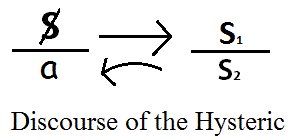
In the hysterical link, the . . over a stands for the subject who is divided, traumatized, by what an object she is for the Other, what role she plays in Other’s desire: “Why am I what you’re saying that I am?” … What she expects from the Other-Master is knowledge about what she is as object (the lower level of the formula).

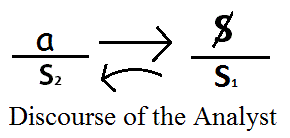
In contrast to hysteria, the pervert knows perfectly what he is for the Other: a knowledge supports his position as the object of Other’s (divided subject’s) jouissance. For that reason, the matheme of the discourse of perversion is the same as that of the analyst’s discourse.

Lacan defines perversion as the inverted fantasy (i.e., his matheme of perversion is a-$), which is precisely the upper level of the analyst’s discourse. The difference between the social link of perversion and that of analysis is grounded in the radical ambiguity of objet petit a in Lacan, which stands simultaneously for the imaginary fantasmatic lure/screen AND for that which this lure is obfuscating, for the void behind the lure.

*So when we pass from perversion to the analytic social link, the agent (analyst) reduces himself to the void, which provokes the subject into confronting the truth of his desire. Knowledge in the position of “truth” below the bar under the “agent,” of course, refers to the supposed knowledge of the analyst, and, simultaneously, signals that the knowledge gained here will not be the neutral objective knowledge of scientific adequacy, but the knowledge that concerns the subject (analysand) in the truth of his subjective position.

In this precise sense, the analyst’s discourse produces the master signifier, the swerve of the patient’s knowledge, the surplus element that situates the patient’s knowledge at the level of truth: after the master signifier is produced, even if nothing changes at the level of knowledge, the same knowledge as before starts to function in a different mode. The master signifier is the unconscious sinthome, the cipher of enjoyment, to which the subject was unknowingly subjected.

*Text here is modified according to https://www.terada.ca/discourse/?p=7106

So, if a political Leader says “I am your Master, let my will be done!” this direct assertion of authority is hystericized when the subject starts to doubt his qualification to act as a Leader (“Am I really their Master?” What is in me that legitimizes me to act like that?”); it can be masked in the guise of the university discourse (“In asking you to do this, I merely follow the insight into objective historical necessity, so I am not your Leader, but merely your servant who enables you to act for your own good. …”); or, the subject can act as a blank, suspending his symbolic efficiency and thus compelling his Other to become aware of how he was experiencing another subject as a Leader only because he was treating him as one.

It should be clear, from this brief description, how the position of the “agent” in each of the four discourses involves a specific mode of subjectivity:

– the Master is the subject who is fuly engaged in his (speech) act, who, in a way, “is his word,” whose word displays an immediate performative efficiency;

– the agent of the university discourse is, on the contrary, fundamentally disengaged: he posits himself as the self-erasing observer (and executor) of “objective laws” accessible to neutral knowledge (in clinical terms, his position is closest to that of the pervert).

– the hysterical subject is the subject whose very existence involves radical doubt and questioning, his entire being is sustained by the uncertainty as to what he is for the Other; insofar as the subject exists only as an answer to the enigma of the Other’s desire, the hysterical subject is the subject par excellence.

Again, in clear contrast to it, the analyst stands for the paradox of the desubjectivized subject, of the subject who fully assumed what Lacan calls “subjective destitution” that is, who breaks out of the vicious cycle of intersubjective dialectics of desire and turns into an acephalous being of pure drive.