objet a and the drive id-evil

Žižek, Slavoj.  Jacques Lacan’s Four Discourses also in an article in Russell Grigg and Justin Clemens Jacques Lacan and the Other Side of Psychoanalysis. 2006

Portions of this stuff are reprinted in The Parallax View starting on page 303.
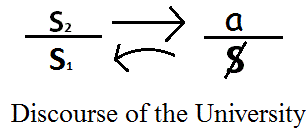
Can the upper level of Lacan’s formula of the university discourse — S2 directed toward a — not also be read as standing for the university knowledge endeavoring to integrate, domesticate, and appropriate the excess that resists and rejects it?

One of the telltale signs of university discourse is that the opponent is accused of being “dogmatic” and “sectarian.” University discourse cannot tolerate an engaged subjective stance. Should not our first gesture be, as Lacanians, to heroically assume this designation of being “sectarian” and engage in a “sectarian” polemic?

University discourse as the hegemonic discourse of modernity has two forms of existence in which its inner tension (“contradiction”) is externalized: capitalism, its logic of the integrated excess, of the system reproducing itself through constant self-revolutionizing, and the bureaucratic “totalitarianism” conceptualized in different guises as the rule of technology, of instrumental reason, of biopolitics, as the “administered world.”

We should not succumb to the temptation of reducing capitalism to a mere form of appearance of the more fundamental ontological attitude of technological domination; we should rather insist, in the Marxian mode, that the capitalist logic of integrating the surplus into the functioning of the system is the fundamental fact.

Stalinist “totalitarianism” was the capitalist logic of self-propelling productivity liberated from its capitalist form, which is why it failed: Stalinism was the symptom of capitalism.

Stalinism involved the matrix of general intellect, of the planned transparency of social life, of total productive mobilization- and its violent purges and paranoia were a kind of a “return of the repressed,” the “irrationality” inherent to the project of a totally organized “administered society.” This means the two levels, precisely insofar as they are two sides of the same coin, are ultimately incompatible: there is no metalanguage enabling us to translate the logic of domination back into the capitalist reproduction-through-excess, or vice versa.

The key question here concerns the relationship between the two excesses:

1) the economic excess/surplus integrated into the capitalist machine as the force that drives it into permanent self-revolutionizing and

2) the political excess of power — exercise inherent to modern power (the constitutive excess of representation over the represented: the legitimate state power responsible to its subjects is supplemented by the obscene message of unconditional exercise of Power —laws do not really bind me, I can do to you whatever I want, I can treat you as guilty if I decide to, I can destroy you if I say so).

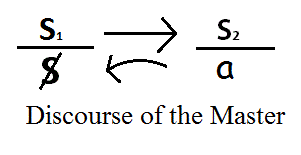
The master’s discourse stands not for the premodern master, but for the absolute monarchy, this first figure of modernity that effectively undermined the articulate network of feudal relations and interdependences, transforming fidelity to flattery: it is the “Sun-King” Louis XIV with his L’état, c’est moi who is the master par excellence. Hysterical discourse and university discourse then deploy two outcomes of the vacillation of the direct reign of the master:

the expert-rule of bureaucracy that culminates in the biopolitics of reducing the population to a collection of homo sacer (what Heidegger called “enframing,” Adorno “the administered world,” Foucault the society of “discipline and punish”);

the explosion of the hysterical capitalist subjectivity that reproduces itself through permanent self-revolutionizing, through the integration of the excess into the “normal” functioning of the social link (the true “permanent revolution” is already capitalism itself).

Lacan’s formula of the four discourses thus enables us to deploy the two faces of modernity

1. total administration and
2. capitalist-individualist dynamics

as two ways to undermine the master’s discourse:

doubt about the efficiency of the master-figure (what Eric Santner called the “crisis of investiture”) can be supplemented by the direct rule of the experts legitimized by their knowledge, or

the excess of doubt, of permanent questioning, can be directly integrated into social reproduction.
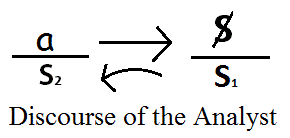
Finally, the analyst’s discourse stands for the emergence of revolutionary-emancipatory subjectivity that resolves the split of university and hysteria.

In it, the revolutionary agent – a – addresses the subject from the position of knowledge that occupies the place of truth (i.e., which intervenes at the “symptomal torsion” of the subject’s constellation), and the goal is to isolate, get rid of, the master signifier that structured the subject’s (ideologico-political) unconscious.

Or does it? Jacques-Alain Miller has recently proposed that today the master’s discourse is no longer the “obverse” of the analyst’s discourse. Today, on the contrary, our “civilization” itself-its hegemonic symbolic matrix, as it were-fits the formula of the analyst’s discourse. The agent of the social link is today a, surplus enjoyment, the superego injunction to enjoy that permeates our discourse; this injunction addresses $ (the divided subject) who is put to work in order to live up to this injunction. The truth of this social link is S2, scientific-expert knowledge in its different guises, and the goal is to generate S1, the self-mastery of the subject, that is, to enable the subject to cope with the stress of the call to enjoyment (through self-help manuals, etc.). Provocative as this notion is, it raises a series of questions. If it is true, in what, then, resides the difference between the discursive functioning of civilization as such and the psychoanalytic social link? Miller resorts here to a suspicious solution: in our civilization, the four terms are kept apart, isolated; each operates on its own, while only in psychoanalysis are they brought together into a coherent link: “in civilization, each of the four terms remains disjoined… it is only in psychoanalysis, in pure psychoanalysis, that these elements are arranged into a discourse.”

However, is it not that the fundamental operation of the psychoanalytic treatment is not synthesis, bringing elements into a link, but, precisely, analysis, separating what in a social link appears to belong together? This path, opposed to that of Miller, is indicated by Giorgio Agamben,Giorgio Agamben, who, in the last pages of The State of Exception, imagines two Utopian options of how to break out of the vicious cycle of law and violence, of the rule of law sustained by violence.

One is the Benjaminian vision of “pure” revolutionary violence with no relationship to the law.

The other is the relationship to the law without regard to its (violent) enforcement, such as Jewish scholars do in their endless (re)interpretation of the Law.

Agamben starts from the right insight that the task today is not synthesis but separation, distinction: nor bringing law and violence together (so that right will have might and the exercise of might will be fully legitimized), but thoroughly separating them, untying their knot.

Although Agamben confers on this formulation an anti-Hegelian twist, a more proper reading of Hegel makes it clear that such a gesture of separation is what the Hegelian “synthesis” is effectively about. In it, the opposites are not reconciled in a “higher synthesis”; it is rather that their difference is posited “as such.”

However, is this vision not again the case of our late capitalist reality going further than our dreams? Are we not already encountering in our social reality what Agamben envisages as a Utopian vision?

Isn’t the Hegelian lesson of the global reflexivization-mediatization of our lives that it generates its own brutal immediacy?

This has best been captured by Etienne Balibar’s notion of excessive, nonfunctional cruelty as a feature of contemporary life, a cruelty whose figures range from “fundamentalist” racist and/or religious slaughter to the “senseless” outbursts of violence performed by adolescents and the homeless in our megalopolises, a violence one is tempted to call Id-Evil, a violence grounded in no utilitarian or ideological reasons.

All the talk about foreigners stealing work from us or about the threat they represent to our Western values should not deceive us: under closer examination, it soon becomes clear that this talk provides a rather superficial secondary rationalization. The answer we ultimately obtain from a skinhead is that it makes him feel good to beat foreigners, that their presence disturbs him. What we encounter here is indeed Id-Evil, that is,

the Evil structured and motivated by the most elementary imbalance in the relationship between the ego and jouissance, by the tension between pleasure and the foreign body of jouissance in the very heart of it.

Id-Evil thus stages the most elementary short circuit in the relationship of the subject to the primordially missing object cause of his desire. What bothers us in the other (Jew, Japanese, African, Turk) is that he appears to entertain a privileged relationship to the object — the other either possesses the object treasure, having snatched it away from us (which is why we don’t have it), or he poses a threat to our possession of the object.

What one should propose here is the Hegelian “infinite judgment,” asserting the speculative identity of these “useless” and “excessive” outbursts of violent immediacy, which display nothing but a pure and naked (“non-sublimated”) hatred of the Otherness, with the global reflexivization of society. […] the response of the neo-Nazi skinhead who, when really pressed for the reasons for his violence, suddenly starts to talk like social workers, sociologists, and social psychologists, quoting diminished social mobility, rising insecurity, the disintegration of paternal authority, the lack of maternal love in his early childhood-the unity of practice and its inherent ideological legitimization disintegrates into raw violence and its impotent, inefficient interpretation.

This impotence of interpretation is also one of the necessary obverses of the universalized reflexivity hailed by the risk-society-theorists: it is as if our reflexive power can flourish only insofar as it draws its strength and relies on some minimal “prereflexive” substantial support that eludes its grasp, so that its universalization comes at the price of its inefficiency, that is, by the paradoxical re-emergence of the brute real of “irrational” violence, impermeable and insensitive to reflexive interpretation. So the more today’s social theory proclaims the end of nature or tradition and the rise of the “risk society,” the more the implicit reference to “nature” pervades our daily discourse: even when we do not speak of the “end of history,” do we not put forward the same message when we claim that we are entering a “postideological” pragmatic era, which is another way of claiming that we are entering a postpolitical order in which the only legitimate conflicts are ethnic/cultural conflicts?

Typically, in today’s critical and political discourse, the term worker has disappeared from the vocabulary, substituted or obliterated by immigrants or immigrant workers: Algerians in France, Turks in Germany, Mexicans in the United States.

In this way, the class problematic of workers’ exploitation is transformed into the multiculturalist problematic of “intolerance of otherness,” and the excessive investment of the multiculturalist liberals in protecting immigrants’ ethnic rights clearly draws its energy from the “repressed class dimension. Although Francis Fukuyama’s thesis on the “end of history” quickly fell into disrepute, we still silently presume that the liberal-democratic capitalist global order is somehow the finally found “natural” social regime, we still implicitly conceive conflicts in the Third World countries as a subspecies of natural catastrophes, as outbursts of quasi-natural violent passions, or as conflicts based on the fanatic identification to one’s ethnic roots (and what is “the ethnic” here if not again a code word for “nature”?). And, again, the key point is that this all-pervasive renaturalization is strictly correlative to the global reflexivization of our daily lives.

What this means, with regard to Agamben’s Utopian vision of untying the knot of the Law and violence is that, in our postpolitical societies, this knot is already untied: we encounter, on the one hand, the globalized interpretation whose globalization is paid for by its impotence, its failure to enforce itself, to generate effects in the real, and, on the other hand, explosions of the raw real of a violence that cannot be affected by its symbolic interpretation. Where, then, is the solution here, between

– the claim that, in today’s hegemonic constellation, the elements of the social link are separated and as such to be brought together by psycho-analysis (Miller),

– and the knot between Law and violence to be untied, their separation to be enacted (Agamben)?

What if these two separations are not symmetrical? What if the gap between the symbolic and the raw real epitomized by the figure of the skinhead is a false one, since this real of the outbursts of the “irrational” violence is generated by the globalization of the symbolic?

When, exactly, does the objet a function as the superego injunction to enjoy? When it occupies the place of the master signifier, that is, as Lacan formulated it in the last pages of his Seminar XI, when the short circuit between S1 and a occurs. The key move to be accomplished in order to break the vicious cycle of the superego injunction is thus to enact the separation between S1 and a.

Consequently, would it not be more productive to follow a different path, that is, to start with the different modus operandi of l’objet a, which in psychoanalysis no longer functions as the agent of the superego injunction — as it does in the discourse of perversion?

This is how Miller’s claim of the identity of the analyst’s discourse and the discourse of today’s civilization should be read: as an indication that this latter discourse (social link) is that of perversion.

That is to say, the fact that the upper level of Lacan’s formula of the analyst’s discourse is the same as his formula of perversion (a-$) opens up a possibility of reading the entire formula of the analyst’s discourse also as a formula of the perverse social link: its agent, the masochist pervert (the pervert par excellence), occupies the position of the object instrument of the other’s desire, and, in this way, through serving his (feminine) victim, he posits her as the hystericized/divided subject who “doesn’t know what she wants.”

Rather, the pervert knows it for her, that is, he pretends to speak from the position of knowledge (about the other’s desire) that enables him to serve the other; and, finally, the product of this social link is the master signifier, that is, the hysterical subject elevated into the role of the master (dominatrix) whom the pervert masochist serves.

In contrast to hysteria, the pervert knows perfectly what he is for the Other: a knowledge supports his position as the object of his Other’s (divided subject’s) jouissance.

The difference between the social link of perversion and that of analysis is grounded in the radical ambiguity of objet a in Lacan, which stands simultaneously for the imaginary fantasmatic lure/screen and for that which this lure is obfuscating, for the void behind the lure.

Consequently, when we pass from perversion to the analytic social link, the agent (analyst) reduces himself to the void, which provokes the subject into confronting the truth of his desire. Knowledge in the position of “truth” below the bar under the “agent,” of course, refers to the supposed knowledge of the analyst, and, simultaneously, signals that the knowledge gained here will not be the neutral objective knowledge of scientific adequacy, but the knowledge that concerns the subject (analysand) in the truth of his subjective position.

Recall, again, Lacan’s outrageous statements that, even if what a jealous husband claims about his wife (that she sleeps around with other men) is all true, his jealousy is still pathological. Along the same lines, one could say that, even if most of the Nazi claims about the Jews were true (they exploit Germans, they seduce German girls), their anti-Semitism would still be (and was) pathological – because it represses the true reason the Nazis needed anti-Semitism in order to sustain their ideological position.

So, in the case of anti-Semitism, knowledge about what the Jews “really are” is a fake, irrelevant, while the only knowledge at the place of truth is the knowledge about why a Nazi needs a figure of the Jew to sustain his ideological edifice.

In this precise sense, the analyst’s discourse produces the master signifier, the swerve of the patient’s knowledge, the surplus element that situates the patient’s knowledge at the level of truth: after the master signifier is produced, even if nothing changes at the level of knowledge, the same knowledge as before starts to function in a different mode. The master signifier is the unconscious sinthome, the cipher of enjoyment, to which the subject was unknowingly subjected.

The crucial point not to be missed here is how the late Lacan’s identification of the subjective position of the analyst as that of objet petit a presents an act of radical self-criticism. Earlier, in the 1950’s, Lacan conceived the analyst not as the small other (a), but, on the contrary, as a kind of stand-in for the big Other (A, the anonymous symbolic order). At this level, the function of the analyst was to frustrate the subject’s imaginary misrecognitions and to make them accept their proper symbolic place within the circuit of symbolic exchange, the place that effectively (and unbeknownst to them) determines their symbolic identity. Later, however, the analyst stands precisely for the ultimate inconsistency and failure of the big Other, that is, for the symbolic order’s inability to guarantee the subject’s symbolic identity.

One should thus always bear in mind the thoroughly ambiguous status of objet a in Lacan. Miller recently proposed a Benjaminian distinction between “constituted anxiety” and “constituent anxiety”: while the first designates the standard notion of the terrifying and fascinating abyss of anxiety that haunts us, its infernal circle that threatens to draws us in, the second stands for the “pure” confrontation with objet a as constituted in its very loss.

Miller is right to emphasize here two features: the difference that separates constituted from constituent anxiety concerns the status of the object with regard to fantasy. In a case of constituted anxiety, the object dwells within the confines of a fantasy, while we get the constituent fantasy only when the subject “traverses the fantasy” and confronts the void, the gap, filled up by the fantasmatic object.

Clear and convincing as it is. Miller’s formula misses the true paradox or, rather, ambiguity of objet a: when he defines objet a as the object that overlaps with its loss, that emerges at the very moment of its loss (so that all its fantasmatic incarnations, from breasts to voice and gaze, are metonymic figurations of the void of nothing), he remains within the horizon of desire — the true object cause of desire is the void filled in by its fantasmatic incarnations.

While, as Lacan emphasizes, objet a is also the object of the drive, the relationship is here thoroughly different. Although in both cases, the link between object and loss is crucial, in the case of objet a as the object cause of desire, we have an object which is originally lost, which coincides with its own loss, which emerges as lost, while, in the case of objet a as the object of the drive, the “object” is directly the loss itself.

In the shift from desire to drive, we pass from the lost object to loss itself as an object. That is to say, the weird movement called “drive” is not driven by the “impossible” quest for the lost object, but by a push to directly enact the “loss” – the gap, cut, distance – itself.

There is thus a double distinction to be drawn here: not only between object a in its fantasmatic and post-fantasmatic status, but also, within this post-fantasmatic domain itself, between the lost object cause of desire and the object loss of the drive. Far from concerning an abstract scholastic debate, this distinction has crucial ideologico-political consequences: it enables us to articulate the libidinal dynamics of capitalism.

Following Miller himself, a distinction has to be introduced here between lack and hole. Lack is spatial, designating a void within a space, while the hole is more radical — it designates the point at which this spatial order itself breaks down (as in the “black hole” in physics).

Therein resides the difference between desire and drive: desire is grounded in its constitutive lack, while drive circulates around a hole, a gap in the order of being. In other words, the circular movement of drive obeys the weird logic of the curved space in which the shortest distance between two points is not a straight line, but a curve: the drive “knows” that the shortest way to attain its aim is to circulate around its goal-object. At the immediate level of addressing individuals, capitalism of course interpellates them as consumers, as subjects of desires, soliciting in them ever new perverse and excessive desires (for which it offers products to satisfy them); furthermore, it obviously also manipulates the “desire to desire,” celebrating the very desire to desire ever new objects and modes of pleasure. However, even if if already manipulates desire in a way that takes into account the fact that the most elementary desire is the desire to reproduce itself as desire (and not to find satisfaction), at this level, we do not yet reach the drive.

The drive inheres to capitalism at a more fundamental, systemic level: drive propels the entire capitalist machinery; it is the impersonal compulsion to engage in the endless circular movement of expanded self-reproduction. The capitalist drive thus belongs to no definite individual – it is rather that those individuals who act as direct “agents” of capital (capitalists themselves, top managers) have to practice it. We enter the mode of the drive when (as Marx put it) the circulation of money as capital becomes “an end in itself, for the expansion of value takes place only within this constantly renewed movement. The circulation of capital has therefore no limits.” One should bear in mind here Lacan’s well-known distinction between the aim and the goal of drive: while the goal is the object around which drive circulates, its (true) aim is the endless continuation of this circulation as such.
slave jouissance

Žižek, Slavoj. “Love Thy Neighbor? No , Thanks!”  in Psychoanalysis and Racism. ed.  Anthony Lane, New York: Columbia University Press, 1998.   154-175.) a slighty different version of this essay appears in The Plague of Fantasies. London: Verso, 1997.

According to Lacan, Hegel, in his dialectics of Lord and Bondsman, misses the key point: Jouissance is on the side not of the Master but rather of his servant — that is, what keeps the servant enslaved is precisely the little piece of jouissance thrown to him by his Master.  Lacan’s reproach to the standard version of the Cunning of Reason (the Slave who works and thus renounces jouissance, this way laying foundation for his future freedom, in contrast to the Master who is idioticized by his jouissance) is that it is, on the contrary, the Slave who has access to jouissance from his ambiguous relation to the Other’s supposed jouissance (to Master qua “subject supposed to enjoy”).  See Lacan, “Subversion.”  (page 174, Note 2)

excremental remainder ethical monster

Kotsko, Adam. “Žižek and the Excremental Body of Christ” Presentation at the American Academy of Religion 2009 Conference

The basic structure of Žižek’s interpretation of Christianity is provided by Hegel, who elaborates a theology of the “death of God” (which was later taken up by American theologians such as Thomas Altizer, whom Žižek discovered after developing his own Hegelian reading of Christianity). Hegel contends that the three persons of the Trinity do not represent three coeternal realities, but rather three decisive and irreversible turning points in the life of God:

the Father empties out the entirety of his divinity into the Son, and by dying the Son then empties out that divinity into the Holy Spirit, which is understood as a new form of social bond.

Coming at this basic structure from a Lacanian perspective and specifically from his use of Lacan to found a contemporary form of ideology critique, Žižek argues that Christ represents a unique form of “master signifier.” Normally “master signifiers” are tautologous authorities whose self-assertion allows some form of symbolic order or ideological structure to crystallize — for instance, in modern society money serves as the foundation of our entire system of values, but when you ask what money is worth, you can only answer that it’s worth… money.

Money is valuable because it’s valuable. The model of this kind of “master signifier” is of course God, whose authority ultimately stems from the fact that he is God. Žižek claims, however, that the founding myth of Christianity provides us with a weird kind of self-effacing or self-denying master signifier — a God who not only dies (many gods have died throughout history, only to be replaced), but who himself becomes an atheist.

In Žižek’s reading, Christ’s cry of dereliction on the cross—“My God, my God, why have you forsaken me?” — presents us with an image of a God who doesn’t believe in himself.

Elevating Christ to the level of a “master signifier” thus means effectively giving up on “master signifiers,” producing a whole new form of social bond — one that is outside of ideology.

As I argue in Žižek and Theology, this elaboration of a “death of God” theology as a path to a non-ideological social bond is the end result of a long and difficult development in Žižek’s political thought, because—to put it bluntly — getting rid of master signifiers is difficult.

It’s easy enough to overthrow any given master signifier, but the human tendency to reestablish them seems irresistible — and before his foray into theology, Žižek seemed to be essentially advocating revolution for its own sake, as a kind of moment of pure authenticity and truth, despite the fact that every revolution will necessarily be a matter of “meet the new boss, same as the old boss.”

The reason for this is that “master signifiers” are a way of organizing our enjoyment, keeping the suffocating force of jouissance sufficiently at bay to give us breathing room, while nonetheless giving us access to occasional moments of indulgence.

A key aspect of this is Žižek’s view that every form of law founded in a “master signifier” includes its own “inherent transgression”— that is, it depends on people occasionally feeling like they not only have permission to break the rules but are actively exhorted to do so, so that they have a way to let off steam.

A familiar example of this is the Jim Crow order in the US — in addition to the official laws segregating blacks and whites, the order was characterized by extra-legal attacks such as lynch mobs.

Žižek would argue that these weren’t unfortunate outbursts but were an integral part of the Jim Crow order, allowing whites to “let off steam” by forcibly asserting their dominance while maintaining the public fiction that segregation was a harmonious system with everyone in their natural place.

Inspired by Alain Badiou’s work on St. Paul, Žižek turns to the origins of Christianity as a way of thinking through what it might mean to have a revolution that would be a durable achievement rather than a flash of inspiration between two ideological regimes. His main critique of Badiou is that Badiou one-sidedly emphasizes the resurrection over the cross — in Lutheran terms, Badiou is a theologian of glory rather than a theologian of the cross.

Žižek believes that any new order (represented by the resurrection) must be preceded by a break with the old (represented by the cross) — some act of negation, some negative gesture separating oneself from the reigning master signifier. But again, this is very difficult to achieve.

Not only does the ideological order actively rely on its own violation through the “inherent transgression,” but Žižek had also argued extensively that “cynical distance” from ideology—the sense that “no one really believes this stuff”—is actually a built-in feature of all ideologies. Just “going through the motions” without really believing it isn’t a way of escaping ideology, but rather the most powerful form of submitting to ideology.

If the seemingly most obvious ways to negate ideology are built-in features of ideology already, then where can one turn? In The Puppet and the Dwarf, which represents his most fully realized account of Christian origins, Žižek makes what is, in my view, one of his most interesting moves—he claims that Judaism represents a kind of inherently negative space, a culture that is “unplugged” from the enjoyment provided by the surrounding pagan ideology, so that the logic of the “inherent transgression” and of “cynical distance” alike don’t apply.

Contradicting both Badiou and centuries of Christian interpreters, Žižek thus argues that the point of Pauline Christianity wasn’t to escape from the Jewish law, but to find some way to induct Gentiles into this “unplugged” Jewish stance.

Historically, of course, Christianity wound up betraying its Jewish roots and became an ideological order like any other, so that perhaps Žižek’s attempt to find a durable model that would be something other than the space between two ideologies has failed — yet he believes that the Pauline communities built on engrafting Gentiles into the promises of Judaism provide at least a way of thinking through what a durable non-ideological social bond might look like.

II.

So where does the Body of Christ fit into all this? As I’ve said, he is uninterested in the idea of the Christian community or church as the “Body of Christ,” and this is not only because he has opted to refer to that social bond as the “Holy Spirit”—in addition to his general distaste for anything as “harmonious” or “organic” as a body metaphor would imply, Žižek also has no interest whatsoever in ecclesiology or in the institutional church as such, believing it to be a betrayal of Christianity’s original revolutionary core. Furthermore, Žižek has never, to my knowledge, addressed the sacraments in any serious way, and so the sacramental Body of Christ in the Eucharist is not on his radar.

What remains, though, is the literal, physical body of Jesus, which Žižek basically only discusses in the context of the crucifixion. Like a medieval mystic, Žižek is fixated on Christ’s weakness and suffering, his pathetic and pitiable appearance—the absolute disjuncture between this disgraced and repulsive dying body and the divine nature he embodies. More than that, he claims, in something like an orthodox fashion, that Christ embodies the truth of humanity, the truth that, in Luther’s words, “we are the shit that fell out of God’s anus.” Drawing on this Lutheran inheritance, Žižek defines Christianity as providing a vision of a God who “freely identified himself with his own shit” (Parallax View, 187).

Now this focus on excrement is not entirely new for Žižek, who has always had a fixation of sorts on whatever is disgusting, repulsive, or otherwise off-putting. In fact, one of the key concepts he takes from Lacan, objet petit a, which represents the ever-elusive object and cause of desire, frequently bears the name of the “excremental remainder,” referring to that little “something” that one has to give up in order to join the social order. What Žižek calls Luther’s “excremental anti-humanism,” then, does not simply lead to humanity wallowing in its own self-disgust.

Rather, it leads to humanity wallowing in its own enjoyment, or as Žižek says, to the emergence of enjoyment as a direct political factor. For Žižek all ideological orders represent a way of organizing enjoyment or jouissance, of keeping it at a distance while allowing periodic indulgence, but what Luther’s position opens up is the possibility of a kind of short-circuit, where jouissance is not just a silently presupposed basis of the political order but instead a conscious emphasis and goal.

The end result is what Žižek characterizes as the contemporary “superego injunction to enjoy” — the perverse situation where authorities are directly exhorting people to enjoy. The most obvious manifestation of this tendency was perhaps George W. Bush’s injunction that people go shopping in response to 9/11, but Žižek believes this basic attitude is absolutely pervasive.

Increasingly, Žižek claims, one feels guilty not for having sex, but for not having enough sex — and even the asceticism of dieting and exercise is geared toward the hedonistic ends of attractiveness and longer lifespan.

Increasingly, contemporary Western subjects, or at least contemporary middle and upper class Western subjects, directly identify with their excremental remainder, with objet petit a — with the end result of a kind of autistic compulsion to enjoy, an obligatory enjoyment that one begins to suspect is not finally all that enjoyable.

The answer to this situation, for cultural conservatives and particularly for conservative Catholics such as Žižek’s dialogue partners G. K. Chesterton and John Milbank, is to reimpose some version of traditional values in order to save enjoyment from itself. For Žižek, however, such a solution is both dishonest and self-undermining, or in other words, perverse — hence the subtitle of The Puppet and the Dwarf:The Perverse Core of Christianity, which refers to Actual Existing Christianity and not to its original, supposedly revolutionary form.

His solution is not to disavow enjoyment, but rather to focus on the enjoyment of the other, to form a community centered on the care for the concrete suffering and enjoying others one happens to encounter. This, in his view, is Christian love, a love he characterizes as “violent” in that it cuts beneath the ideological identity markers of the other and attends directly to the excremental remainder underneath it all.

Though this notion of an authentically Christian community is based in an adaptation of one of the later Lacan’s more opaque concepts, the “discourse of the analyst,” I believe that the clearest example of what he’s talking about can be found in his final contribution to The Monstrosity of Christ. There he discusses Agota Kristof’s novel The Notebook, which for him is “the best literary expression” of an ethical stance that goes beyond the sentimentality of moralism and instead installs “a cold, cruel distance toward what one is doing.”

The novel follows two twin brothers who are “utterly immoral… yet they stand for authentic ethical naivety at its purest.” Žižek gives two examples. In one, they meet a starving man who asks for help and get him everything he asks for, while claiming that they helped him solely because he needed help, not out of any desire to be kind. In another, they urinate on a German officer with whom they find themselves sharing a bed, at his request.

Žižek remarks, “If ever there was a Christian ethical stance, this is it: no matter how weird their neighbor’s demands, the twins naively try to meet them.”

(Interestingly, this ethical stance of giving people what they ask for in the most literal way corresponds with one of Žižek’s earliest political prescriptions for dealing with the cynical distance that is inherent to ideology—instead of resisting the demands of ideology, one should take them as literally as possible, because that’s the one response ideology isn’t prepared for.) Žižek commends the twins’ amoral ethics as follows:

This is where I stand—how I would love to be: an ethical monster without empathy, doing what is to be done in a weird coincidence of blind spontaneity and reflexive distance, helping others while avoiding their disgusting proximity. With more people like this, the world would be a pleasant place in which sentimentality would be replaced by a cold and cruel passion. Monstrosity of Christ 303

Such is Žižek’s understanding of Christian ethics, a position I am sure will not be included in any Christian ethics courses any time soon.

III.

I would like to conclude this presentation by connecting Žižek’s work to liberation theology—not through the more obvious path of the reliance of both on the Marxist tradition, but rather precisely through Žižek’s notion of the Body of Christ as a kind of “excremental remainder.” My initial point of contact here might seem superficial initially, but I believe it will prove surprisingly revealing. In his essay “Extra pauperes nulla salus,” or “No salvation outside the poor,” Jon Sobrino begins with a quotation from his fallen comrade Ignacio Ellacuría, who was among the members of Sobrino’s Jesuit community who were massacred by a Salvadoran death squad in 1989 while Sobrino happened to be out of the country:

What on another occasion I called copro-historical analysis, that is, the study of the feces of our civilization, seems to reveal that this civilization is gravely ill and that, in order to avoid a dreadful and fatal outcome, it is necessary to change it from within itself.

Sobrino agrees, claiming that the “excrement” or waste product of capitalist civilization, in the form of massive impoverishment in the Third World, demonstrates that it is profoundly sick. Reciting the massive imbalances in global priorities, for instance the inconceivable sums spent on arms at the same time as people are starving daily, Sobrino concludes that “we are dealing with a metaphysical obscenity” and that “God is furious” (39). That is of course because for Sobrino and for all liberation theologians, God has identified decisively with this excremental remainder of the poor. The parallel here with Žižek’s “God who freely identifies with his own shit” is inexact—most notably because liberation theologians do not believe God is the author of the process that produces the poor as an excremental remainder — but also compelling, insofar as Žižek has written a great deal recently on the obscene inequalities that characterize the contemporary world and has even put forth urban slum dwellers in the Third World as a contemporary parallel to the “unplugged” stance he detects in first-century Judaism.

In addition, Žižek’s account of “Christian love” as naively meeting people’s needs simply because they ask resonates profoundly with the implied premise of Sobrino’s harsh and furious text: people need to eat!

Regardless of whether they’re deserving, whether giving them food would produce bad economic incentives, etc., etc., people need to eat. The same could obviously be said for all basic needs—for example, regardless of whether it undermines someone’s ability to put big numbers in quarterly reports, people who have AIDS need medicine!

A little more literalism and naïveté would certainly help in our present situation. In addition, simply listening to what people are asking for would be a huge improvement over the patronizing tutelage of NGOs and foreign aid, which Sobrino characterizes as actively contributing to the dehumanization of the already dehumanized people they serve, insofar as it deprives them of agency.

The principle here is basically Jesus’s: sell all you have and give to the poor. The focus here isn’t on liquidating your holdings so that you can enjoy the moral righteousness of poverty, but of putting your goods at the disposal of the poor—or, as Jesus says in another setting, of using your dishonest wealth to make friends.

The really difficult question between Žižek and liberation theology, however, is what the end state looks like. For Sobrino as for most liberation theologians, the basic stance seems to be humanist in the broad sense—a society that respects human dignity, that looks to the intrinsic worth of every individual. Yet Žižek remains resolutely anti-humanist and suspicious of the language of human rights. And while Sobrino can look forward to a correction of civilization’s digestive system such that it will stop producing the poor as excrement, Žižek revels in the disgusting and repellant aspect of the “excremental remainder.”

When the case is stated in this way, it seems difficult to favor Žižek over Sobrino, yet I wonder if Žižek is getting at an important truth here—namely that the end state is something that we, blinkered as we are by the ideology of our present sick civilization, simply cannot recognize as beautiful or desirable, that the change we need is so profound that it will change our very concept of what it means to be human.

In any case, both Žižek and Sobrino agree that what it means to be human now entails the production of a massive and appalling waste product—and that what it means to be faithful to the message of Christ is to freely identify with that waste product.

on neoliberalism a foucaultian analysis

Read, Jason. “A Genealogy of Homo-Economicus: Neoliberalism and the Production of Subjectivity.” Foucault Studies, No 6, pp. 25-36, February 2009

People who have swimming pools don’t need state parks. If you buy your books at Borders you don’t need libraries. If your kids are in private school, you don’t need K-12. The people here, or at least those who vote, don’t see the need for government. Since a lot of the population are not citizens, the message is that government exists to help the undeserving, so we shouldn’t have it at all. People think it’s OK to cut spending, because ESL is about people who refuse to assimilate and health care pays for illegals.

From Tea party in the Sonora: For the future of G.O.P. governance, look to Arizona By Ken Silverstein Harper’s Magazine July 2010

As Thomas Lemke [“Foucault, Governmentality, and Critique.” Rethinking Marxism, 14, 3 (2002)], argues, neoliberalism is a political project that attempts to create a social reality that it suggests already exists, stating that competition is the basis of social relations while fostering those same relations. The contemporary trend away from long term labor contracts, towards temporary and part-time labor, is not only an effective economic strategy, freeing corporations from contracts and the expensive commitments of health care and other benefits, it is an effective strategy of subjectification as well.

It encourages workers to see themselves not as “workers” in a political sense, who have something to gain through solidarity and collective organization, but as “companies of one.” They become individuals for whom every action, from taking courses on a new computer software application to having their teeth whitened, can be considered an investment in human capital. As Eric Alliez and Michel Feher write: “Corporations’ massive recourse to subcontracting plays a fundamental role in this to the extent that it turns the workers’ desire for independence…into a ‘busi-ness spirit’ that meets capital’s growing need for satellites.”12

While Foucault’s analysis captures the particular “fear of the state” that underlies neoliberalism, its belief that any planning, any intervention against competition, is tantamount to totalitarianism. It however does not account for the dominance of neoliberalism in the present, specifically its dominance as a particular “technology of the self,” a particular mode of subjection.

At the same time, Foucault offers the possibility of a different understanding of the history of neoliberalism when he argues that neoliberalism, or the neo-liberal subject as homo economicus, or homo entrepreneur, emerges to address a particular lacunae in liberal economic thought, and that is labor. In this sense neoliberalism rushes to fill the same void, the same gap, that Marx attempted to fill, without reference to Marx, and with very different results.

Marx and neo-liberals agree that although classical economic theory examined the sphere of exchange, the market, it failed to enter the “hidden abode of production” examining how capital is produced. Of course the agreement ends there, because what Marx and neo-liberals find in labor is fundamentally different: for Marx labor is the sphere of exploitation

while for the neo-liberals, as we have seen, labor is no sooner introduced as a problem than the difference between labor and capital is effaced through the theory of “human capital.”

Neoliberalism scrambles and exchanges the terms of opposition between “worker” and “capitalist.” To quote Etienne Balibar, “The capitalist is defined as worker, as an ‘entrepreneur’; the worker, as the bearer of a capacity, of a human capital.” 31

Labor is no longer limited to the specific sites of the factory or the workplace, but is any activity that works towards desired ends. The terms “labor” and “human capital” intersect, overcoming in terminology their longstanding opposition; the former becomes the activity and the latter becomes the effects of the activity, its history. From this intersection the discourse of the economy becomes an entire way of life, a common sense in which every action — crime, marriage, higher education and so on — can be charted according to a calculus of maximum output for minimum expenditure; it can be seen as an investment.

Thus situating Marx and neoliberalism with respect to a similar problem makes it possible to grasp something of the politics of neoliberalism, which through a generalization of the idea of the “entrepreneur,” “investment” and “risk” beyond the realm of finance capital to every quotidian relation, effaces the very fact of ex-ploitation.

Neoliberalism can be considered a particular version of “capitalism without capitalism,” a way of maintaining not only private property but the existing distribution of wealth in capitalism while simultaneously doing away with the antagonism and social insecurity of capitalism, in this case paradoxically by extending capitalism, at least its symbols, terms, and logic, to all of society.

The opposition between capitalist and worker has been effaced not by a transformation of the mode of production, a new organization of the production and distribution of wealth, but by the mode of subjection, a new production of subjectivity. 32

Thus, neoliberalism entails a very specific extension of the economy across all of society; it is not, as Marx argued, because everything rests on an economic base (at least in the last instance) that the effects of the economy are extended across of all of society, rather it is an economic perspective, that of the market, that becomes coextensive with all of society. As Christian Laval argues, all actions are seen to conform to the fundamental economic ideas of self-interest, of greatest benefit for least possible cost. It is not the structure of the economy that is extended across society but the subject of economic thinking, its implicit anthropology.

Thus, the question remains, why now, or at least why over the last thirty years has capitalism taken this neo-liberal turn?

In the Grundrisse, Marx does not use the term “human capital,” but fixed capital, a term generally used to refer to machinery, factories, and other investments in the means of production to refer to the subjectivity, the subjective powers of the worker. In general Marx understood the progression of capital to be a process by which the skills, knowledge, and know-how of workers were gradually incorporated into machinery, into fixed capital, reducing the laborer to an unskilled and ultimate-ly replaceable cog in a machine. This is “proletarianization” the process by which capitalism produces its gravediggers in a class of impoverished workers who have nothing to lose but their chains. In the Grundrisse, however, Marx addresses a fundamentally different possibility, capital’s exploitation of not just the physical powers of the body, but the general social knowledge spread throughout society and embodied in each individual. This is what Marx refers to as the “general intellect”—the diffused social knowledge of society. This knowledge, the capacity to use various languages, protocols, and symbolic systems, is largely produced outside of work. As Marx writes: “The saving of labor time is equal to an increase of free time, i.e. time for the full development of the individual, which in turn reacts back upon the pro-ductive power of labor as itself the greatest productive power. From the standpoint of the direct production process it can be regarded as the production of fixed capital, this fixed capital being man himself.”17

Marx’s deviation from the standard terminology of his own corpus, terminology that designates the worker as labor power (or living labor), the machine or factory as fixed capital, and money as circulating capital, is ultimately revealing. It reveals something of a future that Marx could barely envision, a future that has become our present: the real subsumption of society by capital. This subsumption involves not only the formation of what Marx referred to as a specifically capitalist mode of production, but also the incorporation of all subjective potential, the capacity to communicate, to feel, to create, to think, into productive powers for capital. Capital no longer simply exploits labor, understood as the physical capacity to transform objects, but puts to work the capacities to create and communicate that traverse social relations.

It is possible to say that with real subsumption capital has no outside, there is no relationship that cannot be transformed into a commodity, but at the same time capital is nothing but outside, production takes place outside of the factory and the firm, in various social relationships. Because of this fundamental displacement subjectivity becomes paramount, subjectivity itself becomes productive and it is this same subjectivity that must be controlled. 33

Neoliberalism is a discourse and practice that is aimed to curtail the powers of labor that are distributed across all of society—at the exact moment in which all of social existence be-comes labor, or potential labor, neoliberalism constructs the image of a society of capitalists, of entrepreneurs.

As production moves from the closed space of the factory to become distributed across all of social space, encompassing all spheres of cultural and social existence, neoliberalism presents an image of society as a market, effacing production altogether.

This underscores the difference between neoliberalism as a form of power and the disciplinary power at work in the closed spaces of the factory. If disciplinary power worked by confining and fixing bodies to the production apparatuses, neoliberal power works by dispersing bodies and individuals through privatization and isolation.

Deregulation, the central term and political strategy of neo-liberalism, is not the absence of governing, or regulating, but a form of governing through isolation and dispersion. As more and more wealth is produced by the collective social powers of society, neoliberalism presents us with an image of society made up of self-interested individuals.

In Negri’s analysis, the relation between neoliberalism and real subsumption takes on the characteristics of a Manichean opposition. We are all workers or we are all capitalists: either view society as

an extension of labor across all social spheres, from the factory to the school to the home, and across all aspects of human existence, from the work of the hands to the mind, or

view society as a logic of competition and investment that encompasses all human relationships.

While Negri’s presentation has an advantage over Foucault’s lectures in that it grasps the historical formation of neoliberalism against the backdrop of a specific transformation of capital, in some sense following Foucault’s tendency to present disciplinary power and biopower against the back-drop of specific changes in the economic organization of society, it does so by almost casting neoliberalism as an ideology in the pejorative sense of the term.

It would appear that for Negri real subsumption is the truth of society, and neoliberalism is only a misrepresentation of that truth. … Foucault’s idea of governmentality, argues against such a division that posits actual material reality on one side and its ideological misrepresentation on the other. A governmentality is a particular mentality, a particular manner of governing, that is actualized in habits, perceptions, and subjectivity. Governmentality situates actions and conceptions on the same plane of immanence. 34

Which is to say, that any criticism of neoliberalism as governmentality must not focus on its errors, on its myopic conception of social existence, but on its particular production of truth.

For Foucault, we have to take seriously the manner in which the fundamental understanding of individuals as governed by interest and competition is not just an ideology that can be refused and debunked, but is an intimate part of how our lives and subjectivity are structured.

Despite Negri’s tendency to lapse back into an opposition between labor and ideology, his object raises important questions echoed by other critics of neoliberalism.

What is lost in neoliberalism is the critical distance opened up between different spheres and representations of subjectivity, not only the difference between work and the market, as in Marxism, but also the difference between the citizen and the economic subject, as in classical liberalism.

All of these differences are effaced as one relation; that of economic self-interest, or competition, replaces the multiple spaces and relations of worker, citizen, and economic subject of consumption.

To put the problem in Foucault’s terms, what has disappeared in neoliberalism is the tactical polyvalence of discourse; everything is framed in terms of interests, freedoms and risks.

As Wendy Brown argues, one can survey the quotidian effects or practices of governmentality in the manner in which individualized/market based solutions appear in lieu of collective political solutions: gated communities for concerns about security and safety; bottled water for concerns about water purity; and private schools (or vouchers) for failing public schools, all of which offer the opportunity for individuals to opt out rather than address political problems. Privatization is not just neoliberalism’s strategy for dealing with the public sector, what David Harvey calls accumulation by dispossession, but a consistent element of its particular form of governmentality, its ethos, everything becomes privatized, institutions, structures, issues, and problems that used to constitute the public.

It is privatization all the way down. For Brown, neoliberalism entails a massive de-democratization, as terms such as the public good, rights and debate, no longer have any meaning. “The model neoliberal citizen is one who strategizes for her or himself among various social, po-litical, and economic options, not one who strives with others to alter or organize these options.”

Thus, while it is possible to argue that neoliberalism is a more flexible, an open form of power as opposed to the closed spaces of disciplines, a form of power that operates on freedoms, on a constitutive multiplicity, it is in some sense all the more closed in that as a form of governmentality, as a political rationality, it is without an outside. It does not encounter any tension with a competing logic of worker or citizen, with a different articulation of subjectivity. States, corporations, individuals are all governed by the same logic, that of interest and competition.

Foucault’s development, albeit partial, of account of neoliberalism as governmentality has as its major advantage a clarification of the terrain on which neo-liberalism can be countered. It is not enough to simply oppose neoliberalism as ideology, revealing the truth of social existence that it misses, or to enumerate its various failings as policy.

Rather any opposition to neoliberalism must take seriously its effectiveness, the manner in which it has transformed work subjectivity and social relationships. As Foucault argues, neoliberalism operates less on actions, directly curtailing them, then on the condition and effects of actions, on the sense of possibility.

The reigning ideal of interest and the calculations of cost and benefit do not so much limit what one can do, neoliberal thinkers are famously indifferent to prescriptive ideals, examining the illegal drug trade as a more or less rational investment, but limit the sense of what is possible.

Specifically the ideal of the fundamentally self-interested individual curtails any collective transformation of the conditions of existence. It is not that such actions are not prohibited, restricted by the dictates of a sovereign or the structures of disciplinary power, they are not seen as possible, closed off by a society made up of self-interested individuals.

It is perhaps no accident that one of the most famous political implementers of neoliberal reforms, Margaret Thatcher, used the slogan, “there is no alternative,” legitimating neoliberalism based on the stark absence of possibilities. Similarly, and as part of a belated response to the former Prime Minister, it also perhaps no accident that the slogan of the famous Seattle protests against the IMF and World Bank was, “another world is possible,” and it is very often the sense of a possibility of not only another world, but of another way of organizing politics that is remembered, the image of turtles and teamsters marching hand and hand, when those protests are referred to.

It is also this sense of possibility that the present seems to be lacking; it is difficult to imagine let alone enact a future other than a future dominated by interest and the destructive vicissitudes of competition. A political response to neoliberalism must meet it on its terrain, that of the production of subjectivity, freedom and possibility.

***************************

Foucault develops in “Truth and Juridical Forms,” that Marx posited labor as the “concrete essence of man.”

“So I don’t think we can simply accept the traditional Marxist analysis, which assumes that, labor being man’s concrete essence, the capitalist system is what transforms labor into profit, into hyperprofit or surplus value. The fact is capitalism penetrates much more deeply into our existence. That system, as it was established in the nineteenth century, was obliged to elaborate a set of political techniques, techniques of power, by which man was tied to something like labor—a set of techniques by which people’s bodies and time would become labor power and labor time so as to be effectively used and thereby transformed into hyper profit”

(Michel Foucault, “Truth and Juridical Forms,” in Power: Essential Works of Michel Foucault, 1954-1984: Volume Three, trans. Robert Hurley et al. Ed. James D. Faubion (New York: New Press, 2000), 86).

This idea, of “capillary power relations” that turn man into a subject of labor, is an idea which Foucault sometimes develops as a critique and at other times attributes to Marx, see for example “Les Mailles du pouvoir”, in Dits et Écrits Tome IV: 1980-198, ed. D. Defert and F. Ewald (Paris: Éditions Gallimard, 1994) and less explicitly Discipline and Punish.

post oedipal traverse the fantasy

Žižek, Slavoj. “Cyberspace, or, How to Traverse the Fantasy in the Age of the Retreat of the Big OtherPublic Culture 10:3. (1998) 483-513.

This constellation also provides the key for the problem of the historicity of psychoanalysis. From the early days of his Complexes familiaux ([1938] 1984), Lacan was fully aware of the historicity of the Oedipal complex itself, as well as of its discovery by Freud.

In the modern bourgeois nuclear family, the two functions of the father that were previously separated, or embodied in different persons

(the pacifying Ego-Ideal, the point of ideal identification, and

the ferocious superego, the agent of cruel prohibition; the symbolic function of totem and the horror of taboo), are united in one and the same person.

The previous separate personification of the two functions accounts for the apparent “stupidity” of some aborigines, who thought that the true father of a child was a stone or an animal or a spirit. The aborigines were well aware that the mother was inseminated by the “real” father; they merely separated the real father from its symbolic function.

The unification of the two functions in the bourgeois nuclear family, by giving birth to the ambiguous rivalry with the father figure, created the psychic conditions for the modern, Western, dynamic, creative individualism and, at the same time, sowed the seeds of the forthcoming “crisis of Oedipus” (or, more generally, with regard to figures of authority as such, of the “crisis of investiture” that erupted in the late nineteenth century [Santner 1996). Symbolic authority was more and more smeared over by the mark of obscenity and thus, as it were, undermined from within.

In his early theory of the historicity of the Oedipus complex, Lacan thus already establishes the connection between the psychoanalytic problematic of the Oedipus as the elementary form of “socialization,” of the subject’s integration into the symbolic order, and the standard sociopsychological topoi on how modernity is characterized by individualist competitivity -on how, in modern societies, subjects are no longer fully immersed into and identified with the particular social place into which they were born, but can, in principle at least, freely move between different “roles.” The emergence of the modern “abstract” individual who relates to his or her particular “way of life” as to something with which he or she is not directly identified, but rather which depends on a set of contingent circumstances (the feeling that the particularities of one’s birth, social status, sex, and religion do not determine one fully, do not concern one’s innermost identity) relies on the mutation in the functioning of the Oedipus complex, on the above-described unification of the two aspects of symbolic authority (Ego Ideal and the prohibitive superego) in one and the same person of the “real father.”490

The key question here is: What is going on today when this very modern form of Oedipus is disintegrating– when so-called pathological Narcissism is asserting itself more and more as the predominant form of subjectivity? On the one hand, symbolic prohibitive norms are increasingly replaced with imaginary ideals (of social success, of bodily fitness); on the other hand, this lack of symbolic prohibition is supplemented with the reemergence of the ferocious superego figures. So we have a subject who is extremely narcissistic, who perceives everything as a potential threat to his or her precarious imaginary balance. (See the universalization of the logic of victim: Every contact with another human being is experienced as a potential threat. If the other smokes, if he or she casts a covetous glance at me, he or she already hurts me.) However, far from allowing the subject to float freely in undisturbed balance, this narcissistic self-enclosure leaves him or her to the (not so) tender mercies of the superego injunction to enjoy. One is thus tempted to propose a hypothesis according to which “postmodern” subjectivity involves a kind of direct “superegoization ” of the imaginary Ideal, caused by the lack of the proper symbolic Prohibition: It is the Ideal itself that gives rise to guilty feelings when we fail to reach it, since the (imaginary) Ego-Ideal is no longer supported by the symbolic Ideal-Ego, but directly by the superego.

So, to recapitulate. There is only one consistent answer to the question “Why does the superfluous prohibition emerge, which merely prohibits the impossible?” That is: It obfuscates this inherent impossibility in order to sustain the illusion that, were it not for the externally imposed prohibition, the full (“incestuous”) gratification would be possible. Far from acting as a “repressive” agency that prevents us access to the ultimate object of desire, the paternal figure functions instead to relieve us from the debilitating deadlock of desire, to “maintain hope.” What is missing in “Oedipus on-line” is precisely this “pacifying” function of the paternal figure that enables us to obfuscate the debilitating deadlock of desire. Hence, the strange mixture of “everything is possible” (since there is no positive prohibiting figure) and an all-pervasive frustration and deadlock that characterizes the subject’s experience of cyberspace.

The ontological paradox, scandal even, of fantasy resides in the fact that it subverts the standard opposition of “subjective” and “objective.” Of course, fantasy is by definition not “objective” (in the naive sense of existing independently of the subject’s perceptions); however, it is also not “subjective” (in the sense of being reducible to the subject’s consciously experienced intuitions). Rather, fantasy belongs to the “bizarre category of the objectively subjective-the way things actually, objectively, seem to you even if they don’t seem that way to you” (Dennett 1991, 132).8 When, for example, the subject actually experiences a series of fantasmatic formations which interrelate as so many permutations of each other, this series is never complete-it is always as if the actually experienced series presents so many variations of some underlying “fundamental” fantasy that is never actually experienced by the subject. 507

This brings us back to the mystery of “commodity fetishism.” When a critical Marxist encounters a bourgeois subject immersed in commodity fetishism, the Marxist’s reproach to him or her is not, “Commodity may seem to you a magical object endowed with special powers, but it really is just a reified expression of relations between people”; rather, the actual Marxist’s reproach is, “You may think that the commodity appears to you as a simple embodiment of social relations (that, for example, money is just a kind of voucher entitling you to a part of the social product), but this is not how things really seem to you. In your social reality, by means of your participation in social exchange, you bear witness to the uncanny fact that a commodity really appears to you as a magical object endowed with special powers.”

This is also one of the ways in which to specify the meaning of Lacan’s assertion of the subject’s constitutive “decenterment.” Its point is not that my subjective experience is regulated by objective, unconscious, mechanisms that are “decentered” with regard to my self-experience and, as such, beyond my control (a point asserted by every materialist), but rather something much more unsettling — I am deprived of even my most intimate “subjective” experience, the way things “really seem to me,” the fundamental fantasy that constitutes and guarantees the kernel of my being, since I can never consciously experience it and assume it.

According to the standard view, the dimension that is constitutive of subjectivity is that of the phenomenal (self-)experience. I am a subject the moment I can say to myself “No matter what unknown mechanism governs my acts, perceptions, and thoughts, nobody can take from me what I see and feel now.”

Lacan turns this standard view around: The “subject of the signifier” emerges only when a key aspect of the subject’s phenomenal (self-)experience (the “fundamental fantasy”) becomes inaccessible to him or her, is “primordially repressed.” At its most radical, the Unconscious is the inaccessible phenomenon, not the objective mechanism that regulates my phenomenal experience. So, in contrast to the commonplace according to which we are dealing with a subject the moment an entity displays signs of “inner life”— of a fantasmatic self-experience which cannot be reduced to external behavior — one should claim that what characterizes human subjectivity proper is rather the gap that separates the two — the fact that fantasy, at its most elementary, becomes inaccessible to the subject. This inaccessibility makes the subject “empty.” We thus obtain a relationship that totally subverts the standard notion of the subject who directly experiences herself, her “inner states”— an “impossible” relationship between the empty, nonphenomenal subject and the phenomena that remain inaccessible to the subject. 509

Geneticists predict that in about ten to fifteen years they will be able to identify and manipulate each individual’s exact genome (approximately six billion genetic markers comprising the complete inherited “knowledge”). Potentially, at least, individuals will thus have at their disposal the complete formula of what they “objectively” are. How will this “knowledge in the real,” the fact that I will be able to locate and identify myself completely as an object in reality, affect the status of subjectivity? Will it lead to the end of human subjectivity? Lacan’s answer is negative:

What will continue to elude the geneticist is not my phenomenal self-experience (say, the experience of a love passion that no knowledge of the genetic and other material mechanisms which determine it can take from me), but the “objectively subjective” fundamental fantasy, the fantasmatic kernel inaccessible to my conscious experience.

Even if science formulates the genetic formula of what I objectively am, it will still be unable to formulate my “objectively subjective’’ fantasmatic identity, this objectal counterpoint to my subjectivity, which is neither subjective (experienced) nor objective.

Traversing the Fantasy

A recent English publicity spot for a brand of beer enables us to further clarify this crucial point. Its first part stages a well-known fairytale anecdote: A girl walks along a stream, sees a frog, takes it gently onto her lap, and kisses it; of course, the ugly frog miraculously turns into a beautiful young man. However, the story isn’t over yet: The young man casts a covetous glance at the girl, draws her toward him, kisses her-and she turns into a bottle of beer, which the man holds triumphantly in his hand. For the woman, the point is that her love and affection (signaled by the kiss) turn a frog into a beautiful man, a full phallic presence (in Lacan’s mathems, the big Phi); for the man, the point is to reduce the woman to a partial object, the cause of his desire (in Lacan’s mathems, the object small a). On account of this asymmetry, there is no sexual relationship.

We have either a woman with a frog or a man with a bottle of beer. What we can never obtain is the “natural” couple of the beautiful woman and man. Why not? Because fantasmatic support of this “ideal couple” would have been the inconsistent figure of a frog embracing a bottle of beer. …

This, then, opens up the possibility of undermining the hold a fantasy exerts over us through our very over-identification with it-that is, by way of embracing simultaneously, within the same space, the multitude of inconsistent fantasmatic elements. Each of the two subjects is involved in his or her own subjective fantasizing: The girl fantasizes about the frog who is really a young man, the man about the girl who is really a bottle of beer. What modern art and writing oppose to this is not objective reality but the “objectively subjective” underlying fantasy that the two subjects are never able to assume, something similar to a Magrittesque painting of a frog embracing a bottle of beer, with the title “A man and a woman” or “The ideal couple.” … And is this not the ethical duty of today’s artist-to confront us with the frog embracing the bottle of beer when we are daydreaming of embracing our beloved? Does the artist need to stage fantasies that are radically desubjectivized and which can never be assumed by the subject?

This, then, is the point we were aiming at all along. Perhaps cyberspace, with its capacity to externalize our innermost fantasies in all their inconsistency, opens up to the artistic practice a unique possibility to stage, to “act out,” the fantasmatic support of our existence, up to the fundamental “sadomasochistic” fantasy that cannot ever be subjectivized. We are thus invited to risk the most radical experience imaginable: the encounter with our “noumenal Self,” with the Other Scene which stages the foreclosed hard core of the subject’s Being. Far from enslaving us to these fantasies and thus turning us into desubjectivized, blind puppets, it enables us to treat them in a playful way and thus to adopt toward them a minimum of distance-in short, to achieve what Lacan calls la traversee du fantasme, “going-through, traversing the fantasy.”

So let us conclude with a reference to the (in)famous last proposition of Wittgenstein’s Tractatus: “Wovon man nicht sprechen kann, davon muss man schweigen” [Whereof one cannot speak, thereof must one be silent] (87). This proposition renders in the most succinct way possible the paradox of the Oedipal law that prohibits something (incestuous fusion) which is already in itself impossible (and thereby gives rise to the hope that, if we remove or overcome the prohibition, the “impossible” incest will become possible). If we are effectively to move to a region “beyond Oedipus,” Wittgenstein’s proposition is to be rephrased into: “Wovon man nicht sprechen kann, davon muss man schreiben” [Whereof one cannot speak, thereof must one write].

There is, of course, a long tradition of conceiving art as a mode or practice of writing which augurs that which “one cannot speak about”- the utopian potential “repressed” by the exis ting sociosymbolic network of prohibitions. There is also a long tradition of using writing as a means to communicate a declaration of love too intimate and/or too painful to be directly asserted in a face-to-face speech act.

The Internet is widely used as a space for the amorous encounters of shy people, and, significantly, one of the anecdotes about Edison, the inventor of the telegraph, is that he himself used it to declare love and ask the hand of his secretary (being too shy to do it directly, by the spoken word). However, what we are aiming at is not this standard economy of using cyberspace as a place in which, since we are not directly engaged in it (since we maintain a distance toward it), we feel free to externalize and stage our innermost private fantasies. What we have in mind is a more radical level, the level that concerns our very fundamental fantasy as that “wovon man nicht sprechen kann.”

The subject is never able to assume his or her fundamental fantasy, to recognize him- or herself in it, in a performance of a speech act.

Perhaps cyberspace opens up a domain in which the subject can nonetheless externalize or stage his or her fundamental fantasy and thus gain a minimum of distance toward it.

This, however, in no way suggests that inducing us to “traverse the fantasy” is an automatic effect of our immersion into cyberspace. What one should do here is, rather, accomplish a Hegelian reversal of epistemological obstacle into ontological deadlock.

What if it is wrong and misleading to ask which of the four versions of the libidinal or symbolic economy of cyberspace that we outlined (the psychotic suspension of Oedipus, the continuation of Oedipus with other means, the perverse staging of the law, and traversing the fantasy) is the “correct” one? What if these four versions are the four possibilities opened up by the cyberspace technology, so that, ultimately, the choice is ours? How will cyberspace affect us is not directly inscribed into its technological properties; it rather hinges on the network of sociosymbolic relations (e.g., of power and domination) which always and already overdetermine the way cyberspace affects us.

ego is a passive effect of signifying chain

Verhaeghe, Paul. Does the Woman Exist?: From Freud’s Hysteric to Lacan’s Feminine. New York: Other Press, 2009.

The ego does not speak, it is spoken. Observation of the process of free association leads to this conclusion, but even ordinary speaking yields the same result.

Indeed, when I speak I do not know what I am going to say, unless I have learned it by heart or I am reading my speech from a paper. In all other cases, I do not speak so much as I am spoken, and this speech is driven by a desire with or without my conscious agreement. This is a matter of simple observation, but it wounds man’s narcissism deeply;

which is why Freud called it the third great narcisssistic humilation of mankind. He expressed it very pithily: … The Lacanian equivalent of this Freudian formula runs as follows: “Le signifiant, c’est ce qui représente le sujet pour un autre signifiant.” Lacan defines the subject as a passive effect of the signifying chain, certainly not the master of it. 102

gorilla jouissance

Verhaeghe, Paul. Does the Woman Exist?: From Freud’s Hysteric to Lacan’s Feminine. New York: Other Press, 2009.

The paradoxical result of this Freudian approach, focusing on the individual, even on the individual symptoms of one individual patient, is that Freud is the only one who
succeeded in making a general theory of the human psyche. … Indeed, the core of Freudian theory is based on classical myths and stories, with the Oedipus tragedy and the story of Narcissus being the most famous examples.

In the last volume of the Standard Edition, we find ten pages filled with references to works of art and literature. Freud goes even further with his solution: where he did not find a suitable myth, he invented one himself, and that is of course the story of Totem und Taboo, the myth of the primal father. This Freudian approach resulted in a major breakthrough, a new paradigm. … an important disadvantage has to do with the content of myths and the possibility that this content will be psychologized, which means that it becomes a substantial reality. That is what happened with Jungian and post-Jungian theory. Although we won’t go any further into that, one Lacanian quotation suffices to announce the danger of such an approach…. “If you authenticate the Imaginary, you will fill the waiting-room of madness”.

It is in light of this that we have to consider Lacanian theory as constituting a major breakthrough. Whereas Freud made the step from the individual patient to the underlying myths, Lacan will make the step from these myths to the formal structures which govern those myths. The most important Lacanian structure in this respect is, of course, the theory on the four discourses, and that is my main topic today.

The advantages of these formal structures are obvious. First of all, there is an enormous gain in level of abstraction. Just as in algebra, you can represent anything with those “petites lettres”, the small letters, the a and the S and the A, and the relationships between them. It is precisely this level of abstraction which enables us to fit every particular subject into the main frame. Secondly, these formal structures are so stripped of flesh and bones that they diminish the possibility of psychologizing.

For example, if one compares the Freudian primal father with the Lacanian Master signifier S1, the difference is very clear: with the first one, everybody sees before them an ageing silverback gorilla, running riot among his females.  It is very difficult to imagine this ape when writing S1… and it is precisely this that opens up the possibility of other interpretations of this very important function. … 98

Thirdly, the core of the system concerns jouisssance, albeit in a very strange way — each discourse is a specific method of avoiding jouisssance, of erecting a protection against it and of keeping desire intact.

excentric ex-centric Discourse of the Master

Campbell, Kirsten. Jacques Lacan and Feminist Epistemology, New York: Routledge 2004.

The predication of the subject in language constitutes is as divided, radically split between the conscious and unconscious, and as ‘ex-centric‘, radically other to its conscious self of identity. É: 189 33

S/s Lacan’s algorithm emphasizes not the unity of the sign but the rupture between signifier and signified.

I read the formulae of the four discourses as a dynamic representation of the discursive social link; as devices that formalize and elucidate fundamental forms of intersubjectivity. 53

S1 represents the master signifier, the symbolic element that represents the subject for another signifier. The master signifier marks the subject’s position within the signifying chain and hence within the discursive social tie. 50

S2 designates the symbolic field, teh chain or network of signifiers that form the subject. For this reason, S2 represents the knowledge of the subject. It describes both the form of the subject’s knowledge, for example, academic, psychoanalytic and so on, and the form of knowledge of the subject, such as the differing conceptions of the subject within the unversity and psychoanalysis. 50

a represents the ‘left-over’ or remainder of discourse. That remainder is the jouissance produced by, and surrendered to, language in the taking up of a a speaking position by the subject.  The a is an unassimilable excess to the discourse.  There is no signifier of the a, as it is not possible to represent it in the signifying economy of the discourse.  The subject attempts to structure its relationship to this unassimilable remainder by rendering it as an imaginary object — the objet petit a.  The a thus both functions in the imaginary register, in which it appears as an imaginary object filled with phantasmatic content, and in the symbolic register, in which it marks the excluded term of discourse, the gap in or void of its symbolic structure. For this reason, the a ‘stands simultaneously for the imaginary fantasmic lure/screen and for that which this lure is obfuscating, for the void behind the lure’ (Žižek 1998 4 Disourses Cogito and the Unconscious).

$ designates the barred subject, in which the S of the conscious subject is struck through because of its division by the unconscious.

In the Discourse of the Master, S1 stands in the place of the agent, S2 in the place of the other, $ in the place of truth, and a in the place of the product of the disourse.  In the operation of the Master’s Discourse, the master signifier is the cause of the subject. The subject addresses its speech to the Other of the Symbolic order, S2, the network of signifiers which form the subject. The truth of the discourse is $, the unconscious of the divided subject. The product of its discourse is the a, that remant of jouissance which is forbidden to the subject. Lacan nominates teh Discourse of the Master as the fundamental relation because it represents the structure to another signifier, and hence produces it as a subject in the signifying chain, the cause of the discourse is also the ’cause’ of the speaking subject (Seminar 17: 19-20).  In this way, the S1 of the Discourse of the Master represents the ‘origin’ of discourse as such, because it is the condition of the production of discourse as enunciation.  For this reason, Lacan describes the foundational discourse as that of the Master. 51

primal father realtight

Copjec, Joan. Read My Desire: Lacan Against the Historicists. Cambridge Mass: MIT Press, 1994.

The startling claim made by Lacan is that the structures he is diagraming are real. This claim can only have met with the same incomprehension that it continues to elicit today. For those schooled in structuralism, which teaches us to think of structure as nearly synonymous with symbolic, the proposition presents itself as a solecism, an abuse of language. Lacan was not, naturally, ignorant of the structuralist position, which he shared at the beginning of his teaching . Later, however, his work aimed at critiquing this position, and his argument to the students and to us could at this point be formulated thus : you are right to rebel against structuralism, to complain that it diagrams only moribund relations. You are therefore right to proclaim that structures don’t march in the streets but not for the reasons you think. For the point is not, by changing your analytical model, to make structures take to the streets, to understand them as embedded or immanent in social reality. The point is rather to heed the lesson the original model had to teach:

structures do not and should not-take to the streets. They are not to be located among the relations that constitute our everyday reality; they belong, instead, to the order of the real.

This argument may be too abstract, even still. What, you may wonder, would an analysis that proceeds from this assumption look like? What difference does it make to our understanding of the actual functioning of a society? In order to answer these questions , we ask you to contemplate two examples of just such an analysis. Each is drawn from the work of Freud, and, significantly, each is associated with an inglorious history of ridicule and incomprehension. Our suggestion is that it is the proposition that underwrites them-” structures are real, ” or “every phenomenal field occludes its cause” which causes them to be so radically unassimilable within, and such valuable antidotes against, everyday historicist thought. 11-12

The first example is taken from Totem and Taboo, where Freud provides an analysis of a society in which relations of equality and fraternity prevail among its citizens, no one is distinguished above the others , and power is shared rather than accumulated in one place. What strikes us as most remarkable about Freud’s analysis is that it does not limit itself to a description of these relations, does not attempt to make this “regime of brothers ” coincide simply with the relations that exist among them. Instead Freud insists on going beyond these relations to posit the existence of some preposterous being, a primal father who once possessed all the power the brothers now equally share and whose murder is supposed to have issued in the present regime. No wonder so many have taken this to be one of Freud’s most crackpot ideas … But to call it crackpot is to miss the point that if this father of the primal horde is indeed preposterous, then he is objectively so. That is to say, he is unbelievable within the regime in which his existence must be unthinkable if relations of equality are to take hold. That he is unthinkable within this regime of brothers does not gainsay [contradict] the fact that the institution of the regime is inexplicable without him.

For if we did not posit his existence, we would be incapable, without resorting to psychologism, of explaining how the brothers came together in this fashion.

What Freud accounts for in Totem and Taboo is the structure, the real structure, of a society of equals, which is thus shown to be irreducible to the labile [fluid changing] relations of equality that never obtain absolutely. The petty jealousies and feelings of powerlessness that threaten these relations, that block their permanent realization, betray their guilty origin, the cause that they must efface. 12
The second example is taken from Beyond the Pleasure Principle, in which Freud develops one of his other massively misunderstood notions: the death drive. The common interpretation of this text is that he develops this notion in order to counter the belief that humans are all too humanly ruled by a principle of pleasure. According to this reading, the death drive would be a second principle, co-present and at war with the pleasure principle; that is, the two principles would be seen to occupy the same space, the territory of their struggle with each other.

Yet this is not what Freud says . Rather than contesting the importance of the pleasure principle, he admits its centrality in psychical life; he then seeks, by means of the death drive, to account for this centrality, to state the principle by which the principle of pleasure is installed. 10

In other words, Freud’s positing of the death drive parallels his positing of the father of the primal horde in that both are meant to answer to the necessity of accounting aetiologically for an empirical field, where the pleasure principle reigns, in one case, and where a fraternal order obtains, in the other.

In each case the transcendental principle, or the principle of the principle of rule, is in conflict with the principle of rule itself, though this conflict cannot be conceived to take place on some common ground, since the first order principle and the second order principle are never co-present

Nor can either of these two “warring” principles ever ultimately win out over the other, since the very existence of the empirical field always presupposes the existence of its cause, and since no cause can ever exist abstractly, in the absence of that which it effects.

But we must also acknowledge that these two powerful modern discourses — psychoanalysis and historicism, represented here by Lacan and Foucault, respectively — have in common the conviction that it is dangerous to assume that the surface is the level of the superficial. Whenever we delve below this level, we are sure to come up empty. Yet the lessons each discourse draws from this conviction are strikingly divergent.

Psychoanalysis, via Lacan, maintains that the exclusivity of the surface or of appearance must be interpreted to mean that appearance always routs or supplants being, that appearance and being never coincide. It is this syncopated relation that is the condition of desire.

Historicism, on the other hand, wants to ground being in appearance and wants to have nothing to do with desire.

Thus, when Lacan insists that we must take desire literally, we can understand him to be instructing us about how to avoid the pitfall of historicist thinking. To say that desire must be taken literally is to say simultaneously that desire must be articulated … For if it is desire rather than words that we are to take literally, this must mean that desire may register itself negatively in speech, that the relation between speech and desire, or social surface and desire, may be a negative one. As Lacan puts it, a dream of punishment may express a desire for what that punishment represses. This is a truth that cannot be tolerated by historicism, which refuses to believe in repression and proudly professes to be illiterate in desire. The emergence of a neopopulism cannot be blamed on Foucault, but the historicism he cultivated is guilty of effacing the pockets of empty, inarticulable desire that bear the burden of proof of society’s externality to itself.

Disregarding desire, one constructs a reality that is realtight, that is no longer self external. One paves the way for the conception of a self enclosed society built on the repression of a named desire.

If this book may be said to have one intention, it is this: to urge analysts of culture to become literate in desire, to learn how to read what is inarticulable in cultural statements .

sublimation death drive

Belsey, Catherine. Culture and the Real : Theorizing Cultural Criticism. 2005

Tracing a path through Freud’s own widely distributed observations, Lacan repudiates the binary opposition Freud holds on to so precariously between the libido and death: for Lacan the drive is both sexual and deadly, at once life-giving and destructive. In Seminar 7 sexual desire is not the central problem. Sex, Lacan says, is fine in its way, but you can’t count on it:

Sex ‘simulates’ the impossible jouissance, the encounter with the Thing, but does not in any circumstances enact it. Meanwhile, however, Seminar 7 is less concerned about sex than death. For Lacan sex was never an origin: instead, it merely ‘occupies’, like an invading army, the field of desire (1977: 287),which is brought into being with the loss of the real entailed in our subjection to the symbolic order.

In Lacan’s account, sublimation includes romantic love; there is conflict between sublimation and sex; on the contrary, sex involves the pleasurable signifier. Sublimation rails off the impossible encounter with the engulfing Thing, not the pleasures of sex. 145

A product of his time, however, in the late 1950s and early 1960s, when the world held its breath as two superpowers threatened each other with nuclear annihilation, Lacan became increasingly preoccupied by the death drive, and specifically its expression in the capacity of human beings to destroy their world with weapons of mass destruction. Sublimation pacifies the drive without pathology and without destruction.

There are two possible barriers between the subject and the object of the drive, two ways to keep at bay the death-dealing and vital Thing: on the one hand, the superego; on the other, sublimation.

True to Freud, Lacan finds the superego, ‘obscene’, ‘ferocious’ and ‘morbid’ (1992: 7). The more we concede to this ‘parasite’, the more it demands of us, he argues (302). Its ideals are ‘the goods’: conventional values, ‘family goods, domestic goods . . . the goods of our trade or our profession, the goods of the city, etc’. But psychoanalysis is not there, Lacan insists, to support the bourgeois dream, with its puritanical demands for human sacrifice (303).

If, then, we refuse the goods, one option is to go willingly with Antigone, into a heroic region beyond pleasure, a world of total dispossession, the unearthly place of the drive itself. 146

In the meantime, sublimation promises pleasure at the level of the signifier – including the pleasure offered by the plays of Sophocles, and not least, of course, Antigone.

Sublimation, then, is the ‘true’ barrier between us and absolute destruction, preferable to the goods because beauty ‘gets closer’ to the Thing (216– 17). The pleasure principle presents the beautiful as capable of alluding to the Thing, revealing the nature of the drive, and in the process offering a gratification that differs from its aim (111, 293).

There is nothing sentimental or escapist about the beautiful in Lacan. On the contrary, ‘the beautiful is closer to evil than to the good’ (217). Moreover, it is ‘precisely the function of the beautiful to reveal to us the site of man’s relationship to his own death, and to reveal it to us only in a blinding flash’ (295).

By encircling the void, which marks the place of the real that is lost to the subject, culture exercises the creative aspect of the drive to make allusions at the level of the symbolic to the inaccessible Thing, which is itself beyond pleasure. In culture the symbol comes between us and the enticing, terrifying, dangerous object of the drive.

There is in Seminar 7, however, no sublime object, unreasonably elevated to the dignity of the Thing, no fetish, no fantasy offering a focus for antagonism. On the contrary, while the Thing is best acknowledged, it is also preferable that it should be veiled by the signifier. And the signifier gives pleasure.  147

To secure the sublime object of ideology, Žižek sacrifices the version of sublimation that explains the existence of culture. If Žižek offers on the basis of Lacan a theory of human nature, what Lacan offers on the basis of Freud is a theory of human culture as the only hope of a rapprochement between the symbolic and the real. Lacan insists on the gap between the real and the signifier. … Žižek denies the existence of the real but places the sublime object at the heart of culture. 🙂 hmm don’t know about dat.

Paradoxically, however, this leads him to ignore the capacity of the signifier to give pleasure – though he demonstrates it in his own extremely pleasurable writing over and over again. Only Lacan retains a substantial positivity that the signifier cannot master, an unknown region which we encounter in fear and trembling, but with no trace of theology.

Žižek says you have to go through the fantasy to the void; Lacan says you can do that – but in the meantime, you can make things.

Making things is what culture consists of, given that the things in question include pots, beads, stories, paintings, photographs, films, essays and academic books. This is the material of cultural criticism, and only Lacan, who largely ignores the Kantian sublime, gives us a theoretical explanation of its existence. 148

thing vase of emptiness

Belsey, Catherine. Culture and the Real : Theorizing Cultural Criticism.

What gratification can we derive from images of the footwear a peasant has discarded? Where is the pleasure in a painting of these clumsy, graceless and worn shoes, he wonders. What, after all, do they mean? Not walking, not fatigue; neither passion nor a human relationship. On the contrary, Lacan continues, they mean no more than ‘that which is signified by a pair of abandoned clodhoppers, namely, both a presence and a pure absence’ (1992: 297). No one wears these shoes: they are empty. They thus indicate a temporal relationship, a difference from the past, a loss of the wearer, just as a wooden reel symbolizes the loss of the organic relationship with a beloved mother. 73

In the same way, a still life implies a temporal relationship with the future, a potential for loss there too. Milk or fruit, cream, oranges or grapes, depicted at a moment of perfection, depend for the pleasure they give on our awareness that the moment can’t last.

Does the satisfaction culture affords depend on beauty in the conventional sense, the kind of beauty we identify with high culture? Not necessarily. The archetypal cultural object, Lacan argues, is the work of the potter, who creates a space by making a vase to surround it (120– 21). And here he echoes another of Heidegger’s essays. What holds the liquid in a jug, Heidegger asks. Not, as it might appear, the sides and floor of the jug. On the contrary, the indispensable element is the hole at the centre. ‘The emptiness, the void, is what does the vessel’s holding. The empty space, this nothing of the jug, is what the jug is as the holding vessel.’ The potter ‘shapes the void’ (Heidegger 1971: 169). And Heidegger adds,since only human beings are aware of death, and specifically their own mortality, ‘Death is the shrine of Nothing’ (178). Lacan appropriates Heidegger’s interpretation of the potter’s work for his own specifically psychoanalytic account of culture.

Whenever the signifier makes a magic circle round the absent Thing, we are entitled to find a kind of beauty. In a certain context, a collection of empty matchboxes encloses and inscribes the lost real (Lacan 1992: 114)

Death is the inevitable fate of the human organism. … But death is alien to the subject of Western culture, constituted as it is in the symbolic and divided in the process from the organism that we also are.

Our languages, with their continuous present and their future tenses, enable us to imagine eternal life but, while culture survives (always subject, of course, to the effective control of weapons of mass destruction), the real withholds the possibility of immortality in this world for the individual human being. The monument, unable to make him present, alluding to loss and motivated by the annihilation of Simson himself, acknowledges that too. At the same time, however, it offers a certain consolation, in so far as it shares with A Pair of Shoes and Dutch painting, jugs, matchbox collections and macaroni the creation of a barrier to the experience, impossible for the subject, of pure absence. And perhaps, in its paradoxical signifying exuberance, the monument to the obscure apothecary (Stimson) also shares with all culture an existence as a pleasurable, pacifying alternative to renunciation, on the one hand, or aggressivity on the other. 80

Belsey, Catherine. Culture and the Real : Theorizing Cultural Criticism.

That idealist complacency, the certainty that we not only make ourselves, but also make the world in our own minds, confining what exists to consciousness and erasing the real in the process, may be one of the most dangerous features of Western culture in the twenty-first century.

While idealism does not overtly ally itself with the West’s depredation of the planet or its militaristic foreign policy, a theory that materiality is no more than the effect of culture offers no grounds for repudiating either of these practices. On the contrary, the conviction that what exists depends on our idea of it helps to disconnect our lifestyle from the damage it causes.  58

THE INCURSION OF THE REAL

There is some evidence, however, that the irreducible real is beginning to put up a resistance to our wasteful, culturally scripted habits, and to make itself knowable in the form of melting icecaps, floods, forest fires and high levels of skin cancer. Sadly, the West, which has done most to bring this about, only grudgingly acknowledges the situation, at least explicitly, while at the same time scrambling for control of the planet’s remaining natural resources. 60

Why was 9/11 so shocking? Perhaps because it represented the momentary incursion of the unknowable real into an increasingly idealist culture. The destruction of the twin towers seemed unheralded, inexplicable, unaccountable, out of our control. In the immediate aftermath of the event, sophisticated commentators, including Žižek, delighted in maintaining that 9/11 was first and foremost a media spectacle, reproducing in actuality an already-familiar Hollywood fantasy.  … These planes were not a repressed fragment of our own psyche but, on the contrary, a violent material intrusion from outside. Idealism could not accommodate them.

Paradoxically, to deny the real is also to claim to know for sure. The subject can never achieve such surety, the correspondence between world and consciousness that was Hegel’s goal. Nor can it confidently assert even the more modest conviction that what we don’t know doesn’t matter. How can we be sure even of that, when we can be certain of nothing? 61

What idealism misses, he maintains, is the crucial contribution of psychoanalysis, its understanding of the continuity between the subject and the world, interrupted but not finally erased by the advent of the symbolic order. We remain marked by the lost but inextricable real. The subject is alienated by the Otherness of the signifier and the consequent lack in being, with its propensity at any moment to subtract something from coherent thought or speech. We are subject to temporary disappearances from the signifying chain, liable at any moment to fade. Indeed,

[Lacan quote] “this is the essential flaw in philosophical idealism which, in any case, cannot be sustained and has never been radically sustained. There is no subject without, somewhere, aphanisis [fading] of the subject, and it is in this alienation, in this fundamental division, that the dialectic of the subject is established.” (1979, 221) 62