primary secondary identification

Campbell, Kirsten. Jacques Lacan and Feminist Epistemology. Florence, KY, USA: Routledge, 2004.

In both Freudian and Lacanian theory, the primary and secondary identifications structure the female subject in relation to the mother. Primary identification occurs prior to the object-cathexes of the Oedipus complex and involves an affective relation to the parent, who is then incorporated into the subject to form the nucleus of the ego and the ideal ego. The parent is assimilated as an object ‘inside’ the subject, forming a prototypical self. This process is the ‘individual’s first and most important identification…a direct and immediate identification’ (Freud 1923: 370).

For Freud, the young girl’s formation of a prototypical self ‘rests on her primary affectionate attachment to her mother and takes her as a model’ (1933: 168). Lacan argues that this process takes place in the mirror stage. He also suggests that this primary constitution of the subject involves identification with desire of the phallic mother (É: 320). In these accounts, the first and primary identification of the young girl with her mother forms her prototypical ‘self’. Secondary identification also involves the process of the incorporation of the parental object into the ego. However, in contrast to primary identification, this secondary process takes place in the context of the object-cathexes of the Oedipus complex. It marks the dissolution of the Oedipus complex, since it is a process of identification with the same-sex parent (Freud 1923: 373). For both Freud and Lacan, that identification forms the super-ego. 9 Lacan argues that this secondary identification is symbolic, a process of introjection of the paternal signifier of the father. Lacan perceives these oedipal identifications as having a secondary ‘pacifying and normalising role’ (Bowie 1991: 33). This outcome of the Oedipus complex is an ideal one, and represents its masculine resolution.

The resolution of the Oedipus complex for the young girl poses great difficulty for Freud and Lacan. In his later paper ‘Femininity’, Freud argues that the young girl turns from her mother in rivalry and resentment. However, in that paper he also argues that the young girl takes her mother as a model of femininity in primary identification, and then identifies with the mother as a feminine rival for the father (1933: 168). This description of maternal identification is in keeping with Freud’s earlier description of secondary identification as taking the same-sex parent as its object. Lacan recognizes the contradictions within Freud’s account and attempts to evade them by arguing that the young girl does not identify with the mother but with the paternal object the mother desires, the phallus (S3: 172). However, this argument has the effect that he faces similar difficulties to Freud, but in relation to the paternal rather than maternal identification of the young girl (S2: 262). Moreover, his account implies a maternal identification in that the young girl identifies with the mother’s desire for the phallus, and so takes up a feminine position and becomes a sexed subject. Despite the contradictions within and between the Freudian and Lacanian accounts of the production of female subjectivity, central to both theories is the production of female subjectivity through the primary and secondary maternal identification of the young girl. Unlike the boy, the girl becomes a subject through a series of identifications with her mother. That relation to the maternal forms the female subject through an identificatory relation to an other woman. 92

In these accounts, an incorporation of the maternal figure structures the female subject in a relation to the mother. That formation, and the resulting subjective structure which sustains that relation to the maternal figure, forms and structures the female subject in a relationship to another woman. But what of the Father?

In the Freudian and Lacanian accounts, the Father intervenes in the child’s matriarchal universe to secure phallic identification, such that a ‘successful’ resolution of the Oedipus complex involves an incorporation of the figure of the Father. Yet, for the young girl, that resolution involves identification with the parent of the opposite sex, namely, by identifying with what she is not. Moreover, she must also identify with her mother in order to assume a ‘feminine’ position.

Freud admits that the Oedipus complex is often not resolved as such for the girl, and her incorporation of the paternal figure is less ‘successful’ than the boy’s. Lacan also perceives the ‘successful’ resolution of the Oedipus as problematic for women because of its phallic ordering (S17: 85). In these formulations, ‘feminine’ identification with the Law of the Father is not as efficacious or as immediate for the female subject. Accordingly, the paternal super-ego does not work as effectively in securing ‘feminine’ phallic identification. Freud proposes that the super-ego is less developed in women than in men – a suggestion that he acknowledges will not please feminists (1925b: 342). Nevertheless, if we remember that the super-ego is formed by the introjection of the figure of the father, the representative of paternal, cultural authority, then that ‘lesser’ development suggests not a weaker morality but a weaker paternal super-ego. As the work of the psychologist Carol Gilligan (1982) on moral reasoning in men and women suggests, it may be that women follow other ‘moral’ imperatives besides those proclaimed by the Father. For Lacan, the paternal super-ego is the bearer of Kantian morality (S1: 102; 1958). Gilligan’s critique of a Kantian moral framework suggests that, for a female subject …  94

This description of the production of the female subject recognizes that the young girl may (and most often will) undertake paternal identification and so resolve the otherwise ‘indeterminate’ position of not all in either normative masculine or feminine identifications.

However, a primary and secondary identification with the mother, and a less successful paternal identification, also forms that subject. For this reason, the female subject does not necessarily reproduce normative phallic identifications because she may not identify with the Law of the Father.

An effect of the failure to secure female subjectivity in phallic identification is that the female subject has a certain identificatory mobility. Her identifications are not necessarily exhausted or made rigid by phallic identification. Rather, the formation of the female subject in maternal identification produces an identificatory relation to another woman, which has the possibility of being non-phallic.

The production of the not all of the female subject offers the potential for a non-phallic identification, and hence for an identification with other women. How then do we understand the relationship between this formation of the female subject and the formation of feminist subjects? 94

female feminine feminist

Campbell, Kirsten. Jacques Lacan and Feminist Epistemology. Florence, KY, USA: Routledge, 2004.

How does that subject become a political subject? Is there a relationship between female and feminist subjects? To answer these questions, we need next to consider the relationship between the formation of female and feminist subjects. In the Lacanian account of the production of the female subject, while the phallic function may fail to secure the position of the not all, that position may also resolve into normative ‘masculine’ or ‘feminine’ Oedipal identifications. These ‘normative’ identifications reflect norms of how to be a sexuated subject, and as such are fictional representations of ‘masculinity’ and ‘femininity’. While these Oedipal norms may (and do) fail, they nevertheless represent masculine and feminine identity. Although all identifications are labile, they work to secure the otherwise ‘unstable’ female subject within the ideals of ‘masculinity’ or ‘femininity’.

For Lacan, all speaking beings are inscribed on either side of the Graph of Sexuation (S20: 79). Subjects are by definition sexed, and therefore have masculine or feminine structures.

The female subject can ‘choose’ to take up a place on the masculine side of sexuation. Lacan describes how ‘[o]ne ultimately situates oneself there by choice – women are free to situate themselves there if it gives them pleasure to do so. Everyone knows there are phallic women’ (S20: 71). This female subject takes up a masculine position in phallic identification. This is a subject position of identification with the Law of the Father. 90

In this position, it is not that the female subject exhibits ‘masculine’ traits, but rather that she refuses to recognize that she does not have the phallus. In this position, the subject accepts the terms by which the Law of the Father defines ‘masculinity’ and ‘femininity’, with a concomitant privileging of masculine identity and consolidation of the father’s law.

Alternatively, the female subject can take up a feminine position. That position also requires a masculine identification, insofar as the female subject identifies with the Law of the Father and the operation of the phallus (as the mark of desire) (Evans 1996: 220). In the Lacanian account, the female subject recognizes that the father has what she does not, the phallus. She arrives at the feminine position through the desire for the phallus and its symbolic substitute, the child of the father. For that female subject, the phallus/child operates as the objet a, or the object of desire. Unsurprisingly, that position is arrived at with difficulty because of the absence of the threat of castration and the necessity of identification with the other (masculine) sex. These operations of normative Oedipal identification confront the female subject with a Symbolic order that says all and nothing. In both positions, the female subject identifies with the Law of the Father, the phallic signifier becomes a masculine all, rendering her not all as a nothing.

The female subject appears to be caught within a symbolic field that appears as a universal and transcendental, rather than a contingent, order. These normative identifications do not disrupt a phallocentric subject or socio-symbolic order. They do not disrupt the operation of the phallic signifier, nor contend that other signifiers could structure the subject or the Symbolic order.

However, a fundamental tenet of psychoanalytic theory is the ‘problematic, if not impossible, nature of sexual identity’; the contingency of sexuation, the failure of identity, and the incompleteness of the symbolic field (Rose 1982a: 28). For psychoanalysis, ‘femininity’ is a symptom of that contingency, failure and incompleteness. It is a symptom because female subjectivity is an ‘indetermination’ of a not all, posited as an exception to the phallic function.

For this reason, the ‘riddle’ of femininity has proven to be a source of much difficulty for psychoanalysis. For example, both Freud and Lacan begin by understanding the production of the female subject in the same identificatory structures as the male subject, but in their later work come to recognize the inadequacy of this account. They encounter the difficulty that the phallus ‘guarantees’ the masculine but not feminine subject.

Phallic identification does not determine the female subject because it does not necessarily secure, nor is it secured in, her formation. How, then, do we provide an account of the identificatory instability of the female subject? 91

not all

Campbell, Kirsten. Jacques Lacan and Feminist Epistemology. Florence, KY, USA: Routledge, 2004.

Lacan argues that the position of exception to the phallic signifier is not that of negation or contradiction but of indeterminacy (S20: 103).

The not all of the female subject is a position which the symbolic does not capture. As a position which the law of the signifier does not determine, the not all is a limit to its claim to represent an infinite set of all (S20: 103). It marks both the limit of the phallic signifier (as its exception) and the failure of that limit (as its infinite excess). The not all is an objection to the universal claim of the masculine (S20: 103). The not all of a female subject is a position of a non-universal subject, and so is a position of specificity and particularity. The logic of that position is ‘one by one’ (S20: 10). In the position of not all, the female subject is a specific and particular subject: women ‘do not lend themselves to generalization. Not even, I say this parenthetically, to phallocentric generalization’ (1975e: 18). For Lacan, women do not lend themselves to generalization ‘since we cannot speak of more than one’ (1974: 40). 89

De Lauretis objection which sounds alot like Butler’s

De Lauretis emphasizes the radically indeterminate and unstable nature of this subject, and for this reason rejects a Lacanian theory of the subject. She argues that it proposes ‘a subject constructed in language alone, an “I” continuously prefigured and preempted by an unchangeable symbolic order’, and so cannot address a feminist notion of the subject as ‘a multiple, shifting, and often self-contradictory identity’ (1988: 9).

However, my reformulation of the later Lacanian account of the sexed subject emphasizes its social production as an unstable subject that can therefore be engendered as political. It does not conceive the female subject as an ontological femininity, nor as founded in sexual difference.

The position of the not all is not an ontological description of women, but rather a description of the position of the female subject in socio-symbolic relations. This concept of the female subject locates women neither ‘outside’ nor ‘inside’ the socio-symbolic order. Rose points out that ‘the former relegates women outside language and history, the latter simply subordinates them to both’ (1982a: 57). Rather, resistance can be found in the faltering of the phallic function, which provides the possibility for imagining the socio-symbolic contract otherwise. This possibility is that the phallic Symbolic order does not define all (others) because it fails to know the female subject.

The not all is a position that is neither ‘inside’ nor ‘outside’ the Symbolic order but is in excess of its phallic imaginary. It represents the failure of a metaphysics of phallic identity, and in that failing lies the possibility of an epistemological shift that is able to account for, and move beyond, its limits. This strategy recognizes that is a masculine fantasy that does not represent women. As such, does not describe ‘women’, but is rather a site of feminist contestation. The female subject becomes a position of strategic engagement that recognizes that in ‘feminist theory one speaks as a woman, although the subject “woman” is not a monolithic essence defined once and for all, but rather a site of multiple, complex and potentially contradictory sets of experience’ (Braidotti 1992: 182). This conception of the not all of women requires understanding the female subject not as an ontological ground of the feminist subject, but as a political project which aims to ‘bring about new forms of representation and definition of the female subject’ (Braidotti 1992: 182). It thereby reveals that the possibility of the feminist knower – a knower engaging in the transformation of the failure of the phallic signifier and the socio-symbolic order which it guarantees – is contingent upon a political project of new forms of the socio-symbolic relations and subjectivity.  89-90
campbell sexuation

Campbell, Kirsten. Jacques Lacan and Feminist Epistemology. Florence, KY, USA: Routledge, 2004. p 86.

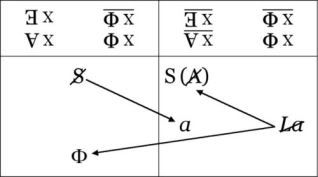
Similarly to the earlier accounts of the sexed subject, the phallus remains the pivot of the later Lacanian account of sexual difference. Lacan’s ‘Graph of Sexuation’ represents sexed identity in relation to the phallic function (S20: 79).

The phallic function is ‘the function that institutes lack, that is, the alienating function of language’ (Fink 1995: 103).

A relation to the phallus structures the masculine and feminine positions, which the formulae of sexuation represent (S20: 79– 80). Because it turns on the phallic function (S20: 59), ‘there is no such thing as a sexual relationship’ (S20: 12).For this reason, a relation between the sexes is an impossibility.

Lacan claims that the ‘male way’ of jouissance produces the non-relation between the sexes (S20: 56– 57). The phallic function produces the jouissance of the masculine subject, the enjoyment of the (phallic) organ on which ‘all’ turns.

Lacan argues that the phallic function inscribes the male subject ‘man as whole’ or ‘as all’ (l’homme comme tout) (S20: 79).

Joan Copjec describes that inscription as producing ‘a universe of men’, a masculine universal (1994: 235).

The masculine subject claims to be a man who is whole and all, a master of himself who ‘[b]y denying the trauma of primary Castration . . . unconsciously perpetuates the suppression of the person’s own division and the belief in her or his autonomy’ (Ragland-Sullivan 1987: 305).

The masculine claim rests on the exception of castration – such that he defines his universality in relation to an other without the phallus. The masculine subject represents his ontological lack as the castration of the feminine other.

That other position of the subject is that of  — a fantasy that affirms that the masculine subject has the phallus.

In this fantasy, desires the phallus, confirming that he has it. If the whole of the sexual relation is a fantasy, it is a masculine fantasy of as the cause of his desire (S20: 131). The cause of his desire is the objet a – the originary missing object that can never be found (S20: 86).

Zizek identifies that missing object as the Mother-Thing on which masculine fantasy turns (1989: 119). For the masculine subject, the feminine represents a fantasy object that can answer his desire for universality and completeness: she confirms that he does not suffer castration.

In its relation to the masculine subject, the feminine is a fantasy of a castrated other that confirms that she is castrated and he is not. The operation of the phallic function produces this fantasy.

For this reason, Lacan argues that does not exist. She exists only as a fantasy of the masculine subject, formed in his phallic jouissance and in his desire (86).

No woman can fulfil that fantasy. In this way, The fantasy Woman does not exist in the real, because no woman could enact the fantasy that he substitutes for her. Lacan points out in his earlier work on feminine masquerade that women may attempt to fulfil that fantasy (É: 321). However, while a woman may attempt to play out the masculine fantasy, in doing so she does not exist as other than in and through fantasy.

Lacan indicates the impossibility of by his bar through the definite article ‘The’. When interviewed in 1973, Lacan formulates the impossibility of ‘Woman’ as ‘The Woman does not exist’ (1974: 38). In Encore, Lacan makes it clear that, by that formulation, he does not mean that women do not exist but that the masculine fantasy of is an impossibility (S20: 72– 73).

If Lacan’s later account of the sexuated subject went no further than this description of masculine and feminine subjects, then it would only be a more elaborated version of the classical Lacanian theory of sexuation. As such, the phallus would still function as a transcendental guarantee of subjectivity and the Symbolic order. Such an account would therefore remain vulnerable not only to the feminist objection of androcentrism, but also to the compelling deconstructionist critique of ‘phallogocentrism’ (Derrida 1980).

However, in Encore, Lacan confronts the question of ‘What does woman want?’, which leads to a reworking of his theory of the female subject. In Encore, Lacan describes how ‘what I am working on this year is what Freud expressly left aside: Was will das Weib? “What does woman want?”’ (S20: 80). Lacan responds to that question with some of his most misogynist statements. He suggests that women tell nothing of their body or their pleasure, and that in fact they know nothing of their bodies or their pleasures (S20: 74– 75). Ultimately, Lacan reduces this mystical unknown Other to the unknowable maternal Thing (S20: 99). The question of what do women want implies a desire to know women, insofar as Lacan wants to know what women want. What is in question is Lacan’s knowledge of women. However, what Lacan puts into question is what women themselves know. His answer? Nothing. What emerges in Lacan’s discussion of what women want is a succession of gestures of rhetorical mastery, which understand this unknown object as ignorant of itself, and finally as unknowable. The drive to master that object is evident in Lacan’s claimed status of Knowing Master: ‘[i]t’s just that they don’t know what they’re saying – that’s the whole difference between them and me’ (S20: 73). However, these gestures of mastery are at play within the same text in which the ‘truth’ of women is in excess of a phallic regime, and constantly threatens to breach its symbolic logic.

The question of what women want opens the way for Lacan’s conception of the female subject as ‘not all’ (pas toute). In Encore, the position of the female subject is not rendered as nothing, but as not all of the phallus: ‘I said “of woman”, whereas in fact woman does not exist, woman is not whole (pas toute)’ (S20: 7).  (87)

In this formulation, the not all of the female subject is a not all of the phallic function. Lacan argues that ‘when any speaking being whatsoever situates itself under the banner “women”, it is on the basis of the following – that it grounds itself as being not-whole in situating itself in the phallic function’ (S20: 72). If the exception of castration defines ‘all’ of the masculine position (S20: 79), then the position of the female subject is that of an exception.

The masculine rests on the exception of feminine (castration). It rests on her being other than the phallic all. With this exception, the phallus cannot be posited as a universal and so cannot define all, because it has the status of a universal that rests on a non-universal.

Reading the Graph of Sexuation in Encore from the side of the masculine subject positions the female subject as an exception to the phallic signifier and hence as a signification of its limit. The phallus does not define her sexed subjectivity, because she comes to be a sexed subject through normative identifications with a member of the opposite sex.

It does not define her body, for the phallus does not symbolize her body (S3: 176). It does not represent her sexuality, since her jouissance is not a phallic jouissance (S20: 74). Lacan argues that ‘[a] woman can but be excluded by the nature of things, which is the nature of words and it must be said that if there is something that women complain about enough for the time being, that’s it’ (S20: 73).

To be a woman is not to be excluded from language. For Lacan, ‘[i]t’s not because she is not wholly in the phallic function that she is not there at all. She is there in full (à plein). But there is something more (en plus)’ (S20: 74). The paradox of the female subject is that she is within the phallic law of the signifier and yet ‘there is something more’.

The not all of the female subject should therefore be understood as the failure of the law of the signifier to represent her sexed subjectivity. The not all of the female subject is constituted in its failure to represent her subjectivity as other than phallic.

Her position of ‘Other’ is then a position of being other than the phallic subject. Therefore, the phallic signifier does not define the female subject. The not all is not that which is Other to the phallus, but that which it does not define. The Lacanian account of the position of the female subject is the failure of the symbolic to represent that subjectivity.

The Graph of Sexuation should therefore be read as a Graph of Male Sexuation and of the operation of masculine subjectivity. It does not describe the female subject other than in terms of the phallic function. For this reason, Lacan’s Graph can only represent the female subject as not defined by the law of the signifier.

In this later model of sexuation, the phallus only guarantees a masculine subject and symbolic order. The subjective and symbolic structures that it supports are therefore incomplete – there is always ‘something more’, such that the phallic order always produces an excess to itself. The phallus fails to effect closure of what otherwise appears to be a transcendental Symbolic order. For this reason, the not all provides a means to reconceive the female subject. (88)

campbell sexuation and the later lacan

Campbell, Kirsten. Jacques Lacan and Feminist Epistemology. Florence, KY, USA: Routledge, 2004. p 84.

… a feminist theory of knowledge that insists that the knower is sexed cannot then argue that the feminist knower does not have a sex. To do so is to reinstitute the universal knowing subject which feminist epistemology compellingly critiques.

The relation between the female subject and feminist knower therefore remains a crucial issue for feminist theories of knowledge. However, existing theories consider this issue in terms of foundational concepts of knower that fix it in already given terms. These theories begin their analysis with a concept of the knower that substantiates it as a sexed knower or as a political subject. This approach mires feminist epistemology in a series of circular debates concerning female/feminist subjects, which oscillate between arguments for and against which subject can serve as the better foundation for feminist knowledges. However, these debates do not actually put those foundational terms into question, and fail to consider the production of those subjects. They assume a given sexual identity (the female knower) and a given political identity (the feminist knower) so that these models do not explain the constitution of the feminist knower. Rather than assuming the prior existence of sexed knower or the political subject, we need to explain their formation. Moreover, we need to explain the relationship between these subjects. To evade the circularity of existing debates, I begin with an analysis of the relation between the formation of the sexed female subject, and the constitution of the knower as feminist subject.

Reading femininity How do we become sexed subjects?

Butler argues that ‘psychoanalysis has a crucial role to play in any theory of the subject’ (2000b: 140). Feminists theorizing subjectivity have predominantly read Lacanian theory as and for an account of the constitution of ‘femininity’. Those engagements with Lacan’s work focus upon his account of the operation of the phallic signifier in relation to the ‘feminine’ subject and sexuality, particularly upon the theory of sexual difference presented in Alan Sheridan’s translation of Écrits.

In this classical Lacanian theory, sexed subjectivity is assumed in relation to the phallic signifier. Masculine subjects are defined by having the phallus and feminine subjects by being the phallus (É: 320). When subjectivity is assumed in the Symbolic order, the masculine or feminine subject is sexually differentiated in its relation to the phallus. In this account, the speaking subject is always a sexed subject defined by the phallic signifier of the Symbolic order, whether it is the masculine subject that has the phallus or the feminine subject that is the phallus. For both sexes, sexuation pivots on the phallus.

Two readings dominate the anglophone feminist reading of the classical Lacanian theory of femininity. The first response, which Nancy Fraser (1992) exemplifies, refuses Lacan’s account as hopelessly and irrevocably phallocentric. The second response, which Ellie Ragland-Sullivan (1987) exemplifies, is a sympathetic interpretation of Lacanian theory that argues that it provides a compelling description of the difficulty of phallic femininity. However, these debates continually return to the problem of sexual difference that constructs femininity as either phallic or Other to the phallus, thereby defining femininity in relation to the phallus.

Moreover, neither of these readings offers a theory of the female/feminist knower because they do not unpack the relationship between these two identities. Such a theory requires a closer examination of the formation of ‘feminine’ subjectivity. It cannot reduce the feminist knower to either her ‘femininity’ or her ‘sexuality’, because it needs to address her political as well as subjective formation. In other words, it must address the distinction ‘between different notions of political identity – between the idea of a political identity for feminism (what women require) and that of a feminine identity for women (what women are or should be)’ (Rose 1986: 103).

How then is it possible to provide a psychoanalytic account of these two identities that is ‘beyond the phallus’? One way is to explore another reading of Lacan.

The feminist reception of Lacan has been based on the ‘classical’ Lacanian account of the sexed subject presented in Écrits, rather than his later seminars of the 1970s. The focus of Anglo-American feminist theory upon Écrits may be attributable to the delay in the publication and translation of Lacan’s later work on femininity, in particular his seminar Encore (1972– 1973) (S20).

Encore was not published until 1975 and, with the exception of two chapters that Jacqueline Rose translates in Feminine Sexuality (1982), remained untranslated until 1998. Lacan’s later work proposes a more complex account of the production of the female subject that avoids the phallocentric circularity of his classical theory of sexed subjectivity. In the next section, I examine the later Lacanian concept of the sexed subject in Encore, developing and redeploying it as a feminist theory of the formation of the female subject and its ‘feminine’ sexuation.  (85)

campbell discourse of analyst pt 2

Campbell, Kirsten.Jacques Lacan and Feminist Epistemology. Florence, KY, USA: Routledge, 2004. p 81.

Analytic knowledge/feminist knowledge

In analytic discourse, the analysand as knowing subject takes up the position of the barred subject – the subject of the unconscious. The analysand acknowledges the pain and psychic cost of entering the Symbolic order because he or she articulates the lack that all speaking subjects suffer. To know this truth is to know the lack of castration (S17: 58). The love of truth enables the analysand to know ‘this weakness’, to recognize the failure and limits of its knowledge.

Refusing the comforts of the fantasy of a secure and securing identity, the analysand recognizes its split and contradictory self.

In her description of situated feminist knowledges, Donna Haraway argues that feminist epistemologies should privilege the notion of the knower as ‘split and contradictory self’. Haraway contends that ‘[s]plitting, not being, is the privileged image for feminist epistemologies. . . . The knowing self is partial in all its guises, never finished, whole, simply there and original; it is always constructed and stitched together imperfectly’ (1991: 193).

This conception of the knower acknowledges her production. The knower recognizes herself as a speaking subject and so her formation in symbolic and social fields. In this position, the knowing subject critically articulates existing orders of representation, and the cost of entering those symbolic economies. By reinscribing that cost into the order of representation, she refuses the position of Master in her acknowledgement of her temporality, disunity and division.

However, the aim of psychoanalysis is to enable the analysand to accept its lack-in-being. Through analysis, the analysand articulates the truth of subjectivity: ontological lack. The analysand consents to that symbolic debt paid by the speaking subject because it accepts the castration that signifies its division and incompleteness.

The analysand represents that loss as castration, which is rendered symbolically through a relation to the phallic signifier.

In this way, the analysand sutures its fundamental lack-in-being through the signification of ontological lack as the sexual difference of castration. By contrast, the feminist knowing subject articulates that symbolic debt but genders, politicizes and refuses it.

While, pace Zizek, subjects may exchange common lack in the Symbolic order, feminism insists that women bear it in their signification of the ontological loss of all subjects (81).

The ‘Woman’ functions as the sign of phallic lack because she comes symbolically to embody ontological (all) lack.

In this way, the female subject pays the debt of the speaking subject in the Symbolic order. In Lacanian terms, the symbolic price that is paid for becoming a subject is the giving up of the mother, and the lack-of-being of all subjects. In feminist terms, women pay this price.

Ragland-Sullivan argues that ‘female depression, passive aggression, and disturbed children is simply too great a price to pay’, and her list is far from being a complete enumeration of the cost of such a social order (1987: 301). However, a feminist subject refuses that cost for herself, other women and other subjects. Unlike the analysand, the feminist knowing subject does not articulate the truth of the Symbolic order simply in order to come to terms with herself. Her knowing position emerges from a relation not only to herself but also to others. In this way, a political relation to others constitutes her position. With that political relation, the position of the knowing subject shifts from psychoanalysis to feminism.

In psychoanalytic discourse, the analyst stands as the cause of the discourse (in the place of the a). The analyst is the silent partner of the analytic process who functions as the addressee of the analysand’s demand for love and knowledge. This address to another introduces the intersubjective dimension of analytic practice. Without the analyst, the analytic process could not unfold because it is through the transferential operation of demand and identification that the analysand produces a hysterical discourse that introduces his or her desire. In this way, the analysand’s relation to an other – the analyst – as a relation to self structures the analytic process.

Unlike psychoanalytic discourse, a political relation to others structures feminism. The feminist subject addresses her desire to know and to love to others, constituting the intersubjective dimension of that address. Other women provide her discourse with its cause. This political address to others distinguishes her position from that of the analysand. Her relation to others, rather than the analysand’s relation to self, produces her speaking position. In her political relation to her others, the knowing subject addresses her desire for knowledge to other women. This address inflects her knowledge, structuring it as an intersubjective negotiation of political principles.

Feminist knowledge seeks to found its act of knowing in the political. Lacan argues that it is not by accident that women inaugurate the revolutionary discourse of psychoanalysis (S17: 62). The analysand Anna O., the subject of the first psychoanalytic case history, named psychoanalysis the ‘talking cure’ (Freud and Breuer 1895: 83). The case of ‘Anna O.’ can be read as an account of the hysterical analysand, or it can be reread through Anna’s own name, Bertha Pappenheim, who was a historical subject with speech, agency and knowledge. In that subjective position, the analysand Anna O. can be recast as the feminist Bertha Pappenheim. Anna O. undoubtedly suffered as a hysteric; it was the hysterical symptom that drove her to her two doctors, Breuer and Freud (82).

However, she also has a speaking position that is not that of the hysterical analysand. Throughout her life, Bertha Pappenheim ‘was a pioneer in German social work as well as a leader in feminist and Jewish women’s organisations’ (Decker 1992: 136). Hannah Decker points out that, unlike Dora, ‘an avocation-turned-career had been the salvation of “Anna O.” ’ (1992: 108).

Bertha Pappenheim was truly able to love and to work. We can see in her life the movement from hysteria, silence and depression to ethical and political engagement, a shift from passive symptom to feminist practice.

If we consider the feminist position as analogous to that of the analysand, and the Discourse of the Hysteric as leading to the Discourse of the Analyst, then it is possible to see the relation between the ‘protofeminism’ of hysteria and feminist discourse (Forrester and Appignanesi 1993: 68).

However, while both have discursive structures that originate in the question of sexual difference and unsatisfied demand, what distinguishes the two is the shift from symptom to signifying practice. One discourse produces a symptom; the other produces a political knowledge. This shift is evident in Anna O.’s life, shifting her position of hysterical analysand to that of the feminist, and from analytic discourse to feminist discourse (83).

campbell sexuation

Campbell, Kirsten. Jacques Lacan and Feminist Epistemology. Florence, KY, USA: Routledge, 2004. p 64.

The power and difficulty of Lacan’s concept of sexed subjectivity for feminism lie in its linking of social, psychic and corporeal sexual difference. The very ground of feminist critiques of Lacan’s account is also that which makes it a powerful account of the formation of masculinity and femininity. This theory offers us, first, an explanation of the formation of sexed subjectivity, and second, an understanding of sexed subjectivity in which:

  1. To become a subject is to become sexed.
  2. To be sexed is to be caught within representations of sexual difference.
  3. That signification is contingent and not fixed by the body.

In this account, sexual difference is both necessary and necessarily contingent. While Lacanian epistemology presents the knower as if it were outside the field of sexual difference, the Lacanian theory of sexuation situates all subjects within that field. Zizek points out that ‘[o]ne of the crucial differences between psychoanalysis and philosophy concerns the status of sexual difference: for philosophy, the subject is not inherently sexualised . . . whereas psychoanalysis promulgates sexualisation into a kind of formal, a priori, condition of the very emergence of the subject’ (1998a: 81). As a speaking subject, the knowing subject of Lacanian epistemology is therefore also sexed. While Lacan does not develop his work in this way, in the next section of the chapter I read Lacan’s accounts of knowledge and sexuation together to develop a theory of the formation of the sexed knower and its knowledges. I interweave Lacanian epistemology and the Lacanian account of sexuation to offer a possible answer to the question: ‘How, then, is sexual difference, this fundamental Real of human existence, inscribed into the matrix of the four discourses? How, if at all, are the four discourses sexualised?’ (Zizek 1998a: 82).  (64)

campbell sexuation phallus

Campbell, Kirsten. Jacques Lacan and Feminist Epistemology. Florence, KY, USA: Routledge, 2004. p 60.

The later Lacanian epistemology also presents a subject that is sexually neutral, because  the master, academic, hysteric and analyst are positions without gender. Since both men and women have to enter the intersubjective relations of discourse in order to become subjects, the subject as such does not have a sex. … The Master is sexless because all must enter the Discourse of the Master in order to become subjects. That discourse produces all speaking subjects, such that ‘[i]n the final analysis, the “person” always has to do with the master’s discourse’ (S20: 69). Lacan makes his claim that the Discourse of the Master forms all subjects in Encore, (S20) the same seminar in which he also proposes that feminine sexuality and subjectivity are in excess of, rather than determined by, the phallic function. In his later work, Lacan repeatedly returns to the question of women’s knowledge (60).

The figure of the knowing woman is both difficult and fascinating for the later Lacan. This difficulty reflects the paradox of the classical account of sexuation: the phallus is a sexually neutral signifier which produces all subjects, but men and women become sexed subjects because of their different relation to the phallus.

In Lacan’s work, a different relationship to the phallic signifier defines the sexual difference of masculinity and femininity. In the description of the formation of the subject presented in Écrits, the child becomes an I and takes up a subject position in language after the intervention of the Law of the Father in the Oedipus complex. After the resolution of the Oedipus complex, subjectivity is assumed in the Symbolic order and the subject sexually differentiated by its relation to the phallus (É: 320– 321).

Similarly, Lacan’s later account argues that the subject’s relation to the phallic signifier produces it as sexed. As Lacan describes it in Encore, each speaking being must line up on one side or the other of the Graph of Sexuation (S20: 79).

In this way, Lacan’s account of the production of the subject turns on his concept of the phallus. This pivotal role of the phallus in the formation of sexed subjectivity gives rise to the most strenuous feminist critiques of Lacan’s work. Generally, the accusation of phallocentrism contains two objections:

– first, that Lacan ties his concept of the phallus to the biological organ of the penis,

– second, by doing so Lacan privileges masculinity and the male body as his model of sexual difference and its formation. For example, Elizabeth Grosz contends that in the phallocentric model, ‘[s]exual difference becomes codified into the presence or absence of a single feature – the male sexual organ’ (1990: 188).

In reply, Lacanians commonly accuse feminists of misreading this concept of the phallus. Typically, Bruce Fink argues that feminist authors such as Jane Gallop ‘have thus provided the reading public with patently or partially false interpretations’ (1995: 98). …

Following the ‘Function and Field of Speech’ (1953), Lacan’s concept of the phallus becomes increasingly complex and central to his theory of sexed subjectivity. For Lacan, the phallus operates in the three registers of the imaginary, the symbolic and the real. In the Symbolic order, the phallus ‘is the signifier for which there is no signified’ (S20: 80); in the imaginary order it operates as a narcissistic object of the phallic image which fulfils that lack (É: 354); and in the real as the real phallus, the organ of the penis (É: 320). …

By implication, the ‘lack’ to which Lacan refers is the anatomical difference of woman, which he renders as the absence of a penis. Kaja Silverman argues that we should expect this confusion of phallus and penis because:

in any [theoretical] passage centrally concerned with elaborating a lack specific to woman…that lack can only be elaborated through reference to the penis. The Lacanian phallus depends for its libidinal centrality upon the anatomical distinction between the sexes, and it cannot, consequently, be rigorously distinguished from the penis. (1992a: 96)

In this way, Lacan’s account of ontological loss is predicated on the assumption of a body that suffers anatomical ‘loss’. For this reason, reference to a social signification of the body secures the Lacanian account of sexed subjectivity.

Lacan emphasizes the contingency of the relation between biological and psychic sexual difference in his argument that the subject can have either masculine or feminine structures, regardless of biological sex (S20: 71). However, while sexuation may be contingent, the socio-symbolic field which assigns masculinity and femininity to male and female bodies also produces them as sexually different.

Sexual subjectivity is not so contingent that it becomes possible to sever its production from the signification of the biological body. A concept of biological sexual difference thus secures which bodies come to be ‘masculine’ and ‘feminine’ (63).

While biological sex does not determine sexed subjectivity, sexuation signifies what it is to have a ‘male’ or ‘female’ body. Because ‘masculine’ and ‘feminine’ refer to a relation of the subject to the phallus, sexuation operates as the signification of biological sex in relation to the phallic signifier. For example, Lacan understands the Hysteric as a position of both men and women. Both sexes can be hysterics and, as analysands, become hysterical subjects. However, he repeatedly identifies this position of the subject with the feminine. The Hysteric has a ‘feminine’ structure because it symbolizes the primary dissatisfaction of castration (S17: 84). Lacan acknowledges that ‘there are many more women hysterics than men – this is a fact of clinical experience – because the woman’s path to symbolic realization is more complicated’ (S3: 178). Conversely, the male hysteric has access to ‘both phallic and the Other jouissance’ (Fink 1995: 108). He is therefore still structured by reference to a masculine structure, that is a masculine relation to the phallic signifier, because otherwise he would not have access to the phallic jouissance which is linked to the male organ (S20: 7). The terms ‘masculinity’ or ‘femininity’ do not have content without reference to the description of bodily sexual difference.

In Lacan’s account, subjects have a masculine or feminine structure, which provides a signification of anatomical sexual difference. The relation to the phallic signifier that produces the subject also gives meaning to biological body. In this theory, the socio-symbolic order assigns masculinity and femininity to particular bodies and in particular ways. That assignation may be contingent; such that pace Fink men can have feminine psychic structures and women can have a masculine relation the phallus. Nevertheless, Lacan does not describe those women as men, but as phallic women. Lacan’s theory assumes that ‘order and norms must be instituted which tell the subject what a man or woman must do’ (1964b: 276), and that most commonly the normative position for men is masculinity and for women is femininity (64).

pluth on sexuality sexual difference

Pluth, Ed. “On Sexual Difference and Sexuality “As Such”: Lacan the and the case of lilttle hans.” Angelaki 12:2 (2007): 69-79.

Sexual difference is traumatic. No doubt, but what is so traumatic about it? Lacanians have had to dance around this forever because of a strong feminist current of critique whose vigilance with regards to spotting forms of essentialism and male bias in Lacanian theory, particularly any time a Lacanian talks about ‘sexual difference.’

Ed Pluth, a Lacanian, is doing more to shed some sort of repectable coherence and understanding to this freakin can of worms:

… what makes sexual difference “real” is the function it plays in the symbolic as a place-holder for something else. … The impasse or “trauma” that sexual difference marks in Lacanian theory is not really a trauma about sexual difference at all. … It is a trauma that, more originally, is about sexuality as such … In other words, if sexual difference is a symbolic impasse, and thus real, it is because it is the repetition of another impasse, one that Lacan describes as sexuality “as such.” 70

Here Pluth is saying that before sexual difference, there is the trauma of sexuality. Sexual difference is a way of taming sexuality as such

It [sexual difference] is less a way of making sense of sexuality than a way of doing something with sexuality, just by putting the enigma of sexual difference in the place of the enigma of sexuality itself (72).

Sexual difference is not a way of representing sexuality as such. A better way to put it is to say that the impossibility introduced by sexuality as such — an impossibility in the sense that its emergence defies symbolization — is replaced by another impossibility in signifiers: what Lacan ends up calling the impossibility of the sexual relationship. (76)

Sexual difference … is a translation or repetition of the impasse of sexuality as such in the symbolic. … a displacing or transferring of an impasse between the real as such and the symbolic as such into purely symbolic terms. (77)

sharpe subjectivity hegelian

The Jacobin Reign of Terror … for Hegel, is that within it for the first time subjects could at any moment ‘lose everything’ with no hope of any equivalent return. To quote The Phenomenology of Spirit

… all these determinations [that the subject receives in its ‘acculturation’ hence] have vanished in the loss suffered by the self in absolute freedom: its negation is the death that is without meaning, the sheer terror of the negative that contains nothing positive … [Hegel, 1997:362]

… it is only when the individual has experienced this ‘terror of the negative’, and had the courage to see in what appeared to him qua particular Self as a groundless alien force something which is ‘immediately one with self-consciousness’, that full ‘self-consciousness’ emerges. [Žižek 1999a: 94] (139).

‘Subject’ [thus] emerges at this very point of utterly meaningless voidance brought about by a negativity which explodes the frame of balanced exchange.  That is to say, what is ‘subject’ [in Hegel] if not the infinite power of absolute negativity/mediation … [for] whom every ‘pathological’ particular positive content [henceforth] appears as ‘posited’, as something externally assumed? [Žižek, 1993, 27; Hegel 1997: 355-63] (139)

Žižek thus comments that what ‘… Bataille fails to … note … is that the modern (Cartesian) subject no longer needs to sacrifice goats intestines, his children, and so on, since his very existence already entails the most radical … sacrifice, the sacrifice of the very kernel of his being’. [Žižek, 1996a 125 … ] (139).

In Hegel, who for Žižek most consistently thought through this subject’s philosophical subversion, the ‘Cartesian’ subject corresponds to: ‘.. the purely negative gesture of limiting phenomena without providing any positive content that would fill out the space beyond the limit.’ [Žižek, 1993, 21]

From Hegel’s Realphilosophie of 1805-6:

The human being is this night, this empty nothing, that contains everything in its simplicity — an unending wealth of presentations, images, none of which occurs to him or is present … here shoots out a bloody head, there a white shape … [Žižek, 1991a, 87; 1997b:8; 1992: 50; 1999b: 136] (139)

sharpe the Other is itself divided the Other does not exist

Sharpe, Matthew. Slavoj Žižek: a little piece of the real. Burlington Vt: Ashgate, 2004.

Žižek’s position is that ideology primarily captures subjects at the level of their unconscious beliefs, and that it does this by structuring their access to jouissance (99).

Žižek proposes … that the answer to how one can still speak from ‘outside’ of the big Other of a hegemonic ideological system comes from a more detailed ontology of this Other itself.  … the Other is itself divided and/or inconsistent, and so contains the resources of its own critique (100).

Modernity, Žižek repeats, is that ‘enlightened’ epoch wherein: “… the symbolic substance (the “big Other” qua texture of symbolic tradition) can no longer contain the subject, can no longer hold him to his symbolic mandate. [Žižek, 1992: 134 (Sharpe’s italics)]

Žižek’s argument is that sexuality only emerges in the first place at the points of the failure of what can be sanctioned by social discourse (113).

sharpe real of jouissance

Sharpe, Matthew. Slavoj Žižek: a little piece of the real. Burlington Vt: Ashgate, 2004.

Žižek’s contention is that the social conditions of the contemporary would demand nothing less than a radical rethinking of the discursive constitution of subjectivity as such. … what risk theory fails to register, and what it falls to a psychoanalytically based analysis to register, is the changed situation of contemporary subjectivity vis-à-vis the ‘Real of jouissance’ (86).

I know very well that symbolic conventions are empty, yet I continue to follow the social expectations [as the only means to attain to money, power, sex (etc.) = because I believe through the duped other(s)].

So Žižek’s position is that we should defitely not be taken in by the contemporary subject’s conscious sense of himself as something of ‘an outlaw … staying clear of binding commitment’ (Žižek, 1991b: 103, 102) Perhaps more than ever, Žižek argues, today’s subjectivity is radically conformist. “… instead of the symbolic Law, we have a multitude of rules to follow” What Žižek is referring to are the multitude of  ‘… imaginary ideals (of social success, of bodily fitness…)’ with which the multimedia, and in particular advertising discourse, solicit us.

From Žižek in 1991:

… [w]hat usually goes unnoticed [by social psychology] is that this disintegration of the ego-ideal entails the installation of a ‘maternal‘ superego taht does not prohibit enjoyment, but, on the contrary imposes it and punishes ‘social failure’ in a far more cruel and severe way, through an unbearable and self-destructive anxiety.  All the babble about the decline nof ‘paternal authority’ merely conceals the resurgnece of this incpmparably more oppressive agency. 89