capital as real

Boyle, Kirk. “The Four Fundamental Concepts of Slavoj Žižek’s Psychoanalytic Marxism.”  International Journal of Žižek Studies Vol 2.1 (2008) 1-21.

Capital as Real: The Marxian Parallax

The more fundamental and systemic mode of the capitalist drive no longer operates in the symbolic order where individuals are interpellated as subjects of desire.

To be clear about where the mode of drive operates in capitalism, another term needs to be introduced: the Lacanian Real. In Lacanian psychoanalysis the Real is a purely formal concept; it is nothing more or less than the inherent limit of a symbolic order, that which must be repressed so this order can function. Because the Real is “simultaneously the thing to which direct access is not possible and the obstacle which prevents this direct access,” it can only be experienced in itssymptomatic effects (Žižek 2007: 243).

Žižek identifies two homologous forms of the Real , which are “detectable within the Symbolic only under the guise of its disturbances”: the traumatic core of sexual antagonism and the social antagonism of “class struggle” (Žižek 1994: 30). Both of these conceptions of the Real may be said to comprise the “minimalist” or “negative” anthropology of Lacanian Marxism. It is the Real of sexual antagonism, for instance, which prevents “it” from being “It”: objet a will always thwart the coincidence of the object of desire with the object-cause of desire. Likewise, the Real of social antagonism will always prevent the formation of a fully (self-)transparent utopian society. Reminiscent of Althusser’s claim that ideology is eternal, psychoanalysis holds that a minimal degree of misrecognition, reification, and fetishistic disavowal—“I know very well what I am doing, but I am doing it anyway”—is endemic to all symbolic orders. Although antagonism is eternal, Žižek adamantly disclaims that the sociotranscendental status of the Real denies the existence of History  [i.e., Butler’s criticism of Lacan].  The Real does not replace temporality with synchronicity or cyclicality. Rather, historical change derives from the emergence of new symbolic formations to deal with the traumatic core of sexual and social antagonism.

Because we still live within a world-economy structured by the “class struggle” inherent within capitalism, Žižek calls it the Real of our epoch. He writes:

The universality of capitalism resides in the fact that capitalism is not a name for a civilization, for a specific cultural-symbolic world, but the name for a truly neutral economico-symbolic machine which operates with Asian values as well as with others… The problem with capitalism is not its secret Eurocentric bias, but the fact that it really is universal, a neutral matrix of social relations—a real in Lacanian terms. (Žižek 2005a: 241)  …  As Žižek states, “the structure of the universe of commodities and capital in Marx’s Capital is not just of a limited empirical sphere, but a kind of sociotranscendental a priori, the matrix which generates the totality of social and political relations” (Žižek 2006b: 56).

Thus, Žižek transcodes the Marxist concepts of “commodity fetishism” and “class struggle” into the Lacanian notion of the Real. Where the older Marxist terms have long since been confused with empirical entities like the “working class” and actual commercial goods, the Lacanian Real has the benefit of emphasizing the purely formal, and therefore universal, status of capitalism and its overdetermination of the totality of social relations.

If we no longer accept a linear model of economic determinism where the economy directly causes sociopolitical events, how are we to understand the ways in which capitalism as Real overdetermines the totality of social relations?

Žižek adopts Althusser’s causal model of overdetermination: if “‘the logic of capital’ is a singular matrix which designates [capitalism’s] Real,” then it operates precisely as the absent cause of the totality-effects that occur within the sociopolitical realm (Žižek 2007: 211).

In the Lacanian Marxist base/superstructure model, as in its Althusserian predecessor, economic events of the Real do not cause Symbolic phenomena directly. Contrary to Althusser’s subject-less base/superstructure model, however, Žižek’s model maintains the subjectivity of the social antagonism of “class struggle” at the heart of the economy by introducing the concept of “parallax.”

The “Marxian parallax” refers to the irreducible gap between Real absent cause and Symbolic totality-effect.

He writes: …the ultimate parallax of the political economy [is] the gap between the reality of everyday material social life (people interacting among themselves and with nature, suffering, consuming, and so on) and the Real of the speculative dance of Capital, its self-propelling movement which seems to be disconnected from ordinary reality….Marx’s point here is not primarily to reduce the second dimension to the first (to demonstrate how the supernatural mad dance of commodities arises out of the antagonisms of “real life”); his point is, rather that we cannot properly grasp the first (the social reality of material production and social interaction) without the second: it is the self-propelling metaphysical dance of Capital that runs the show, that provides the key to real-life development and catastrophes. (Žižek 2006b: 383)
16

Žižek also describes the Marxian parallax of the political economy as follows:

If, for Lacan, there is no sexual relationship, then, for Marxism proper, there is no relationship between economy and politics, no “meta-language” enabling us to grasp the two levels from the same neutral standpoint, although—or, rather, because—these two levels are inextricably intertwined.

The “political” class struggle takes place in the midst of the economy…while, at the same time, the domain of the economy serves as the key that enables us to decode political struggles. No wonder the structure of this impossible relationship is that of the Moebius strip: first, we have to progress form the political spectacle to its economic infrastructure; then in the second step, we have to confront the irreducible dimension of the political struggle at the very heart of the economy. (Žižek 2006b: 320)

drive desire objet petit a

Boyle, Kirk. “The Four Fundamental Concepts of Slavoj Žižek’s Psychoanalytic Marxism.”  International Journal of Žižek Studies Vol 2.1 (2008) 1-21.

Žižek’s more recent theorizations of capitalism have turned away from the Lacanian notion of desire to the concept of drive. The previous section discussed the reflexivity of desire, how desire is desire for the object-cause of desire, objet a.

We saw how this desire could not be satisfied in any lasting way, that it was infinite, an infinite metonymy of desire. Drive distinguishes itself from desire in a short-circuit of sorts. Its object is the loss itself of objet a, not the fantasmatic objet a that never yields its promised jouissance, but what Žižek calls the “object-loss of drive.”

He writes, “in the case of objet petit a as the object of drive, the ‘object’ is directly loss itself —

in the shift from desire to drive we pass from the lost object to loss itself as an object” (Žižek 2006b: 62). Where desire suffers from the repetitive failure to obtain full jouissance, drive finds triumph in this very failure.

Desire acquiesces to the surplus-enjoyment it receives from partial objects that are metonymies for the impossible Thing; drive finds satisfaction in the loop around an object.

If the hysterical libidinal economy of desire works in cahoots with capitalism to produce and reproduce consumer society, then drive may offer a possible way to break out of this endless chain of metonymic commodities. Žižek writes:

drive is literally a counter-movement to desire, it does not strive towards impossible fullness and, being forced to renounce it, gets stuck onto a partial object as its remainder — drive is quite literally the very “drive” to break the All of continuity in which we are embedded, to introduce a radical imbalance into it, and the difference between drive and desire is precisely that, in desire, this cut, this fixation on a partial object, is as it were “transcendentalized,” transposed into a stand-in for the void of the Thing. (Žižek 2006b: 63)

The above passage posits drive in opposition to desire, which, in turn, is represented as creating a transcendental world of partial objects, all of which sustain the illusion of the “Thing as the filler of its void” (Žižek 2006b: 63). Desire, in fact represents the horizon of Lacan’s early theorizations of psychoanalysis, which remain thoroughly Kantian. In this early stage, Lacan posits a lost jouissance of the inaccessible “maternal” Thing with objet a serving as a leftover or remainder of this primordial enjoyment. The regulative ideal implicit in this formulation requires the subject to renounce the Thing and accept substitutive satisfactions in its stead. Hence, the stoicism often associated with the Freudian field (the point of maturity where we accept the fact that “it” never is “It!”).

The drive disrupts the homeostasis implicit in the position that one must keep a proper distance to the Thing less one gets burned by it. Žižek replaces this “Golden Mean” or “Goldilocks effect”—in Freudian terms, the “pleasure principle”—with a notion of drive which “suspends/disrupts the linear temporal enchainment” (Žižek 2006b: 63). In order to “break the All of continuity in which we are embedded,” the subject of the drive tarries with the negative and becomes caught up in a repeated circuit of jouissance, a self-propelling loop beyond the pleasure principle.  Drive exists in both a pre-and post-fantasmatic space, at once prior to the passionate attachments of desire and beyond them.

The realm of the drive is a primordial abyss of dis-attachment in which the subject exists out-of-joint with its environs. Such a description of the drive, however liberating we might imagine it, smacks of a romantic, individualistic form of resistance, a critique that has been cast at Žižek (especially in his examples of the psychoanalytic act).

The subject of the drive sounds awfully like the existential artist-hero who withdraws from society and its fantasmatic lures, confronts the void, and in true Nietzschean fashion fully affirms the eternal recurrence of the same. Žižek, however, is far from proffering the drive as a line of flight from the deadlocks of desire. The opposite, in fact, is the case.

“The lesson of drive,” he writes, “is that we are condemned to jouissance: whatever we do, jouissance will stick to it; we shall never get rid of it; even in our most thorough endeavor to renounce it, it will contaminate the very effort to get rid of it” (Žižek 2000: 293).

What at first glance appears to be a radical act to break out of the linear continuity of the hysterical economy, now becomes a compulsion to repeat, to obtain jouissance by circulating around the goal-object.

Žižek puts an end to all flirtations with the transgressive nature of the drive when he associates it with the machinations of capitalism. After acknowledging that capitalism addresses individuals on a subjective level when it “interpellates them as consumers, as subjects of desire, soliciting in them ever new perverse and excessive desires,” he claims that: Drive inheres to capitalism at a more fundamental, systemic level: drive is that which propels the whole capitalist machinery, it is the impersonal compulsion to engage in the endless circular movement of expanded self-reproduction. We enter the mode of drive the moment the circulation of money as capital becomes “an end in itself, for the expansion of value takes place only within this constantly renewed movement. The circulation of capital has therefore no limits.” (Žižek 2006b: 61)

At the level of drive, capitalism does not address individuals. In a sense, capitalism addresses itself. Drive inheres to capitalism in a quasi-objective manner. “The capitalist drive belongs to no definite individual,” writes Žižek, “rather, it is that those individuals who act as direct ‘agents’ of capital (capitalists themselves, top managers) have to display it” (Žižek 2006a: 61).

These acephalous agents are the ones we see flailing around the stock market floor or rushing through airports juggling their techno-gadget accoutrements.

hysteric capitalism

Boyle, Kirk. “The Four Fundamental Concepts of Slavoj Žižek’s Psychoanalytic Marxism.”  International Journal of Žižek Studies Vol 2.1 (2008) 1-21.

Any discussion of the homology between surplus-enjoyment and surplus-value must begin with the psychoanalytic understanding of ontological difference. Contrary to popularly held theories that disclaim any notion of human nature, psychoanalysis posits a “minimal difference” that enables us to recognize a specifically-human dimension.

For Žižek, the key to the zero-degree of “humanization” is to be found in the Freudian notion of “death drive.”

Death drive represents:

the way immortality appears within psychoanalysis, for an uncanny excess of life, for an “undead” urge which persists beyond the (biological) cycle of life and death, of generation and corruption. The ultimate lesson of psychoanalysis is that human life is never “just life”: humans are not simply alive, they are possessed by the strange drive to enjoy life in excess, passionately attached to a surplus which sticks out and derails the ordinary run of things. (Žižek 2006b: 62)

The “minimalist anthropology” of death drive—the psychoanalytic conception of ontological difference—allows Žižek to develop the idea of surplus enjoyment, Lacan’s equivalent term for Marx’s concept of surplus-value. There is a certain elegance to this homology: just as surplusvalue sets capitalist production in motion, surplus enjoyment provides the object-cause of human desire, what Lacan designates objet petit a. In Lacan’s hands, surplus-value becomes a subsequent instantiation of surplus enjoyment, with the implication that the latter exists as an eternal condition of human existence. (At one point in Seminar XVII, Lacan jests that Marx would have invented the concept of surplus jouissance if he had not had to “invent” capitalism.)

Objet a introduces an important distinction in the economy of enjoyment. Objet a represents the object-cause of desire, not the object of desire. The object of desire is simply the material object, the body of another, etc. The object-cause of desire, on the other hand, is the je ne sais quoi of this object, what is in a product more than the product itself. In the latter sense, objet a signifies the promise of enjoyment-in-the-Real, of an experience of full jouissance, total fulfillment and satisfaction. The impersonal pronoun starring in the eBay ads works because it represents this object-cause of desire as opposed to the objects of desire available at the click of a mouse button. The “it,” the commodity form, is empty precisely because it can never deliver on its promise of jouissance; the objet a can never coincide with the object of desire.

If eBay promises to make “it” accessible, this promise entails the collapse of an irreducible split between what is obtained from what was expected, what was requested from what proves to be ultimately unsatisfactory. In Lacanian terms, the commodity form obfuscates the difference between desire and demand by asserting the possibility of their equivalence. Against this marketing deception, we should assert that the demand for “it” is always an obfuscated desire for objet a. Moreover, when eBay delivers on our demand—when we obtain that obscure something that we have wanted since a time before we can remember—we can rest assured that our desire will remain as restless as it was before the purchase. Objet a is the name for why we respond to “it” with “that’s not it!”

What happens when enjoyment becomes the mandate of an entire symbolic order? One result of the shift from a superego that fosters guilt to one that demands enjoyment is the emergence of new forms of subjectivity. As Jameson and other theorists of postmodernity have argued, the symptomatic subject of late capitalism is schizophrenic. Yet, prior to schizoid normativity, it was Lacan who postulated that the appearance of hysteria was concomitant with the burgeoning of consumer society. Hysteria emerges at a specific time in history when the symbolic order could no longer guarantee an answer to the subjective question, “What does the Other [the symbolic order] want from me?” The radical cutting of traditional social bonds that occurs with the rise of capitalism universalizes this adolescent question and renders it permanent. The hysteric is no longer able to rely on the symbolic order to structure his or her desire, but suffers from a so-called “identity crisis.” Capitalism exploits the hysterical response to the waning of the symbolic order’s efficiency to create meaningful identifications for the subject. Žižek writes, “The excess of doubt, of permanent questioning, can be directly integrated into social reproduction” (Žižek 2005a: 228). We can refer to the excess of doubt and permanent questioning that capitalism exploits as the “infinite metonymy of desire.”

Capitalism feeds off the historical opening up of this infinite metonymy of desire. “Lacan designated capitalism as the reign of the discourse of the hysteric,” writes Žižek. “The vicious circle of a desire whose apparent satisfaction only widens the gap of its dissatisfaction…is what defines hysteria” (Žižek 1993: 209). We can now see how the surplus-enjoyment of objet a connects with the basic functioning of capitalism.

The hysteric-consumer, in his or her permanent quest to fill the lack (a lack shared by hysteric and symbolic order alike), searches for the object cause of desire in the endless aisles of mega-marts, department stores, antique shops, thrift stores, etc. Through purchases the hysteric begins to construct an identity, but this identity is provisional and always open to alterations.

The seemingly infinite malleability for the hysterical subject to make and remake him- or herself through consumerism (the infamous lifestyle branding heralding a new step in this logic), mirrors capitalism’s constant revolutionizing of its own conditions. “The explosion of the hysterical capitalist subjectivity,” writes Žižek, “reproduces itself through permanent self-revolutionizing, through the integration of the excess into the ‘normal’ functioning of the social link (the true ‘permanent revolution’ is already capitalism itself)” (Žižek 2005a: 228). The normalization of this excess signals a primary (if not the primary) contradiction of capitalism.

What does it mean to cement the social link in surplus-enjoyment? Žižek acutely describes the unparalleled moment we currently live in, and I quote at length:

Capitalism is not just a historical epoch among others…a certain excess which was, as it were, kept under check in previous history, perceived as a local perversion, a limited deviation, is in capitalism elevated into the very principle of social life, in the speculative movement of money begetting more money, of a system which can survive only by constantly revolutionizing its own conditions—that is to say, in which the thing can survive only as its own excess, constantly exceeding its own “normal” constraints (Žižek 2006b: 297).

Žižek’s wager is that the “micro” libidinal economy of the hysteric parallels the “macro” political economy of capitalism. Both are characterized by a permanent process of self-revolutionizing through the integration of an excess,surplus enjoyment for the hysteric and surplus-value for capitalism, and both can survive only by exceeding their own normal constraints. The hysteric paradoxically maintains his or her desire by rummaging through a constant parade of object products in desperate search of “it,” the object-cause of desire. By comparison, the capitalist contradiction centers on objet a: “this inherent obstacle/antagonism as the ‘condition of impossibility’ of the full deployment of the productive forces [that] is simultaneously its ‘condition of possibility’” (Žižek 2005b: unpaginated).

Acknowledging that these surpluses are homologous presents a great challenge for the desire called utopia. Žižek writes:

If we subtract the surplus we lose enjoyment itself, just as capitalism, which can survive only by incessantly revolutionizing its own material conditions, ceases to exist it if “stays the same,” if it achieves an internal balance. This, then, is the homology between surplus-value—the “cause” which sets in motion the capitalist process of production — and surplus-enjoyment, the object-cause of desire. (Žižek 1989: 52)

To repeat Marx but not to fall into the evolutionist trap of believing that communism will spontaneously arise out of capitalism, we must envision a symbolic order that somehow eliminates surplus-value while preserving a certain degree of surplus enjoyment. Such is one task of utopian thought.

commodity fetishism

Boyle, Kirk. “The Four Fundamental Concepts of Slavoj Žižek’s Psychoanalytic Marxism.”  International Journal of Žižek Studies Vol 2.1 (2008) 1-21.

To this example, Žižek adds the emergence of labor as a commodity which represents “the internal negation of the universal principle of equivalent exchange of commodities,” and, in
his most extended illustration of the social symptom, Žižek follows Lacan’s claim that Marx discovered the symptom when he conceived of the structural shift in fetishism that occurred in
“the passage from feudalism to capitalism” (Žižek 1989: 23, 26).

Whereas in feudalism fetishism takes place in a “relation between men,” in capitalism it occurs in a “relation between things.” In a feudal society, “relations of domination and servitude” are immediately transparent (the king rules over his subjects because they recognize him as king, and vice versa), while in a capitalist society these power relations are repressed by the institution of commodity fetishism (the capitalist, despite his conspicuous consumption, is hidden by the fact that he or she enjoys the same formal rights as the rest of us). Although these fetishistic structures are mutually exclusive, they follow the same logic.

Fetishism: consists of a certain misrecognition which concerns the relation between a structured network and one of its elements: what is really a structural effect, an effect of the network of relations between elements, appears as an immediate property of one of the elements, as if this property also belongs to it outside its relation with other elements. (Žižek 1989: 24)

Rephrased in Hegelian terms, this misrecognition concerns the relation between the Universal and the Particular. The Universal is really a structural effect, an effect of the network of relations between particularities, but in fetishism the Universal appears as an immediate property of a particularity, as if this property also belongs to it outside its relation with other particularities.  For example, the abstract, universal exchange-value appears as the immediate property of, say, a $50,000 luxury sedan or a $1 loaf of bread.

the social symptom, “the point of emergence of the truth about social relations,” shifts from being a case of ideological misrecognition or “false consciousness” that we can dissolve through the traditional form of Marxist ideology criticism, to become embodied in the reified (the “objectively subjective”) social reality of the world of commodities (Žižek 1989: 26). “It is this world,” Žižek writes, “which behaves ‘idealistically’” (Žižek 1989: 32).

We no longer have to believe in the magical aura emanating from luxury sedans, the cars themselves believe in their thaumaturgy [a miricle, magic] for us.

The ontological status of the social symptom entails that, as Jameson writes apropos of Althusser, “ideology is institutional first and foremost and only later on to be considered a matter of consciousness” (Jameson 2001: xii). Such an admission does not amount to an irreconcilable divorce of … theory from practice. It simply means that when it comes to ideology, doing “speaks louder” than knowing.

Lacan coined the term sinthome to conceptually account for patients whose symptom persisted beyond interpretation. The sinthome is “literally our only substance, the only positive support of our being, the only point that gives consistency to the subject” (Žižek 1989: 75). What would it mean to identify with a social kernel of enjoyment that absolutely resists interpretation?

Žižek has used the example of single black mothers to represent the social mean to identify with a social kernel of enjoyment that absolutely resists interpretation? Žižek has used the example of single black mothers to represent the social sinthome, “a knot, a point at which all the lines of the predominant ideological argumentation (the return to family values, the rejection of the welfare state and its ‘uncontrolled’ spending, etc.) meet” (Žižek 2000: 176).

This example strikes me as perspicacious if we consider the jouissance structuring the predominant ideology, but it seems to remain at the level of a social symptom from a progressive perspective. In other words, the example of the single black mother is still interpretable, we can identify with how she interrupts the “service of goods.”

What about a social sinthome that provides the substance that gives consistency to our “collective” subjectivity?

What about commodity fetishism as the definitive social sinthome of capitalist society? As Žižek reminds us, for Marx:

“there is one exceptional “pathological,” innerworldly particular content in which the very universal form of reflexivity is grounded, to which it is attached by a kind of umbilical cord, by which the frame of this form itself is enframed; for Marx, of course, the particular content is the social universe of commodity exchange” (Žižek 2000: 278).

The enjoyment derived from commodity fetishism persists beyond interpretation. Unlike the symptom which loses its enjoyment factor when we gain knowledge of it, the sinthome, as the fully acknowledged “frame” of our existence, maintains its libidinal position.

The particular knot of the “social relations between things” confronts us with the impotence of our critico-political activity. We identify with the pathological point of the social universe of commodity exchange simply by selling our labor power, not to mention the innumerable ways we enjoy this social sinthome . In a topsy-turvy world where not just wooden tables but direct experiences stand on their head, are not the commodities themselves—like Žižek’s celebrated example of canned laughter in television shows—enjoying for us? Do they not function as the “quanta of enjoyment” in late capitalist society, to paraphrase Žižek’s recent analogy that sinthomes are the “Freudian equivalent of superstrings” (Žižek 2006a: 78)?

How do we cut the umbilical cord that attaches us to the social universe of commodity exchange despite our conscious resistance?

Žižek’s recent work displays an acute awareness of this predicament. He frames the problem by drawing an analogy to the psychoanalytic process. He writes, “Just as the unconscious and not the patient must be brought to the truth, the real task is to convince not the subject, but the [commodities]: not to change the way we talk about commodities, but to change the way commodities talk among themselves” (Žižek 2006b:352).

As in the example of the chicken and the man who believes himself to be a grain of seed, we must convince not ourselves but the chicken-commodities that we are not grains of seed in order to defetishize the social universe of commodity exchange.

castration oeidipal

Kotsko, Adam. “Empire & Eschaton”  Journal of Philosophy and Scripture Volume 2, Issue 1. Fall 2004

Lacanian psychoanalysis understands the human being as constitutively misshapen by the very process of entering the linguistic space of human interaction.

Rather than longing for the impossible pre-linguistic experience that Deleuze and Guattari glorify under the name of a “schizophrenia,” psychoanalysis seeks to reshape the subject’s relationship to the symbolic order, the social substance, to turn the constitutive division in the subject into an opportunity rather than a burden.

As Zizek says in his recent book on Deleuze, Organs Without Bodies:

“Is the Freudian Oedipus complex (especially in terms of its Lacanian interpretive appropriation) not the exact opposite of the reduction of the multitude of social intensities onto the mother-father-and me matrix: the matrix of the explosive opening up of the subject onto the social space?

Undergoing “symbolic castration” is a way for the subject to be thrown out of the family network, propelled into a wider social network….” Organs 12

antigone

“Ethics of Psychoanalysis – Lacan’s Antigone and the Ethics of Interpretation.” 123HelpMe.com

In 1959, Lacan presented Sophocles’ Antigone as a model of pure desire for his seminar on The Ethics of Psychoanalysis:

Antigone presents herself as autonomos, the pure and simple relationship of a human being to that which it miraculously finds itself carrying, that is the rupture of signification, that which grants a person the insuperable power of being—in spite of and against everything—what he [sic] is. . . . Antigone all but fulfills what can be called pure desire, the pure and simple desire of death as such [i.e., of that which is beyond the pleasure principle]. She incarnates this desire. (1986: 328-29)

Lacan notes that Antigone’s decision to defy Creon consciously seeks death. She makes no effort to defend Polynices’ actions (Lacan 1986: 290, 323-25).

Her choice takes her beyond the realm of rational discourse and the collective norms of human satisfaction it implies (Lacan 1986: 78, 281; Zizek 1991: 25).

Hers is a position that transcends the comfortable binary oppositions that structure our daily ethical and social lives. Because her choice of death cannot be understood according to strictly rational norms, she cannot be read as representing some simple antithesis of freedom to tyranny, or the individual to the state (Lacan 1986: 281; Zizek 1992: 77-78). In fact, as she acknowledges, she had chosen death before Creon’s decree against the burial of Polynices, and she defines herself to Ismene as one already belonging to the realm of the dead (ll. 559-60; Lacan 1986: 315, 326). Creon is not a tyrant who forces Antigone to make an impossible choice between life and freedom; rather, he embodies the civic norms that her pursuit of a desire beyond the bounds of those desires articulated within the realm of common life both requires as defining foil, and transcends.

Her choice thus represents a pure ethical act shaped neither by a self-interested selection among communally recognized goods nor the self-loathing of conforming to a code that is recognized and despised (Zizek 1992: 77).

Such an ethical choice, as Lacan acknowledges, is Kantian in its devotion to a pure concept of duty, but psychoanalytic in its predication on a highly individualized desire whose content cannot be generalized into a universal ethical maxim (Lacan 1986: 68, 365-66).

Antigone’s choice, her desire, is pure precisely to the degree that it rejects the claims of the Other. For Lacan, it is the beauty of Antigone’s choice of a Good beyond all recognized goods, beyond the pleasure principle, that gives her character its monumental status and makes her a model for an ethics of creation as opposed to conformity.

It is for this reason that he cites Antigone’s self-comparison to ever-weeping, petrified Niobe, another princess enclosed alive in stone—as the central axis around which the play turns (ll. 823-33). In this one image we see brought together the themes of beauty, monumentality, and death-in-life in a singular apotheosis of tragic transgression (Lacan 1986: 311, 315, 327). Beauty for Lacan represents the perfect moment between life and death, a moment both articulated by and beyond time and desire, a moment whose true achievement can only be imagined as the incarnation of a pure desire beyond any recognizable object.

In its beauty, Sophocles’ Antigone presents what Lacan defines as a “Sublime Object.” Our ethical obligation as readers and analysts is to be true to this object to the precise degree that it transcends all normative categories. As Antigone does not cede on her desire, neither can we assimilate her tragedy to a pre-existing set of critical categories, even psychoanalytic ones.

This is an obligation to the text, but it is simultaneously an obligation to our own desire as readers, critics, and subjects: for the encounter with the sublime object is one that must shake us to our very core if it is not to be a factitious or mechanical exercise in the application of reassuring truisms. To meet our obligation to the sublime text we must go beyond the dictates of the pleasure and reality principles, beyond good and evil to encounter pure desire: the moment in which the canons of meaning shudder before their own beyond.

Works Cited
Lacan, Jacques. 1986. Le séminaire livre VII: L’éthique de la psychanalyse. Paris.
Zizek, Slavoj. 1991. Looking Awry: An Introduction to Jacques Lacan through Popular Culture. Cambridge.
—. 1992. Enjoy Your Symptom: Jacques Lacan in Hollywood and Out. New York.

hardt negri Žižek

Objet a as Inherent Limit to Capitalism: on Michael Hardt and Antonio Negri Also see Žižek’s The Parallax View page 266.

What makes Empire and Multitude such a refreshing reading (clearly the definitive exercises in Deleuzian politics) is that we are dealing with books which refer to and function as the moment of theoretical reflection of — one is almost tempted to say: are embedded in-an actual global movement of anti-capitalist resistance: one can sense, behind the written lines, the smells and sounds of Seattle, Genoa and Zapatistas. So their theoretical limitation is simultaneously the limitation of the actual movement.

Hardt’s and Negri’s basic move, an act which is by no means ideologically neutral (and, incidentally, which is totally foreign to their philosophical paradigm, Deleuze!), is to identify (to name) “democracy” as the common denominator of all today’s emancipatory movements: “The common currency that runs throughout so many struggles and movements for liberation across the world today – at local, regional, and global levels – is the Till now, desire for democracy.”

Far from standing for a utopian dream, democracy is “the only answer to the vexing questions of our day, /…/ the only way out of our state of perpetual conflict and war.”

Not only is democracy inscribed into the present antagonisms as an immanent telos of their resolution; even more, today, the rise of the multitude in the heart of capitalism “makes democracy possible for the first time”

Till now, democracy was constrained by the form of the One, of the sovereign state power; “absolute democracy” (“the rule of everyone by everyone, a democracy without qualifiers, without ifs or buts,” only becomes possible when “the multitude is finally able to rule itself.”

For Marx, highly organized corporate capitalism already was “socialism within capitalism” (a kind of socialization of capitalism, with the absent owners becoming more and more superfluous), so that one only needs to cut the nominal head off and we get socialism. For Negri and Hardt, however, the limitation of Marx was that he was historically constrained to the centralized and hierarchically organized machinical automatized industrial labor, which is why their vision of “general intellect” was that of a central planning agency; it is only today, with the rise of the “immaterial labor” to the hegemonic role, that the revolutionary reversal becomes “objectively possible.”

This immaterial labor extends between the two poles of intellectual (symbolic) labor (production of ideas, codes, texts, programs, figures: writers, programmers…) and affective labor (those who deal with our bodily affects: from doctors to baby-sitters and flight attendants). Today, immaterial labor is “hegemonic” in the precise sense in which Marx proclaimed that, in 19th century capitalism, large industrial production is hegemonic as the specific color giving its tone to the totality – not quantitatively, but playing the key, emblematic structural role: “What the multitude produces is not just goods or services; the multitude also and most importantly produces cooperation, communication, forms of life, and social relationships.”

What thereby emerges is a new vast domain the “common”: shared knowledge, forms of cooperation and communication, etc., which can no longer be contained by the form of private property. This, then, far from posing a mortal threat to democracy (as conservative cultural critics want us to believe), opens up a unique chance of “absolute democracy”.

Why? In immaterial production, the products are no longer material objects, but new social (interpersonal) relations themselves – in short, immaterial production is directly biopolitical, the production of social life. It was already Marx who emphasized how material production is always also the (re)production of the social relations within which it occurs; with today’s capitalism, however, the production of social relations is the immediate end/goal of production: “Such new forms of labor /…/ present new possibilities for economic self-management, since the mechanisms of cooperation necessary for production are contained in the labor itself.”

The wager of Hardt and Negri is that this directly socialized, immaterial production not only renders owners progressively superfluous (who needs them when production is directly social, formally and as to its content?); the producers also master the regulation of social space, since social relations (politics) IS the stuff of their work: economic production directly becomes political production, the production of society itself. The way is thus open for “absolute democracy,” for the producers directly regulating their social relations without even the detour of democratic representation.

There is a whole series of concrete questions that this vision gives rise to. Can one really interpret this move towards the hegemonic role of immaterial labor as the move from production to communication, to social interaction … ?

How does this “politicization” of production, where production directly produces (new) social relations, affect the very notion of politics? Is such an “administration of people” (subordinated to the logic of profit) still politics, or is it the most radical sort of depoliticization, the entry into “post-politics?”

And, last but not least, is democracy by necessity, with regard to its very notion, non-absolute? There is no democracy without a hidden, presupposed elitism. Democracy is, by definition, not “global”; it HAS to be based on values and/or truths which one cannot select “democratically.” In democracy, one can fight for truth, but not decide what IS truth.

As Claude Lefort and others amply demonstrated, democracy is never simply representative in the sense of adequately re-presenting (expressing) a pre-existing set of interests, opinions, etc., since these interests and opinions are constituted only through such representation. In other words, the democratic articulation of an interest is always minimally performative: through their democratic representatives, people establish what their interests and opinions are. As Hegel already knew, “absolute democracy” could only actualize itself in the guise of its “oppositional determination,” as terror.

There is, thus, a choice to be made here: do we accept democracy’s structural, not just accidental, imperfection, or do we also endorse its terrorist dimension?

However, much more pertinent is another critical point which concerns Negri and Hardt’s neglect of the FORM in the strict dialectical sense of the term.

Negri and Hardt continuously oscillate between their fascination by the global capitalism’s “deterritorializing” power, and the rhetoric of the struggle of the multitude against the One of the capitalist power. The financial capital with its wild speculations detached from the reality of material labor, this standard bete noire of the traditional Left, is celebrated as the germ of the future, capitalism’s most dynamic and nomadic aspect.

The organizational forms of today’s capitalism – decentralization of the decision-making, radical mobility and flexibility, interaction of multiple agents – are perceived as pointing towards the oncoming reign of the multitude. It is as if everything is already here, in the “postmodern” capitalism, or, in Hegelese, the passage from In-itself to For-itself – all that is needed is just an act of purely formal conversion, like the one developed by Hegel apropos the struggle between Enlightenment and Faith, where he describes how the “silent, ceaseless weaving of the Spirit”

infiltrates the noble parts through and through and soon has taken complete possession of all the vitals and members of the unconscious idol; then ‘one fine morning it gives its comrade a shove with the elbow, and bang! crash! the idol lies on the floor.’ On ‘one fine morning’ whose noon is bloodless if the infection has penetrated to every organ of spiritual life.

Even the fashionable parallel with the new cognitivist notion of human psyche is not missing here: in the same way brain sciences teach us how there is no central Self in the brain, how our decisions emerge out of the interaction of a pandemonium of local agents, how our psychic life is an “autopoietic” process which, without any imposed centralizing agency (a model which, incidentally, is explicitly based on the parallel with today’s “decentralized” capitalism). So the new society of the multitude which rules itself will be like today’s cognitivist notion of the ego as a pandemonium of interacting agents with no central deciding Self running the show… However, although Negri and Hardt see today’s capitalism as the main site of the proliferating multitudes, they continue to rely on the rhetorics of the One, the sovereign Power, against the multitude; how they bring these two aspects together is clear: while capitalism generates multitudes, it contains them in the capitalist form, thereby unleashing a demon it is unable to control.

The question to be asked here is nonetheless if Hardt and Negri do not commit a mistake homologous to that of Marx: is their notion of the pure multitude ruling itself not the ultimate capitalist fantasy, the fantasy of capitalism self-revolutionizing perpetual movement freely exploding when freed of its inherent obstacle?

In other words, is the capitalist FORM (the form of the appropriation of surplus-value) not the necessary form, formal frame/condition, of the self-propelling productive movement?

Consequently, when Negri and Hardt repeatedly emphasize how “this is a philosophical book,” and warn the reader “do not expect our book to answer the question, What is to be done? or propose a concrete program of action,” this constraint is not as neutral as it may appear: it points towards a fundamental theoretical flaw. After describing multiple forms of resistance to the Empire, Multitude ends with a messianic note pointing towards the great Rupture, the moment of Decision when the movement of multitudes will be transubstantiated the sudden birth of a new world: “After this long season of violence and contradictions, global civil war, corruption of imperial biopower, and infinite toil of the biopolitical multitudes, the extraordinary accumulations of grievances and reform proposals must at some point be transformed by a strong event, a radical insurrectional demand.”

However, at this point when one expects a minimum theoretical determination of this rupture, what we get is again withdrawal into philosophy: “A philosophical book like this, however, is not the place for us to evaluate whether the time for revolutionary political decision is imminent.” Negri and Hardt perform here an all to quick jump: of course one cannot ask them to provide a detailed empirical description of the Decision, of the passage to the globalized “absolute democracy,” to the multitude that rules itself; however, what if this a justified refusal to engage in pseudo-concrete futuristic predictions masks an inherent notional deadlock/impossibility?

That is to say, what one does and should expect is a description of the notional structure of this qualitative jump, of the passage from the multitudes RESISTING the One of sovereign Power to the multitudes directly RULING themselves.

Leaving the notional structure of this passage in a darkness elucidated only by vague homologies and examples from the movements of resistance cannot but raise the anxious suspicion that this self-transparent direct rule of everyone over everyone, this democracy tout court, will coincide with its opposite.

Negri and Hardt are right in rendering problematic the standard Leftist revolutionary notion of “taking power”: such a strategy accepts the formal frame of the power structure and aims merely at replacing one bearer of power (“them”) with another (“us”). As it was fully clear to Lenin in his State and Revolution, the true revolutionary aim is not to “take power,” but to undermine, disintegrate, the very apparatuses of state power. Therein resides the ambiguity of the “postmodern” Leftist calls to abandon the program of “taking power”: do they imply that one should ignore the existing power structure, or, rather, limit oneself to resisting it by way of constructing alternative spaces outside the state power network (the Zapatista strategy in Mexico); or do they imply that one should disintegrate, pull the ground of, the state power, so that the state power will simply collapse, implode? In the second case, the poetic formulas about the multitude immediately ruling itself do not suffice.

Hardt and Negri conform here a sort of triad whose other two terms are Ernesto Laclau and Giorgio Agamben. The ultimate difference between Laclau and Agamben concerns the structural inconsistency of power: while they both insist on this inconsistency, their position towards it is exactly opposite. Agamben’s focusing on the vicious circle of the link between legal power (the rule of Law) and violence is sustained by the messianic utopian hope that it is possible to radically break this circle and step out of it (in an act of the Benjaminian “divine violence”). In The Coming Community, he refers to Saint Thomas’s answer to the difficult theological question: What happens to the souls of unbaptized babies who have died in ignorance of both sin and God? They committed no sin, so their punishment

cannot be an afflictive punishment, like that of hell, but only a punishment of privation that consists in the perpetual lack of the vision of God. The inhabitants of limbo, in contrast to the damned, do not feel pain from this lack: /…/ they do not know that they are deprived of the supreme good. /…/ The greatest punishment – the lack of the vision of God – thus turns into a natural joy: irremediably lost, they persist without pain in divine abandon.

Their fate is for Agamben the model of redemption: they “have left the world of guilt and justice behind them: the light that rains down on them is that irreparable light of the dawn following the novissima dies of judgment. But the life that begins on earth after the last day is simply human life.” (One cannot but recall here the crowd of humans who remain on stage at the end of Wagner’s Twilight of Gods, silently witnessing the self-destruction of gods – what if they are the happy ones?) And, mutatis mutandis, the same goes for Negri and Hardt who perceive resistance to power as preparing the ground for a miraculous LEAP into “absolute democracy” in which multitude will directly rule itself – at this point, the tension will be resolved, freedom will explodes into eternal self-proliferation.

The difference between Agamben and Negri and Hardt could be best apprehended by means of the good old Hegelian distinction between abstract and determinate negation: although Negri and Hardt are even more anti-Hegelian than Agamben, their revolutionary LEAP remains an act of “determinate negation,” the gesture of formal reversal, of merely setting free the potentials developed in global capitalism which already is a kind of “Communism-in-itself”; in contrast to them, Agamben – and, again, paradoxically, in spite of his animosity to Adorno – outlines the contours of something which is much closer to the utopian longing for the ganz Andere (wholly Other) in late Adorno, Horkheimer and Marcuse, to a redemptive leap into a non-mediated Otherness.

Laclau and Mouffe, on the contrary, propose a new version of the old Edouard Bernstein’s arch-revisionist motto “goal is nothing, movement is all”: the true danger, the temptation to be resisted, is the very notion of a radical cut by means of which the basic social antagonism will be dissolved and the new era of a self-transparent non-alienated society will arrive. For Laclau and Mouffe, such a notion disavows not only the Political as such, the space of antagonisms and struggle for hegemony, but the fundamental ontological finitude of the human condition as such – which is why, any attempt to actualize such a leap has to end up in a totalitarian disaster.

What this means is that the only way to elaborate and practice livable particular political solutions is to admit the global a priori deadlock: we can only solve particular problems against the background of the irreducible global deadlock. Of course, this is no way entails that political agents should limit themselves to solving particular problems, abandoning the topic of universality: for Laclau and Mouffe, universality is impossible and at the same time necessary, i.e., there is no direct “true” universality, every universality is always-already caught into the hegemonic struggle, it is an empty form hegemonized (filled in) by some particular content which, at a given moment and in a given conjuncture, functions as its stand-in.

Are, however, these two approaches really as radically opposed as it may appear? Does Laclau and Mouffe’s edifice not also imply its own utopian point: the point at which political battles would be fought without remainders of “essentialism,” all sides fully accepting the radically contingent character of their endeavors and the irreductible character of social antagonisms.

On the other hand, Agamben’s position is also not without its secret advantages: since, with today’s biopolitics, the space of political struggle is closed and any democratic-emancipatory movements are meaningless, we cannot do anything but comfortably wait for the miraculous explosion of the “divine violence.” As for Negri and Hardt, they bring us back to the Marxist confidence that “history is on our side,” that historical development is already generating the form of the Communist future.

If anything, the problem with Negri and Hardt is that they are TOO MUCH Marxists, taking over the underlying Marxist scheme of historical progress: like Marx, they celebrate the “deterritorializing” revolutionary potential of capitalism; like Marx, they locate the contradiction within capitalism, in the gap between this potential and the form of the capital, of the private-property appropriation of the surplus. In short, they rehabilitate the old Marxist notion of the tension between productive forces and the relations of production: capitalism already generates the “germs of the future new form of life,” it incessantly produces the new “common,” so that, in a revolutionary explosion, this New should just be liberated from the old social form.

However, precisely as Marxists, on behalf of our fidelity to Marx’s work, we should discern the mistake of Marx: he perceived how capitalism unleashed the breath-taking dynamics of self-enhancing productivity – see his fascinated descriptions of how, in capitalism, “all things solid melt into thin air,” of how capitalism is the greatest revolutionizer in the entire history of humanity; on the other hand, he also clearly perceived how this capitalist dynamics is propelled by its own inner obstacle or antagonism – the ultimate limit of capitalism (of the capitalist self-propelling productivity) is the Capital itself, i.e. the capitalist incessant development and revolutionizing of its own material conditions, the mad dance of its unconditional spiral of productivity, is ultimately nothing but a desperate flight forward to escape its own debilitating inherent contradiction…

Marx’s fundamental mistake was to conclude, from these insights, that a new, higher social order (Communism) is possible, an order that would not only maintain, but even raise to a higher degree and effectively fully release the potential of the self-increasing spiral of productivity which, in capitalism, on account of its inherent obstacle (“contradiction”), is again and again thwarted by socially destructive economic crises.

In short, what Marx overlooked is that, to put it in the standard Derridean terms, this inherent obstacle/antagonism as the “condition of impossibility” of the full deployment of the productive forces is simultaneously its “condition of possibility”: if we abolish the obstacle, the inherent contradiction of capitalism, we do not get the fully unleashed drive to productivity finally delivered of its impediment, but we lose precisely this productivity that seemed to be generated and simultaneously thwarted by capitalism – if we take away the obstacle, the very potential thwarted by this obstacle dissipates… (Therein would reside a possible Lacanian critique of Marx, focusing on the ambiguous overlapping between surplus-value and surplus-jouissance).

So the critics of Communism were in a way right when they claimed that the Marxian Communism is an impossible fantasy – what they did not perceive is that the Marxiam Communism, this notion of a society of pure unleashed productivity outside the frame of Capital, was a fantasy inherent to capitalism itself, the capitalist inherent transgression at its purest, a strictly ideological fantasy of maintaining the thrust to productivity generated by capitalism, while getting rid of the “obstacles” and antagonisms that were – as the sad experience of the “really existing capitalism” demonstrates – the only possible framework of the effective material existence of a society of permanent self-enhancing productivity.

So where, precisely, did Marx go wrong with regard to the surplus-value?

One is tempted to search for an answer in the key Lacanian distinction between the object of desire and the surplus-enjoyment as its cause.

Recall the curl of the blond hair, this fatal detail of Madeleine in Hitchcock’s Vertigo. When, in the love scene in the barn towards the end of the film, Scottie passionately embraces Judy refashioned into the dead Madeleine, during their famous 360-degree kiss, he stops kissing her and withdraws just long enough to steal a look at her newly blond hair, as if to reassure himself that the particular feature which makes her into the object of desire is still there…

So there is always a gap between the object of desire itself and its cause, the mediating feature or element that makes this object desirable.

And, back to Marx: what if his mistake was also to assume that the object of desire (the unconstrained expanding productivity) would remain even when deprived of the cause that propels it (the surplus-value)?

The same holds even more for Deleuze, since he develops his theory of desire in direct opposition to the Lacanian one. Deleuze asserts the priority of desire over its objects: desire is a positive productive force which exceeds its objects, a living flow proliferating through the multitude of objects, penetrating them and passing through them, in no need of any fundamental lack or “castration” that would serve as its foundation.

For Lacan, however, desire has to be sustained by an object-cause: not some primordial incestuous Lost Object on which desire remains forever transfixed and whose unsatisfying substitutes all other objects are, but a purely formal object which causes us to desire objects that we encounter in reality.

This object-cause of desire is thus not transcendent, the inaccessible excess forever eluding our grasp, but behind the subject’s back, something that from within directs desiring.

And, as is the case with Marx, it is Deleuze’s failure to take into account this object-cause that sustains the illusory vision of unconstrained productivity of desire – or, in the case of Hardt and Negri, the illusory vision of multitude ruling itself, no longer constrained by any totalizing One. We can observe here the catastrophic political consequences of the failure to develop what may appear a purely academic, “philosophical,” notional distinction.

Notes:

Michael Hardt and Antonio Negri, Multitude, New York: The Penguin Press, 2004
G.W.F. Hegel, Phenomenology of the Spirit, Oxford; OUP, 1977.
G. Agamben, The Coming Community, Minneapolis: MUP, 1993.

This is also why Negri and Hardt’s reference to Bakhtin’s notion of carnival as the model for the protest movement of the multitude-they are carnevalesque not only in their form and atmosphere (theatrical performances, chants, humorous songs), but also in their non-centralized organization-is deeply problematic: is late capitalist social reality itself not already carnevalesque? Furthermore, is “carnival” not also the name for the obscene underside of power-from gang rapes to mass lynchings? Let us not forget that Bakhtin developed the notion of carnival in his book on Rabelais written in the 1930s, as a direct reply to the carnival of the Stalinist purges.

master signifier

Slavoj Zizek: What is a Master-Signifier

By Rex Butler

http://www.lacan.com/zizek-signifier.htm

[…]

And what Laclau and Mouffe’s ‘radical democracy’ marks is this paradox whereby the very success of a signifier in casting its light over others is also its failure, because it can do so only at the cost of increasingly emptying itself of any determinate meaning, or because in doing so it can always be shown not to be truly universal, to leave something out.

What this means is that, because there is no underlying society to give expression to, each master-signifier works not because it is some pre-existing fullness that already contains all of the meanings attributed to it, but because it is empty, just that place from which to see the ‘equivalence’ of other signifiers. It is not some original reserve that holds all of its significations in advance, but only what is retrospectively recognized as what is being referred to. Thus, to take the example of ‘democracy’, it is not some concept common to the liberal notion of democracy, which asserts the autonomy of the individual over the State, and the socialist notion of democracy, which can only be guaranteed by a Party representing the interests of the People. It is not a proper solution to argue either that the socialist definition travesties true democracy or that the socialist alternative is the only authentic form of democracy. Rather, the only adequate way to define ‘democracy’ is to include all political movements and orientations that legitimate themselves by reference to ‘democracy’ – and which are ultimately defined only by their differential relationship to ‘non-democracy’. As Zizek writes:

The only possible definition of an object in its identity is that this is the object which is always designated by the same signifier – tied to the same signifier. It is the signifier which constitutes the kernel of the object’s ‘identity’. (SO, 98)

In other words, what is crucial in any analysis of ideology is to detect, behind the apparently transcendental meaning of the element holding it together, this tautological, performative, fundamentally self-referential operation, in which it is not so much some pre-existing meaning that things refer to as an empty signifier that is retrospectively seen as what is being referred to. This ideological point de capiton or master-signifier is not some underlying unity but only the difference between elements, only what its various mentions have in common: the signifier itself as pure difference (SO, 99).

Laclau and Mouffe’s ‘radical democracy’ is a recognition that ideological struggle is an attempt to ‘hegemonize’ the social field: to be that one element that not only is part of the social field but also quilts or gives sense to all the others – or, in Hegelian terms, to be that ‘species which is its own universal kind’ (SO, 89). But, if this is the way ideology works, it is also this contingency, the notion that the meaning of any ideological term is fundamentally empty, not given in itself but able to be interpreted in various ways, that Laclau and Mouffe argue for. That is, ‘radical democracy’ would be not only one of the actual values within the ideological field, but also that in which other values recognize themselves, that for which other values stand in. It would be not only one of the competing values within the ideological struggle, but would speak of the very grounds of this struggle. As Zizek writes:

The dialectical paradox [of ‘radical democracy’] lies in the fact that the particular struggle playing a hegemonic role, far from enforcing a violent suppression of differences, opens the very space for the relative autonomy of particular struggles: the feminist struggle, for example, is made possible only through reference to democratic-egalitarian political discourse. (SO, 88-9)

It is with something like this paradox that we can see Zizek grappling in his first two books. In Sublime Object, he thinks that it is only through the attempt to occupy the position of metalanguage that we are able to show the impossibility of doing so (SO, 156) and the phallus as what ‘gives body to a certain fundamental loss in its very presence’ (SO, 157). In For They Know Not, he thinks the king as guaranteeing the ‘non-closure of the social’ insofar as he is the ‘place-holder of the void’ (TK, 267) and the ‘name’ as what by standing in for the New is able to preserve it (TK, 271-3). And, in a way, Zizek will never cease this complicated gesture of thinking the void through what takes its place. In this sense, his work remains profoundly indebted to the lesson of Hegemony and Socialist Strategy. But in terms of Laclau and Mouffe’s specific project of ‘radical democracy’, Zizek’s work is marked by an increasing distance taken towards it. In “Enjoyment within the Limits of Reason Alone”, his Foreword to the second edition of For They Know Not, he will speak of wanting to get rid of the ‘remnants of the liberal-democratic stance’ of his earlier thought, which ‘oscillates between Marxism proper and praise of ‘pure democracy’ (TK, xviii). And, undoubtedly, Zizek’s work becomes more explicitly Marxist after his first two books. But, more profoundly, this change in political orientation is linked to certain difficulties he begins to have with Laclau and Mouffe’s notion of ‘hegemony’ itself. They might be summarized as: if political struggle is defined as the contest to put forward that master-signifierwhich quilts the rest of the ideological field, then what is it that keeps open that frame within which these substitutions take place? What is it that ‘radical democracy’ does not speak of that allows the space for their mutual contestation? As Zizek writes later in Contingency, Hegemony, Universality, we need to ‘distinguish more explicitly between contingency/substitutability within a certain historical horizon and the more fundamental exclusion/foreclosure that grounds this very horizon’ (CHU, 108). And this leads to Zizek’s second major criticism of Laclau and Mouffe: that for all of their emphasis on the openness and contingency of signification, the way the underlying antagonism of society is never to be resolved, nothing is really contemplated happening in their work; no fundamental alteration can actually take place. There is a kind of ‘resignation’ in advance at the possibility of truly effecting radical change, a Kantian imperative that we cannot go too far, cannot definitively fill the void of the master-signifier, cannot know the conditions of political possibility, without losing all freedom (CHU, 93, 316-7).

But, again, what exactly are Zizek’s objections to Laclau and Mouffe’s notion of ‘radical democracy’? And why is Marxism seen as the solution to them? As we have said, underlying the project of radical democracy is a recognition that society does not exist, cannot be rendered whole. It cannot be rendered whole not because of some empirical excess but because any supposed unity is only able to be guaranteed from some point outside of it, because the master-signifier that gathers together the free-floating ideological elements stands in for a void. As with the order of language, this empty signifier or signifier without signified is the way for a self-contained, synchronic system, in which the meaning of each element is given by its relationship to every other, to signify its own outside, the enigma of its origin (TK, 198). This means that any potential master-signifier is connected to a kind of hole or void that cannot be named, which all the elements stand in for and which is not defined by its relationship to others but is comparable only to itself: objet a. But for Zizek, finally, Laclau and Mouffe’s ‘radical democracy’ remains too much within an horizon simply defined by these elements. It does not do enough to think that frame which allows their exchangeability. More importantly, it does not do enough to change this frame, to bring what is excluded from it inside. It is not, in other words, that true ‘concrete universality’, in which the genus meets itself amongst its species in the form of its opposite (CHU, 99-101). For Zizek, it is not ‘radical democracy’ but only ‘class struggle’ that is able to do this, that is able to signal this antagonism – void – that sutures the various ideological elements. It is only ‘class struggle’ that is at once only one of the competing master-signifiers – class, race, gender – and that antagonism to which every master-signifier is an attempt to respond (CHU, 319-20).

Of course, at this point several questions are raised, to which we will return towards the end of this chapter and in Chapter 5. First of all, how fair are Zizek’s accusations against Laclau and Mouffe when, as we have seen, radical democracy just is this attempt to think that ‘void’ that allows all requiltings, including that of ‘radical democracy’ itself? Is Zizek in his advocacy of ‘class struggle’ only continuing the principle already at stake in ‘radical democracy’? Is he not with his insistence on ‘class struggle’ merely proposing another requilting of ‘radical democracy’, another renaming of the same principle? And yet, Zizek insists, it is only in this way that we can truly bring out what is at stake in ‘radical democracy’. It is only in this way that we can make clear that no master-signifier is final, that every attempt to speak of the void is subject to further redefinition. It is only in this way that the process of contesting each existing master-signifier can be extended forever. (It is for this reason that Zizek will accuse Laclau in Contingency, Hegemony, Universality of a kind of Kantian ‘formalism’ (CHU, 111-2, 316-8), of excepting a transcendental, ahistorical space from the consequences of his own logic.) And yet, if Zizek challenges Laclau and Mouffe’s ‘radical democracy’ on the basis of ‘class’, class is not exactly what he is talking about but would only stand in for it. As we have already seen, class is not to be named as such because the very effect of its presence is that it is always missed. In this sense, class is both master-signifier and objet a, both master-signifier and what contests the master-signifier, both that void the master-signifier speaks of and that void the master-signifier covers over. Is there not therefore a similar ‘resignation’ or failure in Zizek, a continual falling short of that act that would break with the symbolic and its endless substitution? Or is this ‘failure’ only the symbolic itself? Is Zizek finally not proposing an end to the symbolic but rather insisting on the necessity of thinking its ‘transcendental’ conditions, the taking into account of that ‘outside’ that makes it possible?

Accordingly, in this chapter we look at how the master-signifier works. We examine the ways in which Zizek takes it further than Laclau and Mouffe’s similar notion of the hegemonic ‘universal signifier’. And how he takes it further – to begin to head toward those issues we have previously signalled – is that it is not a mere extension of an existing concept tending towards emptiness, but is ’empty’ from the very beginning, a pure ‘doubling’ of what is. That is, implicit in the idea of the master-signifier is that it is not so much an empirical observation that comes out of the world or a formal structure that precedes it as what at once makes the world over in its image and is the secret explanation of the world just as it is; something that is neither to be verified or refuted but, as we saw in Chapter 1 with regard to class and the unconscious, is its own absence or difference from itself. And it is for this reason that later in this chapter we look at the relationship of this master-signifier to objet a around two privileged examples in Zizek’s work: the figure of the ‘shark’ in the film Jaws and the ‘Jew’ in anti-Semitism. In both cases, we can see that objet a that is behind the master-signifier and that allows us to recoup its difference from itself, to say that all its variants speak of the same thing. And this will lead us to the innovative aspect of Zizek’s treatment of ideology: his analysis of how a certain ‘distance’ – or what he calls ‘enjoyment’ – is necessary for its functioning. It is a distance we already find with regard to Jaws and Jews; but it can also be seen as a feature of ideological interpellation, as analysed by Althusser. Finally, following on from this, in the last section of this chapter, we pursue the idea that there is always a certain necessary openness by which we are able to contest any ideological closure, that the same element that sutures the ideological field also desutures it, that we are always able to find a species within it that is more universal than its genus. This again is the ambiguity of objet a as at once what indicates that void at the origin of the symbolic constitution of society and what stands in for it. And it is this that leads us towards Chapter 3, which raises the question of objet aas that act that would break or suspend the symbolic order of the master-signifier.

Some examples of the master-signifier

So what is a master-signifier and how does it operate in ideology? In order to answer this question, let us begin, perhaps surprisingly, with three examples taken from the realm not of politics but of art. In the chapter “The Wanton Identity” from For They Know Not, in the middle of a discussion of what he calls the ‘re-mark’, Zizek speaks of the famous third movement of the Serenade in B flat major, KV 361, by Mozart. In it, a beautiful introductory melody, played by the winds, is joined by another, played by the oboe and clarinet. At first, this second melody appears to be the accompaniment to the first, but after a while we realize that this first is in fact the accompaniment to the second, which as it were ‘descends ‘from above’ (TK, 76-7). Zizek then considers the well-known ‘bird’s eye’ shot of Bodega Bay in flames during the attack of the birds in Hitchcock’s film The Birds. We have what initially appears to be an unclaimed point of view, but at first one bird, then another, and then another, enters the screen, until there is a whole flock hovering there before us. We soon realize that those birds, which originally appeared to be the subject of the shot, much more disquietingly provide its point of view (TK, 77). Finally, Zizek looks at what appears to be the reverse of this procedure, the opening scene of Francis Ford Coppola’s espionage thriller, The Conversation. The film begins with a seemingly conventional establishing shot of workers in a square during their lunch break, over which play random snatches of conversation. It is not until the end of the film that we realize that what we took to be mere background noise there holds the key to the plot (and to the survival of the agent who recorded it): the bugging of a furtive lunchtime liaison of an adulterous couple and their plans to murder the woman’s husband (TK, 77).

There is a surprising turnaround in each case here – close to what a number of contemporary theorists have characterized as simulation – but we should try to explain in more detail how this ‘reversal’ actually occurs. In each case, we can see that it works neither by adding something to the original, proposing some complement to it, nor by inverting the original, suggesting some alternative to it. In Mozart, that second melodic line is not a variation upon or even the counterpoint to the first. In The Birds, we never see whose point of view the ‘bird’s eye’ shot represents. In The Conversation, no one is sure until the end of the film what the significance of the conversation is. The ‘re-mark’ does not so much ‘add’ as ‘subtract’ something – or, more subtly, we might say that it adds a certain ‘nothing’. What the addition of that second, ‘re-marking’ element reveals is that something is missing from the first, that what was originally given is incomplete. That order we initially took to be self-evident, ‘unre-marked’, is shown to be possible only because of another. That place from which the world is seen is reflected back into the world – and the world cannot be realized without it (TK, 13). Or, to put this another way, the world is understood not merely to be but to signify, to belong to a symbolic economy, to be something whose presence can only be grasped against the potential absence or background of another (TK, 22).

Thus, to return to our examples, the genius of Mozart in the third movement of the Serenade is not that the second motif retrospectively converts the first into a variant of it, but that it suggests that both are ultimately variants of another, not yet given, theme. It reveals that the notes that make up the first are precisely not other notes, for example, but only for example, those of the second. This is the ‘divine’ aspect of Mozart’s music: it is able to imply that any given musical motif only stands in for another, as yet unheard one that is greater than anything we could imagine. And this is the genius of Hitchcock too in The Birds (of which The Conversation is an aural variant), for in that Bodega Bay sequence the ultimate point of view is not that of the birds but that of off-screen space itself, for which the birds are only substitutes. Indeed, the French film theorist Pascal Bonitzer speaks of this ‘doubling’ or ‘re-marking’ of what is in terms of the ‘gaze’ in the essay ‘Hitchcockian Suspense’ he writes for the Zizek-edited collection Everything You Always Wanted to Know. He begins by conjuring up that archetypal scene from early cinema, in which we see a young nanny pushing a pram being courted by an amorous soldier in a park. He then speaks of the way that, signalled by an intervening crime, what at first seemed innocent and sentimental becomes:

Troubled, doubled, distorted and ‘hollowed out’ by a second signification, which is cruel and casts back every gesture on to a face marked by derision and the spirit of the comic and macabre, which brings out the hidden face of simple gestures, the face of nothingness. (H, 20)

That is, the soldier and the nanny can now be seen to be playing a dangerous and ambiguous game: the nanny wishing to drown the baby, the soldier dreaming of assaulting the nanny. But, again, the crucial aspect here is that none of this actually has to happen, nor does the crime even have to take place. The peculiar form of Hitchcockian ‘suspense’ lies in what is left out of the scene, what does not happen; this other place or possibility – which we might call the ‘death’s head’ (H, 20) of the gaze – for which what we do see stands in.

It is this reversal of meaning that we also have in Zizek’s other examples of the master-signifier in For They Know Not, which is that book of his where he deals most extensively, as he says, ‘on the One’ (TK, 7-60). The first is the notorious Dreyfus Affair, which in 1898 saw an innocent Jewish captain of the French Army, Alfred Dreyfus, sent to Devil’s Island for being part of a plot to overthrow the government of the day. It is an episode that even now has its effects: the separation of Church and State in modern democracies, Socialist collaboration in reformist governments, the birth of both Zionism and right-wing populist political movements. The decisive incident of the whole affair, argues Zizek, did not occur when we might at first think, during that moment when Dreyfus was initially accused and then vigorously defended by the writer Zola, when the facts were weighed up and appeals made to the rule of law. Rather, the turning point came later, when all was seemingly lost for the anti-Dreyfus forces, when the evidence seemed most stacked against them. It was the episode in which the Chief of French Intelligence, Lieutenant Colonel Henry, who had just been arrested for forging documents implicating Dreyfus, committed suicide in his cell. Of course, to an unbiased observer, this could not but look like an admission of guilt. Nevertheless, it was at this point that the decisive intervention occurred. It was that of the little-known journalist Charles Maurras who, outwitting his better credentialled opponents, argued that this action by Henry was not evidence against the plot in which Dreyfus was implicated but evidence for. That is, looked at in the right way – and here the connection with Hitchcock’s notion of the ‘gaze’ – Henry’s forgery and suicide were not an admission of guilt but, on the contrary, the heroic actions of a man who, knowing the judiciary and press were corrupt, made a last desperate attempt to get his message out to the people in a way they could not prevent. As Zizek says of Maurras’ masterstroke: ‘It looked at things in a way no one had thought or dared to look’ (TK, 28) – and, we might even say, what Maurras added, like Hitchcock, is just this look itself; what he makes us see is that Henry’s actions were meant for our look and cannot be explained outside of it.

We find the same sudden reversal of meaning – the same turning of defeat into victory – in our next example from For They Know Not. It is that of St Paul, the founder of the Christian Church. How is it, we might ask, that St Paul was able to ‘institutionalize’ Christianity, give it its ‘definitive contours’ (TK, 78), when so many others had tried and failed before him? What is it that he did to ensure that Christ’s Word endured, would not be lost and in a way could not be lost? As Zizek writes, in a passage that should remind us of what we said in our Introduction about how the messages of our great philosophers cannot be superseded or distorted:

He (St Paul) did not add any new content to the already-existing dogmas – all he did was to re-mark as the greatest triumph, as the fulfilment of Christ’s supreme mission (reconciliation of God with mankind), what was before experienced as traumatic loss (the defeat of Christ’s mundane mission, his infamous death on the cross) . . . ‘Reconciliation’ does not convey any kind of miraculous healing of the wound of scission; it consists solely in a reversal of perspective by means of which we perceive how the scission is already in itself reconciliation. To accomplish ‘reconciliation’ we do not have to ‘overcome’ the scission, we just have to re-mark it. (TK, 78)

We might say that, if St Paul discovers or institutes the word of Christ here, it is in its properly Symbolic sense. For what he brings about is a situation in which the arguments used against Christ (the failure of His mission, His miserable death on the cross) are now reasons for Him (the sign of His love and sacrifice for us). Again, as opposed to the many competing prophets of the time, who sought to adduce evidence of miracles, and so on, it is no extra dimension that St Paul provides (that in fact Christ succeeded here on earth, proof of the afterlife). Rather, he shows that our very ability to take account of these defeats already implies a kind of miracle, already is a kind of miracle. Defeat here, as understood through the mediation of Christ’s love, is precisely not a sign of a victory to come but already a form of victory. St Paul doubles what is through the addition of an empty signifier – Christ’s worldly mission – so that henceforth the very lack of success is success, the failure of proof is proof. Through this ‘re-mark’, the very fact that this defeat is seen means that it is intended to be seen, that a lesson or strength is sought to be gained from it. This gaze on to events becomes part of these events themselves. It is what Lacan in his Seminar on The Ethics of Psychoanalysis calls the ‘point of view of the Last Judgement’ (S7, 294). And in this would lie the ‘superiority’ of Christianity over both atheism (St Paul) and Jewishness (Maurras). Exactly like the figure of the king for Hegel, through Christ we are able to bring together the highest and the lowest, the Son of God and the poorest and most abject of men (TK, 85). Indeed, this is what Hegel means by dialectical sublation – or this is what allows dialectical sublation – not the gradual coming-together of two things, but a kind of immediate doubling and reversal of a thing into its opposite. Seen from another hitherto excluded perspective, the one already is the other, already is ‘reconciled’ to the other (although, as we have seen, it is also this that allows us to think their separation, what cannot be taken up or sublated).

We might just offer here one more example of this kind of ‘conversion’ from For They Know Not, which originally derives from Lacan’s Seminar on The Psychoses. It is another instance, like St Paul, of the Symbolic power of speech, or what Lacan calls ‘full speech’; but it is a ‘full speech’, paradoxically – and here again we return to the lesson of our great philosophers – that is ‘full’ in being ’empty’. (Or, more accurately, it is a speech that is able to bring about the effect of Imaginary misrecognition, of always referring to present circumstances, through its Symbolic ability to turn failure into success. That is, as Zizek insists in For They Know Not, the Imaginary and the Symbolic are not two opposed registers, for within the Imaginary itself there is always a point of ‘double reflection’ (TK, 10), where the Imaginary is hooked on to the Symbolic.) 1 It is exactly in saying ‘nothing’ that the word lives on, is transmitted. This last example is from the play Athalie by Racine – and it too involves a certain ‘plot’. The master-signifier this time is to be found in the words of one of the play’s characters, the high priest Jehoiada, to the recent convert Abner who, despite his brave actions, still fears what is being done to the Christians under King Athaliah and is unsure as to the ultimate outcome of their struggle. In response to Abner’s doubts, Jehoiada replies:

The one who puts a stop to the fury of the waves Knows also of the evil men how to stop the plots. Subservient with respect to his holy will, I fear God, dear Abner, and have no other fear. (TK, 16)

As Zizek emphasizes, faced with the anxiety and uncertainty of Abner, who in fact is always waiting to be discouraged, Jehoiada does not attempt logically to persuade him. He does not argue that Christianity is winning or promise him heaven (both of which, as it were, would be only the consequence of belief and not its explanation). Rather, he simply states that all of these earthly fears and hopes are as nothing compared to the fear of God Himself. Suddenly – and, again, it is the notion of ‘conversion’ that Zizek is playing on – all of these worldly concerns are seen in a different light. What allows religious conversion is not the prospect of imminent success on earth or the future promise of heaven, but the fear of God Himself, by comparison to which the worst here is already like being in heaven. (At the same time – and this is why Zizek is able to repeat Feuerbach’s critique of religion as offering a merely specular, reversed image of the world, secretly determined by what it opposes (TK, 17) – it is through this impossible, virtual space that we would be able to mark the failure of any actual heaven to live up to its ideal, that we can know that any heaven we can actually grasp is not yet it.) It is only at this point that the proper gesture of ‘quilting’ or point de capiton takes place. Abner is transformed from an uncontrolled zealot, whose fervour marks a deep insecurity, to a true and faithful adherent, who is convinced of his mission and who neither needs the reward of heaven nor is shaken by events that appear to go against him.

This is, indeed, the suddenness or immediacy of Symbolic conversion, as emphasized by Zizek (and intimated in various ways by St Paul and Hegel). It does not properly work by reason, argument, persuasion. It can never be grasped as such. We are always too late to catch it in action because it has already erased itself, made it seem as though it is merely describing things as they are. Any evidence or confirmation would remain only at the level of the Imaginary, always in the form of horoscopes, predictions, self-fulfilling prophecies. And, equally, it is not even a matter of subjective belief, as all the great theologians already knew. The Word, the Other, already believes for us, and we can only follow. There is always a belief before belief. Self-knowledge and self-reflection come about only afterwards. And all of this is why, if St Paul is able to found an institution on the Word of God, he also cannot, because there is always something about the master-signifier that resists being fixed in this way. But this is what God, this is what the institution, this is what the master-signifier, is. The master-signifier is the name for its own difference from itself. The master-signifier names its own difference from itself. And to go back to Lacan’s Seminar on The Psychoses, in which he first begins to formulate his theory of the master-signifier, this is just what the psychotic is unable to do. As Lacan comments there, a little psychosis, as seen in something like paranoia, is normal: the constitution of a coherent symbolic reality requires a certain reading in of plots, of hidden meanings, behind the apparent surface of things. And, of course, what this suggests is the possibility of another plot behind this plot, and so on. But what the psychotic is unable to do is stop at a certain point and say that this infinite regress is what the plot is: the symbolic closure of the Name-of-the-Father or master-signifier has been foreclosed to them. 2 It is in this regard that the Church is necessarily in touch with something that goes beyond it, a sort of performative miracle outside of any institutionalization, which at once opens up and closes down the difference of the master-signifier from itself: objet a. As Lacan notes admiringly of Christianity and its point de capition: “You will say to me – That really is a curate’s egg! Well, you’re wrong. The curates have invented absolutely nothing in this genre. To invent a thing like this you have to be a poet or a prophet.” (S3, 267).

Jaws and Jews

But, despite all we have said so far, we have not perhaps spoken enough about the master-signifier. Are not the examples we have given far-fetched, not typical of the way contemporary society actually operates? Do we really see such conspiracies as the Dreyfus case any more? Can a situation suddenly be ‘converted’ and turned around, as in St Paul and Athalie? Do such points de capiton as the ‘Jewish plot’ and the ‘fear of God’ truly exist in today’s world? Is there a single ‘quilting’ point that is effectively able to condense an entire ideological field and make us see it in its terms? And, along these lines, how are we to obtain any critical distance on to the master-signifier? How are we to speak of its failure when it is just this ‘failure’ that the master-signifier already takes into account, that the master-signifier is? How to oppose anything to the master-signifier when one of the first things affected by it is the ‘very standard by means of which we measure alienation’ (TK, 15)? How to step outside of this ideological space when the very idea of some non-ideological space is the most ideological illusion of all (MI, 19-20)? And what of the role of objet a in all of this, as what allows this differential structure according to which the master-signifier is defined by what it is not, in which the outside is inside (extra-ideological space is ideological) and the inside is outside (the symbolic order works only insofar as there is some distance on to it)? How does objet a function to ensure that there is no outside to the symbolic order, but only insofar as there is a certain ‘outside’ to it?

In order to answer these questions, let us begin by taking up undoubtedly Zizek’s best known example of the master-signifier in action: the figure of the shark from Jaws. Of course, like all great movie monsters, the shark can be seen as representative of many things, from the forces of nature fighting back (as humans increasingly encroach on its territory), to the eruption of sexuality (it appears after two teenagers attempt to have sex in the water), from the threat of the Third World to America (the shark, like illegal immigrants, arrives by the sea) to the excesses of capitalism (as revenge for the greed of the town mayor and resort owners in refusing to close the beach during a holiday weekend). In this sense, the shark can be understood as allowing the expression of ordinarily repressed desires and impulses within society, making explicit its usually unspoken ideologies and beliefs. And it is into this interpretive milieu that the analyst enters when they argue that it is their conception of the shark that best offers an insight into the society that produced it. However, as we have already seen with the ‘rise’ of the Nazi narrative in Germany in the 1930s, it is exactly here not a matter of deciding which account of the shark best corresponds to the truth of contemporary society, for it is the shark itself that each time constructs society in its image. Or, to put it another way, the analyst already has something to say about society (some point to make about the environment, sexuality or capitalism), which they then attribute to the shark. In both cases, what is not questioned – what the overwhelming physical presence of the shark allows us to forget – is that this is only an interpretation of society. What is not seen is that circularity according to which the shark is seen as embodying certain tendencies that have already been attributed to the shark. As Zizek says of what he calls this ‘direct content analysis’: ‘(It) proceeds too quickly and presupposes as self-evident the fantasy surface itself, the empty form/frame which offers space for the appearance of the monstrous content’ (E!, 133).

That is, the true ideological effect of the shark, how it functions as a master-signifier, is to be found not in the way it represents certain tendencies in society that are already recognized but in the way it allows us to perceive and state these tendencies for the first time. It is the shark itself that allows the various fantasies and desires of the analyst – the true ‘monstrous content’ Zizek speaks of – to be expressed as though with some evidence, as though speaking of something that is actually there. As we saw with the re-mark, if the shark appears merely the expression of social forces that already exist, these forces would also not exist without the shark. If the shark appears simply to put a name to things, these things could also not be perceived before being named. (Zizek says the same thing about Hitchcock’s The Birds: that if the film dramatizes certain pre-existing family tensions, these tensions could not be seen without the birds (LA, 104-6). 3 But, again – this is the very ‘fantasy frame’ that allows these ‘monstrous contents’ to be registered – in this circularity something new is brought about. If the shark expresses only what is already attributed to it by various interpreters, it also appears to be what they are all talking about, what they all have in common, even in their very differences from and disagreements with each other. It is over the meaning of the shark that they dispute, as though it is real, as though it is more than others see in it. And it is in this way, finally, that the shark acts as a master-signifier, as what various ideological tendencies recognize themselves in, what ‘quilts’ them, makes them equivalent. As the critic Fredric Jameson writes, in a passage cited by Zizek:

The vocation of the symbol – the killer shark – lies less in any single message or meaning than in its very capacity to absorb and organize all of these quite distinct anxieties together. As a symbolic vehicle, then, the shark must be understood more in terms of its essentially polysemous function rather than as any particular content attributable to it by this or that spectator. (E!, 133)

However, to try to draw out what Jameson is saying a little more, what is implied here is that there is some ‘real’ shark behind all of the various interpretations of it. It would be a shark that is not only what is in common to all of these interpretations but what all of them try (and fail) to take account of. It would be a shark that is more than any of these interpretations and that is unable to be captured by any one of them – something that in a sense cannot be named, and for which the shark itself is only a substitute (TN, 149). 4 It is what Zizek calls in similar circumstances what is ‘in shark more than shark’, the shark as objet a. And it is what we have already seen make it so hard to think outside of the master-signifier, because this outside is what the master-signifier is. From now on, the very differences or even incommensurabilities in interpretation (of society) are only able to take place as though they are arguing over the ‘same’ shark. But let us try to analyse how this objet a works to allow the master-signifier, and how, if it closes off any simple outside, it might also open up a certain ‘alternative’ to it. As we say, the shark is merely a tissue of differences. In a circular way, it is not what various interpretations seek to describe but what is retrospectively seen to fill out various interpretations. To this extent, there is a kind of infinite regress implied in trying to speak the truth of the various interpretations of the shark, insofar as they correspond to the social, because this social can only be seen through the shark. As with the system of language, the shark and these various interpretations of the social are mutually defining. And yet, as with the system of language, we must also try to find what all of these elements attempt to stand in for, what initiates this process of definition. And this is what Zizek calls the shark as objet a: what holds the place of that ‘pure difference’ (SO, 99) that both the shark and its interpretations seek to exchange themselves for.

We might put this another way – and begin to think what Zizek means when he says that ideology today already incorporates its own distance from itself. We have spoken of how the shark is never a neutral or natural object but always from the beginning only a reflection or expression of competing ideologies. And it is into this contested field that the analyst necessarily enters. That is, even the first description of the shark is already an attempt to speak of, displace, other interpretations. Each description is not merely a description but as it were a meta-description, an attempt to provide that point de capiton that quilts all the others. Thus, when it speaks of the shark, it also wants to speak of what all those others that speak of it have in common, what they all stand in for. And it is in this sense – it is just this that we see in cultural studies-style analyses of such objects as Jaws – that each attempt not only is ideological but also attempts to break with ideology, to take a certain distance from those other accounts which it perceives as ideological, to speak of what they leave out. But it is precisely in this way that the shark once again weaves its magic, for we are only able to criticize others for being ideological by assuming that there is some real shark that others – and perhaps, in a final ‘postmodern’ twist, even we – get wrong. That is, in order to criticize others for being ideological, for seeing the shark only as a reflection of their own interests, we have to assume a ‘true’ shark that they do not speak of, which can only be a reflection of us. As Zizek writes: ‘This tension introduces a kind of reflective distance into the very heart of ideology: ideology is always, by definition, ‘ideology of ideology’… There is no ideology that does not assert itself by means of delimiting itself from another mere ‘ideology’ (MI, 19).

To be more exact, what each master-signifier attempts to speak of is that difference – that gap or void in the signifying order – that allows others (and even itself) to speak of it. In a paradoxical way, at once each master-signifier begins by attempting to displace the others, to speak of that difference excluded to allow any of them to speak of the others, and this difference would not exist until after it. This, again, is Zizek’s insight that the shark as master-signifier does not precede the various attempts to speak of it, but is only the after-effect of the failure to do so, is nothing but the series of these failures. However, it is just this that provokes a kind of infinite regress, with a certain lack – objet a – always to be made up, as each successive master-signifier attempts to speak of what precedes and allows the one before. And in this context the anti-ideological gesture par excellence is not at all to speak of what is left out of each master-signifier, of how it ‘distorts’ reality, but to show how it structurally takes the place of a certain void, is merely ‘difference perceived as identity’ (SO, 99). But, again, this is very complex – and we return to those questions we raised in our Introduction – in that this attempt to speak of that void that precedes and makes possible the master-signifier can only be another master-signifier. In that ambiguity that runs throughout this book, that objet a we speak of that allows this differential structure of the master-signifier, as what all of these differences have in common, at once is the only way we have of exposing the master-signifier and is only another master-signifier, reveals the emptiness that precedes the master-signifier and can do this only by filling it up again.

All of this points towards the very real difficulties involved in the analysis of ideology – not only, as Zizek often indicates, in so-called ‘discourse analysis’, whose presumption of a non-ideological space can always be shown to be ideological, but even in Zizek’s own project of uncovering the ‘sublime object’ or objet a of ideology. But in order to consider this in more detail, let us turn to perhaps the privileged example of the master-signifier (and of objet a) in Zizek’s work: the anti-Semitic figure of the ‘Jew’. We have already, of course, looked at the notion of the ‘Jewish plot’ with regard to the Dreyfus case. It is the idea that, behind the seemingly innocent surface of things, events are secretly being manipulated by a conspiracy of Jews. More specifically, as we see for instance in Nazism, it is the idea that the series of different reasons for Germany’s decline in the 1930s, reasons that would require detailed social and historical – that is, political – analysis, are ultimately to be explained by the presence of Jews. And yet, as with the shark in Jaws, it is not as though these ‘Jews’ embody any actual qualities, correspond to any empirical reality; or they are only to be defined by their very ‘polysemousness’, their contradictoriness – as Zizek says, Jews are understood to be both upper and lower class, intellectual and dirty, impotent and highly sexed (SO, 125). This is why the anti-Semite is not to be discouraged by the lack of empirical evidence, the appeal to facts, the way that Jews are not really as they describe them. The notion of the ‘Jewish plot’, like all of our master-signifiers, functions not directly but only indirectly, incorporates our very disbelief or scepticism into it. It is for this reason, as Zizek writes, that even when confronted with evidence of the ‘ordinariness’ of his archetypal Jewish neighbour, Mr Stern, the anti-Semite does not renounce their prejudices but, on the contrary, only finds in this further confirmation of them:

You see how dangerous they really are? It is difficult to recognize their true nature. They hide it behind the mask of everyday appearance – and it is exactly this hiding of one’s real nature, this duplicity, that is a basic feature of the Jewish nature. (SO, 49)

And this is why, behind the obvious conspiracy – that of the master-signifier – there needs to be another, of which the master-signifier itself is part. As Zizek writes in the essay “Between Symbolic Fiction and Fantasmatic Spectre: Towards a Lacanian Theory of Ideology”:

This other, hidden law acts the part of the ‘Other of the Other’ in the Lacanian sense, the part of the meta-guarantee of the consistency of the big Other (the symbolic order that regulates social life). The ‘conspiracy theory’ provides a guarantee that the field of the big Other is not an inconsistent bricolage: its basic premise is that, behind the public Master (who, of course, is an imposter), there is a hidden Master, who effectively keeps everything under control. (BS, 50)

But what exactly is wrong with the empirical refutation of anti-Semitism? Why do we have the feeling that it does not effectively oppose its logic, and in a way even repeats it (just as earlier we saw the cultural studies-style rejection of competing interpretations of the shark – ‘It is not really like that!’ – far from breaking our fascination with the shark, in fact continuing or even constituting it)? Why are we always too late with regard to the master-signifier, only able to play its interpretation against the object or the object against its interpretation, when it is the very circularity between them that we should be trying to grasp? Undoubtedly, Zizek’s most detailed attempt to describe how the master-signifier works with regard to the Jew is the chapter “Does the Subject Have a Cause?” in Metastases of Enjoyment. As he outlines it there, in a first moment in the construction of anti-Semitic ideology, a series of markers that apparently speak of certain ‘real’ qualities is seen to designate the Jew, or the Jew appears as a signifier summarizing – Zizek’s term is ‘immediating, abbreviating’ – a cluster of supposedly effective properties. Thus:

(1) (avaricious, profiteering, plotting, dirty . . .) is called Jewish.

Then, in a second moment, we reverse this process and ‘explicate’ the Jew with the same series of qualities. Thus:

(2) X is called Jewish because they are (avaricious, profiteering, plotting, dirty . . .).

Finally, we reverse the order again and posit the Jew as what Zizek calls the ‘reflexive abbreviation’ of the entire series. Thus:

(3) X is (avaricious, profiteering, plotting, dirty . . .) because they are Jewish (ME, 48-9).

In this third and final stage, as Zizek says, Jew ‘explicates’ the very preceding series it ‘immediates’ or ‘abbreviates’. In it, ‘abbreviation and explication dialectically coincide’ (ME, 48). That is, within the discursive space of anti-Semitism, Jews are not simply Jews because they display that set of qualities (profiteering, plotting . . .) previously attributed to them. Rather, they have this set of qualities because they are Jewish. What is the difference? As Zizek emphasizes, even though stage (3) appears tautological, or seems merely to confirm the circularity between (1) and (2), this is not true at all. For what is produced by this circularity is a certain supplement ‘X’, what is ‘in Jew more than Jew’: Jew not just as master-signifier but as objet a. As Zizek says, with stage (3) we are not just thrown back on to our original starting point, for now Jew is ‘no longer a simple abbreviation that designates a series of markers but the name of the hidden ground of this series of markers that act as so many expression-effects of this ground’ (ME, 49). Jew is not merely a series of qualities, but what these qualities stand in for. Jew is no longer a series of differences, but different even from itself. But, again, what exactly is meant by this? How is the Jew able to move from a series of specific qualities, no matter how diverse or even contradictory, to a master-signifier covering the entire ideological field without exception? How is it that we are able to pass, to use an analogy with Marx’s analysis of the commodity form that Zizek often plays on, from an expanded to a ‘general’ or even ‘universal’ form of anti-Semitism (ME, 49)?

The first thing to note here is that stages (1) and (2) are not simply symmetrical opposites. In (1), corresponding perhaps to that first moment of ideological critique we looked at with Jaws, a number of qualities are attributed to the Jew in an apparently immediate, unreflexive way: (profiteering, plotting . . .) is Jew. In (2), corresponding to that second moment of ideological critique, these same qualities are then attributed to the Jew in a mediated, reflexive fashion: Jew is (profiteering, plotting . . .). In other words, as with the shark in Jaws, we do not so much speak directly about the Jew, but about others’ attempts to speak of the Jew. Each description before all else seeks to dispute, displace, contest others’ attempts to speak of the Jew. Each description is revealed as a meta-description, an attempt to say what the Jew and all those others have in common. Each description in (1) is revealed to be an implicit explication in (2). Each attempts to name that difference – that ‘Jew’ – that is left out by others’ attempts to speak of the Jew. Each attempts to be the master-signifier of the others. And yet – this is how (3) ‘returns’ us to (1); this is how the Jew is not just a master-signifier but also an objet a – to the very extent that the Jew is only the relationship between discourses, what allows us to speak of others’ relationship to the Jew, there is always necessarily another that comes after us that speaks of our relationship to the Jew. Jew in this sense is that ‘difference’ behind any attempt to speak of difference, that ‘conspiracy’ behind any named conspiracy. That is, each description of the Jew can be understood as the very failure to adopt a meta-position vis-à-vis the Jew. Each attempt to take up a meta-position in (2) is revealed to be merely another in an endless series of qualities in (1). That master-signifier in (2) that tries to name what all these different descriptions have in common fails precisely because we can always name another; the series is always open to that difference that allows it to be named. And ‘Jew’, we might say, is the name for this very difference itself: objet a.

We might put this another way in thinking how we finally get to the master-signifier in its ‘universal’ form, the master-signifier as where ‘abbreviation and explication dialectically coincide’. As we have already said, each description of the master-signifier is before all else an attempt to stand in for the other, to take the place of that void which the Jew and its previous descriptions have in common. And yet each description necessarily fails. For any attempt to say what a Jew is we can always find an exception; we can always be accused once again of leaving out the Jew. Indeed, in a certain way, our own list is made up of nothing but exceptions, attempts to say what those previous descriptions left out. We ultimately have only an endless series of predicates with nothing in common or, as Zizek says, a “never-ending series of ‘equivalences’, of signifiers which represent for it [the master-signifier] the void of its inscription’ (TK, 23). Nevertheless, as we say, each new predicate, if it attempts to stand in for this void, also opens it up again. It too will require another to say what it and all those others have in common. As before, we can never finally say what all those descriptions share, what is behind them all. There is no way of saying what a Jew is or even how this sequence began in the first place. The only way out of this impasse – this, again, is how the master-signifier comes to be supplemented by objet a– is to reverse this, so that the Jew just is this difference, the void of its inscription, what allows us to speak of the failure to symbolize the Jew. As Zizek says, the only way out is to ‘reverse the series of equivalences and ascribe to one signifier the function of representing the object (the place of inscription) for all the others (which thereby become ‘all’ – that is, are totalized). In this way, the proper master-signifier is produced.” (TK, 23)

However, to put all of this in a more Hegelian perspective – in which scission is already reconciliation – it is not as though this reversal actually has to take place. Rather, our very ability to mark these attempted descriptions as failures, as exceptions, that is, our very ability to re-mark them at all (close to the idea that there is not a ‘crisis’ until the narrative of Nazism or that those various ideological forces cannot be articulated until the arrival of the shark), already indicates that they stand in for an absent signifier. We cannot even have this endless series of predicates unless they are all speaking about the ‘same’ Jew. If we can never say what the Jew is, then, this is only because, as Zizek says of the letter (SO, 160) – and the Jew is only a letter or a signifier (TN, 150)- we have already found it. The Jew is nothing else but this endless series of predicates, this perpetual difference from itself. Crucially, however, if the Jew cannot be made into a ‘figure’ (named as such), neither can it be designated a ‘ground’ (that for which things stand in). For, in that way we have just seen, any attempt to say what a Jew is, even as a series of qualities, is only to open up an exception, raise the necessity for another ground against which this can be seen. Rather, the ‘Jew’ as objet a, the ‘sublime object’ of ideology, is what allows (and disallows) the relationship between ground and figure, is that void for which both stand in. If in one way, that is, the Jew can only be seen as either (1) or (2), figure or ground, in another way, as we have seen with the shark, it is the very circularity between them. And in speaking of the Jew as the ‘dialectical coincidence’ of ‘abbreviation’ (figure) and ‘explication’ (ground), Zizek does not mean that they become the same or are ever finally reconciled, but that each exchanges itself for the other, holds the place of the other. The description of the empirical Jew in (1) is only possible because of the underlying Jew of (2). And every attempt to say what the Jew as master-signifier is in (2) fails, reveals itself only to be the Jew of (1). (1) is only possible because of (2) and (2) can only be seen as (1), but this only because of the Jew of (3), the Jew not only as the various signifiers of (2), what they all have in common, but the very difference between them, what they all stand in for. It is Jew as the name for this difference, as what is always different from itself. It is Jew not only as present in its absence but absent in its presence, as what everything, including any named Jew, tries and fails to represent: the Jew as truly ‘universal’. 5

Identification with the master-signifier

We see the same thing in terms of how we identify with the master-signifier. Just as Zizek shows the necessity of something outside of the symbolic order (objet a) for the constitution of the master-signifier, so he will show the necessity of something outside of meaning (what he will call ‘enjoyment’) for ideological identification to occur. It is by means of this ‘enjoyment’ that ideology can take its failure into account in advance, that deliberate ignorance or cynicism (pre- or post-ideology) is not outside of ideology but is the very form it takes today. And it is by theorizing this ‘self-reflexive’ aspect of ideology, the way it is able to incorporate its own distance from itself, that Zizek has been able to revivify and extend the traditional categories of ideology-critique. But a complex question is raised at this point, close to the one Zizek puts to Laclau in Contingency, Hegemony, Universality: is what is being described here a new, post-modern variant upon ideological identification, or has it always been the case? Is this addition of what appears to be ‘beyond ideology’ only what is required for it to work in a time of widespread disbelief, or has it always been necessary? And another series of questions is further suggested: if this ‘distance’ returns us to ideology, is part of its operation, might it not also offer a certain admission by ideology of its weakness? Might not this ‘distance’, if it closes off any simple alternative to ideology, also open up an internal limit on to it, the fact that it can operate only through this ‘outside’? And would this not point to – to use a ‘feminine’ logic we will return to throughout what follows – not an exception allowing a universal but the ambiguity of the entire system of ideology, in which every element at once reveals and attempts to cover over this ‘outside’?

Zizek’s most extensive explanation of ideological identification is to be found in the chapter Che Vuoi? of Sublime Object. He offers there a three-part account of the workings of ideology that in many regards corresponds to the three stages in the constitution of the master-signifier. In a first, instinctive conception of identification, we see it as taking place on the level of the Imaginary, in which we identify with the image of the Other. It is an image in which ‘we appear likeable to ourselves, with the image repeating ‘what we would like to be’ (SO, 105). It is an image that we feel potentially reflects us: movie stars, popular heroes, great intellectuals and artists. However, as Zizek emphasizes, not only is this not factually true – we often identify with less-than-appealing characters – but this Imaginary identification cannot be grasped outside of Symbolic identification. In Symbolic identification, we identify not with the image but with the look of the Other, not with how we see ourselves in them but with how we are seen by them. We see ourselves through the way that others see us. We do not identify directly with ourselves but only through another. Zizek provides an example of this in Sublime Object when he speaks of religious belief. Here we do not believe directly but only because others do. We do not believe ourselves, but others believe for us. As Zizek writes: ‘When we subject ourselves to the machine of a religious [we might also say social] ritual, we already believe without knowing it; our belief is already materialized in the external ritual; in other words, we already believe unconsciously’ (SO, 43).

We find another example of this Symbolic identification in Woody Allen’s film Play it Again, Sam, in which a neurotic and insecure intellectual (played by Allen) learns life lessons from a fictitious Bogart figure, who visits him from time to time. At the end of the film, in a replay of the famous last scene of Casablanca, after an affair with his best friend’s wife, Allen meets her at an airport late at night and renounces her, thus allowing her to leave with her husband. When his lover says of his speech: ‘It’s beautiful’, he replies: “It’s from Casablanca. I’ve waited my whole life to say it.” And it is at this point that the Bogart figure appears for the last time, saying that, by giving up a woman for a friend, he has ‘finally got some class’ and no longer needs him’ (SO, 109). Now, the first point to realize here is that the Allen character is not so much speaking to the woman in this final scene as to Bogart. He is not acting selflessly in forsaking her but in order to impress Bogart. That is, he does not identify with Bogart on the Imaginary level – with whatever qualities he possesses – but with the Symbolic position he occupies. He attempts to see himself from where he sees Bogart. As Zizek writes: “The hero realizes his identification by enacting in reality Bogart’s role from Casablanca – by assuming a certain ‘mandate’, by occupying a certain place in the intersubjective symbolic network” (SO, 110). More precisely, he identifies with Bogart’s seeming position outside of the symbolic order. It is his apparent difference from other people that changes everything about him and converts those qualities that would otherwise be unattractive into something unique and desirable. It is just this that we see at the end of the film, when Allen has his last conversation with Bogart, telling him that he no longer needs him insofar as he has become like him: “True, you’re not too tall and kind of ugly but what the hell, I’m short enough and ugly enough to succeed on my own” (SO, 110).

However, this Symbolic is still not the final level of identification. Like every other master-signifier (freedom, democracy, the environment), Bogart always falls short, proves disappointing, fails to live up to his promise. As a result, we are forced to step in, take his place, complete what he is unable to. (It is this that we see at the end of the film when the Allen character says that he no longer needs Bogart.) And yet this is not at all to break with transference but is its final effect. (It is just when Allen is most ‘himself’ that he is most like Bogart.) As we have already seen in ‘Why is Every Act?’, it is not simply a matter of identifying with some quality or gaze of the Other as though they are aware of it. Rather, the full effect of transference comes about through an identification with something that the Other does not appear aware of, that seems specifically meant for us, that comes about only because of us. To use the language of the previous section, we do not so much identify with the Other as holder of the symbolic (as differentially defined from others, as master-signifier) as with what is in the Other ‘more than themselves’ (with what is different from itself, objet a). If in the Imaginary we identify with the image of the Other, and in the Symbolic with the look of the Other, here in this final level we return almost to our original look upon the Other. Or it is perhaps the very undecidability as to whether the Other is looking at us or not that captivates us and makes us want to take their place.

To put this another way, because symbolic authority is arbitrary, performative, not to be accounted for by any ‘real’ qualities in its possessor, the subject when appealed to by the Other is always unsure (SO, 113). They are unsure whether this is what the Other really does want of them, whether this truly is the desire of the Other. And they are unsure of themselves, whether they are worthy of the symbolic mandate that is bestowed upon them. As Zizek writes:

The subject does not know why he is occupying this place in the symbolic network. His own answer to this Che vuoi? of the Other can only be the hysterical question: “Why am I what I’m supposed to be, why have I this mandate? Why am I… [a teacher, a master, a king…]?” Briefly: “Why am I what you [the big Other] are saying that I am?” (SO, 113)

And this is an ambiguity, a ‘dialectic’ (SO, 112), that Zizek argues is ineradicable. It is always possible to ask of any symbolic statement, like Freud’s famous joke about a man telling another man he is going to Cracow when he is in fact going to Cracow (SO, 197): what does it mean? What is it aiming at? Why is the Other telling me this? It is always possible to find another meaning behind the obvious one. It is never possible to speak literally, to occupy the Symbolic without remainder, to have the empty place and what occupies it fit perfectly. It is a mismatch that Zizek associates with a certain enunciation outside of any enunciated. As he writes:

The question mark arising above the curve of ‘quilting’ thus indicates the persistence of a gap between utterance [the enunciated] and its enunciation: at the level of utterance you are saying this, but what do you want to tell me with it, through it? (SO, 111),/p>

In other words, there is always a certain ‘gap’ or ‘leftover’ in any interpellation – but it is not a gap that can be simply got rid of, for it is just this that makes interpellation possible, that is the place from where it speaks. It is a gap that is not merely an empirical excess, something that is greater than any nomination – this is the very illusion of the master-signifier – but a kind of internal absence or void, a reminder of the fact that the message cannot be stated in advance but only after it has been identified with, is only a stand-in for that differentiality which founds the symbolic order. It is not something ‘outside’ or ‘beyond’ ideology, but that ‘difference’ that allows the master-signifier’s naming of its own difference. (That is – and this is brought out by Zizek’s successive parsing of Lacan’s ‘graph of desire’ (SO, 100) in Che Vuoi? – if the Symbolic makes the Imaginary possible, so this other dimension, that of the Real, makes the Symbolic possible.) As Zizek says of this relationship between ideology and what appears ‘outside’ of it:

The last support of the ideological effect (of the way an ideological network of signifiers ‘holds’ us) is the non-sensical, pre-ideological kernel of enjoyment. In ideology, ‘all is not ideology (that is, ideological meaning)’, but it is this very surplus which is the last support of ideology. (SO, 124)

There is thus always a gap between interpellation and any defined symbolic meaning. Any named cause can only come up short; there is always a difference between enunciation and utterance. And yet, as we saw with the master-signifier, interpellation works best when it appears mysterious, nonsensical, incomplete, not only to us but even to the Other. For it is just this that appears to open it up to us, allow us to add to it, make it our own. It is just in its lack and unknowability that it calls upon us to realize it, take its place, say what it should be saying. However, as we saw in our Introduction, whatever we do in response to it will always in retrospect be seen to be what it was already about. It is in its ’emptiness’ that it is able to speak to all future interpretations of it, that any ‘going beyond’ is able to occur only in its name. It is not so much a match between a subject entirely contained within the Symbolic and a master-signifier that quilts the entire social field without remainder that we have here, but a match between a subject that feels themselves outside of the Symbolic and a master-signifier that is always different from itself. We identify not so much with any enunciated as with the position of enunciation itself. The fact that the Other does not have it, is divided from itself, is not a barrier to identification but its very condition, for just as we are completed by the Other, so this Other is completed by us. As Zizek writes:

This lack in the other gives the subject – so to speak – a breathing space; it enables him to avoid total alienation in the signifier not by filling out his lack but by allowing him to identify himself, his own lack, with the lack in the other. (SO, 122)

This is the ambiguity of that fantasy with which Zizek says we fill out the gap in interpellation, just as that ‘sublime object’ fills out what is missing in the master-signifier. And, as with the master-signifier, the particular fantasy that Zizek takes up in order to analyse this is the anti-Semitic one. That is, in terms that almost exactly repeat what we said earlier about a certain ‘in Jew more than Jew’ that supplements the master-signifier of the Jew, so here with interpellation there is a kind of fantasy that behind any actual demand by Jews there is always another, that there is always something more that they want (SO, 114). But, again, the crucial aspect of this fantasy – as we have seen earlier with our mythical Jewish neighbour, Mr Stern – is that Jews themselves do not have to be aware of this. This is the meaning of Zizek’s argument connecting Jews as the privileged target of such racist fantasies and the particular form of their religion. He is precisely not making the point that there is anything actually in their beliefs that would justify or explain these fantasies, but rather that the Jewish religion itself ‘persists in the enigma of the Other’s [that is, God’s] desire’ (SO, 115), that this Other is also a mystery to Jews themselves, that to paraphrase Hegel the mystery of the Jews is a mystery to Jews themselves. Nevertheless, it is this fantasy that Jews somehow do know what they want that operates as a supplement to interpellation. It attempts to fill out the void of the question Che vuoi? with an answer. And even if we have to speak for the Other ourselves, admit the knowledge they do not recognize, this is not to break the anti-Semitic fantasy but only to render it stronger. The very incompleteness of our interpellation, the fact that things make no sense to us or that we can take a cynical distance on to the values of our society, is not at all to dispel the promise of some underlying meaning but only to make us search for one all the more.

And yet, if this distance from society and our positing of the Other are how we are interpellated, all this can also be read another way, as opening up a certain ‘outside’ to the system. It is not simply a matter of doing away with the ideological fantasy but of thinking what makes it possible. For if the Jew as fantasy, just as the Jew as objet a, is able to recoup otherness and return it to the system, it also points to something else that would be required to make this up. That is, if the Jew as objet a or fantasy allows the master-signifier or interpellation to be named as its own difference, it also raises the question of what allows it to be named. And it is this, finally, that Lacan means by his famous statement that ‘There is no Other of the Other’ (E, 311). It does not mean that there is no guarantee to the Other but that there is no final guarantee, that any such guarantee would always have to be underwritten in turn from somewhere else. It means that the same element that closes off the system also opens it up, in a kind of infinite regress or psychotic foreclosure of the Name-of-the-Father. And it is at this point, as we say, that the entire system becomes ambiguous, that the same element that provides an answer to the Che vuoi? also restates the question (SO, 124). 6 And what this in turn raises – in a theme we pursue throughout this book – is that, beyond thinking of the Jew as an exception that allows the universal to be constituted, we have the Jew as the sinthome of a drive: the universal itself as its own exception (ME, 49). It is close to the ambiguity of Zizek’s own work, in which the critique he proposes of the system almost repeats the system’s own logic; but in repeating the system in this manner he also opens it up to something else. Again, taking us back to questions we first raised in our Introduction – that we can reveal the ’emptiness’ at the heart of the Symbolic only by filling it in; that it is never to be seen as such but only as a retrospective effect – we would say that not only is any act or positing of the Symbolic only a repetition of it, but that it is only through such a repetition that we might produce an ‘act’.

Concrete universality

As we have seen, the master-signifier is always different from itself and is the name for this difference. It both reveals the void for which everything stands in and covers over this void. But in order to try to explain this in more detail, let us turn to Zizek’s analysis of the difficult Hegelian concepts of ‘concrete universality’ and ‘oppositional determination’ in For They Know Not. ‘Concrete universality’ stands as the high point of the Hegelian thinking of identity – what Hegel calls ‘identity-with-itself’ after ‘identity-in-itself’ and ‘identity-for-the-other’ – but it is identity as the very ‘impossibility of predicates, nothing but the confrontation of an entity with the void at the point where we expect a predicate, a determination of its positive content’ (TK, 36). To take Hegel’s example of ‘God is God’, which repeats that tautology we find in the master-signifier, in a first stage certain predicates are attributed to Him, while in a second stage He is seen as exhibiting just these attributes (but only in the form of their absence or opposite). As Hegel writes:

Such identical talk therefore contradicts itself. Identity, instead of being in its own self truth and absolute truth, is consequently the very opposite; instead of being the unmoved simple, it is the passage beyond itself into the dissolution of itself. (TK, 35)

And it is this that – as part of a general attack on deconstructionism – distinguishes Hegel from Derrida for Zizek. It is – again, as part of the general question of how to think ‘outside’ of the master-signifier – only through the self-contradiction involved in identity that we are able to grasp its limit, and not through its simple impossibility or deferral. As Zizek writes:

Derrida incessantly varies the motif of how full identity-with-itself is impossible; how it is always, constitutively, deferred, split . . . Yet what eludes him is the Hegelian inversion of identity qua impossible into identity itself as the name for a certain radical impossibility. (TK, 37)

But, before we develop the consequences of this, what is ‘concrete universality’? How do we see it in practice? Zizek provides an example of it in Marx’s classic analysis in ‘The Class Struggles in France’ of how in the 1848 Revolution Republicanism emerged as the surprise outcome of the struggle between the two competing Royalist factions, the Orléanists and the Legitimists. As he outlines the situation there, each faction was confronted with a problem: how best to win the battle with the other? How to speak not merely for their own particular interpretation of the proper royal lineage but for their opponent’s as well? That is, as we have previously seen, how not so much to refute the other empirically as to win by proposing the very grounds of the dispute, so that no matter how the other side argued they would ultimately be agreeing with them? And the extraordinary thing, as Marx shows, was that each side of the Royalist split sought to prevail by putting forward Republicanism as their common ground. As Zizek summarizes:

A royalist is forced to choose between Orléanism and Legitimism – can he avoid the choice by choosing royalism in general, the very medium of the choice? Yes – by choosing to be republican, by placing himself at the point of intersection of the two sets of Orléanists and Legitimists. (TK, 34)

In other words, both Orléanism and Legitimism attempt to quilt the field by claiming that they are seen even in their difference or absence. Each argues that it is not so much either ‘Orléanism’ or ‘Legitimism’, or even that ‘Republicanism’ they have in common, as the very relationship between these. It is what would be different from every statement of itself, even as ‘Republicanism’. As Zizek goes on:

‘Republican’ is thus, in this logic, a species of the genus royalism; within the level of species, it holds the place of the genus itself – in it, the universal genus of royalism is represented, acquires particular existence, in the form of its opposite. (TK, 34)

Or let us take another example of this ‘concrete universality’, this time starting with G.K. Chesterton’s famous aphorism from “A Defence of Detective Stories”: ‘Morality is the most dark and daring of conspiracies’ (TK, 29). At first, we might understand law (morality) here simply as opposed to crime; law as what regulates crime from the outside, as though it could know what it is in advance. But, as Zizek says, paraphrasing Hegel, this would be law only in its ‘abstract’ identity, in which ‘all actual, effective life remains out of reach’ (TK, 33). And what this means is that, as opposed to the supposed opposition between them, the law cannot be known outside of crime; that not only (as the advance of common law attests) can we not know all crime in advance, but that the very institution of law allows crime, opens up the possibility of further crime. This would be law in its ‘concrete’ identity, which includes crime as a ‘sublated moment of the wealth of its content’ (TK, 33). And this would be a little as we saw with the second stage in the constitution of the master-signifier, in which the law is never to be grasped as such but only as crime, as what all various crimes have in common. Law is never to be seen as such but only as its exception; and yet this is what the law is. Law is the name for its own exception, its difference from itself. However, we have still not got to the final ‘concrete universal’ – like that third stage of the master-signifier – until we understand that no statement of the law, even as its own exception, even as what all crimes have in common, can ever take anything but the form of another crime or exception. Law is not merely the difference between crimes, but is always different from itself. The very relationship between law and crime – the ability of law to be the genus of the species crime – can only take the form of a crime, an exception. The universal (law) itself is only another crime. As Zizek writes:

Law ‘dominates’ crime when some ‘absolute crime’ particularizes all other crimes, converts them into mere particular crimes – and this gesture of universalization by means of which an entity turns into its opposite is, of course, precisely that of point de capiton. (TK, 33)

To put this another way, ‘concrete universality’ is that ‘uncanny point at which the universal genus encounters itself within its own particular species’ (TK, 34) – and encounters itself in the form of its opposite. And two conclusions can be drawn from this dialectical ‘coincidence’ of genus and species. First, any attempt to speak of this genus only turns it into another species; and, second, this occurs because of the opposite of this genus, or that of which this genus is the opposite, the very difference between genus and species, which both stand in for. And the final ‘identity-with-itself’ of this universal genus is that it is the void of its inscription in this sense. The universal just is this problem of being able to relate to itself only in the form of the particular. It is only its impossibility, the fact that any statement of it can only be particular. The universal is at once what ensures that there are only particulars and what means that the particular is never merely particular, but always stands in for something else, is the failure to be universal (CHU, 216-7). However, what this implies is that there is a kind of infinite regress at stake in concrete universality, in a continual ‘doubling of the universal when it is confronted with its particular content’ (TK, 34). Any statement of the universal is only to stand in for that void that would allow it, is only the real universal’s absence or opposite. And, again, this infinite regress, this failure of identity, would be what the master-signifier is; but this itself cannot be stated without a certain ‘remainder’; there is always left out that difference or ’empty place’ (TK, 44) that allows this to be said. We never actually have that final ‘reconciliation’ between figure and ground or species and genus, for there is always something excluded – the place of enunciation – that enables this.

This is the complexity – to return to those issues we raised at the beginning of this chapter – of Zizek’s attempt to think antagonism (objet a) outside of the master-signifier. As we have already seen, in the early part of his career, at the time of Sublime Object, Zizek follows Laclau and Mouffe’s project of ‘radical democracy’: the elevation of one particular term from the ideological field and making it the master-signifier of the rest. But the decisive ‘anti-essentialist’ gesture – this is how it differs from Marx’s and Althusser’s concept of over-determination – is that it is not one element given in advance that quilts the others, but that any one of them might be it (SO, 4). And yet, as Zizek’s work goes on – and this is perhaps made most explicit in his dialogue with Laclau in Contingency, Hegemony, Universality – he begins to take a distance from this ‘radical democracy’ for not properly taking into account what he calls ‘external difference’ (CHU, 92), which is not that difference between competing signifiers within the existing symbolic horizon but what is excluded to allow this horizon. That is, Zizek wants to think not how one master-signifier speaks for others, but what allows the master-signifier as such. He wants to think not the master-signifier as that void for which others stand in, but that void for which the master-signifier itself stands in (CHU, 108). And it is at this point that Zizek unexpectedly turns to the once-rejected notion of ‘class’ as the best way of thinking this difference outside of the symbolic, this void which allows the master-signifier. As he writes, citing Marx against Laclau’s argument against ‘class’ as the ultimate master-signifier:

One should counter [Laclau’s objections] by the already-mentioned paradox of ‘oppositional determination’, of the part of the chain that sustains its horizon itself: class antagonism certainly appears as one in the series of social antagonisms, but it is simultaneously the specific antagonism which ‘predominates over the rest, whose relations thus assign rank and influence to the others’. (CHU, 320)

But, in this context, what exactly does Zizek mean by ‘class’? What is at stake in conceiving the constitution of the social not in terms of ‘radical democracy’ but ‘class’? As we suggest, it is for Zizek a way of thinking not so much the universality allowed by the master-signifier as what allows this universality. It is a way of thinking the underlying ‘antagonism’ of society, which is not some empirical excess outside of the social but a kind of impossibility within it. In other words, what Zizek fundamentally accuses Laclau of is that he does not think the third and final stage of the master-signifier: that ‘concrete universality’ in which a thing includes itself, is not merely that difference that allows the identity or equivalence of others but is always different from itself (CHU, 130-1). Class is, in that contest of hegemonization that Laclau speaks of, that which explains the values of ‘radical democracy’ and all those other signifiers and quilts them together. But it is also an attempt to speak of the void that allows any master-signifier, that any master-signifier only stands in for. And it is just this, again, that ‘radical democracy’ does not do in operating only within the horizon of an already-existing universality. It is unable to imagine a truly radical social ‘act’, the realization or incorporation of this ‘antagonism’ in making the universal and particular the same, but only an endless series of substitutions within this universality. As Zizek will say in his collection Revolution at the Gates, in pointing out the status of ‘class’ as the impossible ‘coincidence’ of species and genus, particular and universal, internal and external difference:

For Marx, of course, the only universal class whose singularity (exclusion from the society of property) guarantees its actual universality is the proletariat. This is what Ernesto Laclau rejects in his version of hegemony: for Laclau, the short circuit between the Universal and the Particular is always illusory, temporary, a kind of ‘transcendental paralogism’. (L, 297)

But to make the ambiguity of Zizek’s gesture of thinking ‘class’ clearer, he will go on to speak of it as a ‘symptom‘ in Revolution at the Gates (L, 254-6, 267-8, 332). It is a symptom that, as we have seen when we looked at the Jew, is the sign for a certain impossibility of society. It is what allows us to think an ‘outside’ to the social, what has to be excluded from it in order for it to be constituted. And yet we can see the ‘virtuality’ of this symptom, the difficulty of speaking in its name, in another example of it that Zizek discusses in Sublime Object: the notion of ‘freedom’, as analysed by Marx (SO, 21-3). In bourgeois society, we have a number of freedoms, including the freedom to sell our labour – but this last is a freedom that leads to the enslavement of the worker and the negation of all those other freedoms. Here, as Zizek puts it, in a ‘concrete’ as distinct from an ‘abstract’ freedom, the genus of (bourgeois) freedom meets its opposite in the form of one of its species: the freedom to sell our labour. And it is now this freedom that becomes the true universal, of which bourgeois freedom is only a particular. That is, the various bourgeois freedoms (the freedom of speech, of assembly, of commerce) are only guaranteed within capitalism by this other freedom: the freedom to sell our labour. It is this ‘freedom’ that makes all the others possible, for which they all stand in. But, of course, this leads to the problem that we cannot really say that this freedom to sell our labour is a distortion of some ‘true’ quality of freedom, because this freedom is only possible because of it. And this is to say that antagonism is not really outside of the master-signifier because it can only be expressed in terms of it. If it can only be experienced in a ‘distorted’ way – as with ‘freedom’ here – this is not because we actually see it as distorted, but because we see it as a master-signifier. Antagonism is not so much the failure of the master-signifier as it is the master-signifier itself. Just as the master-signifier is seen in its very absence or impossibility, so this antagonism exists as what it is not: the master-signifier. Antagonism is not some opposition or alternative to what is; but what is arises only in response to antagonism. 7 As Zizek says, antagonism as the true difference, as what is more universal than any universal, is only those ‘particular differences internal to the system’ (CHU, 92).

So, to return to class, what really is at stake in thinking of antagonism in terms of class? We might begin here with Zizek’s description of class as the ‘properly temporal-dialectical tension between the universal and the particular’ (L, 298) (terms which are, incidentally, almost exactly the same as those he uses to describe the Jew in Metastases). In one sense, then, it is impossible to bring the universal and the particular together: as Laclau says, any attempted equivalence between them is always illusory. And Zizek in his early work agrees with this: it is what he means by the ‘king as the place-holder of the void’ (TK, 267) revealing the locus of power to be empty. But, in another sense, we must keep on trying to make the universal and the particular the same. It is only through this attempted making-equivalent that we can reveal the true universal, which is not some empty frame that the particular seeks to fill (as it is for Laclau), but only that place from where this equivalence is stated. (And this is what Zizek can already be understood to mean by the ‘king as the place-holder of the void’: that it is only through the king’s filling out of this empty place that we are able to see that void which allows it.) It is a question no longer of an exception (what cannot be spoken of or filled in) that allows a universal, but of a sinthome connected to a drive (in which any universal is always revealed as an exception). And it is this that Zizek means by class: not a master-signifier that is proved by its exception (by its own absence or impossibility), but – only the slightest twist – this constant process of self-exception itself, in which at once there is no exception to this process and we cannot exactly say what this process is because it is its own exception.

This is why, to conclude, if Zizek speaks of ‘class’, he insists that it is not to be thought of in the old scientific, objectivist way. He agrees with Laclau on this, and even goes further than him (CHU, 319-20). That is, if he speaks of class, it is not finally to go back to the notion of over-determination, or even to say what is excluded from society, as though this could be named. Rather, it is to argue that the social is complete only because of class (struggle), takes the place of class (struggle). The social is explained by class, just as with any master-signifier; but class is not some exception that would render it whole, precisely because it does not stand outside of it. Instead, class renders the social ‘not-all’ (TK, 44): there is at once no exception to the social and the social (as represented by the proletariat) is its own exception. To put this another way, one of Hegel’s arguments – this is his concept of ‘concrete universality’ – is that, if a certain notion does not add up to itself, this lack is reflected back into the notion and the notion itself changes (CHU, 99-100). And we could say the same about class: unlike ‘radical democracy’, which ultimately wants to take its own failure into account from somewhere outside of it, with the ‘failure’ of class the notion itself changes. Class – as universal – is nothing but its own failure. And this is what Hegel means by the Absolute Spirit: not the panlogist sublation of every difference but simply the ‘succession of all dialectical transformations, the impossibility of establishing a final overlapping between the universal and the particular’ (CHU, 60). And this is indicated by the fact that in Contingency, Hegemony, Universality Zizek has several names for this ‘class’ as universal: sexual difference, the Real, even capital itself. And perhaps even ‘behind’ all of these, as another word for it, is the subject (just as the proletariat is the universal ‘subject’ of history). It is subject in that sense we spoke of in Chapter 1 as the only true topic of philosophy. Class as split between the master-signifier and objet a is exactly like that ‘split subject’ we looked at there. This is the final ambiguity of the master-signifier: it is its own opposite (objet a); but it is an opposite – this is perhaps what Zizek does not pay enough attention to in “Why is Every Act?” – that leads only to another master-signifier, that can be seen only through another master-signifier. And in our next chapter, we turn to the ‘other’ side of this in trying to think this objet a as that ‘act’ that allows or results from the master-signifier.

Footnotes

1 As an example of this we might think of George Orwell’s novel 1984. In a first (Imaginary) reading, it is about another, totalitarian country (Russia); but in a second (Symbolic) reading, it is actually about us. It is the liberal, democratic West that is already the dystopia Orwell describes; it is this world that is seen through 1984.
2 As for historical instances of this ‘paranoia’, we might think of the necessity for the Khmer Rouge incessantly to rewrite its origins (T?, 97-9) or the infamous spy within the CIA, James Jesus Angleton, whose job was to look for spies within the CIA (TK, xxxvi-vii). This ‘paranoia’, indeed, is close to that drive Zizek wants, in which we always try to find that void or enunciation behind any enunciated; not simply the Other to the Other, but the Other to the Other to the Other . . . And yet Zizek in the end does not advocate this paranoia, which remains a kind of Hegelian ‘bad infinity’ in its simple denial of symbolic closure (in this regard, deconstruction is perhaps more like paranoia). Rather, Zizek’s challenge is somehow to produce this ‘openess’ through closure, not to say that the Symbolic is impossible but that the Symbolic is its own impossibility (TK, 87-8).
3 The point here is that the birds in The Birds are precisely not ‘symbolic’, suggesting different readings of the film, for example, cosmological, ecological, familial (LA, 97-8). Rather, the birds as master-signifer allow all of these different readings at once. The birds of The Birds would lose their power if they were reduced to any one of these possibilities – and it is part of the effect of the master-signifier that it is able to cover up their radical inconsistency, the fact that they cannot all equally be true (PF, 158).
4 In fact, this is why so many movie monsters are already shape-shifting, ‘second degree’ creatures, not so much any content in particular as able to move between guises and forms: Howard Hawks’ and John Carpenter’s The Thing, Stephen King’s It, Woody Allen’s Zelig (who was also Jewish). All this, as Zizek suggests in his essay on the subject, “Why Does the Phallus Appear?”, is exactly like the phallus itself, which is the ultimate ‘monster’ and what all monsters ultimately resemble (E!, 128-9).
5 Undoubtedly, the greatest example of the master-signifier and its accompanying objet a in literature is to be found in Borges’ essay ‘Kafka and His Precursors’, in which he lists Kafka’s various antecedents: ‘If I am not mistaken, the heterogeneous pieces I have enumerated resemble Kafka; if I am not mistaken, not all of them resemble each other’, Jorges Luis Borges, ‘Kafka and His Precursors’, in Labyrinths, Harmondsworth: Penguin, 1981, p. 236. The first point to be understood here is that Kafka is not simply something in common to his various precursors – because they do not all have something in common – but the very difference between them. The second point is that Kafka is in fact less ‘Kafkaesque’ than some of his precursors: ‘The early Kafka of Betrachtung is less a precursor of the Kafka of sombre myths and atrocious institutions than is Browning or Lord Dunsany’ (p. 236). That is, every attempt to say what Kafka is only reduces him to the status of one of his precursors; any attempted meta-statement concerning Kafka becomes merely another statement. Here, if Kafka’s precursors are ‘immediated-abbreviated’ by Kafka, and Kafka ‘explicates’ them, the true ‘Kafkaesque’ quality Borges is trying to put his finger on is the relationship between these: that ‘nothing’ Kafka and his various precursors have in common. ‘Kafka’ is the relationship between Kafka and his precursors.
6 See on this Robert Pfaller’s essay “Negation and its Reliabilities: An Empty Subject for Ideology?” (CU, 225-46), which criticizes Zizek’s quoting of the line from the film Bladerunner, ‘I am a replicant’, as an extra-ideological statement. Pfaller’s point is not that Zizek is simply incorrect, but that he does not make that extra turn and ask from where his statement is being said.
7 This is Zizek’s point: not that there is no freedom, but that any expression of freedom is only a distortion of it; that freedom is only what allows us to speak of its distortion. And this is the meaning of Zizek saying that the worker is exploited even when he is fully paid (TS, 179-80). Here class or class struggle is a kind of ‘symptom‘ that is present in its absence, that is manifest only in its distortion.
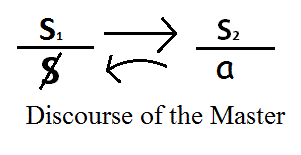
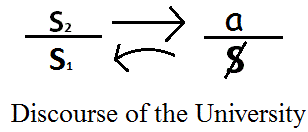
Ž four discourses four subjects

Žižek, Slavoj. “Four Discourses, Four Subjects” in Cogito and the Unconscious. ed. Slavoj Žižek, Duke UP, 1998. 75-113.

The illusion of the gesture of the Master is the complete coincidence between the level of enunciation (the subjective position from which I am speaking) and the level of the enunciated content, that is, what characterizes the Master is a speech-act that wholly absorbs me, in which “I am what I say,” in short, a fully realized, self-contained performative.

Such an ideal coincidence, of course, precludes the dimension of fantasy, since fantasy emerges precisely  in order to fill in the gap between the enunciated content and its underlying position of enunciation.

Fantasy is an answer to the question, “You are telling me this, but why? What do you really want by telling me this?”

The fact that the dimension of fantasy nonetheless persists thus simply signals the ultimate unavoidable failure of the Master’s discourse.

There is thus no reason to be dismissive of the discourse of the Master, to identify it too hastily with “authoritarian repression”: the Master’s gesture is the founding gesture of every social link.  Let us imagine a confused situation of social disintegration, in which the cohesive power of ideology loses its efficiency: in such a situation, the Master is the  one who invents a new signifier, the famous “quilting point,” which again stabilizes the situation and makes it readable; the university discourse that then elaborates the network of Knowledge that sustains this readability by definition presupposes and relies on the initial gesture of the Master.  The Master adds no new positive content — he merely adds a signifier, which all of a sudden turns disorder into order, into “new harmony,” … Therein resides the magic of a Master: although there is nothing new at the level of positive content, “nothing is quite the same” after he pronounces his Word. …

The University discourse is enunciated from the position of “neutral” Knowledge; it addresses the remainder of the real  (say, in the case of pedagogical knowledge, the “raw, uncultivated child”), turning it into the subject .   .  The “truth” of the university discourse, hidden beneath the bar, of course, is power (i.e., the Master-Signifier):
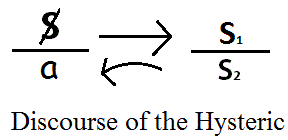
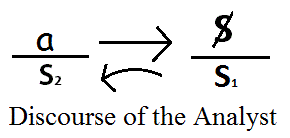
the constitutive lie of the university discourse is that it disavows its performative dimension, presenting what effectively amounts to a political decision based on power as a simple insight into the factual state of things.

What one should avoid here is the Foucaultian misreading: the produced subject is not simply the subjectivity that arises as the result of the disciplinary application of knowledge-power, but its remainder, that which eludes the grasp of knowledge-power. “Production” (the fourth term in the matrix of discourses) does not stand simply for the result of the discursive operation, but rather for its “indivisible remainder,” for the excess that resists being included in the discursive network (i.e., for what the discourses itself produces as the foreign body in its very heart). 78

Suffice it to recall the market expert who advocates strong budgetary measures (cutting welfare expenses, etc.) as a necessity imposed by his neutral expertise devoid of any ideological biases: what he conceals is the series of power-relations (from the active role of state apparatuses to ideological beliefs) that sustain the “neutral” functioning of the market mechanism. 79

In the hysterical link, the . . over a stands for the subject who is divided, traumatized, by what an object she is for the Other, what role she plays in Other’s desire: “Why am I what you’re saying that I am?” … What she expects from the Other-Master is knowledge about what she is as object (the lower level of the formula).

In contrast to hysteria, the pervert knows perfectly what he is for the Other: a knowledge supports his position as the object of Other’s (divided subject’s) jouissance. For that reason, the matheme of the discourse of perversion is the same as that of the analyst’s discourse.

Lacan defines perversion as the inverted fantasy (i.e., his matheme of perversion is a-$), which is precisely the upper level of the analyst’s discourse. The difference between the social link of perversion and that of analysis is grounded in the radical ambiguity of objet petit a in Lacan, which stands simultaneously for the imaginary fantasmatic lure/screen AND for that which this lure is obfuscating, for the void behind the lure.

*So when we pass from perversion to the analytic social link, the agent (analyst) reduces himself to the void, which provokes the subject into confronting the truth of his desire. Knowledge in the position of “truth” below the bar under the “agent,” of course, refers to the supposed knowledge of the analyst, and, simultaneously, signals that the knowledge gained here will not be the neutral objective knowledge of scientific adequacy, but the knowledge that concerns the subject (analysand) in the truth of his subjective position.

In this precise sense, the analyst’s discourse produces the master signifier, the swerve of the patient’s knowledge, the surplus element that situates the patient’s knowledge at the level of truth: after the master signifier is produced, even if nothing changes at the level of knowledge, the same knowledge as before starts to function in a different mode. The master signifier is the unconscious sinthome, the cipher of enjoyment, to which the subject was unknowingly subjected.

*Text here is modified according to https://www.terada.ca/discourse/?p=7106

So, if a political Leader says “I am your Master, let my will be done!” this direct assertion of authority is hystericized when the subject starts to doubt his qualification to act as a Leader (“Am I really their Master?” What is in me that legitimizes me to act like that?”); it can be masked in the guise of the university discourse (“In asking you to do this, I merely follow the insight into objective historical necessity, so I am not your Leader, but merely your servant who enables you to act for your own good. …”); or, the subject can act as a blank, suspending his symbolic efficiency and thus compelling his Other to become aware of how he was experiencing another subject as a Leader only because he was treating him as one.

It should be clear, from this brief description, how the position of the “agent” in each of the four discourses involves a specific mode of subjectivity:

– the Master is the subject who is fuly engaged in his (speech) act, who, in a way, “is his word,” whose word displays an immediate performative efficiency;

– the agent of the university discourse is, on the contrary, fundamentally disengaged: he posits himself as the self-erasing observer (and executor) of “objective laws” accessible to neutral knowledge (in clinical terms, his position is closest to that of the pervert).

– the hysterical subject is the subject whose very existence involves radical doubt and questioning, his entire being is sustained by the uncertainty as to what he is for the Other; insofar as the subject exists only as an answer to the enigma of the Other’s desire, the hysterical subject is the subject par excellence.

Again, in clear contrast to it, the analyst stands for the paradox of the desubjectivized subject, of the subject who fully assumed what Lacan calls “subjective destitution” that is, who breaks out of the vicious cycle of intersubjective dialectics of desire and turns into an acephalous being of pure drive.

objet a and the drive id-evil

Žižek, Slavoj.  Jacques Lacan’s Four Discourses also in an article in Russell Grigg and Justin Clemens Jacques Lacan and the Other Side of Psychoanalysis. 2006

Portions of this stuff are reprinted in The Parallax View starting on page 303.

Can the upper level of Lacan’s formula of the university discourse — S2 directed toward a — not also be read as standing for the university knowledge endeavoring to integrate, domesticate, and appropriate the excess that resists and rejects it?

One of the telltale signs of university discourse is that the opponent is accused of being “dogmatic” and “sectarian.” University discourse cannot tolerate an engaged subjective stance. Should not our first gesture be, as Lacanians, to heroically assume this designation of being “sectarian” and engage in a “sectarian” polemic?

University discourse as the hegemonic discourse of modernity has two forms of existence in which its inner tension (“contradiction”) is externalized: capitalism, its logic of the integrated excess, of the system reproducing itself through constant self-revolutionizing, and the bureaucratic “totalitarianism” conceptualized in different guises as the rule of technology, of instrumental reason, of biopolitics, as the “administered world.”

We should not succumb to the temptation of reducing capitalism to a mere form of appearance of the more fundamental ontological attitude of technological domination; we should rather insist, in the Marxian mode, that the capitalist logic of integrating the surplus into the functioning of the system is the fundamental fact.

Stalinist “totalitarianism” was the capitalist logic of self-propelling productivity liberated from its capitalist form, which is why it failed: Stalinism was the symptom of capitalism.

Stalinism involved the matrix of general intellect, of the planned transparency of social life, of total productive mobilization- and its violent purges and paranoia were a kind of a “return of the repressed,” the “irrationality” inherent to the project of a totally organized “administered society.” This means the two levels, precisely insofar as they are two sides of the same coin, are ultimately incompatible: there is no metalanguage enabling us to translate the logic of domination back into the capitalist reproduction-through-excess, or vice versa.

The key question here concerns the relationship between the two excesses:

1) the economic excess/surplus integrated into the capitalist machine as the force that drives it into permanent self-revolutionizing and

2) the political excess of power — exercise inherent to modern power (the constitutive excess of representation over the represented: the legitimate state power responsible to its subjects is supplemented by the obscene message of unconditional exercise of Power —laws do not really bind me, I can do to you whatever I want, I can treat you as guilty if I decide to, I can destroy you if I say so).

The master’s discourse stands not for the premodern master, but for the absolute monarchy, this first figure of modernity that effectively undermined the articulate network of feudal relations and interdependences, transforming fidelity to flattery: it is the “Sun-King” Louis XIV with his L’état, c’est moi who is the master par excellence. Hysterical discourse and university discourse then deploy two outcomes of the vacillation of the direct reign of the master:

the expert-rule of bureaucracy that culminates in the biopolitics of reducing the population to a collection of homo sacer (what Heidegger called “enframing,” Adorno “the administered world,” Foucault the society of “discipline and punish”);

the explosion of the hysterical capitalist subjectivity that reproduces itself through permanent self-revolutionizing, through the integration of the excess into the “normal” functioning of the social link (the true “permanent revolution” is already capitalism itself).

Lacan’s formula of the four discourses thus enables us to deploy the two faces of modernity

1. total administration and
2. capitalist-individualist dynamics

as two ways to undermine the master’s discourse:

doubt about the efficiency of the master-figure (what Eric Santner called the “crisis of investiture”) can be supplemented by the direct rule of the experts legitimized by their knowledge, or

the excess of doubt, of permanent questioning, can be directly integrated into social reproduction.

Finally, the analyst’s discourse stands for the emergence of revolutionary-emancipatory subjectivity that resolves the split of university and hysteria.

In it, the revolutionary agent – a – addresses the subject from the position of knowledge that occupies the place of truth (i.e., which intervenes at the “symptomal torsion” of the subject’s constellation), and the goal is to isolate, get rid of, the master signifier that structured the subject’s (ideologico-political) unconscious.

Or does it? Jacques-Alain Miller has recently proposed that today the master’s discourse is no longer the “obverse” of the analyst’s discourse. Today, on the contrary, our “civilization” itself-its hegemonic symbolic matrix, as it were-fits the formula of the analyst’s discourse. The agent of the social link is today a, surplus enjoyment, the superego injunction to enjoy that permeates our discourse; this injunction addresses $ (the divided subject) who is put to work in order to live up to this injunction. The truth of this social link is S2, scientific-expert knowledge in its different guises, and the goal is to generate S1, the self-mastery of the subject, that is, to enable the subject to cope with the stress of the call to enjoyment (through self-help manuals, etc.). Provocative as this notion is, it raises a series of questions. If it is true, in what, then, resides the difference between the discursive functioning of civilization as such and the psychoanalytic social link? Miller resorts here to a suspicious solution: in our civilization, the four terms are kept apart, isolated; each operates on its own, while only in psychoanalysis are they brought together into a coherent link: “in civilization, each of the four terms remains disjoined… it is only in psychoanalysis, in pure psychoanalysis, that these elements are arranged into a discourse.”

However, is it not that the fundamental operation of the psychoanalytic treatment is not synthesis, bringing elements into a link, but, precisely, analysis, separating what in a social link appears to belong together? This path, opposed to that of Miller, is indicated by Giorgio Agamben,Giorgio Agamben, who, in the last pages of The State of Exception, imagines two Utopian options of how to break out of the vicious cycle of law and violence, of the rule of law sustained by violence.

One is the Benjaminian vision of “pure” revolutionary violence with no relationship to the law.

The other is the relationship to the law without regard to its (violent) enforcement, such as Jewish scholars do in their endless (re)interpretation of the Law.

Agamben starts from the right insight that the task today is not synthesis but separation, distinction: nor bringing law and violence together (so that right will have might and the exercise of might will be fully legitimized), but thoroughly separating them, untying their knot.

Although Agamben confers on this formulation an anti-Hegelian twist, a more proper reading of Hegel makes it clear that such a gesture of separation is what the Hegelian “synthesis” is effectively about. In it, the opposites are not reconciled in a “higher synthesis”; it is rather that their difference is posited “as such.”

However, is this vision not again the case of our late capitalist reality going further than our dreams? Are we not already encountering in our social reality what Agamben envisages as a Utopian vision?

Isn’t the Hegelian lesson of the global reflexivization-mediatization of our lives that it generates its own brutal immediacy?

This has best been captured by Etienne Balibar’s notion of excessive, nonfunctional cruelty as a feature of contemporary life, a cruelty whose figures range from “fundamentalist” racist and/or religious slaughter to the “senseless” outbursts of violence performed by adolescents and the homeless in our megalopolises, a violence one is tempted to call Id-Evil, a violence grounded in no utilitarian or ideological reasons.

All the talk about foreigners stealing work from us or about the threat they represent to our Western values should not deceive us: under closer examination, it soon becomes clear that this talk provides a rather superficial secondary rationalization. The answer we ultimately obtain from a skinhead is that it makes him feel good to beat foreigners, that their presence disturbs him. What we encounter here is indeed Id-Evil, that is,

the Evil structured and motivated by the most elementary imbalance in the relationship between the ego and jouissance, by the tension between pleasure and the foreign body of jouissance in the very heart of it.

Id-Evil thus stages the most elementary short circuit in the relationship of the subject to the primordially missing object cause of his desire. What bothers us in the other (Jew, Japanese, African, Turk) is that he appears to entertain a privileged relationship to the object — the other either possesses the object treasure, having snatched it away from us (which is why we don’t have it), or he poses a threat to our possession of the object.

What one should propose here is the Hegelian “infinite judgment,” asserting the speculative identity of these “useless” and “excessive” outbursts of violent immediacy, which display nothing but a pure and naked (“non-sublimated”) hatred of the Otherness, with the global reflexivization of society. […] the response of the neo-Nazi skinhead who, when really pressed for the reasons for his violence, suddenly starts to talk like social workers, sociologists, and social psychologists, quoting diminished social mobility, rising insecurity, the disintegration of paternal authority, the lack of maternal love in his early childhood-the unity of practice and its inherent ideological legitimization disintegrates into raw violence and its impotent, inefficient interpretation.

This impotence of interpretation is also one of the necessary obverses of the universalized reflexivity hailed by the risk-society-theorists: it is as if our reflexive power can flourish only insofar as it draws its strength and relies on some minimal “prereflexive” substantial support that eludes its grasp, so that its universalization comes at the price of its inefficiency, that is, by the paradoxical re-emergence of the brute real of “irrational” violence, impermeable and insensitive to reflexive interpretation. So the more today’s social theory proclaims the end of nature or tradition and the rise of the “risk society,” the more the implicit reference to “nature” pervades our daily discourse: even when we do not speak of the “end of history,” do we not put forward the same message when we claim that we are entering a “postideological” pragmatic era, which is another way of claiming that we are entering a postpolitical order in which the only legitimate conflicts are ethnic/cultural conflicts?

Typically, in today’s critical and political discourse, the term worker has disappeared from the vocabulary, substituted or obliterated by immigrants or immigrant workers: Algerians in France, Turks in Germany, Mexicans in the United States.

In this way, the class problematic of workers’ exploitation is transformed into the multiculturalist problematic of “intolerance of otherness,” and the excessive investment of the multiculturalist liberals in protecting immigrants’ ethnic rights clearly draws its energy from the “repressed class dimension. Although Francis Fukuyama’s thesis on the “end of history” quickly fell into disrepute, we still silently presume that the liberal-democratic capitalist global order is somehow the finally found “natural” social regime, we still implicitly conceive conflicts in the Third World countries as a subspecies of natural catastrophes, as outbursts of quasi-natural violent passions, or as conflicts based on the fanatic identification to one’s ethnic roots (and what is “the ethnic” here if not again a code word for “nature”?). And, again, the key point is that this all-pervasive renaturalization is strictly correlative to the global reflexivization of our daily lives.

What this means, with regard to Agamben’s Utopian vision of untying the knot of the Law and violence is that, in our postpolitical societies, this knot is already untied: we encounter, on the one hand, the globalized interpretation whose globalization is paid for by its impotence, its failure to enforce itself, to generate effects in the real, and, on the other hand, explosions of the raw real of a violence that cannot be affected by its symbolic interpretation. Where, then, is the solution here, between

– the claim that, in today’s hegemonic constellation, the elements of the social link are separated and as such to be brought together by psycho-analysis (Miller),

– and the knot between Law and violence to be untied, their separation to be enacted (Agamben)?

What if these two separations are not symmetrical? What if the gap between the symbolic and the raw real epitomized by the figure of the skinhead is a false one, since this real of the outbursts of the “irrational” violence is generated by the globalization of the symbolic?

When, exactly, does the objet a function as the superego injunction to enjoy? When it occupies the place of the master signifier, that is, as Lacan formulated it in the last pages of his Seminar XI, when the short circuit between S1 and a occurs. The key move to be accomplished in order to break the vicious cycle of the superego injunction is thus to enact the separation between S1 and a.

Consequently, would it not be more productive to follow a different path, that is, to start with the different modus operandi of l’objet a, which in psychoanalysis no longer functions as the agent of the superego injunction — as it does in the discourse of perversion?

This is how Miller’s claim of the identity of the analyst’s discourse and the discourse of today’s civilization should be read: as an indication that this latter discourse (social link) is that of perversion.

That is to say, the fact that the upper level of Lacan’s formula of the analyst’s discourse is the same as his formula of perversion (a-$) opens up a possibility of reading the entire formula of the analyst’s discourse also as a formula of the perverse social link: its agent, the masochist pervert (the pervert par excellence), occupies the position of the object instrument of the other’s desire, and, in this way, through serving his (feminine) victim, he posits her as the hystericized/divided subject who “doesn’t know what she wants.”

Rather, the pervert knows it for her, that is, he pretends to speak from the position of knowledge (about the other’s desire) that enables him to serve the other; and, finally, the product of this social link is the master signifier, that is, the hysterical subject elevated into the role of the master (dominatrix) whom the pervert masochist serves.

In contrast to hysteria, the pervert knows perfectly what he is for the Other: a knowledge supports his position as the object of his Other’s (divided subject’s) jouissance.

The difference between the social link of perversion and that of analysis is grounded in the radical ambiguity of objet a in Lacan, which stands simultaneously for the imaginary fantasmatic lure/screen and for that which this lure is obfuscating, for the void behind the lure.

Consequently, when we pass from perversion to the analytic social link, the agent (analyst) reduces himself to the void, which provokes the subject into confronting the truth of his desire. Knowledge in the position of “truth” below the bar under the “agent,” of course, refers to the supposed knowledge of the analyst, and, simultaneously, signals that the knowledge gained here will not be the neutral objective knowledge of scientific adequacy, but the knowledge that concerns the subject (analysand) in the truth of his subjective position.

Recall, again, Lacan’s outrageous statements that, even if what a jealous husband claims about his wife (that she sleeps around with other men) is all true, his jealousy is still pathological. Along the same lines, one could say that, even if most of the Nazi claims about the Jews were true (they exploit Germans, they seduce German girls), their anti-Semitism would still be (and was) pathological – because it represses the true reason the Nazis needed anti-Semitism in order to sustain their ideological position.

So, in the case of anti-Semitism, knowledge about what the Jews “really are” is a fake, irrelevant, while the only knowledge at the place of truth is the knowledge about why a Nazi needs a figure of the Jew to sustain his ideological edifice.

In this precise sense, the analyst’s discourse produces the master signifier, the swerve of the patient’s knowledge, the surplus element that situates the patient’s knowledge at the level of truth: after the master signifier is produced, even if nothing changes at the level of knowledge, the same knowledge as before starts to function in a different mode. The master signifier is the unconscious sinthome, the cipher of enjoyment, to which the subject was unknowingly subjected.

The crucial point not to be missed here is how the late Lacan’s identification of the subjective position of the analyst as that of objet petit a presents an act of radical self-criticism. Earlier, in the 1950’s, Lacan conceived the analyst not as the small other (a), but, on the contrary, as a kind of stand-in for the big Other (A, the anonymous symbolic order). At this level, the function of the analyst was to frustrate the subject’s imaginary misrecognitions and to make them accept their proper symbolic place within the circuit of symbolic exchange, the place that effectively (and unbeknownst to them) determines their symbolic identity. Later, however, the analyst stands precisely for the ultimate inconsistency and failure of the big Other, that is, for the symbolic order’s inability to guarantee the subject’s symbolic identity.

One should thus always bear in mind the thoroughly ambiguous status of objet a in Lacan. Miller recently proposed a Benjaminian distinction between “constituted anxiety” and “constituent anxiety”: while the first designates the standard notion of the terrifying and fascinating abyss of anxiety that haunts us, its infernal circle that threatens to draws us in, the second stands for the “pure” confrontation with objet a as constituted in its very loss.

Miller is right to emphasize here two features: the difference that separates constituted from constituent anxiety concerns the status of the object with regard to fantasy. In a case of constituted anxiety, the object dwells within the confines of a fantasy, while we get the constituent fantasy only when the subject “traverses the fantasy” and confronts the void, the gap, filled up by the fantasmatic object.

Clear and convincing as it is. Miller’s formula misses the true paradox or, rather, ambiguity of objet a: when he defines objet a as the object that overlaps with its loss, that emerges at the very moment of its loss (so that all its fantasmatic incarnations, from breasts to voice and gaze, are metonymic figurations of the void of nothing), he remains within the horizon of desire — the true object cause of desire is the void filled in by its fantasmatic incarnations.

While, as Lacan emphasizes, objet a is also the object of the drive, the relationship is here thoroughly different. Although in both cases, the link between object and loss is crucial, in the case of objet a as the object cause of desire, we have an object which is originally lost, which coincides with its own loss, which emerges as lost, while, in the case of objet a as the object of the drive, the “object” is directly the loss itself.

In the shift from desire to drive, we pass from the lost object to loss itself as an object. That is to say, the weird movement called “drive” is not driven by the “impossible” quest for the lost object, but by a push to directly enact the “loss” – the gap, cut, distance – itself.

There is thus a double distinction to be drawn here: not only between object a in its fantasmatic and post-fantasmatic status, but also, within this post-fantasmatic domain itself, between the lost object cause of desire and the object loss of the drive. Far from concerning an abstract scholastic debate, this distinction has crucial ideologico-political consequences: it enables us to articulate the libidinal dynamics of capitalism.

Following Miller himself, a distinction has to be introduced here between lack and hole. Lack is spatial, designating a void within a space, while the hole is more radical — it designates the point at which this spatial order itself breaks down (as in the “black hole” in physics).

Therein resides the difference between desire and drive: desire is grounded in its constitutive lack, while drive circulates around a hole, a gap in the order of being. In other words, the circular movement of drive obeys the weird logic of the curved space in which the shortest distance between two points is not a straight line, but a curve: the drive “knows” that the shortest way to attain its aim is to circulate around its goal-object. At the immediate level of addressing individuals, capitalism of course interpellates them as consumers, as subjects of desires, soliciting in them ever new perverse and excessive desires (for which it offers products to satisfy them); furthermore, it obviously also manipulates the “desire to desire,” celebrating the very desire to desire ever new objects and modes of pleasure. However, even if if already manipulates desire in a way that takes into account the fact that the most elementary desire is the desire to reproduce itself as desire (and not to find satisfaction), at this level, we do not yet reach the drive.

The drive inheres to capitalism at a more fundamental, systemic level: drive propels the entire capitalist machinery; it is the impersonal compulsion to engage in the endless circular movement of expanded self-reproduction. The capitalist drive thus belongs to no definite individual – it is rather that those individuals who act as direct “agents” of capital (capitalists themselves, top managers) have to practice it. We enter the mode of the drive when (as Marx put it) the circulation of money as capital becomes “an end in itself, for the expansion of value takes place only within this constantly renewed movement. The circulation of capital has therefore no limits.” One should bear in mind here Lacan’s well-known distinction between the aim and the goal of drive: while the goal is the object around which drive circulates, its (true) aim is the endless continuation of this circulation as such.

slave jouissance

Žižek, Slavoj. “Love Thy Neighbor? No , Thanks!”  in Psychoanalysis and Racism. ed.  Anthony Lane, New York: Columbia University Press, 1998.   154-175.) a slighty different version of this essay appears in The Plague of Fantasies. London: Verso, 1997.

According to Lacan, Hegel, in his dialectics of Lord and Bondsman, misses the key point: Jouissance is on the side not of the Master but rather of his servant — that is, what keeps the servant enslaved is precisely the little piece of jouissance thrown to him by his Master.  Lacan’s reproach to the standard version of the Cunning of Reason (the Slave who works and thus renounces jouissance, this way laying foundation for his future freedom, in contrast to the Master who is idioticized by his jouissance) is that it is, on the contrary, the Slave who has access to jouissance from his ambiguous relation to the Other’s supposed jouissance (to Master qua “subject supposed to enjoy”).  See Lacan, “Subversion.”  (page 174, Note 2)

excremental remainder ethical monster

Kotsko, Adam. “Žižek and the Excremental Body of Christ” Presentation at the American Academy of Religion 2009 Conference

The basic structure of Žižek’s interpretation of Christianity is provided by Hegel, who elaborates a theology of the “death of God” (which was later taken up by American theologians such as Thomas Altizer, whom Žižek discovered after developing his own Hegelian reading of Christianity). Hegel contends that the three persons of the Trinity do not represent three coeternal realities, but rather three decisive and irreversible turning points in the life of God:

the Father empties out the entirety of his divinity into the Son, and by dying the Son then empties out that divinity into the Holy Spirit, which is understood as a new form of social bond.

Coming at this basic structure from a Lacanian perspective and specifically from his use of Lacan to found a contemporary form of ideology critique, Žižek argues that Christ represents a unique form of “master signifier.” Normally “master signifiers” are tautologous authorities whose self-assertion allows some form of symbolic order or ideological structure to crystallize — for instance, in modern society money serves as the foundation of our entire system of values, but when you ask what money is worth, you can only answer that it’s worth… money.

Money is valuable because it’s valuable. The model of this kind of “master signifier” is of course God, whose authority ultimately stems from the fact that he is God. Žižek claims, however, that the founding myth of Christianity provides us with a weird kind of self-effacing or self-denying master signifier — a God who not only dies (many gods have died throughout history, only to be replaced), but who himself becomes an atheist.

In Žižek’s reading, Christ’s cry of dereliction on the cross—“My God, my God, why have you forsaken me?” — presents us with an image of a God who doesn’t believe in himself.

Elevating Christ to the level of a “master signifier” thus means effectively giving up on “master signifiers,” producing a whole new form of social bond — one that is outside of ideology.

As I argue in Žižek and Theology, this elaboration of a “death of God” theology as a path to a non-ideological social bond is the end result of a long and difficult development in Žižek’s political thought, because—to put it bluntly — getting rid of master signifiers is difficult.

It’s easy enough to overthrow any given master signifier, but the human tendency to reestablish them seems irresistible — and before his foray into theology, Žižek seemed to be essentially advocating revolution for its own sake, as a kind of moment of pure authenticity and truth, despite the fact that every revolution will necessarily be a matter of “meet the new boss, same as the old boss.”

The reason for this is that “master signifiers” are a way of organizing our enjoyment, keeping the suffocating force of jouissance sufficiently at bay to give us breathing room, while nonetheless giving us access to occasional moments of indulgence.

A key aspect of this is Žižek’s view that every form of law founded in a “master signifier” includes its own “inherent transgression”— that is, it depends on people occasionally feeling like they not only have permission to break the rules but are actively exhorted to do so, so that they have a way to let off steam.

A familiar example of this is the Jim Crow order in the US — in addition to the official laws segregating blacks and whites, the order was characterized by extra-legal attacks such as lynch mobs.

Žižek would argue that these weren’t unfortunate outbursts but were an integral part of the Jim Crow order, allowing whites to “let off steam” by forcibly asserting their dominance while maintaining the public fiction that segregation was a harmonious system with everyone in their natural place.

Inspired by Alain Badiou’s work on St. Paul, Žižek turns to the origins of Christianity as a way of thinking through what it might mean to have a revolution that would be a durable achievement rather than a flash of inspiration between two ideological regimes. His main critique of Badiou is that Badiou one-sidedly emphasizes the resurrection over the cross — in Lutheran terms, Badiou is a theologian of glory rather than a theologian of the cross.

Žižek believes that any new order (represented by the resurrection) must be preceded by a break with the old (represented by the cross) — some act of negation, some negative gesture separating oneself from the reigning master signifier. But again, this is very difficult to achieve.

Not only does the ideological order actively rely on its own violation through the “inherent transgression,” but Žižek had also argued extensively that “cynical distance” from ideology—the sense that “no one really believes this stuff”—is actually a built-in feature of all ideologies. Just “going through the motions” without really believing it isn’t a way of escaping ideology, but rather the most powerful form of submitting to ideology.

If the seemingly most obvious ways to negate ideology are built-in features of ideology already, then where can one turn? In The Puppet and the Dwarf, which represents his most fully realized account of Christian origins, Žižek makes what is, in my view, one of his most interesting moves—he claims that Judaism represents a kind of inherently negative space, a culture that is “unplugged” from the enjoyment provided by the surrounding pagan ideology, so that the logic of the “inherent transgression” and of “cynical distance” alike don’t apply.

Contradicting both Badiou and centuries of Christian interpreters, Žižek thus argues that the point of Pauline Christianity wasn’t to escape from the Jewish law, but to find some way to induct Gentiles into this “unplugged” Jewish stance.

Historically, of course, Christianity wound up betraying its Jewish roots and became an ideological order like any other, so that perhaps Žižek’s attempt to find a durable model that would be something other than the space between two ideologies has failed — yet he believes that the Pauline communities built on engrafting Gentiles into the promises of Judaism provide at least a way of thinking through what a durable non-ideological social bond might look like.

II.

So where does the Body of Christ fit into all this? As I’ve said, he is uninterested in the idea of the Christian community or church as the “Body of Christ,” and this is not only because he has opted to refer to that social bond as the “Holy Spirit”—in addition to his general distaste for anything as “harmonious” or “organic” as a body metaphor would imply, Žižek also has no interest whatsoever in ecclesiology or in the institutional church as such, believing it to be a betrayal of Christianity’s original revolutionary core. Furthermore, Žižek has never, to my knowledge, addressed the sacraments in any serious way, and so the sacramental Body of Christ in the Eucharist is not on his radar.

What remains, though, is the literal, physical body of Jesus, which Žižek basically only discusses in the context of the crucifixion. Like a medieval mystic, Žižek is fixated on Christ’s weakness and suffering, his pathetic and pitiable appearance—the absolute disjuncture between this disgraced and repulsive dying body and the divine nature he embodies. More than that, he claims, in something like an orthodox fashion, that Christ embodies the truth of humanity, the truth that, in Luther’s words, “we are the shit that fell out of God’s anus.” Drawing on this Lutheran inheritance, Žižek defines Christianity as providing a vision of a God who “freely identified himself with his own shit” (Parallax View, 187).

Now this focus on excrement is not entirely new for Žižek, who has always had a fixation of sorts on whatever is disgusting, repulsive, or otherwise off-putting. In fact, one of the key concepts he takes from Lacan, objet petit a, which represents the ever-elusive object and cause of desire, frequently bears the name of the “excremental remainder,” referring to that little “something” that one has to give up in order to join the social order. What Žižek calls Luther’s “excremental anti-humanism,” then, does not simply lead to humanity wallowing in its own self-disgust.

Rather, it leads to humanity wallowing in its own enjoyment, or as Žižek says, to the emergence of enjoyment as a direct political factor. For Žižek all ideological orders represent a way of organizing enjoyment or jouissance, of keeping it at a distance while allowing periodic indulgence, but what Luther’s position opens up is the possibility of a kind of short-circuit, where jouissance is not just a silently presupposed basis of the political order but instead a conscious emphasis and goal.

The end result is what Žižek characterizes as the contemporary “superego injunction to enjoy” — the perverse situation where authorities are directly exhorting people to enjoy. The most obvious manifestation of this tendency was perhaps George W. Bush’s injunction that people go shopping in response to 9/11, but Žižek believes this basic attitude is absolutely pervasive.

Increasingly, Žižek claims, one feels guilty not for having sex, but for not having enough sex — and even the asceticism of dieting and exercise is geared toward the hedonistic ends of attractiveness and longer lifespan.

Increasingly, contemporary Western subjects, or at least contemporary middle and upper class Western subjects, directly identify with their excremental remainder, with objet petit a — with the end result of a kind of autistic compulsion to enjoy, an obligatory enjoyment that one begins to suspect is not finally all that enjoyable.

The answer to this situation, for cultural conservatives and particularly for conservative Catholics such as Žižek’s dialogue partners G. K. Chesterton and John Milbank, is to reimpose some version of traditional values in order to save enjoyment from itself. For Žižek, however, such a solution is both dishonest and self-undermining, or in other words, perverse — hence the subtitle of The Puppet and the Dwarf:The Perverse Core of Christianity, which refers to Actual Existing Christianity and not to its original, supposedly revolutionary form.

His solution is not to disavow enjoyment, but rather to focus on the enjoyment of the other, to form a community centered on the care for the concrete suffering and enjoying others one happens to encounter. This, in his view, is Christian love, a love he characterizes as “violent” in that it cuts beneath the ideological identity markers of the other and attends directly to the excremental remainder underneath it all.

Though this notion of an authentically Christian community is based in an adaptation of one of the later Lacan’s more opaque concepts, the “discourse of the analyst,” I believe that the clearest example of what he’s talking about can be found in his final contribution to The Monstrosity of Christ. There he discusses Agota Kristof’s novel The Notebook, which for him is “the best literary expression” of an ethical stance that goes beyond the sentimentality of moralism and instead installs “a cold, cruel distance toward what one is doing.”

The novel follows two twin brothers who are “utterly immoral… yet they stand for authentic ethical naivety at its purest.” Žižek gives two examples. In one, they meet a starving man who asks for help and get him everything he asks for, while claiming that they helped him solely because he needed help, not out of any desire to be kind. In another, they urinate on a German officer with whom they find themselves sharing a bed, at his request.

Žižek remarks, “If ever there was a Christian ethical stance, this is it: no matter how weird their neighbor’s demands, the twins naively try to meet them.”

(Interestingly, this ethical stance of giving people what they ask for in the most literal way corresponds with one of Žižek’s earliest political prescriptions for dealing with the cynical distance that is inherent to ideology—instead of resisting the demands of ideology, one should take them as literally as possible, because that’s the one response ideology isn’t prepared for.) Žižek commends the twins’ amoral ethics as follows:

This is where I stand—how I would love to be: an ethical monster without empathy, doing what is to be done in a weird coincidence of blind spontaneity and reflexive distance, helping others while avoiding their disgusting proximity. With more people like this, the world would be a pleasant place in which sentimentality would be replaced by a cold and cruel passion. Monstrosity of Christ 303

Such is Žižek’s understanding of Christian ethics, a position I am sure will not be included in any Christian ethics courses any time soon.

III.

I would like to conclude this presentation by connecting Žižek’s work to liberation theology—not through the more obvious path of the reliance of both on the Marxist tradition, but rather precisely through Žižek’s notion of the Body of Christ as a kind of “excremental remainder.” My initial point of contact here might seem superficial initially, but I believe it will prove surprisingly revealing. In his essay “Extra pauperes nulla salus,” or “No salvation outside the poor,” Jon Sobrino begins with a quotation from his fallen comrade Ignacio Ellacuría, who was among the members of Sobrino’s Jesuit community who were massacred by a Salvadoran death squad in 1989 while Sobrino happened to be out of the country:

What on another occasion I called copro-historical analysis, that is, the study of the feces of our civilization, seems to reveal that this civilization is gravely ill and that, in order to avoid a dreadful and fatal outcome, it is necessary to change it from within itself.

Sobrino agrees, claiming that the “excrement” or waste product of capitalist civilization, in the form of massive impoverishment in the Third World, demonstrates that it is profoundly sick. Reciting the massive imbalances in global priorities, for instance the inconceivable sums spent on arms at the same time as people are starving daily, Sobrino concludes that “we are dealing with a metaphysical obscenity” and that “God is furious” (39). That is of course because for Sobrino and for all liberation theologians, God has identified decisively with this excremental remainder of the poor. The parallel here with Žižek’s “God who freely identifies with his own shit” is inexact—most notably because liberation theologians do not believe God is the author of the process that produces the poor as an excremental remainder — but also compelling, insofar as Žižek has written a great deal recently on the obscene inequalities that characterize the contemporary world and has even put forth urban slum dwellers in the Third World as a contemporary parallel to the “unplugged” stance he detects in first-century Judaism.

In addition, Žižek’s account of “Christian love” as naively meeting people’s needs simply because they ask resonates profoundly with the implied premise of Sobrino’s harsh and furious text: people need to eat!

Regardless of whether they’re deserving, whether giving them food would produce bad economic incentives, etc., etc., people need to eat. The same could obviously be said for all basic needs—for example, regardless of whether it undermines someone’s ability to put big numbers in quarterly reports, people who have AIDS need medicine!

A little more literalism and naïveté would certainly help in our present situation. In addition, simply listening to what people are asking for would be a huge improvement over the patronizing tutelage of NGOs and foreign aid, which Sobrino characterizes as actively contributing to the dehumanization of the already dehumanized people they serve, insofar as it deprives them of agency.

The principle here is basically Jesus’s: sell all you have and give to the poor. The focus here isn’t on liquidating your holdings so that you can enjoy the moral righteousness of poverty, but of putting your goods at the disposal of the poor—or, as Jesus says in another setting, of using your dishonest wealth to make friends.

The really difficult question between Žižek and liberation theology, however, is what the end state looks like. For Sobrino as for most liberation theologians, the basic stance seems to be humanist in the broad sense—a society that respects human dignity, that looks to the intrinsic worth of every individual. Yet Žižek remains resolutely anti-humanist and suspicious of the language of human rights. And while Sobrino can look forward to a correction of civilization’s digestive system such that it will stop producing the poor as excrement, Žižek revels in the disgusting and repellant aspect of the “excremental remainder.”

When the case is stated in this way, it seems difficult to favor Žižek over Sobrino, yet I wonder if Žižek is getting at an important truth here—namely that the end state is something that we, blinkered as we are by the ideology of our present sick civilization, simply cannot recognize as beautiful or desirable, that the change we need is so profound that it will change our very concept of what it means to be human.

In any case, both Žižek and Sobrino agree that what it means to be human now entails the production of a massive and appalling waste product—and that what it means to be faithful to the message of Christ is to freely identify with that waste product.