Johnston Adrian review of Parallax View

“Slavoj Žižek’s Hegelian Reformation: Giving a Hearing to The Parallax View (PV)”
Adrian Johnston
diacritics / spring 2007
37.1: 3–20

Apart from the task of denouncing falsifying popular pictures of Hegel, one of Žižek’s other driving ambitions in this book is the desire to formulate a fundamental ontology appropriate to the theory of subjectivity mapped out over the course of his entire intellectual itinerary (a theory informed by Kant and post-Kantian German idealism combined with Lacanian psychoanalytic metapsychology). And, herein, the articulation of such an ontology appropriately gets entangled, via reflections on the nature of the brain, with the latest instantiations of the perennial philosophical problem of the relationship between mind and body. Žižek grants that the central nervous system is, in at least several undeniable and important senses, the material, corporeal ground of the subject, the bodily being without which there cannot be the parlêtre (speaking being).

whereas Kantian transcendental idealism treats the subjectively mediated structures (including various dichotomous splits found therein) which it analyzes as inexplicable givens, Žižek’s Hegel-inspired ontology purports to be able to get back behind these structures so as to explain their very emergence in the first place, both historically and materially. Before delving deeper into the essential features of Žižek’s Hegelian dialectical materialism, it should be asked: Why is exhuming the corpus of an allegedly materialist Hegel important, especially today? Žižek depicts the current intellectual situation as one in which a false forced choice between either “mechanical materialism” (that is, a reductive approach in which material being is treated as nothing more than an aggregate of physical bodies bumping and grinding against each other) or “idealist obscurantism” (that is, a reaction against mechanical materialism that insists upon the existence of a sharp dehiscence between the physical and the metaphysical) is repeatedly presented in diverse forms of packaging [PV 4]. Despite cutting-edge work in the contemporary sciences appearing to vindicate after-the-fact the intuitions contained in the philosophies of nature elaborated by the early nineteenth-century German idealists, these sciences and the majority of those who claim to represent them have tended to turn a blind eye to the theoretical resources contained in the writings of, among others, Schelling and Hegel (this is unsurprising, given that twentieth-century Anglo-American Analytic philosophy arose, in part, as a reaction against nineteenth-century British Hegelianism). Throughout The Parallax View, Žižek, departing from the work of others engaged with the natural sciences (especially cognitive neuroscience) who either gesture in the direction of or strive to develop more sophisticated materialist theoretical frameworks (such as Antonio Damasio, Daniel Dennett, Joseph LeDoux, Catherine Malabou, Thomas Metzinger, and Francisco Varela), aims to show not only that today’s sciences would be better able to express their insights if equipped with the concepts and terminology of a dialectical materialism formulated in dialogue with German idealism. Žižek’s thesis goes one step further: the natural sciences cannot even properly come to recognize and realize their true results if their fashions of self-understanding continue to remain mired in the ill-framed debates staged between, on the one hand, varieties of materialism whose notions of matter are no more sophisticated than seventeenth-century conceptions of “corporeal substance” moved solely by the

sinnerbrink on Žižek on Hegel

International Journal of Žižek Studies. Volume Two, Number Two  “The Hegelian “Night of the World”: Žižek on Subjectivity, Negativity, and Universality”  Robert Sinnerbrink – Macquarie University (Australia)

Hegel’s 1805- 6 Jenaer Realphilosophie manuscripts, the enigmatic “night of the world” passage:

The human being is this night, this empty nothing, that contains everything in its simplicity—an unending wealth of many representations, images, of which none belongs to him—or which are not present. This night, the interior of nature, that exists here—pure self—in phantasmagorical representations, is night all around it, in which here shoots a bloody head — there another white ghastly apparition, suddenly here before it, and just so disappears. One catches sight of this night when one looks human beings in the eye—into a night that becomes awful (Hegel 1974: 204; quoted in Verene 1985: 7-8).

Žižek goes on to link the Hegelian ‘night of the world’ with Schelling’s conception of the subject as “pure night of the Self”, “infinite lack of Being”; the “violent gesture of contraction” that also forms the basis of Hegel’s account of madness as the cutting of all links with external reality, which Hegel then construes as the subject’s regression to the level of the “animal soul” still unreflectively immersed in its immediate natural environment (Žižek 1997: 8; 1999: 34-35).

Where Žižek differs from Hegel, however, is in arguing that this withdrawal from the world, the subject’s contraction and severing of all links with the Umwelt, [Umwelt German, ‘environment’] is rather the founding gesture of ‘humanization’, indeed the emergence of subjectivity itself (1997: 8).

The passage through madness is thus an ontological necessity; there is no subjectivity without this experience of radical negativity, this cutting of links with the Umwelt, which is then followed by the construction of a symbolic universe of meaning (1997: 9; 1996: 78).

The question, psychoanalytically, is not so much how the fall into madness is possible, but rather how the subject is able to attain “normalcy” by climbing out of madness — for Hegel, this radical withdrawal from the world—in order to reconstitute social reality through symbolic mediation.

Indeed, rather than a metaphysical tract on the ‘totalising’ Subject of absolute idealism, Hegel’s famous passage can be read as an account of the radical finitude of the Subject; the constitutive negativity that both makes possible and delimits autonomous subjectivity. To quote Hegel:

Death, if that is what we want to call this non-actuality, is of all things the most dreadful, and to hold fast to what is dead requires the greatest strength. Lacking strength, Beauty hates the Understanding for asking of her what it cannot do. But the life of Spirit is not the life that shrinks from death and keeps itself untouched by devastation, but rather the life that endures it and maintains itself in it. It wins its truth only when, in utter dismemberment, it finds itself. It is this power, not as something positive, which closes its eyes to the negative, as when we say of something that it is nothing or is false, and then, having done with it, turn away and pass on to something else; on the contrary, Spirit is this power only by looking the negative in the face, and tarrying with it. This tarrying with the negative is the magical power that converts it into being. This power is identical with what we earlier called the Subject … (Hegel 1977: 19).

What is striking in this celebrated passage is the way that experiences of finitude—of death, negativity, absence, loss—are all presented as constitutive of the power of the self-conscious Subject as Geist.

Subjectivity is thus constituted through a negative self-relation: a relation to itself that is necessarily a relation to the Other; a mediated self-relation in which the self finds itself precisely in and through its relation to the Other. At the same time, this self-relation through the Other is made possible only because of a violent rending of the immediate self-feeling and immersion of this seemingly isolated proto-subject within its natural environment. The subject is not only negative self-relation, a relation to the Other, it is also a self-relating negativity: that which wins its truth (its self-identity in otherness) only through the experience of radical negativity or the freedom to negate itself,  to say ‘no!’ to everything, even itself; or as Hegel puts it, through the experience of finding itself in and through “utter dismemberment”.

Once again, for Hegel this negativity is constitutive, ontological rather than ontic, as Heidegger would say. Self-conscious Spirit is this power of self-relating negativity, which is to say free subjectivity, only through “tarrying with the negative”. Indeed, this fundamental moment of negativity, we should note, is a decisive feature of every key experience in the phenomenological journey of consciousness and self-consciousness (the most famous example being the life-and-death struggle and experience of mastery and servitude, not to mention the alienated ‘freedom’ of self-consciousness in stoicism, scepticism, and the unhappy consciousness, or the radical affirmation of freedom in the French revolution and subsequent negative moment of Terror as the ‘violence’ of abstract universality). This power of radical negativity, this “abyss of freedom,” is precisely what for Hegel defines and determines “the Subject” (8).

In The Ticklish Subject as well as elsewhere, Žižek’s analysis of the Hegelian “night of the world”is explicitly linked with the question of abstract negativity and its relationship with concrete universal. In an argument charged with political resonances, Žižek shows how the radical negativity of subjectivity—the capacity to negate all our finite, particular determinations—enables the dialectical passage from abstract to concrete universality. In practical terms, this means there is a dimension of violence, conflict, or antagonism that cannot be eliminated in historical and socio-political experience. Far from rehearsing the cliché of Hegel’s reconciliationist stance towards the state, Žižek claims that the radical negativity of the subject—the ‘night of the world’ — means that there can be no concrete universal without the historico-political passage through madness, violence, even revolutionary terror (as in Hegel’s famous analysis of the post-revolutionary Jacobin Terror, an abstract negativity that ushered in the modern bourgeois state (Hegel 1977: 355-363)). This Hegelian argument concerning abstract negativity and concrete universality provides an essential backdrop, frequently misunderstood, to Žižek’s critique of various contemporary forms of ‘post-political’ ethical resistance to the state (most recently, Simon Critchley’s ethically grounded neo-anarchism (see Critchley 2007; Žižek 2006: 332-334; Žižek 2008: 339-350).

Žižek returns again and again to the Hegelian distinction between abstract and concrete universality. What does it mean? Against the prevailing stereotype of Hegel’s subordinating of particularity to universality, Žižek points out that universality in its concrete dimension is realised through individualisation; that is, the concrete universal is embodied in the individual. As Žižek observes, Hegel was the first thinker to argue that the “properly modern notion of individualisation” occurs through secondary identification (1999: 90). The individual is initially immersed in its immediate milieu, the particular life-form into which he or she is born (family, local community).

It is only once one’s primary identifications with one’s ‘organic’ community are broken that one becomes an “individual,” namely by asserting one’s autonomy through identification with a secondary community that is also universal and ‘artificial’; that is, mediated and sustained through the free activity of independent subjects (profession, nation, independent peer-group versus traditional apprenticeship, organic community, prescribed social role, and so on) (Žižek 1999: 90).

The abstract opposition between primary and secondary identifications (where primary identifications are rejected in favour of secondary identifications) is suspended once the primary identifications are reintegrated and experienced as the “modes of appearance” of my secondary identifications (Žižek 1999: 90).

Žižek then further complicates this account of concrete universality, ‘crossbreeding’ it with Hegel’s distinction between neutral “positive” Universality and differentiated “actual”Universality (1999: 90). The former refers to the “impassive/neutral medium of the coexistence of its particular content”; the latter to the actual existence of Universality, “which is individuality, the assertion of the subject as unique and irreducible to the particular concrete totality into which he is inserted” (Žižek 1999: 91). The Universal as neutral ‘container’ that is indifferent towards the particulars it subsumes is contrasted with the Universal as “the power of negativity that undermines the fixity of every particular constellation” (Žižek 1999: 91). The latter is the Universality of the individuated subject as power of the negative; the power to oppose and negate all particular determinate content.

Indeed the passage from abstract to concrete universal, Žižek argues, proceeds thanks to the power of abstract negativity; phenomenologically speaking, this power of the negative “comes into existence in the guise of the individual’s absolute egotist self-contraction” (Žižek 1999: 91)—via what the Phenomenology will later describe, with reference to the discursive understanding, as the subject’s power to “tarry with the negative”.

The striking conclusion Žižek draws from this analysis is that the only way to make the passage from abstract to concrete universality is via “the full assertion” of this power of radical negativity, the negation of all particular content (1999: 92). At one level this would seem to be an instance of the famous Hegelian Aufhebung; we must lose immediate reality in the self contraction of the “night of the world” in order to regain it as social reality, symbolically mediated by the subject; or we must renounce the immediate organic whole, submitting ourselves to the activity of the understanding, in order to regain it at a higher, mediated level as the “totality of Reason” (Žižek 1999: 92).

Here the standard objection to the Hegelian Aufhebung looms, much rehearsed by poststructuralist readers of Hegel (see Žižek 1991: 31-38); namely that Hegel allows the moment of radical negativity, recognises “the horror of the psychotic self-contraction,” the radical dismemberment in which Spirit finds itself, but only in order to dialectically recuperate this negativity in the name of the “reconstituted organic whole” (Žižek 1999: 92-3).

From Abstract to Concrete Universality

Žižek’s radical reading of Hegel challenges this orthodoxy: the passage through negativity, from abstract to concrete universality, is not about avoiding the moment of radical negativity in favour of the rational totality. Rather, it claims that this passage is unavoidable; the passage to the high passes through the low, the direct choice of the higher is precisely the way to miss it (Žižek 1999: 93).

Citing another favourite speculative passage from the Phenomenology, Žižek refers to the peculiar conjunction of opposites that Hegel observes in the case of the penis, a conjunction which Nature “naively expresses when it combines the organ of its highest fulfillment, the organ of generation, with the organ of urination” (Hegel 1977: 210).

It is not a matter of choosing insemination rather than urination (as though these comprise an abstract opposition, as representational consciousness would have it).

Rather, we have to pass through the ‘wrong choice’ (biological excretion, urination) in order to attain the ‘right choice’ (biological conception, insemination, the reproduction of life): the speculative meaning — the Hegelian infinite judgment that articulates the co-existence of excretion/elimination and conception/reproduction, indeed the shift from biological conception to rational comprehension —emerges only as an after-effect of the first, ‘wrong’ reading, which is contained within, indeed constitutive of, the speculative meaning (Žižek 1999: 93).

Žižek’s point here is to show that the movement from abstract to concrete universality requires this passage through radical negativity, that is to say the ‘wrong’ choice of the abstract negativity of conflict and violence is the only way to arrive historically at the ‘right’ choice of a stable, rational, democratic state.

At the level of social and political life, the attempt to bypass the negative and directly choose “the ‘concrete universality’ of a particular ethical life-world” results in the even greater violence of a “regression to premodern organic society”; a denial of the “infinite right of subjectivity” that, for Hegel, is the principle of modernity itself (Žižek 1999: 93).

The modern subject-citizen cannot accept being immersed within a particular determinate social role prescribed within an organic social Whole; rather, as in Hegel’s famous analysis of the French revolution, it is only by passing through the “horror of revolutionary Terror” that the constraints of the premodern organic ‘concrete universality’ are destroyed and the “infinite right of subjectivity in its abstract negativity” can thus be asserted (Žižek 1999: 93).

Again, Žižek questions the standard reading of Hegel’s famous analysis in the Phenomenology of abstract freedom and Terror, according to which the revolutionary project, with its “direct assertion of abstract Universal reason,” perishes in “self-destructive fury” because it fails to organise its revolutionary energy into a stable and differentiated social order (1999: 93).

Hegel’s point, rather, as Žižek argues, is to show how the revolutionary Terror, despite being an historical deadlock, is nonetheless necessary in order to effect the historical passage towards the modern rational state (1999: 93). The historical situation that opposes “a premodern organic body and the revolutionary Terror which unleashes the destructive force of abstract negativity” always involves an Hegelian forced choice:

“one has to choose Terror” (the ‘wrong’ choice) against premodern organic community, in order to create the terrain for the ‘right’ choice; namely to create the conditions “for the new post-revolutionary reconciliation between the demands of social Order and the abstract freedom of the individual” (Žižek 1999: 94).

The destruction of organic community, the subject’s ‘irrational’ insistence on some ‘abstract’ feature of the whole that disrupts its harmonious unity, is the very movement by which the subject is historically actualised — or to put it in Hegelese, the manner in which substance also becomes subject.

As Žižek argues, the unity that emerges from this passage through negativity is thus no longer a substantial organic unity; rather it is a “substantially different Unity,” a Unity grounded in negativity, one in which this movement of negativity assumes a positive existence (1999: 96)—precisely in the modern political state, the formalised ‘embodiment’ of negativity that nonetheless retains the trace of this violent power to expose the life of its citizens. Hegel thus anticipates the Foucaultian-Agambenian theme of biopolitics, the ‘negative’ power of the state to both expose and administer the biological life of its citizens. 14

Revolutionary violence disrupts social reality through the exercise of abstract negativity, temporarily returning the subject to the elemental level of proto-subjectivity, the dismembering violence of the ‘night of the world’. Here one cannot help but make the comparison between Hegel’s brutal observation concerning the guillotine—the post-revolutionary reduction of death to a mechanical cut, “a meaningless chopping off of a cabbage head” (Hegel 1977: 360; Žižek 2006: 43)—and the archaic revival of ‘sacrificial’ beheadings practised by Islamist terrorists. Such beheadings occur through knife-wielding executioner rather than the impersonal operation of the guillotine; and while performed in secret they are video recorded in order to be disseminated via Jihadist propaganda websites for a globally dispersed audience.

In the latter case, however, this abstract negativity or political violence is not in the service of “Absolute Freedom,” as was the case, from Hegel’s perspective, with the post-French revolutionary Terror.7 Rather, Islamist terrorism is more akin to a violent abstract negation of the modern ‘right of individual subjectivity’: a simultaneously ‘pre- and post-modern’, technologically primitive (knives, boxcutters) and sophisticated (internet and communicational media), attempt to negate the ‘morally decadent’ liberal democratic capitalist order that makes this right of subjectivity possible.

The point of Hegel’s analysis, it must be said, is to show that this revolutionary Terror is fundamentally self-undermining; that it cannot reconcile the drive towards (abstractly conceived) Absolute Freedom with the historically achieved norms of freedom and subjectivity that define the institutions of modernity. Žižek’s claim is that such violence is nonetheless historically unavoidable as the way in which the transition from abstract to concrete universality is effected.

Here I return to my earlier question concerning the relationship between imagination and understanding: the contrast between the ‘romantic’ reading of Hegel that gives priority to the ‘pre-synthetic’ imagination of the ‘night of the world’ (abstract negation) versus the ‘idealist’ reading that emphasises the “power of the negative” articulated through the discursive understanding (determinate negation).

Žižek combines the two forms of negativity (abstract and determinate) in a Schellingian manner, arguing that they are two aspects of the same power of negativity. This move, however, exposes him to the criticism that his account of revolutionary Terror flirts with a political romanticism that valorises the abstract negativity of revolutionary struggle over the determinate negation that results in the rational social and political institutions of the modern state.

For Hegel, the abstract negativity of revolutionary violence must be aufgehoben in the rational organisation of the self-reforming social and political institutions of modernity. We only revert to the abstract negativity of revolutionary violence when these norms and institutions have utterly broken down, lost all legitimacy and normative authority, that is, when the (violent) historical transition to a new configuration of Spirit is already well underway.

Must we say, however, with Žižek that abstract negation is the only way that concrete universality — the freedom of subjectivity— can be historically realised?

Global Capitalism: ‘End of History’ or ‘History of Violence’?

The question for us today, then, is to ask what happens when this rational totality (Western neoliberal democracy) becomes disturbed by the contradictory dynamics of global capitalism. There are at least two distinct Hegelian responses: one is to point to the role of the self-reforming institutions of modernity, those of capitalist liberal democracy, to effectively pacify, manage, or control these contradictory dynamics without entirely eliminating them. This line of thought — given popular expression in Fukuyama’s The End of History and the Last Man (1992) — tends to the conclusion that liberal democratic capitalist modernity is here to stay; we have effectively reached the ‘end of history’ in which radical revolutionary political transformations are no longer likely or even possible.

This ‘Fukuyamaian’ line then cleaves into at least two opposing positions: the moral or religious conservative position arguing for a return to traditional values to offset the deracinating effects of neoliberalism, a desperate attempt to refound the disturbed Sittlichkeit of multicultural liberal democracies; and the libertarian-postmodernist position that displaces political radicalism to the contested sphere of culture, arguing for a cultural politics of difference, utopian multiculturalism, radical affirmation of the Other, and so on, as ways of affirming ethical forms of freedom and plural modes of subjectivity made possible by capitalist liberal democracy.

The point, for Žižek, is that both moral-religious conservative and libertarian-postmodernist positions share the ‘Fukuyamaian’ thesis: that capitalist liberal democracy is here to stay, hence needs to be either resisted or reformed. “The dominant ethos today,” as Žižek remarks, “is ‘Fukuyamaian’: liberal-democratic capitalism is accepted as the finally found formula of the best possible society, all one can do is render it more just, tolerant, and so forth” (2008: 421).

On the other hand, there is the romantic, revolutionary position, which argues for a retrieval of the abstract negativity of the revolutionary tradition in order to perform a destructive negation that would disrupt the capitalist economico-political system. This is the line of thought — Hegelian but also Marxist-Leninist in inspiration— that Žižek argues for in his most recent tome, In Defense of Lost Causes (2008).

For Žižek, we must first of all question and theoretically reject the ‘Fukuyamaian’ liberal democratic consensus: capitalist liberal democracy is not necessarily the ‘universal and homogeneous’ form of the state, as Kojève put it, in which the atomised post-historical animals of the species homo sapiens will privately enjoy their narcissistic consumer pleasures (Kojève 1969: 157-162).

Rather, the contradictory dynamics of contemporary global capitalism— we need only mention global credit, fuel, oil, and Third World food crises, and the stark reality of ecological and environmental limits to growth—suggest that it is possible that Western societies may be entering a period of instability, uncertainty, even decline.

Žižek cites four key antagonisms that are relevant here:

1. the ecological crisis (global warming, ‘peak oil’);

2. the challenge to concepts of private property posed by new forms of ‘intellectual property’;

3. the socio-ethical implications of new techno-scientific developments (biogenetics); and

4. new forms of apartheid, particularly the proliferation of slums, separated communities, non-state governed zones of disorder (2008: 421-427).

In light of these intersecting antagonisms confronting global capitalism, the historical question of whether it is possible to redeem the failed revolutionary attempts of the past (Benjamin) may not yet be entirely closed.

Žižek’s radical Hegelian-Marxist wager is directed primarily against contemporary liberal democratic but also ‘postmodernist’ politics that depoliticise the economy—‘naturalising’ it as the unquestioned background of society, culture, and politics—and thereby displace political conflict to the sphere of culture and subjectivity. One could argue that the displacement of political radicalism to the cultural sphere—our contemporary‘aestheticisation of politics’—is an ideological disavowal of the real source of the antagonisms afflicting modern liberal democracies.

It represents a politically debilitating attempt to transpose the abstract negativity of revolutionary struggles to the ‘sublimated’ sphere of culture (as in the familiar ‘culture wars’ that pit social and religious conservatives against secular liberals and libertarian ‘postmodernists’ in symbolic struggles over moral and cultural questions of subjectivity, identity, and values). The problem with this pseudo-Hegelian sublimation of politics into culture, however, is that it leaves untouched what Marx correctly identified as the ‘base’ of these morally driven forms of sociocultural struggle: the economic dynamics of global capitalism.

This is why Žižek’s has recently argued—notably in In Defense of Lost Causes—for a refusal of the liberal democratic ‘moral blackmail’ that condemns in advance any form of radical politics as ‘totalitarian’ or ‘terroristic,’ and why he now advocates an active reclaiming of the historical and political revolutionary heritage of the Left.

Žižek’s radical Hegelian-Marxist proposal would entail acknowledging the power of negativity defining modern subjectivity, a recognition of the suppressed ‘night of the world’ or abstract negativity that continues to haunt the precarious ‘imaginary community’ of liberal democracy. The question, however, is whether this can be done without relapsing into the nightmarish violence of the Hegelian ‘night of the world’.

Are there more determinate forms of negation —of social and political struggle against the normative orders of capitalism— that might disturb the liberal democratic ‘moral consensus’ that has so strikingly paralysed the Left? Does reclaiming the history of revolutionary activism also imply the risk of embracing forms of violence that have marred twentieth-century political history? Or can the revolutionary spirit —the spectre of Marx, if one will— be reanimated without repeating this history of violence? Žižek’s Hegelianism and his Marxist-Leninism pull in different directions precisely on this issue.

The Hegelian answer would be that the abstract negativity of revolutionary violence must be aufgehoben through the formation of rational social and political institutions capable of reconciling the deracinating effects of capitalism with the principle of individual subjectivity. The Marxist-Leninist response, on the other hand, would argue that such liberal-capitalist institutions themselves be subjected to revolutionary violence—a ‘negation of the negation’—that would create the historical conditions for future (communist) emancipation. We should note, though, that the Hegelian response is retrospective and descriptive; a conceptual comprehension of the underlying logic of the dynamics of modernity that would reconcile us to the vicissitudes of modern freedom.

The Marxist-Leninist response, by contrast, is prospective and prescriptive; a demand to translate theory into practice, overcoming this alienating opposition by means of revolutionary action. Žižek appears to argue for a synthesis of these distinct, seemingly incompatible, responses, which raises the following difficulty: how is the Hegelian account of the negativity involved in the transition from abstract to concrete universality to be reconciled with the Marxist-Leninist demand for revolutionary action that would negate all such merely ‘ideological’ comprehension?

One response would be to suggest that Žižek is simply pointing to the unavoidability of the moment of negativity in any theorisation —and political practice— of the historical realisation of free subjectivity. He reminds us that the Left forgets this Hegelian lesson at its peril.

For in that case it either assents to the ‘Fukuyamaist’ consensus that there is ‘nothing to be done’ since we’ve already arrived at the (liberal-capitalist democratic) ‘end of history’; or else it naively asserts the need for a renewed romantic-revolutionary response that demands a violent (abstract) negation of the status quo.

The Hegelian response, by contrast, would be to argue for the possibility of a retrieval of the revolutionary tradition that has also become historically reflective and socio-politically determinate: not simply an abstract ‘violent’ negation of modern liberal-democratic institutions but rather a determinate negation of the normative consensus — the implicit background of economic neo-liberalism — that sustains them; a productive negation that would both preserve their emancipatory potentials while also negating their alienating sociocultural effects. Such a task, of course, is easier said than done.

Žižek’s bold engagement with the relationship between the negativity of the (Hegelian) subject and the antagonisms defining global capitalism thus throws down the philosophico-political gauntlet. All the more so if one believes that social and political movements today should reclaim that seemingly most ‘lost’ of causes — the Leftist revolutionary tradition committed to the concrete universality of freedom.

Žižek, S. (1991). For They Know Not What They Do: Enjoyment as a Political Factor

Žižek, S. (1992/2001). Enjoy Your Symptom! Jacques Lacan in Hollywood and out, Revised Edition, New York/London: Routledge.

Žižek, S. (1993). Tarrying With the Negative: Kant, Hegel, and the Critique of Ideology,

Žižek, S. (1994). The Metastases of Enjoyment: Six Essays on Women and Causality,

Žižek, S. (1996). The Indivisible Remainder: An Essay on Schelling and Related Matters,

Žižek, S/F. W. J. von Schelling (1997). The Abyss of Freedom/Ages of the World.

An Essay by Slavoj Žižek with the text of Schelling’s Die Weltalter (second draft, 1813), in English translation by Judith Norman, Ann Arbor, MI: The University of Michigan Press.

Žižek, S. (1999). The Ticklish Subject: The Absent Centre of Political Ontology,

Žižek, S. (2006). The Parallax View,

Žižek, S. (2008). In Defense of Lost Causes

butler Hegel Žižek ek-static

Judith Butler speaking at Columbia Law School, saying some interesting, no make that really interesting stuff on the notion of “consent.”

Commenting on Žižek in this 2000 text, Butler accuses him of presenting us with an overly formalistic brand of Hegelianism. She draws upon the way in which Žižek’s occupation with the Kant-Hegel combo is telling and productive in some respects, but that ultimately Žižek’s analyses, while brilliant, are often ahistorical, presented in an overly structuralist-formalist fashion that makes thinking a political aritculation somewhat difficult.  Here is a quote from the Verso book Contingency, Universality, Hegemony (2000).

Hegel implicitly likens the Kantian to one who seeks to know how to swim before actually swimming, and he counters this model of a self-possessed cognition with one that gives itself over to the activity itself, a form of knowing that is given over to the world it seeks to know. Although Hegel is often dubbed  philosopher of ‘mastery’, we can see here … that the ek-static disposition of the self towards its world undoes cognitive mastery.  Hegel’s own persistent references to ‘losing oneself’ and ‘giving oneself over’ only confirm the point that the knowing subject cannot be understood as one who imposes ready-made categories on a pre-given world. The categories are shaped by the world it seeks to know, just as the world is not known without the prior action of those categories.  And just as Hegel insists on revising several times his very definition of ‘universality’, so he makes plain that the categories by which the world becomes available to us are continually remade by the encounter with the world that they facilitate.  We do not remain the same, and neither do our cognitive categories, as we enter into a knowing encounter with the world. Both the knowing subject and the world are undone and redone by the act of knowledge (20).

commenting on Zizek:

One difference that is doubtless apparent is that my approach to Hegel draws upon a certain set of literary and rhetorical presumptions about how meaning is generated in his text. I therefore oppose the effort to construe Hegel in formal terms or, indeed, to render him compatible with a Kantian formalism, which is something Žižek has done on occasion. Any effort to reduce Hegel’s own text to a formal schematism will become subject to the very same critique that Hegel has offered of all such formalisms, and subject to the same founderings (25).

Žižek Avatar

Return of the natives

Published 04 March 2010 in the New Statesman

Beneath the idealism and political correctness of Avatar, in the spotlight at the Oscars on Sunday, lie brutal racist undertones.

James Cameron’s Avatar tells the story of a disabled ex-marine, sent from earth to infiltrate a race of blue-skinned aboriginal people on a distant planet and persuade them to let his employer mine their homeland for natural resources. Through a complex biological manipulation, the hero’s mind gains control of his “avatar”, in the body of a young aborigine.

These aborigines are deeply spiritual and live in harmony with nature (they can plug a cable that sticks out of their body into horses and trees to communicate with them). Predictably, the marine falls in love with a beautiful aboriginal princess and joins the aborigines in battle, helping them to throw out the human invaders and saving their planet. At the film’s end, the hero transposes his soul from his damaged human body to his aboriginal avatar, thus becoming one of them.

Given the 3-D hyperreality of the film, with its combination of real actors and animated digital corrections, Avatar should be compared to films such as Who Framed Roger Rabbit (1988) or The Matrix (1999). In each, the hero is caught between our ordinary reality and an imagined universe – of cartoons in Roger Rabbit, of digital reality in The Matrix, or of the digitally enhanced everyday reality of the planet in Avatar. What one should thus bear in mind is that, although Avatar’s narrative is supposed to take place in one and the same “real” reality, we are dealing – at the level of the underlying symbolic economy – with two realities: the ordinary world of imperialist colonialism on the one hand, and a fantasy world, populated by aborigines who live in an incestuous link with nature, on the other. (The latter should not be confused with the miserable reality of actual exploited peoples.) The end of the film should be read as the hero fully migrating from reality into the fantasy world – as if, in The Matrix, Neo were to decide to immerse himself again fully in the matrix.

This does not mean, however, that we should reject Avatar on behalf of a more “authentic” acceptance of the real world. If we subtract fantasy from reality, then reality itself loses its consistency and disintegrates. To choose between “either accepting reality or choosing fantasy” is wrong: if we really want to change or escape our social reality, the first thing to do is change our fantasies that make us fit this reality. Because the hero of Avatar doesn’t do this, his subjective position is what Jacques Lacan, with regard to de Sade, called le dupe de son fantasme.

This is why it is interesting to imagine a sequel to Avatar in which, after a couple of years (or, rather, months) of bliss, the hero starts to feel a weird discontent and to miss the corrupted human universe. The source of this discontent is not only that every reality, no matter how perfect it is, sooner or later disappoints us. Such a perfect fantasy disappoints us precisely because of its perfection: what this perfection signals is that it holds no place for us, the subjects who imagine it.

The utopia imagined in Avatar follows the Hollywood formula for producing a couple – the long tradition of a resigned white hero who has to go among the savages to find a proper sexual partner (just recall Dances With Wolves). In a typical Hollywood product, everything, from the fate of the Knights of the Round Table to asteroids hitting the earth, is transposed into an Oedipal narrative. The ridiculous climax of this procedure of staging great historical events as the background to the formation of a couple is Warren Beatty’s Reds (1981), in which Hollywood found a way to rehabilitate the October Revolution, arguably the most traumatic historical event of the 20th century. In Reds, the couple of John Reed and Louise Bryant are in deep emotional crisis; their love is reignited when Louise watches John deliver an impassioned revolutionary speech.

What follows is the couple’s lovemaking, intersected with archetypal scenes from the revolution, some of which reverberate in an all too obvious way with the sex; say, when John penetrates Louise, the camera cuts to a street where a dark crowd of demonstrators envelops and stops a penetrating “phallic” tram – all this against the background of the singing of “The Internationale”. When, at the orgasmic climax, Lenin himself appears, addressing a packed hall of delegates, he is more a wise teacher overseeing the couple’s love-initiation than a cold revolutionary leader. Even the October Revolution is OK, according to Hollywood, if it serves the reconstitution of a couple.

In a similar way, is Cameron’s previous blockbuster, Titanic, really about the catastrophe of the ship hitting the iceberg? One should be attentive to the precise moment of the catastrophe: it takes place when the young lovers (Leonardo DiCaprio and Kate Winslet), immediately after consummating their relationship, return to the ship’s deck. Even more crucial is that, on deck, Winslet tells her lover that when the ship reaches New York the next morning, she will leave with him, preferring a life of poverty with her true love to a false, corrupted life among the rich.

At this moment the ship hits the iceberg, in order to prevent what would undoubtedly have been the true catastrophe, namely the couple’s life in New York. One can safely guess that soon the misery of everyday life would have destroyed their love. The catastrophe thus occurs in order to save their love, to sustain the illusion that, if it had not happened, they would have lived “happily ever after”. A further clue is provided by DiCaprio’s final moments. He is freezing in the cold water, dying, while Winslet is safely floating on a large piece of wood. Aware that she is losing him, she cries “I’ll never let you go!” – and as she says this, she pushes him away with her hands.

Why? Because he has done his job. Beneath the story of a love affair, Titanic tells another story, that of a spoiled high-society girl with an identity crisis: she is confused, doesn’t know what to do with herself, and DiCaprio, much more than just her love partner, is a kind of “vanishing mediator” whose function is to restore her sense of identity and purpose in life. His last words before he disappears into the freezing North Atlantic are not the words of a departing lover, but the message of a preacher, telling her to be honest and faithful to herself.

Cameron’s superficial Hollywood Marxism (his crude privileging of the lower classes and caricatural depiction of the cruel egotism of the rich) should not deceive us. Beneath this sympathy for the poor lies a reactionary myth, first fully deployed by Rudyard Kipling’s Captains Courageous. It concerns a young rich person in crisis who gets his (or her) vitality estored through brief intimate contact with the full-blooded life of the poor. What lurks behind the compassion for the poor is their vampiric exploitation.

But today, Hollywood increasingly seems to have abandoned this formula. The film of Dan Brown’s Angels and Demons must surely be the first case of a Hollywood adaptation of a popular novel in which there is sex between the hero and the heroine in the book, but not in its film version – in clear contrast to the old tradition of adding a sex scene to a film based on a novel in which there is none. There is nothing liberating about this absence of sex; we are rather dealing with yet more proof of the phenomenon described by Alain Badiou in his Éloge de l’amour – today, in our pragmatic-narcissistic era, the very notion of falling in love, of a passionate attachment to a sexual partner, is considered obsolete and dangerous.

Avatar’s fidelity to the old formula of creating a couple, its full trust in fantasy, and its story of a white man marrying the aboriginal princess and becoming king, make it ideologically a rather conservative, old-fashioned film. Its technical brilliance serves to cover up this basic conservatism. It is easy to discover, beneath the politically correct themes (an honest white guy siding with ecologically sound aborigines against the “military-industrial complex” of the imperialist invaders), an array of brutal racist motifs: a paraplegic outcast from earth is good enough to get the hand of abeautiful local princess, and to help the natives win the decisive battle. The film teaches us that the only choice the aborigines have is to be saved by the human beings or to be destroyed by them. In other words, they can choose either to be the victim of imperialist reality, or to play their allotted role in the white man’s fantasy.

At the same time as Avatar is making money all around the world (it generated $1bn after less than three weeks of release), something that strangely resembles its plot is taking place. The southern hills of the Indian state of Orissa, inhabited by the Dongria Kondh people, were sold to mining companies that plan to exploit their immense reserves of bauxite (the deposits are considered to be worth at least $4trn). In reaction to this project, a Maoist (Naxalite) armed rebellion exploded.

Arundhati Roy, in Outlook India magazine, writes that the Maoist guerrilla army

“is made up almost entirely of desperately poor tribal people living in conditions of such chronic hunger that it verges on famine of the kind we only associate with sub-Saharan Africa. They are people who, even after 60 years of India’s so-called independence, have not had access to education, health care or legal redress. They are people who have been mercilessly exploited for decades, consistently cheated by small businessmen and moneylenders, the women raped as a matter of right by police and forest department personnel. Their journey back to a semblance of dignity is due in large part to the Maoist cadres who have lived and worked and fought by their sides for decades. If the tribals have taken up arms, they have done so because a government which has given them nothing but violence and neglect now wants to snatch away the last thing they have – their land . . . They believe that if they do not fight for their land, they will be annihilated . . . their ragged, malnutritioned army, the bulk of whose soldiers have never seen a train or a bus or even a small town, are fighting only for survival.”

The Indian prime minister characterised this rebellion as the “single largest internal security threat”; the big media, which present it as extremist resistance to progress, are full of stories about “red terrorism”, replacing stories about “Islamist terrorism”. No wonder the Indian state is responding with a big military operation against “Maoist strongholds” in the jungles of central India. And it is true that both sides are resorting to great violence in this brutal war, that the “people’s justice” of the Maoists is harsh. However, no matter how unpalatable this violence is to our liberal taste, we have no right to condemn it. Why? Because their situation is precisely that of Hegel’s rabble: the Naxalite rebels in India are starving tribal people, to whom the minimum of a dignified life is denied.

So where is Cameron’s film here? Nowhere: in Orissa, there are no noble princesses waiting for white heroes to seduce them and help their people, just the Maoists organising the starving farmers. The film enables us to practise a typical ideological division: sympathising with the idealised aborigines while rejecting their actual struggle. The same people who enjoy the film and admire its aboriginal rebels would in all probability turn away in horror from the Naxalites, dismissing them as murderous terrorists. The true avatar is thus Avatar itself – the film substituting for reality.

Slavoj Žižek is a philosopher and critic
The Academy Awards ceremony is on 7 March

udi aloni judith butler interview

Judith Butler Interview with Udi Aloni  February 2010
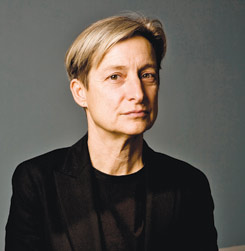

Online version 1 and another version

Philosopher, professor and author Judith Butler arrived in Israel this month, en route to the West Bank, where she was to give a seminar at Bir Zeit University, visit the theater in Jenin, and meet privately with friends and students. A leading light in her field, Butler chose not to visit any academic institutions in Israel itself. In the conversation below, conducted in New York several months ago, Butler talks about gender, the dehumanization of Gazans, and how Jewish values drove her to criticize the actions of the State of Israel.

In Israel, people know you well. Your name was even in the popular film Ha-Buah [The Bubble – the tragic tale of a gay relationship between an Israeli Jew and a Palestinian Muslim].

[laughs] Although I disagreed with the use of my name in that context. I mean, it was very funny to say, “don’t Judith Butler me,” but “to Judith Butler someone” meant to say something very negative about men and to identify with a form of feminism that was against men. And I’ve never been identified with that form of feminism. That?s not my mode. I’m not known for that. So it seems like it was confusing me with a radical feminist view that one would associate with Catharine MacKinnon or Andrea Dworkin, a completely different feminist modality. I’m not always calling into question who’s a man and who’s not, and am I a man? Maybe I’m a man. [laughs] Call me a man. I am much more open about categories of gender, and my feminism has been about women’s safety from violence, increased literacy, decreased poverty and more equality. I was never against the category of men.

A beautiful Israeli poem asks, “How does one become Avot Yeshurun?” Avot Yeshurun was a poet who caused turmoil in Israeli poetry. I want to ask, how does one become Judith Butler -especially with the issue of Gender Trouble, the book that so troubled the discourse on gender?

You know, I’m not sure that I know how to give an account of it, and I think it troubles gender differently depending on how it is received and translated. For instance, one of the first receptions [of the book] was in Germany, and there, it seemed very clear that young people wanted a politics that emphasized agency, or something affirmative that they could create or produce. The idea of performativity – which involved bringing categories into being or bringing new social realities about – was very exciting, especially for younger people who were tired with old models of oppression – indeed, the very model men oppress women, or straights oppress gays.

It seemed that if you were subjugated, there were also forms of agency that were available to you, and you were not just a victim, or you were not only oppressed, but oppression could become the condition of your agency. Certain kinds of unexpected results can emerge from the situation of oppression if you have the resources and if you have collective support. It’s not an automatic response; it’s not a necessary response. But it’s possible. I think I also probably spoke to something that was already happening in the movement. I put into theoretical language what was already being impressed upon me from elsewhere. So I didn’t bring it into being single-handedly. I received it from several cultural resources and put it into another language.

Once you became “Judith Butler,” we began to hear more about Jews and Jewish texts. People came to hear you speak about gender and suddenly they were faced with Gaza, divine violence. It almost felt like you had some closure on the previous matter. Is there a connection, a continuum, or is this a new phase?

Let’s go back further. I’m sure I’ve told you that I began to be interested in philosophy when I was 14, and I was in trouble in the synagogue. The rabbi said, “You are too talkative in class. You talk back, you are not well behaved. You have to come and have a tutorial with me.” I said “OK, great!” I was thrilled.

He said: “What do you want to study in the tutorial? This is your punishment. Now you have to study something seriously.” I think he thought of me as unserious. I explained that I wanted to read existential theology focusing on Martin Buber. (I’ve never left Martin Buber.) I wanted look at the question of whether German idealism could be linked with National Socialism. Was the tradition of Kant and Hegel responsible in some way for the origins of National Socialism? My third question was why Spinoza was excommunicated from the synagogue. I wanted to know what happened and whether the synagogue was justified.

Now I must go Jewish: what was your parents’ relation to Judaism?

My parents were practicing Jews. My mother grew up in an orthodox synagogue and after my grandfather died, she went to a conservative synagogue and a little later ended up in a reform synagogue. My father was in reform synagogues from the beginning.

My mother’s uncles and aunts were all killed in Hungary [during the Holocaust]. My grandmother lost all of her relatives, except for the two nephews who came with them in the car when my grandmother went back in 1938 to see who she could rescue. It was important for me. I went to Hebrew school. But I also went after school to special classes on Jewish ethics because I was interested in the debates. So I didn’t do just the minimum. Through high school, I suppose, I continued Jewish studies alongside my public school education.

And you showed me the photos of the bar mitzvah of your son as a good proud Jewish Mother…

So it’s been there from the start, it’s not as if I arrived at some place that I haven’t always been in. I grew very skeptical of certain kind of Jewish separatism in my youth. I mean, I saw the Jewish community was always with each other; they didn’t trust anybody outside. You’d bring someone home and the first question was “Are they Jewish, are they not Jewish?” Then I entered into a lesbian community in college, late college, graduate school, and the first thing they asked was, “Are you a feminist, are you not a feminist?” “Are you a lesbian, are you not a lesbian?” and I thought “Enough with the separatism!”

It felt like the same kind of policing of the community. You only trust those who are absolutely like yourself, those who have signed a pledge of allegiance to this particular identity. Is that person really Jewish, maybe they’re not so Jewish. I don’t know if they’re really Jewish. Maybe they’re self-hating. Is that person lesbian? I think maybe they had a relationship with a man. What does that say about how true their identity was? I thought I can’t live in a world in which identity is being policed in this way.

But if I go back to your other question… In Gender Trouble, there is a whole discussion of melancholy. What is the condition under which we fail to grieve others? I presumed, throughout my childhood, that this was a question the Jewish community was asking itself. It was also a question that I was interested in when I went to study in Germany. The famous Mitscherlich book on the incapacity to mourn, which was a criticism of German post-war culture, was very, very interesting to me.

In the 70s and 80s, in the gay and lesbian community, it became clear to me that very often, when a relationship would break up, a gay person wouldn’t be able to tell their parents, his or her parents. So here, people were going through all kinds of emotional losses that were publicly unacknowledged and that became very acute during the AIDS crisis. In the earliest years of the AIDS crisis, there were many gay men who were unable to come out about the fact that their lovers were ill, A, and then dead, B. They were unable to get access to the hospital to see their lover, unable to call their parents and say, “I have just lost the love of my life.”

This was extremely important to my thinking throughout the 80s and 90s. But it also became important to me as I started to think about war.

After 9/11, I was shocked by the fact that there was public mourning for many of the people who died in the attacks on the World Trade Center, less public mourning for those who died in the attack on the Pentagon, no public mourning for the illegal workers of the WTC, and, for a very long time, no public acknowledgment of the gay and lesbian families and relationships that had been destroyed by the loss of one of the partners in the bombings.

Then we went to war very quickly, Bush having decided that the time for grieving is over. I think he said that after ten days, that the time for grieving is over and now is time for action. At which point we started killing populations abroad with no clear rationale. And the populations we targeted for violence were ones that never appeared to us in pictures. We never got little obituaries for them. We never heard anything about what lives had been destroyed. And we still don’t.

I then moved towards a different kind of theory, asking under what conditions certain lives are grievable and certain lives not grievable or ungrievable.

It’s clear to me that in Israel-Palestine and in the violent conflicts that have taken place over the years, there is differential grieving. Certain lives become grievable within the Israeli press, for instance – highly grievable and highly valuable – and others are understood as ungrievable because they are understood as instruments of war, or they are understood as outside the nation, outside religion, or outside that sense of belonging which makes for a grievable life. The question of grievability has linked my work on queer politics, especially the AIDS crisis, with my more contemporary work on war and violence, including the work on Israel-Palestine.

It’s interesting because when the war on Gaza started, I couldn’t stay in Tel Aviv anymore. I visited the Galilee a lot. And suddenly I realized that many of the Palestinians who died in Gaza have families there, relatives who are citizens of Israel. What people didn’t know is that there was a massed grief in Israel. Grief for families who died in Gaza, a grief within Israel, of citizens of Israel. And nobody in the country spoke about it, about the grief within Israel. It was shocking.

The Israeli government and the media started to say that everyone who was killed or injured in Gaza was a member of Hamas; or that they were all being used as part of the war effort; that even the children were instruments of the war effort; that the Palestinians put them out there, in the targets, to show that Israelis would kill children, and this was actually part of a war effort. At this point, every single living being who is Palestinian becomes a war instrument. They are all, in their being, or by virtue of being Palestinian, declaring war on Israel or seeking the destruction of the Israel.

So any and all Palestinian lives that are killed or injured are understood no longer to be lives, no longer understood to be living, no longer understood even to be human in a recognizable sense, but they are artillery. The bodies themselves are artillery. And of course, the extreme instance of that is the suicide bomber, who has become unpopular in recent years. That is the instance in which a body becomes artillery, or becomes part of a violent act. If that figure gets extended to the entire Palestinian population, then there is no living human population anymore, and no one who is killed there can be grieved. Because everyone who is a living Palestinian is, in their being, a declaration of war, or a threat to the existence of Israel, or pure military artillery, materiel. They have been transformed, in the Israeli war imaginary, into pure war instruments.

So when a people who believes that another people is out to destroy them sees all the means of destruction killed, or some extraordinary number of the means of destruction destroyed, they are thrilled, because they think their safety and well-being and happiness are being purchased, are being achieved through this destruction.

And what happened with the perspective from the outside, the outside media, was extremely interesting to me. The European press, the U.S. press, the South American press, the East Asian press all raised questions about the excessive violence of the Gaza assault. It was very strange to see how the Israeli media made the claim that people on the outside do not understand; that people on the outside are anti-Semitic; that people on the outside are blaming Israel for defending themselves when they themselves, if attacked, would do the exact same thing.

Why Israel-Palestine? Is this directly connected to your Jewishness?

As a Jew, I was taught that it was ethically imperative to speak up and to speak out against arbitrary state violence. That was part of what I learned when I learned about the Second World War and the concentration camps. There were those who would and could speak out against state racism and state violence, and it was imperative that we be able to speak out. Not just for Jews, but for any number of people. There was an entire idea of social justice that emerged for me from the consideration of the Nazi genocide.

I would also say that what became really hard for me is that if one wanted to criticize Israeli state violence – precisely because that as a Jew one is under obligation to criticize excessive state violence and state racism – then one is in a bind, because one is told that one is either self-hating as a Jew or engaging anti-Semitism. And yet for me, it comes out of a certain Jewish value of social justice. So how can I fulfill my obligation as a Jew to speak out against an injustice when, in speaking out against Israeli state and military injustice, I am accused of not being a good enough Jew or of being a self-hating Jew? This is the bind of my current situation.

Let me say one other thing about Jewish values. There are two things I took from Jewish philosophy and my Jewish formation that were really important for me… well there are many. There are many.

Sitting shiva, for instance, explicit grieving. I thought it was the one of the most beautiful rituals of my youth. There were several people who died in my youth, and there were several moments when whole communities gathered in order to make sure that those who had suffered terrible losses were taken up and brought back into the community and given a way to affirm life again. The other idea was that life is transient, and because of that, because there is no after world, because we don’t have any hopes in a final redemption, we have to take especially good care of life in the here and now. Life has to be protected. It is precarious. I would even go so far as to say that precarious life is, in a way, a Jewish value for me.

I realized something, through your way of thinking. A classic mistake that people made with Gender Trouble was the notion that body and language are static. But everything is in dynamic and in constant movement; the original never exists. In a way I felt the same with the Diaspora and the emancipation. Neither are static. No one came before the other. The Diaspora, when it was static, became separatist, became the shtetl. And when the emancipation was realized, it became an ethnocratic state; it also became separatist, a re-construction of the ghetto. So maybe the tension between the two, emancipation and Diaspora, without choosing a one or the other, is the only way to keep us out of ethnocentrism. I suppose my idea is not yet fully formulated. It relates to the way I felt that my grandfather was open to the language of exile while being connected to the land at the same time. By being open to both, emancipation and Diaspora, we might avoid falling into ethnocentrism.

You have a tension between Diaspora and emancipation. But what I am thinking of is perhaps something a little different. I have to say, first of all, that I do not think that there can be emancipation with and through the establishment of state that restricts citizenship in the way that it does, on the basis of religion? So in my view, any effort to retain the idea of emancipation when you don’t have a state that extends equal rights of citizenship to Jews and non-Jews alike is, for me, bankrupt. It’s bankrupt.

That’s why I would say that there should be bi-nationalism from the beginning.

Or even multi-nationalism. Maybe even a kind of citizenship without regard to religion, race, ethnicity, etc. In any case, the more important point here is that there are those who clearly believe that Jews who are not in Israel, who are in the Galut, are actually either in need of return ? they have not yet returned, or they are not and cannot be representative of the Jewish people. So the question is: what does it mean to transform the idea of Galut into Diaspora? In other words, Diaspora is another tradition, one that involves the scattering without return. I am very critical of this idea of return, and I think “Galut” very often demeans the Diasporic traditions within Judaism.

I thought that if we make a film about bi-nationalism, the opening scene should be a meeting of “The First Jewish Congress for Bi-Nationalism.” It could be a secret meeting in which we all discuss who we would like to be our first president, and the others there send me to choose you? because we need to have a woman, and she has to be queer. But not only queer, and not only woman. She has to be the most important Jewish philosopher today.

But seriously, you know, it would be astonishing to think about what forms of political participation would still be possible on a model of federal government. Like a federated authority for Palestine-Israel that was actually governed by a strong constitution that guaranteed rights regardless of cultural background, religion, ethnicity, race, and the rest. In a way, bi-nationalism goes part of the way towards explaining what has to happen. And I completely agree with you that there has to be a cultural movement that overcomes hatred and paranoia and that actually draws on questions of cohabitation. Living in mixity and in diversity, accepting your neighbor, finding modes of living together. And no political solution, at a purely procedural level, is going to be successful if there is no bilingual education, if there are no ways of reorganizing neighborhoods, if there are no ways of reorganizing territory, bringing down the wall, accepting the neighbors you have, and accepting that there are profound obligations that emerge from being adjacent to another people in this way.

So I agree with you. But I think we have to get over the idea that a state has to express a nation. And if we have a bi-national state, it’s expressing two nations. Only when bi-nationalism deconstructs the idea of a nation can we hope to think about what a state, what a polity might look like that would actually extend equality. It is no longer the question of “two peoples,” as Martin Buber put it. There is extraordinary complexity and intermixing among both the Jewish and the Palestinian populations. There will be those who say, “Ok, a state that expresses two cultural identities.” No. State should not be in the business of expressing cultural identity.

Why do we use term “bi-nationalism?” For me it is the beginning of a process, not the end. We could say “multi-nationalism,” or “one-state solution.” Why do we prefer to use the term “bi-nationalism” rather than “one state” now?

I believe that people have reasonable fears that a one-state solution would ratify the existing marginalization and impoverishment of the Palestinian people. That Palestine would be forced to accept a kind of Bantustan existence.

Or vice versa, for the Jews.

Well, the Jews would be afraid of losing demographic majority if voting rights were extended to Palestinians. I do think that there is the fundamental question of “Who is this ‘we’?” Who are we? The question of bi-nationalism raises the question of who is the “we” who decides what kind of polity is best for this land. The “we” has to be heterogeneous; it has to be mixed. Everyone who is there and has a claim – and the claims are various. They come from traditional and legal grounds of belonging that are quite complicated. So one has to be open to that complication.

Now I want to move to the last part of the conversation. It was over three years ago, at the beginning of the Second Lebanon war, that Slavoj Žižek came to Israel to give a speech on my film Forgiveness. The Campaign for the Academic and Cultural Boycott of Israel asked him not to come to the Jerusalem Film Festival. They said that I should show my film – as Israelis shouldn’t boycott Israel, but they asked international figures to boycott the festival.

Žižek, who was the subject of one of the films in the festival, said he would not speak about that film. But he asked: why not support the opposition in Israel by speaking about Forgiveness? They answered that he could support the opposition, but not in an official venue. He did not know what to do.

Žižek chose to ask for your advice. Your position then, if I recall correctly, was that it was most important to exercise, solidarity with colleagues who chose nonviolent means of resistance and that it was a mistake to take money from Israeli cultural institutions. Your suggestion to Žižek was that he speak about the film without being a guest of the festival. He gave back the money and announced that he was not a guest. There was no decision about endorsing or not endorsing a boycott. For me, at the time, the concept of cultural boycott was kind of shocking, a strange concept. The movement has since grown a lot, and I know that you’ve done a lot of thinking about it. I wonder what do you think about this movement now, the full Boycott, Diversion and Sanction movement (BDS), three years after that confusing event?

I think that the BDS movement has taken several forms, and it is probably important to distinguish among them. I would say that around six or seven years ago, there was a real confusion about what was being boycotted, what goes under the name of “boycott.” There were some initiatives that seemed to be directed against Israeli academics, or Israeli filmmakers, cultural producers, or artists that did not distinguish between their citizenship and their participation, active or passive, in occupation politics. We must keep in mind that the BDS movement has always been focused on the occupation. It is not a referendum on Zionism, and it does not take an explicit position on the one-state or two-state solution. And then there were those who sought to distinguish boycotting individual Israelis from boycotting the Israeli institutions. But it is not always easy to know how to make the distinction between who is an individual and who is an institution. And I think a lot of people within the U.S. and Europe just backed away, thinking that it was potentially discriminatory to boycott individuals or, indeed, institutions on the basis of citizenship, even though many of those who were reluctant very much wanted to find a way to support a non-violent resistance to the occupation.

But now I feel that it has become more possible, more urgent to reconsider the politics of the BDS. It is not that the principles of the BDS have changed: they have not. But there are now ways to think about implementing the BDS that keep in mind the central focus: any event, practice, or institution that seeks to normalize the occupation, or presupposes that “ordinary” cultural life can continue without an explicit opposition to the occupation is itself complicit with the occupation.

We can think of this as passive complicity, if you like. But the main point is to challenge those institutions that seek to separate the occupation from other cultural activities. The idea is that we cannot participate in cultural institutions that act as if there is no occupation or that refuse to take a clear and strong stand against the occupation and dedicate their activities to its undoing.  So, with this in mind, we can ask, what does it mean to engage in boycott? It means that, for those of us on the outside, we can only go to an Israeli institution, or an Israeli cultural event, in order to use the occasion to call attention to the brutality and injustice of the occupation and to articulate an opposition to it.

I think that’s what Naomi Klein did, and I think it actually opened up another route for interpreting the BDS principles. It is no longer possible for me to come to Tel Aviv and talk about gender, Jewish philosophy, or Foucault, as interesting as that might be for me; it is certainly not possible to take money from an organization or university or a cultural organization that is not explicitly and actively anti-occupation, acting as if the cultural event within Israeli borders was not happening against the background of occupation? Against the background of the assault on, and continuing siege of, Gaza? It is this unspoken and violent background of “ordinary” cultural life that needs to become the explicit object of cultural and political production and criticism. Historically, I see no other choice, since affirming the status quo means affirming the occupation. One cannot “set aside” the radical impoverishment, the malnutrition, the limits on mobility, the intimidation and harassment at the borders, and the exercise of state violence in both Gaza and the West Bank and talk about other matters in public? If one were to talk about other matters, then one is actively engaged in producing a limited public sphere of discourse which has the repression and, hence, continuation of violence as its aim.

Let us remember that the politics of boycott are not just matters of “conscience” for left intellectuals within Israel or outside. The point of the boycott is to produce and enact an international consensus that calls for the state of Israel to comply with international law. The point is to insist on the rights of self-determination for Palestinians, to end the occupation and colonization of Arab lands, to dismantle the Wall that continues the illegal seizure of Palestinian land, and to honor several UN resolutions that have been consistently defied by the Israeli state, including UN resolution 194, which insists upon the rights of refugees from 1948.

So, an approach to the cultural boycott in particular would have to be one that opposes the normalization of the occupation in order to bring into public discourse the basic principles of injustice at stake. There are many ways to articulate those principles, and this is where intellectuals are doubtless under a political obligation to become innovative, to use the cultural means at our disposal to make whatever interventions we can.

The point is not simply to refuse contact and forms of cultural and monetary exchange – although sometimes these are most important – but rather, affirmatively, to lend one’s support to the strongest anti-violent movement against the occupation that not only affirms international law, but establishing exchanges with Palestinian cultural and academic workers, cultivating international consensus on the rights of the Palestinian people, but also altering that hegemonic presumption within the global media that any critique of Israel is implicitly anti-democratic or anti-Semitic.

Surely it has always been the best part of the Jewish intellectual tradition to insist upon the ethical relation to the non-Jew, the extension of equality and justice, and the refusal to keep silent in the face of egregrious wrongs.

I want to share with you what Riham Barghouti, from BDS New York, told me. She said that, for her, BDS is a movement for everyone who supports the end of the occupation, equal rights for the Palestinians of 1948, and the moral and legal demand of the Palestinians’ right of return. She suggested that each person who is interested, decide how much of the BDS spectrum he or she is ready to accept. In other words, endorsement of the boycott movement is a continuous decision, not a categorical one. Just don’t tell us what our guidelines are. You can agree with our principles, join the movement, and decide on the details on your own.

Yes, well, one can imagine a bumper sticker: “what part of ‘justice’ do you fail to understand?” It is surely important that many prominent Israelis have begun to accept part of the BDS principles, and this may well be an incremental way to make the boycott effort more understandable. But it may also be important to ask,

why is it that so many left [wing] Israelis have trouble entering into collaborative politics with Palestinians on the issue of the boycott, and why is it that the Palestinian formulations of the boycott do not form the basis for that joint effort? After all, the BDS call has been in place since 2005; it is an established and growing movement, and the basic principles have been worked out.

Any Israeli can join that movement, and they would doubtless fine that they would immediately be in greater contact with Palestinians than they otherwise would be. The BDS provides the most powerful rubric for Israeli-Palestinian cooperative actions. This is doubtless surprising and paradoxical for some, but it strikes me as historically true.

It’s interesting to me that very often Israelis I speak to say, “We cannot enter into collaboration with the Palestinians because they don’t want to collaborate with us, and we don’t blame them.” Or: “We would put them in a bad position if we were to invite them to our conferences.” Both of these positions presume the occupation as background, but they do not address it directly. Indeed, these kinds of positions are biding time when there is no time but now to make one’s opposition known. Very often, such utterances take on a position of self-paralyzing guilt which actually keeps them from taking active and productive responsibility for opposing the occupation even more remote.

Sometimes it seems to me that they make boycott politics into a question of moral conscience, which is different from a political commitment. If it is a moral issue, then “I” as an Israeli have a responsibility to speak out or against, to sink into self-beratement or become self-flagellating in public and become a moral icon. But these kinds of moral solutions are, I think, besides the point. They continue to make “Israeli” identity into the basis of the political position, which is a kind of tacit nationalism. Perhaps the point is to oppose the manifest injustice in the name of broader principles of international law and the opposition to state violence, the disenfranchisement politically and economically of the Palestinian people. If you happen to be Israeli, then unwittingly your position shows that Israelis can and do take positions in favor of justice, and that should not be surprising. But it does not make it an “Israeli” position.

But let me return to the question of whether boycott politics undermines collaborative ventures, or opens them up. My wager is that the minute you come out in favor of some boycott, divestment or sanctions strategy, Udi, you will have many collaborators among Palestinians. I think many people fear that the boycott is against collaboration, but in fact Israelis have the power to produce enormous collaborative networks if they agree that they will use their public power, their cultural power, to oppose the occupation through the most powerful non-violent means available. Things change the minute you say, “We cannot continue to act as normal.”

Of course, I myself really want to be able to talk about novels, film, and philosophy, sometimes quite apart from politics. Unfortunately, I cannot do that in Israel now. I cannot do it until the occupation has been successfully and actively challenged. The fact is that there is no possibility of going to Israel without being used either as an example of boycott or as an example of anti-boycott. So when I went, many years ago, and the rector of Tel Aviv University said, “Look how lucky we are. Judith Butler has come to Tel Aviv University, a sign that she does not accept the boycott,” I was instrumentalized against my will. And I realized I cannot function in that public space without already being defined in the boycott debate. So there is no escape from it. One can stay quiet and accept the status quo, or one can take a position that seeks to challenge the status quo.

I hope one day there will be a different political condition where I might go there and talk about Hegel, but that is not possible now. I am very much looking forward to teaching at Bir Zeit in February. It has a strong gender and women’s studies faculty, and I understand that the students are interested in discussing questions of war and cultural analysis. I also clearly stand to learn. The boycott is not just about saying “no” – it is also a way to give shape to one’s work, to make alliances, and to insist on international norms of justice. To work to the side of the problem of the occupation is to participate in its normalization. And the way that normalization works is to efface or distort that reality within public discourse. As a result, neutrality is not an option.

So we’re boycotting normalization.

That’s what we’re boycotting. We are against normalization. And you know what, there are going to be many tactics for disrupting the normalization of the occupation. Some of us will be well-equipped to intervene with images and words, and others will continue demonstrations and other forms of cultural and political statements. The question is not what your passport says (if you have a passport), but what you do. We are talking about what happens in the activity itself. Does it disrupt and contest the normalization of the occupation?

You remember that in Toronto declaration against the spotlight on Tel Aviv at the film festival, it was very clear that we do not boycott individuals, but the Israeli foreign minister tried to argue that we were boycotting individuals. Yet the question is about institutions. On that note, I want to clarify: You will not speak in Tel Aviv University… forever? Well, not forever…

When it’s a fabulous bi-national university [laughter]

Udi Aloni is an Israeli-American filmmaker and writer

***** Lacan’s four 4 discourses *****

Bracher, Mark. “On the Psychological and Social Functions of Language: Lacan’s Theory of the Four Discourses” Lacanian Theory of Discourse. New York UP: New York. 1994. Mark Bracher, Marshall W. Alcorn et al. (eds) pp. 107-128.

Evans, Dylan. An Introductory Dictionary of Lacanian Psycho- analysis. Routledge: New York, 1996.

Fink, Bruce. “Master Signifier and the Four Discourses.” Key Concepts in Lacanian Psychoanalysis. Danny Nobus (ed), Rebus Press. 1998.

Lacan’s 4 discourses stress the nature of intersubjectivity, that speech always implies another subject. Lacan identifies four possible types of social bond, four possible articulations of the symbolic network which regulates intersubjective relations. These ‘four discourses’ are the discourse of the master, the discourse of the university, the discourse of the hysteric, and the discourse of the analyst. Lacan represents each of the four discourses by an algorithm: each algorithm contains the following four algebraic symbols:

S1 (Master Signifier)

The force then —psychological and social— of the articulated systems of knowledge derives from the systems’ positioning the subject at certain points within them and thus establishing a certain “identity” for the subject.

These positionings entail a certain sense of identity (or ego), a certain jouissance, and a certain structuring of the unconscious. The most significant factor in these positionings is the imposition of the trait unaire, or singular characteristic. This singular characteristic is the earliest significance through which the child experiences itself —as a result of significations attributed to it by the Other (mother, father, and ultimately society as large).

This constitutes the subject’s primary identification, and this primary identification continues throughout the subject’s existence to exercise a decisive influence on the subject’s desire, thought, perception, and behaviour. But the trait unaire established by primary identification is supplemented and extended by various secondary identifications that serve as its avatars. It is, in fact, only through these secondary identifications that the primary identification manifests itself. And these secondary identifications, which are certain (usually collective) values or ideals, play a crucial role in discourse. They are what Lacan calls master signifiers, S1

A master signifier is any signifier that a subject has invested his or her identity in —any signifier that the subject has identified with (or against) and that thus constitutes a powerful positive or negative value. Master signifiers are thus the factors that give the articulated system of signifiers (S2) — that is, knowledge, belief, language —purchase on a subject: they are what make a message meaningful, what make it have an impact rather than being like a foreign language that one can’t understand.

Master signifiers would include words like “God”, “Satan”, “sin” “heaven”, and “hell” in religious discourse and “American”, “freedom”, “democracy” and “communism” in political discourse. [Mark Bracher, 1994. 111]

S2 (Knowledge)

a (The Plus-de-Jouir)

The Real, that which is simultaneously produced and excluded by the system of knowledge and its master signifiers

When the divided subject $, arises inthe intervention of S1 in S2, another factor isproduced as well: the object a.

(The barred subject)

The subject split between the identity to which it is interpellated (S1) and the plus-de-jouir (a), the jouissance that it sacrifices in assuming that identity.

What distinguishes the four discourses from one another is the positions of these four symbols. There are four positions in the algorithms of the four discorses, each of which is designated by a different name. Each discourse is defined by writing the four algebraic symbols in a different position. The symbols always remain in the same order, so each discourse is simple the result of rotating the symbols a quarter turn.

Speaker       Receiver

Agent —–> Other
Truth        Production

Production: the enjoyment/jouissance produced by discourse

The left-hand positions designate the factors active in the subject who is speaking or sending a message, and the right-hand positions are occupied by the factors activated or elicited in the subject who receives the message.

The top position on each side represents the overt or manifest factor

The bottom position the covert, latent, implicit, or repressed factor — the factor that acts or occurs beneath the surface.

More specifically, the top left position is the place of agency or dominance; it is occupied by the factor in a discourse that is most active and obvious. The bottom left position is the place of (hidden) truth — that is, of the factor that supports, grounds, underwrites, and gives rise to the dominant factor, or constitutes the condition of its possibility, but is repressed by it.

On the right, the side of the receiver, the top position is designated as that of the other, which is occupied by the factor in the receiving subject that is called into action by the dominant factor in the message. The activation of this factor is a prerequisite for receiving and understanding a given message or discourse. For example, if systematic knowledge is the dominant element of a discourse (occupying the top left position), receivers, in order to understand this discourse, must (for a moment, at least) be receptive to a preconstituted knowledge, which means emptying themselves of any knowledge that might interfere with the knowledge in the discourse and becoming an amorphous, nonarticulated substance, a, to be articulated by the discourse. What is produced as a result of their allowing themselve to be thus interpellated by the dominant factor of a discourse is represented by the position of production, the bottom right. (Bracher, 1994, 109).

The Discourse of the Master

S1 —> S2
$             a

Žižek, Slavoj  Iraq: The Borrowed Kettle. London: Verso, 2004.

There is no reason to be dismissive of the discourse of the Master, to identify it too hastily with ‘authoritarian repression’: the Master’s gesture is the founding gesture of every social bond. Let us imagine a confused situation of social disintegration, in which the cohesive power of ideology has lost its efficiency: in such a situation, the Master would be the one who invented a new signifier, the famous ‘quilting point’, which again stablized the situation and made it readable; the University discourse, which would then elaborate the network of Knowledge which sustained this readability, would by definition presuppose and rely on the initial gesture of the Master. The Master adds no new positive content; he merely adds a signifier which suddenly turns disorder inot order — into ‘new harmony’ … Let us take as an example anti-Semitism in Germany in the 1920s: people felt disorientated, succumbing to an undeserved military defeat, an economic crisis which ate away at their life savings … and the Nazis provided a single agent which accounted for it all: the Jew, the Jewish plot. That is the magic of a Master: although there is nothing new at the level of positive content, ‘nothing is quite the same’ after he pronounces his Word (Ž 138).

The most salient feature: dominance of the master signifier S1. Upon reading or hearing such a discourse, one is forced, in order to understand the message, to accord full explanatory power and/or moral authority to the proffered master signifiers and to refer all other signifiers (objects, concepts, or issues) back to these master signifiers. In doing this, the receiver of the message enacts the function of knowledge (S2). As a result of enacting this function, the receiver produces a plus-de-jouir that is, the suppressed (i.e., beneath the bar) excess of enjoyment, no longer to be enjoyed, for which there is no place in the system of knowledge or belief (S2) enacted by the receiver in response to the master’s S1. It is this a, this plus-de-jouir, that carries the power of revolution, of subverting and disrupting the system of knowledge (S2) and its master signifiers (S1). (Bracher 1993, 121)

[All attempts at totalization are doomed to failure. The discourse of the master ‘masks the division of the subject’ The master (S1) is the agent who puts the slave (S2) to work; the result of this work is a surplus (a) that the master attempts to appropriate. Dylan Evans 45]

The discourse of the Master restricts this a, the unsymbolized cause of desire, to the receiver (the slave, the one in the position of powerlessness), who has no voice (no legitimation of his or her own subjectivity).; The speaker, or master, is oblivious to the cause of his own desire (a)and has even repressed his own self-division ($) The essence of the position of the master is to be castrated: a certain jouissance is forbidden to him. The speaker is totally oblivious, unaware of the reason for promulgating its master signifiers.

Discourses that promote mastery, discourses that valorize and attempt to enact an autonomous, self-identical ego by instituting dominance of master signifiers (S1), which order knowledge (S2) according to their own values and keep fantasy ($♦a) in a subordinate and repressed position.

It is only by confronting this lack in its relation to the cause of desire (a) that the impetus behind S1 can be understood and, perhaps redirected, displaced. By interrogating the something of the subject that is left out by the master signifier, it becomes possible to reclaim that which has been suppressed and repressed and thus institute a new economy of both the psychological and the social structure. If one wants to be subversive, Lacan suggests, one might do worse that to approach “the hole from which the master signifier gushes”. (Bracher 121)

All teaching begins as a discourse of mastery with the imposition of basic concepts of a discipline i.e., master signifiers that serve to ground and explain the procedure of a body of knowledge that constitutes the discipline. Medical teaching for example, consists of acts of reverence to terms considered sacred, that is master signifiers. Philosophy is a clear instance of the discourse of the Master. Philosophical works are ultimately nothing other than attempts to promote a certain way of speaking, to promote certain master signifiers.

No discourse can operate without master signifiers, rather the question is what use we put the master signifiers to. My aim is to use these (Lacanian) master signifiers as means to promote change rather than as holy words with which we might baptize or consecrate certain phenomena and thereby ascend to some state of blessedness.

Lacanian master signifiers and knowledge S1 and S2 like any others, as soon as they become the dominant factor in a discourse, constellate a discourse of the Master and a discourse of the University, respectively, unless subordinated to an alternative aim, which the discourse of the Analyst provides.

From Paul Verhaeghe, Does the Woman Exist? 1997, 1999 rev. ed.

He (the master) is blind to his own truth, he cannot recognise this truth, because if he did he would fall from his position and cease to be master.  108

The Discourse of the University

For centuries, knowledge has been pursued as a defense against truth. Jacques Lacan

S2 —> a
S1       $

[The dominant position is occupied by knowledge. This illustrates the fact that behind all attempts to impart an apparently ‘neutral’ knowledge to the other can always be located an attempt at mastery (master of knowledge, and domination of the other to whom this knowledge is imparted). The discourse of the university represents the hegemony of knowledge, particularly visible in modernity in the form of hegemony of science. Evans 46]

We begin our academic careers as students in the position of a receivers of the system of knowledge S2. Subjected in this position to a dominating totalized system of knowledge/belief (S2), we are made to produce ourselves as (alienated) subjects ($) of this system.

Our position as the a simply continues the position we are born into. Before we learn to speak — and even before we are born — we occupy the position of the receiver of speech, and we do so in the form of the a as the as yet unassimilated piece of the Real that is the object of the desires of those around us, particularly our parents, for whom children often function as the object a that promises to compensate for the Other’s lack and thus fill the subject’s lack as well. As we have seen, our preverbal experience of ourselves and the world, mediated as it is by the actions and demeanor of our primary caretakers, is partially determined by the system of knowledge/belief, or language, inhabited by them, and by the position they attribute to us within that system, speaking and thinking of us, as son or daughter, delicate or hearty, future beauty queen or athlete, etc. In the second instance it means that when we begin to understand language and to speak it, we must fashion our sense of ourselves (our identity) out of the subject positions made available by the signifiers (i.e., categories) of the System S2. (Bracher 115)

This discursive structure and hence the totalizing and tyrannical effect of the S2 are not limited however to our infancy or to education. Bureaucracy is perhaps the purest form of the discourse of the University; it is nothing but knowledge — i.e., pure impersonal system: The System, and nothing else. No provision is made for individual subjects and their desires and idiosyncrasies. Individuals are to act, think and desire onlytin ways that function to enact reproduce, or extend The System. Bureaucracy thus functions to educate, in the root sense of that term: it forms particular types of subjects. (Bracher 1993, 55) (1994, 115)

The kind of knowledge involved in the university discourse amounts to mere rationalization, in the most pejorative Freudian sense of the the term. We can imagine it, not as the kind of thought that tries to come to grips with the Real, to maintain the difficulties posed by apparent logical and/or physical contradictions, but rather as a kind of encyclopaedic endeavour to exhaust a field. Working in the service of the master signifier, more or less any kind of argument will do, as long as it takes on the guise of reason and rationality (Fink 34).

The Discourse of the Hysteric (from Bruce Fink)

$ —> S1
a       S2

In the hysteric’s discourse the split subject occupies the dominant position and addresses S1 calling it into question. Whereas the university discourse takes its cue from the master signifier, glossing over it with some sort of trumped-up system, the hysteric goes at the master and demands that he or she show his or her stuff, prove his or her mettle by producing something serious by way of knowledge.

The hysteric’s discourse is the exact opposite of the university discourse, all the positions reversed. The hysteric maintains the primacy of subjective division, the contradiction between conscious and unconscious, and thus the conflictual, or self-contradictory nature of desire itself.

In the lower right-hand corner, we find knowledge S2. This position is also the one where Lacan situates jouissance, the enjoyment produced by a discourse, and he thus suggests here that an hysteric gets off on knowledge. Knowledge is perhaps eroticized to a greater extent in the hysteric’s discourse than elsewhere. In the master’s discourse, knowledge is prized only insofar as it can produce something else, only so long as it can be put to work for the master; yet knowledge itself remains inaccessible to the master. In the university discourse, knowledge is not so much an end in itself as that which justifies the academic’s very existence and activity. Hysteria thus provides a unique configuration with respect to knowledge, and I believe this is why Lacan finally identifies the discourse of science with that of hysteria (Fink 37).

The hysteric pushes the master ”incarnated in a partner, teacher, or whomever” to the point where he or she can find the master’s knowledge lacking. Either the master does not have an explanation for everything, or his or her reasoning does not hold water. In addressing the master, the hysteric demands that he or she produce knowledge and then goes on to disprove his or her theories. Historically speaking, hysterics have been a true motor force behind the medical, psychiatric, and psychoanalytic elaboration of theories concerning hysteria. Hysterics led Freud to develop psychoanalytic theory and practice, all the while proving to him in his consulting room the inadequacy of his knowledge and know-how.

Hysterics, like good scientists, do not set out to desperately explain everything with the knowledge they already have ”that is the job of the systematizer or even the encyclopedaedist” nor do they take for granted that all the solutions will be someday forthcoming. … In the hysteric’s discourse, object (a) the Real appears in the position of truth. That means that the truth of the hysteric’s discourse, its hidden motor force, is the Real. Physics too, when carried out in a truly scientific spirit, is ordained and commanded by the real, that is to say by that which does not work, by that which does not fit. It does not set out to carefully cover over paradoxes and contradictions, in an attempt to prove that the theory is nowhere lacking” that it works in every instance” but rather to take such paradoxes and contradictions as far as they can go (Fink 37).

The Discourse of the Analyst

a —> $
S2    S1

The discourse of the analyst is produced by a quarter turn of the discourse of the hysteric (in the same way as Freud developed psychoanalysis by giving an interpretive turn to the discourse of his hysterical patients.) The position of the agent, which is the position occupied by the analyst in the treatment, is occupied by objet petite a this illustrates the fact that the analyst must, in the course of treatment, become the cause of the analysand’s desire. The fact that this discourse is the inverse of the discourse of the master emphasises that, for Lacan, psychoanalysis is an essentially subversive practice which undermines all attempts at domination and mastery.

The analyst plays the part of pure desirousness (pure desiring subject), and interrogates the subject in his or her division, precisely at those points where the split between conscious and unconscious shows through: slips of the tongue, bungled and unintended acts, slurred speech, dreams, etc. In this way, the analyst sets the patient to work, to associate, and the product of that laborious association is a new master signifier. The patient in a sense ‘coughs up’ a master signifier that has not yet been brought into relation with any other signifier.

As it appears concretely in the analytic situation, a master signifier presents itself as a dead end, a stopping point, a term, word, or phrase that puts an end to association, that grinds the patient’s discourse to a halt. It could be a proper name (the patient’s or the analyst’s), a reference to the death of a loved one, the name of a disease (AIDS, cancer, psoriasis, blindness), or a variety of other things. The task of analysis is to bring such master signifiers into relation with other signifiers, that is, to dialecticize the master signifiers it produces. That involves reliance upon the master’s discourse … recourse to the fundamental structure of signification: a link must be established between each master signifier and a binary signifier such that subjectification takes place. The symptom itself may present itself a s a master signifier; in fact, as anlysis proceeds and as more and more aspects of a person’s are taken as symptoms, each symptomatic activity or pain may present itself in the analytic work as a word or phrase that simply is, that seems to signify nothing to the subject. Lacan refers to S1 in the analyst’s discourse as la betise (stupidity or ‘funny business’), a reference back to the case of Little Hans who refers to his whole horse phobia as la betise. It is a piece of nonsense produced by the analytic process itself.

S2 appears in analytic discourse in the place of truth (lower left-hand position). S2 represents knowledge here, but obviously not the kind of knowledge that occupies the dominant position in the university discourse. The knowledge in question here is unconscious knowledge, that knowledge that is caught up in the signifying chain and has yet to be subjectified. Where that knowledge was, the subject must come to be.

Now according to Lacan, while the analyst adopts the analytic discourse, the analysand is inevitably, in the course of analysis, hystericized. The analysand, regardless of his or her clinical structure — whether phobic, perverse, or obsessive compulsive — is backed into the hysteric’s discourse. Why is that? Because the analyst puts the subject as divided, as self-contradictory, on the firing line, so to speak. The analyst does not question the obsessive neurotic’s theories about Dostoevsky’s poetics, for example, attempting to show the neurotic where his or her intellectual views are inconsistent. Such an obsessive may attempt to speak during his or her analytic sessions from the position of S2, in the university (academic) discourse, but to engage the analysand at that level allows the analysand to maintain that particular stance. Instead, the analyst, ignoring, we can imagine, the whole of a half-hour long critique of Bakhtin’s veiws on Dostoevsky’s dialogic style, may focus on the slightest slip of the tongue or ambiguity in the analysand’s speech — the analysand’s use, for example, of the graphic metaphor ‘near misses’ to describe her bad timing in the publishing of her article on Bakhtin, when the analyst knows that this analysand had fled her country of origin shortly after rejecting an unexpected an unwanted marriage proposal (‘near Mrs.’).

Thus the analyst, by pointing to the fact that the analysand is not master of his or her own discourse, instates the analysand as divided between conscious speaking subject and some other (subject) speaking at the same time through the same mouthpiece, as agent of a discourse wherein the S1s produced in the course of analysis are interrogated and made to yield their links with S2 (as in the hysteric’s discourse). Clearly the motor force of the process is object (a)— the analyst operating as pure desirousness.

What does it mean concretely for the analyst to occupy the position of object (a) for an analysand, the position of cause of the analysand’s desire? Many analysands tend, at an early stage of analysis, to thrust responsibility for slips and slurs onto the analyst. As one patient said to her therapist, ‘You’re the one who always sees dark and dirty things in everything I say!’ At the outset, analysands often see no more in a slip than a simple problem regarding the control of the tongue muscles or a slight inattention. The analyst is the one who attributes some Other meaning to it.

As time goes on, however, analysands themselves begin to attribute meaning to such slips, and the analyst, rather than standing in for the unconscious, for that strange Other discourse, is viewed by the analysand as its cause: ‘I had a dream last night because I knew I was coming in to see you this morning.’ In such a statement, very often heard in analysis, the analyst is case in the role of the cause of the analysand’s dream: ‘I wouldn’t have had such a dream were it not for you.’ ‘The dream was for you.’ You were in my dream last night.’ Unconscious formations, such as dreams, fantasies, and slips, are produced for the analyst, to be recounted to the analyst, to tell the analyst something. The analyst, in that sense, is behind, is the reason for their production, is, in a word, their cause.

When the analyst is viewed as an other like the analysand, the analyst can be considered an imaginary object or other for the analysand. When the analyst is viewed as a judge or parent, the analyst can be considered a sort of symbolic object or Other for the analysand. When the analyst is viewed as the cause of the analysand’s unconscious formations, the analyst can be considered a ‘real’ object, object (a) for the analysand.

Once the analyst has manoeuvred in such a way that he or she is placed in the position of cause by the analysand (cause of the analysand’s dreams and of the wishes they fulfil — in short, cause of the analysand’s desire), certain manifestation of the analysand’s transference love or ‘positive transference,’ typically associated with the early stages of analysis, may well subside, giving way to something far less ‘positive’ in coloration. The analysand may begin to express his or her sense that the analyst is ‘under my skin,’ like an irritant. Analysands who seemed to be comfortable or at ease during their sessions at the outset (by no means the majority however) may well display or express discomfort, tension, and even signs that they are rebelling against the new configuration, the new role the analyst is taking on in their lives and fantasies. The analyst is becoming too important, is showing up in their daydreams, in their masturbation fantasies, in their relationships with the significant other and so on.

Lacan considers this to be the ARCHIMEDEAN POINT OF ANALYSIS, that is the very point at which the analyst can apply the lever that can move the symptom.

The analyst in the position of cause of desire for the analysand is, according to Lacan, THE MOTOR FORCE OF ANALYSIS; in other words, it is the position the analyst must occupy in order for tranference to lead to something other than identification with the analyst as the endpoint of an analysis (identification with the analyst being considered the goal of analysis by certain psychoanalysts).

‘Negative transference’ is by no means the essential sign indicating that the analysand has come to situate the analyst as cause of desire; it is but one possible manifestation of the latter. Nevertheless, the attempt by therapists of many ilks to avoid or immediately neutralize any emergence of negative transference … means that aggression and anger are turned into feelings which are inappropriate for the analysand to project onto the therapist … Patients thereby learn not to express them in therapy … thereby defusing the intensity of the feeling and possible therapeutic uses of the projection. Anger and aggression are thus never worked out with the therapist, but rather examined ‘rationally.’ … It is only by making psychical conflicts — such as aggression against one’s parent or hatred of a family member — present in the relationship with the analyst that the patient can work them through. To work them through means not that they are intellectually viewed and processed,’ but rather that the internal libidinal conflict which is holding a symptomatic relationship to someone in place must be allowed to repeat itself in the relationship with the analyst and play itself out. If verbalization (putting things into words) is the only technique allowed the analysand, a true separation from the analyst and from analysis never occurs. Projection must be allowed to go so far as to bring out all the essential aspects of a conflict-ridden relationship, all the relevant recollections and dynamics, and the full strength of the positive/negative affect. It should be recalled that one of the earliest lessons of Freud and Breuer’s Studies on Hysteria was that verbalizing traumatic events without reliving the accompanying affect left the symptom intact.

Transference, viewed as the transference of affect (evoked in the past by people and events) in the here and now of the analytic setting, means that the analysand must be able to project onto the analyst a whole series of emotions felt in relation to significant figures from his or her past and present. If the analyst is concerned with ‘being himself’ or being herself’ or with being the ‘good father’ or ‘good mother’ he or she is likely to try ot immediately distance him or herself from the role in which the analysand is casting him or her, by saying something like, ‘I am not your father’ or ‘You are projecting.’ The message conveyed by such a statement is, ‘Don’t confuse me with him’ or ‘It is not appropriate to project.’ But the analyst would do better to neither encourage or discourage the case of mistaken identity that arises through the transfer of feeling, and to let the projection of different personas occur as it will — unless, of course, it goes so far as to jeopardize the very continuation of the therapy.

Rather than interpreting the fact of transference, rather than pointing out to the analysand that he or she is projecting or transferring something onto the analyst, the analyst should direct attention to the content (the ideational and affective content) of the projection, attempting to get the analysand to put it into words. Not to dissipate it or prohibit it, not to make the analysand feel guilty about it, but to speak it. Here the analyst works — often more by asking questions than by interpreting — to re-establish the connections between the content (thought and feeling) and the persons, situation, and relationships that initially gave rise to it.

Just as one should interpret not the fact of transference but rather its content, one should avoid interpreting ‘resistance,’ transference being but one manifestation of resistance. Resistance, rather than being nothing more than an ego defense, is in Lacan’s view, structural, arising because the real resists symbolization; when the analysand’s experience resists being put into words, he or she grabs onto, digs into, or takes it out on the only other person present: the analyst. Transference is thus a direct product of resistance, of the resistance the real (e.g. trauma) erects against its symbolization, against being spoken. … Of course the analysand resists — that is a given, a structural necessity. Interpretation must aim at the traumatic event or experience that is resisting verbalization, not the mere fact of resistance (Fink 43-45).

Fink, Bruce. “Master Signifier and the Four Discourses.” Key Concepts in Lacanian Psychoanalysis. Danny Nobus (ed), Rebus Press. 1998.

Žižek hegel lacan

How Hegelian is Lacan?

Žižek proposes that we trace this through the 3 stages of theorization of the Symbolic in Lacan’s thought.

1) Symbolic as intersubjective dimension, focusing on speech as place of signification, and symptoms, traumas are blank spaces, analysand cannot properly gain ‘full speech’ and the goal of “analysis is to produce the recognition of desire through ‘full speech’, to integrate desire within the universe of signification.”
2) Schema L : the structuralist Symbolic through and through, the subject is at the mercy of the “Symbolic machine.”

foreclosure (Verwerfung),

repression (Verdrängung),

denial (Verneinung

displacement (Enstellung)

3) Definitely NOT a synthesis of first 2 stages.

a barred Other () incomplete, not-all, an Other articulated against a void, an Other which carries within it an extimate, non-symbolizable kernel.

subject of the signifier ():

It is only by working from the barred Other () that one can understand the subject of the signifier (): if the Other is not fractured, if it is a complete array, the only possible relationship of the subject to the structure is that of total alienation, of a subjection without remainder; but the lack in the Other means that there is a remainder, a non-integratable residuum in the Other, objet a, and the subject is able to avoid total alienation only insofar as it posits itself as the correlative of this remainder: <> a. In this sense, one is able to conceive of a subject that is distinct from the ego, the place of Imaginary misrecognition: a subject that is not lost in the ‘process without subject’ of the structural combination.

QUOTE: At first sight, it might appear that the Lacanian reference to Hegel is fundamentally limited to the first stage, with its themes of symbolization as historicization, integration within the symbolic universe, etc. Throughout this period, the Lacanian reading of the Hegelian text is ‘mediated’ by Kojeve and Hyppolite, and the predominant themes are those of struggle and the final reconciliation in the medium of intersubjective recognition, which is speech. In effect, the achievement of symbolic realization, the abolition of the symptom, the integration of every traumatic kernel into the symbolic universe, this final and ideal moment when the subject is finally liberated from Imaginary opacity, when the blanks of its history are filled in by ‘full speech’ when the tension between ‘subject’ and ‘substance’ are finally resolved by this speech in which the subject is able to assume his desire, etc. – is it not possible to recognize this state of plenitude as a psychoanalytic version of Hegelian ‘Absolute Knowledge’: a non-barred Other, without symptom, without lack, without traumatic kernel?

In the third stage, in which Lacan places the accent on the Real as the impossible/non-symbolizable kernel, ‘death drive’ becomes the name for that which, following Sade, takes the form of the ‘second death’: symbolic death, the annihilation of the signifying network, of the text in which the subject is inscribed, through which reality is historicized – the name of that which, in psychotic experience, appears as the ‘end of the world’, the twilight, the collapse of the symbolic universe. To put it another way, ‘death drive’ designates the ahistorical possibility implied, exposed by the process of symbolization/historicization: the possibility of its radical effacement.

The Freudian concept which best designates this act of annihilation is das Ungeschehenmachen, ‘in which one action is cancelled out by a second, so that it is as though neither action had taken place’,or more simply, retroactive cancellation. And it is more than coincidence that one finds the same term in Hegel, who defines das Ungeschchenmachen as the supreme power of Spirit.*

This power of ‘unmaking’ the past is conceivable only on the symbolic level: in immediate life, in its circuit, the past is only the past and as such is incontestable; but once one is situated at the level of history qua text, the network of symbolic traces, one is able to wind back what has already occurred, or erase the past. One is thus able to conceive of Ungeschehenmachen, the highest manifestation of negativity, as the Hegelian version of ‘death drive’: it is not an accidental or marginal element in the Hegelian edifice, but rather designates the crucial moment of the dialectical process, the so-called moment of the ‘negation of negation’, the inversion of the ‘antithesis’ into the ‘synthesis’: the ‘reconciliation’ proper to synthesis is not a surpassing or suspension (whether it be ‘dialectical’) of scission on some higher plane, but a retroactive reversal which means that there never was any scission to begin with – ‘synthesis’ retroactively annuls this scission. This is how the enigmatic but crucial passage from Hegel’s Encyclopaedia must be understood:

The accomplishing of the infinite purpose consists therefore in sublating the illusion that it has not yet been accomplished.**

One does not accomplish the end by attaining it, but by proving that one has already attained it, even when the way to its realization is hidden from view. While advancing, one was not yet there, but all of a sudden, one has been there all along – ‘too soon’ changes suddenly into ‘too late’ without detecting the exact moment of their transformation. The whole affair thus has the structure of the missed encounter: along the way, the truth, which we have not yet attained, pushes us forward like a phantom, promising that it awaits us at the end of the road; but all of a sudden we perceive that we were always already in the truth. The paradoxical surplus which slips away, which reveals itself as ‘impossible’ in this missed encounter of the ‘opportune moment’, is of course objet a: the pure semblance which pushes us toward the truth, right up to the moment when it suddenly appears behind us and that we have already arrived ahead of it, a chimerical being that does not have its ‘proper time’, only ever persisting in the interval between ‘too soon’ and ‘too late’.

This essay was originally published in French in Le plus sublime des hystériques – Hegel passe, Broché, Paris, 1999. It appears in Interogating the Real, London: Continuum, 2005, Rex Butler and Scott Stephens editors.

* G. W. F. Hegel, Phenomenology of Spirit, trans. A. V. Miller, Oxford, Oxford University Press, 1977, p. 402.

** G. W. F. Hegel, The Encyclopedia of Logic: Part I of the Encyclopedia of Philosophical Sciences with the Zusädtze, trans. T. F. Geraets, W. A. Suchting and H. S. Harris, Indianapolis, Hackett, 1991, p. 286.

rothenberg molly excessive subjects

I am reading a book that is interfering with my work on Butler, however it doesn’t seem too tangential. It’s by Molly Anne Rothenberg, Excessive Subjects.  It’s a re-thinking of social theory from the perspective of a retelling of the Žižekian tale only this time exposing the critical Lacanian insights in more detail, and talking way slower than Žižek.  Plus Rothenberg includes some nice chapters on Butler and Laclau, so I’m dying to read the rest of the book.

Laclau subject formation

if the subject were a mere subject position within the structure, the latter would be fully closed and there would be no contingency at all … [Radical contingency is possible only] if the structure is not fully reconciled with itself, if it is inhabited by an original lack, by a radical undecidability that needs to be constantly superseded by acts of decision. There acts are, precisely, what constitute the subject, who can only exist as a will transcending the structure. Because this will has no place of constitution external to the structure but is the result of the failure of the structure to constitute itself, it can be formed only through acts of identification. If I need to identify with something it is because I do not have a full identity in the first place. These acts of identification are thinkable only as a result of the lack within the structure and have the permanent trace of the latter. Contingency is shown in this way: as the inherent distance of the structure from itself.

Laclau, Emancipation(s) 1996: 92.

Taken from: Jason Glynos and David Howarth,
Logics of Critical Explanation in Social and Political Theory.

Routledge, 2007 pp. 128-129.

rickert affective modalities

Affective modalities for integrating language and world: fantasy jouissance desire (46)

For Lacan and Žižek, reality is formulated as “the Real,” those things that are foreclosed from the symbolic and that return as errors, gaps, and misrecognitions.  In plainest terms this means that language fails to capture the Real; the Real always exceeds what can be conveyed by means of the symbolic.

rickert acts of enjoyment

Rickert, Thomas. Acts of Enjoyment.

However as Torfing explains in New Theories of Discourse, there is a difference between conceiving the social as a totality that always falls short of closure and conceiving it as something already fundamentally split or fissured that we try and fail to conceive as a totality (Torfing 52)(45).

This is the point at which Žižek parts company with Laclau and Mouffe. While he retains notions such as chains of signifiers and a discursive field open to rearticulations, he theorizes the discursive field in terms of a fundamental fissure, not simply as something nontotalizable.

From Žižek’s perspective, the social is better understood in terms of a fundamental antagonism that prevents any closure, rather than as a Derridean field of signifiers whose incompleteness stems from the signifier’s free play in the absence of any organizing, totalizing center.  It is thus a question of whether substitution or antagonism is primary in the operations of discourse. (45)