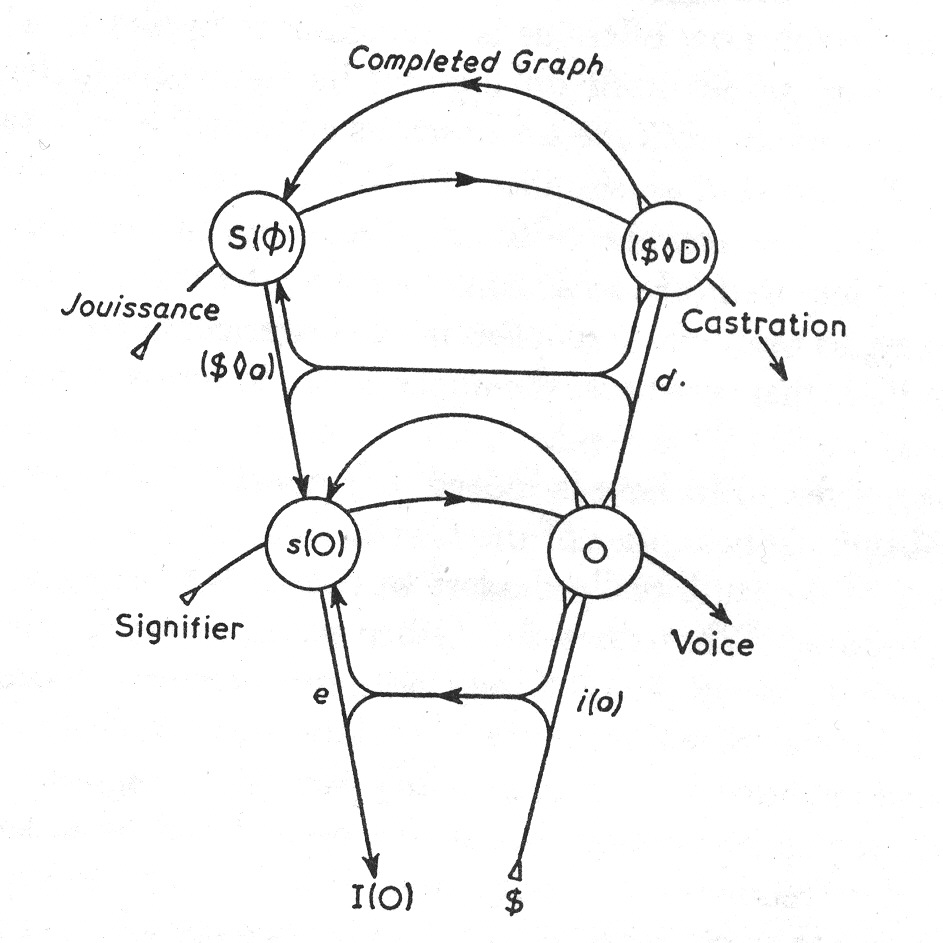
complete graph of desire

Lacan, Jacques. “The Subversion of the Subject and the Dialectics of Desire.” in Jacques Lacan Écrits A Selection. Trans. Bruce Fink, New York: W.W. Norton, 2002. 281-312.

12
Lacan_Graphs_Desire_All
Žižek: The complete graph is divided into two levels: level of meaning and level of enjoyment. THe problem of first (lower) level is how intersection of signifying chain and of a mythical intention (Δ) produces the effect of meaning, with all its internal articulation: the imaginary (i(o)) and symbolic I(O) — identification of the subject based on this retroactive production of meaning, and so on. The problem of the second (upper) level is what happens when this very field of the signifier’s order, of the big Other, is perforated, penetrated by a pre-symbolic (real) stream of enjoyment — what happens when the pre-symbolic ‘substance’, the body as materialized, incarnate enjoyment, becomes enmeshed in the signifier’s network.

Its general result is clear: by being filtered through the sieve of the singifier, the body is submitted to castration, enjoyment is evacuated from it, the body survives as dismembered, mortified. In other words, the order of the signifier (the big Other) and that of enjoyment (the Thing as its embodiment) are radically heterogeneous, inconsistent; any accordance between them is structurally impossible.

This is why we find on the left-hand side of the upper level of the graph — at the first point of intersection between enjoyment and signifier S(Ø) — the signifier of the lack in the Other, of the inconsistency of the Other, as soon as the field of the signifier is penetrated by enjoyment it becomes inconsistent, porous, perforated — the enjoyment is what cannot be symbolized, its presence in the field of the signifier can be detected only through the holes and inconsistencies of this field, so the only possible signifier of enjoyment is the signifier of the lack in the Other, the signifier of its inconsistency (Sublime Object 122).

or S(Ø) as written above. Signifier_Lack_Other“It designates the fact that there is no Other of the Other, no guarantee (or guarantor such as God) of what the Other says — whether the familial, juridical, religious, or analytic Other. NO statement has any other guarantee that its very enunciation, he suggests.” (Fink Reading Écrits 122-3
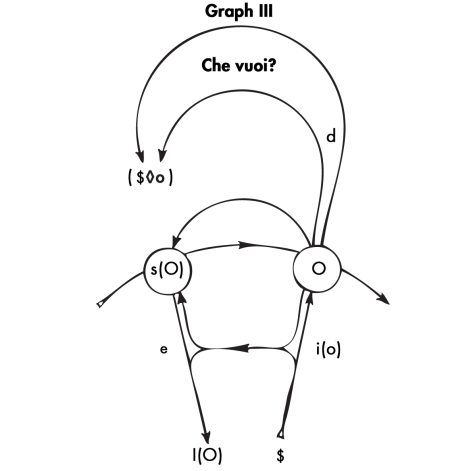
Žižek: Today, it is a common place that the Lacanian subject is divided, crossed-out, identical to a lack in a signifying chain. However, the most radical dimension fo Lacanian theory lies … in realizing that the big Other, the symbolic order itself, is also barré, crossed-out, by a fundamental impossibility, structured around an impossible/traumatic kernel, around a central lack. Without this lack in the Other, the Other would be a closed structure and the only possibility open to the subject would be his radical alienation in the Other. So it is precisely this lack in teh Other which enables the subject to achieve a kind of ‘de-alenation’ called by Lacan separation: not in the sense that the subject experiences that now he is separated for ever from the object by the barrier of language, but that the object is separated from the Other itself, that the Other itself ‘hasn’t got it’, hasn’t got the final answer — that is to say, is in itself blocked, desiring; that there is also a desire of the Other.

This lack in the Other gives the subject — so to speak — a breathing space, it enables him to avoid the total alienation in the signifier not by fill out out his lack but by allowing him to identify himself, his own lack with the lack in the Other.

(more to come)

zupančič 7 subjectivation without subject

Zupančič, Alenka. The Ethics of the Real. New York: Verso. 2000.

‘Act so that the maxim of your will can always hold at the same time as the principle giving universal law’ — what is the paradox implicit in this formulation of the categorical imperative?

The paradox is that, despite its ‘categorical’ character, it somehow leaves everything wide open .

For how am I to decide if (the maxim of) my action can hold as a principle providing a universal law, if I do not accept the presupposition that I am originally guided by some notion of the good (i.e. some notion of what is universally acceptable)?

In other words, there is no a priori criterion of universality. It is true that Kant was convinced that he had found this criterion in the principle of non-contradiction. However, there is an impressive body of commentary demonstrating the weakness of this criterion. 92

Kant invents two stories which are supposed, first, to ‘prove’ the existence of the moral law  and, secondly, to demonstrate that the subject cannot act contrary to his pathological interests for any reason other than that of the moral law. The first story concerns a man who is placed in the situation of being executed on his way out of the bedroom as a condition of spending the night with the woman he desires . The other story, which we have already discussed, concerns a man who is put in the position of either bearing false witness against someone who, as a result, will lose his life, or being put to death himself if he does not do so.

As a comment on the first alternative , Kant simply affirms: ‘We do not have to guess very long what his [the man’s in question] answer would be.’

As for the second story, Kant claims that it is at least possible to imagine that a man would rather die than tell a lie and send another man to his death.

It follows from these two comments that there is no ‘force’ apart from the moral law that could make us act against our well-being and our ‘pathological interests’. Lacan raises the objection that such a ‘force’ — namely, jouissance (as distinct from pleasure ) – does exist:

The striking significance of the first example resides in the fact that the night spen t with the lady is paradoxically presented to us as a pleasure that is weighed against a punishment to be undergone … but one only has to make a conceptual shift and move the night spent with the lady from the category of pleasure to that of jouissance, given that jouissance implies precisely the acceptance of death … for the example to be ruined. (Lacan, The Ethics of Psychoanalysis. 1992, 189). 99

For Kant, it is unimaginable that someone would want his own destruction — this would be diabolical — Lacan’s answer is not that this is nevertheless imaginable, and that even such extreme cases exist, but that there is nothing extreme in it at all: on a certain level every subject, average as he may be, wants his destruction, whether he wants it or not. 100

Kant’s point can be formulated more generally: there is no (ethical) act without a subject who is equal to this act. This, however, implies the effacement of the distinction between the level of the enunciation and the level of the statement: the subject of the statement has to coincide with the subject of the enunciation – or, more precisely, the subject of enunciation has to be entirely reducible to the subject of the statement. 102

The am lying is a signifier which forms a part, in the Other, of the treasury of vocabulary. This ‘vocabulary’ is something that I can use as a tool, or something that can use me as a ‘talking machine’. As subject, I emerge on the other level, the level of enunciation, and this level is irreducible.

Here we come, once again, to the point which explains why the subject cannot ‘hide behind’ the Law, presenting himself as its mere instrument: what is suspended by such a gesture is precisely the level of the enunciation.

That ‘there is no deposit without a depositor who is equal to his task’, or ‘there is no (ethical) act without the subject who is equal to his act’, implies that we set as the criterion or the condition of the ‘realization’ of an act the abolition of the difference between the statement and the enunciation. 102

But the crucial question is why the abolition of this difference should be the criterion or the necessary condition of an act.

Why claim that the accomplishment of an act presupposes the abolition of this split?

It is possible to situate the act in another, inverse perspective: it is precisely the act, the (‘successful’) act, which fully discloses this split, makes it present. From this perspective, the definition of a successful act would be that it is structured exactly like the paradox of the liar: this structure is the same as the one evoked by the liar who says ‘I am lying’, who utters ‘ the impossible’ and thus fully displays the split between the level of the statement and the level of the enunciation, between the shifter ‘I’ and the signifier ‘am lying’.

To claim, as we are claiming here, that there is no subject or ‘hero’ of the act means that at the level of ‘am lying’, the subject is always pathological (in the Kantian sense of the word), determined by the Other, by the signifiers which precede him. At this level, the subject is reducible or ‘dispensable’.

But this is not all there is to it. Whereas the ‘subject’ of the statement is determined in advance (he can only use the given signifiers), the (shifter) I is determined retroactively: it ‘becomes a signification, engendered at the level of the statement, of what it produces at the level of the enunciation‘.

It is at this level that we must situate the ethical subject: at the level of something which becomes what ‘it is’ only in the act (here a ‘speech act) engendered, so to speak, by another subject. 103

However, the fact that the act ‘reveals’ the difference between the level of the statement and the level of the enunciation does not imply that the subject of the act is a divided subject. On the contrary, we know very well that when we are really dealing with an act, the subject ‘is all there in his act’.

What reveals the distinction between the statement and the enunciation, between the subject who says or does something and the subjective figure which arises from it, is precisely the abolition of the division of the subject. Of course, this does not mean that the subject of an act is a ‘full ‘ subject who knows exactly what he wants but, rather, that the subject ‘is realized’, ‘objectified‘ in this act: the subject passes over to the side of the object. The ethical subject is not a subject who wants this object but, rather, this object itself.  In an act, there is no ‘divided subject’: there is the ‘it’ (the Lacanian ça) and the subjective figure that arises from it.

We may thus conclude that the act in the proper sense of the word follows the logic of what Lacan calls a ‘headless subjectivation’ or a ‘subjectivation without subject’.

zupančič 6 suicide

Zupančič, Alenka. The Ethics of the Real. New York: Verso. 2000.

After an act, I am ‘not the same as before’. In the act, the subject is annihilated and subsequently reborn (or not); the act involves a kind of temporary eclipse of the subject. The act is therefore always a ‘crime’, a ‘transgression’ — of the limits of the symbolic community to which I belong. 83

It might, therefore, be instructive to draw a distinction , with Kant’s help, between two different logics of suicide . First there is the suicide that obeys the logic of sacrifice. When duty calls, I sacrifice this or that and, if necessary, even my life . Here, we are dealing with the logic of infinite ‘purification’, in which sacrificing my life is just ‘ another step’ forward – only one among numerous ‘ objects’ that have to be sacrificed. The fact that it is a final step is mere coincidence; or, to put it in Kantian terms, it is an empirical, not a transcendental necessity.

It is this logic that governs Kant’s postulate of the immortality of the soul, and serves to preserve the consistency of the big Other.

According to this logic, it is the subject who has to separate herself infinitely from everything that belongs to the register of the pathological. At the same time, (the position of) the big Other only gets stronger; its ‘sadism’ increases with every new sacrifice the subject makes, and it therefore demands more and more of the subject. We can point to examples from popular culture, which seems to be more and more fascinated by this superegoic side of morality. Consider, for instance, Terminator 2.

The Terminator first helps people to wipe off the face of the earth everything that could lead, in the future, to the invention of machines such as the Terminator (and thus to catastrophe, and the eruption of ‘radical evil’). In the end, the Terminator him/itself remains the only model that could serve to decipher all the necessary steps for the production of such cyborgs. He/it throws him-/itself into a pool of white-hot iron in order to save the human race from catastrophe. The same type of suicide occurs in Alien 3.

Ripley first exterminates all aliens, only to find out in the end that the last one resides inside herself. In order to eliminate this last alien , she has to kill herself — she has to destroy the ‘stranger’ in herself, to cut off the last remains of the ‘pathological’ in herself.

The second type of suicide is less popular, for it serves no cause, no purpose. What is at stake is not that in the end we put on the altar of the Other our own life as the most we have to offer. The point is that we ‘kill’ ourselves through the Other, in the Other.

We annihilate that which — in the Other, in the symbolic order — gave our being identity, status, support and meaning.

This is the suicide to which Kant refers in the famous footnote from The Metaphysics of Morals in which he discusses regicide (the execution of Louis XVI) .

‘Regicide’ is not really the right term, because what preoccupies Kant is precisely the difference between the murder of a monarch (regicide) and his formal execution. It is in relation to the latter that Kant says: ‘it is as if the state commits suicide’, and describes it in terms of what he elsewhere calls ‘diabolical evil’. What we are dealing with is the difference between the ‘king’s two bodies’ . Were the monarch simply killed, murdered, this would strike a blow only at his ’empirical body’, whereas his ‘other body’, incarnated in his symbolic mandate, would survive more or less unharmed.

Yet his formal execution, which Kant — in spite of, or even because of, his almost obsessive insistence on form — describes as outrageously useless, is precisely what strikes a blow at the monarch’s ‘symbolic body’, that is, the given symbolic order.

Why is it that for Kant this act of ‘the people’ has the structure of suicide? Because people are constituted as The People only in relation to this symbolic order. Outside it, they are nothing more than ‘masses’ with no proper status. It is the monarch ( in his symbolic function) who gives people their symbolic existence, be it ever so miserable. A very audible undertone of Kant’s argument thus implicitly poses this question: if the French people were so dissatisfied with their monarch, why didn’t they simply kill him; why did they have to perform a formal execution, and thus shake the very ground beneath their feet (that is, ‘commit suicide’) ?

zupančič 5

Zupančič, Alenka. Ethics of the Real: Kant and Lacan. New York: Verso, 2000.

The subject cannot choose herself as subject without having first arrived at the point which is not a forced choice but an excluded or impossible choice.

This is the ‘choice’ of S, of unfreedom, of radical subordination to the Other, of the absolute determination of one’s actions by motives, interests and other causes.

The subject first has to reach the point where it becomes impossible to articulate statements such as ‘I act’ , or ‘I think’.

Passage through this impossible point of one’s own non-being, where it seems that one can say of oneself only ‘I am not’, however, is the fundamental condition of attaining the status of a free subject.

Only at this point, after we have followed the postulate of determinism to the end, does the ‘leftover’ element that can serve as the basis for the constitution of the ethical subject appear.

… this experience of radical alienation at the basis of freedom … 32

zupančič 4

Zupančič, Alenka. Ethics of the Real: Kant and Lacan. New York: Verso, 2000.

The advent of the subject of practical reason coincides with a moment that might be called a moment of ‘forced choice’.

Paradoxical as this may seem, the forced choice at issue here is none other than the choice of freedom, the freedom that first appears to the subject in the guise of psychological freedom.

It is essential to the constitution of the subject that she cannot but believe herself free and autonomous.

The subject is presumed to be free , yet she cannot disclose this freedom in any positive way, cannot point to it by saying:’This act of mine was free; this precise moment I was acting freely.’

Instead, the more she tries to specify the precise moment at which freedom is real, the more it eludes her, ceding its place to (causal) determination, to the pathological motives which were perhaps hidden from view at first glance.


KantSubject1
The left side of the schema presents the ‘fact of the subject’, the fact that the subject is, so to speak, free by definition, that the subject cannot but conceive of herself as free.

The right side illustrates the choice the ethical subject faces, in which she must choose herself either as pathological or as divided.

The paradox, however, is that the subject cannot choose herself as pathological (S) without ceasing to be a subject as a result. The choice of the S is an excluded, impossible choice.

🙂 Pathological means here to be fully determined by internal causes, hate/love/jealousy/fear/anger etc, and to be determined strictly by pathological motives would preclude freedom.

The other choice would simply be that of choosing oneself as subject, as the ‘pure form’ of the subject, which is the form of the division as such.

We might also say that in this case the subject chooses herself as subject and not as (psychological) ‘ego’, the latter being understood — in all its profundity and authenticity — as the locus of the pathological. 32

zupančič 3

However, if structuralism ultimately identifies the subject with structure (the Other), Lacan intervenes, at this point, in a very Kantian manner: he introduces the subject as a correlative to the lack in the Other; that is, as correlative to the point where structure fails fully to close in upon itself.

He does this in two different ways. The first consists in introducing a moment of irreducible jouissance as the ‘proof of the subject’s existence’.

The second – and this is what interests us here – consists in defining the subject via the shifter ‘I’ in relation to the ‘act of enunciation’.

Lacan ‘s claim that there is no Other of the Other means that the Other and the statement have no guarantee of their existence besides the contingency of their enunciation.

This dependence cannot in principle be eliminated from the function of the Other, and this is precisely what attests to its lack. The subject of enunciation does not and cannot have a firm place in the structure of the Other; it finds its place only in the act of enunciation.

This amounts to saying that the depsychologizing of the subject does not imply its reducibility to a (linguistic or other) structure. The Lacanian subject is what remains after the operation of ‘de-psychologizing’ has been completed: it is the elusive, ‘palpitating’ point of enunciation.

zupančič 2

Kantian ethics is an ethics of alienation since it forces us to reject all that “which is most truly ours.” and to submit ourselves to the abstract priciple that takes neither love nor sympathiy into account. 23

Guilt is the way in which the subject originally participates in freedom.

Freedom manifests itself in the split of the subject. The crucial point here is that freedom is not incompatible with the fact that ‘I couldn’t do anything else’, and that I was ‘carried along by the stream of natural necessity’.

Paradoxically, it is at the very moment when the subject is conscious of being carried along by the stream of natural necessity that she also becomes aware of her freedom. 27

I am guilty even if things were beyond my control, even if I truly ‘could not have done anything else’

Yet at this point we should push the discussion a little further in order to account for how these two apparently opposite conclusions seem to follow from Kant’s view – how Kant’s argument leads in two apparently mutually exclusive directions.

1. On the one hand, Kant seems persistent in his attempt to persuade us that none of our actions is really free; that we can never establish with certainty the nonexistence of pathological motives affecting our actions; that so-called ‘inner’ or ‘psychological’ motives are really just another form of ( natural ) causality.

2. On the other hand, he never tires of stressing, with equal persistence, that we are responsible for all our actions, that there is no excuse for our immoral acts; that we cannot appeal to any kind of ‘necessity’ as a way of justifying such actions – in brief, that we always act as free subjects.

In other words, where the subject believes herself autonomous, Kant insists on the irreducibility of the Other, a causal order beyond her control. But where the subject becomes aware of her dependence on the Other (such and such laws, inclinations, hidden motives . . . ) and is ready to give up, saying to herself: ‘This isn’t worth the trouble’, Kant indicates a ‘crack’ in the Other, a crack in which he situates the autonomy and freedom of the subject.

He does not try to disclose the freedom of the subject somewhere beyond causal determination; on the contrary, he enables it to become manifest by insisting to the bitter end on the reign of causal determination.

What he shows is that there is in causal determination a ‘stumbling block’ in the relation between cause and effect. In this we encounter the (ethical) subject in the strict sense of the word: the subject as such is the effect of causal determination, but not in a direct way — the subject is the effect of this something which only makes the relation between the cause and (its) effect possible. 29

zupančič 1

This is the real ‘miracle’ involved in ethics. The crucial question of Kantian ethics is thus not “how can we eliminate all the pathological elements of will, so that only the pure form of duty remains?” but, rather, “how can the pure form of duty itself function as a pathological element, that is, as an element capable of assuming the role of the driving force or incentive of our actions?”. 15-16

Pure form of duty as the sole motive for performing an act that is called ethical. Alenka wants to propose an ethics based solely on the drive.

surplus jouissance equals the objet petit a

What both Lacan and Kant are trying to get their heads arounds is articulating, conceptualizing a certain SURPLUS. 17

Triebfeder (drive or incentive) as one of the pivotal points of Kant’s practical philosophy. This Triebfeder is nothing but the object drive of the will. Now even if Kant makes a point of stressing that the ethical act is distinguished by its lack of any Triebfeder, he also introduces what he calls the echte Triebfeder, the ‘genuine drive’ of pure practical reason.

This genuine object-drive of the will is itself defined precisely in terms of pure form as an absence of any Triebfeder.

We can see here, as well, that the Lacanian notion of the objet petit a is not far off: the objet petit a designates nothing but the absence, the lack of the object, the void around which desire turns.

After a need is satisfied, and the subject gets the demanded object, desire continues on its own ; it is not ‘extinguished’ by the satisfaction of need. The moment the subject attains the object she demands, the objet petit a appears, as a marker of that which the subject still ‘has not got’, or does not have — and this itself constitutes the ‘echte’ object of desire.

Thus we can see that the object-drive involved in Kant’s conceptualization of ethics is not just like any other pathological motivation, but neither is it simply the absence of all motives or incentives.

The point, rather, is that this very absence must at a certain point begin to function as an incentive. It must attain a certain ‘material weight’ and ‘positivity’, otherwise it will never be capable of exerting any influence whatsoever on human conduct. 18

Žižek

Excerpt from: Slavoj Žižek Event: Philosophy in Transit Penguin Books.  January 2014.

For Lacan, the Unconscious is not a pre-logical (irrational) space of instincts, but a symbolically ar-ticulated knowledge ignored by the subject.)

These ‘unknown knowns’ were indeed the main cause of the troubles the US encountered in Iraq, and Rumsfeld’s omission proves that he was not a true philosopher. ‘Unknown knowns’ are the privileged topic of philosophy – they form the transcendental horizon, or frame, of our experience of reality.

At its most elementary, event is not something that occurs within the world, but is a change of the very frame through which we perceive the world and engage in it.

Finally, Kelvin grasps that Solaris, this gigantic brain, directly materializes our innermost fantasies which support our desire; it is a machine that materializes in reality my ultimate fantasmatic object that I would never be ready to accept in reality, though my entire psychic life turns around it. Harey is a materialization of Kelvin’s innermost traumatic fantasies.

The way to break out of the Hollywood frame is thus not to treat the Thing as just a metaphor of family tension, but to accept it in its meaningless and impenetrable presence. This is what happens in Lars von Trier’s Melancholia (2011), which stages an interesting reversal of this classic formula of an object-Thing (an asteroid, alien) that serves as the enabling obstacle to the creation of the couple.

At the film’s end, the Thing (a planet on a collision course with Earth) does not withdraw, as in Super 8; it hits the Earth, destroying all life, and the film is about the different ways the main characters deal with the impending catastrophe (with responses ranging from suicide to cynical acceptance). The planet is thus the Thing – das Ding at its purest, as Heidegger would have it: the Real Thing which dissolves any symbolic frame – we see it, it is our death, we cannot do anything.

The film begins with an introductory sequence, shot in slow motion, involving the main characters and images from space, which introduces the visual motifs. A shot from the vantage point of space shows a giant planet approaching Earth; the two planets collide. The film continues in two parts, each named for one of two sisters, Justine and Claire.

In part one, ‘Justine’, a young couple, Justine and Michael, are at their wedding reception at the mansion of Justine’s sister, Claire, and her husband, John. The lavish reception lasts from dusk to dawn with eating, drinking, dancing and the usual family conflicts (Justine’s bitter mother makes sarcastic and insulting remarks, ultimately resulting in John attempting to throw her off his property; Justine’s boss follows her around, begging her to write a piece of advertising copy for him). Justine drifts away from the party and becomes increasingly distant; she has sex with a stranger on the lawn, and, at the end of the party, Michael leaves her.

In part two, ‘Claire’, the ill, depressed Justine comes to stay with Claire and John and their son, Leo. Although Justine is unable to carry out normal everyday activities like taking a bath or even eating, she gets better over time. During her stay, Melancholia, a massive blue telluric planet that had been hidden behind the sun, becomes visible in the sky as it approaches Earth. John, who is an amateur astronomer, is excited about the planet, and looks forward to the ‘fly-by’ expected by scientists, who have assured the public that Earth and Melancholia will pass each other without colliding. But Claire is getting fearful and believes the end of the world is imminent. On the internet, she finds a site describing the movements of Melancholia around Earth as a ‘dance of death’, in which the apparent passage of Melancholia past Earth initiates a slingshot orbit that will bring the planets into collision soon after. On the night of the fly-by, it seems that Melancholia will not hit Earth; however, after the flyby, background birdsong abruptly ceases, and the next day Claire realizes that Melancholia is circling back and will collide with Earth after all. John, who also discovers that the end is near, commits suicide through a pill overdose. Claire becomes increasingly agitated, while Justine remains unperturbed by the impending doom: calm and silent, she accepts the coming event, claiming that she knows that life does not exist elsewhere in the universe. She comforts Leo by making a protective ‘magic cave’, a symbolic shelter of wooden sticks, on the mansion’s lawn. Justine, Claire and Leo enter the shelter as the planet approaches. Claire continues to remain agitated and fearful, while Justine and Leo stay calm and hold hands. The three are instantly incinerated as the collision occurs and destroys Earth.

This narrative is interspersed with numerous ingenious details. To calm Claire, John tells her to look at Melancholia through a circle of wire which just encompasses its circular shape in the sky, thus enframing it, and to repeat this 10 minutes later so she will see that the shape has become smaller, leaving gaps within the frame – a proof that Melancholia is moving away from the Earth. She does this, and grows jubilant when she sees a smaller shape. However, when she looks at Melancholia through the frame some hours later, she is terrified to see that the shape of the planet has now expanded well beyond the frame of the wire circle. This circle is the circle of fantasy enframing reality, and the shock arrives when the Thing breaks through and spills over into reality.

There are also wonderful details of the disturbances that happen in nature as Melancholia approaches the Earth: insects, worms, roaches and other repellent forms of life usually hidden beneath the green grass come to the surface, rendering visible the disgusting crawling of life beneath the idyllic surface – the Real invading reality, ruining its image. (This is similar to David Lynch’s Blue Velvet, in which, in a famous shot after the father’s heart attack, the camera moves extremely close to the grass surface and then penetrates it, rendering visible the crawling of micro-life, the repelling Real beneath the idyllic suburban surface.)…

This fact offers yet another example of the split between reality – the social universe of established customs and opinions in which we
dwell – and the traumatic, meaningless brutality of the Real: in the film,

John is a ‘realist’, fully immersed in ordinary reality, so when the coordinates of this reality dissolve, his entire world breaks down;

Claire is an hysteric who starts to question everything in a panic, but nonetheless avoids complete psychotic breakdown;

and the depressed Justine goes on as usual because she is already living in a melancholic withdrawal from reality.

The film deploys four subjective attitudes towards this ultimate Event (the planet-Thing hitting the Earth) as Lacan would understand them.

John, the husband, is the embodiment of university knowledge, which falls apart in its encounter with the Real;

Leo, the son, is the cherubinic object-cause of desire for the other three;

Claire is the hysterical woman, the only full subject in the film (insofar as subjectivity means doubts, questioning, inconsistency);

and this, surprisingly, leaves to Justine the position of a Master, the one who stabilizes a situation of panic and chaos by introducing a new Master-Signifier, which brings order into a confused situation, conferring on it the stability of meaning.

Her Master-Signifier is the ‘magic cave’ that she builds to establish a protected space when the Thing approaches. One should be very careful here: Justine is not a protective Master who offers a beautiful lie – in other words, she is not the Roberto Benigni character in Life Is Beautiful. 11

What she provides is a symbolic fiction which, of course, has no magic efficacy, but which works at its proper level of preventing panic. Justine’s point is not to blind us from the impending catastrophe: the ‘magic cave’ enables us to joyously accept the End. There is nothing morbid in it; such an acceptance is, on the con-

eagleton literary theory

Here is a link to Žižek: Slavoj Žižek and Srećko Horvat: What Does Europe Want?

Terry Eagleton Notes on Literary Theory

– literary theory has been indissociably bound up with political beliefs and ideological values
– literary theory has helped, wittingly or not, to sustain and reinforce capitalism

There are two familiar ways in which any theory can provide itself with a distinct purpose and identity. Either it can define itself in terms of its particular methods of enquiry; or it can define itself in terms of the particular object that is being enquired into.

Literary criticism is rather like a laboratory in which some of the staff are seated in white coats at control panels, while others are throwing sticks in the air or spinning coins. Genteel amateurs jostle with hard-nosed professionals, and after a century or so of ‘English’ they have still not decided to which camp the subject really belongs. 173

The impotence of liberal humanism is a symptom of its essentially contradictory relationship to modern capitalism. For although it forms part of the ‘official’ ideology of such society, and the ‘humanities’ exist to reproduce it, the social order within which it exists has in one sense very little time for it at all. Who is concerned with the uniqueness of the individual, the imperishable truths of the human condition or the sensuous textures of lived experience in the Foreign Office or the boardroom of Standard Oil?

The truth is that liberal humanism is at once largely ineffectual, and the best ideology of the ‘human’ that present bourgeois society can muster. The ‘unique individual’ is indeed important when it comes to defending the business entrepreneur’s right to make profit while throwing men and women out of work; the individual must at all costs have the ‘right to choose’, provided this means the right to buy one’s child an expensive private education while other children are deprived of their school meals, rather than the rights of women to decide whether to have children in the first place.

Departments of literature in higher education, then, are part of the ideological apparatus of the modern capitalist state. Literary theorists, critics and teachers, then, are not so much purveyors of doctrine as custodians of a discourse.

The power of critical discourse moves on several levels. It is the power of ‘policing’ language – of determining that certain statements must be excluded because they do not conform to what is acceptably sayable. It is the power of policing writing itself, classifying it into the ‘literary’ and ‘nonliterary’, the enduringly great and the ephemerally popular. It is the power of authority vis-a-vis others – the power-relations between those who define and preserve the discourse, and those who are selectively admitted to it. It is the power of certificating or non-certificating those who have been judged to speak the discourse better or worse. Finally, it is a question of the powerrelations between the literary-academic institution, where all of this occurs, and the ruling power-interests of society at large, whose ideological needs will be served and whose personnel will be reproduced by the preservation and controlled extension of the discourse in question.

literary theory, as I hope to have shown, is really no more than a branch of social ideologies, utterly without any unity or identity which would adequately distinguish it from philosophy, linguistics, psychology, cultural and sociological thought; and secondly in the sense that the one hope it has of distinguishing itself – clinging to an object named literature – is misplaced. We must conclude, then, that this book is less an introduction than an obituary, and that we have ended by burying the object we sought to unearth.

I am countering the theories set out in this book not with a literary theory, but with a different kind of discourse – whether one calls it of ‘culture’, ‘signifying practices’ or whatever is not of first importance which would include the objects (‘literature’) with which these other theories deal, but which would transform them by setting them in a wider context.

The feminist critic is not studying representations of gender simply because she believes that this will further her political ends. She also believes  that gender and sexuality are central themes in literature and other sorts of discourse, and that aJ!.y critical account which suppresses them is seriously  defective. Similarly, the socialist critic does not see literature in terms of ideology or class-struggle because these happen to be his or her political  interests, arbitrarily projected on to literary works: He or she would hold that such matters are the very stuff of history, and that in so far as literature  is an historical phenomenon, they are the very stuff of literature too. What would be strange would be if the feminist or socialist critic thought analysing  questions of gender or class was merely a matter of academic interest merely a question of achieving a more satisfyingly complete account of  literature. For why should it be worth doing this? Liberal humanist critics are not merely out for a more complete account of literature: they wish to discuss literature in ways which will deepen, enrich and extend our lives.

Socialist and feminist critics are quite at one with them on this: it is just that they wish to point out that such deepening and enriching entails the transformation of a society divided by class and gender. They would like the liberal humanist to draw the full implications of his or her position. If the liberal humanist disagrees, then this is a political argument, not an argument about whether one is ‘using’ literature or not. 182-3

Žižek books online

Žižek books online

Only Communism Can Save Us From Liberal Democracy 3 Oct. 2011.

1989 marked not only the defeat of the Communist State-Socialism, but also the defeat of the Western Social Democracy.

Nowhere is the misery of today’s Left more palpable than in its “principled” defence of the Social-Democratic Welfare State: the idea is that, in the absence of a feasible radical Leftist project, all that the Left can do is to bombard the state with demands for the expansion of the Welfare State, knowing well that the State will not be able to deliver.

This necessary disappointment serves as a reminder of the basic impotence of the social-democratic Left and thus push the people towards a new radical revolutionary Left.

Needless to say, such a politics of cynical “pedagogy” is destined to fail, since it fights a lost battle: in the present politico-ideological constellation, the reaction to the inability of the Welfare State to deliver will be Rightist populism. In order to avoid this reaction, the Left will have to propose its own positive project beyond the confines of the Social-Democratic Welfare State.

This is why it is totally erroneous to pin our hopes on strong Nation-States, which can defend the acquisitions of the Welfare State, against trans-national bodies like the European Union, which, so the story goes, serve as the instruments of the global capital to dismantle whatever remained of the Welfare State. From here, it is only a short step to accept the “strategic alliance” with the nationalist Right worried about the dilution of national identity in trans-national Europe.

(One of the crazy consequences of this stance is that some Leftists support the Czech liberal-conservative President Vaclav Klaus, a staunch Euro-sceptic: his ferocious anti-Communism and opposition to the “totalitarian” Welfare State is dismissed as a cunning strategy to render acceptable his anti-Europeanism …)

So where does the Left stand today? Alain Badiou wonderfully characterized the post-Socialist situation as “this troubled situation, in which we see Evil dancing on the ruins of Evil”: there is no question of any nostalgia, the Communist regimes were “evil” – the problem is that what replaced them is also “evil,” albeit in a different way.

In what way?

Back in 1991, Badiou gave a more theoretical formulation to the old quip from the times of Really Existing Socialism about the difference between the democratic West and the Communist East.

In the East, the public word of intellectuals is eagerly awaited and has a great resonance, but they are prohibited to speak and write freely; while in the West, they can say and write whatever they want, but their word is ignored by the wide public.

Badiou opposes the West and the East with regard to the different way the (rule of the) Law is located between the two extremes of State and philosophy (thinking).

In the East, philosophy is asserted in its importance, but as a State-philosophy, directly subordinated to the State, so that there is no rule of Law: the reference to philosophy justifies the State as working directly on behalf of the Truth of History, and this higher Truth allows it to dispense with the rule of Law and its formal freedom.

In the West, the State is not legitimized by the higher Truth of History, but by democratic elections guaranteed by the rule of Law, and the consequence is that the State as well as the public are indifferent to philosophy:

The submission of politics to the theme of Law in parliamentary societies… leads to the impossibility of discerning the philosopher from the sophist… Inversely, in bureaucratic societies it is impossible to distinguish the philosopher from the functionary or the policeman. In the last instance, philosophy is generally nothing other than the word of the tyrant.”

In both cases, philosophy is denied its truth and autonomy because:

the inherent adversaries of the identity of philosophy, the sophist and the tyrant, or even the journalist and the policeman, declare themselves philosophers.”

One should add here that Badiou in no way secretly or openly prefers the police party-State to the State of Law: he states that it is fully legitimate to prefer the State of Law to the police party-State; he draws here another key distinction:

The trap would be to imagine that this preference, which concerns the objective history of the State, is really a subjective political decision.”

What he means by “subjective political decision” is the authentic collective engagement along the Communist lines: such an engagement is not “opposed” to parliamentary democracy, it simply moves at a radically different level – that is, in it political engagement is not limited to the singular act of voting, but implies a much more radical continuous “fidelity” to a Cause, a patient collective “work of love.”

Today, when the democratic honeymoon is definitely over, this lesson is more actual than ever: what Badiou put in theoretical terms is confirmed by daily experience of the majority of ordinary people: the collapse of Communist regimes in 1989 was no Event in the sense of a historical break, of giving birth to something New in the history of emancipation.

After this supposed break, things just returned to their capitalist normality, so that we have the same passage from the enthusiasm of freedom to the rule of profit and egotism described already by Marx in his analysis of the French Revolution.

Exemplary here is the case of Vaclav Havel: his followers were shocked to learn that this highly ethical fighter for “living in truth” later engaged in shady business deals with suspicious real estate companies dominated by the ex-members of the Communist secret police.

And so, how naive did Timothy Garton Ash appear on his visit to Poland in 2009 to mark the 20th anniversary of the fall of Communism: blind to the vulgar grey reality around him, he tried to convince the Poles that they should feel glorious, as if their land is still the noble land of Solidarity.

The ruling ideology is, of course, well aware of this gap, and its reply is “maturity”: one should get rid of utopian hopes which can only end up in totalitarianism and accept the new capitalist reality. The tragedy is that some Leftists subscribe to this judgment.

Alain Badiou described three distinct ways for a revolutionary – or radical emancipatory – movements to fail.

First, there is, of course, a direct defeat: one is simply crushed by the enemy forces.

Second, there is defeat in the victory itself: one wins over the enemy (temporarily, at least) by way of taking over the main power-agenda of the enemy (the goal is simply to seize state power, either in the parliamentary-democratic way or in a direct identification of the Party with the State).

On the top of these two versions, there is a third, perhaps most authentic, but also most terrifying, form of failure: guided by the correct instinct that every attempt to consolidate the revolution into a form of State power represents a betrayal of the revolution, but unable to invent and impose on social reality a truly alternative social order, the revolutionary movement engages in a desperate strategy of protecting its purity by the “ultra-leftist” resort to destructive terror.

Badiou aptly calls this last version the “sacrificial temptation of the void”:

One of the great Maoist slogans from the red years was ‘Dare to fight, dare to win’. But we know that, if it is not easy to follow this slogan, if subjectivity is afraid not so much to fight but to win, it is because struggle exposes it to a simple failure (the attack didn’t succeed), while victory exposes it to the most fearsome form of failure: the awareness that one won in vain, that victory prepares repetition, restauration. That a revolution is never more than a between-two-States. It is from here that the sacrificial temptation of the void comes. The most fearsome enemy of the politics of emancipation is not the repression by the established order. It is the interiority of nihilism, and the cruelty without limits which can accompany its void.

What Badiou is effectively saying here is the exact opposite of Mao’s “Dare to win!” – one should be afraid to win (to take power, to establish a new socio-political reality), because the lesson of the twentieth century is that victory either ends in restoration (return to the logic of State power) or gets caught in the infernal cycle of self-destructive purification.

This is why Badiou proposes to replace purification with subtraction: instead of “winning” (taking over power) one maintains a distance towards state power, one creates spaces subtracted from State. But does this not represent a kind of division of labour between the radical and the pragmatic Left?

Subtracting itself from State politics, the radical Left limits itself to assuming principled positions and bombarding the State with impossible demands, while the pragmatic Left makes a pact with the devil in the sense of Peter Mandelson’s admission that, when it comes to the economy, we are all Thatcherites.

Is Communism then simply “impossible” in the sense that it cannot be stabilized into a new order? Even Badiou presents the eternal “Idea of Communism” as something which returns again and again, from Spartacus and Thomas Munzer to Rosa Luxemburg and the Maoist Cultural Revolution – in other words, as something that fails again and again.

The term “impossible” should make us stop and think. Today, impossible and possible are distributed in a strange way, both simultaneously exploding into an excess.

On the one hand, in the domains of personal freedoms and scientific technology, the impossible is more and more possible (or so we are told): “nothing is impossible.” We can enjoy sex in all its perverse variations, entire archives of music, films and TV series are available for download. There is even now the prospect of enhancing our physical and mental abilities, of manipulating our basic properties through interventions into genome, up to the tech-gnostic dream achieving immortality by way of fully transforming our identity into a software which can be downloaded from one to another hardware …

On the other hand, especially in the domain of socio-economic relations, our era perceives itself as the era of maturity in which, with the collapse of Communist states, humanity has abandoned the old millenarian utopian dreams and accepted the constraints of reality (namely, the capitalist socio-economic reality) with all its impossibilities.

And so, today we cannot engage in large collective acts (which necessarily end in totalitarian terror), cling to the old Welfare State (it makes you non-competitive and leads to economic crisis), isolate yourself from the global market, and so on, and so on.

It is crucial clearly to distinguish here between two impossibilities: the impossibility of a social antagonism and the impossibility on which the predominant ideological field focuses. Impossibility is here re-doubled, it serves as a mask of itself: the ideological function of the second impossibility is to obfuscate the real of the first impossibility.

Today, the ruling ideology endeavours to make us accept the “impossibility” of a radical change, of abolishing capitalism, of a democracy not constrained to parliamentary game, in order to render invisible the impossible/real of the antagonism which cuts across capitalist societies.

This real is impossible in the sense that it is the impossible of the existing social order – which, however, in no way implies that this real/impossible cannot be directly dealt with and radically transformed in a “crazy” act which changes the basic “transcendental” coordinates of a social field, an act which changes the very coordinates of what is possible and thus retroactively creates its own conditions of possibility.

This is why Communism concerns the Real: to act as a Communist means to intervene into the real of the basic antagonism which underlies today’s global capitalism.

In authentic Marxism, totality is not an ideal, but a critical notion – to locate a phenomenon in its totality does not mean to see the hidden harmony of the Whole, but to include into a system all its “symptoms,” antagonisms, inconsistencies, as its integral parts.

In this sense, liberalism and fundamentalism form a “totality”: the opposition of liberalism and fundamentalism is structured so that liberalism itself generates its opposite. So what about the core values of liberalism: freedom, equality, fraternity? The paradox is that liberalism itself is not strong enough to save them against the fundamentalist onslaught.

Fundamentalism is a reaction – a false, mystifying, reaction, of course – against a real flaw of liberalism, and this is why it is again and again generated by liberalism. Left to itself, liberalism will slowly undermine itself – the only thing that can save its core is a renewed Left.

In Western and Eastern Europe, there are signs of a long-term re-arrangement of the political space. Until recently, the political space was dominated by two main parties which addressed the entire electoral body: a Right-of-centre party (Christian-Democrat, or liberal-conservative) and a Left-of-centre party (socialist, social-democratic), with smaller parties addressing a narrow electorate (greens, liberals, etc.).

Now, there is progressively emerging one party which stands for global capitalism as such, usually with relative tolerance towards abortion, gay rights, religious and ethnic minorities; opposing this party is a stronger and stronger anti-immigrant populist party which, on its fringes, is accompanied by directly racist neo-Fascist groups.

The exemplary case is here Poland: after the disappearance of the ex-Communists, the main parties are the “anti-ideological” centrist liberal party of the Prime Minister Donald Dusk, and the conservative Christian party of Kaczynski brothers.

Silvio Berlusconi in Italy is a proof that even this ultimate opposition is not insurmountable: the same party, his Forza Italia, can be both the global-capitalist-party and integrate the populist anti-immigrant tendency.

In the de-politicized sphere of post-ideological administration, the only way to mobilize people is to awaken fear (from immigrants – that is, from the neighbour). To quote Gaspar Tamas, we are thus again slowly approaching the situation in which “there is no one between Tsar and Lenin” – in which the complex situation will be reduced to a simple basic choice: community or collective, Socialism or Communism.

To put it in the well-known terms from 1968, in order for its key legacy to survive, liberalism needs the brotherly help of the radical Left.

The task is thus to remain faithful to what Badiou calls the eternal Idea of Communism: the egalitarian spirit alive for thousands of years in revolts and utopian dreams, in radical movements from Spartacus to Thomas Muntzer up to some religions (Buddhism versus Hinduism, Daoism or Legalists versus Confucianism, and so on).

The problem is how to avoid the alternative of radical social explosions which end in defeat, unable to stabilize themselves in a new order, or of equality, but displaced to a domain outside social reality (in Buddhism we are all equal in nirvana).

It is here that the originality of the Western thought enters, in its three great historical ruptures: Greek philosophy breaking with the mythic universe; Christianity breaking with the pagan universe; modern democracy breaking with traditional authority.

In all these cases, the egalitarian spirit is transposed into a – limited, but nonetheless actual – new positive order.

In short, the wager of the Western thought is that radical negativity (whose first and immediate expression is egalitarian terror) is not condemned to remain a short ecstatic outburst after which things have to return to normal; on the contrary, radical negativity, this undermining of every traditional hierarchic order, can articulate itself in a new positive order in which it acquires the stability of a new form of life.

This is the meaning of the Holy Spirit in Christianity: faith can not only be expressed in, but exists as the collective of believers. This faith is in itself based on “terror” indicated by Christ’s words that he brings sword, not peace, that whoever doesn’t hate his father and mother is not his true follower – the content of this terror is the rejection of all traditional hierarchic community ties, with the wager that another collective link is possible based on this terror, an egalitarian link of believers connected by agape as political love.

Another example of such an egalitarian link based on terror is democracy itself. One should follow Claude Lefort’s description of democracy here: the democratic axiom is that the place of power is empty, that there is no one who is directly qualified for this post either by tradition, charisma, or his expert and leadership properties.

This is why, before democracy can enter the stage, terror has to do its work, forever dissociating the place of power from any natural or directly qualified pretender: the gap between this place and those who temporarily occupy it should be maintained at any cost.

But we can well imagine a democratic procedure maintaining the same gap on account of the irreducible moment of contingency in every electoral result: far from being its limitation, the fact that the elections do not pretend to select the most qualified person is what protects them from the totalitarian temptation – which is why, as it was clear already to the Ancient Greeks, the most democratic form of selecting who will rule us is by a lot.

That is to say, as Lefort has demonstrated, the achievement of democracy is to turn what is in traditional authoritarian power the moment of its greatest crisis, the moment of transition from one to another master when, for a moment, “the throne is empty,” which causes panic, into the very resort of its strength: democratic elections are the moment of passing through the zero-point when the complex network of social links is dissolved into purely quantitative multiplicity of individuals whose votes are mechanically counted.

The moment of terror, of the dissolution of all hierarchic links, is thus re-enacted and transformed into the foundation of a new and stable positive political order. Hegel is thus perhaps wrong in his fear of the direct universal democratic vote (see his nervous rejection of the English Reform Bill in 1831): it is precisely democracy which accomplishes the “magic” trick of converting the negativity (the self-destructive absolute freedom which coincides with the reign of terror) into a stable new political order: in democracy.

Once upon a time, we called this Communism. Why is its re-actualization so difficult to imagine today? Because we live in an era of naturalization: political decisions are as a rule presented as matters of pure economic necessity. For instance, when austerity measures are imposed, we are repeatedly told that this is simply what has to be done.

In May 2010 and again in June 2011, large demonstrations exploded in Greece after the government announced the austerity measures it has to adopt in order to meet the conditions of the European Union for the bailout money to avoid the state’s financial collapse.

One often hears that the true message of the Greek crisis is that not only Euro, but the project of the united Europe itself is dead. But before endorsing this general statement, one should add a Leninist twist to it: Europe is dead, OK, but – which Europe?

The answer is: the post-political Europe of accomodation to world market, the Europe which was repeatedly rejected at referendums, the Brussels technocratic-expert Europe. The Europe which presents itself as standing for the cold European reason against Greek passion and corruption, for mathematics against pathetics.

But, utopian as it may appear, the space is still open for another Europe, a re-politicized Europe, a Europe founded on a shared emancipatory project, a Europe that gave birth to ancient Greek democracy, to French and October revolutions.

This is why one should avoid the temptation to react to the ongoing financial crisis with a retreat to fully sovereign nation-states, easy preys of the freely-floating international capital which can play one state against the other.

More than ever, the reply to every crisis should be even more internationalist and universalist than the universality of global capital. The idea of resisting global capital on behalf of the defense of particular ethnic identities is more suicidal than ever, with the spectre of the North Korean juche idea lurking behind.

Slavoj spoke at the Festival of Dangerous Ideas on Sunday, 2 October 2011.