Category: dubash
Clinamen
Sources: Wikipedia and this rather strange article
Clinamen is the Latin name Lucretius gave to the unpredictable swerve of atoms, in order to defend the atomistic doctrine of Epicurus.
When atoms move straight down through the void (kenon) by their own weight, they deflect a bit in space at a quite uncertain time and in uncertain places, just enough that you could say that their motion has changed. But if they were not in the habit of swerving, they would all fall straight down through the depths of the void, like drops of rain, and no collision would occur, nor would any blow be produced among the atoms. In that case, nature would never have produced anything
Clinamen is the word that Lucretius, in his 2nd century book, The Nature of Things, used to describe how the world works. Today, people are not inclined to read a physics book that is 2000 years old, but it is not the particular beliefs that Lucretius may have held that interest us but, rather, the way he used inversion to uncover a key truth that is just as true in the world of particle colliders and Hibbs’ Fields as ever.
Instead of describing solid things as fixed and resting in space, he got his readers to imagine that the whole solid spatial world was moving along in the same direction. Our analogy would be a 12 lane highway where commuter traffic is all moving along at exactly the same speed. In terms of the cars and trucks on the highway, there is no apparent motion, although they are all traveling, if they are lucky, at 60 mph.
What creates a sensation, however, is when something swerves. He called this a “clinamen,” and we can imagine how velocity — a car shooting forward or one slowing down — creates an issue.
10 questions academics should ask themselves
New year, new career: 10 questions academics should ask themselves
Apply a spot of healthy self-reflection to find out whether your current career plan is still the right one for 2014 and beyond.
Tradition dictates that the start of a new year is a fitting time to make plans and promises for the 12 months to come. Eat and drink less, exercise more, keep in touch with friends and family regularly – these are the stock fixtures on many a list of new year’s resolutions, whether solemnly written out or only half-intended.
This seasonal tendency towards a spot of healthy self-reflection could just as usefully be applied to your career and, specifically, whether your current career plan is still the right one for 2014 and beyond. Below I offer a list of 10 questions which you might find handy to prompt your reflection.
The intent is not to lead you sententiously in one direction or another, nor is this one of those magazine-style quizzes where you add up your answers and find out at the end whether you and your career plan are a perfect match. These are prompts – what you want to do; what you can do; what, perhaps, you ought to do. The questions aren’t necessarily presented in order of priority, and there is no expectation that you’ll find all of them relevant, but some at least may resonate with you.
1) How did you get to where you are now?
Let’s be honest: very few careers follow an absolutely linear path, where each step is meticulously pre-arranged and executed as part of a master plan. Happenstance is a crucial determinant in almost all professional stories, just as most of us are, at times, constrained in our options. But each career step entails a positive choice (apply or don’t apply; stay or go; keep trying or move on) and it’s important to remember why we made those choices.
Why did you opt to study your subject? Why did you stay on in academia? Why did you choose job X? Why did you move to university Y? Implicit in these questions is, of course, the path not travelled: why did you do X, but not Y or Z? It’s almost never true that there was “nothing else”; it’s more likely the other options were unpalatable and/or unfeasible.
2) How much do you know about other options?
When it comes to careers, I’ve heard one phrase from researchers more than any other: “I don’t know what else I could do.” Don’t stay in academia just because it’s the only thing you know; make an informed decision that it’s the best career for you. Of all your friends and family members, how many do jobs you don’t fully understand? Here’s a resolution for 2014: find out how they actually spend their time. Your go-to question could be: what does a typical working day for you involve?
3) What do you find fulfilling in your current work?
When do you feel that you’re both energised and doing good work? Which days do you leap out of bed, or at least crawl out of it less slowly? Don’t be content with sweeping answers – “when I’m doing my research” – because any activity is made up of myriad tasks and responsibilities. Deconstruct what you really mean. Doing bibliographic searches? Reading papers? Being at your desk/bench? Doing experiments? Searching the archive? Writing up?
4) What do you find unfulfilling or frustrating?
There’s nothing wrong with admitting that you dislike parts of your job, even in such a powerfully vocational career as academia. Apply the same principle as you did to what fulfils you by deconstructing your answers in order to get to the specifics.
5) Do you have talents you’re not currently using, but would like to?
This question is fairly self-explanatory, with the caveat that we are talking here about demonstrable talents rather than mere desires. For example, my passion for tennis is not, sadly, indicative of any ability whatsoever, which is why it would be a preposterous career step. But if you have a proven capacity for, say, successfully leading teams and a job that primarily involves working on your own, then it’s worth considering whether you are making the most of what you have to offer.
6) What, realistically, will you need to do in order to maximise your chances of succeeding in your current career?
If you know what you want to achieve, do you know what is required for you to get there? If publications or funding are high on your list, as they are for most early career researchers, then how – in the spirit of resolutions – are you going to commit to getting them done? If you’re not sure what’s required, then start by making a list of who will be able to advise you.
7) Are you good enough?
Perhaps this question is better expressed as: can you convince others that you’re good enough? Either way, the point is a tough yet vital one. Knowing the career you want is one thing, but do you have what it takes? The harsh reality is that there are more PhD students than there are postdoc jobs , just as there are far more postdocs than there are permanent academic positions, more lecturers than endowed chairs, and so on. What’s your evidence that you’re good enough to last the course?
8) What practical considerations must you keep in mind?
This question is another self-explanatory one. It’s a truism, for instance, that to make it in academia, you have to move around (preferably internationally). But this is not a workable scenario for everyone, and it pays to be realistic about such things. Are you being honest with yourself about whether you can, or are willing to, do what’s practically required?
9) Whose career advice are you seeking?
What I really mean here is: how many opinions have you sought? Career pathways in academia are various and often complex, and they have undergone significant changes in the last 20 years. In other words, it’s unwise to assume that what worked for the preceding generations of academics will work now.
If you’re looking at other career options, then the need to hear a mix of viewpoints – what a job is really like – is even more critical. All you can do is to be ecumenical in the range of people from whom you seek advice. If you’re not already seeking multiple and varied opinions, then add that to your list of new year’s resolutions.
10) How do you tend to make decisions?
Here’s a final reflection on the nature of reflection itself. Some people like to gather facts and details which they can weigh up carefully before acting; some are inclined to be more instinctive and spontaneous in their decision-making; and some oscillate between the two depending on the stakes.
Put more directly, some readers of this piece will like the kind of reflective thinking these questions intend to prompt; others simply won’t. Either reaction is fine, because, at the end of the day, nobody cares about your career as much as you do, and you are responsible for it. So, don’t try to operate against your preferences, try to work with them.
I wish you every success in your career during 2014.
Briko Racing journal
At this present moment I’m looking at the Briko Racing black journal. My first entry is dated June 17, 1995 and its on Gayle Rubin’s “The Traffic in Women.” And so almost to the day, 18 years later in June 2013 I would be defending a thesis that deals with this exact article. I’m absolutely amazed that the things I was thinking about and taking notes on close to 18 and a half years ago is what I’m still on today. Laclau/Lacan and split subjectivity, a recurring theme that I have never left.
I have even detailed the June 21 1996 trip to Hungary and December 15 1996 departure for Japan, I celebrated the arrival of 1997 in Totaro’s hometown.
I have the Lacanian Graphs of Desire, taking them from Žižek’s 1989 book The Sublime Object of Ideology.
Žižek books online
Only Communism Can Save Us From Liberal Democracy 3 Oct. 2011.
1989 marked not only the defeat of the Communist State-Socialism, but also the defeat of the Western Social Democracy.
Nowhere is the misery of today’s Left more palpable than in its “principled” defence of the Social-Democratic Welfare State: the idea is that, in the absence of a feasible radical Leftist project, all that the Left can do is to bombard the state with demands for the expansion of the Welfare State, knowing well that the State will not be able to deliver.
This necessary disappointment serves as a reminder of the basic impotence of the social-democratic Left and thus push the people towards a new radical revolutionary Left.
Needless to say, such a politics of cynical “pedagogy” is destined to fail, since it fights a lost battle: in the present politico-ideological constellation, the reaction to the inability of the Welfare State to deliver will be Rightist populism. In order to avoid this reaction, the Left will have to propose its own positive project beyond the confines of the Social-Democratic Welfare State.
This is why it is totally erroneous to pin our hopes on strong Nation-States, which can defend the acquisitions of the Welfare State, against trans-national bodies like the European Union, which, so the story goes, serve as the instruments of the global capital to dismantle whatever remained of the Welfare State. From here, it is only a short step to accept the “strategic alliance” with the nationalist Right worried about the dilution of national identity in trans-national Europe.
(One of the crazy consequences of this stance is that some Leftists support the Czech liberal-conservative President Vaclav Klaus, a staunch Euro-sceptic: his ferocious anti-Communism and opposition to the “totalitarian” Welfare State is dismissed as a cunning strategy to render acceptable his anti-Europeanism …)
So where does the Left stand today? Alain Badiou wonderfully characterized the post-Socialist situation as “this troubled situation, in which we see Evil dancing on the ruins of Evil”: there is no question of any nostalgia, the Communist regimes were “evil” – the problem is that what replaced them is also “evil,” albeit in a different way.
In what way?
Back in 1991, Badiou gave a more theoretical formulation to the old quip from the times of Really Existing Socialism about the difference between the democratic West and the Communist East.
In the East, the public word of intellectuals is eagerly awaited and has a great resonance, but they are prohibited to speak and write freely; while in the West, they can say and write whatever they want, but their word is ignored by the wide public.
Badiou opposes the West and the East with regard to the different way the (rule of the) Law is located between the two extremes of State and philosophy (thinking).
In the East, philosophy is asserted in its importance, but as a State-philosophy, directly subordinated to the State, so that there is no rule of Law: the reference to philosophy justifies the State as working directly on behalf of the Truth of History, and this higher Truth allows it to dispense with the rule of Law and its formal freedom.
In the West, the State is not legitimized by the higher Truth of History, but by democratic elections guaranteed by the rule of Law, and the consequence is that the State as well as the public are indifferent to philosophy:
“The submission of politics to the theme of Law in parliamentary societies… leads to the impossibility of discerning the philosopher from the sophist… Inversely, in bureaucratic societies it is impossible to distinguish the philosopher from the functionary or the policeman. In the last instance, philosophy is generally nothing other than the word of the tyrant.”
In both cases, philosophy is denied its truth and autonomy because:
“the inherent adversaries of the identity of philosophy, the sophist and the tyrant, or even the journalist and the policeman, declare themselves philosophers.”
One should add here that Badiou in no way secretly or openly prefers the police party-State to the State of Law: he states that it is fully legitimate to prefer the State of Law to the police party-State; he draws here another key distinction:
“The trap would be to imagine that this preference, which concerns the objective history of the State, is really a subjective political decision.”
What he means by “subjective political decision” is the authentic collective engagement along the Communist lines: such an engagement is not “opposed” to parliamentary democracy, it simply moves at a radically different level – that is, in it political engagement is not limited to the singular act of voting, but implies a much more radical continuous “fidelity” to a Cause, a patient collective “work of love.”
Today, when the democratic honeymoon is definitely over, this lesson is more actual than ever: what Badiou put in theoretical terms is confirmed by daily experience of the majority of ordinary people: the collapse of Communist regimes in 1989 was no Event in the sense of a historical break, of giving birth to something New in the history of emancipation.
After this supposed break, things just returned to their capitalist normality, so that we have the same passage from the enthusiasm of freedom to the rule of profit and egotism described already by Marx in his analysis of the French Revolution.
Exemplary here is the case of Vaclav Havel: his followers were shocked to learn that this highly ethical fighter for “living in truth” later engaged in shady business deals with suspicious real estate companies dominated by the ex-members of the Communist secret police.
And so, how naive did Timothy Garton Ash appear on his visit to Poland in 2009 to mark the 20th anniversary of the fall of Communism: blind to the vulgar grey reality around him, he tried to convince the Poles that they should feel glorious, as if their land is still the noble land of Solidarity.
The ruling ideology is, of course, well aware of this gap, and its reply is “maturity”: one should get rid of utopian hopes which can only end up in totalitarianism and accept the new capitalist reality. The tragedy is that some Leftists subscribe to this judgment.
Alain Badiou described three distinct ways for a revolutionary – or radical emancipatory – movements to fail.
First, there is, of course, a direct defeat: one is simply crushed by the enemy forces.
Second, there is defeat in the victory itself: one wins over the enemy (temporarily, at least) by way of taking over the main power-agenda of the enemy (the goal is simply to seize state power, either in the parliamentary-democratic way or in a direct identification of the Party with the State).
On the top of these two versions, there is a third, perhaps most authentic, but also most terrifying, form of failure: guided by the correct instinct that every attempt to consolidate the revolution into a form of State power represents a betrayal of the revolution, but unable to invent and impose on social reality a truly alternative social order, the revolutionary movement engages in a desperate strategy of protecting its purity by the “ultra-leftist” resort to destructive terror.
Badiou aptly calls this last version the “sacrificial temptation of the void”:
“One of the great Maoist slogans from the red years was ‘Dare to fight, dare to win’. But we know that, if it is not easy to follow this slogan, if subjectivity is afraid not so much to fight but to win, it is because struggle exposes it to a simple failure (the attack didn’t succeed), while victory exposes it to the most fearsome form of failure: the awareness that one won in vain, that victory prepares repetition, restauration. That a revolution is never more than a between-two-States. It is from here that the sacrificial temptation of the void comes. The most fearsome enemy of the politics of emancipation is not the repression by the established order. It is the interiority of nihilism, and the cruelty without limits which can accompany its void.”
What Badiou is effectively saying here is the exact opposite of Mao’s “Dare to win!” – one should be afraid to win (to take power, to establish a new socio-political reality), because the lesson of the twentieth century is that victory either ends in restoration (return to the logic of State power) or gets caught in the infernal cycle of self-destructive purification.
This is why Badiou proposes to replace purification with subtraction: instead of “winning” (taking over power) one maintains a distance towards state power, one creates spaces subtracted from State. But does this not represent a kind of division of labour between the radical and the pragmatic Left?
Subtracting itself from State politics, the radical Left limits itself to assuming principled positions and bombarding the State with impossible demands, while the pragmatic Left makes a pact with the devil in the sense of Peter Mandelson’s admission that, when it comes to the economy, we are all Thatcherites.
Is Communism then simply “impossible” in the sense that it cannot be stabilized into a new order? Even Badiou presents the eternal “Idea of Communism” as something which returns again and again, from Spartacus and Thomas Munzer to Rosa Luxemburg and the Maoist Cultural Revolution – in other words, as something that fails again and again.
The term “impossible” should make us stop and think. Today, impossible and possible are distributed in a strange way, both simultaneously exploding into an excess.
On the one hand, in the domains of personal freedoms and scientific technology, the impossible is more and more possible (or so we are told): “nothing is impossible.” We can enjoy sex in all its perverse variations, entire archives of music, films and TV series are available for download. There is even now the prospect of enhancing our physical and mental abilities, of manipulating our basic properties through interventions into genome, up to the tech-gnostic dream achieving immortality by way of fully transforming our identity into a software which can be downloaded from one to another hardware …
On the other hand, especially in the domain of socio-economic relations, our era perceives itself as the era of maturity in which, with the collapse of Communist states, humanity has abandoned the old millenarian utopian dreams and accepted the constraints of reality (namely, the capitalist socio-economic reality) with all its impossibilities.
And so, today we cannot engage in large collective acts (which necessarily end in totalitarian terror), cling to the old Welfare State (it makes you non-competitive and leads to economic crisis), isolate yourself from the global market, and so on, and so on.
It is crucial clearly to distinguish here between two impossibilities: the impossibility of a social antagonism and the impossibility on which the predominant ideological field focuses. Impossibility is here re-doubled, it serves as a mask of itself: the ideological function of the second impossibility is to obfuscate the real of the first impossibility.
Today, the ruling ideology endeavours to make us accept the “impossibility” of a radical change, of abolishing capitalism, of a democracy not constrained to parliamentary game, in order to render invisible the impossible/real of the antagonism which cuts across capitalist societies.
This real is impossible in the sense that it is the impossible of the existing social order – which, however, in no way implies that this real/impossible cannot be directly dealt with and radically transformed in a “crazy” act which changes the basic “transcendental” coordinates of a social field, an act which changes the very coordinates of what is possible and thus retroactively creates its own conditions of possibility.
This is why Communism concerns the Real: to act as a Communist means to intervene into the real of the basic antagonism which underlies today’s global capitalism.
In authentic Marxism, totality is not an ideal, but a critical notion – to locate a phenomenon in its totality does not mean to see the hidden harmony of the Whole, but to include into a system all its “symptoms,” antagonisms, inconsistencies, as its integral parts.
In this sense, liberalism and fundamentalism form a “totality”: the opposition of liberalism and fundamentalism is structured so that liberalism itself generates its opposite. So what about the core values of liberalism: freedom, equality, fraternity? The paradox is that liberalism itself is not strong enough to save them against the fundamentalist onslaught.
Fundamentalism is a reaction – a false, mystifying, reaction, of course – against a real flaw of liberalism, and this is why it is again and again generated by liberalism. Left to itself, liberalism will slowly undermine itself – the only thing that can save its core is a renewed Left.
In Western and Eastern Europe, there are signs of a long-term re-arrangement of the political space. Until recently, the political space was dominated by two main parties which addressed the entire electoral body: a Right-of-centre party (Christian-Democrat, or liberal-conservative) and a Left-of-centre party (socialist, social-democratic), with smaller parties addressing a narrow electorate (greens, liberals, etc.).
Now, there is progressively emerging one party which stands for global capitalism as such, usually with relative tolerance towards abortion, gay rights, religious and ethnic minorities; opposing this party is a stronger and stronger anti-immigrant populist party which, on its fringes, is accompanied by directly racist neo-Fascist groups.
The exemplary case is here Poland: after the disappearance of the ex-Communists, the main parties are the “anti-ideological” centrist liberal party of the Prime Minister Donald Dusk, and the conservative Christian party of Kaczynski brothers.
Silvio Berlusconi in Italy is a proof that even this ultimate opposition is not insurmountable: the same party, his Forza Italia, can be both the global-capitalist-party and integrate the populist anti-immigrant tendency.
In the de-politicized sphere of post-ideological administration, the only way to mobilize people is to awaken fear (from immigrants – that is, from the neighbour). To quote Gaspar Tamas, we are thus again slowly approaching the situation in which “there is no one between Tsar and Lenin” – in which the complex situation will be reduced to a simple basic choice: community or collective, Socialism or Communism.
To put it in the well-known terms from 1968, in order for its key legacy to survive, liberalism needs the brotherly help of the radical Left.
The task is thus to remain faithful to what Badiou calls the eternal Idea of Communism: the egalitarian spirit alive for thousands of years in revolts and utopian dreams, in radical movements from Spartacus to Thomas Muntzer up to some religions (Buddhism versus Hinduism, Daoism or Legalists versus Confucianism, and so on).
The problem is how to avoid the alternative of radical social explosions which end in defeat, unable to stabilize themselves in a new order, or of equality, but displaced to a domain outside social reality (in Buddhism we are all equal in nirvana).
It is here that the originality of the Western thought enters, in its three great historical ruptures: Greek philosophy breaking with the mythic universe; Christianity breaking with the pagan universe; modern democracy breaking with traditional authority.
In all these cases, the egalitarian spirit is transposed into a – limited, but nonetheless actual – new positive order.
In short, the wager of the Western thought is that radical negativity (whose first and immediate expression is egalitarian terror) is not condemned to remain a short ecstatic outburst after which things have to return to normal; on the contrary, radical negativity, this undermining of every traditional hierarchic order, can articulate itself in a new positive order in which it acquires the stability of a new form of life.
This is the meaning of the Holy Spirit in Christianity: faith can not only be expressed in, but exists as the collective of believers. This faith is in itself based on “terror” indicated by Christ’s words that he brings sword, not peace, that whoever doesn’t hate his father and mother is not his true follower – the content of this terror is the rejection of all traditional hierarchic community ties, with the wager that another collective link is possible based on this terror, an egalitarian link of believers connected by agape as political love.
Another example of such an egalitarian link based on terror is democracy itself. One should follow Claude Lefort’s description of democracy here: the democratic axiom is that the place of power is empty, that there is no one who is directly qualified for this post either by tradition, charisma, or his expert and leadership properties.
This is why, before democracy can enter the stage, terror has to do its work, forever dissociating the place of power from any natural or directly qualified pretender: the gap between this place and those who temporarily occupy it should be maintained at any cost.
But we can well imagine a democratic procedure maintaining the same gap on account of the irreducible moment of contingency in every electoral result: far from being its limitation, the fact that the elections do not pretend to select the most qualified person is what protects them from the totalitarian temptation – which is why, as it was clear already to the Ancient Greeks, the most democratic form of selecting who will rule us is by a lot.
That is to say, as Lefort has demonstrated, the achievement of democracy is to turn what is in traditional authoritarian power the moment of its greatest crisis, the moment of transition from one to another master when, for a moment, “the throne is empty,” which causes panic, into the very resort of its strength: democratic elections are the moment of passing through the zero-point when the complex network of social links is dissolved into purely quantitative multiplicity of individuals whose votes are mechanically counted.
The moment of terror, of the dissolution of all hierarchic links, is thus re-enacted and transformed into the foundation of a new and stable positive political order. Hegel is thus perhaps wrong in his fear of the direct universal democratic vote (see his nervous rejection of the English Reform Bill in 1831): it is precisely democracy which accomplishes the “magic” trick of converting the negativity (the self-destructive absolute freedom which coincides with the reign of terror) into a stable new political order: in democracy.
Once upon a time, we called this Communism. Why is its re-actualization so difficult to imagine today? Because we live in an era of naturalization: political decisions are as a rule presented as matters of pure economic necessity. For instance, when austerity measures are imposed, we are repeatedly told that this is simply what has to be done.
In May 2010 and again in June 2011, large demonstrations exploded in Greece after the government announced the austerity measures it has to adopt in order to meet the conditions of the European Union for the bailout money to avoid the state’s financial collapse.
One often hears that the true message of the Greek crisis is that not only Euro, but the project of the united Europe itself is dead. But before endorsing this general statement, one should add a Leninist twist to it: Europe is dead, OK, but – which Europe?
The answer is: the post-political Europe of accomodation to world market, the Europe which was repeatedly rejected at referendums, the Brussels technocratic-expert Europe. The Europe which presents itself as standing for the cold European reason against Greek passion and corruption, for mathematics against pathetics.
But, utopian as it may appear, the space is still open for another Europe, a re-politicized Europe, a Europe founded on a shared emancipatory project, a Europe that gave birth to ancient Greek democracy, to French and October revolutions.
This is why one should avoid the temptation to react to the ongoing financial crisis with a retreat to fully sovereign nation-states, easy preys of the freely-floating international capital which can play one state against the other.
More than ever, the reply to every crisis should be even more internationalist and universalist than the universality of global capital. The idea of resisting global capital on behalf of the defense of particular ethnic identities is more suicidal than ever, with the spectre of the North Korean juche idea lurking behind.
Slavoj spoke at the Festival of Dangerous Ideas on Sunday, 2 October 2011.
freedom in the clouds and Tom Hanks
Žižek: Freedom in the Clouds December 2013
He starts his talk with his visit to Julian Assange at Ecuadorean Embassy. A general tendency today. James Bond Quantum of Solace. He saves President Morales. First time there is no sex in a Bond film. Dan Brown Film Angels and Demons.
ontogenetics phylogenetics
Phylogenetics:
In biology, phylogenetics is the study of evolutionary relationships among groups of organisms. A phylogenetic tree or evolutionary tree is a branching diagram or “tree” showing the inferred evolutionary relationships among various biological species or other entities based upon similarities and differences in their physical and/or genetic characteristics.
Ontogenetics:
The origin and development of an individual organism from embryo to adult. Also called ontogenesis; the entire sequence of events involved in the development of an individual organism.
outwith calum neill
I’m really pleased to hear you’ve found my book and that you are enjoying it. It’s curious that among all the Lacanian terminology that it is always outwith which snags people.
It’s a Scottish word but one which is apparently spreading in usage. Basically it means something close to ‘beyond’.
I prefer it to beyond in that it doesn’t carry the implication of exceeding or surpassing, doesn’t suggest a value relation, at least not in that simple sense.
You could also see it as close to ‘outside of’ but this seems clumsier and lacks the juridical sense that outwith carries, as in being beyond the scope or reach of something.
Partly too I wanted to use a word which would not be over or comfortably familiar to the reader in the hope that it would snag the eye and force the reader to think the relationship in question further.
let it go
Buddha
Whether it is letting go of a past hurt caused by a loved one, anger, resentment, jealousy, or even just material desires. Our desire to hold onto things keeps us from truly feeling free and living our life with as little worry as possible. That is why many Buddhist teachings talk about letting go. One of my better analogies about letting go came about while discussing how to overcome anger in a past relationship.
“Imagine your life like a gentle river that flows seamlessly along. You are in the middle floating peacefully as the river is taking you on your path or journey through life. Along the way you pick up stones and rocks that begin to weigh you down. This is the pain and harm caused towards you throughout life. As you continue to have new experiences that cause you anger, pain, jealousy, etc, you continue to grab more and more stones, weighing you down further. You become consumed by the water, your life is drowning and all you can feel is the pain that is caused by all the stones you have picked up along the way, never realizing that by simply letting go of the stones, you would once again rise to the top and float peacefully down the river through your path with life.”
Everything we cling and hold on to adds weight to our mind, bodies, and our energy. By allowing our past to grab hold of our present and remain there, we continue to give power to the person or things that have caused a disruption of our happiness and peace. It is important for us to recognize our unhappiness and take immediate steps to remedy the problem. As many have stated numerous times, finding happiness in difficult situations is ‘easier said than done’, and you are correct. If finding our inner peace and happiness came easy, the world would be a very different place. Unfortunately, it is much easier to find anger, hate, hurt, pain, jealousy, etc than it is to find our inner peace, compassion, and happiness. That is why we practice.
The quickest way to overcome the hurt caused by another is to learn how to forgive. First, you must forgive yourself for allowing the pain and hurt to effect your happiness. Then you must forgive the person or things that have caused you hurt. Once you have forgiven them, you must be willing to let it go and stay in the past. If you continue holding onto the past, it is like dragging a boulder behind you. Sure, you might get where you are going, but the weight of your past makes the journey hard, painful, and exhausting. Let go of the past as you would let go of something physical.
Try this exercise for letting go of your past. Imagine yourself on a tall bridge looking down over a river. The river is deep and moving rapidly and flowing behind you. As you are on top of the bridge, imagine the hurt and pain from your past. Imagine yourself taking that hurt and physically placing it in a canvas bag tied with rope. As you seal the bag, you show gratitude and thanks for your experience with the hurt, knowing that you will never feel this hurt again, as it will no longer be able to effect you as it has so many times. Now imagine tossing it over the bridge and watch it fall, farther and farther down until it finally hits the water. You watch the hurt splash and then rapidly move down the river, quickly floating out of sight…forever.
Do this exercise every time you want to get past negative emotions, and you will begin to understand how much easier it becomes to let go of things and the true power of letting go and being at peace.
Brando on the waterfront
CHARLEY
Listen to me Terry. Take the job. Just take it. No questions take it. Terry take this job, please. Please take it.
TERRY hushed, gently guiding the gun down toward Charley’s lap
Charley… . Charley… . ah Charlie, …. Wow…
CHARLEY (genuinely)
Look , … I, … Look kid I …. (gently)
How much you weigh slugger?
(nostalgically) When you weighed one hundred and sixty-eight pounds. You were beautiful. You could’ve been another Billy Conn. That skunk we got you for a manager … he brought you along too fast.
TERRY
It wasn’t him Charley. It was you.
(years of abuse crying out in him)
Remember that night in the Garden, you came down in my dressing room and says, “Kid, this ain’t your night — we’re going for the price on Wilson.”
You remember that? This ain’t your night. My night I could have taken Wilson apart.
So what happens he gets the title shot outdoors in a ballpark – and what do I get — a one-way ticket to Palookaville.
You was my brother Charley. You should of looked after me a little bit
You should have taken care of me just a little bit so I wouldn’t have taken them dives for the short-end money.
CHARLEY (defensively)
I always had a bet down for you. You saw some money.
TERRY (agonized)
You don’t understand!
CHARLEY
I tried to keep you in good with Johnny.
TERRY
You don’t understand!
I coulda had class.
I coulda been a contender.
I coulda been somebody.
Instead of a bum, which is what I am. Let’s face it …
It was you, Charley.
Charley takes a long, fond look at Terry. Then he glances quickly out the window.
CHARLEY
turning back to Terry, his tone suddenly changed
Okay — Okay. I’ll tell him … I couldn’t find you. Ten to one he won’t believe me. Here … Here take this (HANDS HIM THE GUN)
You’re gonna need it. Yo you pull over!
As Terry jumps out. A bus is just starting up a little further along the street.
Take me to the Gardens!
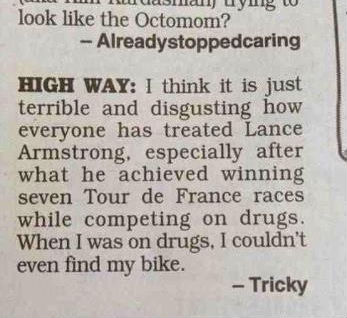
lance armstrong on drugs
Ha ha.
rogers and the comma
The placement of a comma in a contract between Rogers Communications Inc. and Aliant Inc. looks like it will cost Rogers dearly—an extra $2.13 million. Rogers thought it had a 5-year deal with Aliant to string Rogers’ cable lines across thousands of utility poles in Canada for an annual fee of $9.60 per pole.
But early last year Rogers was informed that the contract was being cancelled and the rates were going up. Impossible, Rogers thought, its contract was iron-clad until the spring of 2007, and could potentially be renewed for another 5 years.
The construction of one sentence in the contract allowed the entire deal to be scrapped with only a year’s notice, Aliant argued [1].
The contract states that the agreement “shall continue in force for a period of 5 years from the date it is made, and thereafter for successive 5 year terms, unless and until terminated by 1 year prior notice in writing by either party.”
Sous réserve des dispositions relatives à la résiliation du présent contrat, ce dernier prend effet à la date de signature. Il demeure en vigueur pour une période de cinq (5) ans à partir de la date de la signature et il est subséquemment renouvelé pour des périodes successives de cinq (5) années, à moins d’un préavis écrit de résiliation d’un an signifié à l’autre partie.
CRTC agreed with Aliant that the right to cancel did apply to the first five years of the contract. “Based on the rules of punctuation,” the comma in question “allows for the termination of the [contract] at any time, without cause, upon one-year’s written notice,” the CRTC said.
Notice the second comma. Did it have the effect of permitting the contract to be terminated by one year’s notice at any time, or only after the initial period of 5 years had expired? The CRTC held that the contract could be terminated at any time
In the Commission’s view, the “rules of punctuation” meant that the second comma—placed as it was before the phrase “unless and until terminated by one year’s prior notice in writing by either party”—meant that that phrase qualified both the phrases before it. One party argued that the phrase “unless and until terminated by one year’s prior notice in writing by either party” qualified only “thereafter for successive five (5) year terms”.
On this construction, the agreement would continue in force for at least the first five-year period. But that construction would deny the efficacy of the second comma. Hence, the “plain and ordinary meaning” of the clause allowed for termination at any time without cause, upon one year’s written notice… a report of the decision in the Canadian Globe and Mail on 6 August 2006 calculated the cost of the “grammatical blunder” as upwards of $2.13m—being the cost to the losing party of the winning party’s right to terminate the contract on one year’s notice.
Rogers’ intent in 2002 was to lock into a long-term deal of at least 5 years, but the regulators with the CRTC stated that the validity of the contract came down to the second comma in the previous sentence. Had it not been there, the right to cancel wouldn’t have applied to the first 5 years of the contract, and Rogers would be protected from the higher rates it now faces.
The regulator stated that the comma in question “allows for the termination of the [contract] at any time, without cause, upon 1-year’s written notice.” Rogers intention was to shield itself from rate increases, but now it will see its costs increase to up to $28.05 per pole. Rogers will probably have to pay $2.13 million more than expected, based on rough calculations.
August 21, 2007
The French language has trumped the comma in a contract dispute between Rogers Communications Inc. and Bell Aliant Regional Communications LP.
Rogers claimed victory yesterday after the French version of a five-year contract convinced the CRTC to overturn an earlier decision in which the regulator said the placement of a comma justified Bell Aliant’s decision to terminate the contract early.
In the English version, the CRTC said last year, the insertion of a comma to separate a termination clause from a clause about future renewals of the contract suggested the contract could be terminated before it expired in 2007. Had there been no comma, it would have been clear that the right to termination applied only to the end of the contract that set telephone pole access fees and future renewals. In the French version, the commission concluded yesterday, there were no errant commas to cloud the termination rights.
“We’re pleased that we prevailed,” said Pam Dinsmore, vice-president of regulatory issues for Rogers. “We’re pleased the commission interpreted the clause in the same way we had done.”
In addition to providing the commission with a French version and drafts of the contract, Rogers took issue with the federal regulator’s grasp of grammar, insisting the “rule of punctuation that the Commission purported to rely on did not exist” and was “inconsistent with ordinary English.”
Even if the commission’s “alleged punctuation rule” existed, it was an error of law to rely on it without consider “broader rules of construction,” Rogers argued.
Bell Aliant had argued that last year’s decision in its favour should stand, saying the decision was “valid, regardless of the rules of punctuation and an inquiry into the separation of phrases by commas was unnecessary.”
The firm further argued it was “inappropriate” to try to determine the intent of the contract in French because it was “a form of words and a language” the companies did not use.
But in yesterday’s decision, which reversed the earlier ruling, the CRTC said it was appropriate to review the French version of the contract because the commission had approved the pole access rates and regulations in both English and French in 2000 when they were put in place.
“The Commission considers that, between the two versions, it is appropriate to prefer the French language version as it has only one possible interpretation, and that interpretation is consistent with one of the two possible interpretations of the English language version.”
The dispute now boils down to $800,000 in fees Rogers has paid for access to telephone poles since the more favourable contract with Bell Aliant was terminated prematurely last year. “Unfortunately it’s not over. There’s still money at stake,” Ms. Dinsmore said yesterday.