Kate Ruff, a leading theorist of impact measurement has written a chapter that looks at best practices and key challenges of measuring and assessing impact. These are my notes interspersed with quotes from the chapter. The entire book which is available on a Creative Commons License is available here
She starts off by asking what we mean when we use the term “social impact.” She distinguishes between social impact and impact measurement
Impact as a generic word for any kind of social or environmental result.
In this definition Social Impact refers to social or environmental outputs and outcomes and Impact Measurement tracks these outputs and outcomes
Impact as contribution
These are impact methods that allow for claims of attribution by using control groups and experimental design. See Impact Management Project (IMP)
Impact as significant change
The long term effect of an organization’s work such as on populations or overall need. “In this definition, impact measurement refers to the effects that come after outcomes — often, the long-lasting effects.”
Impact as valuation
Social Return on Investment (SROI) calculates impact by “multiplying outcomes with financial proxies and estimates of attribution.”
Foundational Practices
Engage Stakeholders: Primary stakeholders includes members, clients, beneficiaries, staff, funders, subsets withing these groups. “Engaging stakeholders throughout the measurement cycle can help organizations more accurately understand what changed, and can be effective way of creating change through sense making. Communicating results with all stakeholders (not just funders) allows them to hold organizations to account.”
Plan your change: What do you intend to achieve and how do you plan to get there?
Use performance measures: Express objectives and planned activities in terms of outcomes and outputs, and identify indicators to signal progress. Indicators are verifiable measures that mark or signal that an output, outcome or impact has been achieved.”
Collect useful data: “Strive to make data collection routine. Ensure that what data you do collect is stored in useful ways. It is time-consuming to collate data from notebooks and Word files on individual computers. Instead, opt for shared spreadsheets, online forms, and specialized software like an Impact Dashboard. Periodically review the data to make sure that everything collected is useful in some way.”
Assess and gauge impact: Indicators never tell the whole story. Take time to make sense of the data in context, with risks and mitigating factors. Try to contemplate how much of the results can be attributed to the organization.
Report: Share assessments with stakeholders. Reports are important to close the loop.
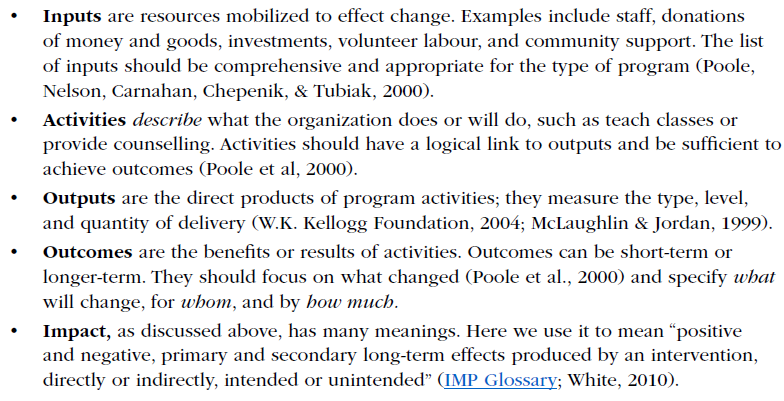
The Causal Model