Campbell, Kirsten. Jacques Lacan and Feminist Epistemology. Florence, KY, USA: Routledge, 2004.
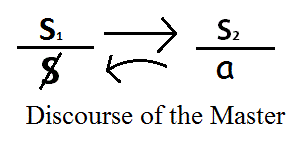
For Lacan, the Discourse of the Master describes the production of the speaking subject in the symbolic field. The subject comes into being when it enters the signifying chain through identification with a signifier, S1. The S1 is a fundamental symbolic element which ‘knots’ signifier and signifed and thereby arrests their constant sliding. It represents the signifier that gives the subject its symbolic coherence and situates it within language. For this reason, the  marks the point of the ‘origin’ of the subject’s speech, because the identification with the I of speech, the S1 that symbolizes the I of the master, constitutes the subject (Seminar 17: 70). In this way, identification with the I of the Master forms the subject in the symbolic field. The Discourse of the Master thereby inaugurates a speaking subject which is identical to its proper signifer and which ‘names’ it. For Lacan, this discourse binds the subject to the master signifier and all its illusions. 65
In the Discourse of the Master, the subject refuses knowledge of its formation in signifying networks. In his schema, Lacan represents this refusal to know by an arrow S1—>S2 labelled impossibility. Given this structure, it is impossible for the subject to know its relation to the signifier. For this reason, Lacan represents that impossibility by his figure of the barred subject, $. He represents the subject as barred because it refuses to acknowledge the truth of its unconscious division. That lack is a consequence of its constitution as a speaking being, because castration is the price of entering the Symbolic order. The discourse of the Master hides the truth of the lack-in-being of the subject (S17 90). The Master does not want to know, and cannot know, the truth of its unconscious. The subject perceives itself as an I, that is, as a unified subject, and hence refuses to acknowledge that it is in fact a Master that suffers castration.
The Discourse produces a subject who wishes to master its self, its others, its desire, and its unconscious. For Lacan, the Master wishes to dominate that which it excludes form its discourse (S17 110).
Fink describes how this subject must show no weakness, in this sense carefully hides the fact that he or she, like everyone else, is a being of language and has succumbed to symbolic castration’ (Fink in Nobus Key Concepts 1998). The castrated Master refuses to believe that it is castrated. 66
It veils over its lack with the illusion that it is whole and complete; the méconnaissance of a self that imagines that it is identical to itself and to its master signifier (S17 70). It imagines that it has mastery of a ‘univocal’ discourse that masks its unconscious division. 66
The Knowing Master is a position in which the imaginary order captures the knower such that it perceives its self and its objects in the mirror of the ego. The Master subject claims to be a unified subject which creates itself in an act of mastery. It imagines itself to be whole and identical to itself, and perceives its self and its others as identical to its egoistic projections. The knower constructs its relationship to its others as an objectifying identification in which the other is an object that it seeks to master. Its knowledge is an aggressive, objectifying and distorting domination of its known object. The knowing subject attempts to gain omnipotent control of itself and its world, so as to imagine itself as the ‘Absolute Master’ (Lacan 1955: 47, Éc: 33). It posits itself as omniscient, the possessor of absolute knowledge. 66
Lacan’s description of the knowing subject of the Discourse of the Master presents it as the universal, disembodied knower. However, given that the Lacanian account of subjectivity posits sexuation as its condition, then the knower is necessarily sexed.
Following a feminist deconstructive strategy leads us to ask, how is sexuation inscribed into the Lacanian theory of the knowing subject? (66)
To answer that question requires the reinscription of sexual difference into Lacan’s account of the production of the Master subject. 67
🙂 Here we go
For Lacan, the Master subject is produced through identification with a symbolic term, the trait unaire, translated as the unitary, unary or ‘single-stroke’ trait. Lacan’s theory draws on Freud’s account in Group Psychology (1921) of the process of the assimilation of an aspect or characteristic of another, in which the subject identifies with a trait of another subject. Lacan argues that an identification with the unitary trait ‘marks’ each one of us as a singular and unified identity. (S17 180)
He links this concept of the unifying mark to the signfier of ‘L’Un’ (The One). ‘The One’ is the signifier that institutes the symbolic structure of the subject (S17 12, S20 143-144).
In the Discourse of the Master the unitary trait appears as S1, the master signifier. The master signifier functions as the signifier that represents the subject as subject.67
However Lacan also links S1 to the phallic signifier. In his discussion of sexuation, Lacan describes the phallus as ‘that which is also incarnated in S1, which, of all the signifiers, is the signfier for which there is no signified (S20 80). The phallus incarnates or ‘makes flesh’ the S1 of the master signifier.
For this reason, identification with the phallic signifier operates as identification with the master signifier. What links these terms is the process of symbolic identification in which the phallic signifier is a master signifier that produces the subject.
Lacan argues that in the formation of the subject, the signification of the phallus [is evoked by the paternal metaphor]. The paternal metaphor is the attribution of procreation to the Name-of-the-Father and the signification of the paternal relation.
A moment of the Oedipus complex, the paternal metaphor represents the intervention of the Symbolic order (signified by The-Name-of-the-Father) in the subject’s imaginary relation to the mother (and her desire).
In the operation of the paternal metaphor, the desire for the mother is repressed and the phallic signifier stands in for that desire in the subject’s unconscious (Muller and Richardson 1994 213). This process forms the subject in a relation to the phallic signifier and hence as a sexed identity which has or does not have the phallus (S5 186). In this account, the masculine subject has the phallus, a position of possessing the signifier of the phallic object, while the feminine subject does not have the phallus, a position of lack and hence castration. 67
Lacan argues that the dissolution of the Oedipus complex involves symbolic interjection, in which ‘what was outside becomes the inside, what was the father becomes the super-ego’ (S1 169). In symbolic identification the subject introjects the signifier of the father, forming the super-ego. The subject assimilates the phallic signifier as the mark of the Father, and thereby incorporates the Symbolic father as an I. (S11 256-257)
Presenting the reformulation of the paternal metaphor (and of the Oedipus complex) in the theory of the Discourse of the Master.
In the Discourse of the Master, identification with the phallic signifier — S1 — of the Father produces a ‘unified’ subject. It is an identification with the paternal signifier because the phallic signifier is the mark of the Father, and hence of his Law. This symbolic identification ‘marks’ and names the subject with and by the Name-of-the-Father. Identification with S1 involves an assimilation of the Symbolic father. For this reason, Lacan describes ‘the law’, that is, the Law of the Father, as dominating the Discourse of the Master (S17 48). 68
The process of symbolic identification with the Father produces the illusion of a conscious self. It establishes a subjective relation of I and ego in which the I of the speaking subject appears to be co-extensive with the ego because of the operation of repression. For the Master subject, consciousness founds illusion of the transcendental I (S17 70). Identification with the Symbolic Father who has the phallus and is not castrated structures this position of mastery, forming the master subject in terms of a psychic structure of defence against the unconscious. The identification with the Symbolic father produces a subject structured by a méconnaissance of its origniary and ontological lack.
However, in the Lacanian account identification with the Symbolic father operates differently in formation of masculine and feminine subjects. In the logic of castration, the model of a typical ‘successful’ resolution fo the Oedipus complex is that of the paternal identification of the little boy because of the tie of the symbolic phallus and the real penis. (S4 209). In the third stage of the Oedipus complex, the little boy identifies with the father who possesses the penis while the little girl recognizes that he has it (S5 196) For Lacan, if masculinity and femininity both ‘fail’, they fail differently. The difference concerns the more or less ‘problematic’ assumption of Oedipal subjectivity, because the master signifier that represents the subject is masculine (S17 107).
In Lacan’s account, the masculine subject has the phallus (S20 80). That is, the masculine subject possesses the phallus and, in this sense, is not castrated. The male subject defines its masculine position through the exception of castration such that his ‘all’ is defined through an other position of ‘not-being-all’. This other position is that of castration, which is the feminine position of a being that does not have the phallus. The phallus is the master signifier by which the masculine subject refuses the (lacking) body. …The phallus ‘that props him up as signifier and is also incarnated in S1 which of all the signifier, is the signifier for which there is no signified (S20 80). His ontological loss cannot be acknowledged without being symbolized as castration, for otherwise hts fantasy of omnipotence, unity and universality would unravel.
The displacement of ontological loss through the representation of castration in a symbolic function allows the masculine subject the illusion of mastery (S17 144).
In that illusion of mastery, the masculine subject misrecognizes itself as a being whole and complete of itself. It is a position of (masculine) mastery. 69
It is a position of presence, of the universal masculine subject which is ‘whole’ and which does not suffer loss or lack. The Discourse of the Master describes the production of the knowing master, a masculiine subject that secures its identity through identification with the Symbolic father in a repudiation of castration. 69
Reconceiving the knowing master as a masculine subject explains the formation of the masculine knower and its imaginary méconnaissance. It explains the relation between the knowing subject of consciousness and the masculine knower … showing the link between the formation of masculine subjects and knowers. In this way, it provides an account of the constitution of the knower as a masculine subject by providing the feminist deconstructive project with a means of understanding the formation fo the subject of ‘masculine’ knowledges.
Campbell, Kirsten. Jacques Lacan and Feminist Epistemology. Florence, KY, USA: Routledge, 2004. p 75.
My account of the discourses of mastery provides a means of retaining these insights of deconstructive theories, while also not reducing masculine knowledge to an effect of individual experience or familial objects. In the later Lacanian epistemology, different discursive social links produce particular forms of knowledges and knowing subjects. Those symbolic relations between subjects represent different forms of the social bond. In a Western culture, a phallocentric Symbolic order structures those social relations between subjects. In particular, it founds the Discourse of the Master as a dominant discourse of Western culture. The Discourse of the Master produces dominant forms of knowledge and the masculine knowing subject.
These masculine subjects need not be men. Both men and women can, and do, become knowing Masters. However, men are more likely to assume this position than women for two reasons.
First, the Master is a paradigmatic knower because of the material and cultural privileging of particular forms of masculine identity.
Second, the normative production of identity attaches masculinity to biologically male subjects.
My account of the discourses of mastery provides an explanation for this ‘demonstrable alignment’ between masculine knowers and knowledges. For example, following Scheman’s description of the Cartesian knower, it explains how identification with the Symbolic father forms this egoistic, defensive Knowing Master. Similarly, following Bordo’s description of the masculine Cartesian subject, it explains why the knowledges of the masculine knower repudiate its feminine others (indeed, all others), the better to control their difference (1986: 452).
Rather than seeing masculine knowledges as a reflection of the privilege of men in social relations (as in standpoint theory), my account explains how those social relations produce masculine discourses of mastery. Those social relations produce discourses of knowledge that form the knower and its objects. These forms of knowing are discursive practices that do not describe the nature of ‘knowledge’, but rather the production of particular knowers and forms of knowing. (76)