Campbell, Kirsten. Jacques Lacan and Feminist Epistemology. Florence, KY, USA: Routledge, 2004. p 77 – 78.
For feminist epistemology, the question is how to create a political discourse that does not reproduce the Discourse of the Master. Its utopian claims posit the possibility of other discourses, citing feminist knowledges as evidence of that possibility. … For Lacan, the question too is how to stop the discourse of mastery (S17 207). The possibility of a psychoanalytic discourse also subsists in the disruption of the Discourse of the Master. In the later Lacanian epistemology, that disruption occurs in the Discourses of the Hysteric and the Analyst.
Lacan argues that the discourses of the Hysteric and the Analyst create new positions of epistemological enunciation and a new relation of subject to object. Can his account of these discourses explain the new position of epistemological enunciation and relation which feminist epistemology seeks? If so, does the feminist knower occupy the position of the Hysteric or the Analyst? Or neither? 77
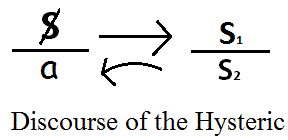
For Lacan, the hysterical analysand opens the Master’s Discourse to the Analyst’s Discourse. The desire to know the Master animates the Discourse of the Hysteric. (S17 36). She asks ‘what is it to be a woman?’ (S3 175) In Lacan’s discussion of the case history of Dora he places the emergence of hysteria … in the little girl’s reproach to the mother that she does not have the phallus. The hysterical demand emerges from that reproach, in which the hysteric signifies the frustration of her unanswerable demand to have and to enjoy the phallus (S17 112). … She subjects the Master’s Discourse to her unanswerable demand, and he can only reply with the assertion that she is castrated — that there are beings that do not have the phallus and that she is in that class of beings. 77
One strand of feminist thinking, such as that of Elaine Showalter (1987), has also understood the hysteric as a position of feminine protest, and her symptoms as a bodily rewriting of her experience of a social order that causes her psychic pain. It perceives Dora, the exemplary hysteric of psychoanalysis, as its first feminist heroine who represents the limits of psychoanalytic knowledge and patriarchal discourse. It interprets Dora’s rejection of Freud’s cure both as a refusal to be reinserted into the exchange of women, and as a protest against that exchange.
In this interpretation, Dora is a metaphor for the inability of psychoanalytic knowledge, and patriarchal knowledge generally, to describe feminine sexuality in general, and female homosexuality in particular. She comes to represent a rupture of an apparently seamless masculine representation and knowledge of women. In both these accounts, the hysteric represents a contestation and disruption of the Master’s Discourse. She represents its moment of failure because she reveals its cost.
However, Lacan argues that the position of the Hysteric resolves itself in a demand to the Master (S17: 150). She constructs her protests within his terms. The Hysteric desires knowledge, but the knowledge that she desires is that which the Master possesses.
In this way, her position is one of symptomatic repetition that fails to contest or change the Master’s discourse.
The Hysteric’s response to her pain is a symptomatic protest rather than resistance to the social order that produces her symptoms. She does not represent a contestation of the knowledge of the Master but is trapped within it.
Other feminist readings of the hysteric perceive her in similar terms, arguing that she does not represent a political figure. For example, Maria Ramas (1985) argues that the hysteric silently protests the oppression of women by taking up a position of inarticulate and passive resistance, thereby participating in traditional feminine protest of mute victimhood. These feminists argue that while such a position may have been the only position open to Dora, it does not provide an adequate basis for an active and interventionist politics that seeks to change the social order rather than to silently suffer its injustices.
In both Lacanian and feminist theory, the position of the Hysteric represents an important moment in the contestation of the Discourse of the Master. However, while the hysteric reveals the failure of the Discourse of the Master, she fails to disrupt its operation. The hysterical analysand exposes the castration of the Master, but she does not dislodge him from his position of mastery. The Discourse of the Master ultimately recuperates the position of the hysterical analysand. She knows that the Master is castrated, but she refuses to address him as other than Master. In epistemological terms, the limit of the Discourse of the Hysteric is evident in relation to her knowledge.
What is the knowledge of the hysteric? She knows the truth of the Master’s discourse, namely that he suffers castration. Lacan acknowledges that the price she pays for that knowledge is herself. But what does this castration reveal? The hysteric’s demand that she have the phallus is unanswerable. She cannot be a Master nor have mastery, and in this the hysteric must always fail.
Her knowledge cannot be spoken because she cannot articulate the castration of the Master within her discourse, and hence cannot bring it into representation. Without that possibility, the hysterical analysand cannot represent the Master other than as Master. She cannot articulate a position other than that of unattainable Mastery or of suffering hysteria. For that reason, hysteria operates as a symptom, rather than as a political discourse that can change the social order that causes the Hysteric’s psychic conflict and distress.
For this reason, the Discourse of the Hysteric does not produce an adequate subject position for the feminist knower. Dora the hysterical analysand may be interpreted as a nascent feminist heroine. However, her knowledge of the Master’s discourse is bodily rather than political.
Feminist politics implies symbolization, a representation of how we might understand gender and gender relations differently. However, the hysteric wants to evade the very possibility of representation, because it is the refusal to articulate desire that produces the hysterical symptom. The Discourse of the Hysteric is not the Discourse of the Feminist. Is, then, feminist discourse a Discourse of the Analyst? 79