Žižek Derrida 4 christian universality

Žižek, Slavoj. “A Plea for a Return to Différance (with a Minor Pro Domo Sua)” Critical Inquiry. 32.2 (2006): 226-249.  PDF download

This is how one should answer the standard critique of Christian universalism:what this all-inclusive attitude

(recall St.Paul’s famous statement, “Where there is neither Greek nor Jew” [Col. 3:11])

involves is a thorough exclusion of thosewho do not accept Christianity. In other “particularistic” religions (and even in Islam, in spite of its global expansionism), there is a place for others, they are tolerated, even if they are condescendingly looked upon.

The Christian motto, All Men Are Brothers, however, means also that those who are not my brothers are not (even) men. Christians usually praise themselves for overcoming the Jewish exclusivist notion of the ChosenPeople and encompassing the entirety of humanity—the catch here is that, in their very insistence that they are the Chosen People with the privileged direct link to God, Jews accept the humanity of the other people who celebrate their false gods, while Christian universalism tendentiously excludes nonbelievers from the very universality of humankind.

Thus Christian universality is not the all-encompassing global medium where there is a place for all and everyone. It is rather the struggling universality, the site of a constant battle.

Which battle, which division? To follow Paul: not the division between Law and sin, but between, on the one side, the totality of Law and sin as its supplement and, on the other side, the way of Love.

Christian universality emerges at the symptomal point of those who are “part of no-part” of the global order. This is where the reproach of exclusion gets it wrong: Christian universality, far from excluding some subjects, is formulated from the position of those excluded, of those for whom there is no specific place within the existing order, although they belong to it; universality is strictly codependent with this lack of specific place/determination.

Or, to put it in a different way, the reproach to Paul’s universalism misses  the true site of universality. The universal dimension he opened up is not  the “neither Greeks nor Jews but all Christians,” which implicitly excludes  non-Christians; it is rather the difference Christians/non-Christians itself which, as a difference, is universal; that is, it cuts across the entire social body, splitting, dividing from within every kind of ethnic identity: Greeks are cut into Christians and non-Christians, as well as Jews.

The standard reproach thus in a way knocks on an open door. The whole point of the Paulinian notion of struggling universality is that true universality and partiality do not exclude each other and also that universal Truth is only accessible from a partial, engaged, subjective position. 242
Žižek Derrida 3 concrete universal

Žižek, Slavoj. “A Plea for a Return to Différance (with a Minor Pro Domo Sua)” Critical Inquiry. 32.2 (2006): 226-249.

This logic of the “minimal difference,” of the constitutive noncoincidence of a thing with itself, provides the key to the central Hegelian category of concrete universality.

Let us take a “mute” abstract universality that encompasses a set of elements all of which somehow subvert, do not fit, this universal frame.

Is, in this case, the “true” concrete universal not this distance itself, the universalized exception?

And, vice versa, is the element that directly fits the universal not the true exception?

Universality is not the neutral container of particular formations, their common measure, the passive (back)ground on which the particulars fight their battles, but this battle itself, the struggle leading from one to another particular formation. 236

Take a look at this 2004 YouTube clip where Ž talks about universality/particularity

“Concrete universality” is a name for this process through which fiction
explodes from within documentary, that is, for the way the emergence of
fiction cinema resolves the inherent deadlock of the documentary cinema. 237

This brings us to the very heart of the concept of Concrete Universality.

It is not merely the universal core that animates a series of its particular
forms of appearance; it persists in the very irreducible tension, noncoincidence, between these different levels.

Hegel is usually perceived as an “essentialist historicist,” positing the spiritual “essence” of an epoch as a universal principle that expresses itself in a specific way in each domain of social life; say, the modern principle of subjectivity expresses itself in religion as Protestantism, in ethics as the subject’s moral autonomy, in politics as democratic equality, and so on.

What such a view misses is what one is tempted to call temporal parallax. In the complex dialectic of historical phenomena, we encounter events or processes that, although they are the actualization of the same underlying “principle” at different levels, cannot occur at the same historical moment.

Recall the old topic of the relationship between Protestantism, Kantian philosophical revolution, and the French political revolution. Rebecca Comay recently refuted the myth that Hegel’s critique of the French Revolution can be reduced to a variation of the “German” idea of how the Catholic French had to perform the violent “real” political revolution because they missed the historical moment of Reformation that already accomplished in the spiritual sphere the reconciliation between the spiritual Substance and the infinite subjectivity sought after in social reality by the revolutionaries.

In this standard view, the German ethico-aesthetic attitude “sublates” revolutionary violence in the inner ethical order, thus enabling the replacement of the abstract “terrorist” revolutionary freedom by the concrete freedom of the state as an aesthetic organic whole. However, already the temporality of this relationship between the French political revolution and the German spiritual reformation is ambiguous.

Three possible relations seem to overlap here. First, the idea of sublation points towards a succession; the French “immediate” unity of the Universal and the Subject is followed by its sublation, the German ethico-aesthetic mediation.

Then, there is the idea of a simultaneous choice (or lack thereof), which made the two nations follow different paths: the Germans opted for Reformation, while the French remained within the Catholic universe and had thus to take the tortuous route of violent revolution.

However, the empirical fact that Kant’s philosophical revolution precedes the French Revolution is also not just an insignificant accident; in the spectacle of revolutionary Terror, Kantian ethics itself encounters the ultimate consequence of its own “abstract” character, so that Kant’s philosophy should be read retroactively, through the prism of the French Revolution  which enables us to perceive its limitations:

[…]

Jameson’s critique of the notion of alternate modernities thus provides a model of the properly dialectical relationship between the Universal and the Particular; the difference is not on the side of particular content (as the traditional differentia specifica) but on the side of the Universal.

The Universal is not the encompassing container of the particular content, the peaceful medium background of  the conflict of particularities; the Universal as such is the site of anunbearable antagonism, self-contradiction, and (the multitude of) its particular species are ultimately nothing but so many attempts to obfuscate, reconcile, master this antagonism.

In other words, the Universal names the site of a problem-deadlock, of a burning question, and the particulars are the attempted but failed answers to this problem.

Say that the concept of state names a certain problem: how to contain the class antagonism of a society? All particular forms of state are so many (failed) attempts to propose a solution for this problem. 241-242

Žižek Derrida 2 lesson of Hegel

Žižek, Slavoj. “A Plea for a Return to Différance (with a Minor Pro Domo Sua)” Critical Inquiry. 32.2 (2006): 226-249.

What, then, would be this differénce that precedes the ethical commit-ment to the abyss of Otherness?

On the southern side of the demilitarized zone in Korea, there is a unique visitor’s site: a theater building with a large screenlike window in front, opening up onto theNorth. The spectaclepeo-ple observe when they take seats and look through the window is reality itself (or, rather, a kind of “desert of the real”): the barren demilitarized zone with walls, and so on, and, beyond, a glimpse of North Korea. (As if to comply with the fiction, North Korea has built in front of this theater a fake, a model village with beautiful houses; in the evening, the lights in all the houses are turned on at the same time, although nobody lives in them.)

Is this not a pure case of the symbolic efficiency of the frame as such? A  barren zone is given a fantasmatic status, elevated into a spectacle, solely by  being enframed. Nothing substantially changes here; it is merely that, viewed through the frame, reality turns into its own appearance.

A supreme case of such an ontological comedy occurred in December 2001 in Buenos Aires, when Argentinians took to the streets to protest against their government and, especially, against Cavallo, the economy minister. When the crowd gathered around Cavallo’s building, threatening to storm it, he escaped wearing a mask of himself (sold in disguise shops so that people could mock him by wearing his mask).

It thus seems that at least Cavallo did learn something from the widely spread Lacanian movement in Argentina — the  fact that a thing is its own best mask. What one encounters in tautology is  thus pure difference, not the difference between the element and other elements, but how the element is different from itself. 234

The fundamental lesson of Hegel is that the key ontological problem is not that of reality but that of appearance: not, Are we condemned to the interminable play of appearances, or can we penetrate through their veil to the underlying true reality?

but, How could — in the middle of flat, stupid reality, which is just there — something like appearance emerge?

The minimal ontology is therefore that of the Möbius strip, of the curved space that is bent onto itself; all that has to intervene into the Real is an empty frame so that the same things we saw “directly” before are now seen through the frame.

A certain surplus-effect is thus generated, which cannot simply be cancelled through demystification. It is not enough to display the mechanism behind the frame; the stage-effect within the frame becomes autonomous. How is this possible?

There is only one conclusion that can account for this gap: there is no “neutral” reality within which gaps occur, within which frames isolate domains of appearances.

Every field of “reality” (every “world”) is always already enframed, seen through an invisible frame. However, the parallax of the two frames is not symmetrical, composed of two incompatible perspectives on the same x: there is an irreducible asymmetry between the two perspectives, a minimal reflexive twist.

We do not have two perspectives; we have a perspective and what eludes it, and the other perspective fills in this void of what we could not see from the first perspective. 235

Žižek Derrida

Žižek, Slavoj. “A Plea for a Return to Différance (with a Minor Pro Domo Sua)” Critical Inquiry. 32.2 (2006): 226-249.  PDF download

Here we get the difference betweenHegel and Derrida at its purest.

Derrida accepts Hegel’s fundamental lesson that one cannot assert the innocent ideal against its distorted realization. This holds not only for democracy but also for religion.

The gap that separates the ideal concept from its actualization is already inherent to the concept itself.

However, againstHegel, Derrida insists on the irreducible excess in the ideal concept that cannot be reduced to the dialectic between ideal and its actualization: the messianic structure of “to come,” the excess of an abyss that cannot ever be actualized in its determinate content.Hegel’s own position is here more intricate than it may appear: his point is not that, through gradual dialectical progress, one can master the gap between concept and its actualization and achieve the concept’s full self-transparency (“Absolute Knowledge”).

Rather, to put it in speculative terms, his point is to assert a “pure” contradiction that is no longer the contradiction between the “undeconstructible” pure Otherness and its failed actualizations/determinations, but the thoroughly immanent “contradiction” that precedes any Otherness. 232

Actualizations and/or conceptual determinations are not traces of the undeconstructible” divineOtherness, but just traces marking their in-between.

Or, to put it in yet another way, in a kind of inverted phenomenological epoche, Derrida reduces Otherness to the “to come” of a pure potentiality, thoroughly deontologizing it, bracketing its positive content, so that all that remains is the specter of a promise; and what if the next step is to drop this minimal specter of Otherness itself, so that all that remains is the rupture, the gap as such that prevents entities from reaching their self-identity? 232

What if the idea of infinitemes-sianic justice that operates in an indefinite suspension, always to come, as the “undeconstructible” horizon of deconstruction, already obfuscates the
“pure”différance, the pure gap that differs an entity from itself?

Is it not possible to think this pure in-between prior to any notion of messianic justice? Derrida acts as if the choice is between the positive ontoethics, the gesture of transcending the existing order towards another higher positive Order, and the pure promise of spectral Otherness. However, what if we drop this reference to Otherness altogether? 233

Brando on the waterfront

CHARLEY
Listen to me Terry. Take the job. Just take it. No questions take it.  Terry take this job, please.  Please take it.

TERRY hushed, gently guiding the gun down toward Charley’s lap
Charley… . Charley… . ah Charlie, …. Wow…

CHARLEY (genuinely)
Look , …  I, … Look kid I …. (gently)
How much you weigh slugger?
(nostalgically) When you weighed one hundred and sixty-eight pounds.  You were beautiful. You could’ve been another Billy Conn. That skunk we got you for a manager … he brought you along too fast.

TERRY
It wasn’t him Charley.  It was you.
(years of abuse crying out in him)
Remember that night in the Garden, you came down in my dressing room and says, “Kid, this ain’t your night — we’re going for the price on Wilson.”
You remember that?  This ain’t your night. My night I could have taken Wilson apart.
So what happens he gets the title shot outdoors in a ballpark – and what do I get — a one-way ticket to Palookaville.
You was my brother Charley. You should of looked after me a little bit
You should have taken care of me just a little bit so I wouldn’t have taken them dives for the short-end money.

CHARLEY (defensively)
I always had a bet down for you. You saw some money.

TERRY (agonized)
You don’t understand!

CHARLEY
I tried to keep you in good with Johnny.

TERRY
You don’t understand!
I coulda had class.
I coulda been a contender.
I coulda been somebody.
Instead of a bum, which is what I am.  Let’s face it …
It was you, Charley.

Charley takes a long, fond look at Terry.  Then he glances quickly out the window.

CHARLEY
turning back to Terry, his tone suddenly changed
Okay — Okay. I’ll tell him … I couldn’t find you. Ten to one he won’t believe me. Here … Here take this (HANDS HIM THE GUN)
You’re gonna need it.  Yo you pull over!
As Terry jumps out. A bus is just starting up a little further along the street.
Take  me to the Gardens!

dolar beyond interpellation 1

Dolar, Mladen. “Beyond Interpellation” Qui Parle 6.2 (1993): 75-96.

But the famous formula of interpellation – “the ideology interpellates individuals into subjects” – implies a clean cut as well. There is a sudden and abrupt transition from an individual- a pre-ideological entity, a sort of materia prima — into the ideological subject, the only kind of subject there is for Althusser.

One becomes a subject by suddenly recognizing that one has always already been a subject: becoming a subject has always takes effect retroactively — it is based on a necessary illusion, an extrapolation, an illegitimate extension of a later state into the former stage.  A leap — a moment of sudden emergence — occurs. 76

… there is a part of individual that cannot successfully pass into the subject, an element of “pre-ideological” and “presubjetive” materia prima that continues to haunt subjectivity once it is constitued as such. A part of external materiality that cannot be successfully integrated in the interior.

Interpellation was based on a happy transition from a pre-ideological state into ideology: successfully achieved it wipes out the traces of its origin and results in a belief in the autonomy  and self-transparency of the subject. The subject is experienced as  <em>causa sui</em> — in itself an inescapable illusion once the operation is completed.

How exactly would materiality entail subjectivation? Why would interpellation require materiality? One could say that materiality and subjectivity rule each other out: if I am (already) a subject, I am necessarily blinded in regard to materiality.

The  psychoanalytic point of departure is the remainder produced by the operation; psychoanalysis does not deny the cut, it only adds a remainder.   The clean cut is always unclean, it cannot produce the flawless interiority of an autonomous subject. The psychoanalytic subject is coextensive with that very flaw in the interior. (One could say that the psychoanalytic symptom, the starting point of analysis, is its most obvious manifestation). In short, the subject is precisely the failure to become the subject, — the psychoanalytic subject is the failure to become an Althusserian one.

For Althusser, the subject is what makes ideology work; for psychoanalysis, the subject emerges where ideology fails. The il1usion of autonomy may wel1 be necessary, but so is its failure; the cover-up never holds fast. The entire psychoanalytic apparatus starts from this point: different subjective structures that the psychoanalysis has discovered and described – neurosis (with its two faces of hysteria and obsession), psychosis, perversion — are just so many different ways to deal with that rest, with that impossibility to become the subject.

On the social level as well — on the level of discourse as a social bond — the four basic types of discourse pinpointed by Lacan are four different ways to tackle that remainder.  Interpellation, on the other hand, is a way of avoiding it: it can explain its proper success,  but not how and why it does not work.

ethics is not w/in framework of law

We might say that the ethical dimension of an action is ‘supernumerary’ to the conceptual pair legal/illegal.

This in turn suggests a structural connection with the Lacanian notion of the Real. As Alain Badiou has noted, Lacan conceives of the Real in a way that removes it from the logic of the apparently mutually exclusive alternatives of the knowable and the unknowable. The unknowable is just a type of the knowable; it is the limit or degenerate case of the knowable; whereas the Real belongs to another register entirely.

Analogously, for Kant the illegal still falls within the category of legality -they both belong to the same register, that of things conforming or failing to conform with duty. Ethics – to continue the analogy – escapes this register.

Even though an ethical act will conform with duty, this by itself is not and cannot be what makes it ethical. So the ethical cannot be situated within the framework of the law and violations of the law. Again, in relation to legality, the ethical always presents a surplus or excess. The question then becomes: ‘what exactly is the nature of this excess?’ The simple answer is that it has something to do with the Kantian conception of ‘form’. The exact meaning of this requires more careful consideration. EOR 12

Verhaeghe pre-ontological cocktail

Verhaeghe, Paul. “Causation and Destitution of a Pre-ontological Non-entity: On the Lacanian Subject.” Key Concepts of Lacanian Psychoanalysis. Ed. Dany Nobus. 1999. 164-189

The important thing about the divided subject is that it has no essence, no ontological substance, but, on the contrary, comes down to a pre-ontological, indeterminate non-being which can only give rise to an identity, an ego, in retrospect. Difficult as this may seem, it is rather easy to grasp.

Just think of what we will call ‘the cocktail experience.’ You are invited for a drink with a group of people you do not know. You have to introduce yourself, and so you have to produce signifiers. This production of signifiers will never be satisfactory. Furthermore, the more signifiers produced, the more contradictions, gaps and difficulties will become clear.

Therefore, the ‘Experienced Cocktail Consumer’, will stick to the proverbial ‘That’s me!’ and produce a stock introduction.

From a Lacanian point of view, it would be wrong to assume that the difficulty lies in finding the correct signifiers to present oneself. On the contrary, one is produced by the uttered signifiers, which are coming from the field of the Other, albeit in a divided way. It would also be a mistake to assume that the subject is identical to the produced signifier(s).

The identification with a number of signifiers, coming from the Other, presents us with the ego. The subject, on the contrary, is never realised as such; it joins the pre-ontological status of the unconscious, the unborn, non-realised etc.

In this sense, the Lacanian subject is exactly the opposite of the Cartesian one. In the formula ‘I am thinking, therefore I exist’ Descartes concludes from his thinking that he has a being, whereas for Lacan, each time (conscious) thinking arises its being disappears under the signifier.

This explains two basic characteristics of the Lacanian subject: it is always at an indeterminate place and it is essentially divided:

Alienation consists in this vel, which - if you do not object to the word condemned, I will use it - condemns the subject to appearing only in that division which, it seems to me, I have just articulated sufficiently by saying that, if it appears on one side as meaning, produced by the signifier, it appears on the other as aphanisis.74

Again, Lacan distances himself from any idea of substantiality.

The subject is not an unconscious intention that will interrupt the normal conscious discourse.

The interruption or division does not take place between a real or authentic part and a false, external one, but the split defines the subject as such. The subject is split from its real being and forever tossed between eventually contradicting signifiers coming from the Other.

This rather pessimistic view confronts us with the issue of therapeutic and psychoanalytic possibilities.

Paradoxical as this may seem, Lacan’s point of view is more optimistic than the Freudian one. Freud’s theory is by and large deterministic, whereas Lacan leaves an element of choice, albeit a ‘forced’ choice.

It is this element that brings us to the second operation, separation, and to the theme of our final investigation: the goal of psychoanalytic treatment.

Verhaeghe pre-ontological non-entity

Verhaeghe, Paul. (1998). Causation and Destitution of a Pre-ontological Non-entity: On the Lacanian Subject.  Key Concepts of Lacanian Psychoanalysis. Ed. Dany Nobus. 1999. 164-189.

Until  the  early  1960 ‘s,  Lacan focused  upon this opposition between the imaginary and the symbolic.

Yet there is a shift in attention: instead of the opposition and division between ego and subject, the division and splitting  within the subject itself comes to the fore. Instead of the term  ‘subject,’  the expression ‘divided  subject’ appears — that  is, divided by language.

With the conceptualisation of the category of the real, another major shift occurs. From the 1964 Seminar Xl onwards, the real becomes a genuine Lacanian concept, within a strictly Lacanian theory, and changes the theory of the subject in a very fundamental way.

In the first part, we will study the  causal background of the subject: how does it come into being? It will be demonstrated that the causation of the subject has everything to do with the drive, and that it has strong links with the status of the unconscious.

In the second part, we will discuss the ontological status of the subject, which is radically different from the traditional conceptions. Lacan ‘s ontology is an ‘alterology,’  alienation being the  grounding mechanism and identity always coming from the Other

Moreover, the subject has a mere pre-ontological status, which is again closely linked to the status of the unconscious. The ever divided subject is a fading, a vacillation, without any substantiality.

In the third and final part, we will discuss the link between Lacan’s theory of the  subject and his theory of the aims and goals of  psychoanalysis. Here, the central mechanism is separation,  as first formalized by Lacan in Seminar Xl and further developed during the 1960’s.  165

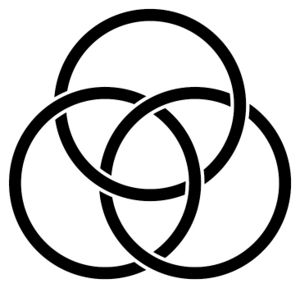
BorromeanKnot3Rings

Freud assumed that there is an original state of primary satisfaction, which he considered to be a state of homeostasis .

The inevitable loss of this state sets the development in motion and provides us with the
basic characteristic of every drive: the tendency to return to an original state.

Thus, the entire development is motivated by a central loss,around which the ego is constituted.  The lack is irrevocable. Freud’s key denomination for this lack is castration.

Freud’s key denomination for this lack is castration, which is his attempt at formulating the link between the original, pregenital loss and the oedipal elaboration thereof. For several reasons, the Freudian castration theory itself will never be fully satisfying. Freud’s focus on the real, that is to say the biological basis of castration, did not help him any further either, and inevitably brought him to the pessimistic conclusion of 1 937, concerning the ‘biological bedrock’ as the limit of psychoanalysis .

Freud’s theory is quite unidimensional and Freud himself remained remarkably obstinate in this respect. He refused to take other losses than the loss of a penis into account – with one exception, as becomes clear from his affirmation of Aristophanes’ fable about the search for the originally lost counterpart. This one-sidedness was directed by his conviction regarding the universality of the pleasure principle, i .e. of the desire to restore the original homeostasis. Things became more complicated once he discovered that there is a ‘beyond’ to the pleasure principle, in which yet another kind of drive is at work, also striving to restore an original condition, ·albeit a totally different one.

Things became more complicated once he discovered that there is a ‘beyond’ to the pleasure principle, in which yet another kind of drive is at work, also striving to restore an original condition, ·albeit a totally different one.

The duality of life versus death drives opened up a dimension beyond the one-sidedness of neurosis, castration and desire.

It is this dimension that is taken into account by Lacan. Indeed, Lacan’s starting-point is also the very idea of lack and loss, but he will recognize a double loss and a double lack.

Moreover, the interaction between those two losses will determine the constitution of the subject. 165

(to be continued Sept 17 2014)

ethical maxim discourse of master

The ethical maxim behind the discourse of the master is perhaps best formulated in the famous verse from Juvenal: ‘Summum crede nefas animam praeferre pudori, et propter vitam vivendi perdere causas

Count it the greatest of all sins to prefer life to honour, and to lose, for the sake of living, all that makes life worth living.

Another version of this credo might be found in Paul Claude!: ‘Sadder than to lose one’s life is it to lose one’s reason for living.’

In ‘Kant with Sade’ Lacan proposes his own ‘translation’ of this ethical motto:’desire, what is called desire, suffices to make life have no sense in playing a coward.’ (EOR 5)

Kant introduced dimension of desire into ethics

Kant was the one who introduced the dimension of desire into ethics, and brought it to its ‘pure state’. This step, crucial as it was, nevertheless needs another ‘supplementary’ step, which Kant — at least according to Lacan — did not take: the step that leads beyond desire and its logic, into the realm of the drive.

An ethics of the Real is not an ethics orientated towards the Real, but an attempt to rethink ethics by recognizing and acknowledging the dimension of the Real (in the Lacanian sense of the term ) as it is already operative in ethics. The term ethics is often taken to refer to a set of norms which restrict or ‘bridle’ desire – which aim to keep our conduct (or, say, the ‘conduct’ of science) free of all excess. Yet this understanding of ethics fails to acknowledge that ethics is by nature excessive, that excess is a component of ethics which cannot simply be eliminated without ethics itself losing all meaning. In relation to the ‘smooth course of events’, life as governed by the ‘reality principle’, ethics always appears as something excessive, as a disturbing ‘interruption’. (EOR 4)

zupancic ethics of real 1

By insisting on the fact that the moral imperative is not concerned with what might or might not be done, Kant discovered the essential dimension of ethics: the dimension of desire , which circles around the real qua impossible. This dimen­sion was excluded from the purview of traditional ethics, and could therefore appear to it only as an excess.

So Kant’s crucial first step involves taking the very thing excluded from the traditional field of ethics, and turning it into the only legitimate territory for ethics. If critics often criticize Kant for demanding the impossible, Lacan attributes an incontestable theoretical value to this Kantian demand. 3