Nothing versus the Void

The distinction between nothing and the void: Nothing is localized, like when we say “there is nothing here;’ while the void is a dimension without limits.” In psychoanalytic clinics, this couple is clearly operative in the distinction between psychosis and hysteria: in psychosis, we encounter so-called “depersonalization’ or the feeling of the loss of reality, which refers to a void; while in hysteria, this void is localized as a nothing, a specific dissatisfaction.

What this means is that nothing is always a nothing within some specific framework: there is nothing within a frame where we expected something.  The first task in the analysis of a psychotic is thus arguably the most difficult, but also the most crucial: that of “hystericizing” the psychotic subject, that is, transforming the void of his “depersonalization’ into a hysterical dissatisfaction. The opposite of this transformation is the case of psychotic forclusion, where the excluded element throws the subject back into the void. But why? Because the excluded element — the Name-of-the-Father —is not just one among the signifiers, but a signifier-frame, a signifier which sustains the texture of an entire symbolic framework. 68

It is only this nothing, and not the void, which can then be counted as 1. One should apply this lesson to the key problem of Neoplatonist mystics: how to pass from the primordial abyss of the limitless Void to the One? By way of framing it and thus turning it into a nothing which can be counted as One.  [footnote 67]

Real defined in LTN

There is not just the interplay of appearances, there is a Real — this Real, however, is not the inaccessibleThing, but the gap which prevents our access to it, the “rock” of the antagonism which distorts our view of the perceived object through a partial perspective. The “truth” is thus not the “real” state of things, accessed by a “direct” view of the object without any perspectival distortion, but the very Real of the antagonism which causes the perspectival distortion itself. Again, the site of truth is not the way “things really are in themselves;” beyond perspectival distortion, but the very gap or passage which separates one perspective from another, the gap (in this case, social antagonism) which makes the two perspectives radically incommensurable.  The “Real as impossible” is the cause of the impossibility of our ever attaining the “neutral” non-perspectival view of the object. There is a truth, and not everything is relative-but this truth is the truth of the perspectival distortion as such, not a truth distorted by the partial view from a one-sided perspective. 48


In this middle space, many weird things can take place-how can we not think of Gramsci’s remark: “the crisis lies precisely in the fact that the old is dying and the new cannot be born. In the interregnum, a variety of morbid symptoms appear”?

The Real we are dealing with here is the Real of the pure virtual surface, the “incorporeal” Real, which is to be opposed to the Real in its most terrifying imaginary dimension, the primordial abyss which swallows up everything, dissolving all identities-a figure well known in literature in multiple guises, from Edgar Allan Poe’s maelstrom and Kurtz’s “horror” at the end of Conrad’s Heart of Darkness.

Alain Badiou

Alain Badiou: a life in writing Interview in the Guardian, May 18, 2012.

Love, says France’s greatest living philosopher, “is not a contract between two narcissists. It’s more than that. It’s a construction that compels the participants to go beyond narcissism. In order that love lasts one has to reinvent oneself.”

Alain Badiou, venerable Maoist, 75-year-old soixante-huitard, vituperative excoriator of Sarkozy and Hollande and such a controversial figure in France that when he was profiled in Marianne magazine they used the headline “Badiou: is the star of philosophy a bastard?”, smiles at me sweetly across the living room of his Paris flat. “Everybody says love is about finding the person who is right for me and then everything will be fine. But it’s not like that. It involves work. An old man tells you this!” Continue reading “Alain Badiou”

Kotsko sociopaths

Kotsko, Adam. Why We Love Sociopaths. Washington: Zero Books 2012

Fantasy sociopath characterized by a lack of moral intuition, human empathy, and emotional connection. Yet uses these traits to his advantage, unlike in real life these traits do not prevent him from acting, from accomplishing tasks and realizing goals.

My hypothesis is that the sociopaths we watch on TV allow us to indulge in a kind of thought experiment, based on the question: “What if I really and truly did not give a fuck about anyone?” And the answer they provide? “Then I would be powerful and free.”

The fantasy sociopath is a way to escape the “inescapably social nature of human experience.”

The typical sociopath is someone who could butt-in line, and then make the person that calls them out look silly for it.

The big transition to fantasy sociopathology: When we move from “I hate that guy” to “I wish I were that guy.” 6  This happen because our moral superiority no longer suffices, “Oh isn’t it good that I’m not an asshole like that guy,” but then it appears with the breakdown of the social that assholes are getting away with lots of stuff, here Kotsko cites the bankers on Wall St. walking away with millions in bonuses, while the average Joe is forced to bail out the banks. 7

“What  our cultural fascination with the fantasy sociopath points toward, however, is the fact that the social order … might also deliver some form of justice of fairness. The failure to deliver on that front is much more serious and consequential than the failure to allay our social anxieties, though the pattern is similar in both cases. in a society that is breaking down, the no-win situation of someone flagrantly cutting in line repeats itself over and over, on an ever grander scale, until the people who destroyed the world economy walk away with hundreds of millions of dollars in “bonuses” and we’re all reduced to the pathetic stance of fuming about how much we hate that asshole — and the asshole also has the help of a worldwide media empire (not to mention an increasingly militarized police force) to shout us down if we gather up the courage to complain.”7

“At that point the compensation of moral superiority no longer suffices. WE recognize our weakness and patheticness and project its opposite onto our conquerors. If we feel very acutely the force of social pressure, they feel nothing. if we are bound by guilt and obligation, they are completely amoral.  And if we don’t have any idea what to do about the situation, they always know exactly what to do.  If only I didn’t give a fuck about anyone or anything, we think — then I would be powerful and free.  Then I would be the one with millions of dollars, with the powerful and prestigious job, with the more sexual opportunities than I know what to do with.  In short order, it even comes to seem that only such people can get ahead.” 7

Kotsko claims that the guy that thinks to himself, “I’d love to be Tony Soprano” and the guy working in the bank that thinks he IS Tony Soprano, is that in both cases they overlook the social nature of their predicament:

“What both fail to recognize is that Tony Soprano’s actions are no more admirable or necessary than the decision to exclude some poor schlub from the in-group on the playground. More fundamentally, both fail to recognize that what is going on is a social phenomenon, a dynamic that exceeds and largely determines the actions of the individuals involved — not a matter of some people simply being more callous or amoral (though some people certainly are) or being more clear-eyed and realistic (as few of us really are in any serious way).”9

The fantasy of the sociopath, then, represents an attempt to escape from the inescapably social nature of human experience. The sociopath is an individual who transcends the social, who is not bound by it in  any gut-level way and who can therefore use it purely as a tool.  The two elements of the fantasy sociopath may not make for a psychologically plausible human being, but they are related in a rigorously consistent way. 9

Sociopaths, or the fantasy of sociopaths that appear in various television shows, represent our attempt to escape the social, or the breakdown of the social.  That is,

breakdown of the social

How ideology of family buttresses the fantasy of the sociopath

Altruism, caring for others can be our greatest weakness as sociality breaks down, interns, volunteerism, used as free exploitative labour. As opposed to the sociopath whose ability to manipulate social norms through various ruses, cheating and lying, may be denounced from a standpoint of morality, but the fact is, that it works.  “In a broken society, it seems, only a broken person can succeed.” 14

Wimps or timid individuals, so busy thinking if they play by the rules, their hard work will get recognized are deluded.  Society really is broken.  And this is what Kotsko argues fuels the fantasy of the sociopath 14

“In addition to pointing to the problem, then, the fantasy of the sociopath may be pointing toward a solution. If relating to social norms as tools is the mark of a sociopath, then perhaps we could all benefit from being more sociopathic. it may not be a matter of choosing between cynically manipulating social norms and faithfully following them, but of choosing the goals towards which we cynically manipulate them — meaning first of all that we need to abandon the path of manipulating them toward self-undermining ends. Indeed, the problem with fantasy sociopaths may be that they are not sociopathic enough, that their end goals wind up serving the system they have supposedly transcended and mastered.” 15-16

AGAIN  “If relating to social norms as tools is the mark of a sociopath, then perhaps we could all benefit from being more sociopathic.” 15-16

Schemers Short-sighted, bumblers, seek only to take advantage of others, plans are mis-managed, but all about winning. This is zero or base level sociopathy.
– Homer Simpson (The Simpsons)
– Eric Cartman (South Park)

Climbers Seducers, skillful manipulators in very clearly-defined ways
– Don Draper (Mad Men)
– Peggy Olson (Mad Men)
– Stringer Bell (The Wire)

Enforcers sociopathically devoted to their jobs, violation of the law is committed for the sake of the law, “to achieve the goals that the law cannot achieve when enforced literally.” These characters represent the ultimate “necessary evil,” whose anti-social tendencies keep the social order from collapsing.

– Jimmy McNulty (The Wire)  Rogue police officer where its necessary to violate the law in order to maintain the law, to keep social order from collapsing.
– Jack Bauer (24)
– Dexter (Dexter)
– Dr. Gregory House (House)

Bartleby Politics

Parallax View

frog embracing bottle of beer

‘objectively subjective’ underlying fantasy which the two subjects are never able to assume

A certain excess which was, as it were, kept under check in previous history, perceived as a local perversion, a limited deviation, is in capitalism elevated into the very principle of social life, in the speculative movement of money begetting more money, of a system which can survive only by constantly revolutionizing its own conditions — that is to say, in whichthe thing can survive only as its own excess, constantly exceeding its own “normal” constraints. 297

The Analyst Discourse and the emergence of revolutionary-emancipatory subjectivity
Analyst Discourse

revolutionary agent addresses the subject from the position of knowledge which occupies the place of truth (that is, which intervenes at the “symptomal torsion” of the subject’s constellation), and the goal is to isolate, get rid of, the Master-Signifier which structured the subject’s (ideologico-political) unconscious.


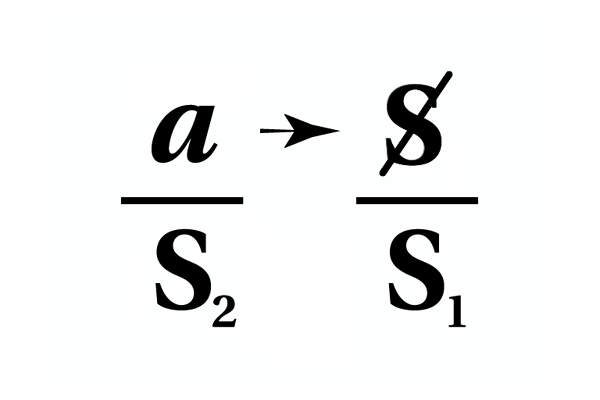
Jacques-Alain Miller:  Our civilization fits the discourse of the Analyst. the “agent” is a surplus enjoyment, the superego injunction to enjoy, addresses (the divided subject) who is put to work in order to live up to this injunction.  If ever there was a superego injunction, it is the famous Oriental wisdom, “Don’t think, just do it.” The “truth” of this social link is S2, scientific-expert knowledge in its different guises, and the goal is to generate S1, the self-mastery of the subject — that is to enable the subject to “cope with” the stress of the call to enjoyment (through self-help manuals and so on)…

Žižek replies:

imbalance between Ego and jouissance, imbalance between pleasure and foreign body of jouissance, pose a threat to the possession of the objet

Ž Antigone LTN

Far from just throwing herself into the jaws of death, possessed by a strange wish to die or to disappear, Sophocles’s Antigone insists up to her death on performing a precise symbolic gesture: the proper burial of her brother. Like Hamlet, Antigone is a drama of a failed symbolic ritual — Lacan insisted on this continuity (he had analyzed Hamlet in the seminar that preceded The Ethics of Psychoanalysis, which deals with Antigone). Antigone does not stand for some extra-symbolic real, but for the pure signifier-her “purity” is that of a signifier. This is why, although her act is suicidal, the stakes are symbolic: her passion is the death drive at its purest-but here, precisely, we should distinguish between the Freudian death drive and the Oriental nirvana. What makes Antigone a pure agent of the death drive is her unconditional demand for the symbolic ritual to be performed, an insistence which allows for no displacement or other form of compromise-this is why Lacan’s formula of drive is $—D: the subject unconditionally insisting on a symbolic demand.  LTN 84

Žižek Parmenides LTN

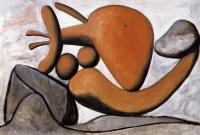
Picasso Woman throwing stone
Woman Throwing a Stone 1931 (Picasso)

🙂 Ž says this does capture the essence of woman throwing a stone. Even though representationalists would dispute this fact, given they like the more ‘realistic’ stuff.

The distinction between appearance and essence has to be inscribed into appearance itself.

Appearance is nothing in itself; it is just an illusory being, but this illusory being is the only being of essence, so that the reflective movement of essence is the movement nothing to nothing. and so back to itself. The transition, or becoming, sublates itself in its passage; the other that in this transition comes to be, is not the non-being of a being, but the nothingness of a nothing, and this, to be the negation of a nothing, constitutes being. Being only is as the movement of nothing to nothing, and as such it is essence; and the latter does not have this movement within it, but is this movement as a being that is itself absolutely illusory, pure negativity, outside of which there is nothing for it to negate but which negates only its own negative, and this negative, which latter is only in this negating.   (Science of Logic Trans A.V. Miller p. 400)

The answer to “Why is there Something rather than Nothing? ” is thus that there is only Nothing, and all processes take place “from Nothing through Nothing to Nothing:’ However, this nothing is not the Oriental or mystical Void of eternal peace, but the nothingness of a pure gap (antagonism, tension, “contradiction” ), the pure form of dislocation ontologically preceding any dislocated content. LTN 38

The corrosive all pervasive force of nothingness

So why a return to Plato? Why do we need a repetition of Plato’s founding gesture? In his Logiques des mondes, Badiou provides a succinct definition of “democratic materialism” and its opposite, “materialist dialectics”: the axiom which condenses the first is ” There is nothing but bodies and languages . . ;’ to which materialist dialectics adds ” . . . with the exception of truths.'” … Badiou here makes the paradoxical philosophical gesture of defending, as a materialist, the autonomy of the “immaterial” order of Truth.  LTN 41

How can a human animal forsake its animality and put its life in the service of a transcendent Truth?

How can the “transubstantiation” from the pleasure-oriented life of an individual to the life of a subject dedicated to a Cause occur? In other words, how is a free act possible? How can one break (out of) the network of the causal connections of positive reality and conceive an act that begins by and in itself?

This, then, is our basic philosophico-political choice (decision) today: either repeat in a materialist vein Plato’s assertion of the meta-physical dimension of “eternal Ideas:’ or continue to dwell in the postmodern universe of “democratic materialist” historicist relativism, caught in the vicious cycle of the eternal struggle with “premodern” fundamentalisms.  How is this gesture possible, thinkable even? Let us begin with the surprising fact that Badiou identifies the “principal contradiction:’ the predominant antagonism, of today’s ideological situation not as the struggle between idealism and materialism, but as the struggle between two forms of materialism (democratic and dialectical ) . Plus, to add insult to injury, “democratic materialism” stands for the reduction of all there is to the historical reality of bodies and languages (the twins of Darwinism, brain science, etc., and of discursive historicism), while “materialist dialectics” adds the “Platonic” (“idealist”) dimension of “eternal” Truths.

Butler on Levinas, Arendt

Judith Butler with Bracha Ettinger At European Graduate School in 2011

The first is whether any of us have the capacity or inclination to respond ethically to suffering at a distance, and what makes that ethical encounter possible, when it does take place.

The second is what it means for our ethical obligations when we are up against another person or group, find ourselves invariably joined to those we never chose and responding to solicitations and languages we may not understand or even wish to understand.

… I am trying to underscore that something impinges upon us, without our being able to anticipate or prepare for it in advance, and this means that we are in such moments affronted by something that is beyond our will, not of our making, that comes to us from the outside, as an imposition, but also as an ethical demand. I want to suggest that these are ethical obligations which do not require our consent, and neither are they the result of contracts or agreements into which any of us have deliberately entered.

Can we understand the working of an ethical obligation upon our sensibilities.  Indeed this word sensibility is one that Levinas reserves for that region of responsiveness that precedes the ego.  A kind of response that therefore is and is not my response.  To say it is my response is to lodge the ego as its source.  But what we’re trying to talk about here is a form of responsiveness that implies a dispossession of the egological.

Ethical obligations that impose themselves upon us without our consent.

It is, of course, one thing to claim this in the abstract, but quite another to understand what the difficulties are in struggling for social and political forms that are committed to fostering a sustainable interdependency on egalitarian terms. When any of us are affected by the sufferings of others, we recognize and affirm an interconnection with them, even when we do not know their names or speak their language. At its best, some media representations of suffering at a distance compel us to give up our more narrow communitarian ties, and to respond, sometimes in spite of ourselves, sometimes even against our will, to a perceived injustice. Such presentations can bring the fate of others near or make it seem very far away, and yet, the kind of ethical demands that emerge through the media in these times depend on this reversibility of the proximity and distance. Indeed, I want to suggest that certain bonds are actually wrought through this very reversibility. And we might find ways of understanding the interdependency that characterizes co-habitation precisely as these bonds.

My own thesis is that the kind of ethical demands that emerge through the global circuits in these times depends on this reversibility of the proximity and distance. Indeed, I want to suggest that certain bonds are actually wrought through this very reversibility. If I am only bound to those who are close to me, already familiar, then my ethics are invariably parochial, communitarian, and exclusionary.

If I am only bound to those who are “human” in the abstract, then I avert every effort to translate culturally between my own situation and that of others. If I am only bound to those who suffer at a distance, but never those who are close to me, then I evacuate my situation in an effort to secure the distance that allows me to entertain ethical feeling.

But if ethical relations are mediated – and I use that word deliberately here – confounding questions of location such that what is happening “there” also happens in some sense “here” and if what is happening “there” depends on the event being registered in several “elsewheres”, then it would seem that the ethical claim of the event takes place always in a “here” and “there” that are fundamentally bound to one another.

In one sense, the event is emphatically local, since it is precisely the people there whose bodies are on the line. But if those bodies on the line are not registered elsewhere, there is no global response, and also, no global form of ethical recognition and connection, and so something of the reality of the event is lost. It is not just that one discrete population views another through certain media moments, but that such a response makes evident a form of global connectedness, however provisional, with those whose lives and actions are registered in this way. In short, to be unprepared for the media image that overwhelms can lead not to paralysis but to a situation of (a) being moved, and so acting precisely by virtue of being acted upon and (b) being at once there and here, and in different ways, accepting and negotiating the multi-locality of ethical connections we might rightly call global.

Can we, then, turn to some versions of ethical philosophy in order to reformulate what it means to register an ethical demand during these times that is reducible neither to consent nor to established agreement and that takes place outside of established community bonds?

I am trying to articulate a version of cohabitation that follows from the account of ethical obligation I am describing. Turning to Palestine/Israel to suggest a set of Jewish views of cohabitation that demand a departure from communitarianism and even Jewish communitarianism and that may serve as a critical alternative during this time that state of Israel seeks to secure its claim to represent Jewishness.

Levinas’s position allows us the following conclusion: that the set of ethical values by which one population is bound to another in no ways depends on those two populations bearing similar marks of national, cultural, religious, racial belonging. It is interesting that Levinas insisted that we are bound to those we do not know, and even those we did not choose, could never have chosen, and that these obligations are, strictly speaking, pre-contractual.

Of course, this raises a question of how there can be an ethical relation to those who cannot appear within the horizon of ethics, who are not persons, or are not considered to be the kind of beings with whom one can or must enter into an ethical relation.

Here is where a most painful division within Levinas’s work continues to haunt those of us who seek ethical resources there. On the one hand, he tells us that we are claimed by others, including those we have never known, those we still don’t know, and that we are born into this situation of being compelled to honor the life of the other, every other, whose claim on life comes before our own.

On the other hand, he claims that this very ethical relation depends upon a specific set of religious and cultural conditions, Judaeo-Christian, and that those who are not formed within this tradition are not prepared for ethical life, and are not included as those who can make a claim upon those who belong to a narrow conception of the West. It is an agonizing contradiction at the heart of Levinas’s writing. But is it possible to take the ethical philosophy formulated there and deploy it against the very exclusionary assumptions by which it is sometimes supported? Can we, in other words, use Levinas against himself to help in the articulation of a global ethics that would extend beyond the religious and cultural communities that he saw as its necessary condition and limit?

Let us take as an example his argument that ethical relations are asymmetrical. In his work, the Other has priority over me. What does that concretely mean? Does the other not have the same obligation toward me? Why should I be obligated toward another who does not reciprocate in the same way toward me?

For Levinas, reciprocity cannot be the basis of ethics, since ethics is not a bargain: it cannot be the case that my ethical relation to another is contingent on their ethical relation to me, since that would make that ethical relation less than absolute and binding; and it would establish my self-preservation as a distinct and bounded sort of being as more primary than any relation I have to another. For Levinas, no ethics can be derived from egoism; indeed, egoism is the defeat of ethics itself.

I take distance from Levinas here, since though I agree in the refutation of the primacy of self-preservation for ethical thinking, I want to insist upon a certain intertwinement between that other life, all those other lives, and my own — one that is irreducible to national belonging or communitarian affiliation.

In my view (which is surely not mine alone) the life of the other, the life that is not our own, is also our life, since whatever sense “our” life has is derived precisely from this sociality, this being already, and from the start, dependent on a world of others, constituted in and by a social world.

In this way there are surely others distinct from me whose ethical claim upon me is irreducible to an egoistic calculation on my part. But that is because we are, however distinct, also bound to one another.

And this is not always a happy or felicitous experience. To find that one’s life is also the life of others, even as this life is distinct, and must be distinct, means that one’s boundary is at once a limit and a site of adjacency, a mode of spatial and temporal nearness and even boundedness.

Moreover, the bounded and living appearance of the body is the condition of being exposed to the other, exposed to solicitation, seduction, passion, injury, exposed in ways that sustain us but also in ways that can destroy us. In this sense the exposure of the body points to its precarity [precariousness].

At the same time, for Levinas, this precarious and corporeal being is responsible for the life of the other, which means that no matter how much one fears for one’s own life, preserving the life of the other is paramount.

If only the Israeli army felt this way! Indeed, this is a form of responsibility that is not easy while undergoing a felt sense of precarity. Precarity names both the necessity and difficulty of ethics.

It is surely hard to feel at once vulnerable to destruction by the other and yet responsible for the other, and readers of Levinas object all the time to his formulation that we are, all of us, in some sense responsible for that which persecutes us. He does not mean that we bring about our persecution – not at all. Rather, “persecution” is the strange and disconcerting name that Levinas gives for an ethical demand that imposes itself upon us against our will. We are, despite ourselves, open to this imposition, and though it overrides our will, its shows us that the claims that others make upon us are part of our very sensibility, our receptivity, and our answerability. We are, in other words, called upon, and this is only possible because we are in some sense vulnerable to claims that we cannot anticipate in advance, and for which there is no adequate preparation.

For Levinas, there is no other way to understand the ethical reality; ethical obligation not only depends upon our vulnerability to the claims of others, but establishes us as creatures who are fundamentally defined by that vulnerability and by that ethical relation. This ethical relation is not a virtue that I have or exercise; it is prior to any individual sense of self. It is not as a discrete individual that we honor this ethical relation. I am already bound to you, and this is what it means to be the self I am, receptive to you in ways that I cannot fully predict or control. This is also, clearly, the condition of my injurability as well, and in this way my answerability and my injurability are bound up with one another. In other words, you may frighten me and threaten me, but my obligation to you must remain firm.

This relation precedes individuation, and when I act ethically, I am undone as a bounded being. I come apart. I find that I am my relation to the “you” whose life I seek to preserve, and without that relation, this “I” makes no sense, and has lost its mooring in this ethics that is always prior to the ontology of the ego.

Another way to put this point is that the “I” becomes undone in its ethical relation to the “you” which means that there is a very specific mode of being dispossessed that makes ethical relationality possible. If I possess myself too firmly or too rigidly, I cannot be in an ethical relation to you. The ethical relation means ceding a certain egological perspective for one which is structured fundamentally by a mode of address: you call upon me, and I answer. But if I answer, it was only because I was already answerable; that is, this susceptibility and vulnerability constitutes me at the most fundamental level, and is there, we might say, prior to any deliberate decision to answer the call. In other words, one has to be already capable of receiving the call before actually answering it. In this sense, ethical responsibility presupposes ethical responsiveness.

Why bring a discussion of Levinas together with one regarding Arendt? Both Levinas and Arendt take issue with the classically liberal conception of individualism, that is, the idea that individuals knowingly enter into certain contracts, and their obligation follows from having deliberately and volitionally entered into agreements with one another. This view assumes that we are only responsible for those relations, codified by agreements, into which we have knowingly and volitionally entered.

And Arendt disputes this view. Indeed, it was the substance of the argument that she made against Eichmann. He thought he could choose which populations should live and die, and in this sense he thought he could choose with whom to co-habit the earth. What he failed to understand, according to Arendt, is that no one has the prerogative to choose with whom to co-habit the earth.

There is no one part of the population that can claim the earth for itself, no community or nation-state or regional unit, no clan, no party, and no race. As I have suggested, to make such a claim is to enter into a policy of genocide. This means that unwilled proximity and unchosen cohabitation are preconditions of our political existence, the basis of her critique of nationalism, the obligation to live on the earth and in a polity that establishes mode of equality for a necessarily and irreversibly heterogenous population.

Indeed, unwilled proximity and unchosen cohabitation serve as well as the basis of our obligations not to destroy any part of the human population, and to outlaw genocide as a crime against humanity, but also to invest institutions with the demand to seek to make all lives liveable.

Thus, from unchosen co-habitation, Arendt derives notions of universality an equality

that commit us to institutions that seek to sustain human lives without regarding some part of the population as socially dead, as redundant, or as intrinsically unworthy of life and therefore ungrievable.

But what is evident is that her views on cohabitation, federated authority, equality, and universality were in stark contrast to those who were defending nationalist forms of Jewish sovereignty, differential classifications for Jewish and non-citizens, military policies to uproot Palestinians from their lands, and efforts to establish a Jewish demographic majority for the state.

Although it is so often taught that Israel became an historical and ethical necessity for the Jews during and after the Nazi genocide, and that anyone who questions the founding principles of the Jewish state shows an extraordinary insensitivity to the plight of the Jews, there were Jewish thinkers and political activists at the time, including Arendt, Martin Buber, Hans Kohn, and Judah Magnus, who thought among the most important lessons of the Holocaust was an opposition to illegitimate state violence, to any state formation that sought to give electoral priority and citizenship to one race or religion, and that nation-states ought to be internationally barred from dispossessing whole populations who fail to fit the purified idea of the nation.

For those who extrapolated principles of justice from the historical experience of internment and dispossession, the political aim is to extend equality regardless of cultural background or formation, across languages and religions, to those none of us ever chose (or did not recognize that we chose) and with whom we have an enduring obligation to find a way to live.

For whoever “we” are, we are also those who were never chosen, who emerge on this earth without everyone’s consent and who belong, from the start, to a wider population and a sustainable earth. And this condition, paradoxically, yields the radical potential for new modes of sociality and politics beyond the avid and wretched bonds formed through settler colonialism and expulsion.

We are all, in this sense, the unchosen, but we are nevertheless unchosen together. It is not uninteresting to note that Arendt, herself a Jew and refugee, understood her obligation not to belong to the “chosen people” but rather to the unchosen, and to make mixed community precisely among those whose existence implies a right to exist and to lead a liveable life.

In Sweden on May 27 2011 at the Nobel Museum Butler gave a similar talk and this is her paper here. IF you want to download it click here. Download a copy of Butler’s talk

Žižek interview

Žižek interview in Guardian June 10 2012

Žižek picture June 2012

Slavoj Žižek doesn’t know the door number of his own apartment in Ljubljana. “Doesn’t matter,” he tells the photographer, who wants to pop outside. “Come back in through the main door, and then just think in terms of politically radical right; you turn from left to right, then at the end, right again.” But what’s the number, in case he gets lost? “I think it’s 20,” Žižek suggests. “But who knows? Let’s double check.” So off he pads down the hallway, opens his door and has a look.

Waving the photographer off, he points in the distance across the Slovenian capital. “Over there, that’s a kind of counter-culture establishment – they hate me, I hate them. This is the type of leftists that I hate. Radical leftists whose fathers are all very rich.” Most of the other buildings, he adds, are government ministries. “I hate it.” Now he’s back in the living room, a clinically tidy little sliver of functional space lacking any discernible aesthetic, the only concessions being a poster for the video game Call Of Duty: Black Ops, and a print of Joseph Stalin. Žižek pours Coke Zero into plastic McDonald’s cups decorated in Disney merchandising, but when he opens a kitchen cupboard I see that it’s full of clothes.

“I live as a madman!” he exclaims, and leads me on a tour of the apartment to demonstrate why his kitchen cabinets contain only clothing. “You see, there’s no room anywhere else!” And indeed, every other room is lined, floor to ceiling, with DVDs and books; volumes of his own 75 works, translated into innumerable languages, fill one room alone.

If you have read all of Žižek’s work, you are doing better than me. Born in 1949, the Slovenian philosopher and cultural critic grew up under Tito in the former Yugoslavia, where suspicions of dissidence consigned him to academic backwaters. He came to western attention in 1989 with his first book written in English, The Sublime Object of Ideology, a re-reading of Žižek’s great hero Hegel through the perspective of another hero, the psychoanalyst Jacques Lacan. Since then there have been titles such as Living in the End Times, along with films – The Pervert’s Guide To Cinema – and more articles than I can count.

By the standards of cultural theory, Žižek sits at the more accessible end of the spectrum – but to give you an idea of where that still leaves him, here’s a typical quote from a book called Žižek: A Guide for the Perplexed, intended to render him more comprehensible: “Žižek finds the place for Lacan in Hegel by seeing the Real as the correlate of the self-division and self-doubling within phenomena.”

At the risk of upsetting Žižek’s fanatical global following, I would say that a lot of his work is impenetrable. But he writes with exhilarating ambition and his central thesis offers a perspective even his critics would have to concede is thought-provoking. In essence, he argues that nothing is ever what it appears, and contradiction is encoded in almost everything. Most of what we think of as radical or subversive – or even simply ethical – doesn’t actually change anything.

“Like when you buy an organic apple, you’re doing it for ideological reasons, it makes you feel good: ‘I’m doing something for Mother Earth,’ and so on. But in what sense are we engaged? It’s a false engagement. Paradoxically, we do these things to avoid really doing things. It makes you feel good. You recycle, you send £5 a month to some Somali orphan, and you did your duty.” But really, we’ve been tricked into operating safety valves that allow the status quo to survive unchallenged? “Yes, exactly.” The obsession of western liberals with identity politics only distracts from class struggle, and while Žižek doesn’t defend any version of communism ever seen in practice, he remains what he calls a “complicated Marxist” with revolutionary ideals.

To his critics, as one memorably put it, he is the Borat of philosophy, churning out ever more outrageous statements for scandalous effect. “The problem with Hitler was that he was not violent enough,” for example, or “I am not human. I am a monster.” Some dismiss him as a silly controversialist; others fear him as an agitator for neo-Marxist totalitarianism. But since the financial crisis he has been elevated to the status of a global-recession celebrity, drawing crowds of adoring followers who revere him as an intellectual genius. His popularity is just the sort of paradox Žižek delights in because if it were down to him, he says, he would rather not talk to anyone.

You wouldn’t guess so from the energetic flurry of good manners with which he welcomes us, but he’s quick to clarify that his attentiveness is just camouflage for misanthropy. “For me, the idea of hell is the American type of parties. Or, when they ask me to give a talk, and they say something like, ‘After the talk there will just be a small reception’ – I know this is hell. This means all the frustrated idiots, who are not able to ask you a question at the end of the talk, come to you and, usually, they start: ‘Professor Žižek, I know you must be tired, but …’ Well, fuck you. If you know that I am tired, why are you asking me? I’m really more and more becoming Stalinist. Liberals always say about totalitarians that they like humanity, as such, but they have no empathy for concrete people, no? OK, that fits me perfectly. Humanity? Yes, it’s OK – some great talks, some great arts. Concrete people? No, 99% are boring idiots.”

Most of all, he can’t stand students. “Absolutely. I was shocked, for example, once, a student approached me in the US, when I was still teaching a class – which I will never do again – and he told me: ‘You know, professor, it interested me what you were saying yesterday, and I thought, I don’t know what my paper should be about. Could you please give me some more thoughts and then maybe some idea will pop up.’ Fuck him! Who I am to do that?”

Žižek has had to quit most of his teaching posts in Europe and America, to get away from these intolerable students. “I especially hate when they come to me with personal problems. My standard line is: ‘Look at me, look at my tics, don’t you see that I’m mad? How can you even think about asking a mad man like me to help you in personal problems, no?'” You can see what he means, for Žižek cuts a fairly startling physical figure – like a grizzly bear, pawing wildly at his face, sniffing and snuffling and gesticulating between every syllable. “But it doesn’t work! They still trust me. And I hate this because – this is what I don’t like about American society – I don’t like this openness, like when you meet a guy for the first time, and he’s starting to tell you about his sex life. I hate this, I hate this!” I have to laugh at this, because Žižek brings up his sex life within moments of our first meeting. On the way up in the lift he volunteers that a former girlfriend used to ask him for what he called “consensual rape”. I had imagined he would want to discuss his new book about Hegel, but what he really seems keen to talk about is sex.

“Yeah, because I’m extremely romantic here. You know what is my fear? This postmodern, permissive, pragmatic etiquette towards sex. It’s horrible. They claim sex is healthy; it’s good for the heart, for blood circulation, it relaxes you. They even go into how kissing is also good because it develops the muscles here – this is horrible, my God!” He’s appalled by the promise of dating agencies to “outsource” the risk of romance. “It’s no longer that absolute passion. I like this idea of sex as part of love, you know: ‘I’m ready to sell my mother into slavery just to fuck you for ever.’ There is something nice, transcendent, about it. I remain incurably romantic.”

I keep thinking I should try to intervene with a question, but he’s off again. “I have strange limits. I am very – OK, another detail, fuck it. I was never able to do – even if a woman wanted it – annal sex.” Annal sex? “Ah, anal sex. You know why not? Because I couldn’t convince myself that she really likes it. I always had this suspicion, what if she only pretends, to make herself more attractive to me? It’s the same thing for fellatio; I was never able to finish into the woman’s mouth, because again, my idea is, this is not exactly the most tasteful fluid. What if she’s only pretending?”

He can count the number of women he has slept with on his hands, because he finds the whole business so nerve-racking. “I cannot have one-night stands. I envy people who can do it; it would be wonderful. I feel nice, let’s go, bang-bang – yes! But for me, it’s something so ridiculously intimate – like, my God, it’s horrible to be naked in front of another person, you know? If the other one is evil with a remark – ‘Ha ha, your stomach,’ or whatever – everything can be ruined, you know?” Besides, he can’t sleep with anyone unless he believes they might stay together for ever. “All my relationships – this is why they are very few – were damned from the perspective of eternity. What I mean with this clumsy term is, maybe they will last.”

But Žižek has been divorced three times. How has he coped with that? “Ah, now I will tell you. You know the young Marx – I don’t idealise Marx, he was a nasty guy, personally – but he has a wonderful logic. He says: ‘You don’t simply dissolve marriage; divorce means that you retroactively establish that the love was not the true love.’ When love goes away, you retroactively establish that it wasn’t even true love.” Is that what he did? “Yes! I erase it totally. I don’t only believe that I’m no longer in love. I believe I never was.”

As if to illustrate this, he glances at his watch; his 12-year-old son, who lives nearby, will be arriving shortly. How is this going to work when he gets here? Don’t worry, Žižek says, he’s bound to be late – on account of the tardiness of his mother: “The bitch who claims to have been my wife.” But weren’t they married? “Unfortunately, yes.”

Žižek has two sons – the other is in his 30s – but never wanted to be a parent. “I will tell you the formula why I love my two sons. This is my liberal, compassionate side. I cannot resist it, when I see someone hurt, vulnerable and so on. So precisely when the son was not fully wanted, this made me want to love him even more.”

By now I can see we’re not going to get anywhere near Žižek’s new book about Hegel, Less Than Nothing: Hegel and the Shadow of Dialectical Materialism. Instead, he tells me about the holidays he takes with his young son. The last one was to the Burj Al Arab hotel, a grotesque temple to tacky ostentation in Dubai. “Why not? Why not? I like to do crazy things. But I did my Marxist duty. I got friendly with the Pakistani taxi driver who showed to me and my son reality. The whole structure of how the workers there live was explained, how it was controlled. My son was horrified.” This summer they are off to Singapore, to an artificial island with swimming pools built on top of 50-storey skyscrapers. “So we can swim there and look down on the city: ‘Ha ha, fuck you.’ That’s what I like to do – totally crazy things.” It wasn’t so much fun when his son was younger. “But now, we have a certain rhythm established. We sleep ’til one, then we go to breakfast, then we go to the city – no culture, just consumerism or some stupid things like this – then we go back for dinner, then we go to a movie theatre, then we play games ’til three in the morning.”

I wonder what all Žižek’s earnest young followers will make of this, and worry they will be cross with me for not getting anything more serious out of him. But to Žižek, Dubai tells us just as much about the world as a debate about the deficit, say, ever can. When his sweet-looking, polite young son arrives, I try to steer Žižek on to the financial crisis, and to the role his admirers hope he will play in formulating a radical response.

“I always emphasise: don’t expect this from me. I don’t think that the task of a guy like me is to propose complete solutions. When people ask me what to do with the economy, what the hell do I know? I think the task of people like me is not to provide answers but to ask the right questions.” He’s not against democracy, per se, he just thinks our democratic institutions are no longer capable of controlling global capitalism. “Nice consensual incremental reforms may work, possibly, at a local level.” But localism belongs in the same category as organic apples, and recycling. “It’s done to make you feel good. But the big question today is how to organise to act globally, at an immense international level, without regressing to some authoritarian rule.”

How will that happen? “I’m a pessimist in the sense that we are approaching dangerous times. But I’m an optimist for exactly the same reason. Pessimism means things are getting messy. Optimism means these are precisely the times when change is possible.” And what are the chances that things won’t change? “Ah, if this happens then we are slowly approaching a new apartheid authoritarian society. It will not be – I must underline this – the old stupid authoritarianism. This will be a new form, still consumerist.” The whole world will look like Dubai? “Yes, and in Dubai, you know, the other side are literally slaves.”

There is something inexplicably touching about all Žižek’s mischievous bombast. I hadn’t expected him to be so likable, but he really is hilariously good company. I had hoped to find out if he was a genius or a lunatic – but I fear I leave none the wiser. I ask him how seriously he would recommend we take him, and he says he would rather be feared than taken for a clown. “Most people think I’m making jokes, exaggerating – but no, I’m not. It’s not that. First I tell jokes, then I’m serious. No, the art is to bring the serious message into the forum of jokes.”

Two years ago his front teeth came out. “My son knows I have a good friend; none of us is gay, just good friends. So when he saw me without teeth, he said: ‘I know why.’ My son! He was 10! You know what he told me? Think, associate, in the dirtiest way.” I think I can guess. “Yes! Sucking! He said my friend complained that my teeth were in the way.” Žižek roars with laughter, great gales of paternal pride. “And you know what was tragicomic? After he told me this, he said: ‘Father, did I tell this joke well?'”

A 24-hour launch event for Less Than Nothing takes place on 15 June 2012 at Cafe Oto, London. versobooks.com.

Less Than Nothing Review in Guardian

Jonathan Rée Review of Less Than Nothing in the Guardian, Wednesday 27 June 2012

The Slovenian philosopher Slavoj Žižek has thousands of devoted fans, and it’s easy to see why. He is cheeky, voluble and exuberant, and over the past 30 years he has turned high theory into performance art. He was born in communist Yugoslavia in 1949, and received a thorough grounding in Marxism and the principles of “dialectical materialism”. In 1971 he got a job in philosophy at the University of Ljubljana, only to be dismissed two years later for being “un-Marxist”. After a stretch of military service, he resumed his academic work and spent a few years in Paris with followers of the surrealistic psychoanalyst Jacques Lacan. In the 80s he adopted English as his working language and launched himself on an international career as a taboo-busting radical theorist. Continue reading “Less Than Nothing Review in Guardian”

Lars von Trier’s Melancholia

Žižek Snippet

Lars von Trier’s Melancholia, I think, it’s a basically, I’m not kidding, optimistic film, even as we know at the end the planet Melancholia hits the earth, we all die. But I find something beautifully poetical in the attitude of the main person, Justine, played by Kirsten Dunst, no, this inner peace, how she accepts this.

I claim that we should not read this as kind of a pessimism. “Oh, we all die. Who cares?” No, if you really want to do something good for society, if you want to avoid all totalitarian threats and so on, you basically should go, we should all go to this, let me call it–although I’m a total materialist–fundamentally spiritual experience of accepting that at some day everything will finish, that at any point the end may be near. I think that, quite on the contrary of what may appear, this can be a deep experience which pushes you to strengthen ethical activity.

The result of this experience is not, “Oh, the end may be near, so let’s kill, let’s just enjoy,” and so on. No, it’s the opposite. Again, paradoxically, I claim it’s not a superficially but profoundly optimistic film.

Žižek interview with Derbyshire and russia talk

Žižek interview with Derbyshire On June 2012  and Žižek in Russia  August 21, 2012

Why Hegel Today?
Cut to Hegel is 1 of the key 3 philosophers: Plato, Descartes, Hegel. Each defines a whole epoch that comes after them but in a negative way.

All history of philosophy is a history of Anti-Platonism: Aristotle, Plato to Nato (Popper, Levinas), Marxist anti-Platonism, Analytical philosophy anti-Platonism. And the same goes for Descartes.  Nobody is ready to be a Hegelian, everyone wants to mark a distance.

The same for Descartes, all modern philosophy is a refute of Descartes.  Leibniz and feminists, ecology etc.  The same is for Hegel, all modern philosophy is a way to distance itself from Hegel: Marx Heidegger etc.  Nobody wants to be a Hegelian.  Even if you largely agree with him you have to set out a marginal space where you disagree with him.

Is is possible to be a Hegelian today.  The answer is NO.

In each of these 3 cases what people react to is SCREEN MEMORY, an easy simplified image and memory which protects you from something much more unsettling, traumatic. And the thing is to see through this screen memory.

Plato: Traumatic encounter, an idea is something you traumatically encounter
Descartes: de-substantialize philosophy, introduces madness into philosophy
Hegel: the ultimate philosopher

All the problems of reading Hegel: the crazy guy who knows everything, Absolute Knowledge, can read the mind of God, this is a screen memory to cover up something which is maybe TOO RADICAL and TRAUMATIC for us to accept today.

Cut to Joke about Ninotchka: Coffee without cream, coffee without milk

but nor is he a historicist. Both poles are wrong.

Hegel is a hinge point in the history of philosophy: The moment of German Idealism 1787 when Kant publishes Critique of Pure Reason  and 1831 when Hegel dies.

CUT TO: Speculative Realists (Quentin Meillassoux, Ray Brassier) This is I think where we disagree. For me philosophy is transcendental. Philosophy before Kant was too naive. They though reality was out there, how do we understand it.

We should think with Hegel but BEYOND HEGEL. All this post-Hegelian reversals, Willing of Schopenhauer, Late Schelling production process for Marx, were ways to NOT confront HEGEL.  Hegel’s deep insight was too traumatic, monstrous to accept for post-Hegelian period. So we have to go back and seek what Hegel did.

CUT TO: Kant’s transcendental turn: the conditions of possible experience. What is it that takes Hegel  beyond Kant. Epistemological into ontological.  What Kant sees as epistemological obstacles, imperfections in knowledge, Hegel sees as “cracks in the real.”

Quantum Physics Uncertainty Principle

Where Heisenberg sees it as an epistemological limitation: velocity/position we can’t measure at same time, if we measure one we can’t get the other

Neils Bohr: Not only can’t we measure at the same time but In itself reality is INCOMPLETE

ŽiŽek brings up the computer game analogy, you play a computer game, and you see a house, but the total house is not programmed, because it doesn’t belong in the game, it only exists in blurred not fully realized way. (This is from the Nicholas Fearn book)

INCOMPLETELY PROGRAMMED REALITY AND QUANTUM physics.

IF we are not to approach the house in the game because its not part of the game, we have incompleteness in reality because God underestimated us. God created the world but God thought we would not go beyond the atom but we surprised him. But I’m an atheist. So is it possible to think reality as incomplete without GOD.

IS IT POSSIBLE TO THINK THIS INCOMPLETENESS WITHOUT GOD.

Heidegger is crucial for me here, I agree with Quentin Meillassoux, ultimately we cannot ask this direct naive question, does this table exist, do I have a soul, all we can do is ask within what hermeneutic horizon do these things appear so that we can ask this question.

The basic way things are disclosed to us. In medieval times nature meant meaningful order, in modern nature becomes grey endless universe, with no value. With Heidegger we can go no further, it’s meaningless. In order to approach the question, REALITY has already to be disclosed to you in a certain way. This attitude becomes our daily bread.

The predominant form of continental French philosophy is historicist discourse theory.  For a typical continental philosopher: Does the human being have a soul. All I can describe the episteme within which such a question could be raised. My problem is IS THIS ENOUGH. CAN WE MOVE BEYOND THE TRANSCENDENTAL. And for me Hegel Lacan is a way to say YES WE CAN but without falling into Speculative Realists pre-Kantian objectivism.

This “reality is out there we can endlessly approach it and so on and so on” No!  How can we break out of the TRANSCENDENTAL HORIZON? the answer for me is Hegel-Lacan. I’m not a continental thinker in terms of this TRANSCENDENTAL HISTORICISM.

I try to be more productively ECLECTIC but in a stupid way. I’m on side of Lacan and Deleuze, because they do not say, “all guys until me are idiots, only I see the way it is.” I don’t do this.

Just look at Hegel’s work. The end of his lectures of the history of philosophy. As a good idealist, he ends up with his system. He says this is where we are today for the time being. He doubly relativizes it. When he talks in his philosophy of history, in 1820 when he talks about about USA and Russia, he says we cannot develop a full philosophical history of these countries, because their century will be the 20th century. Not bad saying this in 1820.

I follow here Robert Solomon, he wrote In the Spirit of Hegel, Absolute Knowing, at every historical period, if you go to the end you reach the limit, so that Absolute Knowing is historicism brought to its most radical extreme. Hegel opens up a space for Otherness. Hegel’s point is not that we now know everything. Hegel is out there is an openness, not that WE know it it all.   Hegel is more materialist than Marx.  Marx thinks the proletariat have access to some historical necessity, out of contradictions of society, you can know history and act as an agent of this knowledge. for Hegel this is too IDEALIST, Hegel is more open to contingency than Marx.

Žižek gives the Hegel lecture at Free University of Berlin in March 2011

Žižek in Russia August 2012 on Totality at 45 minute mark

Totality is not an ideal of an organic whole.  But a critical notion. To locate a phenomenon in it’s totality is not to see hidden harmony of its whole. but to include into a system all its symptoms: antagonism, the Hegelian totality is self-contradictory antagonistic.  The whole which is the true is the whole plus its symptoms, it’s unintended consequences which betrays its untruth.  If you want to talk about today’s global capitalism means you must speak about Congo.

Hegel is absolutely NOT a holistic philosopher.  IF there is something foreign to Hegel, it is the legitimation of EVIL. the comparison with a big painting, you may think you see evil in the world, but the things you see as evil, is like viewing a picture too close and you see just a stain, but from a proper distance that stain is part of the global harmony.  For Hegel this position of holistic wisdom this is NOT Hegel.

Hegel’s dialectic is not this stupid wisdom we have to take into account all sides.  NO for HEGEL TRUTH IS UNILATERAL.

A JOKE

There was in 1930s a debate in Politburo.  Will there be money or not?  First there was a Leftist deviation, Trotsky said there will be no money, it will be a transparent society then Bukharin the Right winger said but money is necessary in a complex society.  Then Stalin says you are both wrong.  There will be a dialectical synthesis, a dialectical unity,  “There will be money and there will be not money. Some people will have money and other people will not have money.”

The space of the Hegelian totality is the very space of the abstract harmonious whole, and all the excesses which undermine it.

For Freud it’s not that we have a normal person and then here and there we have pathologies, as Freud put it, pathological phenomena are the truth of normallity itself.

Whenever you have a project to do something, you can expect it to go wrong.  Every project is undermined by its inconsistency.

“Property is theft.”  external negation becomes self-negation.  Theft becomes internal to definition of property itself.

Hegel does not subscribe to liberal critique of French Revolution (1789 but not 1793). Hegel saw the necessity of going through the Jacobin Terror.  1793-94 is a necessary consequence of 1789.  Only the abstract terror of the French Revolution creates the conditions for liberal freedom. The first choice has to be the wrong choice, it is only the wrong choice that opens the space for concrete freedom.

You arrive at the highest only through the radical contradiction of the lowest. This is the basic temporality of the dialectical process.

The first choice has to be the wrong choice, it is only the wrong choice that creates the conditions for the right choice.  You only arrive at the choice where you see the choice of the rational state, through the choice of abstract terror, it is only terror itself that opens up the space for concrete freedom.  You arrive at the choice in 2 stages, the choice has to be repeated.

Ultimate Hegelian Joke

Rabinovitch, a Soviet Jew, wants to emigrate from Soviet Union.  I want to emigrate for 2 reasons.  1) I want to emigrate because if Soviet Union falls the Jews will be blamed. The bureaucrat says are you crazy, the Soviet Union will be here forever. Nothing will change here.  Rabinovitch says, that’s my second reason. The necessity of this detour is Hegelian

Bad news is God is dead, we have no support in the big Other.  Good news is this bad news, we now have substantial freedom.

Book of Job (click here too): First great critique of ideology in history of humanity. why?  Things go terribly wrong for Job.  Each of his 3 friends (ideologists) try to convince Job that there is a deeper meaning to his suffering. One says God is testing you, the other one, oh God is Just, so if you suffer you must have done something wrong even if you don’t know what, they all 3 try to justify Job’s suffering.

The greatness of Job he doesn’t say I’m innocent, only that these catastrophes have NO MEANING.  God comes and says everything the 3 ideologists say is wrong, and everything Job says is right, he agrees with JOB.  Then comes an even more subversive moment. Then JOb asks god, ok I get the point but nonetheless, “why did I suffer?” God’s reply might sound arrogant. Where were you when I created the earth, all the animals and so on. HOW ARE WE TO READ THIS? Who are you small men to understand me God, we are on different levels. THis is how it is usually read.

GK CHESTERTON provides a much more radical reading: Why did all this happen to me??  God’s reply is usually read as arrogance of god, the gap that separates us from God. Chesteron turns this around God’s answer: You think you are in trouble, look at the entire universe I created it’s one big mess all around.   Here is Žižek at Princeton in Oct 2010 explaining this point

The commandment NOT TO KILL is primarily addressed at God himself, “Don’t be too brutal to humans.” Which I think the first theology to say that GOD IS DEAD is Judaism. The God of the law is a DEAD God.

Recall the story from the Talmud about two rabbis debating a theological point: the one losing the debate calls upon God himself to intervene and decide the issue, but when God (Jehovah) duly arrives, the other rabbi yells at him, go away old man, that since his work of creation is already accomplished, God now has nothing to say and should leave. God says yes you are right and walks away. This is a sacred text, wow!!

The whole strategy is to keep God at a proper distance.  Images of God is too close, God should only be in the letter, a dead god.  The only atheists today are theologists.  People usually say, God dies in Aushwitz.  If there is God how could he have permitted the holocaust.  Even Habermas said a nice answer, in view of the horrors of the 20th Century,  these crimes are so horrible, to describe them in secular terms is not strong enough, it doesn’t match the horror. So we need here some dimension of the sacred, a excessive sublime, its too much, it can’t be explained as a secular affair.   Not only did GoD NOT DIE at aushwitz, maybe he came back at Aushwitz, he came too close to us.     [Ž at University of Vermont Oct 16 2012]

So in Judaism God is dead what only remains is the LAW. But Nietzsche knew this death of God is NOT enough. This death of God is not enough. I think that what happens with the death of Christ is even this dead God which is still alive as a moral authority HAS TO DIE. Which is why the death of Christ can only be read as a radicalization of the book of JOB.

The message of Christ is not don’t worry if you’re in trouble there is a good old guy upstairs that will take care of things. The message of the death of Christ is there is no one. You are alone. Even intelligent Catholic conservatives Paul Claudel, is not put your trust in God, he can do it, but that God put his trust in us.

God expresses his perplexity at his own creationThis is an incredible ETHICAL REVOLUTION.

First step out of Pagan justice means: do your particular duty … this withdrawal culminates in the death of Christ: What dies on the cross: not God’s messenger, what dies on the cross is GOD of BEYOND himself, God as that TRANSCENDENT power that secretly pulls the strings.  Precisely god can no longer be conceived as we are in shit, but there’s a guy up there who secretly pulls the strings, NO this is no longer.  Something tremedous happens in Christianity.  After death of Christ we have not the Father but the HOLY SPIRIT.  where there is love between the two of you I AM THERE.

God says to Job, “You think you are something special but I screwed up everything.”

What dies on the cross is God of beyond itself. Holy Spirit is totally unique, what dies on the cross is this disgusting idea that God is up there as a guarantee of meaning. As in when something appears to us as evil, you are looking too close it is a stain, but if you stand back, you can look at it as a part of global harmony.  The sacrifice of Jesus Christ, there is no big Other, no guarantee of meaning, the Holy Ghost is that we are here alone without a guarantee.  The true message of Christianity is not Trust God, but God Trusts Us.  God abdicated, the Holy Spirit is the first radical egalitarian institution, (Communist Party).

For Hegel what is contingent is necessity itself

No. We are not simply retroactively projecting things into the past. No what if history is not fully constituted, history is open, events are retroactively constituted.

There is needed a materialist reversal of Marx back to Hegel. This opening towards contingency, Hegel is radical thinker of contingency.  The position adopted by Marx is that you as a historical agent can look into history, see where history is going, and then posit yourself as an agent of progress.  Hegel says no way.  This is strictly prohibited by Hegel. For Hegel precisely there is no big Other.  This is not because we cannot know this higher divine plan, its because there IS NONE. Those philosophers who claim that Hegel is also a philosopher of LOVE are RIGHT!!

You know how it is when you fall in Love. You float around in a contingent way. You just slip down on a banana. You are taken to hospital, you fall in love with the nurse. You automatically translate all your previous life as leading to this moment. It is a retroactive semiotic totalization of a contingency. There is a necessity but it is always a retroactive necessity. Something contingently happened and you retroactively create the necessity that leads to it.

Borges wrote about Kafka, every writer has his predecessors, Kafka can be said to create his forerunners or predecessors. No. We are not simply retroactively projecting things into the past. No what if history is not fully constituted, history is open, events are retroactively constituted. Every totality is retroactive. There is no deeper teleology. Something happens contingently and retroactively creates an order. Hegel is more materialist than Marx.

The conservative poet T.S. Eliot stated, this: Every really new work of art, it retroactively changes the whole history of art.  This is the Hegelian theory of totality. With every new break the whole past is re-written.  This is the Hegelian totality.

Something happens contingently and retroactively creates an order. Hegel is more materialist than Marx.

Push this contigency idea to the limit and we get to the ONTOLOGICAL INCOMPLETENESS OF REALITY


True Materialist task, the Hegelian challenge to quantum physics.  Can we think this incompleteness of reality without God thinking it?  This is the task.

***************

Avenir not Future.  Future means also the continuation, once and future thing.  Avenir points to a radical break, a true openness.

LACAN IS JUST AN INSTRUMENT FOR ME TO READ HEGEL, I OPENLY ADMIT IT. AT 39:40

Conservative Hegelians: McTaggert and Bradley

Now its the LIBERAL HEGEL: Hegel of RECOGNITION

CONSERVATIVE LACAN: paternal authority, symbolic law, the problem of today’s permissive society, the only thing that can save us is return to paternal authority

Now Liberal Lacanianism: I part ways with Jacques Miller. Every social field is based on imaginary symbolic illusions, we can only accept the necessity of these illusions, like Edmund Burke, better not to know too much

Late Lacan’s rumblings, how to organize the Lacanian school, his Leninist writings, how to construct a social space, a group, a society of psychoanalysts without the MASTER FIGURE.

Is there a chance for EGALITARIAN society, not just a Tahir square, every now and then.

Alain Badiou: This idea that the state is here to stay. Authentic politics has to take place outside of the state. Authentic politics should not engage in power, but SUBTRACT withdraw, resist.

What I don’t like, I see here an opening for a comfortable safe position, I can be in my safe position. I believe in HEROICALLY INTERVENING.

I don’t sit and wait for some radical violent moment, my attitude is extremely pragmatic. The most threatening thing to do is REJECT dialogue. Occupy Wall St. Oh fine let’s come together, let’s debate. This is not a time to do that. It was only possible there to speak the language of the enemy. Sometimes, you have to strike with all brutal violence (Against Hitler), and sometimes, you have only minor political gestures. I have a sympathy for Obama, (disagree with Tariq Ali), Healthcare. What kind of traumatic sore point this is for the conservative establishment, it disturbs the very foundation of popular American ideology. FREE CHOICE. At the same time its not an impossible demand. There is universal healthcare in other countries. This is how to ACT. Place a demand. NOW Ž sounds like a social democrat.

Hey Liberalism did something wonderful. It was the answer to a desperate predicament of European religious wars. How can we live together, construct a shared space. Even Social Democracy, with all the criticism we can make of it … can you imagine in the period in history of humanity, so many people lived such prosperous free lives in social democratic western Europe in last 50-60 years. But these times are over.

I still accept the greatness of Lenin. We have to accept, it’s easy to say USSR had a great chance, Stalin screwed it up, or No it was already in Lenin, Marx no Rousseau, No it was in Christianity, No it was already in Plato.

On the one hand the October Revolution was an authentic explosion of egalitarianism, emancipatory project. But Stalin … You can’t say same for Hitler. There is no tragic split in Nazism.

I really fully support in OCCUPY WALL ST. But the Bartleby point: I would prefer NOT TO. Contrast to single issues protest, we have for first time Big protest movement that targets Capitalist system as such, there is a structural fault in system as such.

The existing institutional democratic mechanisms we have are not strong enough to control this excess of capital.

What then should the LEFT DO: All Žižek finds here are ironies. Too general stuff. The critique of FINANCIAL capitalism, no its not this. Re-organize society so bankers don’t have power to do this.

THE MORNING AFTER: the true test what will really change when afterwards, things return to “normal” will there be any changes felt there. If no. Then we are in sad cyclical stuff where things explode and then return to normal.

Syriza in Greece is the idea that Ž truly supports. The commies hate Syriza so much they’ll make a pack with New Democracy, because commies say the situation is not ready yet … but if you wait for the right moment the right moment will never arrive, it only arrives through repeated attempts repeated failures.

The lesson the the last years: the true illusion is that things can go on as always with a little tinkering. No we are approaching a zero-point. things cannot go on indefinitely the way they are, even if we don’t do anything things will change, it will be some form of authoritarian, one of the first to get this point was Terry Gillian in BRAZIL. Its crazy comical, Berlusconi rule of BRAZIL. This is for me what is unsettling in China. Till now one can reasonably claim that capitalism may have required 10-20 years of dictatorship, once it began to take hold, there were movements for democracy. THis time is over. Capitalism Asiatic/Berlusconi. Capitalism more dynamic,creative destructive, than our western flavour, but it DOESN’T need democracy to function. IF you are serious about protecting LIBERAL values, you need to work with the socialists.

We like your ideas but why do you stick to Communism?

1. There is still a tradition clearly identified as part of Communism that is precious: Spartucus rebellion, radical millenarian rebellion, there is something great in authentic popular outbursts

2. The problem that I see today is communist problem, all the crucial problems today are problems of the commons, intellectual, bio-genetics, environment.

3. All trauma associated with “communism” all the other terms: Democracy/socialism/justice can all be appropriated but not communism.

4. We are approaching dangerous times. Isn’t it nice to have as your master signifier a term that can remind of all the time of how WRONG things can go, you are all the time aware of how things can go wrong.