Byung-Chul Han

Psychopolitics: Neoliberalism and New Technologies of Power. 2017 Verso

True happiness comes from what runs riot, lets go, is exuberant and loses meaning — the excessive and superfluous. That is, it comes from what luxuriates, what has taken leave of all necessity, work, performance and purpose.

page 52
Byung-Chul Han

The art of living is the art of killing psychology, of creating with oneself and with others unnamed individualities, being, relations, qualities. If one can’t manage to do that in one’s life, that life is not worth living

Michel Foucault cited in Byung-Chul Han

The art of living stands opposed to the ‘psychological terror’ through which subjugating subjectivation occurs.

Neoliberal psychopolitics is a technology of domination that stabilizes and perpetuates the prevailing system by means of psychological programming and steering. Accordingly, the art of living, as the praxis of freedom, must proceed by way of de-psychologization. This serves to disarm psychopolitics, which is a means of effecting submission. When the subject is de-psychologized — indeed, de-voided — it opens onto a mode of existence that still has no names: an unwritten future. 79

ego is a passive effect of signifying chain

Verhaeghe, Paul. Does the Woman Exist?: From Freud’s Hysteric to Lacan’s Feminine. New York: Other Press, 2009.

The ego does not speak, it is spoken. Observation of the process of free association leads to this conclusion, but even ordinary speaking yields the same result.

Indeed, when I speak I do not know what I am going to say, unless I have learned it by heart or I am reading my speech from a paper. In all other cases, I do not speak so much as I am spoken, and this speech is driven by a desire with or without my conscious agreement. This is a matter of simple observation, but it wounds man’s narcissism deeply;

which is why Freud called it the third great narcisssistic humilation of mankind. He expressed it very pithily: … The Lacanian equivalent of this Freudian formula runs as follows: “Le signifiant, c’est ce qui représente le sujet pour un autre signifiant.” Lacan defines the subject as a passive effect of the signifying chain, certainly not the master of it. 102

chantal mouffe

New Statesman Published 19 November 2009

You argue that politicians should seek to create a “vibrant ‘agonistic’ public sphere”. What do you mean by that?

What I have in mind is not simply a space for the expression of any kind of disagreement, but a confrontation between conflicting notions about how to organise society. This does not exist in Britain at the moment, because no political party clearly challenges the hegemony of neoliberalism. There are, of course, disagreements about a variety of issues, but what is lacking is a debate about possible alternatives to the current neoliberal model of globalisation. We have been told by advocates of New Labour that politics now takes place at the centre and that the categories of right and left have become obsolete.

Did the BBC contribute towards the creation of such a public sphere by putting the BNP’s Nick Griffin on Question Time?

In such a situation, which I designate as “post-political”, an agonistic debate cannot exist, and it is not by inviting Nick Griffin on Question Time that things are going to change. That does not mean that he should not have been invited. Indeed, if the BNP is allowed to present candidates at elections, there is no reason to ban its representatives from taking part in public debates. To criticise the BBC for inviting him is typical of themoralistic attitude that has replaced the political confrontation between left and right. Instead of trumpeting their moral condemnation, Labour politicians should be inspired to examine why some of their supporters are being attracted by the BNP. But moral indignation is easier and more self-gratifying than auto-critique.

What concrete changes in British politics would get us closer to your ideal of agonistic democracy?

My agonistic model of democracy acknowledges the existence in social life of antagonistic conflicts, conflicts that concern the configuration of power relations and the way society should be organised. Those conflicts cannot be solved by deliberation, and they will never be eliminated. The aim of a pluralist democracy is to provide the institutions that will allow them to take an agonistic form, in which opponents will treat each other not as enemies to be destroyed, but as adversaries who will fight for the victory of their position while recognising the right of their opponents to fight for theirs. An agonistic democracy requires the availability of a choice between real alternatives and that is precisely what is missing in Britain today. What would be needed to foster an agonistic democracy is a significant break from Third Way politics by Labour or the development of a new party with a clear left identity, like Die Linke in Germany.

You talk about a “post-political” era. What do you mean by this?

When I speak of the post-political, I am not agreeing with Third Way theorists on the need to think “beyond left and right” and the demise of the adversarial model of politics. We have no doubt been witnessing a blurring of the frontiers between left and right in recent decades, but this is not something that I celebrate. In my view, such a post-political situation represents a danger for democracy. I have tried in my recent work to show that our inability to envisage the problems with which we are confronted in a properly political way is the origin of a widespread disaffection with democratic institutions. This is a disaffection that, in several European countries, has led to the growing success of right-wing populist parties.

How has the global economic crisis influenced your thinking?

There was a moment at the beginning of the financial crisis when it seemed that the hegemony of neoliberalism had received a serious blow. After decades of being demonised, the state was suddenly called to the rescue. However, instead of implementing redistributive policies, the intervention of the state has been limited to rescuing the banks. There is, though, a positive aspect. I think there is an increasing awareness that the current model of development is unsustainable.

Interview by Nina Power

logics of critical explanation

Course: Applying Discourse Theory

Logics of Critical Explanation in Social and Political Theory
Published October 1, 2007 by Routledge, New York
Authors: Jason Glynos and David Howarth

Jason Glynos and David Howarth’s (hereafter: GH) have written a comprehensive theoretical tract outlining how one would go about investigating concrete empirical phenomena using a poststructuralist discourse analytical framework. Heavily influenced by a Lacanian inspired discourse analysis that emerged out of Ernesto Laclau and Chantal Mouffe’s post-Marxist intervention Hegemony and Socialist Strategy back in 1985, GH’s intention is to illustrate how a robust, empirically grounded political analysis can be conducted using a combination of three different ‘logics’ of investigation. These three logics are, in order of application: a social logic which characterizes relevant social practices and clusters of practices or regimes. The social logic sets out to answer the query, what is the object of investigation? Next is a political logic which is a genealogical investigation that reveals why a social practice or regime became institutionalized (sedimented) in the social fabric and, alternatively, the possibility it can become ‘dislocated’ through counter-hegemonic struggles. Thirdly and to this reviewer most interestingly, there are fantasmatic logics that locate how subjects are ‘gripped’ by ideology and thus seemingly are attached to social practices that seem to work against their own interests.

So instead of prioritizing totalised and determining social structures on the one hand, or fully constituted subjects on the other, we begin by accepting that social agents always find themselves ‘thrown’ into a system of meaningful practices. However, we also add the critical rider that these structures are ontologically incomplete. Indeed, it is in the ‘space’ or ‘gap’ of social strucures, as they are rendered visible in moments of crisis and dislocation, that a political subject can emerge through particular ‘acts of identification’. Morevover, as these identification are understood to take place across a range of possible ideologies or discourses — some of which are excluded or repressed — and as these are always incomplete, then any form of identification is doomed to fall short of its promise (79).

In short, following Heidegger, subjects are ‘thrown’ into a world not of their choosing, but have the capacity under certain conditions to act differently. But more than this we need also to be able to explain the constitution and reproduction of the social relations into which they have been thrown, and we need also to account for the way in which subjects are gripped by certain discourses and ideologies. Our poststructuralist approach strives to unfold a social ontology adequate to these tasks.

Glynos, Howarth 2007: 79

We must develop a style of research that builds contingency into its very modus operandi, and which is open and attentive to possibilities disclosed by the research itself

Glynos, Howarth 2007: 155

genealogy of discourse theory

Jacob Torfing, “Discourse Theory: Achievements, Arguments, and Challenges” in Discourse Theory in European Politics. David Howarth, Jacob Torfing (eds). Palgrave, 2005. pp. 1-32.

As against Hume, it was Kant who argued that “perception and experience of empirical phenomena are made possible by some pregiven categories in the human mind.” Discourse theory agrees that we should focus on the conditions of possibility of our perceptions, utterances, and actions, rather than on the factual immediacy or hidden meaning of the social world.” (10)

There have been many attempts in the history of Western thought to explain the course of history, the structure of society, and the identities of subjects and objects by reference to an underlying essence which is given in a full presence and plenitude and not implicated in any historical processes of structuration. God, Reason, Humanity, Nature, and the Iron Laws of Capitalism are some of the celebrated candidates for this transcendental determining centre … Discourse theory aims to draw out the consequences of giving up the idea of a transcendental centre. The result is not total chaos and flux, but playful determination of social meaning and identities within a relational system which is provisionally anchored in nodal points that are capable of partially fixing a series of floating signifiers. (13).

Two differences between the classical transcendentalism of Kant and poststructuralist discourse theory:

1. The conditions of possibility are not invariable and ahistorical as Kant suggest, but subject to political struggles and historical transformation. As such, discourse theory adopts a quasi-transcendental view of the conditions of possibility.

2. Discourse theory does not see the conditions of possibility as an inherent feature of the human mind, but takes them to be a structural feature of contingently constructed discourses. Discourse theory focuses neither on observable facts nor on deep meanings, but on the historical formation of the discursive conditions of social being.

on the subject

When it comes to the theory of the subject, post-structuralism has retained a rather structuralist view that threatens to reduce the subject to an objective location within the discursive structure, or, as Louis Althusser phrased it: to a ‘mere bearer of the structure’. The idea that the subject simultaneously occupies the position of being a worker, a woman, an environmentalist, and so on, might help us to combat class reductionism, but provides an inadequate understanding of the processes that lead to the formation of multiple selves.

real of woman

Campbell, Kirsten. Jacques Lacan and Feminist Epistemology. Florence, KY, USA: Routledge, 2004. p 127-131

The production of the excluded ‘reality’ of women is evident in, for example, the case of sexual harassment.

Before feminist activism in this area, social discourses did not represent the ‘experience’ of sexual harassment. Sexual harassment existed as a social practice, but it was not possible to articulate that experience as such within the symbolic economy of existing social discourses. These experiences were literally ‘not spoken of’.

Yet at the same time, the sexual harassment of women is a social practice that is produced by gendered social relations. The social discourse produces both the practice and its disavowal. The exclusions of social fictions can be traced to the operation of a phallic Symbolic order that produces discourse as discourse and subject as subject.

In Lacanian terms, the production of the real of women as an excluded term of discourse is linked to the impossibility of symbolically rendering women in a phallocentric Symbolic order. The Lacanian position links the excluded real of women to the symbolically repudiated female body of the Mother in a phallic Symbolic order. In feminist terms, this symbolic economy renders ‘women’ as either the phantasy of The Woman or as an excluded term. In this formulation, feminist discourses articulate the founding symbolic repudiation of the excluded real of women.

Unlike social fictions, feminist discourses render the real of women not as lack but symbolize and reinscribe it into the signifying chain. This reinscription shifts the relation of symbolic elements within the chain, producing a new chain of signifiers. This reinscription produces a new discourse and thus a different representation of women.

Instead, the a should be understood as analogous to the Lacanian concept of the Real. This concept is one of Lacan’s most difficult and complex, as he uses it in many linked senses and its meaning changes over the course of his work. … Lacan posits the Real as excess, impossibility and lack. In Lacan’s earlier work, it is a material plenitude which exceeds the Symbolic order, and in which nothing is lacking … In Lacan’s later work, the real is impossible (‘le réel, c’est impossible’) (S17: 143). It is a logical obstacle that cannot be represented within the symbolic (S17: 143). For this reason, the Real is also lack in language, because it marks that which the Symbolic cannot symbolize. No signifying chain can represent it in its totality – hence its impossibility. Something must always fall out of discourse, which is its excluded a. 131

In this way, the Real can also be understood as the hole in the Symbolic order, the impossibility on which that order is predicated and the absence that it encircles. 131

It is not the matching of a signifier to its correlative signified, because there is no metalanguage able to tell the truth about truth and no transcendental signifier that can fix meaning as a correlate of reality (Lacan 1965: 16, Éc: 867– 868). Knowledge is a discourse of the Real, diffracting it through the prism of discursive structures. The production of a new signifying chain represents a different relation to the Real, and with it a new ‘real’.

My account of feminist knowledge does not understand the Real as a fixed entity that the act of knowing passively uncovers. Rather, it is the constitutive ‘outside’ of the existing limits of discourse. An effect of the excess plenitude of the Real is theoretical and political possibility.

If the Symbolic order does not represent the totality of being, then language can take a different form, can represent a different relationship to the Real, and can represent a different Real. It becomes possible to signify the Real differently. Such a conception grants a utopian dimension to knowledge, for if it is not immutable, then the world that it represents is not given, and it can describe a different Real.

Accordingly, knowledge exists in both a present and a future signifying relation to the Real. If the Real is an impossible plenitude, it becomes possible to accept that we can never fully know or represent it, while also accepting that it offers a multiplicity of possibilities.

There can be other symbolic exclusions from discourse, such that the operations of discourse are less costly to those excluded others of the Symbolic order.

We need not conflate the lack in the symbolic with a Symbolic that represents femininity as lack. To claim that it is possible to change a signifying relation to the Real (and with it the signifying relation to object, self and others) is not to claim that it is possible to obtain a mystical fusion with the plenitude of the Real, in which language is adequate to its all and the speaking being suffers no loss. My conception of feminist discourse assumes that there is no knowledge that can ever provide a full and adequate representation of the world. Rather, knowledge is necessarily incomplete, situated and partial, such that it cannot ever represent all, or be a transcendental Truth.

Campbell, Kirsten. Jacques Lacan and Feminist Epistemology.
Florence, KY, USA: Routledge, 2004. p 132.
http://site.ebrary.com/lib/oculryerson/Doc?id=10098962&ppg=145

Copyright ? 2004.  Routledge.  All rights reserved.

phallic signifier

Campbell, Kirsten. Jacques Lacan and Feminist Epistemology. Florence, KY, USA: Routledge, 2004. p 122.

Social fictions are not seamless and unitary, but multiple and contradictory. For example, Gloria Anzaldúa argues that for the Hispanic lesbian markers of ‘identity’ often conflict, and that ‘self’ is negotiated in those conflictual identificatory demands (1987: 77– 91). Anzaldúa describes a process in which master signifiers of the subject – those markers of ‘self’ – produce a subject with multiple discursive interpellations.

Anzaldúa’s account is in clear contrast to the white bourgeois and heterosexual masculine subject whose markers of identity seem to ‘match’ the master signifiers of social fictions of modern Western society. The subject is produced in both personal and social histories that are fundamentally imbricated. In this way, social fictions are discourses of both the subjective and the social, because an imaginary and symbolic relation to other subjects always produces the subject.

This description of the subject draws on the Lacanian psychoanalytic insight that the psychic and the social are moments of each other, produced in the basic ‘nature’ of humans not to be natural.

However, the concept of the social fiction does not imply the liberal idea of the social contract in which individual subjects of consciousness agree at a mythical moment of origin to enter rational social arrangements. Rather, it retains the Lacanian insistence that there is no pre-discursive reality since the world is always already inscribed in discourse (S20: 32).

The subject does not therefore emerge into a neutral social world but is inserted into already existing social relations. Social fictions exist prior to the subject and its very existence is contingent upon them. Social fictions are discursive relations between subjects that have material effect because they are ‘lived’ by subjects. This material effect can be seen in the operations of fictions of gender.

For example, while the Symbolic order is a symbolic relation between subjects, the phallic signifier orders that relation, positing some subjects as having the phallus and others as not having it.

At this symbolic level, the possession or absence of the phallus defines subjects. However, at a discursive level, the symbolic relation is filled with content as to the ‘nature’ of sexed identity. The social fictions of ‘masculinity’ and ‘femininity’ attach respectively to a subject with or without the phallus. The fictions of gender interpellate male and female bodies as masculine and feminine subjects, so that it fixes the contingency of the relation between phallus and penis. The fictions of gender render penis, phallus and masculinity as male subjectivity. In the Western social world, the phallus is a signifier that proliferates in a multitude of discourses of masculinity, which in turn produce a number of recognizably ‘masculine’ subjects.

Male subjects can recognize themselves as ‘masculine’, and equally importantly, other subjects are able to recognize them as ‘masculine’. Social fictions are symbolic relations that have material effects, and those material effects give substance, reality and existence to these symbolic relations between subjects.

Jane Gallop points out that it is not just the referentiality of phallus/penis that produces ‘masculinity’ but also the social arrangements that attach power of many forms to the masculine subject (1988: 53). The social world of the fictions of gender is still riven with material and structural inequality for women.

… The social fiction of gender operates such that even if a female subject were to want to take up a ‘masculine’ position, she would find innumerable difficulties in doing so. These difficulties arise not only because she may not identify with the social fiction of masculinity, but also because other subjects may insist on her insertion into the social discourses of femininity, regardless of her identificatory position.

In this sense, the subject is not its own creation, for it must always contend with the realities of social life. The world of the social fiction has facticity, in the sense that it is prior to the subject and has a material and psychic reality for the subject.

Positing the subject
Social fictions produce a subjective position of social identity, in which ‘position’ describes a temporal and spatial moment of subjectivation rather than an ontological foundation. The true subject of the social fiction, like the subject of the Lacanian account it draws upon, is empty.

Fraser claims that ‘Lacan’s account of identity construction cannot account for identity shifts over time’ (1992: 183). However, the Lacanian subject is never an ‘essence’, not even an Oedipal essence. Identity is fictional, for otherwise psychoanalysis could not have as its aim ‘identity shifts’. The Lacanian account fundamentally engages with the spatial and temporal formation of subjectivity and intersubjectivity, and my model of the subject of social fictions takes up the Lacanian emphasis upon its continual production.

In this model of the social fiction, two key and ongoing processes of interpellation produce a speaking position of the subject. The first key process is the personal history of the subject, that is, its production within familial networks. However, these familial relationships are not ‘outside’ the symbolic networks of social fictions, so that a personal history describes a position formed at the intersection of both psychic and social histories.

In this first process of interpellation, the subject comes into existence as a ‘being’ which possesses a ‘self’. These imaginary relations to self and others make discursive relations lived or ‘real’. That child becomes an adult, a social being that lives in and through its formative social fictions.

In this second key process of interpellation, the subject ‘mis/recognizes’ itself in discourse, in terms of its already given ‘identity’ and ‘self’. In this sense, identification with the master signifiers of social fictions reproduces the subject, because it reiterates the imaginary and symbolic relations which were formative of the subject and which capture the subject in social fictions. That capture is a process both of an experience of ‘identity’ and of an enactment of an ‘identity’ for others. This subject does not simply reflect existing social identities, because it also has agency. It can ‘read’ social fictions for their representation of dominant identities and act on that reading, such that the subject can represent itself through different master signifiers of social identity and come to occupy a different position of identity.

An example of this process can be seen in class mobility, in which the subject takes on the cultural markers of its aspirant class.

‘Identity’ in social fictions is not a social construct imposed upon a passive subject. The subject itself acts to produce its identity by reproducing or resisting fictive identities. Nevertheless, it is not necessarily easy to attain subjective mobility, particularly in relation to sexualized and racialized bodies, since sexuality and race are read on to and mark the body itself.

Transsexuals recognize that social fact in their desire to be bodily ‘men’ or ‘women’, rather than only presenting the signs of ‘masculinity’ or ‘femininity’. The desire for surgical intervention shows how immobile gender ‘mobility’ can be. In transsexuality, the subject represents itself to others through master signifiers of ‘masculinity’ or ‘femininity’. In this example, the subject is concerned with its representation of its ‘self’ to others. However, those others may insist that the subject embody particular and ‘fixed’ master signifiers of sexual difference, and it is this insistence that the transsexual often seeks to evade. In its relations to others, the subject engages with the imaginary and symbolic relations of social fictions that others seek to impose upon it. Because of sexist or racist others, it may not be possible to evade another’s signification of our ‘selves’ in discourses of social fictions.

Subjective engagement with social fictions is performative in Butler’s sense and is therefore open to change. However, others will constrain the mobility of that performance of identity. The subject has agency in relation to social fictions because of their contingency. The relation of subject to social fictions is a contingent one, as it is fixed by imaginary and symbolic relations. For example, the relation between the female body and ‘femininity’ is conditional upon the fixing of cultural difference to bodily difference (Chanter 1997: 59). However, to argue that this relation is contingent is not to argue within a sex/gender model that has generally dominated feminist thinking.

The psychoanalytic inflection of the social fiction emphasizes the production of sexed subjectivity within imaginary and symbolic relations. If the subject is always already sexed, then feminist resistance is not merely a matter of reinscribing the female body (although this may be a strategy of that resistance), but also requires intervention in the symbolic and imaginary orders that produce our relation to ourselves and others.

For this reason, my account of the social fiction should not be misread as a social constructivist account of the imposition of a social order upon a passive being, with an additional psychoanalytic emphasis on the psychic mechanisms that produce social identity. … Joan Copjec points out that if the constructivist model was an accurate description of the production of subjects, the social world would create content and happy beings whose pleasures were commensurate with its normative roles (1994: 53– 54). This clearly is not the case. 125

My account of the social fiction is distinguishable from that influential sociological account by its Lacanian insistence that social integration is neither ‘successful’ nor complete. As a psychoanalytic social theory, the social fiction emphasizes the cost and failure of production of the subject in social (re)production.

Psychoanalysis posits a moment of failure of and excess to the social that is produced in the social order itself: the unconscious. The unconscious marks the failure of the social order to complete and fix the subject. The unconscious marks that failure of the social order to integrate the subject fully or satisfactorily into its discursive demands. However, the unconscious also marks an excess to the social. Unconscious desires, fantasy and identification interpellate the subject in discursive formations, but they also mark subjective demands that exceed those social discourses, as the unconscious describes culturally repudiated desires of the subject.

For this reason, Jacqueline Rose is right to argue that a political project which is also psychoanalytically inflected cannot reify the unconscious – for the unconscious represents what we (and the social order) do not want as much as that which we do (1986: 8).

For example, the hysteric’s dilemma is an outcome of that repudiation of desire. In this sense, the unconscious marks that which the social order repudiates and represses, and so represents its excess. Psychoanalysis recognizes the anti-social, aggressive and solipsistic nature of an unconscious for which there is no negation.

In my psychoanalytic model of intersubjective relations, the subject is fictional and the signifier ambiguous. The subject and meaning are never determined; where they are fixed in a monologic symbolic economy, it is always at some cost to the subject.

The psychoanalytic insight of the cost of civilization concerns the suffering of the subject that the fixity of repetition causes. This failure of complete interpellation not only reveals the cost of securing social identity, but also creates the possibility of its contestation. If social integration is never complete, then the dominant fictions of our social order cannot ever entirely succeed, and where they are secured, it is only at a cost to the subject itself. Most importantly, in this account a moment of failure founds social relations themselves.

Social relations as symbolic relations fail because they are structured by an order which itself suffers a limit and concomitant failure in its symbolic logic. The Symbolic order is structured in an absence – a lack that founds and produces that order. Rose argues that both psychoanalysis and feminism share the position that a limit and a failure of the social order is sexual difference – specifically, the sexual difference of women (1986: 91).

In the modern socio-symbolic order, the social stumbles upon ‘Woman’ which functions as an unstable ‘break’ upon which it is founded and founders. If the cost of sociality is borne by all subjects, that cost is borne differently by sexuated subjects. Subjects may exchange a common loss which is the price of sociality, but the bearer of that loss is the female subject who represents all subjects’ lackin-being. For this reason, Freud is correct to see ‘women’ as a problem of the social, since ‘women’ represent its limit as well as its ground (1930: 293). Yet this position of women can also be reread as possibility – for the possibility that the phallic social order fails to define all that women are produces feminist knowledge. In this reading, women do not represent the ‘problem’ of sociality, but rather that ‘problem’ is a symbolic and social order that would posit women as a defining limit. This political shift is made by feminism. While social fictions of gender may constitute female subjectivity, feminist discourse articulates their inability to symbolize the ‘not all’ of women. It represents the possibility that a social fiction is fictional, and as such it is possible to contest and change it. 126-127

social fictions symbolic

Campbell, Kirsten. Jacques Lacan and Feminist Epistemology. Florence, KY, USA: Routledge, 2004. p 119.

Social fictions are culturally dominant representations of how to be a subject and how to exist as a subject in relation to other subjects.

… Lacan links what he describes as the dominant discourse of our age – the Discourse of the Master – to the rise of capitalism and the modern ego (S17: 207), indicating that discourses are historically and culturally specific. Accordingly, social fictions can be understood as historically and culturally specific forms of the Symbolic order, which articulate particular historical and cultural discourses.

Judith Butler offers a useful reading of the Symbolic order as ‘a register of regulatory ideality’, which includes not only sexualized but racialized interpellations (1993b: 18). For Butler, the Symbolic produces ‘regulatory norms’ which demarcate and delimit forms of family, identity and love (1997b: 66). It represents ‘reigning epistemes of cultural intelligibility’ (1997b: 24), suggesting that it is a set of cultural rules which constitute social norms.

However, in this formulation, the Symbolic remains a closed and monolithic structure that produces a single normative subject. Such a conception of the Symbolic does not explain the many discourses of identity, or their historical specificity – which are precisely the grounds of Butler’s critique of the Lacanian notion of the Symbolic.

‘Social fictions’ help us to understand the ‘register of regulatory ideality’ as a discursive register of social fictions, as discourses of identity that produce it through the identification with master signifiers of sexualized and racialized subjectivity. The Symbolic order also produces racialized and sexualized relations between subjects, operating as a register of regulatory relations. While the Symbolic order structures discourses in terms of the production of sexualized and racialized subjects and intersubjective relations, the ‘content’ of those identities and social relations will be historically and culturally articulated as social fictions. Social fictions are therefore specific to a historical moment of that social order. In this way, social fictions are contingent in the sense that they represent particular cultural and historical forms of the discursive production of identity. If social fictions are contingent and mobile, then they are open to political contestation and change.

symbolic cuts the real

Campbell, Kirsten. Jacques Lacan and Feminist Epistemology. Florence, KY, USA: Routledge, 2004. page 108

Feminist discourse

In the Lacanian account of language, the Symbolic order is that which literally orders an undifferentiated Real (É: 71– 72). 2 An effect of that arrangement of signifiers is to ‘cut’ the Real, such that the Symbolic order structures signification of the Real in one way rather than another.

In Lacan’s later reformulation of the discursive operation of the Symbolic order, signification is structured so that it privileges certain discursive operations while excluding others. The Symbolic order delimits discursive operation because it inscribes certain subjects but not others, and certain social relations but not others. 107

However, it is that which the socio-symbolic order does not represent that puts feminism to work.

In many different practices, feminist knowledges attempt to reinscribe the object as subject through the tropes of the ‘impossible’ feminine, the repressed maternal, the refused body, the banished other, a misrecognized difference, an ‘unimaginable’ utopia. As the third-waver Barbara Findlen describes it, feminism has named ‘the problem that had no name’: by the time that I was discovering feminism, naming had become a principle occupation of feminists.

Everywhere you looked feminists were naming things – things like sexual harassment, date rape, displaced homemakers and domestic violence – that used to be called, as Gloria Steinem pointed out, just life. (1995a: xi)

In Lacanian terms, feminist knowledges represent that which the Symbolic order does not represent, and bring into the signifying order that which it previously refused. Applying the Lacanian model, how then might we understand the structure of this discourse? In its most structural and minimal terms, we might say that feminist discourse represents the a, the excluded of discourse. We can represent existing discourse and its relationship to its excluded term like this:

Existing discourse: s-s-s-s-s-s|a

Feminism recognizes that the Other is lacking; that it excludes from its symbolic economy the a. Feminism sets the knower to work, and the product of that work is a new signifier. Feminist knowledges articulate the a and produce a new signifier. 3 This new symbolic element represents that which the signifying chain did not previously articulate, the a:
Feminist discourse: Feminist knowledge affirms the existence of this excluded term, in an act that Freud (1925a: 438– 439), and Lacan (S1: 57– 58) following him, describe as a judgment of existence. By such a judgment ‘we symbolically affirm the existence of an entity: existence is here synonymous with symbolization, integration into the symbolic order – only what is symbolized fully “exists” ’ (Zizek 1992: 136). It is possible, then, to describe a feminist act of knowing as an act of symbolization, which articulates the a of discourse in a judgment of existence. This symbolic affirmation gives the a existence, producing a new signifier. 108
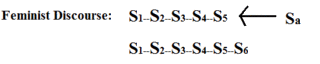
In the Lacanian model, the inscription of a new signifier into the signifying chain produces new discourses. Because the differential relation of symbolic elements in the signifying chain produces meaning, its production is contingent upon a particular relationship of signifiers. However, the inscription of the excluded term reorders the relation of those symbolic elements. The insertion of the otherwise excluded term changes the previously closed order of these elements, creating a new discursive structure and so a new signifying chain. In this way, the analysand produces a new discourse and hence new meaning. From this model, it is possible to understand how the feminist articulation of the a can produce a new discourse. In the operation of feminist discourse, the act of knowing inserts a new signifier into the existing structure of symbolic elements, and thus forms a new signifying chain:

taken from page 109

The disruption and rearrangement of the prior signifying order produces a new relation of symbolic elements, and hence a new discourse. This new discourse produces new meaning, and hence a different representation of the world. This new representation of the world provides a new way to understand it. If knowing is a discursive practice, then the production of new discourses permits the creation of new knowledges by which to know the world.

In the 1970s, the feminist movement began to name the sexual violence many women experienced, but which was perceived neither as a political issue nor as being related to gender politics. This naming is the signification of the a of discourse, because it represents a violence against women which had previously not been articulated. The naming of gendered harms produces a signifier of an otherwise unsignified a of social discourses. …, Deirdre Davis argues that ‘[i]n order to address, deconstruct, and eradicate a harm, we must give the harm a name’ (1997: 200). This naming of the a is then inscribed into the signifying chains of social discourses, which produces a new signifying chain, or knowledge, around the issue of gendered harms. In this way, feminism produces new discourses of gendered harms that fundamentally shift the social meaning of sexual violence.

jodi dean politics without politics

Dean, Jodi. “Politics without Politics” Parallax, 2009, vol. 15, no. 3, 20–36.

In this concrete sense, Žižek is right to claim that attachment to democracy is the form our attachment to capital takes. In the consumption and entertainment-driven setting of the contemporary United States, one’s commitments to capitalism are expressed as commitments to democracy. They are the same way of life, the same daily practices of ‘aware-ing’ oneself and expressing one’s opinion, of choosing and voting and considering one’s choice a vote and one’s vote a choice.

… democracy names left castration (‘I know, but nevertheless’). Because the left presents itself as appealing to and supporting democracy, it fails to take a stand, to name an enemy. Instead of drawing a line and saying what it is against, what it excludes, left political theory in the contemporary United States advocates inclusion, universality, multiplicity, the plurality of modes of becoming, and ethical responsiveness (Dean 21).

Insofar as left political theory adopts democracy as its primary aspiration, it disavows the fundamental antagonism conditioning politics as such. For the left (in the United States and in parts of the European Union), democracy thus takes the form of a fantasy of politics without politics (like fascism is a form of capitalism without capitalism): everyone and everything is included, respected, valued, and entitled. No one is made to feel uncomfortable. Everyone is heard and seen and recognized and has a place at the table (George Lakoff identifies Barak Obama as a key figure in the new politics, which is precisely this ‘politics’ of unity, empathy, and understanding) (Dean 21).

There are at least three sites a theory of democracy might
designate:

a. democracy might designate a site of resistance, struggle or opposition;

b. democracy might designate a system of governance, order, or rule;

c. democracy might designate a society, culture, or spirit (ambient milieu).

Which of these three is correct? Derrideans would say the fourth one: democracy is always to come and hence necessarily exceeds the three aforementioned sites. But this answer is just another version of ‘I know but nevertheless’. Democracy remains an ideological fantasy covering the failures, excesses, and obscenities of real existing democracy. The Derridean response thus returns me back to where I started: democracy as the solution to the problems of democracy or the democratic capture of left aspirations to equitable and sustainable distributions of resources, labor, and its products.

Derridean democracy to come and the post-politics, post-democracy thesis are two sides of the same coin. They are two aspects of democratic time, past and future, but not now (Žižek might say that their relation is that of a parallax; we can see democracy from each perspective but not from the two perspectives simultaneously). Consider a chant repeated at hundreds and thousands of protests over the last decade: What do we want? Democracy! When do we want it? Now! This chant works as a protest because it is clearly impossible. What would happen if the response were ‘Okay, protestors, you’ve got your democracy. Now what are you going to do?’ Imagine the executive branch of the US government walking off the job, handing their codes and files and top-secret stamps to the throngs outside their gates, the protestors wondering what to do with their puppets, signs, and bongos as they fragment into affinity groups and try to decide what their goals and priorities are. The protestors are not really demanding democracy now. Their demand is not meant to be met. Democracy has already arrived – as language of right and left, governance and electoral politics, ambient milieu. This is what democracy looks like, real existing democracy. To avoid the trauma of the real, of getting what we wished for, leftists move from actuality to possibility (from what we have to what could be) … (Dean 25).

But this move from actual to possible democracy doesn’t quite work. It misses its own movement or moving, the torsion that the shift from actual to possible entails. Žižek’s description of the temporal anamorphosis (distortion) of objet petit a is appropriate here:

Spatially, a is an object whose proper contours are discernible only if we glimpse it askance; it is forever indiscernible to the straightforward look. Temporally, it is an object which exists only qua anticipated or lost, only in the modality of not-yet or not-anymore, never in the
‘now’ of a pure, undivided present.18

This description applies to democracy. Democracy is anticipated or lost, but never present. When one looks at the present, all one sees is a gap, perhaps manifested by multiple attempts to fill it, as in the various definitions of democracy as resistance, governance, or ambient milieu.

There can be past democratic ideals – nostalgic fantasies of Athens, town meetings, our days in the resistance – or there can be hope for the future, justification of present acts in terms of this future, but there isn’t responsibility now. So disavowing democracy’s arrival, democracy now, contemporary left fantasies of democracy animate its diagnoses of post-politics and inspire its rejections of law, regulation, and the state.

In the account I’ve offered thus far, democracy appears as an obscure object-cause of desire, something that can never be fully attained or reached without ending the desire for it. But this is only one aspect of objet a. The other is its status in drive, not as something lost but as a hole or gap, not as an impossible lost object but as loss itself.

DRIVE

Drawing from Lacan, Žižek construes drive as fixation, not as the thing onto which one is fixated. In drive, enjoyment comes from missing one’s goal, from the repeated yet ever failing efforts to reach it that start to become satisfying on their own. Drive circulates around an object, generating satisfaction through this very circulation. Perhaps paradoxically, then, drive is at the same time disruptive. Fixation cuts into and derails the regular course of things, what is taken for the conventional patterns of everyday life, assessments of benefit and risk, pragmatic realism, and the organic attempts to secure the conditions of life. It’s a traumatic kernel in the reality of the symbolic order itself.

This drive dimension better describes democracy for the left; it is our circling around, our missing of a goal, and the satisfaction we attain through this missing. It accounts for the attachments and repetitions to which we are stuck, even as this very stuckness undermines our possibilities for political efficacy. Democratic drive, then, is another way of conceiving democracy as ambient milieu, a way that highlights the circulation we can’t avoid, but which at the same time can’t be understood as giving us what we want even as it gives us something else instead, some kick of enjoyment. We protest. We talk.We complain.We undercut our every assertion, criticizing its exclusivity, partiality, and fallibility in advance as if some kind of purity were possible, as if we could avoid getting our hands dirty. We sign petitions and forward them to everyone in our mailbox, fetishizing communication technologies as the solution to our problems. We worry about conservatives even as we revel in our superiority – how can anyone be so stupid? We enjoy (Dean 26).

I’ve presented post-politics and democracy-to-come as two sides of the same coin. I’ve suggested that the gap separating and connecting them be thought in terms of the closed circuit of drive rather than the openness of desire. So understood, democracy is not what we seek but never reach, not a name for political desire as such, but instead a term for the capture of political aspiration in the circuit of drive. Democracy is a remnant from the nineteenth and twentieth centuries we have yet to escape. Differently put, if democracy names a political desire that is never fulfilled,
then it is accompanied by a political drive wherein democracy is what we fail to escape. In this dimension of drive, democracy designates our political stuckness (Dean 28).

My argument is that gaps emerge; they are political, and contemporary democracy organizes enjoyment as an effect of circling around these gaps. Rancie` re’s narrativization, then, is better understood an image of the capture of politics in the circuits of democratic drive. The contemporary setting is not one of simple opposition between post-political consensus and the eruption of irrational violence (and eruption Rancie`re views as a return of the archaic). Rather, it involves the satisfaction of the democratic drive as its aims remain inhibited (Dean 35).

Rather than achieving the goal of equality, then, disagreement produces satisfaction; I’ll call it a political satisfaction, by staging the lack of equality. Although it might seem paradoxical that one’s aim is not agreement to one’s demand – the demand for equality – the paradox occurs only in the register of desire. Understood in terms of drive, the bending or distortion or change in the aim such that the failure to reach it provides enjoyment makes sense. The aim of equality is sublimated in the drive to make one’s disagreement with inequality appear. One gets satisfaction by appearing in one’s disagreement. This provides its own partial enjoyment and in fact can only continue to provide it so long as there is inequality, so long as the ostensible aim in staging the disagreement isn’t reached (Dean 35).

Rancière’s account of the staging of disagreement, rather than figuring the political as such (the political confrontation between politics and the police) exemplifies the sublimation of politics in democratic drive. As drive, democracy organizes enjoyment via a multiplicity of stagings, of making oneself visible in one’s lack. Contemporary protests in the United States, whether as marches, vigils, Facebook pages, or internet petitions aim at visibility, awareness, being seen. They don’t aim at taking power. Our politics is one of endless attempts to make ourselves seen. It’s as if instead of looking at our opponents and working out ways to defeat them, we get off on imagining them looking at us. And since, as Lacan reminds us in Seminar XI, the object of the drive is of total indifference,46 the disagreement one imagines oneself being seen as staging is irrelevant. Egalitarian or elite, anarchist or communist, any political gap will provide a charge sublimated as it is within the democratic drive. We want to make ourselves seen as political without actually taking the risk of politics (Dean 35).

lloyd interpellation subjection assujettisement

Psychic subjectivity is formed in dependence

subjection (assujetissement) in order to continue as a subject, individuals have to submit to the very power that subordinates them. Their evident willingness to do so suggests … a ‘passionate attachment’ to their subjection.

The policeman in the street calls out, “Hey you there!” and the individual recognizing that it is being spoken to, turns towards the policeman’s voice. At that moment the individual is transformed into a subject, or in Althusserian terms, a subject of ideology.

The turn to the voice of the law is the action that constitutes the individual’s subjection by power. Subjection, as Butler summarizes it, is best thought of, through the rhetorical idea of the trope, or turn (Psychic 3, Lloyd 98).

This turn is figurative since it cannot be made by an actual subject —the subject only comes into existence through the turn. In Althusser’s case, prior to the turn there is only the individual; after the turn there is a subject. What intrigues Butler however, is why the individual turns in the first place; why, that is, does it respond to the voice of the law? Althusser, according to Butler, offers no explanation for this. So she provides one.

The individual responds to the voice of the law because it assumes that it is guilty of some infraction —otherwise why would the policeman be calling out to it? It responds, that is, because its conscience tell it to. But if the individual has a conscience prior to its subjection by the law, then … The individual has already been subjected to a prior psychic operation of power, in which it has become both self-conscious and self subjugating (Psychic 106-131 Lloyd 98-99)

On its own, therefore, the theory of interpellation cannot explain subjection. What is needed here is a theory of the formation of the psyche.

stephen white interpellation

White, Stephen K. Sustaining Affirmation: The Strengths of Weak Ontology in Political Theory. New Jersey: Princeton UP, 2000.

Don’t just think in terms of isolated scenes. Imagine rther a lifetime of being hailed into discourse, beginning with the doctor who announces: “It’s a girl!” Keeping in mind the earlier analysis of gender as performative, Butler would have us reconstrue this familiar speech act as the beginning of a lifelong chain of “girling” utterances that enact certain scripts as normal and others as abnormal. With this expansion of the temporal horizon and application of the notion of performativity, the relatively sovereign subjectivity of the passerby begins to dissolve. It is replaced by the image of a subjectiviy produced or constituted by the insistent, interpellating “demand” of “discursive power”. (82)

The policeman who hails the person in the street is enabled to make that call through the force of reiterated convention.  This is one of the speech acts that police perform, and the temporality of the act exceeds the time of the utterance in question. In a sense, the police cite the convention of hailing, participate in an utterance that is indifferent to the one who speaks it. The act “works” in part because of the citational dimension of the speech act, the historicity of convention that exceeds and enables the moment of its enunciation. (Butler Excite 33 cited in White 82)

Thus it is the reiterating function of language that is primarily carrying and reproducing dominant norms and crating the effect of sovereign, disengaged subjects by the continual process of calling them into social existence. We are, in short,“interpellated kinds of beings” continually being called into linguistic life, being “given over to social terms that are never fully [our] own.”

Butler’s ontology is one in which the basic “things” are persistent forces or processes. We must be careful not to imagine these as having qualities of subjectivy. Thus, power is not an anonymous subject that initiates discrete acts of constitution or construction. There is rather only “a process of reiteration by which both ‘subjects’ and ‘acts’ come to appear at all. There is no power that acts, only a reiterated acting that is power in its persistence. (83)

But none of this … implies a notion that subjexts are dopes of discursive power. Reiterating is always potentially open to resignifying in ways that may contest the smooth reproduction of the dominant terms of discourse. Butler has described this subversive potential as “power’s own possibility of being reworked.”

What is not yet clear in Butler’s account is why or how this imperfection mightever be taken advantage of intentionally by an actor (83).

Thinking power together with a theory of the psyche

Why does the passerby turn to answer the policeman?  Power “hails,” but why does one submit to its call?

The violence of the prohibition, the frustrated desire, self-beratement, self-denial, desire turns back upon itself in the form of a will in the service of the regulating regime, that is of terms not one’s own.  There is an investment of erotic libidinal energy in this turning back, in this prohibitive activity of the emergent entity of conscience.  The conscience can never be an adequate site for thinking critical agency, since it is, in its very constitution, in complicity with the violent appropriation of desire by power.