Žižek comment on Butler 2001

Hanlon,Christopher. “Psychoanalysis and the Post-Political: An Interview with Slavoj .” New Literary History, 32 (2001): 1-21. PDF  rest of interview in this blog is here

Question: Judith Butler—with whom you have engaged in ongoing if cordial debate—maintains that the Lacanian topology is itself dubious for its nonhistorical, transcultural presuppositions. You yourself have written that “jouissance is nonhistorical” How do you respond to complaints such as Butler’s?

Žižek: Ah! This is what we are struggling with for dozens, maybe hundreds of pages, in this book. My answer is to say that she is nonhistorical. That is to say, she presents a certain narrative, the same as Ernesto [Laclau]. With Ernesto, it’s that we have an older type of essentialist class politics, then slowly, slowly, essentialism starts to disintegrate, and now we have this contingent struggle for hegemony where everything is open to negotiation . . . . With Judith Butler, there is the same implicit narrative: in the old times, there was sex essentialism, biologically-identified; then slowly, slowly, this started disintegrating into a sex/gender distinction, the awareness that gender is not biologically— but rather culturally—constructed; finally, we come to this performativity,contingency, and so on and so on. So the same story, from essentialist zero-point to this open contingency where we have struggles for hegemony which are undecided. My first reproach as a philosopher to this is that here, some metanarrative is missing. To ask a very stupid, naïve question: why were people one hundred and fifty years ago essentialists? Were they simply stupid? You know what I mean? There is a certain, almost teleological narrative here, in which from the “bad” zero-point of essentialism, slowly we come to the “good” realization that everything is a performative effect, that nothing is exempted from the contingent struggle for hegemony. But don’t you need a metanarrative if you want to avoid the conclusion that people were simply stupid one hundred and fifty years ago?

CH: Well, perhaps not a metanarrative in the sense of a guiding historical trajectory, but an acceptance of a loosely Foucauldian premise, that one hundred and fifty years ago there were in place certain institutional mechanisms, powerdiscourses, which coerced belief from their subjects, engendered them . . .

Žižek: Ah! But if you accept this Foucauldian metanarrative, then things get a little complicated. Because Foucault is not speaking about truth value; for him, it is simply the change from one episteme to another. Then . . . OK, I ask you another question—let’s engage in this discussion, with you as Butler. So: is there a truth-value distinction between essentialism and the performativity of gender or is it simply the passage from one episteme to another? What would you say?

CH: I won’t speak for Butler, but if I were a Foucauldian, I would say that the latter is the case, though I may prefer the later episteme in light of my own political objectives.

Žižek: Yeah, but Butler would never accept that.

CH: You don’t think so?

Žižek: You think she would? Because I think that the epistemic presupposition of her work is implicitly—even explicitly, at least in her early work—that, to put it bluntly, sex always already was a performative construction. They just didn’t know it then. But you cannot unite this with Foucauldian narrative, because Foucauldian narrative is epistemologically neutral, in which we pass from one paradigm to the other. You know, sex was confessionary then; sex is now post-confessionary, pleasurable bodies, whatever . . . . But OK: Foucault would be one possible metanarrative. Marxism would provide the other one, in the sense that “the development of capitalism itself provoked a shift in subjectivity,” whatever. But again, what I claim is that there is some unresolved tension concerning historicity and truth-value. I ask you a different question. Both in Laclau and in Butler, there is a certain theory: Butler—and I’m speaking of early Butler; later, things get much more complex, much more interesting, a more intense dialogue becomes possible . . .

CH: So we’re talking about Gender Trouble, parts of Bodies That Matter . . .

Žižek: Yeah, I’m talking about Gender Trouble with Butler, and about Hegemony and Socialist Strategy with Laclau. Why? Because let’s not forget that these two books were the only two authentic “big hits” of the time. . . . I’ll tell you why: both Gender Trouble and Hegemony and Socialist Strategy were read as a model for a certain political practice. With Gender Trouble, the idea was that performativity and drag politics could have a political impact; it was, to put it in naïve, Leninist terms, “a guideline for a certain new feminist practice.” It was programmatic. It was the same with Hegemony and Socialist Strategy. It was a justification for the abandonment of so-called essentialist class politics, after which no specific struggle takes priority, we just have to coordinate our practices, cultivate a kind of “rainbow coalition,” although Ernesto rejects the term . . . . Now, what are these theories? Are they universal theories—of gender or of social/political processes—or are they specific theories about political practice, sex practice, within a certain historical/political moment? I claim that the ambiguity is still irreducible. At the same time that it’s clear that these theories are rooted in a certain historical moment, it’s also clear that they touch upon a universal dimension. Now my ironic conclusion is that, with all this anti-Hegelianism, what both Ernesto and Judith do here is the worst kind of pseudo-Hegelian historicism. At a certain point, it’s as if the access to truth or what always already was true is possible only in a certain historical situation. So in other words, philosophically, I claim that beneath these theories of contingency, there is another narrative that is deeply teleological.

CH: But either Butler or Laclau might rebut this reproach by pointing out that even such an embedded teleology is no worse than a matrix of non-historical Lacanian presuppositions.

Žižek: But my God, this is the big misunderstanding with her! Butler systematically conflates what she calls “Real” with some nonhistorical symbolic norm. It’s interesting how, in order to qualify the Lacanian notion of sexual difference as a nonhistorical Real, she silently slips in this nonhistorical gender norm, to then claim that “we homosexuals are excluded from this,” and so on. So her whole criticism inveighs against this notion that Lacan thinks of sexual difference as part of a nonhistorical, heterosexual normativity, and that this is what should be subverted . . . .

Of course, my counterpoint is that “Real,” for Lacan, is the exact opposite.

Real” is that on account of which every norm is undermined. When [Butler] speaks of historicity, my point is not that there is something nonhistorical which precedes us. My point is that the Lacanian Real, in a way, is historical, in the sense that each historical epoch, if you will, has its own Real. Each horizon of historicity presupposes some foreclosure of some Real.

Now, Judith Butler would say “OK, I agree with this, but doesn’t this mean that we should re-historicize the Real, include it, re-negotiate it?” No, the problem is more radical . . . . Maybe the ultimate misunderstanding between us—from my perspective— is that for her, historicity is the ultimate horizon. As an old fashioned Freudian, I think that historicity is always a certain horizon which has to be sustained on the basis of some fundamental exclusion. Why is there historicity? Historicity doesn’t simply means that “things change,” and so on. That’s just stupid evolutionism; not in the biological sense, but common sense.

Historicity means that there must be some unresolved traumatic exclusion which pushes the process forward. My paradox would be that if you take away the nonhistorical kernel, you lose history itself.

And I claim that Judith Butler herself, in her last book, is silently approaching this position. Because in Gender Trouble, the idea that your psychic identity is based on some primordial loss or exclusion is anathema; it’s the Big Bad Wolf. But have you noticed that, if you read it closely, in The Psychic Life of Power she now accepts this idea of a primordial loss when she speaks of these “disavowed attachments”? The idea is now that we become subjects only through renouncing the fundamental passionate attachment, and that there’s no return, no reassumption of the fundamental attachment. It’s a very Freudian notion. If you lose the distance, the disavowal . . . it’s psychosis, foreclosure. The big problem I have with this shift is that it’s a very refined political shift of accent. What I don’t quite accept in her otherwise remarkable descriptions is how, when she speaks about the “marginalized disavowed,” she always presupposes—to put it in very naïve terms—that these are the good guys. You know: we have Power, which wants to render everything controllable, and then the problem is how to give voice to those who are marginalized, excluded . . .

CH: You see it as a kind of vulgar Bakhtinianism?

Žižek: Yeah, yeah—you know what I’m aiming at. What I’m aiming at is . . . aren’t racist, anti-Semitic pogroms also Bakhtinian carnival? That’s to say that what interests me is not so much the progressive other whom the power is controlling, but the way in which power has to disavow its own operation, has to rely on its own obscenity. The split is in the power itself. So that . . . when Butler argues very convincingly against—at least she points to the problematic aspects of—legal initiatives that would legalize gay marriages, claiming that in this way, you accept state authority, you become part of the “visible,” you lose solidarity with all those whose identity is not publicly acknowledged . . . I would say, “Wait a minute! Is there a subject in America today who defines himself as marginalized, repressed, trampled by state authority?” Yes! They are called survivalists! The extreme right! In the United States, this opposition between public state authority and local, marginalized resistances is more and more an opposition between civil society and radical rightwing groups. I’m not saying we should simply accept the state. I’m just saying that I am suspicious of the political pertinence of this opposition between the “public” system of power which wants to control, proscribe everything, and forms of resistance to subvert it. What I’m more interested in are the obscene supplements that are inherent to power itself.

psychopedagogy

Cho, Daniel. Psychopedagogy. London: Ashgate, 2009.

The force that keeps the unconscious from being heard is the imaginary relation that the analysand constructs between their ego and the analyst’s. To state it differently, the analysand enters into a mirror-relation with the analyst’s ego. The analysand identifies with the analyst by grasping onto the ways they are similar. In a way, the analysand is saying to the analysts, “You are like me!” The analysand will even go so far as to be alienated by the analyst’s ego: “After all,” as the analysand seems to say, “the analyst is the trained professional, the expert.” By regarding the analyst as a mirror-image of one’s self results in attempts to master that image, the analyst. Returning for a moment to Dora – all of her resistance stems from her desire for mastery over Freud, which means the ego is at the bottom of the conflict. Dora is trying to maintain the integrity of her ego by mastering the image qua Freud.

For the unconscious to be heard, the ego must be muted. But one does not mute the ego by debasing, insulting, or shaming it; for indeed the ego will simply redouble itself against such efforts at traumatisation. Rather one disarms the ego by breaking the imaginary identification that alienates the analysand`s subjectivity in the analyst`s, that is, by causing separation. For this reason, Lacan says that the analyst must be ‘not a living mirror, but an empty mirror’ (SII 246). The analyst must be a mirror that reflects an empty image, that is, an image with which the patient cannot identify. The analyst does so by functioning as object a, that obscure object which sullies a perfect picture. And the analyst functions this way by speaking on behalf of the unconscious – the true subject of psychoanalysis. 42

Thus the lesson of the Ratman: we always possess more knowledge than we should like to admit – sometimes more than we ourselves are consciously aware. Learning therefore does not always mean acquiring absolutely new knowledge; it sometimes requires relearning the traumatic knowledge we do “not-want-to-know” but possess all the same. 81

Class consciousness is thus the knowledge of the mode of production contained, or as Lukacs has it, “imputed,” to a particular structural class position within the total system, its thrust is that it places knowledge on the side of the system itself. It no longer much matters what individuals actually think or know about the system. The system functions regardless; and by functioning, the system literally “thinks” the appropriate thoughts for the individuals. For example, the individual worker need not imagine extracting living labor power from the body in order to sell it as a commodity on the market in order for capitalism to function. This knowledge – that is, of classes and their particular functions – is possessed by the system of capital production itself, and as it operates, the system literally thinks about the extraction, sale, and consumption of labor power so that the individual does not have to. In other words, while empirical individuals may not care about the economy or politics, the economy and politics care about empirical individuals. Class consciousness, in other words, on Lukacs’s account, exists on a similar formal level as does the psychoanalytic unconscious. 84

But as suggestive and provocative Lukacs’s unadulterated Marxian variation on consciousness may be, even he does not take into account the various resistances, in the psychoanalytic sense of the word, individuals will produce in order not to know the traumatic knowledge yielded by certain standpoints. We must therefore follow through with the

Just as Lukacs correlates class consciousness to the system itself, effectively rubbing out the individual’s relevance, so Lacan and psychoanalysis also correlate the unconscious to a kind of nonindividual subject: “if there is an image which could represent for us the Freudian notion of the unconscious, it is indeed that of the acephalic subject, of a subject who no longer has an ego, who doesn’t belong to the ego” (S II: 167).

Lacan describes his notion of the subject as acephalic (that is, headless) because its thought is no longer tided to the consciousness of the ego but is now taken over by the unconscious itself. Because of its ties to the ego, consciousness is considered by Lacan as an obstacle or resistance to the knowledge of the unconscious. In dividing thought and being between the unconscious and the subject, Lacan introduces a fundamental division into his variation on the subject, that is to say, the Lacanian subject is a split-subject , which he conveys in his nomenclature: $. 87

Lukacs, similarly, introduces a split into the subject of the proletariat with class consciousness, as we saw, on the side of the system itself, separated from the individual’s being. In both Lukacs and Lacan, the acephalic subject becomes the image to which we must hold on.

The overcoming of the ego leaves a clearing in which the subject of the unconscious can emerge. This is why, for Lacan, the subject can only be described negatively. Only when conscious thought or positive identity (i.e., I am a man, I am a teacher, I am able-bodied, etc.) – in short, the ego – is subtracted from individuals, that is, only when they are transformed into the negativity that is the Lacanian subject, can they learn the unconscious. 87

If class consciousness corresponds to the unconscious in that they are both forms of repressed knowledge, then trauma would be the sign of class consciousness’s emergence. Therefore the criticism that Marx issues his political economist contemporaries on the basis of their not having learned the miserable truth of capitalist accumulation is a bit off the mark. For Marx grants them too much benefit of the doubt. More correct would have been to make the psychoanalytic critique, namely, that the bourgeois political economists knew this truth quite well but nonetheless did “not want to know” about it. They felt the trauma of capitalism and attempted to rationalize it away. 88

stavrakakis 8 of 8

Stavrakakis, Yannis. Subjectivity and the Organized Other: Between Symbolic Authority and Fantasmatic Enjoyment Organization Studies 2008 29: 1037

This is not to say that resistance is impossible. It is merely to imply that our dependence on the organized Other is not reproduced merely at the level of knowledge and conscious consent, and thus a shift in consciousness through knowledge transmission is not enough to effect change. What is much more important is the formal (symbolic) structure of power relations that social ordering presupposes. The subject very often prefers not to realize the performative function of the symbolic command — the fact that what promises to deal with subjective lack is what reproduces this lack perpetuating the subject’s desire for subjection. Most crucially, the reproduction of this formal structure relies on a libidinal, affective support that binds subjects to the conditions of their symbolic subordination. What makes the lack in the Other ‘invisible’ — and thus sustains the credibility of the organized Other — is a fantasmatic dialectic manipulating our relation to a lost/impossible enjoyment. It is impossible to unblock and displace identifications and passionate attachments without paying attention to this important dimension.

[A]ny analysis that purports to capture the complex relation between subject and structure cannot remain at the level of signification, although the role of the symbolic command remains extremely important. But, then, how exactly should one theorize the ‘material’ irreducible to signification?

The importance of this question appears to be elevated in a context in which passion and affect are given increasingly prominent roles in the study of society and politics. Here, contrary to what is widely believed, Lacan does not limit his insights within the level of representation and signification.

One needs to stress the productivity of the Lacanian distinction between the ‘subject of the signifier’ and the ‘subject of enjoyment/jouissance’ in addressing this question, and to develop its implications for how we can or should consider the relation between subject and organized Other.

… Lacanian theory accounts for the … lack in the Other, the lack that splits subjective and objective reality, as a lack of jouissance … This lack is always posited as something lost, as a lost fullness, the part of ourselves that is sacrificed — castrated — when we enter the symbolic system of language and social relations. As we have already seen, however, this lack of jouissance should not be viewed as a nihilistic conclusion. It is, rather, what constitutes and sustains human desire: the prohibition of jouissance — the nodal point of the Oedipal drama — is exactly what permits the emergence of desire, a desire structured around the unending quest for the lost, impossible jouissance.

Even after symbolic castration — or, rather, because of it — jouissance remains the catalyst of inter-subjective interaction, a potent political factor.

According to this schema, it is only by sacrificing her pre-symbolic enjoyment that the social subject can develop her desire (including the desire to identify with particular political projects, ideologies and discourses).

The fact, however, that this enjoyment is excised during the process of socialization does not mean that it stops affecting the politics of subjectivity and identification. On the contrary; first of all, it is the imaginary promise of recapturing our lost/impossible enjoyment which provides the fantasy support for many of our political projects and social choices. Almost all political discourse focuses on the delivery of the ‘good life’ or a ‘just society’, both fictions (imaginarizations) of a future state in which current limitations thwarting our enjoyment will be overcome.

… During this imaginary period, which we could call ‘original state’, the nation was prosperous and happy. However, this original state of innocence was somehow destroyed and national(ist) narratives are based on the assumption that the desire of each generation is to try and heal this (metaphoric) castration in order to give back to the nation its lost full enjoyment.

But this is not the full story. Apart from the promise of fantasy, what sustains desire, what drives our identification acts at the level of affectivity/jouissance, is also our ability to go through limit-experiences related to a jouissance of the body.

Otherwise, without any such experience, our faith in fantasmatic political projects — projects which never manage to deliver the fullness they promise — would gradually vanish. A national war victory or the successes of the national football team are examples of such experiences of enjoyment at the national level. However impressive, this jouissance remains partial:

That’s not it

‘“That’s not it” is the very cry by which the jouissance obtained is distinguished from the jouissance expected’ (Lacan 1998: 111); its momentary character, unable to fully satisfy desire, fuels dissatisfaction. It reinscribes lack in the subjective economy, the lack of another jouissance, of the sacrificed jouissance qua fullness, and thus reproduces the fantasmatic promise of its recapturing, the kernel of human desire.

Precisely because the partiality of this second type of enjoyment threatens to reveal the illusory character of our fantasies of fullness, the credibility and salience of any object of identification — and of the organized Other offering it — relies on the ability of providing a convincing explanation for the lack of total enjoyment.

It is here that the idea of a ‘theft of enjoyment’ is introduced (Zizek 1993). If we seem unable to access our lost/impossible enjoyment this is not because castration is constitutive of our symbolic reality, it is not because fullness is impossible, it is only because somebody else is obstructing our access; what we are lacking has been stolen by this satanic other. It may be a foreign occupier, the ‘national enemy’, those who ‘always plot to rule the world’, some dark powers and their local sympathizers ‘who want to enslave our proud nation’, immigrants ‘who steal our jobs’, etc.

The obstacle to full enjoyment shifts depending on the specificity of the fantasmatic narrative at stake, but the logic operating here remains the same.

Conclusion

I have tried in this paper to outline the ways in which Lacanian theory moves beyond subjectivism and objectivism in illuminating the dialectic between subject and organized Other. By understanding the subject as a subject of lack,

Lacan’s negative ontology provides a solution to the paradox of a desire for subjection. There is no desire without lack. And the Other — embodied in the symbolic command — is both what consolidates this lack in the symbolic and what promises to ‘manage’ this lack. At the same time, by understanding the Other as an equally lacking domain Lacan helps us to explain the failure of subjection, the possibility of escaping a full determination of the subject by the socio-symbolic structure.

Why is it then that this option only rarely enacts itself?

To the extent that the lack marking both subject and Other is always a lack of real jouissance, forms of identification offered by the organized Other are obliged to operate at this level also, adding the dimension of a positive incentive to the formal force of the symbolic command. We have thus seen how Lacanian theory illuminates the dialectic between subject and organized Other not only by focusing on the symbolic presuppositions of authority (the irresistibility of the Other’s command), but also by exploring the fantasmatic administration of real enjoyment and its lack, which sustains the credibility of the lacking Other and defers resistance.

Only by taking into account both these dimensions, lack and enjoyment, symbolic command and fantasy, can we start envisaging a comprehensive explanation of what drives identification acts sustaining structures of subjection and, simultaneously, allows a margin of freedom, which, however, can only be enacted with difficulty.

And, of course, the reason for this difficulty is that the symbolic and fantasmatic force of orders of subjection is so overwhelming that resistance or non-compliance itself (when it manages to occur) is usually guided by and ends up instituting a new order of subjection and rarely engages in attempts to encircle lack in a radically democratic ethico-political direction.

Lacan’s reaction to May 1968 is absolutely relevant here (and not only because of the 40th anniversary of the May events). I will very briefly refer to it by way of concluding this essay. During the May events, Lacan observed the French teachers’ strike and suspended his seminar; it seems that he even met Daniel Cohn-Bendit, one of the student leaders (Roudinesco 1997: 336). One way or the other, his name became linked to the events. However, the relation was not an easy one. In 1969, for instance, Lacan was invited to speak at Vincennes, but obviously he and the students operated at different wavelengths. The discussion ended as follows:

‘The aspiration to revolution has but one conceivable issue, always, the discourse of the master. That is what experience has proved. What you, as revolutionaries, aspire to is a Master. You will have one… for you fulfil the role of helots of this regime. You don’t know what that means either? This regime puts you on display; it says: “Watch them fuck”.’ (Lacan 1990: 126)

A similar experience marks his lecture at the Université Catholique de Louvain on 13 October 1973, when he is interrupted and eventually attacked by a student who seizes the opportunity to transmit his (situationist) revolutionary message. The episode, which has been filmed by Françoise Wolff, concludes with Lacan making the following comment:

‘As he was just saying, we should all be part of it, we should close ranks together to achieve, well, what exactly? What does organization mean if not a new order? A new order is the return of something which — if you remember the premise from which I started — it is the order of the discourse of the Master … It’s the one word which hasn’t been mentioned, but it’s the very term organization implies.’ A grim picture, but one that has to be seriously taken into account in reflecting our current theoretico-political predicament.

lack in the other

Tutt, Daniel. The Object of Proximity: The Ethics of Psychoanalysis in Žižek and Santner via Lacan. American University Also available here danielp.tutt(at)gmail.com

For Lacan, symbolic identity inhabits an empty place, or the “point de capiton,” which occurs when the subject functions as a signifier embodying a function beyond its own concreteness. The subject is emptied of its particular signification in point de capiton, in order to represent fullness in general. Point de capiton operates in national, religious, political, or ethnic signifiers such as “the nation” or “communism” or even religious identity groupings such as “Christian” or “Muslim,” yet they function as pure negativity, and represent what has to be excluded or negated.

As Yannis Stavrakakis points out in the Lacanian Left, the Name of the Father functions as an insertion into point de capiton, as an operation tied to power relations in late capitalism. Lacan’s Seminar on the Four Discourses introduces the “university discourse” as arising in the wake of the chaotic revolutionary protests of May 1968 in France, and across Europe. The university discourse is a mode of discourse that incorporates scientific discourse to legitimize relations of power. The subject in university discourse becomes equivalent with the social totality, and is situated in the particular historical and late capitalist symbolic space, where the movement occurs, mainly apart from the Master’s discourse, and into university discourse.

An excellent example that reveals the procedure of Name of the Father filing in the point de capiton into empty symbolic identity are the popular “culture jamming” Yes Men. The Yes Men are a group of activists who inhabit false symbolic authority by assuming the identity of powerful businessmen, activists, and politicians. They deliver totally ludicrous presentations that are in actuality totally empty of legitimate content. What they have discovered through these presentations to power holders is that their audiences end up listening attentively to their presentations, and more importantly, they end up taking their statements for total fact without question and most often end up agreeing with their absurd findings.

What this indicates more than anything is that symbolic identity construction functions as an empty gesture of symbolic power supported by a fantasmatic supplement, and both unite to form reality. What the Yes Men and the case of Schreber both indicate is that the commands of identity, deployed from the level of fantasy will always be filled up as an empty vessel. The “crisis of investiture” for both Schreber and the Yes Men occur when “the kernel of invasiveness of too much reality” functions on the side of symbolic identity as an empty space that can be filled in with an inherent negativity. This crisis of identity problematizes attempts to adequately symbolize oneself in everyday reality. 🙂 His use of Yes Men here is confusing.

Lack and Desire in the real

In the Ethics of Psychoanalysis, the mediating force of the Other is desire. Desire is posited as universal,  “all desire is desire of the Other,” since all desire is structured around a missing jouissance, around a lack; it is important to understand the way that lack of the Other structures symbolic identities.

Lack is always introduced through an act of exclusion, an exclusion in part responsible for the fundamental disequilibrium between integrating the Other into the symbolic realm, yet we find that there is something that does fill in the symbolic: fantasy

The imposition of fantasy arises precisely when the desire for filling in, or covering over lack arises. On a structural level, fantasy stimulates and promises to cover over the lack in the Other created by the loss of jouissance.

Since fantasy is also an effect of symbolic castration, it is also a defense mechanism against the fear of symbolic castration. Symbolic castration is defined by Lacan as, “a symbolic lack of an imaginary object,” and symbolic castration is the subject’s first perception of the Other, as not complete, but lacking.

Lacan argues that the subject can only maintain psychic normality by accepting this inherent lack of the other; hence symbolic castration plays a normalizing effect on the subject.

Fantasy then becomes crucial to understanding the role of the “I-Other” relationship and to determining how the Other serves as a support that fills in the void for the lack in the Other, in the realm of the symbolic. The illusory nature of fantasyserves as the central support for the desire to identify, which is inherently impossible in the real, as discussed above.

The Other of fantasy takes on the role of an object, or das Ding to sustains desire itself, and since the Other appears as a remainder, the Other is in an almost mythological status to the subject. The Other promises to provide what the subject lacks and thus unify both as subjects.

The other takes on the role of the object that can potentially unify both the split psyche (of the subject) and of unifying the split social field itself.

over-proximity

Tutt, Daniel. The Object of Proximity: The Ethics of Psychoanalysis in Žižek and Santner via Lacan. American University Also available here danielp.tutt(at)gmail.com

The Psychotheology of Over-Proximity

The ethical problem of proximity to the neighbor introduces a number of ethical implications for ethics, and the ethical relation to the Other in Eric Santner’s work, The Psychotheology of Everyday Life. For Santner, the ultimate problem of the neighbor is based on the whether the subject accepts the Other (or neighbor) in their jouissance, or REAL excess, and in so doing, how they come to handle this over-proximity. Santner characterizes the Freudian “mental excess” (what Lacan would later deem jouissance) as an “excess of validity over meaning,” as the “undeadness of biopolitical life,” and his primary ethical concern is in how to convert the excess into a “blessings of more life.”[25] This mental excess that the subject inhabits, or what Santner refers to as “undeadness” colors everyday life as “a paradoxical kind of mental excess that constrains by means of excess.”[26] Santner develops a slightly different type of Otherness than that of Lacan, based on Jean Laplanche’s psychoanalytic theory of “seduction. ” Laplanche was an intimate student and colleague of Lacan, and in his conception of the Other, or the “enigmatic signifier” the traumatic encounter with the Other’s desire becomes constitutive of the inner strangeness we call the unconscious itself. Therefore, unlike the Lacanian Other, Santner’s Other is stripped of its material properties, a position that evokes Derrida’s notion of the spectral aura of the Other:

“the other is not reducible to its actual predicates, to what one might define or thematize about it, anymore than the I is. It is naked. Bared of every property, and this nudity is also its infinitely exposed vulnerability: its skin. This absence of determinable properties, of concrete predicates, of empirical visibility, is not doubt what gives to the face of the other a spectral aura.” [Derrida, Adieu. To Emmanuel Levinas, pg. 111]

The subject is placed in a relationship with the enigma of the Other’s desire not through language (as in Lacan) but through an unconscious transmission that is neither simply enlivening nor simply deadening but rather “undeadening” – the encounter with the Other produces an internal alienness that has a sort of vitality, and yet belongs to no life at all. This “undeadness” creates an encounter with legitimation, or what Freud referred to as the death drive, a “too much-ness” of pressure and the build of an urge to put an end to it.

Santner’s ethics at this point, in light of the crisis of symbolic identity is concerned with whether we ought to assume our identity in the social body based on the symbolic mandates that determine our identity, or whether the subject ought to break with this system. The two poles of ethical action he develops are the “sciences of symbolic identity,” and the “ethics of singularity.” The strength of Santner’s ethical position is that only when we “truly inhabit the midst of life” are we able to “loosen the fantasy” that structures everyday life.

Thus, similar to what we see in Lacan, to own one’s fantasy is to really live as a free subject, aiming at the truly ethical question that Lacan poses: “have you acted in conformity with the desire which inhabits you?” for it is desire that aims at the real.

The Crisis of Symbolic Investiture

How the subject in Santner’s the Psychotheology, as well as Lacan’s ethical subject deals with “the crisis of symbolic investiture” are a matter of ethics, which we will explore below.

For both Lacan and Santner, ethics requires a confrontation with the Other to free oneself of the Other and then surrender to the real, or everyday life. The confrontation with everyday life, or the Lacanian real is a collapse of the subject’s symbolic constructed identity.

The symbolic identity crisis that Lacan and Santner refer to can be more clearly understood through Santner’s reading of the book Soul Murder, and Lacan’s theory of the Name of the Father. Soul Murder and Name of the Father are instructive to understanding how “the crisis of symbolic investiture” operates through psychoanalytic theory.   Both Lacan and Santner refer to the crisis of symbolic identity when discussing the infamous case of the Judge Daniel Schreber, who upon receiving the symbolic authority in society as a Judge experienced a total psychotic breakdown where his very ability to assume a symbolic identity rooted in authority became penetrated with “a kernel of invasiveness, which introduced the subject into too much reality.” What is it about this “too much reality” that created the conditions for the “the crisis of symbolic investiture?” To fully understand this crisis, a reading of Lacan’s late capitalist “university discourse” and the complex insertion of the Name of the Father bring the crisis into more clarity.

Fink Stavrakakis Van Haute

Fink, Bruce. The Lacanian Subject. New Jersey: Princeton UP, 1995. [LS]
Stavrakakis, Yannis. Lacan and the Political. New York: Routledge, 1999. [LP]
Van Haute , Phillipe. Against Adaptation. New York: Other Press, 2002. [AA]

Alienation [LS 48]
By submitting to the Other, the child nevertheless gains something: he or she becomes, in a sense, one of tf language’s subjects, a subject “of language” or “in language.” Schematically represented, the child, submitting tothe Other, allows the signifier to standin for him or her.
Other/child
The child, coming to be as a divided subject, disappears beneath or behind the signifier, S.
S/$
“Your money or your life!”
… it is clear that your money is as good as gone. … You will thus, no doubt, be more prudent and hand over your wallet or purse; but you will nonetheless suffer a restriction of your enjoyment, insofar as money buys enjoyment. … in his or her confrontation with the Other, the subject immediately drops out of the picture. While alienation is the necessary “first step” in acceding to subjectivity, this step involves choosing “one’s own” disappearance.

Lacan’s concept of the subject as manqué-à-être is useful here: the subject fails to come forth as someone, as a particular being; in the most radical sense, he or she is not, he or she has no being. The subject exists — insofar as the word has wrought him from nothingness, and he or she can be spoken of, talked about, and discoursed upon — yet remains beingless.

Prior to the onset of alienation there was not the slightest question of being … Alienation gives rise to a pure possibility of being, a place where one might expect to find a subject but which nevertheless remains empty. Alienation engenders, in a sense, a place in which it is clear that there is, as of yet, no subject: a place where something is conspicuously lacking. The subject’s first guise is this very lack. [LS52]

Lack in Lacan’s work has, to a certain extent, an ontological status, it is the first step beyond nothingness.
… the subject is completely submerged by language, his or her only trace being a place-marker or place-holder in the symbolic order.

The process of alenation may, as J.A. Miller suggests, be viewed as yielding the subject as empty set, {0}, in other words, a set which has no elements, a symbol which transforms nothingness into something by marking or representing it. [LS52]

The empty set as the subject’s place-holder within the symbolic order is not unrelated to the subject’s proper name. That name is often selected long before the child’s birth, and it inscribes the child in the symbolic. A priori, this name has absolutely nothing to do with the subject; it is as foreign to him or her as any other signifier. But in time this signifier – more, perhaps, than any other—will go to the root of his or her being and become inextricably tied to his or her subjectivity. It will become the signifier of his or her very absence as subject, standing in for him or her.


“Imaginary relations” are not illusory relationships – relationships that don’t really exist – but rather relations between egos, wherein everything is played out in terms of but one opposition: same or different. They involve other porple who you consider to be like yourself for a variety of reasons. It could be because the two of you look very much alike, are similar in size or age, and so on.

Imaginary relationships are characterized by two salient features: love (identification) and hate (rivalry). Insofar as the other is like me, I love and identify with him or her, feeling his or her joy and pain as my own. In the case of identical twins, one often finds that one twin cathects the other twin’s ego almost as much as his or her own.

Difference inevitably creeps between even the most identical of twins, whether due to differential treatment by parents or changes in appearance over time, and the closer the relationship at the outset, the greater the rage over minute differences is likely to be.

Sibling rivalry is the best-known example of imaginary relations involving hatred. Whereas very young children usually do not call into question their subordination to their parents — perceiving a clear difference between their parents and themselves — they do regularly contest, right from a very tender age, their rank and status among their siblings.  Children generally consider their siblings as in the same category as themselves, and cannot abide overly preferential treatment by the parents of anyone other than themselves, double standards, and so on. They come to hate their siblings for taking away their special place in the family, stealing the limelight, and perfomring better than they do in activities valued by the parents. That same kind of rivalry generally esxtends in time to classmates, cousings, neighborhood friends, and so on. The rivalry in such relationships very often revolves around status symbols and implies all kinds of other symbolic and linguistic elements as well.  LS 84-85

phallic enjoyment the thing

Bailly, Lionel. Lacan: A Beginner’s Guide. Oxford: One World, 2009.

In the seminar in 1957, the objet petit a begins to take on the meaning of the object of desire, which means not this or that specific object that you think you desire, but what is aimed at or sought after that seems to be contained within a particular object – for convenience, one may begin to think of it as the ‘desirable quality’ of the object, or what is desirable in the real-world object. 129

“the object of desire in the usual sense is either a fantasy which supports the desire, or a lure.” Lacan specifies here that the objet petit a is the “imaginary cause of desire” rather than “what the desire tends towards”, to emphasise that this is not a “real world object” (a thing), but an object in the sense of “object relations” – that is, the vehicle upon which a function is exercised (the breast, the stool, the genitalia), and whose relational properties (e.g. controllability for the stool, excitability for the genitalia) form the basis of the different kinds of relationship one may have with the exterior world.

Lacan never suggested that the objet petit a was derived from part objects, only that real-world objects which have something of the properties of part objects are often the ‘receptacles’ for the objet petit a. For example, money shares the property of the stool (the object of the anal function) in being something that may be lost or retained, the unexpected loss of which may be a cause of anxiety, the ‘spending’ of which may be a cause of enjoyment in its own right (how common is the phenomenon of ‘spending money for its own sake’?), and giving and retention of which both have meaning for other people. In other words, it is not money in itself that is an object cause of desire, but its stool-like properties make it a good receptacle for the object cause of desire. 129

The objets petit a may be seen as a fragment of the Phallus, which arises from castration, when the child understands that the Phallus is possessed neither by itself nor its father, nor yet any living person.

However, the lost Phallus cannot be forgotten – the Subject knows it must have existed from the fact that it has lost it.

The Phallus leaves traces of itself everywhere – a little like the mirror of the Snow Queen in the fairy tale, which breaks into a thousand pieces that lodge themselves in objects and people. These Phallic fragments are the objet petit a – the object cause of desire—and can be found in many things: fast cars, the latest technological gadget, the ‘perfect’ cocktail dress … and in other people – a woman who hankers after the love of a powerful man may well be attracted to the Phallic fragment he appears to possess.

The quest to possess the Phallic fragment is a well-spring of creativity and effort: the search for the solution to the insoluble maths problem, to invent a new chess strategy, to perfect your skill at the piano, to discover the structure of DNA …

The pursuit of the Phallus is qualitatively different from the pursuit of fame or social recognition, as it is object-focused (or objective-focused) rather than purely narcissistic (although there will necessarily be a narcissistic element in everything we do); it is to do with the attempt to incorporate in oneself the Phallic fragments.

The Name-of-the-Father is an object of identification for the Subject, as well as the representative of the Other: it is central to the construction of both Subject and its ego. It is the signifier that the Subject can enunciate as representing the object of desire; the master signifiers that take its place will have exactly the same character. This is why Lacan attributes such an important structural role to the master signifiers as being the backbone upon which the Subject is built. Consider the following example:

A man loves sailing and has built much of his image and identity around this; many of his desires revolve around the sea and sailing and the sort of society that goes with it – all this is observable in his choices of clothes, homes, women, etc. ‘Sailing’ is among his master signifiers. In his early life, this man’s father was a keen sailor, and in his identification with his father and fierce rivalry with his brothers for his father’s attention, the boy’s skill at the helm became his main ‘weapon’ of power – his representation of the Phallus (or objet petit a).

If you think of how the Name-of-the-Father hides the true object of the mother’s desire (who was, after all a seaman), one can easily see how ‘sailing’ has replaced the Name-of-the-Father as the metaphorical representation of the object of desire. 133

Just as the master signifiers are substitutes for the Name-of-the-Father, the object cause of desire replaces the lost Phallus as the only thing that can answer the subject’s lack that causes anxiety. I hope this final example will show clearly the relationship between these elements:

A woman in her forties suffered chronic insomnia, caused by her inability to stop thinking, or to ‘switch off her mind’. She was a mathematician by career, and her master signifiers included ‘rationality’ and ‘logic’: she was almost exasperatingly rational.

Beneath the bar of her master signifiers was hidden her great desire for a rational universe, for achievable solutions to problems; the Phallic enjoyment of her life revolved around this. Analysis revealed a child hood in which she had suffered greatly from a mother whose apparently illogical decisions had cost the family greatly and whose ‘childish irrationality’ was a great source of suffering and anger to the child, who proceeded to build her own personality around the signifier and the objects that she felt were her best defence. Beneath the bar of ‘irrationality’ in her unconscious was, as ever the anxiety of the helplessness – castratedness—she had experienced as a result of it as child. Because there is jouissance in the functioning of the psychological apparatus, part of the woman’s problem was that she enjoyed thinking too much (in her insomniac moments, she would solve chess problems in her mind). The defence mechanism she had developed in childhood against the anxiety caused by her helplessness against irrationality had got out of control: her jouissance was transgressing both the pleasure and reality principles. The insomnia became particularly bad whenever situations arose that caused her to re-experience castration anxiety: difficulties at work that she could not ‘solve’ however much she thought would cause her completely sleepless nights, resulting in exhaustion and a vicious circle of not being able to think clearly, and feeling even more anxious about this. 135-136

The Thing (das Ding)

The Thing attracts desire perhaps because it is the object of loss itself: the unsymbolisable and unimaginable reality of loss.

Freud’s Thing is the object of yearning, of desire; it creates jouissance, and is the object of language, while being unsymbolisable. We seek to approach it all the time in what we say, but we can only circle it. Freud held that the Thing was the ‘sovereign good’ to which subjects aspire, but which is always unattainable, because attaining it would transgress the reality principle and will be experie3nced as suffering or evil. …

Lacan’s innovation was to equate the Thing with the mother – not the real mother, obviously, but the mother-who-is-lost: the absence of mother. … the Subject is constituted by its separation from and emotional relationship with the Thing, which is unsymbolisable and therefore cannot be repressed. This relationship with the Thing is so charged with primary affects characteristic of the mother-baby relationship

I would postulate that if a primary characteristic of the Thing is to be unsymbolised and unsymbolisable, then perhaps the Thing is what is lost at the point of birth: the environment in utero, a state in which the baby had no needs, because all its needs were being met by the functioning of the mother. … 138

Although the Thing has something of the effects of the objet petit a arises from the Phallus, and thereby indirectly from the desire of the mother, the Thing arises from the primary affects of a relationship with what is not-yet-represented – the unforgettable-but-already-forgotten other. To return to a total enjoyment of this phantasmatic mother – this mother-as-world – would require a dismantling of the Subject – a kind of regression to a pre-language state that is simply impossible.

Because the Subject is brought into being by signifiers, and the Thing exists outside the Symbolic realm, absolute jouissance in the Thing would require an exit from the realm of signifiers, which is the realm of subjectivity, and the Subject itself would be erased, annihilated. 139

… what is the most intimate thing for a Subject, and yet the most threatening, in terms of its potential to block its access to the Symbolic? The mother is in many ways the gatekeeper of the Symbolic – it is her presence/absence that creates the polarities in which proto-thinking can begin, it is she who embodies the Other, and only she can invoke the Name-of-the-Father.

Therefore, the mother – structurally inaccessible, signified as prohibited, and imagined by the baby Subject as the sovereign good – constitutes, in her absence and in the impossibility of fully accessing her, the Thing. 139-140

The Thing is therefore an object of transgression, which is observable in behaviours that begin as seeking jouissance, and end in self-destruction. The Thing may be thought of as the object of the death drive: those who seek oblivion in heroin or people who strangle themselves in the name of sexual excitement may be acting out their search for the Thing. The search for the Thing exists in tension with the pursuit of the Phallus, and of the objet petit a; this dynamic of tensions set up between the different objects can be seen as the sum of the forces of creativity. 140

phallic identification

Bailly, Lionel. Lacan: A Beginner’s Guide. Oxford: One World, 2009.

Phallic Jouissance

Before the infant accesses the paternal metaphor, it supposes that the mother is there entirely for its satisfaction, and it en joys this mother-object, who is the whole and highly satisfactory world to it; at the same time, it has identified the mother as the representative of Other – the Omnipotent and Omniscient – and itself with her. Its identification with her at this stage is so intense that it experiences her as the powerful part of itself. Lacan described the infant’s psychological position at this point as being in ‘la jouissance de l’Autre’ (the enjoyment of the Other, Otherly enjoyment) … the Other referred to is a proto-Symbolic Other, as the child has not clearly situated it outside its dyadic relationship. Furthermore, the child’s enjoyment of this other is based upon its fantasy of omnipotence as conferred by its identification with the mother – an untenable albeit attractive state. 121

L’Autre jouissance is what can be observed in babies and small children; echoes of it remain in all of us. The infant is entirely sensualist and self-centred in its ‘Otherly’ enjoyment, it believes the objective world to be designed for its satisfaction, and that its will reigns supreme. However, at some point, this fantasy will be severely curtailed by the submission to the paternal metaphor and the infant’s entry into the Symbolic realm, in which it learns to take a different form of enjoyment – la jouissance phallique.

When a child begins to function well in the Symbolic realm – the realm of language, laws and all the social constructs that arise from these – it is the access to Phallic enjoyment that allows it to learn to read; to take pleasure in structured games in which there are rules (as opposed to purely physical play); to be able to include more and more elements of the real world in its imaginary games; to appreciate humour in which the joke consists in overturning rules of language or society; and to understand puns and clever rhymes where an appreciation of the underlying rule is necessary for the thing to work. The child as this stage will become interested in learning, and will start to develop its grown-up theories of the universe. All these things are manifestation of its Phallic enjoyment. But what is the impetus for the child to enter into Phallic enjoyment? Why should its symbolic castration make it go down this route? The answers to these questions are at the heart of the building of the Subject and its ego, and in them one may find the status of desire in the formation of the Subject. 122

The absences or ‘disobedience’ to the child of the mother (who is busy pursuing her own desire) are the cause of great anxiety and rage in the child: still relatively helpless, its fantasies of omnipotence (when mother is there and attentive) are damaged by the reality of its impotence (when she is not, or refuses it what it wants). The supposition that the mother is seeking the Phallus in her absence, or obeying its dictates when she goes against the will of the child, makes it the ultimate object of desire for the child, by this sequence of unarticulated thoughts:

It must be a wonderful thing if she spends so much time on it – it must be desirable in itself; also, it must be a powerful thing if she must obey it, even more powerful than she is – the child’s desire forms around the Phallus

Maybe if I can get it, then she will want to be with me and I will not have to face her absences and I will get whatever I want – the Phallus as an attainable object and a defence against anxiety.

After it has formulated in the imaginary the hypothesis of the Phallus, the child may, for a period, cling to the hope that it has the Phallus (which is proven by the mother’s presence), but if castration is successful and complete, then it relocates the Phallus in association with (hidden beneath) the Name-of-the-Father, in an act of symbolisation. Then, in accepting its barred (castrated) state ($), the child begins to seek the lost Phallus, which is now attachable to all manner of signifiers, in the exterior world (in its object relations, in the jargon of psychoanalysis). 123

As we have seen, the acceptance of the paternal metaphor is a way out of the impasse of its real impotence in the face of Mother’s absence or disobedience, and for two additional reasons: because the Phallus is relocated ‘elsewhere’ as a lost object, it or something of it is retrievable again; and because one may aspire, in identifying with the Name-of-the-Father, to gaining it. Because the Name-of-the-Father is a signifier, it is infinitely replaceable with others; the Phallus is an idea of the ultimate object of desire, attached to a representation that is in the unconscious but is also replaceable.

What the child supposes the Phallus to be for its mother will depend upon her real desires: a mother who is highly sociable and constantly in company may have a child who thinks that the object of her desire is contained in the concept of ‘sociability’ or ‘popularity’; a mother who is a piano teacher and whose object of desire seems to be enshrined in the ability to play the piano may have a child who, in his quest for the Phallus, becomes a concert pianist.

The desire to possess the Phallus is the motor behind much of human activity, which keeps at bay the anxiety that arises out of the acceptance of one’s lack of it. 124

Castration brings with it a new psychological need – that of possessing the Phallus, the metaphorical object of desire which will ensure the Subject’s own desirability; the Phallus now serves as the new object of the libidinal drive, whose organs of expression are not only the genitalia but also the intellect. There is just as much, if not greater jouissance in the functioning of the mind than in the functioning of any other bodily part. The ability to cross the bar of metaphor, to operate in the symbolic realm – to conceptualise, to analyse, and to rationalise – are all libidinal functions, which entail enjoyment of the mere functioning of the intellect. 124 … Phallic enjoyment is every bit as powerful component of desire as that related to a bodily function; as Lacan rather pithily said: “I am not fucking, I am talking to you. Well! I can have exactly the same satisfaction as if I were fucking. That’s all it means.”

The mother is not the only embodiment of the Other for the child (indeed, if she remains this way, the result is psychosis, as we have already seen).

The Other – the symbolised mental universe – is different for everyone: every small other has an Other. The child soon comes into contact with other Others – that of its father and a little later, those of its peers. With each new Other that is encountered, the desire of this Other is transmitted in language; thus, as she/he grows up, the individual’s desire becomes moulded by the desire of the many Others the Subject has identified with.

Lacan suggests that in these secondary identification, the ‘influence’ exerted by the others upon the Subject is that of a structuring (or restructuring) of desire, which passes through the medium of signifiers: ‘It does not involve the assumption by the subject of the other’s insignia, but rather the condition that the subject find the constitutive structure of his desire in the same gap opened up by the effect of signifiers in those who come to represent the Other for him, insofar as his demand is subjected to them.’ The individual Subject is thus formed by the complex interplay of many different identifications, as well as other environmental factors; so too is its desire. 127

a sinthome

Schroeder, Jeanne L. The Four Lacanian Discourses or Turning Law Inside-Out. New York: Routledge-Cavendish, 2008.

objet petit a

Lacan’s theory is one of negativity and gaps. The subject is barred, split, castrated. As a consequence, the subject always desires. The objet petit a as object cause of desire is by definition a lost, excluded object that stands in for the radical negativity of the subject’s soul. If it were not excluded, if the subject ever obtained his true desire, he would cease to be castrated, and lose his subjectivity. Consequently, the relationship between the barred subject and the objet petit a is, necessarily, an impossibility, a non-relationship. There can be no connection between the two in the symbolic order. The barred subject, however, finds this gap between him and the object of his desire intolerable. He, therefore, imagines that he can bridge this gap and attain the object. This is “fantasy”— imagining that one obtains and has a relationship with the object cause of one’s desire. 178

sinthome

Lacan’s metaphor for the relationship between the three orders is the Borromean knot – three circles overlapping in such a way that if one is broken, the knot comes undone. This expresses the idea that each order – and subjectivity itself—necessarily requires the others.

BorromeanKnot240X230

Unfortunately, Lacan found that his theory of the knotting of subjectivity ran aground with respect to empirical evidence. Clinical experience indicated that breaking one ring of the knot does not always throw the analysand into psychosis. His theory would be falsified unless he could hypothesize an ancillary theory that would explain this apparent empirical anomaly.

Late in life Lacan proposed that the empirical problem of the Borromean metaphor was in fact the same as the empirical problem of the Freudian theory of trauma and symptoms. Freud and Lacan originally hypothesized that a trauma and its symptoms should dissolve in analysis. This seemed true by definition: if a trauma is that which is real because it has not been integrated into the symbolic, its symptoms should no longer occur once a trauma is articulated. Nevertheless, some analysands lovingly cling to their symptoms even after “successful” analysis. Once again, this observation threatened to falsify the theory, unless Lacan could develop an ancillary hypothesis explaining this apparent empirical anomaly. Lacan’s late revelation was that the same ancillary hypothesis could solve both the mystery of the persistence of subjectivity and the mystery of the persistence of symptoms.

Studying the mathematical field of topology, Lacan realized that the traditional terminology of the Borromean knot is misleading. The figure is not technically a knot, but a chain – which is why it should fall apart when the weakest link is broken. Lacan posited that there might be a fourth category – a true knot – keeping the three orders bound together in the event of breakage. Using what he claims is an old French word for symptom, he called this fourth the sinthome. Metaphorically, the sinthome is like the safety chain on a bracelet that keeps it from falling off in the event the clasp breaks. The knot of the sinthome ties together his earlier understanding that it is the real of the symptom that gives structure to the subject. Understood in this way, the sinthomeis not merely real. Like the objet petit a, it also participates in the imaginary and the symbolic. The sinthome is located where the three orders meet. It is precisely the limit where the fantasies of the imaginary are unable to cover up the holes in the symbolic that constitutes the trauma. This is why symptoms can linger even after trauma is articulated. Even though the trauma is integrated into the symbolic through its interpretation, there is a part that remains supplementary to the symbolic and, therefore, serves as the real of trauma. This symptom that is at the center of the Borromean chain knitting together the three orders is in effect nothing but the subject herself. The persistence of the symptom actually explains the persistence of the subject despite the breaking of the Borromean chain. In other words, it is neurosis itself that keeps psychosis at bay. 110-111

tim dean

Žižek, Slavoj. Violence

[H]uman communication in its most basic, constitutive dimension does not involve a space of egalitarian intersubjectivity. It is not ‘balanced’. It does not put the participants in symmetric mutually responsible positions where they all have to follow the same rules and justify their claims with reasons. On the contrary, what Lacan indicates with his notion of the discourse of the Master as the first (inaugural, constitutive) form of discourse is that every concrete, ‘really existing’ space of discourse is ultimately grounded in a violent imposition of a Master-Signifier which is strico sensu ‘irrational’: it cannot be further grounded in reasons. It is the point at which one can only say that ‘the buck stops here’; a point at which, in order to stop the endless regress, somebody has to say, ‘It is so because I say it is so!” Here, Levinas was right to emphasise the fundamentally asymmetcial character of intersubjectivity: there is never a balanced reciprocity in my encountering another subject.. the appearance of égalité is always discursively sustained by an asymmetric axis of master versus servant, of the bearer of university knowledge versus its object, of a pervert versus a hysteric, and so on. This, of course, runs against the predominant ideological approach to the topic of violence which understands it as ‘spontaneous’ … 53

page 55: This is why language itself, the very mdedium of non-violence, of mutural recognition, involves unconditional violence. IN other words, it is language itself which pushes our desire beyond proper limits, transforming it into a ‘desire that contains the infinite’, elevating it into an absolute striving that cannot ever by satisfied. What Lacan calls objet petit a is precisely this ethereal ‘undead’ object, the surplus object that causes desire in its excessive and derailing aspect. One cannot get rid of excess: it is consubstantial with human desire as such.

Dean, Tim. Beyond Sexuality. Chicago: University of Chicago Press. 2000.

I like where he’s going with the real, only that he’s taking his time getting there. Oh my god can this guy talk. His writing is ok, but you get the impression that he has a lot to say and has trouble ‘filtering’.

The problem with the idea of the intersubjective dialectic is, as Lacan noted of Hegel, that intersubjectivity remains at the limit of anthropology, in which the other always retains the staus of subject. Thus intersubjective relations are, in principle if not in practice, symmetrical and reversible. But when Lacan reconceives the subject-other relation as a subject-Other relation, he insists that there cannot be an Other of the Other, since the Other’s conceptual value — as it accumulated throughout the 1950s — is that it is strictly divested of subjective status. The subject-Other relation, which describes a fully symbolic subject, is definitively asymmetrical. 43

[Lacan’s] early conception of [desire] as “desire of the other” maintains desire within a Kojève-Hegelian intersubjective dialectic, in which it is impossible not to reduce desire — and fantasy — to imaginary scenarios. … In Hegel desire is the desire for recognition, a desire for the other to ratify my existence by means of affirmation; thus insofar as the imaginary is ordered by recognitions and especially by misrecognitions (méconnaissances), this Hegelian persepecive reduces desire to the imaginary level. 44

His subsequent account of desire as an unconscious effect of the cause he names OBJECTA. At his moment in Lacan’s thinking, his notion of the object as something that can never appear in the mirror —and which therefore remains heterogeneous to the imaginary register — has not yet emerged. 45

Lacan’s theory of desire is later detached from the category of the imaginary other as a causal explanation and resituated as an effect of language.

Since it is primarily the phallus’s imaginary attributes that permit it to represent the signifier of signifiers, we must deduce that it is purely conventional and therefore, in the final analysis, arbitrary that the phallus should hold any indisputable priority in relation to the symbolic order’s exigencies. Though Lacan never relinquished the phallus as a concept, his theory of OBJECTA makes clear that desire has multiple causes, many of which have no relation whatsoever to gender or sexual difference. Rather than trying to purify the phallus of its imaginary residue or, alternatively, showing the impossibility of any such purification, I want to suggest that the phallus as Lacan’s model for the causal principle of desire may be bracketed once the full significance of OBJECTA comes into view. Such an appreciation enables us to move beyond interminable and increasingly sterile debates over the phallogocentric biases of Lacan’s account of the phallus toward a more interesting “1960s Lacan” of the object.

Desire is predicated on the incommensurability of body and subject. 200

THINKING SEXUALITY OUTSIDE THE TERMS OF GENDER

… in the end Freud’s contention that we’ve all made a homosexual object-choice (whether we know it or not) doesn’t go far enough, because his notion of object-choice remains trapped within the terms of gender. The very possibility of describing object-choice as homosexual or heterosexual takes for granted that the object chosen is genderred and that — no matter how partial or fragmented the obejct may be — it’s somehow identifiable as masculine or feminine. In contrast, Lacan’s concept of OBJECTa radically revises the Freudian notion of object-choice by leaving gender behind, in a move whose far-reaching implications I wish to delineate. 219

Thus for Lacan sexuality is explicable in terms of neither nature NOR nurture, since the unconscious cannot be considered biological — it isn’t part of my body and yet it sin’t exactly culturally constructed either. Instead, the unconscious may be grasped as an index of how both biology and culture FAIL to determine subjectivity and sexual desire. Thinking of the unconscious as neither biological nor cultural allows us to distinguish (among other things) a properly psychoanalytic from a merely psychological notion of the unconsicous.
… Lacan’s account of sexuality remains unassimilable to the nature (Simon LeVay The Sexual Brain)/nurture debate, essentialists and social constructionists [Hello Judith Butler].

By describing sexuality in terms of unconscious desire, I wish to separate sexual orientation from questions of identity and of gender roles, practices, and performances, since it is by conceiving sexualty outside the terms of gender AND identity that we can most thoroughly deheterosexualize desire. 221-222

Thus although historicism shares with psychoanalysis the view that identities are essentially illusory, historicism resorts to the empiricist solution of investigating discrete social and cultural practices, whereas psychoanalysis focuseds on what, though not exactly illusory, nevertheless resists empirical verification, namely, FANTASY. 224

… Lacan helps to distinguish a psychoanalytic from a more psychological notion of the unconscious as denoting interiority, depth, or the repsitory of drives and complexes. If we think of the real in light of the PSYCHOANALYTIC unconscious, we will see more clearly how the real is connected with —indeed remins inseparable from— sexuality. 231

The paradox of human sexuality, according to Freud, consist in its diphasic emergence: its initial efflorescence in childhood, prior to maturation of the sexaul organs, is succeeded by a period of latency before sexuality reemerges alongside, yet forever out of synch with, organic changes in the body. Freud’s claim on behalf of infantile sexuality entail recognizing that sex comes before one is ready for it — either physically or psychically. In the case of children it seems relatively clear what being physically unprepared for sex means; psychically it means that the human infant encounters sexual impulses — its own as well as other people’s — as alien, unmasterable, unassimilable to its fledgling ego, and hence ultimately traumatic. As a consequence of this capacity to disorganize the ego or coherent self, sexuality bcomes part of the UNCONSCIOUS; and it is owing to this subjectively traumatic origin that Lacan aligns sex with the order of the real.
The real — like trauma — is what resists assimilation to any imaginary or symbolic universe. Another way of putting this would be to say that the premature emergence of sexuality in humans — its original noncoincidence with biology — splits sexuality off from reality and reassigns it to the domain of FANTASY. In so doing, human sexuality is constituted as ireemediably PERVERSE. 231-232

In Freud’s theory of sexualty, perversion doesn’t represent a detour or falling away fromthe norm, as it does in the prepsychoanalytic, theological conception of perversion. Instead, for Freud the reverse is true: perversion is primary, rather than a secondary deviation. In the form of polymorphous infantile sexuality, perversion PRECEDES the norm, and therefore normal sexuality — that is, reproductive genital heterosexuality — represents a deviation or falling away from perversion. To specify this relation more precisely, perhaps we could say that within the Freudian dialectic of sexuality, the norm SUBLATES perversion, ostensibly superseding but never actually eliminating it. 235

What homosexuality expresses —indirectly and in popular form— is desire’s disquieting disregard for gender and for persons. … DESIRE’S OBJECTS REMAIN ESSENTIALLY CONTINGENT. BUT WHEN HOMOSEXUALITY BECOMES THE BASIS FOR AN IDENTITY, THIS CONTINGENT RELATION BETWEEN DESIRE AND ITS OBJECTS VANISHES. … “Homosexual desire is perverse in the Freudian sense, i.e. it is simply an-Oedipal, as long as it expresses the disorganisation of the component drives. It becomes neurotically perverse in the ordinary sense when it relates to a face, when it enters the speher of the ego and the imaginary.” … THIS QUESTION CONCERNS HOW WE MAY CONCEIVE OF DESIRE AS NOT RELATING “TO A FACE”: HOW CAN WE DEPERSONIFY OR IMPERSONALIZE DESIRE SO AS TO RETAIN ITS ORGINARY PERVERSE FORCE WITHOUT SIMPLY PLUNGING INTO SEXUAL ANARCHY? 239

*****
How can we INHIBIT the prosopopoeia —the face-making trope— that accompanies libidinal investments while still honoring the other’s alterity? 239
******
Hocquenghem speaks not of “depersonifying” or “impersonalizing” desire but, more austerely, of its DEHUMANIZATION: “The sexualisation of the world herealded by the gay movement pushes capitalist decoding to the limit and corresponds to teh disolution of the human; from this point of view the gay movement undertakes the necessary dehumanisation.” 240

Thus we might say that man is unmanned in antihumanist philosophy, finding himself no longer master of his world since no longer master of himself. The principal name psychoanalysis gives to this loss of mastery or decentering of the human is THE UNCONSCIOUS. From this it follows that we may nuance the potentially misleading terms “antihumanism” and “dehumanization” by substituting for them DE-EGO-IZATION, since it is less the death of humanity of or Man perse that is at stake than the obsolescence of a particular conception and ideology of the self. Hocquenghem makes this clear when he concludes … “homosexual desire is neither on the side of death nor on the side of life; it is the killer of civilised egos.” 241

Not only does fangtasy fulfill a crucial mediating function, htereby permitting us to complicate teh relation between desire and the social, but it does so by deeping perversion alive and in play. thus, in my view, quieer theory cannot afford to accept Foucault’s —or Deleuze and Guattari’s— dismissal of fantasy as a ruse of idealism. For me the significance of Lacan’s inverting his formula for fantasy ($<>a) to make the formula for perversion (a<>$) lies in its maintaining fantasy as always potentially perverse, while also guaranteeing perversion a mobility that defers it soldification into an identity (THE pervert). Hence the full significance of the <> sign … that links $ and a, and which Lacan says “is created to allow a hundred and one different readings, a multiplicity that is admissible as long as teh spoken remains caught in its algebra” (Ecrits 313). This <> sign indicates a set of possible relations between the subject of the unconscious and its object, a veritable repertoire of relationality. To appreciate how this works, we need to clarify the ambiguous status of the OBJECTa, which, designating neither a person nor a thing, occupies a distincly multivalent position in Lacan’s theory of sexuality. 246-247

The new perspective on humanity inaugurated by the discovery or invention of the unconscious involves a sense of loss, but this loss is a consequence of excess — that is, a loss of mastery that stems from an excess of signification. Thus the paradox whereby excess is not so much the alternative to lack as its precondition entails a more specific problem, namely, that the boon of linguistic subjecvity comes at the cost of subjective unity. This excess of meaning called the unconscious genertes desire as a multiplicity of possible connections, metonymic links between signifiers that engender subjectivity. Another way of putting this is to point out how linguistic duplicity —the very possibility that language can deceive— produces the perpetual illusion of a secret located beyond language, and it is this enigma that elicits desire. HENCE FOR LACAN, THE SUBJECT AND DESIRE COME INTO BEING AT THE SAME MOMENT; AND HE NAMES THIS CONSITUTIVE DIVISION THAT FOUNDS THE SUBJECT “OBJECTa” a term intended to designate the remainder or EXCESS that keeps self-identity forever out of reach, thus maintaining desire. 250

As I have been arguing throughout this book, the logic of this concept, OBJECTa, demotes or relativizes that of the phallus: whereas the phallus implies a univocal model of desire (insofar as all desiring positions are mapped in relation to a singular term), OBJECTa implies multiple, heterogeneous possibilities for desire, especially since OBJECTa bears no discernible relation to gender. 250

OBJECTa takes multple forms as a consequence of the drive’s partiality … In Lacan’s theory the object results from an excess of signification that Freud calls the UNCONSCIOUS; more specifically, it is the effect of this excess on the human body that brings desire into being. In his Three Essays Freud describes this phenomenon in terms of plymorphous perversity, emphasizing the infant’s capacity for autoerotic pleasure in any number of bodily openings, surfaces and activities. As is well known, Freud designates these multiple corporeal apertures and surfaces EROGENOUS ZONES and this inspires Lacan’s account of OBJECTa. 251

<<
The very delimitation of the “erogenous zone” that the drive isolates … is the result of a cut expressed in the anatomical mark of a margin or border — lips, “the enclosure of the teeth,” the rim of the anus, the tip of the penis, the vagina, the slit fromed by the eyelids, even the horn-shaped aperature of the ear …. the mamilla, faeces, the phallus (imaginary object), the urinary flow. (An unthinkable list, if one adds, as I do, the phoneme, the gaze, the voice — the nothing.) [Ecrits 314-315 Cited in Tim Dean Beyond Sexuality 252]

Erogenous zones — which are always multiple, never singular — come into being as soon as sexuality is separated from organic functions, that is, in the reflexive moment of autoeroticism. Lacan describes this process as “the result of a cut” that occurs at any number of bodily borders. Not only is “this mark of the cut” (WHICH CREATES OBJECT a) multiplied throughout the body, but it is my own body on which the symbolic order makes these incisions. thus for Lacan, as for Freud, sexual desire originates in autoeroticism. Dean, Beyond Sexuality 252

The significance of this logic for our purposes lies in the implication that desire emerges independently of heterosexuality or homosexuality; and hence the gendering involved in “object-choice” must be a secondary process performed on objects THAT PRECEDE GENDER — as Lacan’s example of “the horn=shaped aperture of the ear” clearly demonstrates. This secondary process, which organizes and thus totalizes OBJECTSa into a gendered object-choice, shows how personification functions as a strategy of normalization. We might even say that the psychoanalytic notion of object-choice is itself a heterosexist invention, one that runs counter to psychoanalysis’s own logic of unconscious desire. 253

I’d like to look a little harder at the material object Lacan takes as his prototype for OBJECTa — the turd. Looking unblinkingly at a psychoanalytic theory of exrement offers the benefit of enabling us to gauge just how incidental to Lacan’s account of fantasy, sexuality, and desire is the phallus. … Speaking of what happens to the human organism in the process of subjectification —when, that is, language impacts the body — … Lacan’s model for subjective loss is not the phallus but feces, an ungendered object. In the face of THI|S object-cause of desire, the controversy over the concept of the phallus pales into insignificance, since whether or not we’re all —men as well as women— missing the phallus, certainly we’ve all lost objects from the anus. And this distinction remins universally true —irrespective of gender, race, class, nation, cutlure, or history— in that although we never may be completely certain that nobody has the phallus, we can be sure everybody has an anus. … The explanatory virtue of turds over the phallus lies not only in the fact that everybody loses them, but also in the fact that their loss is repeated: it’s because loss from this part of the body is multiplied over and over that feces so aptly figure OBJECTSa. Now this formulation confronts us with the disturbing implication that in fantasy ($ <> a) we find the subject relating to its shit. 264-265

Perhaps it takes a gay man to observe that the phallus is simply a turd in disguise … 266

Let me make clear that I’m claiming not that sexual difference is inconsequential to this account of sexuality, just that it is secondary. Desire emerges before sexual difference, through the anal object, and therefore there can be no a priori gendering of the object-cause of desire. “to encounter desire is first of all to forget the diference in the sexes” and [to instead focus] on anal erotics. … excrement remains an extraordinarily difficult topic for sustained discourse: the anal object tests the limits of sexual tolerance far more stringently than mere homosexuaity or other manifestation of queerness. In deed, homosexuality’s being branded “the love that dare not speak its name” must have been a consequence primarily of its association with anality. Even Freud, whose broadmindedness still retains the capacity to astonish, deems perversion most unequivocally pathological when it involves sexual contact with shit. 267

Freud reminds us that originally the object of desire is not another person, much less a member of the opposite sexj, but somethign rather more abject. Thinking of sexual object-choice in terms of persons entails a kind of sublimation, an idealizing consolidation of the object, rather than the idealization of the instinct manifested in Freud’s examples of necrophilia and coprophagy. When we grasp the idea that erotidc desire for another person itself depends on some sort of sublimation —rather than sublimation standing as the alternative to interpersonal desire, as is commonly supposed— then we can begin to appreiate just how strange, how distant from the normalizing perspective on love and sex, psychoanalytic theory really is. In its most fundamental formulations psychoanalysis is queer theory. [End of chapter] 268

Dean, Tim. “Lacan and Queer Theory” Ed. Jean-Michel Rabaté, The Cambridge Campanion to Lacan. Cambridge: Cambridge UP 2003. 239-

As Simon Watney has shown in his analysis of media discourse about AIDS in Britain and the United States, the diea of a general population implies a notion of disposable populations in much the same way that the category of the normal defines itself in relation to the pathological, on which it necessarily depends. hence the “general population” can be understood as another term for heteronormative society. those excluded from teh general population —whether by virtue of their sexuality, race, class, or nationality— are by definition QUEER.

In this way “QUEER” came to stand less for a particular sexual orientation or a stigmatized erotic identity than for a critical distance from the white, middle-class, heterosexual norm. … a new style of political organization that focused more on building alliances and coalitions than on maintaining identity boundaries: … entailed a critique of identity and an acknowledgement that different social groups could transcend their identity based on paricularisms in the interest of resititng heteronormative society. thus while gay oppses straight, queer sets itself more broadly in opposition to the forces of normalization taht regulate social conformity. QUEER IS ANTI-IDENTITARIAN AND IS DEFINED RELATIONALLY RATHER THAN SUBSTANTIVELY. QUEER HAS NO ESSENCE, AND ITS RADICAL FORECE EVAPORATES —OR IS NORMALIZED— AS SOON AS QUEER COALESCES INTO A PSYCHOLOGICAL IDENTITY. 240

Composed in a Lacanian milieu (though without ever mentioning Lacan’s name), The History of Sexuality launches a polemic against what Foucault calls the repressive hypothesis. This hypothesis states that human desire is distorted by cultural constraints, which, once lifted, would liberate desire and permit its natural, harmonious fulfillment, thereby eliminating the various neuroses that beset our civilization. Picturing desire and the law in an antagonistic relation, the repressive hypothesis infers a precultural or prediscursive condition of desire in its “raw” state. Foucault —like Lacan— maintains that no such prediscursive state exists. Instead, desire is positiviely produced rather than repressed by discourse; desire follwos teh law, it does not oppsoe it. In 1963, more than a decade before the History of Sexuality Lacan argued that “Freud finds a singular balance, a kind of co-conformity — if I may be allowed to double my prefixes — of Law and desire, stemming fro the fact that both are born together. (T, p.89). This affirmation comports well with Foucault’s critique of the repressive hypothesis. 241

However Fouclult’s critique of a naive conception of repression — repression considered as a purely external force — prompts him to argue against all formulae of negation where desire is concerned, and thus his polemic leaves little conceptual room for any consideration of negativity. … While Lacan wants to reconceptualize the unconscious in de-individualed terms, Foucault wishes to rethink that which structures subjectivity in purely positive terms, without recourse to notions of repression, negation, or the unconscious. 242

But in denaturalizing sex and sexuality, Lacan suggests more than the comparatively familiar idea that sex is a social construct. Psychoanalytic antinaturalism does not boil down to mere culturalism. Rather, his account of how discourse generates desire specifies more precisely the function of negativity in creating human subjectivity. Lacan locates the cause of desire in an object (L’OBJECT PETITa) that comes into being as a result of language’s impace on the body, but that is not itself discursive. The OBJECT PETITa is what remains after culture’s symbolic netoworks have carved up the body, and hence the object reminds us of the imperfect fit betwen language and coproreality. …. Lacan argues that the object-cause of desire is EXTRADISCURSIVE — something that cannot be contained within or mastered by language, and therefore cannot be understood as a cultural construct.

… in its origins DESIRE IS NOT HETEROSEXUAL: desire is determined not by the opposite sex but by L’OBJECT PETITa, which necessarily precedes gender. 244

In his Three Essays on the Theory of Sexuality Freud claimed that the peculiar termporality of human sexual life compelled him to conclude that the instinct has no predetermined object or aim: “It seems probable that the sexual instinct is in the first instance independent of its object; nor is its origin likely to be due to its object’s attractions” (SE 7, p.148). By invalidating the popular notion that erotic desire is congenitally oriented toward the opposite sex, this psychoanalytic insight poses a fundamental challenge to heteronormativity. And it is thanks to ideas such as this one — the instinct’s original independence of its object — that Freud rather than Foucault may be credited as the intellectual founder of queer theory.
In order to grasp Lacan’s theory of L’OBJECT PETITa and how it deheterosexualizes desire, we need to consider fruther Freud’s account of the sexual instinct and its contingent object. As his severing of the natural link between instinct and object implies, Freud disassembles the instinct into it components, arguing that the notion of a unified instinct in which the parts function together harmoniously on the model of animal instinct is a desuctive fiction; it does not describe accurately how human instinctual life operates. there is no single, unifed sexual instinct in humans, Freud maintains, but only partial drives, component instincts. Instinct is an evolutionary concept, a way of thinking about an organism’s adaptation to its environment. For Freud, however, the human subject is constitutively maladapted to its environment, and the unconscious stands as the sign of this maladaption. Psychoanalytic thinkers after Freud have formalized the distinction between instinct and drive that remains somewhat inchoate in Freud’s own work. The distinction is particularly important in terms of the epistemological status of psychoanalysis, since drive theory tends to be taken as one of the most retrograde aspects of Freudianism, a mark of its essentialism. But in fact the instinct/drive distinction confirms Freud’s departure from biologistic conceptions of sexuality. IF INSTINCT CAN BE SITUATED AT THE LEVEL OF BIOLOGICAL NECESSITY, THEN DRIVE IS THE RESULT OF INSTINCT’S CAPTURE IN THE NETS OF LANGUAGE, ITS HAVING TO BE ARTICULATED INTO A SIGNIFYING CHAIN IN ANY ATTEMPT TO FIND SATISFACTION.

Lacan spells out this distinction: “the instinct is the effect of the mark of the signifier on needs, their transformation as an effect of the signifier into something fragmented and panic-stricken that we call drive” (Seminar VII, 301). Fragmented or partialized by symbolic networks, the drive is thereby DISoriented (“panic stricken”) in a manner that gives the lie to conventional motions of sexual orientatation. The very idea of sexual orientation assumes that desire can be coordinated in a single direction, that it can be streamlined and stabilised. Another way of putting this would be to say that the idea of SEXUAL ORIENTATION DISCIPLINES BY REGULATING ITS TELOS. The notion of orientation —including same-sex orientation— can be viewed as normalizing in that it attempts to totalize uncoordinated fragments into a coherent unity. The conceptual correlate of orientation is sexual identity, a psychological category that confroms to the instinctual understanding of sex. Instinct, orientation, and identity are psychological concepts, not psychoanalytic ones. These concepts normalize the weirder psychoanalytic theory of partial drives and unconscious desire by unifying the latter’s discontinuities into recognizable identity formations. The impulse to coordinate and synthesize is a function of the ego and betrays an imaginary view of sex. This is true of the notions of homosexual orientation and gay identity as it is of heterosexual identity. Both straight and gay identities elide the dimension of the unconscious. As an orientation or identity, homosexuality is normalizing though not socially normative. In other words, while homosexuality is far from representing the social norm, as a minority identity it does conform to the processes of normalization that regulate desire into social categories for disciplinary purposes. 245-246

With this distinction in mind, we can begin to appreciate how Freud’s radical claim that psychoanalysis “has found that all human beings are capable of making a homosexual object-choice and have in fact made one in their unconsciuos” does not go far enough in dismantling an identititarian view of sex. The contention that everyone has made a homosexual object-choice in his or her unconscious undermines the notion of a seamless sexual identity, but without challenging the assumption that object-choice is determined by gender. For an object-choice to qualify as homosexual, it must represent a selection based on the similarity of the object’s gender to that of the subject making the selection. This implies that the gender of objects still is discernible at teh level of the unconscious, and that sexuality concerns recognizably “whole” objects, such as men and women (or at least masculine and feminine forms). But such assumptions are invalidated by Freud’s own theory of partial drives, as well as by the concept of OBJET PETITa, a kind of partialized object that Lacan derives from Freudian drive theory. In developing his concept of OBJET PETITa, Lacan invokes the oral, anal, and scopic drives that Freud discusses in “Instincts and their vicissitudes” (1915), adding to Freud’s incomplete list the vocatory drive (in which the voice is taken as an object). From the partial drives Lacan emphasises, one sees immediately that the gender of an object remains irrelevant to the drives’ basic functioning. … THE DRIVES’ PARTIALITY REVOKES HETEROSEXUALITY AT THE LEVEL OF THE UNCONSCIOUS. 246

If, as far as the unconscious is concerned, it makes no sense to speak of heterosexual or homosexual object-choices, then a theory of subjectivity that takes the unconscious into account could be extremely useful from a queer perspective. … Freud’s partializing of the drive discredits not only the viability of sexual complementarity, but also the possibility of subjective harmony. In contrast to the functionality of sexual instinct, drive discloses the dysfunctionality of a subject at odds with itself as a result of symbolic existence. Characterized by repetition rather than by development, the drive does not necessarily work toward the subject’s well being. In fact, its distance from organic rhythms means that the drive insists at the level of the unconscious even to the point of jeopardizing the subject’s life. For this reason, Lacan aligns the drive with death rather than life, claiming that “the drive, the partial drive, is profoundly a death drive and represents in itself the portion of death in the sexed living being” (Seminar XI 205). It bears repeating that the death drive is not an essentialist or organicist concept, since it derives from an inference about the effect of language on bodily matter; it is as CULTURAL subjects that humans are afflicted with the death drive. There is no essential, inborn death drive; rather, the dysfunctional, antinaturalistic way in which partial drives fail to conduce toward life lends every drive an uncanny, death-like quality. 247

Nobus, Dany. “Lacan’s Science of the Subject: Between Linguistics and Topology” Ed. Jean-Michel Rabaté, The Cambridge Campanion to Lacan. Cambridge: Cambridge UP 2003.

… Lacan also mapped out the antagonism between self-consciousnes identity and unconscious subject across the two poles of opposition between the subject of the statement (sujet de l’énoncé) and the subject of the enunciation (sujet de l’énonciation). Freud’s famous joke of the two Jews who meet at a station in Galicia still serves as an excesslent example of what Lacan was trying to demonstrate here. When the first Jew —let us call him Moshe — asks the second, who will go by the name of MOrdechai, “So where are you going?” Mordechai says, “I am going to Cracow.” This message instantly infuriates Moshe, who exclams: “You’re a dirty liar, Mordechai, because you are only telling me you’re going to Cracow in order to make me believe that you’re going to Lemberg, but I happen to know that you are going to Cracow!” Of course, the joke is that Moshe accuses Mordechai of being a liar, whereas what Mordechai says is a truthful description of his journey plan. Moshe acknowledges that the subject of the statement is telling the truth about himself — “I know you are going to Cracow” — but he also pinpoints the deceitful intention behind Mordechai’s statement, which reveals the subject of the enunciation: “Your true intention is to deceive me.” Mordechai may or may not have been aware of his intention, the fact of the matter is that Moshe acknowledges the presence of another subject behind the subject of the statement. 61-62

Verhaeghe Does Woman

Discourse of Hysteric

The questions put to the master are bascially the same: “Tell me who I am, tell me what I want.” Although this master can be found in different places — it could be a priest, a doctor, a scientist, an analyst, even a husband — there is always one common factor: the master is supposed to know, he is supposed to know and to produce the answer. That is why we find knowledge, S2, in the position of product. Typically, this answer always misses the point. S2 as general knowledge is impotent in producing a particular answer to the particular driving force of objectA in the place of truth: a//S2. This inevitably results in a never ending battle between the hysterical subject and the particular master on duty. …

Structurally, the discourse of the hysteric results in alienation for the hysterical subject and in castration for the master. The answer given by the master will always miss the point, because the true answer concerns objectA, the object which is forever lost and cannot be put into words. The standard reaction to this failure is to produce even more signifiers but they only lead one further and further from the lost object in the position of truth. This impossibility causes the failure of the master, and entails his symbolic castration. Meanwhile, the master, in the position of the other as S1, has produced an ever increasing body of S2, of knowledge. It is this very knowledge that the hysterical subject experiences ass profoundly alienating: as an answer to her particular question she receives a general theory, …. Whether or not she complies with it, whether or not she identifies herself with it, is besides the point. In every case, the answer will be felt as alienating. Knowdledge as a product is unable to say anything important about objectA in the place of truth: a//S2 (Verhaeghe, Does the Woman 110).

[The master’s] truth is that he is also castrated, divided and subject to the Law. The paradox is that in striving to attain jouissance, the only thing he can produce is a knowledge which always falls short and which automatically makes him fail as a master. Ineed, if he wants to display his knowledge he has to speak, but the moment he does, he reveals his division. the only way for a master to say master is to keep away from the game of desire.
[…] Only he who does not desire is not submitted to castration, remains undivided and can occupy the position of master. … The idealised father of the hysteric is teh dead father, the one who, freed from all desire, is no longer subjected to the fundamental lack and can produce in his own name, S1, a knowledge, S2, concerning jouissance. Verhaeghe 112

Discourse of University (Verhaeghe, Does the Woman 116-117)

In the discourse of the university, the master functions as a formal guarantee for knowledge, thereby denying the ever-problematic division of the one who knows. In the end, this denial will be a failure. It is this knowledge that takes up the position of agent in the discourse of the university. If we turn the terms in the discourse of the master back a quarter, we obtain the discourse of the university as a regression of the discourse of the master, and as the inverse of the discourse of the hysteric. The agent is a ready-made knowlege, whereas the other is reduced to mere object, cause of desire: S2 –>a

The history of psychoanalysis illustrates this aim of the discoruse of the university: Freud is reduced to a merer guarantee of a closed and well-established knowledge. The problematic aspect of his work is put aside, only his name remans as the master signifier necessary for the guarantee: “Made in …” The unifying aspect of this S1 already shows itself in the fact that post-Freudianism reduced Freud to a massive whole, a monolith without any internal dynamic. Certainly, the ‘evolution’ in his work was recognised, but only in the sense of a cumulative progression, which began before Freud (‘dynamic’ psychiatry), and resulted after him in the pinnacle known as Ego psychology …

This knowledge is presented as an organised and transparent unity which can be applied straight from the textbook. the hidden truth is that it can only function if one can guarantee it with a master-signifier.

In the position of the other, we find the lost object, the cause of desire. The relationship between this object and the signifying chain is structurally impossible: the object is precisely that element, Das Ding, which is beyond the signifier. As a result, the product of this discourse is a growing division of the subjuct: the more knowledge one uses to reach the object, the more one becomes divided between signifiers, and the further one moves away from home, that is, from the true cause of desire: S2–>a.

The product of this discourse demonstrates its failure since the result is nothing but the divided subject $. This is a consequence of the impossible relationship between S2 –>a. Knowledge does not yield jouissance, only a subject divided by a knowledge expressed in signifiers. This subject, $, can never be identified with an S1 because it would require a state of non-division. Between truth and product, the disjunction of impotence insists: S1//$.

Moreover, there is no relationship between the subject and the master-signifier in this discourse; the master is supposed to secrete signifiers without there being any relationship with his own subjectivity: S1//$. This illusion is behind the ‘objectivity’ required in classical science.

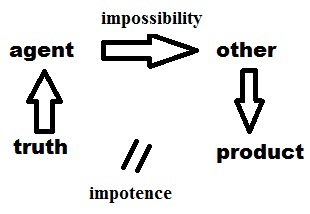
capital as real

Boyle, Kirk. “The Four Fundamental Concepts of Slavoj Žižek’s Psychoanalytic Marxism.”  International Journal of Žižek Studies Vol 2.1 (2008) 1-21.

Capital as Real: The Marxian Parallax

The more fundamental and systemic mode of the capitalist drive no longer operates in the symbolic order where individuals are interpellated as subjects of desire.

To be clear about where the mode of drive operates in capitalism, another term needs to be introduced: the Lacanian Real. In Lacanian psychoanalysis the Real is a purely formal concept; it is nothing more or less than the inherent limit of a symbolic order, that which must be repressed so this order can function. Because the Real is “simultaneously the thing to which direct access is not possible and the obstacle which prevents this direct access,” it can only be experienced in itssymptomatic effects (Žižek 2007: 243).

Žižek identifies two homologous forms of the Real , which are “detectable within the Symbolic only under the guise of its disturbances”: the traumatic core of sexual antagonism and the social antagonism of “class struggle” (Žižek 1994: 30). Both of these conceptions of the Real may be said to comprise the “minimalist” or “negative” anthropology of Lacanian Marxism. It is the Real of sexual antagonism, for instance, which prevents “it” from being “It”: objet a will always thwart the coincidence of the object of desire with the object-cause of desire. Likewise, the Real of social antagonism will always prevent the formation of a fully (self-)transparent utopian society. Reminiscent of Althusser’s claim that ideology is eternal, psychoanalysis holds that a minimal degree of misrecognition, reification, and fetishistic disavowal—“I know very well what I am doing, but I am doing it anyway”—is endemic to all symbolic orders. Although antagonism is eternal, Žižek adamantly disclaims that the sociotranscendental status of the Real denies the existence of History  [i.e., Butler’s criticism of Lacan].  The Real does not replace temporality with synchronicity or cyclicality. Rather, historical change derives from the emergence of new symbolic formations to deal with the traumatic core of sexual and social antagonism.

Because we still live within a world-economy structured by the “class struggle” inherent within capitalism, Žižek calls it the Real of our epoch. He writes:

The universality of capitalism resides in the fact that capitalism is not a name for a civilization, for a specific cultural-symbolic world, but the name for a truly neutral economico-symbolic machine which operates with Asian values as well as with others… The problem with capitalism is not its secret Eurocentric bias, but the fact that it really is universal, a neutral matrix of social relations—a real in Lacanian terms. (Žižek 2005a: 241)  …  As Žižek states, “the structure of the universe of commodities and capital in Marx’s Capital is not just of a limited empirical sphere, but a kind of sociotranscendental a priori, the matrix which generates the totality of social and political relations” (Žižek 2006b: 56).

Thus, Žižek transcodes the Marxist concepts of “commodity fetishism” and “class struggle” into the Lacanian notion of the Real. Where the older Marxist terms have long since been confused with empirical entities like the “working class” and actual commercial goods, the Lacanian Real has the benefit of emphasizing the purely formal, and therefore universal, status of capitalism and its overdetermination of the totality of social relations.

If we no longer accept a linear model of economic determinism where the economy directly causes sociopolitical events, how are we to understand the ways in which capitalism as Real overdetermines the totality of social relations?

Žižek adopts Althusser’s causal model of overdetermination: if “‘the logic of capital’ is a singular matrix which designates [capitalism’s] Real,” then it operates precisely as the absent cause of the totality-effects that occur within the sociopolitical realm (Žižek 2007: 211).

In the Lacanian Marxist base/superstructure model, as in its Althusserian predecessor, economic events of the Real do not cause Symbolic phenomena directly. Contrary to Althusser’s subject-less base/superstructure model, however, Žižek’s model maintains the subjectivity of the social antagonism of “class struggle” at the heart of the economy by introducing the concept of “parallax.”

The “Marxian parallax” refers to the irreducible gap between Real absent cause and Symbolic totality-effect.

He writes: …the ultimate parallax of the political economy [is] the gap between the reality of everyday material social life (people interacting among themselves and with nature, suffering, consuming, and so on) and the Real of the speculative dance of Capital, its self-propelling movement which seems to be disconnected from ordinary reality….Marx’s point here is not primarily to reduce the second dimension to the first (to demonstrate how the supernatural mad dance of commodities arises out of the antagonisms of “real life”); his point is, rather that we cannot properly grasp the first (the social reality of material production and social interaction) without the second: it is the self-propelling metaphysical dance of Capital that runs the show, that provides the key to real-life development and catastrophes. (Žižek 2006b: 383)
16

Žižek also describes the Marxian parallax of the political economy as follows:

If, for Lacan, there is no sexual relationship, then, for Marxism proper, there is no relationship between economy and politics, no “meta-language” enabling us to grasp the two levels from the same neutral standpoint, although—or, rather, because—these two levels are inextricably intertwined.

The “political” class struggle takes place in the midst of the economy…while, at the same time, the domain of the economy serves as the key that enables us to decode political struggles. No wonder the structure of this impossible relationship is that of the Moebius strip: first, we have to progress form the political spectacle to its economic infrastructure; then in the second step, we have to confront the irreducible dimension of the political struggle at the very heart of the economy. (Žižek 2006b: 320)

drive desire objet petit a

Boyle, Kirk. “The Four Fundamental Concepts of Slavoj Žižek’s Psychoanalytic Marxism.”  International Journal of Žižek Studies Vol 2.1 (2008) 1-21.

Žižek’s more recent theorizations of capitalism have turned away from the Lacanian notion of desire to the concept of drive. The previous section discussed the reflexivity of desire, how desire is desire for the object-cause of desire, objet a.

We saw how this desire could not be satisfied in any lasting way, that it was infinite, an infinite metonymy of desire. Drive distinguishes itself from desire in a short-circuit of sorts. Its object is the loss itself of objet a, not the fantasmatic objet a that never yields its promised jouissance, but what Žižek calls the “object-loss of drive.”

He writes, “in the case of objet petit a as the object of drive, the ‘object’ is directly loss itself —

in the shift from desire to drive we pass from the lost object to loss itself as an object” (Žižek 2006b: 62). Where desire suffers from the repetitive failure to obtain full jouissance, drive finds triumph in this very failure.

Desire acquiesces to the surplus-enjoyment it receives from partial objects that are metonymies for the impossible Thing; drive finds satisfaction in the loop around an object.

If the hysterical libidinal economy of desire works in cahoots with capitalism to produce and reproduce consumer society, then drive may offer a possible way to break out of this endless chain of metonymic commodities. Žižek writes:

drive is literally a counter-movement to desire, it does not strive towards impossible fullness and, being forced to renounce it, gets stuck onto a partial object as its remainder — drive is quite literally the very “drive” to break the All of continuity in which we are embedded, to introduce a radical imbalance into it, and the difference between drive and desire is precisely that, in desire, this cut, this fixation on a partial object, is as it were “transcendentalized,” transposed into a stand-in for the void of the Thing. (Žižek 2006b: 63)

The above passage posits drive in opposition to desire, which, in turn, is represented as creating a transcendental world of partial objects, all of which sustain the illusion of the “Thing as the filler of its void” (Žižek 2006b: 63). Desire, in fact represents the horizon of Lacan’s early theorizations of psychoanalysis, which remain thoroughly Kantian. In this early stage, Lacan posits a lost jouissance of the inaccessible “maternal” Thing with objet a serving as a leftover or remainder of this primordial enjoyment. The regulative ideal implicit in this formulation requires the subject to renounce the Thing and accept substitutive satisfactions in its stead. Hence, the stoicism often associated with the Freudian field (the point of maturity where we accept the fact that “it” never is “It!”).

The drive disrupts the homeostasis implicit in the position that one must keep a proper distance to the Thing less one gets burned by it. Žižek replaces this “Golden Mean” or “Goldilocks effect”—in Freudian terms, the “pleasure principle”—with a notion of drive which “suspends/disrupts the linear temporal enchainment” (Žižek 2006b: 63). In order to “break the All of continuity in which we are embedded,” the subject of the drive tarries with the negative and becomes caught up in a repeated circuit of jouissance, a self-propelling loop beyond the pleasure principle.  Drive exists in both a pre-and post-fantasmatic space, at once prior to the passionate attachments of desire and beyond them.

The realm of the drive is a primordial abyss of dis-attachment in which the subject exists out-of-joint with its environs. Such a description of the drive, however liberating we might imagine it, smacks of a romantic, individualistic form of resistance, a critique that has been cast at Žižek (especially in his examples of the psychoanalytic act).

The subject of the drive sounds awfully like the existential artist-hero who withdraws from society and its fantasmatic lures, confronts the void, and in true Nietzschean fashion fully affirms the eternal recurrence of the same. Žižek, however, is far from proffering the drive as a line of flight from the deadlocks of desire. The opposite, in fact, is the case.

“The lesson of drive,” he writes, “is that we are condemned to jouissance: whatever we do, jouissance will stick to it; we shall never get rid of it; even in our most thorough endeavor to renounce it, it will contaminate the very effort to get rid of it” (Žižek 2000: 293).

What at first glance appears to be a radical act to break out of the linear continuity of the hysterical economy, now becomes a compulsion to repeat, to obtain jouissance by circulating around the goal-object.

Žižek puts an end to all flirtations with the transgressive nature of the drive when he associates it with the machinations of capitalism. After acknowledging that capitalism addresses individuals on a subjective level when it “interpellates them as consumers, as subjects of desire, soliciting in them ever new perverse and excessive desires,” he claims that: Drive inheres to capitalism at a more fundamental, systemic level: drive is that which propels the whole capitalist machinery, it is the impersonal compulsion to engage in the endless circular movement of expanded self-reproduction. We enter the mode of drive the moment the circulation of money as capital becomes “an end in itself, for the expansion of value takes place only within this constantly renewed movement. The circulation of capital has therefore no limits.” (Žižek 2006b: 61)

At the level of drive, capitalism does not address individuals. In a sense, capitalism addresses itself. Drive inheres to capitalism in a quasi-objective manner. “The capitalist drive belongs to no definite individual,” writes Žižek, “rather, it is that those individuals who act as direct ‘agents’ of capital (capitalists themselves, top managers) have to display it” (Žižek 2006a: 61).

These acephalous agents are the ones we see flailing around the stock market floor or rushing through airports juggling their techno-gadget accoutrements.