Bartleby Politics

Parallax View

frog embracing bottle of beer

‘objectively subjective’ underlying fantasy which the two subjects are never able to assume

A certain excess which was, as it were, kept under check in previous history, perceived as a local perversion, a limited deviation, is in capitalism elevated into the very principle of social life, in the speculative movement of money begetting more money, of a system which can survive only by constantly revolutionizing its own conditions — that is to say, in whichthe thing can survive only as its own excess, constantly exceeding its own “normal” constraints. 297

The Analyst Discourse and the emergence of revolutionary-emancipatory subjectivity
Analyst Discourse

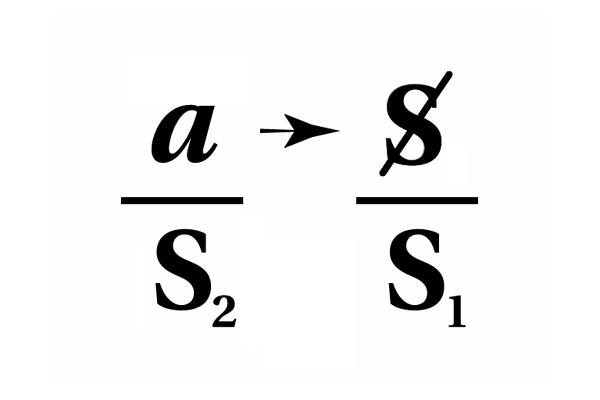
revolutionary agent addresses the subject from the position of knowledge which occupies the place of truth (that is, which intervenes at the “symptomal torsion” of the subject’s constellation), and the goal is to isolate, get rid of, the Master-Signifier which structured the subject’s (ideologico-political) unconscious.


Jacques-Alain Miller:  Our civilization fits the discourse of the Analyst. the “agent” is a surplus enjoyment, the superego injunction to enjoy, addresses (the divided subject) who is put to work in order to live up to this injunction.  If ever there was a superego injunction, it is the famous Oriental wisdom, “Don’t think, just do it.” The “truth” of this social link is S2, scientific-expert knowledge in its different guises, and the goal is to generate S1, the self-mastery of the subject — that is to enable the subject to “cope with” the stress of the call to enjoyment (through self-help manuals and so on)…

Žižek replies:

imbalance between Ego and jouissance, imbalance between pleasure and foreign body of jouissance, pose a threat to the possession of the objet

Žižek interview with Derbyshire and russia talk

Žižek interview with Derbyshire On June 2012  and Žižek in Russia  August 21, 2012

Why Hegel Today?
Cut to Hegel is 1 of the key 3 philosophers: Plato, Descartes, Hegel. Each defines a whole epoch that comes after them but in a negative way.

All history of philosophy is a history of Anti-Platonism: Aristotle, Plato to Nato (Popper, Levinas), Marxist anti-Platonism, Analytical philosophy anti-Platonism. And the same goes for Descartes.  Nobody is ready to be a Hegelian, everyone wants to mark a distance.

The same for Descartes, all modern philosophy is a refute of Descartes.  Leibniz and feminists, ecology etc.  The same is for Hegel, all modern philosophy is a way to distance itself from Hegel: Marx Heidegger etc.  Nobody wants to be a Hegelian.  Even if you largely agree with him you have to set out a marginal space where you disagree with him.

Is is possible to be a Hegelian today.  The answer is NO.

In each of these 3 cases what people react to is SCREEN MEMORY, an easy simplified image and memory which protects you from something much more unsettling, traumatic. And the thing is to see through this screen memory.

Plato: Traumatic encounter, an idea is something you traumatically encounter
Descartes: de-substantialize philosophy, introduces madness into philosophy
Hegel: the ultimate philosopher

All the problems of reading Hegel: the crazy guy who knows everything, Absolute Knowledge, can read the mind of God, this is a screen memory to cover up something which is maybe TOO RADICAL and TRAUMATIC for us to accept today.

Cut to Joke about Ninotchka: Coffee without cream, coffee without milk

but nor is he a historicist. Both poles are wrong.

Hegel is a hinge point in the history of philosophy: The moment of German Idealism 1787 when Kant publishes Critique of Pure Reason  and 1831 when Hegel dies.

CUT TO: Speculative Realists (Quentin Meillassoux, Ray Brassier) This is I think where we disagree. For me philosophy is transcendental. Philosophy before Kant was too naive. They though reality was out there, how do we understand it.

We should think with Hegel but BEYOND HEGEL. All this post-Hegelian reversals, Willing of Schopenhauer, Late Schelling production process for Marx, were ways to NOT confront HEGEL.  Hegel’s deep insight was too traumatic, monstrous to accept for post-Hegelian period. So we have to go back and seek what Hegel did.

CUT TO: Kant’s transcendental turn: the conditions of possible experience. What is it that takes Hegel  beyond Kant. Epistemological into ontological.  What Kant sees as epistemological obstacles, imperfections in knowledge, Hegel sees as “cracks in the real.”

Quantum Physics Uncertainty Principle

Where Heisenberg sees it as an epistemological limitation: velocity/position we can’t measure at same time, if we measure one we can’t get the other

Neils Bohr: Not only can’t we measure at the same time but In itself reality is INCOMPLETE

ŽiŽek brings up the computer game analogy, you play a computer game, and you see a house, but the total house is not programmed, because it doesn’t belong in the game, it only exists in blurred not fully realized way. (This is from the Nicholas Fearn book)

INCOMPLETELY PROGRAMMED REALITY AND QUANTUM physics.

IF we are not to approach the house in the game because its not part of the game, we have incompleteness in reality because God underestimated us. God created the world but God thought we would not go beyond the atom but we surprised him. But I’m an atheist. So is it possible to think reality as incomplete without GOD.

IS IT POSSIBLE TO THINK THIS INCOMPLETENESS WITHOUT GOD.

Heidegger is crucial for me here, I agree with Quentin Meillassoux, ultimately we cannot ask this direct naive question, does this table exist, do I have a soul, all we can do is ask within what hermeneutic horizon do these things appear so that we can ask this question.

The basic way things are disclosed to us. In medieval times nature meant meaningful order, in modern nature becomes grey endless universe, with no value. With Heidegger we can go no further, it’s meaningless. In order to approach the question, REALITY has already to be disclosed to you in a certain way. This attitude becomes our daily bread.

The predominant form of continental French philosophy is historicist discourse theory.  For a typical continental philosopher: Does the human being have a soul. All I can describe the episteme within which such a question could be raised. My problem is IS THIS ENOUGH. CAN WE MOVE BEYOND THE TRANSCENDENTAL. And for me Hegel Lacan is a way to say YES WE CAN but without falling into Speculative Realists pre-Kantian objectivism.

This “reality is out there we can endlessly approach it and so on and so on” No!  How can we break out of the TRANSCENDENTAL HORIZON? the answer for me is Hegel-Lacan. I’m not a continental thinker in terms of this TRANSCENDENTAL HISTORICISM.

I try to be more productively ECLECTIC but in a stupid way. I’m on side of Lacan and Deleuze, because they do not say, “all guys until me are idiots, only I see the way it is.” I don’t do this.

Just look at Hegel’s work. The end of his lectures of the history of philosophy. As a good idealist, he ends up with his system. He says this is where we are today for the time being. He doubly relativizes it. When he talks in his philosophy of history, in 1820 when he talks about about USA and Russia, he says we cannot develop a full philosophical history of these countries, because their century will be the 20th century. Not bad saying this in 1820.

I follow here Robert Solomon, he wrote In the Spirit of Hegel, Absolute Knowing, at every historical period, if you go to the end you reach the limit, so that Absolute Knowing is historicism brought to its most radical extreme. Hegel opens up a space for Otherness. Hegel’s point is not that we now know everything. Hegel is out there is an openness, not that WE know it it all.   Hegel is more materialist than Marx.  Marx thinks the proletariat have access to some historical necessity, out of contradictions of society, you can know history and act as an agent of this knowledge. for Hegel this is too IDEALIST, Hegel is more open to contingency than Marx.

Žižek gives the Hegel lecture at Free University of Berlin in March 2011

Žižek in Russia August 2012 on Totality at 45 minute mark

Totality is not an ideal of an organic whole.  But a critical notion. To locate a phenomenon in it’s totality is not to see hidden harmony of its whole. but to include into a system all its symptoms: antagonism, the Hegelian totality is self-contradictory antagonistic.  The whole which is the true is the whole plus its symptoms, it’s unintended consequences which betrays its untruth.  If you want to talk about today’s global capitalism means you must speak about Congo.

Hegel is absolutely NOT a holistic philosopher.  IF there is something foreign to Hegel, it is the legitimation of EVIL. the comparison with a big painting, you may think you see evil in the world, but the things you see as evil, is like viewing a picture too close and you see just a stain, but from a proper distance that stain is part of the global harmony.  For Hegel this position of holistic wisdom this is NOT Hegel.

Hegel’s dialectic is not this stupid wisdom we have to take into account all sides.  NO for HEGEL TRUTH IS UNILATERAL.

A JOKE

There was in 1930s a debate in Politburo.  Will there be money or not?  First there was a Leftist deviation, Trotsky said there will be no money, it will be a transparent society then Bukharin the Right winger said but money is necessary in a complex society.  Then Stalin says you are both wrong.  There will be a dialectical synthesis, a dialectical unity,  “There will be money and there will be not money. Some people will have money and other people will not have money.”

The space of the Hegelian totality is the very space of the abstract harmonious whole, and all the excesses which undermine it.

For Freud it’s not that we have a normal person and then here and there we have pathologies, as Freud put it, pathological phenomena are the truth of normallity itself.

Whenever you have a project to do something, you can expect it to go wrong.  Every project is undermined by its inconsistency.

“Property is theft.”  external negation becomes self-negation.  Theft becomes internal to definition of property itself.

Hegel does not subscribe to liberal critique of French Revolution (1789 but not 1793). Hegel saw the necessity of going through the Jacobin Terror.  1793-94 is a necessary consequence of 1789.  Only the abstract terror of the French Revolution creates the conditions for liberal freedom. The first choice has to be the wrong choice, it is only the wrong choice that opens the space for concrete freedom.

You arrive at the highest only through the radical contradiction of the lowest. This is the basic temporality of the dialectical process.

The first choice has to be the wrong choice, it is only the wrong choice that creates the conditions for the right choice.  You only arrive at the choice where you see the choice of the rational state, through the choice of abstract terror, it is only terror itself that opens up the space for concrete freedom.  You arrive at the choice in 2 stages, the choice has to be repeated.

Ultimate Hegelian Joke

Rabinovitch, a Soviet Jew, wants to emigrate from Soviet Union.  I want to emigrate for 2 reasons.  1) I want to emigrate because if Soviet Union falls the Jews will be blamed. The bureaucrat says are you crazy, the Soviet Union will be here forever. Nothing will change here.  Rabinovitch says, that’s my second reason. The necessity of this detour is Hegelian

Bad news is God is dead, we have no support in the big Other.  Good news is this bad news, we now have substantial freedom.

Book of Job (click here too): First great critique of ideology in history of humanity. why?  Things go terribly wrong for Job.  Each of his 3 friends (ideologists) try to convince Job that there is a deeper meaning to his suffering. One says God is testing you, the other one, oh God is Just, so if you suffer you must have done something wrong even if you don’t know what, they all 3 try to justify Job’s suffering.

The greatness of Job he doesn’t say I’m innocent, only that these catastrophes have NO MEANING.  God comes and says everything the 3 ideologists say is wrong, and everything Job says is right, he agrees with JOB.  Then comes an even more subversive moment. Then JOb asks god, ok I get the point but nonetheless, “why did I suffer?” God’s reply might sound arrogant. Where were you when I created the earth, all the animals and so on. HOW ARE WE TO READ THIS? Who are you small men to understand me God, we are on different levels. THis is how it is usually read.

GK CHESTERTON provides a much more radical reading: Why did all this happen to me??  God’s reply is usually read as arrogance of god, the gap that separates us from God. Chesteron turns this around God’s answer: You think you are in trouble, look at the entire universe I created it’s one big mess all around.   Here is Žižek at Princeton in Oct 2010 explaining this point

The commandment NOT TO KILL is primarily addressed at God himself, “Don’t be too brutal to humans.” Which I think the first theology to say that GOD IS DEAD is Judaism. The God of the law is a DEAD God.

Recall the story from the Talmud about two rabbis debating a theological point: the one losing the debate calls upon God himself to intervene and decide the issue, but when God (Jehovah) duly arrives, the other rabbi yells at him, go away old man, that since his work of creation is already accomplished, God now has nothing to say and should leave. God says yes you are right and walks away. This is a sacred text, wow!!

The whole strategy is to keep God at a proper distance.  Images of God is too close, God should only be in the letter, a dead god.  The only atheists today are theologists.  People usually say, God dies in Aushwitz.  If there is God how could he have permitted the holocaust.  Even Habermas said a nice answer, in view of the horrors of the 20th Century,  these crimes are so horrible, to describe them in secular terms is not strong enough, it doesn’t match the horror. So we need here some dimension of the sacred, a excessive sublime, its too much, it can’t be explained as a secular affair.   Not only did GoD NOT DIE at aushwitz, maybe he came back at Aushwitz, he came too close to us.     [Ž at University of Vermont Oct 16 2012]

So in Judaism God is dead what only remains is the LAW. But Nietzsche knew this death of God is NOT enough. This death of God is not enough. I think that what happens with the death of Christ is even this dead God which is still alive as a moral authority HAS TO DIE. Which is why the death of Christ can only be read as a radicalization of the book of JOB.

The message of Christ is not don’t worry if you’re in trouble there is a good old guy upstairs that will take care of things. The message of the death of Christ is there is no one. You are alone. Even intelligent Catholic conservatives Paul Claudel, is not put your trust in God, he can do it, but that God put his trust in us.

God expresses his perplexity at his own creationThis is an incredible ETHICAL REVOLUTION.

First step out of Pagan justice means: do your particular duty … this withdrawal culminates in the death of Christ: What dies on the cross: not God’s messenger, what dies on the cross is GOD of BEYOND himself, God as that TRANSCENDENT power that secretly pulls the strings.  Precisely god can no longer be conceived as we are in shit, but there’s a guy up there who secretly pulls the strings, NO this is no longer.  Something tremedous happens in Christianity.  After death of Christ we have not the Father but the HOLY SPIRIT.  where there is love between the two of you I AM THERE.

God says to Job, “You think you are something special but I screwed up everything.”

What dies on the cross is God of beyond itself. Holy Spirit is totally unique, what dies on the cross is this disgusting idea that God is up there as a guarantee of meaning. As in when something appears to us as evil, you are looking too close it is a stain, but if you stand back, you can look at it as a part of global harmony.  The sacrifice of Jesus Christ, there is no big Other, no guarantee of meaning, the Holy Ghost is that we are here alone without a guarantee.  The true message of Christianity is not Trust God, but God Trusts Us.  God abdicated, the Holy Spirit is the first radical egalitarian institution, (Communist Party).

For Hegel what is contingent is necessity itself

No. We are not simply retroactively projecting things into the past. No what if history is not fully constituted, history is open, events are retroactively constituted.

There is needed a materialist reversal of Marx back to Hegel. This opening towards contingency, Hegel is radical thinker of contingency.  The position adopted by Marx is that you as a historical agent can look into history, see where history is going, and then posit yourself as an agent of progress.  Hegel says no way.  This is strictly prohibited by Hegel. For Hegel precisely there is no big Other.  This is not because we cannot know this higher divine plan, its because there IS NONE. Those philosophers who claim that Hegel is also a philosopher of LOVE are RIGHT!!

You know how it is when you fall in Love. You float around in a contingent way. You just slip down on a banana. You are taken to hospital, you fall in love with the nurse. You automatically translate all your previous life as leading to this moment. It is a retroactive semiotic totalization of a contingency. There is a necessity but it is always a retroactive necessity. Something contingently happened and you retroactively create the necessity that leads to it.

Borges wrote about Kafka, every writer has his predecessors, Kafka can be said to create his forerunners or predecessors. No. We are not simply retroactively projecting things into the past. No what if history is not fully constituted, history is open, events are retroactively constituted. Every totality is retroactive. There is no deeper teleology. Something happens contingently and retroactively creates an order. Hegel is more materialist than Marx.

The conservative poet T.S. Eliot stated, this: Every really new work of art, it retroactively changes the whole history of art.  This is the Hegelian theory of totality. With every new break the whole past is re-written.  This is the Hegelian totality.

Something happens contingently and retroactively creates an order. Hegel is more materialist than Marx.

Push this contigency idea to the limit and we get to the ONTOLOGICAL INCOMPLETENESS OF REALITY


True Materialist task, the Hegelian challenge to quantum physics.  Can we think this incompleteness of reality without God thinking it?  This is the task.

***************

Avenir not Future.  Future means also the continuation, once and future thing.  Avenir points to a radical break, a true openness.

LACAN IS JUST AN INSTRUMENT FOR ME TO READ HEGEL, I OPENLY ADMIT IT. AT 39:40

Conservative Hegelians: McTaggert and Bradley

Now its the LIBERAL HEGEL: Hegel of RECOGNITION

CONSERVATIVE LACAN: paternal authority, symbolic law, the problem of today’s permissive society, the only thing that can save us is return to paternal authority

Now Liberal Lacanianism: I part ways with Jacques Miller. Every social field is based on imaginary symbolic illusions, we can only accept the necessity of these illusions, like Edmund Burke, better not to know too much

Late Lacan’s rumblings, how to organize the Lacanian school, his Leninist writings, how to construct a social space, a group, a society of psychoanalysts without the MASTER FIGURE.

Is there a chance for EGALITARIAN society, not just a Tahir square, every now and then.

Alain Badiou: This idea that the state is here to stay. Authentic politics has to take place outside of the state. Authentic politics should not engage in power, but SUBTRACT withdraw, resist.

What I don’t like, I see here an opening for a comfortable safe position, I can be in my safe position. I believe in HEROICALLY INTERVENING.

I don’t sit and wait for some radical violent moment, my attitude is extremely pragmatic. The most threatening thing to do is REJECT dialogue. Occupy Wall St. Oh fine let’s come together, let’s debate. This is not a time to do that. It was only possible there to speak the language of the enemy. Sometimes, you have to strike with all brutal violence (Against Hitler), and sometimes, you have only minor political gestures. I have a sympathy for Obama, (disagree with Tariq Ali), Healthcare. What kind of traumatic sore point this is for the conservative establishment, it disturbs the very foundation of popular American ideology. FREE CHOICE. At the same time its not an impossible demand. There is universal healthcare in other countries. This is how to ACT. Place a demand. NOW Ž sounds like a social democrat.

Hey Liberalism did something wonderful. It was the answer to a desperate predicament of European religious wars. How can we live together, construct a shared space. Even Social Democracy, with all the criticism we can make of it … can you imagine in the period in history of humanity, so many people lived such prosperous free lives in social democratic western Europe in last 50-60 years. But these times are over.

I still accept the greatness of Lenin. We have to accept, it’s easy to say USSR had a great chance, Stalin screwed it up, or No it was already in Lenin, Marx no Rousseau, No it was in Christianity, No it was already in Plato.

On the one hand the October Revolution was an authentic explosion of egalitarianism, emancipatory project. But Stalin … You can’t say same for Hitler. There is no tragic split in Nazism.

I really fully support in OCCUPY WALL ST. But the Bartleby point: I would prefer NOT TO. Contrast to single issues protest, we have for first time Big protest movement that targets Capitalist system as such, there is a structural fault in system as such.

The existing institutional democratic mechanisms we have are not strong enough to control this excess of capital.

What then should the LEFT DO: All Žižek finds here are ironies. Too general stuff. The critique of FINANCIAL capitalism, no its not this. Re-organize society so bankers don’t have power to do this.

THE MORNING AFTER: the true test what will really change when afterwards, things return to “normal” will there be any changes felt there. If no. Then we are in sad cyclical stuff where things explode and then return to normal.

Syriza in Greece is the idea that Ž truly supports. The commies hate Syriza so much they’ll make a pack with New Democracy, because commies say the situation is not ready yet … but if you wait for the right moment the right moment will never arrive, it only arrives through repeated attempts repeated failures.

The lesson the the last years: the true illusion is that things can go on as always with a little tinkering. No we are approaching a zero-point. things cannot go on indefinitely the way they are, even if we don’t do anything things will change, it will be some form of authoritarian, one of the first to get this point was Terry Gillian in BRAZIL. Its crazy comical, Berlusconi rule of BRAZIL. This is for me what is unsettling in China. Till now one can reasonably claim that capitalism may have required 10-20 years of dictatorship, once it began to take hold, there were movements for democracy. THis time is over. Capitalism Asiatic/Berlusconi. Capitalism more dynamic,creative destructive, than our western flavour, but it DOESN’T need democracy to function. IF you are serious about protecting LIBERAL values, you need to work with the socialists.

We like your ideas but why do you stick to Communism?

1. There is still a tradition clearly identified as part of Communism that is precious: Spartucus rebellion, radical millenarian rebellion, there is something great in authentic popular outbursts

2. The problem that I see today is communist problem, all the crucial problems today are problems of the commons, intellectual, bio-genetics, environment.

3. All trauma associated with “communism” all the other terms: Democracy/socialism/justice can all be appropriated but not communism.

4. We are approaching dangerous times. Isn’t it nice to have as your master signifier a term that can remind of all the time of how WRONG things can go, you are all the time aware of how things can go wrong.
on Ž act and Real superego

McSweeney, John. “Finitude and Violence: Žižek versus Derrida on Politics” KRITIKE 5:2 (December 2011) 41-58

Any act which would bear upon this Real could only be “tragic”:  either one ultimately succeeds in acting only within the Symbolic order, leaving the transcendental Real and its deep circumscription of socio-political possibilities unchanged (so that one’s acts are always already futile from the outset), or one succeeds in acting upon the Real, but at the cost of a radical destruction of the existing social order, realized in a radical annihilation of the self (Lacan’s passage à l’acte).

Indeed, just two years earlier, Žižek had realized that Lacan’s model of such an act, Antigone, is insufficient to the uncompromising violence of such an act. Her sacrifice of her place within the Symbolic order is only apparent, because her treasonous burial of her brother remains at the service of, and inscribes her existence within, a deeper law of the gods. In her stead, Žižek proposes the figure of Medea, whose murder of her children, means that there can be no recuperation of her act of vengeance against her husband.

Faced with this disturbing logic, Žižek would soon come to the conclusion that the construction of the Real as transcendental Thing is not only flawed but, in fact, may be a key element of capitalist ideology, misdirecting political acts toward an impossible capitalism as phantom Thing (and thus toward an impossible act), and away from actually existing capitalism and its rather more mundane vulnerabilities to change.

Instead, Žižek turned to an immanent conception of the Real as the internal limit of the Symbolic, such that the “not-All” of the Symbolic order, the encounter with its aporias and limits, is an encounter with the Real that exceeds, conditions, and precedes it. And this encounter with the SymbolicReal limit immanent to things is the encounter with their self-difference: with the excess of the thing over its signification, symbolized by the excess of the  materiality of the letter over its signifying force.

Act in turn is modeled on St. Paul’s notion of overcoming the Sisyphean cycle of law, transgression and guilt via naive identification with elements of the law, attending to the SymbolicReal letter of the law, in order to expose and undermine the operation of its  superego supplement, “the Law”, which would grant it pure Symbolic coherence.

In Žižek’s reading, Paul’s act mirrors the later Lacan’s notion of feminine subjectivation, in which woman identifies with elements of the Symbolic order, apart from the social-superego supplement that would constitute them as elements of a perfectly complete signifying system. By thus identifying with the Symbolic as a “not-All” traversed by multiple Symbolic-Real limits, the feminine subject exposes and undermines the operation of these superego injunctions.

The crucial point for the current discussion is that Žižek thus conceives of act as fundamentally within the Symbolic order, but without support from it: its significance does not depend upon the Symbolic order (and it can be justified only retrospectively in terms of the new situation it brings about). By contrast, masculine subjectivation involves identification with one’s individual “little bit of the Real” left over from one’s castrating insertion within the Symbolic order, such that a subjective act must both be entangled with and be destructive of that order. Arguably, this complex relation increases the vulnerability of the masculine subject to the subtle inversions of ideological interpellation. Thus, unlike Derridean messianicity (as Žižek conceives it), the Pauline-feminine act pays attention to the concrete self-difference of things, placing faith in the liberatory force of identification with a given element of the Symbolic order and its specific Symbolic-Real difference.

zupančič sexual difference and real pt 2 of 4

Video of this presentation March 2011

Here is the paper online without works cited page

Freud in Three Essays on the Theory of Sexuality (1905) he insists on the original nonexistence of any germ of two sexes (or two sexualities) in preadolescent time.

The auto-erotic activity of the erotogenic zones is, however, the same in both sexes, and owing to this uniformity there is no possibility of a distinction between the two sexes such as arises after puberty … Indeed, if we were able to give a more definite connotation to the concepts of “masculine” and “feminine,” it would even be possible to maintain that libido is invariably and necessary of a masculine nature, whether it occurs in men or in women and irrespectively of whether its object is a man or a woman.

In other words, at the level of the libido there are no two sexes. And if we were able to say what exactly is “masculine” and “feminine,” we would describe it as “masculine” — but we are precisely not able to do this, as Freud further emphases in the footnote attached to the quoted passage. 7

So, when confronted with the question of sexual difference, the first answer of psychoanalysis is: From the strictly analytical point of view, there is in fact only one sex, or sexuality.

Moreover, sexuality is not something that springs from difference (between sexes); it is not propelled by any longing for our lost other half, but is originally self-propelling (and “autoerotic”). Freud writes, “The sexual drive is in the first instance independent of its object; nor is its origin likely to be due to its object’s attractions.”

Does this mean that sexual difference is only and purely a symbolic construction? Here waits the other surprise (not unrelated to the first, of course) of the psychoanalytic stance: Sexual difference doesn’t exist in the symbolic either, or, more precisely, there is no symbolic account of this difference as sexual. “In the psyche, there is nothing by which the subject may situate himself as male or female being.”

That is to say, although the production of meaning of what it is to be a “man” or a “woman” is certainly symbolic—and massive—it doesn’t amount to producing sexual difference as signifying difference. In other words, sexual difference is a different kind of difference; it doesn’t follow the differential logic.

Mladen Dolar quote: “There is a widespread criticism going around that aims at the binary oppositions as the locus of enforced sexuality, its règlementation, its imposed mould, its compulsory stricture. By the imposition of the binary code of two sexes we are subjected to the basic social constraint. But the problem is perhaps rather the opposite: the sexual difference poses the problem of the two precisely because it cannot be reduced to the binary opposition or accounted for in terms of the binary numerical two. It is not a signifying difference, such that it defines the elements of structure. It is not to be described in terms of opposing features, or as a relation of given entities preexisting the difference One could say: bodies can be counted, sexes cannot. Sex presents a limit to the count of bodies; it cuts them from inside rather than grouping them together under common headings.”

And sex does not function as a stumbling block of meaning (and of the count) because it is considered morally naughty. It is considered morally naughty because it is a stumbling block of meaning.

This is why the moral and legal decriminalization of sexuality should not take the path of its naturalization (“whatever we do sexually is only natural behavior”).

We should instead start from the claim that nothing about (human) sexuality is natural, least of all sexual activity with the exclusive aim of reproduction. There is no “sexual nature” of man (and no “sexual being”). The problem with sexuality is not that it is a remainder of nature that resists any definite taming; rather, there is no nature here — it all starts with a surplus of signification.

If we now return to the question of what this implies in relation to ontology in general, and, more specifically, to the performative ontology of contemporary gender studies, we must start from the following, crucial implication: Lacan is led to establish a difference between being and the Real.   The real is not a being, or a substance, but its deadlock. It is inseparable from being, yet it is not being. One could say that for psychoanalysis, there is no being independent of language (or discourse)—which is why it often seems compatible with contemporary forms of nominalism.

All being is symbolic; it is being in the Other. But with a crucial addition, which could be formulated as follows: there is only being in the symbolic — except that there is real There “is” real, but this real is no being. Yet it is not simply the outside of being; it is not something besides being, it is — as I put it earlier — the very curving of the space of being. It only exists as the inherent contradiction of being.

Which is precisely why, for Lacan, the real is the bone in the throat of every ontology: in order to speak of “being qua being,” one has to amputate something in being that is not being. 

That is to say, the real is that which the traditional ontology had to cut off in order to be able to speak of “being qua being.”

We only arrive to being qua being by subtracting something from it — and this something is precisely that which, while included in being, prevents it from being fully constituted as being.

The real, as that additional something that magnetizes and curves the (symbolic) space of being, introduces in it another dynamics, which infects the dynamics of the symbolic, makes it “not all.”

Now, a very good way of getting closer to the relationship between sexuality as such (its real) and sexual difference is via an excerpt from a lecture by Joan Copjec, in which she made the following crucial observation:

“The psychoanalytic category of sexual difference was from this date [the mid-1980s] deemed suspect and largely forsaken in favor of the neutered category of gender. Yes, neutered. I insist on this because it is specifically the sex of sexual difference that dropped out when this term was replaced by gender.

Gender theory performed one major feat: it removed the sex from sex.

For while gender theorists continued to speak of sexual practices, they ceased to question what sex or sexuality is; in brief, sex was no longer the subject of an ontological inquiry and reverted instead to being what it was in common parlance: some vague sort of distinction, but basically a secondary characteristic (when applied to the subject), a qualifier added to others, or (when applied to an act) something a bit naughty.” [Copjec The Sexual Compact]

Goto Part 3

Zupančič sexual difference pt 1 of 2

Alenka Zupančič Sexual Difference and Ontology This paper was originally presented at the 2011 Summer School EGS

And here is a general discussion of ontology and realism: “One Divides Into Two: Negativity, Dialectics, and Clinamen,” held at the Institute for Cultural Inquiry Berlin in March 2011.

July 4, 2012 both Zupančič and Copjec particpated in a forum in Spain.  Audio is here.

Traditional ontologies and traditional cosmologies were strongly reliant on sexual difference, taking it as their very founding, or structuring, principle. Ying-yang, water-fire, earth-sun, matter-form, active-passive—this kind of (often explicitly sexualized) opposition was used as the organizing principle of these ontologies and/or cosmologies, as well as of the sciences—astronomy, for example—based on them.

And this is how Lacan could say,“primitive science is a sort of sexual technique.”

At some point in history, one generally associated with the Galilean revolution in science and its aftermath, both science and philosophy broke with this tradition. And if there is a simple and most general way of saying what characterizes modern science and modern philosophy, it could be phrased precisely in terms of the “desexualisation” of reality, of abandoning sexual difference, in more or less explicit form, as the organizing principle of reality, providing the latter’s coherence and intelligibility.

The reasons why feminism and gender studies find these ontologizations of sexual difference highly problematic are obvious. Fortified on the ontological level, sexual difference is strongly anchored in essentialism—it becomes a combinatory game of the essences of masculinity and femininity. Such that, to put it in the contemporary gender-studies parlance, the social production of norms and their subsequent descriptions finds a ready-made ontological division, ready to essentialize “masculinity” and “femininity” immediately. Traditional ontology was thus always also a machine for producing “masculine” and “feminine” essences, or, more precisely, for grounding these essences in being.

When modern science broke with this ontology it also mostly broke with ontology tout court. (Modern) science is not ontology; it neither pretends to make ontological claims nor, from a critical perspective on science, recognizes that it is nevertheless making them. Science does what it does and leaves to others to worry about the (ontological) presuppositions and the (ethical, political, etc.) consequences of what it is doing; it also leaves to others to put what it is doing to use.

Rather, the sexual in psychoanalysis is something very different from the sense-making combinatory game—it is precisely something that disrupts the latter and makes it impossible. What one needs to see and grasp, to begin with, is where the real divide runs here.

Psychoanalysis is both coextensive with this desexualisation, in the sense of breaking with ontology and science as sexual technique or sexual combinatory, and absolutely uncompromising when it comes to the sexual as the irreducible real (not substance). There is no contradiction here.

The lesson and the imperative of psychoanalysis is not, “Let us devote all of our attention to the sexual (meaning) as our ultimate horizon”; it is instead a reduction of the sex and the sexual … to the point of ontological inconsistency, which, as such, is irreducible.

Here is her start on Judith Butler:

One of the conceptual deadlocks in simply emphasizing that gender is an entirely social, or cultural, construction is that it remains within the dichotomy nature/culture.

Judith Butler saw this very well, which is why her project radicalizes this theory by linking it to the theory of performativity. As opposed to expressivity, indicating a preexistence and independence of that which is being expressed, performativity refers to actions that create, so to speak, the essences that they express. Nothing here preexists: Sociosymbolic practices of different discourses and their antagonisms create the very “essences,” or phenomena, that they regulate.

The time and the dynamics of repetition that this creation requires open up the only margin of freedom (to possibly change or influence this process in which sociosymbolic constructions, by way of repetition and reiteration, are becoming nature — “only natural,” it is said.

What is referred to as natural is the sedimentation of the discursive, and in this view the dialectics of nature and culture becomes the internal dialectics of culture. Culture both produces and regulates (what is referred to as) nature.  We are no longer dealing with two terms: sociosymbolic activity, and something on which it is performed; but instead, we are dealing with something like an internal dialectics of the One (the discursive) that not only models things but also creates the things it models, which opens up a certain depth of field. Performativity is thus a kind of onto-logy of the discursive, responsible for both the logos and the being of things.

To a large extent, Lacanian psychoanalysis seems compatible with this account, and it is often presented as such. The primacy of the signifier and of the field of the Other, language as constitutive of reality and of the unconscious (including the dialectics of desire), the creationist aspect of the symbolic and its dialectics (with notions such as symbolic causality, symbolic efficiency, materiality of the signifier) …

All of these (undisputed) claims notwithstanding, Lacan’s position is irreducibly different from the above performative ontology. In what way exactly? And what is the status of the real that Lacan insists upon when speaking of sexuality?

Lacan also starts with a One (not with two, which he would try to compose and articulate together in his theory).

He starts with the One of the signifier. But his point is that, while this One creates its own space and beings that populate it (which roughly corresponds to the space of performativity described above), something else gets added to it. It could be said that this something is parasitic of performative productivity; it is not produced by the signifying gesture but together with and “on top of” it.

It is inseparable from this gesture, but, unlike how we speak of discursive creations/beings, it is not created by it. It is neither a symbolic entity nor one constituted by the symbolic; rather, it is collateral to the symbolic. Moreover, it is not a being: It is discernable only as a (disruptive) effect within the symbolic field, yet it is not an effect of this field, (it is NOT) an effect of the signifier; the emergence of the signifier is not reducible to, or exhausted by the symbolic.

The signifier does not only produce a new, symbolic reality (including its own materiality, causality, and laws); it also “produces,” or opens up, the dimension that Lacan calls the Real. This is what irredeemably stains the symbolic, spoils its supposed purity, and accounts for the fact that the symbolic game of pure differentiality is always a game with loaded dice. This is the very space, or dimension, that sustains the previously mentioned “vital” phenomena (the libido or jouissance, the drive, sexualized body) in their out-of-jointness with the symbolic.

Sexuality (as the Real) is not some being that exists beyond the symbolic; it “exists” solely as the curving of the symbolic space that takes place because of the additional something produced with the signifying gesture.

This, and nothing else, is how sexuality is the Real.

Starting from sexuality’s inherent contradictions — from its paradoxical ontological status, which precisely prevents us from taking it as any kind of simple fact — psychoanalysis came to articulate its very concept of the Real as something new.

The Real is not predicated on sexuality; it is not that “sexuality is the real in the sense of the latter defining the ontological status of the former. On the contrary, the psychoanalytic discoveries regarding the nature of sexuality (and of its accomplice, the unconscious) have led to the discovery and conceptualization of a singularly curved topological space, which it named the Real.

The antagonism conceptualized by psychoanalysis is not related to any original double, or original multiple, but to the fact that a One introduced by the signifier is always a “One plus” — it is this unassignable plus that is neither another One nor nothing that causes the basic asymmetry and divide of the very field of the One .

The most general, and at the same time precise, Lacanian name for this plus is jouissance, defined by its surplus character. …

The Other is not the Other of the One ; it is the Lacanian name for the “One plus,” which is to say, for the One in which this plus is included and for which it thus has considerable consequences. This, by the way, is also why the Other referred to by Lacan is both the symbolic Other (the treasury of signifiers) and the Other of jouissance, of sexuality.

The first and perhaps most striking consequence of this is that human sexuality is not sexual simply because of its including the sexual organs (or organs of reproduction). Rather, the surplus (caused by signification) of jouissance is what sexualizes the sexual activity itself, endows it with a surplus investment (one could also say that it sexualizes the activity of reproduction).

This point might seem paradoxical, but if one thinks of what distinguishes human sexuality from, let’s say, animal or vegetal sexualities, is it not precisely because of the fact that human sexuality is sexualized in the strong meaning of the word (which could also be put in a slogan like, “sex is sexy”)? It is never “just sex.” Or, perhaps more precisely, the closer it gets to “just sex,” the further it is from any kind of “animality” (animals don’t practice recreational sex).

This constitutive redoubling of sexuality is what makes it not only always already dislocated in respect to its reproductive purpose but also and foremost in respect to itself. The moment we try to provide a clear definition of what sexual activity is, we get into trouble. We get into trouble because human sexuality is ridden with this paradox: The further the sex departs from the “pure” copulating movement (i.e., the wider the range of elements it includes in its activity), the more “sexual” it can become. Sexuality gets sexualized precisely in this constitutive interval that separates it from itself.

Zupančič verneinung pt 1 A deep hegelian point

Alenka Zupančič Not-Mother: On Freud’s Verneinung

A guy goes into a restaurant and says to the waiter: “Coffee without cream, please.”  The waiter replies: “I am sorry sir, but we are out of cream. Could it be without milk?”

This joke carries a certain real, even a certain truth about the real, which has to do precisely with the singular negativity introduced or discovered by psychoanalysis.

A negation of something that is neither pure absence nor pure nothing nor simply the complementary of what it negates.

At the moment it is spoken there remains a trace of that which is not.

This is a dimension that is introduced (and made possible) by the signifier yet is irreducible to it.

It has (or can have) a positive, albeit spectral, quality, which can be formulated in the precise terms of “with without (cream)” as irreducible to both alternatives (cream/no cream).

Hegel says, “Negation is part of the positive identity of an object.” An object is not only what it is, you have to include what it is not.

zizek April 24 2012 Los Angeles

Žižek is in Los Angeles 3 days before I met him in Brockport

Why did God have to die on the cross?

– pay price of our sins , to whom?  Another guy, the devil??

– because justice must be done, this is paganism, God is not really the top, there is some kind of cosmic destiny in which god is subordinated

– we wouldn’t be grateful to god, like he’s a narcissist, PR, lets make god look good

Malbranche: god wanted to be admired, w/o Jesus sacrifice we wouldn’t all be lost, we would be redeemed automaticlly, god through us all into sin so he could save some of us. — a perverse God. There is something a little impenetrable today, which is covered over by the usual dogma today. When Napoleon took the crown and put it himself on the head, the Pope said to Napoleon, you try to ruin the church, but catholics have been trying for 2000 years

How exactly do you read those statements : I don’t bring peace and love I bring sword and fire, if you don’t love your parents … there is a system of de-traumatizing these statements – don’t read them too seriously, don’t get too attached to earthly objects obei wan kenobi philosophy.  The best answer: my god, I wasn’t prepared for this question … But you had 2000 years to prepare for this question!

Žižek solution:  when in the bible if you don’t hate your father, mother, it stands for entire power edifice social hierarchy, that is Christian message an egalitarian community outside of the power hierarchy. In Pagan religions you can only attain this in death … Christian an egalitarian collective is the Holy Ghost.

Book of Job: First great critique of ideology. why?  Things go terribly wrong for Job.  Each of his friends try to convince Job that there is a deeper meaning to his suffering.  The greatnest of Job he doesn’t say I’m innocent, only that these catastrophes have NO MEANING.  God comes and agrees with JOB.  GK CHESTERTON: Why did all this happen to me??  God’s reply is usually read as arrogance of god, the gap that separates us from God. Chesteron turns this around God’s answer: You think you are in trouble, look at the entire universe I created it’s one big mess.  God expresses his perplexity at his own creation.  This is an incredible ETHICAL REVOLUTION.  First step out of Pagan justice means: do your particular duty … this withdrawal culminates in the death of Christ: What dies on the cross: not God’s messenger, what dies on the cross is GOD of BEYOND himself, God as that TRANSCENDENT power that secretly pulls the strings.  Precisely god can no longer be conceived as we are in shit, but there’s a guy up there who secretly pulls the strings, NO this is no longer.  Something tremedous happens in Christianity.  After death of Christ we have not the Father but the HOLY SPIRIT.  where there is love between the two of you I AM THERE.

Paul Claudel:  Not we can trust God, but God has to trust us.  This is an important message of freedom.  In all other religions you have atheists, people who don’t believe in God, only in Christianity, God himself becomes for a moment an atheist.  Far from fashionable talk i.e.,  we are in neo-pagan era, NO we should stick to this tremendous explosive impact of what Christianity is telling us.

Not Dennett or Hitchens (DITCHKINS), to be an atheist, this AUTHENTIC atheism, in the sense of experiencing the radical absence of any transcendental guarantee, you have to go through Christianity.

Only through the Christian experience can you REACH THE ABYSS OF ATHEISM.  Ditchkins is some stupid sense there is some truth, but it doesn’t work, there is no insight of how a religion effectively works.  A whole dimension is missing in Ditchkins.  The status of BELIEF is very mysterious, do we really believe?  We don’t live in an era of hedonism, but in strictly controlled hedonism … celebrating sex, explaining it in pragmatic terms, like Dr. Ruth, yes sex, but healthy sex, beer without alcohol  The only hedonists today are those who take drugs and those who smoke.  This obsession with the danger of smoking … distinguished black guy smoking, “I’m from the South, and when I was young I remember racism, but it isn’t as bad as now as being oppressed for smoking.”

WE BELIEVE MORE THAN EVER.  beliefs in order to function, don’t have to be FIRST person beliefs, you can BELIEVE THROUGH OTHERS.  We are Atheists, but in order not to hurt our children we believe, and then you ask the children … you have a belief that no one believes in the FIRST person.   CANNED LAUGHTER  Prayer wheels

We need to believe that there is someone who believes, even if that someone is hypothetical

CHRISTIAN GESTURE: ABANDON OBJECTIFIED BELIEF.  Life is Beautiful movie: to make it a much better film, the father discovers at the end that THE SON KNEW THIS ALL THE TIME HE PRETENDED TO BELIEVE HIS FATHER TO PROTECT HIM. this is the christian reversal.

🙂 I don’t see what the difference here is between the Objectifying belief in prayer wheel or canned laughter. Okay. But he goes on to say that equally, belief occurs through 3rd parties, we don’t necessarily believe, as long as somebody believes for us.  I don’t really believe in Christmas, I do it for the kids. But he claims that the boy in Life is Beautiful  in an alternate ending, should all along have pretended to believe his father, rather than sincerely believing in his father’s stories about how it’s just an extended vacation etc.  That is, I think he is arguing that instead of disavowal, of claiming we don’t believe but as long as others believe for us, we turn it around, we avow our belief in something, though still pretend.  Why did the boy still need to pretend, even though he know his dad was full of crap?  It’s the fetishist disavowal.

fetishist disavowal: “I know very well that things are the way I see them /that this person is a corrupt weakling, but I nonetheless treat him respectfully, since he wears the insignia of a judge, so that when he speaks, it is the Law itself which speaks through him”. So, in a way, I effectively believe his words, not my eyes, i.e. I believe in Another Space (the domain of pure symbolic authority) which matters more than the reality of its spokesmen.

The cynical reduction to reality thus falls short: when a judge speaks, there is in a way more truth in his words (the words of the Institution of law) than in the direct reality of the person of judge – if one limits oneself to what one sees, one simply misses the point. This paradox is what Lacan aims at with his les non-dupes errent: those who do not let themselves be caught in the symbolic deception/fiction and continue to believe their eyes are the ones who err most.

What a cynic who “believes only his eyes” misses is the efficiency of the symbolic fiction, the way this fiction structures our experience of reality. The same gap is at work in our most intimate relationship to our neighbors: we behave AS IF we do not know that they also smell badly, secrete excrement, etc. – a minimum of idealization, of fetishising disavowal, is the basis of our co-existence.

And doesn’t the same disavowal account for the sublime beauty of the idealizing gesture discernible from Anna Frank to American Communists who believed in the Soviet Union? Although we know that Stalinist Communism was an appalling thing, we nonetheless admire the victims of the McCarthy witch hunt who heroically persisted in their belief in Communism and support for the Soviet Union.

🙂 And Žižek says this ending to A Beautiful Life is preferable? In what sense?  The Christian reversal, is this fetishist disavowal, take it upon ourselves as our belief, know that what we are relying on belief not relying on somebody else to believe for us, we don’t sub-contract our belief, we do it ourselves, we believe in order to believe.

Žižek continues: For me Church is today at a CROSSROADS: it could be authentic liberation, an authentic subjective experience, at the same time it can be terribly misused.

Good people do bad things: we are relatively decent people, we do need some strong mythopoetic structure to serve as a screen to convince us thta the horrors we do can be transubstantiated into a higher meaning: POETRY. No ethnic cleansing without POETRY. you must be de-sensitized, to rape ethnic cleansing, it is preciesly this ethnic founding mythic, sacred text religions that can do the job.  Rwanda massacre, a great poet was laying the foundations for the slaughter.   This is the MEGA MEGA dilemma, how to find the way here.  For me, the message of Christiantity is the opposite of this need for TRANSCENDENCE.  Modern world is not a world with too much freedom, I can’t speak dirty, I can’t beat my wife, by becoming ethnic fundamentalists, opens up a space of freedom.  I am ethnically cleansing for my country I can rape, I can kill.  If there is God, I am an instrument of god, then everything is permitted.

zupancic

2001 interview with Zupancic

Within reality as it is constituted via what Lacan calls the Imaginary and the Symbolic mechanisms, there is a “place of the lack of the Image,” which is symbolically designated as such. That is to say that the very mechanism of representation posits its own limits and designates a certain beyond which it refers to as “unrepresentable.” In this case, we can say that the place of something that has no image is designated symbolically; and it is this very designation that endows whatever finds itself in this place with the special power of fascination. Since this unrepresentable is usually associated with the transgression of the given limits of the Symbolic, it is spontaneously perceived as “evil,” or at least as disturbing.

In To Be or Not To Be, Lubitsch provides a very good example of “the image that occupies the very place of the lack of the Image.” At the beginning of the film, there is a brilliant scene in which a group of actors is rehearsing a play that features Hitler. The director is complaining about the appearance of the actor who plays Hitler, saying that his make-up is bad and that he doesn’t look like Hitler at all. He also says that what he sees in front of him is just an ordinary man. The scene continues, and the director is trying desperately to name the mysterious “something more” that distinguishes the appearance of Hitler from the appearance of the actor in front of him. One could say that he is trying to name the “evil” that distinguishes Hitler from this man who actually looks a lot like Hitler. He is searching and searching, and finally he notices a photograph of Hitler on the wall, and triumphantly cries out: “That’s it! This is what Hitler looks like!” “But sir,” replies the actor, “this picture was taken of me.” Needless to say, we as spectators were very much taken in by the enthusiasm of the director who saw in the picture something quite different from this poor actor. Now, I would say that there is probably no better “image” of the lack of the Image than this “thing” that the director (but also ourselves) has “seen” in the picture on the wall and that made all the difference between the photograph and the actor. One should stress, however, that this phenomenon is not linked exclusively to the question of evil, but to the question of the “unrepresentable” in general.

butler antigone lacan real

The Act as Feminine: Antigone Between Lacan and Butler
Author: A. Hugill. Goldsmiths College London.

Lacan insists throughout his lectures on Antigone that the tragic heroine should be taken as exemplary of the beautiful, in the Kantian sense.

… the relation of the beautiful to death and desire in Lacan – would gain nuance if the concept of the beautiful from which Lacan is working, namely as it appears in Kant’s Critique of Judgement, were further elaborated.

Echoing Kant’s own definition of the beautiful, Lacan frames it in terms of the pure ‘there is’ (il y a); that which is beautiful “communicate[s] a sign of understanding that is situated precisely at equal distance from the power of the imagination and that of the signifier.” Similarly, Kant’s crucial insight in the Critique of Judgement is to radicalize any exclamation that a thing is beautiful, by pointing to the indeterminate character of the object in question.

Beauty, rather than being a property of an object, describes a sensation of pleasure arising from an overwhelming feeling of life (Lebensgefühl) engendered by the free play of the cognitive powers, imagination (Einbildungskraft) and understanding (Verstand), insofar as they are not restricted by any determinate concept.

Beauty is distinguished from the good and the agreeable inasmuch as it is, for Kant, the only free liking. This free liking to which Kant refers is called favour (Gunst) and it is marked by a “letting-be” of the object, a disinterested interest. Interest in the Critique of Judgement refers to a certain use-value, desire or concern with the existence of the object that, in order for a pure aesthetic judgement to arise, should not be taken into consideration.

Lacan’s own definition of the structure of desire is in fact precisely in tune with this definition of beauty as disinterested interest: the object cause of desire (the objet petit a), for Lacan, can never be attained and so too causes desire to function as a means without end. In the same paradoxical manner, one’s desire resists conceptual rationalization and is sustained by the tension of its unfulfillment. Something remains beautiful so long as it resists being fully conceptualized.

The feeling of the sublime describes those “moments when something entrances us so much that we are ready to forget (and to renounce) everything, our own well-being and all that is associated with it; moments when we are convinced that our existence is worth something only in so far as we are capable of sacrificing it.”  In the case of Antigone, we see a subject who identifies entirely with the Thing, the limit, without a protective distance and in so doing meets her demise.

It is against this backdrop that Antigone’s act is radically re-thought by the Lacanian school, as a case of pure means. For Lacan, Antigone is precisely driven by a certain jouissance and not – as is the case with Creon – by any adherence to a concept of an ethical good (representing family or divine law, as some other commentators suggest). As Butler explains, “Antigone will emerge, then, for Lacan as a problem of beauty, fascination, and death as precisely what intervenes between the desire for the good, the desire to conform to the ethical norm, and thereby derails it, enigmatically, from its path.” Antigone’s act could not be judged beautiful in the Kantian sense if it were merely an external embodiment of a moral good. It is precisely the non-conceptual element of her act that fascinates Lacan and propels his interpretation forward in his later consideration of feminine sexuality in Seminar XX.

Zupancic’s description of the sublime as the ‘jouissance of the Other’ in the above-cited passage provides a key to understanding why it is that Antigone’s act is formulated as a ‘feminine act.’ In Seminar XX: Encore,, feminine jouissance is defined precisely as the ‘jouissance of the Other.’ In this lecture, Lacan discusses the particularity of feminine jouissance in contrast to phallic jouissance. The title of the seminar, meaning “again”, signifies the manner in which enjoyment (jouissance) is never satisfied. There is always a gap or remainder left over and desire is sustained through this impossibility of satisfaction in the sexual relationship. In his lesson “On jouissance,” Lacan famously says that “to man insofar as he is endowed with the organ said to be phallic – I said, ‘said to be’ – the corporal sex or sexual organ of woman – I said ‘of woman,’ whereas in fact woman does not exist, woman is not whole – woman’s sexual organ is of no interest except via the body’s jouissance.”

He is here describing what he calls ‘phallic’ jouissance or the jouissance of the organ – which should not be misconstrued as concerning a biological category. There are phallic women and non-phallic men. It rather denotes to what extent a person identifies with the phallic function. Phallic or “sexual” jouissance, for Lacan, is “the obstacle owing to which man does not come (n’arrive pas)… to enjoy woman’s body, precisely because what he enjoys is the jouissance of the organ.”

Feminine jouissance, on the other hand, is “beyond the phallus” by virtue of its non-subsumption in the phallic order. Impossible to know anything about it other than that some women (and men) experience it, Lacan explains it using an example of mystical ecstasy.  In his invocation of God and the mystics, Lacan’s ‘explanation’ of feminine jouissance points to a pure jouissance of being, a being that is at the very limit of language. With recourse to (post)-Lacanian thinkers like Julia Kristeva and Luce Irigaray, it is possible to conceive of this feminine jouissance as relating to the primary relationship with the m(O)ther and the pre- or extra-symbolic inscription of language on the body. In Kristeva, we find a model of this in her concept of the semiotic, the unnamable within the symbolic, what she calls the “transsymbolic, transpaternal function of poetic language.”

Returning to Antigone, we find in Lacan’s Ethics a clear alignment of Antigone’s act – her unwavering love for the pure ‘there is’ of her brother – with this experience of the limits of language. Antigone’s act is fixed to the singularity of her brother’s being, without reference to any particular content:

“The unique value involved is essentially that of language. Outside of language it is inconceivable, and the being of him who has lived cannot be detached from all he bears with him in the nature of good and evil, of destiny, of consequences for others, or of feelings for himself. That purity, that separation of being from the characteristics of the historical drama he has lived through, is precisely the limit or the ex nihilo to which Antigone is attached. It is nothing more than the break that the very presence of language inaugurates in the life of man. That break is manifested at every moment in the fact that language punctuates everything that occurs in the movement of life.”  [Lacan, Ethics, 279]

The purity of Antigone’s act is at the limits of the means-ends logic constituting the symbolic order. The work to which Antigone commits herself, insofar as it can be called a ‘work,’ is marked by a ceaseless ‘unworking.’  She quite literally goes to the limit – to her own death – and as the multiple and never-ending interpretations of Sophocles’ play suggest, Antigone’s insistence is ultimately ambiguous with regard to any positive conceptualization and offers no determinate program in advance. Though her explicit action is to bestow Polyneices with a proper burial, it is uncertain in which name she insists upon doing so (whether divine or family law, or defiance of the state, or something entirely else).

Lacan suggests that Antigone acts in relation to the pure ‘there is,’ the singularity of her brother independent of any particular content, in the ineffaceable character of what is. Lacan regards this unshakeable yet indeterminate stance as the crucial issue of Sophocles’ text, and the reason for its ceaseless fascination:

“What is, is, and it is to this, to this surface, that the unshakeable, unyielding position of Antigone is fixed. She rejects everything else. The stance of the-race-is-run is nowhere better illustrated than here. And whatever else one relates it to, is only a way of causing uncertainty or disguising the absolutely radical character of the position of the problem in the text.” [Lacan, Ethics, 279]

In his book Enjoy Your Symptom!, Zizek draws on this insight with regard to Antigone, in order to put forward a model of a political subjectivity that might be called ‘anarcho-communist.’ He recounts a historical event: Tito’s ‘No!’ to Stalin in 1948, or the split of Yugoslav Communists from the international communist movement. Zizek argues that the importance of this act was to deny Stalin’s hegemony outside of any pre-determined positive ideological project, and to do so from the very situated position of communism itself; to resist Stalin as a communist, to create a rupture in the communist monolith from within, and to subject it to renewed critical consideration. Zizek remarks that a typical liberal reproach to this Lacanian ethic is to depict it as incompatible with a notion of community, as a suicidal ecstasy that suspends the social dimension. Instead, Zizek wants to suggest that a ‘suicidal gesture’ –as Antigone comes to exemplify it – is at the very foundation of every new social link: “with an act, stricto sensu, we can therefore never fully foresee its consequences, i.e., the way it will transform the existing symbolic space: the act is a rupture after which ‘nothing remains the same.’”  Antigone’s No! to Creon is presented as the real feminine act, the real ethical act as such, because it is situated at the limit of being, the very birthplace of the social itself, a place of pure potentiality from which real change can emerge.

[…] However, at the heart of Mendieta’s artistic action is a commitment to a certain identity, charged with a kind of naïve essentialism. And it is this fixed notion of community that both Butler and Lacan are working against in their writing on Antigone, though from very different poles.  On the one hand,

Butler wants to posit a multiplicity of meaning that is never fixed beyond the performance of a deed. In this sense, Butler’s notion of ‘performativity’ is not so different from the Lacanian ethical idea; but only to the extent that it puts into question the notion of a ‘doer behind the deed’ – a fixed subjecthood – just as the Lacanian ethical act destabilizes the subject.

[…] Rather than pursuing the destabilized subject to the point of rupture, extreme danger and risk, the point where new possibilities truly emerge, Butler believes in the possibility to gradually dismantle what already exists by parodically using the tools already given, without the act of destruction.

Converging on the body of Antigone, we can see two political stances emerge: death-driven insistence on the singularity of being in contrast to a vitalist view of the limitless plasticity or multiplicity of being. In this sense, Antigone’s legacy concerns, fundamentally, no less than the state of our social order itself. Antigone brings to the fore the question of resistance today. Is it any longer possible to resist capitalist-patriarchal heteronormativity by means of parody? Or is it not, rather, that notions of parody and performance have themselves been subsumed within that very order itself and thus exposed to their own impotency?

Sophocles’ Antigone has been repeatedly resurrected over the last centuries as a result of the fascinating, timeless and unresolved problematics that it presents.  In Lacan’s account, mobilized to support his ethics, the radical non-instrumentality of Antigone’s act is brought to the fore. In this way, it becomes for Lacan the site of similarly constituted ideas: the beautiful and the sublime in Kant’s aesthetics, and feminine jouissance. I have added to this list désoeuvrement and radical passivity. What each of these thoughts holds in common is a paradoxical active-passivity, an ‘unworking’ that pursues the limits of experience. In the pursuit of the limit – the Lacanian Real – the subject is in a position of extreme risk and death-driven instability without recourse to any pre-determined conceptual aim. For Zizek, this is the act par excellence, the act that puts into crisis the stability of any order. Indeed, Antigone’s act “most forcefully exposes the utter injustice and contingency of the Law, the fact that the Law functions precisely to ‘actively’…cover over the fact that it is constructed across a void.”

parallax kant sade

So, far from announcing a triumphant solution, Lacan’s “Kant avec Sade,” his assertion of Sade as the truth of Kant, rather names an embarrassing problem that Lacan failed to resolve — and did not even fully confront — in his Ethics seminar: how are we to distinguish the appearance of pure desire—the violent gesture of transgressing the social domain of “servicing goods” and entering the terrifying domain of ate, that is, the ethical stance of the subject who “does not compromise his desire”—from the fully consummated “passion for the Real,” the subject’s disappearance-immersion in the primordial jouissance? 95

What, then, is the Fall from this Kantian perspective? Consider the first moments of a feminist awakening: it all begins not with a direct attack on patriarchy, but with experiencing one’s situation as unjust and humiliating, one’s passivity as a failure to act—is this very overwhelming awareness of failure not in itself a positive sign? Does it not, in a negative way, bear witness to the fact that women clearly perceive the need to assert themselves, that they perceive the lack of it as a failure? In the same way,“Fall” is the first step toward liberation—it represents the moment of knowledge, of cognizance of one’s situation. Thus “fall into sin” is a purely formal change: nothing changes in reality, it is just the subject’s stance toward reality that undergoes a radical change.

This means that the Fall in the religious sense (the knowledge of sin) is already a reaction to the Fall proper, the retreat from the “dizziness of freedom.”This is why it is crucial to realize that Kierkegaard leaps over the first contraction of finitude, the first emergence of a sinthome which makes the subject a creature proper, and goes directly from the primordial repose to the Prohibition.We should focus on the difference between the two withdrawals from the Void of infinity: the first one is the primordial contraction that creates the sinthome — it precedes Prohibition, while it is only the second one, the retreat from the “dizziness of freedom,” which is the Fall proper: with it,we enter the domain of the superego, of the vicious cycle of the Law and its transgression.

parallax ethics real

Žižek, S. Parallax View MIT Press, 2006. Pages 81-84.

That is to say: how should we interpret the great feminine “No!” of Isabel Archer at the end of The Portrait of a Lady?  Why doesn’t Isabel leave Osmond, although she definitely doesn’t love him and is fully aware of his manipulations? The reason is not the moral pressure exerted on her by the notion of what is expected of a woman in her position — Isabel has sufficiently proven that, when she wants to, she is quite willing to override conventions: “Isabel stays because of her commitment to the bond of her word, and she stays because she is unwilling to abandon what she still sees as a decision made out of her sense of independence.”

In short, as Lacan put it apropos of Sygne de Coufontaine in The Hostage, Isabel is also “the hostage of the word.” So it is wrong to interpret this act as a sacrifice bearing witness to the proverbial “feminine masochism”: although Isabel was obviously manipulated into marrying Osmond, her act was her own, and to leave Osmond would simply equal depriving herself of her autonomy.

Continue reading “parallax ethics real”

zupančič ethics of real

Zupančič, Alenka. Ethics of the Real. 2000
It is at precisely this point that we must situate the scandal of this dialogue: the terror of Turelure ‘s demands pales before the terror inflicted upon Sygne ( through the intermediary of Badilon ) by the Holy Father.

Thou shalt love thy neighbour as thyself, has not lost its currency. The commandment in question is evident in the profane discourse of ethics (and politics), where it presents itself under the flag of ‘cultural diversity’ and the associated commandment: ‘Respect the difference of the other.’ This commandment, it is true, does not ask that we love the neighbour/other — it suffices that we “tolerate” him or her. But it seems that at bottom, as Freud would say, it comes down to the same thing. … Thus Badiou has observed:

A first suspicion arises when we consider that the proclaimed apostles of ethics and of the ‘right to difference’ are visibly horrified by any difference that is even a bit pronounced. Because for them, African costumes are barbarous, Islamic fundamentalists are frightening, as is the Chinese totalitarian, and so on. In truth, this famous “other” is not presentable unless he is a good other, that is to say, insofar as he’s the same as us … Just as there is no freedom for the enemies of freedom, so there is no respect for those whose difference consists precisely in not respecting differences.

That is to say: one finds here the same conjuncture as in the case of the commandment to ‘love thy neighbour’: what happens if this neighbour is ‘wicked’, if he or she has a completely different idea of the world, if he or she gets his or her enjoyment in a manner that conflicts with mine?

When Lacan, in The Ethics of Psychoanalysis, comments on the commandment ‘Thou shalt love thy neighbour as thyself’, and on Freud’s hesitation regarding this subject, he formulates its impasse with essentially same words as Badiou uses in speaking of the ‘right to ‘difference ‘ :

My egoism is quite content with a certain altruism, altruism of the kind that is situated on the level of the useful. And it even becomes the pretext by means of which I can avoid taking up the problem of the evil I desire, and that my neighbour desires also … What I want is the good of others in the image of my own. That doesn’t cost so much. What I want is the good of others provided that it remain in the image of my own.

we cannot conceive of radical alterity, of the ‘completely other’ (to which Lacan gives the Freudian name das Ding [the Thing]), without bringing up the question of the Same (as opposed to the similar). The similar [le semblable] presupposes and necessitates difference; it requires — in Badiou’s terms – a multiplicity, even an ‘infinite multiplicity’.

Contrary to this, the problem of enjoyment is the problem of the Same, which must be excluded so that this multiplicity can be closed, or ‘united’.

The moment the similar gives way to the Same, evil appears, and with it the hostility associated with the ‘completely other’.

Sygne’s real ethical act does not consist simply in her sacrifice of everything that is dearest to her; this act is, rather, to be found in the final scene of the play: the act in the proper sense of the term, the ethical act, resides in Sygne’s ‘no’ It is only this ‘no’ that propels her sacrifice into the dimension of the real. Let us now turn to this ‘no’ to determine its status, and to specify the relation between the two scenes or ‘events’ in question, Sygne’s sacrifice and her ‘no’.

The thesis which seems the most questionable is the one according to which we realize at the end that Sygne, ‘by some part of herself’, had not really given way or adhered to the politico-religious compromise demanded of her. Contrary to this reading we would insist that:

1. Her act (of sacrifice) is not an instance of ‘giving up on one’s desire ‘ but, rather, one of pure desire; it is characteristic of the logic of desire itself to have as its ultimate horizon the sacrifice of the very thing in the name of which Sygne is ready to sacrifice everything.

2. There is in fact a connection that leads from ‘Sygne’s choice ‘ (her sacrifice) to her final ‘ no ‘. That is to say: without her initial choice, Sygne would never have reached an occasion for Versagung, and — it follows from this —

3 . In the final analysis, it is precisely Badilon who leads her to this ‘negation’; this means that he is not the simple opposite of the analyst but that, in a certain respect, he ‘personifies’ the position of the analyst.

Maxim of ethics of desire: Sadder than to lose one’s life is it to lose one’s reason for living.

Sacrifice everything, including her life to HONOUR (her reason to live).

Life is situated not in the register of being, but in the register of having, HONOUR is something that belongs to the very being of Sygne. 231

It is not this choice: Life or HONOUR

It is this choice: if HONOUR is the only thing left to her, if she has nothing else to give, she will have to give this last thing 231

The logic of Sygne’s sacrifice remains inscribed in the logic of desire, and represents the ultimate horizon of her ‘fundamental fantasy’. But the paradox here is that the moment Sygne attains this ultimate horizon, she is already obliged to go beyond it, to leave it behind.