Our core claimis that caring causes a subjective conflict in the caregiver, because it evokes desires and tendencies that are irreconcilable with his or her best intentions. The way in which the caregiving subject deals with this conflict determines the likelihood of his or her withdrawal from work through burnout.
Stijn Vanheule Department of Psychoanalysis and Clinical Consulting, Ghent University, Ghent, Belgium
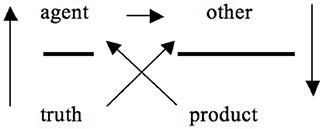
What is essential to the four discourses is that a desiring “agent” addresses an “other,” which is indicated by the horizontal upper arrow. In the move from “agent” to “other” we recognize the human tendency to create social bonds. However, here Lacan is not expressing some sort of romantic view on human interrelations, but is stressing that the relationship between “agent” and “other” is marked by a “disjunction of impossibility” (Verhaeghe, 2004, p. 59; Bruno, 2010): the message that the agent sends is never received as it was intended. Lacan (1969–1970, p. 174) explains this as follows: “The first line comprises a relation, indicated here by an arrow, which is always defined as impossible. In the master’s discourse, for instance, it is effectively impossible that there be a master who makes the entire world function. Getting people to work is even more tiring, if one really has to do it, than working oneself.” Indeed, the agent’s address never provokes a reciprocal reaction, which is why no returning arrow connects the “other” back to the “agent” (see Figure 1).
The lower part of the formula highlights the hidden side of discourse. The first position on the bottom left is “truth,” which is connected to the position of the “agent” by an arrow pointing upwards. This arrow indicates that all actions made by the agent in a given discourse rest on a hidden truth. Indeed, characteristic of all discourse is that a repressed element motivates the agent’s actions, and that this repression engenders the possibility of a social bond, represented at the upper level of the discourses. In a similar vein, “truth” also has an effect on the position of the “other,” which Lacan emphasizes by drawing an additional (diagonal) arrow.
The arrow pointing downwards (right side of Figure 1) indicates that the agent’s address to the other has effects: a “product” is created. This product fuels the agent, but occupies a disjunctive position in relation to the truth that set the discourse in motion.
Specifically, in the four standard discourses the position of truth is not targeted by an arrow, and the positions of “agent”/“semblance” and “other”/“jouissance” are influenced by two (not mutually related) other positions, which makes its functioning structurally lapse.
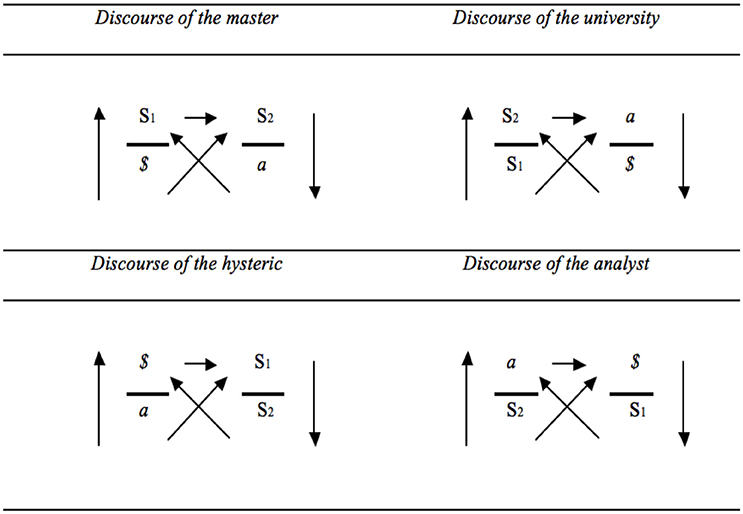
In the discourse of the master, a master signifier (S1) is formulated by the agent, and imposed onto the other who is presumed to function by means of knowledge (S2). Characteristically, such a domineering move rests on the repression of subjective division ($), and as a product the other is reduced to the position of an object (a). For example a therapist may tell his phobic client to be brave (S1) and to face the crowds he is afraid of by adhering to specific instructions as to how one might behave in groups (S2). By adopting such a directive style the therapist puts his own uncertainty in social situations ($) aside, and by obeying the therapist, the client is reduced to a pawn in the game of social interactions, which will finally produce further discontent (a) that might engender the formulation of new directives (S1).
Central to the discourse of the hysteric is the active formulation of complaints ($) and the search for an other who is presumed to have an answer (S1) for what bothers the subject. This discourse represses the truth that all desire rests on a lack that cannot be alleviated (a), and typically results in the production of narratives (S2) that don’t solve the fundamental lack (a), but actually engender further irritation ($).
The discourse of the university builds on the proclamation of knowledge (S2). Such knowledge always rests on the acceptance of dogmas and assumptions (S1), but this is neglected in this discourse. Characteristically, the other is put in the place of the object (a). This produces discontent ($), which fuels further knowledge creation (S2).
Finally, in the discourse of the analyst, the analyst qua agent confronts the other with a so-called object a, logically notated a. The object a refers to a drive or jouissance-related remainder that cannot be named and that fuels desire5. For example, the analyst’s silence, which often baffles the analysand who expects reciprocity in the interaction, can function as an object a (see Lacan, 1971, p. 25). By occupying the place of the object (a) the analyst creates a place where, via free associative speech, subjective division can be articulated ($). In order to pay close attention to the singularity of the patient the analyst puts aside pre-established ideas about patients and pathologies (S2), such that key signifiers that mark the analysand’s subjectivity (S1) can be formulated, which fuels the analyst’s positioning qua object a.
Semblance and Jouissance in Discourse
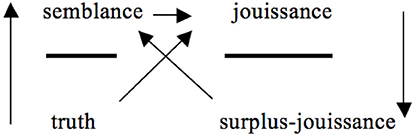
In Seminar XVIII (e.g., Lacan, 1971, p. 25) and Seminar XIX, Lacan (e.g., Lacan, 1971–1972, p. 67) somewhat rearticulated the positions he first entitled as “agent,” “other,” and “product” (see Figure 3), indicating that engaging in discourse above all means that one makes use of semblance. During his teaching Lacan interpreted the concept of semblance in various ways (Grigg, 2007). In the nineteen fifties he uses the concept semblance (“le semblant”) to refer to the world of appearances that is installed by means of the Imaginary. At that moment semblance is an imaginary phenomenon that needs to be distinguished from the Symbolic. As Lacan developed his discourse theory this all changed profoundly. At this point he suggests that the fact of social relations as such implies semblance, which is expressed in the following statement: “discourse as such is always discourse of semblance” (Lacan, 1971–1972, p. 226, my translation). Henceforth, discourse unfolds when someone forges a position in relation to another; semblance is “the proper object based on which the economy of the discourse regulates itself” (Lacan, 1971, p. 18, my translation). For example, the discourse of the master takes shape if someone plays the role of the commanding agent.
In seminar XIX, the position of the other is described as the position ofjouissance(Lacan, 1971–1972, p. 193). Here Lacan defines jouissance as a disturbing dimension in the experience of the body, which renders the subject unable to experience itself as a self-sufficient enjoying entity (Lacan, 1971–1972, p. 217). Jouissance is immensely disruptive. It is a dimension of otherness that we all have to deal with. Indeed, the very idea of “dealing with it” bears witness to discourse; that is, to the fact that we treat jouissance by making an appeal to an agent or semblance, which is expected to manage it: jouissance provokes the mobilization of semblance. The root of jouissance is in the structurally dysfunctional status that the body has for the human being (Lacan, 1971–1972, p. 217).
What is typical for discourse, is that it envelopes a semblance around jouissance, and as a result jouissance is no longer unlimited, but conditioned by the element occupying the position of semblance. In this maneuver, a social bond is created: “What is discourse? It is that which, in the arrangement of what might be produced because of the existence of language, makes up the function of the social bond” (Lacan, 1972, p. 51, my translation).
Surplus-Jouissance As the Product of Discourse
In the early nineteen seventies Lacan frequently points out that the product of discourse makes up a “surplus-jouissance” (e.g., Lacan, 1971–1972, p. 193). In forging his concept “surplus-jouissance” Lacan builds on Marx’s concept “surplus value.” In Marx’s Capital (1999), the notion of surplus value is defined as the difference between the exchange value of products of labor (commodities) and the value that coincides with the effort of producing these products, i.e., the means of production and labor power. In our market economy system, Marx says, money is the pre-eminent criterion to measure the amount of the value that is realized. Within the capitalist system gaining surplus value seems to be the sole aim. Profit-making and the expansion of capital are the motives that drive capitalism. However, gaining surplus value is only possible by selling fetishized commodities for a price that is higher than the value attributed to labor that produced them. If equivalent values are exchanged, no surplus value can be realized.
Marx indicates that the realization of this aim depends on a trick, and it is this cunning trick that interests Lacan (1968–1969, pp. 64–65; Vanheule and Verhaeghe, 2004). In the market the capitalist buys labor power in order to produce merchandise. Marx states that the trick put into practice in this process is that the capitalist pays the laborer as much as he has to, but less than the market value of what the laborer actually produced. In other words, in the process of exchanging value (labor power/money) the capitalist pockets a monetary surplus behind the back of the laborer, and behaves as if he too worked hard during the process of production. Here Marx states that the capitalist must hide his smile: “after a hearty laugh, he re-assumes his usual mien” (Marx, 1999, p. 126). This laughter results from the fact that the value that is created during a workday is actually much higher than what the capitalist pays the laborer.
Capitalist production implies that one no longer works solely in order to satisfy needs, and stops once they have been met. Production continues beyond satisfying needs, which results in a fetishist relation to surplus value (Tomšič, 2012, 2015). Lacan (1968–1969, pp. 64–65) concludes that the secret gain of surplus value is both the product and the motor of the capitalist production system. Yet, despite the appropriation of surplus value, Marx stresses that the capitalist does not personally enjoy what he gains. The capitalist is only the support that makes the system run. Therefore, what the capitalist system produces are suppositions and phantasies of gratification, while in fact nobody enjoys (McGowan, 2004). Indeed, this is what Lacan also stresses when addressing Marx’s socio-economic analyses: “There is only one social symptom: each individual actually is a proletarian” (Lacan, 1974, p. 187, my translation).
Furthermore, Lacan suggests that the general structure of discourse is “homologous” to the system of capitalism described by Marx, and this is why the above discussion of surplus value is relevant. Both systems produce an element of excess, in relation to which a fetishist relation is created. In capitalist production surplus value and/or commodities are fetishized, while in the use of discourse a fetishist relation with surplus-jouissance (plus-de-jouir) is created (Lacan, 1968–1969, p. 45; Tomšič, 2012).
Homology means that their structure is identical (Regnault, 2005): while coming in a different form, the use of discourse and capitalist production obey the same logic. As we use discourse language is produced, in the capitalist system commodities are produced. Yet, through the process of exchange something is lost. By using discourse one is robbed of something: in attempting to address jouissance by means of language, and find a solution for it through the social bond, the experience of an un-articulated “beyond” is produced. Using signifiers to name jouissance confronts the speaker with a dose of corporeal tension that is not inherent to language: a surplus-jouissance that can only be located in phantasy or delusion comes to the fore. It is precisely at this point that the function of laughter can be situated. In Marx’s system, laughter refers to the capitalist’s gain of surplus value, and to the process of alienation that this entails. In the use of discourse, laughter refers to the surplus-jouissance inherent in our alienation in the signifier.
In explaining surplus-jouissance, Lacan points to the joke. As we speak we invariably also utter nonsense, and because of this we laugh. Yet, why exactly does the joke provoke laughter? Lacan (1968–1969, p. 64, my translation) suggests the following: “it [the joke] provokes laughter, in the end, to the extent that it is actually hooked to the failure inherent to knowledge.” The pursuit of meaning through speech implies deadlocks. Speech is always a half-saying (mi-dire). It misses its point, and this failure coincides with a dose of jouissance, to which laughter bears witness. Consequently, surplus-jouissance has a status of lack and loss (Tomšič, 2015)—language use always misses the point; expressed by downward arrow in the formulae for discourse—and at the same time makes discourse function as an endless attempt to get hold of what one misses; expressed by the diagonal arrow from surplus-jouissance/product to semblance/agent. Furthermore, by connecting the manifestation of surplus-jouissance to laughter and misrepresentation, Lacan situates surplus-jouissance at the level of the unconscious (Lacan, 1971, p. 21). In Marx’s production system the capitalist laughs with the money the system generates; in Lacan’s model the user of discourse laughs to the extent that, at the level of the unconscious, a surplus of jouissance is produced which one fails to get hold of. The unconscious concerns the combined expression of half-saying and surplus-jouissance.
In the discourse of the master the object a is a component of libidinous corporeality that is delineated by the use of signifiers, but is not represented by means of the signifier. It is what remains leftover after imposing knowledge (S2) onto jouissance. Qua element of symbolic nothingness, the object a nonetheless makes itself felt as corporeal tension, gravitating around a gaze, a voice, or in the element of oral nothingness to be taken in, and anal nothingness to be given away. In the end, this surplus-jouissance is juxtaposed with the master signifier (S1), but, as mentioned previously, it doesn’t correspond to the truth that the discourse was initially fueled by. In the end the discourse of the master stresses the fact that there is no hope that subjective division can ever be transcended, or that discontent can be resolved if we address jouissance by means of language, which is what we typically do. Unbehagen is structurally unsolvable, which is expressed in the formula by the fact that none of the arrows arrive at $. It is precisely the failure that coincides with the discourse of the master that, in Lacan’s reasoning, makes analytical discourse possible. Through the exploration of subjective discord via free association, there is a return in the analysis to the signifiers that connote and mark the subject.
In most discussions of surplus-jouissance, Lacan starts from the master discourse. In the discourse of the master the object a is the surplus that the semblant is confronted with. Yet, in terms of Lacan’s later discussions of the structure of discourse (Figure 3), surplus-jouissance is not identical to the object a, but the end position of each discourse (Lacan, 1971–1972, p. 193). In the discourse of the university the divided subject occupies this place; in the discourse of the hysteric it is unconscious knowledge that emerges; and in the discourse of the analyst the master signifier makes up the surplus-jouissance.
Capitalist Discourse
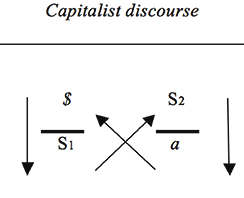
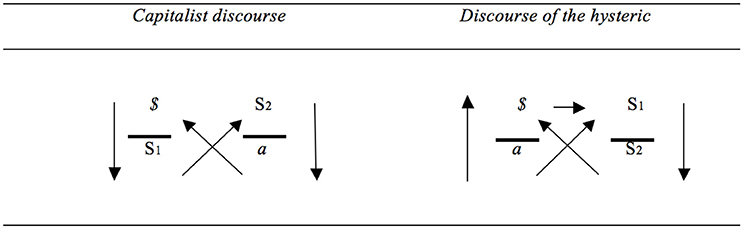
On one occasion, during a 1972 lecture at the University of Milan, entitled du discours psychanalytique, Lacan articulated a model on the precise structure of capitalist discourse. This model coheres with Lacan’s initial four discourses, but cannot be seen as just another variant in the series of discourses. After all, Lacan’s four discourses have a strict structure: four positions are linked by means of five unidirectional arrows (Figures 1, 3); and 4 elements ($, S1, S2, and a) rotate in a fixed order across these positions (Figure 2). The discourse of the capitalist disrupts this structure, and is a “mutant” of the discourse of the master. Indeed, Lacan (1972, p. 48) understands capitalist discourse as the contemporary variant of the classic discourse of the master. Yet with regard to the discourse of the master, it contains 3 mutations7 (Lacan, 1972, p. 40):
(1) $ and S1 exchange places.
(2) The arrow pointing upward on the left that makes the position of the truth unattainable in the classic discourse changes now into an arrow pointing downwards.
(3) The upper horizontal arrow that made the connection between “agent” and “other,” or “semblance” and “jouissance,” disappears.
The effect of these three changes is that a number of obstructions that are inherent to the four discourses are not characteristic of the fifth discourse. We can circulate within the capitalist discourse like go-carts on a racetrack. Indeed, in the capitalist discourse, the non-rapport is circumvented. Tomšič describes this as follows: “The vectors show that the capitalist discourse is grounded on the foreclosure of the impossibility of totalization that marks other discourses, an impossibility that is structurally determined by the fact that the signifiers constitute an open system of differences.”
Specifically, in the four standard discourses the position of truth is not targeted by an arrow, and the positions of “agent”/“semblance” and “other”/“jouissance” are influenced by two (not mutually related) other positions, which makes its functioning structurally lapse. In the capitalist discourse, “a very small inversion between the S1 and the $, which is the subject, is enough for it to run as if it were on wheels, it can’t run better, but it actually runs too fast, it runs out, it runs out such that it burns itself out”8 (Lacan, 1972, p. 48, my translation). Indeed, what is structurally characteristic of the discourse of the capitalist is that while the four positions remain intact, the pathways made up by the arrows change: in all positions one arrow arrives, such that a closed circuit of arrows is created. The structural lapse that marks the four standard discourses cannot be found at the root of this fifth discourse, which, so to speak, makes it run on wheels. Yet Lacan suggests that in the end the one functioning along the lines of this smoothly running process burns himself out, and gets consumed. One idea that the above quote articulates, is that in the capitalist discourse subjectivity is corrupted. The main structural reason for this is that in this discourse, the distance between $ and a is lost: corporeal tension that is proper to surplus jouissance disturbs the subject.
Just like in the discourse of the hysteric $ is situated at the level of the agent/semblance. Indeed, the discourse of the capitalist essentially starts from the experience of subjective division. In line with his earlier work, Lacan suggests that the subject is, on the one hand, a connotative effect of language use—“the signifier is what represents a subject for another signifier” (Lacan, 1972, p. 51, my translation). On the other hand, the subject is determined by the object a, which is the structural cause of desire—“The object a is the true support of what we have seen function, and it functions so in a more and more pure way to specify each in his desire” (Lacan, 1972, p. 52, my translation). Yet, most characteristically, man is marked by sexuality, which is not instinctively organized, and makes up “that in which man never feels at ease at all” (Lacan, 1972, p. 38, my translation). In the discourse of the hysteric the Unbehagen thus obtained results in an address to the other. Capitalist discourse, by contrast, does not capitalize on the social relation: “capitalism, that was its starting point: getting rid of sex” (Lacan, 1974, p. 34). Indeed, the capitalist discourse directly aims at the root of the problem, which is what the downward arrow on the left indicates. This discourse does not encapsulate the discomfort of subjective division as structural, but aims to recuperate discontent in its very system. It is a discourse in which there are answers for this discomfort: there exists an S1 that answers the $ and functions as a truth for the divided subject. For example, in our contemporary Western consumption culture, discontent is often deemed the upshot of having not yet obtained the right object and suggests that a state of subjective satisfaction will be reached once this object is obtained. In other words, the semblance of being dissatisfied can be answered with the S1 of a brand name or a product that offers the promise of satisfaction. Capitalist discourse actively cultivates the semblance of dissatisfaction, as well as a fantasy of self-sufficiency, completeness and vitality (Tomšič, 2015). The market9 tells us what we need: the merchandise it provides. These are all S1’s: they are isolated signifiers that consumers take to be the truth of their discontent. Indeed, within the capitalist discourse, the products that make up the market constitute a despotic truth to which the subject is subjected.
The move from $ to S1 reflects a denial of the structural quality of subjective division. On the one hand the capitalist discourse starts from subjective division, yet, on the other hand the move toward S1 suggests that subjective division might be overcome through alienation in a master signifier.
This bears witness to a perversion-like movement: while in perversion “the subject takes care himself to compensate for the flaw of the Other” (Lacan, 1968–1969, p. 265, my translation), in capitalist discourse an S1 is carefully promoted to compensate for the flaw of the subject. In both cases, subjective flaw is believed to be corrigible [fixed or repairable RT], which is why the discourse of the capitalist is often described in terms of a generalized perversion (Mura, 2015). In line with this interpretation Lacan, postulates a rejection of symbolic castration at the basis of the discourse of capitalism: “What distinguishes the capitalistic discourse is this: Verwerfung, rejection, rejection outside all fields of the symbolic …of castration.” Within the capitalistic logic, the lack at the heart of subjectivity is not seen as a structural consequence of using signifiers, but an accidental frustration that can be remedied within the market of supply and demand.The assumption that an S1 exists for each discomfort is ingrained in this discourse.
As a result, capitalist discourse implies a particularization of desire, treated as if it is a demand. Whereas in classic discourse desire is singular in that it cannot be solved by means of the signifier, the capitalist discourse suggests that particular solutions for dealing with subjective division actually exist: the market is there to satisfy customers’ demands. Consequently, at the point of desire, the capitalistic logic leads to exploitation: “the exploitation of desire, this is the big invention of capitalist discourse” (Lacan, 1973a, p. 97, my translation). This discourse exploits desire by treating it as a specific question to be answered by means of practical solutions. The superego command characteristic of capitalist times concerns an obligation to satisfy desire via consumption (McGowan, 2004).
Interestingly, following Žižek, Bryant (2008, p. 13) suggests that under the regime of capitalism, the subject’s principal question is not “what do I desire” but “what should I desire,” which is “not a question about objects, but a question of those conditions under which the subject might be desired by the Other.” Indeed, it is a basic Lacanian tenet that the desire governing the subject is essentially mediated by the desire of the Other: “man’s desire is the Other’s desire” (Lacan, 1960, p. 690). Within capitalist discourse this implies that merchandise will not so much be preferred for its intrinsic qualities, but in terms of how it is evaluated by the other. Indeed, this is often how marketing proceeds, products are presented as highly desired by celebrities, which directs the consumer’s desire.
Obviously, such exploitation of desire only works because the S1 that the capitalist discourse formulates as an answer is not at all random: S1 refers to an entire knowledge apparatus, S2, which guarantees the adequacy of the answer. Indeed, according to Lacan (1969–1970), there is compatibility between contemporary science and the capitalist discourse. In his view, the capitalist’s discourse is engaged in a “curious copulation with science” (Lacan, 1969–1970, p. 110). Science ensures10 the development of S2, through which S1 grows ever more innovative and, as a result, old answers must be constantly replaced by new ones. Within the capitalist discourse, S1 is not a fixed anchorage, but a solution that is replaced by endlessly better solutions. The fact of the matter is that the innovation of S2 continuously recreates both S1 and the demand. The only thing that the system needs is the consumer: subjects that are prepared to translate their discord $ in terms of the gap in the market that is delineated by S2, and who believe in S1.
Moreover, the switch between S1 and $ reveals something about what is taken seriously. In the discourse of the master, it is a signifier that is taken seriously: an S1 is adopted, and around this signifier a world of semblance is created through which the other and jouissance are addressed, which is what the upper horizontal arrow indicates. In the discourse of the capitalist, by contrast, it is discontent that is taken seriously. In this respect, the capitalist discourse resembles the discourse of the hysteric.
Quote from Freud’s “Beyond the Pleasure Principle”
If we may assume as an experience admitting of no exception that everything living dies from causes within itself, and returns to the inorganic, we can only say ‘The goal of all life is death’, and, casting back, ‘The inanimate was there before the animate’. At one time or another, by some operation of force which still completely baffles conjecture, the properties of life were awakened in lifeless matter. Perhaps the process was a prototype resembling that other one which later in a certain stratum of living matter gave rise to consciousness. The tension then aroused in the previously inanimate matter strove to attain an equilibrium; the first instinct was present, that to return to lifelessness. The living substance at that time had death within easy reach; there was probably only a short course of life to run, the direction of which was determined by the chemical structure of the young organism. So through a long period of time the living substance may have been constantly created anew, and easily extinguished, until decisive external influences altered in such a way as to compel the still surviving substance to ever greater deviations from the original path of life, and to ever more complicated and circuitous routes to the attainment of the goal of death. These circuitous ways to death, faithfully retained by the conservative instincts, would be neither more nor less than the phenomena of life as we now know it. If the exclusively conservative nature of the instincts is accepted as true, it is impossible to arrive at any other suppositions with regard to the origin and goal of life.
hypothesis: life is accidental there is no mysterious will of want to live. There is no struggle, life is a circuitous route to death, will to live just do their job of making the circuitous job operative.
The postulate of the selfpreservative instincts we ascribe to every living being stands in remarkable contrast to the supposition that the whole life of instinct serves the one end of bringing about death. The theoretic significance of the instincts of self-preservation, power and self-assertion, shrinks to nothing, seen in this light; they are part-instincts designed to secure the path to death peculiar to the organism and to ward off possibilities of return to the inorganic other than the immanent ones, but the enigmatic struggle of the organism to maintain itself in spite of all the world, a struggle that cannot be brought into connection with anything else, disappears. It remains to be added that the organism is resolved to die only in its own way; even these watchmen of life were originally the myrmidons of death. Hence the paradox comes about that the living organism resists with all its energy influences (dangers) which could help it to reach its life-goal by a short way (a short circuit, so to speak); but this is just the behaviour that characterises a pure instinct as contrasted with an intelligent striving.
Conservative instincts repeat a required pathways. What is life if we spell out these implications.
At 20 minutes: Life has no ground or source of its own. It’s something that happens to inanimate, it is an interruption and disturbance of the inanimate. Instead of saying the inanimate universe doesn’t give a damn if we live or die, we are invited to consider a possibility that we are mere perversions or strange pleasures of the inanimate itself. Precisely constituting its tics and grimaces. Life is but a dream of the inanimate, more precisely it is a nightmare disturbance, since the inanimate wants nothing but to be left alone.
Big Problem: return to inanimate and cancel out tension … Pleasure Principle: Lowering of tension to reach state of Nirvana (homeostatic state). The death drive is simply another name for Pleasure Principle. Reality Principle, sometimes have to postpone to survive, uses same image of ‘detour’ between life and death drive. Reality Principle, postponement of satisfaction. Life (reality principle) is disturbance of the inanimate, Reality Principle is detour of death drive, or Pleasure Principle, so there is a direct point by point mapping between Pleasure Principle and Death Drive.
This is a problem: Pleasure Principle being a primary principle but what about the compulsion to repeat, something more drive related than the P.P which it overrides. Compulsion to Repeat (CtR), insistance of an organism to endless repeat the state of tension, this corresponds more to Freud’s first idea. Interesting dilemma, abandon notion of D.D. as useless detour, or try to conceptualize in different way and this is what Lacan did. There is something essential to drives, when Freud introduced the D.D. Not D.D. as one drive amongst others (scopic,anal), there is something in the midst of every drive that has this dimension.
Sexual Drive (SD), the SD are something more and less than life. This is the part of Freud’s text, he sets up a dualist view, Eros and Thanatos. This dualist view turns out to be unsustainable for Freud, what undermines it is that sexuality cannot be subsumed under life instinct.
There is not inbuilt principle that orients sexuality. Jung’s Libidinal as neutral substance. Freud’s move was to DE-substantialize sexuality, it is the very impossibility of its own circumscription or delimitation. The sexual is not a separate principal or domain of human life, this is why it can inhabit every domain of human life.
There are only sexual drives, all drives are sexual. Freud inclines to monism, but not of the Jungian kind. Sexual Drives (SD). I love in you something more than you (object a) I mutilate you. Imperceptibly the perspective has changed. to the Monism of Sexual Drives.
45 minutes: Split/Antagonism prevents any substance from being One. We don’t start with one, or two, we start with a problem that prevents being from being One
SPLIT/Contradiction: This negativity, the minus to life becomes the very site of the unconscious. Something gets lost here, death becomes inherent to life, its presupposition. We start talking when one signifier goes missing.
Freudian concept of Unconscious and sexuality. Death is what lurks in the very midst of sexual drives, not as aim, but as negative magnitude or gap, or minus repeated by them.
Lacanian notion of the DD. Repetition in conservative, instinct of self-preservation, repetition, instincts repeat circuitous paths, DD originating in another kind of repetition within this conservative repetition, a repetition within a repetition. Freud in 3 Essays in series of Sexuality. Surplus satisfaction, we eat but there is also pleasure of oral beyond the need for food. This surplus satisfaction is internal cause of tension, it has constant pressure, The drive originating in this surplus, doesn’t seek to minimize tension but to repeat it.
satisfaction comes before the demand, satisfaction and its repetitions goes against PP
2017 article on Death Drive
Zupančič, Alenka. “Death Drive.” Lacan and Deleuze, edited by Boštjan Nedoh and Adreja Zevnik, Edinburgh University Press, 2017, pp. 163-179.
Compulsion to repeat and hypothesis of the death drive.
Human relationships that end is same outcome: teacher-mentor abandoned each time by his/her protégés, however much protégés differ from one another. Person whose friendships all end by the friend, person who raises people to positions of great public or private authority and after a while upsets the authority and replaces them with a new one, or lover each of whose love affairs, “passes through same phases and reaches the same outcome.”
Even ‘passive cases’ i.e., women married 3 times and each time husbands fell ill and she had to cater to and nursed them on their deathbeds. At the level of dreams that are governed by pleasure principle and wish fulfilment, compulsion to repeat particular traumas
Pleasure principle EQUALS maximize pleasure (lowering of tension), minimize displeasure, BUT the compulsion to REPEAT contradicts the Pleasure Principle
Why would somebody be compelled to repeat a distinctly unpleasant experience?
Two divergent accounts in Freud: a) Repetition appears something one can’t remember, “Repetitions is thus fundamentally the repetition (in different ‘disguises’) of a concrete, originally traumatic event or experience.” Ray Brassier has opined that what this repetition repeats is not a traumatic and hence repressed experience, “but something which COULD NEVER REGISTER AS EXPERIENCE TO BEGIN WITH.” In other words the trauma being repeated is according to Z, outside of the horizon of experience (and is constitutive of it).
Spectral Psychoanalysis: the Nabokov Effect Sigi Jöttkandt CRISIS & CRITIQUE
In a “post-truth” environment where everything becomes language games, truth abdicates; it disappears back into “misty abysses,” putting new agents in charge of deciding which hallucinatory version of reality prevails.
CRISIS & CRITIQUE Interview by Agon Hamza and Frank Ruda VOLUME 6 / ISSUE 1 pp. 435 – 453.
Zupančič, A. (2019, April 2). Philosophy or Psychoanalysis? Yes Please! Crisis & Critique. 6(1) 435-453.
Question: Why psychoanalysis?
Zupančič: At the moment when philosophy was just about ready to abandon some of its key central notions as belonging to its own metaphysical past, from which it was eager to escape, along came Lacan, and taught us an invaluable lesson: it is not these notions themselves that are problematic; what can be problematic in some ways of doing philosophy is the disavowal or effacement of the inherent contradiction, even antagonism, that these notions imply, and are part of. That is why, by simply abandoning these notions (like subject, truth, the real…), we are abandoning the battlefield, rather than winning any significant battles. This conviction and insistence is also what makes the so-called “Lacanian philosophy” stand out in the general landscape of postmodern philosophy.
Question: Some claim that psychoanalysis, especially following Lacan, is first and foremost a clinical practice and should not be considered to be a “theoretical” enterprise. In this sense it would not be a science (and if we are not mistaken, Lacan famously remarked that the subject of psychoanalysis is the subject of modern science, but not that psychoanalysis is a science). What is your view on this?
I believe that genuine psychoanalytic concepts are not derivatives of the clinic, but kind of “comprise” or contain the clinic, an element of the clinical, in themselves. I believe it is possible to work with these concepts in a very productive way (that is a way that allows for something interesting and new to emerge) even if you are not a clinician. But you need to have an ear, a sensibility for that clinical element, for that bit of the real comprised in these concepts. Of this I’m sure. Not everybody who works with psychoanalytic theory has it, but – and this is an important “but” – not everybody who practices analysis has it either.
One of the predominant ways or strategies with which psychoanalysts today aim at preserving their “scientific” standing, is by trying to disentangle themselves from philosophy (or theory), returning as it were to pure clinic. I think this is a very problematic move.
The Clinic should not be considered as a kind of holy grail providing the practitioners with automatic superiority when it comes to working theoretically, with psychoanalytic concepts.
There are, perhaps even increasingly so, attacks coming from the clinical side against “mere theorists” who are condemned for being engaged in pure sophistry, operating on a purely conceptual level and hence depriving psychoanalysis of its radical edge, of its real. Yes, there are many poor, self-serving or simply not inspiring texts around, leaning strongly – reference-wise – on psychoanalytic theory, and producing nothing remarkable. But interestingly, they are not the main targets of these attacks. No, the main targets are rather people whose “theorizing” has effects, impact, and makes waves (outside the purely academic territories). They are accused of playing a purely self-serving, sterile game. I see this as profoundly symptomatic. For we have to ask: when was the last time that a genuinely new concept, with possibly universal impact, came from the side of the accusers, that is, from the clinical side? There is an obvious difficulty there, and it is certainly not “theoretical psychoanalysts” that are the cause of it, for there is no shortage of practicing analysts around, compared to, say, Freud’s time. This kind of confrontation, opposition between philosophy (or theory) and clinic is in my view a very unproductive one. (436)
Which brings us back to your inaugural question: psychoanalysis is not a science, or “scientific” in the usual sense of this term, because it insists on a dimension of truth which is irreducible to “accuracy” or to simple opposition true/false.
At the same time the whole point of Lacan is that this insistence doesn’t simply make it unscientific (unverifiable, without any firm criteria…), but calls for a different kind of formalization and situates psychoanalysis in a singular position in the context of science. And here philosophy, which is also not a science in the usual sense of the term, can and should be its ally, even partner. They are obviously not the same, but their often very critical dialogue shouldn’t obfuscate the fact that there are also “sisters in arms”.
My claim is that the Freudian notion ofsexuality is above all a concept, a conceptual invention, and not simply a name for certain empirical “activities” that exist out there and that Freud refers to when talking about sexuality.
As such, this concept is also genuinely “philosophical”. It links together, in a complex and most interesting way, language and the drives, it compels us to think a singular ontological form of negativity, to reconsider the simplistic human/animal divide, and so on … (438)
QUESTION: There is a widespread return of ontology, ontologies even, after a long period in which ontological claims were almost always bracketed as metaphysical or replaced by a straightforwardly pragmatist approach. But is this proliferation of ontologies symptomatic of something else? We read your most recent work as an attempt to offer, if not answer, this question. We are saying this because your reading of the concept of sexuality has a bearing on the most fundamental ontological concepts. Yet, at the same time, you do not simply suggest to identify the psychoanalytic account of sexuality with ontology – so that psychoanalysis would simply be the newest name of ontology. Rather in psychoanalysis, if we are not mistaken, we can find an account of being and its impasses and of subjectivity and its impasses. Both are systematically interlaced (in such a way that subjectivity with its impasses has something to do with being and its impasses). And this conceptual knot has an impact on our very understanding: not only of sexuality’s ontological import, but also on our understanding of ontology itself. Could you help us disentangle some bits of this knot?
There is this rather bafflingly simplifying claim according to which Kant and the “transcendental turn” to epistemology was just a big mistake, error, diversion — which we have to dismiss and “return” to ontology proper, to talking about things as they are in themselves. Kant’s transcendental turn was an answer to a real impasse of philosophical ontology. We can agree that his answer is perhaps not the ultimate, or philosophically, the only viable answer, but this does not mean that the impasse or difficulty that it addresses was not real and that we can pretend it doesn’t exist. The attempt to “return to” the idea of sexuality as a subject of ontological investigation is rooted in my conviction that psychoanalysis and its singular concept of the subject are of great pertinence for the impasse of ontology that Kant was tackling. So the claim is not simply that sexuality is important and should be taken seriously; in a sense, it is spectacularly more ambitious. The claim is that the Freudo-Lacanian theory of sexuality, and of its inherent relation to the unconscious, dislocates and transposes the philosophical question of ontology and its impasse in a most interesting way. I’m not interested in sexuality as a case of “local ontology,” but as possibly providing some key conceptual elements for the ontological interrogation as such. (439)
QUESTION: So what is sex?
We usually talk about or invoke sex as if we knew exactly what we are talking about, yet we don’t. And the book is rather an answer to the question why this is so. One of the fundamental claims of my book is that there is something about sexuality that is inherently problematic, “impossible”, and is not such simply because of external obstacles and prohibitions. What we have been witnessing over more than half a century has been a systematic obliteration, effacement, repression of this negativity inherent to sexuality – and not simply repression of sexuality. Freud did not discover sexuality, he discovered its problem, its negative core, and the role of this core in the proliferation of the sexual. Sexuality has been, and still is, systematically reduced, yes, reduced, to a self-evident phenomenon consisting simply of some positive features, and problematic only because caught in the standard ideological warfare: shall we “liberally” show and admit everything, or “conservatively” hide and prohibit most of it? But show or prohibit what exactly, what is this “it” that we try to regulate when we regulate sexuality? This is what the title of my book tries to ask: What IS this sex that we are talking about? Is it really there, anywhere, as a simply positive entity to be regulated in this or that way? No, it is not. And this is precisely why we are “obsessed” with it, in one way or another, also when we want to get rid of it altogether. 440
The question orientating the book was not simply what kind of being is sex, or sexuality, but pointed in a different direction. Sex is neither simply being, nor a quality or a coloring of being. It is a paradoxical entity that defies ontology as “thought of being qua being”, without falling outside ontological interrogation. It is something that takes place (“appears”) at the point of its own impossibility and/or contradiction.
So the question is not: WHAT is sex?, but rather: What IS sex? However, the two questions are not unrelated, and this is probably the most daring philosophical proposition of the book. Namely, that sexuality is the point of a short circuit between ontology and epistemology.
If there is a limit to what I can know, what is the status of this limit? Does it only tell us something about our subjective limitations on account of which we can never fully grasp being such as it is in itself? Or is there a constellation in which this not-knowing possibly tells us something about being itself, its own “lapse of being”? There is, I believe; it is the constellation that Freud conceptualized under the name of the unconscious. Sexuality is not simply the content of the unconscious, understood as a container of repressed thoughts. The relationship between sex and the unconscious is not that between a content and its container. Or that between some primary, raw being, and repression (and other operations) performed on it. The unconscious is a thought process, and it is “sexualized” from within, so to say. The unconscious is not sexual because of the dirty thoughts it may contain or hide, but because of how it works. If I keep emphasizing that I’m interested in the psychoanalytical concept of sexuality, and not simply in sexuality, it is because of the fundamental link between sexuality and the unconscious discovered by Freud. Sexuality enters the Freudian perspective strictly speaking only in so far as it is “unconscious sexuality”. Yet “unconscious sexuality” does not simply mean that we are not aware of it, while it constitutes a hidden truth of most of our actions. Unconsciousness does not mean the opposite of consciousness, it refers to an active and ongoing process, the work of censorship, substitution, condensation…, and this work is itself “sexual”, implied in desire, intrinsic to sexuality, rather than simply performed in relation to it. (440)
Phallus is not a signifier because men have it and masculinity is naturally favored, but because women don’t have it, and this negativity, this non-immediacy, this gap, is constitutive for the signifying order.
Now, the question of sexual difference is that of how one relates to this signifier or, which is the same question, how does one handle castration, relate to it. Men are identified as those who venture to put their faith into the hands of this signifier, hence acknowledging symbolic castration (the signifier now represents them, operates on their behalf), with different degrees of how (un)conscious this acknowledgement actually is. There are many men who strongly repress the dimension of castration involved in their access to symbolic power, and believe that this power emanates directly from them, from some positivity of their being, and not from the minus that constitutes phallus as the signifier. The anatomy obviously plays a part in facilitating this “masculine” identification, but the latter still remains precisely that: an identification, and not a direct, immediate consequence of anatomy. One can be anatomically a man and this identification doesn’t take place. Not all subjects identify with the signifier (of castration) in this way, accept its representation of them, take the symbolic order at is face value, so to say. Those who do not, identify as “women”, and tend to expose the “nothing”, the gap at the very core of the signifier and of symbolic identifications.
This opens a really interesting perspective on psychoanalysis and feminism, which is often missed. It is not that women are not acknowledged, fully recognized by the symbolic, oppressed by it; no, to begin with, women are subjects who question the symbolic, women are the ones who, by their very positioning, do not fully “acknowledge” its order, who keep signaling its negative, not-fully-there dimension. This is what makes them women, and not simply an empirical absence of an organ. This is their strength – but also the reason for their social repression, the reason why they “need to be managed” or “put in their place”. But these are two different levels. If we don’t keep in mind the difference between these two levels, we risk to fall prey to versions of liberal feminism which loses sight of precisely the radical positioning of “women”, depriving this position of its inherent thrust to question the symbolic order and all kinds of circulating identities, replacing this thrust with the simpler demand to become part of this circulation, to be fully recognized by the given order.
Contingency is not the same as relativism. If all is relative, there is no contingency. Contingency means precisely that there is a heterogeneous, contingent element that strongly, absolutely decides the structure, the grammar of its necessity – it doesn’t mean that this element doesn’t really decide it, or that we are not dealing with necessity. To just abstractly assert and insist that the structure could have been also very different from what it is, is not enough. This stance also implies that we could have simply decided otherwise, and that this decision is in our power. But contingency is not in our power, by definition, otherwise it wouldn’t be contingency. Ignoring this leads to the watered-down, liberal version of freedom. Freedom understood as the freedom to choose, for instance between different, also sexual, identities. But this is bullshit, and has little to do with freedom, because it doesn’t even begin to touch the grammar of necessity which frames the choices that we have. Freedom is a matter of fighting, of struggle, not of choosing. Necessities can and do change, but not because they are not really necessities and merely matters of choice.
The sexual in psychoanalysis is a factor of radical disorientation, something that keeps bringing into question all our representations of the entity called “human being.” This is why it would also be a big mistake to consider that, in Freudian theory, the sexual is the ultimate horizon of the animal called “human,” a kind of anchor point of irreducible humanity in psychoanalytic theory; on the contrary, it is the operator of the inhuman, the operator of dehumanization.
And this is precisely what clears the ground for a possible theory of the subject (as developed by Lacan), in which the subject is something other than simply another name for an individual or a “person.”
What Freud calls the sexual is thus not that which makes us human in any received meaning of this term, it is rather that which makes us subjects, or perhaps more precisely, it is coextensive with the emergence of the subject.
So this subject is not the Althusserian subject of interpellation, emerging from “recognition”. But this is not simply to say that (the Lacanian) subject is directly an antidote for ideological interpellation. Things are a bit more complicated than that. I would almost be tempted to turn Althusser’s formula around. Not “ideology interpellates individuals into subjects”, but rather: ideology interpellates subjects into individuals with this or that identity. In some sense, ideology works like “identity politics”. By turning the Althusserian formula around I don’t mean to suggest that subject is a kind of neutral universal substrate on which ideology works, like “individuals” seem to be in Althusser’s formula.
The subject is – if you’d pardon my language – a universal fuck-up of a neutral substrate, it is a crack in this substrate. But this in itself is not what resists ideology, on the contrary, it is rather what makes its functioning possible, it is what offers it a grip. Subject as a crack, or as interrogation mark, is in a sense “responsible” for the ideological interpellation having a grip on us.
Only a subject will turn around, perplexed, upon hearing “Hey, you!” But this is not all. Precisely because the subject is not a neutral substrate to be molded into this or that ideological figure or shape, but a negativity, a crack, this crack is not simply eliminated when an ideological identification/recognition takes place, but becomes part of it.
It can be filled up, or screened off, but its structure is not exactly eliminated, because ideology is only efficient against its background. So not only is the subject in this sense a condition of ideology, it also constitutes its inner limit, its possible breaking point, its ceasing to function and losing its grip on us.
The subject, as negativity, keeps on working in all ideological structures, the latter are not simply monolithic and unassailable, but also fundamentally instable because of this ongoing work. Ideology is not something that we can resist (as subjects). This usually gets us no further than to a posture of ironical or cynical distance. It is not by “mastering” our relation to ideology that we are subjects, we are, or become, emancipatory subjects by a second identification which is only made possible within the ideological parallax: say by identifying with the underdog, by locating the gaps that demands and generate “positive” repression… In a word, the subject is both, the problem and the possible (emancipatory) solution.
The fact that to be a “woman” has always been a socially recognized sexual position, did little to protect women against harsh social discrimination (as well as physical mistreatment) based precisely on this “recognized” sexuality. Part of this discrimination, or the very way in which it was carried out, has always led through definitions (and images) of what exactly does it mean to be a woman.
So a recognized identity itself does not necessarily help. And the point is also not to fill in the identity of “woman” with the right content, but to empty it of all content. More precisely, to recognize its form itself, its negativity, as its only positive content. To be a woman is to be nothing. And this is good, this should be the feminist slogan. Obviously, nothing” is not used as an adjective here, describing a worth, it is used in the strong sense of the noun.
Emancipatory struggle never really works by way of enumerating a multiplicity of identities and then declaring and embracing them all equal (or the same). No, it works by mobilizing the absolute difference as means of universalization in an emancipatory struggle.
I strongly believe, perhaps against all contemporary odds, that the inherent and radical political edge of sexuality consists in how it compels us to think the difference. A difference that makes the difference.
As for #MeToo, it is a very significant movement, already and simply because it is a movement. But movements have a way of sometimes inhibiting their own power. #MeToo should not become about “joining the club” (of the victims), and about demanding that the Other (different social institutions and preventive measures) protect us against the villainy of power, but about women and all concerned being empowered to create social change, and to be its agents. Movements generate this power, and it is vital that one assumes it, which means leaving behind the identity of victimhood. And this necessarily implies engagement in broader social solidarity, recognizing the political edge of this struggle, and pursuing it. (450)
To eliminate passion from politics is to eliminate politics (in any other sense than simple management). And this is what’s happened. But it is crucial here to avoid a possible misunderstanding: I’m not saying that politics needs to make space for passions as well, and needs to involve them as well. This way of speaking already presupposes the wrong divide, an original distinction between politics and passion, their fundamental heterogeneity: as if politics were something completely exterior to passion, and would then let some passion in when needed, and in right dosages. One should rather start by dismantling the very idea that passions are by definition “private” and apolitical (because personal). No, passion is not a private thing! Even in the case of amorous passion, it concerns at least two, and has consequences in a wider social space of those involved. Politics, different kind of politics, are different articulations of a communal passion, of how we live together and how we would like to live together.
To allow for political passion, or politics as passion, does not mean to allow for people to freely engage in all kinds of hate speech as expression of their feelings. First, feelings and passion are not exactly the same thing, passion is something much more systematic, it allows for organization, thinking, strategy… When I say “passion” I also don’t mean frenzied gaze and saliva coming out of our mouth. What is political passion? It is the experience of being concerned by ways in which our life in common (as societies) takes place, and where it is going. We are all subjectively implied in this communal space, and it’s only logical to be passionate about it. (452)
[T]he problem that confronted Lacan was: how do we pass from animal coupling led by instinctual knowledge and regulated by natural rhythms to human sexuality possessed by a desire which is eternalized and, for that very reason, insatiable, inherently perturbed, doomed to fail, and so on? …
So the answer to Lacan’s problem is: we enter human sexuality through the intervention of the symbolic order qua heterogeneous parasite that disrupts the natural rhythm of coupling. 155
A quote from Zizek (Tarrying with the Negative, pp.113-4):
Invoking the “living dead” is no accident here: in our ordinary language, we resort to indefinite judgments precisely when we endeavor to comprehend those borderline phenomena which undermine established differences, such as those between living and being dead. In the texts of popular culture, the uncanny creatures which are neither alive nor dead, the “living dead” (vampires, etc.), are referred to as “the undead”; although they are not dead, they are clearly not alive like us, ordinary mortals. The judgment “he is undead” is therefore an indefinite-limiting judgment in the precise sense of a purely negative gesture of excluding vampires from the domain of the dead, without for that reason locating them in the domain of the living (as in the case of the simple negation “he is not dead”). The fact that vampires and other “living dead” are usually referred to as “things” has to be rendered with its full Kantian meaning: a vampire is a Thing which looks and acts like us, yet it is not one of us. Continue reading “Ž on Kant undead”
I – As a philosopher, what is it that interests you in psychoanalysis, and why?
Psychoanalysis is not simply a therapeutic practice. It is – perhaps above all – a stunning conceptual invention that made this new practice possible. In this sense, psychoanalysis is also something that “happened” to philosophy and that philosophy cannot remain indifferent to, as if nothing happened there. But this implies of course that – as Lacan put it somewhere – “psychoanalysis is not psychology”. For me this means that psychoanalysis is not a regional science of human being, but concerns, and has something to say about, the very constitution of subjectivity, also in its profound philosophical sense. Lacan’s “return to Freud” involved an extremely serious engagement with philosophy, the whole history of philosophy, as a means of showing and conceptualizing what is so new, or different about Freud. Psychoanalysis is not simply a move “beyond” philosophy; in many ways, philosophy itself has always been a move beyond (previous) philosophy… Continue reading “12 Questions ALENKA ZUPANČIČ”
Johnston, A. (2013). Drive Between Brain And Subject: An Immanent Critique Of Lacanian Neuropsychoanalysis. The Southern Journal of Philosophy. Vol. 51, Spindel Supplement
I am convinced that the life sciences, in order to do real justice to the richly and unpredictably weird sorts of subjects humans are, must supplement the framing worldview of their spontaneous organicism with the notion that (phrased in Lacanian fashion) there is something in the organic more than the organic itself.
In other words, a nonorganicity is immanent to the most complex forms of the organic. This is by virtue of the reality that, above certain thresholds, complexity of various sorts (be it biological, computational, institutional, social, or whatever) tends, within its given domain(s),to generate inner antagonisms, bugs, glitches, loopholes, short circuits, and tensions (a fact to which any experienced computer programmer, tax lawyer, or government bureaucrat readily would testify).
Alenka Zupančič (The Institute of Philosophy of the Scientific Research Centre of the Slovenian Academy of Sciences and Arts) The report will explore the encounter between psychoanalysis and philosophy at the point where the two seem to be the most incompatible.
Sex (and psychoanalytic theory of sexuality) is something that philosophy usually doesn’t know what to do with; sex is the question usually left out in even the most friendly philosophical appropriations of Lacan and his concepts.
And ontology (as since of pure being) is something that psychoanalysis doesn’t know what to do with, or is highly critical about.
The report will take these two notions and cast them, so to say, in the opposite camps. It will argue that sex is the properly philosophical (ontological) question of psychoanalysis, and present some consequences that this shift of perspective has for philosophy.
European University at St. Petersberg Russia
Philosophy and Psychoanalysis
Philosophers in postmodern fashion gave up on traditional concepts: subject, truth, real, and put in metaphysical past. Then along came Lacan, who said the concepts are not problematic in themselves, but the way we use them.
Boucher, G. (2005) The Law as a Thing : Žižek and the Graph of Desire. In G. Boucher, J. Glynos, & M. Sharpe (Eds.), Traversing the Fantasy Critical Responses to Slavoj Žižek. (pp. 23-44). Burlington, VT: Ashgate.
Žižek Responds:
[…] my critics often fall into the trap of what Hegel called “reflexive determination”; what they describe as my oscillation is the projection into my work of the inadequacy of their own reading of my texts. They start with reducing my position to a simplified account of it, and when, afterwards, they are compelled to take note of how my texts do not fit this frame, they misperceive this gap as my own inconsistency or oscillation.
In the present volume, it is Boucher’s basic critical argument which, I think, can serve as an example: he first reads my opposition of public Law and its obscene superego supplement as the opposition between the conscious Law and the unconscious Real, i.e., he “essentialises” the obscene superego into a “pre-cultural Real”; then, of course, when he realises that my notion of the obscenesuperego doesn’t fit this substantialised “pre-cultural Real,” he transposes this inconsistency into my own theoretical edifice and arrives at the “antinomy governing Žižek’s theory”:
. . . on the one hand. the Real is only the “inherent transgression” of the Symbolic, and so we should cleave to the symbolic field by rejecting the allure of superego enjoyment. On the other hand, however, the symbolic field is nothing but a ruse, secretly supported by an obscene enjoyment that in actuality reigns supreme. … Because of the way Žižek has structured this subject, there is no way to get beyond the oscillation between the symbolic field and an obsceneenjoyment, except by dispensing completely with the unconscious.
This alternative itself is false: both “hands” are here Boucher’s, i.e., what I advocate is neither the reduction of the obsceneunderside of the Law to its secondary “safety valve” to be rejected in the pursuit of a more adequate symbolic law, nor a substantial Real which effectively “runs the show” and devalues the public Law into an impotent theatre of shadows.
The obscene underside, of course, is the supplement of a Law, its shadowy double, its “inherent transgression”; it is not merely a secondary “safety valve,” but an active support of the public Law not a tolerated pseudo-excess, but a solicited excess. For this very reason, it functions as a Lacanian sinthome: a knot which literally holds together the Law — you dissolve the excess, and you lose the Law itself whose excess it is.
[…] what if the “oscillation” in question is not simply an epistemological default, but is part of the “thing itself,” a feature of the described socio-symbolic process?
An example from Boucher. again: ”The oscillation between the advocacy of presidential Bonapartism and a religious commune determines the compass of Žižek’s politics”.
What, however, if these are the two sides of the same coin — what if it is precisely because (what Boucher calls) the ”presidential Bonapartism” is the “truth” of democracy, that one should at least keep the space open for what Boucher calls my, advocacy of a “religious
commune” (actually, I locate religious communes into a series with revolutionary collectives like councils (“soviets”) and psychoanalYtic associations !).
There is another-politically much more crucial case of “oscillation” that my critics do not mention that fits this model, the one concerning the status of the obscene underside of the symbolic order: is this obscene underside of unwritten rules mainly the “inherent transgression” of the public Law (and, as such, its ultimate support), or does it also have a positive emancipatory function (the motif that I develop in my Lenin booklet: how an authentic contact with the ethnic, cultural — Other can only pass through an exchange of obscenities). Is, however, this really a case of my oscillation? What if this ambiguity is inscribed into the thing itself — what if the status of obscenity is ambiguous in itself?