commodity fetishism

Boyle, Kirk. “The Four Fundamental Concepts of Slavoj Žižek’s Psychoanalytic Marxism.”  International Journal of Žižek Studies Vol 2.1 (2008) 1-21.

To this example, Žižek adds the emergence of labor as a commodity which represents “the internal negation of the universal principle of equivalent exchange of commodities,” and, in
his most extended illustration of the social symptom, Žižek follows Lacan’s claim that Marx discovered the symptom when he conceived of the structural shift in fetishism that occurred in
“the passage from feudalism to capitalism” (Žižek 1989: 23, 26).

Whereas in feudalism fetishism takes place in a “relation between men,” in capitalism it occurs in a “relation between things.” In a feudal society, “relations of domination and servitude” are immediately transparent (the king rules over his subjects because they recognize him as king, and vice versa), while in a capitalist society these power relations are repressed by the institution of commodity fetishism (the capitalist, despite his conspicuous consumption, is hidden by the fact that he or she enjoys the same formal rights as the rest of us). Although these fetishistic structures are mutually exclusive, they follow the same logic.

Fetishism: consists of a certain misrecognition which concerns the relation between a structured network and one of its elements: what is really a structural effect, an effect of the network of relations between elements, appears as an immediate property of one of the elements, as if this property also belongs to it outside its relation with other elements. (Žižek 1989: 24)

Rephrased in Hegelian terms, this misrecognition concerns the relation between the Universal and the Particular. The Universal is really a structural effect, an effect of the network of relations between particularities, but in fetishism the Universal appears as an immediate property of a particularity, as if this property also belongs to it outside its relation with other particularities.  For example, the abstract, universal exchange-value appears as the immediate property of, say, a $50,000 luxury sedan or a $1 loaf of bread.

the social symptom, “the point of emergence of the truth about social relations,” shifts from being a case of ideological misrecognition or “false consciousness” that we can dissolve through the traditional form of Marxist ideology criticism, to become embodied in the reified (the “objectively subjective”) social reality of the world of commodities (Žižek 1989: 26). “It is this world,” Žižek writes, “which behaves ‘idealistically’” (Žižek 1989: 32).

We no longer have to believe in the magical aura emanating from luxury sedans, the cars themselves believe in their thaumaturgy [a miricle, magic] for us.

The ontological status of the social symptom entails that, as Jameson writes apropos of Althusser, “ideology is institutional first and foremost and only later on to be considered a matter of consciousness” (Jameson 2001: xii). Such an admission does not amount to an irreconcilable divorce of … theory from practice. It simply means that when it comes to ideology, doing “speaks louder” than knowing.

Lacan coined the term sinthome to conceptually account for patients whose symptom persisted beyond interpretation. The sinthome is “literally our only substance, the only positive support of our being, the only point that gives consistency to the subject” (Žižek 1989: 75). What would it mean to identify with a social kernel of enjoyment that absolutely resists interpretation?

Žižek has used the example of single black mothers to represent the social mean to identify with a social kernel of enjoyment that absolutely resists interpretation? Žižek has used the example of single black mothers to represent the social sinthome, “a knot, a point at which all the lines of the predominant ideological argumentation (the return to family values, the rejection of the welfare state and its ‘uncontrolled’ spending, etc.) meet” (Žižek 2000: 176).

This example strikes me as perspicacious if we consider the jouissance structuring the predominant ideology, but it seems to remain at the level of a social symptom from a progressive perspective. In other words, the example of the single black mother is still interpretable, we can identify with how she interrupts the “service of goods.”

What about a social sinthome that provides the substance that gives consistency to our “collective” subjectivity?

What about commodity fetishism as the definitive social sinthome of capitalist society? As Žižek reminds us, for Marx:

“there is one exceptional “pathological,” innerworldly particular content in which the very universal form of reflexivity is grounded, to which it is attached by a kind of umbilical cord, by which the frame of this form itself is enframed; for Marx, of course, the particular content is the social universe of commodity exchange” (Žižek 2000: 278).

The enjoyment derived from commodity fetishism persists beyond interpretation. Unlike the symptom which loses its enjoyment factor when we gain knowledge of it, the sinthome, as the fully acknowledged “frame” of our existence, maintains its libidinal position.

The particular knot of the “social relations between things” confronts us with the impotence of our critico-political activity. We identify with the pathological point of the social universe of commodity exchange simply by selling our labor power, not to mention the innumerable ways we enjoy this social sinthome . In a topsy-turvy world where not just wooden tables but direct experiences stand on their head, are not the commodities themselves—like Žižek’s celebrated example of canned laughter in television shows—enjoying for us? Do they not function as the “quanta of enjoyment” in late capitalist society, to paraphrase Žižek’s recent analogy that sinthomes are the “Freudian equivalent of superstrings” (Žižek 2006a: 78)?

How do we cut the umbilical cord that attaches us to the social universe of commodity exchange despite our conscious resistance?

Žižek’s recent work displays an acute awareness of this predicament. He frames the problem by drawing an analogy to the psychoanalytic process. He writes, “Just as the unconscious and not the patient must be brought to the truth, the real task is to convince not the subject, but the [commodities]: not to change the way we talk about commodities, but to change the way commodities talk among themselves” (Žižek 2006b:352).

As in the example of the chicken and the man who believes himself to be a grain of seed, we must convince not ourselves but the chicken-commodities that we are not grains of seed in order to defetishize the social universe of commodity exchange.

Ž four discourses four subjects

Žižek, Slavoj. “Four Discourses, Four Subjects” in Cogito and the Unconscious. ed. Slavoj Žižek, Duke UP, 1998. 75-113.

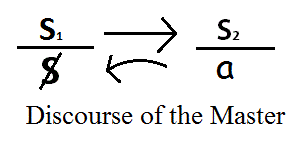
The illusion of the gesture of the Master is the complete coincidence between the level of enunciation (the subjective position from which I am speaking) and the level of the enunciated content, that is, what characterizes the Master is a speech-act that wholly absorbs me, in which “I am what I say,” in short, a fully realized, self-contained performative.

Such an ideal coincidence, of course, precludes the dimension of fantasy, since fantasy emerges precisely  in order to fill in the gap between the enunciated content and its underlying position of enunciation.

Fantasy is an answer to the question, “You are telling me this, but why? What do you really want by telling me this?”

The fact that the dimension of fantasy nonetheless persists thus simply signals the ultimate unavoidable failure of the Master’s discourse.

There is thus no reason to be dismissive of the discourse of the Master, to identify it too hastily with “authoritarian repression”: the Master’s gesture is the founding gesture of every social link.  Let us imagine a confused situation of social disintegration, in which the cohesive power of ideology loses its efficiency: in such a situation, the Master is the  one who invents a new signifier, the famous “quilting point,” which again stabilizes the situation and makes it readable; the university discourse that then elaborates the network of Knowledge that sustains this readability by definition presupposes and relies on the initial gesture of the Master.  The Master adds no new positive content — he merely adds a signifier, which all of a sudden turns disorder into order, into “new harmony,” … Therein resides the magic of a Master: although there is nothing new at the level of positive content, “nothing is quite the same” after he pronounces his Word. …

The University discourse is enunciated from the position of “neutral” Knowledge; it addresses the remainder of the real  (say, in the case of pedagogical knowledge, the “raw, uncultivated child”), turning it into the subject .   .  The “truth” of the university discourse, hidden beneath the bar, of course, is power (i.e., the Master-Signifier):

the constitutive lie of the university discourse is that it disavows its performative dimension, presenting what effectively amounts to a political decision based on power as a simple insight into the factual state of things.

What one should avoid here is the Foucaultian misreading: the produced subject is not simply the subjectivity that arises as the result of the disciplinary application of knowledge-power, but its remainder, that which eludes the grasp of knowledge-power. “Production” (the fourth term in the matrix of discourses) does not stand simply for the result of the discursive operation, but rather for its “indivisible remainder,” for the excess that resists being included in the discursive network (i.e., for what the discourses itself produces as the foreign body in its very heart). 78

Suffice it to recall the market expert who advocates strong budgetary measures (cutting welfare expenses, etc.) as a necessity imposed by his neutral expertise devoid of any ideological biases: what he conceals is the series of power-relations (from the active role of state apparatuses to ideological beliefs) that sustain the “neutral” functioning of the market mechanism. 79

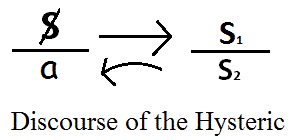
In the hysterical link, the . . over a stands for the subject who is divided, traumatized, by what an object she is for the Other, what role she plays in Other’s desire: “Why am I what you’re saying that I am?” … What she expects from the Other-Master is knowledge about what she is as object (the lower level of the formula).

In contrast to hysteria, the pervert knows perfectly what he is for the Other: a knowledge supports his position as the object of Other’s (divided subject’s) jouissance. For that reason, the matheme of the discourse of perversion is the same as that of the analyst’s discourse.

Lacan defines perversion as the inverted fantasy (i.e., his matheme of perversion is a-$), which is precisely the upper level of the analyst’s discourse. The difference between the social link of perversion and that of analysis is grounded in the radical ambiguity of objet petit a in Lacan, which stands simultaneously for the imaginary fantasmatic lure/screen AND for that which this lure is obfuscating, for the void behind the lure.

*So when we pass from perversion to the analytic social link, the agent (analyst) reduces himself to the void, which provokes the subject into confronting the truth of his desire. Knowledge in the position of “truth” below the bar under the “agent,” of course, refers to the supposed knowledge of the analyst, and, simultaneously, signals that the knowledge gained here will not be the neutral objective knowledge of scientific adequacy, but the knowledge that concerns the subject (analysand) in the truth of his subjective position.

In this precise sense, the analyst’s discourse produces the master signifier, the swerve of the patient’s knowledge, the surplus element that situates the patient’s knowledge at the level of truth: after the master signifier is produced, even if nothing changes at the level of knowledge, the same knowledge as before starts to function in a different mode. The master signifier is the unconscious sinthome, the cipher of enjoyment, to which the subject was unknowingly subjected.

*Text here is modified according to https://www.terada.ca/discourse/?p=7106

So, if a political Leader says “I am your Master, let my will be done!” this direct assertion of authority is hystericized when the subject starts to doubt his qualification to act as a Leader (“Am I really their Master?” What is in me that legitimizes me to act like that?”); it can be masked in the guise of the university discourse (“In asking you to do this, I merely follow the insight into objective historical necessity, so I am not your Leader, but merely your servant who enables you to act for your own good. …”); or, the subject can act as a blank, suspending his symbolic efficiency and thus compelling his Other to become aware of how he was experiencing another subject as a Leader only because he was treating him as one.

It should be clear, from this brief description, how the position of the “agent” in each of the four discourses involves a specific mode of subjectivity:

– the Master is the subject who is fuly engaged in his (speech) act, who, in a way, “is his word,” whose word displays an immediate performative efficiency;

– the agent of the university discourse is, on the contrary, fundamentally disengaged: he posits himself as the self-erasing observer (and executor) of “objective laws” accessible to neutral knowledge (in clinical terms, his position is closest to that of the pervert).

– the hysterical subject is the subject whose very existence involves radical doubt and questioning, his entire being is sustained by the uncertainty as to what he is for the Other; insofar as the subject exists only as an answer to the enigma of the Other’s desire, the hysterical subject is the subject par excellence.

Again, in clear contrast to it, the analyst stands for the paradox of the desubjectivized subject, of the subject who fully assumed what Lacan calls “subjective destitution” that is, who breaks out of the vicious cycle of intersubjective dialectics of desire and turns into an acephalous being of pure drive.

objet a and the drive id-evil

Žižek, Slavoj.  Jacques Lacan’s Four Discourses also in an article in Russell Grigg and Justin Clemens Jacques Lacan and the Other Side of Psychoanalysis. 2006

Portions of this stuff are reprinted in The Parallax View starting on page 303.
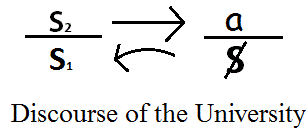
Can the upper level of Lacan’s formula of the university discourse — S2 directed toward a — not also be read as standing for the university knowledge endeavoring to integrate, domesticate, and appropriate the excess that resists and rejects it?

One of the telltale signs of university discourse is that the opponent is accused of being “dogmatic” and “sectarian.” University discourse cannot tolerate an engaged subjective stance. Should not our first gesture be, as Lacanians, to heroically assume this designation of being “sectarian” and engage in a “sectarian” polemic?

University discourse as the hegemonic discourse of modernity has two forms of existence in which its inner tension (“contradiction”) is externalized: capitalism, its logic of the integrated excess, of the system reproducing itself through constant self-revolutionizing, and the bureaucratic “totalitarianism” conceptualized in different guises as the rule of technology, of instrumental reason, of biopolitics, as the “administered world.”

We should not succumb to the temptation of reducing capitalism to a mere form of appearance of the more fundamental ontological attitude of technological domination; we should rather insist, in the Marxian mode, that the capitalist logic of integrating the surplus into the functioning of the system is the fundamental fact.

Stalinist “totalitarianism” was the capitalist logic of self-propelling productivity liberated from its capitalist form, which is why it failed: Stalinism was the symptom of capitalism.

Stalinism involved the matrix of general intellect, of the planned transparency of social life, of total productive mobilization- and its violent purges and paranoia were a kind of a “return of the repressed,” the “irrationality” inherent to the project of a totally organized “administered society.” This means the two levels, precisely insofar as they are two sides of the same coin, are ultimately incompatible: there is no metalanguage enabling us to translate the logic of domination back into the capitalist reproduction-through-excess, or vice versa.

The key question here concerns the relationship between the two excesses:

1) the economic excess/surplus integrated into the capitalist machine as the force that drives it into permanent self-revolutionizing and

2) the political excess of power — exercise inherent to modern power (the constitutive excess of representation over the represented: the legitimate state power responsible to its subjects is supplemented by the obscene message of unconditional exercise of Power —laws do not really bind me, I can do to you whatever I want, I can treat you as guilty if I decide to, I can destroy you if I say so).

The master’s discourse stands not for the premodern master, but for the absolute monarchy, this first figure of modernity that effectively undermined the articulate network of feudal relations and interdependences, transforming fidelity to flattery: it is the “Sun-King” Louis XIV with his L’état, c’est moi who is the master par excellence. Hysterical discourse and university discourse then deploy two outcomes of the vacillation of the direct reign of the master:

the expert-rule of bureaucracy that culminates in the biopolitics of reducing the population to a collection of homo sacer (what Heidegger called “enframing,” Adorno “the administered world,” Foucault the society of “discipline and punish”);

the explosion of the hysterical capitalist subjectivity that reproduces itself through permanent self-revolutionizing, through the integration of the excess into the “normal” functioning of the social link (the true “permanent revolution” is already capitalism itself).

Lacan’s formula of the four discourses thus enables us to deploy the two faces of modernity

1. total administration and
2. capitalist-individualist dynamics

as two ways to undermine the master’s discourse:

doubt about the efficiency of the master-figure (what Eric Santner called the “crisis of investiture”) can be supplemented by the direct rule of the experts legitimized by their knowledge, or

the excess of doubt, of permanent questioning, can be directly integrated into social reproduction.
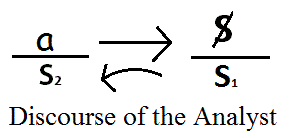
Finally, the analyst’s discourse stands for the emergence of revolutionary-emancipatory subjectivity that resolves the split of university and hysteria.

In it, the revolutionary agent – a – addresses the subject from the position of knowledge that occupies the place of truth (i.e., which intervenes at the “symptomal torsion” of the subject’s constellation), and the goal is to isolate, get rid of, the master signifier that structured the subject’s (ideologico-political) unconscious.

Or does it? Jacques-Alain Miller has recently proposed that today the master’s discourse is no longer the “obverse” of the analyst’s discourse. Today, on the contrary, our “civilization” itself-its hegemonic symbolic matrix, as it were-fits the formula of the analyst’s discourse. The agent of the social link is today a, surplus enjoyment, the superego injunction to enjoy that permeates our discourse; this injunction addresses $ (the divided subject) who is put to work in order to live up to this injunction. The truth of this social link is S2, scientific-expert knowledge in its different guises, and the goal is to generate S1, the self-mastery of the subject, that is, to enable the subject to cope with the stress of the call to enjoyment (through self-help manuals, etc.). Provocative as this notion is, it raises a series of questions. If it is true, in what, then, resides the difference between the discursive functioning of civilization as such and the psychoanalytic social link? Miller resorts here to a suspicious solution: in our civilization, the four terms are kept apart, isolated; each operates on its own, while only in psychoanalysis are they brought together into a coherent link: “in civilization, each of the four terms remains disjoined… it is only in psychoanalysis, in pure psychoanalysis, that these elements are arranged into a discourse.”

However, is it not that the fundamental operation of the psychoanalytic treatment is not synthesis, bringing elements into a link, but, precisely, analysis, separating what in a social link appears to belong together? This path, opposed to that of Miller, is indicated by Giorgio Agamben,Giorgio Agamben, who, in the last pages of The State of Exception, imagines two Utopian options of how to break out of the vicious cycle of law and violence, of the rule of law sustained by violence.

One is the Benjaminian vision of “pure” revolutionary violence with no relationship to the law.

The other is the relationship to the law without regard to its (violent) enforcement, such as Jewish scholars do in their endless (re)interpretation of the Law.

Agamben starts from the right insight that the task today is not synthesis but separation, distinction: nor bringing law and violence together (so that right will have might and the exercise of might will be fully legitimized), but thoroughly separating them, untying their knot.

Although Agamben confers on this formulation an anti-Hegelian twist, a more proper reading of Hegel makes it clear that such a gesture of separation is what the Hegelian “synthesis” is effectively about. In it, the opposites are not reconciled in a “higher synthesis”; it is rather that their difference is posited “as such.”

However, is this vision not again the case of our late capitalist reality going further than our dreams? Are we not already encountering in our social reality what Agamben envisages as a Utopian vision?

Isn’t the Hegelian lesson of the global reflexivization-mediatization of our lives that it generates its own brutal immediacy?

This has best been captured by Etienne Balibar’s notion of excessive, nonfunctional cruelty as a feature of contemporary life, a cruelty whose figures range from “fundamentalist” racist and/or religious slaughter to the “senseless” outbursts of violence performed by adolescents and the homeless in our megalopolises, a violence one is tempted to call Id-Evil, a violence grounded in no utilitarian or ideological reasons.

All the talk about foreigners stealing work from us or about the threat they represent to our Western values should not deceive us: under closer examination, it soon becomes clear that this talk provides a rather superficial secondary rationalization. The answer we ultimately obtain from a skinhead is that it makes him feel good to beat foreigners, that their presence disturbs him. What we encounter here is indeed Id-Evil, that is,

the Evil structured and motivated by the most elementary imbalance in the relationship between the ego and jouissance, by the tension between pleasure and the foreign body of jouissance in the very heart of it.

Id-Evil thus stages the most elementary short circuit in the relationship of the subject to the primordially missing object cause of his desire. What bothers us in the other (Jew, Japanese, African, Turk) is that he appears to entertain a privileged relationship to the object — the other either possesses the object treasure, having snatched it away from us (which is why we don’t have it), or he poses a threat to our possession of the object.

What one should propose here is the Hegelian “infinite judgment,” asserting the speculative identity of these “useless” and “excessive” outbursts of violent immediacy, which display nothing but a pure and naked (“non-sublimated”) hatred of the Otherness, with the global reflexivization of society. […] the response of the neo-Nazi skinhead who, when really pressed for the reasons for his violence, suddenly starts to talk like social workers, sociologists, and social psychologists, quoting diminished social mobility, rising insecurity, the disintegration of paternal authority, the lack of maternal love in his early childhood-the unity of practice and its inherent ideological legitimization disintegrates into raw violence and its impotent, inefficient interpretation.

This impotence of interpretation is also one of the necessary obverses of the universalized reflexivity hailed by the risk-society-theorists: it is as if our reflexive power can flourish only insofar as it draws its strength and relies on some minimal “prereflexive” substantial support that eludes its grasp, so that its universalization comes at the price of its inefficiency, that is, by the paradoxical re-emergence of the brute real of “irrational” violence, impermeable and insensitive to reflexive interpretation. So the more today’s social theory proclaims the end of nature or tradition and the rise of the “risk society,” the more the implicit reference to “nature” pervades our daily discourse: even when we do not speak of the “end of history,” do we not put forward the same message when we claim that we are entering a “postideological” pragmatic era, which is another way of claiming that we are entering a postpolitical order in which the only legitimate conflicts are ethnic/cultural conflicts?

Typically, in today’s critical and political discourse, the term worker has disappeared from the vocabulary, substituted or obliterated by immigrants or immigrant workers: Algerians in France, Turks in Germany, Mexicans in the United States.

In this way, the class problematic of workers’ exploitation is transformed into the multiculturalist problematic of “intolerance of otherness,” and the excessive investment of the multiculturalist liberals in protecting immigrants’ ethnic rights clearly draws its energy from the “repressed class dimension. Although Francis Fukuyama’s thesis on the “end of history” quickly fell into disrepute, we still silently presume that the liberal-democratic capitalist global order is somehow the finally found “natural” social regime, we still implicitly conceive conflicts in the Third World countries as a subspecies of natural catastrophes, as outbursts of quasi-natural violent passions, or as conflicts based on the fanatic identification to one’s ethnic roots (and what is “the ethnic” here if not again a code word for “nature”?). And, again, the key point is that this all-pervasive renaturalization is strictly correlative to the global reflexivization of our daily lives.

What this means, with regard to Agamben’s Utopian vision of untying the knot of the Law and violence is that, in our postpolitical societies, this knot is already untied: we encounter, on the one hand, the globalized interpretation whose globalization is paid for by its impotence, its failure to enforce itself, to generate effects in the real, and, on the other hand, explosions of the raw real of a violence that cannot be affected by its symbolic interpretation. Where, then, is the solution here, between

– the claim that, in today’s hegemonic constellation, the elements of the social link are separated and as such to be brought together by psycho-analysis (Miller),

– and the knot between Law and violence to be untied, their separation to be enacted (Agamben)?

What if these two separations are not symmetrical? What if the gap between the symbolic and the raw real epitomized by the figure of the skinhead is a false one, since this real of the outbursts of the “irrational” violence is generated by the globalization of the symbolic?

When, exactly, does the objet a function as the superego injunction to enjoy? When it occupies the place of the master signifier, that is, as Lacan formulated it in the last pages of his Seminar XI, when the short circuit between S1 and a occurs. The key move to be accomplished in order to break the vicious cycle of the superego injunction is thus to enact the separation between S1 and a.

Consequently, would it not be more productive to follow a different path, that is, to start with the different modus operandi of l’objet a, which in psychoanalysis no longer functions as the agent of the superego injunction — as it does in the discourse of perversion?

This is how Miller’s claim of the identity of the analyst’s discourse and the discourse of today’s civilization should be read: as an indication that this latter discourse (social link) is that of perversion.

That is to say, the fact that the upper level of Lacan’s formula of the analyst’s discourse is the same as his formula of perversion (a-$) opens up a possibility of reading the entire formula of the analyst’s discourse also as a formula of the perverse social link: its agent, the masochist pervert (the pervert par excellence), occupies the position of the object instrument of the other’s desire, and, in this way, through serving his (feminine) victim, he posits her as the hystericized/divided subject who “doesn’t know what she wants.”

Rather, the pervert knows it for her, that is, he pretends to speak from the position of knowledge (about the other’s desire) that enables him to serve the other; and, finally, the product of this social link is the master signifier, that is, the hysterical subject elevated into the role of the master (dominatrix) whom the pervert masochist serves.

In contrast to hysteria, the pervert knows perfectly what he is for the Other: a knowledge supports his position as the object of his Other’s (divided subject’s) jouissance.

The difference between the social link of perversion and that of analysis is grounded in the radical ambiguity of objet a in Lacan, which stands simultaneously for the imaginary fantasmatic lure/screen and for that which this lure is obfuscating, for the void behind the lure.

Consequently, when we pass from perversion to the analytic social link, the agent (analyst) reduces himself to the void, which provokes the subject into confronting the truth of his desire. Knowledge in the position of “truth” below the bar under the “agent,” of course, refers to the supposed knowledge of the analyst, and, simultaneously, signals that the knowledge gained here will not be the neutral objective knowledge of scientific adequacy, but the knowledge that concerns the subject (analysand) in the truth of his subjective position.

Recall, again, Lacan’s outrageous statements that, even if what a jealous husband claims about his wife (that she sleeps around with other men) is all true, his jealousy is still pathological. Along the same lines, one could say that, even if most of the Nazi claims about the Jews were true (they exploit Germans, they seduce German girls), their anti-Semitism would still be (and was) pathological – because it represses the true reason the Nazis needed anti-Semitism in order to sustain their ideological position.

So, in the case of anti-Semitism, knowledge about what the Jews “really are” is a fake, irrelevant, while the only knowledge at the place of truth is the knowledge about why a Nazi needs a figure of the Jew to sustain his ideological edifice.

In this precise sense, the analyst’s discourse produces the master signifier, the swerve of the patient’s knowledge, the surplus element that situates the patient’s knowledge at the level of truth: after the master signifier is produced, even if nothing changes at the level of knowledge, the same knowledge as before starts to function in a different mode. The master signifier is the unconscious sinthome, the cipher of enjoyment, to which the subject was unknowingly subjected.

The crucial point not to be missed here is how the late Lacan’s identification of the subjective position of the analyst as that of objet petit a presents an act of radical self-criticism. Earlier, in the 1950’s, Lacan conceived the analyst not as the small other (a), but, on the contrary, as a kind of stand-in for the big Other (A, the anonymous symbolic order). At this level, the function of the analyst was to frustrate the subject’s imaginary misrecognitions and to make them accept their proper symbolic place within the circuit of symbolic exchange, the place that effectively (and unbeknownst to them) determines their symbolic identity. Later, however, the analyst stands precisely for the ultimate inconsistency and failure of the big Other, that is, for the symbolic order’s inability to guarantee the subject’s symbolic identity.

One should thus always bear in mind the thoroughly ambiguous status of objet a in Lacan. Miller recently proposed a Benjaminian distinction between “constituted anxiety” and “constituent anxiety”: while the first designates the standard notion of the terrifying and fascinating abyss of anxiety that haunts us, its infernal circle that threatens to draws us in, the second stands for the “pure” confrontation with objet a as constituted in its very loss.

Miller is right to emphasize here two features: the difference that separates constituted from constituent anxiety concerns the status of the object with regard to fantasy. In a case of constituted anxiety, the object dwells within the confines of a fantasy, while we get the constituent fantasy only when the subject “traverses the fantasy” and confronts the void, the gap, filled up by the fantasmatic object.

Clear and convincing as it is. Miller’s formula misses the true paradox or, rather, ambiguity of objet a: when he defines objet a as the object that overlaps with its loss, that emerges at the very moment of its loss (so that all its fantasmatic incarnations, from breasts to voice and gaze, are metonymic figurations of the void of nothing), he remains within the horizon of desire — the true object cause of desire is the void filled in by its fantasmatic incarnations.

While, as Lacan emphasizes, objet a is also the object of the drive, the relationship is here thoroughly different. Although in both cases, the link between object and loss is crucial, in the case of objet a as the object cause of desire, we have an object which is originally lost, which coincides with its own loss, which emerges as lost, while, in the case of objet a as the object of the drive, the “object” is directly the loss itself.

In the shift from desire to drive, we pass from the lost object to loss itself as an object. That is to say, the weird movement called “drive” is not driven by the “impossible” quest for the lost object, but by a push to directly enact the “loss” – the gap, cut, distance – itself.

There is thus a double distinction to be drawn here: not only between object a in its fantasmatic and post-fantasmatic status, but also, within this post-fantasmatic domain itself, between the lost object cause of desire and the object loss of the drive. Far from concerning an abstract scholastic debate, this distinction has crucial ideologico-political consequences: it enables us to articulate the libidinal dynamics of capitalism.

Following Miller himself, a distinction has to be introduced here between lack and hole. Lack is spatial, designating a void within a space, while the hole is more radical — it designates the point at which this spatial order itself breaks down (as in the “black hole” in physics).

Therein resides the difference between desire and drive: desire is grounded in its constitutive lack, while drive circulates around a hole, a gap in the order of being. In other words, the circular movement of drive obeys the weird logic of the curved space in which the shortest distance between two points is not a straight line, but a curve: the drive “knows” that the shortest way to attain its aim is to circulate around its goal-object. At the immediate level of addressing individuals, capitalism of course interpellates them as consumers, as subjects of desires, soliciting in them ever new perverse and excessive desires (for which it offers products to satisfy them); furthermore, it obviously also manipulates the “desire to desire,” celebrating the very desire to desire ever new objects and modes of pleasure. However, even if if already manipulates desire in a way that takes into account the fact that the most elementary desire is the desire to reproduce itself as desire (and not to find satisfaction), at this level, we do not yet reach the drive.

The drive inheres to capitalism at a more fundamental, systemic level: drive propels the entire capitalist machinery; it is the impersonal compulsion to engage in the endless circular movement of expanded self-reproduction. The capitalist drive thus belongs to no definite individual – it is rather that those individuals who act as direct “agents” of capital (capitalists themselves, top managers) have to practice it. We enter the mode of the drive when (as Marx put it) the circulation of money as capital becomes “an end in itself, for the expansion of value takes place only within this constantly renewed movement. The circulation of capital has therefore no limits.” One should bear in mind here Lacan’s well-known distinction between the aim and the goal of drive: while the goal is the object around which drive circulates, its (true) aim is the endless continuation of this circulation as such.
Review of Excessive Subject

In this book Molly Anne Rothenberg makes clear that progressive political theorists need to re-think their understanding of the subject because the current deadlock has resulted in either structuralist dead-ends, or immanentist ‘Foucaultian’ type analyses that don’t account for the nature of agency and resistance, and so can’t with any sort of robustness contribute to an understanding of social change that includes an idea of radical subjectivity. According to Rothenberg, social theory has been deadlocked around these two versions of subjective agency and their respective theories of causality. She suggests that we toss these theories into the wastebin, and look at an newly emerging way of thinking the ‘social field’ reflected in the recent work of Alain Badiou, Slavoj Zizek and Alenka Zupancic. I think she benefits most from the theory of Badiou, but is definitely influenced by the latter two as well. Critical of Zizek’s notion of the Act, she nonetheless draws much theoretical weight from his notion of subjective destitution, which Rothenberg, much to her credit, takes to new heights in this book. It is a difficult concept, but one can see Rothenberg struggling to articulate a new approach to thinking subjectivity and its articulation to the social field through an ‘excess’ and a ‘relation of non-relation’. Her final chapter rewards the reader’s discipline (the book overall is a challenging yet clear and insightful read) and patience. Taking up an alternative reading of Melville’s Bartleby, R. allows the reader to get a further handle on her theory of the ‘excessive subject’. Additionally the reading of Felix Guattari’s early work shows the extent to which R. does not shy away from seeking to show how a relation to ‘excess’ via a Möbius subjectivity allows us to begin to think a radical newness and an ethicality that is truly radical and original. Buy this book.

Note: Adam Kotsko in the latest installment of the Journal of Zizek Studies, helpfully points out that Zizek reads Agota Kristof’s novel The Notebook, and claims the twin boy characters as new vehicles of a radical ethical subjectivity. One certainly wonders what Rothenberg would make of this, that is, whether she would see this as a more positive elaboration by Zizek of his important notion of the de-constituted subject, hence shadowing her idea of the Möbius subject? Reading Kotsko’s article together with Rothenberg’s book, gives me the impression that there is a subtle groundswell for a different articulation of the subject that gets us beyond many of the deadlocks that have stymied creative and radical theory for so long now.

subject*

social change is irremediably fantasmatic (206)

The excess (*) attending the subject, to repeat, is therefore both the medium of its connection to other subjects and the obstacle to that connection. This dual function comprises the “relation of nonrelation” that undergirds the social field, a relation predicated on an obstacle to relationality.

… because the Möbius subject encompasses both its symbolic properties (elements of the set) and its formal properties (set-ness, empty set), de-personalization doesn’t rid the subject of its ontic properties but it sets them off, revealing them as contingent (rather than necessary) bearers of meaning.  By making visible the relation of nonrelation through symbolic divestiture the subject situates itself as the source of the non-orientability of the social field, without however being able to account for its own effects within that field in any predictive or comprehensive sense.

In this way, the subject takes ethical responsibility for its parallax oscillation, exposing the excess that sticks to itself (as if it were being seen from the perspective of others) and establishing distance from it, which is a prerequisite to tolerating it nondefensively (207).

As far as I can see, the suspension of the defense against excess — or the neutralization of the more destructive defenses — is the only way that the subject’s transformation of its relation to its own jouissance can affect others.  This suspension means that the subject accepts the relation of nonrelation, giving up its fruitless but often destructive efforts to locate the excess outside itself or to eradicate it.  By refusing to defend itself (or by refusing to deploy destructive defenses such as narcissism, aggression, projection, and scapegoating), the subject decreases its contribution to the affective storm in a social field that circulates excess like a hot potato.  The potentiation of affect decreases, however temporarily, when the subject absorbs some of the affective energy without releasing it back in a destructive form (207).

… in general the absorption of affect by one member of the group provides an opening for others to change their own affective posture.

In any case, no matter what the specific defense aroused, the encounter with the neosubject will make apparent the dominant identifications and defenses of others.  This display of the dominant tendencies in a particular social universe permits reflection on what works and what doesn’t, helping to aggregate and focus social energies.  These may be actions that put the brakes on violence, stymie bullies, alleviate suffering, secure privacy, promote stability and so on.  That is, the encounter with the neosubject forces into the open the rationalizations for the status-quo, and in so doing can foster the conditions under which people will have a choice to make at the level of practices — individual, familial, institutional.

The setting-off of the subject’s substantive traits — through, for example, self-deprecating humor — both exposes the contingent meaning of those traits and reflects back to others the way those traits get used as explanations for social discord. In this way, the subject brings something new into the social field — not only a de-emphasis on ontic properties and a revelation of a dimension of universality independent of such properties, but also a new way of being in the social field that nondefensively accepts the relation of nonrelation.  What is more, unlike the immanent cause or the exceptional cause, the effects of the deployment of the extimate cause, as it generates new behavior and new relations, can be tracked, studied, and analyzed (208).

Möbius subject and the relation of nonrelation

The Möbius subject has two driving motivations, that is, motivations at the level of the drive:

1. The first is to maintain the extimacy that is the ground of its existence: as we know, the drive circulates around objet a, the missing object, established by way of the encounter with the formal negation, the Non/Nom-du-Père.

2. The second is to defend itself against the anxiety generated by its excessive status. This anxiety, understood in Lacanian terms, is simply affect itself, a function of the Möbius condition of subjectivity.

The motivations may be at odds, but they derive necessarily from the subject’s founding.  Taken together, they provide the means by which the social space itself is propagated and sustained.

Because, at the level of the drive, the subject comes into existence only if it seems as though objet a is possible, prohibited rather than impossible, the subject has a stake in the very condition that produces anxiety — its status as a signifier depends upon the impossibility of objet a and its status as a signifier makes its ultimate stability, its final meaning or self-consistency, unreachable.  In this dynamic, seen from the level of Symbolic relations, it can seem that the other’s failure to stabilize the subject’s meaning is willfully aggressive (or negligent) rather than a function of impossibility.

As a result, the Möbius subject relates to the other both as the solution and the obstacle to its own inconsistency — a relation of nonrelation.  That is, thanks to the excess that sticks to each subject, and thanks to the fantasy that the other is consistent in a way that the subject is not, the social relation necessarily emerges as a relation of nonrelation (202).

In the Levinasian version the subject seeks to overcome the radical alterity that, in this view, properly belongs to the other.  In the extimate version, the subject must perpetually seek a response from the others because, in fact the subject will never be sure of the meaning of the response it gets, yet the subject has nowhere else to go to get it.  The other is not radically other — it is close enough to the subject in kind to warrant the desire tor the relationship while distant enough in its ability to fulfill the subject’s deepest desire to maintain its otherness.

At the same time, the “other” to whom the subject relates does not truly exist in the way the subject believes: the other is a fantasmatic projection of a wish.  So the subject has a relation of nonrelation to the actual others in the social space.  It is in this relation of nonrelation that we find the sustaining of the duality of subject and other that Levinas requires for ethics but fails to provide.

The hatred and envy that can arise from the subject’s frustration at the other’s inability to repair the subject’s self-inconsistency could easily galvanize the destruction of the very space of the social … (203).  The destruction of that space, however, would spell the demise of the subject qua subject. Subjects mobilize a number of (necessarily inadequate) defenses — including perversion and hysteria — to avoid that result.  … We don’t want to feel that “we’re all in this together” if that means everyone is subject to excess.  We want to feel that someone can solve this problem or be targeted as its source.  But because these wishes do not actually resolve the excess, the best we can do is to try to send it on its rounds, even though it inevitably “returns” to us — since, of course, in reality it never left.  We are stuck with and to excess. From this point of view, it appears that the motivation for the social relation is not the preservation of the other’s distinct existence, as Levinas and Critichley would have it, but rather the need to preserve the social field itself — the field without which the subject (all subjects) as such cannot exist — from a threat of dissolution.

That is, the subject fantasizes that the continual dissolution and reassemblage of the social field made possible and necessary by excess is a threat to the field rather than the very condition of its perpetuation (203).

subject of the drive and the universal

Rothenberg, Molly. The Excessive Subject. Malden, M.A. : Politiy Press, 2010.

As long as we are fixated — as happens in multiculturalism and identity politics — on the symbolic identifiers of our personal identities, we obscure the link between the subject and the drive as the true engine of the subject’s existence.

Molly isn’t big on ‘subject of desire’
For when we focus on the symbolic dimension of identity, we are conceiving of the subject as a subject of desire, perpetually seeking to overcome its lack by finding its object of desire.  Any political action founded on this premise dooms the actors to a futile search for a utopia which, of necessity, must always be deferred (176).

In Žižek’s view, the political meaning of one’s acts has nothing to do with one’s “sincerity or hypocrisy” — that is, one’s “subjective self-experience” is irrelevant to the objective truth of one’s actions. Rather, the subject of the drive institutes a gap between itself and its symbolic subjective dimension.

The subject’s identification with objet a re-casts it, not as a set of symbolic properties, but as connected directly to the order of objectivityIntroducing a distance towards one’s own symbolic identity puts one in a position to act in an “objective-ethical” way (OWB 182).

Presumably, it is this link to the objective that makes solidarity possible.  The manifold differences or symbolic properties of individuals move to the background, while each subject, as identified with the object of the drive, finds its way to the objective order, the only terrain on which meaningful change can occur. Solidarity, then, emerges not from intersubjective relations but rather from the relations of subjects purified of their symbolic identities, subjects who meet on the ground of objectivity, as objects (177).

pluth sinthome

Pluth, Ed. Signifiers and Acts: Freedom in Lacan’s Theory of the Subject. Albany: SUNY Press, 2007.

… Miller’s contention is that the analytic act in Lacanian theory was thought primarily as traversal, and thus as negation, as disinvestment. As we have seen, this is also how Žižek describes the act. If the fantasy is something in which one makes oneself subject, in which there is some procurement of enjoyment that comes along with a position recognized by the Other, then the disinvestment in question in an act is a separation from this position. Thus an act would entail a dissolution of the subject of fantasy and its replacement by a new subject. But what, if anything, does an act do to something like a sinthome? 160-161

Nothing at all, according to Miller. The sinthome does not budge after the libidinal disinvestment in fantasy that characterizes an act.

On of the problems explored in my closing chapters was the question of what remains of the Other after the act and what can be done with what could be considered a de-Othered symoblic.

Miller claims that in the sinthome one forms a partnership with something of the Other at the level of enjoyment — one enjoys the Other through one’s sinthome, and this enjoyed Other, which seems to occur in the form of an “enjoyed meaning” or sens-jouis, is contrasted to the Other as a site that guarantees meaning and confers recognition. What happens after the voiding of the Other is that rather than an investment in fantasy, which is mediated by the Other, there is a direct investment in signifiers as such; and it is on this basis that a partnership with the Other, on the level of enjoyment is forged (163).