Campbell, Kirsten. Jacques Lacan and Feminist Epistemology. Florence, KY, USA: Routledge, 2004. p 122.
Social fictions are not seamless and unitary, but multiple and contradictory. For example, Gloria Anzaldúa argues that for the Hispanic lesbian markers of ‘identity’ often conflict, and that ‘self’ is negotiated in those conflictual identificatory demands (1987: 77– 91). Anzaldúa describes a process in which master signifiers of the subject – those markers of ‘self’ – produce a subject with multiple discursive interpellations.
Anzaldúa’s account is in clear contrast to the white bourgeois and heterosexual masculine subject whose markers of identity seem to ‘match’ the master signifiers of social fictions of modern Western society. The subject is produced in both personal and social histories that are fundamentally imbricated. In this way, social fictions are discourses of both the subjective and the social, because an imaginary and symbolic relation to other subjects always produces the subject.
This description of the subject draws on the Lacanian psychoanalytic insight that the psychic and the social are moments of each other, produced in the basic ‘nature’ of humans not to be natural.
However, the concept of the social fiction does not imply the liberal idea of the social contract in which individual subjects of consciousness agree at a mythical moment of origin to enter rational social arrangements. Rather, it retains the Lacanian insistence that there is no pre-discursive reality since the world is always already inscribed in discourse (S20: 32).
The subject does not therefore emerge into a neutral social world but is inserted into already existing social relations. Social fictions exist prior to the subject and its very existence is contingent upon them. Social fictions are discursive relations between subjects that have material effect because they are ‘lived’ by subjects. This material effect can be seen in the operations of fictions of gender.
For example, while the Symbolic order is a symbolic relation between subjects, the phallic signifier orders that relation, positing some subjects as having the phallus and others as not having it.
At this symbolic level, the possession or absence of the phallus defines subjects. However, at a discursive level, the symbolic relation is filled with content as to the ‘nature’ of sexed identity. The social fictions of ‘masculinity’ and ‘femininity’ attach respectively to a subject with or without the phallus. The fictions of gender interpellate male and female bodies as masculine and feminine subjects, so that it fixes the contingency of the relation between phallus and penis. The fictions of gender render penis, phallus and masculinity as male subjectivity. In the Western social world, the phallus is a signifier that proliferates in a multitude of discourses of masculinity, which in turn produce a number of recognizably ‘masculine’ subjects.
Male subjects can recognize themselves as ‘masculine’, and equally importantly, other subjects are able to recognize them as ‘masculine’. Social fictions are symbolic relations that have material effects, and those material effects give substance, reality and existence to these symbolic relations between subjects.
Jane Gallop points out that it is not just the referentiality of phallus/penis that produces ‘masculinity’ but also the social arrangements that attach power of many forms to the masculine subject (1988: 53). The social world of the fictions of gender is still riven with material and structural inequality for women.
… The social fiction of gender operates such that even if a female subject were to want to take up a ‘masculine’ position, she would find innumerable difficulties in doing so. These difficulties arise not only because she may not identify with the social fiction of masculinity, but also because other subjects may insist on her insertion into the social discourses of femininity, regardless of her identificatory position.
In this sense, the subject is not its own creation, for it must always contend with the realities of social life. The world of the social fiction has facticity, in the sense that it is prior to the subject and has a material and psychic reality for the subject.
Positing the subject
Social fictions produce a subjective position of social identity, in which ‘position’ describes a temporal and spatial moment of subjectivation rather than an ontological foundation. The true subject of the social fiction, like the subject of the Lacanian account it draws upon, is empty.
Fraser claims that ‘Lacan’s account of identity construction cannot account for identity shifts over time’ (1992: 183). However, the Lacanian subject is never an ‘essence’, not even an Oedipal essence. Identity is fictional, for otherwise psychoanalysis could not have as its aim ‘identity shifts’. The Lacanian account fundamentally engages with the spatial and temporal formation of subjectivity and intersubjectivity, and my model of the subject of social fictions takes up the Lacanian emphasis upon its continual production.
In this model of the social fiction, two key and ongoing processes of interpellation produce a speaking position of the subject. The first key process is the personal history of the subject, that is, its production within familial networks. However, these familial relationships are not ‘outside’ the symbolic networks of social fictions, so that a personal history describes a position formed at the intersection of both psychic and social histories.
In this first process of interpellation, the subject comes into existence as a ‘being’ which possesses a ‘self’. These imaginary relations to self and others make discursive relations lived or ‘real’. That child becomes an adult, a social being that lives in and through its formative social fictions.
In this second key process of interpellation, the subject ‘mis/recognizes’ itself in discourse, in terms of its already given ‘identity’ and ‘self’. In this sense, identification with the master signifiers of social fictions reproduces the subject, because it reiterates the imaginary and symbolic relations which were formative of the subject and which capture the subject in social fictions. That capture is a process both of an experience of ‘identity’ and of an enactment of an ‘identity’ for others. This subject does not simply reflect existing social identities, because it also has agency. It can ‘read’ social fictions for their representation of dominant identities and act on that reading, such that the subject can represent itself through different master signifiers of social identity and come to occupy a different position of identity.
An example of this process can be seen in class mobility, in which the subject takes on the cultural markers of its aspirant class.
‘Identity’ in social fictions is not a social construct imposed upon a passive subject. The subject itself acts to produce its identity by reproducing or resisting fictive identities. Nevertheless, it is not necessarily easy to attain subjective mobility, particularly in relation to sexualized and racialized bodies, since sexuality and race are read on to and mark the body itself.
Transsexuals recognize that social fact in their desire to be bodily ‘men’ or ‘women’, rather than only presenting the signs of ‘masculinity’ or ‘femininity’. The desire for surgical intervention shows how immobile gender ‘mobility’ can be. In transsexuality, the subject represents itself to others through master signifiers of ‘masculinity’ or ‘femininity’. In this example, the subject is concerned with its representation of its ‘self’ to others. However, those others may insist that the subject embody particular and ‘fixed’ master signifiers of sexual difference, and it is this insistence that the transsexual often seeks to evade. In its relations to others, the subject engages with the imaginary and symbolic relations of social fictions that others seek to impose upon it. Because of sexist or racist others, it may not be possible to evade another’s signification of our ‘selves’ in discourses of social fictions.
Subjective engagement with social fictions is performative in Butler’s sense and is therefore open to change. However, others will constrain the mobility of that performance of identity. The subject has agency in relation to social fictions because of their contingency. The relation of subject to social fictions is a contingent one, as it is fixed by imaginary and symbolic relations. For example, the relation between the female body and ‘femininity’ is conditional upon the fixing of cultural difference to bodily difference (Chanter 1997: 59). However, to argue that this relation is contingent is not to argue within a sex/gender model that has generally dominated feminist thinking.
The psychoanalytic inflection of the social fiction emphasizes the production of sexed subjectivity within imaginary and symbolic relations. If the subject is always already sexed, then feminist resistance is not merely a matter of reinscribing the female body (although this may be a strategy of that resistance), but also requires intervention in the symbolic and imaginary orders that produce our relation to ourselves and others.
For this reason, my account of the social fiction should not be misread as a social constructivist account of the imposition of a social order upon a passive being, with an additional psychoanalytic emphasis on the psychic mechanisms that produce social identity. … Joan Copjec points out that if the constructivist model was an accurate description of the production of subjects, the social world would create content and happy beings whose pleasures were commensurate with its normative roles (1994: 53– 54). This clearly is not the case. 125
My account of the social fiction is distinguishable from that influential sociological account by its Lacanian insistence that social integration is neither ‘successful’ nor complete. As a psychoanalytic social theory, the social fiction emphasizes the cost and failure of production of the subject in social (re)production.
Psychoanalysis posits a moment of failure of and excess to the social that is produced in the social order itself: the unconscious. The unconscious marks the failure of the social order to complete and fix the subject. The unconscious marks that failure of the social order to integrate the subject fully or satisfactorily into its discursive demands. However, the unconscious also marks an excess to the social. Unconscious desires, fantasy and identification interpellate the subject in discursive formations, but they also mark subjective demands that exceed those social discourses, as the unconscious describes culturally repudiated desires of the subject.
For this reason, Jacqueline Rose is right to argue that a political project which is also psychoanalytically inflected cannot reify the unconscious – for the unconscious represents what we (and the social order) do not want as much as that which we do (1986: 8).
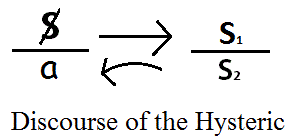
For example, the hysteric’s dilemma is an outcome of that repudiation of desire. In this sense, the unconscious marks that which the social order repudiates and represses, and so represents its excess. Psychoanalysis recognizes the anti-social, aggressive and solipsistic nature of an unconscious for which there is no negation.
In my psychoanalytic model of intersubjective relations, the subject is fictional and the signifier ambiguous. The subject and meaning are never determined; where they are fixed in a monologic symbolic economy, it is always at some cost to the subject.
The psychoanalytic insight of the cost of civilization concerns the suffering of the subject that the fixity of repetition causes. This failure of complete interpellation not only reveals the cost of securing social identity, but also creates the possibility of its contestation. If social integration is never complete, then the dominant fictions of our social order cannot ever entirely succeed, and where they are secured, it is only at a cost to the subject itself. Most importantly, in this account a moment of failure founds social relations themselves.
Social relations as symbolic relations fail because they are structured by an order which itself suffers a limit and concomitant failure in its symbolic logic. The Symbolic order is structured in an absence – a lack that founds and produces that order. Rose argues that both psychoanalysis and feminism share the position that a limit and a failure of the social order is sexual difference – specifically, the sexual difference of women (1986: 91).
In the modern socio-symbolic order, the social stumbles upon ‘Woman’ which functions as an unstable ‘break’ upon which it is founded and founders. If the cost of sociality is borne by all subjects, that cost is borne differently by sexuated subjects. Subjects may exchange a common loss which is the price of sociality, but the bearer of that loss is the female subject who represents all subjects’ lackin-being. For this reason, Freud is correct to see ‘women’ as a problem of the social, since ‘women’ represent its limit as well as its ground (1930: 293). Yet this position of women can also be reread as possibility – for the possibility that the phallic social order fails to define all that women are produces feminist knowledge. In this reading, women do not represent the ‘problem’ of sociality, but rather that ‘problem’ is a symbolic and social order that would posit women as a defining limit. This political shift is made by feminism. While social fictions of gender may constitute female subjectivity, feminist discourse articulates their inability to symbolize the ‘not all’ of women. It represents the possibility that a social fiction is fictional, and as such it is possible to contest and change it. 126-127