there is no big Other

Imagine experiencing oneself abandoned by God, left to one’s own devices, with no big Other secretly watching over one and guaranteeing a happy outcome — is this not another name for the abyss of freedom?   111

What to make, then, of the standard reproach that Hegel transposes Christianity-a religion of love and passion, of total subjective engagement into a narrative representation of “abstract” speculative truth? Although Christianity is the “true” religion, in it the truth still appears in the medium of representation (and not in its own conceptual medium), so that speculative philosophy is the truth (the true-adequate form) of the Christian truth (content); the passion and pain of subjective engagement are thus dismissed as a secondary narrative husk to be discarded if we want to reach the truth in its own conceptual element. What this critique misses is that the casting off of the pathetic-narrative existential experience-the transubstantiation of the subject from a “concrete” self immersed in its life world into the subject of pure thought — is itself a process of ”abstraction” which has to be accomplished in the individual’s “concrete” experience, and which as such involves the supreme pain of renunciation.  111

Precisely by the fact that Christianity is, at its deepest core, already atheistic, a paradoxically atheistic religion. When Christ says to his followers deceived after his death on the Cross that, whenever there is love between them, he will be there, alive among them, this should not be read as a guarantee that Christ-Love is a Third term in the relationship of love, its guarantee and foundation, but, on the contrary, as another way of proclaiming the death of God: there is no big Other which guarantees our fate; all we have is the self-grounded abyss
of our love.

What this means is also that Hegel really is the ultimate Christian philosopher: no wonder he often uses the term “love” to designate the play of the dialectical mediation of opposites. What makes him a Christian philosopher and a philosopher of love is the fact that, contrary to the common misunderstanding, in the arena of dialectical struggle there is no Third which unites and reconciles the two struggling opposites.   112

THE ATHEIST WAGER

In Lacan’s formulae of sexuation, “non-All” designates the feminine position, a field which is not totalized because it lacks the exception, the Master-Signifier. Applied to Christianity, this means that the Holy Spirit is feminine, a community not based on a leader. The shift to the feminine occurs already in Christ: Christ is not a male figure; as many subtle readers have noted, his strangely passive stance is that of feminization, not of male intervention.

Christ’s impassivity thus points towards the feminization of God: his sacrifice follows the same logic as that of the heroine of Henry James’s Portrait of a Lady, or of Sygne de Colifontaine in Claudel’s L’Otage. Christ is not a Master figure, but the objet a, occupying the position of the analyst: an embarrassing excess, answering questions with jokes and riddles that only confound his listeners further, already acting as his own blasphemy. 112

First, I conceive my position NOT as being somewhere in between atheism and religious belief, but as the only true radical atheism, that is, an atheism which draws all the consequences from the inexistence of the big Other. Therein resides the lesson of Christianity: as we have seen, it is not only that we do not believe in God, but that God himself does not believe in himself, so that he also cannot survive as the non-substantial symbolic order, the virtual big Other who continues to believe in our stead, on our behalf. Second, only a belief which survives such a disappearance of the big Other is belief at its most radical … the atheist subject engages itself in a (political, artistic, etc.) project, “believes” in it, without any guarantee. 116

My thesis is thus double: not only is Christianity (at its core, if disavowed by its institutional practice) the only truly consistent atheism, it is also that atheists are the only true believers. 116

In true ethics, one acts from the position of the inexistence of the big Other, assuming the abyss of the act deprived of any guarantee or support.

Authentic belief is to be opposed to the reliance on (or reference to) a(nother) subject supposed to believe: in an authentic act of belief, I myself fully assume my belief and thus have no need for any figure of the Other to guarantee that belief; to paraphrase Lacan, an authentic belief ne s’authorise que de lui-meme. In this precise sense, authentic belief not only does not presuppose any big Other (is not a belief in a big Other), but, on the contrary, presupposes the destitution of the big Other, the full acceptance of its inexistence. 118

A profoundly religious friend once commented on the subtitle of a book of mine, “the perverse core of Christianity”: “I fully agree with you there! I believe in God, but I find repulsive and deeply disturbing all the twists celebrating sacrifice and humiliation, redemption through suffering, God organizing his own son’s killing by men. Can’t we have Christianity without this perverse core?”  I could not bring myself to answer him: “But that is precisely the point of my book: what I want is all those perverse twists of redemption through suffering, the death of God, etc., but without God!”

Thus, as we have said, God has to die twice, first as real, then as symbolic; first in Judaism, then in Christianity. In Judaism, the God of the real survives as Word, as the virtual-dead Other whose specter is kept alive by the ritual performance of his subjects; in Christianity, this virtual Other itself dies. In Judaism, the God perceived directly as real dies; in Christianity, the God who is unconscious dies. The passage from paganism to Judaism is one of sublimation (the dead god survives as the symbolic Other) ; the death of Christ is not sublimation, in other words it is not the death of the real God who is resurrected in the Holy Ghost as the symbolic Other, like Julius Caesar who returns as sublimated in the symbolic title “Caesar.”  119

In strict parallel with this double move from paganism to Judaism and from Judaism to Christianity is the move from traditional authoritarian power to democracy and from democracy to revolutionary power: it is only in revolutionary power that the big Other really dies. In democracy, the place of power is empty, but the electoral procedure functions as a kind of ersatz-Other providing the legitimacy for power. That is to say, democracy-in the way this term is used today-concerns above all formal legality: its minimal requirement is the unconditional adherence to a certain set of formal rules which guarantee that antagonisms are fully absorbed into the agonistic game. “Democracy” means that, whatever electoral manipulation takes place, every political agent will unconditionally respect the results.  … there nevertheless is a “big Other” which continues to exist in democracy: the procedural “big Other” of electoral rules which must be obeyed whatever the result-and this “big Other,” this unconditional reliance on rules, is what a more radical politics threatens to suspend.  119
death drive

What, then, is that which does not die, the material support of the Holy Spirit? When Robeson sang “Joe Hill” at the legendary Peace Arch concert in 1952, he changed the key line from “What they forgot to kill” into: “What they can never kill went on to organize.” The immortal dimension in man, that in man which it “takes more than guns to kill;’ the Spirit, is what went on to organize itself.

This should not be dismissed as an obscurantist-spiritualist metaphor — there is a subjective truth in it: when emancipatory subjects organize themselves, it is the “spirit” itself which organizes itself through them. One should add to the series of what the impersonal “it” (das Es, ça) does (in the unconscious, “it talks,” “it enjoys”): it organizes itself (ça s’organise — therein resides the core of the “eternal Idea” of a revolutionary party). One should also shamelessly evoke the standard scene from science-fiction horror movies in which the alien who has taken on human appearance (or invaded and colonized a human being) is exposed, its human form destroyed, so that all that remains is a formless slime, like a pool of melted metal . . . the hero leaves the scene, satisfied that the threat has been dealt with — and then the formless slime that the hero forgot to kill (or could not kill) starts to move, slowly organizing itself, and the old menacing figure is reconstituted.

Is not what we believers consnme in the Eucharist, Christ’s flesh (bread) and blood (wine), precisely the same formless remainder, “what they [the Roman soldiers who crucified him] can never kill,” which then goes on to organize itself as a community of believers? From this standpoint we should reread Oedipus himself as a precursor of Christ: against those-including Lacan himself — who perceive Oedipus at Colonus and Antigone as figures driven by the uncompromisingly suicidal death drive, “unyielding right to the end, demanding everything, giving up nothing, absolutely unreconciled.”

Does this not recall a later beggar king, Christ himself, who, by his death as a nobody, an outcast abandoned even by his disciples, grounds a new community of believers? They both re-emerge by way of passing through the zero-level of being reduced to an excremental remainder. The notion of the Christian collective of believers (and its later versions, from emancipatory political movements to psychoanalytic societies) is an answer to a precise materialist question: how to assert materialism not as a teaching, but as a form of collective life? Therein resides the failure of Stalinism: no matter how “materialist” its teaching was, its form of organization-the Party, which is an instrument of the historical big Other-remained idealist. Only a collective of the Holy Spirit founded on the “death of God;’ on accepting the inexistence of the big Other, is materialist in its very form of social organization.

Once upon a time there was a child who was willful and did not do what his mother wanted. For this reason God was displeased with him and caused him to become ill, and no doctor could help him, and in a short time he lay on his deathbed. He was lowered into a grave and covered with earth, but his little arm suddenly came forth and reached up, and it didn’t help when they put it back in and put fresh earth over it, for the little arm always came out again. So the mother herself had to go to the grave and beat the little arm with a switch, and as soon as she had done that, it withdrew, and the child finally came to rest beneath the earth.

Is not this obstinacy that persists even beyond death freedom — the death drive at its most elementary? Instead of condemning it, should we not rather celebrate it as the last resort of our resistance? The death of Christ is also the death/end of human mortality, the “death of death,” the negation of negation: the death of God is the rise of the undead drive (the undead partial object). 101

Here, however, Hegel is not radical enough: since he is not able to think objet a, he also ignores bodily immortality (“undeadness”) — both Spinoza and Hegel share this blindness for the proper dimension of the objet a. How can a Christian believer come to terms with this obscene excess of immortality? Is the answer, once again, love? Can one love this excess? 101

big Other

The big Other is a virtual order which exists only through subjects “believing” in it; if, however, a subject were to suspend its belief in the big Other, the subject itself, its “reality;’ would disappear. The paradox is that symbolic fiction is constitutive of reality: if we take away the fiction, we lose reality itself. This loop is what Hegel called “positing the presuppositions.” This big Other should not be reduced to an anonymous symbolic field-there are many interesting cases where an individual stands for the big Other. One should think not primarily of leader-figures who directly embody their communities (king, president, master), but rather of the more mysterious protectors of appearances-such as otherwise corrupted parents who desperately try to keep their child ignorant of their depraved lives, or, if it is a leader, then one for whom Potemkin villages are built.” 92

When, in David Lean’s Brief Encounter, the lovers meet for the last time at the desolate train station, their solitude is immediately disturbed by Celia Johnson’s noisy and inquisitive friend who, unaware of the underlying tension between the couple, goes prattling on about ridiculously insignificant everyday incidents. Unable to communicate directly, the couple can only stare desperately.

This common prattler is the big Other at its purest: while it appears as an accidental and unfortunate intrusion, its role is structurally necessary.  When, towards the end of the film, we see this scene a second time, accompanied by Celia Johnson’s voice over, she tells us that she was not listening to what her friend was saying, indeed she had not understood a word; however, precisely as such , her prattling provided the necessary support, as a kind of safety-cushion, for the lover s’ last meeting, preventing its self-destructive explosion or, worse, its decline into banality. That is to say, on the one hand, the very presence of the naive prattler who “understands nothing” of the situation enables the lovers to maintain a minimum of control over their predicament, since they feel compelled to “maintain proper appearances” in front of this gaze. On the other hand, in the few words privately exchanged before the big Other’s interruption, they had come to the brink of confronting the unpleasant question: if they’re really so  passionately in love that they can’t live without each other, why don’t they simply divorce their spouses and get together? The prattler then arrives at exactly the right moment, enabling the lovers to maintain the tragic grandeur of their predicament.  Without the intrusion, they would have had to confront the banality and vulgar compromise of their situation. The shift to be made in a proper dialectical analysis thus goes from the condition of impossibility to the condition of possibility: what appears as the “condition of impossibility;’ or the obstacle, is in fact the condition that enables what it appears to threaten to exist.  93

Is God then the big Other? The answer is not as simple as it may appear. One can say that he is the big Other at the level of the enunciated, but not at the level of the enunciation (the level which really matters). Saint Augustine was already fully aware of this problem, when he asked the naive but crucial question: if God sees into the innermost depths of our hearts, knowing what we really think and want better than we do ourselves, why then is a confession to God necessary? Are we not telling him what he already knows? Is God then not like the tax authorities in some countries who already know all about our income, yet still ask us to report it, just so they can compare the two lists and establish who is lying? The answer, of course, lies in the position of enunciation. In a group of people, even if everyone knows my dirty secret (and even if everyone knows that everyone else knows it) , it is still crucial for me to say it openly, the moment I do, everything changes. But what is this “everything”? The moment I say it, the big Other, the instance of appearance, knows it; my secret is thereby inscribed into the big Other. Here we encounter the two opposite aspects of the big Other: the big Other as the “subject supposed to know,” as the Master who sees everything and secretly pulls the strings, and the big Other as the agent of pure appearance, the agent supposed to not know, the agent for whose benefit appearances are to be maintained.

Prior to my confession, God in the first aspect of the big Other already knows everything [Level of ENUNCIATION], but God in the second aspect [Level of ENUNCIATED] does not. This difference can also be expressed in terms of subjective assmnption: insofar as I merely know it, I do not really assume it subjectively, in other words, I can continne to act as if I do not know it; only when I confess to it in public can I no longer pretend not to know.

The theological problem is the following: does not this distinction between the two Gods introduce finitude into God himself?  Should not God as the absolute Subject be precisely the one for whom the enunciated and its enunciation totally overlap, so that whatever we intimately know has already been confessed to him? The problem is that such a God is the God of a psychotic, the God to whom I am totally transparent also at the level of enunciation.  95

of course there is no Spirit as a substantial entity above and beyond individuals, but this does not make Hegel a nominalist there is “something more” than the reality of individuals, and this “more” is the virtual Real which always supplements reality, “more than
nothing, but less than something.”

Sygne de Coufontaine

In pure love, I freely consent to my own damnation or disappearance, I ecstatically assume it, while in tragedy, I (also) accept my Fate, but I accept it as an external force without consenting to it — the tragic hero rejects it absolutely, protesting against it to the end (Oedipus at Colonus — the case of Antigone is here more ambiguous). In other words, in contrast to the notion of amor fati, there is no love in the tragic hero’s acceptance of his damnation by Fate.

Therein resides the tragic hero’s uncompromising fidelity to his desire: not in the acceptance of Fate, but in holding on to his desire against Fate, in a situation where everything is lost.

Is there, then, no properly Christian tragedy? Here, Antigone is to be opposed to Sygne de Coufontaine from Paul Claudel’s Otage: if Oedipus and Antigone are the exemplary cases of Ancient tragedy, Sygne stands for the Christian tragedy. 81

Sygne lives in the modern world where God is dead: there is no objective Fate, our fate is our own choice, we are fully responsible for it. Sygne first follows the path of ecstatic love to the end, sacrificing her good, her ethical substance for God, for his pure Otherness; and she does it not on account of some external pressure, but out of the innermost freedom of her being — hence she cannot blame Fate when she finds herself totally humiliated, deprived of all ethical substance. This, however, is why her tragedy is much more radical than that of either Oedipus or Antigone: when, mortally wounded after taking the bullet meant for her despicable and hated husband, she refuses to confer any deeper sacrificial meaning on her suicidal intervention, there is no tragic beauty in this refusal — her “No” is signaled merely by a repellent grimace, a compulsive facial tic.

There is no tragic beauty because her total sacrifice has deprived her of all inner beauty and ethical grandeur, so that all that remains is a disgusting excremental stain, a living shell deprived of life.

There is no love here either, all her love was consumed in her previous renunciations. In a way, Sygne is here crucified, her “No” akin to Christ’s “Father, why have you forsaken me?” — which is also a gesture of defiance, a kind of “Up yours! ” directed at the God-Father.  Balmes is right to point out that this properly Christian “No” in all its forms is the “unthinkable” traumatic core of pure love, a scandal which undermines it from within. …

The problem with Antigone is not the suicidal purity of her death drive but, quite the opposite, that the monstrosity of her act is covered up by its aestheticization: the moment she is excluded from the community of humans, she turns into a sublime apparition evoking our sympathy by complaining about her plight. This is one of the key dimensions of Lacan’s move from Antigone to Sygne de Coufontaine: there is no sublime beauty in Sygne at the play’s end-all that marks her as different from common mortals is the tic that momentarily disfigures her face. This feature which spoils the harmony of her beautiful face, the detail that sticks out and renders it ugly, is the material trace of her resistance to being co-opted into the universe of symbolic debt and guilt. This, then, should be the first step in a consistent reading of Christianity:  the dying Christ is on the side of Sygne, not of Antigone; Christ on the Cross is not a sublime apparition but an embarrassing monstrosity.

undecidability

Does this then mean that Lacan himself effectively was a sophist, in this sense, when he asserted that “there is no Other of the Other;’ no ultimate guarantee of Truth exempted from the circular (self-referential) play of language? If every such line of separation is “undecidable,” does this mean that Badiou’s desperate struggle against postmodernist — deconstructionist “sophists,” and his heroic Platonic insistence on Truth as independent of historical language games, amounts to an empty gesture with no foundation? Badiou can nonetheless be defended here: the opposition between Truth and doxa occurs within the “undecidable” self-referential field of language, so when Badiou emphasizes the undecidability of a Truth-Event, his conception is radically different from the standard deconstructionist notion of undecidability.

For Badiou, undecidability means that there are no neutral “objective” criteria for an Event: an Event appears as such only to those who recognize themselves in its call, or, as Badiou puts it, an Event is self-relating, including itself — its own nomination-among its components. While this does mean that one has to decide about an Event, such an ultimately groundless decision is not “undecidable” in the standard sense. It is, rather, uncannily similar to the Hegelian dialectical process in which — as Hegel had already made clear in the Introduction to his Phenomenology — a “figure of consciousness” is not measured by any external standard of truth but in an absolutely immanent way, through the gap between itself and its own exemplification/staging. An Event is thus “non-All” in the precise Lacanian sense of the term: it is never fully verified precisely because it is infinite, that is, because there is no external limit to it. The conclusion t o be drawn is that, for the very same reason, the Hegelian “totality” is also “non-All.” 76-77

The element of truth in this reproach is that, for Hegel, the truth of a proposition is inherently notional, determined by the immanent notional content, not a matter of c01nparison between notion and reality — in Lacanian terms, there is a non-All (pas-tout) of truth. It may sound strange to invoke Hegel with regard to the non-All — is he not the philosopher of All par excellence? The Hegelian truth, however, is precisely without an external limitation/exception that would serve as its measure or standard, which is why its criterion is absolutely immanent: a statement is compared with itself, with its own process of enunciation. 77

Badiou and Barbara Cassin are engaged in an ongoing dialogue which can best be characterized as a new version of the ancient dialogue between Plato and the sophists: the Platonist Badiou against Cassin’s insistence on the irreducibility of the sophists’ rupture. The fact that Badiou is a man and Cassin a woman takes on a special Significance here: the opposition between the Platonist’s trust in the firm foundation of truth and the sophists’ groundless play of speech is connoted by sexual difference. So, from the strict Hegelian standpoint, perhaps Cassin is right to insist on the irreducible character of the sophist’s position: the self-referential play of the symbolic process has no external support which would allow us to draw a line, within the language game, between truth and falsity. Sophists are the irreducible “vanishing mediators” between mythos and logos, between the traditional mythic universe and philosophical rationality, and, as such, they are a permanent threat to philosophy. Why is this the case?

The sophists broke down the mythic unity of words and things, playfully insisting on the gap that separates words from things; and philosophy proper can only be understood as a reaction to this, as an attempt to close the gap the sophists opened up, to provide a foundation of truth for words, to return to mythos but under the new conditions of rationality. This is where one should locate Plato: he first tried to provide this foundation with his teaching on Ideas, and when, in Parmenides, he was forced to admit the fragility of that foundation, he engaged in a long struggle to re-establish a clear line of separation between sophistics and truth.”*

The irony of the history of philosophy is that the line of philosophers who struggle against the sophistic temptation ends with Hegel, the “last philosopher;’ who, in a way, is also the ultimate sophist, embracing the self-referential play of the symbolic with no external support of its truth. For Hegel, there is truth, but it is immanent to the symbolic process — the truth is measured not by an external standard, but by the “pragmatic contradiction,” the inner (in)consistency of the discursive process, the gap between the enunciated content and its position of enunciation.

*The opposition between the sophists and Plato is also linked to the opposition between democracy and corporate organic order: the sophists are dearly democratic, teaching the art of seducing and convincing the crowd, while Plato outlines a hierarchic corporate order in which every individual has his or her proper place, allowing for no position of singular universality.

non-being in LTN Parmenides

Non-being is thunk by Plato between 2 extremes, Parmenides Unconditional ONE, and the sophist Gorgias who talks about the multiplicity of non-being.

“Plato defines Not-Being not as the opposite of Being (i.e., not as excluded hom the domain of Being), but as a Difference within the domain of Being: negative predication indicates something different hom the predicate (when I say “this is not black;’ I thereby imply that it is a color other than black). Plato’s basic strategy is thus to relativize non-being, that is, to treat it not as an absolute negation of being but as a relational negation of a predicate.”  43

Even when a fiction is a fiction, it still works

“… even when an (ideological) fiction is clearly recognized as a fiction, it still works: “it is possible to use fictions in order to attain the real
without believing in them:'” This is the paradox of which Marx was already aware when he painted out that “commodity fetishism” persists even after its illusory nature has become transparent. Niels Bohr provided its perfect formulation in response to a friend who asked if he really believed that the horseshoe above his door would bring him good luck: “Of course not, but I’ve been told it works even if one doesn’t believe in it!” 44   🙂 Okay, this is an old Joke. What is Ž up to here?

There are many worlds because Being cannot be One, because a gap persists between the two.  52

For Aristotle, the concept of oneness is only an aspect of the particular. Every particular is “one;’ insofar as it is indivisible and individual. “Oneness;’ in this view, basically depends on the meaning of “Being.” In Platonism, the reverse is true: the concept of the One is self-sufficient, so to speak, preceding the domain of particulars. Accordingly, the One accounts for the existence of particulars in a manifold that is somehow unified, structured, and determinate. It is a variant of the One. All these basic predicates of the particular can be interpreted in terms of the One that precedes all being  [note 39 Dieter Henrich, Between Kant and Hegel]

Y a d’l’Un : There is (something of the ) One

being-a-One adds nothing to the content of an object; its only content is the form of self-identity itself.  55

1) There is One

if the result of hypothesis 1 was that the One, taken solely in virtue of itself, apart from everything else, is nothing at all (or totally undescribable), 61

2) One is

and if the result of hypothesis 2 was that the One, taken in virtue of others, is everything indiscriminately (large and slnall, similar and dissimilar, in movement and at rest . . . ), the appendix tries to resolve this antinomy by introducing the temporal dimension. A One which exists in time can without any contradiction change in time from one state to another (it can move, say, and then be at
rest).

But the interest of this otherwise commonsensical solution is that it again arrives at a paradoxical result when Pannenides focuses on the simple question: when does the One in question change? “If it is in motion, it has not yet changed. If it is at rest, it has already changed. When it changes must it not be neither in motion nor at rest? But there can be no time when a thing is neither in motion nor at rest.”  61

In this middle space, many weird things can take place-how can we not think of Gramsci’s remark: “the crisis lies precisely in the fact that the old is dying and the new cannot be born. In the interregnum, a variety of morbid symptoms appear”? 61

3) One is [One with Being does not preclude Others with Being: there can be Others with predicates. 55]

Hypothesis 3 proper, which then follows (“if one is, what are the consequences for the others”), … outlining a common-sense, realistic ontology: although the others are not the One, they can have some relation to the One, they can partake of the form of the One: when they are combined into a Whole, this Whole is One; as parts of this Whole, each of them is also One, etc. The form of One thus delimits the parts in relation to each other and to the whole; it “accounts for the organization of parts in a unified whole,” that is, it acts as the “principle of structure for the entities it combines.” If we take the form of the One away from the others, we get a chaotic unlimited multitude.  64

4) There is One  [One without Being precludes Others and thus also their predication. 55]

5) One is not

It concerns a One, something that is an entity, but which does not exist, i.e., does not have Being. Even if One is not, we can still predicate it, i.e., negative predication is possible, we know what we are saying when we negate a predicate. 55

– the One of hypothesis 5, the One that does not exist, but which we can talk about, is the symbolic fiction;

6) There is no One  [The One is here not only deprived of Being, but deprived of its very character of One: it is no longer a non-existent entity, but a nonentity — and, as such, cannot be predicated. 55]

Hypotheses 5 and 6 explore the consequences for the One if “One is not”; 5 reads “is not” as the assertion of a non-predicate, while 6 reads “is not” as a direct outright negation. In other words, in 5, “One is not” means that the One partakes of many characteristics (is unlike the others, like itself, and so on), among them non-being. The consequences of this triplicity are far-reaching: when we say “x is large;’ this does not mean that the object x is large because it directly participates in the Idea of largeness; it rather means that x partakes of being in relation to largeness.  This triplicity holds not only for the predicative use of the verb “being”: if we say that Socrates and Plato are similar in that they are both Greek, they are not similar because they both partake of the Idea of Greek — they are similar because they both partake of the Idea of Similarity in relation to being-Greek. 64

7) One is not

What does the fact that the One is a non-existing entityrnean for Others?  As in the case of the hypothesis 5, Others can be predicated. 55

– the dispersed not-One of hypothesis 7 is that of imaginary illusion

8) There is no One

If however, One is not only a non-existent entity, but a nonentity, then there are also no Others, existing or non- existing — there is nothing at all. 55

– the One that is not One of hypothesis 8 is the Real as impossible.

CONCLUSION

Ideas do not exist … That is to say, the only appropriate conclusion is that eternal Ideas are Ones and Others which do not participate in (spatio-temporal) Being (which is the only actual being there is): their status is purely virtual   68

Nothing versus the Void

The distinction between nothing and the void: Nothing is localized, like when we say “there is nothing here;’ while the void is a dimension without limits.” In psychoanalytic clinics, this couple is clearly operative in the distinction between psychosis and hysteria: in psychosis, we encounter so-called “depersonalization’ or the feeling of the loss of reality, which refers to a void; while in hysteria, this void is localized as a nothing, a specific dissatisfaction.

What this means is that nothing is always a nothing within some specific framework: there is nothing within a frame where we expected something.  The first task in the analysis of a psychotic is thus arguably the most difficult, but also the most crucial: that of “hystericizing” the psychotic subject, that is, transforming the void of his “depersonalization’ into a hysterical dissatisfaction. The opposite of this transformation is the case of psychotic forclusion, where the excluded element throws the subject back into the void. But why? Because the excluded element — the Name-of-the-Father —is not just one among the signifiers, but a signifier-frame, a signifier which sustains the texture of an entire symbolic framework. 68

It is only this nothing, and not the void, which can then be counted as 1. One should apply this lesson to the key problem of Neoplatonist mystics: how to pass from the primordial abyss of the limitless Void to the One? By way of framing it and thus turning it into a nothing which can be counted as One.  [footnote 67]

Real defined in LTN

There is not just the interplay of appearances, there is a Real — this Real, however, is not the inaccessibleThing, but the gap which prevents our access to it, the “rock” of the antagonism which distorts our view of the perceived object through a partial perspective. The “truth” is thus not the “real” state of things, accessed by a “direct” view of the object without any perspectival distortion, but the very Real of the antagonism which causes the perspectival distortion itself. Again, the site of truth is not the way “things really are in themselves;” beyond perspectival distortion, but the very gap or passage which separates one perspective from another, the gap (in this case, social antagonism) which makes the two perspectives radically incommensurable.  The “Real as impossible” is the cause of the impossibility of our ever attaining the “neutral” non-perspectival view of the object. There is a truth, and not everything is relative-but this truth is the truth of the perspectival distortion as such, not a truth distorted by the partial view from a one-sided perspective. 48


In this middle space, many weird things can take place-how can we not think of Gramsci’s remark: “the crisis lies precisely in the fact that the old is dying and the new cannot be born. In the interregnum, a variety of morbid symptoms appear”?

The Real we are dealing with here is the Real of the pure virtual surface, the “incorporeal” Real, which is to be opposed to the Real in its most terrifying imaginary dimension, the primordial abyss which swallows up everything, dissolving all identities-a figure well known in literature in multiple guises, from Edgar Allan Poe’s maelstrom and Kurtz’s “horror” at the end of Conrad’s Heart of Darkness.

Bartleby Politics

Parallax View

frog embracing bottle of beer

‘objectively subjective’ underlying fantasy which the two subjects are never able to assume

A certain excess which was, as it were, kept under check in previous history, perceived as a local perversion, a limited deviation, is in capitalism elevated into the very principle of social life, in the speculative movement of money begetting more money, of a system which can survive only by constantly revolutionizing its own conditions — that is to say, in whichthe thing can survive only as its own excess, constantly exceeding its own “normal” constraints. 297

The Analyst Discourse and the emergence of revolutionary-emancipatory subjectivity
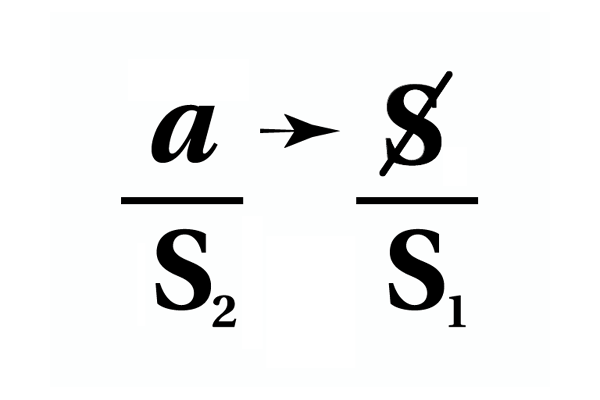
Analyst Discourse

revolutionary agent addresses the subject from the position of knowledge which occupies the place of truth (that is, which intervenes at the “symptomal torsion” of the subject’s constellation), and the goal is to isolate, get rid of, the Master-Signifier which structured the subject’s (ideologico-political) unconscious.


Jacques-Alain Miller:  Our civilization fits the discourse of the Analyst. the “agent” is a surplus enjoyment, the superego injunction to enjoy, addresses (the divided subject) who is put to work in order to live up to this injunction.  If ever there was a superego injunction, it is the famous Oriental wisdom, “Don’t think, just do it.” The “truth” of this social link is S2, scientific-expert knowledge in its different guises, and the goal is to generate S1, the self-mastery of the subject — that is to enable the subject to “cope with” the stress of the call to enjoyment (through self-help manuals and so on)…

Žižek replies:

imbalance between Ego and jouissance, imbalance between pleasure and foreign body of jouissance, pose a threat to the possession of the objet

Ž Antigone LTN

Far from just throwing herself into the jaws of death, possessed by a strange wish to die or to disappear, Sophocles’s Antigone insists up to her death on performing a precise symbolic gesture: the proper burial of her brother. Like Hamlet, Antigone is a drama of a failed symbolic ritual — Lacan insisted on this continuity (he had analyzed Hamlet in the seminar that preceded The Ethics of Psychoanalysis, which deals with Antigone). Antigone does not stand for some extra-symbolic real, but for the pure signifier-her “purity” is that of a signifier. This is why, although her act is suicidal, the stakes are symbolic: her passion is the death drive at its purest-but here, precisely, we should distinguish between the Freudian death drive and the Oriental nirvana. What makes Antigone a pure agent of the death drive is her unconditional demand for the symbolic ritual to be performed, an insistence which allows for no displacement or other form of compromise-this is why Lacan’s formula of drive is $—D: the subject unconditionally insisting on a symbolic demand.  LTN 84

Žižek Parmenides LTN

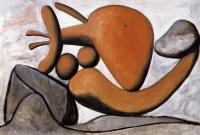
Picasso Woman throwing stone
Woman Throwing a Stone 1931 (Picasso)

🙂 Ž says this does capture the essence of woman throwing a stone. Even though representationalists would dispute this fact, given they like the more ‘realistic’ stuff.

The distinction between appearance and essence has to be inscribed into appearance itself.

Appearance is nothing in itself; it is just an illusory being, but this illusory being is the only being of essence, so that the reflective movement of essence is the movement nothing to nothing. and so back to itself. The transition, or becoming, sublates itself in its passage; the other that in this transition comes to be, is not the non-being of a being, but the nothingness of a nothing, and this, to be the negation of a nothing, constitutes being. Being only is as the movement of nothing to nothing, and as such it is essence; and the latter does not have this movement within it, but is this movement as a being that is itself absolutely illusory, pure negativity, outside of which there is nothing for it to negate but which negates only its own negative, and this negative, which latter is only in this negating.   (Science of Logic Trans A.V. Miller p. 400)

The answer to “Why is there Something rather than Nothing? ” is thus that there is only Nothing, and all processes take place “from Nothing through Nothing to Nothing:’ However, this nothing is not the Oriental or mystical Void of eternal peace, but the nothingness of a pure gap (antagonism, tension, “contradiction” ), the pure form of dislocation ontologically preceding any dislocated content. LTN 38

The corrosive all pervasive force of nothingness

So why a return to Plato? Why do we need a repetition of Plato’s founding gesture? In his Logiques des mondes, Badiou provides a succinct definition of “democratic materialism” and its opposite, “materialist dialectics”: the axiom which condenses the first is ” There is nothing but bodies and languages . . ;’ to which materialist dialectics adds ” . . . with the exception of truths.'” … Badiou here makes the paradoxical philosophical gesture of defending, as a materialist, the autonomy of the “immaterial” order of Truth.  LTN 41

How can a human animal forsake its animality and put its life in the service of a transcendent Truth?

How can the “transubstantiation” from the pleasure-oriented life of an individual to the life of a subject dedicated to a Cause occur? In other words, how is a free act possible? How can one break (out of) the network of the causal connections of positive reality and conceive an act that begins by and in itself?

This, then, is our basic philosophico-political choice (decision) today: either repeat in a materialist vein Plato’s assertion of the meta-physical dimension of “eternal Ideas:’ or continue to dwell in the postmodern universe of “democratic materialist” historicist relativism, caught in the vicious cycle of the eternal struggle with “premodern” fundamentalisms.  How is this gesture possible, thinkable even? Let us begin with the surprising fact that Badiou identifies the “principal contradiction:’ the predominant antagonism, of today’s ideological situation not as the struggle between idealism and materialism, but as the struggle between two forms of materialism (democratic and dialectical ) . Plus, to add insult to injury, “democratic materialism” stands for the reduction of all there is to the historical reality of bodies and languages (the twins of Darwinism, brain science, etc., and of discursive historicism), while “materialist dialectics” adds the “Platonic” (“idealist”) dimension of “eternal” Truths.

Žižek interview

Žižek interview in Guardian June 10 2012

Žižek picture June 2012

Slavoj Žižek doesn’t know the door number of his own apartment in Ljubljana. “Doesn’t matter,” he tells the photographer, who wants to pop outside. “Come back in through the main door, and then just think in terms of politically radical right; you turn from left to right, then at the end, right again.” But what’s the number, in case he gets lost? “I think it’s 20,” Žižek suggests. “But who knows? Let’s double check.” So off he pads down the hallway, opens his door and has a look.

Waving the photographer off, he points in the distance across the Slovenian capital. “Over there, that’s a kind of counter-culture establishment – they hate me, I hate them. This is the type of leftists that I hate. Radical leftists whose fathers are all very rich.” Most of the other buildings, he adds, are government ministries. “I hate it.” Now he’s back in the living room, a clinically tidy little sliver of functional space lacking any discernible aesthetic, the only concessions being a poster for the video game Call Of Duty: Black Ops, and a print of Joseph Stalin. Žižek pours Coke Zero into plastic McDonald’s cups decorated in Disney merchandising, but when he opens a kitchen cupboard I see that it’s full of clothes.

“I live as a madman!” he exclaims, and leads me on a tour of the apartment to demonstrate why his kitchen cabinets contain only clothing. “You see, there’s no room anywhere else!” And indeed, every other room is lined, floor to ceiling, with DVDs and books; volumes of his own 75 works, translated into innumerable languages, fill one room alone.

If you have read all of Žižek’s work, you are doing better than me. Born in 1949, the Slovenian philosopher and cultural critic grew up under Tito in the former Yugoslavia, where suspicions of dissidence consigned him to academic backwaters. He came to western attention in 1989 with his first book written in English, The Sublime Object of Ideology, a re-reading of Žižek’s great hero Hegel through the perspective of another hero, the psychoanalyst Jacques Lacan. Since then there have been titles such as Living in the End Times, along with films – The Pervert’s Guide To Cinema – and more articles than I can count.

By the standards of cultural theory, Žižek sits at the more accessible end of the spectrum – but to give you an idea of where that still leaves him, here’s a typical quote from a book called Žižek: A Guide for the Perplexed, intended to render him more comprehensible: “Žižek finds the place for Lacan in Hegel by seeing the Real as the correlate of the self-division and self-doubling within phenomena.”

At the risk of upsetting Žižek’s fanatical global following, I would say that a lot of his work is impenetrable. But he writes with exhilarating ambition and his central thesis offers a perspective even his critics would have to concede is thought-provoking. In essence, he argues that nothing is ever what it appears, and contradiction is encoded in almost everything. Most of what we think of as radical or subversive – or even simply ethical – doesn’t actually change anything.

“Like when you buy an organic apple, you’re doing it for ideological reasons, it makes you feel good: ‘I’m doing something for Mother Earth,’ and so on. But in what sense are we engaged? It’s a false engagement. Paradoxically, we do these things to avoid really doing things. It makes you feel good. You recycle, you send £5 a month to some Somali orphan, and you did your duty.” But really, we’ve been tricked into operating safety valves that allow the status quo to survive unchallenged? “Yes, exactly.” The obsession of western liberals with identity politics only distracts from class struggle, and while Žižek doesn’t defend any version of communism ever seen in practice, he remains what he calls a “complicated Marxist” with revolutionary ideals.

To his critics, as one memorably put it, he is the Borat of philosophy, churning out ever more outrageous statements for scandalous effect. “The problem with Hitler was that he was not violent enough,” for example, or “I am not human. I am a monster.” Some dismiss him as a silly controversialist; others fear him as an agitator for neo-Marxist totalitarianism. But since the financial crisis he has been elevated to the status of a global-recession celebrity, drawing crowds of adoring followers who revere him as an intellectual genius. His popularity is just the sort of paradox Žižek delights in because if it were down to him, he says, he would rather not talk to anyone.

You wouldn’t guess so from the energetic flurry of good manners with which he welcomes us, but he’s quick to clarify that his attentiveness is just camouflage for misanthropy. “For me, the idea of hell is the American type of parties. Or, when they ask me to give a talk, and they say something like, ‘After the talk there will just be a small reception’ – I know this is hell. This means all the frustrated idiots, who are not able to ask you a question at the end of the talk, come to you and, usually, they start: ‘Professor Žižek, I know you must be tired, but …’ Well, fuck you. If you know that I am tired, why are you asking me? I’m really more and more becoming Stalinist. Liberals always say about totalitarians that they like humanity, as such, but they have no empathy for concrete people, no? OK, that fits me perfectly. Humanity? Yes, it’s OK – some great talks, some great arts. Concrete people? No, 99% are boring idiots.”

Most of all, he can’t stand students. “Absolutely. I was shocked, for example, once, a student approached me in the US, when I was still teaching a class – which I will never do again – and he told me: ‘You know, professor, it interested me what you were saying yesterday, and I thought, I don’t know what my paper should be about. Could you please give me some more thoughts and then maybe some idea will pop up.’ Fuck him! Who I am to do that?”

Žižek has had to quit most of his teaching posts in Europe and America, to get away from these intolerable students. “I especially hate when they come to me with personal problems. My standard line is: ‘Look at me, look at my tics, don’t you see that I’m mad? How can you even think about asking a mad man like me to help you in personal problems, no?'” You can see what he means, for Žižek cuts a fairly startling physical figure – like a grizzly bear, pawing wildly at his face, sniffing and snuffling and gesticulating between every syllable. “But it doesn’t work! They still trust me. And I hate this because – this is what I don’t like about American society – I don’t like this openness, like when you meet a guy for the first time, and he’s starting to tell you about his sex life. I hate this, I hate this!” I have to laugh at this, because Žižek brings up his sex life within moments of our first meeting. On the way up in the lift he volunteers that a former girlfriend used to ask him for what he called “consensual rape”. I had imagined he would want to discuss his new book about Hegel, but what he really seems keen to talk about is sex.

“Yeah, because I’m extremely romantic here. You know what is my fear? This postmodern, permissive, pragmatic etiquette towards sex. It’s horrible. They claim sex is healthy; it’s good for the heart, for blood circulation, it relaxes you. They even go into how kissing is also good because it develops the muscles here – this is horrible, my God!” He’s appalled by the promise of dating agencies to “outsource” the risk of romance. “It’s no longer that absolute passion. I like this idea of sex as part of love, you know: ‘I’m ready to sell my mother into slavery just to fuck you for ever.’ There is something nice, transcendent, about it. I remain incurably romantic.”

I keep thinking I should try to intervene with a question, but he’s off again. “I have strange limits. I am very – OK, another detail, fuck it. I was never able to do – even if a woman wanted it – annal sex.” Annal sex? “Ah, anal sex. You know why not? Because I couldn’t convince myself that she really likes it. I always had this suspicion, what if she only pretends, to make herself more attractive to me? It’s the same thing for fellatio; I was never able to finish into the woman’s mouth, because again, my idea is, this is not exactly the most tasteful fluid. What if she’s only pretending?”

He can count the number of women he has slept with on his hands, because he finds the whole business so nerve-racking. “I cannot have one-night stands. I envy people who can do it; it would be wonderful. I feel nice, let’s go, bang-bang – yes! But for me, it’s something so ridiculously intimate – like, my God, it’s horrible to be naked in front of another person, you know? If the other one is evil with a remark – ‘Ha ha, your stomach,’ or whatever – everything can be ruined, you know?” Besides, he can’t sleep with anyone unless he believes they might stay together for ever. “All my relationships – this is why they are very few – were damned from the perspective of eternity. What I mean with this clumsy term is, maybe they will last.”

But Žižek has been divorced three times. How has he coped with that? “Ah, now I will tell you. You know the young Marx – I don’t idealise Marx, he was a nasty guy, personally – but he has a wonderful logic. He says: ‘You don’t simply dissolve marriage; divorce means that you retroactively establish that the love was not the true love.’ When love goes away, you retroactively establish that it wasn’t even true love.” Is that what he did? “Yes! I erase it totally. I don’t only believe that I’m no longer in love. I believe I never was.”

As if to illustrate this, he glances at his watch; his 12-year-old son, who lives nearby, will be arriving shortly. How is this going to work when he gets here? Don’t worry, Žižek says, he’s bound to be late – on account of the tardiness of his mother: “The bitch who claims to have been my wife.” But weren’t they married? “Unfortunately, yes.”

Žižek has two sons – the other is in his 30s – but never wanted to be a parent. “I will tell you the formula why I love my two sons. This is my liberal, compassionate side. I cannot resist it, when I see someone hurt, vulnerable and so on. So precisely when the son was not fully wanted, this made me want to love him even more.”

By now I can see we’re not going to get anywhere near Žižek’s new book about Hegel, Less Than Nothing: Hegel and the Shadow of Dialectical Materialism. Instead, he tells me about the holidays he takes with his young son. The last one was to the Burj Al Arab hotel, a grotesque temple to tacky ostentation in Dubai. “Why not? Why not? I like to do crazy things. But I did my Marxist duty. I got friendly with the Pakistani taxi driver who showed to me and my son reality. The whole structure of how the workers there live was explained, how it was controlled. My son was horrified.” This summer they are off to Singapore, to an artificial island with swimming pools built on top of 50-storey skyscrapers. “So we can swim there and look down on the city: ‘Ha ha, fuck you.’ That’s what I like to do – totally crazy things.” It wasn’t so much fun when his son was younger. “But now, we have a certain rhythm established. We sleep ’til one, then we go to breakfast, then we go to the city – no culture, just consumerism or some stupid things like this – then we go back for dinner, then we go to a movie theatre, then we play games ’til three in the morning.”

I wonder what all Žižek’s earnest young followers will make of this, and worry they will be cross with me for not getting anything more serious out of him. But to Žižek, Dubai tells us just as much about the world as a debate about the deficit, say, ever can. When his sweet-looking, polite young son arrives, I try to steer Žižek on to the financial crisis, and to the role his admirers hope he will play in formulating a radical response.

“I always emphasise: don’t expect this from me. I don’t think that the task of a guy like me is to propose complete solutions. When people ask me what to do with the economy, what the hell do I know? I think the task of people like me is not to provide answers but to ask the right questions.” He’s not against democracy, per se, he just thinks our democratic institutions are no longer capable of controlling global capitalism. “Nice consensual incremental reforms may work, possibly, at a local level.” But localism belongs in the same category as organic apples, and recycling. “It’s done to make you feel good. But the big question today is how to organise to act globally, at an immense international level, without regressing to some authoritarian rule.”

How will that happen? “I’m a pessimist in the sense that we are approaching dangerous times. But I’m an optimist for exactly the same reason. Pessimism means things are getting messy. Optimism means these are precisely the times when change is possible.” And what are the chances that things won’t change? “Ah, if this happens then we are slowly approaching a new apartheid authoritarian society. It will not be – I must underline this – the old stupid authoritarianism. This will be a new form, still consumerist.” The whole world will look like Dubai? “Yes, and in Dubai, you know, the other side are literally slaves.”

There is something inexplicably touching about all Žižek’s mischievous bombast. I hadn’t expected him to be so likable, but he really is hilariously good company. I had hoped to find out if he was a genius or a lunatic – but I fear I leave none the wiser. I ask him how seriously he would recommend we take him, and he says he would rather be feared than taken for a clown. “Most people think I’m making jokes, exaggerating – but no, I’m not. It’s not that. First I tell jokes, then I’m serious. No, the art is to bring the serious message into the forum of jokes.”

Two years ago his front teeth came out. “My son knows I have a good friend; none of us is gay, just good friends. So when he saw me without teeth, he said: ‘I know why.’ My son! He was 10! You know what he told me? Think, associate, in the dirtiest way.” I think I can guess. “Yes! Sucking! He said my friend complained that my teeth were in the way.” Žižek roars with laughter, great gales of paternal pride. “And you know what was tragicomic? After he told me this, he said: ‘Father, did I tell this joke well?'”

A 24-hour launch event for Less Than Nothing takes place on 15 June 2012 at Cafe Oto, London. versobooks.com.