Campbell, Kirsten. Jacques Lacan and Feminist Epistemology. Florence, KY, USA: Routledge, 2004. p 79.
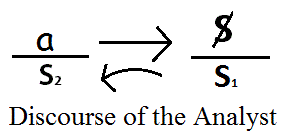
For Lacan, The Discourse of the Analyst is revolutionary because it articulates the truth of the (unconscious) subject. … psychoanalytic knowledge is a process of symbolizataion which acknowledges the lack of the subject and which recognizes its subjection to the signifier. The knowledge of the Analyst is savoir, symbolic knowledge. Psychoanalysis produces knowledge (savoir), rather than learninig (connaissance) or representation (représentation) (S17 32). The Discourse of the Analyst articulates savoir, knowledge of the laws of the Symbolic order. 79
For Lacan, the Discourse of the Analyst stands in opposition to that of the Master (S17: 99– 100). It is revolutionary because it operates against the closure and rigidity of discourse of the Master’s discourse, since ‘it is opposed to all will of mastery, engaging in a continuous flight from meaning and closure, in a displacement that never ceases’ (Bracher 1994: 124). In psychoanalysis, the analysand traverses the imaginary objet a, the fantasy which sustains its identity and which fixes the structures of its discourse in repetition. It comes to recognize ‘that the Other is lacking, that the object is separated from the Other, that the Other does not have a final answer’ (Adams 1996: 79). The analysand recognizes the lack in the Other – the symbolic a, its excluded element. The reinscription of the symbolic a into the analysand’s signifying chain shifts the fixed structure of their discourse. Because the Discourse of the Master excludes that a, the inscription of that element disrupts it.(79)
The a is the cause of psychoanalytic knowledge. The reinscription of the excluded a permits the analysand to reconfigure its structure of signifiers, and, with that reorganization of signification, to produce new meaning and knowledge. In Lacan’s account, the knowing subject of psychoanalysis is an analyst and an analysand, since analytic discourse produces both. Yet the positions of analyst and analysand are not the same, either in Lacan’s descriptions of their analytic roles or in their structural positions.
The schema of psychoanalytic discourse does not describe the speaking position of the subject that it produces (the analysand), but that of the transferential figure that supports the production of that subject (the analyst). Lacan’s schema describes the production of one subject, the analysand, not two. Logically, the analyst and analysand cannot occupy the same position, because they represent different speaking positions. Otherwise, it would not be possible to exclude ‘wild analysis’ from the psychoanalytic field, as it would be the figure of the analyst, and not the structural operation of psychoanalytic practice, which produced analytic effects upon the discourse of the analysand.
Lacan’s schema thus describes the operation of analytic discourse and the production of the analysand, rather than that of the analyst. In contrast to the analysand, the analyst occupies an imaginary position of mastery. The analyst is structurally posited as the subject supposed to know (le sujet supposé savoir) (S11: 232).
The analyst functions as the supposed subject of knowledge because the analysand posits the analyst as the Master who can answer the question of his desire (S11: 234). Lacan notes that if the Discourse of the Analyst opposes that of the Master, it is also its counterpoint (S17: 99). It is the analyst who is the master (S17: 38). The Analyst, both structurally and institutionally, is in the position of the Master. However, while the analyst may have knowledge on his side, he must refuse this position of the Master.
If the psychoanalyst understands him or herself as the master Clinician and Theoretician – the one who is able to ‘know’ the desire of the analysand and who is able to intervene in the analysand’s knowledge in the act of interpretation – then he or she insists upon being the knowing Master, offering their interpretation as knowledge and that knowledge as complete, whole and comprehensive. It is this desire and enjoyment of knowledge that the analyst must refuse in order for the analysand to come to their own truth (Nobus 2000: 95).
According to Lacan, the analyst must institute the analysand as master of their speech (S17: 59). For these reasons, we should understand Lacan’s schema not as describing the knowledge of the analyst, but that of the analysand. It is the analysand who must refuse a relation of mastery to knowledge, in order that he or she can recognize the truth of their unconscious desires. This relation to knowledge is a refusal of the imaginary position of the Master, with his dreams of unity and omnipotence. The discourse of the analysand provides a means of conceiving of a knowledge that does not invoke mastery. (80)
If feminist epistemology is to deploy the theory of analytic discourse, that theory needs to be understood as a description of the knowledge of the analysand rather than the mastery of the Analyst. This reformulation of Lacan’s theory retains his concept of the structure of analytic discourse but emphasizes the position of the knowing subject which that discourse produces. This reconfiguration shifts analytic knowledge from being a Discourse of the Master Analyst to being the Discourse of the Analysand. (81)