symbolic cuts the real

Campbell, Kirsten. Jacques Lacan and Feminist Epistemology. Florence, KY, USA: Routledge, 2004. page 108

Feminist discourse

In the Lacanian account of language, the Symbolic order is that which literally orders an undifferentiated Real (É: 71– 72). 2 An effect of that arrangement of signifiers is to ‘cut’ the Real, such that the Symbolic order structures signification of the Real in one way rather than another.

In Lacan’s later reformulation of the discursive operation of the Symbolic order, signification is structured so that it privileges certain discursive operations while excluding others. The Symbolic order delimits discursive operation because it inscribes certain subjects but not others, and certain social relations but not others. 107

However, it is that which the socio-symbolic order does not represent that puts feminism to work.

In many different practices, feminist knowledges attempt to reinscribe the object as subject through the tropes of the ‘impossible’ feminine, the repressed maternal, the refused body, the banished other, a misrecognized difference, an ‘unimaginable’ utopia. As the third-waver Barbara Findlen describes it, feminism has named ‘the problem that had no name’: by the time that I was discovering feminism, naming had become a principle occupation of feminists.

Everywhere you looked feminists were naming things – things like sexual harassment, date rape, displaced homemakers and domestic violence – that used to be called, as Gloria Steinem pointed out, just life. (1995a: xi)

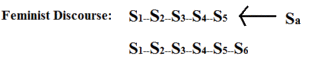
In Lacanian terms, feminist knowledges represent that which the Symbolic order does not represent, and bring into the signifying order that which it previously refused. Applying the Lacanian model, how then might we understand the structure of this discourse? In its most structural and minimal terms, we might say that feminist discourse represents the a, the excluded of discourse. We can represent existing discourse and its relationship to its excluded term like this:

Existing discourse: s-s-s-s-s-s|a

Feminism recognizes that the Other is lacking; that it excludes from its symbolic economy the a. Feminism sets the knower to work, and the product of that work is a new signifier. Feminist knowledges articulate the a and produce a new signifier. 3 This new symbolic element represents that which the signifying chain did not previously articulate, the a:
Feminist discourse: Feminist knowledge affirms the existence of this excluded term, in an act that Freud (1925a: 438– 439), and Lacan (S1: 57– 58) following him, describe as a judgment of existence. By such a judgment ‘we symbolically affirm the existence of an entity: existence is here synonymous with symbolization, integration into the symbolic order – only what is symbolized fully “exists” ’ (Zizek 1992: 136). It is possible, then, to describe a feminist act of knowing as an act of symbolization, which articulates the a of discourse in a judgment of existence. This symbolic affirmation gives the a existence, producing a new signifier. 108

In the Lacanian model, the inscription of a new signifier into the signifying chain produces new discourses. Because the differential relation of symbolic elements in the signifying chain produces meaning, its production is contingent upon a particular relationship of signifiers. However, the inscription of the excluded term reorders the relation of those symbolic elements. The insertion of the otherwise excluded term changes the previously closed order of these elements, creating a new discursive structure and so a new signifying chain. In this way, the analysand produces a new discourse and hence new meaning. From this model, it is possible to understand how the feminist articulation of the a can produce a new discourse. In the operation of feminist discourse, the act of knowing inserts a new signifier into the existing structure of symbolic elements, and thus forms a new signifying chain:

taken from page 109

The disruption and rearrangement of the prior signifying order produces a new relation of symbolic elements, and hence a new discourse. This new discourse produces new meaning, and hence a different representation of the world. This new representation of the world provides a new way to understand it. If knowing is a discursive practice, then the production of new discourses permits the creation of new knowledges by which to know the world.

In the 1970s, the feminist movement began to name the sexual violence many women experienced, but which was perceived neither as a political issue nor as being related to gender politics. This naming is the signification of the a of discourse, because it represents a violence against women which had previously not been articulated. The naming of gendered harms produces a signifier of an otherwise unsignified a of social discourses. …, Deirdre Davis argues that ‘[i]n order to address, deconstruct, and eradicate a harm, we must give the harm a name’ (1997: 200). This naming of the a is then inscribed into the signifying chains of social discourses, which produces a new signifying chain, or knowledge, around the issue of gendered harms. In this way, feminism produces new discourses of gendered harms that fundamentally shift the social meaning of sexual violence.

campbell discourse of analyst pt 2

Campbell, Kirsten.Jacques Lacan and Feminist Epistemology. Florence, KY, USA: Routledge, 2004. p 81.

Analytic knowledge/feminist knowledge

In analytic discourse, the analysand as knowing subject takes up the position of the barred subject – the subject of the unconscious. The analysand acknowledges the pain and psychic cost of entering the Symbolic order because he or she articulates the lack that all speaking subjects suffer. To know this truth is to know the lack of castration (S17: 58). The love of truth enables the analysand to know ‘this weakness’, to recognize the failure and limits of its knowledge.

Refusing the comforts of the fantasy of a secure and securing identity, the analysand recognizes its split and contradictory self.

In her description of situated feminist knowledges, Donna Haraway argues that feminist epistemologies should privilege the notion of the knower as ‘split and contradictory self’. Haraway contends that ‘[s]plitting, not being, is the privileged image for feminist epistemologies. . . . The knowing self is partial in all its guises, never finished, whole, simply there and original; it is always constructed and stitched together imperfectly’ (1991: 193).

This conception of the knower acknowledges her production. The knower recognizes herself as a speaking subject and so her formation in symbolic and social fields. In this position, the knowing subject critically articulates existing orders of representation, and the cost of entering those symbolic economies. By reinscribing that cost into the order of representation, she refuses the position of Master in her acknowledgement of her temporality, disunity and division.

However, the aim of psychoanalysis is to enable the analysand to accept its lack-in-being. Through analysis, the analysand articulates the truth of subjectivity: ontological lack. The analysand consents to that symbolic debt paid by the speaking subject because it accepts the castration that signifies its division and incompleteness.

The analysand represents that loss as castration, which is rendered symbolically through a relation to the phallic signifier.

In this way, the analysand sutures its fundamental lack-in-being through the signification of ontological lack as the sexual difference of castration. By contrast, the feminist knowing subject articulates that symbolic debt but genders, politicizes and refuses it.

While, pace Zizek, subjects may exchange common lack in the Symbolic order, feminism insists that women bear it in their signification of the ontological loss of all subjects (81).

The ‘Woman’ functions as the sign of phallic lack because she comes symbolically to embody ontological (all) lack.

In this way, the female subject pays the debt of the speaking subject in the Symbolic order. In Lacanian terms, the symbolic price that is paid for becoming a subject is the giving up of the mother, and the lack-of-being of all subjects. In feminist terms, women pay this price.

Ragland-Sullivan argues that ‘female depression, passive aggression, and disturbed children is simply too great a price to pay’, and her list is far from being a complete enumeration of the cost of such a social order (1987: 301). However, a feminist subject refuses that cost for herself, other women and other subjects. Unlike the analysand, the feminist knowing subject does not articulate the truth of the Symbolic order simply in order to come to terms with herself. Her knowing position emerges from a relation not only to herself but also to others. In this way, a political relation to others constitutes her position. With that political relation, the position of the knowing subject shifts from psychoanalysis to feminism.

In psychoanalytic discourse, the analyst stands as the cause of the discourse (in the place of the a). The analyst is the silent partner of the analytic process who functions as the addressee of the analysand’s demand for love and knowledge. This address to another introduces the intersubjective dimension of analytic practice. Without the analyst, the analytic process could not unfold because it is through the transferential operation of demand and identification that the analysand produces a hysterical discourse that introduces his or her desire. In this way, the analysand’s relation to an other – the analyst – as a relation to self structures the analytic process.

Unlike psychoanalytic discourse, a political relation to others structures feminism. The feminist subject addresses her desire to know and to love to others, constituting the intersubjective dimension of that address. Other women provide her discourse with its cause. This political address to others distinguishes her position from that of the analysand. Her relation to others, rather than the analysand’s relation to self, produces her speaking position. In her political relation to her others, the knowing subject addresses her desire for knowledge to other women. This address inflects her knowledge, structuring it as an intersubjective negotiation of political principles.

Feminist knowledge seeks to found its act of knowing in the political. Lacan argues that it is not by accident that women inaugurate the revolutionary discourse of psychoanalysis (S17: 62). The analysand Anna O., the subject of the first psychoanalytic case history, named psychoanalysis the ‘talking cure’ (Freud and Breuer 1895: 83). The case of ‘Anna O.’ can be read as an account of the hysterical analysand, or it can be reread through Anna’s own name, Bertha Pappenheim, who was a historical subject with speech, agency and knowledge. In that subjective position, the analysand Anna O. can be recast as the feminist Bertha Pappenheim. Anna O. undoubtedly suffered as a hysteric; it was the hysterical symptom that drove her to her two doctors, Breuer and Freud (82).

However, she also has a speaking position that is not that of the hysterical analysand. Throughout her life, Bertha Pappenheim ‘was a pioneer in German social work as well as a leader in feminist and Jewish women’s organisations’ (Decker 1992: 136). Hannah Decker points out that, unlike Dora, ‘an avocation-turned-career had been the salvation of “Anna O.” ’ (1992: 108).

Bertha Pappenheim was truly able to love and to work. We can see in her life the movement from hysteria, silence and depression to ethical and political engagement, a shift from passive symptom to feminist practice.

If we consider the feminist position as analogous to that of the analysand, and the Discourse of the Hysteric as leading to the Discourse of the Analyst, then it is possible to see the relation between the ‘protofeminism’ of hysteria and feminist discourse (Forrester and Appignanesi 1993: 68).

However, while both have discursive structures that originate in the question of sexual difference and unsatisfied demand, what distinguishes the two is the shift from symptom to signifying practice. One discourse produces a symptom; the other produces a political knowledge. This shift is evident in Anna O.’s life, shifting her position of hysterical analysand to that of the feminist, and from analytic discourse to feminist discourse (83).

campbell discourse of analyst

Campbell, Kirsten. Jacques Lacan and Feminist Epistemology. Florence, KY, USA: Routledge, 2004. p 79.

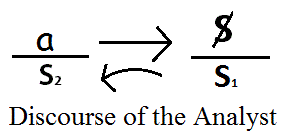
For Lacan, The Discourse of the Analyst is revolutionary because it articulates the truth of the (unconscious) subject.  … psychoanalytic knowledge is a process of symbolizataion which acknowledges the lack of the subject and which recognizes its subjection to the signifier.  The  knowledge of the Analyst is savoir, symbolic knowledge. Psychoanalysis produces knowledge (savoir), rather than learninig (connaissance) or representation (représentation) (S17 32). The Discourse of the Analyst articulates savoir, knowledge of the laws of the Symbolic order. 79

For Lacan, the Discourse of the Analyst stands in opposition to that of the Master (S17: 99– 100). It is revolutionary because it operates against the closure and rigidity of discourse of the Master’s discourse, since ‘it is opposed to all will of mastery, engaging in a continuous flight from meaning and closure, in a displacement that never ceases’ (Bracher 1994: 124). In psychoanalysis, the analysand traverses the imaginary objet a, the fantasy which sustains its identity and which fixes the structures of its discourse in repetition. It comes to recognize ‘that the Other is lacking, that the object is separated from the Other, that the Other does not have a final answer’ (Adams 1996: 79). The analysand recognizes the lack in the Other – the symbolic a, its excluded element. The reinscription of the symbolic a into the analysand’s signifying chain shifts the fixed structure of their discourse. Because the Discourse of the Master excludes that a, the inscription of that element disrupts it.(79)

The a is the cause of psychoanalytic knowledge. The reinscription of the excluded a permits the analysand to reconfigure its structure of signifiers, and, with that reorganization of signification, to produce new meaning and knowledge. In Lacan’s account, the knowing subject of psychoanalysis is an analyst and an analysand, since analytic discourse produces both. Yet the positions of analyst and analysand are not the same, either in Lacan’s descriptions of their analytic roles or in their structural positions.

The schema of psychoanalytic discourse does not describe the speaking position of the subject that it produces (the analysand), but that of the transferential figure that supports the production of that subject (the analyst). Lacan’s schema describes the production of one subject, the analysand, not two. Logically, the analyst and analysand cannot occupy the same position, because they represent different speaking positions. Otherwise, it would not be possible to exclude ‘wild analysis’ from the psychoanalytic field, as it would be the figure of the analyst, and not the structural operation of psychoanalytic practice, which produced analytic effects upon the discourse of the analysand.

Lacan’s schema thus describes the operation of analytic discourse and the production of the analysand, rather than that of the analyst. In contrast to the analysand, the analyst occupies an imaginary position of mastery. The analyst is structurally posited as the subject supposed to know (le sujet supposé savoir) (S11: 232).

The analyst functions as the supposed subject of knowledge because the analysand posits the analyst as the Master who can answer the question of his desire (S11: 234). Lacan notes that if the Discourse of the Analyst opposes that of the Master, it is also its counterpoint (S17: 99). It is the analyst who is the master (S17: 38). The Analyst, both structurally and institutionally, is in the position of the Master. However, while the analyst may have knowledge on his side, he must refuse this position of the Master.

If the psychoanalyst understands him or herself as the master Clinician and Theoretician – the one who is able to ‘know’ the desire of the analysand and who is able to intervene in the analysand’s knowledge in the act of interpretation – then he or she insists upon being the knowing Master, offering their interpretation as knowledge and that knowledge as complete, whole and comprehensive. It is this desire and enjoyment of knowledge that the analyst must refuse in order for the analysand to come to their own truth (Nobus 2000: 95).

According to Lacan, the analyst must institute the analysand as master of their speech (S17: 59). For these reasons, we should understand Lacan’s schema not as describing the knowledge of the analyst, but that of the analysand. It is the analysand who must refuse a relation of mastery to knowledge, in order that he or she can recognize the truth of their unconscious desires. This relation to knowledge is a refusal of the imaginary position of the Master, with his dreams of unity and omnipotence. The discourse of the analysand provides a means of conceiving of a knowledge that does not invoke mastery. (80)

If feminist epistemology is to deploy the theory of analytic discourse, that theory needs to be understood as a description of the knowledge of the analysand rather than the mastery of the Analyst. This reformulation of Lacan’s theory retains his concept of the structure of analytic discourse but emphasizes the position of the knowing subject which that discourse produces. This reconfiguration shifts analytic knowledge from being a Discourse of the Master Analyst to being the Discourse of the Analysand. (81)

campbell discourse of hysteric

Campbell, Kirsten. Jacques Lacan and Feminist Epistemology. Florence, KY, USA: Routledge, 2004. p 77 – 78.

For feminist epistemology, the question is how to create a political  discourse that does not reproduce the Discourse of the Master. Its utopian claims posit the possibility of other discourses, citing feminist knowledges as evidence of that possibility. … For Lacan, the question too is how to stop the discourse of mastery (S17 207). The possibility of a psychoanalytic discourse also subsists in the disruption of the Discourse of the Master. In the later Lacanian epistemology, that disruption occurs in the Discourses of the Hysteric and the Analyst.

Lacan argues that the discourses of the Hysteric and the Analyst create new positions of epistemological enunciation and a new relation of subject to object. Can his account of these discourses explain the new position of epistemological enunciation and relation which feminist epistemology seeks? If so, does the feminist knower occupy the position of the Hysteric or the Analyst? Or neither? 77

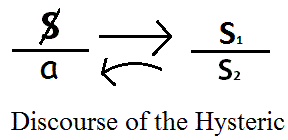
For Lacan, the hysterical analysand opens the Master’s Discourse to the Analyst’s Discourse. The desire to know the Master animates the Discourse of the Hysteric. (S17 36).  She asks ‘what is it to be a woman?’ (S3 175)  In Lacan’s discussion of the case history of Dora  he places the emergence of hysteria … in the little girl’s reproach to the mother that she does not have the phallus.  The hysterical demand emerges from that reproach, in which the hysteric signifies the frustration of her unanswerable demand to have and to enjoy the phallus (S17 112). … She subjects the Master’s Discourse to her unanswerable demand, and he can only reply with the assertion that she is castrated — that there are beings that do not have the phallus and that she is in that class of beings. 77

One strand of feminist thinking, such as that of Elaine Showalter (1987), has also understood the hysteric as a position of feminine protest, and her symptoms as a bodily rewriting of her experience of a social order that causes her psychic pain.  It perceives Dora, the exemplary hysteric of psychoanalysis, as its first feminist heroine who represents the limits of psychoanalytic knowledge and patriarchal discourse.  It interprets Dora’s rejection of Freud’s cure both as a refusal to be reinserted into the exchange of women, and as a protest against that exchange.

In this interpretation, Dora is a metaphor for the inability of psychoanalytic knowledge, and patriarchal knowledge generally, to describe feminine sexuality in general, and female homosexuality in particular. She comes to represent a rupture of an apparently seamless masculine representation and knowledge of women. In both these accounts, the hysteric represents a contestation and disruption of the Master’s Discourse. She represents its moment of failure because she reveals its cost.

However, Lacan argues that the position of the Hysteric resolves itself in a demand to the Master (S17: 150). She constructs her protests within his terms. The Hysteric desires knowledge, but the knowledge that she desires is that which the Master possesses.

In this way, her position is one of symptomatic repetition that fails to contest or change the Master’s discourse.

The Hysteric’s response to her pain is a symptomatic protest rather than resistance to the social order that produces her symptoms. She does not represent a contestation of the knowledge of the Master but is trapped within it.

Other feminist readings of the hysteric perceive her in similar terms, arguing that she does not represent a political figure. For example, Maria Ramas (1985) argues that the hysteric silently protests the oppression of women by taking up a position of inarticulate and passive resistance, thereby participating in traditional feminine protest of mute victimhood. These feminists argue that while such a position may have been the only position open to Dora, it does not provide an adequate basis for an active and interventionist politics that seeks to change the social order rather than to silently suffer its injustices.

In both Lacanian and feminist theory, the position of the Hysteric represents an important moment in the contestation of the Discourse of the Master. However, while the hysteric reveals the failure of the Discourse of the Master, she fails to disrupt its operation. The hysterical analysand exposes the castration of the Master, but she does not dislodge him from his position of mastery. The Discourse of the Master ultimately recuperates the position of the hysterical analysand. She knows that the Master is castrated, but she refuses to address him as other than Master. In epistemological terms, the limit of the Discourse of the Hysteric is evident in relation to her knowledge.

What is the knowledge of the hysteric? She knows the truth of the Master’s discourse, namely that he suffers castration. Lacan acknowledges that the price she pays for that knowledge is herself. But what does this castration reveal? The hysteric’s demand that she have the phallus is unanswerable. She cannot be a Master nor have mastery, and in this the hysteric must always fail.

Her knowledge cannot be spoken because she cannot articulate the castration of the Master within her discourse, and hence cannot bring it into representation. Without that possibility, the hysterical analysand cannot represent the Master other than as Master. She cannot articulate a position other than that of unattainable Mastery or of suffering hysteria. For that reason, hysteria operates as a symptom, rather than as a political discourse that can change the social order that causes the Hysteric’s psychic conflict and distress.

For this reason, the Discourse of the Hysteric does not produce an adequate subject position for the feminist knower. Dora the hysterical analysand may be interpreted as a nascent feminist heroine. However, her knowledge of the Master’s discourse is bodily rather than political.

Feminist politics implies symbolization, a representation of how we might understand gender and gender relations differently. However, the hysteric wants to evade the very possibility of representation, because it is the refusal to articulate desire that produces the hysterical symptom. The Discourse of the Hysteric is not the Discourse of the Feminist. Is, then, feminist discourse a Discourse of the Analyst? 79

campbell discourse of the master

Campbell, Kirsten. Jacques Lacan and Feminist Epistemology. Florence, KY, USA: Routledge, 2004.
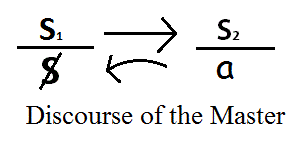

For Lacan, the Discourse of the Master describes the production of the speaking subject in the symbolic field. The subject comes into being when it enters the signifying chain through identification with a signifier, S1. The S1 is a fundamental symbolic element which ‘knots’ signifier and signifed and thereby arrests their constant sliding.  It represents the signifier that gives the subject its symbolic coherence and situates it within language.  For this reason, the marks the point of the ‘origin’ of the subject’s speech, because the identification with the I of speech, the S1 that symbolizes the I of the master, constitutes the subject (Seminar 17: 70).  In this way, identification with the I of the Master forms the subject in the symbolic field.  The Discourse of the Master thereby inaugurates a speaking subject which is identical to its proper signifer and which ‘names’ it.  For Lacan, this discourse binds the subject to the master signifier and all its illusions. 65

In the Discourse of the Master, the subject refuses knowledge of its formation in signifying networks. In his schema, Lacan represents this refusal to know by an arrow S1—>S2 labelled impossibility. Given this structure, it is impossible for the subject to know its relation to the signifier. For this reason, Lacan represents that impossibility by his figure of the barred subject, $He represents the subject as barred because it refuses to acknowledge the truth of its unconscious division. That lack is a consequence of its constitution as a speaking being, because castration is the price of entering the Symbolic order. The discourse of the Master hides the truth of the lack-in-being of the subject (S17 90). The Master does not want to know, and cannot know, the truth of its unconscious.  The subject perceives itself as an I, that is, as a unified subject, and hence refuses to acknowledge that it is in fact a Master that suffers castration.

The Discourse produces a subject who wishes to master its self, its others, its desire, and its unconscious. For Lacan, the Master wishes to dominate that which it excludes form its discourse (S17 110).

Fink describes how this subject must show no weakness, in this sense carefully hides the fact that he or she, like everyone else, is a being of language and has succumbed to symbolic castration’ (Fink in Nobus Key Concepts 1998). The castrated Master refuses to believe that it is castrated. 66

It veils over its lack with the illusion that it is whole and complete; the méconnaissance of a self that imagines that it is identical to itself and to its master signifier (S17 70). It imagines that it has mastery of a ‘univocal’ discourse that masks its unconscious division. 66

The Knowing Master is a position in which the imaginary order captures the knower such that it perceives its self and its objects in the mirror of the ego. The Master subject claims to be a unified subject which creates itself in an act of mastery. It imagines itself to be whole and identical to itself, and perceives its self and its others as identical to its egoistic projections. The knower constructs its relationship to its others as an objectifying identification in which the other is an object that it seeks to master. Its knowledge is an aggressive, objectifying and distorting domination of its known object. The knowing subject attempts to gain omnipotent control of itself and its world, so as to imagine itself as the ‘Absolute Master’ (Lacan 1955: 47, Éc: 33). It posits itself as omniscient, the possessor of absolute knowledge. 66

Lacan’s description of the knowing subject of the Discourse of the Master presents it as the universal, disembodied knower. However, given that the Lacanian account of subjectivity posits sexuation as its condition, then the knower is necessarily sexed.

Following a feminist deconstructive strategy leads us to ask, how is sexuation inscribed into the Lacanian theory of the knowing subject? (66)

To answer that question requires the reinscription of sexual difference into Lacan’s account of the production of the Master subject. 67

🙂 Here we go

For Lacan, the Master subject is produced through identification with a symbolic term, the trait unaire, translated as the unitary, unary or ‘single-stroke’ trait. Lacan’s theory draws on Freud’s account in Group Psychology (1921) of the process of the assimilation of an aspect or characteristic of another, in which the subject identifies with a trait of another subject. Lacan argues that an identification with the unitary trait ‘marks’ each one of us as a singular and unified identity. (S17 180)

He links this concept of the unifying mark to the signfier of ‘L’Un’ (The One).  ‘The One’ is the signifier that institutes the symbolic structure of the subject (S17 12, S20 143-144).

In the Discourse of the Master the unitary trait appears as S1, the master signifier.  The master signifier functions as the signifier that represents the subject as subject.67

However Lacan also links S1 to the phallic signifier. In his discussion of sexuation, Lacan describes the phallus as ‘that which is also incarnated in S1, which, of all the signifiers, is the signfier for which there is no signified (S20 80). The phallus incarnates or ‘makes flesh’ the S1 of the master signifier.

For this reason, identification with the phallic signifier operates as identification with the master signifier. What links these terms is the process of symbolic identification in which the phallic signifier is a master signifier that produces the subject.

Lacan argues that in the formation of the subject, the signification of the phallus [is evoked by the paternal metaphor]. The paternal metaphor is the attribution of procreation to the Name-of-the-Father and the signification of the paternal relation.

A moment of the Oedipus complex, the paternal metaphor represents the intervention of the Symbolic order (signified by The-Name-of-the-Father) in the subject’s imaginary relation to the mother (and her desire).

In the operation of the paternal metaphor, the desire for the mother is repressed and the phallic signifier stands in for that desire in the subject’s unconscious (Muller and Richardson 1994 213). This process forms the subject in a relation to the phallic signifier and hence as a sexed identity which has or does not have the phallus (S5 186). In this account, the masculine subject has the phallus, a position of possessing the signifier of the phallic object, while the feminine subject does not have the phallus, a position of lack and hence castration. 67

Lacan argues that the dissolution of the Oedipus complex involves symbolic interjection, in which ‘what was outside becomes the inside, what was the father becomes the super-ego’ (S1 169).  In symbolic identification the subject introjects the signifier of the father, forming the super-ego.  The subject assimilates the phallic signifier as the mark of the Father, and thereby incorporates the Symbolic father as an I. (S11 256-257)

Presenting the reformulation of the paternal metaphor (and of the Oedipus complex) in the theory of the Discourse of the Master.

In the Discourse of the Master, identification with the phallic signifier — S1 — of the Father produces a ‘unified’ subject. It is an identification with the paternal signifier because the phallic signifier is the mark of the Father, and hence of his Law. This symbolic identification ‘marks’ and names the subject with and by the Name-of-the-Father. Identification with S1 involves an assimilation of the Symbolic father. For this reason, Lacan describes ‘the law’, that is, the Law of the Father, as dominating the Discourse of the Master (S17 48). 68

The process of symbolic identification with the Father produces the illusion of a conscious self. It establishes a subjective relation of I and ego in which the I of the speaking subject appears to be co-extensive with the ego because of the operation of repression. For the Master subject, consciousness founds illusion of the transcendental I (S17 70). Identification with the Symbolic Father who has the phallus and is not castrated structures this position of mastery, forming the master subject in terms of a psychic structure of defence against the unconscious. The identification with the Symbolic father produces a subject structured by a méconnaissance of its origniary and ontological lack.

However, in the Lacanian account identification with the Symbolic father operates differently in formation of masculine and feminine subjects. In the logic of castration, the model of a typical ‘successful’ resolution fo the Oedipus complex is that of the paternal identification of the little boy because of the tie of the symbolic phallus and the real penis. (S4 209). In the third stage of the Oedipus complex, the little boy identifies with the father who possesses the penis while the little girl recognizes that he has it (S5 196) For Lacan, if masculinity and femininity both ‘fail’, they fail differently. The difference concerns the more or less ‘problematic’ assumption of Oedipal subjectivity, because the master signifier that represents the subject is masculine (S17 107).

In Lacan’s account, the masculine subject has the phallus (S20 80). That is, the masculine subject possesses the phallus and, in this sense, is not castrated.  The male subject defines its masculine position through the exception of castration such that his ‘all’ is defined through an other position of ‘not-being-all’.  This other position is that of castration, which is the feminine position of a being that does not have the phallus.  The phallus is the master signifier by which the masculine subject refuses the (lacking) body.  …The phallus ‘that props him up as signifier and is also incarnated in S1 which of all the signifier, is the signifier for which there is no signified (S20 80).  His ontological loss cannot be acknowledged without being symbolized as castration, for otherwise hts fantasy of omnipotence, unity and universality would unravel.

The displacement of ontological loss through the representation of castration in a symbolic function allows the masculine subject the illusion of mastery (S17 144).

In that illusion of mastery, the masculine subject misrecognizes itself as a being whole and complete of itself. It is a position of (masculine) mastery. 69

It is a position of presence, of the universal masculine subject which is ‘whole’ and which does not suffer loss or lack. The Discourse of the Master describes the production of the knowing master, a masculiine subject that secures its identity through identification with the Symbolic father in a repudiation of castration. 69

Reconceiving the knowing master as a masculine subject explains the formation of the masculine knower and its imaginary méconnaissance.  It explains the relation between the knowing subject of consciousness and the masculine knower … showing the link between the formation of masculine subjects and knowers.  In this way, it provides an account of the constitution of the knower as a masculine subject by providing the feminist deconstructive project with a means of understanding the formation fo the subject of ‘masculine’ knowledges.

Campbell, Kirsten. Jacques Lacan and Feminist Epistemology. Florence, KY, USA: Routledge, 2004. p 75.

My account of the discourses of mastery provides a means of retaining these insights of deconstructive theories, while also not reducing masculine knowledge to an effect of individual experience or familial objects. In the later Lacanian epistemology, different discursive social links produce particular forms of knowledges and knowing subjects. Those symbolic relations between subjects represent different forms of the social bond. In a Western culture, a phallocentric Symbolic order structures those social relations between subjects. In particular, it founds the Discourse of the Master as a dominant discourse of Western culture. The Discourse of the Master produces dominant forms of knowledge and the masculine knowing subject.

These masculine subjects need not be men. Both men and women can, and do, become knowing Masters. However, men are more likely to assume this position than women for two reasons.

First, the Master is a paradigmatic knower because of the material and cultural privileging of particular forms of masculine identity.
Second, the normative production of identity attaches masculinity to biologically male subjects.

My account of the discourses of mastery provides an explanation for this ‘demonstrable alignment’ between masculine knowers and knowledges. For example, following Scheman’s description of the Cartesian knower, it explains how identification with the Symbolic father forms this egoistic, defensive Knowing Master. Similarly, following Bordo’s description of the masculine Cartesian subject, it explains why the knowledges of the masculine knower repudiate its feminine others (indeed, all others), the better to control their difference (1986: 452).

Rather than seeing masculine knowledges as a reflection of the privilege of men in social relations (as in standpoint theory), my account explains how those social relations produce masculine discourses of mastery. Those social relations produce discourses of knowledge that form the knower and its objects. These forms of knowing are discursive practices that do not describe the nature of ‘knowledge’, but rather the production of particular knowers and forms of knowing. (76)

campbell sexuation phallus

Campbell, Kirsten. Jacques Lacan and Feminist Epistemology. Florence, KY, USA: Routledge, 2004. p 60.

The later Lacanian epistemology also presents a subject that is sexually neutral, because  the master, academic, hysteric and analyst are positions without gender. Since both men and women have to enter the intersubjective relations of discourse in order to become subjects, the subject as such does not have a sex. … The Master is sexless because all must enter the Discourse of the Master in order to become subjects. That discourse produces all speaking subjects, such that ‘[i]n the final analysis, the “person” always has to do with the master’s discourse’ (S20: 69). Lacan makes his claim that the Discourse of the Master forms all subjects in Encore, (S20) the same seminar in which he also proposes that feminine sexuality and subjectivity are in excess of, rather than determined by, the phallic function. In his later work, Lacan repeatedly returns to the question of women’s knowledge (60).

The figure of the knowing woman is both difficult and fascinating for the later Lacan. This difficulty reflects the paradox of the classical account of sexuation: the phallus is a sexually neutral signifier which produces all subjects, but men and women become sexed subjects because of their different relation to the phallus.

In Lacan’s work, a different relationship to the phallic signifier defines the sexual difference of masculinity and femininity. In the description of the formation of the subject presented in Écrits, the child becomes an I and takes up a subject position in language after the intervention of the Law of the Father in the Oedipus complex. After the resolution of the Oedipus complex, subjectivity is assumed in the Symbolic order and the subject sexually differentiated by its relation to the phallus (É: 320– 321).

Similarly, Lacan’s later account argues that the subject’s relation to the phallic signifier produces it as sexed. As Lacan describes it in Encore, each speaking being must line up on one side or the other of the Graph of Sexuation (S20: 79).

In this way, Lacan’s account of the production of the subject turns on his concept of the phallus. This pivotal role of the phallus in the formation of sexed subjectivity gives rise to the most strenuous feminist critiques of Lacan’s work. Generally, the accusation of phallocentrism contains two objections:

– first, that Lacan ties his concept of the phallus to the biological organ of the penis,

– second, by doing so Lacan privileges masculinity and the male body as his model of sexual difference and its formation. For example, Elizabeth Grosz contends that in the phallocentric model, ‘[s]exual difference becomes codified into the presence or absence of a single feature – the male sexual organ’ (1990: 188).

In reply, Lacanians commonly accuse feminists of misreading this concept of the phallus. Typically, Bruce Fink argues that feminist authors such as Jane Gallop ‘have thus provided the reading public with patently or partially false interpretations’ (1995: 98). …

Following the ‘Function and Field of Speech’ (1953), Lacan’s concept of the phallus becomes increasingly complex and central to his theory of sexed subjectivity. For Lacan, the phallus operates in the three registers of the imaginary, the symbolic and the real. In the Symbolic order, the phallus ‘is the signifier for which there is no signified’ (S20: 80); in the imaginary order it operates as a narcissistic object of the phallic image which fulfils that lack (É: 354); and in the real as the real phallus, the organ of the penis (É: 320). …

By implication, the ‘lack’ to which Lacan refers is the anatomical difference of woman, which he renders as the absence of a penis. Kaja Silverman argues that we should expect this confusion of phallus and penis because:

in any [theoretical] passage centrally concerned with elaborating a lack specific to woman…that lack can only be elaborated through reference to the penis. The Lacanian phallus depends for its libidinal centrality upon the anatomical distinction between the sexes, and it cannot, consequently, be rigorously distinguished from the penis. (1992a: 96)

In this way, Lacan’s account of ontological loss is predicated on the assumption of a body that suffers anatomical ‘loss’. For this reason, reference to a social signification of the body secures the Lacanian account of sexed subjectivity.

Lacan emphasizes the contingency of the relation between biological and psychic sexual difference in his argument that the subject can have either masculine or feminine structures, regardless of biological sex (S20: 71). However, while sexuation may be contingent, the socio-symbolic field which assigns masculinity and femininity to male and female bodies also produces them as sexually different.

Sexual subjectivity is not so contingent that it becomes possible to sever its production from the signification of the biological body. A concept of biological sexual difference thus secures which bodies come to be ‘masculine’ and ‘feminine’ (63).

While biological sex does not determine sexed subjectivity, sexuation signifies what it is to have a ‘male’ or ‘female’ body. Because ‘masculine’ and ‘feminine’ refer to a relation of the subject to the phallus, sexuation operates as the signification of biological sex in relation to the phallic signifier. For example, Lacan understands the Hysteric as a position of both men and women. Both sexes can be hysterics and, as analysands, become hysterical subjects. However, he repeatedly identifies this position of the subject with the feminine. The Hysteric has a ‘feminine’ structure because it symbolizes the primary dissatisfaction of castration (S17: 84). Lacan acknowledges that ‘there are many more women hysterics than men – this is a fact of clinical experience – because the woman’s path to symbolic realization is more complicated’ (S3: 178). Conversely, the male hysteric has access to ‘both phallic and the Other jouissance’ (Fink 1995: 108). He is therefore still structured by reference to a masculine structure, that is a masculine relation to the phallic signifier, because otherwise he would not have access to the phallic jouissance which is linked to the male organ (S20: 7). The terms ‘masculinity’ or ‘femininity’ do not have content without reference to the description of bodily sexual difference.

In Lacan’s account, subjects have a masculine or feminine structure, which provides a signification of anatomical sexual difference. The relation to the phallic signifier that produces the subject also gives meaning to biological body. In this theory, the socio-symbolic order assigns masculinity and femininity to particular bodies and in particular ways. That assignation may be contingent; such that pace Fink men can have feminine psychic structures and women can have a masculine relation the phallus. Nevertheless, Lacan does not describe those women as men, but as phallic women. Lacan’s theory assumes that ‘order and norms must be instituted which tell the subject what a man or woman must do’ (1964b: 276), and that most commonly the normative position for men is masculinity and for women is femininity (64).

campbell 4 discourses pt 4.

Campbell, Kirsten. Jacques Lacan and Feminist Epistemology. Florence, KY, USA: Routledge, 2004. p 56.

In the later Lacanian epistemology, ‘knowledge’ is not only a relation of subject to object, but also of subject to subject. Lacan argues that the four discourses represent different forms of the social bond. The discourses that produce different forms of intersubjectivity also produce different forms of knowledge. In this way, the later Lacanian account of knowledge moves between subjective and intersubjective structures.

Because Lacan’s model describes not only the relation of subject to object, but also the relation of subjects, discourses of knowledge reveal the relation of the knower to its others. The Lacanian model thereby unfolds the epistemological relation of knowing subject, signifier and known object to include the relation of the knowing subject to other subjects.

The later Lacanian epistemology is a model of knowledge that posits it as a social practice in the sense that it is the product of the discursive social link. This model describes knowing as contingent upon social bonds which enable the subject to give meaning to, and make sense of, its world. It articulates discourses that structure how the knowing subject knows the world. To conceive knowledge in this way posits it as contingent upon our social bonds.

For this reason, Lacan conceives knowledge or savoir as that which is inscribed in the social link (S20: 73). Lacanian epistemology thus provides an account of the intersubjective production of knowledge, and of knowing as a socially mediated act. Lacan’s theory of the four discourses is far from being an elaborated epistemology. For example, Lacan does not indicate whether the discourses are necessarily interlinked or whether they can operate as explanatory devices without reference to each other. Moreover, Lacan does not reveal why it is four (and only four) discourses that comprise the fundamental social bonds. Lacan argues that these four discourses represent fundamental social bonds within the psychoanalytic field and possible forms of psychoanalytic knowledge. However, he does not explain why these discourses of the master, the hysteric, the university and the psychoanalyst function as foundational social links, nor why he has chosen these four discourses out of all possible social discourses.

Despite these omissions, the later epistemological work provides a new and important means of understanding the production of knowledge. Lacanian epistemology analyses knowledge as a discursive practice that is the product of the operation of particular signifying structures. Knowledge is also a social practice, in that the discursive social link produces it. In Lacan’s account, knowledge is understood as a discursive social practice. It does not reduce knowledge to the status of a proposition (as in many philosophical theories) nor to a social object (as in many sociological accounts). Rather, Lacanian epistemology offers feminist epistemology a theoretical apparatus to analyse the relation between knowledge, subjectivity and sociality.

campbell 4 discourses pt 3.

Campbell, Kirsten. Jacques Lacan and Feminist Epistemology. Florence, KY, USA: Routledge, 2004. p 53.

I read the formulae of the four discourses as a dynamic representation of the discursive social link; as devices that formalize and elucidate fundamental forms of intersubjectivity. These models of the four discourses are a conceptual apparatus that can be used as skeleton keys to open the complexities of discourse.

In the theory of the four discourses, Lacan describes the different relations of the knower to other subjects and to its objects, and the different forms of those epistemological relations. Each discourse formalizes a position of a knowing subject, its relation to that which its discourse excludes, to its master signifier, and to its knowledge. The formulae represent the structural relation of these key elements, so that each represents a stable structure of discourse. Each schema describes a particular and specific form of knowledge. For example, the Discourse of the University attempts to know all, including that which it excludes. A desire for mastery and control of its objects dominates this discourse, which at the same time operates to reproduce the exclusions of its knowledge (S17: 70– 71). The foundational discourses thus articulate possible combinations of discursive elements, representing four possible positions of the knowing subject and four possible epistemological relations (53-54).

However, the position of the knower and the form of its knowledge cannot be understood by simply examining the place of the barred subject ($) or of knowledge (S2) in the formulae of the discourses. The knower does not take up the position of the $, just as S2 does not represent its knowledge (54).

Rather, Lacan suggests that a knowing subject takes up a particular speaking position (for example, that of the master, the hysteric or the analyst) and so produces a particular type of knowledge (mastering, hysterical, analytic). The discourses describe four possible forms of knowledge. (54)

The four discourses present a theory of specific forms of knowledge. However, they also constitute an epistemological metatheory. Underlying these four models is a radical imbrication of knowledge and discourse because ‘[d]iscourse is a fundamental apparatus which is prior to and which determines the whole relation of subjects to subjects and subjects to objects’ (Adams 1996: 72). For Lacan, discourse produces knowledge. It gives meaning to the world, and so how that world is known is contingent upon its symbolic network. Lacan’s formulae do not represent a formal description of the conditions of true belief abstracted from reality. Rather, as speaking beings we are always already within the world of discourse. Reality is a function of discourse, for discourse produces both the world that is known, and the only world that can be known (S17: 13). In this model, discourse has a necessary and stable structure which shapes the interplay of its elements and which produces signification. Lacan analyses discourses in terms of their constitutive elements, and the operation of those elements. The different combinations of a knowing subject, the barred subject, the signifying chain, the excluded from discourse (the a), and the master signifier, produce different forms of knowledge. Lacan reduces each discourse to its constituent components. In this way, Lacanian epistemology describes the structural logic or symbolic economy of knowledge. In this model, knowledge is contingent upon the discursive position of the knower. However, that subjective structure is necessarily an effect of discursive structure. By taking up a speaking position, the knower thereby is enmeshed in the fundamental relations of discourse. In the Lacanian account, it is inscribed in every act of enunciation of a subject (S17: 11).

In each of Lacan’s schemas, the knower exists in a particular relation to S2 – knowledge or le savoir (S20: 16). The knowledge of the Master differs from that of the Hysteric, and these subject positions articulate a different relation to that knowing. For example, Lacan contrasts the ignorance of the Master who does not want to know with the desire of the Hysteric to know. The discourse of the knowing subject produces its relation to the known object. This relation is inscribed in an order of signifiers such that ‘knowledge’ is a representation or signification of what is known. Accordingly, the different operations of discourse produce different forms of knowledge. Lacanian epistemology therefore posits knowledge as a signification of a known object. The object is signified, rather than known in and of itself. Discourse produces the known object, since the object can only be represented through signifying structures. This model of knowledge conceives it as a signifying act. The act of knowing is an act of representation that the stable structures of signifying chains produce. Therefore, knowledge itself has a discursive structure and thereby is rethought as the product of signification.

The later Lacanian epistemology does not describe the propositional content of knowledge, but instead describes how discursive networks produce a known object, and the relation between the knowing subject and its known object. In the later Lacanian epistemology, what is known is inseparable from how it is known. Knowledge describes a relation to the real, and the structuring of that relation in discourse. Lacan argues that the world is known through the meaning given to it, and that meaning is always bound up in discourse (S17: 13), because every ‘reality’ is presented in discursive networks (S20: 32). Discourse describes the symbolic structure through which the knowing subject represents the world to itself and to other subjects.

Knowledge is therefore a symbolic practice because it is an act of meaning of the knowing subject. This act of signification is the insertion of the known object into the signifying chain, placing it within a symbolic field that enwraps the object and gives it meaning. Lacanian epistemology posits knowledge as a signification given to the object.

What is known is therefore radically contingent upon the discourse of the knowing subject, and accordingly radically limited by it. If discourse produces knowledge, then discourse is a necessary condition of knowing. Forms of knowledge are therefore contingent upon discursive forms. In this way, Lacan’s theory suggests that there exists a causal, if not determinative, relation between knowledge and discourse (S17: 13). Lacan does not argue that these concepts are identical or reducible to each other. However, his account does suggest that what can be known is conditional upon discursive networks.

In this sense, discursive structures delimit what is thinkable and signifiable as knowledge, such that to change those structures is to change how we know the world (S20: 16). (55)

In Lacan’s theory, discourse produces signification. It structures signifiers by ordering their relation and so producing meaning. Discourse enables the otherwise arbitrary signifier to mean something not only to the knowing subject but also to other subjects. Discourse knots the signifier and signified together by functioning as the link that enables the circulation of the signifier between those who speak (S20: 30). The signifier is an arbitrary symbolic element that does not produce meaning until it is brought into relation with other signifiers.

Because subjects exist in a symbolic relation to one another, they are able to exchange meaning. In this model, different knowing subjects may use the same symbolic element to name a known object but each may attribute it with a different signified. For Lacan, what enables other knowing subjects to ‘read’ the signifier is the social link between knowing subjects.

The social tie is language because its discursive chains form the link and the relationship between speaking subjects. For Lacan, discourse is not a transparent relation between subjects. It does not imply that its addressee receives the message sent by the sender, as Lacan starts out from the position that communication is necessarily a failure (Verhaeghe 1997: 100). Rather, discourse is a particular arrangement of signifiers that enables symbolic exchange between subjects (56).

For Lacan, the practice of language ‘dominates’ the social because the social order is founded in the structures of language, the Symbolic order. The Symbolic order produces a number of stable discourses, which represent fundamental intersubjective relations. The four discourses therefore articulate four different and foundational social bonds (which in turn raises the possibility of the existence of other discourses) (56).

campbell 4 discourses part 2

Campbell, Kirsten. Jacques Lacan and Feminist Epistemology. Florence, KY, USA: Routledge, 2004.

As in L’envers, in Encore Lacan represents each of the discourses by a schema which sets out the relation of four terms: b, S2 , a and $. These terms designate respectively: the master signifier (le signifiant maître), knowledge (le savoir), surplus jouissance (le plus-de-jouir) and the subject (le sujet) (S20: 17).

S1 represents the master signifier, the symbolic element that represents the subject for another signifier. The master signifier marks the subject’s position within the signifying chain and hence within the discursive social tie.

S2 designates the symbolic field, the chain or network of signifiers that form the subject. For this reason, S1, S2 represents the knowledge of the subject. It describes both the form of the subject’s knowledge, for example, academic, psychoanalytic and so on, and the form of knowledge of the subject, such as the differing conceptions of the subject within the university and psychoanalysis.

The term a represents the ‘left-over’ or remainder of discourse. That remainder is the jouissance produced by, and surrendered to, language in the taking up of a speaking position by the subject. The a is an unassimilable excess to the discourse. There is no signifier of the a, as it is not possible to represent it in the signifying economy of the discourse. The subject attempts to structure its relationship to this unassimilable remainder by rendering it as an imaginary object – the objet petit a. The a thus both functions in the imaginary register, in which it appears as an imaginary object filled with phantasmic content, and in the symbolic register, in which it marks the excluded term of discourse, the gap in or void of its symbolic structure. For this reason, the a ‘stands simultaneously for the imaginary fantasmic lure/screen and for that which this lure is obfuscating, for the void behind the lure’ (Zizek 1998a: 80).

The fourth term, $, represents the subject. The subject does not represent the S of the conscious subject but the ‘true’ psychoanalytic subject of the unconscious. $ designates the barred subject, in which the S of the conscious subject is struck through because of its division by the unconscious. The schemas of the discourses describe the relation of each of these terms, S1 , S2 , a and $ (50).

campbell 4 discourses pt 1

Campbell, Kirsten. Jacques Lacan and Feminist Epistemology. Florence, KY, USA: Routledge, 2004.

Discourse thus produces the social link between subjects, because discursive chains of signifiers structure stable intersubjective relations. In the theory of the four discourses, the intersubjective relation is a discursive relation. This concept of discourse does not therefore imply a Hegelian intersubjectivity, which Lacan always associates with the imaginary order, but rather a symbolic relation between subjects (48).

The social bond of subjects is discursive because language anchors that relation (S20: 54). For Lacan, language produces a ‘speaking being’ – l’être parlant – and the relation between such subjects (S20: 54). In this way, the term ‘discourse’ implies a relation between speaking subjects. It represents the transindividual aspect of language that structures social bonds. The Lacanian concept of discourse links the structure of signification and the intersubjective relation because it describes signifying chains that form relations between subjects.

In his theory of the four discourses, Lacan identifies four different and foundational types of social bonds of speaking subjects. Lacan describes the subject of discourse as the ‘subject of a signifier’. In a typically cryptic formulation, Lacan explains ‘this minimal formula’ further with a restatement of his earlier definition of the subject in Écrits whereby ‘a signifier represents a subject to another signifier’ (S20: 142). A signifier represents a subject for another signifier because a discursive relation between signifiers produces the subject. As in the Lacanian epistemology of Écrits, the subject describes a position in language. However, in the later Lacanian theory, specific discourses produce different subjects (49).